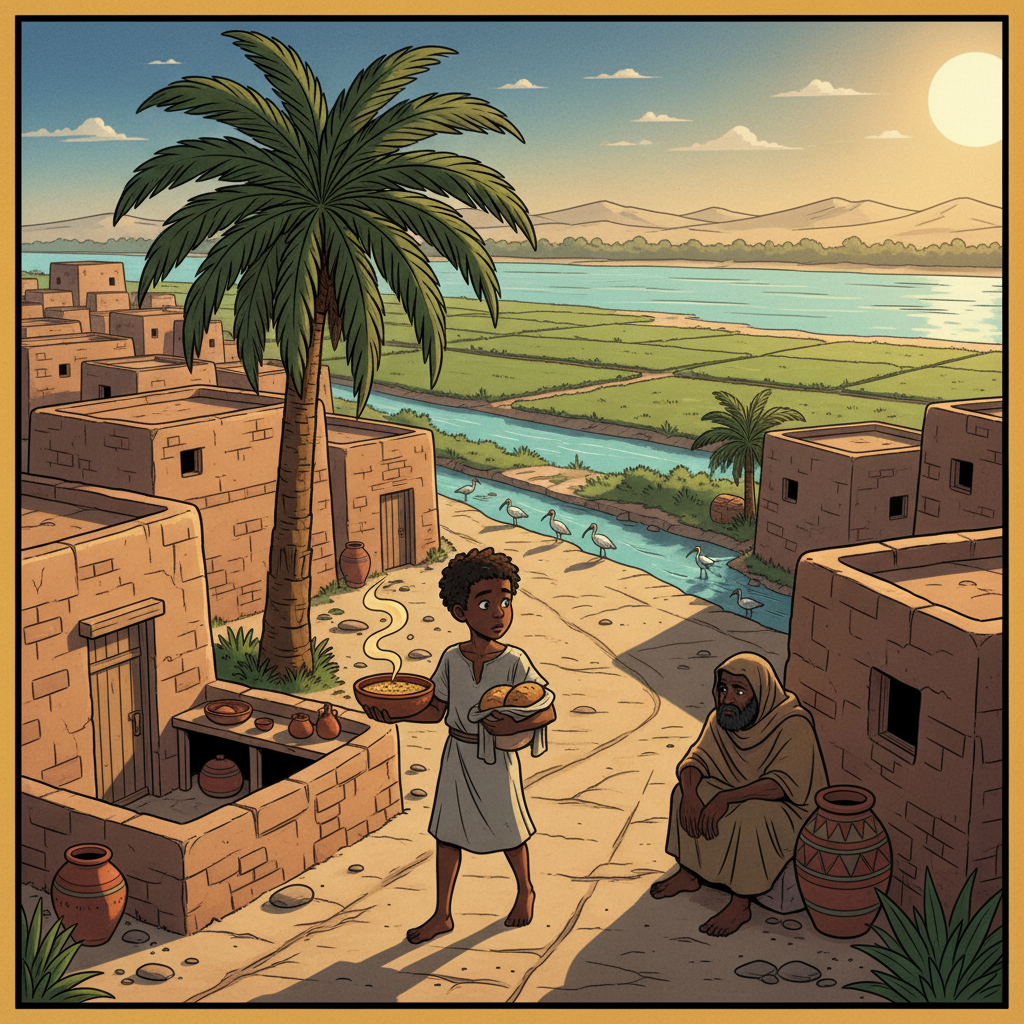
The sun hung high over the village of Ipet-Resyt, pouring golden heat across the mud-brick homes and the green ribbon of farmland that hugged the great Nile. Nkosi walked the dusty path from his mother's kitchen, carrying a clay bowl of lentil stew thick with onions and cumin, and two rounds of warm bread wrapped in cloth. The smell rose into the dry air and made his stomach tighten with hunger. He was heading to his favorite spot beneath the old sycamore tree near the irrigation canal, where he always ate his midday meal alone, watching the white ibis birds wade through the shallow water. But today, something made him stop. Near the village well, beneath the drooping fronds of a tall palm tree, sat a stranger — a man Nkosi had never seen before.
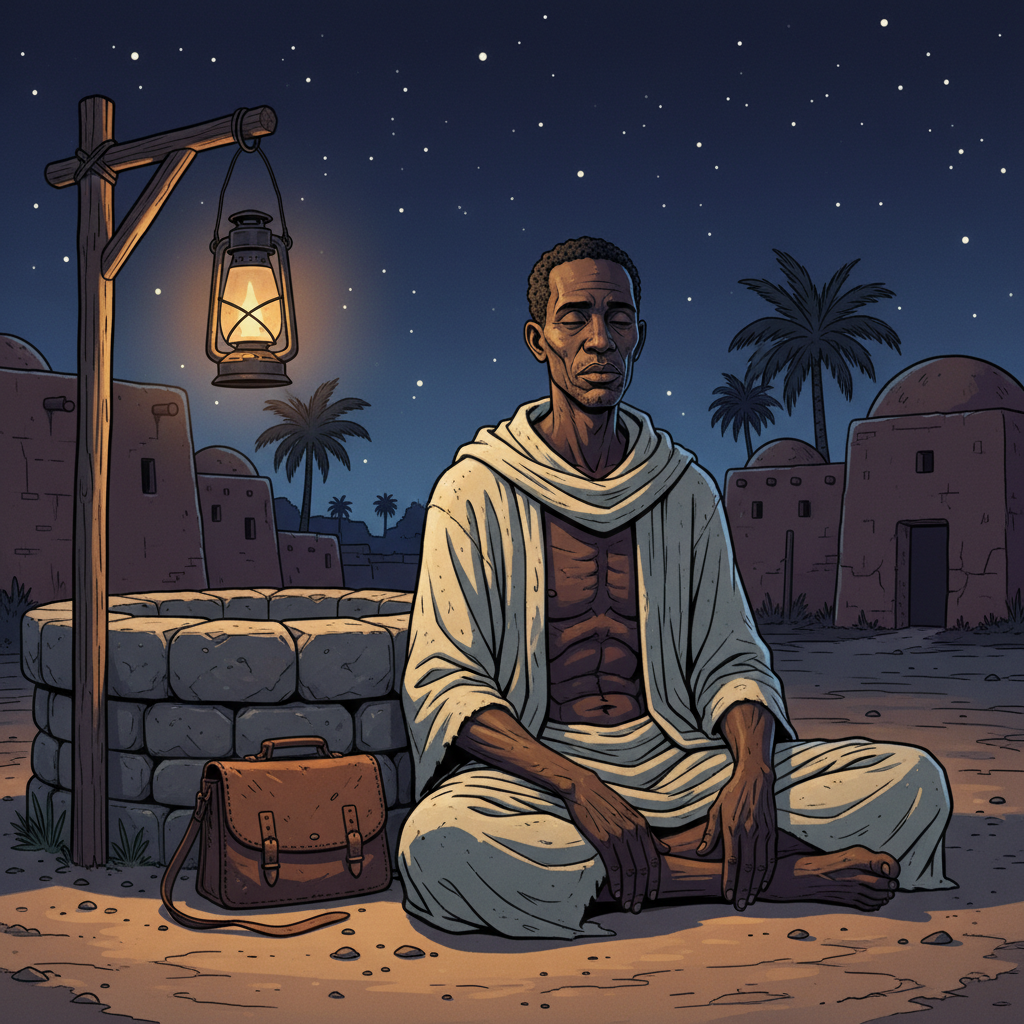
The stranger was tall even while sitting, with deep ebony skin that had been cracked and darkened further by weeks of brutal sun. His sandals were worn through to almost nothing. His robes, which might once have been white, were now the color of river dust. He sat perfectly still, his long hands resting on his knees, his eyes half-closed. A leather satchel, old and carefully stitched, leaned against the well beside him. Nkosi could see the man's ribs pressing against the thin fabric of his robe. The stranger had not eaten in a long time. His lips were dry and split. Yet he sat with a quiet dignity, not begging, not calling out — just waiting, as though he trusted that the world would eventually remember him.
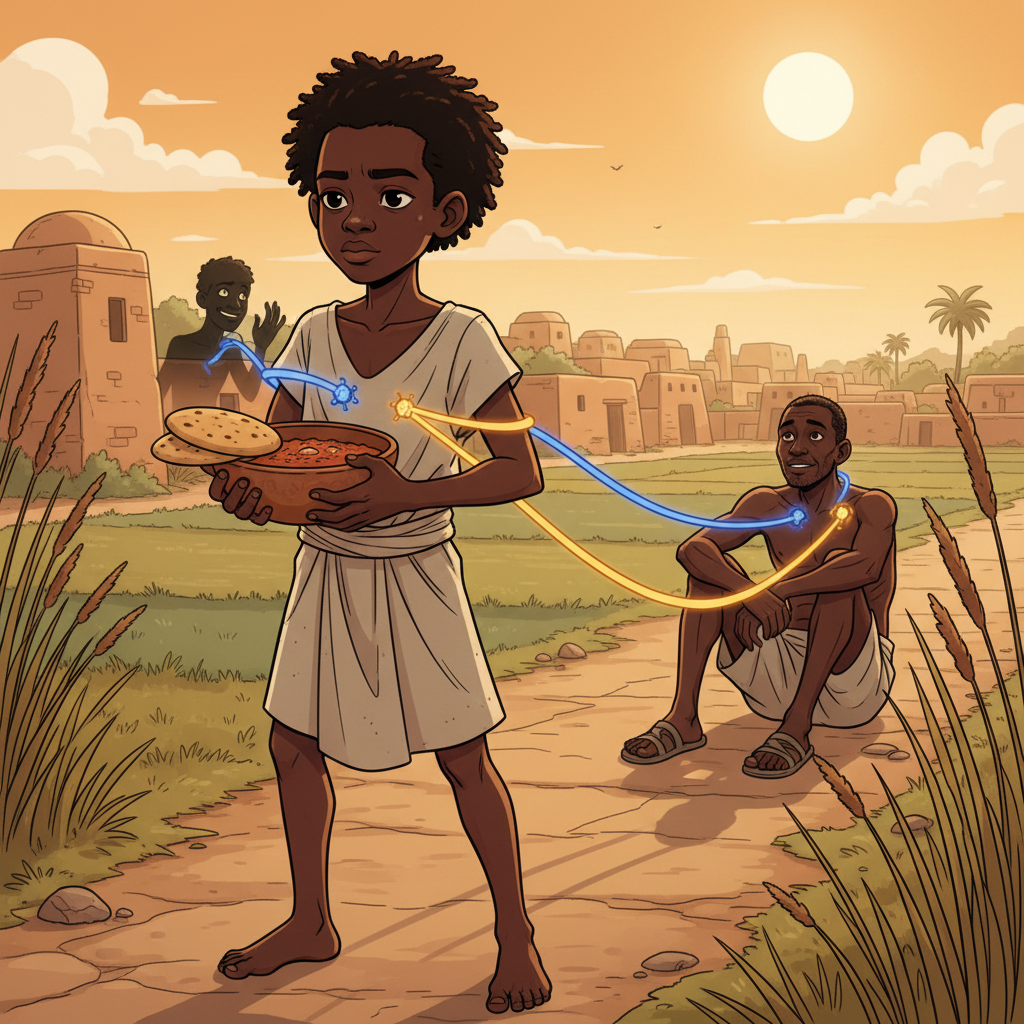
Nkosi was ten years old, dark-skinned and strong for his age, with sharp eyes and hands already calloused from helping his father in the fields. He stood on the path and felt two forces pulling at his chest like ropes in opposite directions. His stomach growled. The stew was his — his mother had ground the lentils herself that morning, had seasoned them with coriander and garlic, had told him to eat every bite so he would grow tall. A small voice inside him whispered: "Keep walking. He is not your family. He is not your problem. The food is yours and there is not enough to share." That voice was isfet — the force of selfishness and disorder that lives in every human heart, always pulling us away from what is right. Isfet never shouts. It reasons. It sounds perfectly logical. And that is what makes it dangerous.
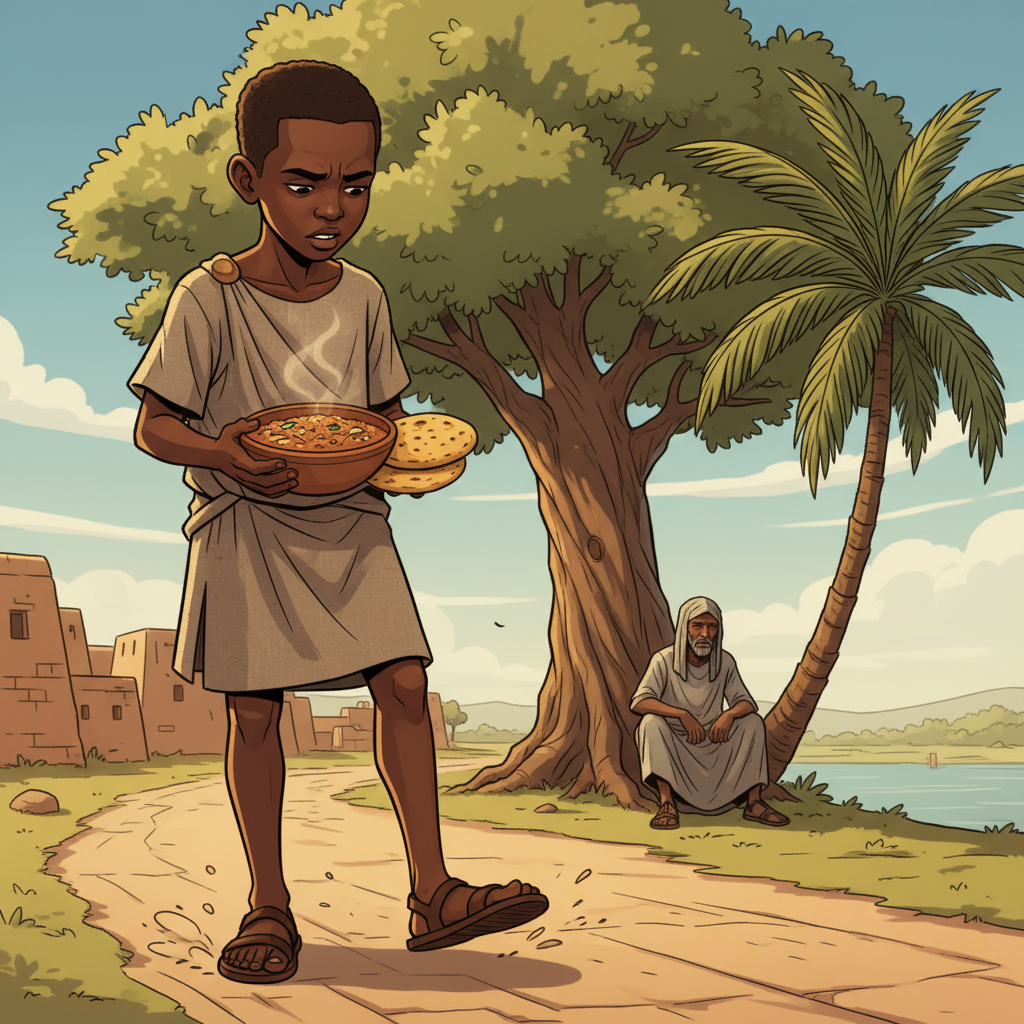
Nkosi took another step down the path toward the sycamore tree. But his feet felt heavy, as though the earth itself was holding him back. He thought of something his grandmother once told him when he was very small: "Your ka is not just your spirit, child. It is the part of you that knows right from wrong before your mind does. When your ka is troubled, stop and listen." His ka was troubled now. He could feel it — a tightness behind his ribs, a warmth in his face that was not from the sun. He looked down at the bowl of stew and the two rounds of bread. Then he looked back at the stranger beneath the palm tree. The man had not moved. He had not asked for anything. And somehow, that made it harder to walk away.
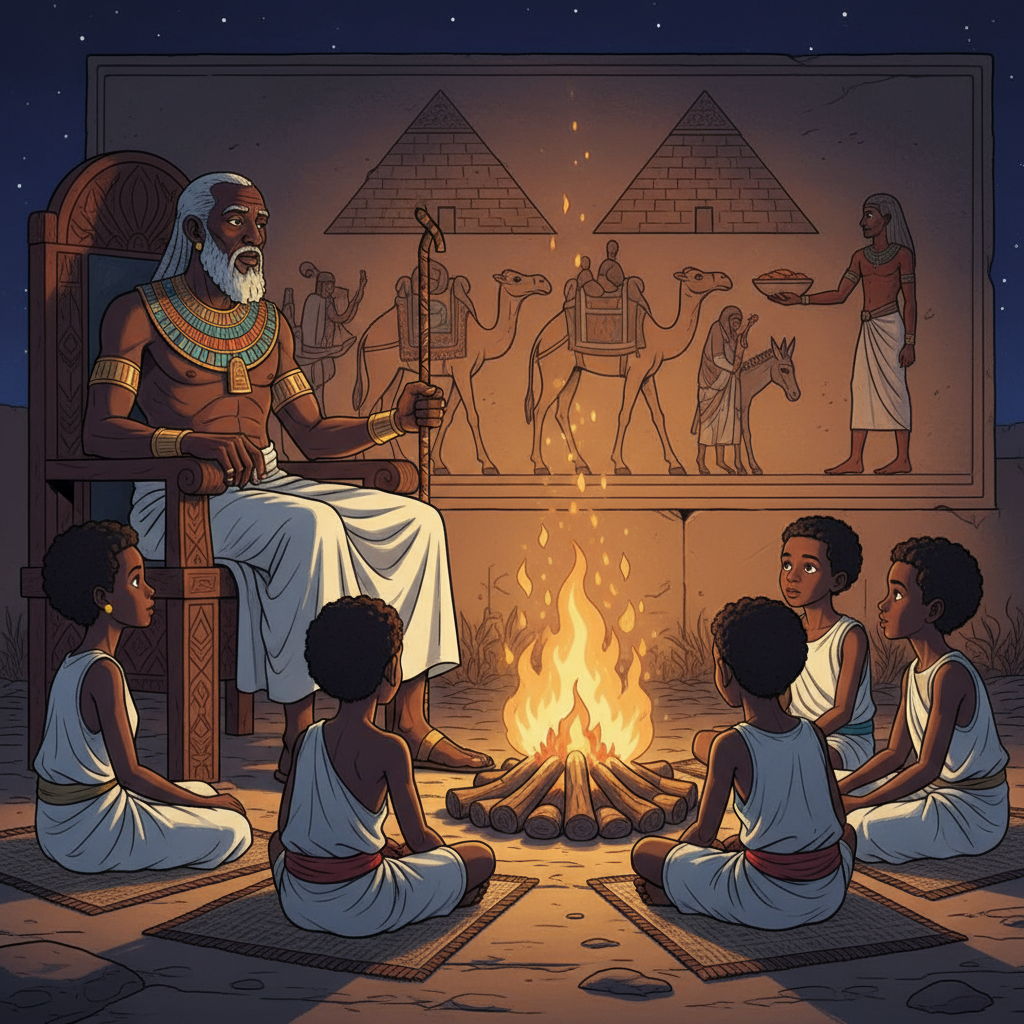
Nkosi remembered what his father always said during evening lessons by the fire: "In the way of Maat, every traveler is a guest. This is not just kindness, Nkosi — it is law. It is the oldest law. Our ancestors traveled freely across the land, from Kemet to Kush, from Kush to Punt, from Punt to the great forests to the west where the rivers run wider than the Nile itself. No borders stopped them. No one turned them away. And wherever they went, they were fed." His father would grow serious when he spoke of this. "The nations of our world were connected long before anyone wrote it down. Gold and salt and ivory moved north. Grain and linen and papyrus moved south. But the most important thing that moved between peoples was trust. And trust begins with a bowl of food offered to a stranger."
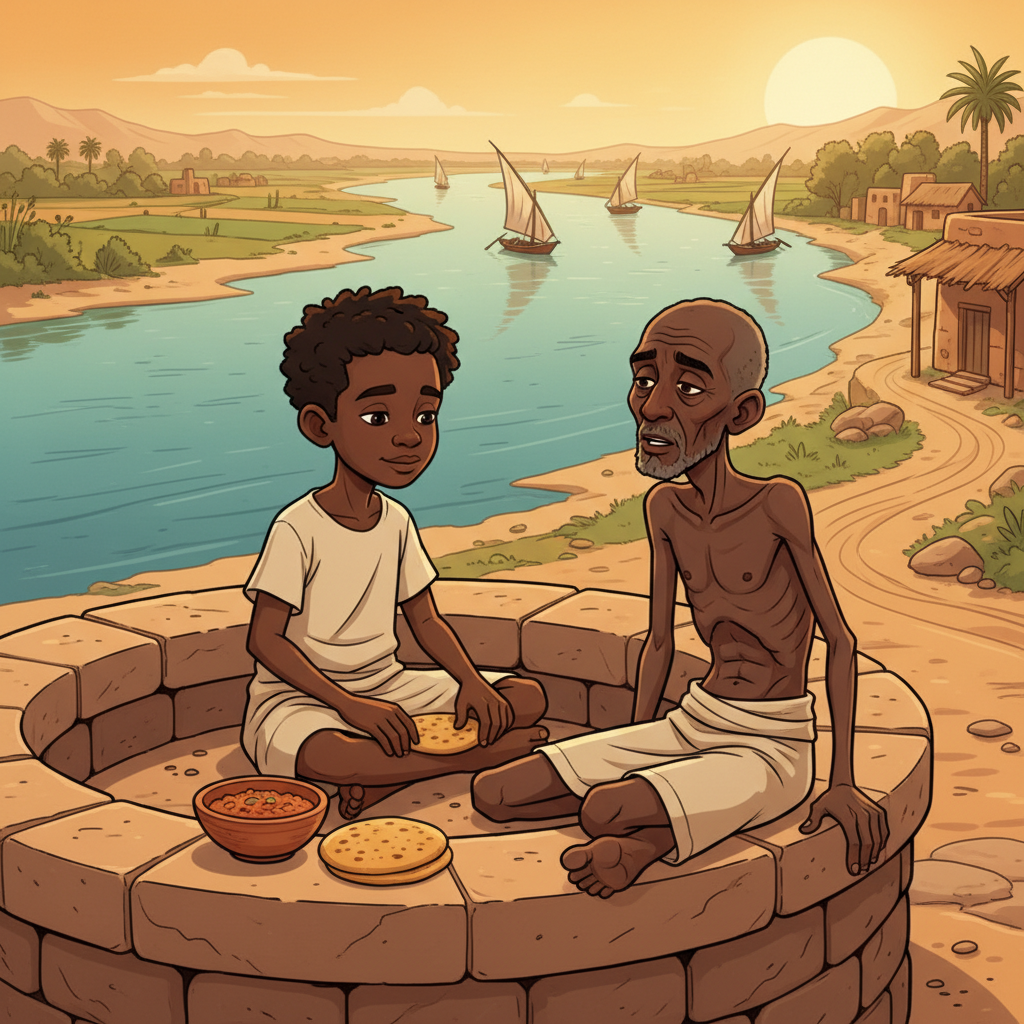
Nkosi turned around. He walked back toward the well, his heart beating fast, isfet still whispering that he was foolish, that he would be hungry all afternoon, that the stranger might be dangerous. But with each step, the whisper grew quieter, and something else grew stronger — a feeling of calm certainty, like the stillness of the Nile at dawn before the fishermen push out their boats. He sat down beside the stranger on the warm stone ledge of the well. The man opened his eyes slowly. They were deep brown, almost black, and filled with a weariness that Nkosi had never seen in anyone before — the weariness of a man who had walked a very, very long road. Nkosi divided his meal carefully in two, placing half the stew and one full round of bread on a clean stone. "Please eat, elder. You look like you have traveled far."
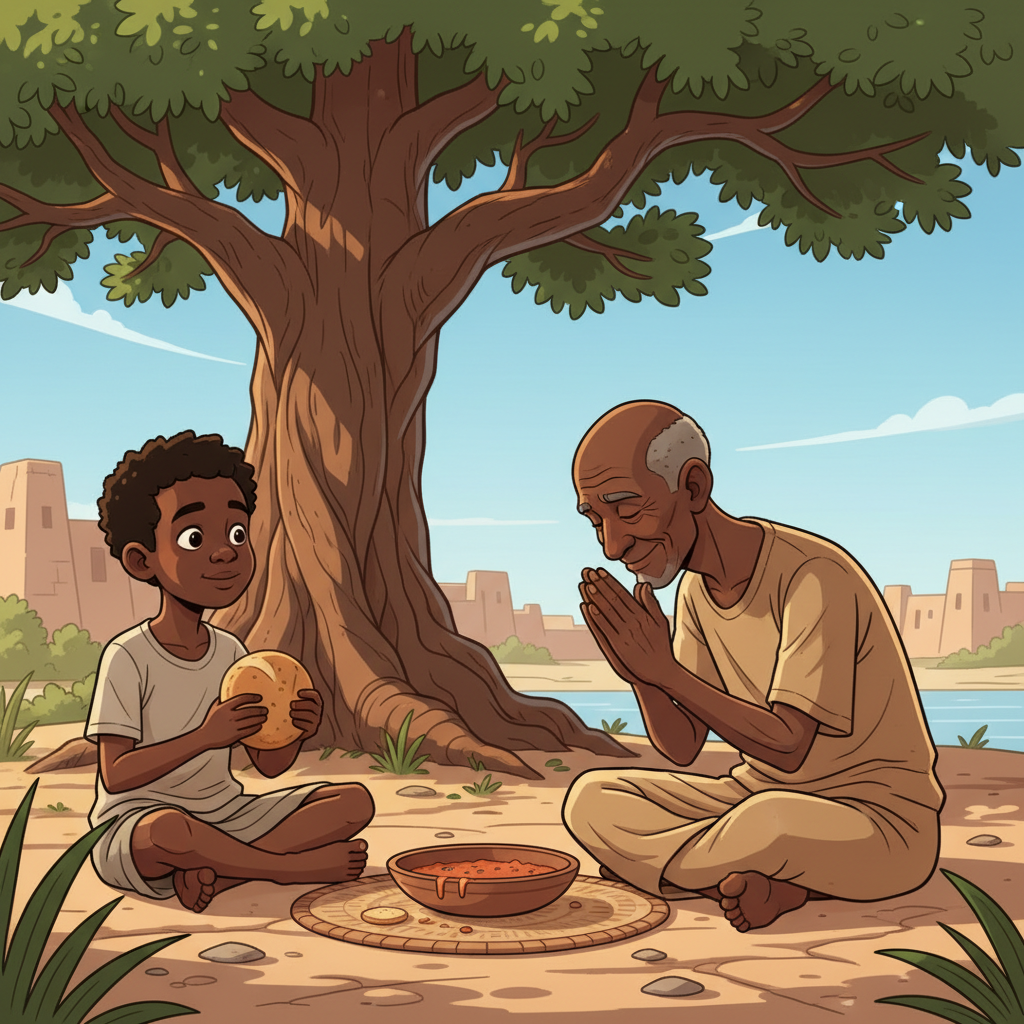
The stranger looked at the food, then at Nkosi. For a long moment he said nothing. Then he pressed his palms together and bowed his head — a gesture of deep thanks that Nkosi had seen elders use in ceremony. "May your ka be strengthened, young one," the man said quietly. His voice was low and rough, like stones rubbing together. He ate slowly, deliberately, savoring every bite as though each one was sacred. Nkosi ate his own half in silence, watching the stranger from the corner of his eye. The man tore the bread into small pieces and used each piece to scoop the lentil stew, wasting nothing — not a single drop, not a single crumb. When he finished, he closed his eyes and whispered something Nkosi could not hear. A prayer, perhaps, in a language from far away.
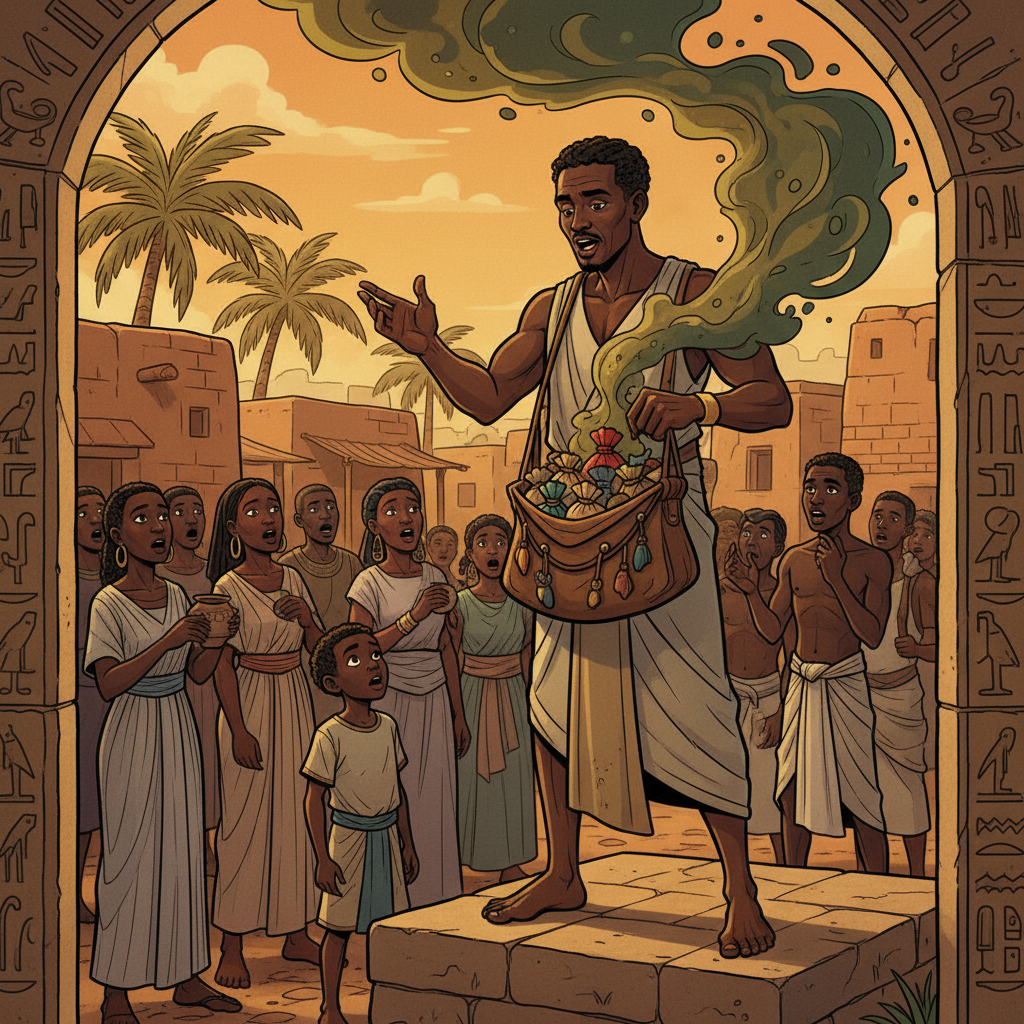
When the meal was finished, the stranger spoke. "I am Osei, a healer and keeper of plant knowledge from the kingdom of Wagadu, far south and west of Kush, where the great rivers fork through forests so thick the sunlight turns green before it reaches the ground." Nkosi's eyes went wide. He had heard traders speak of the lands beyond Kush, but he had never met anyone who had actually walked those distant roads. Osei opened his leather satchel carefully and revealed dozens of small pouches, each tied with colored thread. The smell that rose from the bag was extraordinary — sharp and sweet and earthy all at once, like nothing Nkosi had ever encountered. "I carry medicines your village healers have never seen," Osei said. "Remedies made from roots, bark, and leaves that do not grow along this part of the Nile. I have walked for two full moons to bring this knowledge north, as healers have done since the beginning of memory."
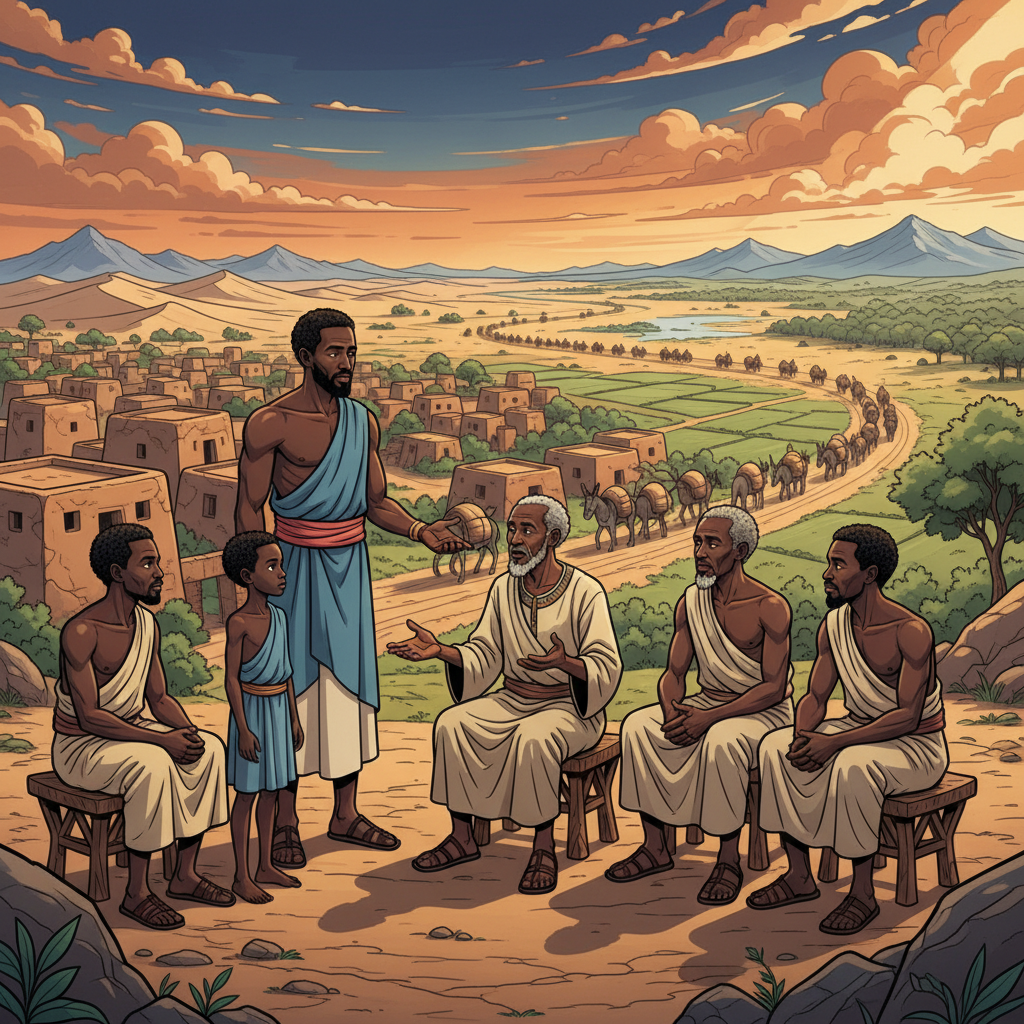
Nkosi brought Osei to his father, who brought him to the village council. The elders listened carefully as Osei explained his journey. He had followed the ancient trade roads — paths worn smooth by ten thousand years of footsteps, paths that connected the great civilizations of the African world long before any outsider knew they existed. Gold from Wagadu traveled north along these roads. Obsidian from the eastern highlands traveled west. Salt from the desert crossed south. And always, always, knowledge traveled in every direction. "Your people in Kemet have long understood heka — the sacred science of healing through words, ritual, and intention," Osei told the council. "My people have mastered the science of healing through plants. Alone, each tradition is powerful. Together, they could save lives that neither could save on its own." The elders looked at one another and nodded. Osei would stay.
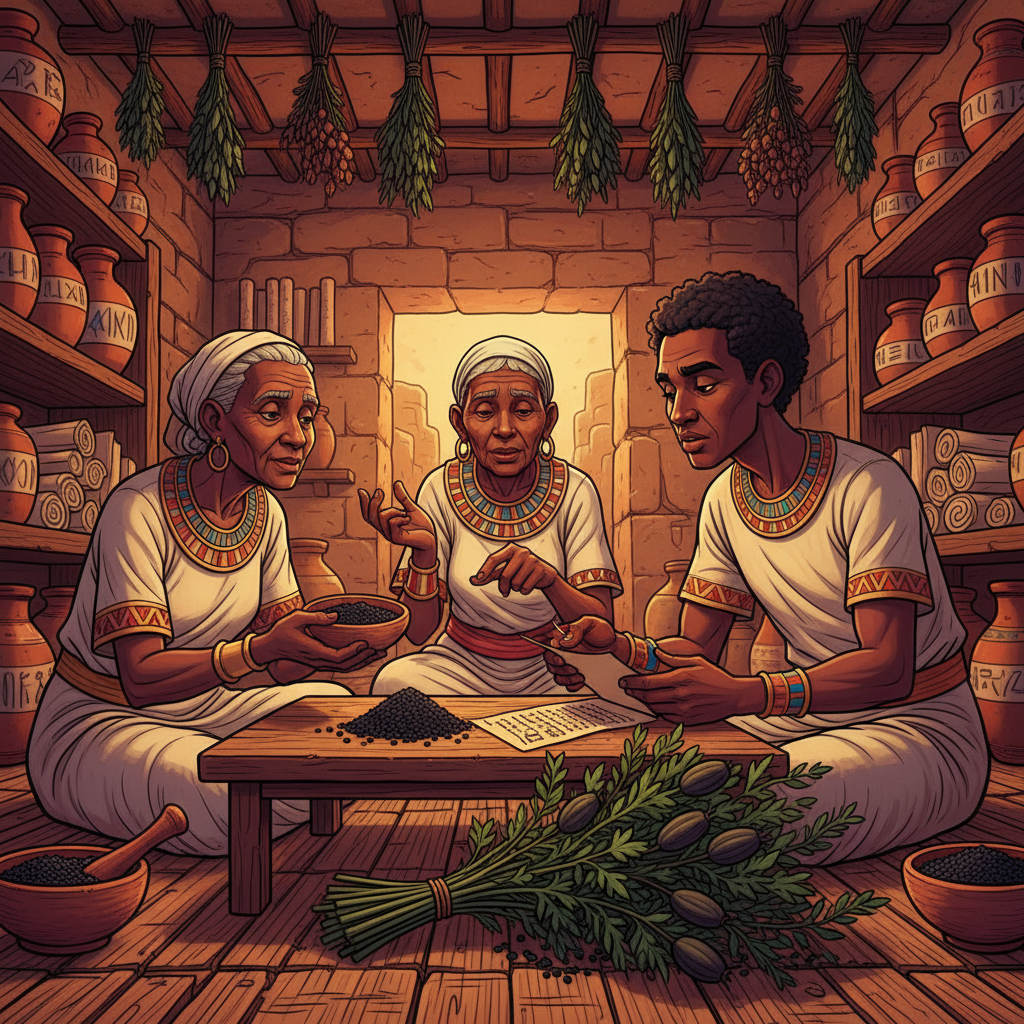
For one full moon, Osei worked alongside the village healers in the small mud-brick building they called the per ankh — the House of Life — where medicines were prepared and sacred texts were studied. The per ankh smelled of dried herbs and old papyrus. Its walls were lined with clay jars, each labeled in careful hieratic script. Here, knowledge was treated as something holy — not to be hoarded, but to be shared, expanded, and passed on. Osei showed the healers a bark that could bring down fevers that resisted every remedy they knew. He taught them about a root from the western forests that eased pain in the joints of elderly workers who spent their lives bending over crops. In return, the village healers taught him how to prepare medicines from the black seed plant, which grew abundantly along the Nile and which their tradition held could cure everything except death itself.
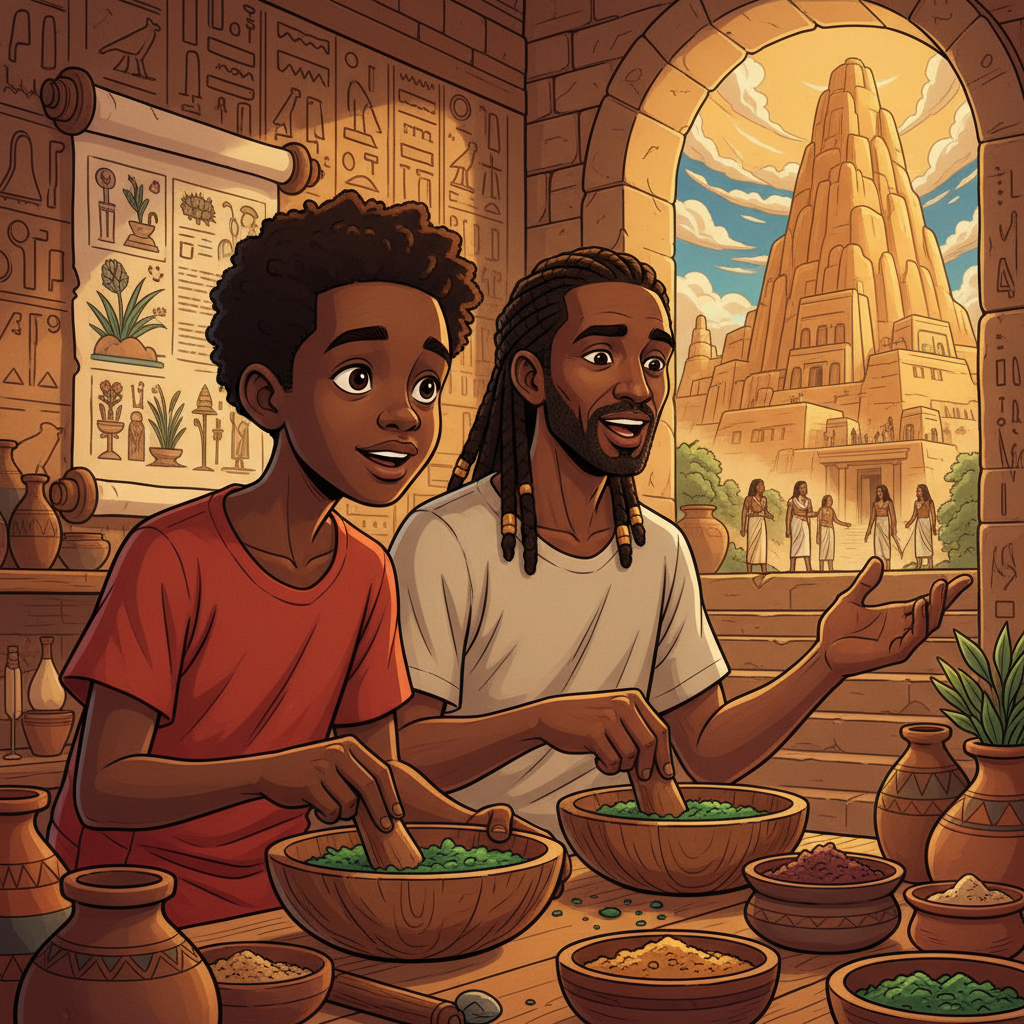
Nkosi watched all of this with fascination. He began spending every free hour at the per ankh, listening as Osei and the village healers compared their knowledge. He learned that the world was far larger and more connected than he had imagined. Osei told him about cities to the south where buildings were carved from single pieces of stone. He described markets where people who spoke twenty different languages traded side by side, understanding one another through gestures, trust, and the universal law of fair exchange. "People think the world was once divided, and that connection is something new," Osei told Nkosi one evening as they sat grinding dried herbs with stone pestles. "But that is a lie born from forgetting. The peoples of this land — from the northern sea to the southern cape — have been trading, teaching, marrying, and building together since before the first pyramid rose from the sand. Your blood and mine are not as separate as you might think."
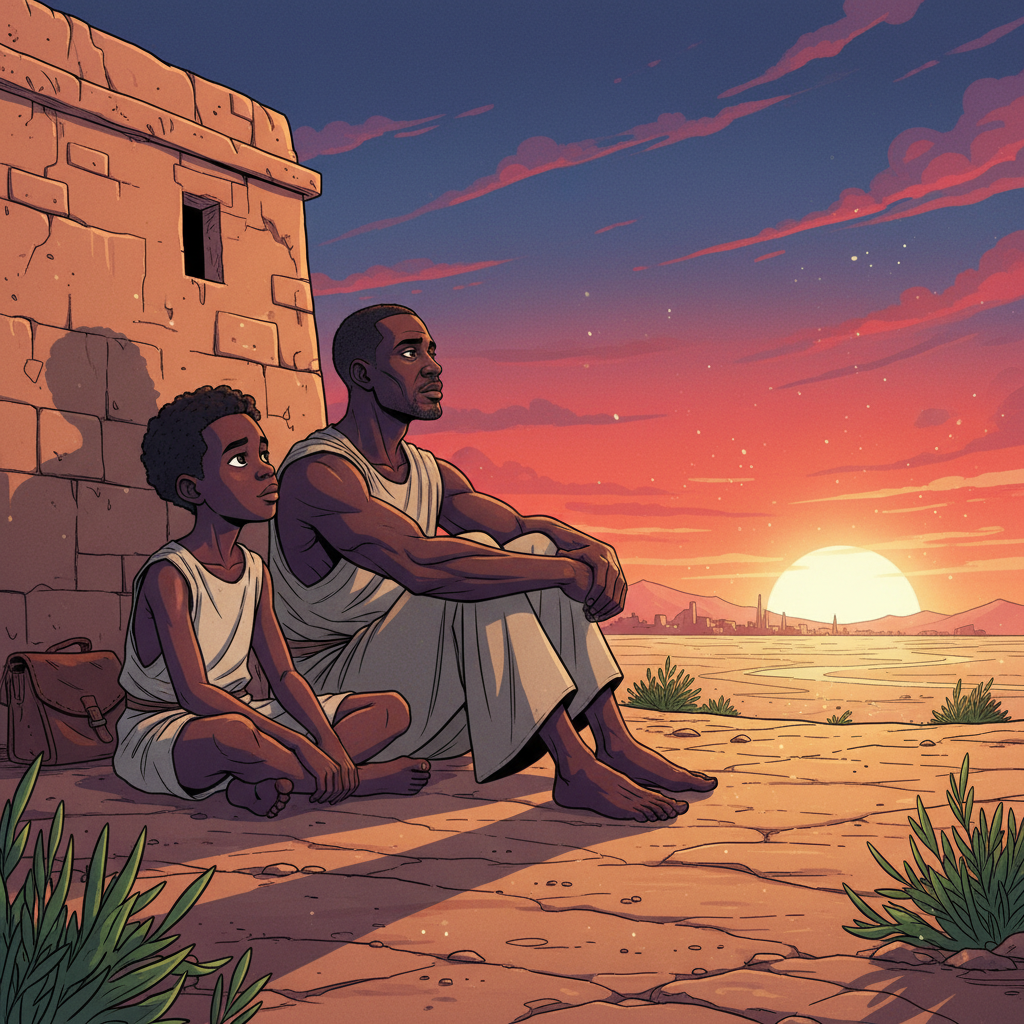
One afternoon, Nkosi found Osei sitting alone behind the per ankh, staring south toward the horizon with a heaviness in his eyes. "Do you miss your home?" Nkosi asked quietly. Osei was still for a long time. Then he said, "Every day. I have a son about your age. His name is Kofi. When I left, he asked me why I had to go. I told him: because knowledge that stays in one place grows stale, like water that does not flow. A healer who never shares what he knows is no healer at all." Nkosi sat beside him in silence. He thought about what it would feel like if his own father left for two moons to help strangers in a distant village. He understood now that Osei's journey was not just travel — it was sacrifice. It was maat in action: putting the good of many above the comfort of one. The same choice Nkosi had made with his bowl of stew, but on a scale he was only beginning to understand.
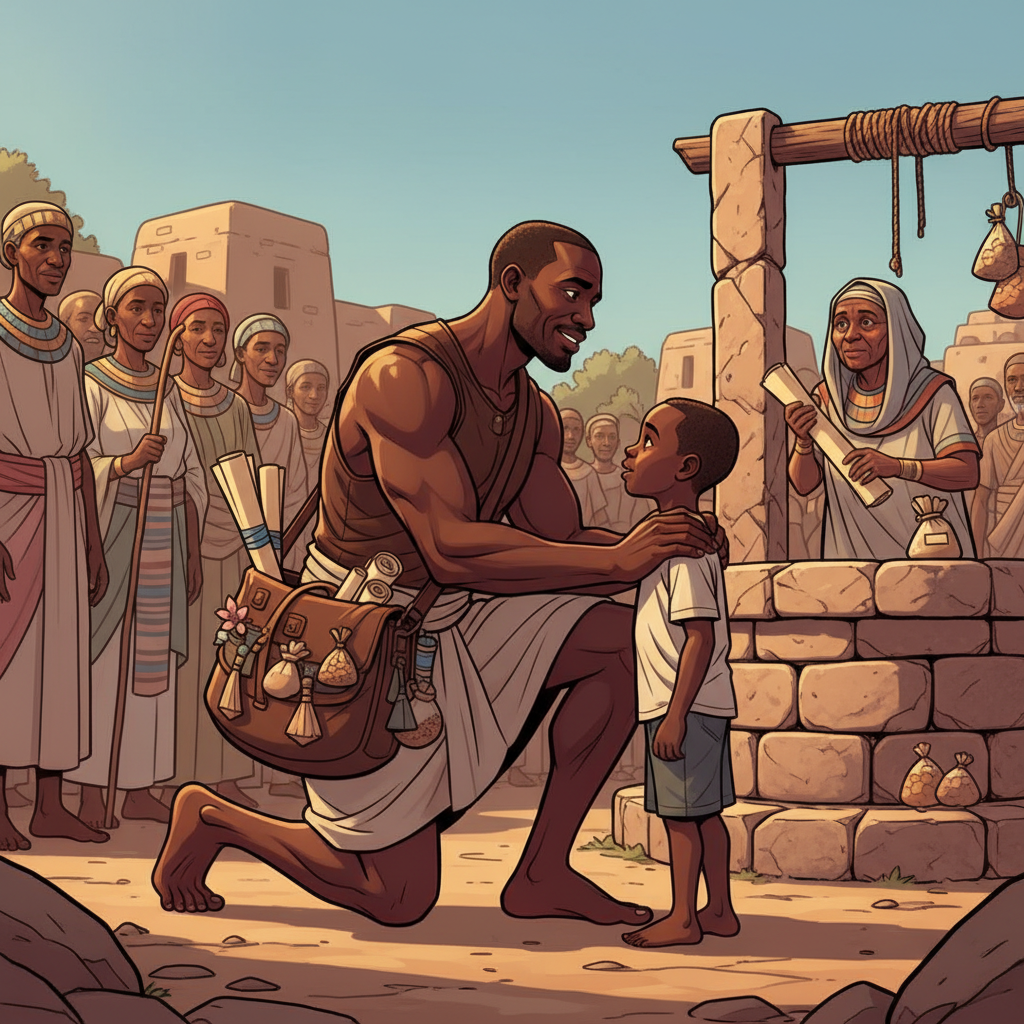
On the morning Osei prepared to leave, the entire village gathered at the well where Nkosi had first found him. The elders presented him with a roll of papyrus containing their own healing formulas, carefully copied by the best scribe in the village. The head healer gave him pouches of black seed and dried Nile lotus. Osei's leather satchel, which had arrived nearly empty, was now full of new knowledge to carry home to Wagadu. Osei knelt before Nkosi so that their eyes were level. The morning sun caught the rich dark brown of the healer's face, and Nkosi saw that the weariness he had noticed that first day was gone. In its place was something warm and steady. "You chose maat when isfet told you to walk past a hungry stranger," Osei said. "Because of your one small act of generosity, both our peoples are now wiser. Never forget that. The biggest changes in this world have always started with someone choosing to share what they have."
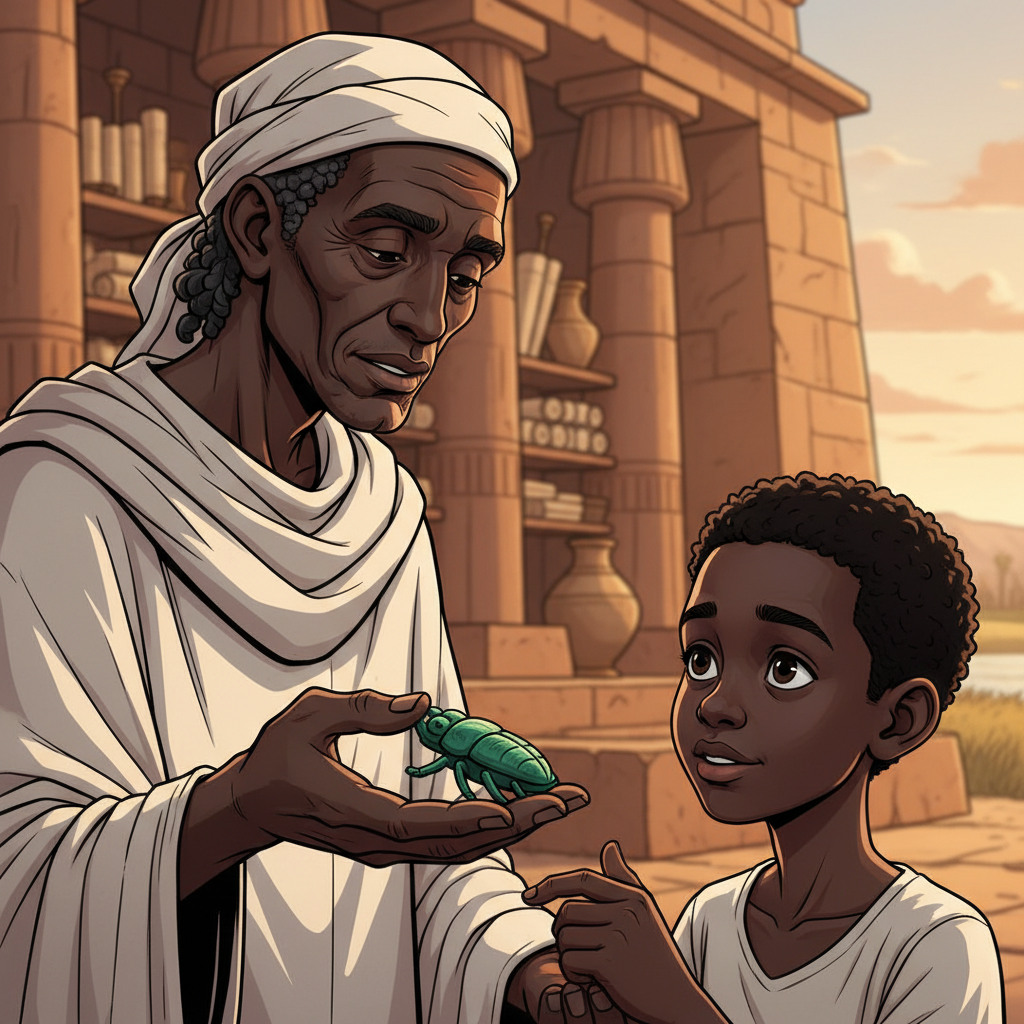
Osei reached into his robe and brought out a small scarab carved from green stone — the kind of deep, living green that Nkosi had only seen in the young papyrus reeds after the river's flood. The scarab was smooth and cool in his palm, and so finely carved that Nkosi could see each tiny leg, each ridge on its back. "The scarab pushes its ball of earth across the ground each day, just as the sun crosses the sky," Osei said. "It reminds us that even the smallest creature can move the world forward. Let this remind you, Nkosi: what you give freely always returns, multiplied." Nkosi held the scarab tightly and watched Osei walk south along the river road, his leather satchel swaying with each step. He watched until the healer was a small dark figure against the golden land, and then until he was gone. But the knowledge Osei left behind would remain in the village for generations — written on papyrus, memorized by healers, and carried forward like a flame passed from torch to torch.
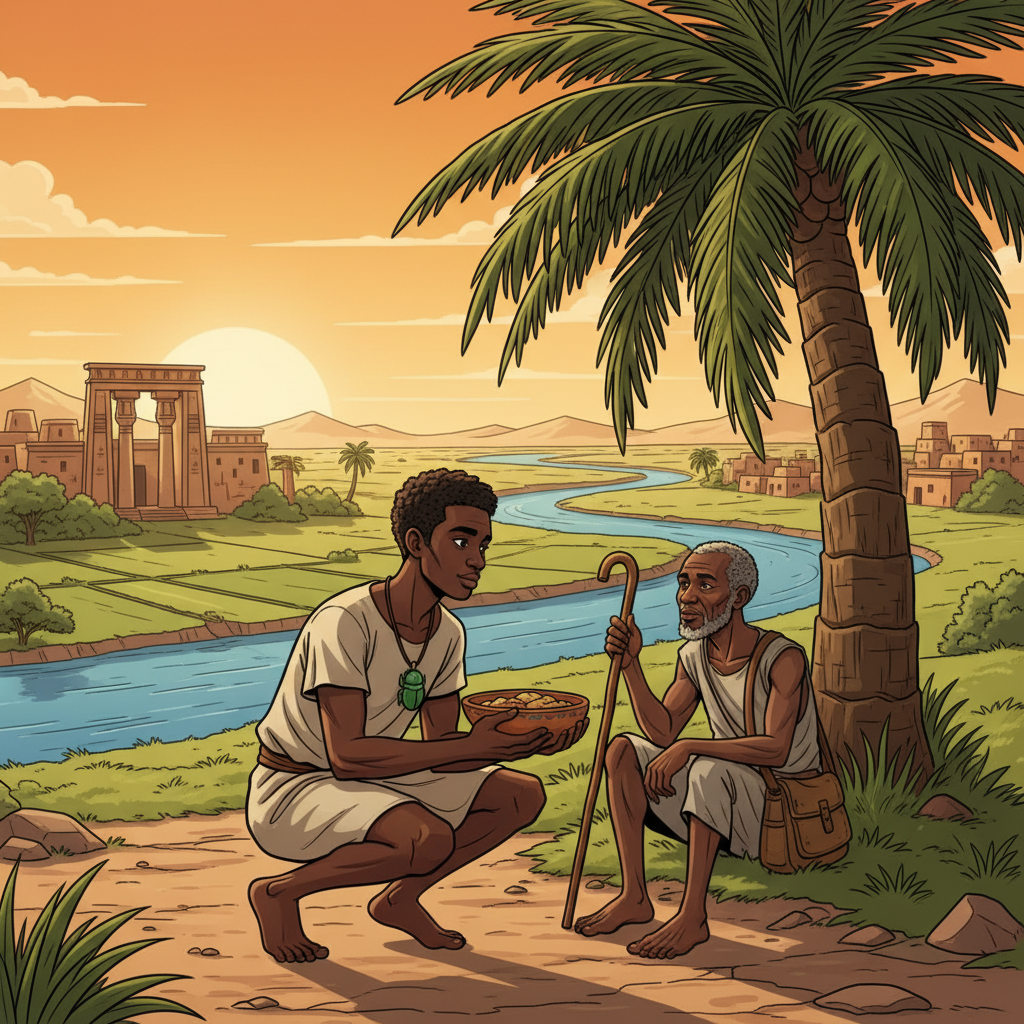
In the years that followed, Nkosi grew into a young healer himself, trained in the per ankh by the very teachers Osei had worked alongside. He never forgot what he learned that day by the well — that maat is not just an idea spoken about in temples. It is a practice. It is the decision you make when no one is watching, when isfet whispers that you owe the world nothing, when it would be so easy to simply walk past. The ancient African world was held together not by armies or walls, but by this sacred agreement: that knowledge should flow like the Nile, that strangers deserve dignity, and that generosity is the foundation of civilization itself. Nkosi kept the green scarab his whole life. And whenever he saw a traveler resting by the road, tired and hungry, he already knew what to do. He had learned it at ten years old, with a clay bowl of lentil stew, under a palm tree, in the way of Maat.