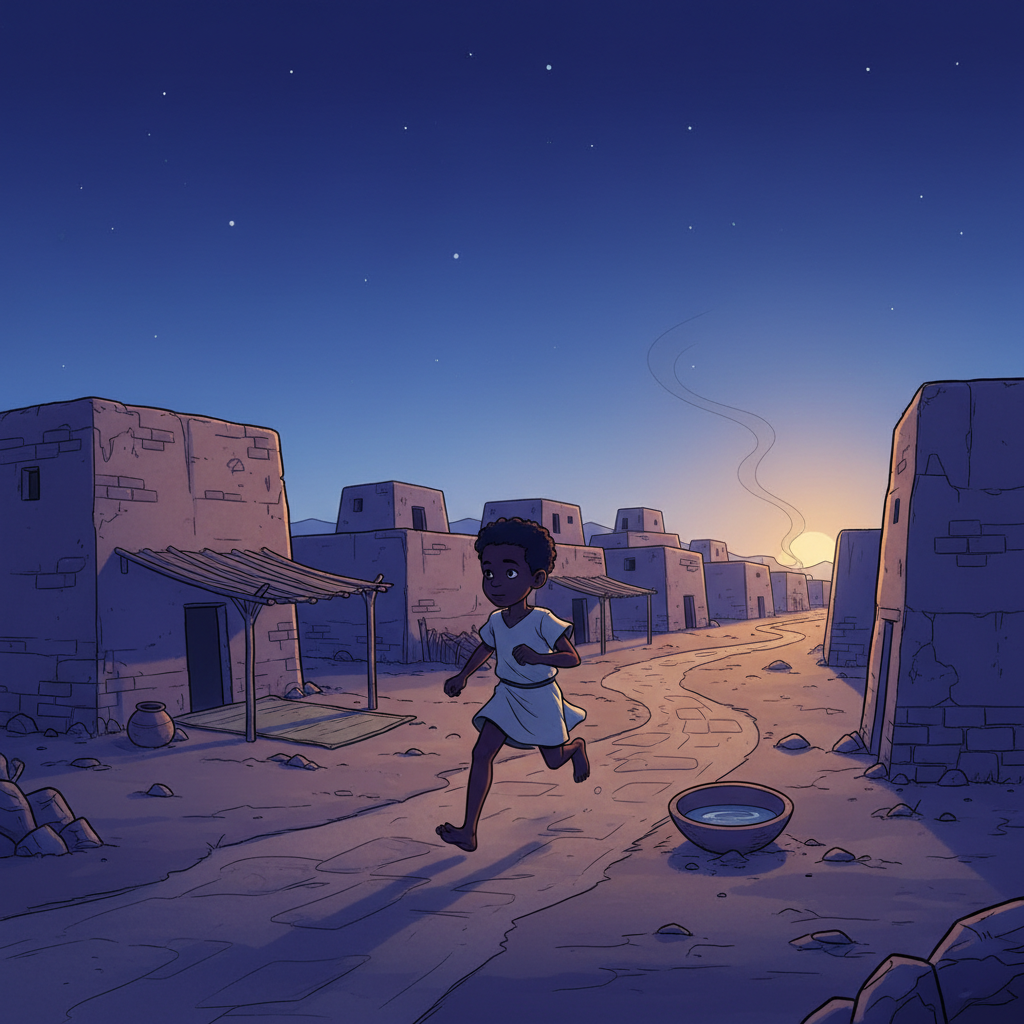
Every morning before the sun painted the sky gold, Tau jumped from his sleeping mat and splashed cool water on his face. He was only eight floods old, but his legs were fast and his heart was always racing toward one place. He ran barefoot down the dusty path between the mud-brick houses, feeling the cool earth beneath his feet. The village of Ipet-Isut was still wrapped in blue shadow, but Tau could already smell the smoke from Grandmother Khensa's cooking fire curling up into the fading stars.
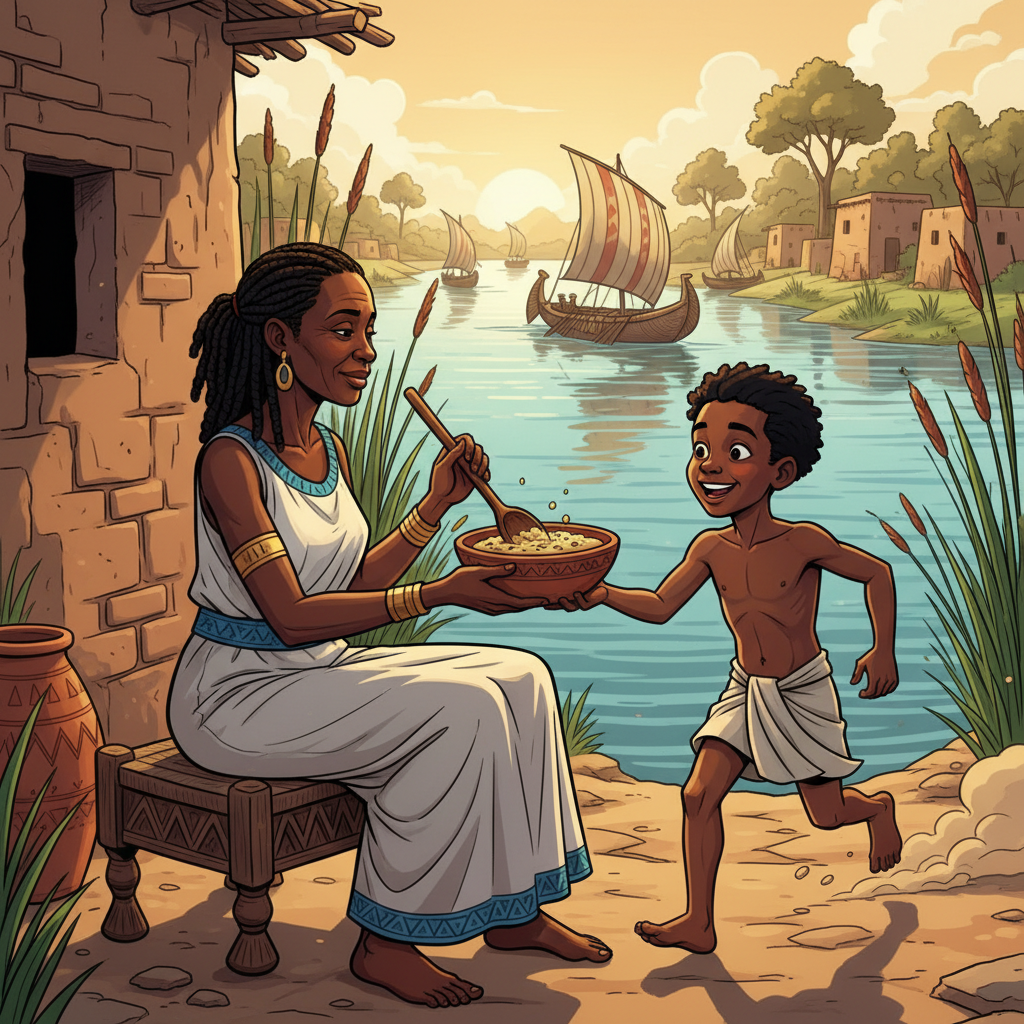
Khensa sat on her low wooden stool outside her door, stirring a pot of warm porridge with honey and sesame. Her skin was deep ebony, soft and lined like the bark of an ancient sycamore tree. She was the oldest person in all the village, and when she smiled, her whole face became a map of every story she had ever lived. "There you are, little river," she said, because Tau never walked anywhere — he always flowed fast, like water rushing over stones. She handed him a warm bowl and watched him eat with the hunger of a boy who had run the whole way. "Today we walk together. I will show you how Ma'at lives in small things."
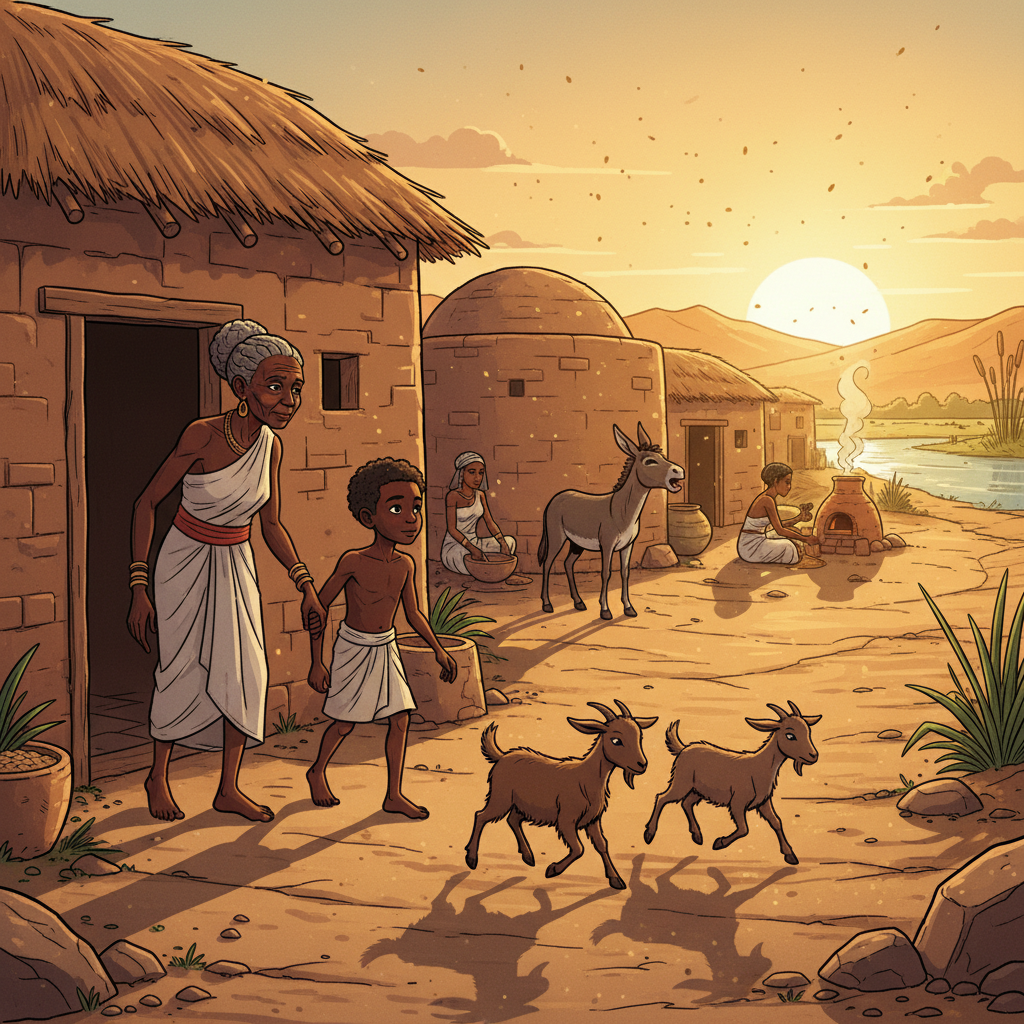
They stepped out together just as Ra's golden light broke over the eastern hills and poured across the rooftops like warm honey. The village was waking up all around them. Tau could hear the soft clucking of hens, the creak of wooden doors opening, and the gentle thump of women grinding grain in stone mortars. The air smelled of fresh bread baking in clay ovens and the sweet green scent of the river reeds. A donkey brayed somewhere behind the granary, and two small goats trotted across the path ahead of them, their little hooves clicking on the packed earth. Tau breathed it all in. The village felt alive, like one great body stretching and yawning awake.
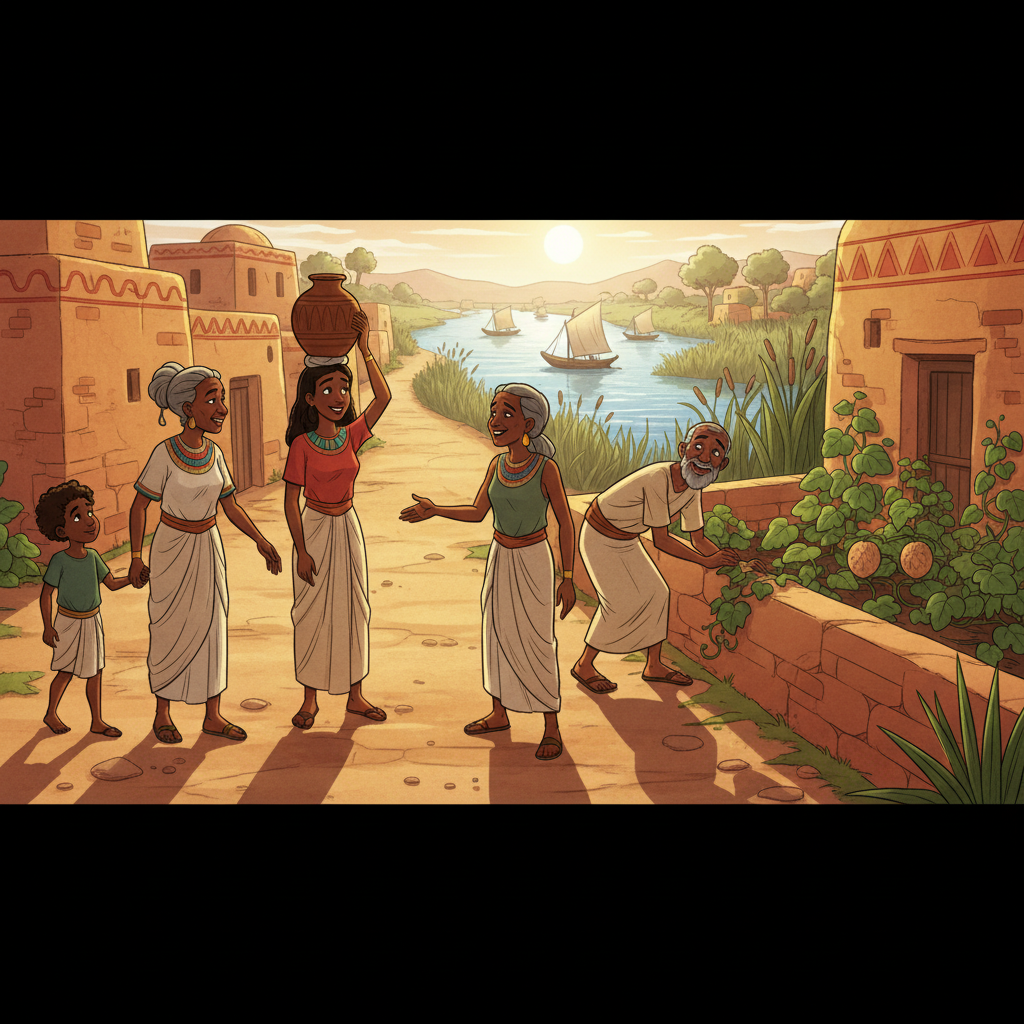
As they walked, Khensa greeted every single person they passed — and she called each one by name. "Good morning, Nefertari! How is your baby's tooth coming in?" she called to a young mother balancing a water jug on her head. "Djauti, that melon vine is looking strong!" she said to an old farmer bending over his garden wall. Tau noticed something wonderful. Every person Khensa greeted stood a little taller. Their eyes brightened, and their mouths curved into smiles, as if her words were small gifts she was handing out along the road. "Grandmother," Tau asked, "why do you remember everyone's name?" Khensa looked down at him with her warm, deep eyes. "Because Ma'at begins with seeing people, little river. Truly seeing them. When you say a person's name, you are telling their Ka — I know you are here. You matter."
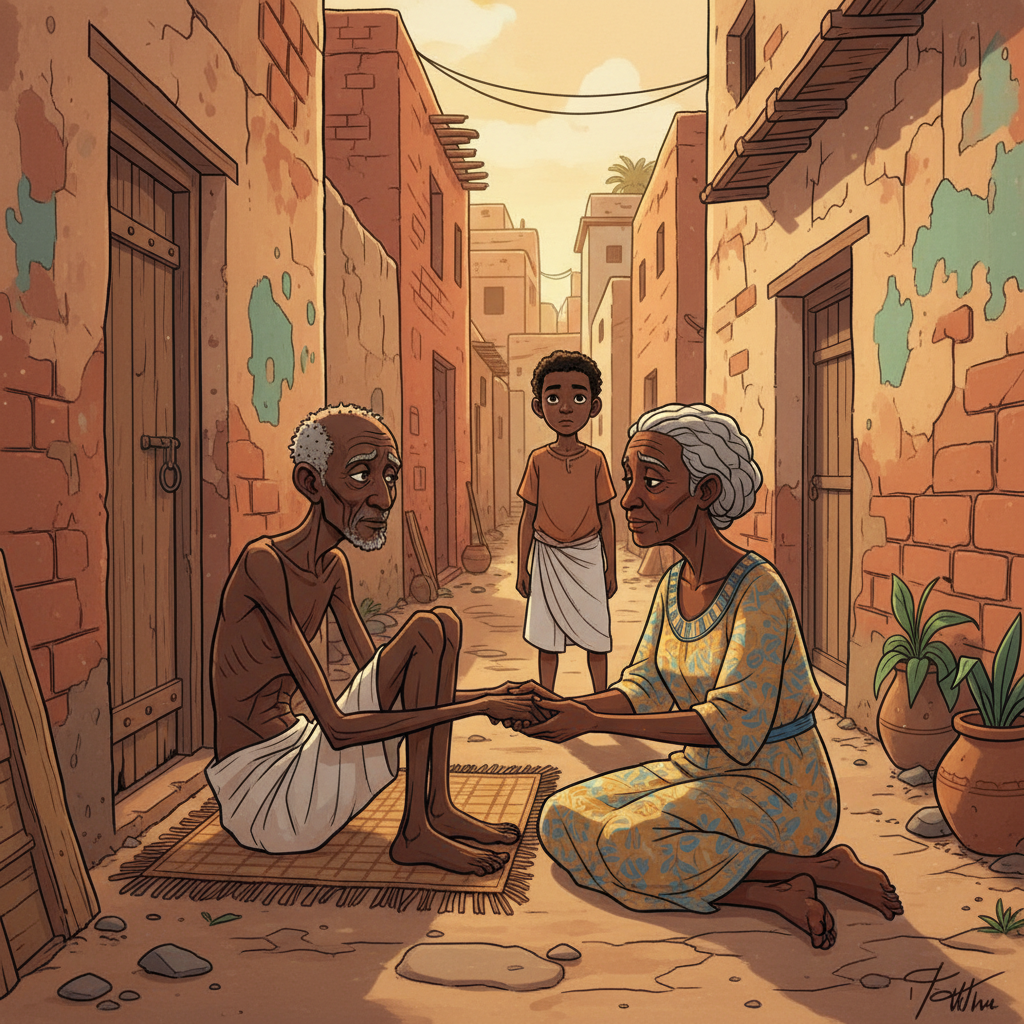
They turned down a quieter lane where the houses were older and the walls were cracked and faded. At the very end sat a man alone on a reed mat outside his door. His name was Mensah, and his dark brown skin hung loose on his thin frame. His children had moved far away to the great city of Waset, and his wife had joined the ancestors two floods ago. Khensa sat down right beside him on the dusty ground, even though her old knees creaked like a wooden gate. She took his hand in hers and simply held it. "Tell me about your morning, Mensah," she said softly. And Mensah, who had been staring at nothing with cloudy eyes, slowly began to talk. His voice was rusty at first, like a door that had not been opened in a long time, but then it grew warmer and steadier.
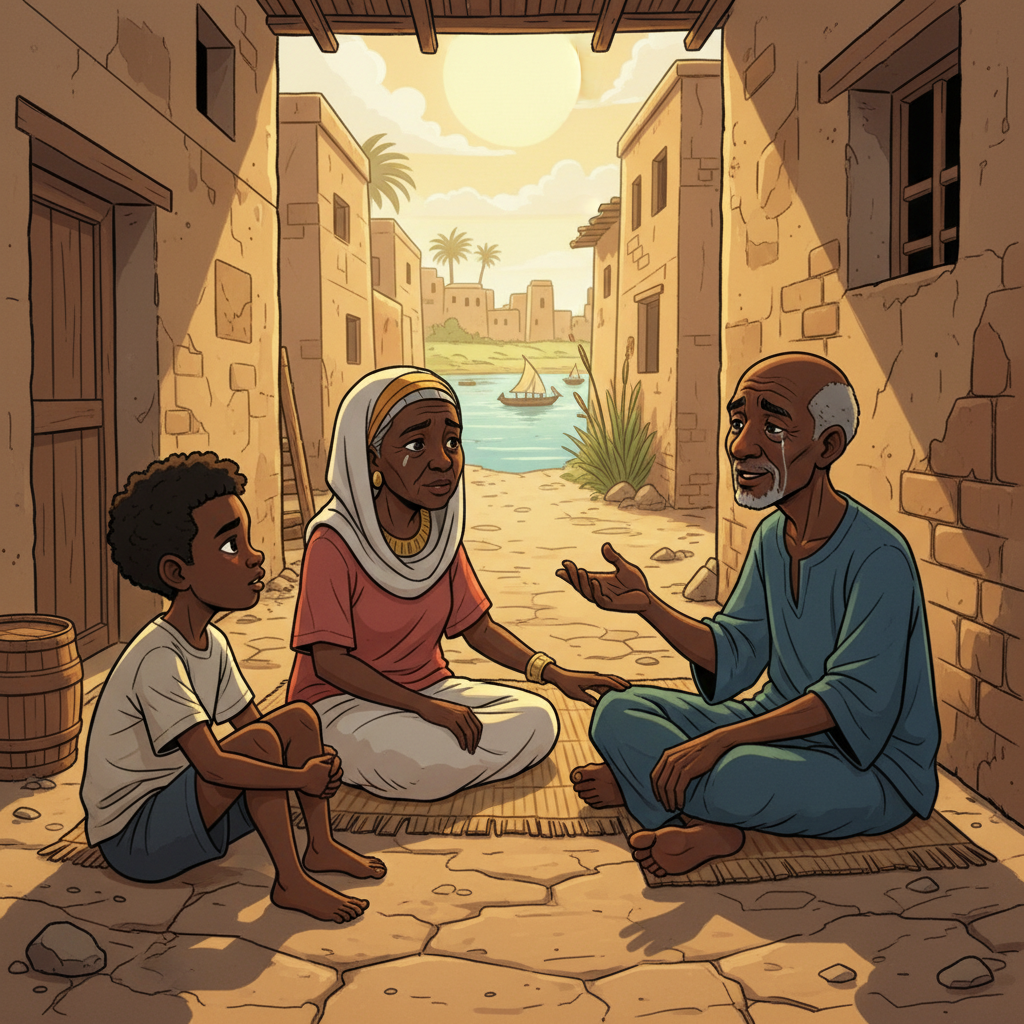
Tau sat cross-legged on the ground and listened. Mensah talked about a dream he'd had of his wife, and how the birds outside his window had sung a song that reminded him of her. His eyes grew wet, but he was smiling. Tau felt something squeeze inside his own chest — a feeling like his heart understood something his mind could not yet name. When they finally stood to leave, Mensah held Khensa's hand tightly and whispered, "Thank you for sitting with me." As they walked away, Khensa said quietly, "Remember this, Tau. Loneliness is Isfet's favorite weapon. It creeps in like cold water through a crack in the wall. But Ma'at is the hand that reaches out. Sometimes all a person needs is someone to sit beside them and listen."
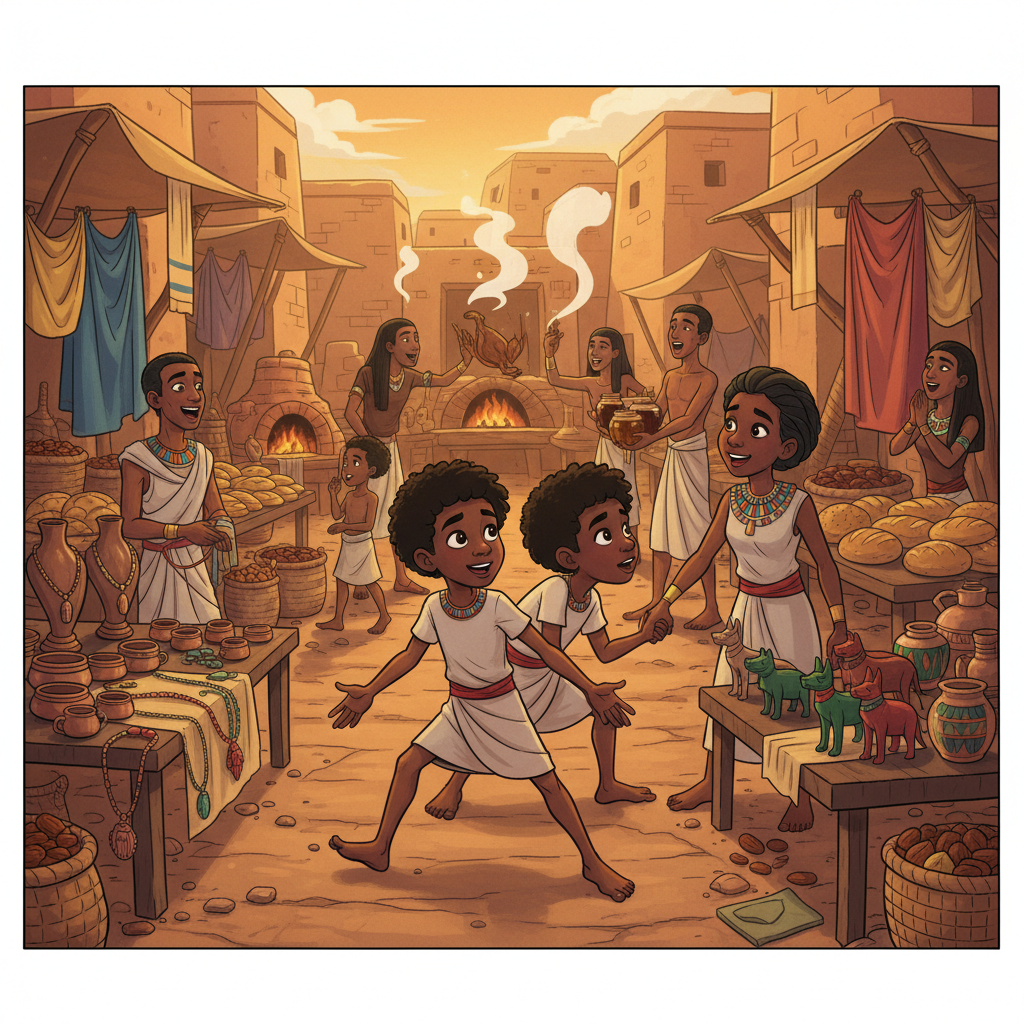
The market square was bursting with color and noise and life. Tau's eyes went wide. There were bright bolts of linen cloth dyed red and yellow, baskets overflowing with dates and figs, and tables stacked with golden loaves of bread. A woman was roasting duck over a fire, and the smell made Tau's stomach growl even though he had already eaten. Men called out their prices in loud, singing voices. Children darted between the stalls like little fish in a river. Tau felt the excitement buzzing through his body — he wanted to look at everything all at once. His mind jumped from the copper jewelry to the carved wooden animals to the jars of dark honey, and his feet kept pulling him in different directions.
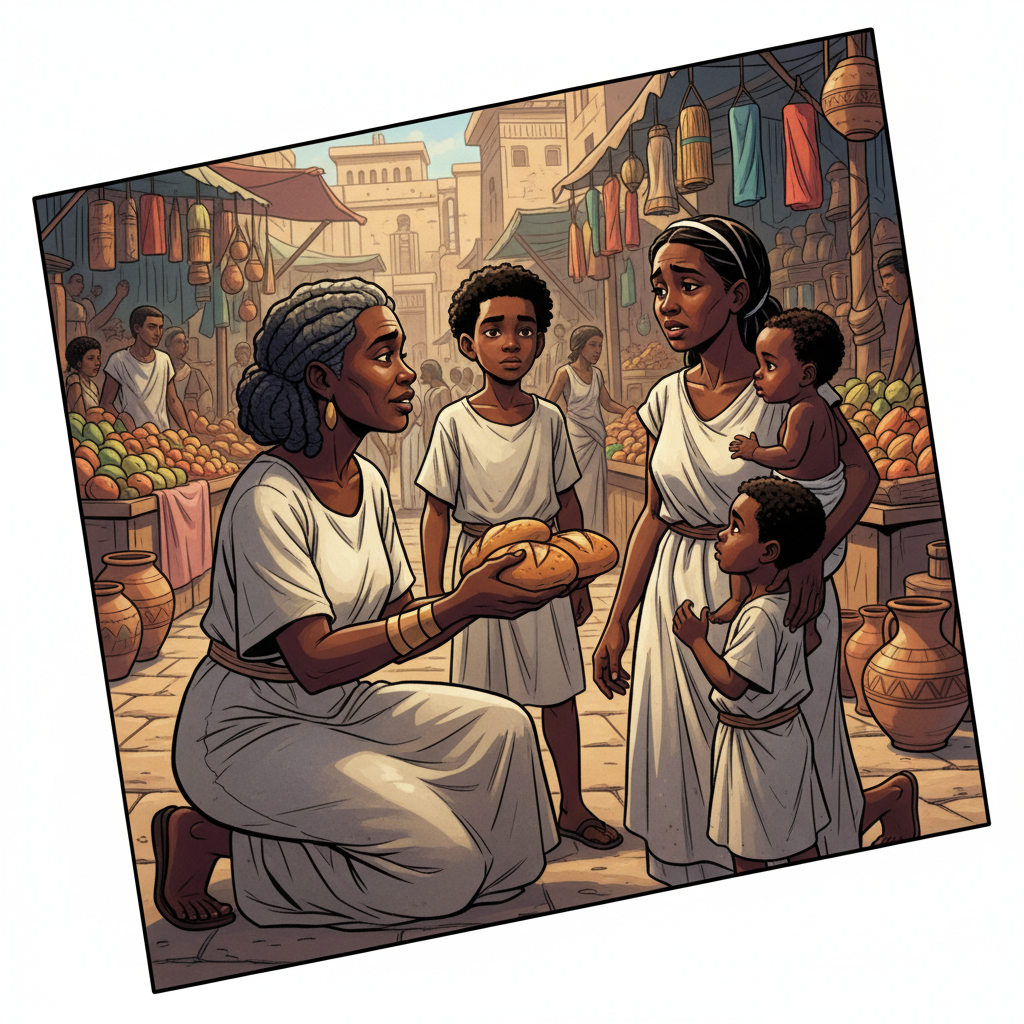
But Khensa moved through the market slowly and with purpose. She bought her usual things — oil, grain, and dried fish — and then she stopped at the bread stall and bought two extra loaves. Tau watched her tuck them into her basket. "Who are those for?" he asked. Khensa nodded toward the edge of the market where a young mother sat on the ground with a baby on her hip and a small boy pressed against her side. Their clothes were thin and dusty. The young mother's dark skin looked dull, and her eyes had the tired, faraway look of someone who had not eaten enough. Khensa walked over and knelt beside her. She did not make a speech. She simply placed the bread in the woman's hands and said, "For your little ones." The mother's lips trembled, and she whispered a blessing.
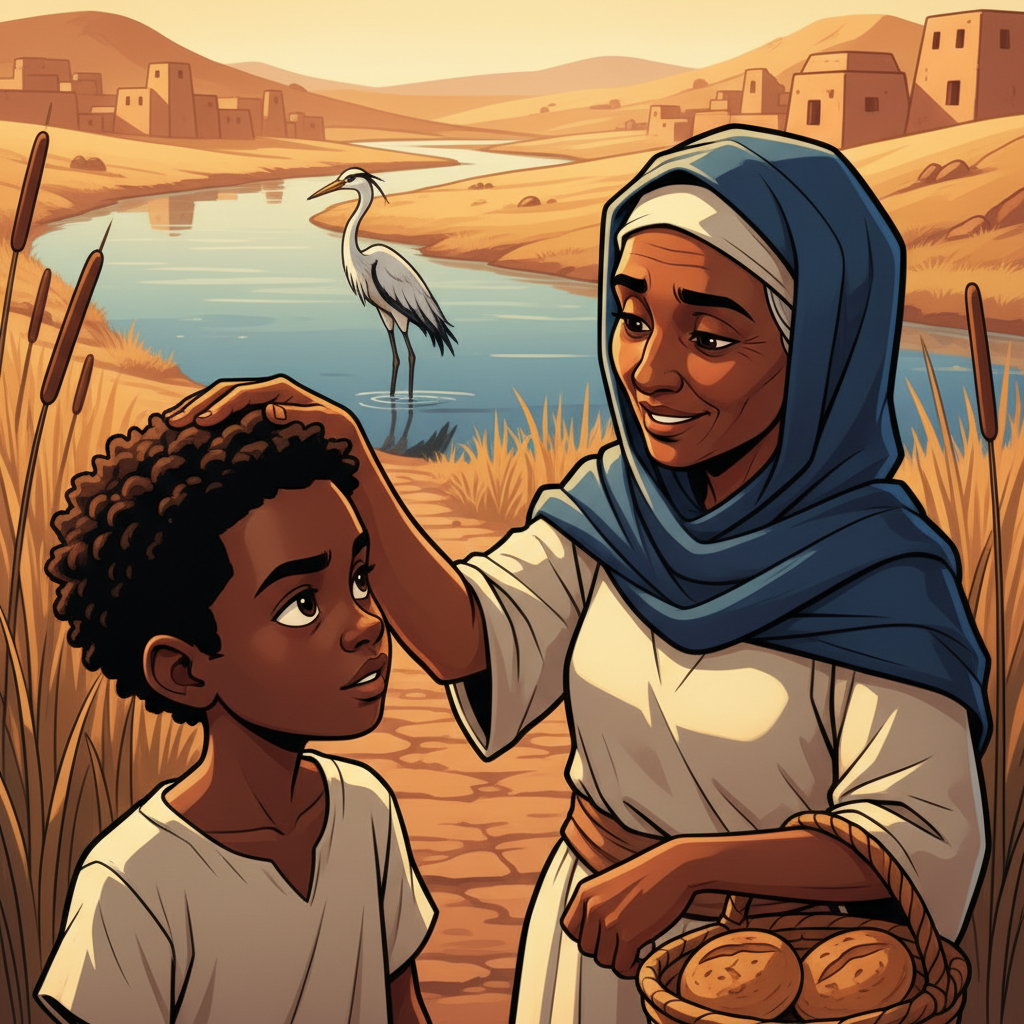
As they walked away from the market, Tau looked up at his grandmother. "Why didn't you give her the bread where everyone could see? Then other people might give her food too." Khensa shook her head gently. "Ma'at does not need an audience, little river. When you do a kind thing so that others will watch and praise you, the kindness becomes about you — not about the person you are helping." Tau thought about this carefully as they walked along the path by the river. He watched a crane standing perfectly still in the shallow water, patient and focused. "So real Ma'at is quiet?" he asked. Khensa smiled and touched the top of his head. "Real Ma'at is like that crane. It does not announce itself. It simply does what is needed, at the moment it is needed."
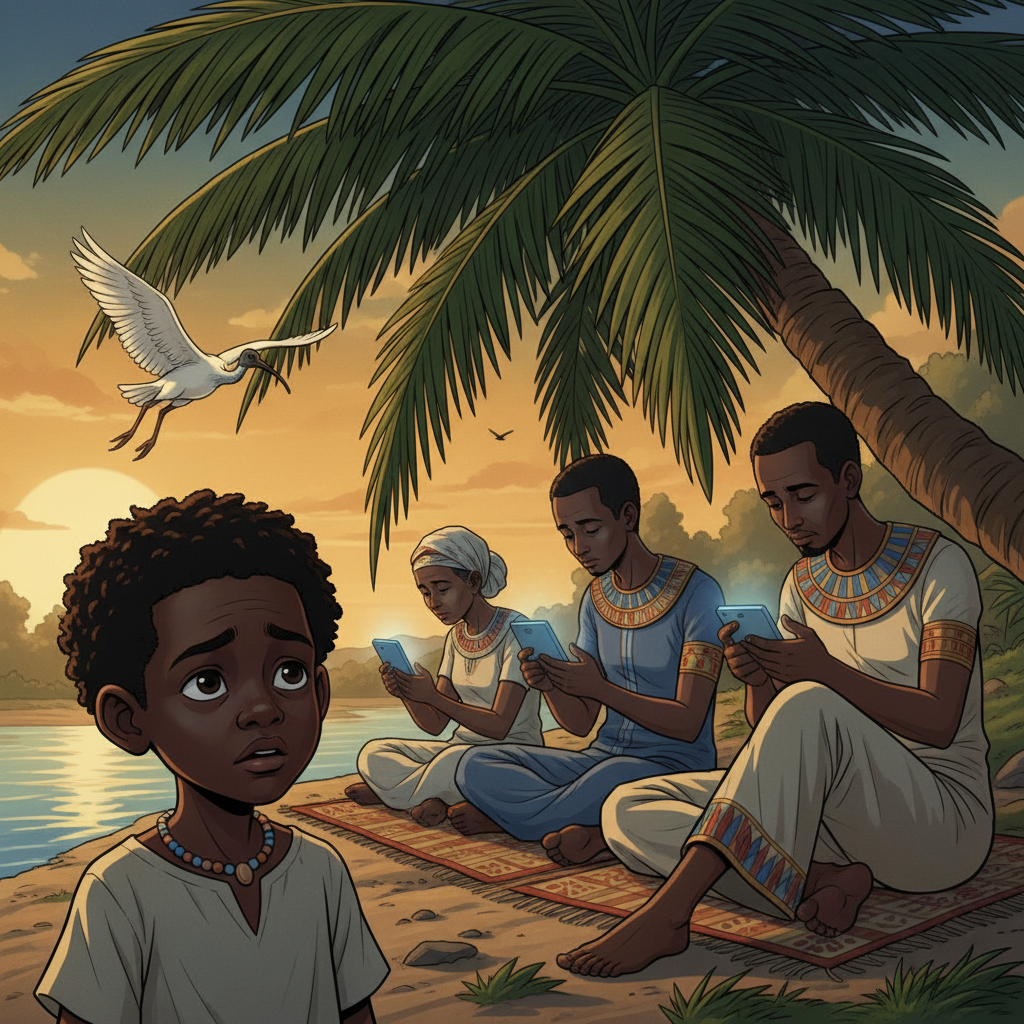
On their way home, they passed a group of travelers from the great city resting under a palm tree. Tau stared at them. Each one held a small glowing rectangle in their hands, and their faces were bent down toward the light. None of them were talking to each other. None of them looked up at the sky or the river or the beautiful ibis flying overhead. "Grandmother," Tau said slowly, "why do the city people stare at those little screens and never see each other? They are sitting so close together, but they look so far apart." He felt something uncomfortable in his belly, like watching something important breaking and not knowing how to fix it.
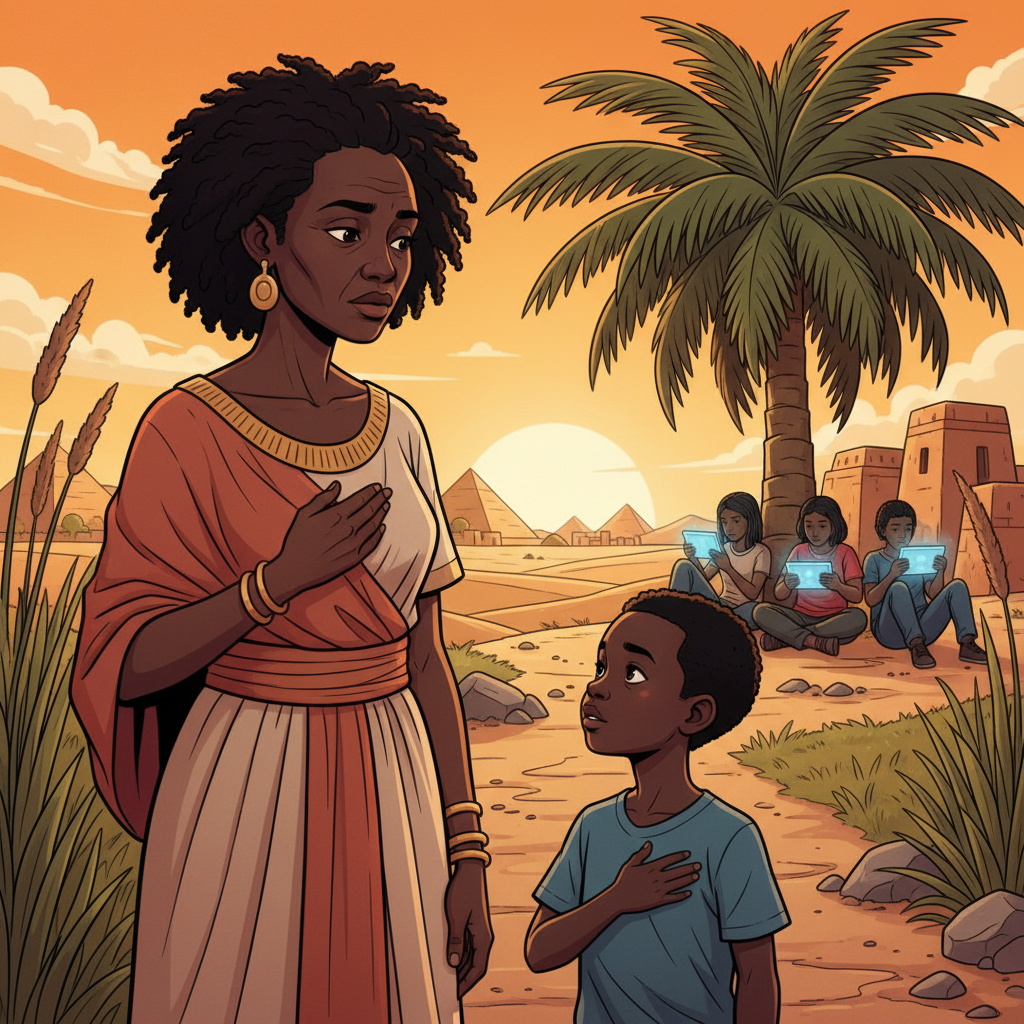
Khensa watched the travelers for a long moment, and her face grew serious but not angry. "Those bright screens are the new Isfet," she said quietly. "They are not evil by themselves — a tool is just a tool. But Isfet is clever. It does not always come roaring like a lion. Sometimes it comes whispering, pulling your eyes away from the people right beside you." She placed her hand over Tau's heart. "The bonds between people are like threads of linen, little river. Strong when they are woven together, but easy to snap one by one. When people stop seeing each other — stop saying each other's names, stop sitting together, stop listening — those threads break. And Isfet fills the empty space with loneliness and forgetting. That is why what we did today matters. Every greeting, every kindness, every moment of true seeing — it weaves the threads tighter."
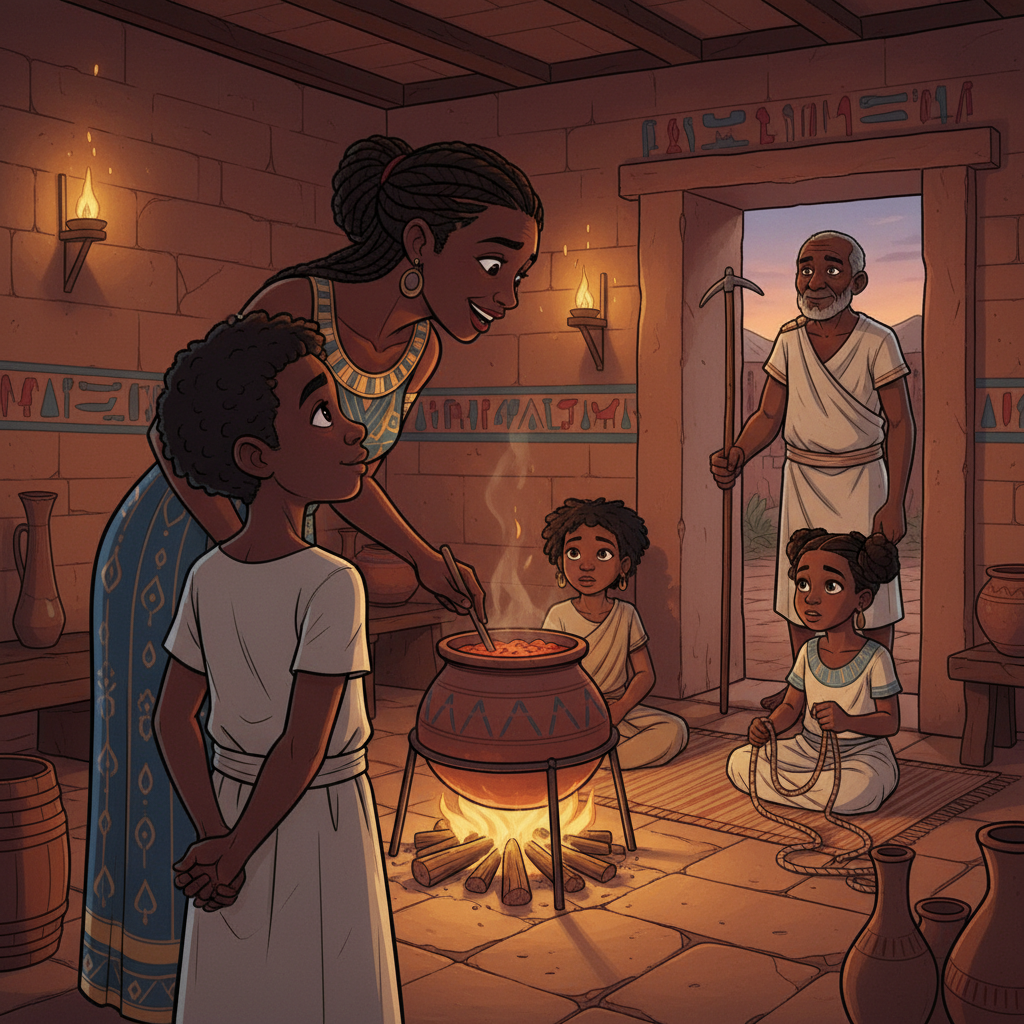
That evening, Tau walked into his family's house and did something he had never done quite this way before. He looked at his mother stirring the evening stew, and he said, "Thank you for cooking for us, Mama." Her eyes widened with surprise, and then she laughed and kissed his forehead. He found his little sister Nailah struggling to braid a piece of rope, and he sat beside her and helped her, slowly and patiently, the way Khensa had sat with Mensah. When his father came home tired from the fields, Tau brought him water and asked, "How was your day, Baba? Tell me everything." His father looked at him with a curious, proud expression and began to talk. That night, as Tau lay on his sleeping mat listening to the crickets singing outside, he understood. Ma'at was not some great magic hidden in a temple. It lived in his voice when he said someone's name. It lived in his hands when he helped his sister. It lived in his eyes when he truly saw another person. And tomorrow morning, before the sun painted the sky gold, he would run to Grandmother Khensa's house again — because Ma'at was not something you did once. It was something you practiced every single day.