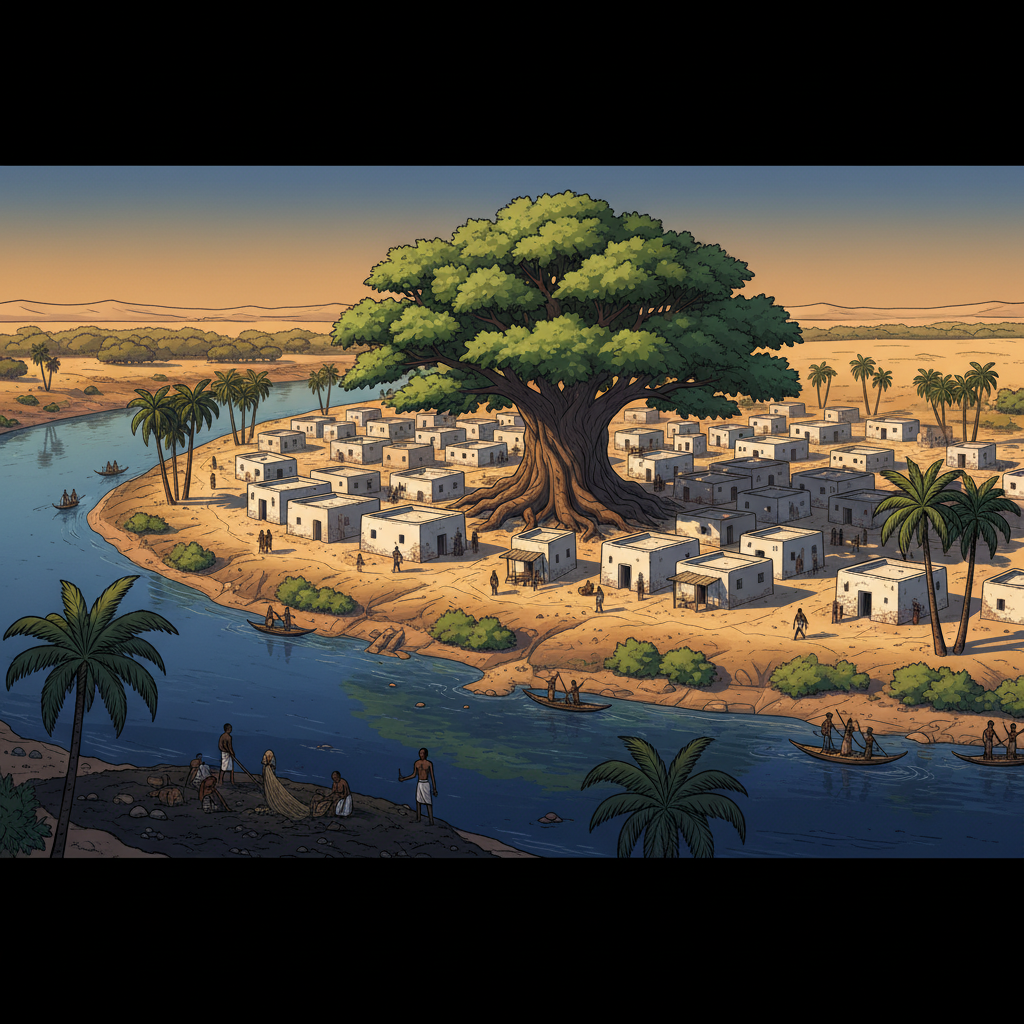
The village of Abdju sat on the western bank of the Nile, cradled in a bend of the great river where the water moved slowly and the soil was black with life. It was a place of farmers and fishermen, of weavers and potters, where the rhythm of the seasons governed everything and the people lived close to the earth. The houses were mudbrick, whitewashed against the sun, and palm trees threw long shadows across dusty lanes each afternoon. At the center of the village stood a sycamore tree so ancient that nobody could remember a time before it. Among the people of Abdju, there lived a healer named Tuya. She was a woman of thirty seasons, with deep ebony skin and hands that moved with the sureness of someone who had spent her life learning the language of the body. The people said Tuya's hands carried heka — sacred healing power — and that she could feel illness the way a farmer feels the coming rain.
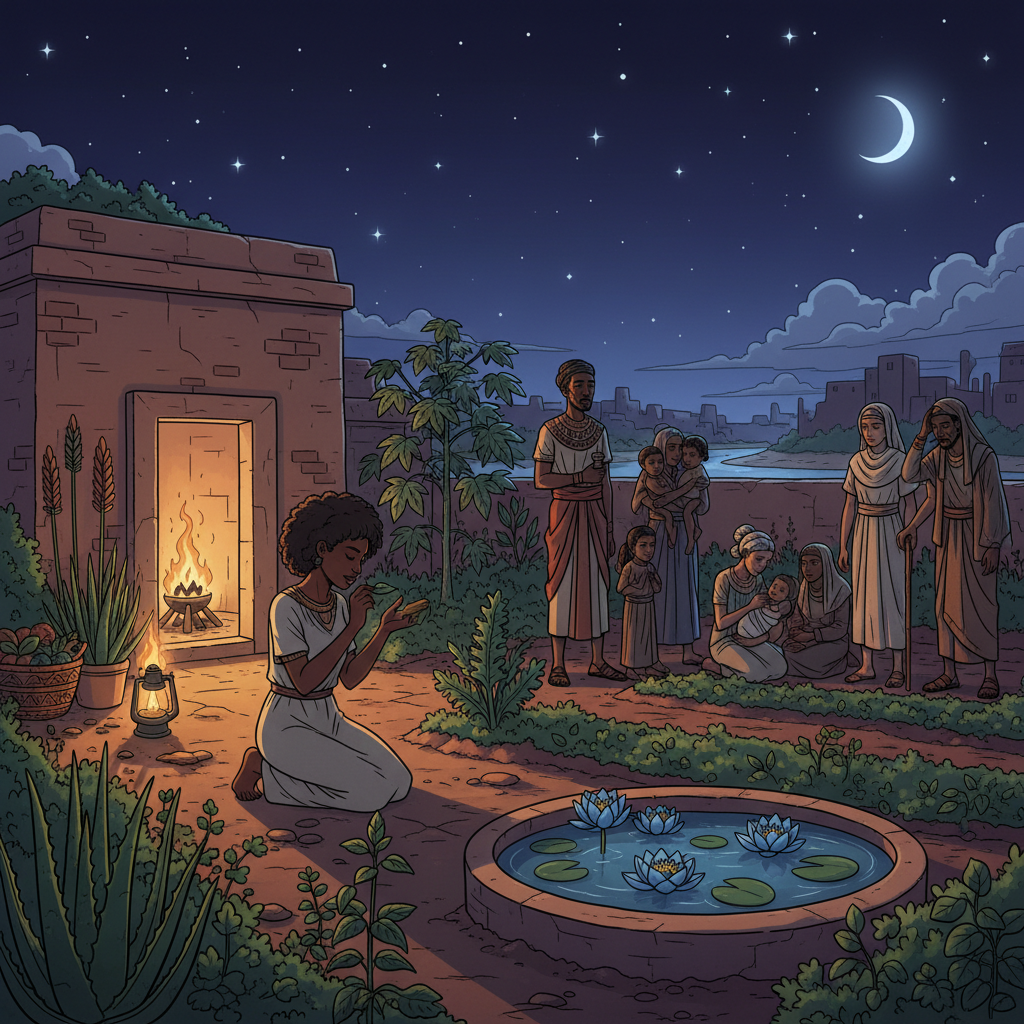
Tuya's healing garden grew behind her small house near the river. It was a miracle of green in the dry land — rows of aloe and castor, mint and coriander, blue lotus floating in a clay-lined pool, and the precious silphium plant that Tuya had nursed from a cutting traded by a merchant from the far west. Every morning before dawn, Tuya walked between the rows, checking leaves for spots, testing the soil with her dark fingers, whispering to the plants the way her mother had whispered to them, and her mother's mother before that. The knowledge was ancient, passed through seven generations of healers, and Tuya guarded it with the devotion of a priest guarding a sacred text. In Abdju, Tuya healed everyone who came. Rich farmers and poor fishermen, old grandmothers and crying infants, travelers from distant lands who stumbled into the village burning with desert fever. Her door was never closed. Her fire was always burning.
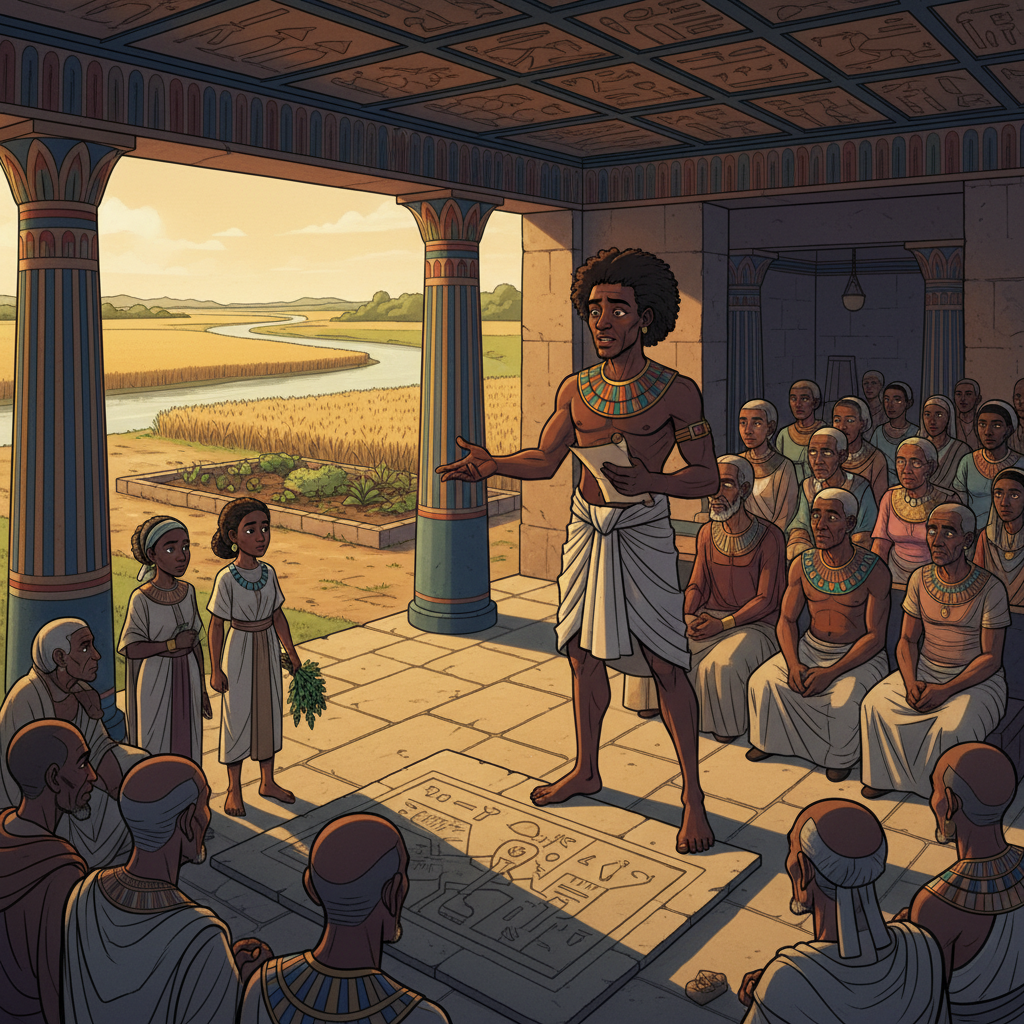
But Tuya had not always lived in abundance. Ten years ago, when she was a young woman just beginning her healing practice, she and her family had been driven from their ancestral farmland by a merchant named Khufu. He was a grain trader, broad-shouldered and loud-voiced, with dark brown skin and eyes that calculated the value of everything they touched. Khufu had wanted Tuya's family's land for its rich soil and its access to the river irrigation channels. He could grow three times the grain there. Khufu had gone to the village council and argued that the land was underused — that a healer's garden produced less value than a grain field. He offered to pay the family, but the sum was insultingly small. When Tuya's father refused, Khufu whispered in the ears of powerful men. He called in debts. He made promises and threats. Within a season, the council ruled that the land should be redistributed for agricultural use.
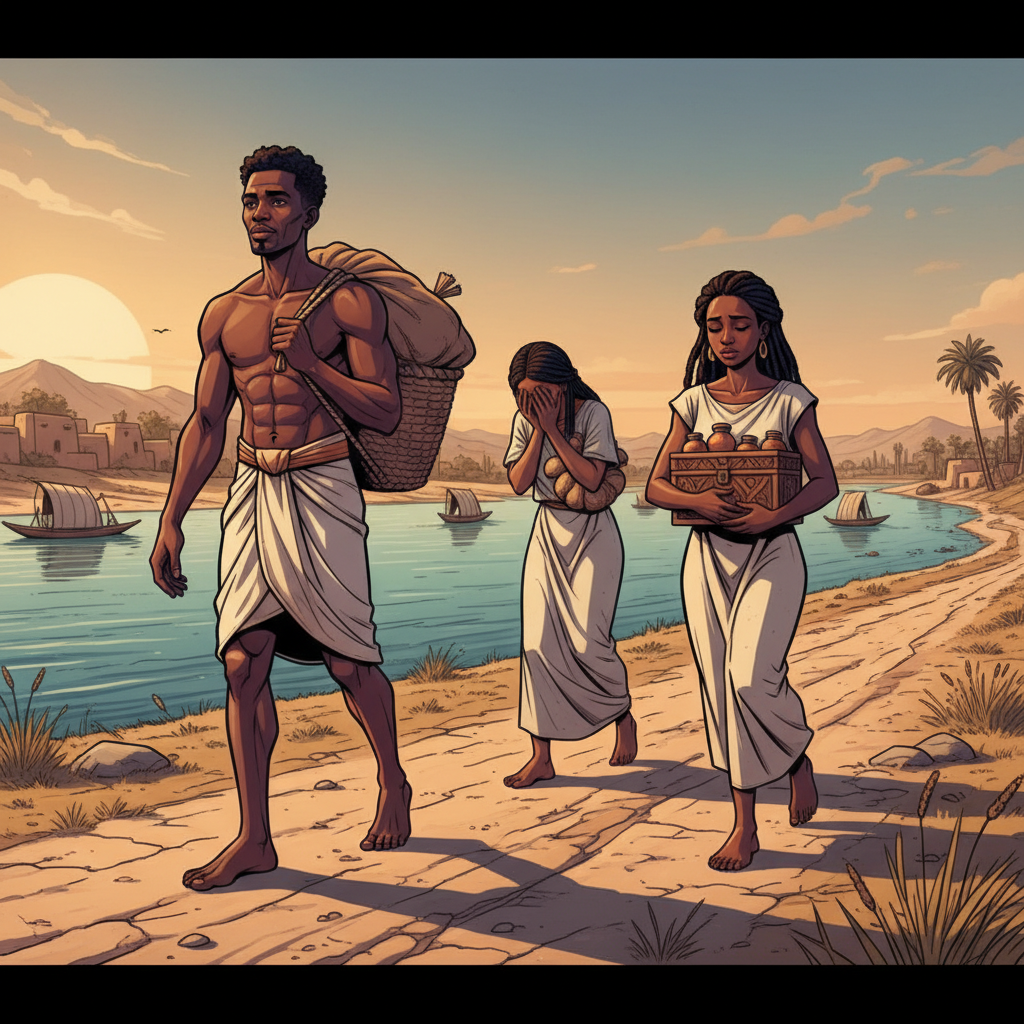
Tuya remembered the day they were forced to leave. Her father, a proud man with deep ebony skin and the quiet dignity of someone who had worked the same soil his whole life, carried their belongings on his back without a word. Her mother wept. Tuya, barely twenty years old, walked behind them carrying her medicine chest — the only thing she would not let anyone else touch. The clay jars rattled with each step, and she held the chest against her stomach like a child. They resettled on a small, rocky patch of land at the edge of the village. The soil was poor. The water access was limited. But Tuya's father planted what he could, and Tuya began her garden again from nothing — coaxing life from reluctant earth, trading her healing skills for seeds and cuttings. It took her five years to build what Khufu had taken from them in a single season.
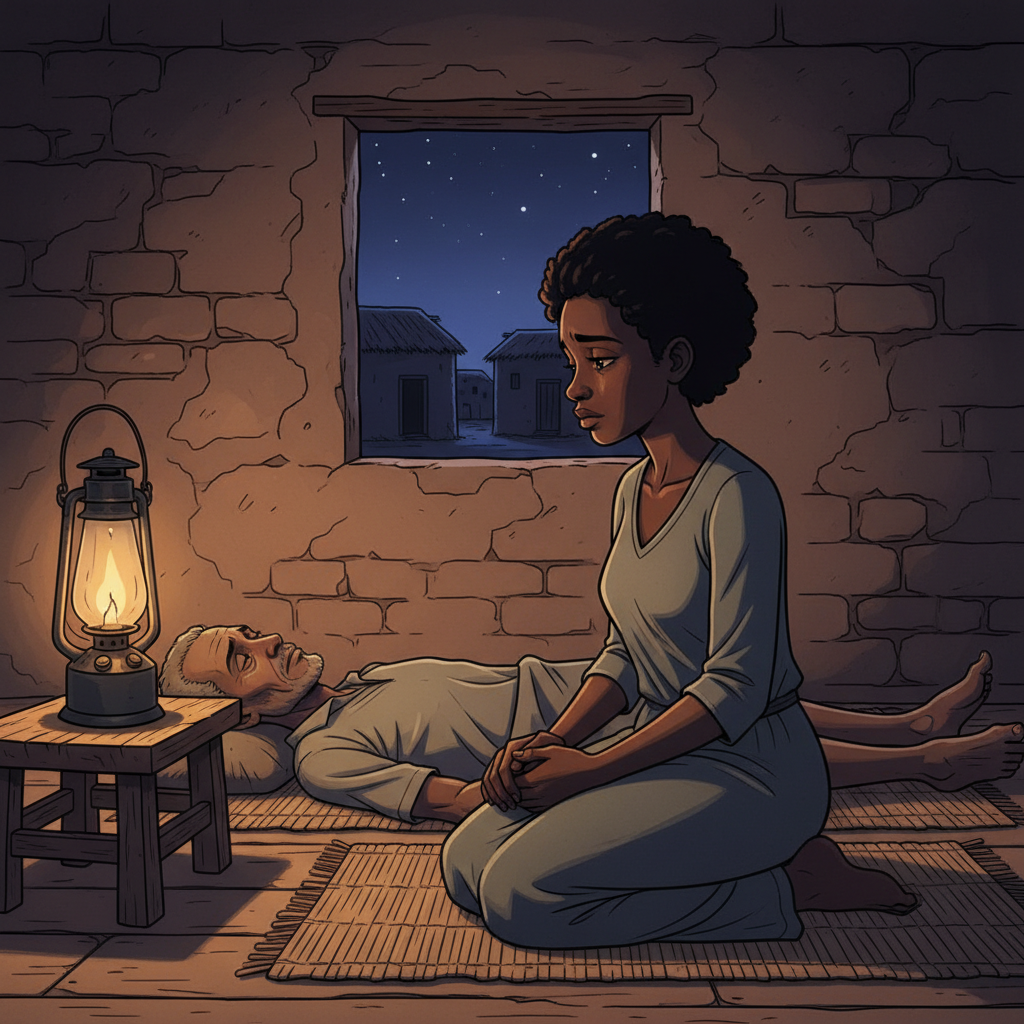
Her father never recovered. Not from any illness that Tuya's medicines could treat, but from a sickness of the spirit. The loss of his ancestral land broke something inside him that no herb could mend. He grew quiet, then thin, then still. He died on a cool evening three years after they were displaced, lying on a reed mat in their small new house, his dark hand resting on the soil of a land that was not truly his. Tuya held that hand as it grew cold, and something hardened inside her chest like fired clay. She did not blame the village council. They had been manipulated by a clever man. She blamed Khufu. And in the deepest, most private chamber of her heart, she made a promise that she told no one: she would never help that man. Not if he came crawling on his knees. Not if the last breath was leaving his body. Let him reap what he had sown.
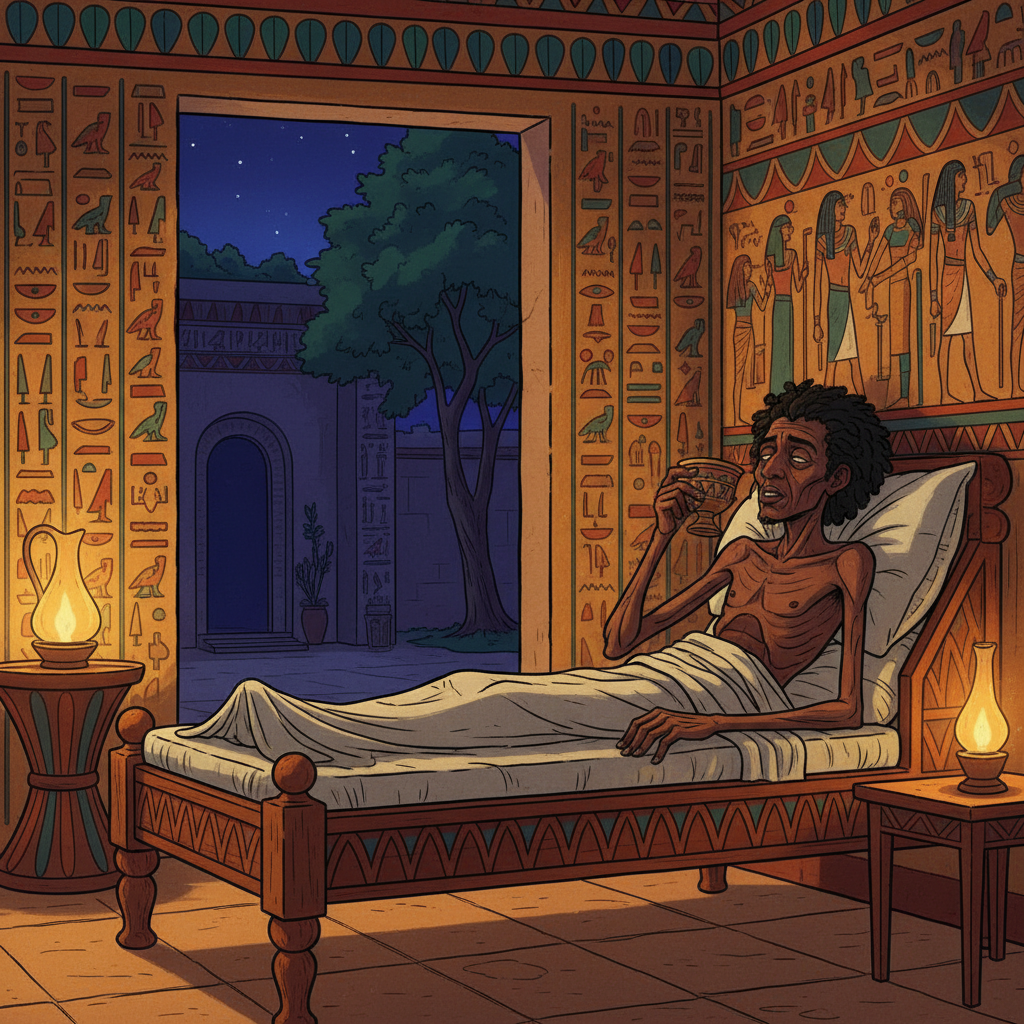
Now, ten years later, Khufu was sick. The grain merchant who had grown wealthy on Tuya's family's land — who had built a fine house with painted walls and a courtyard shaded by tamarind trees — lay in his bed unable to stand. The illness had come on slowly, a weakness in his legs that spread upward over many months until his thick arms could barely lift a cup of water. His dark skin, once flushed with health and prosperity, had turned ashen and dull. The village healers had tried everything they knew, but Khufu's condition only worsened. Everyone knew that Tuya was the only healer in the region with the knowledge to treat this kind of wasting illness. Her mother had encountered it once, decades ago, and had passed the treatment to Tuya — a complex preparation involving three herbs that had to be combined in exact proportions and administered over many weeks.
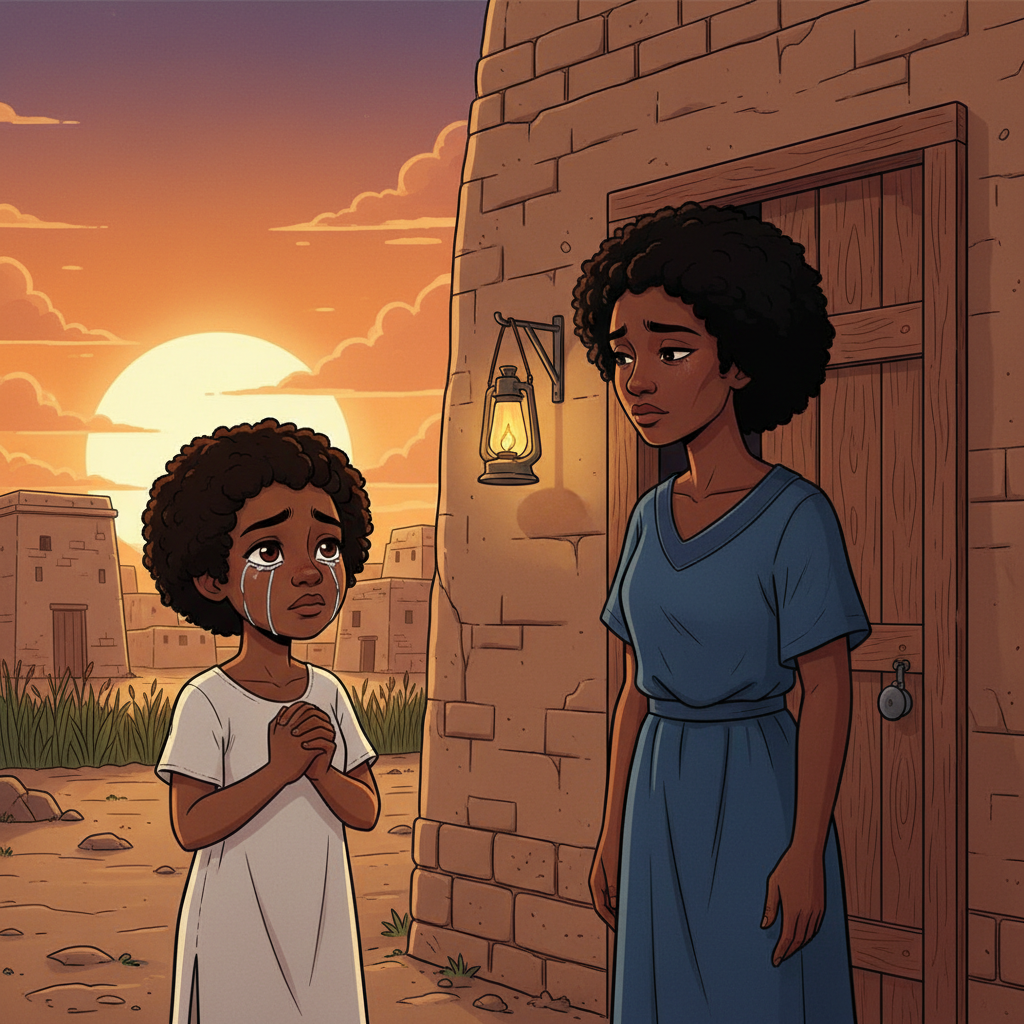
The knock on Tuya's door came at sunset. She opened it to find Khufu's wife, Meryt, standing in the fading light. Meryt was a small woman with deep brown skin and red-rimmed eyes that spoke of many sleepless nights. She held her hands clasped in front of her, knuckles pale from gripping, and her voice shook when she spoke. "Tuya, please. My husband is dying. The other healers cannot help him. You are the only one. I know what he did to your family. I know it was wrong. But he is the father of my children. They are small. They need him." Meryt's voice broke, and tears ran silently down her dark cheeks. Tuya stood in the doorway, and for a long, terrible moment, she said nothing at all. Her face was still as carved stone.
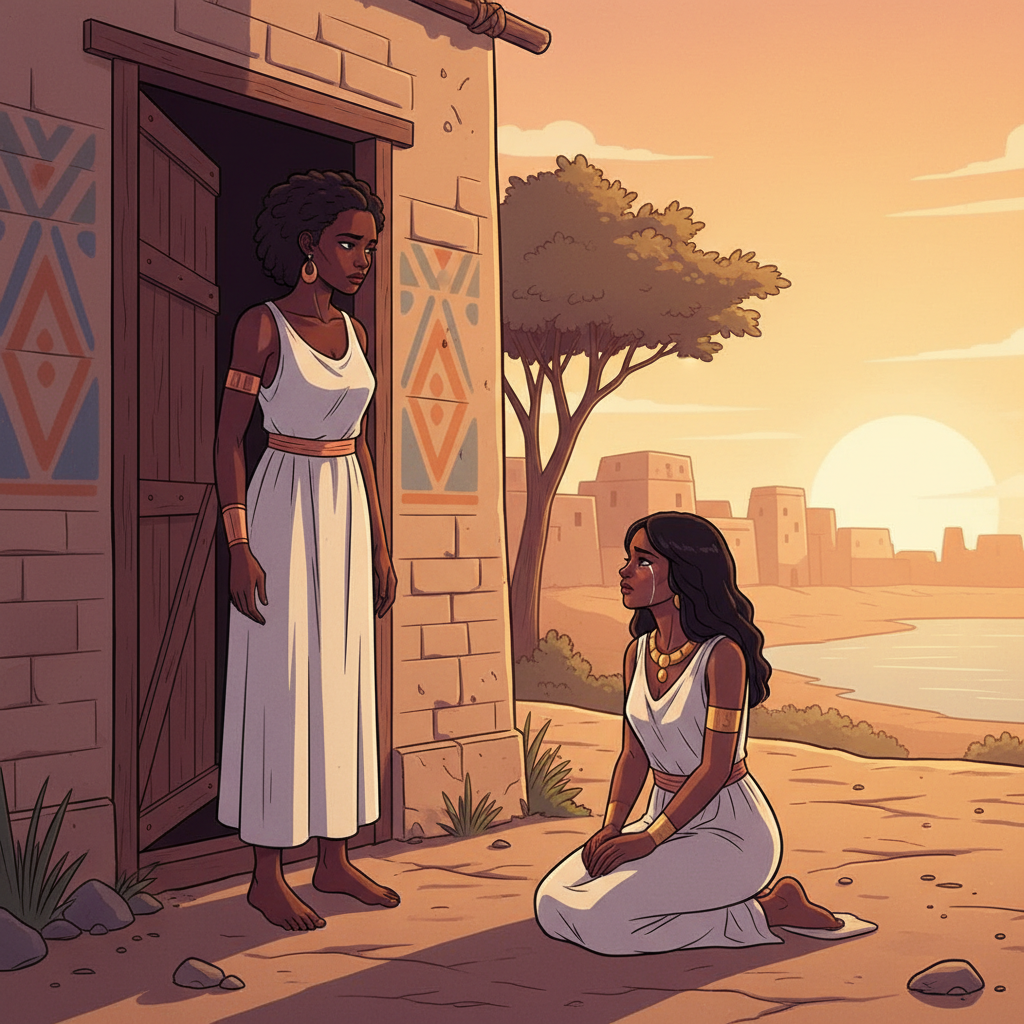
Tuya looked at Meryt with eyes that held ten years of pain compressed into two dark points. "I am sorry for your children," she said, and her voice was quiet and controlled. "But I will not help Khufu. He took my family's land. He destroyed my father. He watched my father die slowly and never once came to apologize or make it right. Why should I save a man who killed mine?" Meryt sank to her knees in the dust. "I am not asking you to forgive him. I am asking you to heal him. A healer heals. That is who you are." Tuya shook her head, and when she spoke again, her voice was hard as bronze. "A healer is also a person with a heart, and my heart remembers what Khufu did. I choose not to help him. That is my right." She stepped back and closed the door.
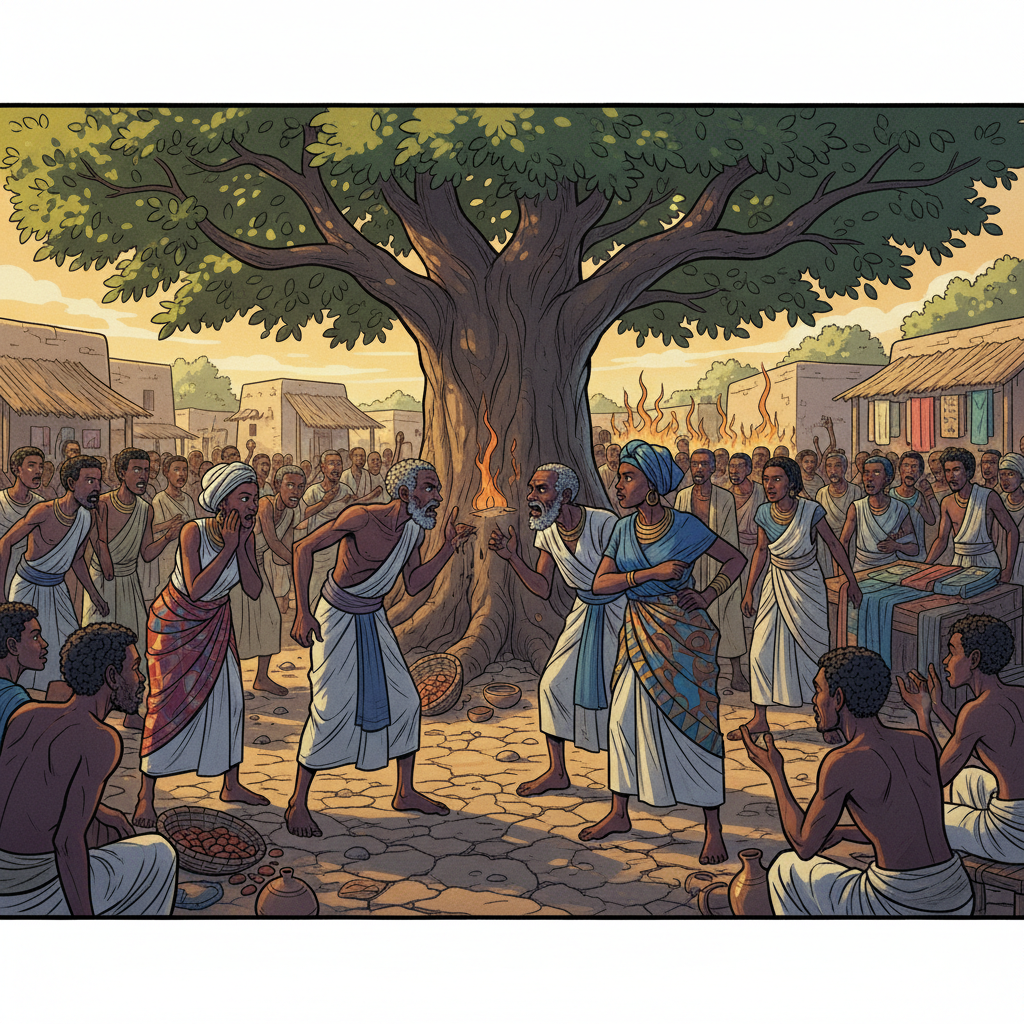
The news spread through Abdju like fire through dry reeds. Tuya, the healer who had never turned anyone away, had refused to treat Khufu. The village erupted into argument. In the market square, by the well, in the shade of the ancient sycamore, people debated with a passion that surprised even the elders. Baba Mensah, the old fisherman, spat in the dust. "Khufu stole that woman's land and broke her father. If a scorpion stings you, do you carry it on your back? She owes him nothing." His wife nodded firmly. But Trader Esi, who sold cloth in the market, shook her head. "A healer's duty is to heal. It is not her decision who deserves to live or die. That is for the neter to decide, not for Tuya."
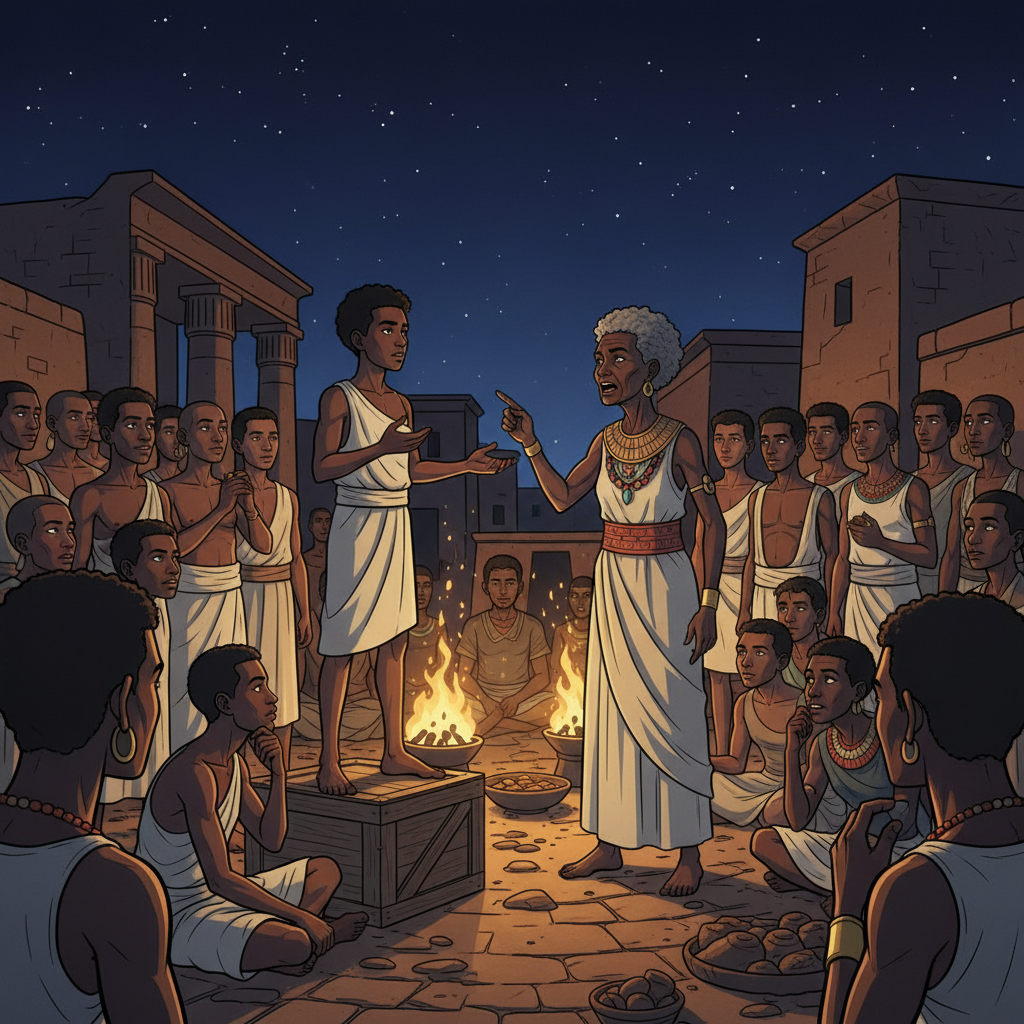
The debate grew deeper and more complicated as the day wore on. Young Kamose, a student at the temple school, raised a question that silenced the market square for a long moment. "If Tuya heals everyone except Khufu, then her healing is not Maat. It is revenge dressed up as justice. Maat does not choose favorites. Maat is for all people, even the ones who have done wrong." But his grandmother, old Nefertiti, a woman with skin like dark leather and eyes sharp as flint, fired back: "And where was Maat when Khufu stole their land? Where was Maat when her father wasted away? You talk about Maat for all people, but Maat was not there for Tuya's family. If the world does not give her justice, she has the right to find her own." The crowd murmured, torn between two truths that both rang with the sound of something real.
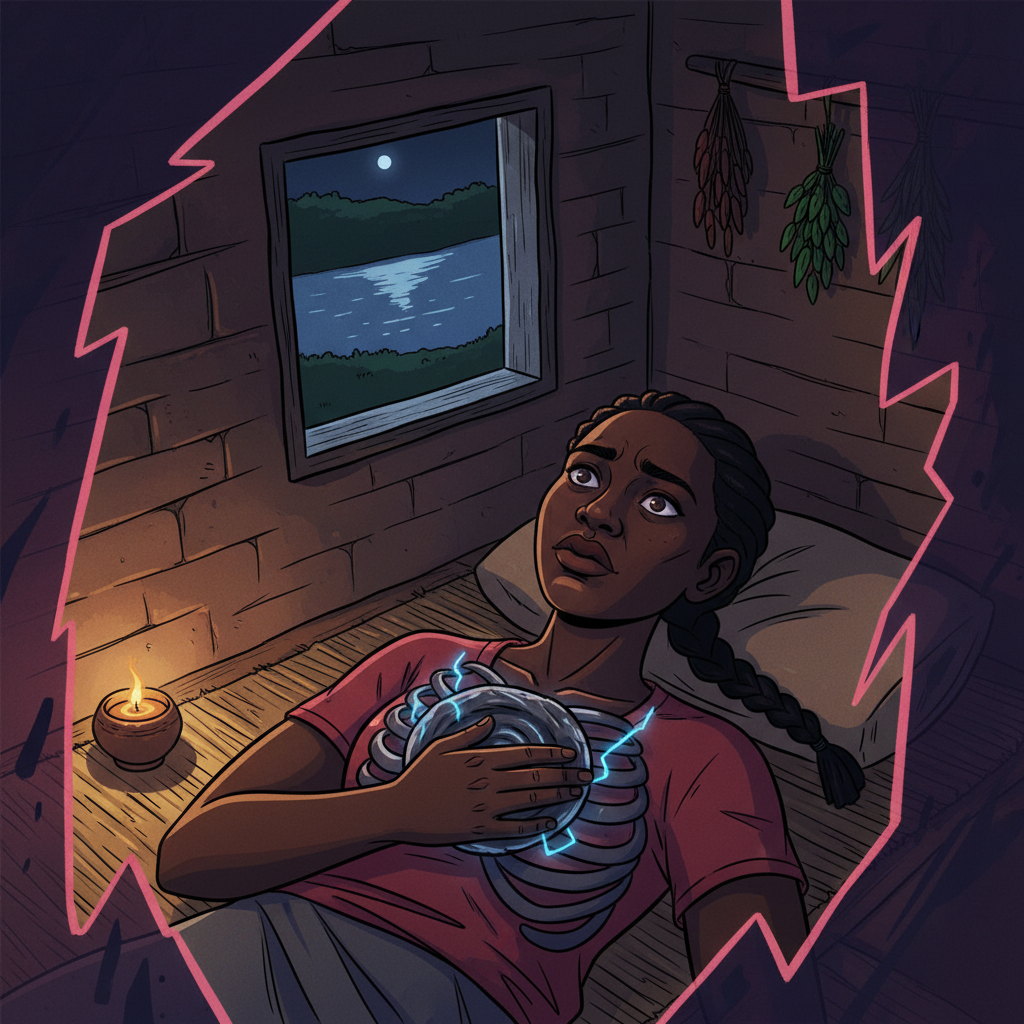
Three days passed. Khufu grew weaker. Meryt came to Tuya's door each evening and was turned away each time. The children — two boys and a girl, the oldest barely seven — began appearing in the village lanes with frightened eyes, asking neighbors if their father was going to die. The sight of them tore at the village like a thorn caught in cloth. Tuya worked in her garden each morning as always, tending her plants with steady hands. But those who knew her well could see the storm behind her eyes. She was not at peace. The hard knot of refusal sat in her chest like a stone, and some nights she lay awake listening to the river and feeling something she did not want to name pressing against the walls she had built inside herself.
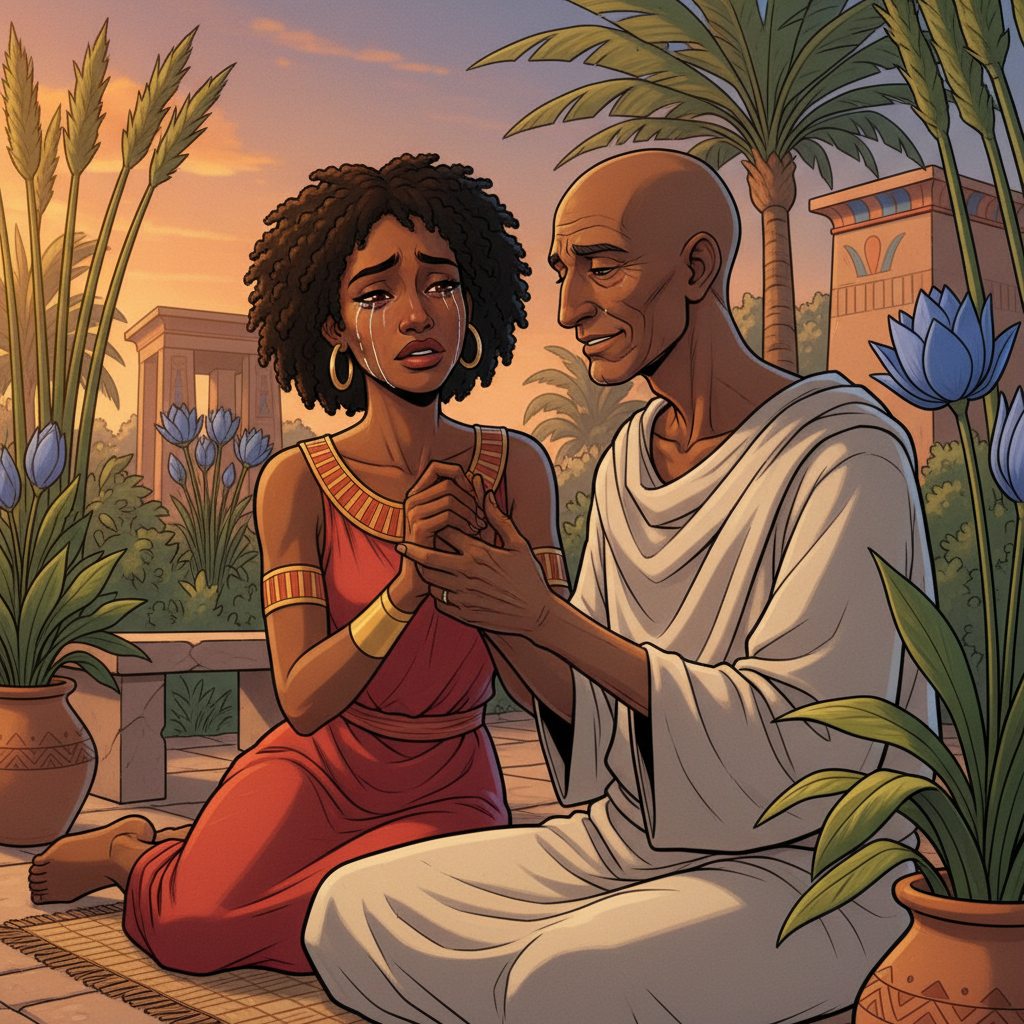
On the fourth evening, an elder named Userhet came to sit with Tuya in her garden. He was old and thin, with deep ebony skin creased like folded papyrus, and he had known Tuya since she was a girl. He did not argue with her. He did not plead. He simply sat beside her in the fading light and said, "Tell me about your father." The question cracked something open. Tuya spoke for a long time — about her father's gentle hands, his love of the land, the way he used to sing to the crops at dawn. She spoke about watching him fade, about the helplessness of being a healer who could not heal the wound that mattered most. She wept, and Userhet held her hand without speaking, because sometimes the greatest wisdom is knowing when to be silent.
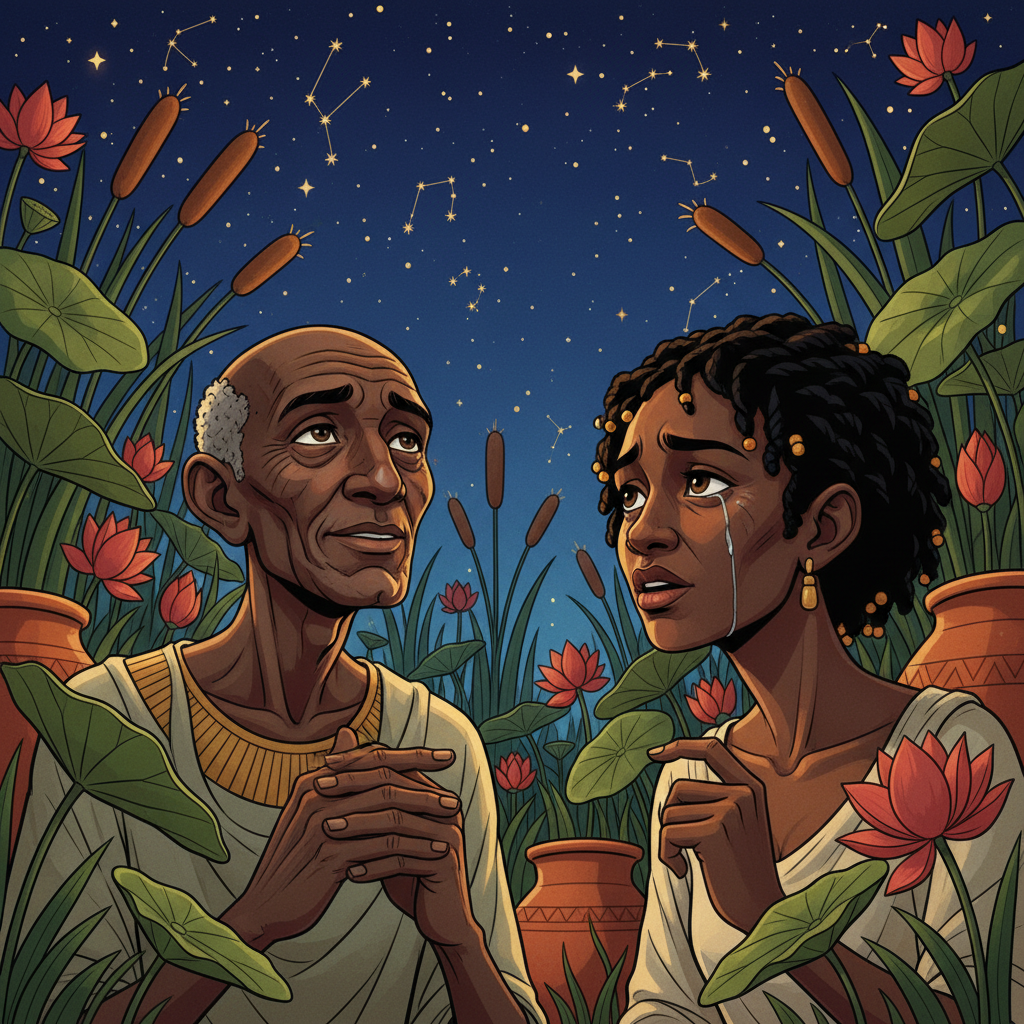
When the tears had passed and the stars were thick above the garden, Userhet spoke softly. "Your pain is real, Tuya. And your anger is justified. What Khufu did was Isfet. He used power to take what was not his, and your father paid the price. No one who knows the truth would deny you the right to be angry." He paused. "But here is the question the ancestors asked in the Per Ankh, and I ask it now not to judge you but to help you see clearly: does your refusal heal the wound Khufu caused? Does Khufu's death undo your father's? Or does it add another broken family to the first — three more children without a father, repeating the very suffering that was done to you?"
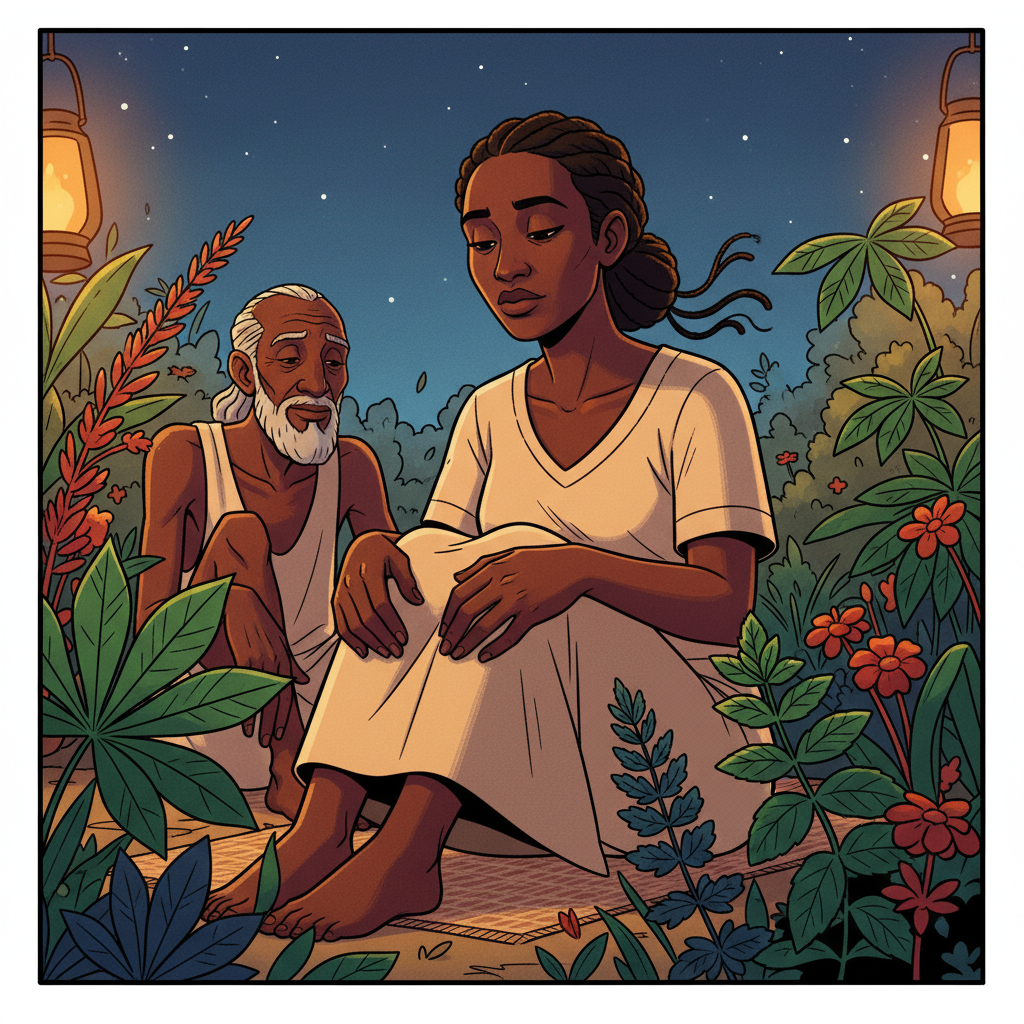
Tuya sat in silence for a long time, her dark hands resting on her knees. The night breeze carried the scent of her garden — mint and castor and the sweet green smell of growing things. She could feel the question working inside her like medicine working through the body, reaching into the places she had sealed shut. "I hear what you are saying," she whispered. "But if I heal him, it says that what he did does not matter. That you can destroy a family and still be saved. Where is the justice in that?" Userhet nodded slowly. "That is a true question. And here is what I believe: healing his body does not forgive his soul. You can save his life and still demand that he face what he has done. Compassion and justice are not enemies, Tuya. They are two hands of the same body."

Tuya did not sleep that night. She sat in her garden until dawn, watching the stars wheel overhead and listening to the voice of the river and the quieter voice inside her own chest. She thought about her father. She thought about Meryt's children. She thought about the kind of healer she wanted to be and the kind of person her father had raised her to be. He had been a man who would have helped anyone — even someone who had hurt him. She knew this with a certainty that ached. When the first light appeared over the eastern cliffs, Tuya rose, washed her face in cool water, and began preparing the medicine. Her hands moved with the precision of long practice, grinding herbs, measuring proportions, mixing the preparation that only she knew how to make. She worked in silence, and her tears fell into the mortar and were ground in with the leaves.
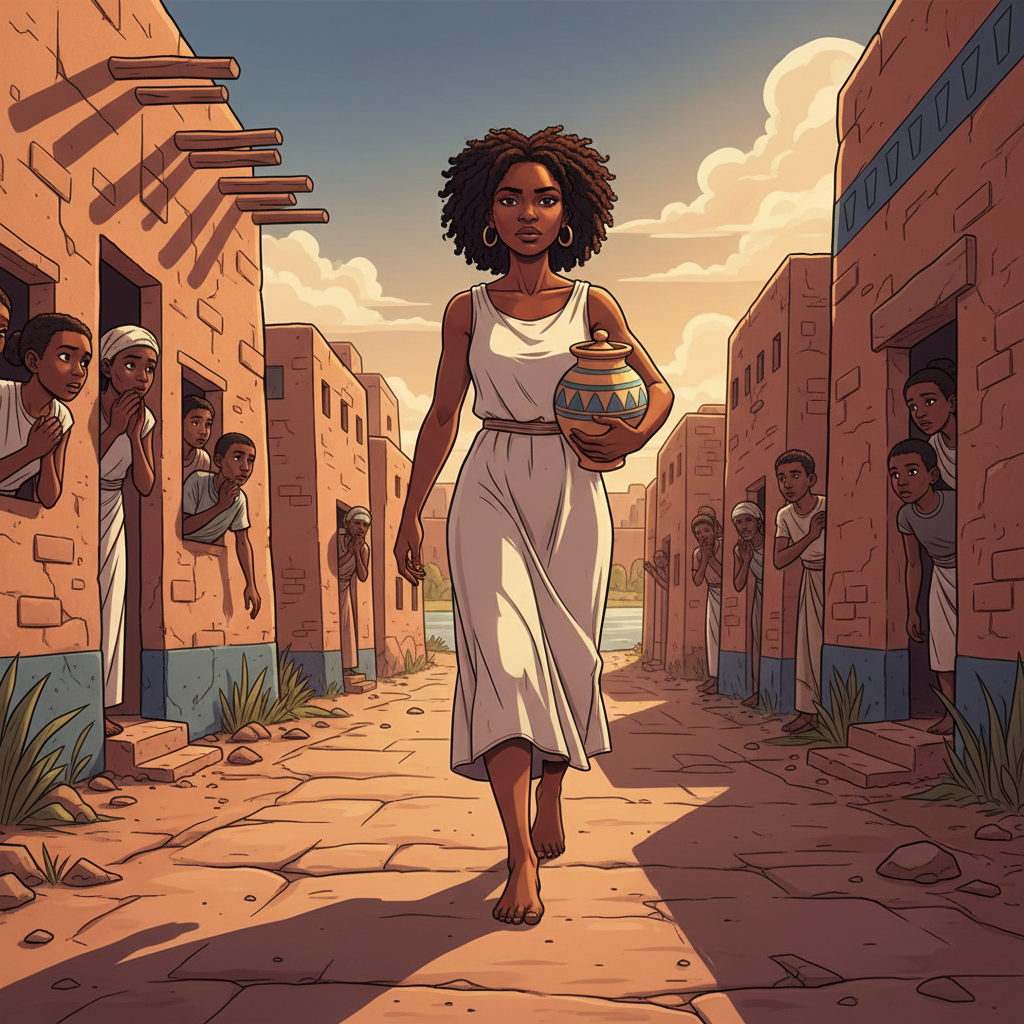
Tuya walked to Khufu's house carrying the medicine in a sealed jar. The whole village watched from doorways and windows, holding its breath. When Meryt opened the door and saw Tuya standing there, she crumpled to her knees and could not speak. Tuya stepped inside and found Khufu lying on his bed, wasted and gray. He looked up at her with eyes that held something she had never seen in them before: shame. "I know what I did," he rasped. His voice was barely a whisper. "I destroyed your family. I was greedy. I was Isfet walking on two legs." Tuya set the jar on the table and looked at him with a face that was neither warm nor cold. "I am not here to forgive you, Khufu. I am here because I am a healer, and letting you die would not bring my father back. It would only make me into something he would not recognize."
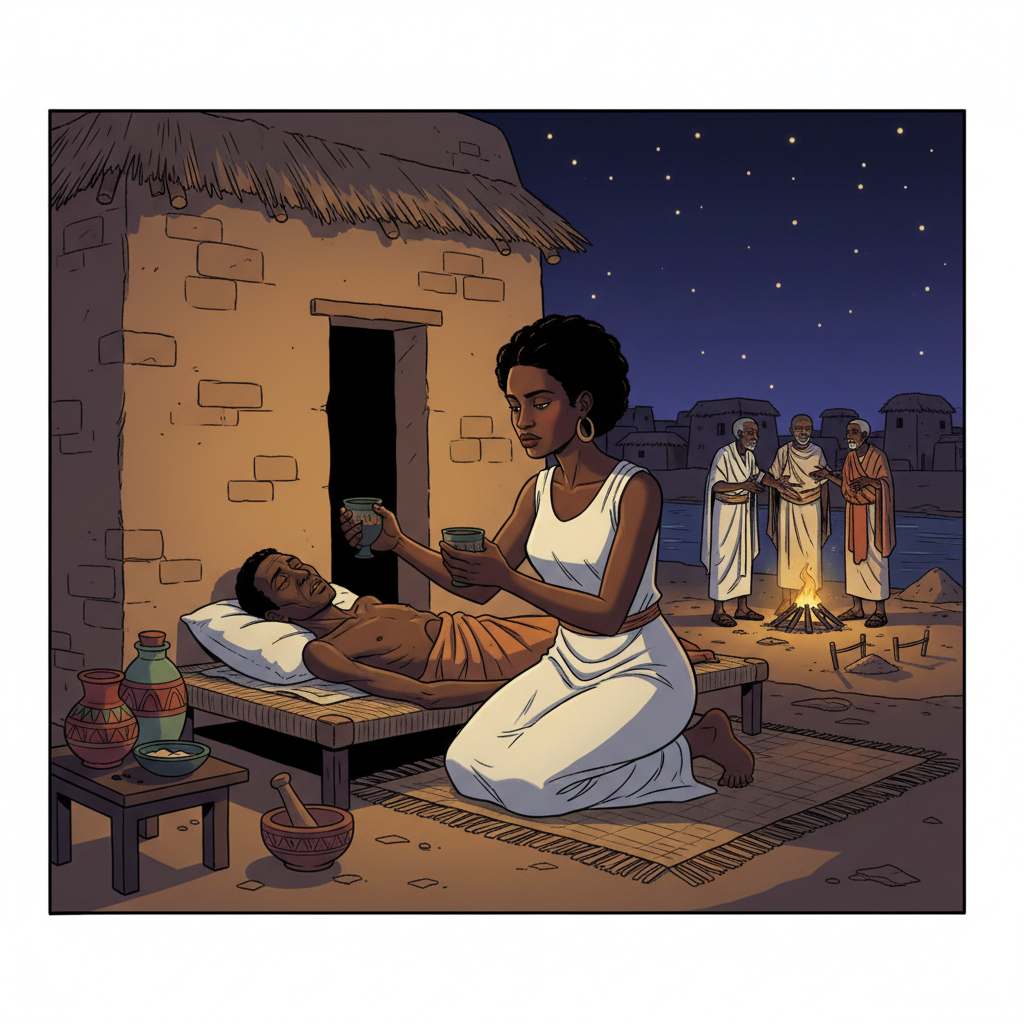
She administered the first dose and left without another word. She returned each day for seven weeks, measuring and mixing and pressing the bitter liquid to Khufu's lips. She never smiled at him. She never stayed longer than necessary. She healed his body with the same skill she gave to everyone, but she did not pretend that healing erased the past. The village council, moved by the situation, reopened the question of Tuya's family land. With Khufu too weak to resist and the truth of his manipulation now impossible to deny, the council restored a portion of the land to Tuya. It was not everything her family had lost. It was not justice made perfect. But it was something — a crack of light in a wall that had been solid darkness for ten years.
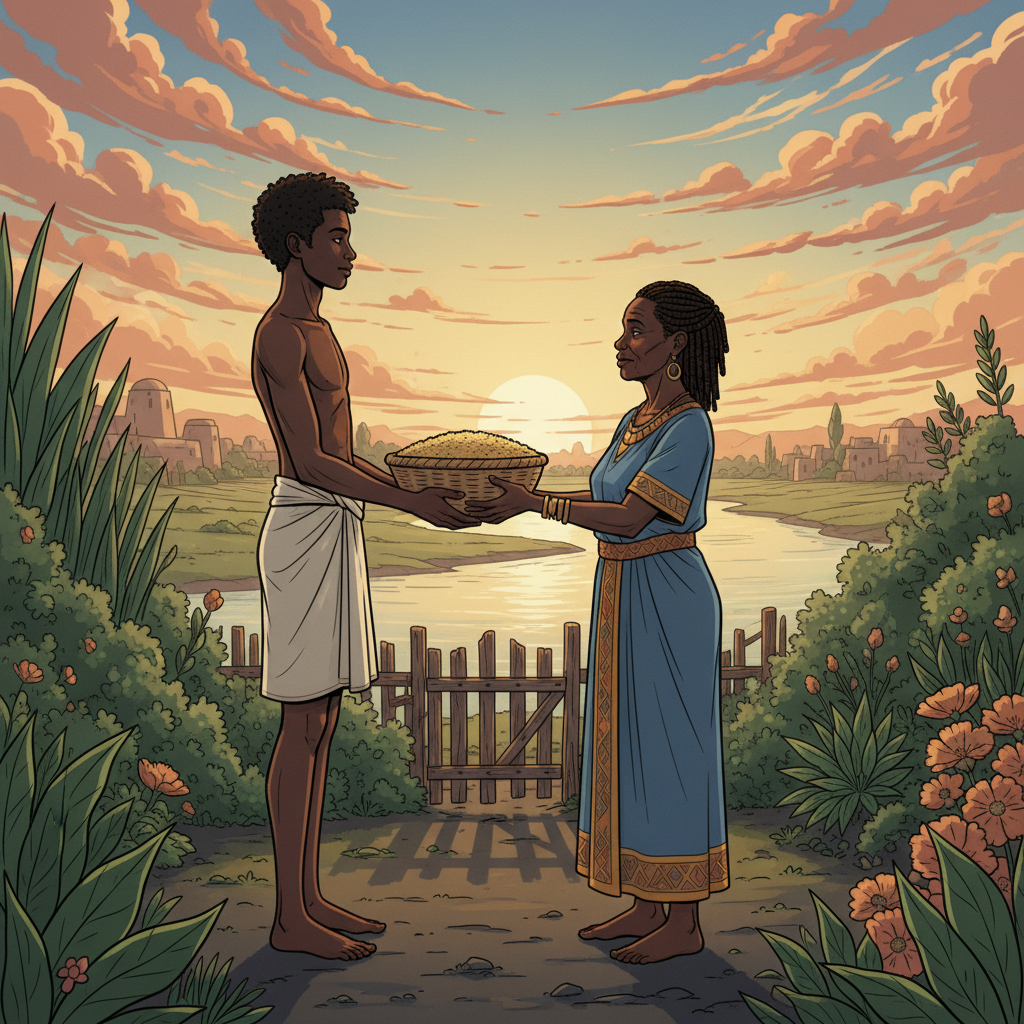
Khufu recovered slowly. He never became the man he was before — the wasting illness left him thinner, quieter, as though the sickness had burned away the loud, grasping part of him and left only the part that remembered what it felt like to be helpless. He sent his eldest son to Tuya's garden each week with a basket of grain from the very land he had taken. Tuya accepted the grain without comment. The village never fully agreed on whether Tuya had been right to refuse at first, or whether her eventual decision to heal was mercy or duty. Old Nefertiti maintained until her dying day that Tuya owed Khufu nothing. Young Kamose argued that Maat demanded she heal him from the start. Both spoke truth. Both missed something the other could see. And Tuya herself, when asked years later, said only this: "I do not know if I did the right thing. I only know I did the hardest thing. And sometimes that is all Maat asks."