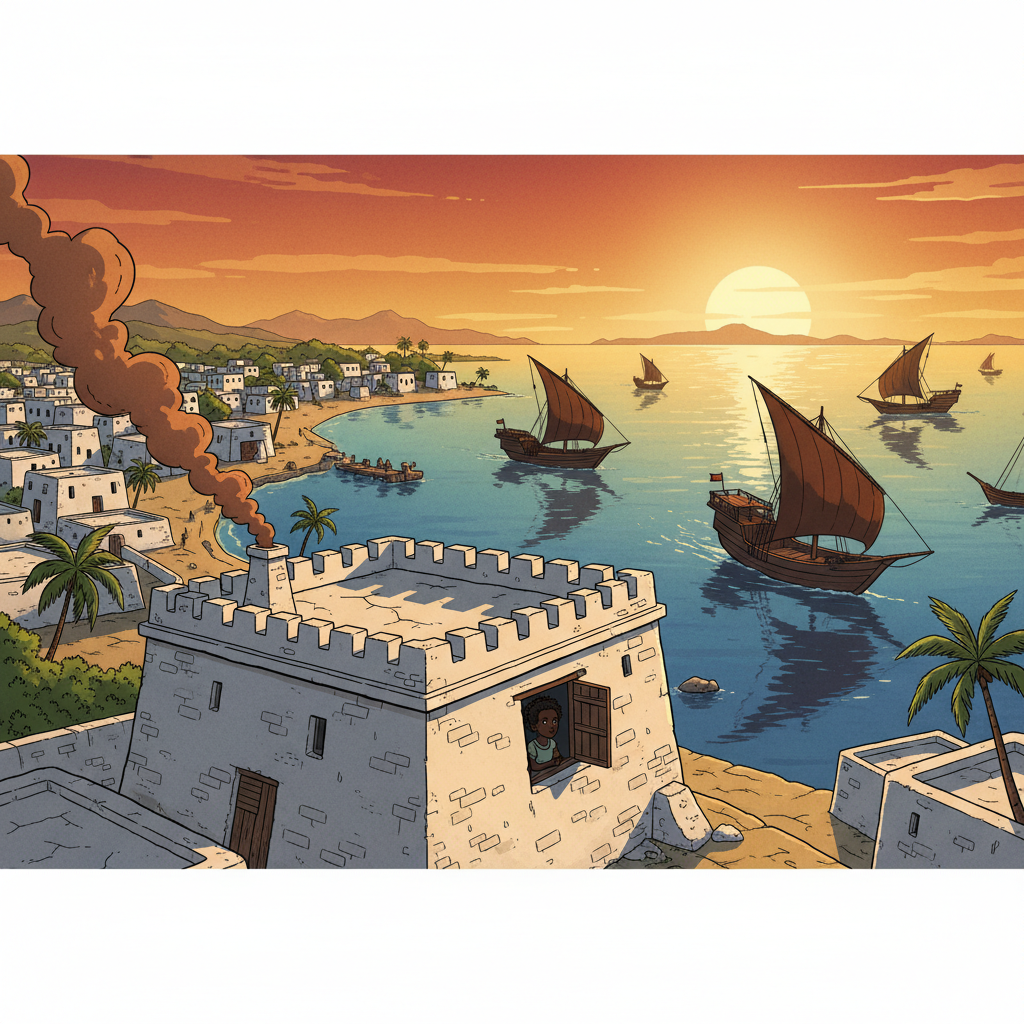
Mwanaisha was thirteen years old and lived above the Kilwa mint, where the air always smelled faintly of copper smoke and salt. The mint stood near the harbor on the island of Kilwa Kisiwani, on the eastern coast of Africa, and from the upstairs window of her family's quarters Mwanaisha could see the dhow ships coming in from Hormuz and Surat and Cambay — their square sails dark against the morning sea. She was the daughter of Aisha bint Yusuf, who kept the mint's record-book in Arabic and Swahili, and Hamisi the mint-master, who tested the gold-and-copper ratio of every incoming bullion shipment from the southern interior. Her parents had taught her, from the time she could walk, that the mint of Kilwa was a small thing that held up a very large thing. The reputation of an entire coast depended on the steadiness of one set of brass scales.
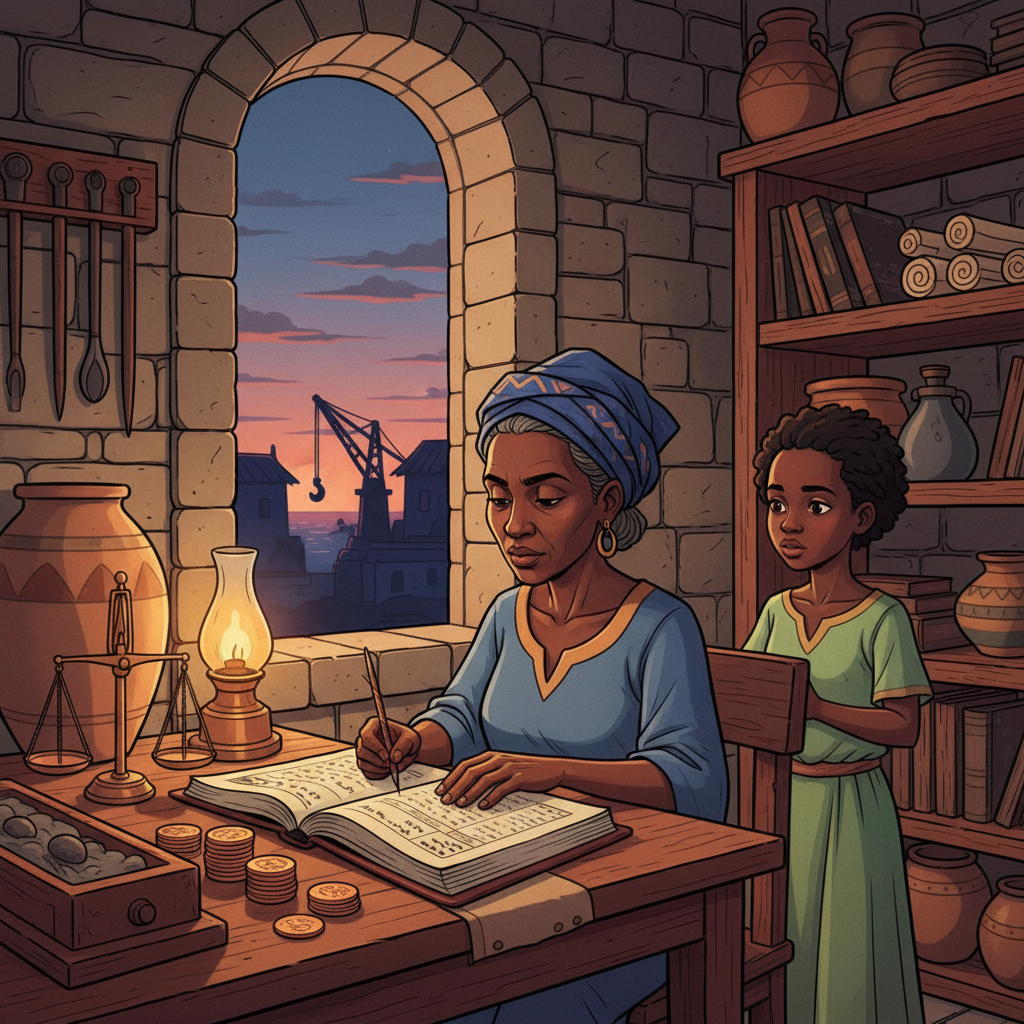
On the morning the story began, Mwanaisha came down the narrow stairs into the mint's testing room before sunrise. Her mother Aisha was already at the record-desk by the eastern window, the day's ledger open in front of her. Aisha was small and steady-handed, with deep brown skin and graying hair gathered under a head-wrap of indigo cloth. She wrote in two scripts — Arabic for the formal accounts that the sultan's clerks would later review, and Swahili in Arabic letters for the working notes of the workshop itself. "The first bullion arrives at the second hour after sunrise," she said without looking up. "From Sofala, by way of the Zambezi mouth. Your father wants you in the testing room when it does." Mwanaisha nodded and went to wash her face at the courtyard basin.
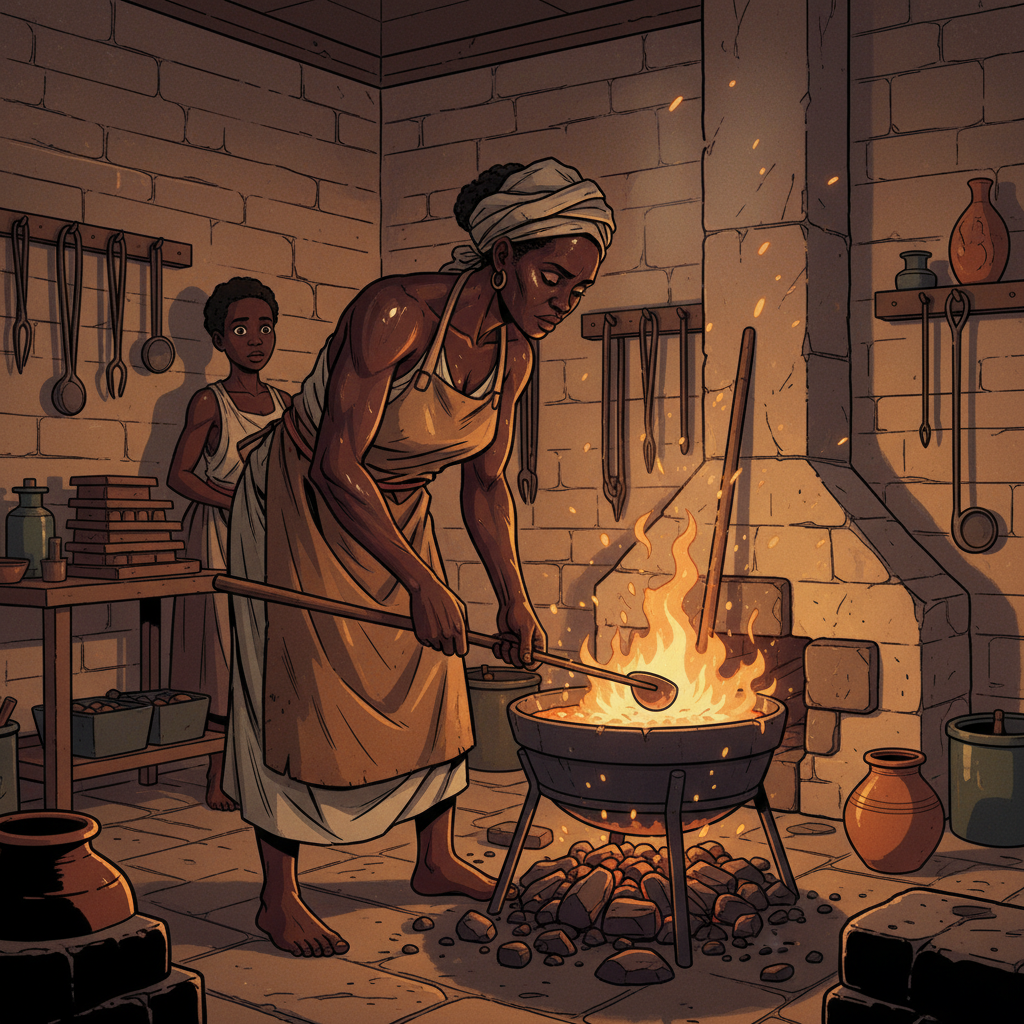
In the small inner courtyard of the mint compound, the head melter Maridhia was already at her brazier. Maridhia was in her mid-thirties, with the powerful shoulders and scarred forearms of a woman who had spent fifteen years pouring molten copper into ingot molds. Sparks from the forge had left small shiny burn-marks across the deep brown skin of her arms, and she wore a leather apron and a thick cloth wrapped around her head against the heat. She was the woman who actually melted the gold-copper alloy that became Kilwa's coins — copper coins for the inland market, alloy coins for the coastal trade. "Did you sleep, child?" she asked Mwanaisha. Mwanaisha nodded. "Good. Your father has a hard test today. Watch carefully. Even old hands miss things on hard tests."
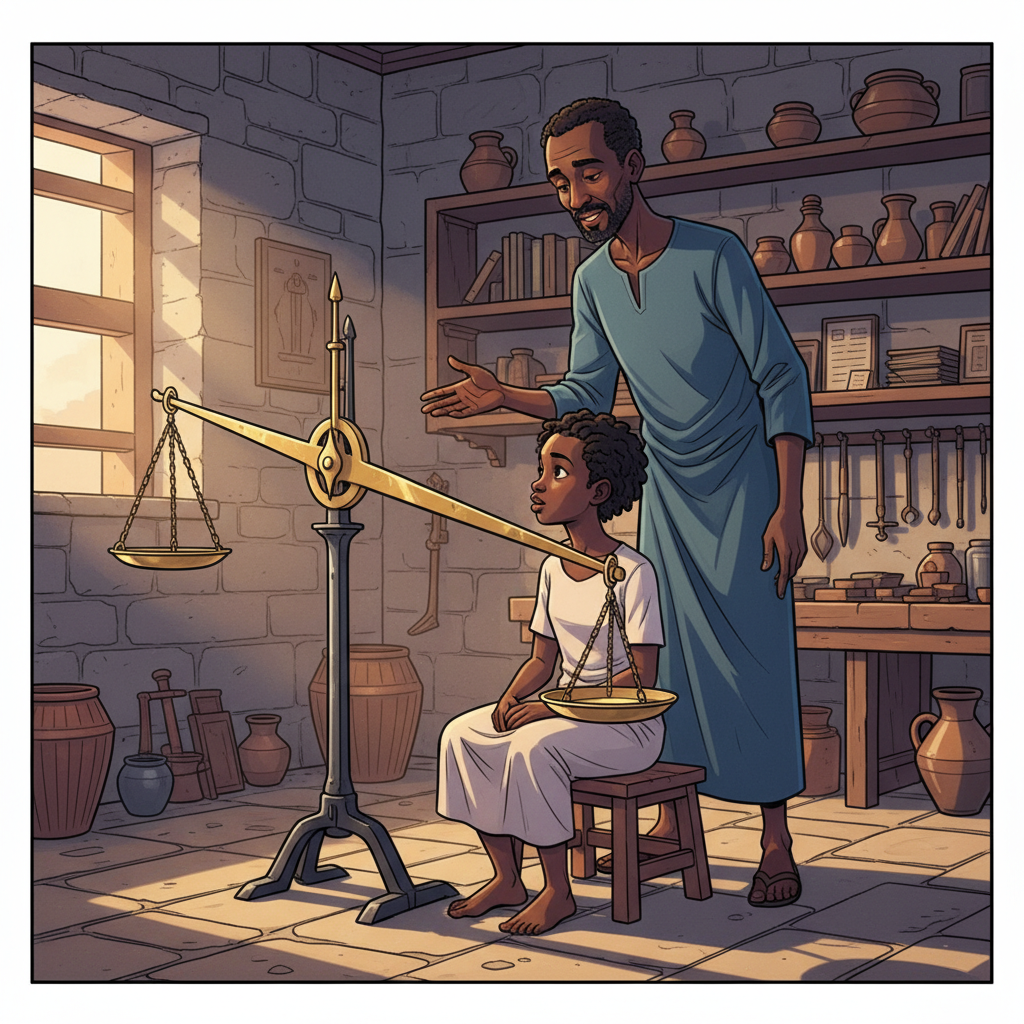
Mwanaisha's father Hamisi was a tall, lean man in his early forties, with skin the deep warm brown of polished mahogany and quiet hands that had tested ten thousand shipments of bullion in his life. He greeted his daughter at the testing-room door with a small nod and gestured to the empty stool beside the beam-balance. The beam-balance was the heart of the mint: a long brass bar, finely polished, suspended at its exact center from an iron stand. Two pans hung from its ends, one on the left and one on the right. A small brass tongue rose from the center of the beam, pointing straight up when the two pans were in balance. The tongue moved one width-of-a-hair for every grain of weight difference. Mwanaisha had been allowed to use this scale since she was eleven. Today, she understood, her father wanted her near it for a reason.
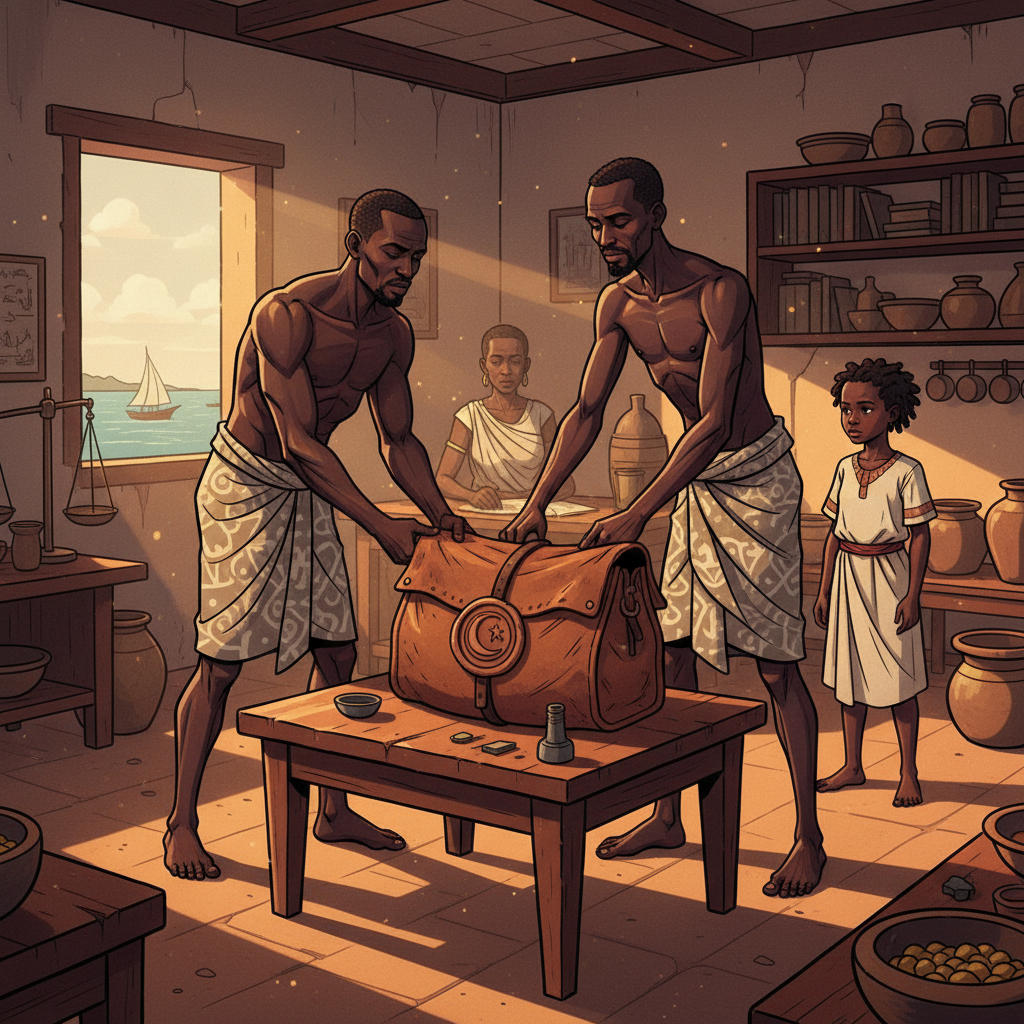
At the second hour after sunrise, the bullion arrived. Two Sofala porters set a heavy leather satchel on the testing-room's low cedar table. The satchel was sealed with the small wax cylinder-seal of the Sofala merchant — a man named Sulayman who had been sending bullion north to Kilwa for twelve years. Hamisi broke the seal, opened the satchel, and lifted out a small folded square of indigo cloth. He unfolded the cloth on the table. Inside were three thin gold-and-copper ingots, each the length and width of two fingers, each shining a soft warm yellow in the morning light. Hamisi weighed them. He tested their density in a small bowl of water — a method, he had taught Mwanaisha, learned from al-Khwarizmi's manuscripts that had reached the Swahili coast from Cairo two centuries before.

The density test was the most important measurement. Pure gold sank with a known weight in water. Gold mixed with copper sank with a slightly lighter known weight. By comparing the dry weight to the underwater weight, a careful mint-master could calculate the exact ratio of gold to copper in an alloy ingot. Hamisi did the math in his head. He did it three times. Each time he came up with the same answer: the ingots were 78% gold, 22% copper — the standard Sofala alloy ratio agreed to twelve years before. He nodded once. He spoke to the Sofala porters: "Tell Sulayman the test is good. The bullion is accepted." The porters bowed and left. Mwanaisha watched all of this and said nothing.
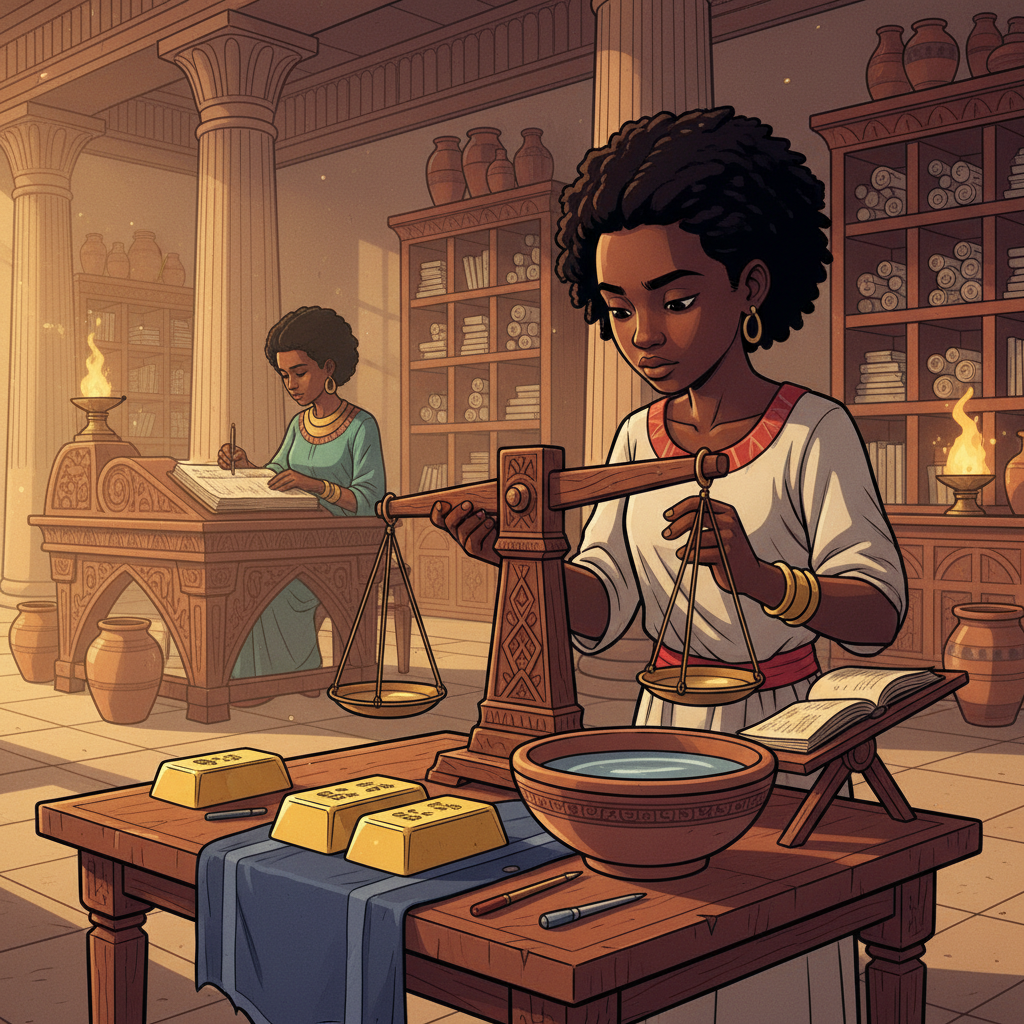
After the porters were gone, after her father had gone to the front office to draft the formal acceptance-letter, Mwanaisha came back into the testing room. The three ingots still lay on the indigo cloth. Maridhia the head melter had stepped out to check her brazier. Aisha was at the record-desk, writing the day's entry. Mwanaisha took one of the ingots and weighed it again on the beam-balance. She wrote down the dry weight. She lowered the ingot into the water-bowl. She wrote down the displaced weight. She did the math the way her father had taught her — multiply the dry weight by the constant of pure gold, subtract the displaced weight times the constant of pure copper, divide, and you have the ratio.
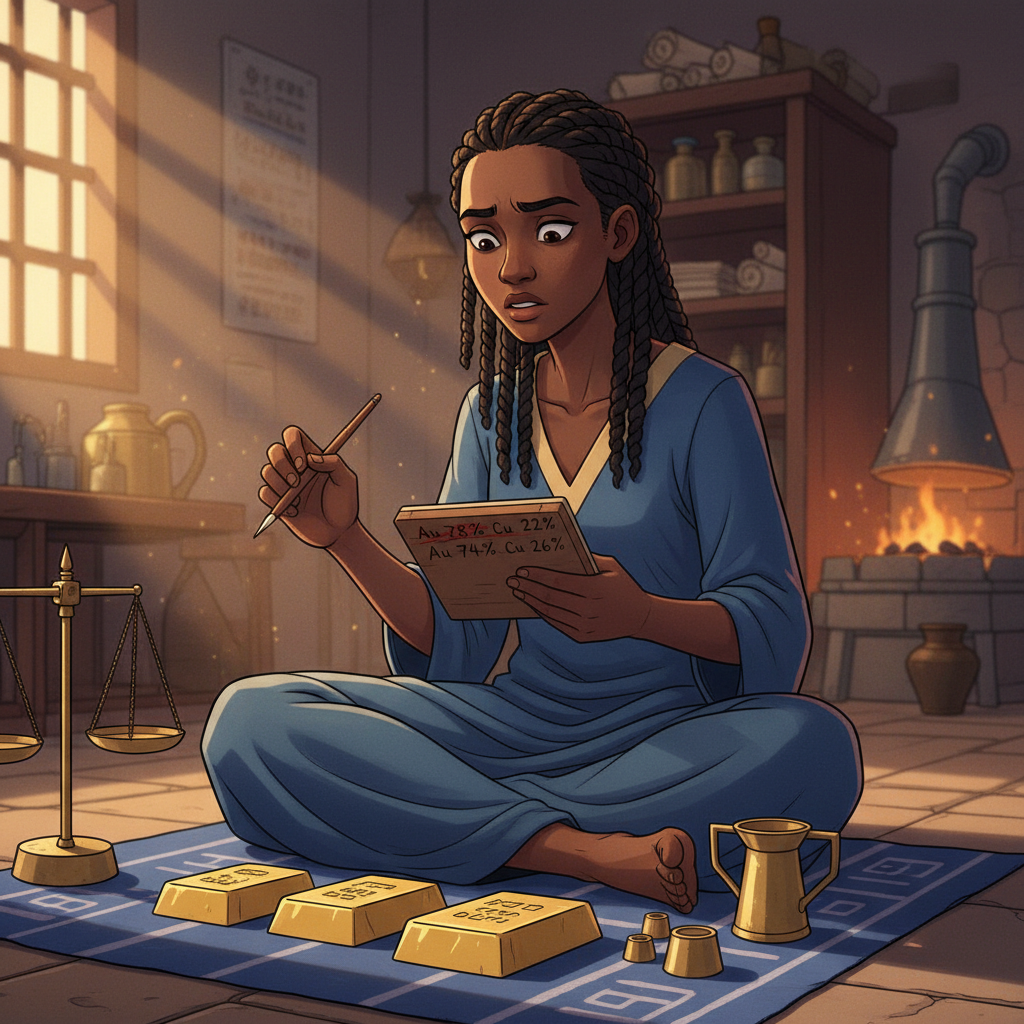
The number came back: 74% gold, 26% copper. Not 78%. Not 22%. Four percent off. Mwanaisha did the math again. Then a third time. The number did not change. She set the ingot down on the indigo cloth very carefully, the way her mother set down a heavy ink-stone. Her hands were not shaking, but she felt the small steady pulse of her heart in her ears. Four percent. Her father had read the ingots at 78% gold. The ingots were 74%. The difference, on a single ingot, was small — perhaps the value of a single household's meal. The difference, multiplied across hundreds of ingots arriving over a decade, was the difference between a wealthy mint and a poor one. Her father had missed it. She had not.

Mwanaisha sat very still on the cedar testing-stool for a long moment, the bowl of water in front of her, the three ingots in their indigo cloth beside it, the morning sun coming through the eastern window in golden bars across the polished floor. Her father had been a mint-master for twenty-two years. He was respected from Sofala to Mombasa. The Sofala merchant Sulayman had been trustworthy for twelve years. There were a hundred reasons to believe that her math was wrong and her father's was right. There was one reason to believe the opposite. The scale did not lie. The water did not lie. The numbers were what they were. Mwanaisha got up. She walked, slowly, to the front office where her father was drafting his letter.
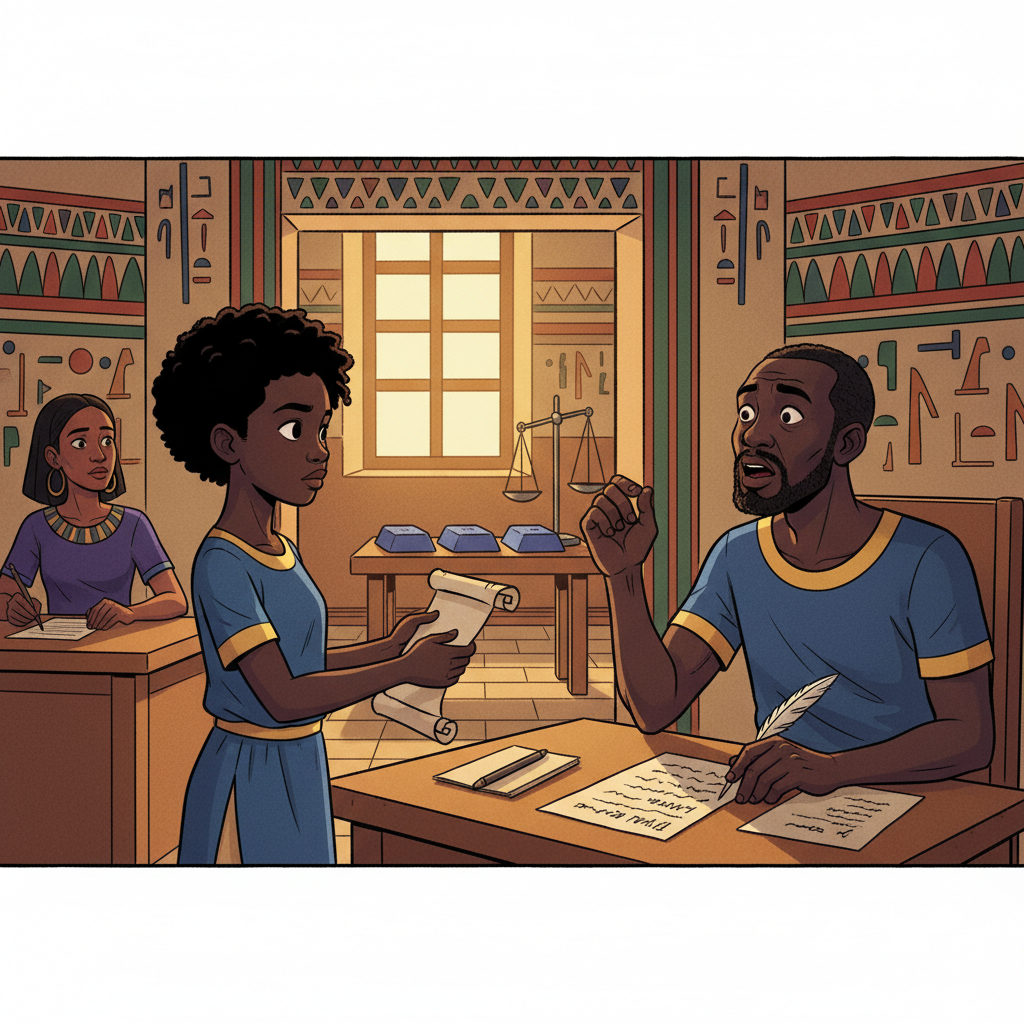
"Father." Her voice came out smaller than she meant. Hamisi looked up from the half-finished letter. His pen was still in his hand. "Father, I have re-tested the first ingot. The ratio comes back 74% gold, not 78%. I have done the math three times." She held out her notes. Hamisi did not move for a moment. Then he set down his pen, very carefully, and he took the notes from her hand. He read them. He looked at her. He stood up without speaking and walked back to the testing room. Mwanaisha followed. Aisha looked up from her record-desk and watched both of them pass. Hamisi sat down at the beam-balance. He repeated the test on the same ingot Mwanaisha had used. The number came back: 74% gold. Four percent off. He repeated it on the second ingot. Then the third. All three: 74%, not 78%.
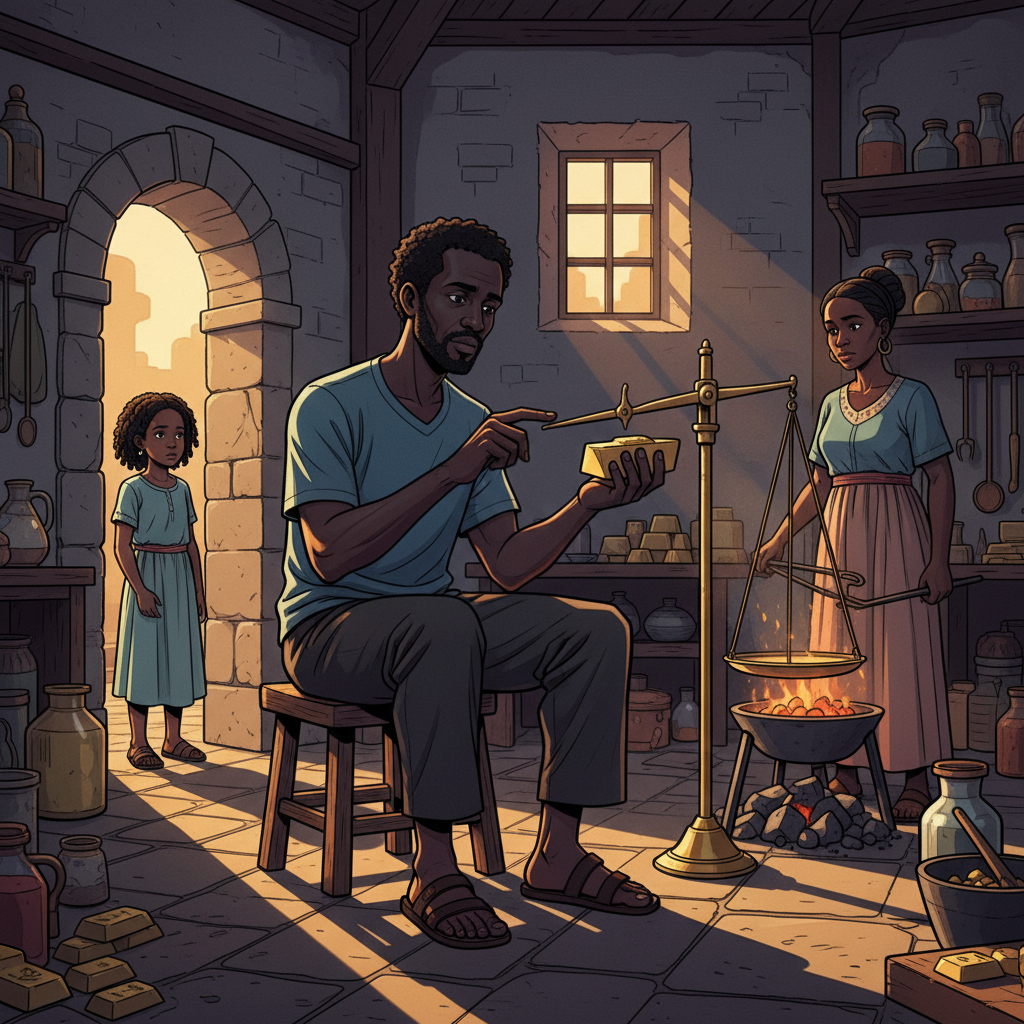
Hamisi sat with the third ingot still in his hand and the small brass tongue of the beam-balance pointing one width-of-a-hair past true. He did not speak for a long moment. Aisha had come quietly to the doorway, and Maridhia had returned from the brazier, and the three of them stood and watched him. He did not look at any of them. He looked at the tongue of the scale. Then he reached out with his right hand and tapped the brass tongue with the nail of his index finger. A single clear note rang out — a small bell-note, the sound of a fingernail on polished brass. It hung in the air of the testing room for a moment, very pure, and then faded. He turned to Mwanaisha. "You heard the tongue?" he said. "Yes," she said. He nodded. "Then we have a problem to solve."
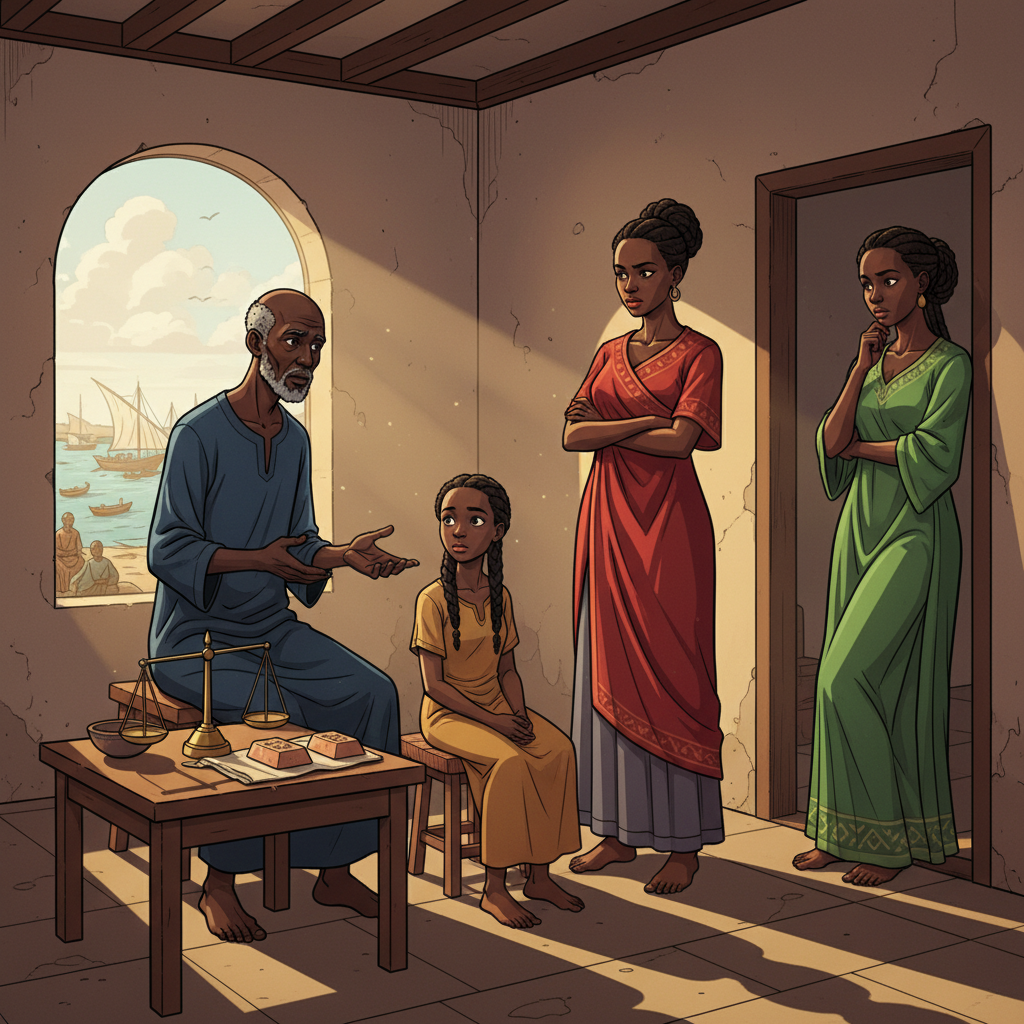
The problem was this: either Sulayman the Sofala merchant had been short-changing Kilwa for twelve years and was only now being caught, or someone in the supply-chain between Sofala and Kilwa had been substituting lower-ratio ingots after Sulayman sealed them. The first possibility meant a respected partner had been lying. The second meant a thief inside the trading network. Hamisi explained this to Aisha and Maridhia and to Mwanaisha in the small front room of the mint, in the late morning, while the sun rose higher and the harbor traffic outside the window picked up. Aisha listened without speaking. Maridhia, leaning against the doorframe, said quietly: "Sulayman is honest. I have known him fifteen years. The substitution is at our end of the route." Hamisi nodded slowly. "I agree. Someone here, or at Mafia Island where the ingots overnight, has been swapping the seals."
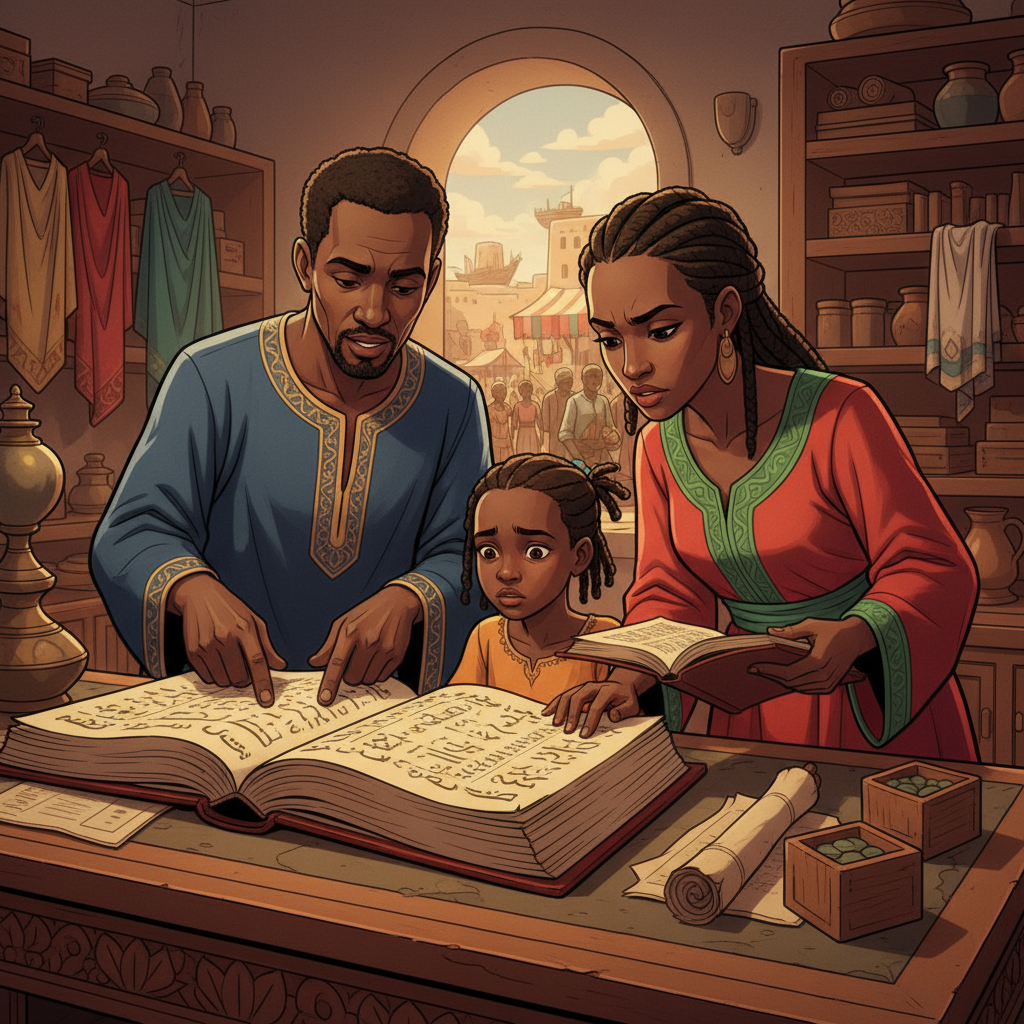
That afternoon Hamisi sent a runner to Sulayman's factor on Kilwa — a quiet man named Ali ibn-Hamza who lived in the merchants' quarter — asking him to come to the mint the next morning. Then Hamisi sat down with Aisha at her record-desk and they went through the mint's ledger for the previous twelve years, page by page. Mwanaisha sat with them. Aisha had recorded every shipment, every seal, every density-test. The records showed that Sulayman's ingots had tested at 78% gold for the first nine years. Then, in the tenth year, the recorded ratio dropped to 76%. By the eleventh year, 75%. This year, 74%. The slide had been slow enough that no single year's test looked suspicious. Hamisi had been accepting the slide for three years without seeing it.

"The teacher Konadu," Aisha said quietly, "in the books that came north from the Akan country two generations ago, wrote that our coast's reputation is one weight. One shaved coin and the whole reputation tips. I have always thought that line was poetic. Tonight I see it is practical." She closed the ledger. "We will catch whoever is swapping the seals. We will return the difference to Sulayman. And tomorrow we will tell Mwanaisha's father what we owe her." Hamisi did not contradict his wife. He sat with his hands folded on the closed ledger and looked at Mwanaisha. He did not say what we owe her right away. He said something quieter: "Tomorrow, daughter, you will sit at this desk with me when Ali ibn-Hamza arrives. You will tell him what you found. The mint's name is no longer only mine."
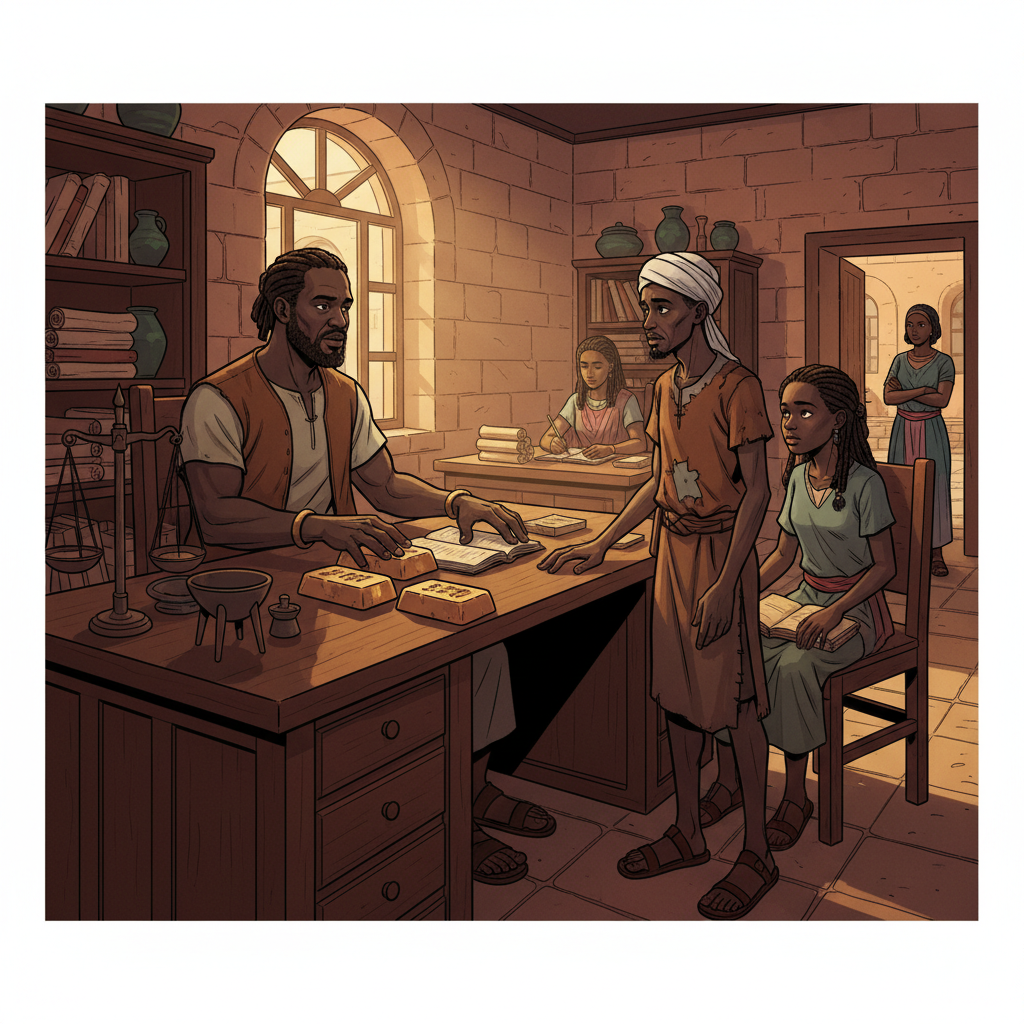
The next morning Ali ibn-Hamza arrived in his white turban and brown leather sandals, with the careful walk of a man who suspected he was being summoned about something he could not yet name. Hamisi sat at the front-room desk. Mwanaisha sat beside him. Aisha sat at the record-desk with the ledger open. Maridhia stood quietly by the courtyard door, listening. Hamisi did not raise his voice. He showed Ali the three ingots. He showed him the density-test results. He showed him the twelve-year ledger entries. He said: "The Sofala bullion arrives at 74% gold this year. It was 78% when Sulayman sealed it in Sofala. The substitution is happening between Sofala's warehouse and our scale. I would like your help finding where."

Ali ibn-Hamza did not protest. He did not deny. He was an honest factor and he had no reason to suspect any one of the porters or warehouse-keepers in the chain — but he had also been the man who routed Sulayman's shipments through Mafia Island for the last three years, because the new route had been slightly cheaper. He understood, sitting in front of Hamisi's twelve-year ledger, that the substitution had begun in the same year he had changed the route. He went pale under his deep brown skin. "Mafia Island," he said. "The new overnight warehouse. I will leave for Mafia tomorrow on the first dhow." Hamisi nodded. "I will write a letter to Sulayman explaining what has happened. We will refund him the four-percent difference on every shipment for the last three years out of our own treasury, before we recover it from whoever has been swapping the seals."
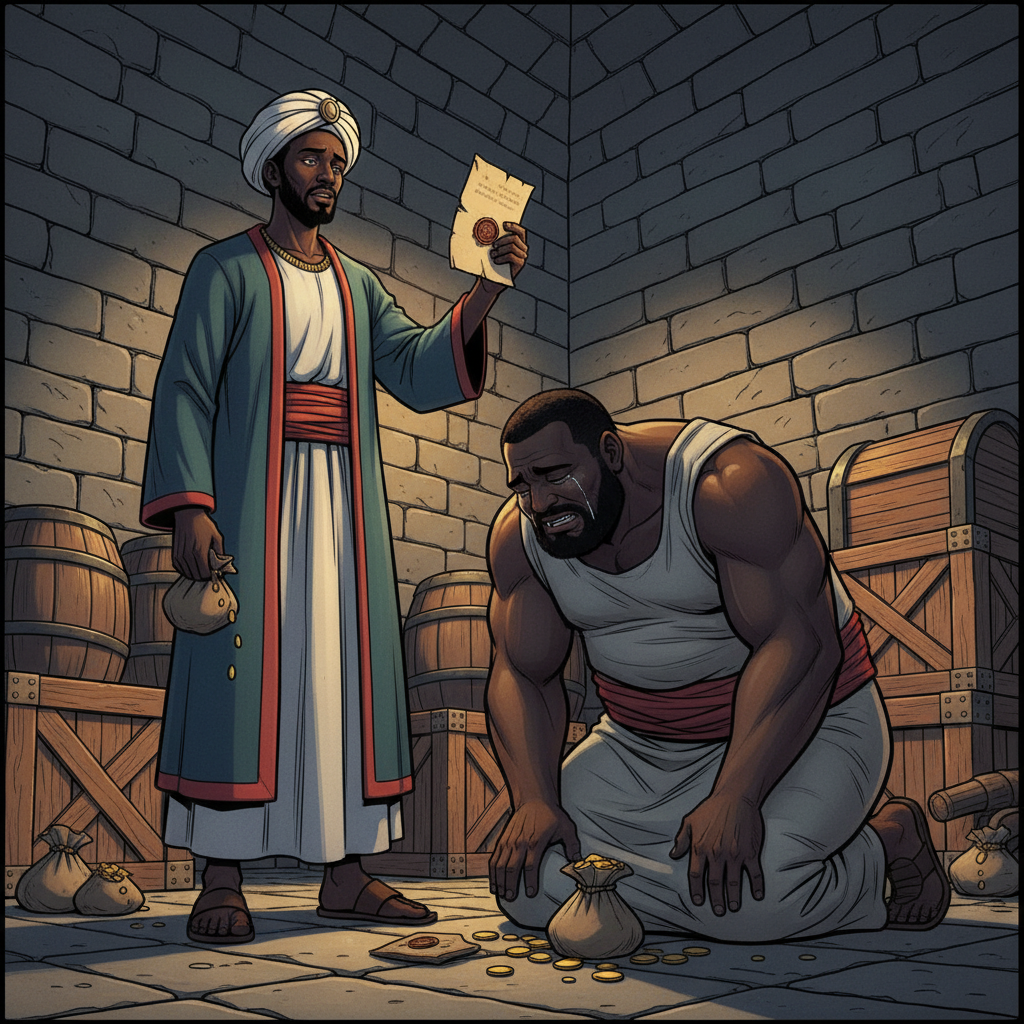
Ali ibn-Hamza left for Mafia Island the next dawn. He returned eleven days later with a wax-sealed letter, a confession, and a small pouch of pure gold. The warehouse-keeper at Mafia — a man who had begun the substitutions slowly, four percent the first year, hoping no one would notice — had broken down within an hour of Ali's arrival. He had hidden the substituted gold in his own cellar. Some of it was recovered. Some of it had been spent. The warehouse-keeper would be tried under Kilwa's law, his family would lose his earnings for a decade, and the route through Mafia Island would be closed in favor of a direct Sofala-to-Kilwa run that cost more but had no overnight warehouse. Hamisi's mint repaid Sulayman the full difference. Sulayman's next letter, when it came north, included a small extra shipment of gold — what he called a gift of friendship for an honest partner.
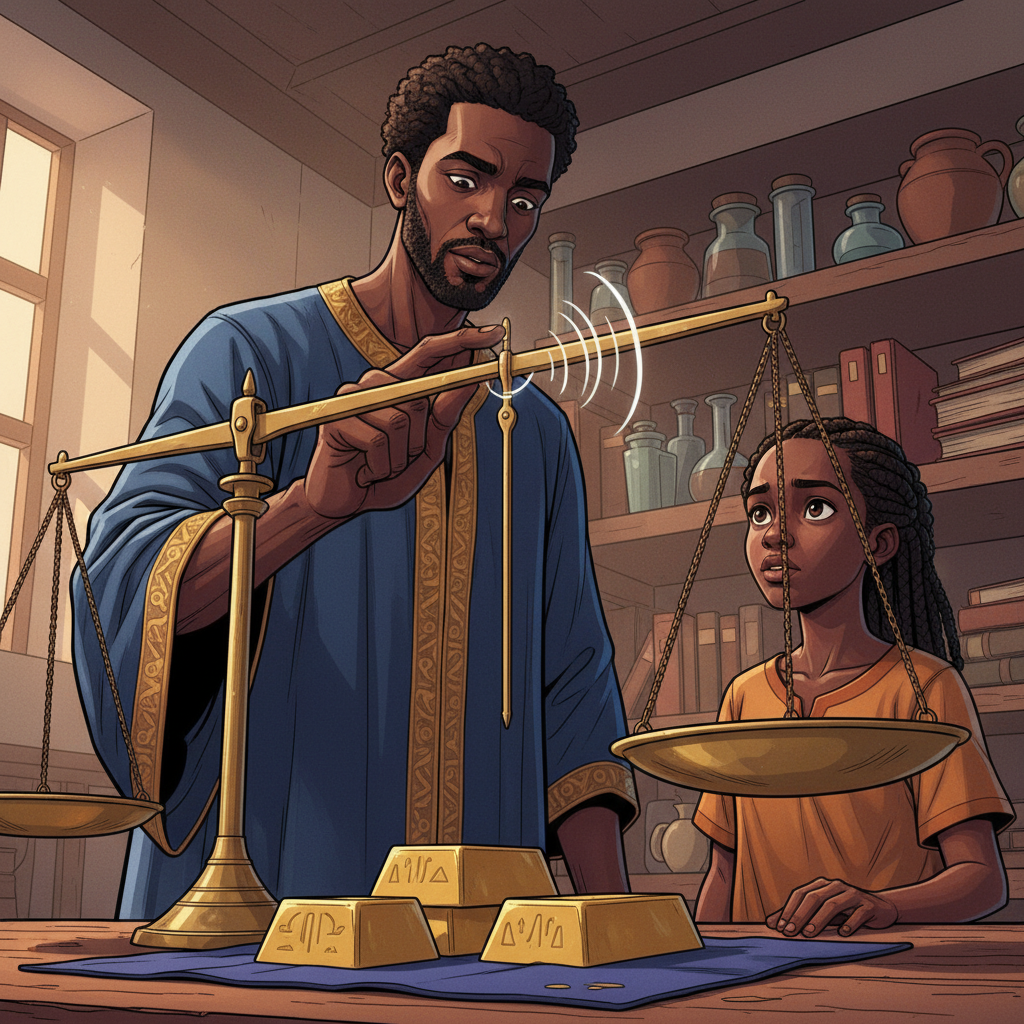
On the day Sulayman's letter arrived, Hamisi called Mwanaisha into the testing room. The three new ingots from the latest shipment — tested at 78% gold, the correct ratio at last — sat in their indigo cloth on the cedar table. The beam-balance's small brass tongue pointed straight up at true. Hamisi looked at his daughter for a long moment. Then he reached out and tapped the brass tongue again with his fingernail. The single clear note rang out — the same small bell-note. It hung in the air. "From this day," he said, "you will test the first ingot of every shipment yourself. Your name will be entered next to your mother's in the day's record. The mint's name is no longer only mine. It is now also yours."
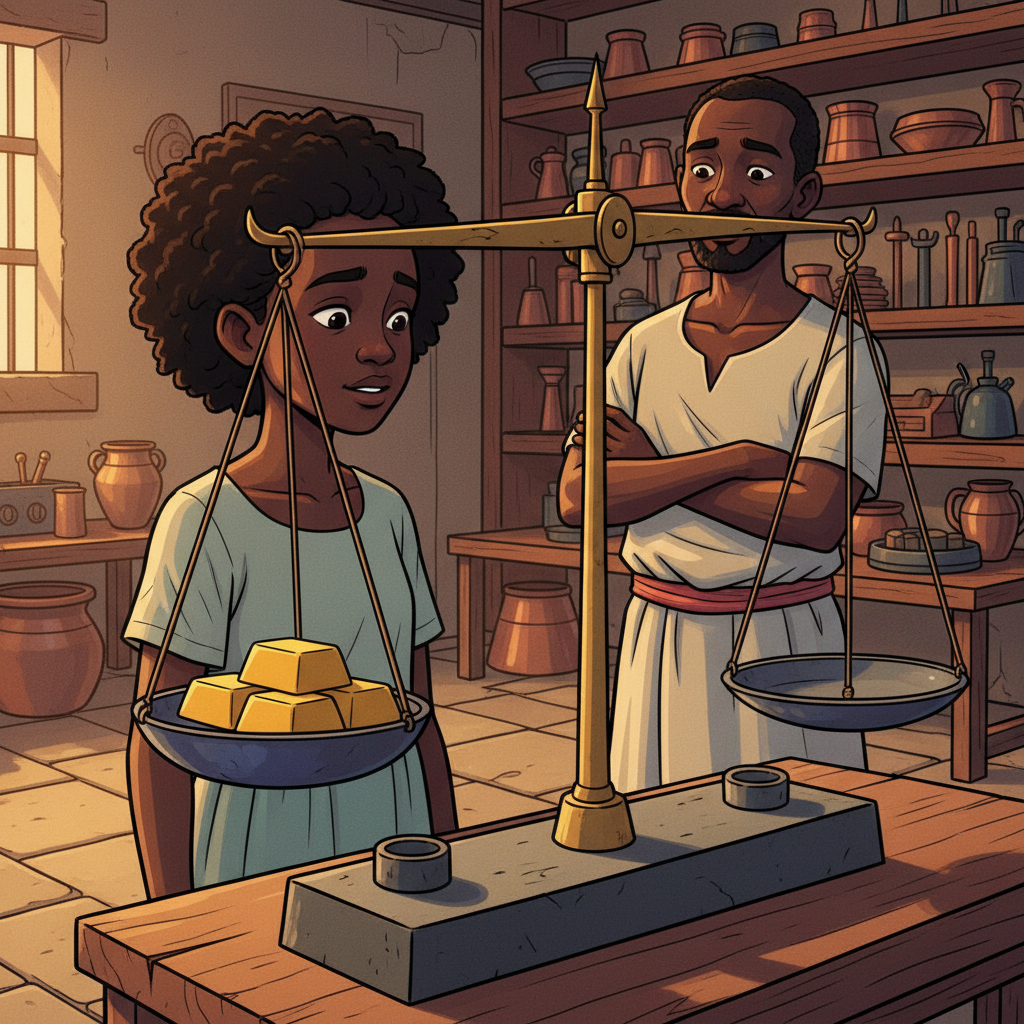
Mwanaisha did not say anything for a moment. She watched the brass tongue. It pointed exactly straight. She thought of how she had almost said nothing the morning of the 74% test. She thought of how the slow slide — 78% to 76% to 75% to 74% — could have continued another three years if her father had not been willing to listen to her. She thought of how every coin the mint had stamped for the last three years would have carried, invisibly, a small lie at its heart. The lie would have spread up and down the coast on every cargo, in every transaction, like an infection in the city's blood. Her father's reputation, and her mother's, and Maridhia's, and now her own — all four of them, attached to a brass tongue that pointed one width-of-a-hair past true.
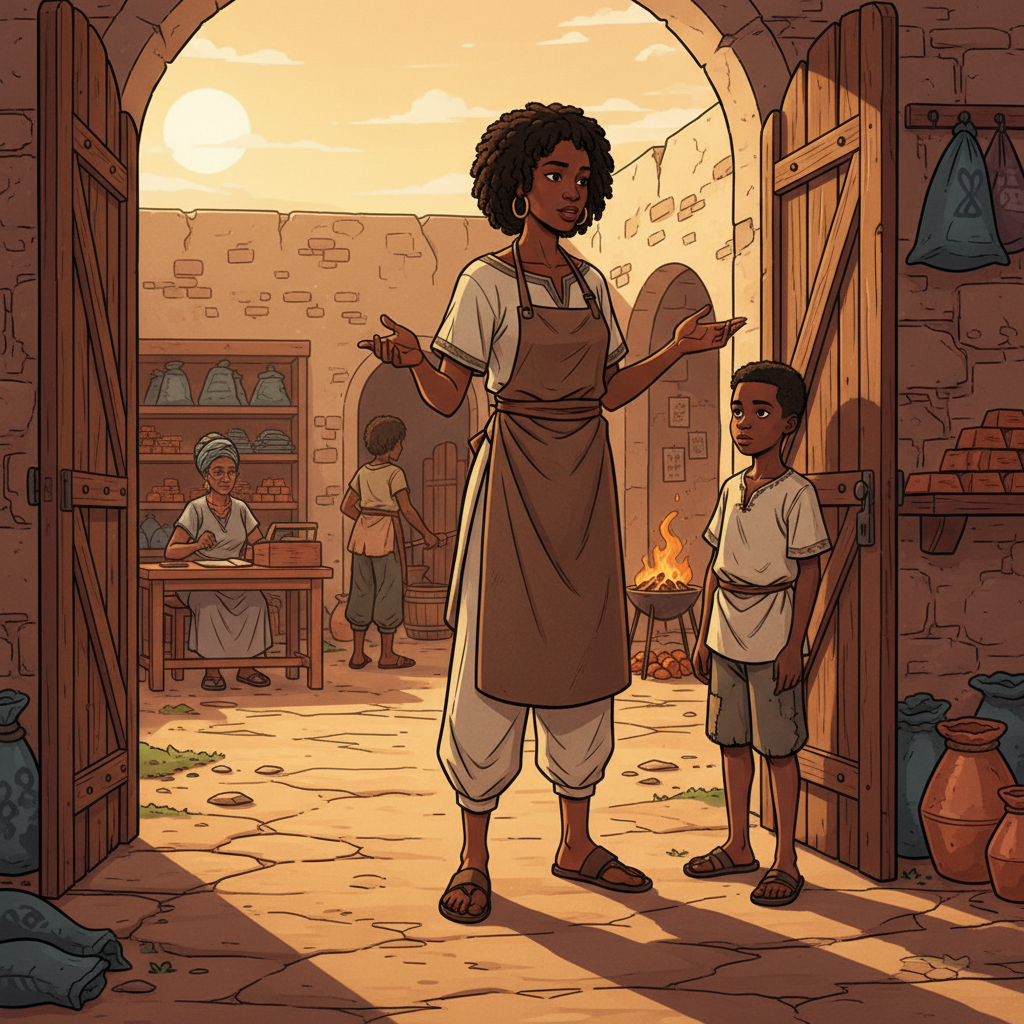
Ten years passed. Mwanaisha grew taller. Her hands grew steadier. Her father grew older. By the time she was twenty-three the mint had a second testing room and a third melter — Maridhia's younger sister — and the Kilwa mint's reputation had grown from "respected" to "untouchable." Hamisi retired the year Mwanaisha turned twenty-five. He moved to a small house on the harbor edge where he could watch the dhow ships come in. Mwanaisha became the new mint-master. Aisha continued at the record-desk. Maridhia continued at the brazier. On Mwanaisha's first day as mint-master, she walked into the courtyard at sunrise and found a boy of about eleven leaning against the gate. He was clean but his sandals were thin and his clothes were mended. He was deep brown-skinned, thin, with very steady eyes. "My name is Hamadi," he said. "My uncle says you might apprentice me. He cannot afford the fee."
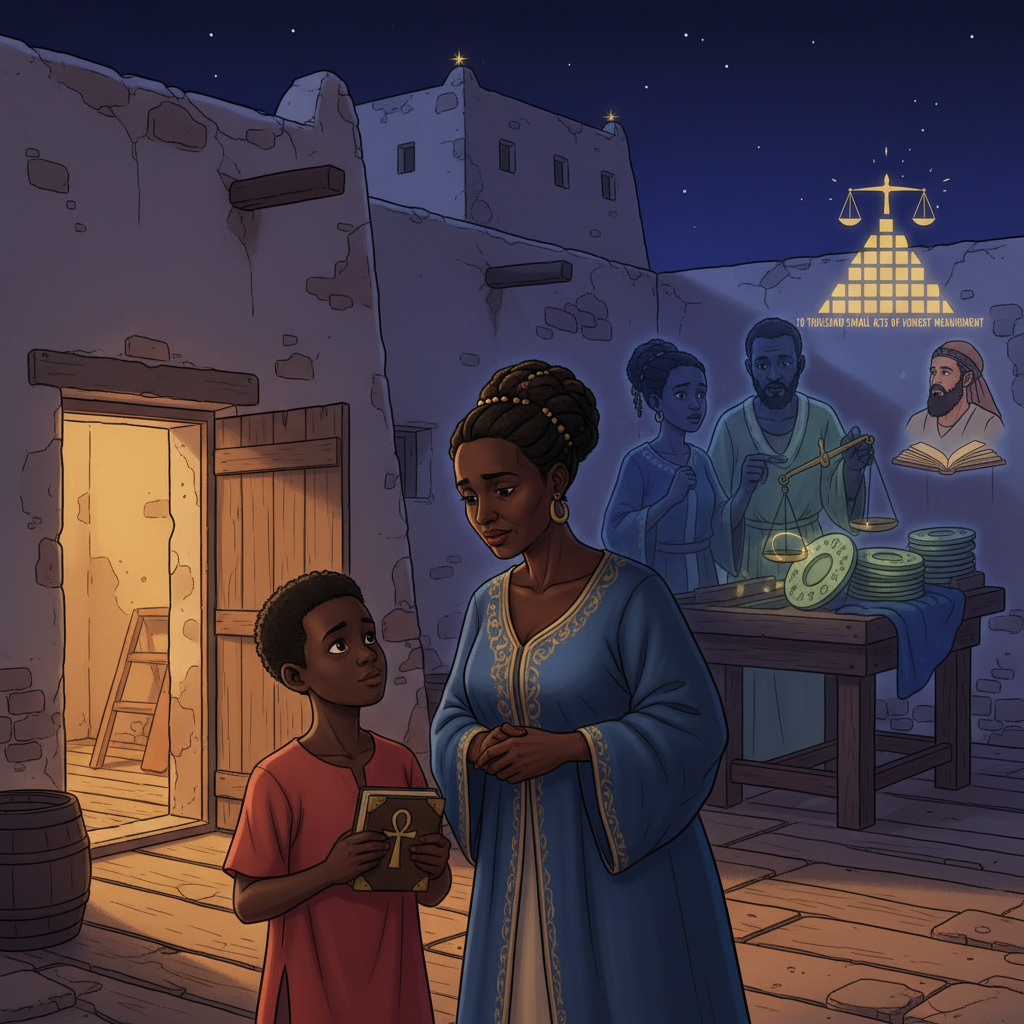
Mwanaisha looked at the boy. She remembered being thirteen, standing in front of a beam-balance, knowing she was right and being afraid to say so. She remembered her father's nail tapping the brass tongue. She remembered the single clear ringing note in the testing room's morning air. The teacher Konadu, she thought — Konadu whose books had reached her workbench by way of the Akan trade-routes a generation ago — knew, the way her father had known, that a great trading civilization is held up by ten thousand small acts of honest measurement. The mint's reputation was not a thing one mint-master could carry alone. It needed every generation to refuse to round. "Come inside," Mwanaisha said to Hamadi. "Your fees are waived. You will start at the brass tongue."

Hamadi came inside. Mwanaisha showed him the beam-balance. She showed him the water-bowl, the indigo cloth, the small brass tongue at the beam's exact center. She tapped the tongue with her fingernail, the way her father had tapped it twelve years before, and the single clear note rang out across the morning. "This is the heart of the mint," she said. "It points to truth or it does not. Your job is to listen to it. Some days you will hear it ring true. Some days you will hear it ring false. Your job is to say what you hear, both times. Not what you wish you heard. Not what is easy to say. What you hear." Hamadi nodded. He looked at the tongue. He looked at Mwanaisha. "Where does the gold come from?" he asked. Mwanaisha smiled. "Today's gold is from Sofala. Tomorrow we will trace the route together. Tomorrow you will learn the four-percent story."