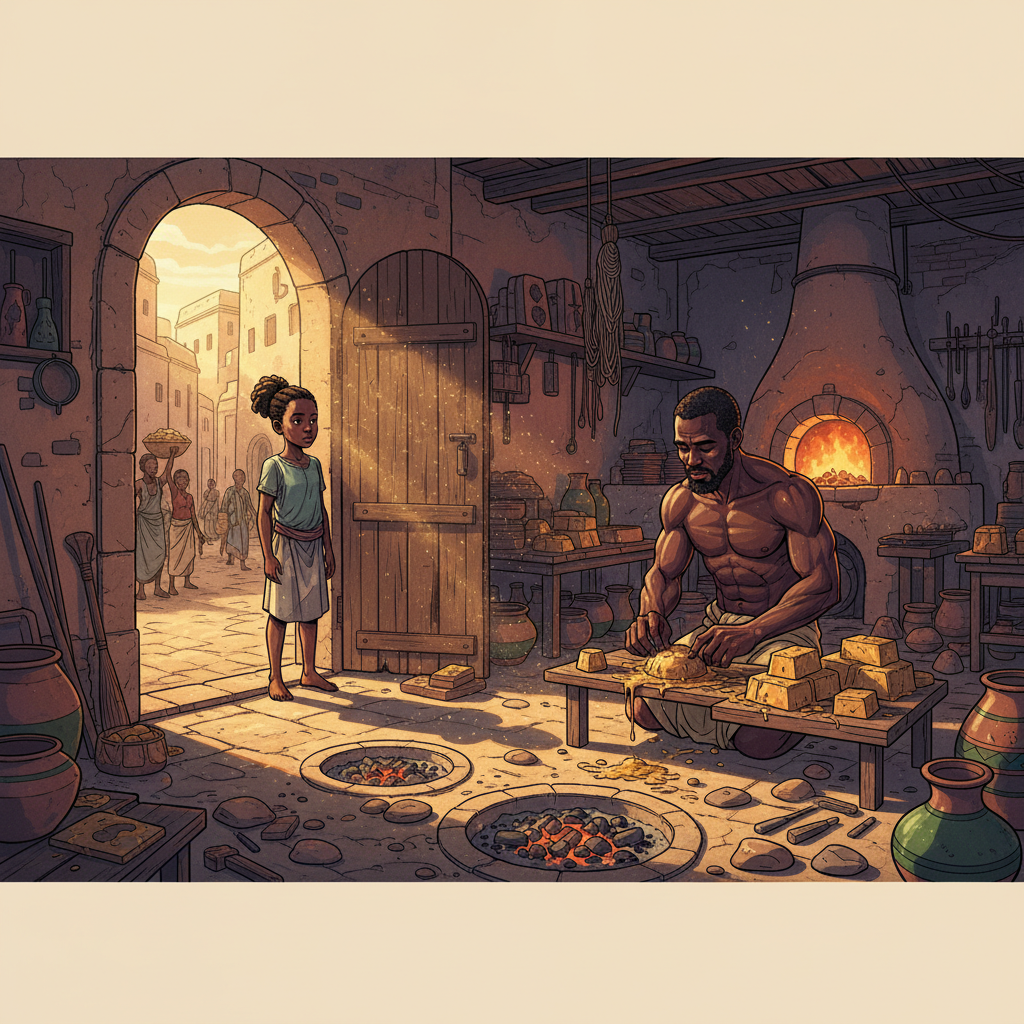
The smell of burning charcoal and melted beeswax filled the narrow street like a warm, invisible river. Nine-year-old Ife stood in the doorway of her father's workshop on Igun Street in the heart of Benin City, watching the morning light pour golden and thick across the clay walls. Her deep ebony skin glistened with a fine sheen of sweat, because even at dawn the workshop was hot — hot from the great clay furnace in the corner, hot from the charcoal pits glowing orange beneath their ash blankets, hot from the work that never stopped on this street where the bronze casters had labored for longer than anyone could remember. Ife's father, Osaro, knelt beside a wooden table covered with tools — thin metal scrapers, smooth river stones for polishing, bundles of fine cotton thread, and blocks of golden beeswax that caught the light like chunks of solid honey. His dark brown hands moved with a slowness that always surprised Ife, because her father was a big man with broad shoulders and strong arms built from years of pouring molten bronze. Yet when he touched the wax, his fingers became as gentle as if he were holding a newborn bird.
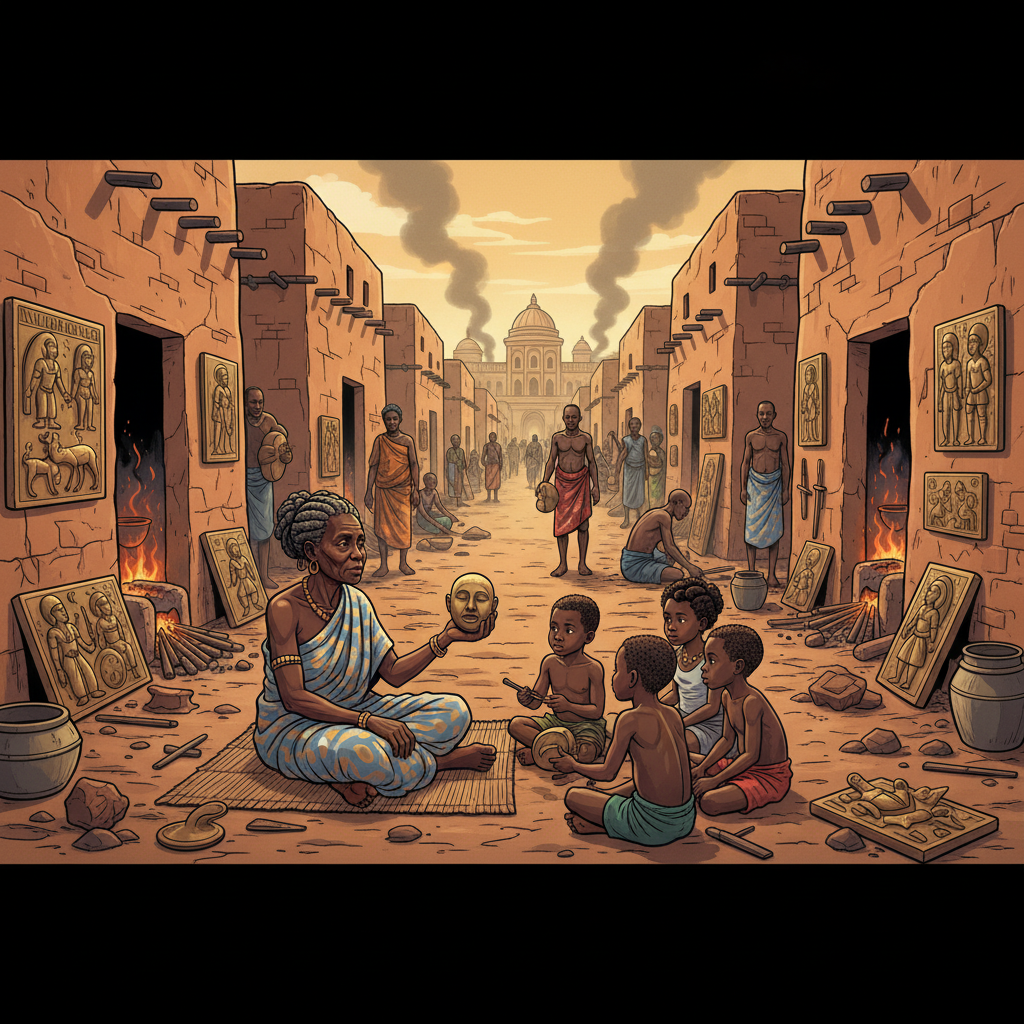
Igun Street was not like other streets in Benin City. While the rest of the great city hummed with traders selling palm oil and kola nuts, with dyers dipping cloth into vats of deep indigo, and with children chasing goats through the wide, straight avenues, Igun Street belonged to the Igun-Eronmwon — the sacred guild of bronze casters. Every house on this street was also a workshop, and every family here had been casting bronze for generations stretching back so far that the oldest grandmothers could not name the beginning. The Oba himself, the divine ruler of Benin, had given the Igun-Eronmwon their sacred duty: to create the bronze plaques, the ceremonial heads, and the magnificent figures that decorated the royal palace and recorded the kingdom's history in gleaming metal. No one outside the guild was permitted to cast bronze. It was not merely a craft — it was a holy trust, passed from parent to child like a living flame that must never go out.
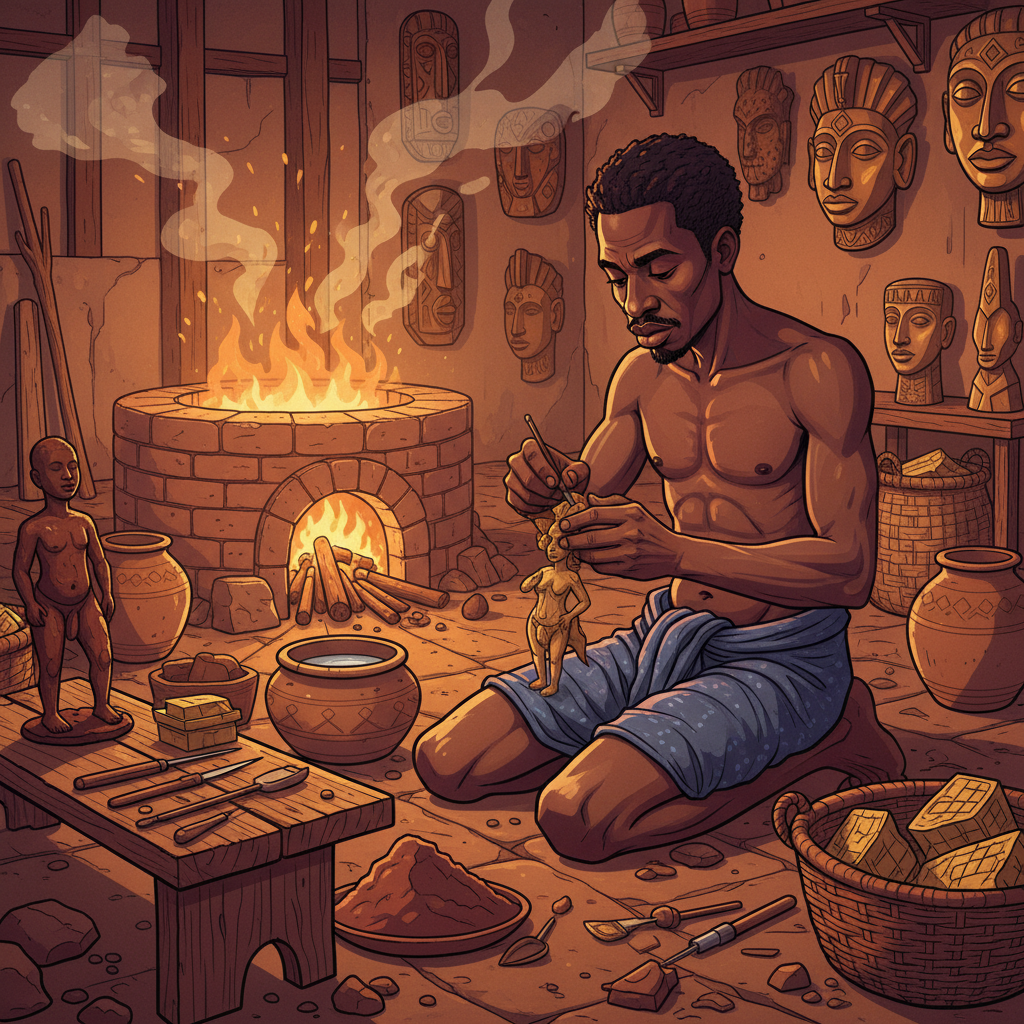
Ife had been watching her father work since she was old enough to crawl across the packed-earth floor of the workshop. She knew the names of every tool before she knew the names of the trees in the palace gardens. She could identify the quality of beeswax by its smell — sweet and clean meant it was fresh and ready, sour and crumbly meant it was old and would crack. And she had memorized, through years of patient watching, every step of the lost-wax casting process that made Benin's bronzes the most magnificent in all the world. First, the artist carved a figure from beeswax, shaping every detail — every fold of cloth, every strand of coral bead, every curve of muscle — with fingers and fine tools. Then the wax figure was coated in layers of wet clay, built up like wrapping a gift in thick, damp earth. When the clay dried hard as stone, the whole thing was placed in the furnace. The wax inside melted and poured out through tiny channels, leaving behind a perfect hollow mold. Finally, molten bronze — liquid metal glowing orange as the setting sun — was poured into the empty space where the wax had been. When the clay was broken away, a bronze figure emerged, an exact copy of the original wax carving.
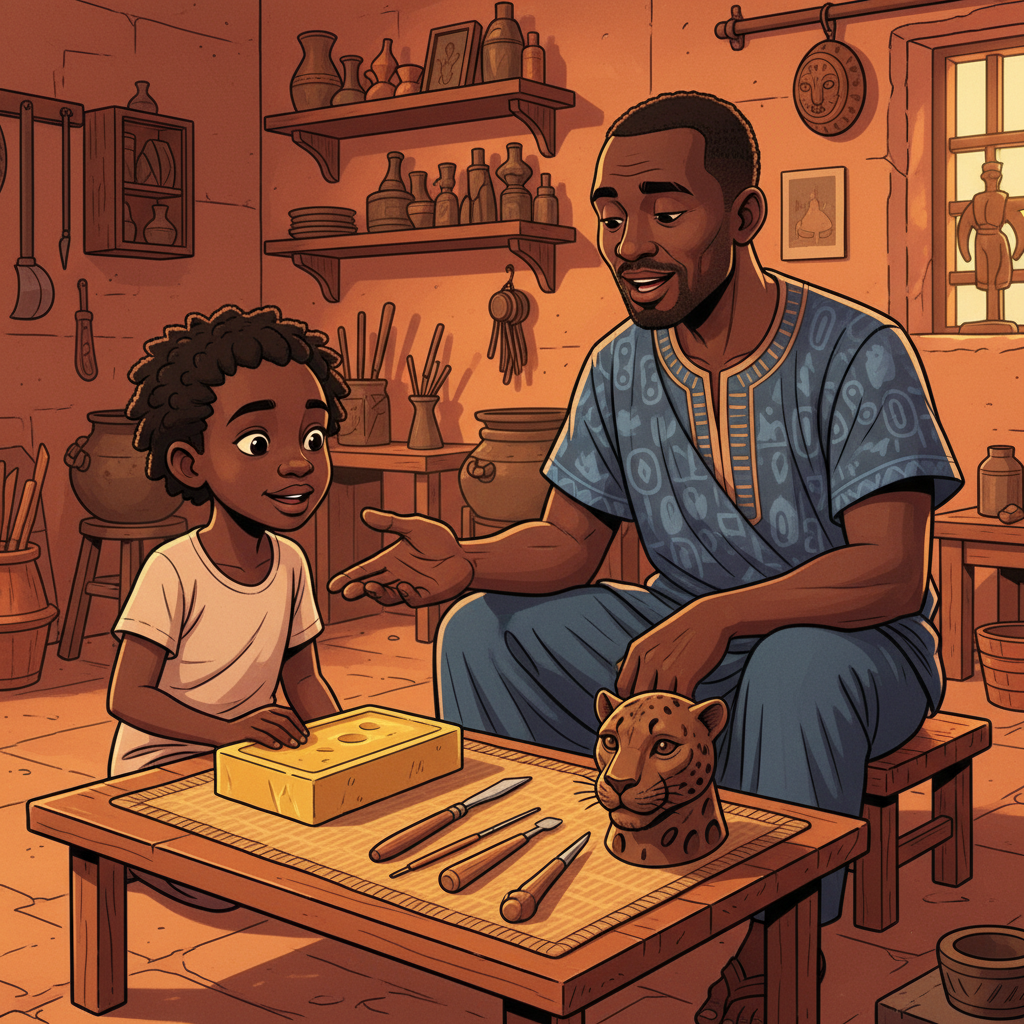
Today was the day Ife had been waiting for since her seventh birthday. Today, her father was finally going to let her carve her own wax figure from start to finish — her first real piece, not just a practice scrap to be melted down and reused. Osaro had set a fresh block of golden beeswax on the table in front of her, along with a set of carving tools that he had made especially for her smaller hands: a thin copper blade, a wooden shaping stick with a rounded tip, and a needle-fine scorer for detail work. "You will carve a leopard's head," Osaro said, settling onto his low stool beside her. His voice was deep and unhurried, like a drum beaten slowly. "The leopard is the symbol of the Oba's royal power. Every bronze caster of the Igun-Eronmwon must be able to carve the leopard before they carve anything else. It is our first test." He placed a small bronze leopard head on the table — one he had cast years ago — for her to study. The detail was breathtaking: the whiskers were as fine as real hair, the ears curved with perfect symmetry, and the eyes seemed almost alive, watching Ife with calm, ancient patience.
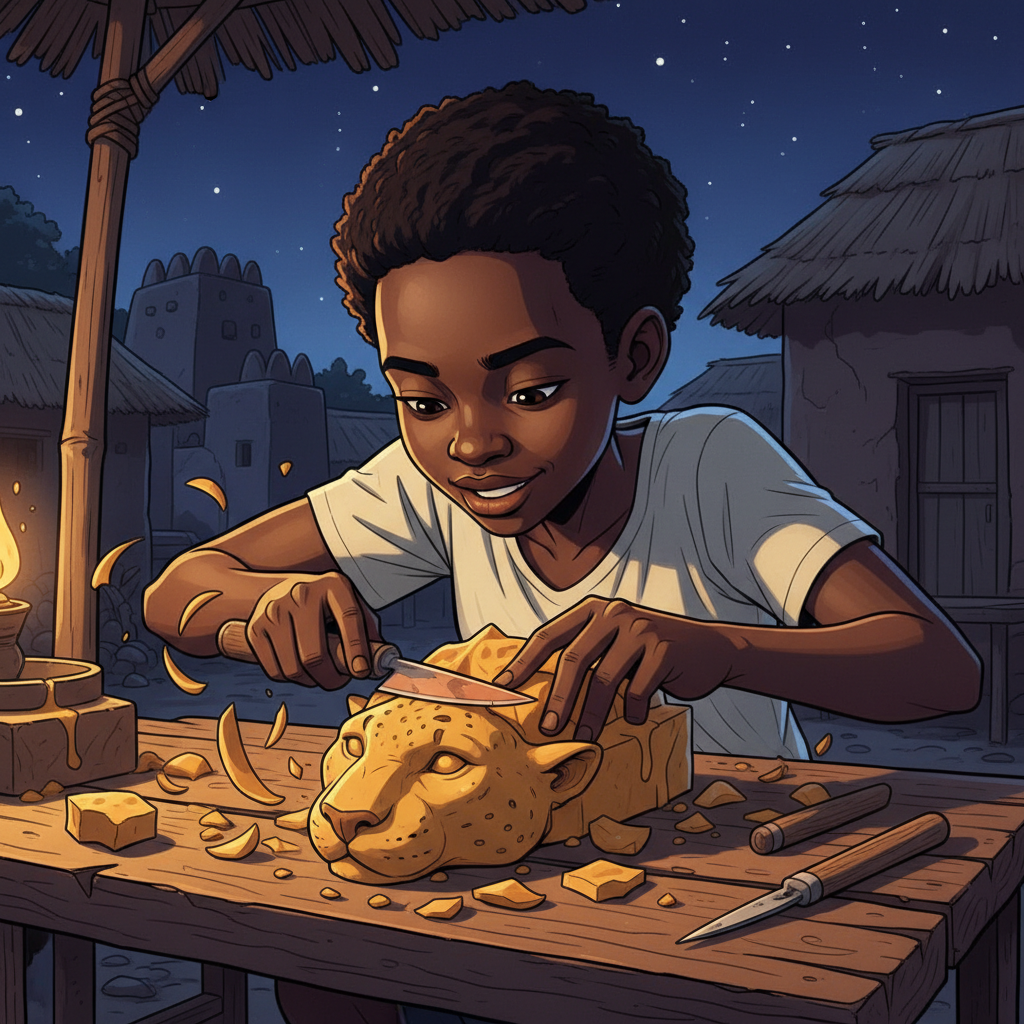
Ife picked up the wax block and turned it in her dark brown fingers, feeling its weight and warmth. She could already see the leopard inside it — or she thought she could. The shape was right there, waiting to be freed, like a bird waiting to fly. Her heart beat fast with excitement. She had watched her father carve hundreds of times. She knew exactly what to do. How hard could it be? She grabbed the copper blade and began cutting. Fast, confident strokes. She carved the basic shape of the head in just a few minutes, slicing away large chunks of wax that fell to the table like golden petals. The rough form appeared quickly — a rounded head, two pointed ears, the beginning of a broad nose. Ife grinned. This was easier than she had expected. She moved to the detail work, pressing the shaping stick into the wax to form the eye sockets, then using the scorer to scratch in the whisker lines. Her hands moved quickly, almost carelessly, because the shape was coming together and she wanted to see the finished piece as fast as possible.
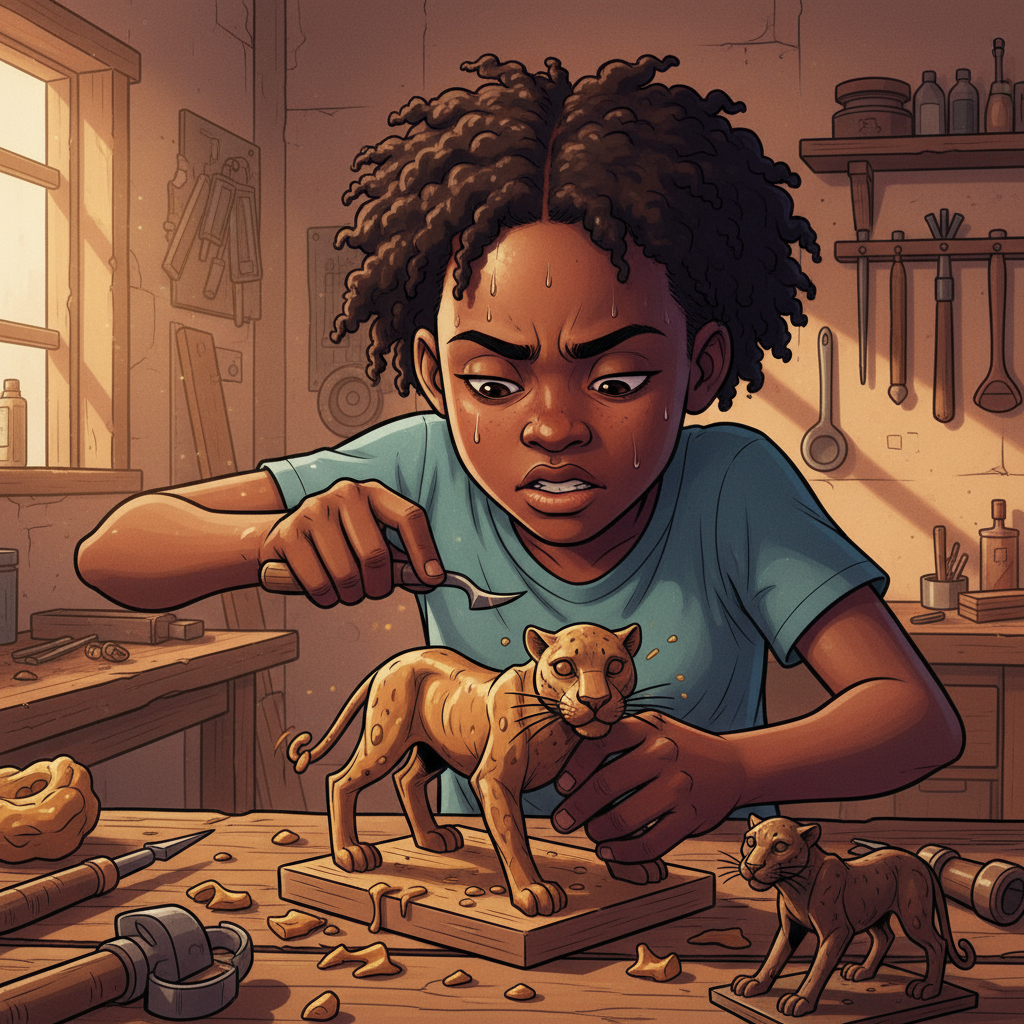
But something was wrong. The more she carved, the more the leopard seemed to resist her. One ear came out slightly larger than the other. When she tried to fix it by shaving the big ear down, she cut too deep and the ear became a thin, fragile sliver that looked nothing like the strong, curved ear on her father's bronze. The eyes were uneven — one sat higher than the other, giving the leopard a confused, dizzy expression. And the whisker lines she had scratched in with such confidence were jagged and uneven, like cracks in dry mud rather than the flowing, precise lines on the model. Ife frowned and pressed harder with her tools, trying to force the wax into the shape she wanted. She scraped and pushed and cut, her movements growing faster and more frustrated. Sweat dripped from her brow onto the wax, making it slippery under her fingers. "Come on," she whispered through clenched teeth. "Just look right. Just be right." But the harder she pushed, the worse it got. A chunk of the nose broke away under too much pressure, leaving a flat, ugly gap that made the leopard look like it had been stepped on.
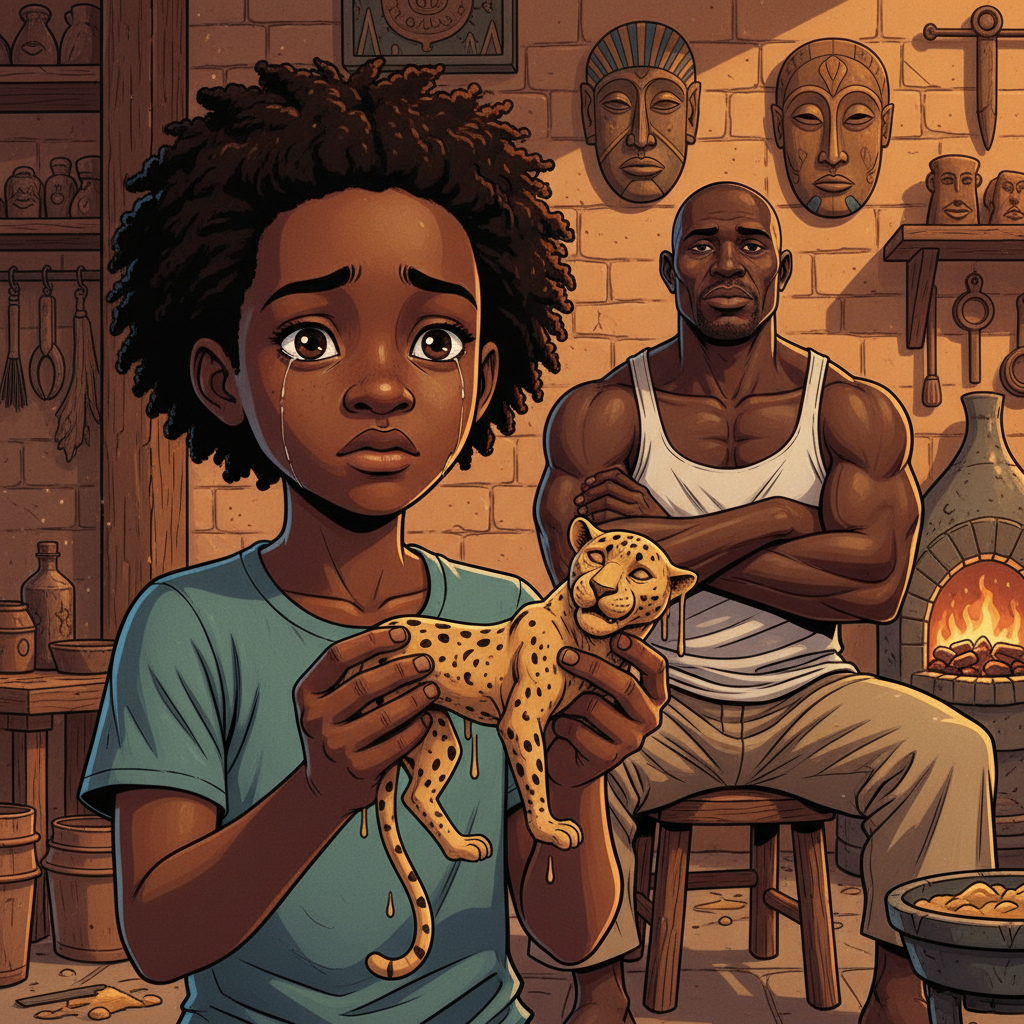
Osaro had been watching in silence the whole time. He sat on his stool with his thick arms folded across his chest, his face as calm and unreadable as the bronze masks that hung on the workshop wall. He did not correct her. He did not reach over to guide her hand. He simply watched, the way the river watches a stone that has fallen into its current. When Ife tried to apply the clay coating to her damaged wax leopard, the disaster became complete. The thin, uneven wax could not support the weight of the wet clay. As she pressed the first layer on, the fragile ear snapped off with a soft crack that sounded, to Ife, like her heart breaking. Then a section of the jaw crumbled inward, and then the whole left side of the face collapsed under the clay's pressure, folding in on itself like a flower wilting in the midday heat. Ife stared at the ruined mess of wax and clay in her hands. Her eyes burned with tears she was too proud to let fall.
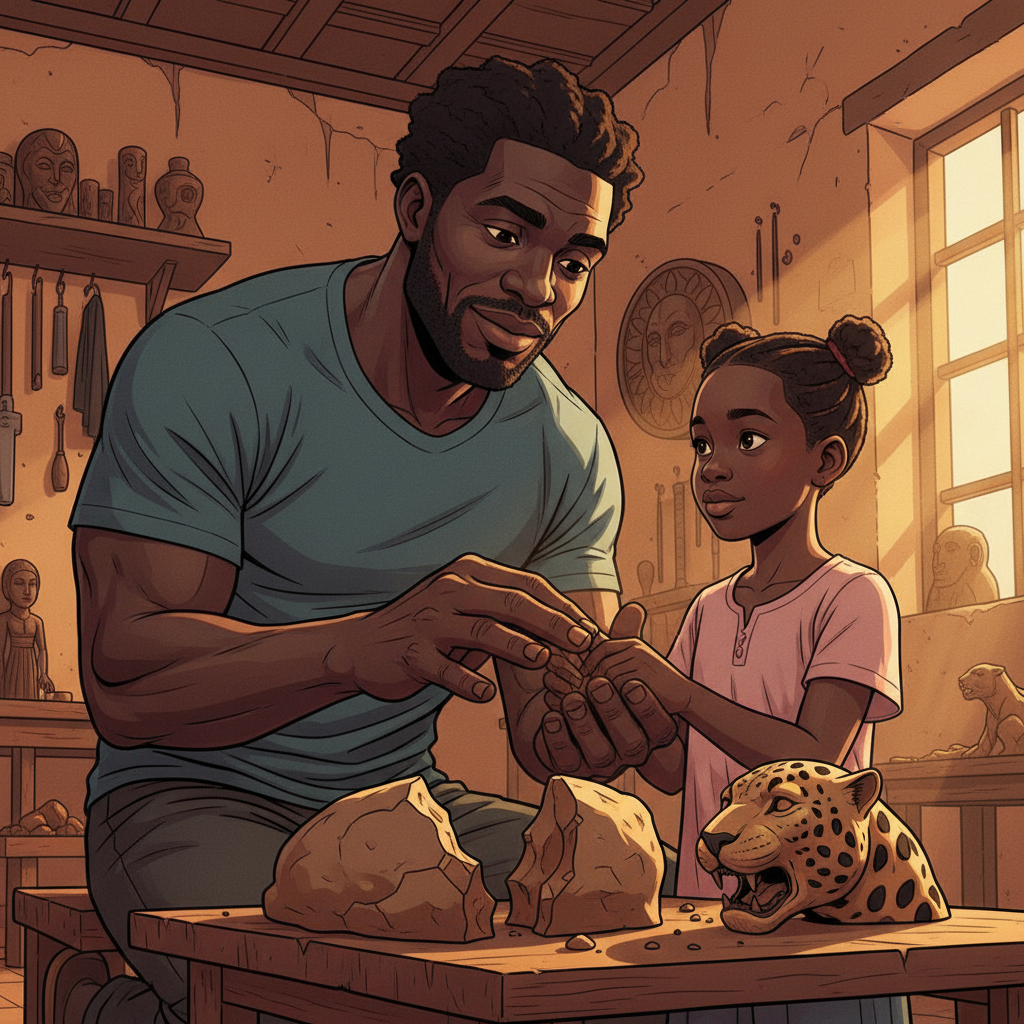
Osaro leaned forward and gently took the broken mold from Ife's hands. He set it on the table and looked at it for a long moment, as if reading a story written in the cracks and dents. Then he looked at his daughter. His dark eyes were not angry — they were warm and steady, like coals that have burned past their fiercest heat into something deeper and more lasting. "Do you know why the bronze remembers?" he asked quietly. Ife shook her head, not trusting her voice. Osaro picked up the small bronze leopard head — the perfect one — and held it in the light. "When you pour liquid bronze into the mold, it fills every space the wax once held. Every scratch, every fingerprint, every tiny mistake — the bronze records it all. You cannot hide careless work inside a mold, Ife. The metal is honest. It shows exactly what the carver's hands truly did." He set the leopard down and placed his broad, warm hand over hers.
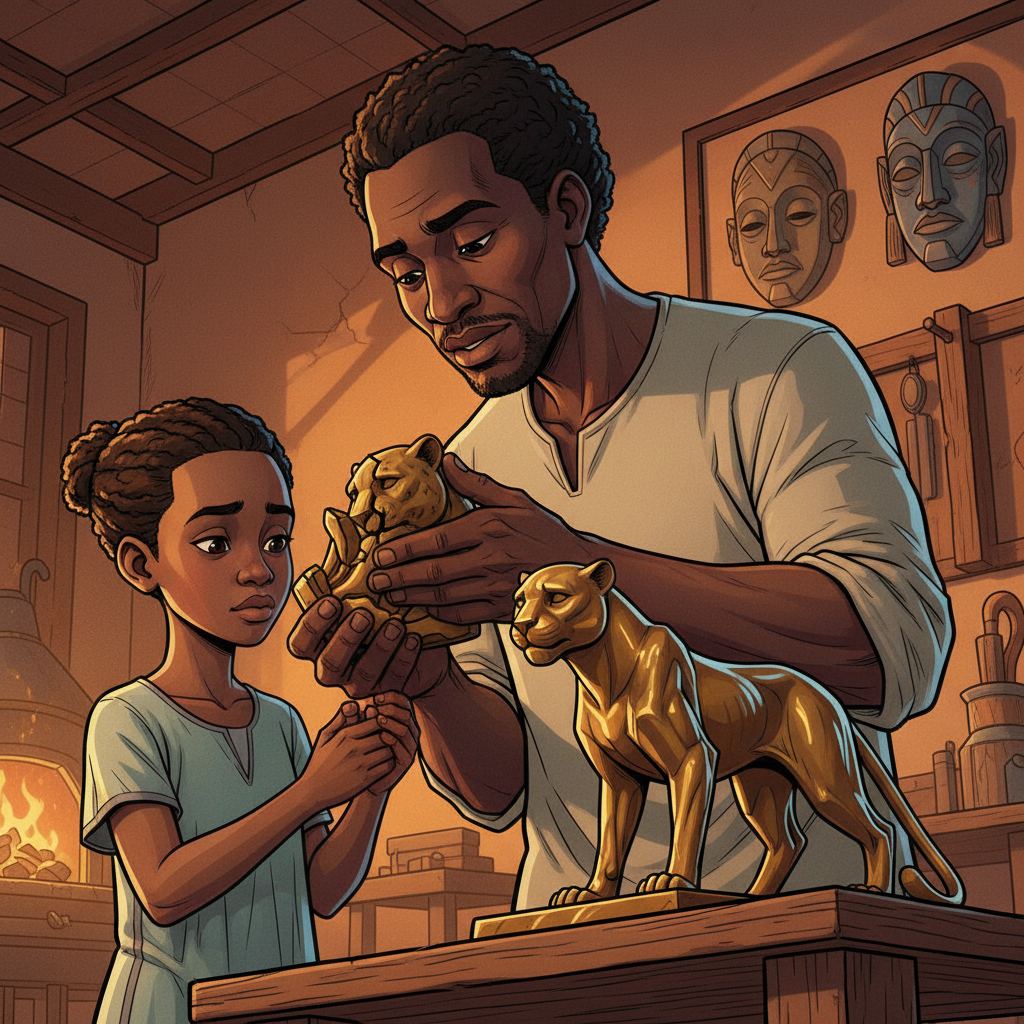
"In the kingdom of Kemet, far to the east, they call it Maat — the sacred truth that holds the world in balance. Here in Benin we know the same truth by a different name — every stroke of the carver's hand must be honest, or the bronze remembers the lie." Osaro squeezed her fingers gently. "You rushed, daughter. You wanted the finish before you had earned it. That impatience — that is what the old ones call isfet. Disorder. Chaos. The enemy of all good craft. When you rush the wax, you invite isfet into the bronze, and isfet cannot be melted away once it has been cast." Ife looked down at the ruined mold and then at her father's perfect leopard. The difference was not talent — she had watched enough to know that her father's hands had once been as uncertain as hers. The difference was patience. Every line on his leopard had been carved slowly, checked, adjusted, and checked again. His hands had not rushed toward the end. They had honored each moment of the making.
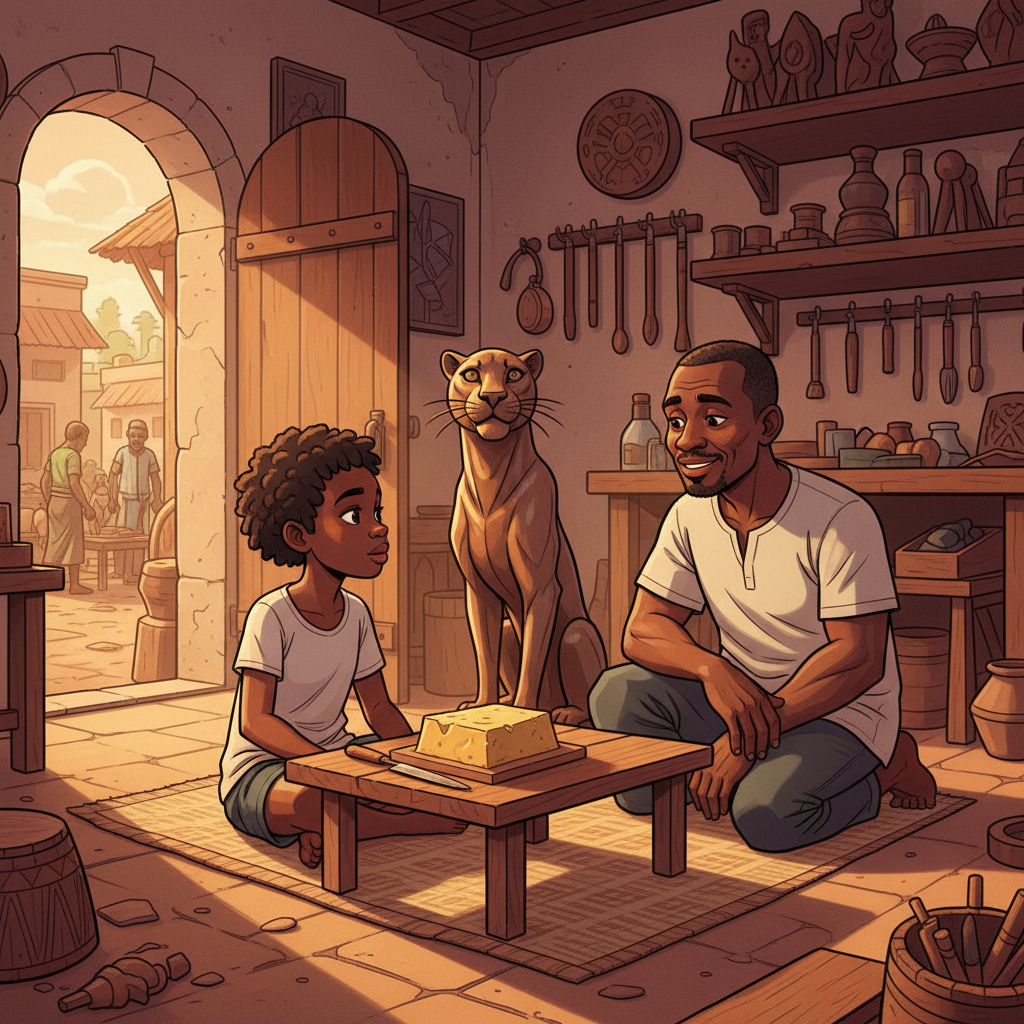
Ife wiped her eyes with the back of her hand and took a deep breath that filled her whole chest. "Can I try again, Baba?" she asked. Osaro smiled — a slow, wide smile that crinkled the corners of his dark eyes. "A true bronze caster of the Igun-Eronmwon always tries again," he said. He placed a fresh block of beeswax in front of her, golden and smooth and full of possibility. This time, Ife did not grab her tools. She sat still for a long moment, studying her father's bronze leopard the way she had seen him study the Oba's commissions — turning it slowly, tracing every line with her eyes before her hands ever touched the wax. Then she picked up the copper blade and made her first cut. Slowly. One careful stroke. She checked it against the model. She adjusted. Another slow stroke. The afternoon shadows crept across the workshop floor as Ife carved, and the sounds of Igun Street — the ring of hammers, the murmur of other casters at their work, the distant drums from the palace — wrapped around her like a warm cloth. Hour by hour, cut by patient cut, a leopard began to emerge from the wax. Its ears matched. Its eyes were level and alive. Its whiskers flowed in clean, graceful lines. When Ife finally set down her tools, the evening star was glowing in the purple sky above Benin City, and on the table before her sat a wax leopard so fine that Osaro pressed his hand against his chest and let out a breath he seemed to have been holding all day. "Now," he said softly, "the bronze will have no lies to remember." And Ife understood, deep in her bones, that maat lived not only in the finished bronze but in every patient, honest moment of its making.