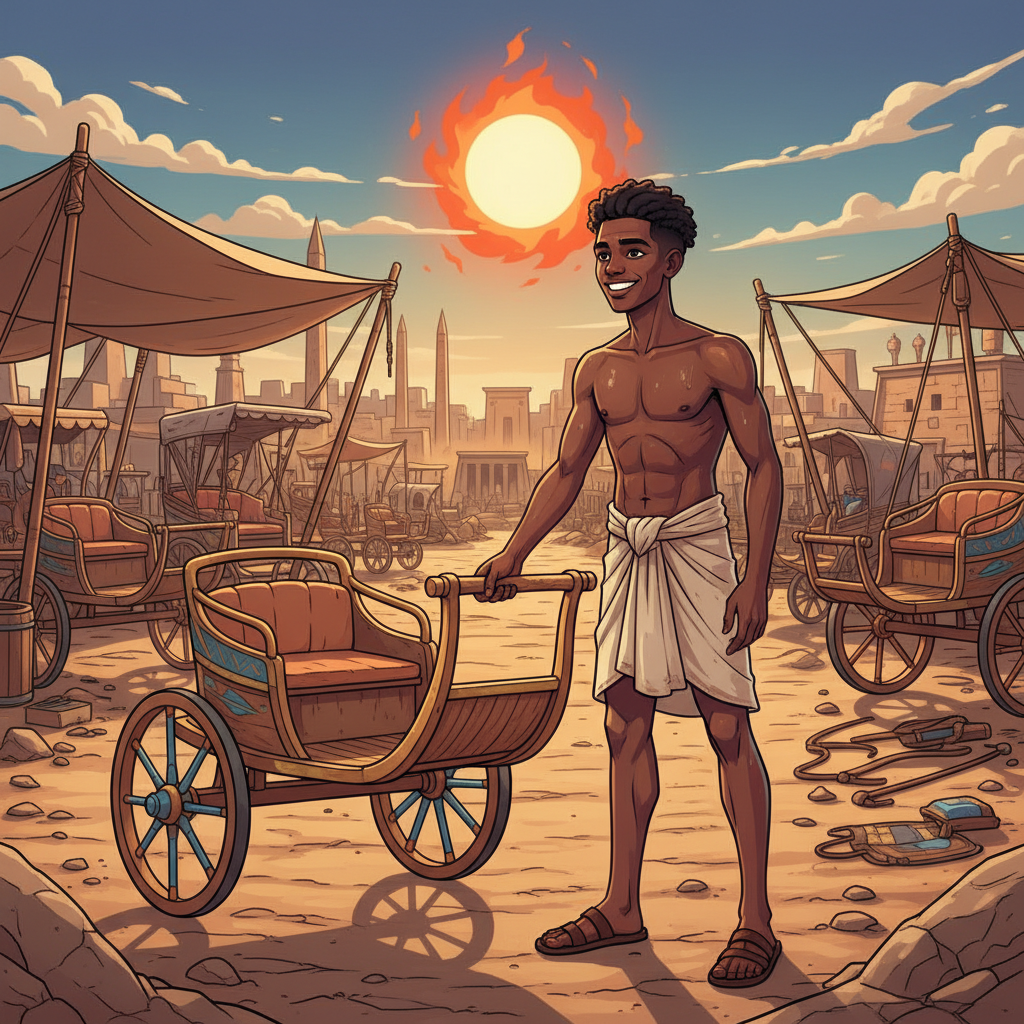
The sun, a fiery eye of Ra, beat down on Djedhor's back as he tightened the last leather strap. Sweat beaded on his deep brown skin, mingling with wood dust. Fourteen summers had passed since his birth in Kemet, and today, he felt the weight of them all, balanced with the lightness of pure joy. His own apprentice chariot, smaller than his father's grand racing models, stood gleaming before him. Its acacia wood frame, sanded smooth, promised speed and freedom. The wheels, carefully crafted, hummed with anticipation, ready to carry him across the fields near Waset. He ran a hand over the polished rail, a smile stretching across his face, revealing teeth as white as Nile ivory. This chariot was a piece of his soul, born from long hours of apprenticeship in his father's bustling workshop.
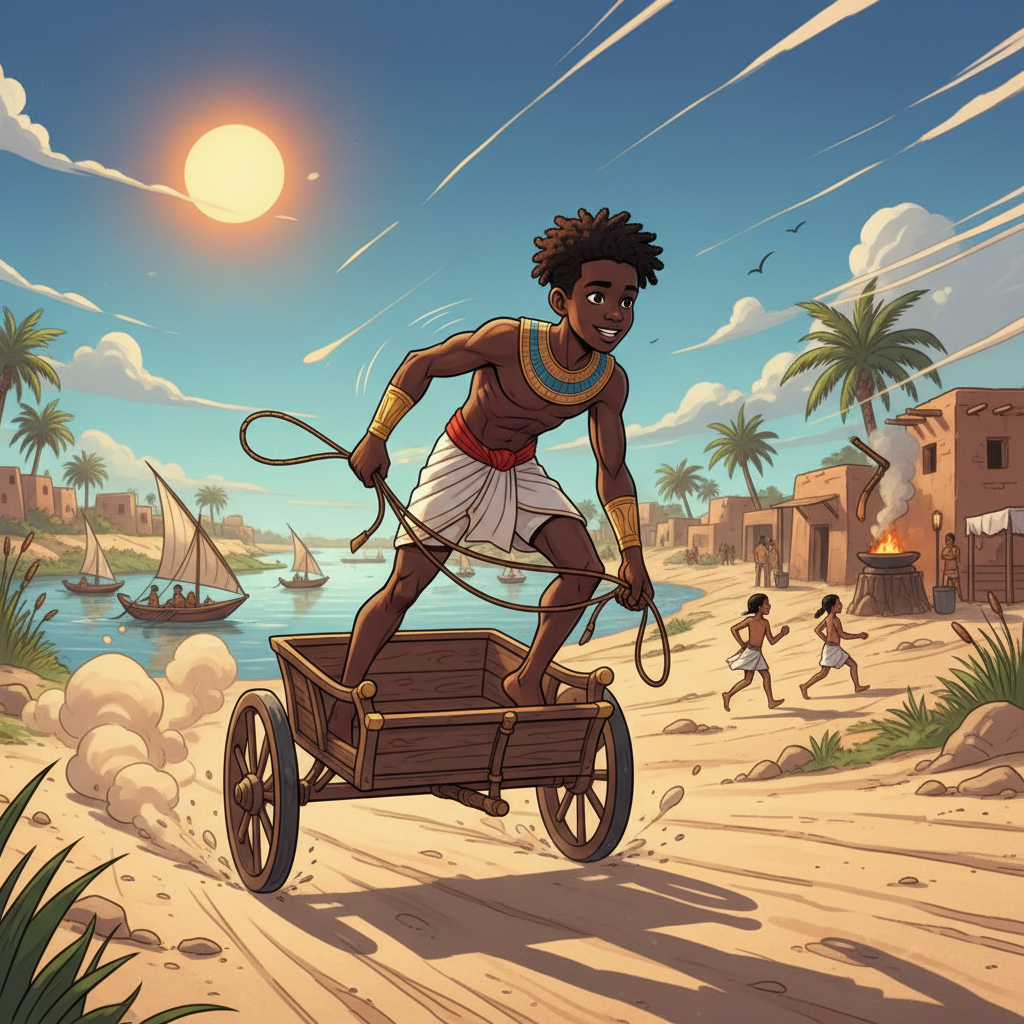
With a triumphant shout, Djedhor wheeled the chariot out into the open practice yard. The air hummed with the busy sounds of the village – distant shouts from the river, the rhythmic clang of the blacksmith, the chatter of children. But Djedhor heard only the pounding of his own heart. He climbed into the driver's seat, the leather warm beneath him, and imagined the powerful horses that would one day pull a full-sized chariot. For now, his strong legs would be the engine. He pushed off, the small chariot rolling forward, gathering momentum. The wind rushed past his ears, a whispered song of freedom. He weaved and turned, feeling the balance, the control, the perfect alignment of wood and will.
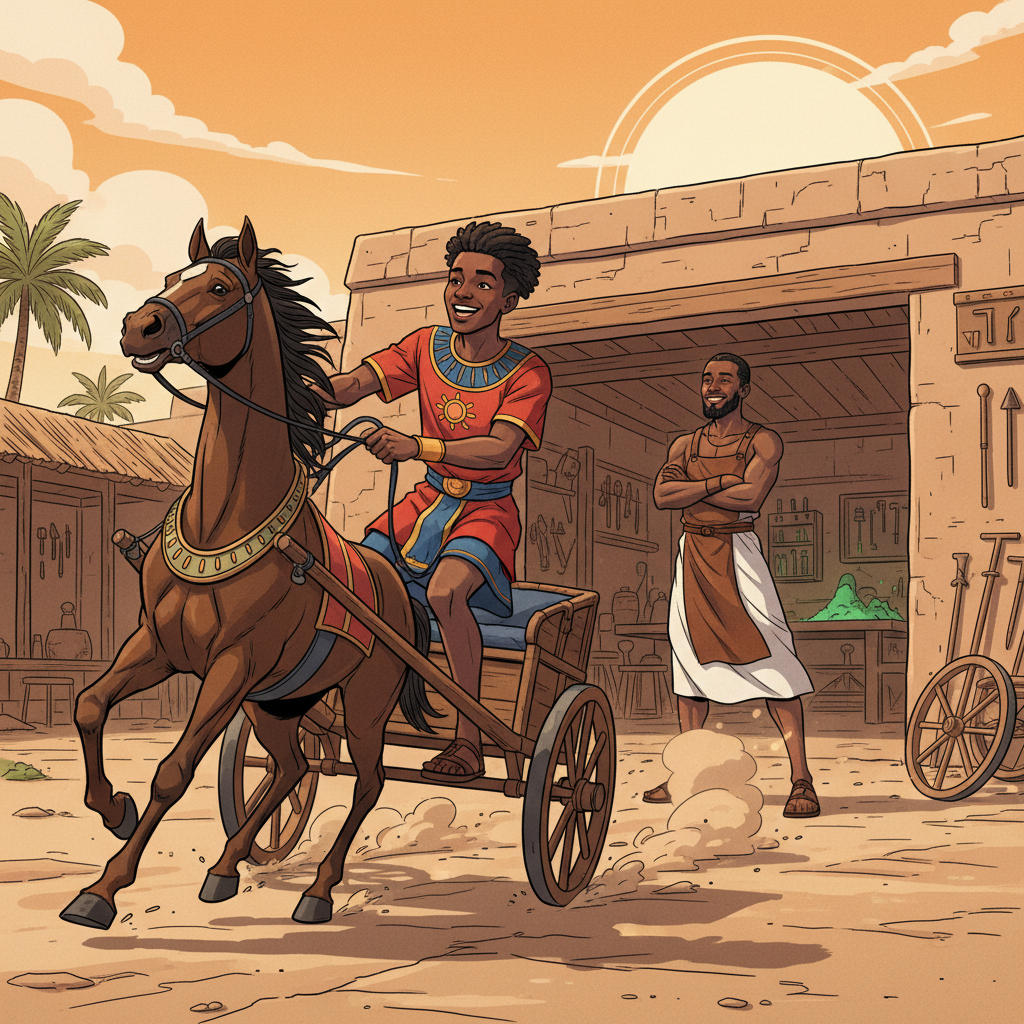
Each turn was smoother, each push more powerful. Djedhor laughed aloud, a sound as bright as the morning sun. He pictured himself a great charioteer, racing through the desert, a blur of speed and skill. He practiced tight turns, mimicking the maneuvers his father, Khensu, taught him. From the workshop doorway, Khensu watched, a proud smile on his face, his arms crossed over his leather apron. Djedhor felt his father's gaze, adding to his confidence. He pushed harder, reveling in the feeling of being one with the chariot, a fleeting moment of perfect Maat, where everything felt right and in its place. He wanted to feel this exhilarating rush forever, pushing the limits of speed and control.
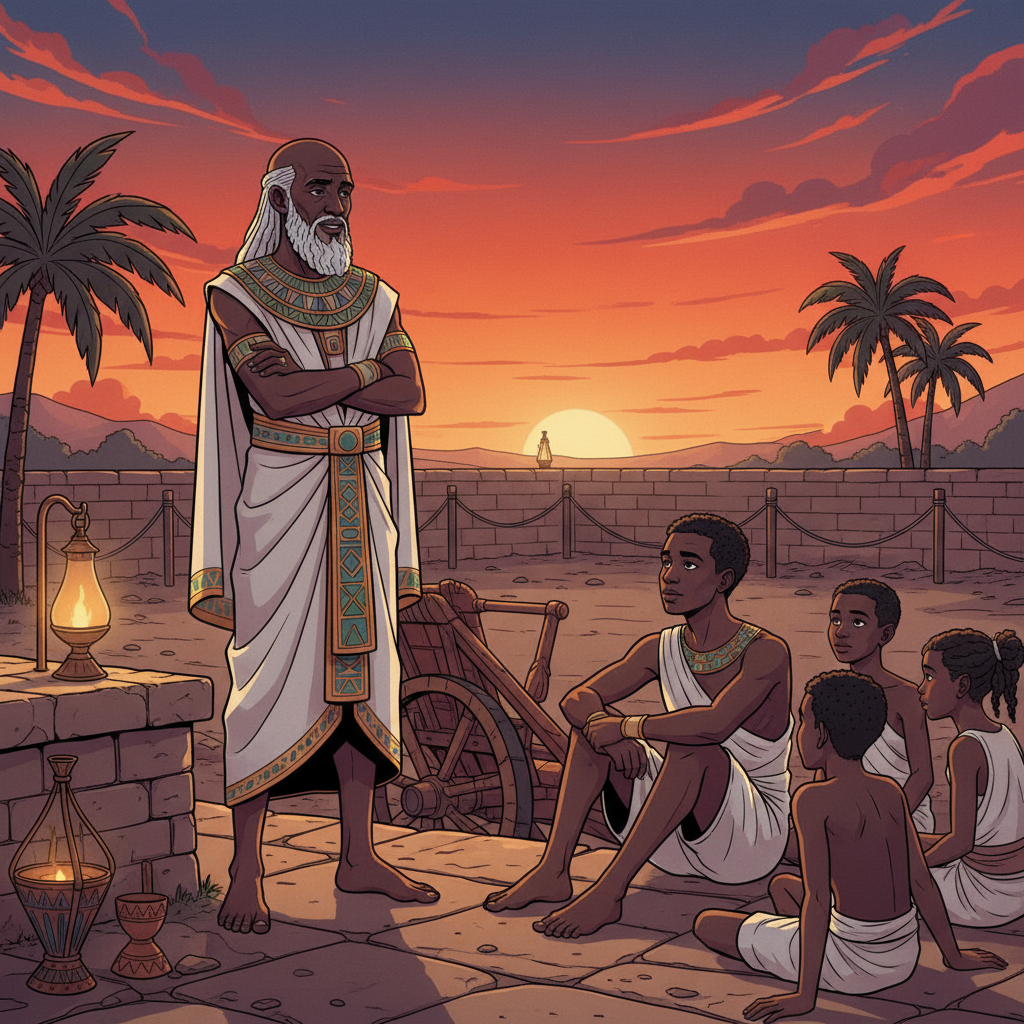
Later that evening, as the sun dipped below the horizon, painting the sky in fiery hues, Khensu spoke. His voice, usually booming, was soft but firm. 'Djedhor, my son, your skill grows with each passing day. The Neteru bless your hands.' He paused, his gaze sweeping over the practice yard. 'But remember, the designated area is for a reason. The ground beyond these marks is uneven, treacherous. It holds hidden ruts, unseen by the eager eye. We practice within boundaries, not to limit you, but to protect you, to ensure your Ka remains strong and your Djed stable. Understand this, my boy.' Djedhor nodded, his chest still full of the day's exhilaration, a small part of him already thinking of the forbidden open fields.
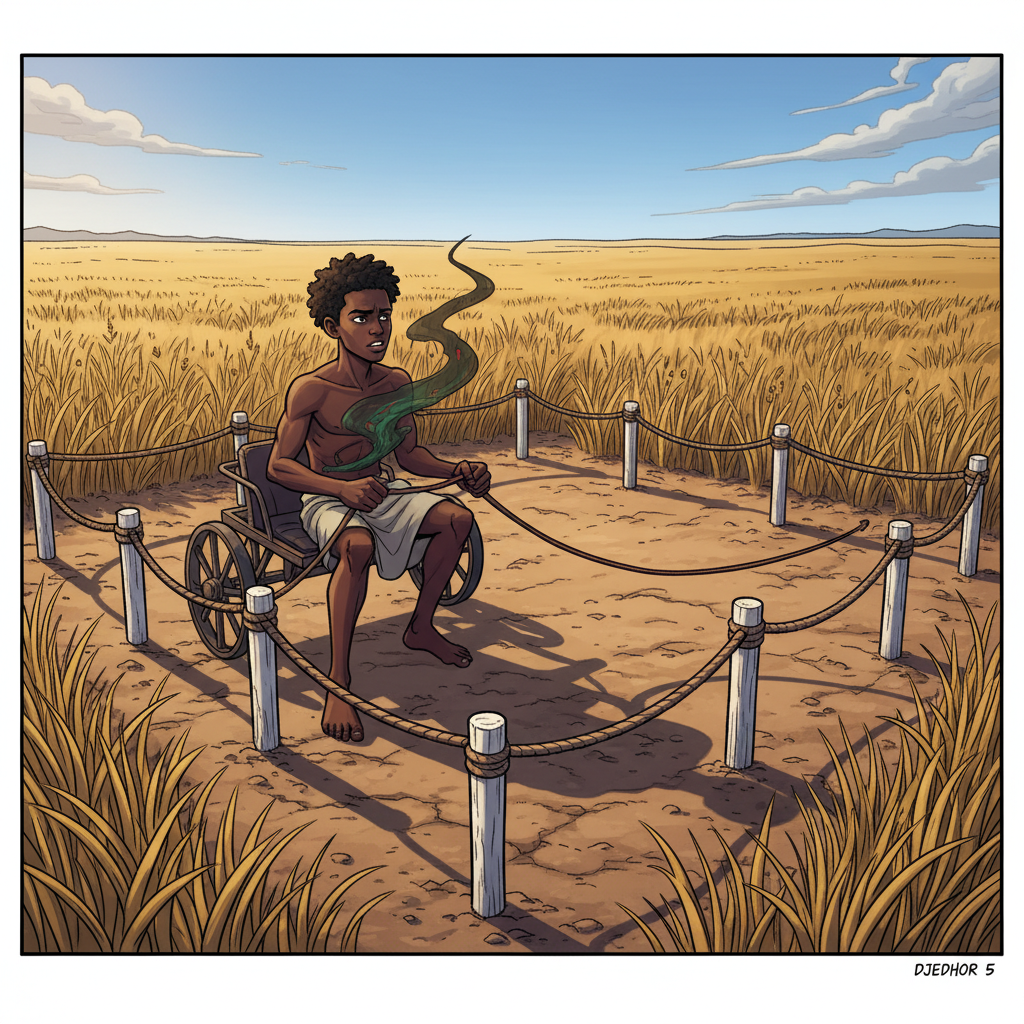
The next few days, Djedhor followed his father's instruction, staying within the marked area. But the practice yard, which once felt vast, now seemed to shrink. He longed for more space, more speed, the thrill of untamed ground. The call of the vast, flat fields beyond their boundaries echoed in his mind, a tempting whisper. He imagined the feeling of truly letting go, of pushing the chariot to its absolute fastest, unrestrained by visible lines. Wasfet, the spirit of disorder, began to stir within him, urging him to challenge what he perceived as limits, not protection. He felt a growing impatience with the sensible rules, seeing them as barriers to his potential, not safeguards.
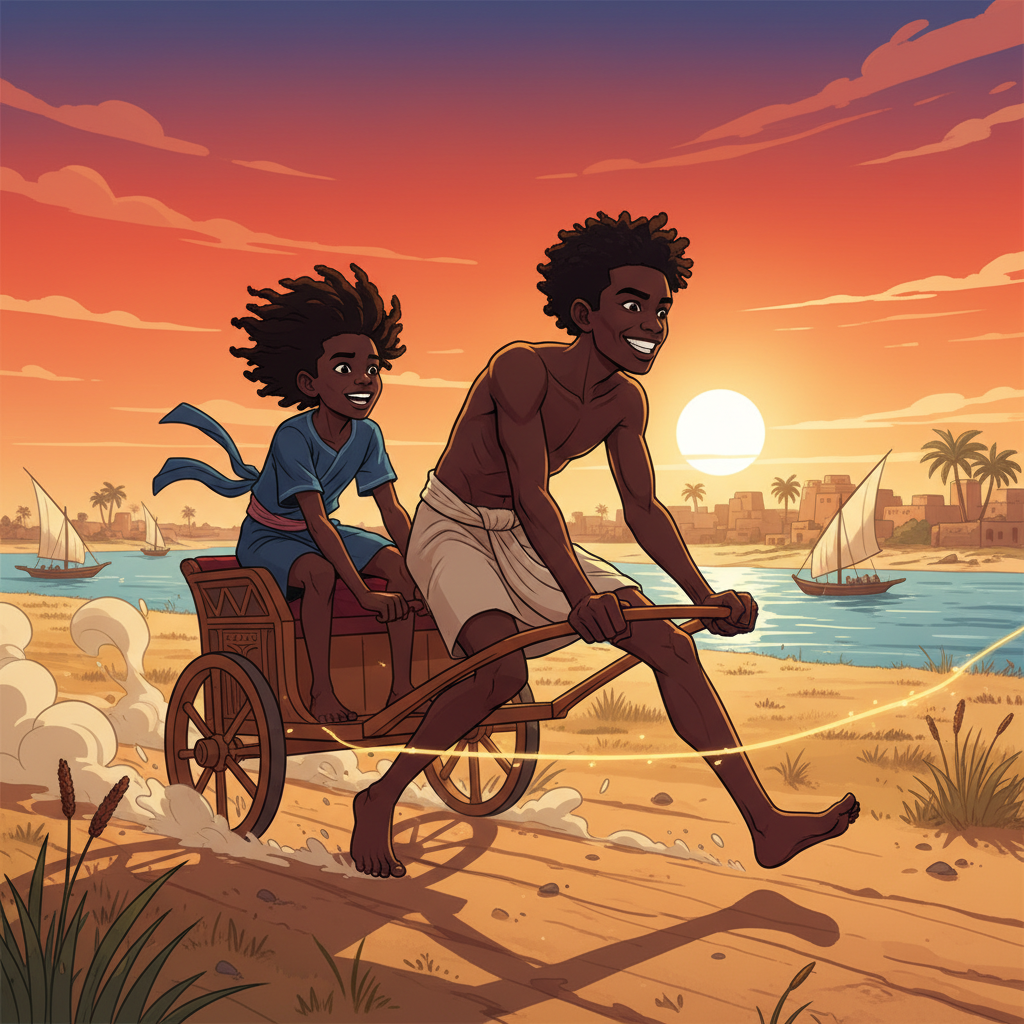
One sweltering afternoon, Khensu was called away to deliver a new chariot to a noble further up the Nile. Djedhor, left to oversee the workshop, felt an irresistible urge. 'Just once,' he told himself, 'just a little way.' He hoisted himself into the small chariot. His heart thumped a wild rhythm against his ribs. He pushed off, staying within the bounds for a moment, then, with a surge of defiance, he veered sharply to the right, crossing the invisible line. The thrill was instant, intoxicating. The chariot gathered speed, flying across the open field, the wind whipping his apprentice Tekenu around his legs. He felt invincible, convinced his speed would overcome any obstacle.
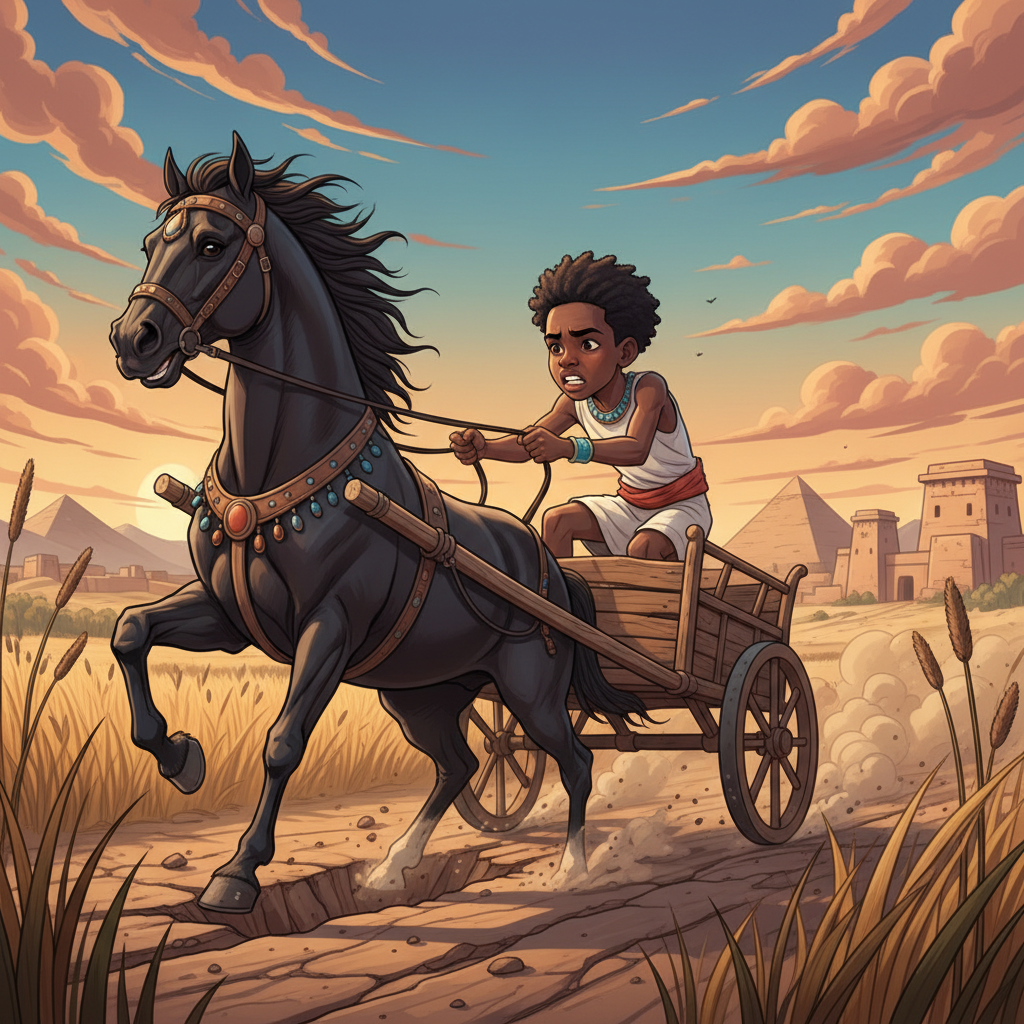
The ground outside the practice area was indeed different. It looked smooth from a distance, but the chariot bumped and jolted, rattling Djedhor's bones. He gripped the rails tighter, a knot of unease twisting in his gut, but the urge for speed pushed him on. Suddenly, a hidden rut, obscured by tall grasses, appeared. There was no time to react. The left wheel struck it with a sickening thud. The chariot lurched violently, throwing Djedhor from the seat. He flew through the air for a horrifying moment, a scream caught in his throat, before landing hard on his side, a sharp, searing pain shooting up his leg. The chariot skidded, its axle twisting with a groan of stressed wood.
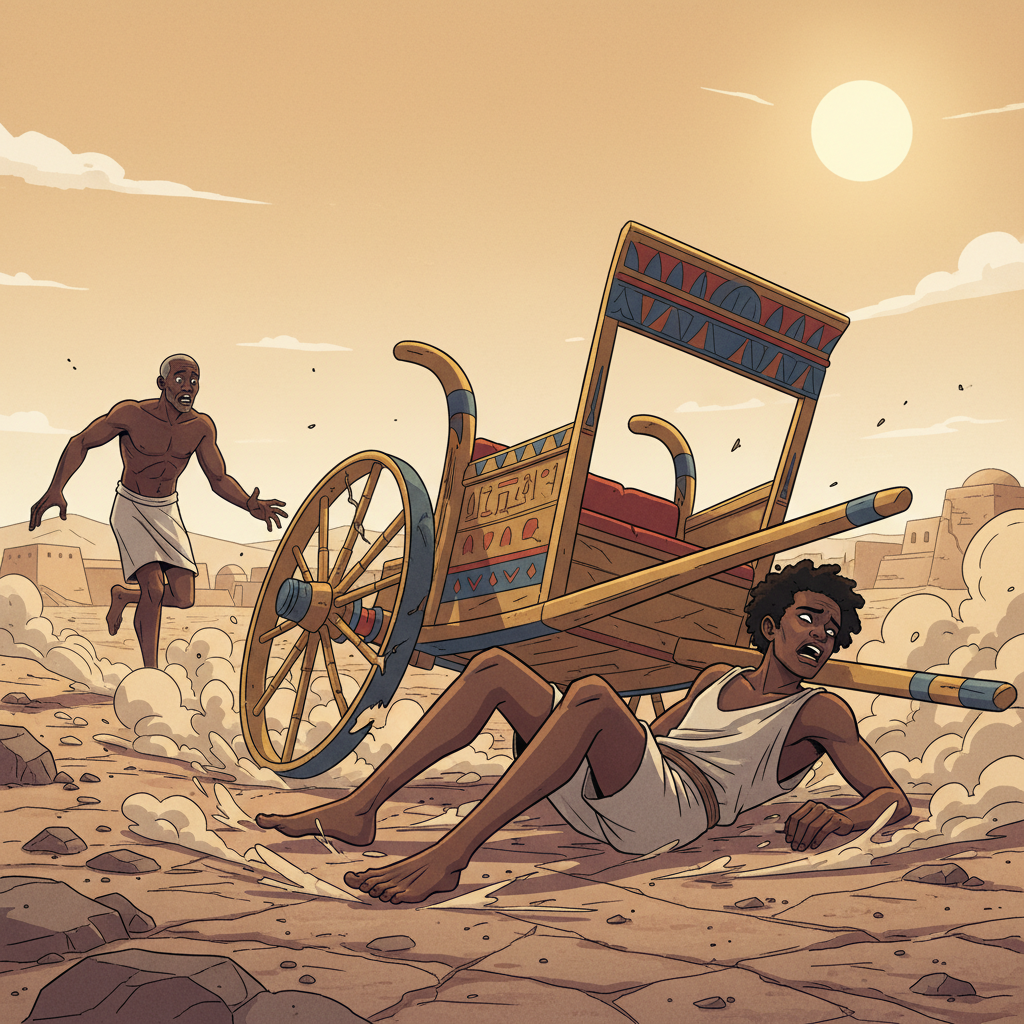
Dust swirled around him as he lay there, gasping for breath, the pain in his leg a fiery torment. He tried to move, but a fresh wave of agony made him cry out. The bright sun seemed to mock his reckless ambition. He looked at his chariot, now lying on its side, a wheel bent at an unnatural angle, the beautiful acacia wood splintered. Shame washed over him, hot and bitter. He had ignored Khensu's words, and now he paid the price. From the distance, he heard a shout, then the frantic thud of approaching footsteps. Khensu, back earlier than expected, ran towards him, his face a mask of grim concern, his eyes wide with fear and disappointment.
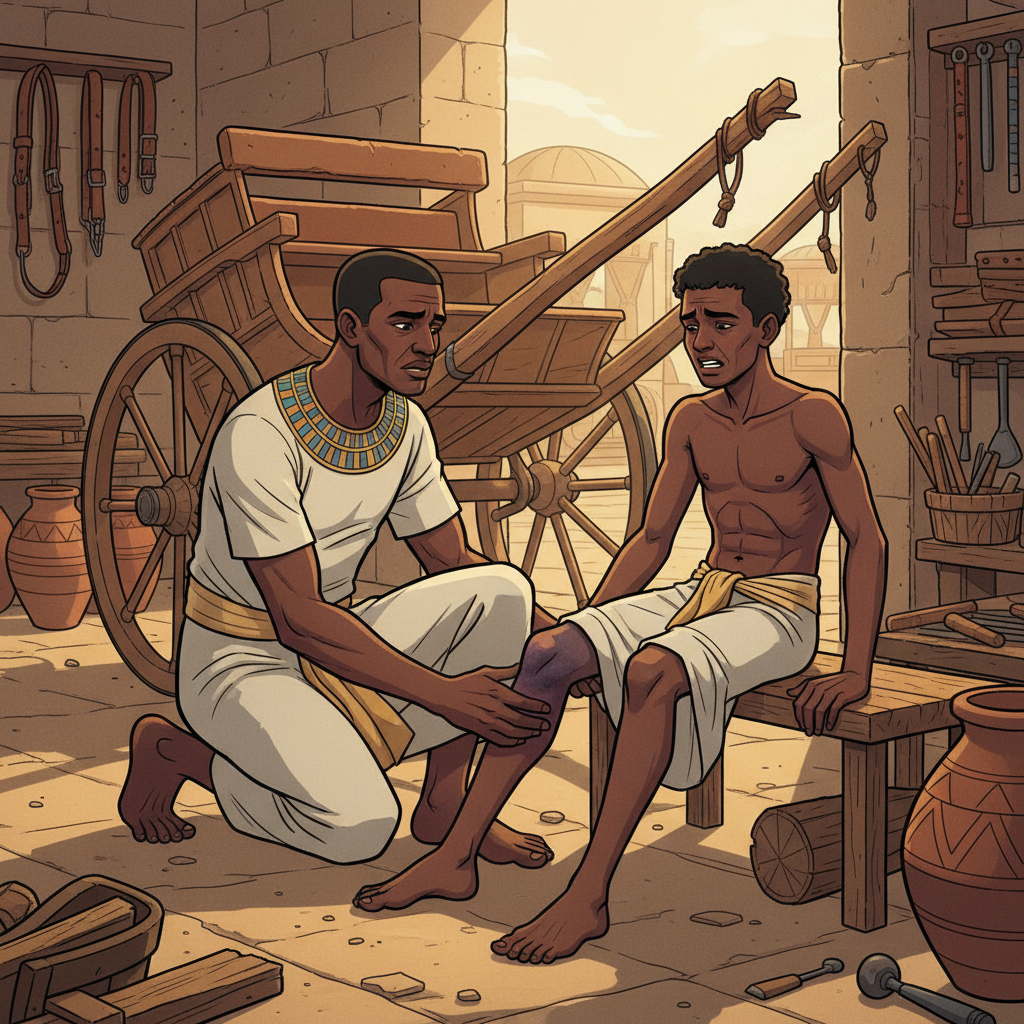
Khensu knelt, gently examining Djedhor’s leg. It wasn't broken, but a deep, ugly bruise was already forming, swelling visibly beneath his skin. The pain was sharp and constant. Then, his father turned to the chariot, his expression hardening. He traced the splintered wood, the twisted axle, the bent wheel. The silence that followed was heavier than any shout. 'No more riding,' Khensu finally said, his voice low and firm, 'not until your leg is healed, and then, only under my eye. This chariot, your pride and joy, will be repaired, but it will not be for you to ride alone.' Djedhor felt a cold fist clench his heart. The restriction felt like a life sentence, an unbearable punishment for a moment of youthful exuberance. Isfet began to take root, turning his shame into bitter resentment.
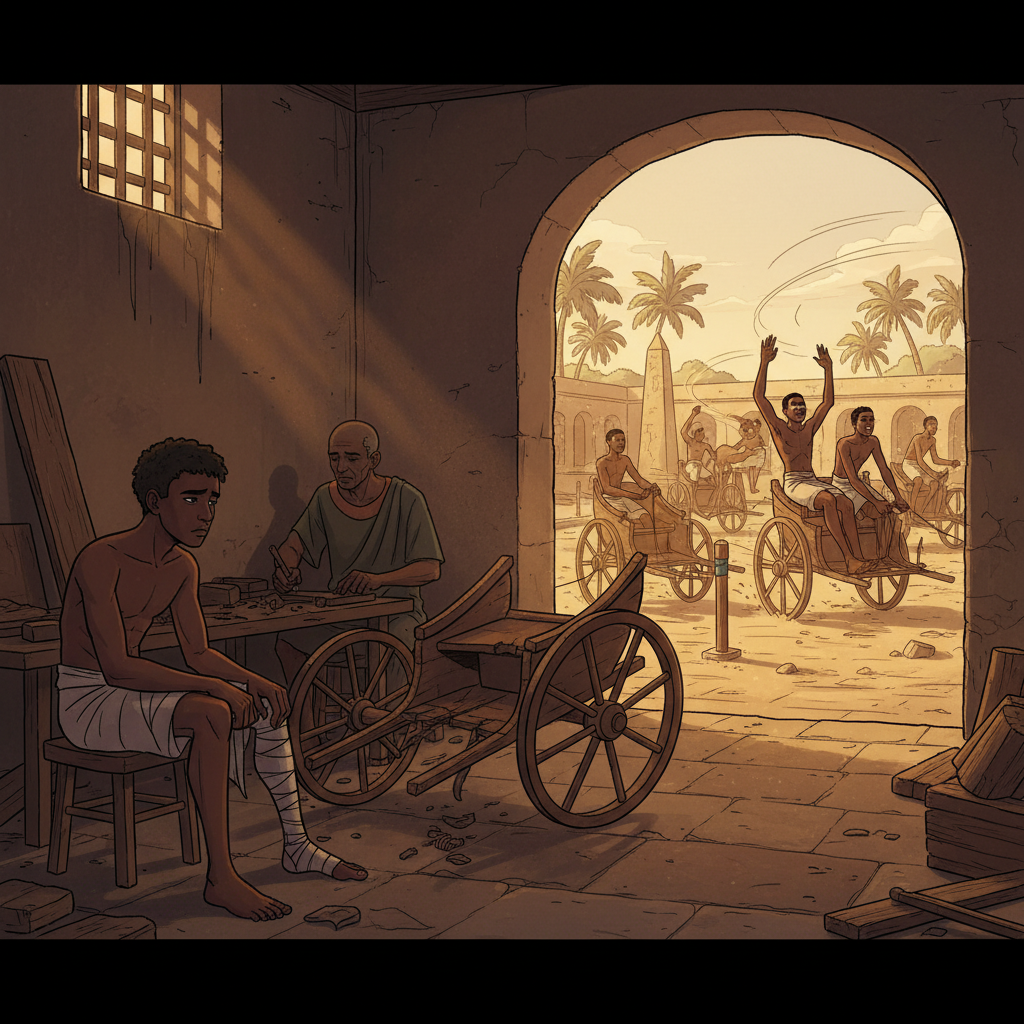
The days that followed were a torment. Djedhor's leg mended slowly, but the wound in his spirit festered. He watched other apprentices practice, their laughter and shouts echoing in the yard, each sound a fresh stab of envy. His own chariot sat in a corner of the workshop, awaiting repair, a constant reminder of his mistake and his father's unforgiving rule. He saw the rule not as protection, but as a cage. His father, Khensu, continued his work, carving, sanding, shaping, seemingly oblivious to Djedhor's internal storm. Each focused stroke of Khensu's hand on a fresh piece of wood felt like a silent rebuke, deepening Djedhor's sense of injustice. The joyous freedom of his first ride seemed a distant dream.
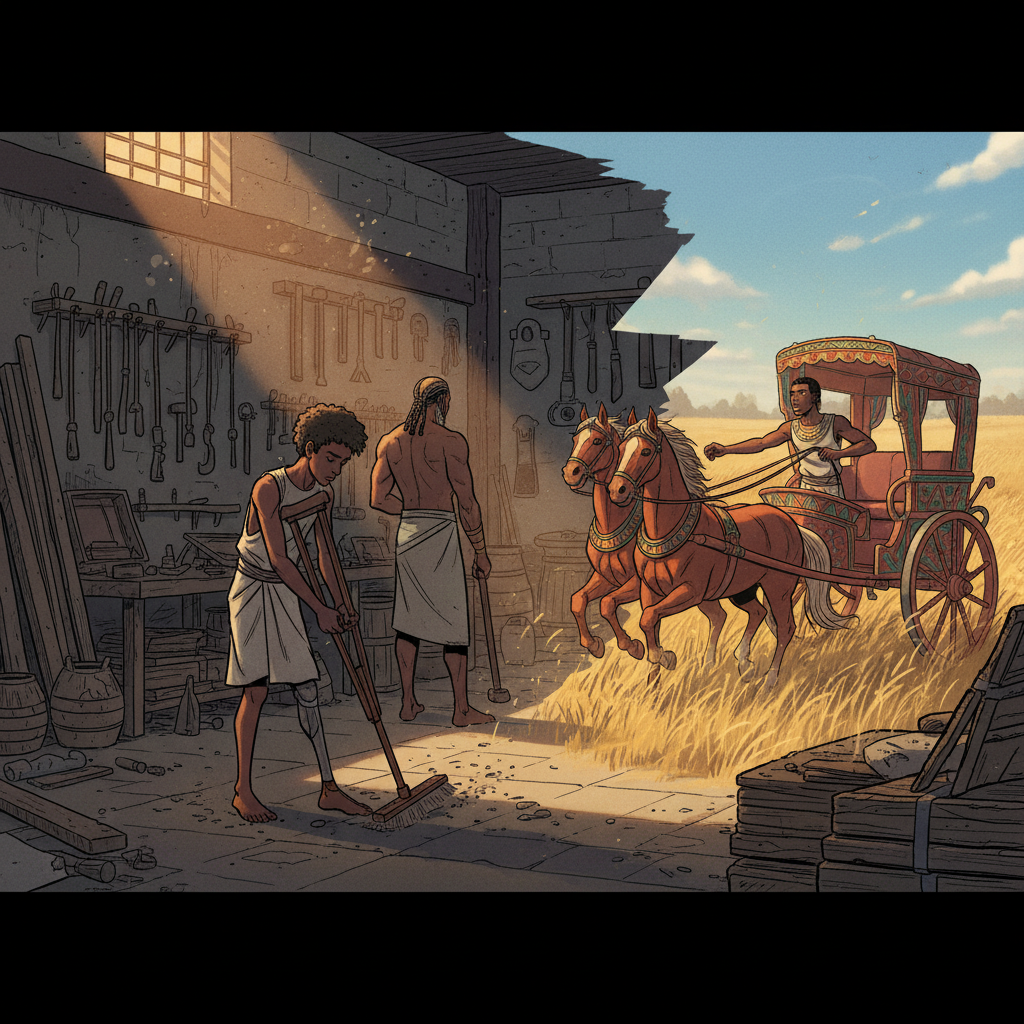
The workshop, once a place of vibrant creation and shared purpose, now felt like a prison cell to Djedhor. The scent of cedar and linseed oil, once comforting, now choked him, reminding him of the craft he loved but was now denied. He dragged his foot, limping through his chores, eyes downcast, avoiding his father's gaze. He imagined Khensu, riding his own grand chariot through the open fields, free and unburdened. The thought twisted in Djedhor's gut, fueling his anger. He felt isolated, misunderstood. The joy he once found in crafting was replaced by a dull ache of resentment, a constant hum of Wasfet buzzing in his ears. He wanted to scream, to lash out, to make his father feel his pain.
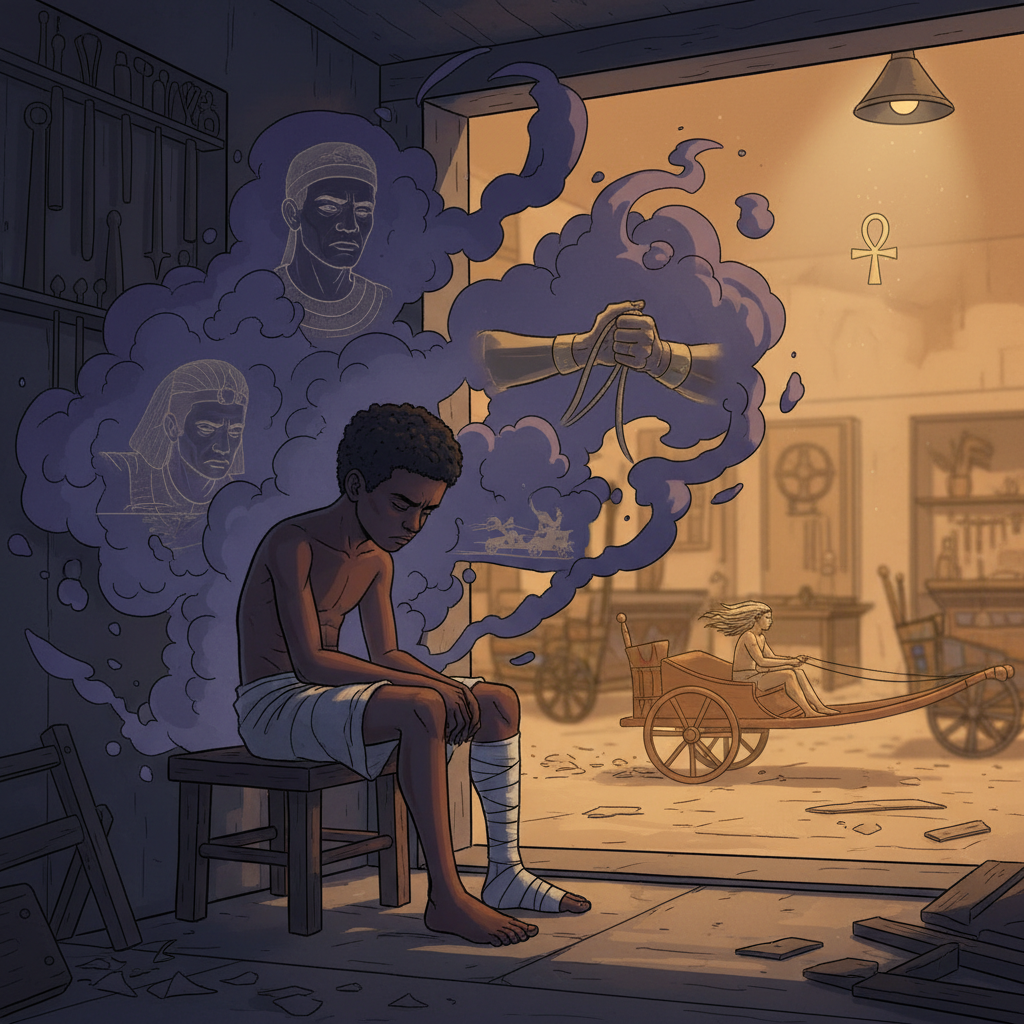
Djedhor began to brood, retreating into himself. He convinced himself that Khensu was being unnecessarily harsh, punishing him for too long. 'He doesn't trust me,' Djedhor thought bitterly, 'he just wants to control me.' The clarity of Maat, of understanding the balance between freedom and responsibility, was lost in a fog of self-pity and anger. He pictured his father's skilled hands, the hands that had taught him everything, now seemingly holding him captive. He longed for the exhilaration of the ride, the wind in his hair, the ground rushing beneath him. The more he thought, the more his anger swelled, poisoning his usually clear mind. He felt trapped, his spirit chafing against the restrictions.
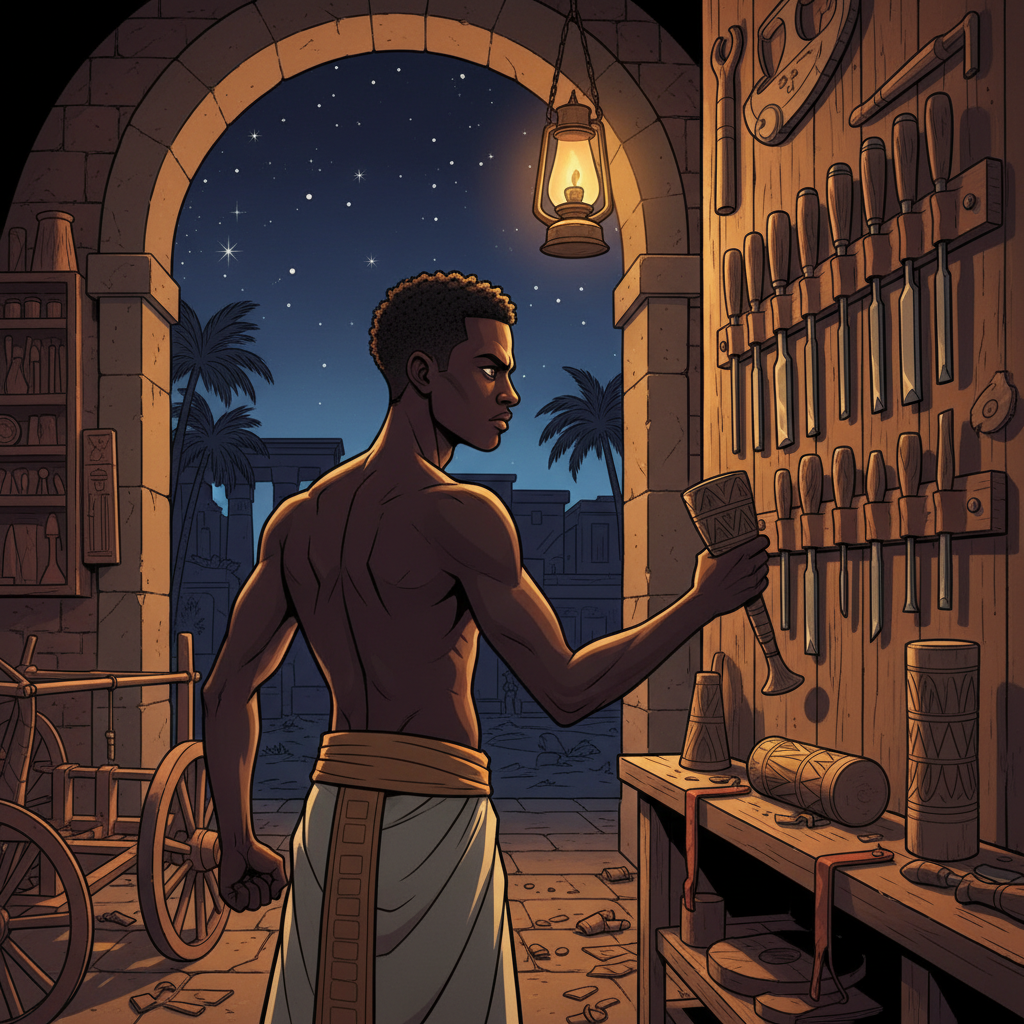
A dark thought, insidious and tempting, began to take root in Djedhor's mind. If he couldn't have the freedom of his chariot, perhaps his father shouldn't have the perfection of his tools. A small act of rebellion, a way to inflict a fraction of the hurt he felt, to make Khensu understand his pain. He eyed the row of finely honed chisels, the instruments his father treasured most, each one sharpened to a razor's edge, capable of shaping wood with exquisite precision. The idea, though unsettling, felt powerful, a way to reclaim some control in a world that felt completely out of his hands. He imagined the subtle shift, the moment of his father's frustration. This was a path to Isfet, he knew, but the bitterness was too strong.
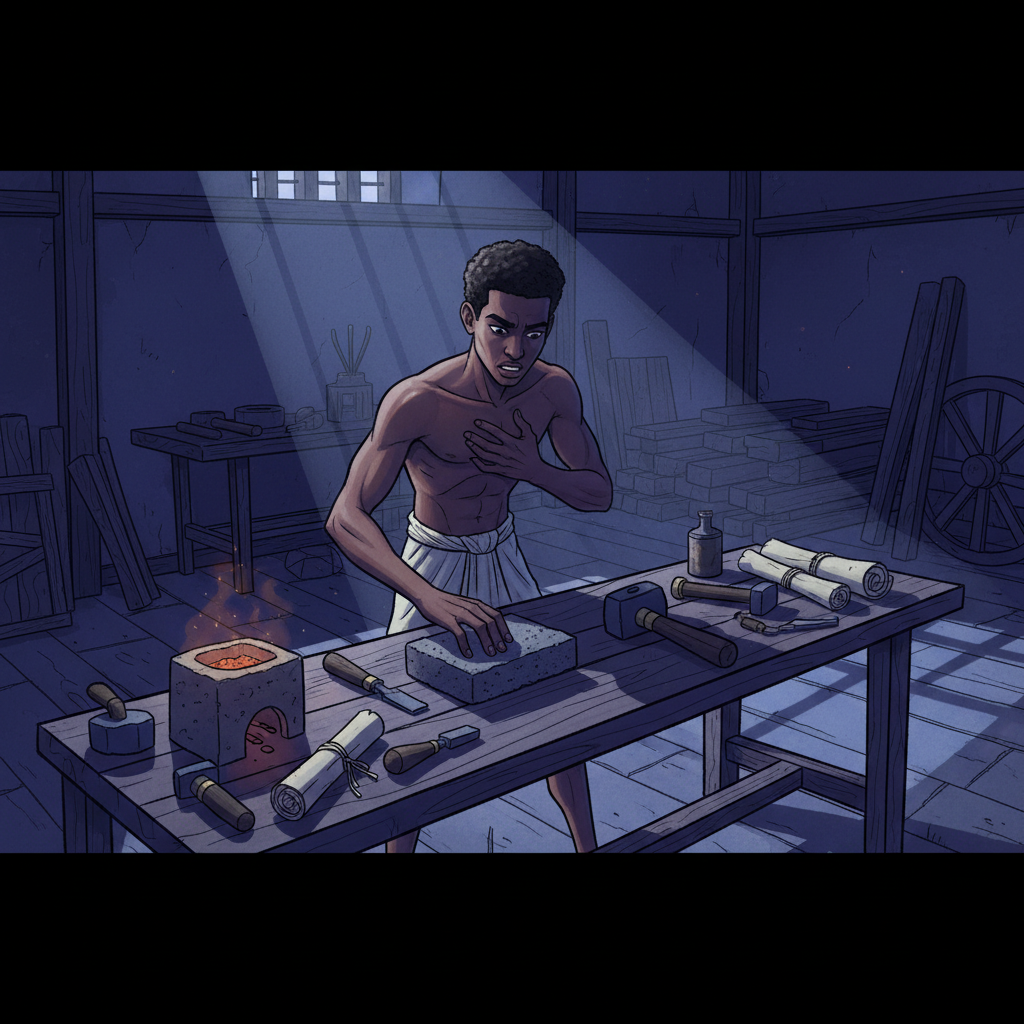
Late that evening, after the last apprentice had departed and the workshop was cloaked in the deep shadows of night, Djedhor crept silently from his sleeping mat. The only sounds were the chirping of crickets and the distant murmur of the Nile. His heart hammered against his ribs, a frantic drumbeat of fear and angry resolve. He moved towards the workbench where Khensu’s most valued tools lay carefully arranged. The moon cast long, ghostly fingers across the room, illuminating his path. He paused, his hand hovering over a heavy sanding stone, its surface rough and unforgiving. A tremor of hesitation ran through him, but the burning resentment pushed it aside.
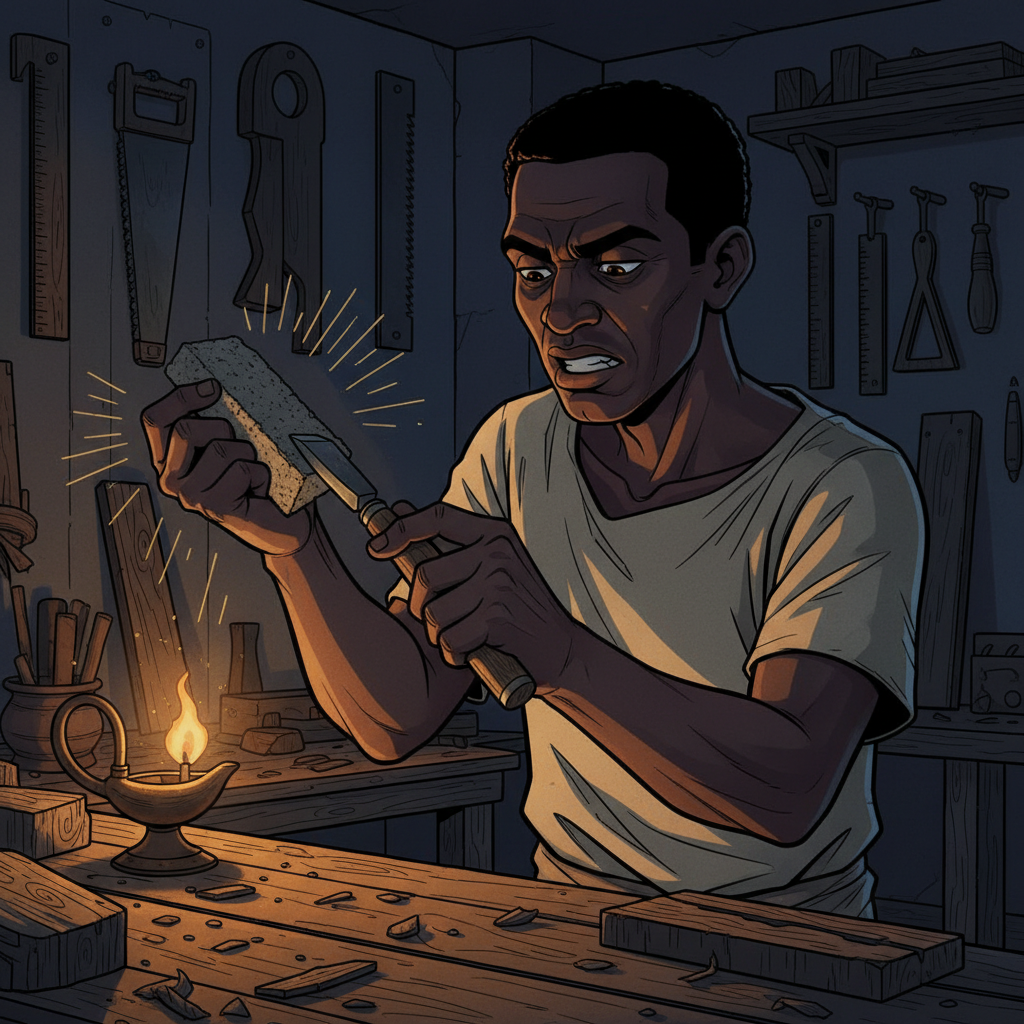
With trembling hands, Djedhor picked up the sanding stone. He selected his father's favorite carving chisel, its blade thin and wickedly sharp. He thought of his bruised leg, of the days spent watching others, of the unfairness. With a grunt of suppressed fury, he began to scrape the stone against the delicate edge of the chisel. A harsh, grinding sound filled the silent workshop, each rasping stroke a deliberate act of defiance. He nicked the blade, then dulled another, ruining the fine balance and precision that Khensu had so meticulously maintained. Each damaging scrape felt like a small victory against the perceived injustice, a way to make his father feel a fraction of his own simmering frustration. He left them subtly marred, hoping the damage wouldn't be immediately obvious, but would reveal itself in the struggle of work.
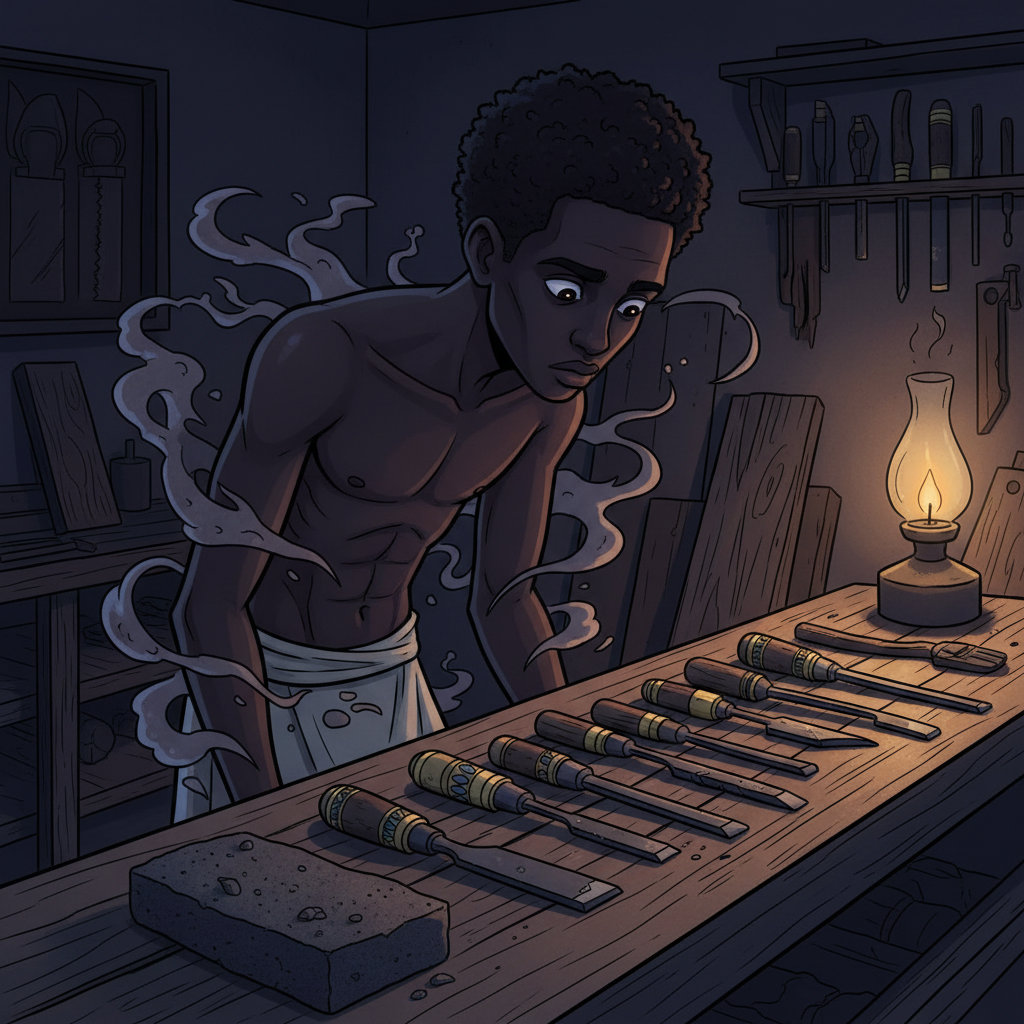
He finished, dropping the sanding stone with a soft thud that seemed deafening in the stillness. He looked at the row of now imperfect tools, a cold, hollow satisfaction settling in his chest. He had done it. He had struck back. But the triumph was fleeting, quickly replaced by a heavy, unsettling emptiness. The anger, so potent just moments before, had drained away, leaving behind a bitter taste. He hadn't felt better, only heavier, as if he had swallowed a stone. The workshop felt colder, the shadows deeper. He slipped back to his mat, the damaged tools a silent testament to his act, a growing knot of dread forming in his stomach. The feeling of Isfet clung to him like a shroud.
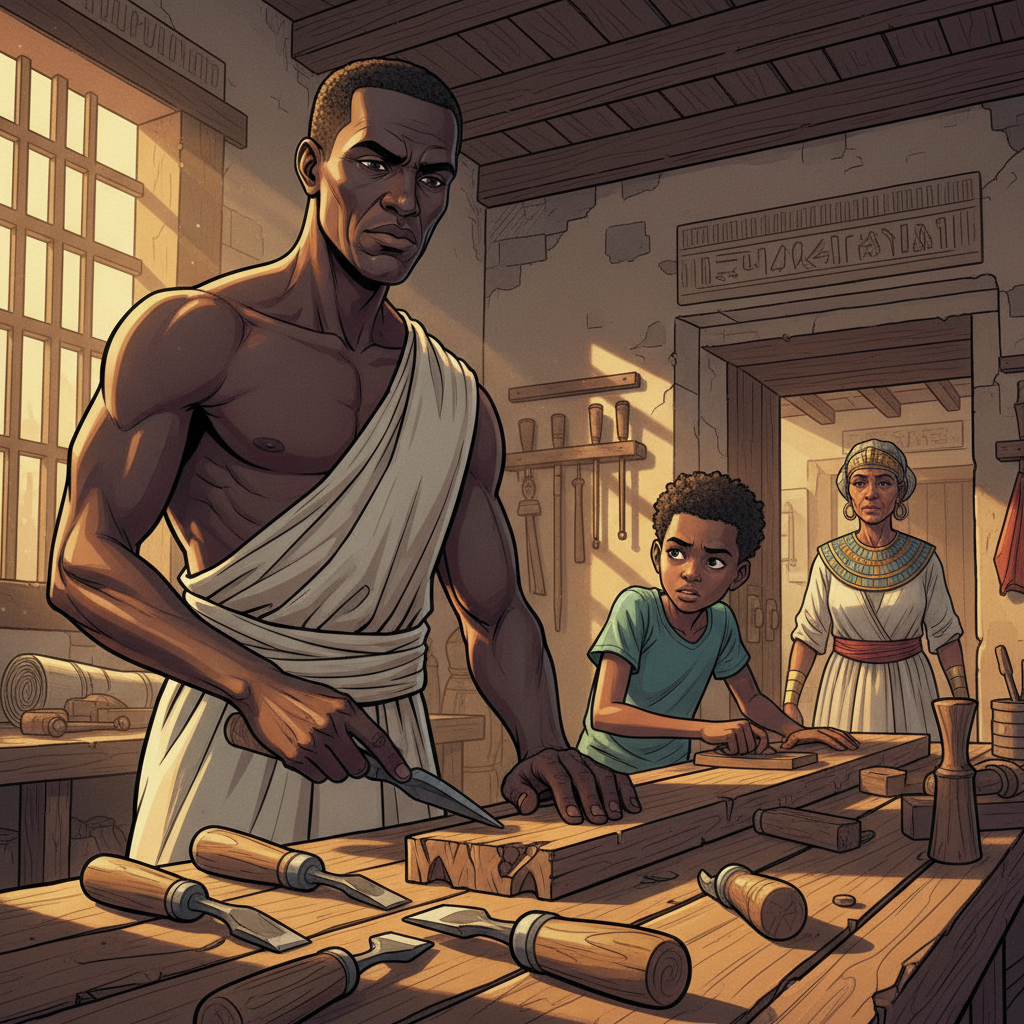
The next morning, the sun streamed through the workshop window, illuminating the workbench. Khensu, with his usual morning ritual, reached for his chisels. He paused, his brow furrowing. He picked up one, then another, his fingers tracing the marred edges. A quiet fury settled on his face, far more potent than any shout. Djedhor, trying to appear busy, watched from the corner of his eye, a tremor of fear running through him, quickly followed by a stubborn refusal to show weakness. Just then, his grandmother, Ama Sekhmet, a woman whose skin was the color of rich earth and whose eyes held the wisdom of Ta-Seti, entered the workshop, her gaze sweeping over the scene, sensing the heavy air.
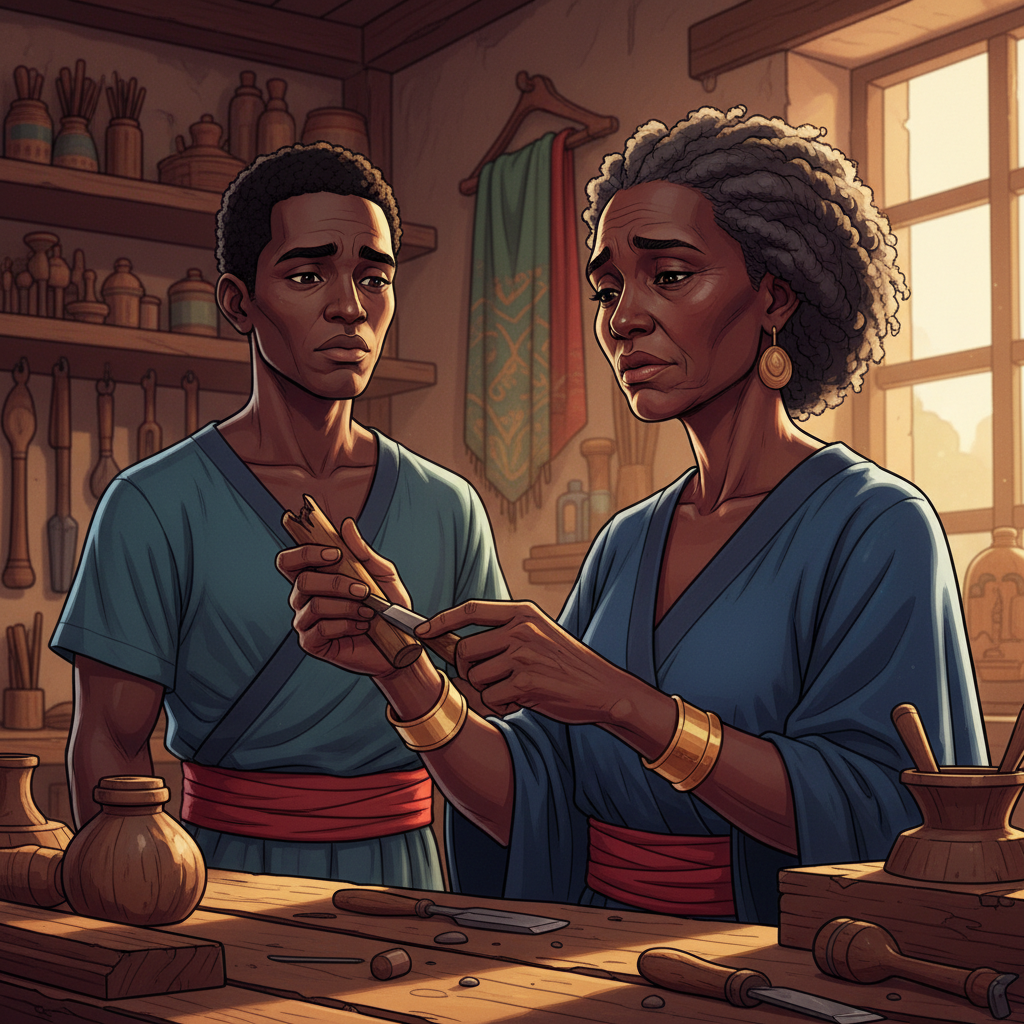
Ama Sekhmet, with eyes that held the wisdom of Ta-Seti, moved slowly to the workbench. She gently picked up a damaged chisel, her aged fingers tracing the rough edge where Djedhor had scraped it. She looked at Djedhor, not with anger, but with a deep, profound sorrow that pierced him more than any scolding. Her voice was soft, barely a whisper, yet it resonated with the weight of generations. 'Did you punish your father, Djedhor,' she asked, her gaze unwavering, 'or did you punish the hands that feed you? These tools, my grandson, are an extension of his Maat, his ability to bring order and beauty, to provide for us. Think on this.'
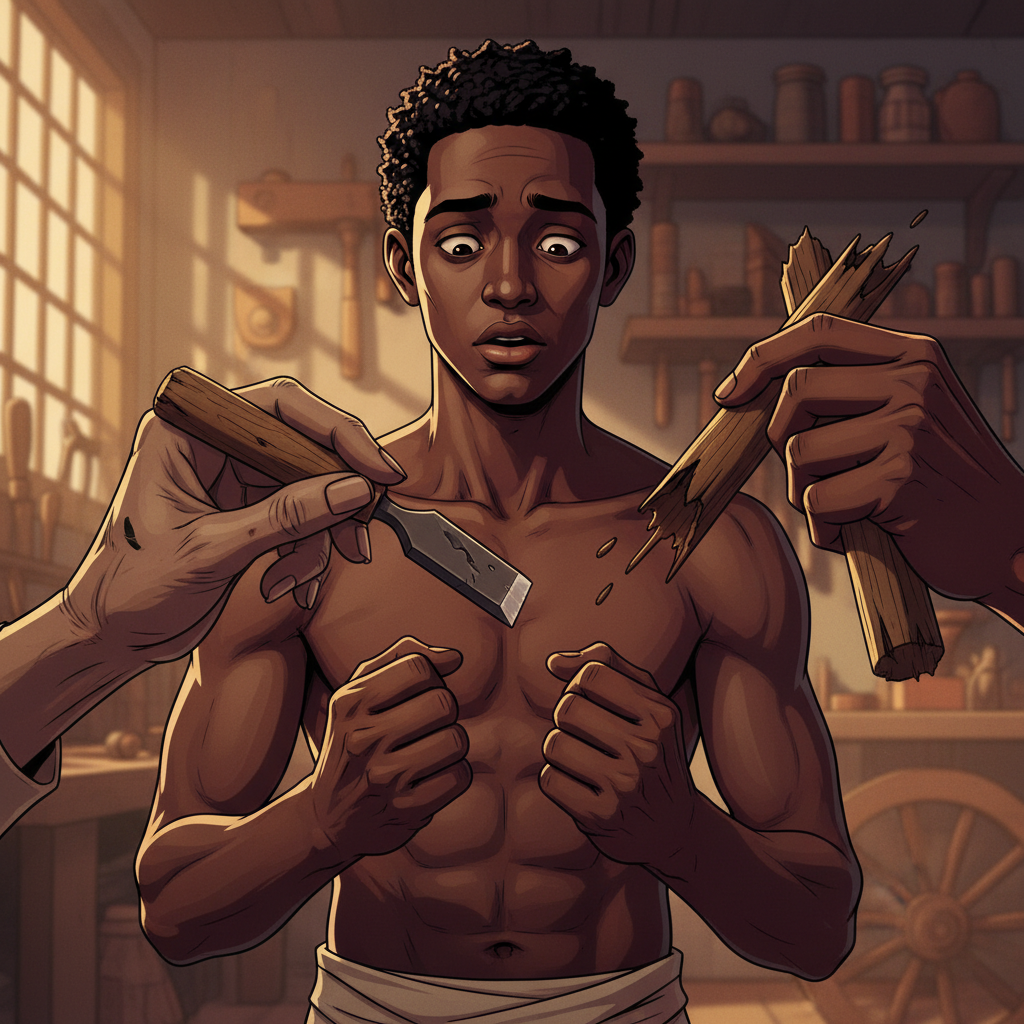
Her words hit Djedhor like a physical blow, stripping away his anger and leaving him exposed. He stared at the dull, uneven edge of the tool in Ama Sekhmet’s hand, then at his own trembling hands, then at his father’s strong, skilled hands which now held a broken piece of his craft, his livelihood. The truth of her question began to unravel the tight, hard knot of Isfet in his chest. He had not punished Khensu alone; he had attacked the very source of their family's balance, their ability to create, to sustain. The concept of Maat, of living in truth and order, suddenly felt miles away from his rash, vengeful actions, a stark contrast to his inner turmoil.
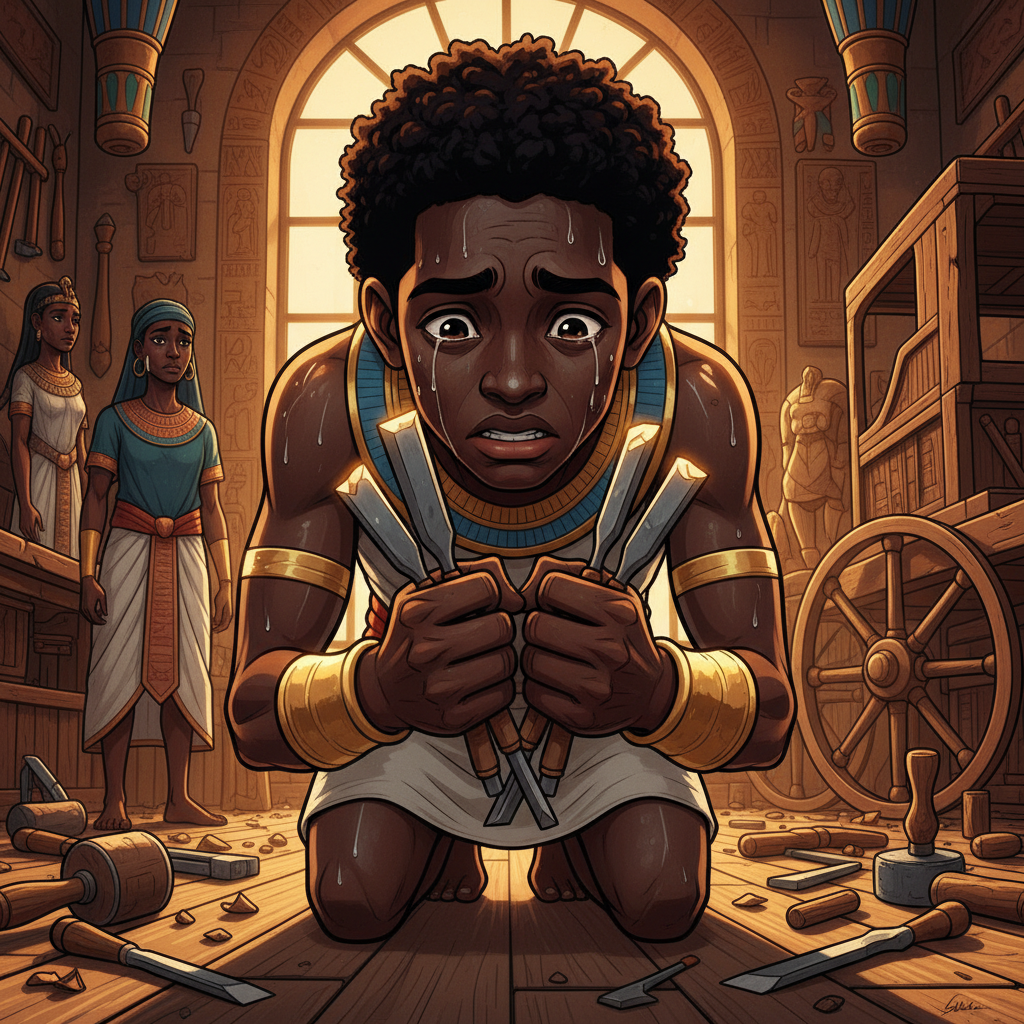
The realization washed over him, cold and clear. He saw the chisels not just as his father's tools, but as extensions of their shared life, their family's sustenance, their contribution to Kemet. He had acted out of raw, unbalanced anger, bringing disorder and harm into their sacred workshop and their home. The Maat of their household, the careful balance Khensu strived to maintain, had been shattered by his impulsive act. The weight of his transgression pressed down on him, suffocating him with shame. He understood, with a painful clarity, that his actions had not been about justice, but about a childish, destructive outburst, driven by the very Isfet he was taught to avoid.
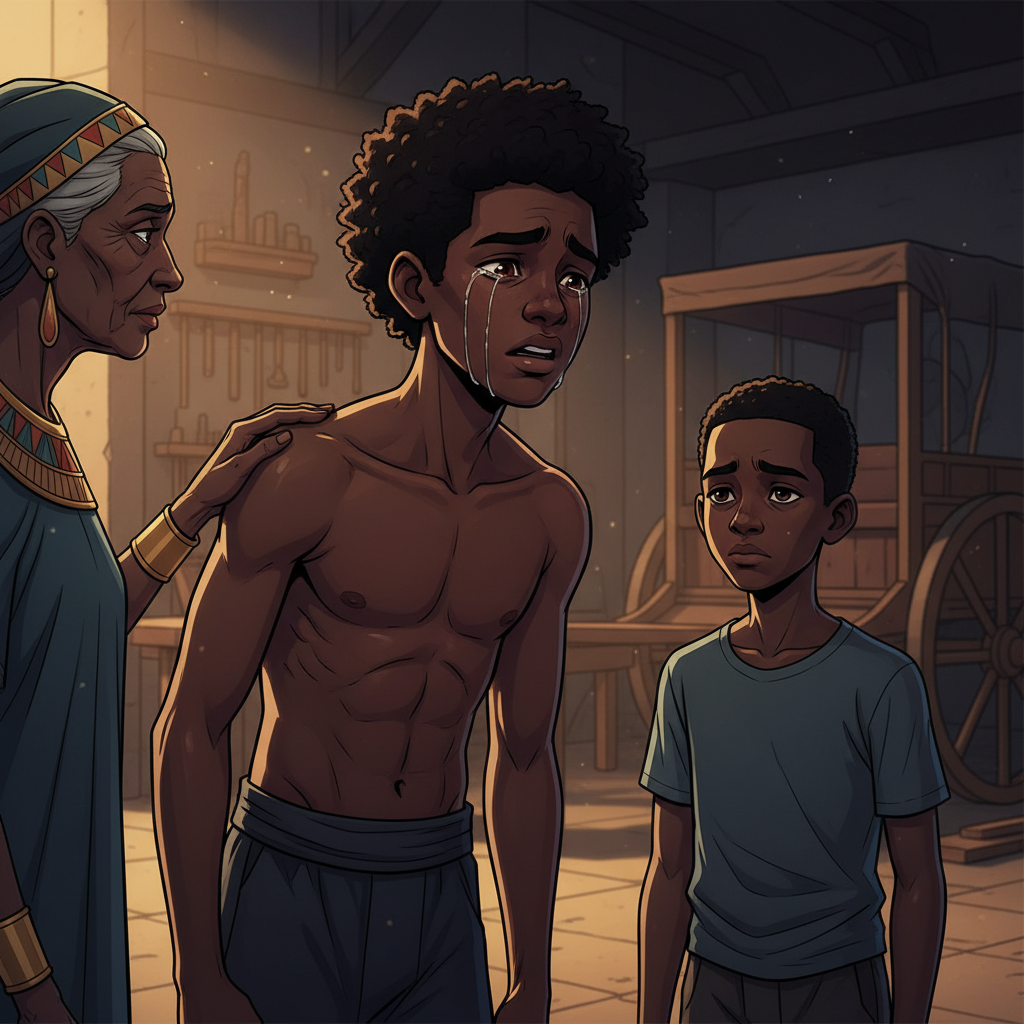
Tears, hot and sudden, welled in Djedhor's eyes. He could no longer hold back the truth. 'It was me, Ama,' he whispered, his voice thick with shame, barely audible. 'I was angry. I felt unfair. I was wrong.' His throat tightened, the words catching. He looked at Khensu, whose face was still etched with a quiet, profound disappointment, rather than the rage Djedhor had expected. The silence was heavy, filled with the unspoken weight of his confession. He stood before them, a boy stripped of his bravado, vulnerable and exposed, truly understanding the depth of his imbalance, the chaos he had invited.
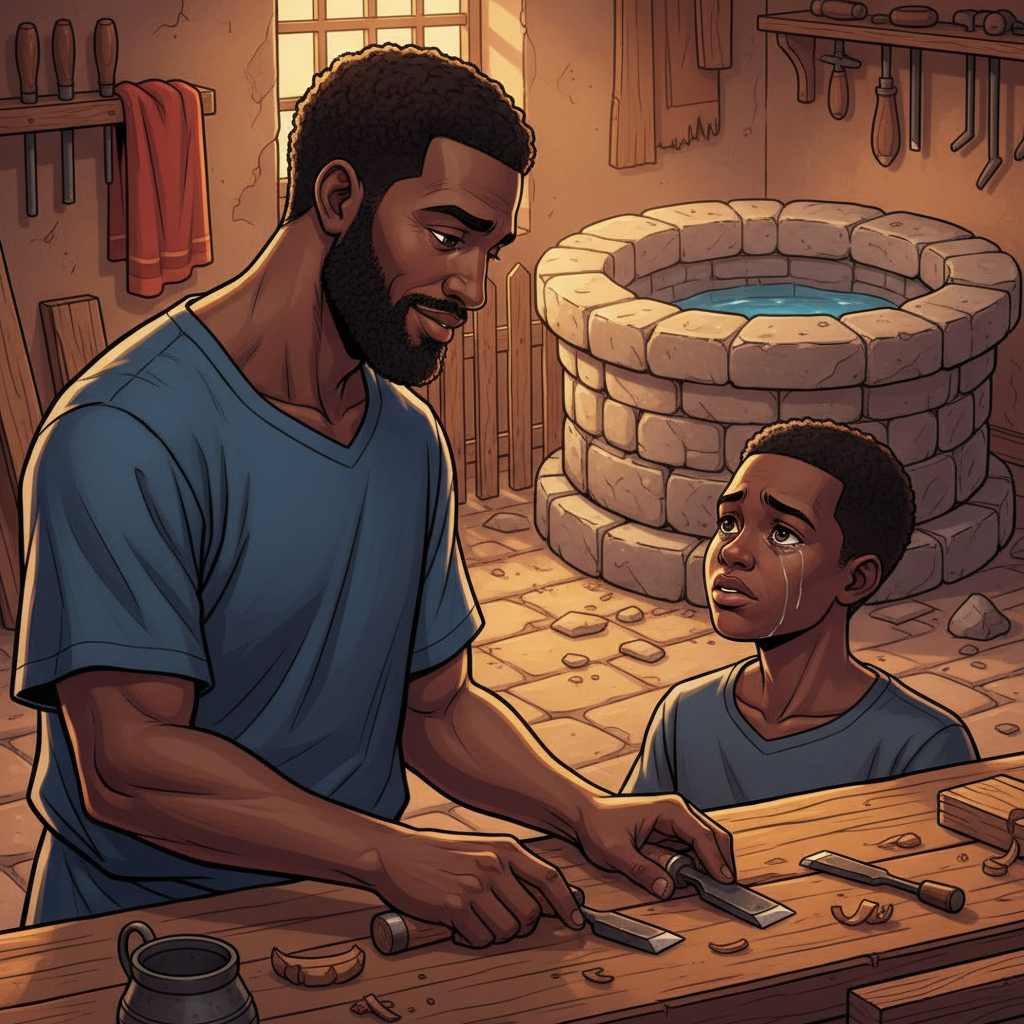
Khensu didn't shout. Instead, he sighed, a deep, weary sound that resonated with sorrow more than anger. He gently placed the damaged chisels back on the bench, his gaze meeting Djedhor's. 'You were angry at the fence, Djedhor,' he said, his voice soft but firm, 'but the fence was built to keep you from falling into the well. It was built to protect the precious water, to protect you. My rules were not to punish your spirit, but to keep your Ka safe, to ensure your journey through life upholds Maat.' The words hung in the air, a profound truth, simple yet powerful.
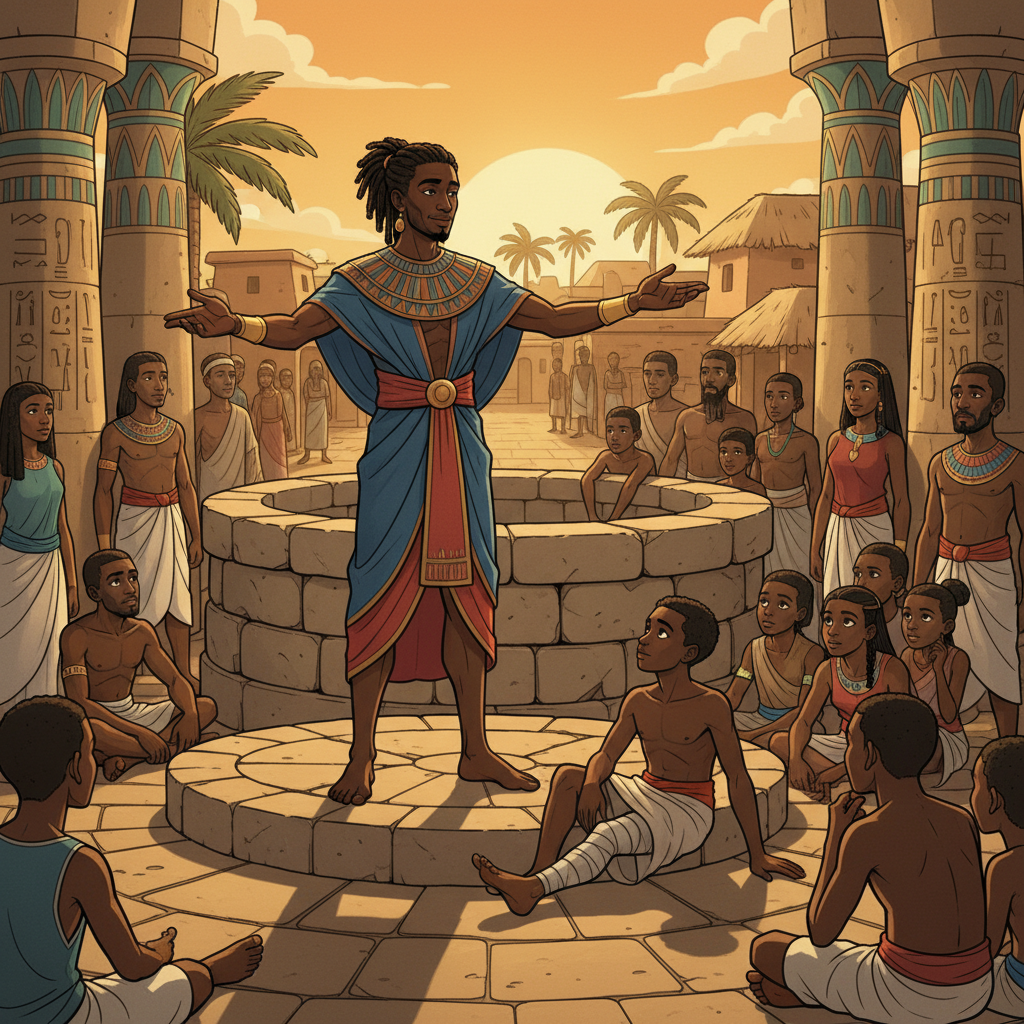
Khensu continued, his voice calm, weaving wisdom into his words like an ancient tapestry. 'The rules, my son, are not chains to hold you back. They are like the strong walls around our village's well, protecting the precious water within. They are for your safety, for your flourishing, for the balance of Maat in your life. You chafed against the boundary because it felt restrictive, but it was there to prevent the very injury you suffered. My love for you, my desire for your safe growth, is what created that boundary. It is not control, but care.' Djedhor listened, truly listened, for the first time, seeing the truth in his father's eyes.
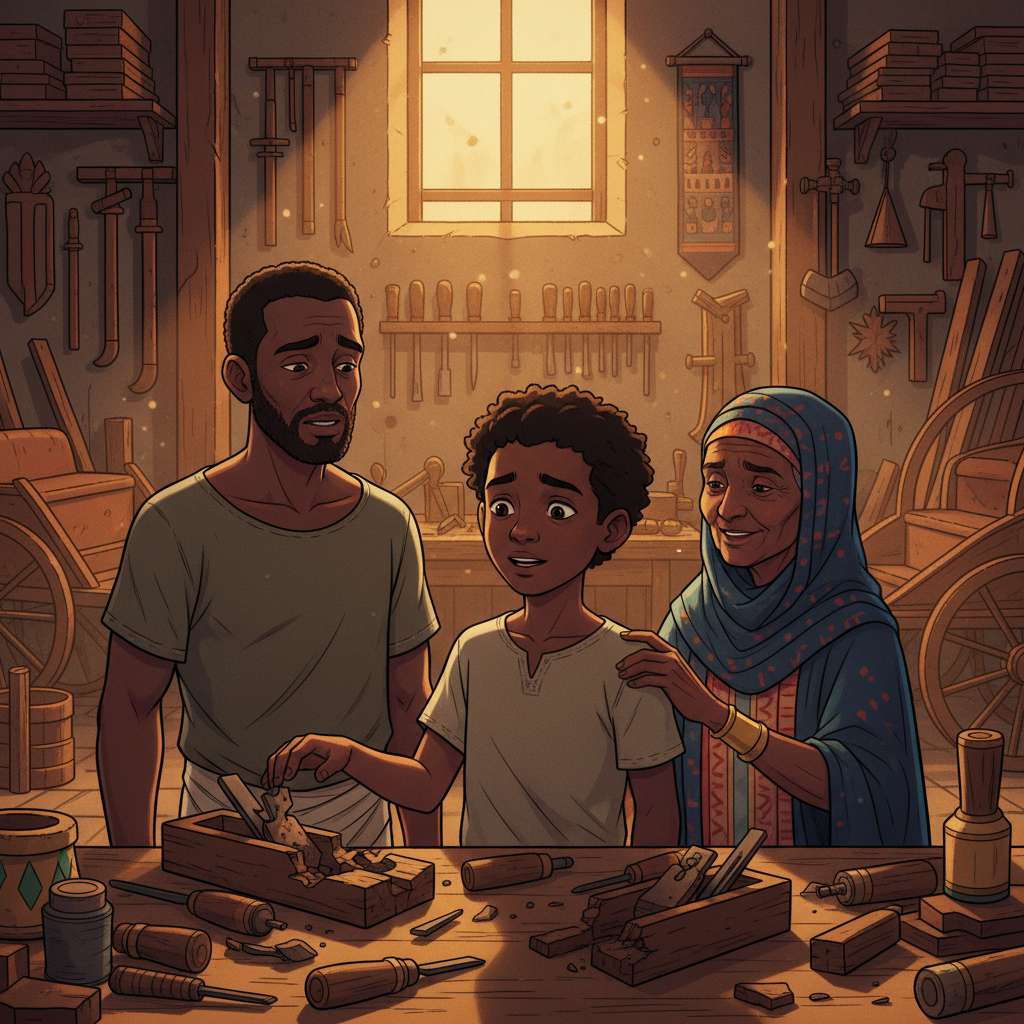
Djedhor looked from his father’s pained but understanding face to his grandmother’s gentle, encouraging gaze. The truth of their words settled deep within him, chasing away the last vestiges of Isfet. He reached out, his hand hovering over one of the damaged chisels. 'Can... can I help fix them, Baba?' he asked, his voice barely audible, thick with emotion. Khensu looked at his son, then at Ama Sekhmet, and a slow, hopeful nod spread across his face. 'Yes, my son,' Khensu said, his voice regaining some of its usual warmth, 'together, we will restore the Maat of these tools, and of our workshop.' The journey of repair, both physical and spiritual, had begun.
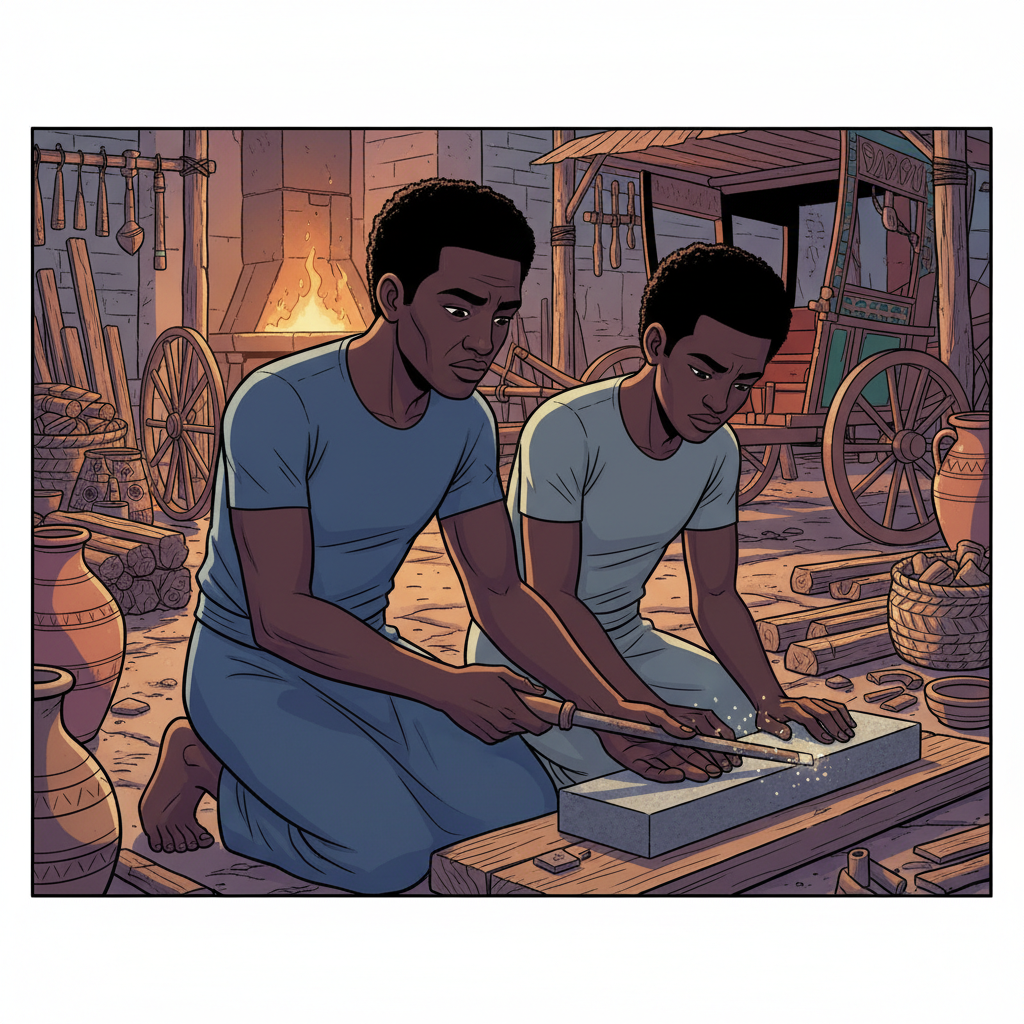
His father began to explain the intricate process of resharpening, of carefully grinding the metal against the whetstone, slowly, patiently, to restore the perfect edge. Together, they began the painstaking work. It was slow, difficult, and humbling. Djedhor learned how much care and precision went into maintaining such tools, how easily they could be ruined, and how much effort it took to bring them back to their state of Maat. Each careful stroke of the sharpening stone was a lesson in patience, a symbolic act of restoring balance, not just to the tools, but to himself. The rhythmic scraping of stone against metal became a soothing, meditative sound, calming the lingering echoes of Isfet within his heart.
As they worked side by side, hour after hour, Djedhor began to truly understand. The rules his father had set hadn't been about control; they had been about profound care, about ensuring his journey through life was safe, productive, and balanced. He saw the love behind his father's boundaries, the protective embrace of Maat woven into every instruction. He saw that true freedom wasn't about doing whatever he wanted, but about understanding the natural order, the consequences, and living in harmony with them. The workshop, once a prison, now felt like a temple of learning, a space of shared understanding and renewed connection with his Baba. His heart felt lighter, clear of the bitterness that had weighed it down.
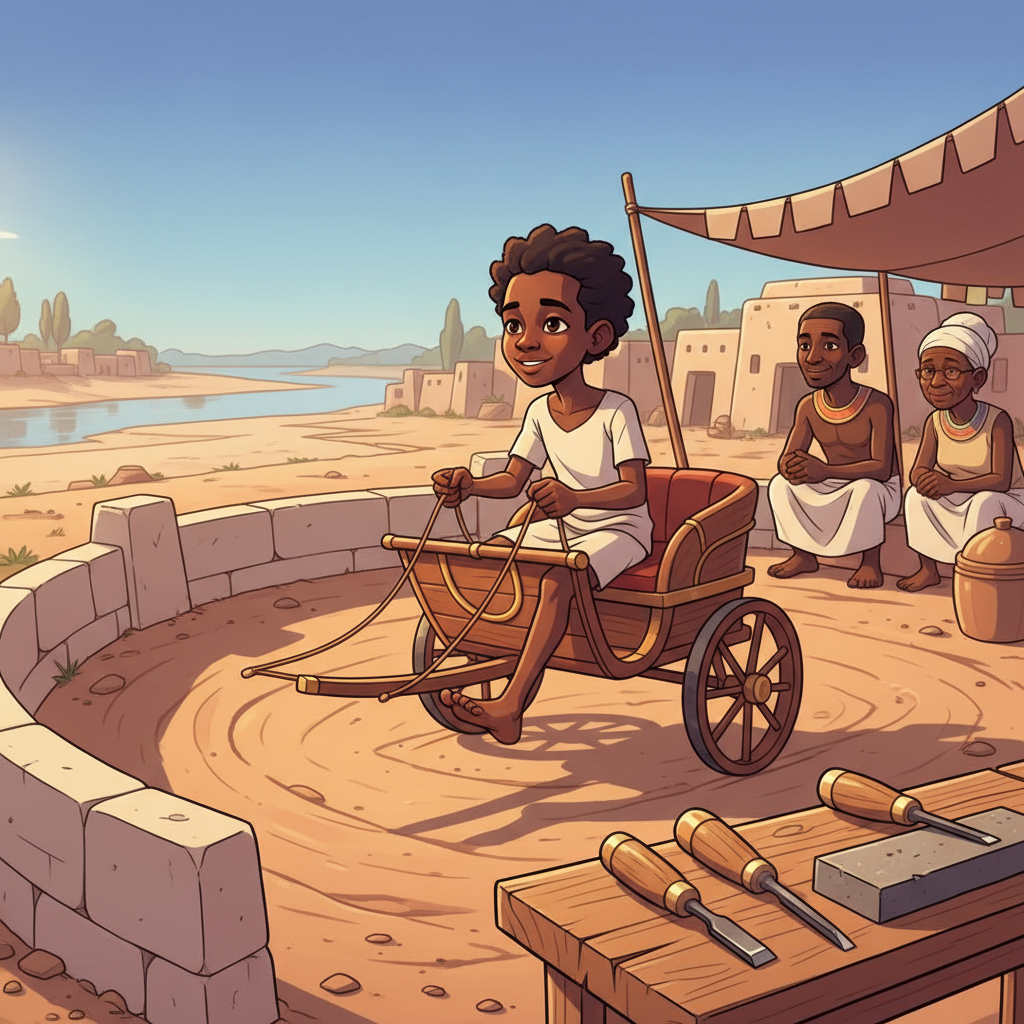
Weeks later, Djedhor’s leg was fully healed, and the chisels, meticulously restored, gleamed on the workbench, sharper than ever. His small chariot, too, had been repaired, its wood reinforced, its wheels trued. Djedhor climbed back into the driver's seat. This time, as he pushed off, he stayed well within the designated practice area. He felt the exhilaration, yes, but also a deep sense of peace, a quiet understanding. He knew that true strength and freedom came not from breaking boundaries, but from mastering oneself within them, from embracing the balance and order of Maat. The chariot, once a symbol of defiance, now represented his renewed commitment to wisdom, discipline, and the profound love that guided his path.