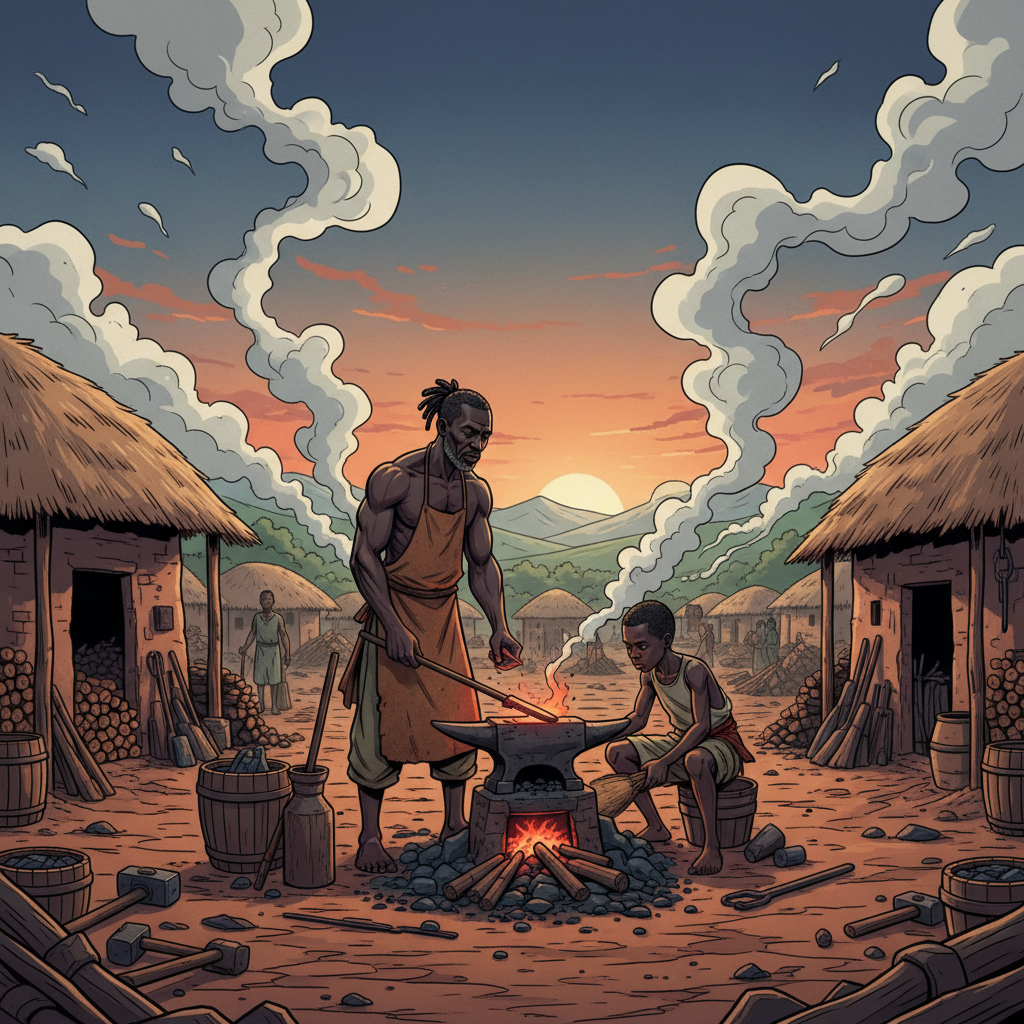
The air in Awka always carried the scent of woodsmoke and damp earth, but nowhere was it as potent as near Master Obinna's forge. For Ikenna, twelve years old and nimble, it was the smell of purpose. He was an apprentice, his skin dark as polished ebony, his hands already calloused from handling tongs and hammers. Each morning, before the sun crested the eastern hills, he would be there, fanning the coals, watching the iron glow. Master Obinna, a man whose muscles rippled beneath his skin like ancient rivers, taught him not just how to strike, but how to listen to the metal, how to feel its temper. Awka was known for its blacksmiths, and Ikenna dreamed of one day wielding the hammer with such grace and wisdom.
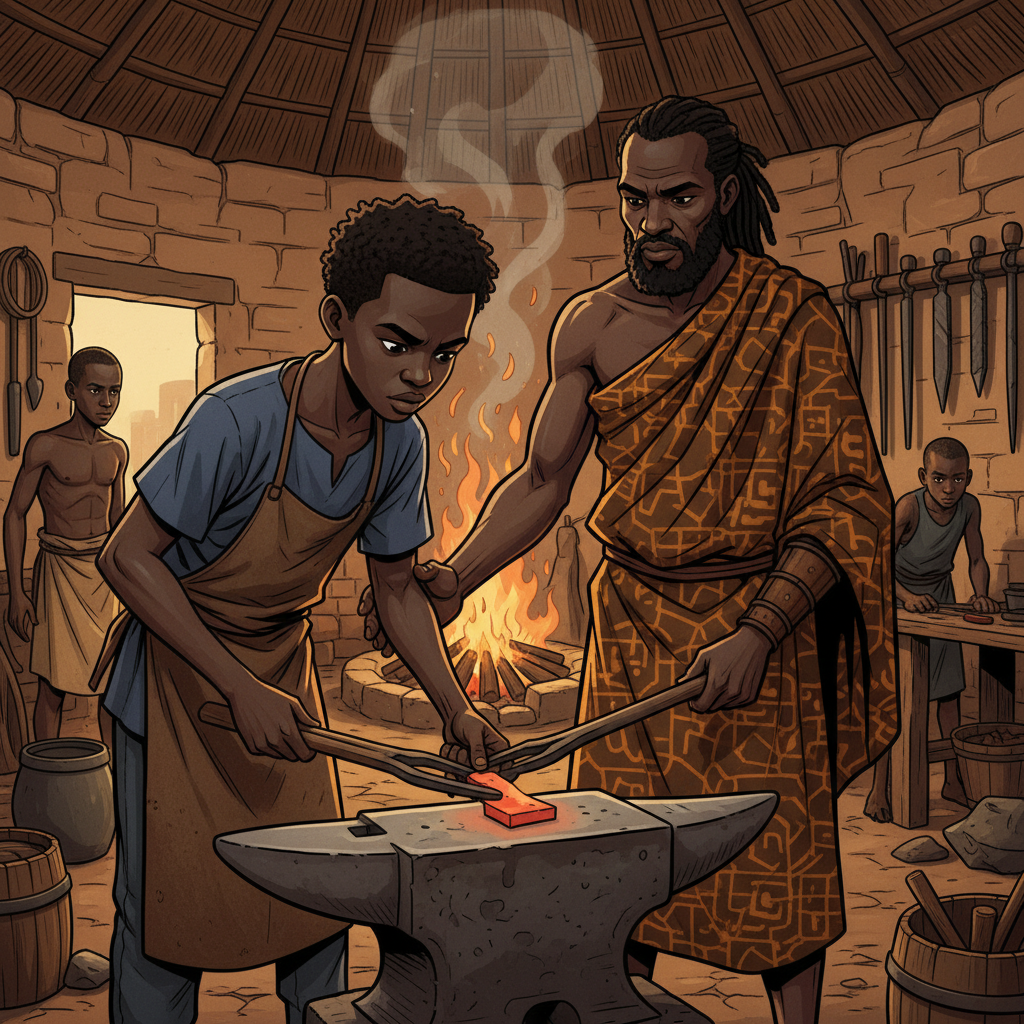
The rhythm of the forge was a song Ikenna knew by heart. The hiss of quenching, the ringing clang of hammer on anvil, the roar of the bellows – each note a part of the day's work. He learned to distinguish the subtle changes in the iron's color, from cherry red to glowing orange, knowing what each shade meant for its malleability. Master Obinna rarely spoke many words, preferring to teach through demonstration and the patient correction of a misplaced strike. “The iron,” he would say, his voice a low rumble, “it tells you what it wants to become, if you listen.” Ikenna practiced, shaping small pieces, learning the discipline and patience the craft demanded.
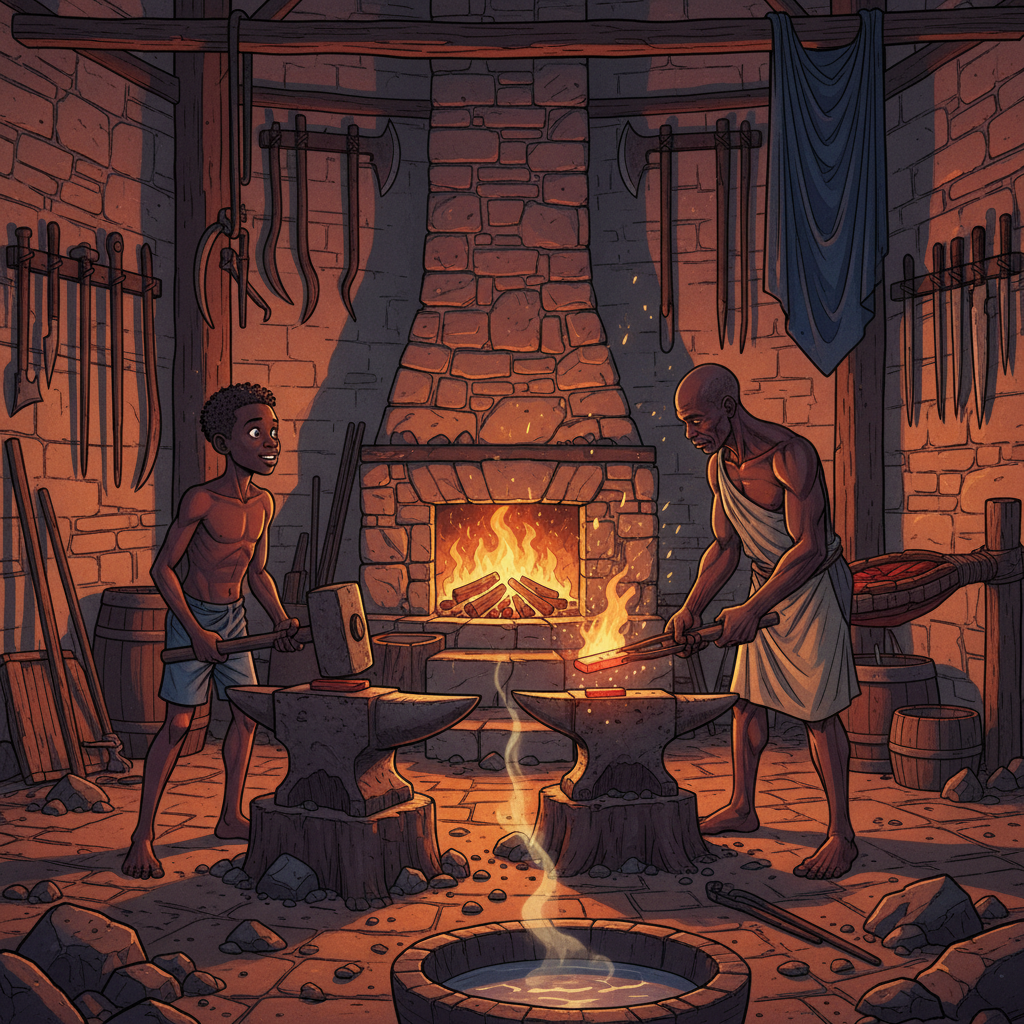
Ikenna loved the feeling of the hammer in his hand, the way its weight became an extension of his own arm. He spent hours watching Master Obinna transform rough, dark chunks of iron into tools that brought life to the community. Hoes for planting yam, axes for clearing brush, knives for harvest – each piece carefully crafted, its edge keen and its balance true. The forge was a place of creation, a heart beating at the center of Awka, providing the essential instruments that helped the village thrive. Ikenna felt a deep pride in their work, knowing that their skill was woven into the very fabric of Awka’s daily life.
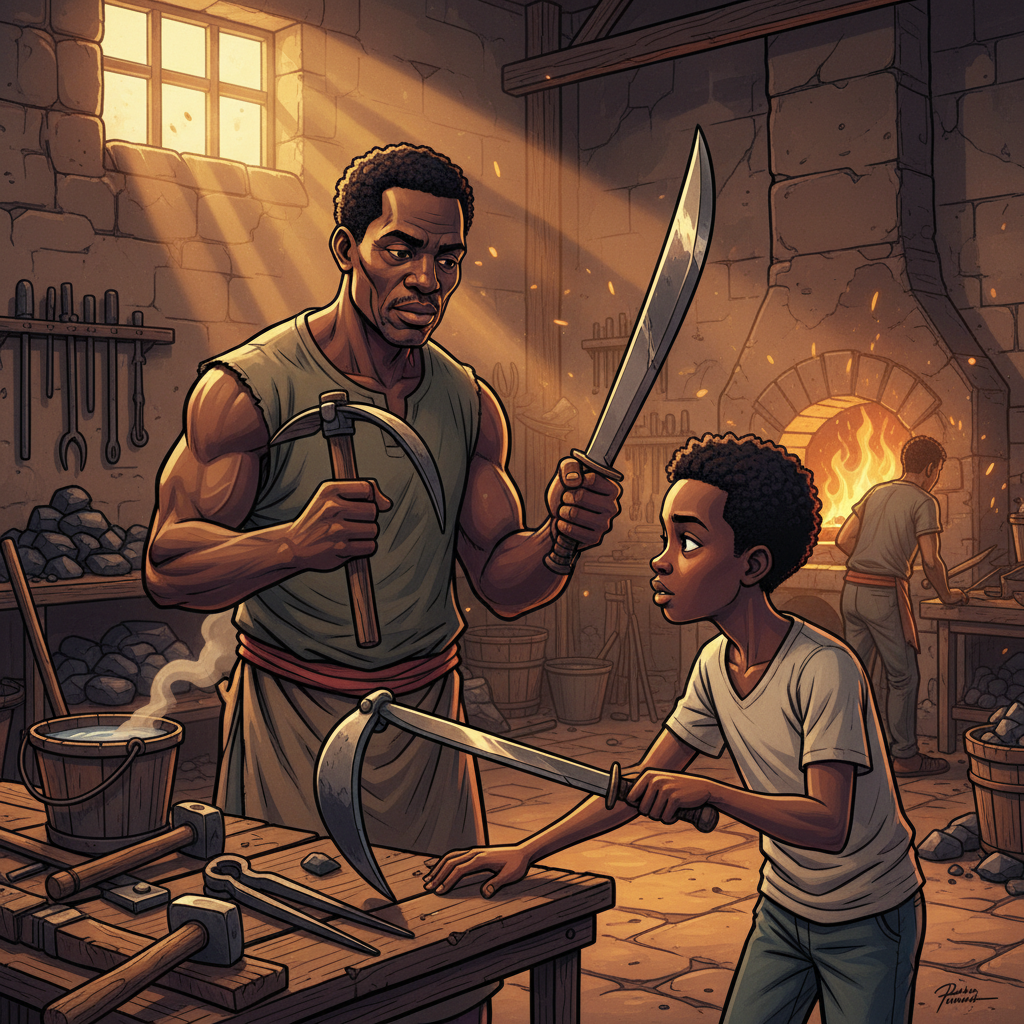
One sweltering afternoon, as the sun beat down relentlessly, Master Obinna held up two finished pieces for Ikenna to examine. One was a sturdy hoe, its blade broad and curved, ready to turn the soil. The other was a sleek, long machete, its edge glinting dangerously in the forge light. “Look closely, Ikenna,” Master Obinna instructed, his eyes steady. “Tell me what you see.” Ikenna ran his fingers carefully along the cool metal of both. They were made from the same raw iron, pulled from the same earth, heated in the same fire. Yet their purposes were as different as day and night. The hoe promised cultivation, the machete, a different kind of cutting.
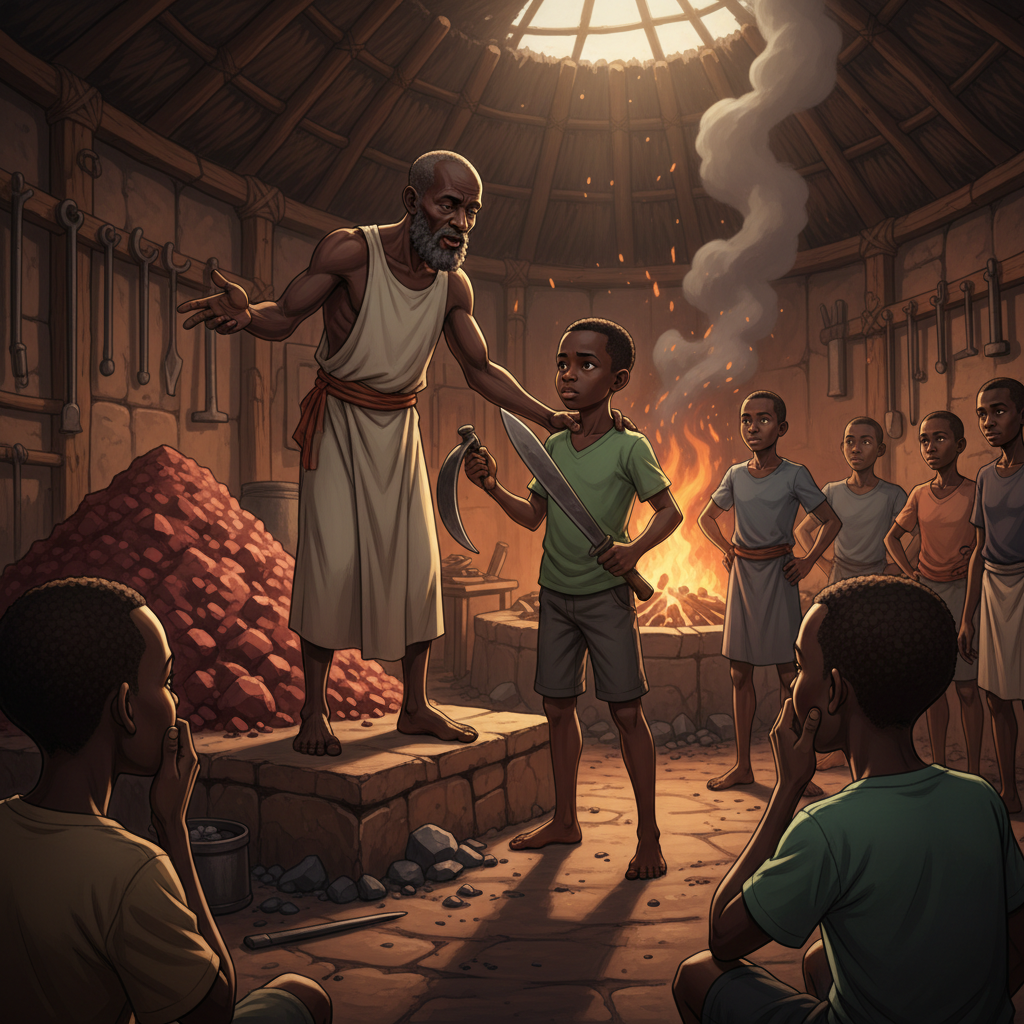
“They are both strong, Master,” Ikenna observed, “and sharp. But one serves to plant, and the other… to clear paths, or harvest tough crops.” He knew the machete’s other uses too, the ones not spoken aloud in the forge, the ones that made his stomach clench slightly. Master Obinna nodded slowly. “Indeed. The iron itself does not choose its destiny. It is the hand that shapes it, the mind that designs it, that gives it purpose.” He gestured to the pile of raw ore in the corner. “From this same earth, from this very material, comes the tool that builds and the tool that, if misused, can destroy. Remember that, Ikenna.”
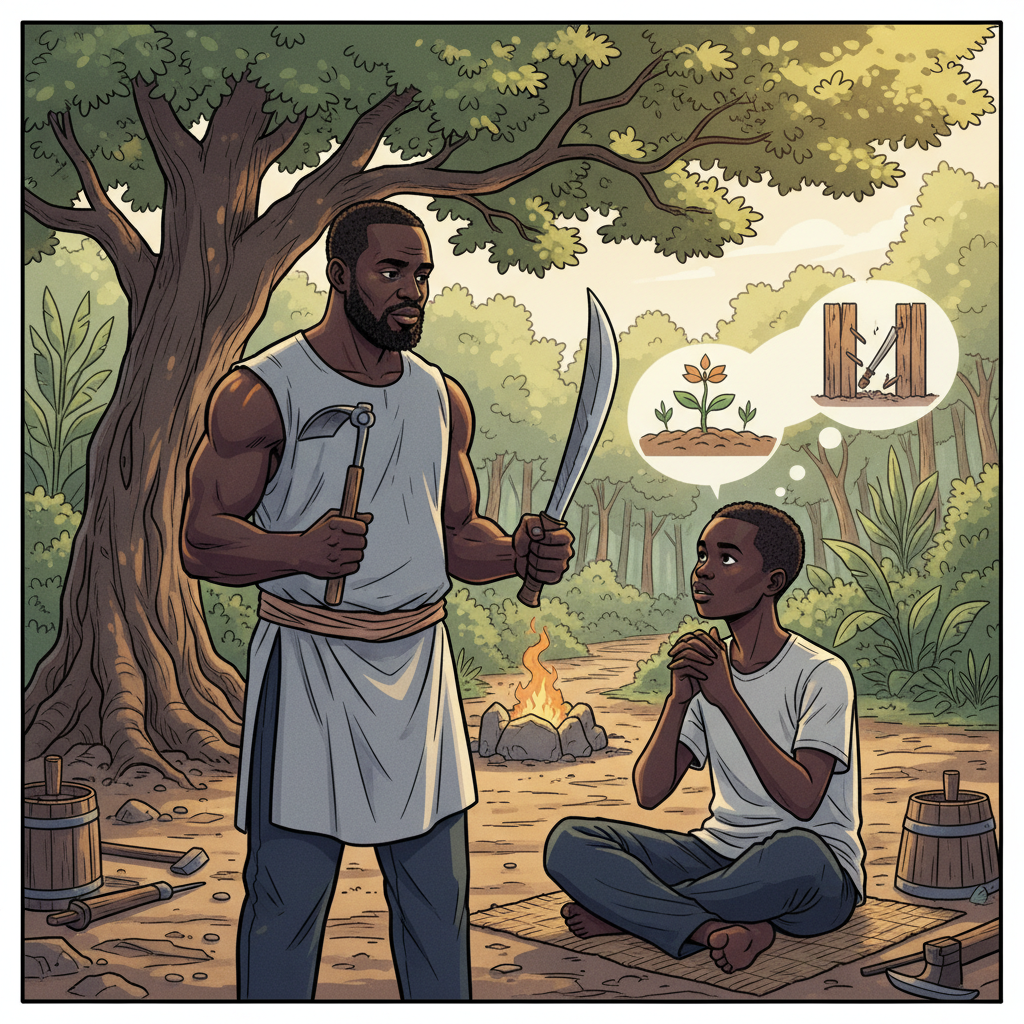
Ikenna often pondered Master Obinna’s words as he went about his tasks. He understood that the inherent nature of iron was simply to be strong, to hold an edge. Its goodness or badness was not within the metal, but in how it was wielded. A hoe could be used to strike an enemy, just as a machete could be used to clear a path for a new village. It was a complex thought for a young boy, but it settled in his mind, like a seed planted in fertile ground. The power of creation, he realized, was also the power of destruction, held in the same hands, guided by the same intent.
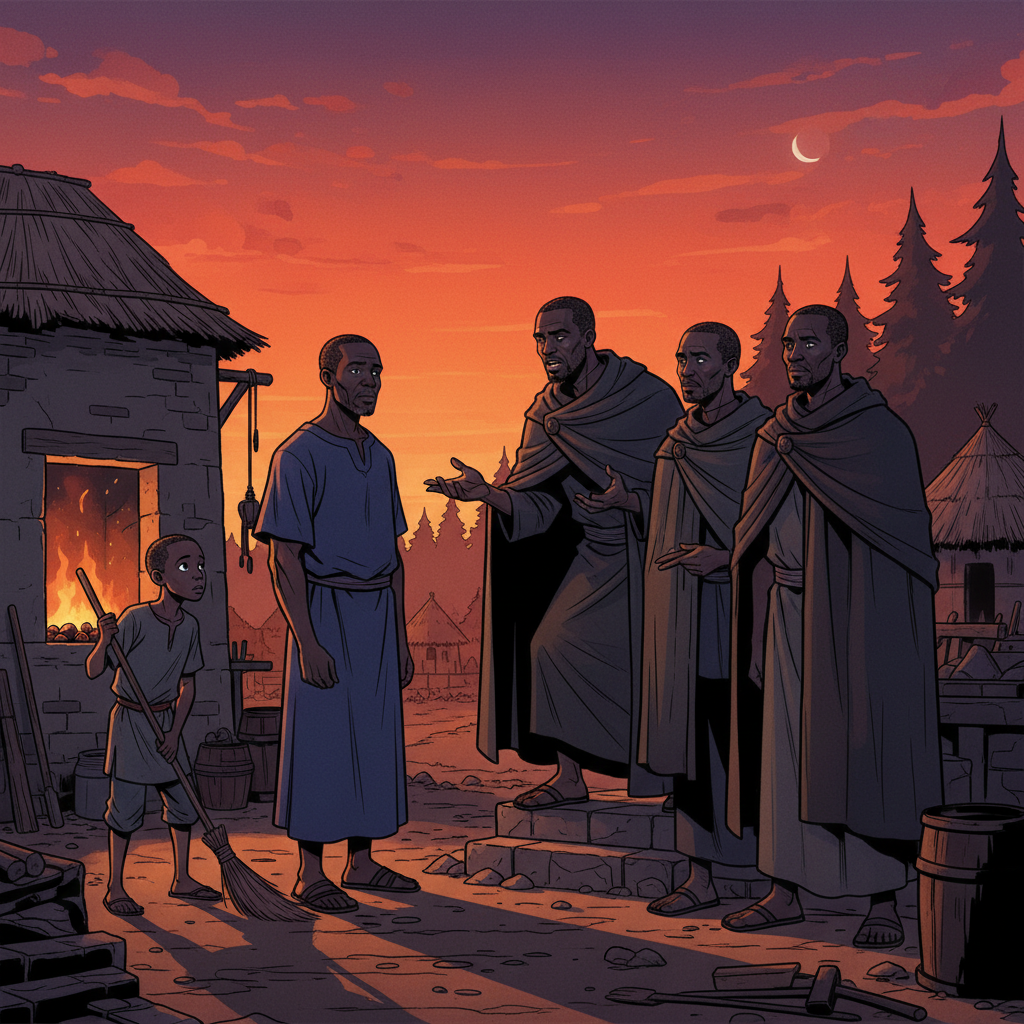
Days turned into weeks, marked by the rhythmic pounding of hammers and the rising sun. One evening, as dusk painted the sky in hues of orange and purple, a group of stern-faced men arrived at the forge. They wore cloaks that seemed to absorb the light, and their voices were hushed, yet urgent. Ikenna, who was sweeping the last embers, paused, sensing the shift in the atmosphere. Master Obinna greeted them with a respectful but cautious nod. The men spoke of a dispute with a neighboring village, a long-standing disagreement over land and fishing rights that had suddenly flared into open hostility.
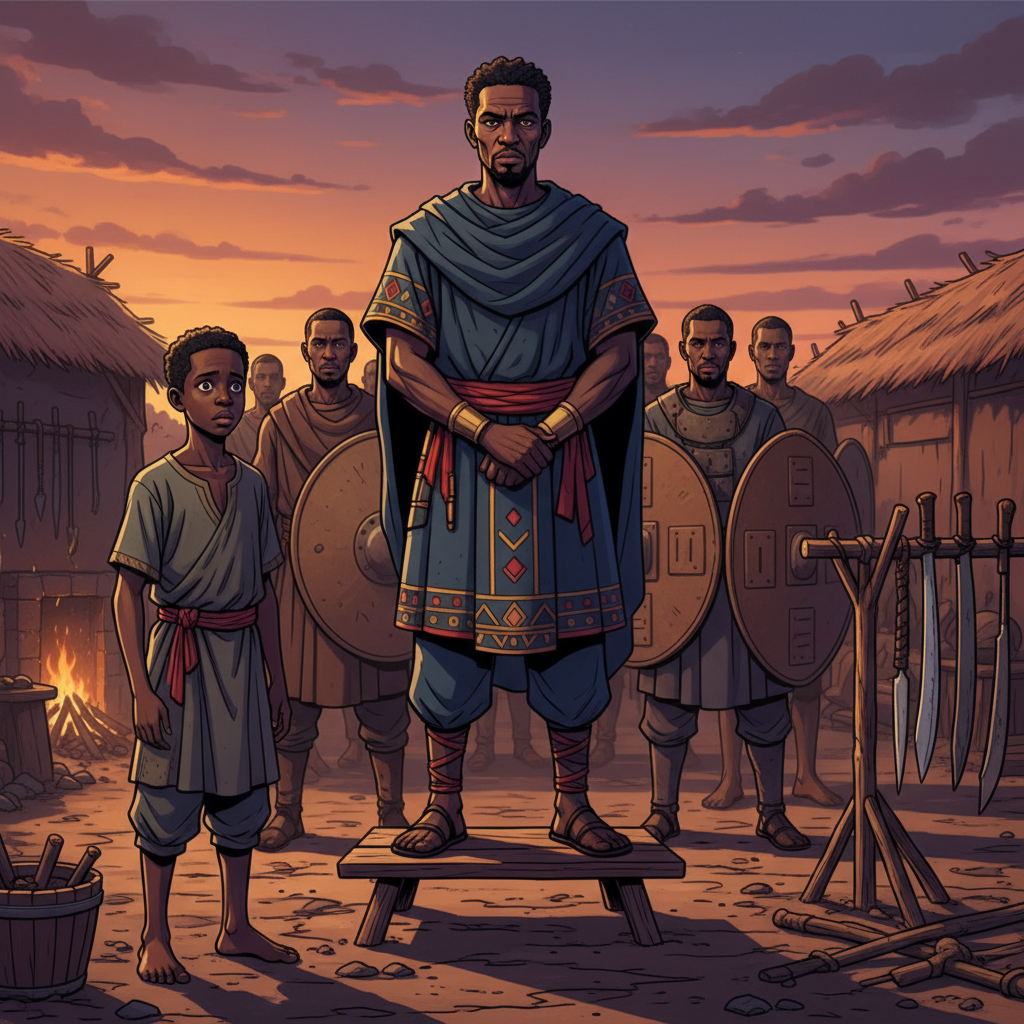
The leader of the group, a tall man with deep lines etched into his brow, stepped forward. “Master Obinna,” he began, his voice gravelly, “our warriors need new machetes. Strong ones, sharp ones. Machetes for… protection.” He did not need to say more. Both Ikenna and Master Obinna understood. These were not machetes for clearing fields. These were weapons for raid, tools meant to inflict harm. A cold knot formed in Ikenna’s stomach. He looked at Master Obinna, expecting to see a similar unease, but the Master’s face remained impassive, his eyes betraying no emotion.
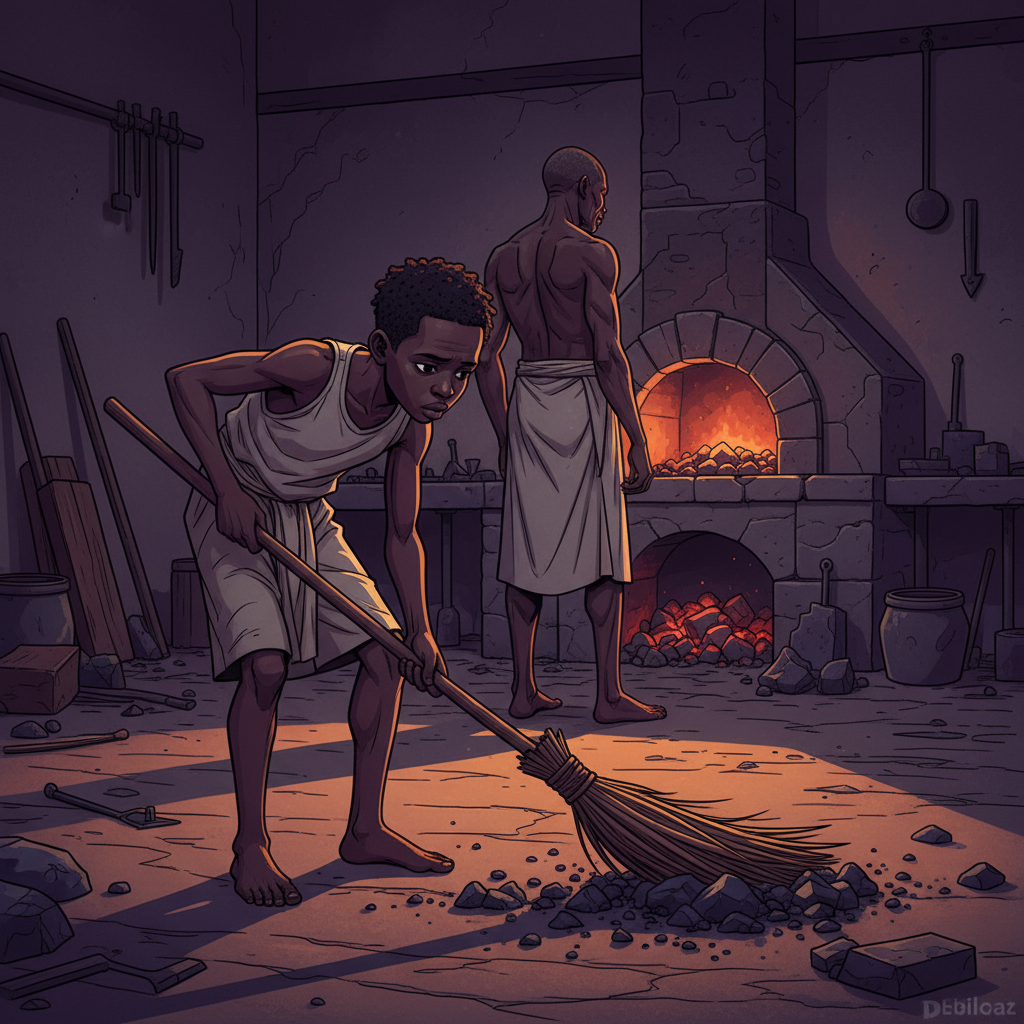
Master Obinna listened patiently, his gaze fixed on the glowing coals. When the men finished speaking, he simply nodded. “It shall be done,” he said, his voice flat, devoid of emotion. Ikenna felt a jolt. He had expected questions, a moment of hesitation, perhaps even a refusal. But Master Obinna had accepted the order without a word. The men left, their shadows lengthening in the twilight. The forge, usually a place of warm light and cheerful sounds, now felt heavy, almost ominous. Ikenna swept the embers with a new sense of dread, the metal dust feeling gritty and cold beneath his bare feet.
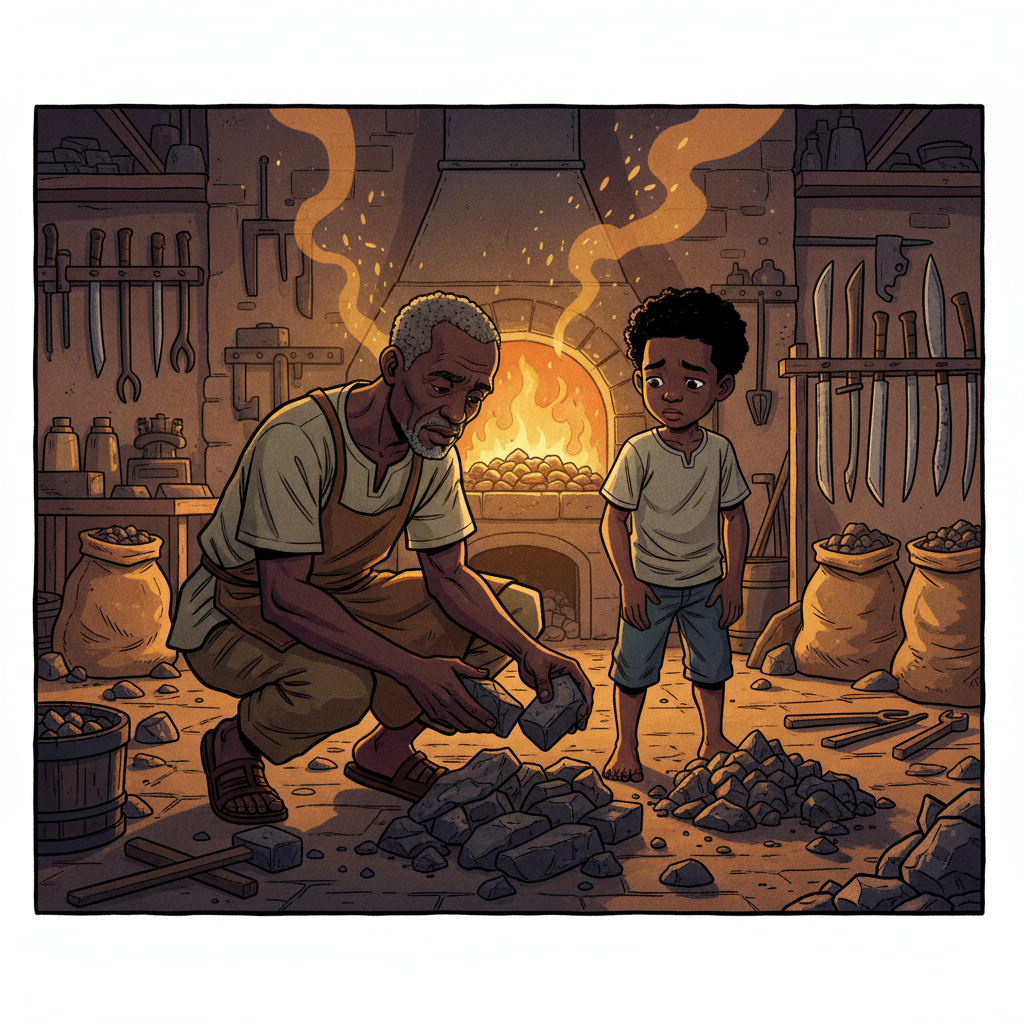
The next morning, the air felt different. Master Obinna began selecting the iron for the new order, his movements precise and deliberate. Ikenna watched, his own usual enthusiasm for the craft dimmed. He helped prepare the coals, knowing that soon, the very fire he tended would be used to forge instruments of conflict. He could not shake the image of the sleek machete Master Obinna had shown him weeks ago, now imbued with a far more sinister purpose. He wanted to ask, to understand, but the words stuck in his throat, caught between respect for his Master and the churning unease within his young heart.
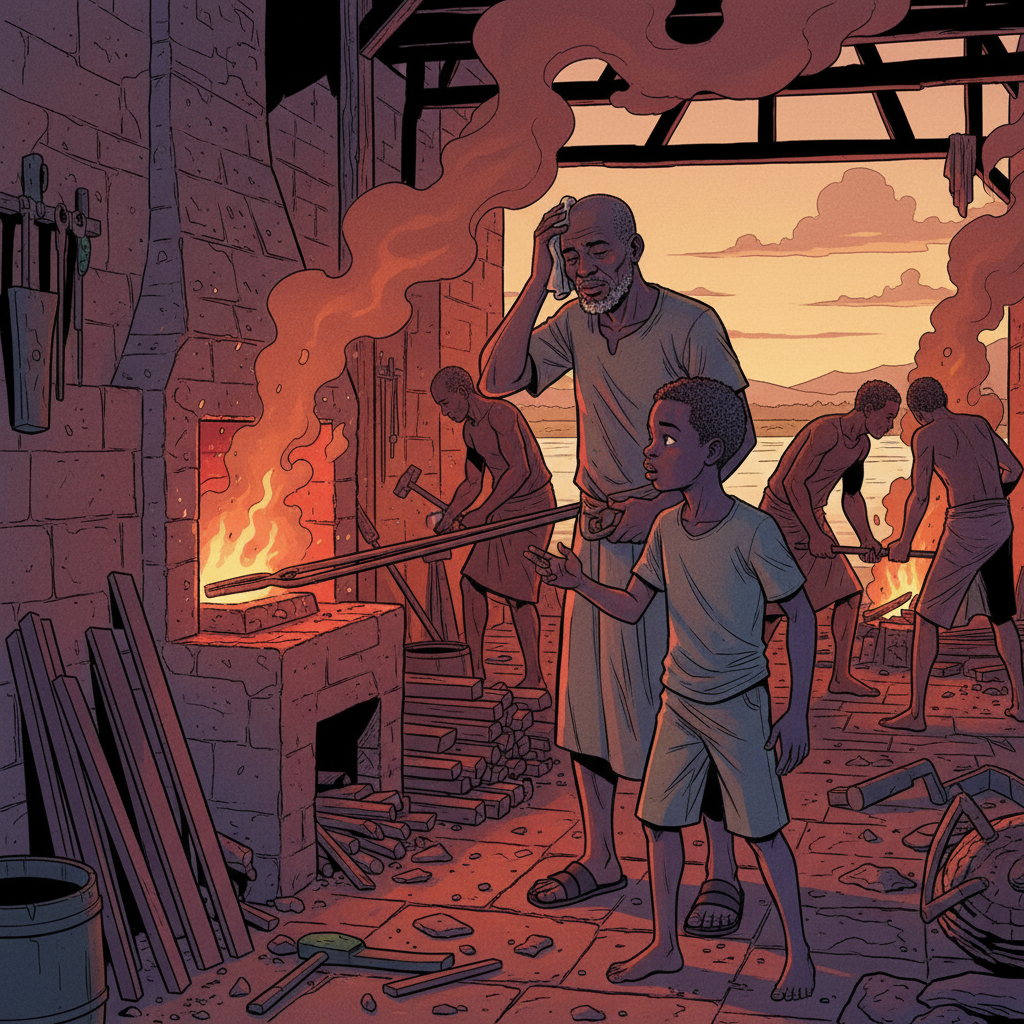
Finally, as Master Obinna paused to wipe sweat from his brow, Ikenna found his voice, small and hesitant. “Master,” he began, “the iron… the hoes we make, they help bring food. They help us live. But these…” He gestured vaguely towards the chosen iron, now beginning to glow faintly in the coals. “These will be used to… hurt.” Master Obinna turned, his expression unreadable. He picked up a long pair of tongs, turning a piece of iron in the fire. The heat radiated outwards, warming Ikenna’s face, but doing little to warm the cold feeling in his chest.
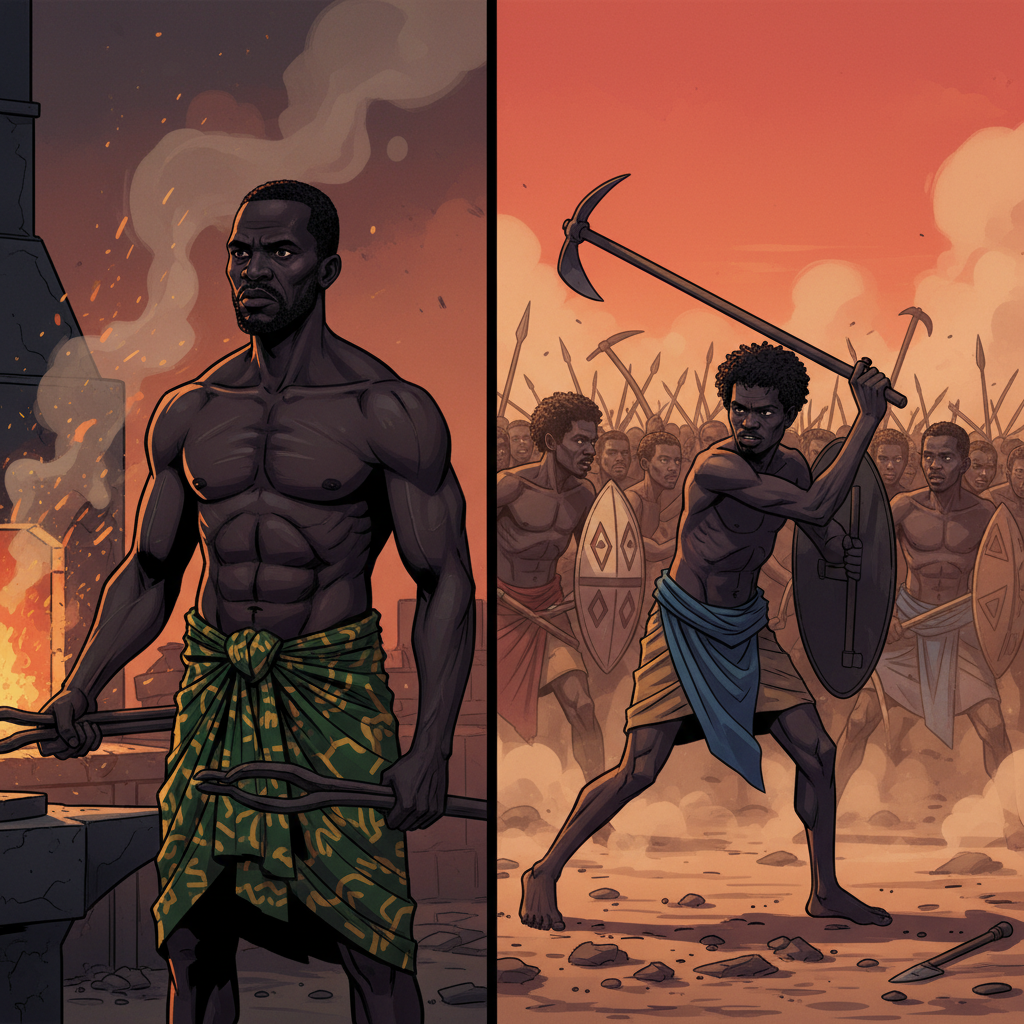
“Ikenna,” Master Obinna said, his voice quiet but firm, “the blacksmith does not choose the purpose of the tool. We are the hands that shape, not the minds that command. Our skill is to take the earth’s bounty and make it useful. If men choose to use a hoe for battle, or a machete for peace, that is their decision, not the iron’s, and not the smith’s.” He returned his gaze to the iron, as if seeking answers in its molten glow. “We provide what the community asks for. That is our duty.”
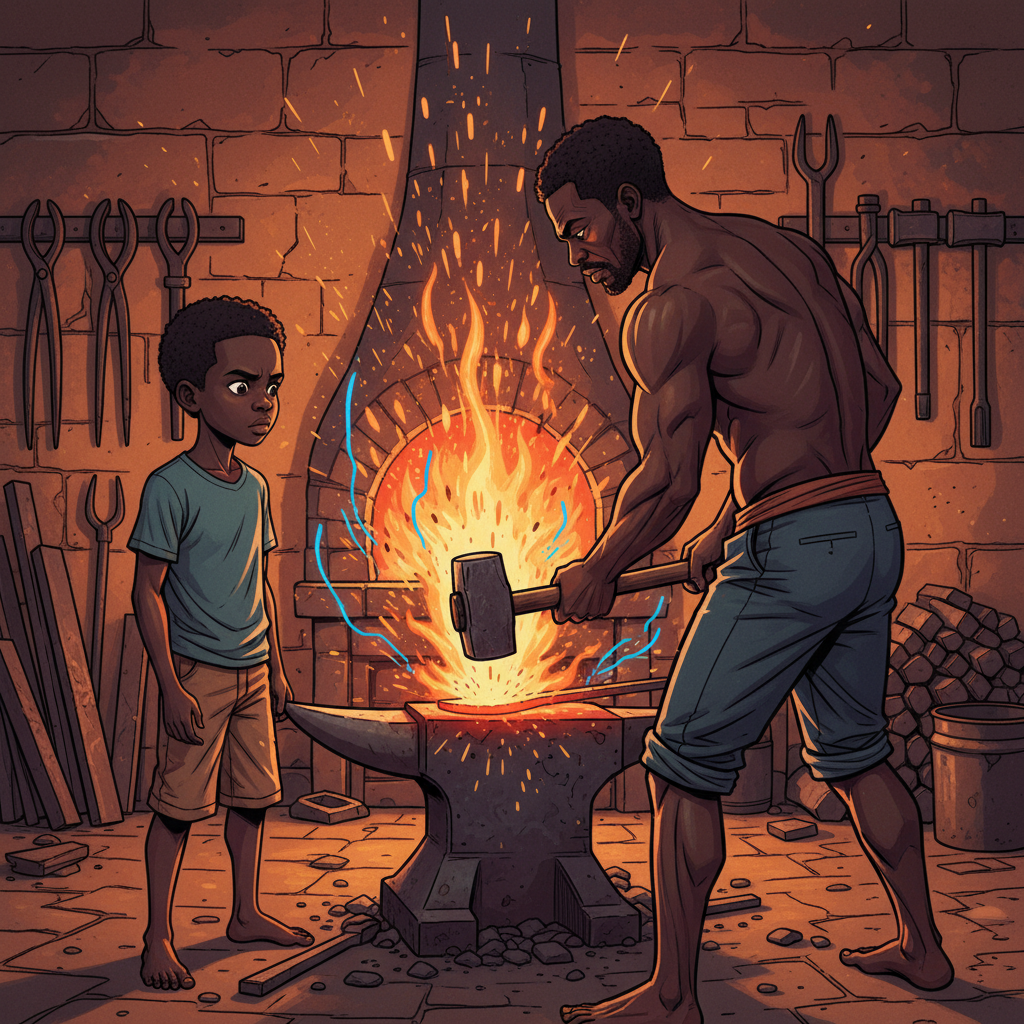
Ikenna listened, trying to understand. His Master’s logic seemed sound, like the solid strike of a hammer. The iron was indeed neutral, a blank canvas awaiting form. But still, a part of him rebelled. Was there no choice for the craftsman? Was their skill merely a conduit, without any moral weight? The idea felt hollow, incomplete. He watched Master Obinna begin to hammer the first piece of iron, the familiar rhythm now infused with a new, unsettling resonance. Each clang echoed not just the shaping of metal, but the shaping of a potentially violent future.
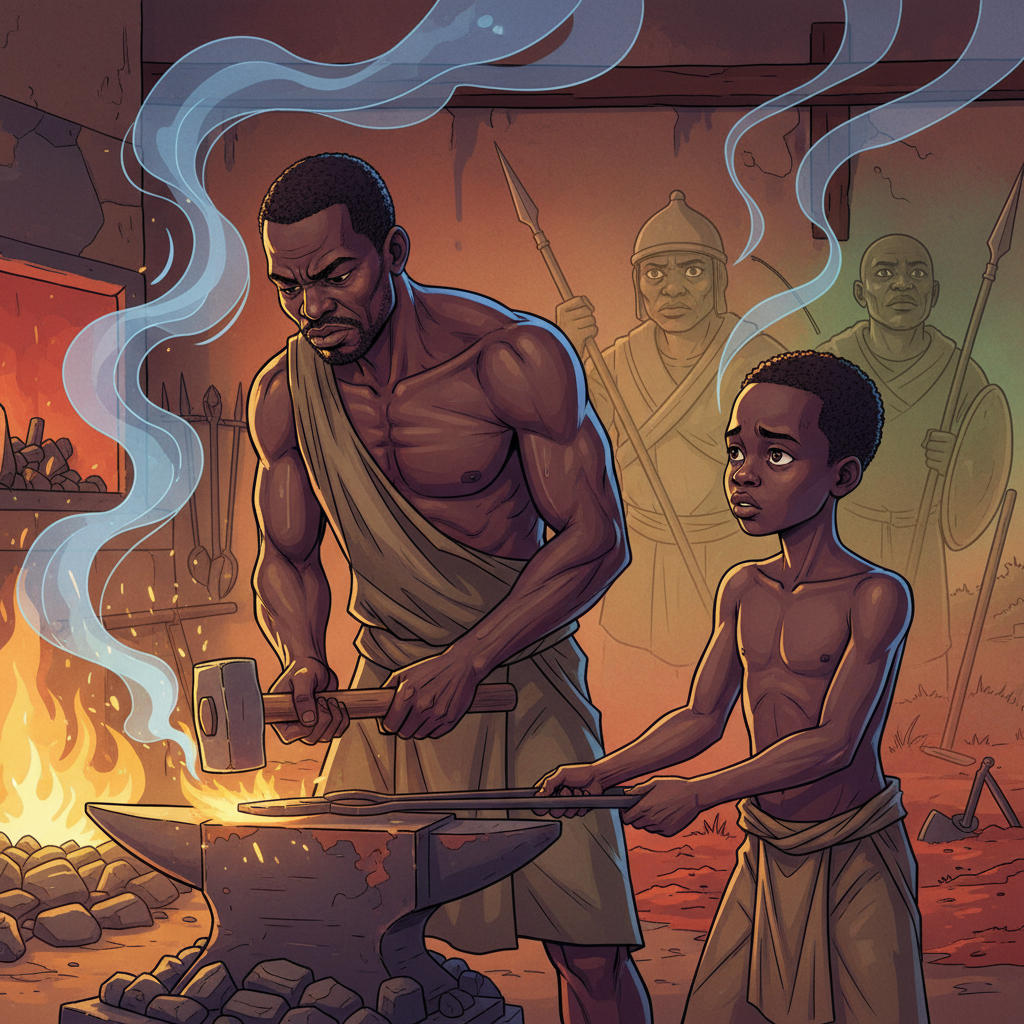
Master Obinna continued his work, his brow furrowed in concentration. The air filled with the familiar smells of hot metal and charcoal, but Ikenna found no comfort in them today. He assisted mechanically, pulling the bellows, holding the iron steady with the tongs, his thoughts elsewhere. He imagined the strong arms of warriors wielding these very machetes, their faces grim, their intent clear. He pictured the fields where hoes usually turned soil, now perhaps stained with something else. The contrast between creation and destruction, usually an abstract concept, now felt terribly real and imminent.
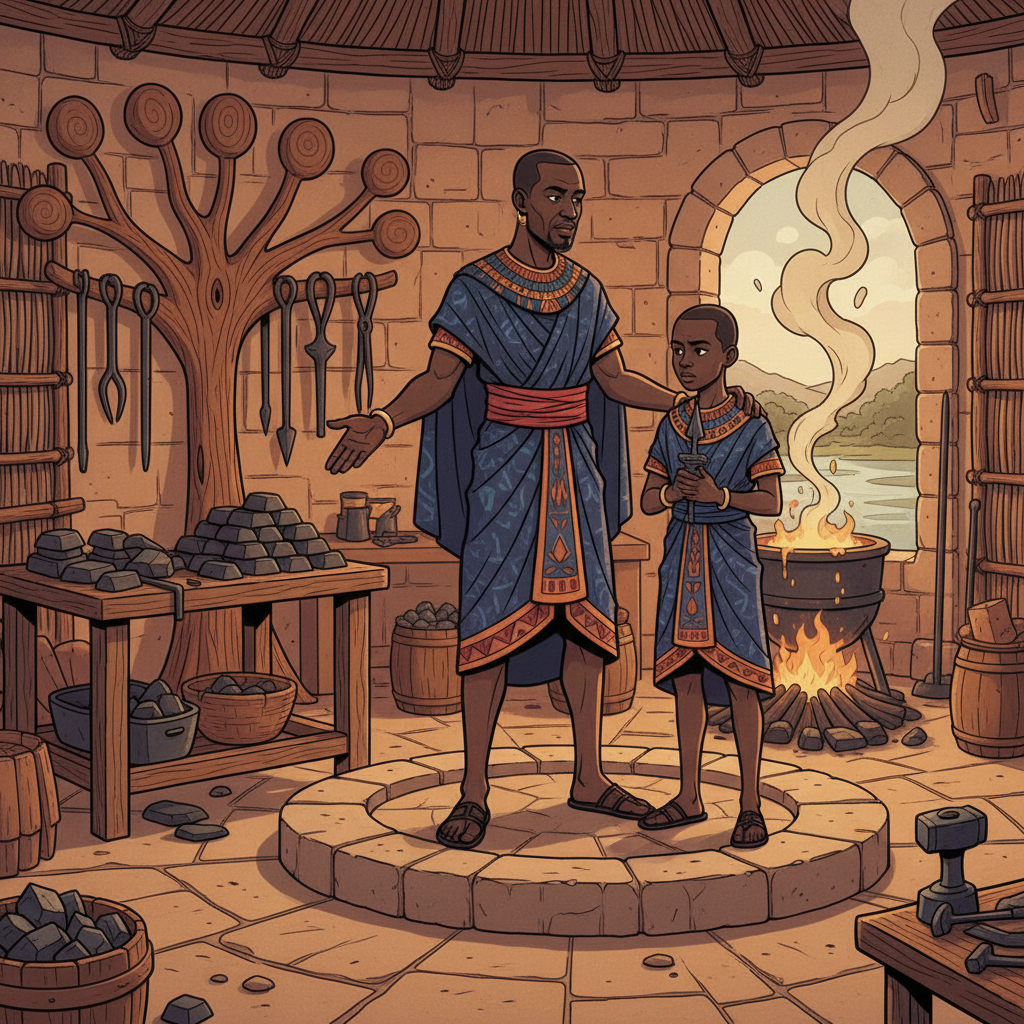
“Iron does not choose its path, Ikenna,” Master Obinna repeated later that day, sensing the boy’s lingering turmoil. “It is raw strength, waiting to be directed. We give it form. Nothing more, nothing less. If the path it takes after it leaves our hands is one of sorrow, that is on those who direct it, not on the iron itself, nor on the skill that brought it into being.” His voice held a quiet finality, as if closing a chapter on the discussion. Ikenna could not argue with the words, but his heart still whispered a different truth.
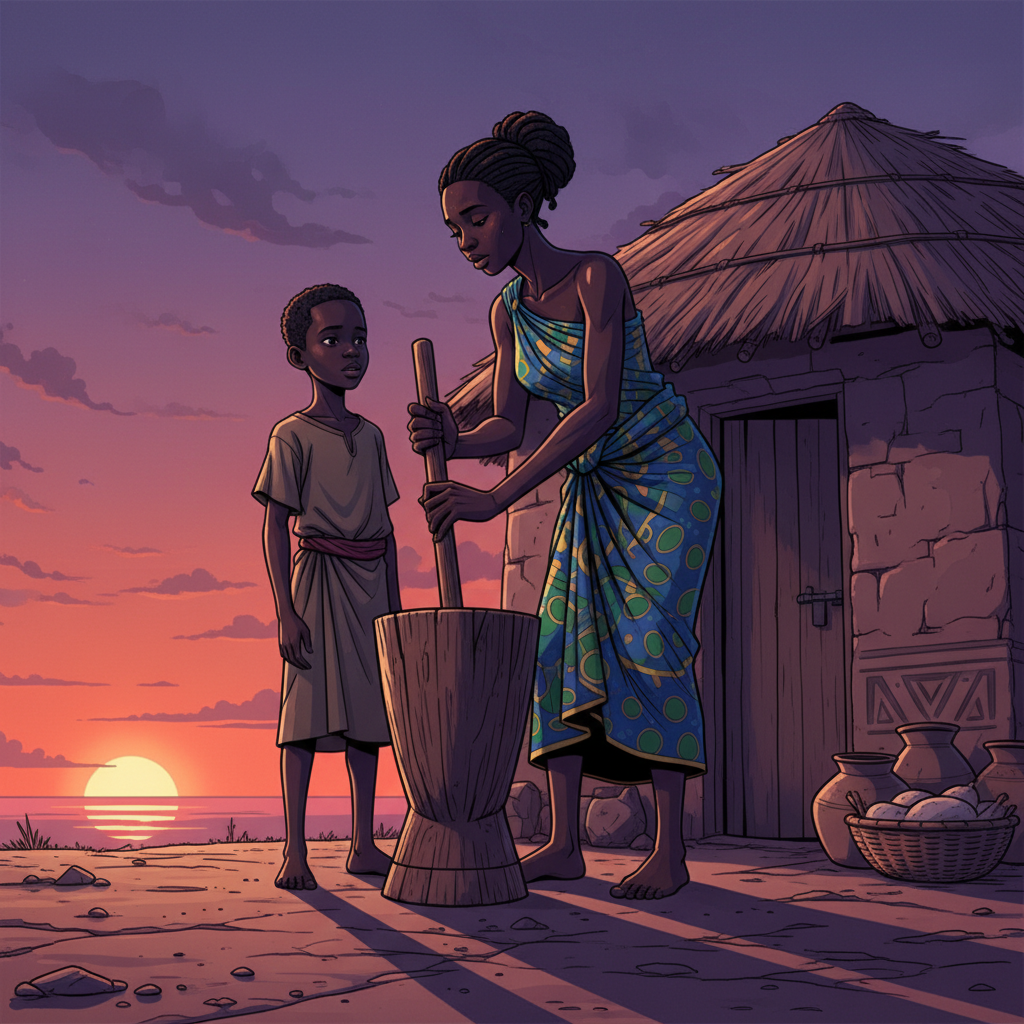
That evening, Ikenna walked home slowly, the sun dipping below the horizon, casting long, purple shadows. He found his mother, Mama Nneka, pounding yam in front of their hut, her movements strong and graceful. Her dark skin shimmered with a light sheen of sweat, and her wrapper glowed in the fading light. He watched her for a moment, finding a strange comfort in the familiar rhythm of her pestle. Mama Nneka was known for her quiet wisdom, her words often gentle but always deep. He knew he could speak to her about the heavy burden on his heart.
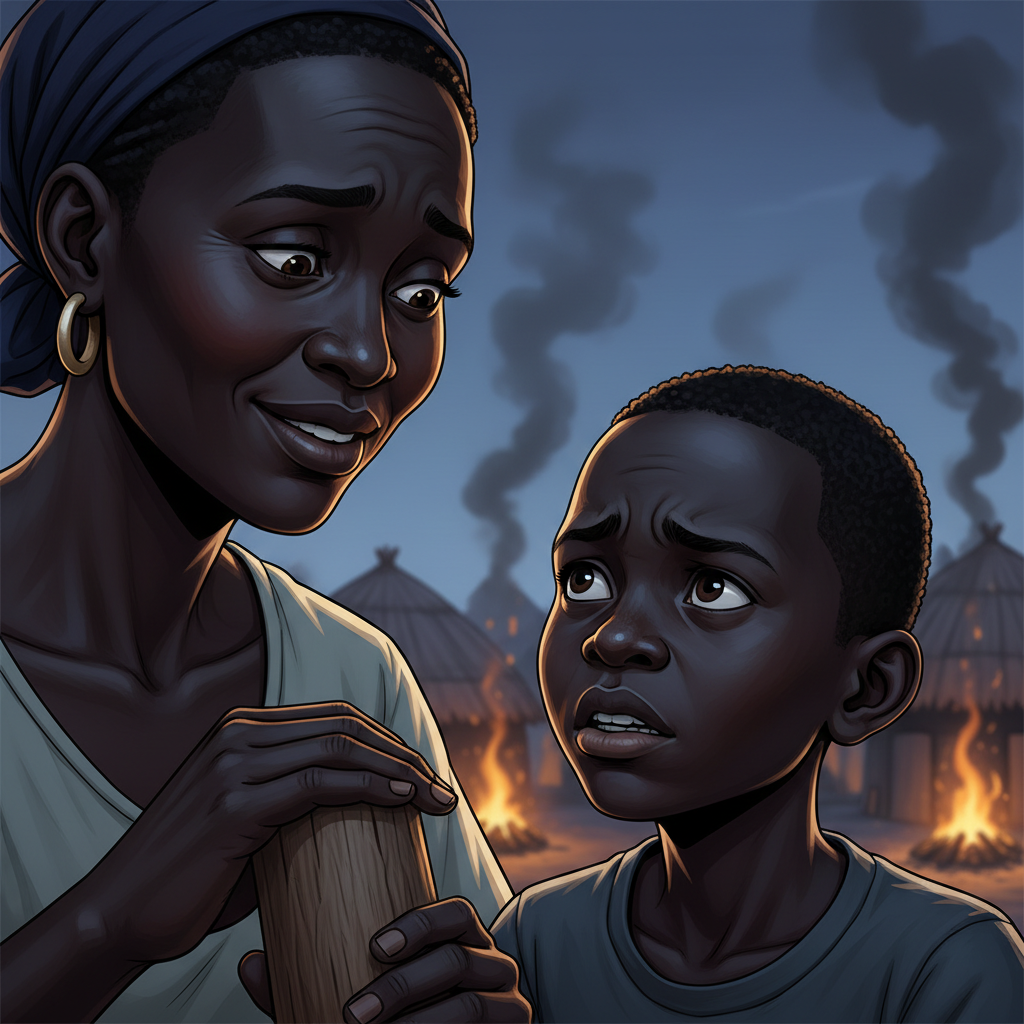
“Mama,” Ikenna said, his voice low, drawing her attention. She paused, her smile soft as she saw the troubled look on his face. “My son, what weighs upon your spirit?” He explained the order for the raid machetes, Master Obinna’s perspective, and his own gnawing unease. He spoke of the same iron making hoes for life and machetes for conflict, the stark contrast that troubled him so deeply. Mama Nneka listened patiently, her eyes never leaving his face, her hands resting on the heavy pestle. The evening air grew cooler, carrying the scent of cooking fires from nearby huts.
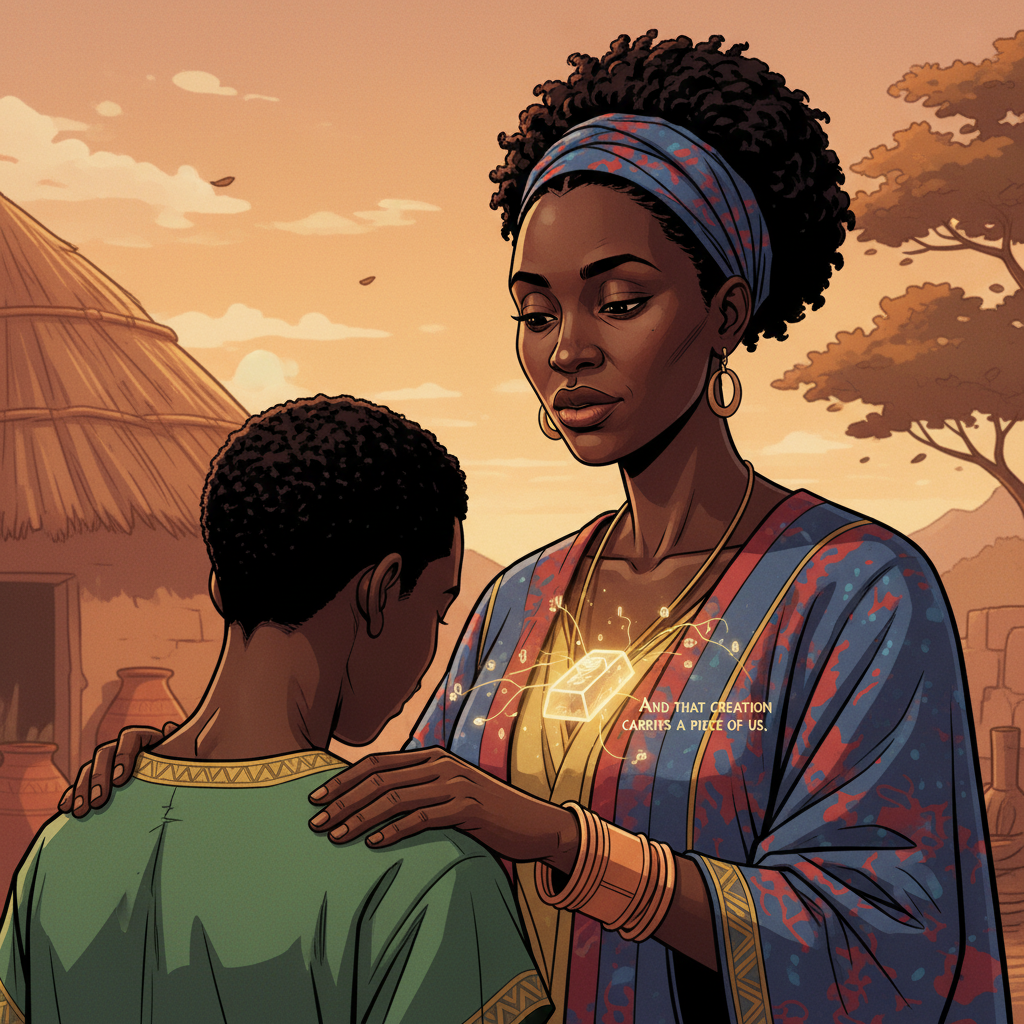
When Ikenna finished, a silence settled between them, broken only by the distant sounds of village life. Mama Nneka finally spoke, her voice like the gentle rustle of leaves in a breeze. “Your Master speaks a truth, Ikenna. The iron itself does not choose. It is a gift from the earth, waiting for form. But a craftsman’s hands are not merely tools; they are guided by a heart, by a spirit. And that spirit carries responsibility. What we create, we send into the world. And that creation carries a piece of us.” She looked at him, her eyes wise and knowing.
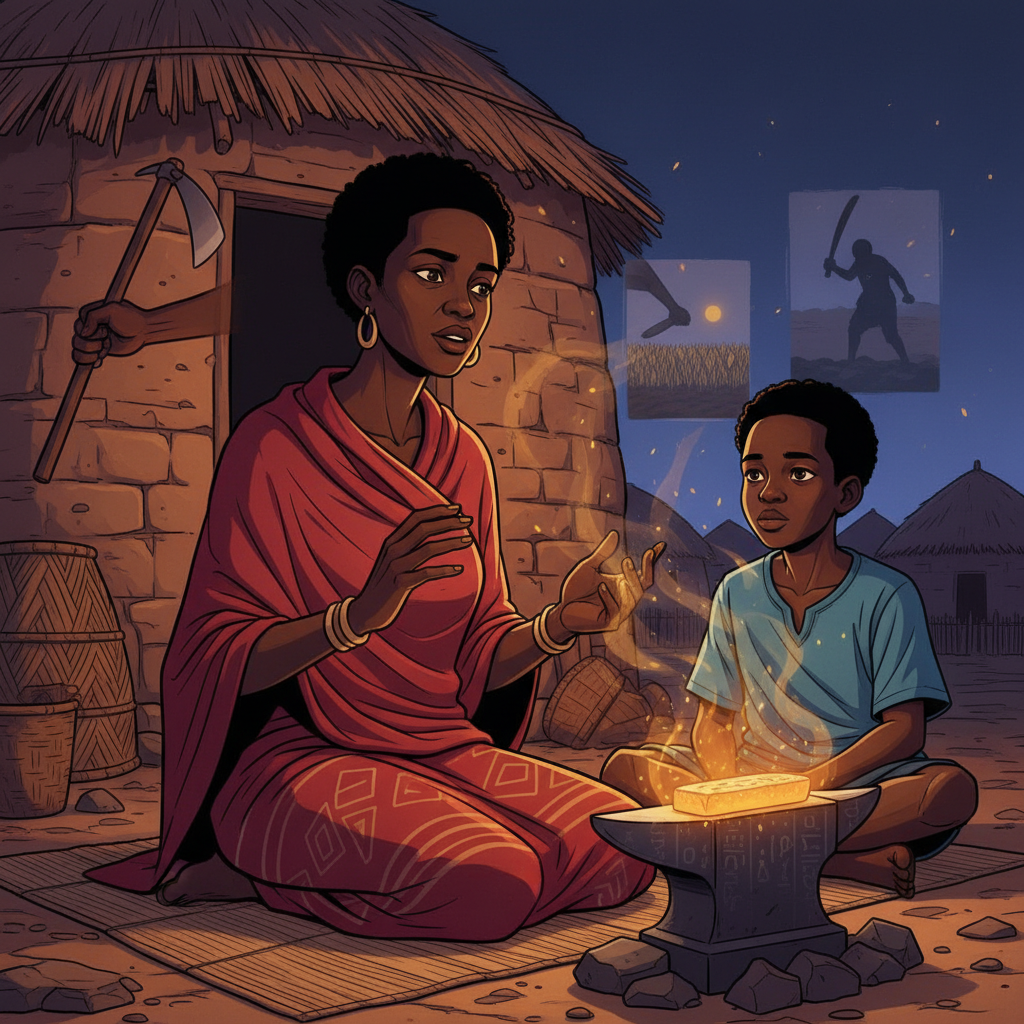
“The hoe you make for planting,” Mama Nneka continued, “does it not carry the hope of a good harvest, the promise of sustenance for our families? And if that hoe were misused, would not a small part of that hope be broken? So too, the machete. If it is made for destruction, for taking life, does it not carry the shadow of that purpose, no matter how neutral the iron once was?” She paused, her gaze thoughtful. “Iron does not choose, my son. But iron remembers the hands that shaped it. And the community remembers who made the tools that brought them either prosperity or sorrow.”
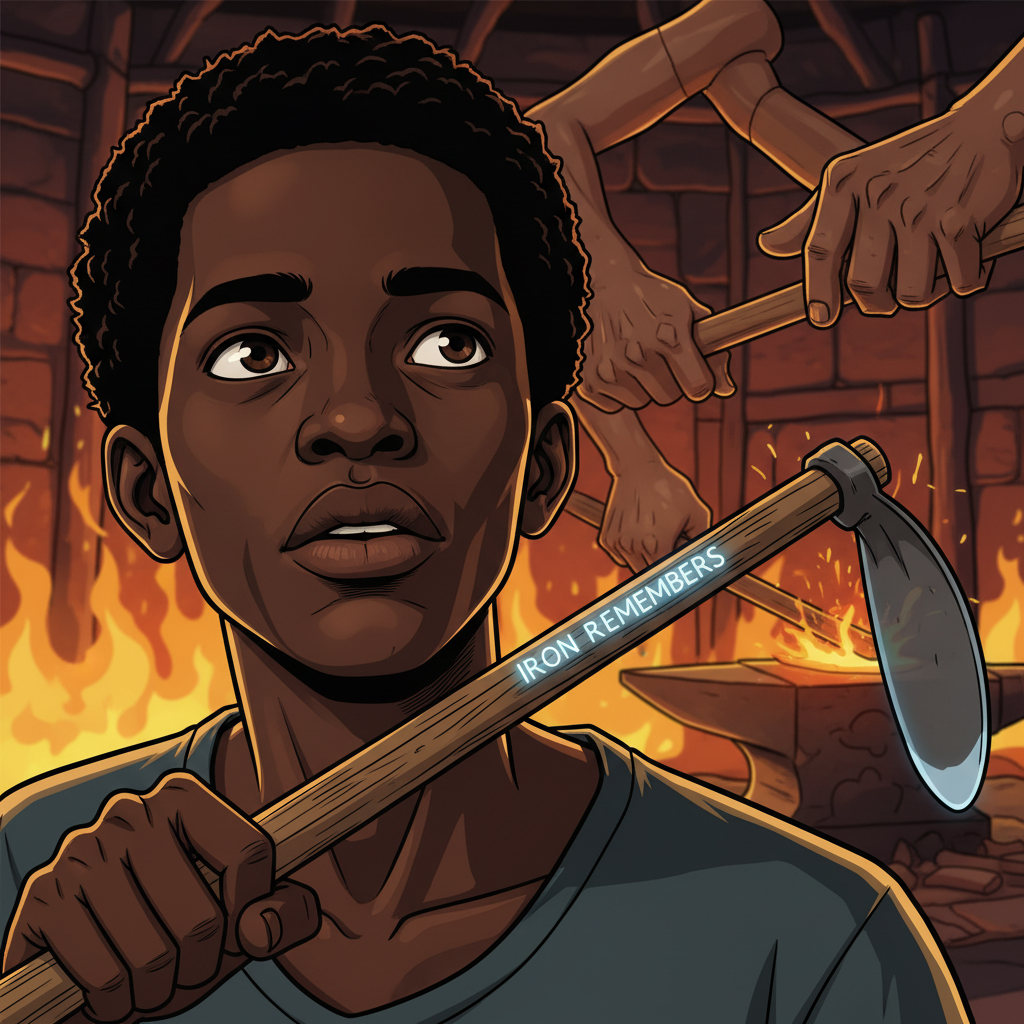
Her words settled into Ikenna’s heart like stones falling into a deep well. “Iron remembers the hands that shaped it.” It was a truth that resonated far deeper than Master Obinna’s more practical argument. The craftsman was not just a conduit, not merely a pair of hands. He was an integral part of the chain of purpose, from earth to tool to outcome. His choice, his intent, left an indelible mark. The creation was intertwined with its potential destruction, and the creator bore a share of that weight. This was the ethical challenge, the heart of the craft.
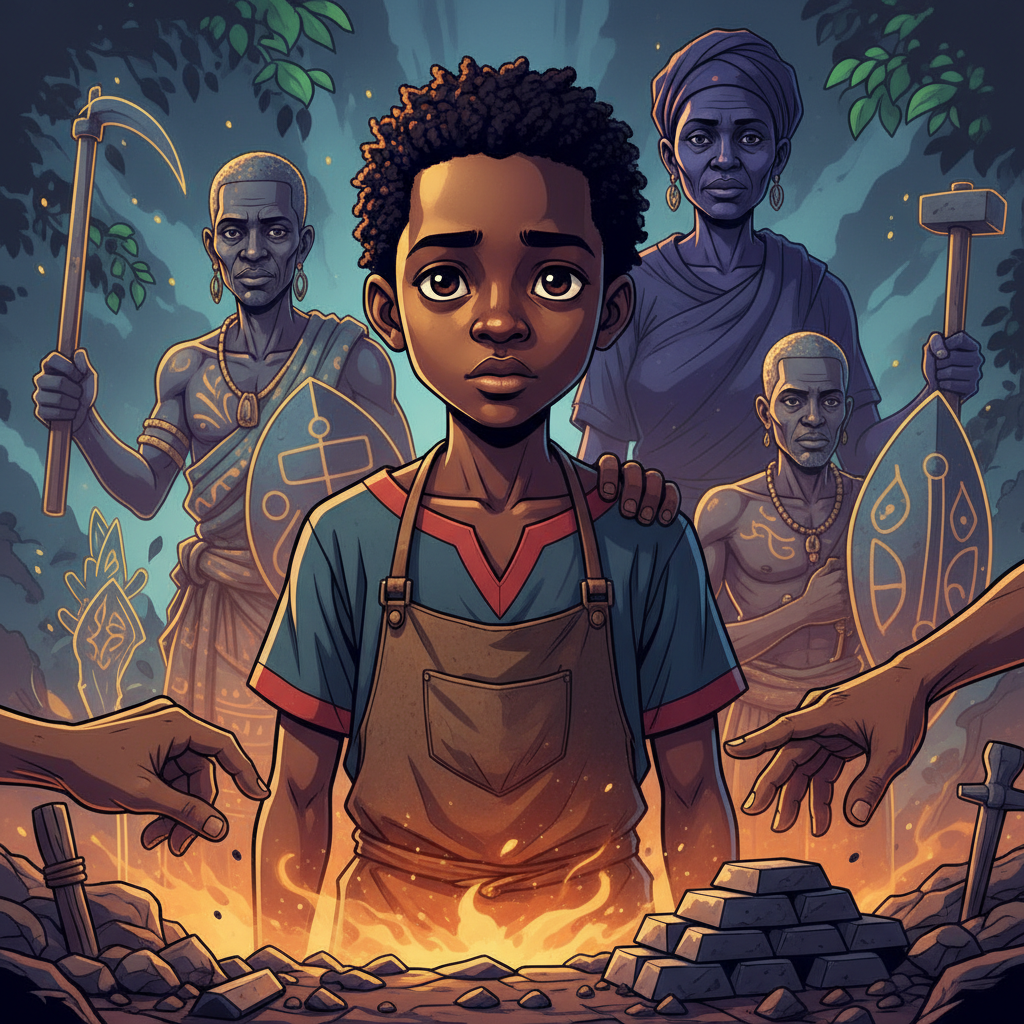
Ikenna understood then that his Master’s words were about the *material*, while his mother’s words were about the *maker*. Both held truth, but Mama Nneka’s truth demanded more from him, called him to a higher standard. It was not enough to simply shape metal; one had to consider the impact of that shaping. The ethics of craft were not just about skill, but about wisdom, about foresight. He thought of the Awka ancestors, the legendary blacksmiths whose names were spoken with reverence. Surely, they too had faced such dilemmas, making choices that echoed through generations.
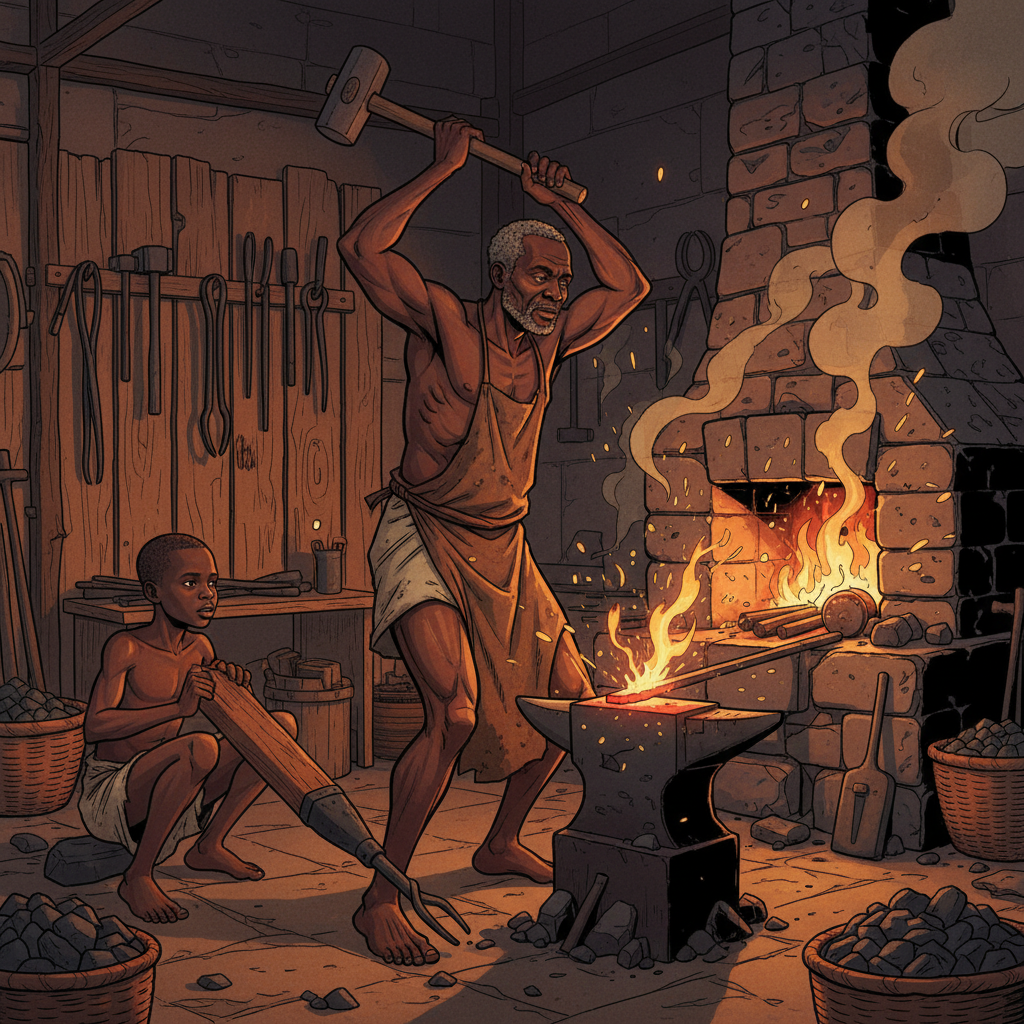
The next morning, Ikenna returned to the forge with a new resolve. He watched Master Obinna, who was already at work, his hammer rising and falling with practiced ease. The air was thick with the scent of coal and hot iron. Ikenna joined him, taking his place at the bellows, his movements deliberate. He knew he could not stop the order from being fulfilled. The needs of the community, however misguided, often dictated the work of the smith. But he also knew he could choose how *he* approached his craft.
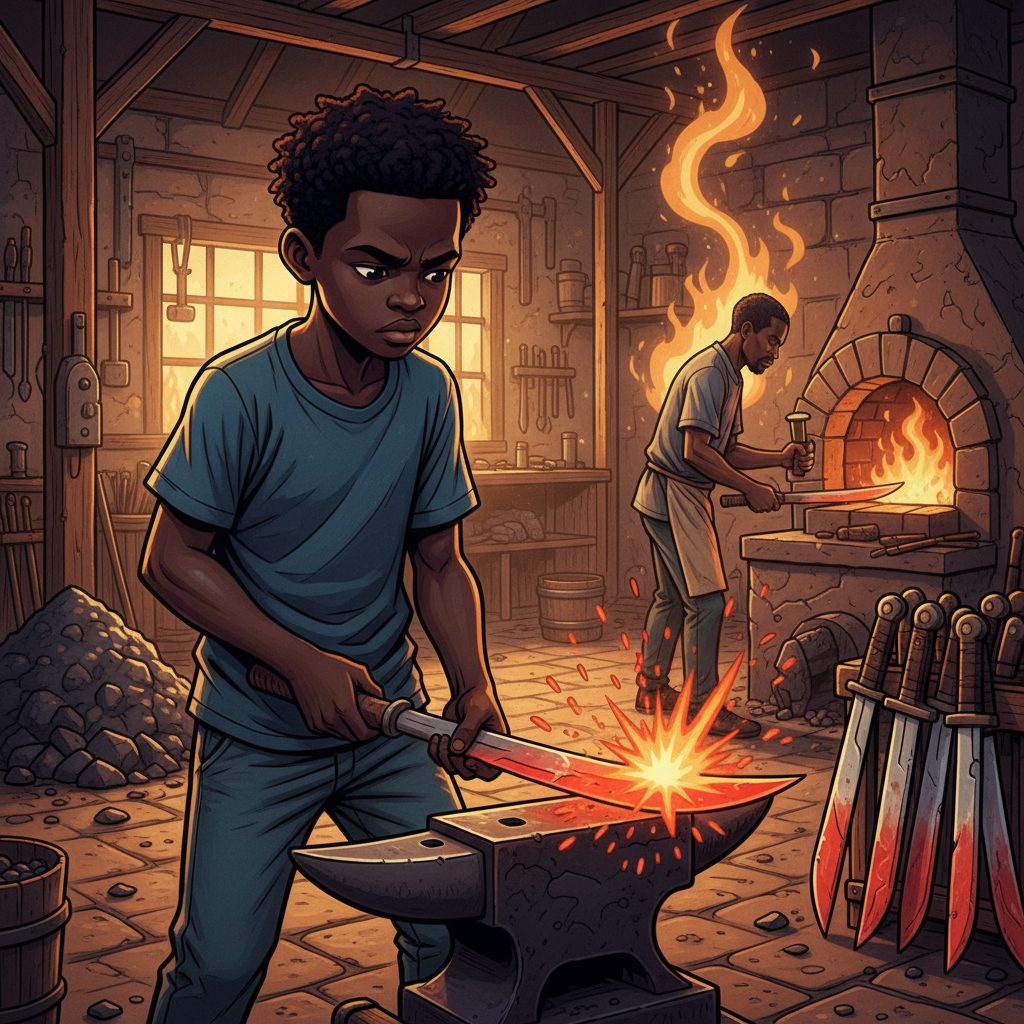
As the days passed, and the raid machetes began to take shape, Ikenna worked with a heavy heart, yet with greater precision. Each strike of his hammer was deliberate, each polish of the blade careful. He was shaping the iron as requested, but his spirit was elsewhere, weighing the implications. He understood that while he could not always control the request, he could control the integrity with which he performed his work. He would infuse each piece with the finest craftsmanship, a silent testament to the belief that even tools of potential destruction deserved respect in their making.
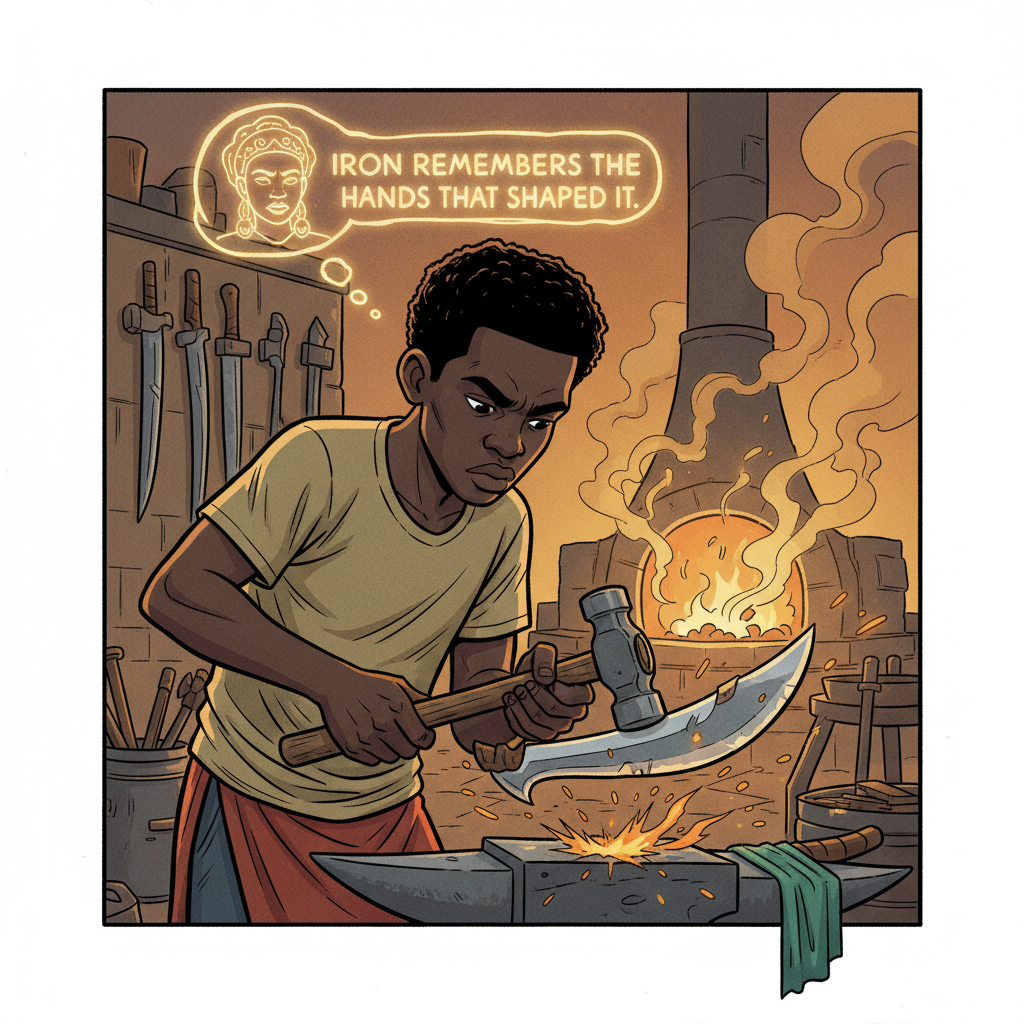
He thought of Mama Nneka’s words: “Iron remembers the hands that shaped it.” He would ensure that his hands, though shaping tools of war, would do so with a purity of craft that transcended their immediate, troubling purpose. He would not allow the intent of others to diminish the integrity of his skill. This was his silent rebellion, his personal adherence to the ethics of his craft. He would create, even when creation was twisted towards destruction, but he would do so with a clear conscience, knowing that he had done his part to uphold the true spirit of the Awka blacksmith.
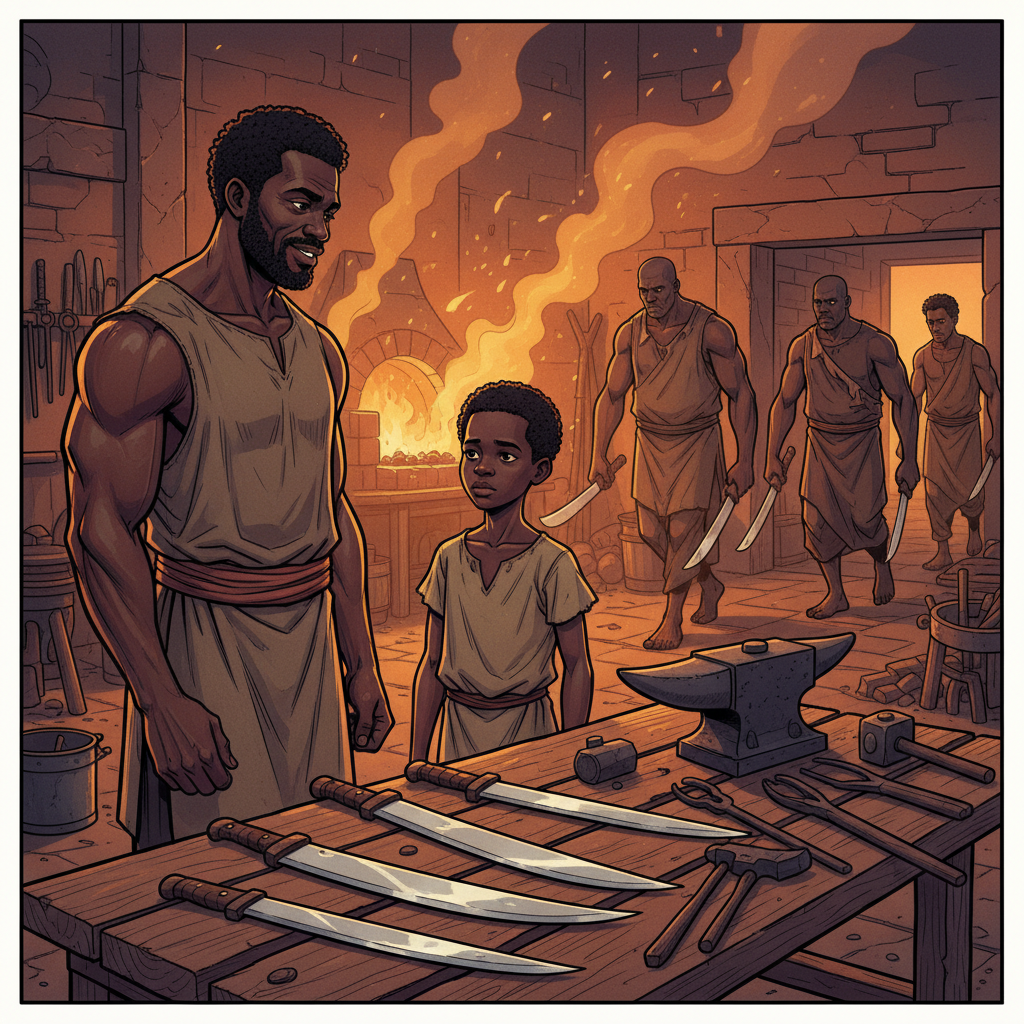
When the last machete was finished, its blade gleaming, Master Obinna looked at Ikenna with a rare, approving nod. He had noticed the boy’s diligence, his unwavering focus. Ikenna had not shied away from the difficult task, but had faced it with a quiet determination. The men came to collect their order, their faces grim, their intentions clear. Ikenna watched them go, the weight of the machetes heavy in their hands, knowing that he had played a part, but also knowing he had carried a different lesson from the forge that week. The iron had indeed been shaped, but so too had his own understanding of responsibility.
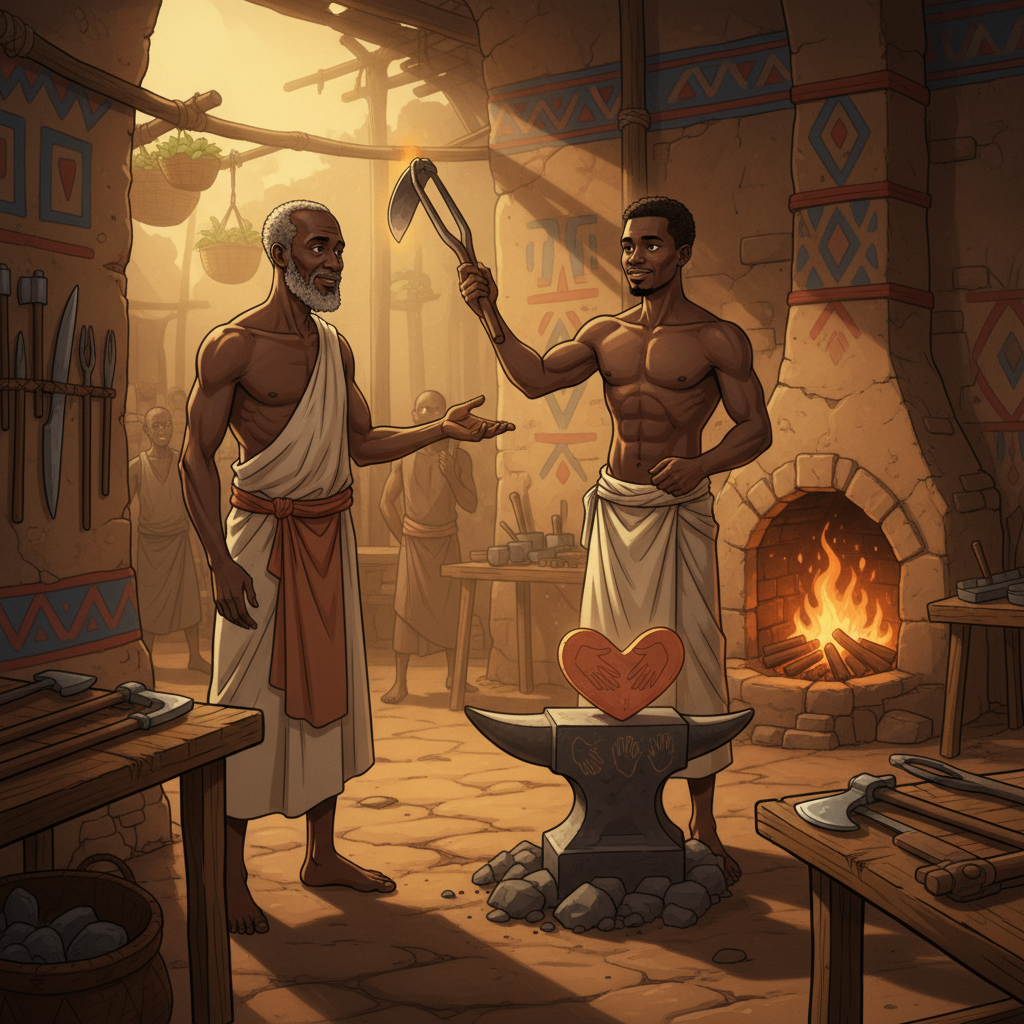
The forge continued its ancient song, shaping iron for all of Awka’s needs. Hoes, axes, knives – tools of life, tools of creation. Ikenna, now a young man, worked alongside Master Obinna, his strikes confident, his mind clear. He never forgot the lesson of the raid machetes. He learned that the true strength of an Awka blacksmith lay not just in the power of their hammer, but in the wisdom of their heart. It was a wisdom that understood the profound connection between creator and creation, and the enduring truth that while iron might not choose, it would always remember the hands that gave it form, for good or for ill.