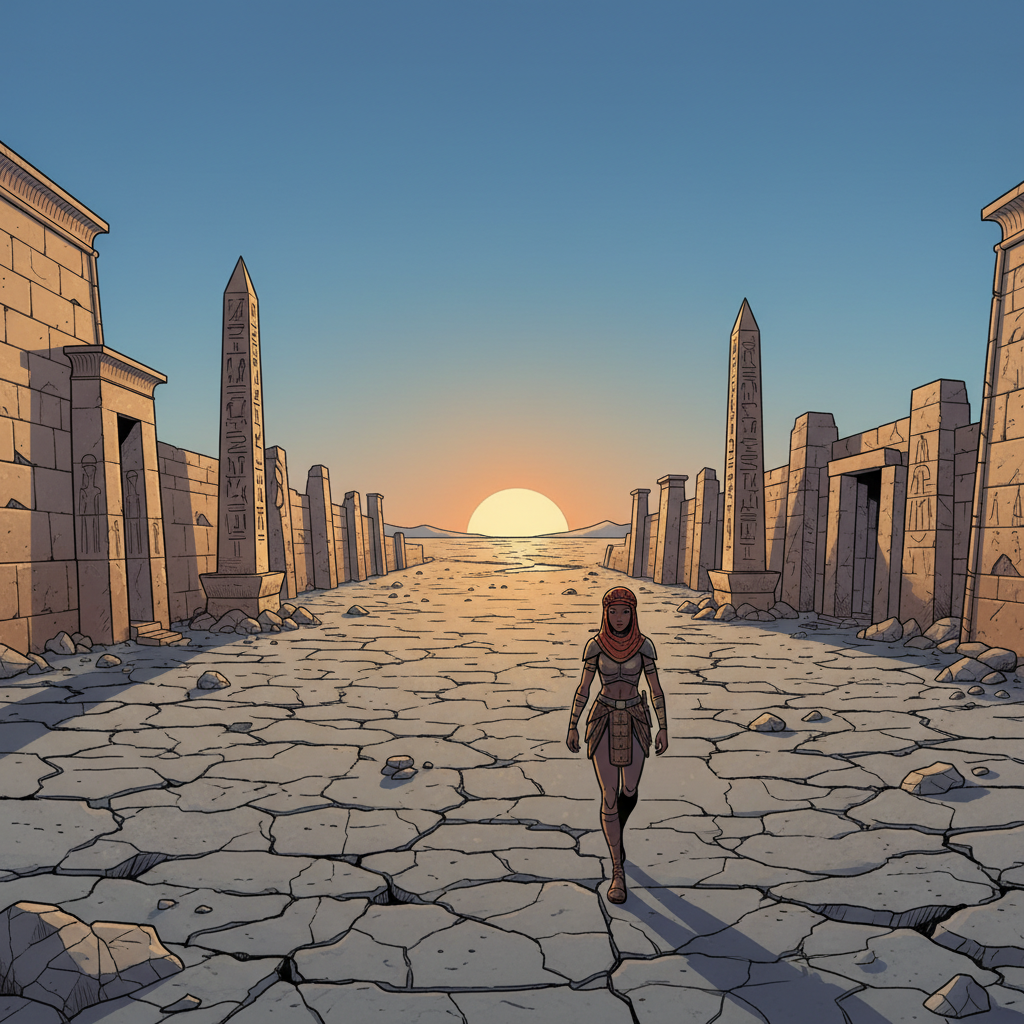
The drought had turned the fields along the Nile into cracked plates of grey mud. Kesi walked her patrol route through the temple district of Waset as the sun climbed into a sky that had not seen clouds in forty days. She was thirty-two years old, a veteran Medjay who had served the peace of this city for eleven years. Her deep ebony skin was marked by a thin scar across her left forearm — a reminder from a knife fight in the market quarter when she was twenty-one. Her close-cropped 4C hair was hidden beneath the traditional Medjay headcloth, and her leather armor creaked softly with each measured step.

Kesi carried a bronze-tipped spear in her right hand and a coiled leather whip at her belt — the standard equipment of a Medjay peacekeeper. But in her eleven years of service, she had learned that her most important tool was neither weapon. It was her eyes. A good Medjay saw everything: the merchant who palmed extra weights onto his scale, the drunk who stumbled too close to the canal edge, the child who wandered too far from home. And tonight, as the last light bled from the western horizon, Kesi's eyes caught movement where there should have been none.
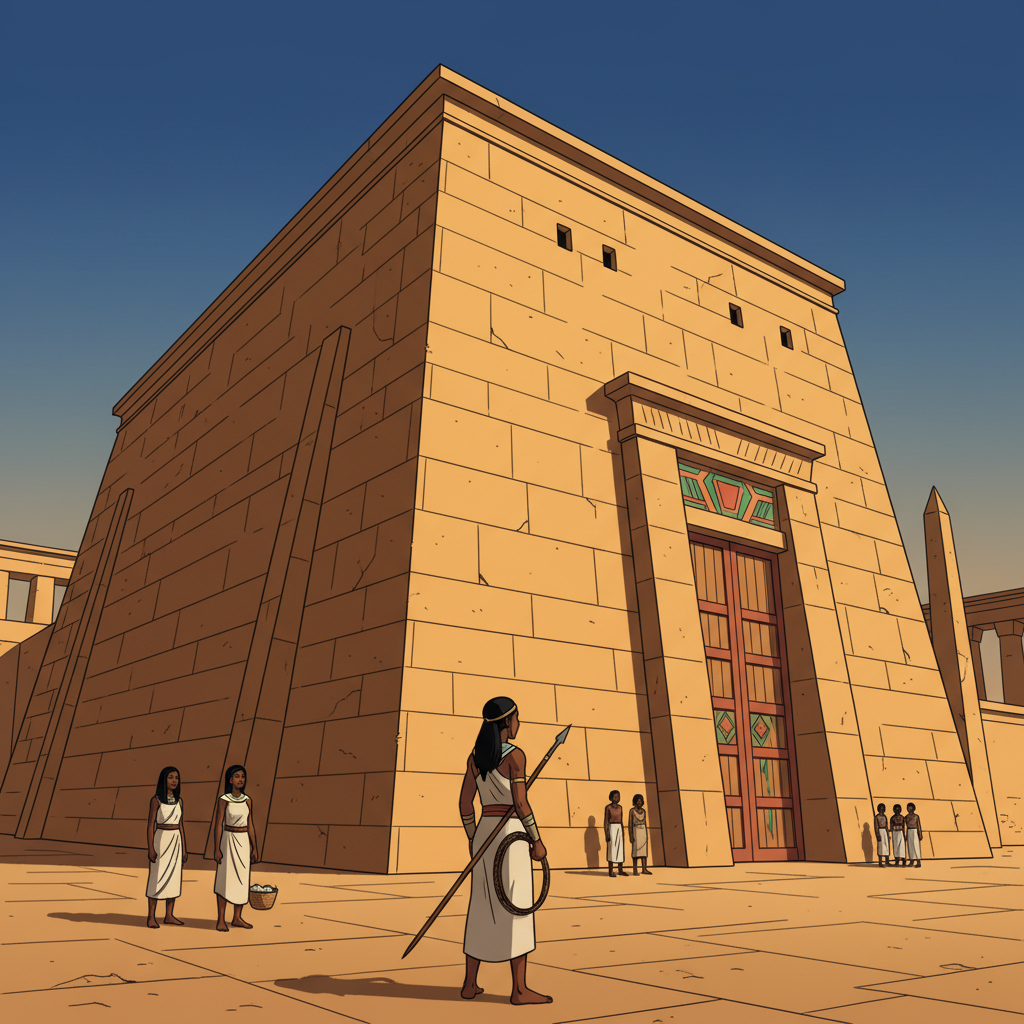
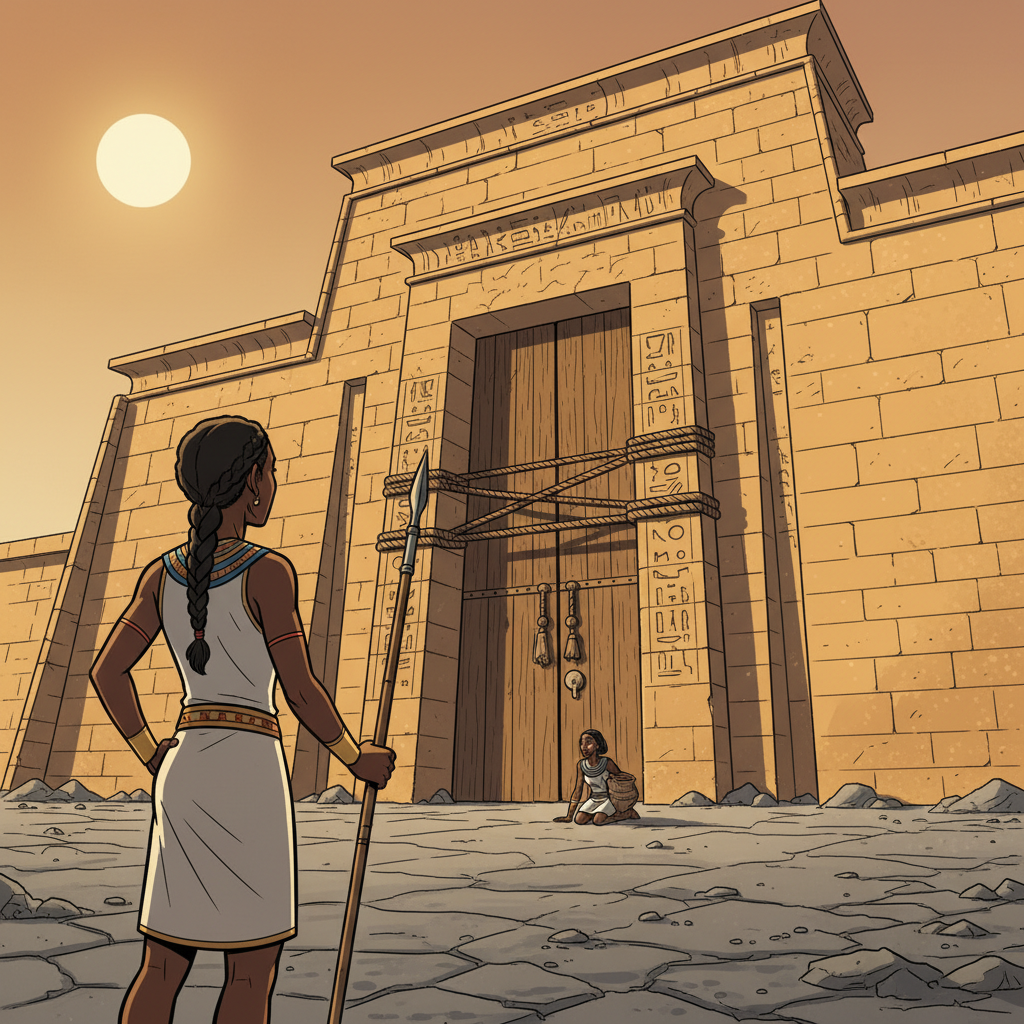
The temple granary of Amun stood at the edge of the sacred precinct — a massive mudbrick building with walls thick enough to keep grain cool through the brutal Kemetic summer. During years of plenty, the granary held enough emmer wheat and barley to feed the entire district for six months. It was, by Pharaoh's decree, a reserve for times of crisis. The drought had made this one of those times. But the great wooden doors remained shut, and the grain stayed locked inside while families in the surrounding streets went hungry.

Kesi saw the shadow slip through a gap in the granary's rear wall — a hole that should not have existed, barely wide enough for a thin person to squeeze through. She moved silently, the way her training had taught her, placing each foot on solid ground before shifting her weight. As she rounded the corner of the building, she heard the soft scraping of grain being scooped into a container — a clay pot, from the sound of it. She tightened her grip on the spear and stepped through the gap.
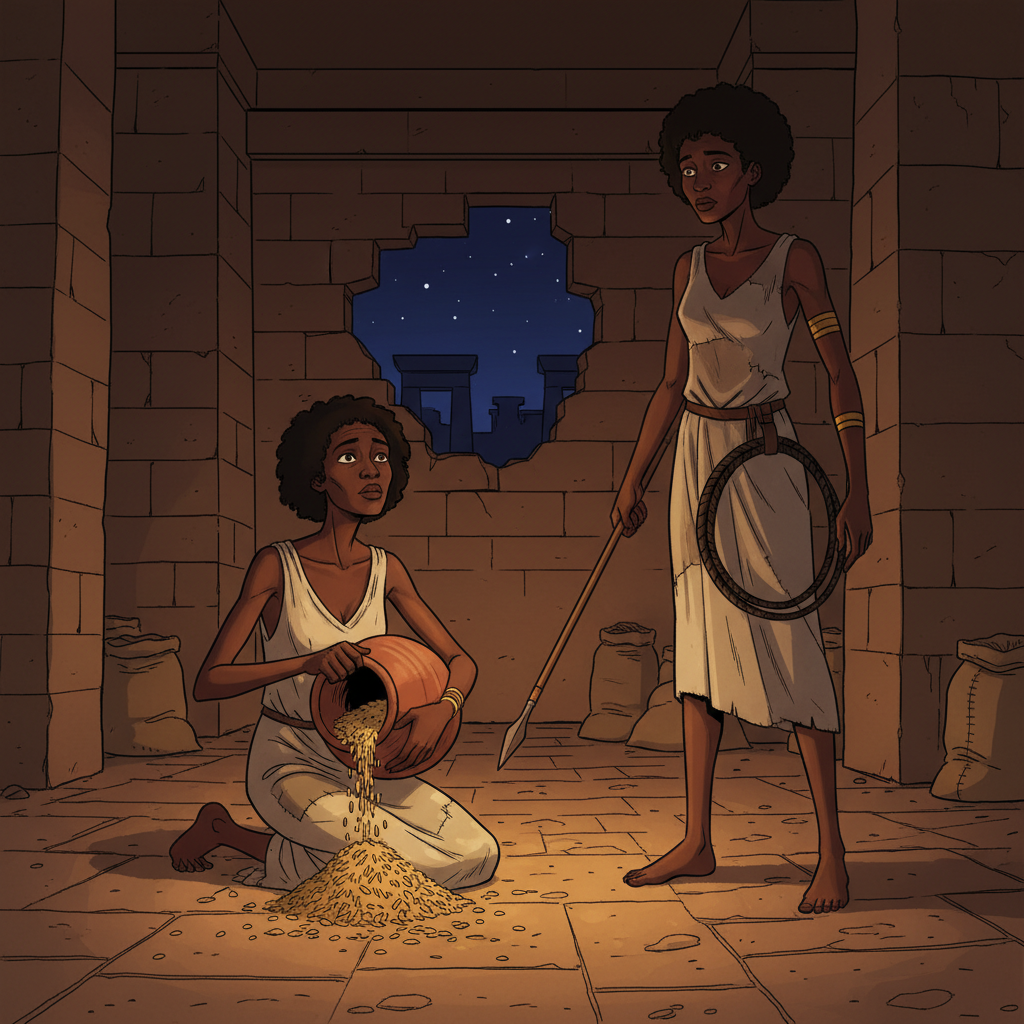
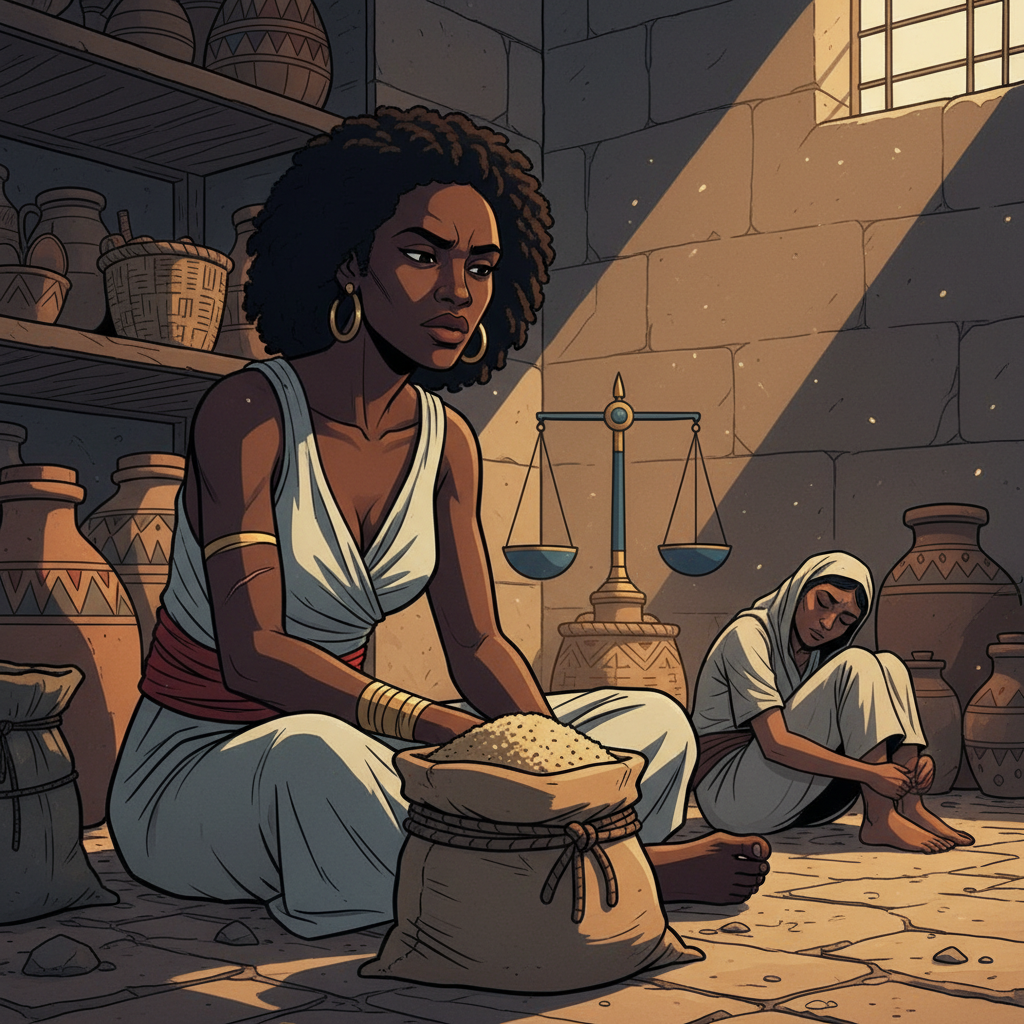
The thief was a woman. She knelt on the granary floor with a large clay pot clutched against her chest, scooping handfuls of golden emmer wheat into it with trembling hands. Her linen dress was threadbare and patched in a dozen places. Her dark brown skin stretched tight across her cheekbones — the gauntness of someone who had been eating last and least for a long time. When Kesi's shadow fell across her, the woman froze. She did not run. She did not fight. She looked up at Kesi with eyes that held no defiance, no anger — only a vast and terrible exhaustion.
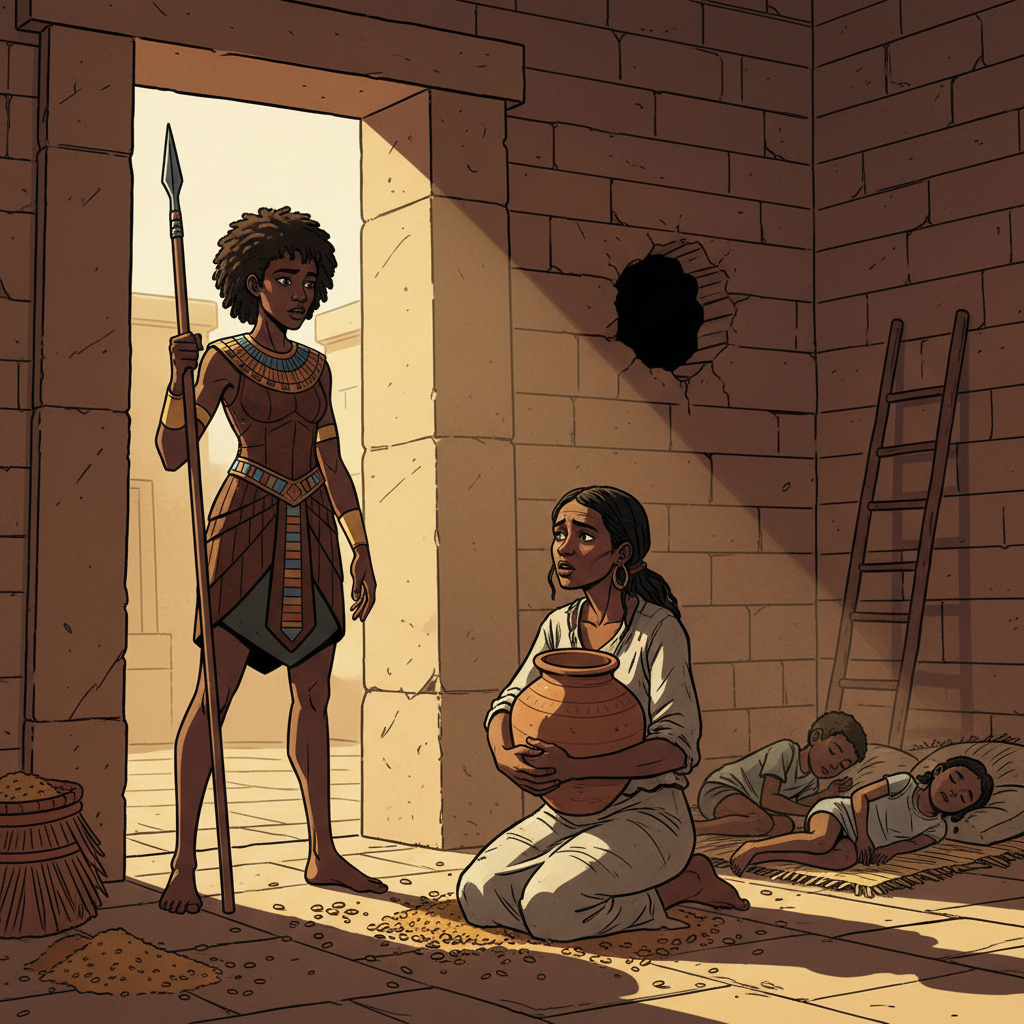
"Please," the woman whispered. Her voice cracked like dry earth. "My children have not eaten in two days. The youngest — she is only three. She has stopped crying, and that frightens me more than the crying ever did." Kesi stood in the doorway with her spear and her authority and the full weight of the law behind her. Temple theft was a serious crime in Kemet. The punishment could be harsh — flogging, forced labor, or worse. The law was clear. The law was unambiguous. And looking at this starving woman, the law felt like a stone in Kesi's stomach.

Kesi lowered her spear. Not in surrender — a Medjay never surrendered — but because pointing a weapon at a starving mother felt like something Isfet would do. "What is your name?" she asked, keeping her voice level and calm. "Nebet," the woman said. "My husband was a fisherman. He drowned in the river four months ago when his boat struck a submerged log. Since then I have sold everything — our furniture, our tools, even my wedding beads. There is nothing left to sell and no work to be had. The drought has dried up everything, including mercy."
Kesi knew she should arrest Nebet immediately. That was the procedure. That was the law. A Medjay who ignored theft — even sympathetic theft — was failing in her duty. But something else pulled at her, a question that had been growing louder in her mind since the drought began: why was this granary still locked? The Pharaoh's decree was explicit — temple grain reserves existed to feed the people during crisis. The drought had lasted forty days. Children were going hungry in the streets. And the granary stood full and sealed like a tomb.

"Stay here," Kesi told Nebet. "Do not move. Do not take anything else." She left the granary and walked to the temple administrative building where Overseer Herihor kept his records. Herihor was the man responsible for managing the grain reserves — deciding when to distribute, how much, and to whom. He was a temple official with a round belly that suggested he had not missed many meals during the drought, and fingers heavy with gold rings that gleamed even in the dim lamplight of his office.

Kesi found Herihor at his desk, eating roasted duck and drinking date wine — luxuries that most of Waset had not seen in weeks. He looked up with irritation when she entered. "What is it, Medjay? I am busy." Kesi reported the break-in and the captured thief. She expected Herihor to be concerned about the security breach. Instead, his face darkened with anger. "A thief? Have her beaten and brought before the magistrate in the morning. Temple property is sacred. Make an example of her."

"Overseer," Kesi said carefully, "the woman is a widow with three starving children. I must ask — why has the granary not been opened for distribution? The Pharaoh's decree authorizes emergency rations during drought." Herihor's eyes narrowed. "The decree authorizes ME to decide when the crisis is severe enough. I have determined that the current situation does not yet warrant distribution. The grain must be preserved for a true emergency." His voice carried the smooth confidence of a man accustomed to being obeyed without question.

Kesi looked at the duck bones on his plate. She looked at the wine. She looked at his well-fed belly and his gold rings. And she felt something shift inside her — not rage, which would have been Isfet, but a cold, clear understanding. The grain was not being preserved for an emergency. The grain was being hoarded. Whether Herihor was selling it privately, trading it for favors, or simply enjoying the power of controlling the food supply, the result was the same: the people's grain sat locked away while the people's children starved.
But understanding was not proof. And Kesi was a Medjay, not a judge. She could not accuse a temple official of corruption without evidence — that would be as much a violation of Maat as the corruption itself. False accusations destroy the fabric of justice just as surely as unpunished crimes do. So Kesi did something that required more discipline than any battle she had ever fought: she waited. She returned to the granary, secured Nebet, and spent the rest of the night thinking.

Over the next three days, Kesi conducted a quiet investigation — interviewing grain merchants, checking Herihor's records against actual deliveries, and talking to other temple workers who had seen things but feared speaking up. What she found confirmed her suspicion. Herihor had been diverting temple grain to private traders for months, pocketing the profits while filing reports claiming the reserves were "dangerously low." In truth, the granary was nearly full. There was enough grain to feed the entire district for three months. It had been there all along.

The evidence gathered, Kesi faced the harder question. Nebet had still committed a crime. The law she broke was real, even if the circumstances were desperate. Could Kesi simply release her? That would undermine the very system of law that protected everyone. If one theft could be excused because the thief had a sympathetic story, where did that end? Every thief had a reason. Every criminal could construct a justification. The law could not bend for individuals without eventually breaking for everyone.
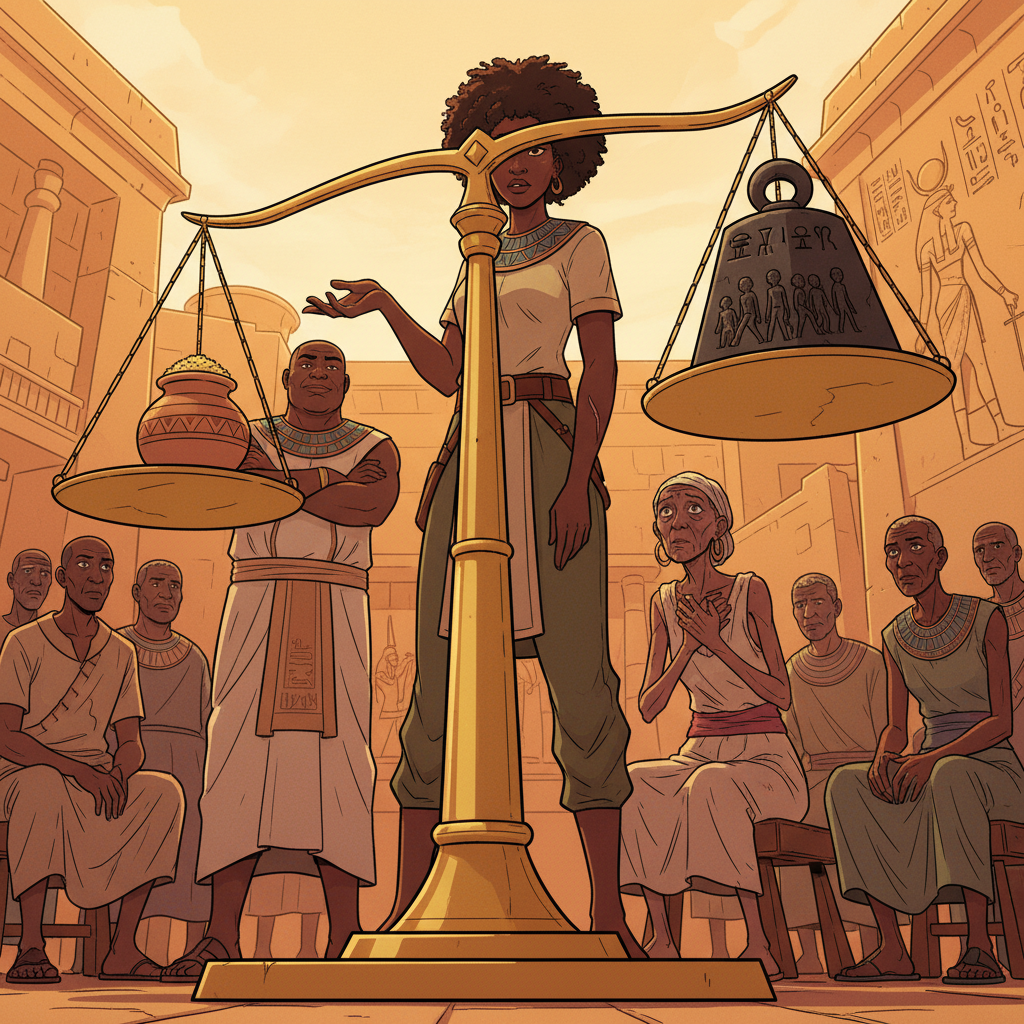
But the law was not supposed to be a weapon wielded by the corrupt against the desperate. Maat was not a stone wall — it was a living balance, a scale that weighed all things. The widow had stolen a pot of grain. The overseer had stolen the people's trust, their food supply, and their children's health. On the great Scale of Maat, whose crime weighed heavier? Kesi brought both cases before the kenbet — the village court where disputes were settled by community elders under Medjay supervision.
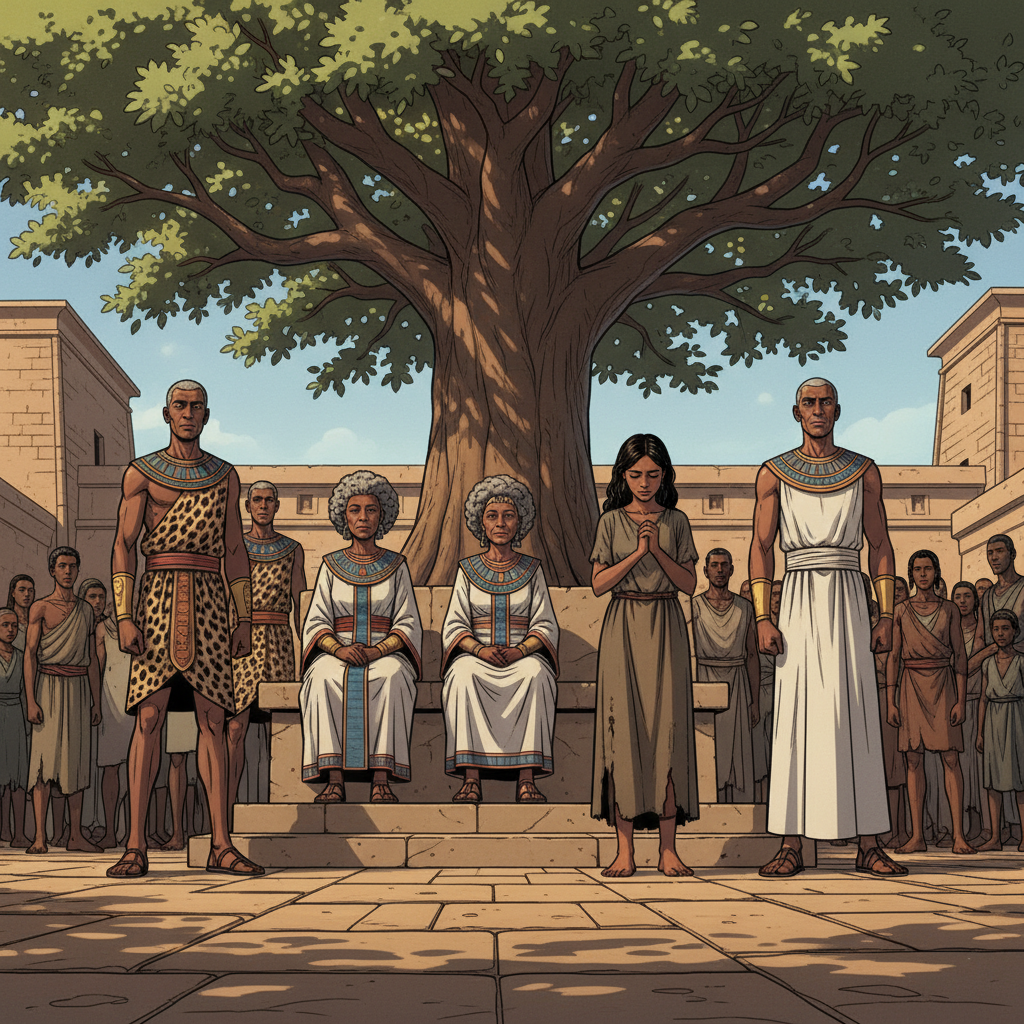
The kenbet convened in the courtyard of the district house, under a spreading sycamore tree. Three elders sat on raised stone seats — two men and a woman, all grey-haired, all respected for their fairness. The Medjay stood at the side as enforcers and witnesses. Herihor arrived in fine linen, his expression offended and dismissive. Nebet came in her threadbare dress, her hands clasped together, her eyes fixed on the ground. Behind her, the village waited — dozens of families who had been going hungry while the granary sat full.

Kesi presented both cases. She laid out the evidence against Herihor — the diverted grain, the false records, the private sales. She described Nebet's situation — the dead husband, the starving children, the sealed granary. She did not argue for either side. A Medjay at the kenbet presented facts, not opinions. The truth itself would testify. The eldest judge, a woman named Meryt, listened with her eyes closed, her weathered dark hands resting on the Staff of Maat that she held across her knees.

Herihor defended himself with practiced eloquence. He questioned Kesi's evidence, challenged the witnesses, and invoked his authority as a temple official. "I serve the gods," he declared. "My judgment on the grain reserves is beyond the authority of a common court." But the elders were not swayed by titles. "The gods require Maat," Judge Meryt said, opening her eyes. "And Maat requires that the powerful answer for their actions just as the powerless do. Perhaps more, because the powerful were given their authority in trust."
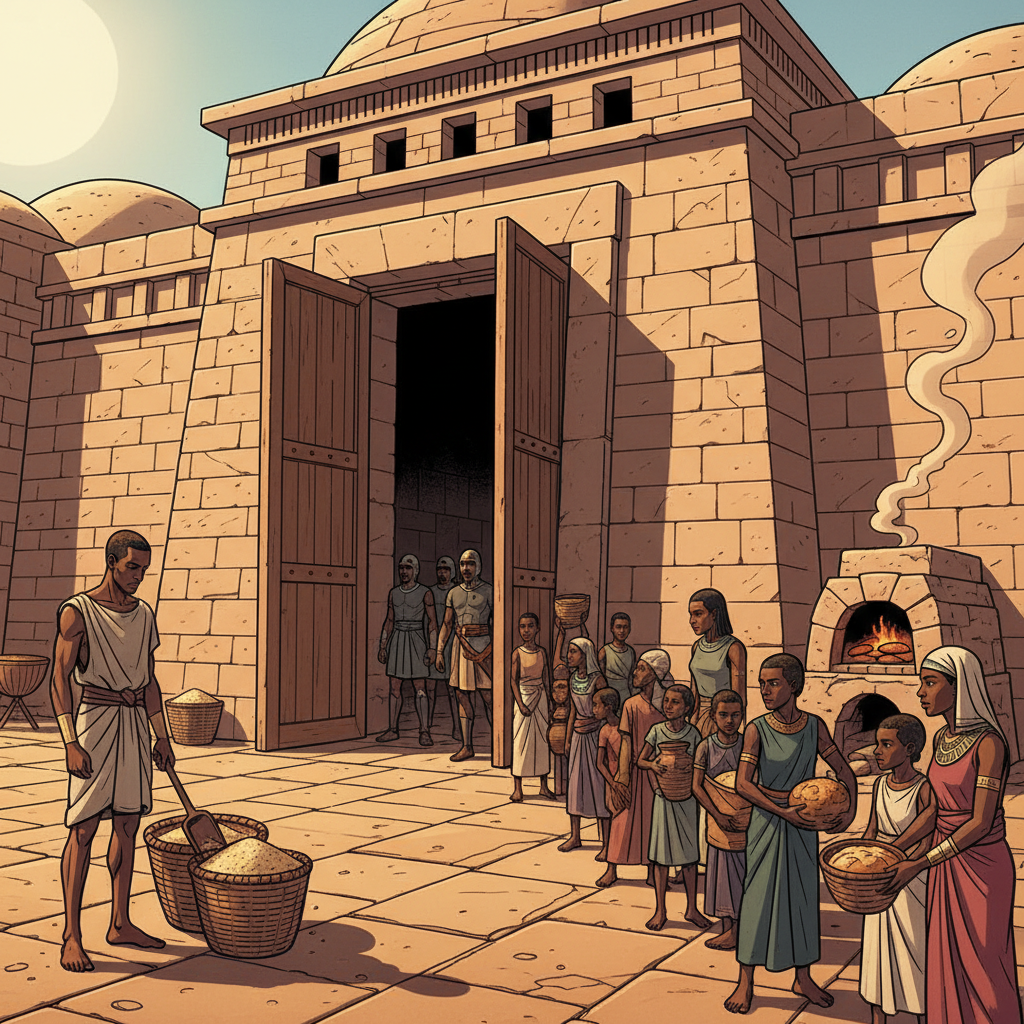
The verdict came as the sun reached its peak. Herihor was stripped of his position, ordered to repay the value of all diverted grain, and sentenced to one year of labor in the very granary he had corrupted — measuring and distributing food to the people he had denied. It was not a soft punishment, but it was a just one. He would learn, through his own labor, what the grain was for. The granary was opened immediately. Within the hour, families were lining up with their pots and baskets, and the smell of baking bread drifted through the district for the first time in weeks.
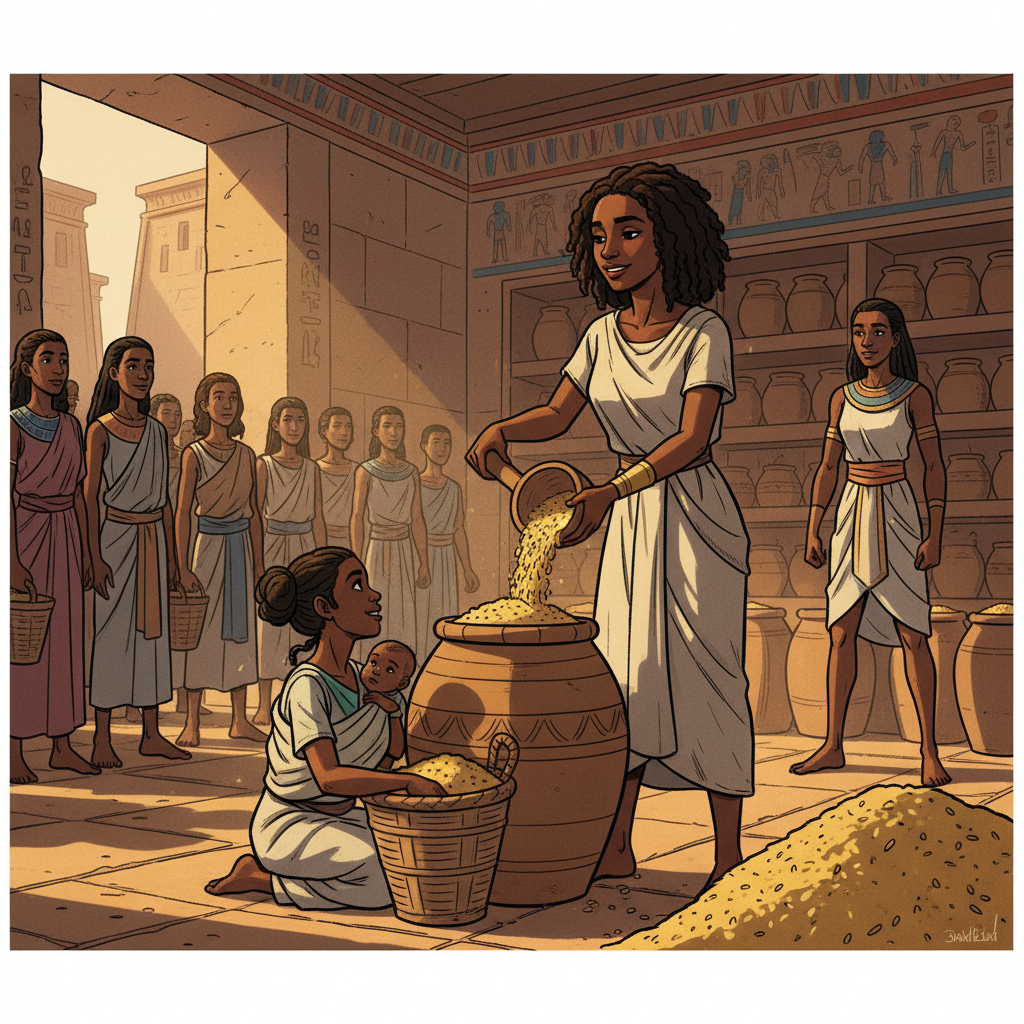
Nebet's case was harder. She had broken the law. The elders did not dismiss this. "Desperation explains an action," Judge Meryt said. "It does not erase it. If we say that hunger permits theft, we open a door that cannot be closed." But neither did they condemn her harshly. Nebet was sentenced to thirty days of community service — helping distribute the grain that was now flowing freely from the reopened granary. It was labor, but it was dignified labor, and it fed her children while she served.

After the kenbet adjourned, Kesi walked along the river as the sun set over Waset. The Nile moved slowly in the drought, its banks pulled back to expose dark mud flats where children now played, not yet understanding how close they had come to real suffering. Kesi thought about the two judgments. Herihor's punishment was severe and satisfying. Nebet's was measured and merciful. Neither felt perfectly right. That, she was beginning to understand, was the nature of justice.

Her captain, an older Medjay named Bek, found her by the river. He had watched the kenbet with quiet attention. "You could have just arrested the widow and been done with it," he said. "The law was clear. Your duty was simple. Why did you dig deeper?" Kesi watched a heron standing perfectly still in the shallows, patient as stone. "Because the law told me what happened," she said. "But Maat required me to understand why. A Medjay who only enforces the law without understanding it is not serving justice. She is serving obedience. And obedience without wisdom is just another form of Isfet."

Bek nodded slowly. "That answer," he said, "is why you will be captain someday." He walked away, leaving Kesi alone with the river and the first cool breeze that the drought had allowed in forty days. She thought about Nebet, who had broken the law out of love for her children. She thought about Herihor, who had broken Maat out of greed for himself. Both stood before the same Scale. But the weight of their hearts could not have been more different. Justice, Kesi understood now, was not a door that opened or closed. It was a living balance, endlessly adjusted, endlessly weighed — heavy with the burden of every human story it was asked to hold.