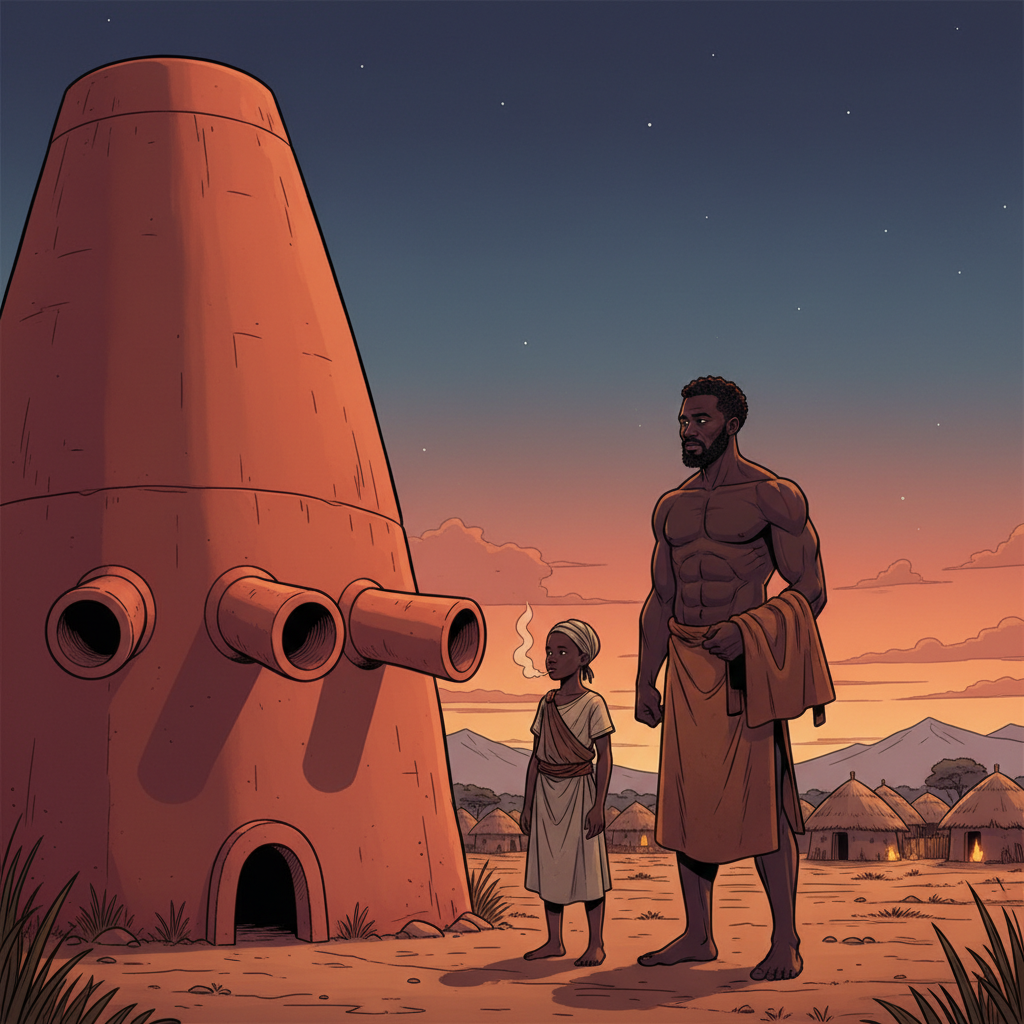
Ngozi was twelve years old when her father first walked her to the edge of the village in the cold hour before dawn and stood her in front of the great clay furnace. The furnace was taller than he was — a smooth cone of red baked earth, almost the height of two men stacked on each other, with a small mouth at the bottom and three long air-pipes thrust into its lower belly. The pipes were called tuyères, and they pulled air into the fire when men worked the leather bellows on the ground outside. Ngozi had seen this furnace her whole life. The smelters of the Jos Plateau built one in every village, and the smoke that rose from her father's furnace on firing-days could be seen for half a day's walk in any direction. But tonight was different. Tonight her father had not brought her brother Chike. He had brought her. Her deep brown hand was cold. The air on the plateau before dawn was cold enough that her breath made a small white cloud whenever she exhaled. Her father, Obiora, stood beside her with his thick smelter's leather apron folded over one arm. He was a tall man with arms ridged from forty years of bellows-work, and his deep brown skin had been darkened further by decades of standing near fire. He did not look at her. He looked at the furnace. "Tonight," he said, "I will show you what I have not shown your brother yet. The furnace has a voice, Ngozi. Most smelters never learn to hear it. Their fathers never taught them. Mine taught me, and tonight, I will teach you. Watch. Listen. Say nothing."
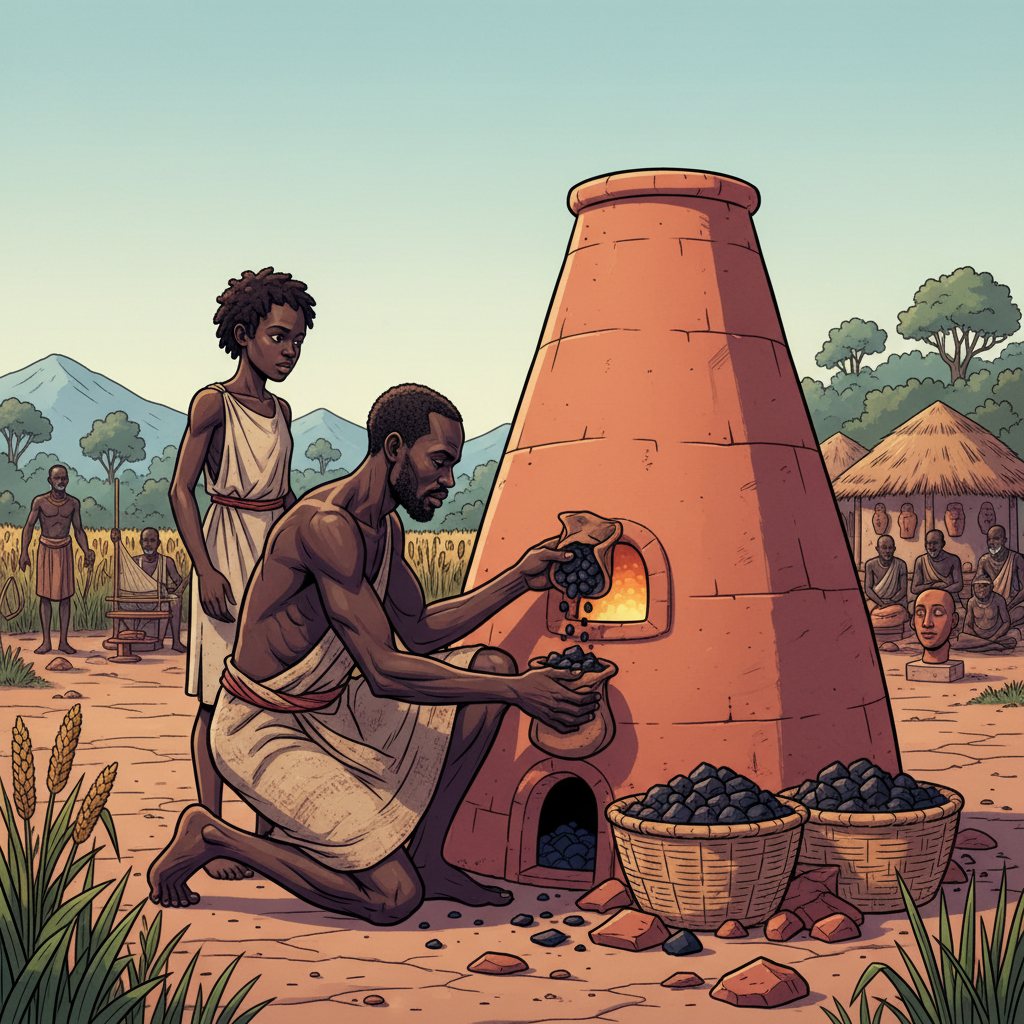
Ngozi nodded slowly. She did not trust her own voice yet, so she only nodded. Her father had a way of speaking that made silence feel safer than words — not because he was cruel, but because he chose his words so carefully that he expected the same care in return. She knew, even at twelve, that this morning was something rare. In their village on the Jos Plateau, the master smelter was the most honored worker of all. The farmers grew yams and millet, the weavers wove cloth, the potters fired the famous terracotta heads that the elders kept in the ancestor-shrines — but the smelters made the iron that made every other kind of work possible. Without the iron hoe, the farmer could not clear the forest. Without the iron knife, the weaver could not cut the cloth. The smelter's craft sat at the root of the village's whole life. And the master smelter's craft sat at the root of the smelter's. Her father knelt in front of the furnace and lifted a small leather pouch from his apron. He poured a careful measure of charcoal from one of the baskets at the furnace's base, then a careful measure of iron-bearing rock — the rust-red ore the diggers brought down from the hills above the plateau. He layered them inside the furnace mouth the way a baker layers dough and dates inside a sweet loaf. "Charcoal, then ore, then charcoal, then ore," he said softly. "Not too much of either. The furnace eats both. If you feed it only one, it will refuse to give you iron." Ngozi watched his hands move. They were calloused and certain, hands that had layered ten thousand furnaces before this one. She tried to memorize the rhythm.
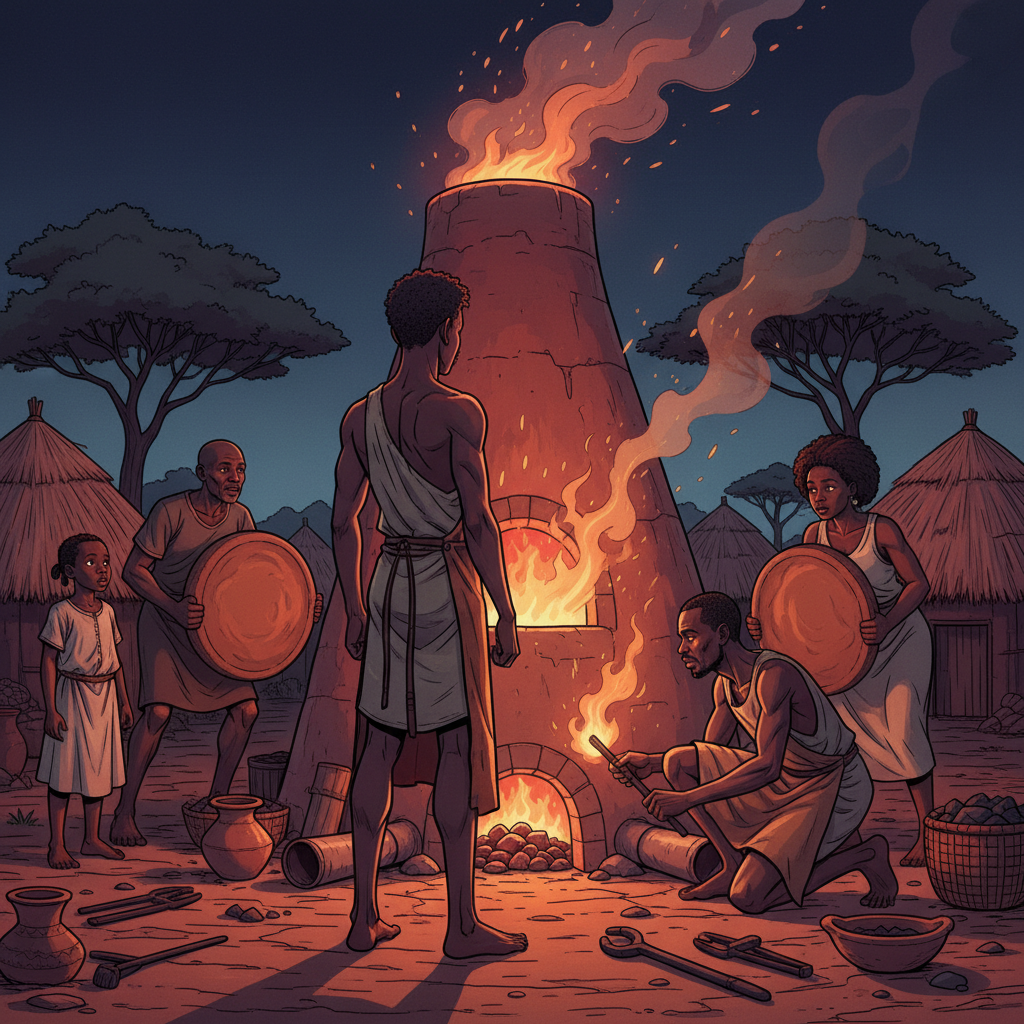
When the layering was finished, Obiora stepped back and clapped his hands twice — a soft signal in the dark — and four other smelters rose from where they had been waiting near the edge of the village square. Two of them were Ngozi's uncles. One was the village headman's nephew, Adamma, a wide-shouldered young man Ngozi had known her whole life. The fourth was her brother Chike. He was fifteen, three years older than Ngozi, and he had been hovering around the furnace for as long as she could remember, helping the smelters carry charcoal and water, asking quick questions, sometimes being shooed away when his questions got in the way of the work. Tonight he was here in his own leather apron — too big for him, borrowed — and he held his shoulders very straight. He did not look at Ngozi. He looked at the furnace, the way their father had looked at it. As if it were a thing he was about to fight. The smelters took their positions at the four bellows. The bellows were great leather bags fitted to two of the tuyères on either side of the furnace. When a smelter stood on the bag and pumped his legs, air rushed down the pipe and into the furnace's belly, and the fire inside roared in answer. Obiora touched a glowing reed to the lower fuel-hole. The first orange tongue of flame licked up through the charcoal. He stepped back. He nodded to the smelters. The four men began to pump. The leather bags hissed and breathed. The fire inside the furnace gathered itself, brightened, and began — very slowly — to roar.
For the first hour Ngozi did not understand what she was supposed to be watching for. The fire burned. The smelters pumped the bellows in a steady, rocking rhythm. Smoke curled up from the top of the furnace into the dark predawn sky, pale grey at first, then darker, then a hot bright orange-grey when the fire really took hold. Her father walked slowly around the furnace, putting one ear close to the clay wall at different heights, listening. Then he would step back and watch. Then listen again. Chike followed him at a careful distance, watching everything his father did, sometimes trying to put his own ear to the clay the way Obiora had done. Ngozi noticed that her brother's eyes were always on their father. He was watching Obiora more than he was watching the furnace. Ngozi did not know whether that was wrong, but it felt different from what she was doing. She was watching the furnace. She watched the way the smoke changed color. She watched the way the heat rippled the air above the open top. She watched the way the clay of the furnace itself glowed faintly through its outer skin in the places where the fire was hottest inside. After two hours her uncles changed places with two other men who had come up from their houses in the village. After four hours those men were changed again. The bellows never stopped. The fire never paused. The sun rose over the plateau, a thin red line first, then a wide pale gold, then a bright hot disk. Ngozi was thirsty. She did not ask for water. Her father had said to watch and listen and say nothing, and she watched and listened and said nothing.
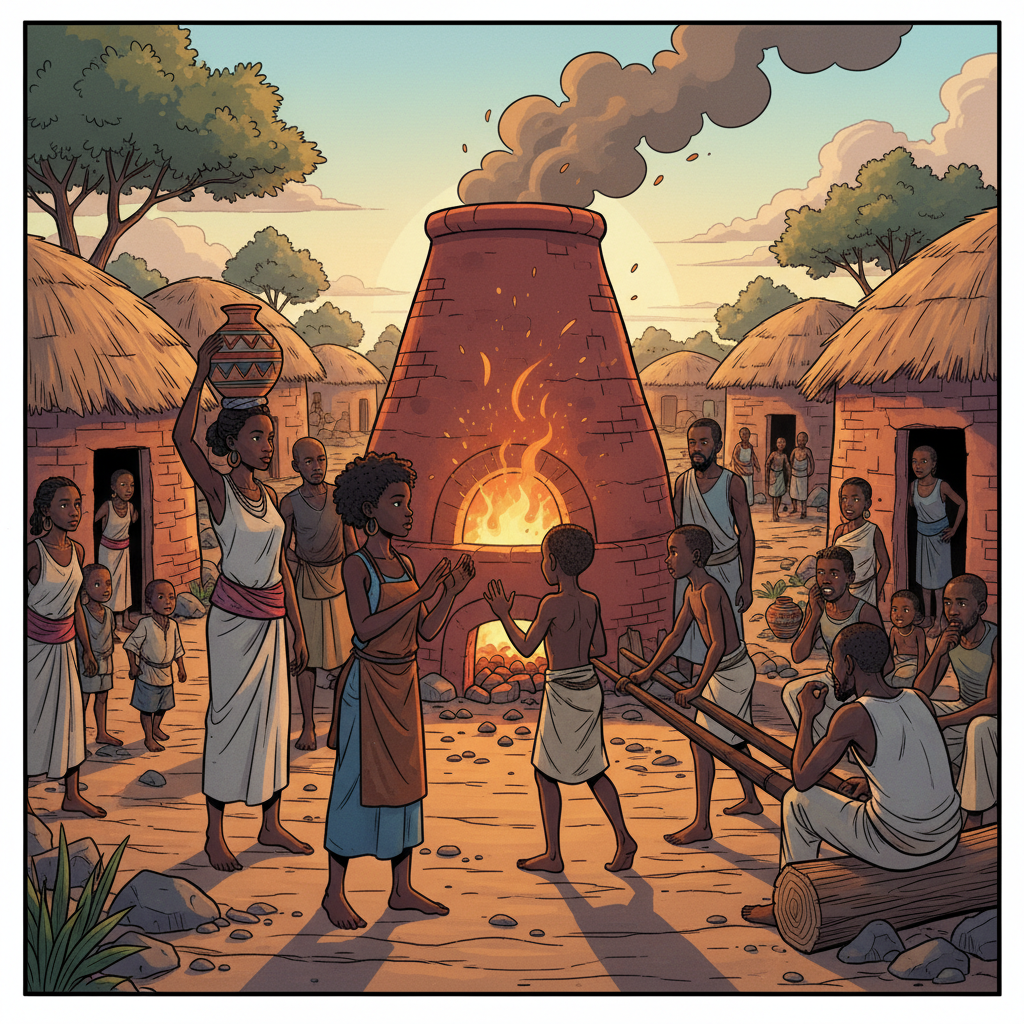
By midmorning the village was awake around them. Children peered out from the doorways of the round mudbrick houses. Women carried water-pots on their heads down the path to the spring and back, glancing at the furnace as they passed. The men who were not at the bellows sat on a low log nearby and chewed kola nuts and watched, the way men in the village always watched a firing. A firing was an event. The whole village waited to see what the furnace would give. Ngozi had stood through firings as a small child, on her mother's hip, and as a slightly bigger child holding her mother's hand. But she had never been called inside the work the way she had been called tonight. She was not standing among the watchers. She was standing inside the circle of the smelters, in her own small leather apron her mother had cut down to fit her last week. Chike was standing closer to the furnace mouth than she was. He had crept forward a step every half hour or so, and now he was almost shoulder-to-shoulder with their father. Ngozi noticed that her brother's hands kept reaching out as if he wanted to do something — touch the clay, adjust a bellow-strap, lift a piece of charcoal — but each time, before he actually moved, he caught himself and let the hand drop. He was hungry to do. Ngozi understood the hunger because it lived inside her too. But she also understood, with a feeling she could not yet name, that doing was not what tonight was about. Tonight was about not-doing. Tonight was about seeing.
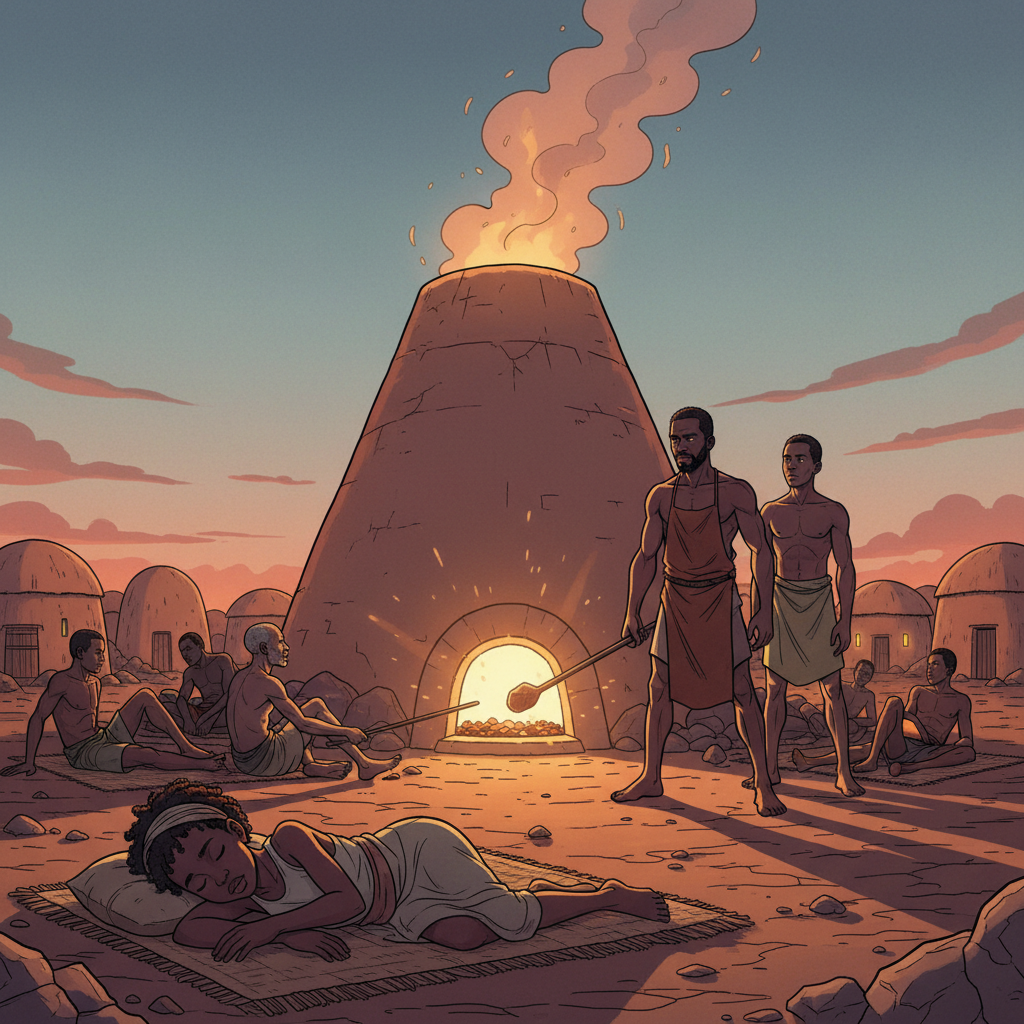
The first day of the firing ended when the sun went down. The bellows kept pumping all through the night. The men slept in shifts on grass mats laid near the furnace, never letting the fire fall below a steady roar. Ngozi was sent to her own mat at the second hour after sundown, and she slept the heavy dreamless sleep of a child who has stood all day in the cold and then in the heat. When she woke the second morning, her father was already at the furnace. Chike was beside him, looking tired but proud, having stayed up half the night. Ngozi joined them in her apron and took her old position three paces from the furnace mouth. Her father glanced at her, gave a single nod, and turned back to the work. The second day passed like the first. The third day was the day of the molten iron. Ngozi could feel it before her father said anything. The smoke had changed. It was thinner now, almost transparent at the very top of the furnace, and there was a smell coming out of the mouth that had not been there yesterday — a hot metal smell, sharp and clean, like the smell of a knife-blade left in the sun. The fire inside the furnace was no longer just orange. It was white at the bottom, white-hot, so bright that when Ngozi stood close to the lower vent and looked in, her eyes flooded with tears and she had to look away. Obiora moved around the furnace with a different quality of attention. He was not casual anymore. He was tight, careful, every muscle alert. He spoke to the bellows-men in short clipped words. "Slower. Now faster. Hold." Chike was watching him hard.
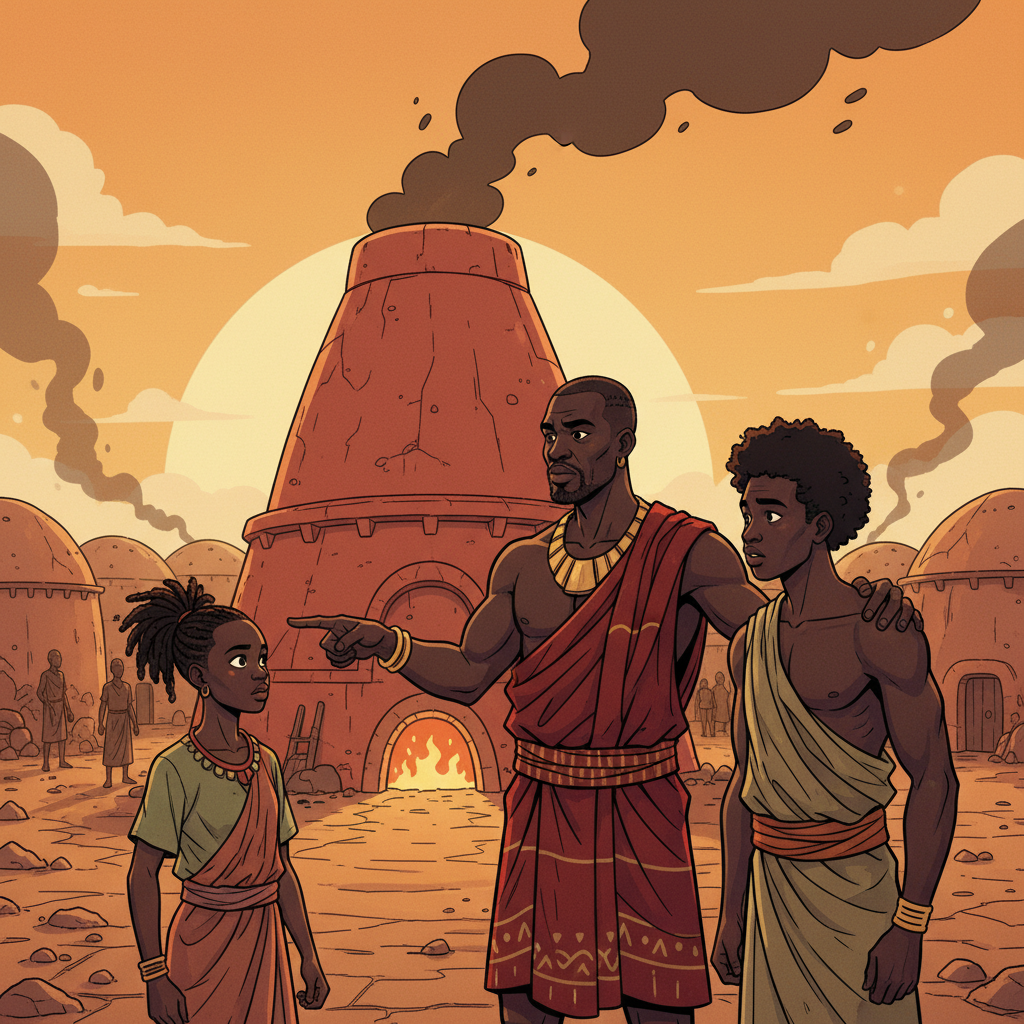
In the late afternoon of the third day, Obiora turned to his two children and pointed at the furnace mouth. "Tonight," he said. "Tonight, late, the iron will speak. Both of you will be here. Both of you will watch. The first one who hears the iron speak — who sees the moment — will be the next master smelter of this village. The other one will work beside that smelter for the rest of their life. That is how it has always been chosen, in our village. Not by birth-order. Not by whose father was whose. By who is listening when the furnace asks its question." Ngozi felt her stomach tighten. Chike did not move at first. Then he turned and looked at her — really looked — for the first time in three days. His expression was not angry. It was bewildered. As if their father had just spoken in a language he had not expected to hear. "Father," Chike said carefully, "I am the older one." Obiora did not react. He simply waited. Chike tried again, his voice lower. "I have been at this furnace since I was eight. Ngozi has only stood here three days." Obiora nodded slowly. He was not denying any of it. "All of that is true," he said. "And none of it is what the furnace asks. The furnace does not ask whose turn it is. It asks who was listening." He laid one hand on Chike's shoulder. His grip was gentle but did not waver. "I am not choosing between you, son. The iron is. My only job tonight is to put you both in front of the iron and let the iron decide. Do you understand me?" Chike was quiet for a long moment. Then he nodded once, sharply, and turned back to face the furnace.
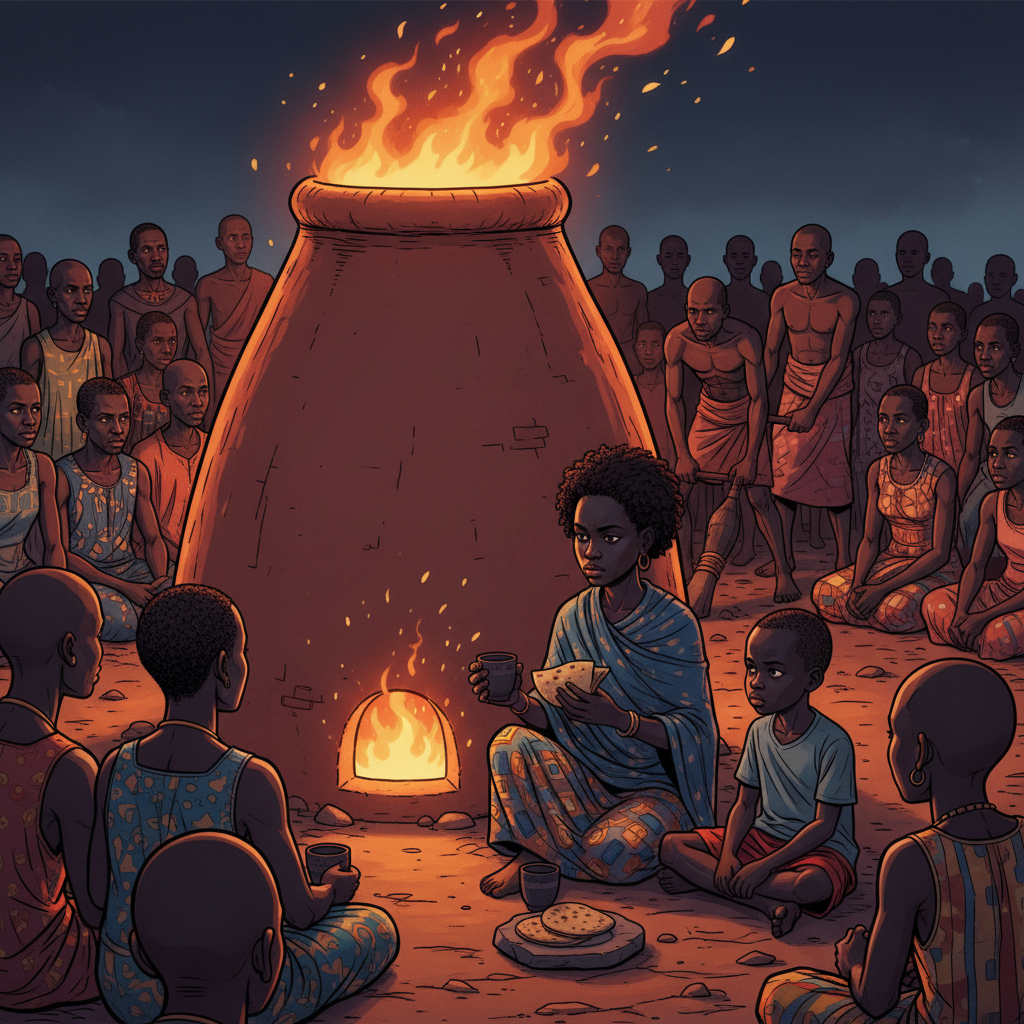
Night fell on the plateau. The village quieted. The watchers on the log went home to their houses to eat, but most of them came back out afterward, sitting now on the ground in a wide loose circle around the furnace, the firelight from the mouth catching their faces in flickering orange. Ngozi's mother brought her a small cup of millet beer mixed with water and a piece of flatbread folded around bean-stew. "Eat," her mother said softly, deep brown eyes serious in the firelight. "You will need it. Your father has not eaten all day, and he will not. But you are still a child. Eat." Ngozi ate. Chike refused his own portion. Their mother sighed and did not press him. She set his food on a small stone by his feet in case he changed his mind. The hours passed. The bellows kept their rhythm. The fire inside the furnace grew so bright that Ngozi could feel its heat on her face from three paces away. Her father had positioned her on the right side of the furnace mouth and Chike on the left. Both of them had a clear view of the lower vent — the small clay-edged opening near the base where, when the iron was ready, a master smelter could see the molten metal pooling at the bottom of the furnace. Ngozi did not take her eyes from the vent. She had been watching that small bright opening for so long now that when she blinked, the orange light stayed printed inside her eyelids. She watched. She listened. Her ears found, under the roar of the fire and the hissing of the bellows, a softer sound — a steady, deep, almost-musical hum coming from the heart of the furnace itself.
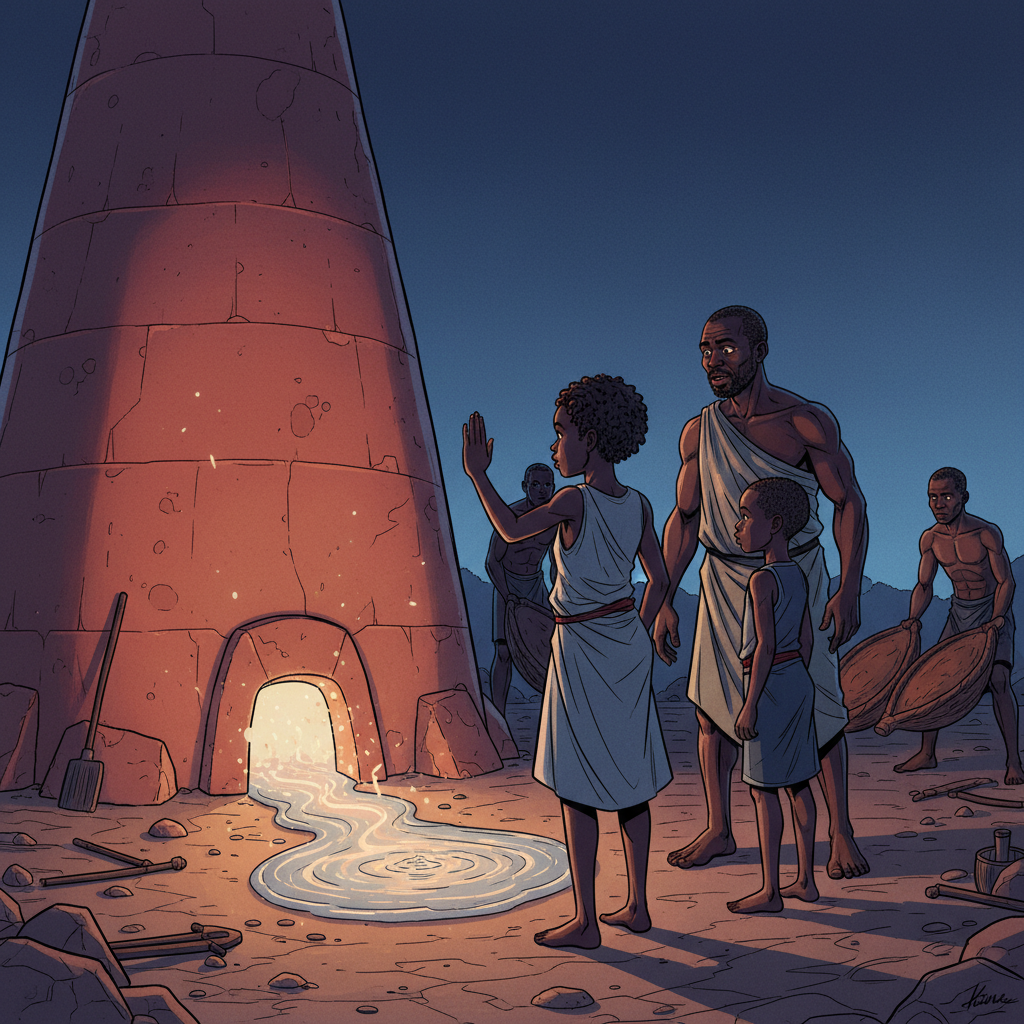
It was after midnight when Ngozi felt the change. The hum from inside the furnace shifted. It became deeper, and slower, and somehow more patient — like the breath of a sleeping animal that has just begun to dream. At the same moment, the light at the lower vent went from white to a strange shimmering color she had never seen before: pale silver-orange, almost like a moving river of light. The surface of the molten iron at the bottom of the furnace had become a mirror, a thin moving skin of brightness, and on that skin Ngozi saw something move. Tiny ripples. Tiny waves. The iron was not just hot anymore. The iron was alive at its surface, shimmering the way water shimmers when wind moves across it, and the shimmer had a rhythm. The shimmer was breathing. She raised her hand without thinking. She did not point. She did not call out. She simply lifted her open palm in the air at chest height — the gesture her father had used three days ago when he had silenced the bellows-men, the flat-palm "wait" sign that every smelter knew. Her father saw it. His eyes flicked from her hand to her face to the vent to the hand again. He did not speak. He waited. Across the furnace from her, Chike had not noticed. He was looking at their father, watching for a signal, ready to act on whatever instruction came. Ngozi held her hand up. The shimmer on the surface of the iron breathed once, twice, three times. Then her father gave the smallest possible nod, and Ngozi understood that the iron had spoken, and that she had heard it.
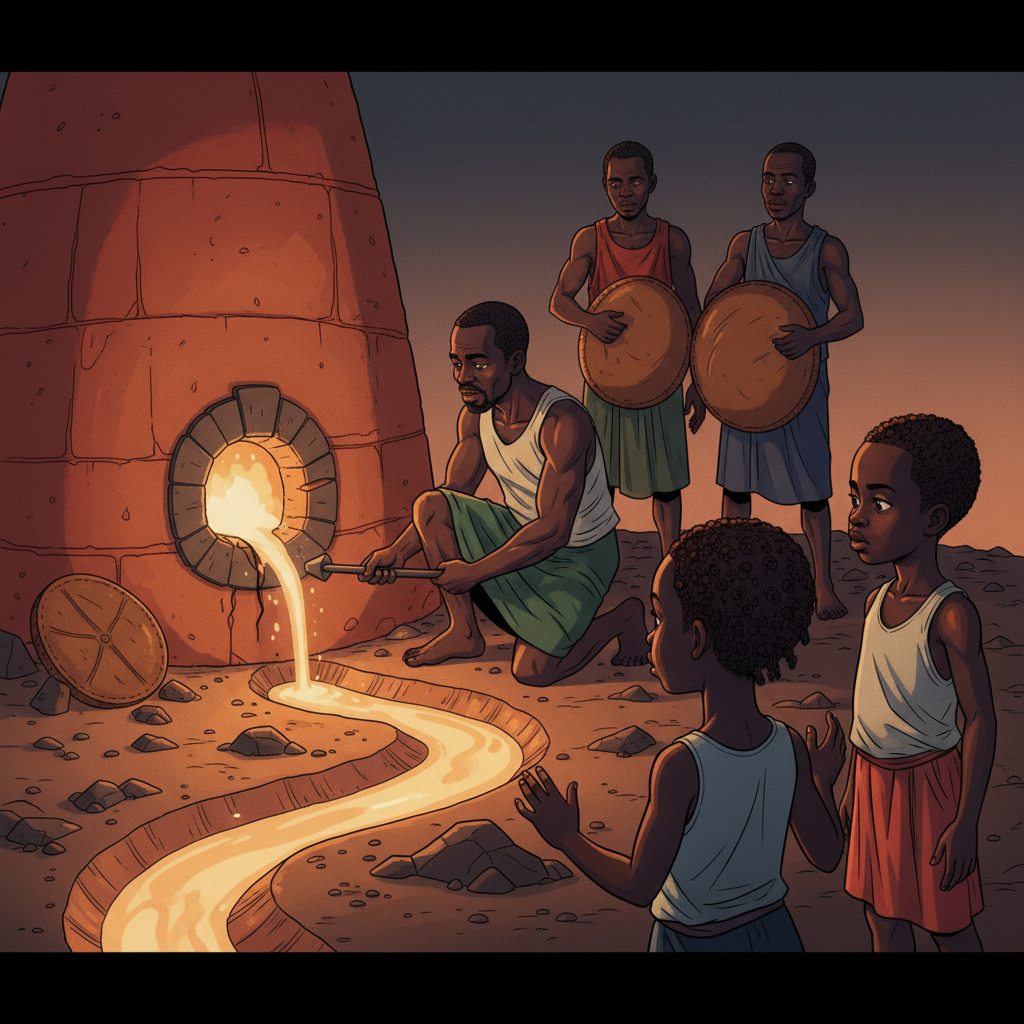
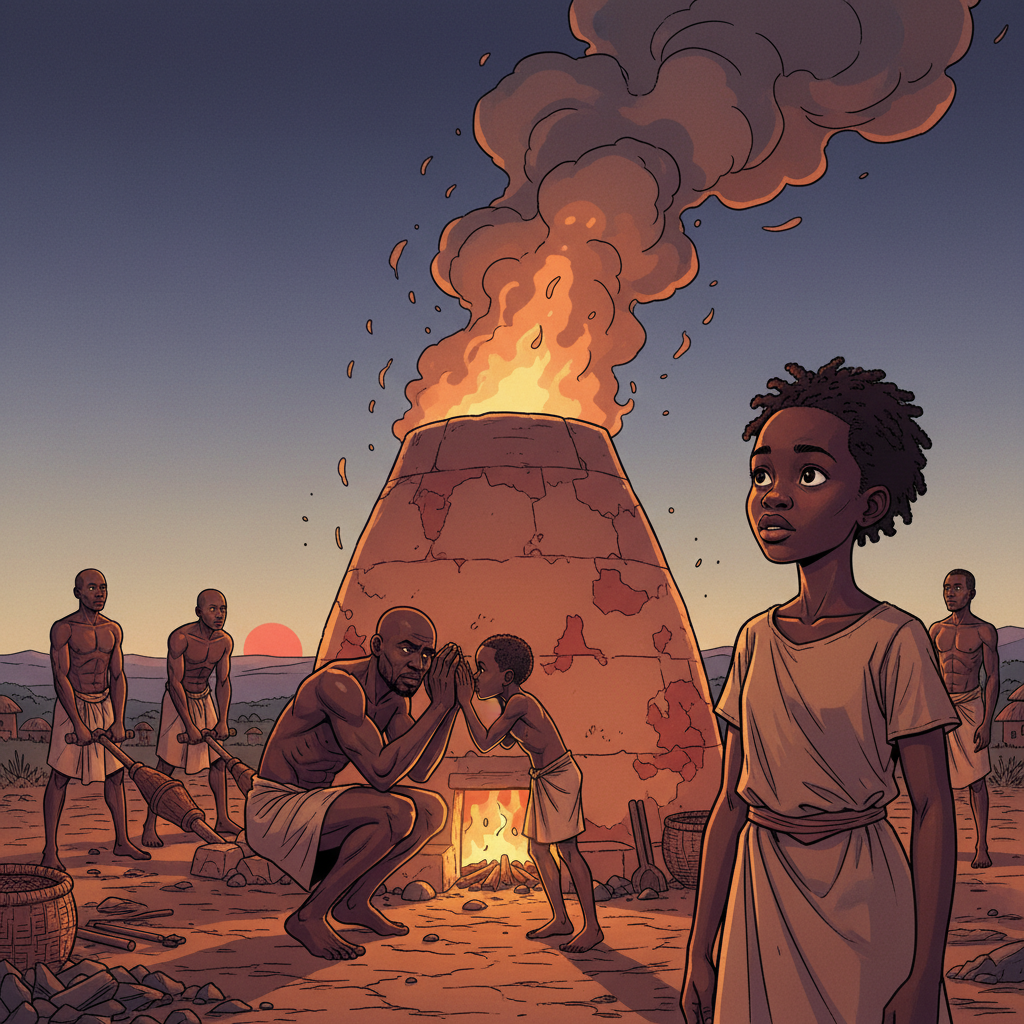
Her father turned to the bellows-men. "Hold," he said, in the same flat-palmed voice he had used three days ago. The bellows-men stopped pumping. The hiss of leather ceased. The fire in the furnace, no longer fed by the rushing air, began to settle from its white-hot roar into a softer, deeper burn. Obiora went to the bottom of the furnace with his long iron rod — a tool only the master smelter handled — and tapped a single careful tap on the clay plug at the very base of the wall. The plug, weakened by three days of heat, cracked. A trickle of pale silver-orange liquid ran out into the sand-shaped channel the smelters had dug that morning. Then a wider stream. Then a slow molten pour. Ngozi watched the iron of her village pour out of the furnace into the cooling-channel for the first time in her life, and her hands were shaking, and she did not know whether she was about to cry or laugh or fall down. Chike was staring at her. He had finally turned. His face in the firelight was strange — not angry, not yet, just very still. He had not seen the shimmer. He had not raised his hand. He had been watching their father instead of the iron, and the iron had spoken when he was looking the other way. Ngozi did not know what to say to him. She did not even know if she was supposed to say anything. So she said nothing. She stood with her hand still half-raised at her side and watched her father work the molten iron into the channel until the very last of it had run out and the furnace went dark and silent inside.
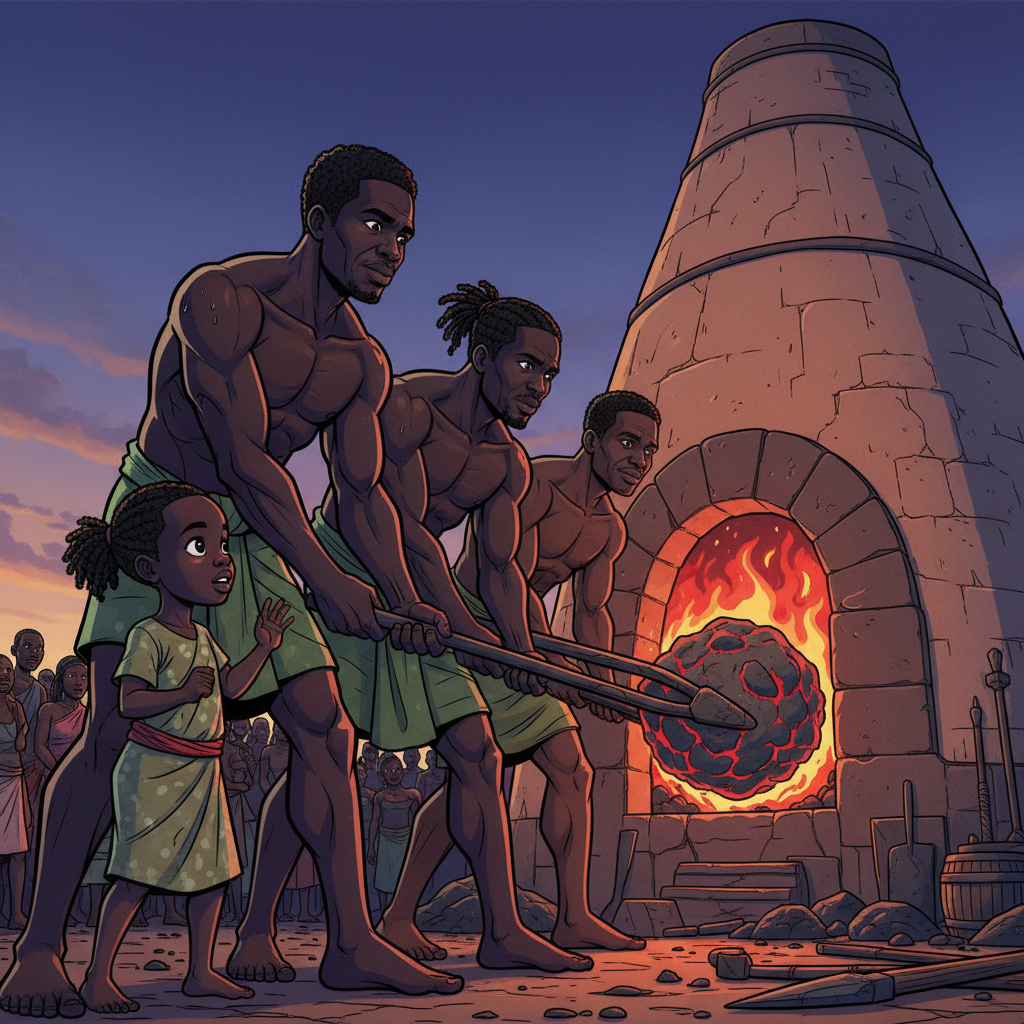
In the cold hour before sunrise, the smelters opened the cooling-channel and pulled out the bloom. The bloom was the first form of the new iron — a heavy, irregular gray lump pocked with black slag and red-hot at its core. It looked nothing like the smooth blades and hoes the village smiths would later hammer it into. It looked, Ngozi thought, like a small dark moon that had fallen out of the sky and was still cooling on the earth. Obiora hauled it onto a stone slab with a pair of iron tongs. Then he turned to the gathered villagers — those who had stayed all night, plus a fresh crowd that had come out at first light — and held up the bloom for them to see. There was a low respectful murmur. A firing had succeeded. The village would have iron enough for forty new hoe-blades, ten knives, three spear-points, and four cooking-pots before the next moon. Obiora set the bloom down again. He turned to his children. The whole village watched. "Tonight," he said, his voice loud enough now to carry to the back of the crowd, "the iron asked its question, and one of my two children answered. Ngozi raised the hand. Ngozi saw the shimmer. Ngozi heard the iron speak." A small murmur passed through the crowd — surprised, then thoughtful. Obiora let it pass before he continued. "She is twelve years old. She has stood at this furnace for three days. She will stand at this furnace for the rest of her life, because the furnace does not ask whose turn it is. It asks who was listening. From this day forward, Ngozi is the apprentice master smelter of our village. Chike — my son, my elder child — will work beside her, and she will be glad of his help, because he is strong and patient and his hands know this furnace almost as well as mine."
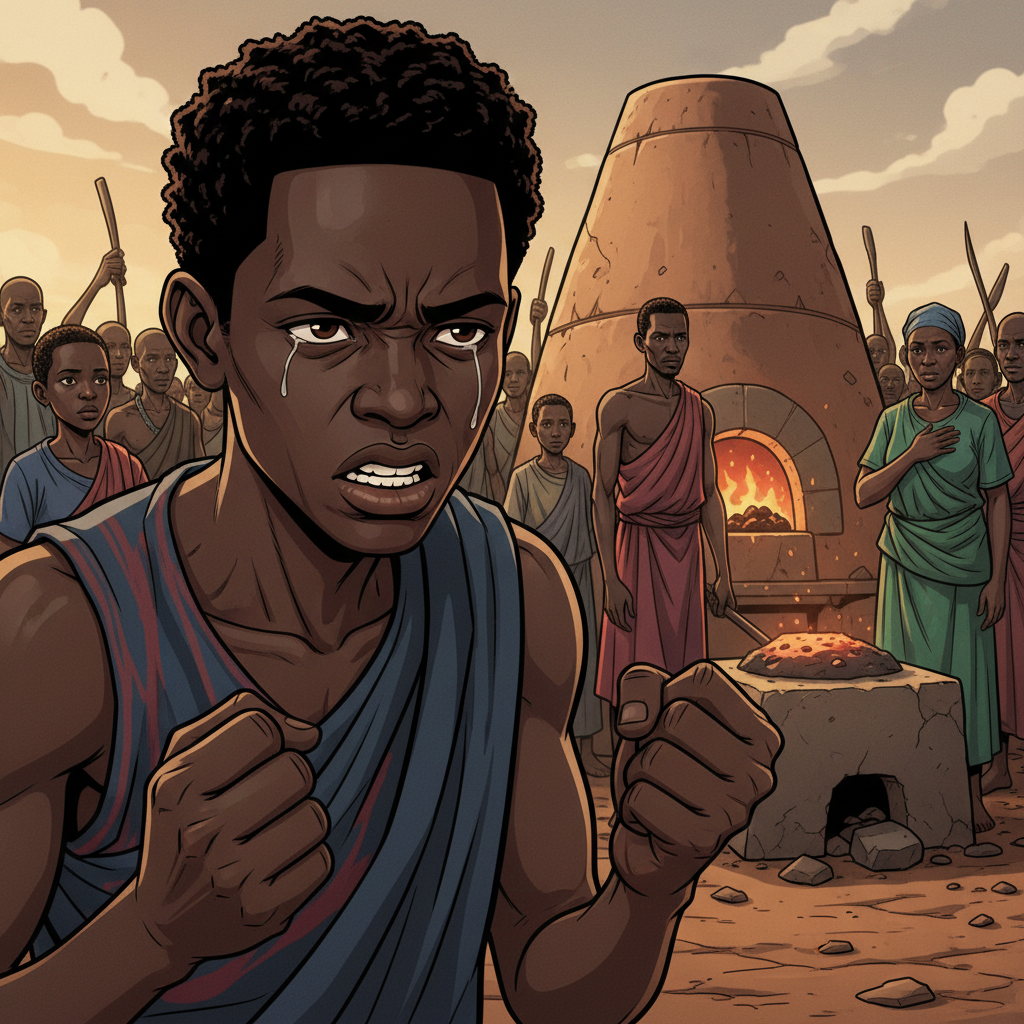
Chike's face went tight. Ngozi watched it happen — the slow setting of the jaw, the small narrowing of the eyes, the way his hands curled and then uncurled at his sides. The crowd was watching him too. Everyone in the village knew that he had stood at this furnace longer than she had. Everyone knew that by the old patrilineal custom, the eldest son inherited the father's craft. Everyone was waiting to see what Chike would do. Their mother, standing at the edge of the crowd, had one hand pressed flat against her own chest as though to hold her own heart in place. Their father said nothing more. He had said what the furnace required him to say, and now he waited, the bloom of new iron cooling on the stone slab beside him. Chike did not speak for a long time. The villagers shifted on their feet. Some looked at the ground. A child somewhere in the back asked a question and was hushed. Finally, Chike turned away from his father and looked at Ngozi instead. His eyes — deep brown, like hers, like their mother's — were wet. But they were not angry. They were something else. He drew a long breath. "Father," he said, still looking at her, "I was watching you the whole night. I was waiting for you to tell me what to do. I never looked at the iron." His voice broke a little on the word "iron," and he swallowed hard. "Ngozi was looking at the iron. I was looking at you. That is the difference."
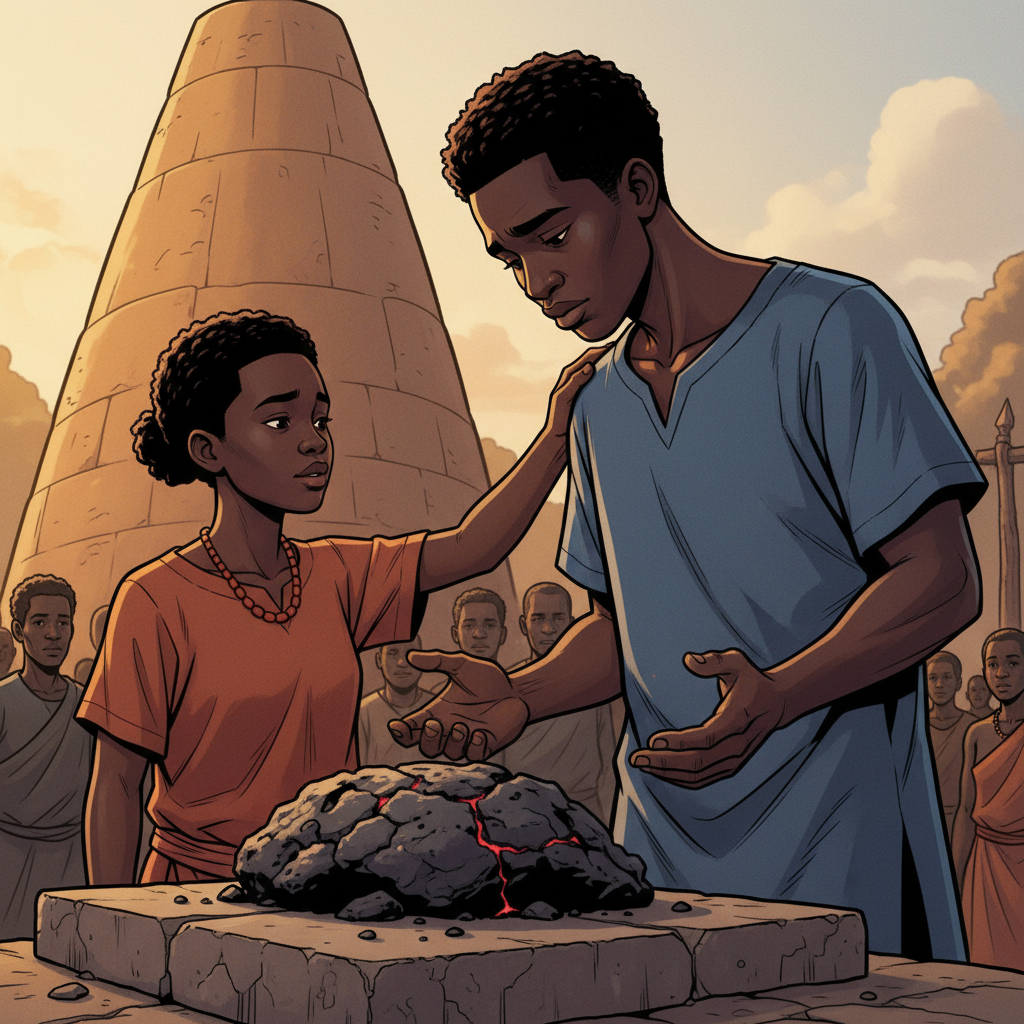
Obiora nodded slowly. He did not interrupt. He let his son keep speaking, because what Chike was doing in front of the whole village — naming his own failure honestly, in the open, with no excuses — was a thing that took more courage than most grown men would ever have to find. "I do not know what kind of brother I will be from today," Chike said quietly, his voice rough but steady. "I want to be the kind who works beside her. I do not know yet if I can. But I want to be." He turned his head and looked at the bloom on the stone slab — at the dark cooling iron that his sister had heard and he had not. "I will try, father. I will try, Ngozi." Then he lowered his head, just a fraction, the way a person lowers their head when they are speaking to something larger than themselves. Ngozi did not know what to do. She had been her brother's little sister for twelve years. She had never been anything else to him. She had certainly never been his master smelter. She looked at his lowered head, at the way his shoulders were trying very hard not to shake, and her own throat closed up. She took two slow steps forward, across the cold cleared sand of the firing-ground, until she was standing in front of him. Then she did the only thing she could think of to do. She reached out and laid her hand on his shoulder — flat-palmed, the way she had raised her hand at the furnace, the way their father raised his hand to silence the bellows. "Brother," she said softly. "I will need you. Will you stay?" Chike lifted his eyes. He nodded once. "Yes," he said. "I will stay."
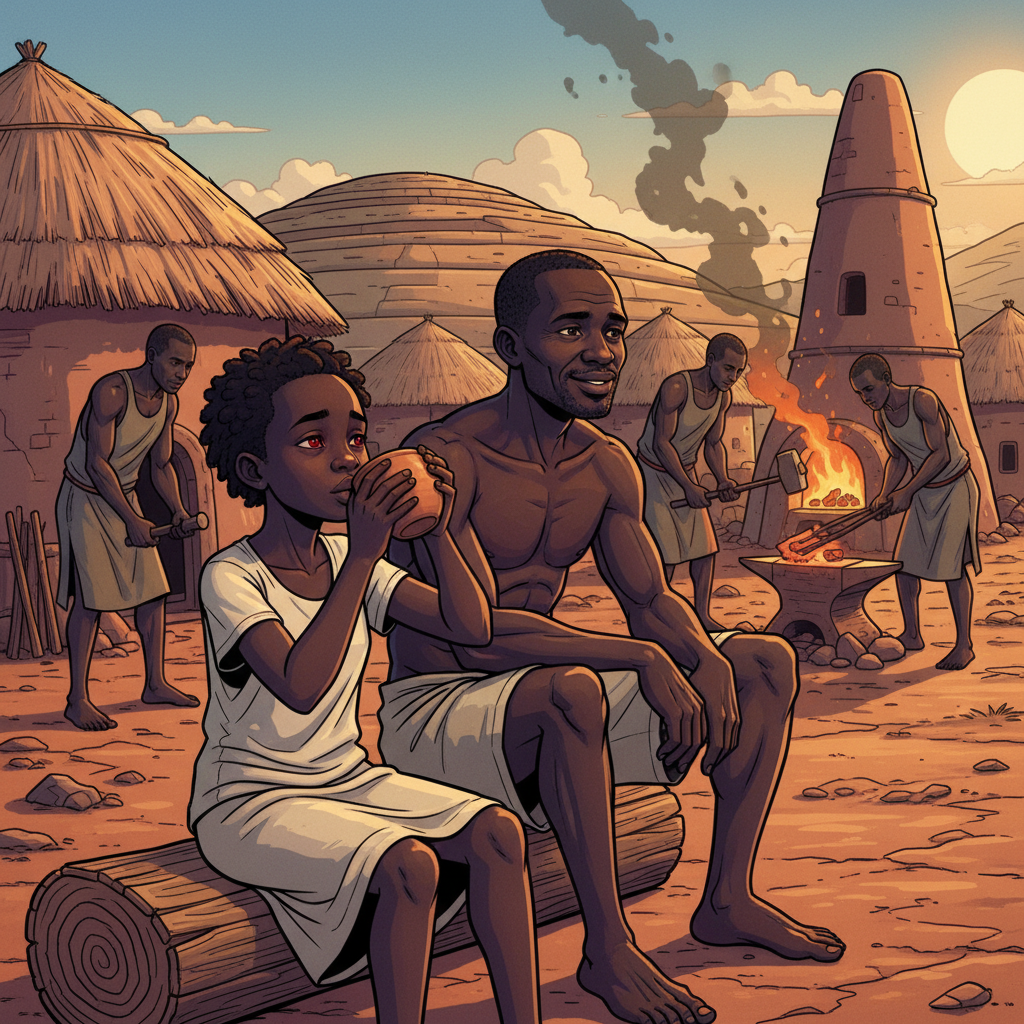
That afternoon, while the village smiths began the slow careful work of breaking the bloom into smaller pieces and reheating each piece for the hammer, Ngozi sat with her father on the log outside the smelter's house. He gave her a small cup of cool water. She drank it gratefully. Her arms ached. Her eyes burned. She had not slept in the proper way for three nights. "Father," she said, when she had finished the water, "how did your father teach you to hear the iron?" Obiora was quiet for a long moment. He looked at the ridges of the Jos Plateau in the distance, the way the dry red earth fell away toward the lower forests. "My father did not teach me to hear it," he said at last. "No one can teach that. My father taught me where to stand. He taught me when to be silent. He taught me that the iron has a voice, and that the voice is real. The hearing — the hearing is something each smelter must do alone." Ngozi thought about this. "Then how will I teach my own apprentices someday?" she asked. Her father turned and looked at her with a small smile in his eyes — the first real smile he had given her in three days. "The same way I taught you," he said. "You will not give them the answer. You will give them the question. You will stand them in front of the furnace. You will tell them where to look. You will tell them when to be silent. And then you will step back and let the iron ask. The ones who listen will hear. The ones who do not listen will not. That is how it has always been done in our village. That is how it will always be done, as long as our furnaces still burn."
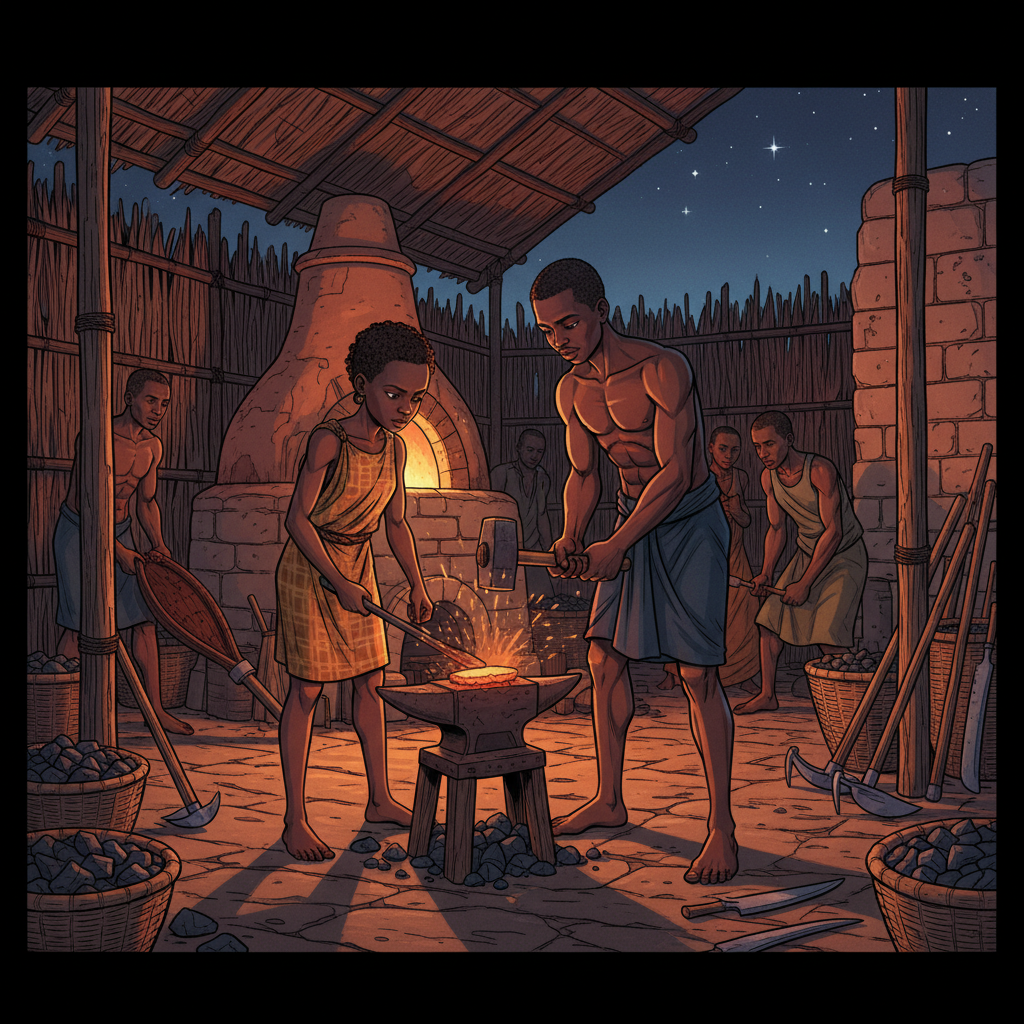
In the weeks that followed, the village adjusted, slowly, to its new master-smelter-in-training. Some of the older men grumbled at first — a girl, and not even the eldest child — but the grumbling did not last long. Ngozi worked harder than anyone had ever seen her work. She was at the furnace before dawn every morning and she stayed past sundown every night. She watched everything. She asked careful questions and she listened to the answers with the same patient attention she had given the iron. Chike worked beside her, exactly as their father had said he would. He was a quiet, steady, careful worker. His hands were stronger than hers, and he could carry baskets of charcoal twice as long as she could before he had to rest. They were a good pair. She could see what the iron needed, and he could give the iron what she saw it needed. Together they were one good smelter, and apart they would have been two unfinished ones. The village benefited almost immediately. Within a single moon, Ngozi and Chike together fired the furnace twice. Each firing produced enough bloom for forty hoe-blades — and the village smiths hammered out the blades, and the farmers fitted them onto wooden handles, and the farmers walked out into the forest at the edge of the plateau and began the slow patient work of clearing new ground. An iron hoe cut through tree-roots four times faster than the older wood-and-stone tools the village had used in their grandparents' time. Land that would have taken a family a whole season to clear could now be cleared in a quarter of a season. New fields opened. New crops were planted. The village grew. Children who would have gone hungry ate. Mothers who would have lost babies kept them. The iron from the furnace did not just make tools. The iron made life.
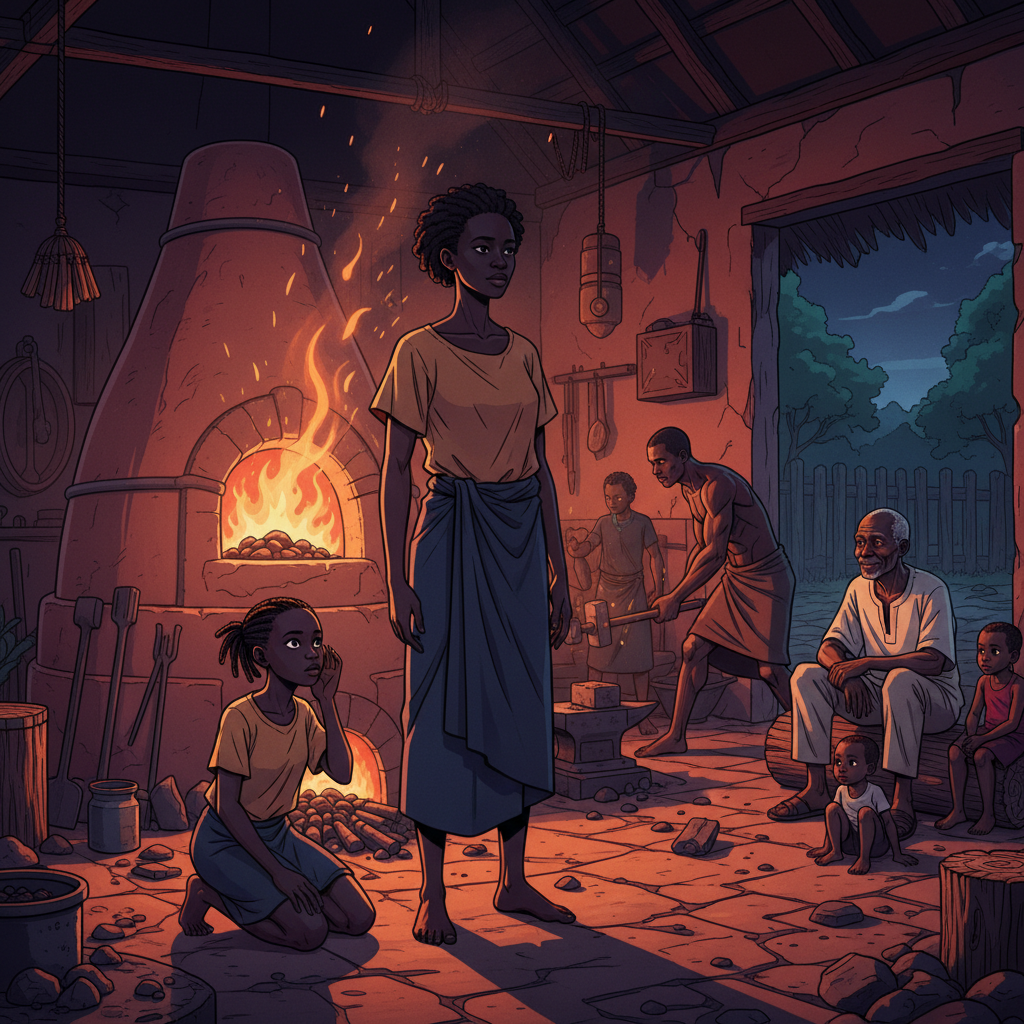
Years later, when Ngozi was a grown woman with her own apprentices and her father had become an old man who sat on the log outside the smelter's house and watched the firings without taking part, she would sometimes catch herself thinking back to that third night. To the cold air. To the shimmer on the surface of the iron. To the moment her open hand had risen at her side without any conscious thought from her. She thought, too, of her brother. Chike had become the village's most trusted bellows-master. He could read the fire by its color the way a fisherman reads the river by its currents, and when he was on the bellows, the rhythm of the air was so steady that the smelters said the furnace itself seemed to breathe easier. He had married a weaver from the next village over, and he had three children, and his oldest daughter — a serious-eyed girl named Adaeze — had begun, just last firing season, to stand at the furnace mouth and watch the way her aunt Ngozi watched. Ngozi had not yet said anything about Adaeze to her brother. There was no need to. She had seen the way her niece's eyes moved during the last firing — quick, alert, taking in the smoke and the heat and the color and the sound, sweeping over the whole furnace and then settling on the lower vent for long, patient minutes at a time. The girl was listening. Whether the iron would speak to her, Ngozi did not yet know. The iron made its own choices. But the girl was already standing where the iron could find her if it wanted to. Ngozi had watched her own father teach her by simply not getting in the way, and she would teach Adaeze the same way. Some inheritances are passed down. Some are listened up to. The furnace decided. The smelter prepared the ground.
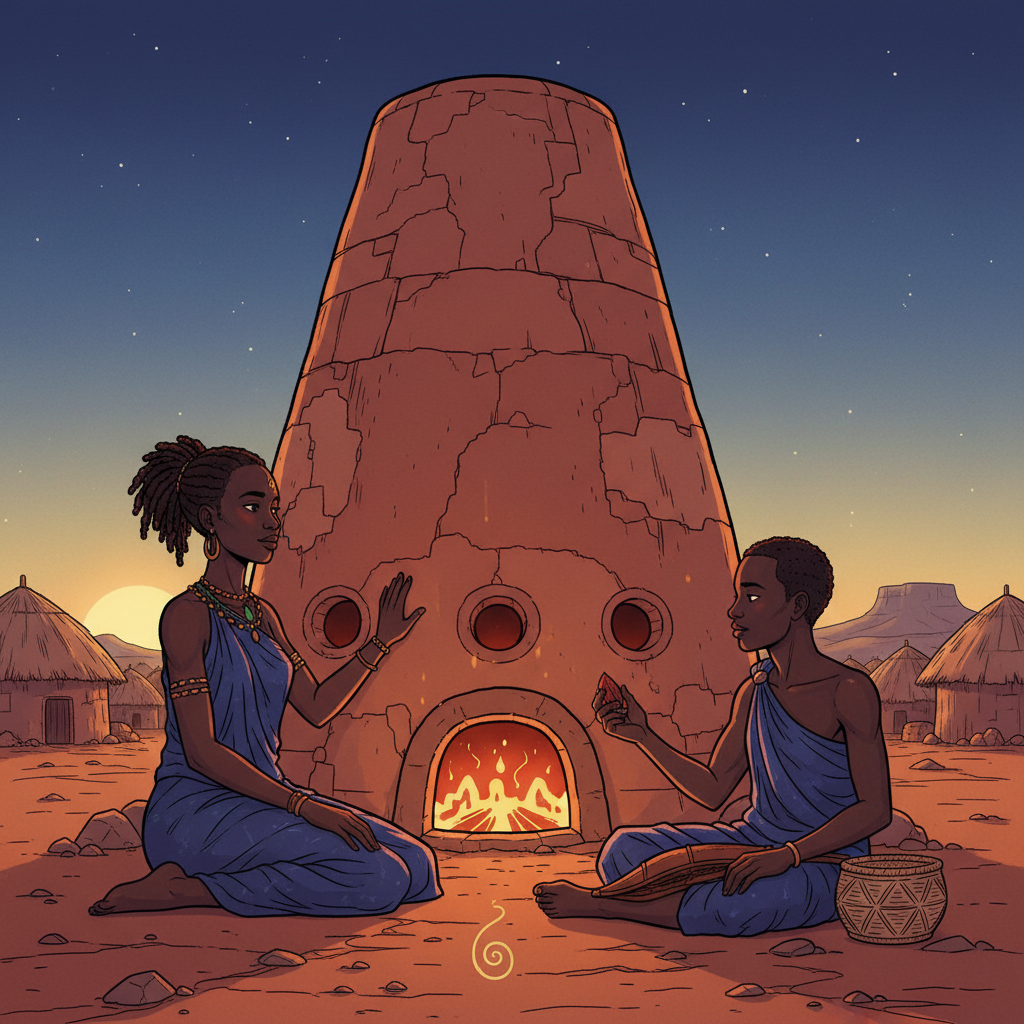
On the night before her first firing as fully-named master smelter — the year Ngozi turned twenty, the year her father stepped formally aside — she walked alone to the furnace in the cold hour before dawn, exactly as her father had walked her there eight years before. The furnace was the same. The clay walls had been patched and re-patched, but the shape was unchanged. The three tuyères still angled into its lower belly. The mouth still opened to the sky. She put her hand on the warm clay of its outer wall and felt the faint constant heat of the village's working life pulsing inside. Then she sat down on the cold ground in front of it and waited for sunrise, and as she waited, she said softly, mostly to herself but a little to the furnace too: "The furnace does not ask whose turn it is. It asks who was listening." She had been saying that sentence to herself almost every day since she was twelve, and she would keep saying it for the rest of her life. When the sun came up over the plateau, the bellows-men arrived to begin the firing, and Chike was the first of them — as he had been the first of them for every firing of the last eight years. He carried his bellows-leathers folded over one arm and a small woven basket of kola nuts in the other hand. He sat down beside his sister, opened the basket, and broke a kola nut in two. He handed half to her. "Ready, smelter?" he asked. Ngozi took the kola nut, looked at her brother, and smiled. "Ready, brother," she said. The fire was already gathering itself inside the clay. Somewhere far down at the bottom of the furnace, in a place no eye could yet see, the new iron was beginning to think about its question. And Ngozi, who had been listening for eight years, was ready, again, to hear the answer.