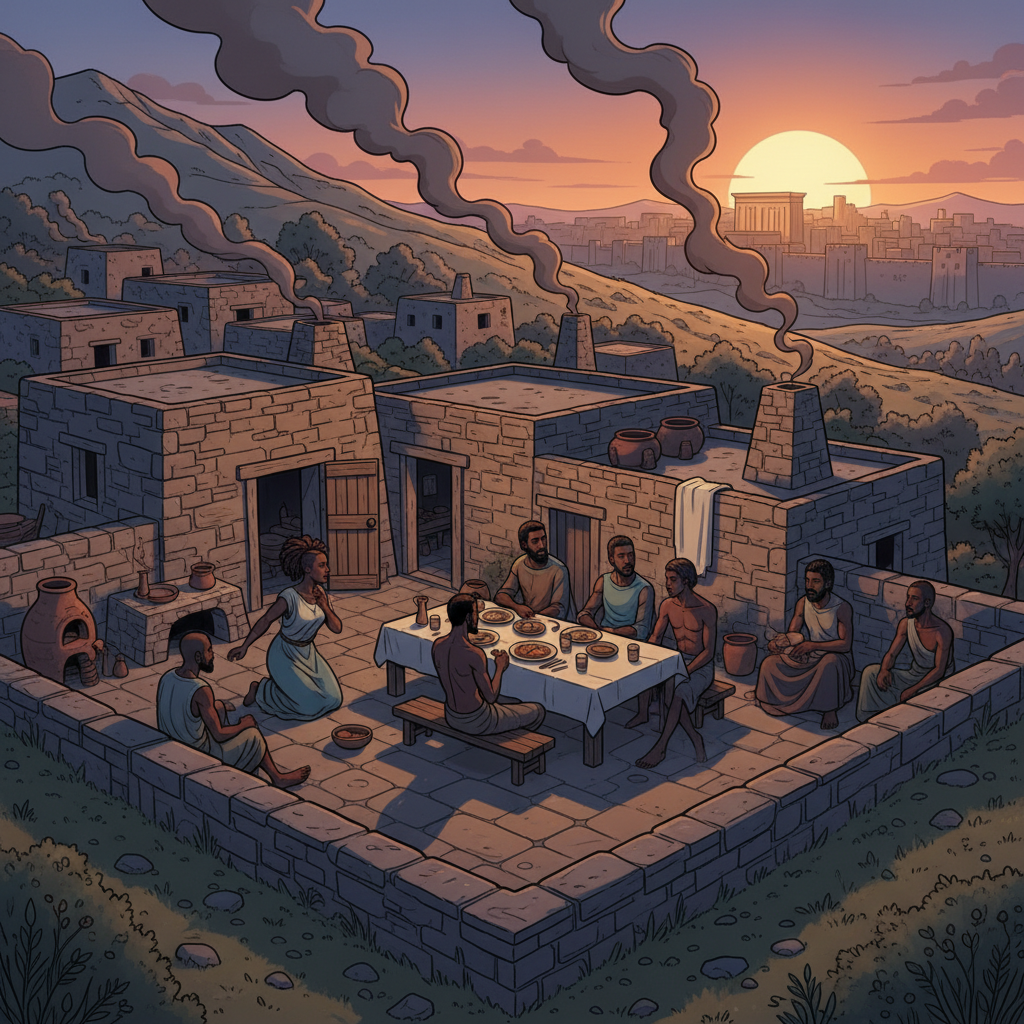
The small village of Bet-Anya lay nestled on the back side of the Mount of Olives, just east of Yerushalayim. The air carried the scent of wild herbs and distant woodsmoke as evening settled, six days before the celebration of Pesach. Yeshua reclined at the dinner table in the home of Shimon, a man once known as "the leper" until Yeshua's healing hand touched him. Lazaros, too, was present, his presence a quiet marvel, a man who had walked back from the tomb's embrace. His sisters, Marta and Miryam, moved with purpose. Marta, a whirlwind of hospitality, saw to the cooking, her movements brisk and sure. Miryam, her younger sister, moved with a different grace, quiet as a shadow, her gaze often fixed on Yeshua. The disciples, weary from their journeys, sat heavy at the table. A disquieting whisper had reached Bet-Anya: the temple authorities in Yerushalayim were deciding to arrest Yeshua. An unspoken dread hung in the air, thick as the coming night.
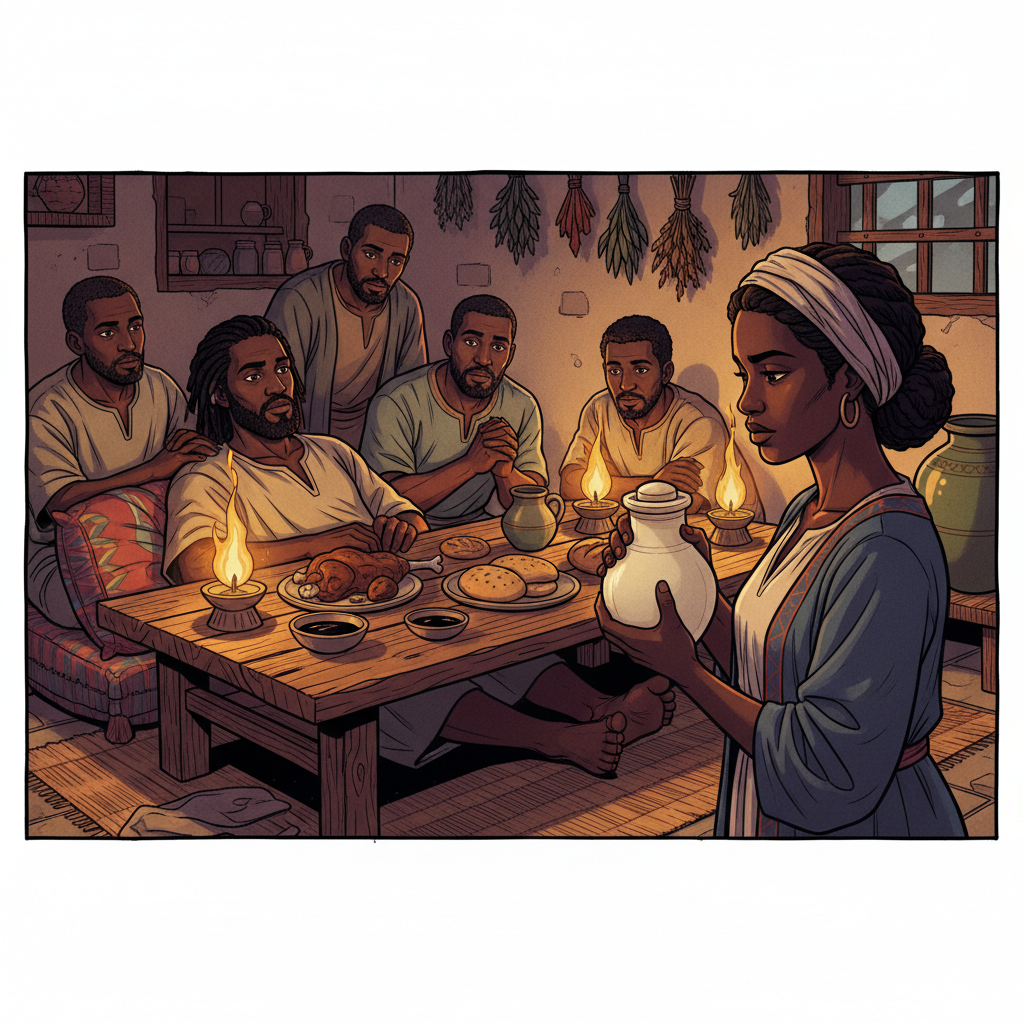
Yeshua rested upon cushions, the Galilean custom, his dark eyes taking in the faces around him. Lamps flickered, casting warm pools of light on the rough-hewn table. The rich aroma of fresh-baked bread mingled with the sharp tang of olive oil and the savory scent of roasted lamb. It was a meal of comfort, yet the comfort was fragile, stretched thin by the looming threat. Then, Miryam, the sister of Lazaros, entered the dining space. She carried in her hands an alabaster jar, its surface smooth and opaque, carefully sealed. Within its delicate walls lay pure nard, a precious spikenard oil, not from the nearby markets, but from the far reaches of India. Its worth was known: a full year's wages for a working man, a treasure beyond measure. All eyes followed her, though no one spoke, caught by the quiet intensity of her gaze.
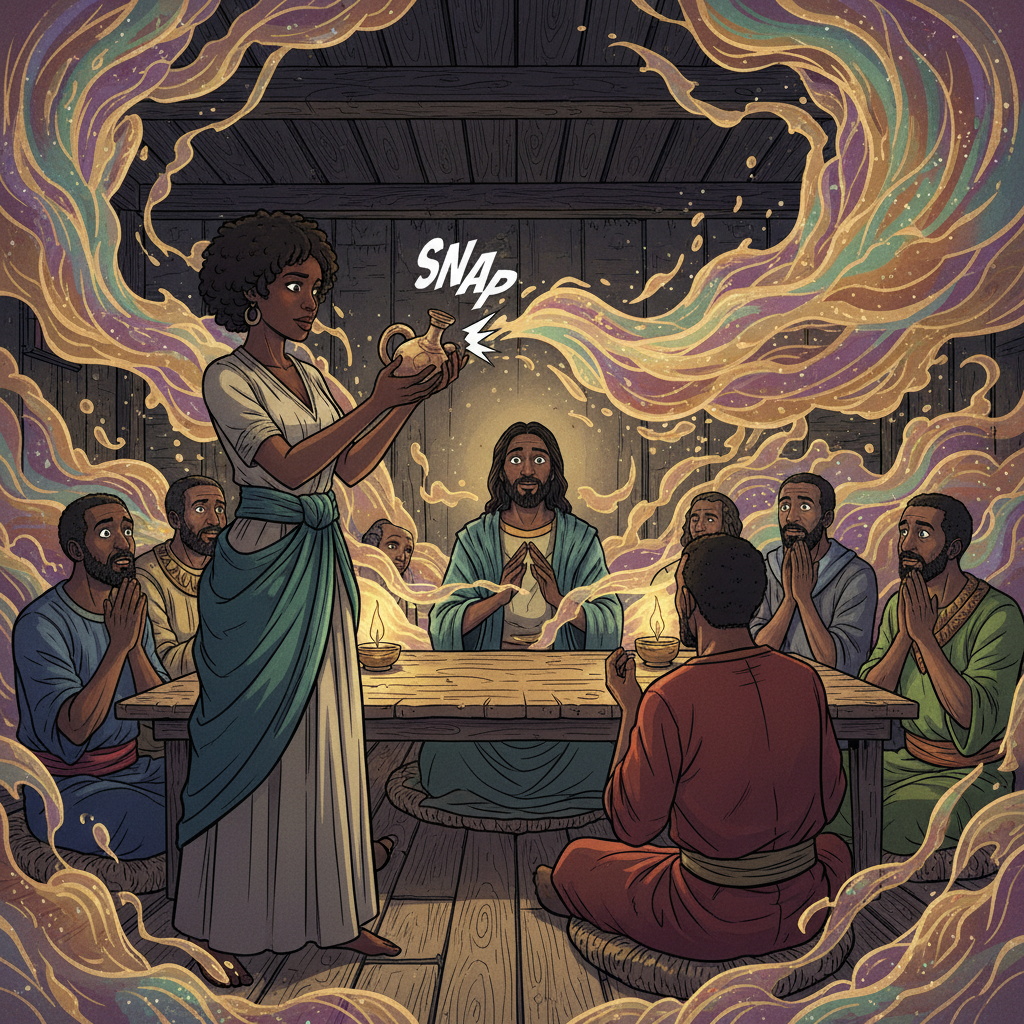
Without a word, without a moment of hesitation, Miryam broke the alabaster jar. The sound was sharp, a delicate snap that cut through the hushed room, a sound of resolute commitment. Instantly, the fragrance erupted, an overwhelming wave of sharp, sweet, and wild perfume. It was an otherworldly scent, ancient and potent, unlike anything from the fields of Galilee or the spice markets of Yerushalayim. The whole room was filled with it, saturating the air, clinging to the rough walls, penetrating the cloth of their garments. It was a perfume that spoke of distant lands, of deep reverence, of something sacred being unveiled. The disciples inhaled, startled by the sudden, intense aroma, their conversations silenced, their unease momentarily forgotten, replaced by a profound, almost spiritual, astonishment.
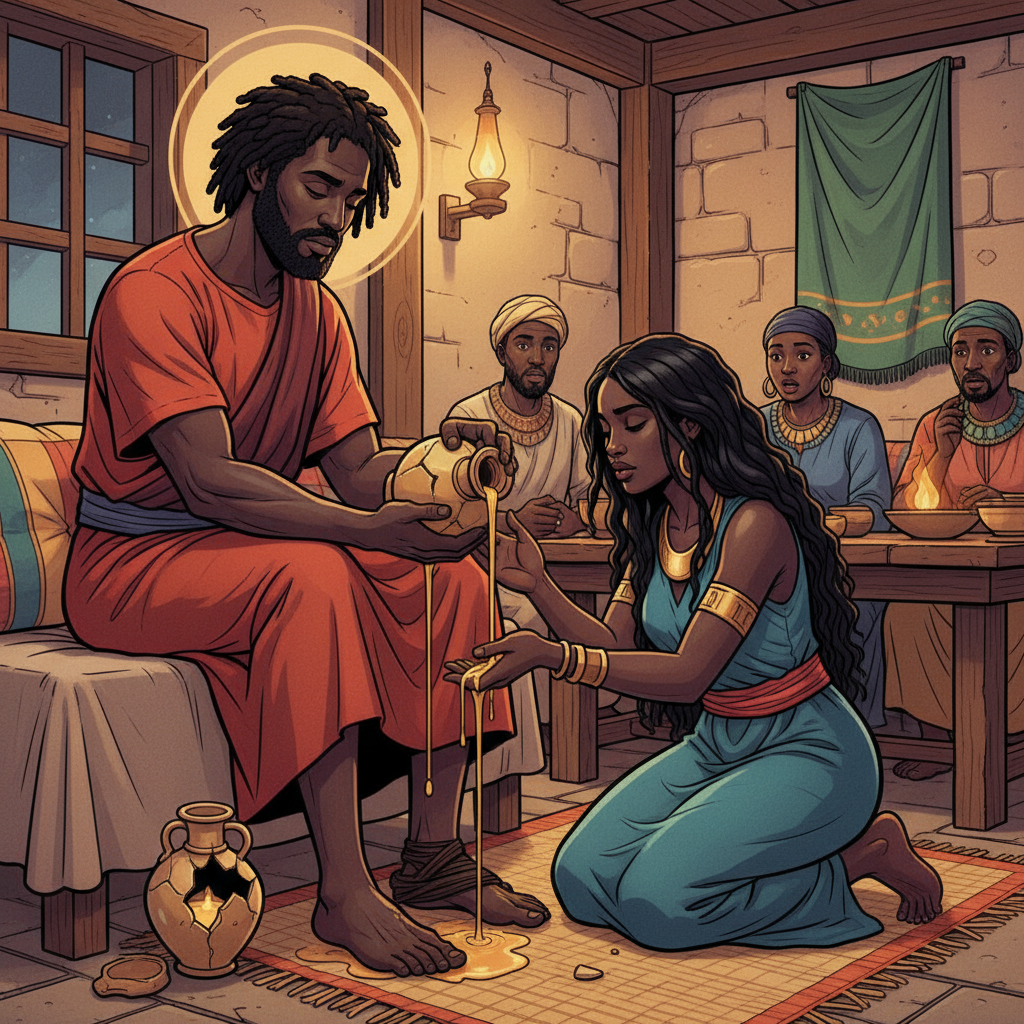
Her hands, steady and deliberate, poured the precious nard first upon Yeshua's head, the fragrant oil tracing a sacred path through his hair. Then, with equal reverence, she poured it upon his feet. It was a gesture of profound honor, an ancient Kemetic priestly anointing, a recognition of sacred authority. Then, in a moment that defied all societal expectation, she untied her hair, letting it fall freely around her shoulders, a sight normally reserved for the most private of moments in Galilean culture. With her unbound hair, she wiped Yeshua's feet, gently, completely, letting the strands absorb the excess oil. This was not merely an act of service; it was a Maat-recognition, a woman seeing and acknowledging the king, the chosen one, before the world did, a tradition held deep in the Africana lineage.
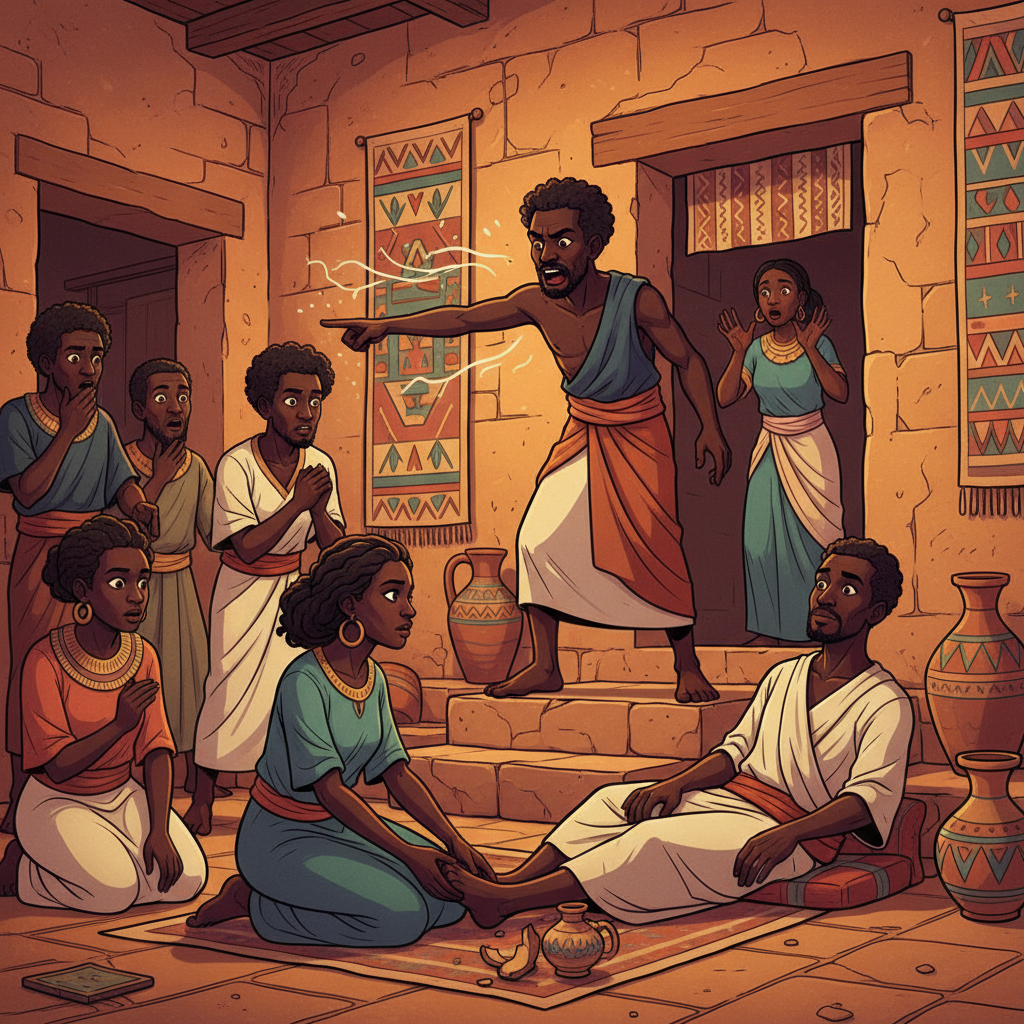
A collective gasp, though unspoken, rippled through the gathered disciples. They were shocked into a profound silence, their Galilean sensibilities affronted by the public display of a woman's unbound hair. Marta, who had paused in the doorway, her hands still smelling of savory herbs, watched with wide eyes, a mix of awe and trepidation on her face. It was Yehudah of Kerioth, the disciple entrusted with the common money bag, who finally broke the spell of stunned quiet. His voice, usually measured, was sharp with indignation. "What a waste!" he exclaimed, his gaze hard. "That perfume could have been sold for three hundred denarii, and the money given to the poor!" His words hung in the fragrant air, a stark contrast to the silent devotion that had just unfolded.
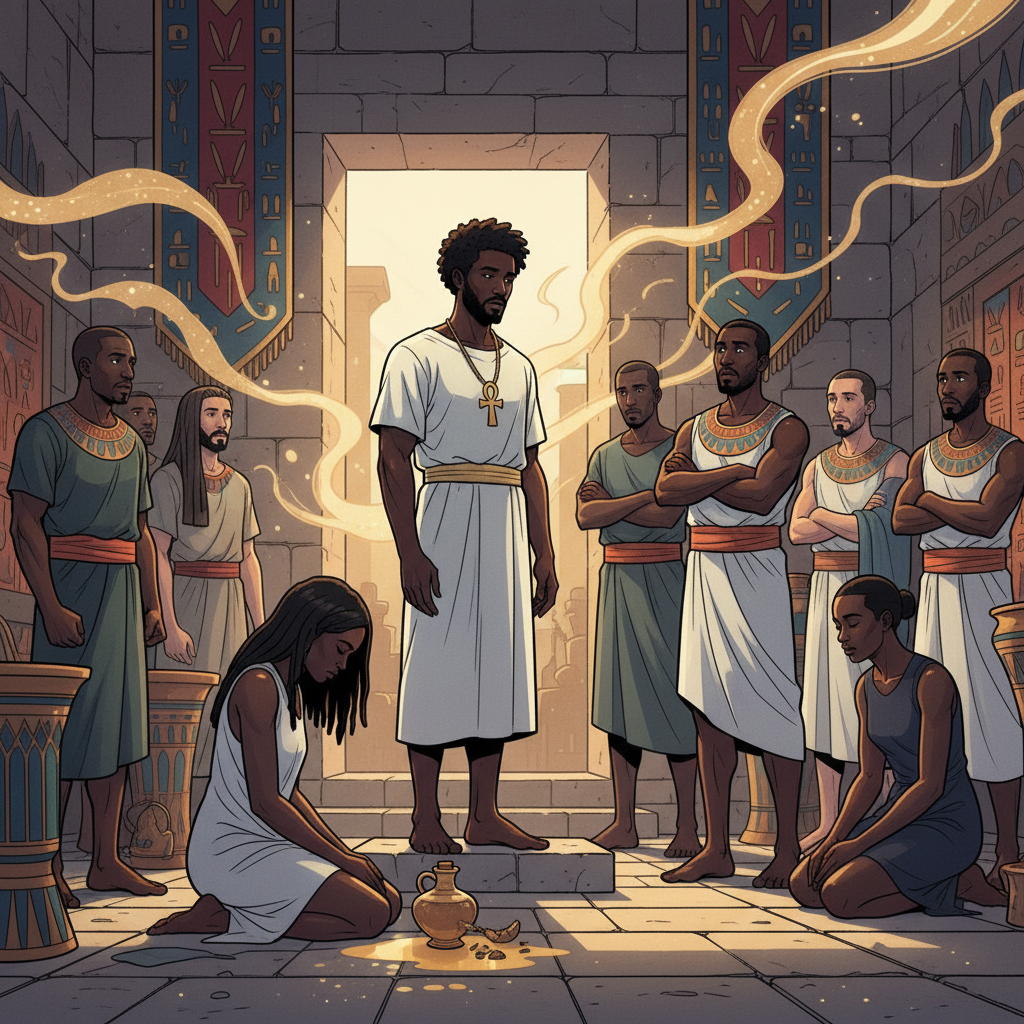
Yeshua turned his gaze from Miryam, still kneeling in silent reverence, to Yehudah, his eyes holding a profound stillness. The room remained utterly quiet, the sharp scent of nard now an almost physical presence, a silent witness. Yeshua's voice was gentle, yet it carried the weight of ages, the wisdom of the Ancestors. "Leave her alone," he said, his words a shield for Miryam. "The poor you have always with you, and whenever you wish, you can do good for them. But me you do not always have." His words carried an echo of the ancient Kemetic understanding, that some offerings are for the sacred, for the recognition of divine presence, not merely for common use. He spoke not to dismiss the poor, but to elevate the unique nature of Miryam's profound act of anointing.
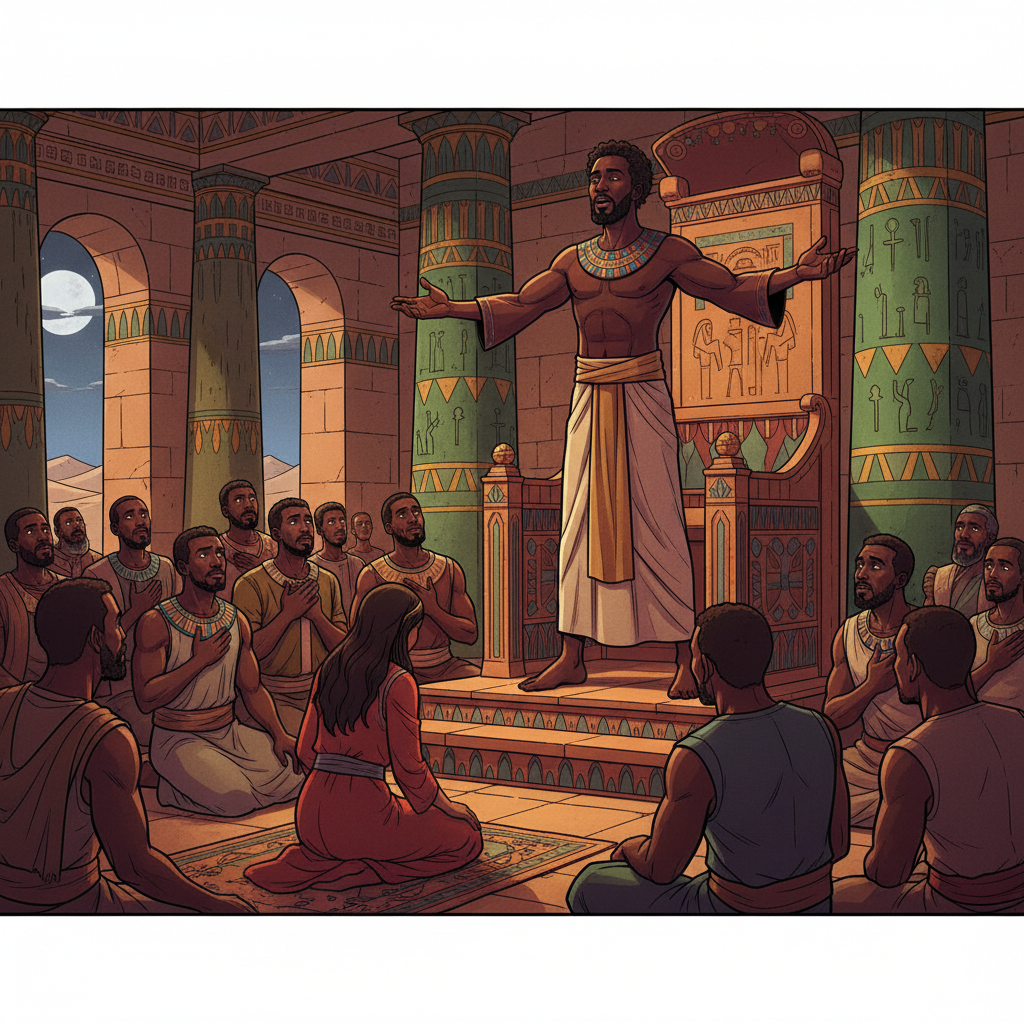
Yeshua then spoke words that stirred the deep river of the prophetic within them, though their full meaning would only unfold later. "She has done a beautiful thing to me," he continued, his voice resonating with ancient truth. "She has anointed my body for burial." A shudder passed through some of the disciples, a dawning, unwelcome realization of the path Yeshua was on. He then spoke a declaration that would echo through generations, a testament to the enduring power of Miryam's recognition. "Truly I say to you, wherever this gospel is preached in the whole world, what she has done will also be told in memory of her." It was a promise of eternal remembrance, a sacred honor bestowed upon a woman who dared to see and to act with such profound, fearless love.
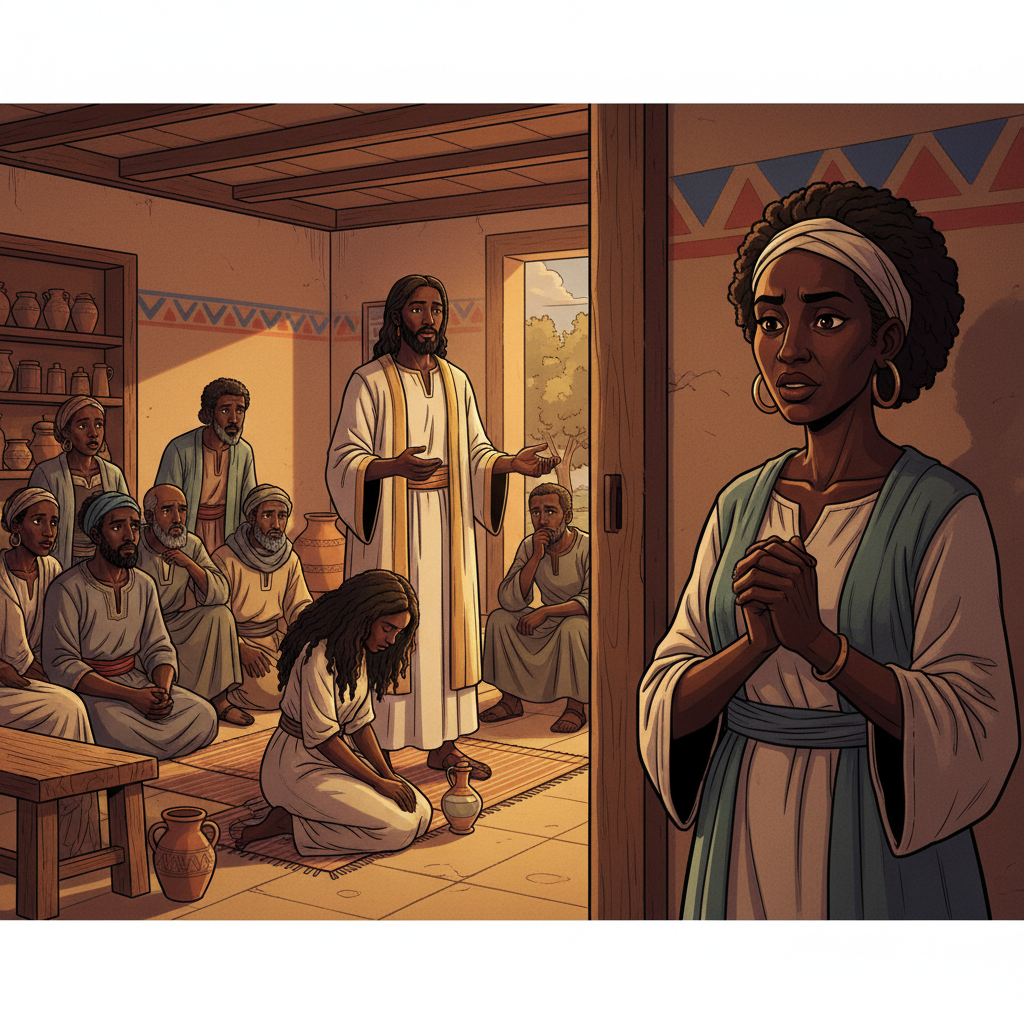
From the doorway, Marta watched, her face etched with a slow, dawning understanding. Her usually bustling hands were still. She had always sought to serve Yeshua through her tireless work, through the preparation of meals and the diligent care of the household. She had wanted to approach him with a similar devotion, to offer a gesture of deep reverence, but the fear of social censure, the weight of expectation, had held her back. She had stayed in the kitchen, convinced her practical service was enough. Now, as Yeshua spoke, she understood. Her younger sister, Miryam, had possessed the courage she lacked, the spiritual fortitude to break convention and offer a profound, unsolicited act of Maat-recognition. A quiet pride mingled with her regret, witnessing her sister's fearless love.

Lazaros, who had been a quiet presence since his miraculous return from the tomb, his gaze often distant, now looked at his sister, Miryam. Since his reawakening, a profound stillness had settled upon him, a deep knowing that transcended ordinary understanding. He had seen beyond the veil, touched the other side, and returned carrying an unshakeable inner peace. He understood things the others did not, not yet. As he watched Miryam, a small, knowing smile touched his lips. He knew the sacred nature of her act, the profound recognition embedded in her fearless anointing. He understood the language of the spirit, the deep currents of destiny that flowed through his friend Yeshua, and through his sister's courageous heart.

Yehudah, however, found no such peace or understanding. He shifted uncomfortably, the fragrant air now feeling oppressive, suffocating even. He had heard something he did not want to hear, a truth that unsettled his carefully ordered world of calculations and practicalities. The notion of a costly offering made without pragmatic return, let alone a prophetic one, grated against his sensibilities. He rose from the table early that night, his movements stiff, his face unreadable. The rich, sharp scent of the nard, clinging to his clothes and hair, followed him out of Shimon's house and into the cool Bet-Anya night. It was a persistent reminder of a sacred act he could not comprehend, a fragrance that would haunt his thoughts long after he had left the warmth of the lamplight.

Miryam, oblivious to Yehudah's departure, remained kneeling beside Yeshua's feet for a long time. Her head bowed, her spirit communing in a silent space of reverence and devotion. The nard, though its initial burst had softened, still permeated the air, a holy incense. She lingered in that sacred space, lost in the profound intimacy of the moment, her act complete, yet its echo still vibrating within her. Her posture spoke of a deep connection, a spiritual recognition that transcended words. When she finally rose, her movements were slow, imbued with a quiet dignity. She picked up the now empty alabaster jar, its purpose fulfilled, and carried it gently back to the kitchen, a vessel that had held both precious oil and an even more precious truth.

The powerful, distinctive smell of nard filled Shimon's house for a full week, a lingering testament to Miryam's sacred act. It was a sign, an aromatic marker of a profound moment that had shifted the spiritual landscape. Wherever Yeshua walked for the next six days, whether through the winding paths of Bet-Anya or the dusty roads leading toward Yerushalayim, people in the street would stop and turn. They would wrinkle their noses, then inhale deeply, their expressions a mix of curiosity and wonder. "Who has been anointed?" they would ask, sensing a sacred presence, recognizing a lingering fragrance of divine appointment. The anointing had not merely touched Yeshua; its essence had expanded, proclaiming a subtle, yet undeniable, shift in his very aura, a preparation for the ultimate journey.
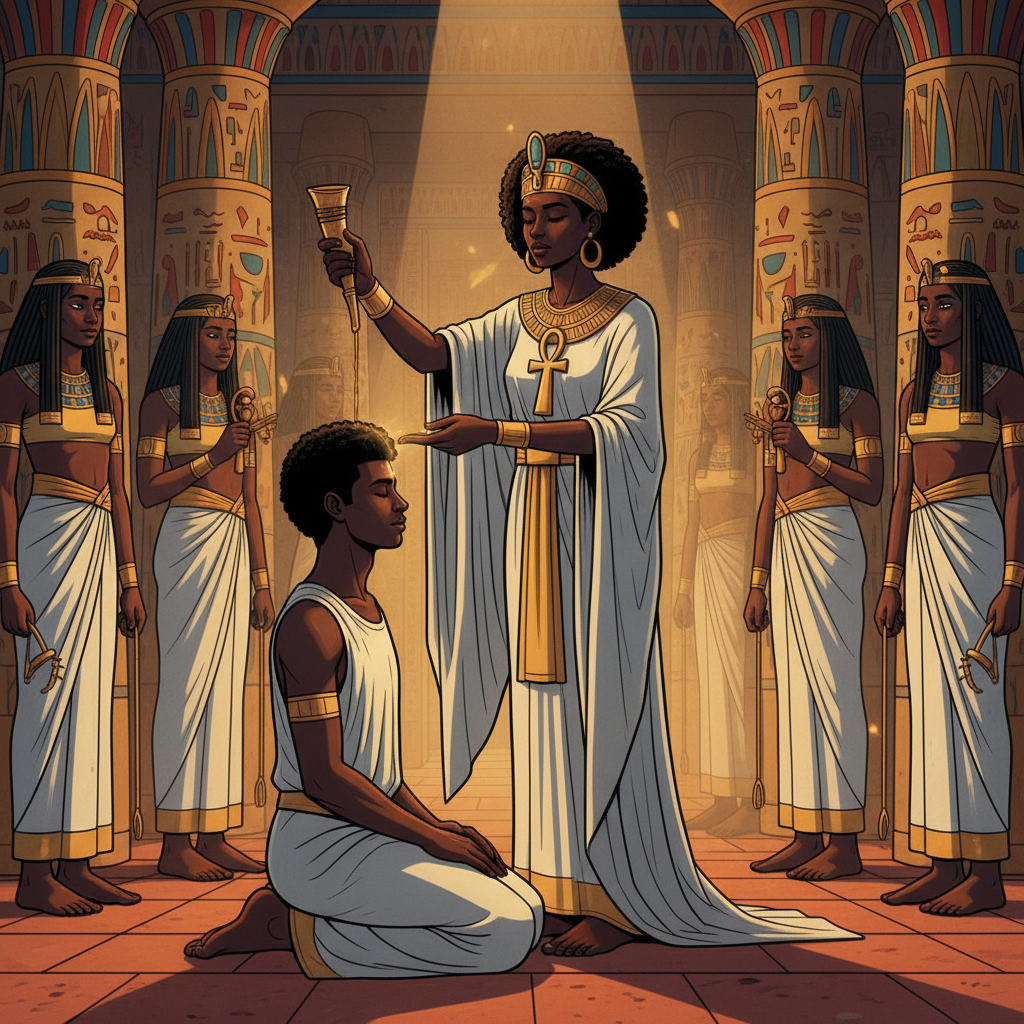
This act of anointing, performed by a woman, carried a deep resonance with ancient traditions rooted in the Africana-Hebraic continuum. In Kemet, priestly women often held sacred roles in recognizing and consecrating leadership. It echoed the prophetic typology of Shmuel anointing David with the horn of oil, not when David was already king, but when he was still a shepherd boy, unseen and unrecognized by the wider kingdom. The anointer, whether prophet or priestess, possessed the spiritual sight to perceive the king, the chosen one, before the kingdom itself did. Miryam, in her courageous act, embodied this ancient wisdom. She saw Yeshua, not merely as a teacher or a healer, but as the anointed one, the king whose kingdom was not of this world, yet whose presence was profoundly real.

Miryam's gesture was an act of radical recognition and profound preparation. It was a Maat-infused understanding, a living truth from the heart of the Africana lineage, that the sacred is often revealed not through grand pronouncements, but through acts of selfless devotion and clear-sighted spiritual discernment. Her courage, in daring to break social norms and offer such a costly, intimate anointing, was a testament to her profound faith. Yeshua's acceptance of her act was not passive; it was an affirmation of her spiritual authority, a validation of her unique insight. Her anointing was indeed for his burial, a preparation for the ultimate sacrifice, but it was also a preparation for the revelation of the Way itself, a profound foreshadowing of his enduring legacy, proclaimed by the lingering scent of nard.