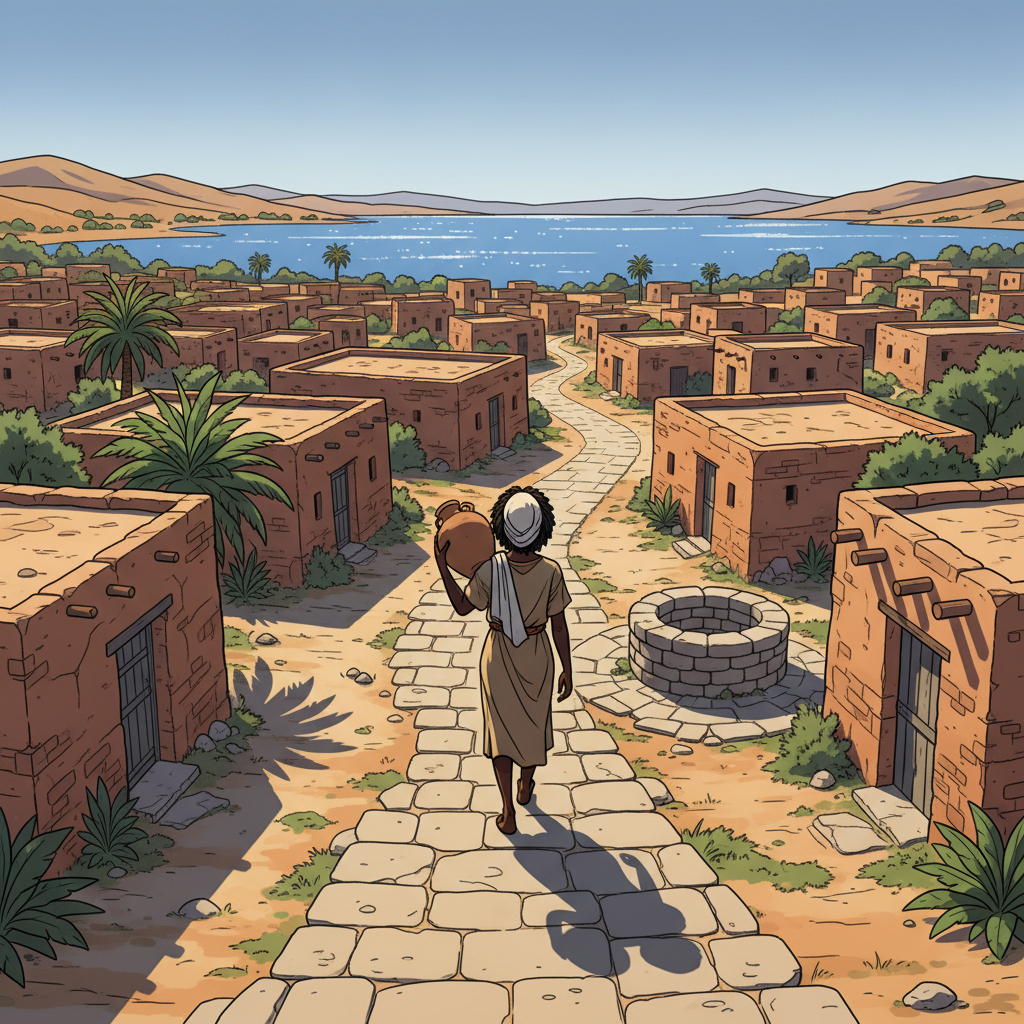
The village of Magdala sat on the western shore of the great inland sea the Romans called Tiberias and the people called Kinneret. It was a town of fishermen and dyers, of weavers and salt-makers, and in its dusty lanes the women went to the well at dawn — always together, always in chattering groups, their clay jars balanced on strong shoulders. Miryam did not go with them. She had not gone with them for years. Her skin was the warm dark brown of the fertile Galilean hills, her hair tied back in a rough linen wrap, her eyes steady and tired in a face that had seen too much. She waited until the sun climbed high and the other women were gone. Only then did she take up her jar and walk the long stone path alone, the heat pressing down on her head like a heavy hand.
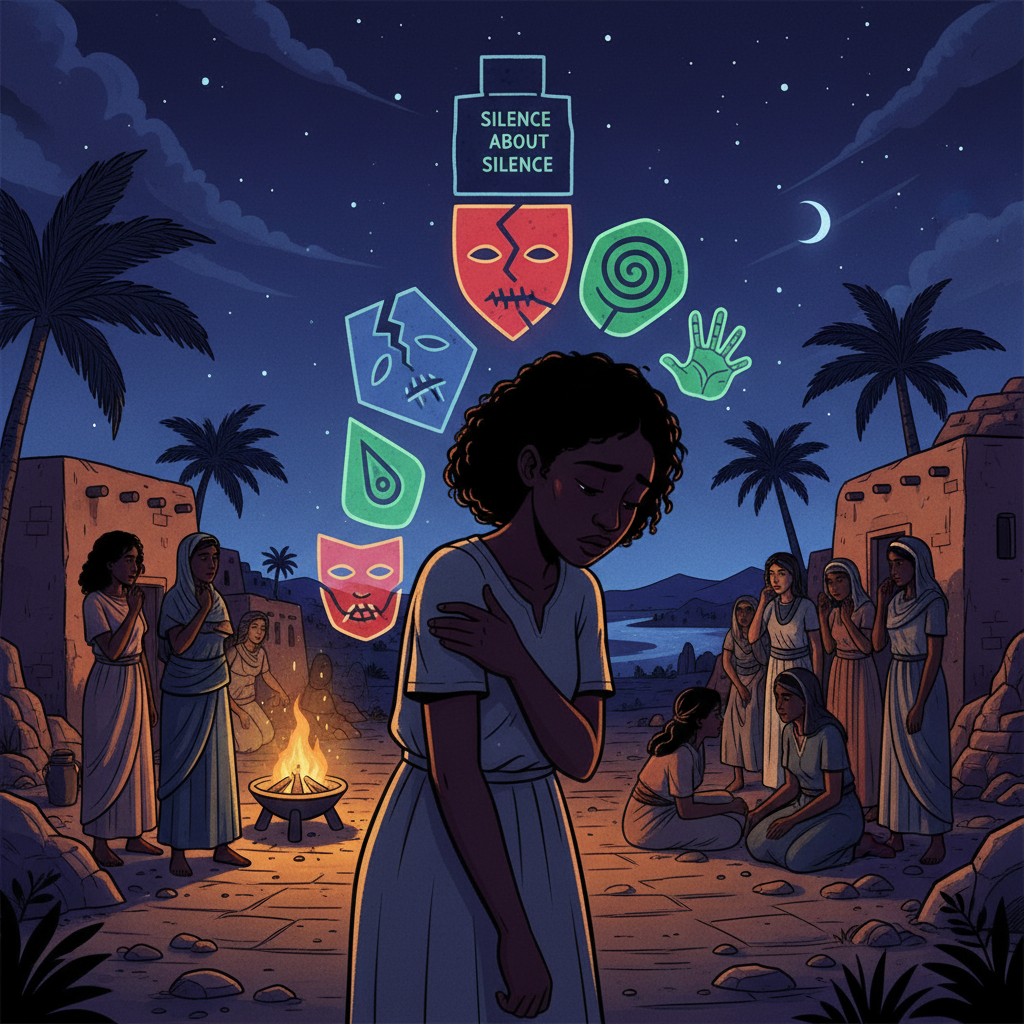
The villagers whispered when she passed. They said she was possessed by seven spirits. They said her mind had broken. They said a woman who lived as she lived — without a husband, without a father, without a man’s roof over her head — must be touched by something dark. The rumors had followed her since she was a girl. They had grown teeth over the years, and those teeth had bitten deep. But the seven spirits were not demons. The scholar Dr. Ben Jochannan would one day teach that the "seven spirits" of the old stories were seven burdens — seven traumas laid on the backs of African women who had been used and discarded by the societies around them. Miryam carried those seven burdens. Hunger. Shame. Loneliness. Grief for a mother dead too young. Fear of men who had taken without asking. Silence. And the heaviest of all — the silence about the silence.
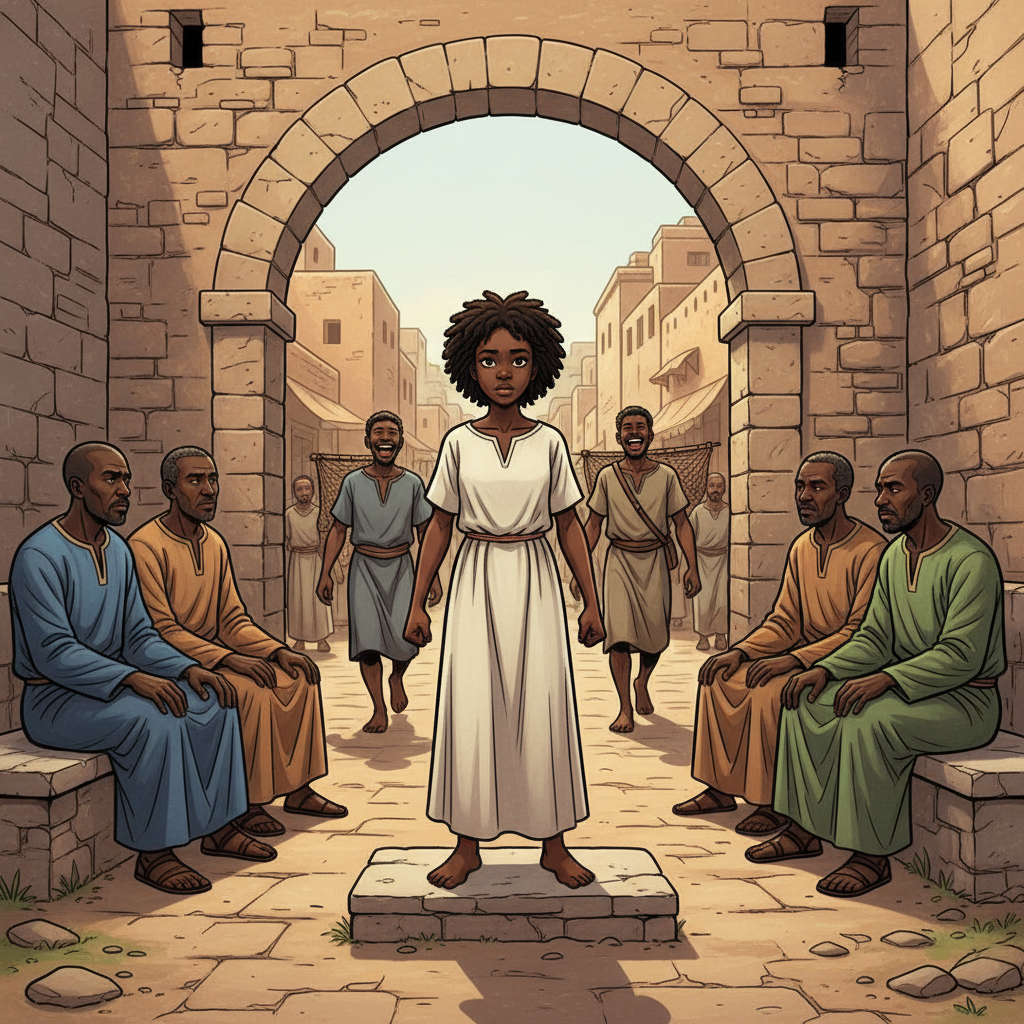
She had tried, when she was younger, to tell the village elders what had been done to her. She had stood before the old men at the gate in a clean linen tunic, her voice trembling but steady, and she had named the men who had harmed her. The elders had listened with tight mouths and had sent her home. Nothing was done. The men who had hurt her walked free through the marketplace, laughing. After that day, something inside Miryam had gone quiet. She stopped going to the Sabbath gatherings. She stopped sitting with the women at the loom. She took odd work at the dyeing vats, her hands stained purple and red from the madder and the murex, and she lived in a small stone room on the edge of town. The villagers said she had gone mad. But the scholar Zora Neale Hurston would have known the truth — Miryam had simply stopped performing for a world that had refused to see her.
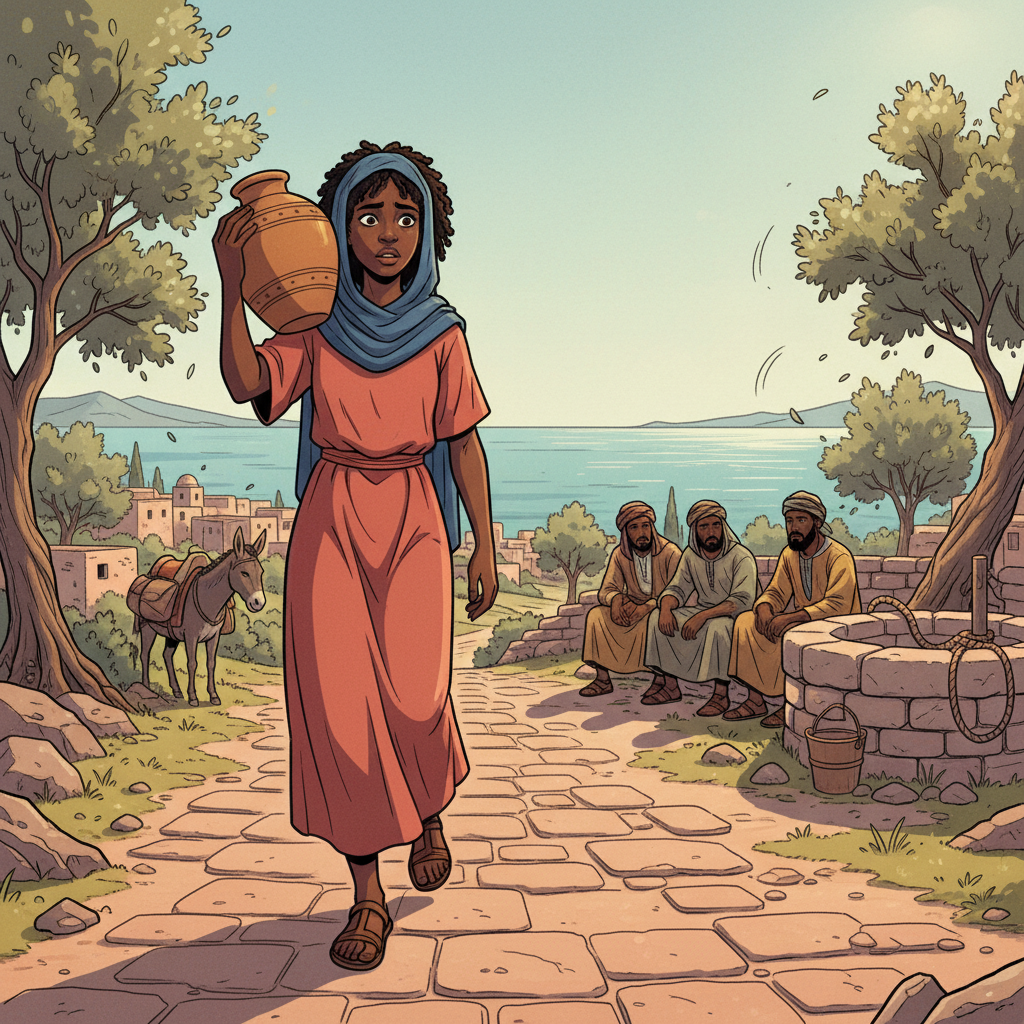
On this particular day, the air above Magdala shimmered with heat. The cicadas buzzed in the olive trees. Miryam walked the path to the well with her jar balanced on her shoulder, her sandals slapping the hot stones. She was thinking of nothing in particular — only the water, and the walk, and the coolness she would feel when her jar was full and the rope was wet in her hands. She came over the rise, and she stopped. There were men at the well. A small group of them — travelers by the look of their dusty robes, sitting in the scant shade of the stone wall that surrounded the spring. Her first instinct was to turn back. She had learned long ago that strange men gathered in groups were not safe for a woman alone. Her hand tightened on the rim of her clay jar, and her heart began to beat hard in her chest.
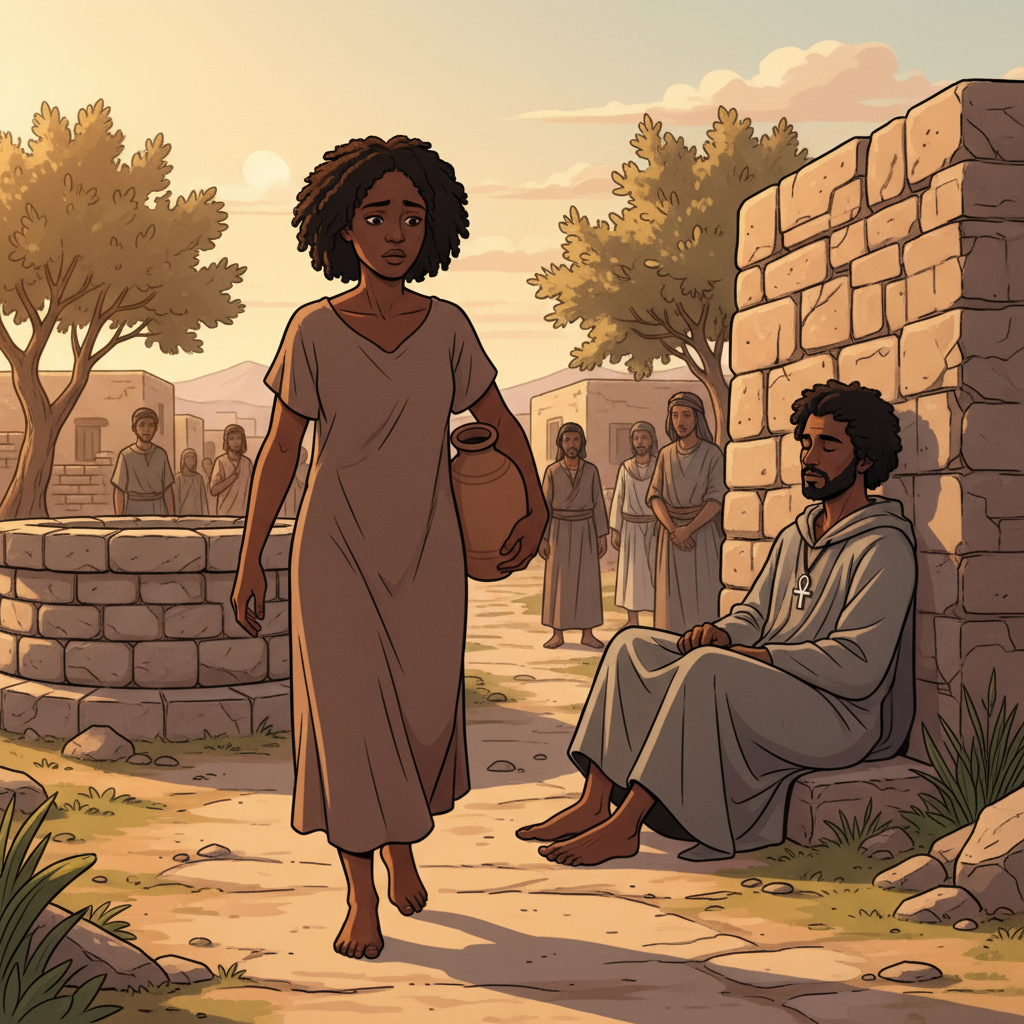
But she was thirsty. And the walk back was long. And she was so tired — tired in a way that went deeper than her body, a tiredness that had settled into her bones like old rain. So she kept walking, slow and careful, her eyes on the ground. She would fill her jar quickly. She would not speak. She would leave. As she came closer, she saw that one of the men was sitting a little apart from the others, his back against the stones, his head tilted down in rest. He wore a plain travel cloak of undyed wool, dust-gray from the road. A thin cord hung around his neck, and at the end of the cord she could see the flash of silver — a small ankh, the ancient Kemetic symbol of life, resting against his chest. She had not seen an ankh in many years. The sight of it stopped her breath for a moment.
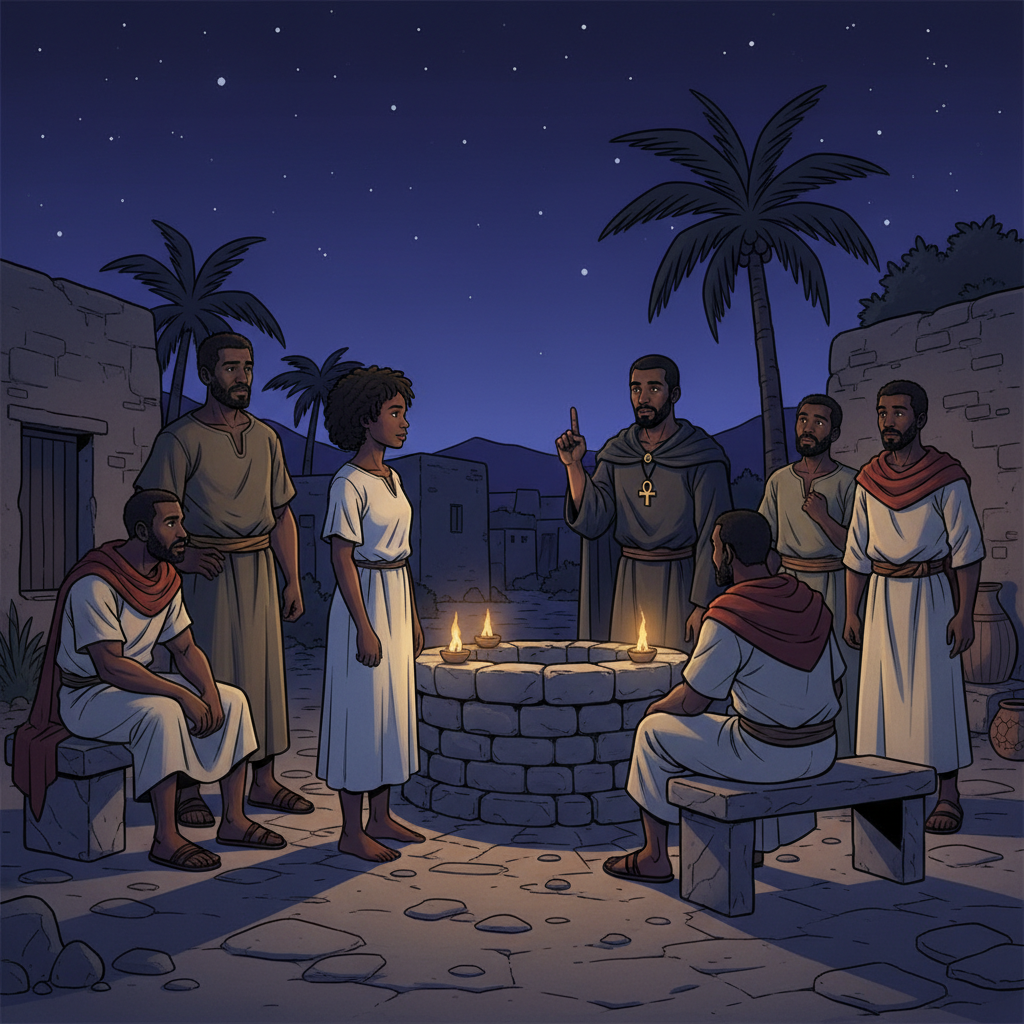
The other men — she counted six or seven of them — looked up as she approached. One of them, a broad-shouldered man with a fisherman’s rough hands, began to rise as if to send her away. But the man in the plain cloak raised one finger, and the fisherman sat back down without a word. The man with the ankh lifted his head, and his eyes met Miryam’s across the stone courtyard of the well. His skin was the same warm dark brown as her own — the color of the people who had lived in this Galilean corridor for thousands of years, a corridor where African and Levantine bloodlines had met and mingled since the time of the old dynasties. His beard was trimmed short. His eyes were steady. And they did not look at her the way men usually looked at her. They did not strip her. They did not measure her. They simply saw her.
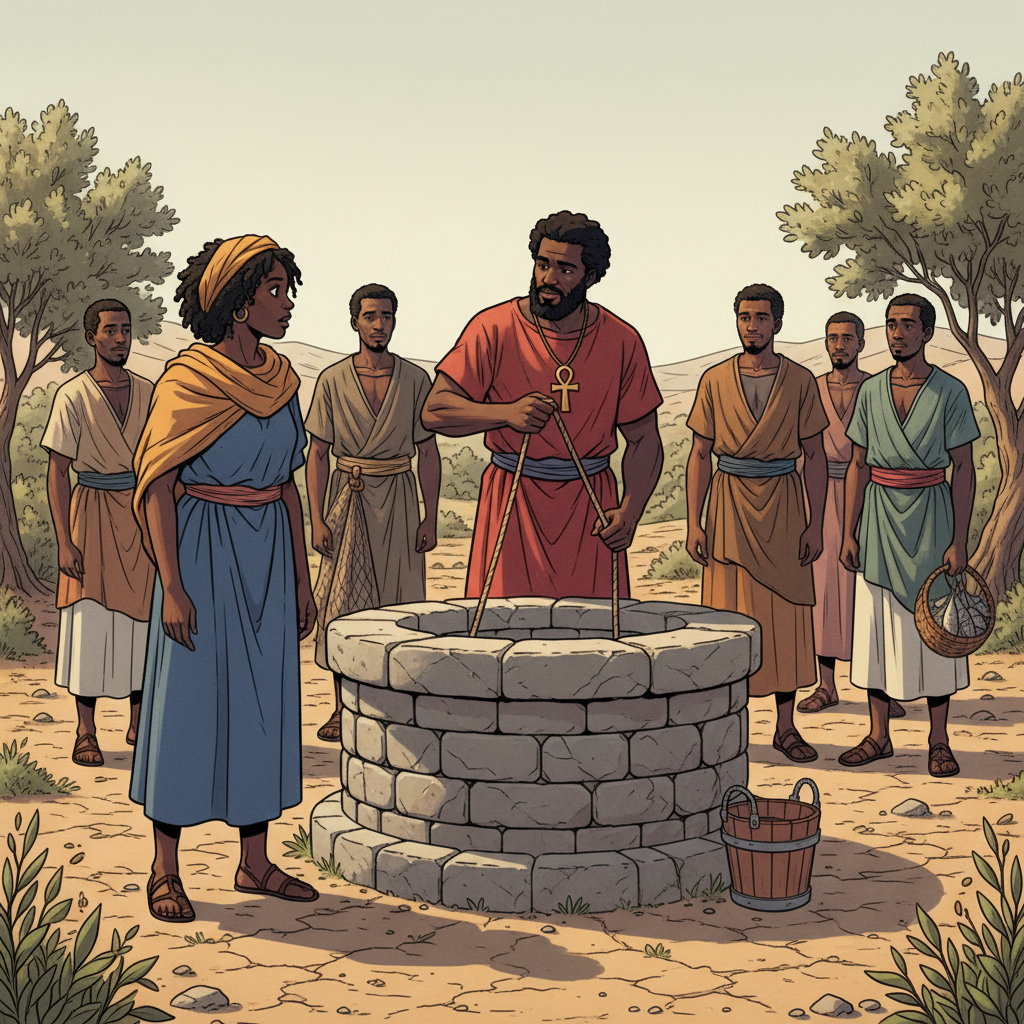
"Sister," he said. His voice was quiet. "The water is cold and the rope is long. Let me draw for you." Miryam stood very still. For a long moment she did not know what to say. No man in Magdala had offered to draw water for her since her father had died. Men did not draw water for women in this village — water was women’s work, and men kept to their nets and their fields. She looked at him, at the ankh on his chest, at the quiet attention of his companions who had stopped their murmuring to watch. "Who are you?" she said at last. Her voice came out rough from disuse. "You are not from Magdala." "No," he said. "I am Yeshua, of Nazareth. These are my companions. We are traveling north. We stopped here to rest." He paused. "And you?" "Miryam," she said. "Of this village. Though the village would say I am of nowhere."
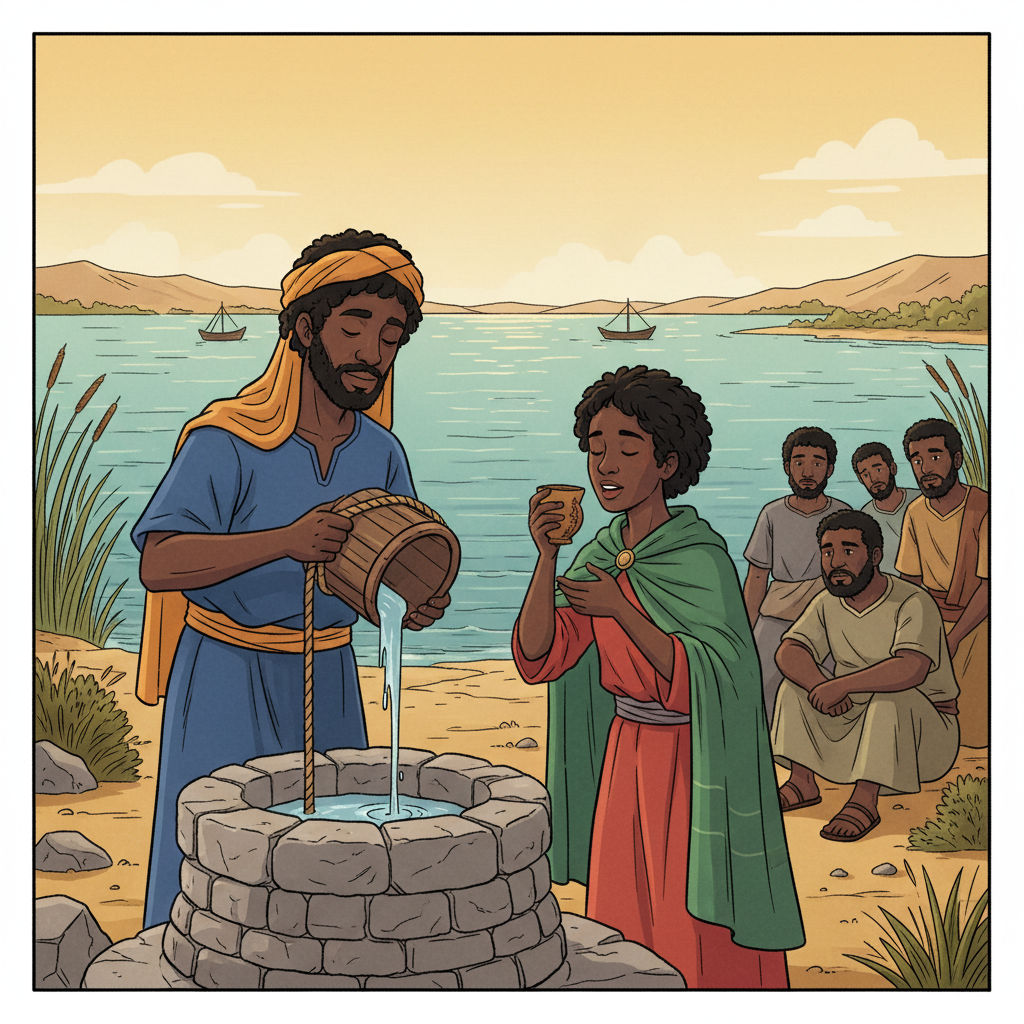
Yeshua stood up. He moved slowly, without threat, the way one moves when approaching a wounded animal. He walked to the well, took the rope in his hands, and began to draw. The wooden bucket came up dripping, and he poured the cold water into her clay jar with care, not spilling a single drop. Then he dipped a small gourd into the jar and held it out to her. "Drink first," he said. "The road is hot." She took the gourd. Her hand was shaking, and she was embarrassed that it was shaking. She drank. The water was cold and clean and it tasted of stone and deep earth, and for a moment she closed her eyes and let it move through her. When she opened her eyes again, Yeshua was still watching her with that same steady, seeing gaze. He had not looked away. He had not looked at her body.
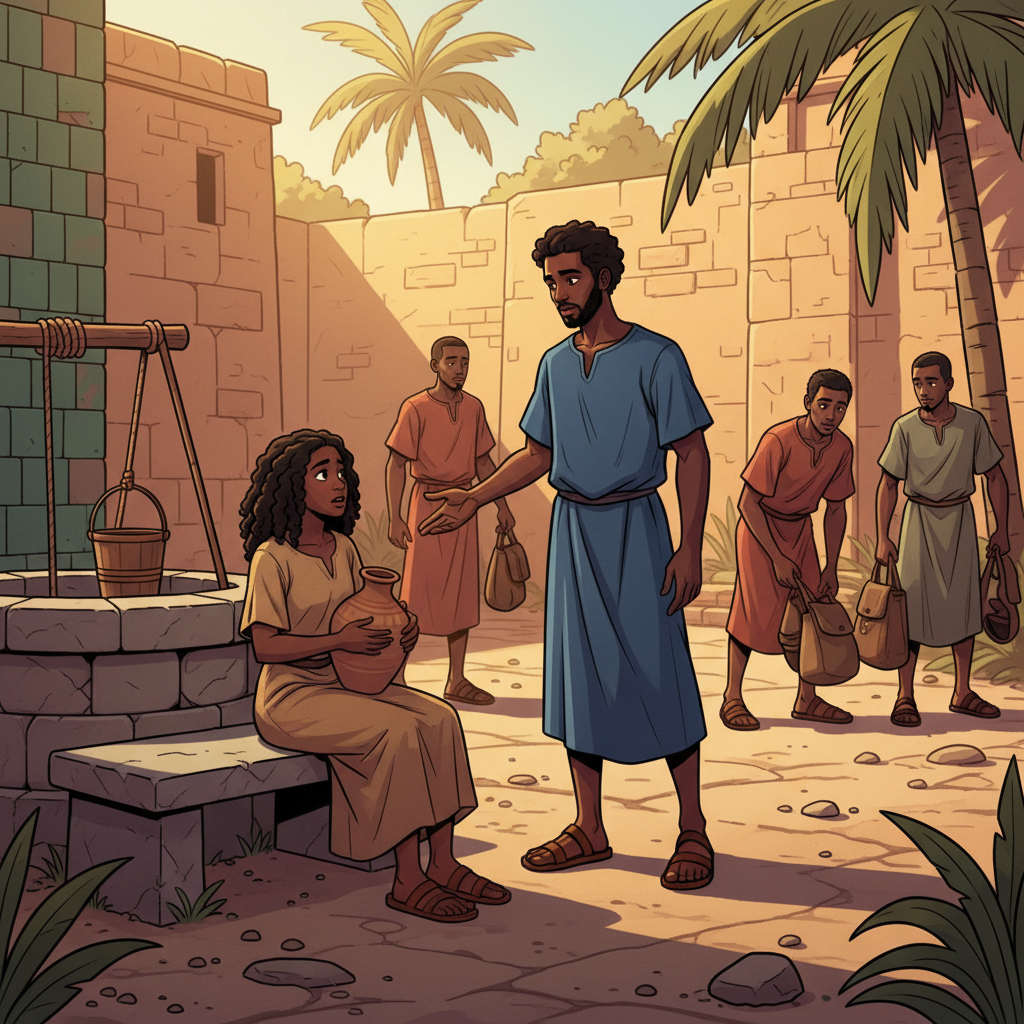
"Sit," he said. He gestured to the low stone bench that ran along the inside of the well’s courtyard. "Sit in the shade, Miryam of Magdala. Rest a moment before you carry that jar home." She should have said no. She should have taken her jar and left. But something in his voice — something in the way he had said her name, like it was a real name and not a curse muttered under a neighbor’s breath — held her there. She sat down on the bench. The stone was cool against the backs of her legs through the rough linen of her tunic. The other men, the companions, drifted a little further off. They busied themselves with their packs and their sandals, giving her space. One of them, a young man with gentle eyes, glanced at her with something that looked almost like concern, but no one stared. No one pointed. It was strange. It was very strange.
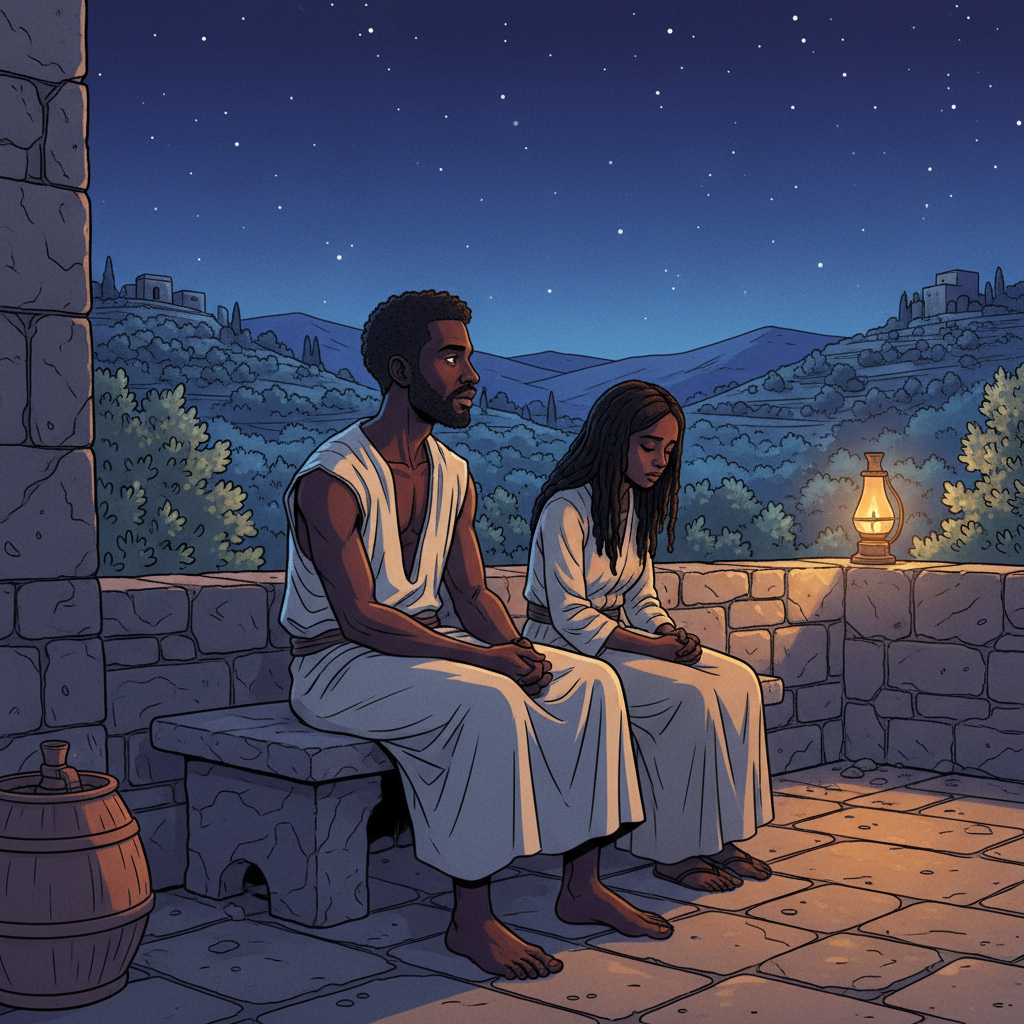
Yeshua sat down on the bench beside her — not too close, leaving a careful hand’s breadth of space between them. He did not look at her. He looked out across the hills of Galilee, where the olive groves climbed the slopes in silver-green terraces and the air shimmered with heat. "They say you are possessed by seven spirits," he said quietly. Miryam’s whole body went cold. She started to rise. "I should go —" "Sit," he said gently. "Please. I did not say it because I believe it. I said it because I want you to hear me say that I do not believe it." He turned and looked at her. His dark eyes held hers. "I see no demons in you, Miryam. I see a woman who has carried seven heavy things that were never hers to carry. And I see that no one in this village has ever helped her set them down."
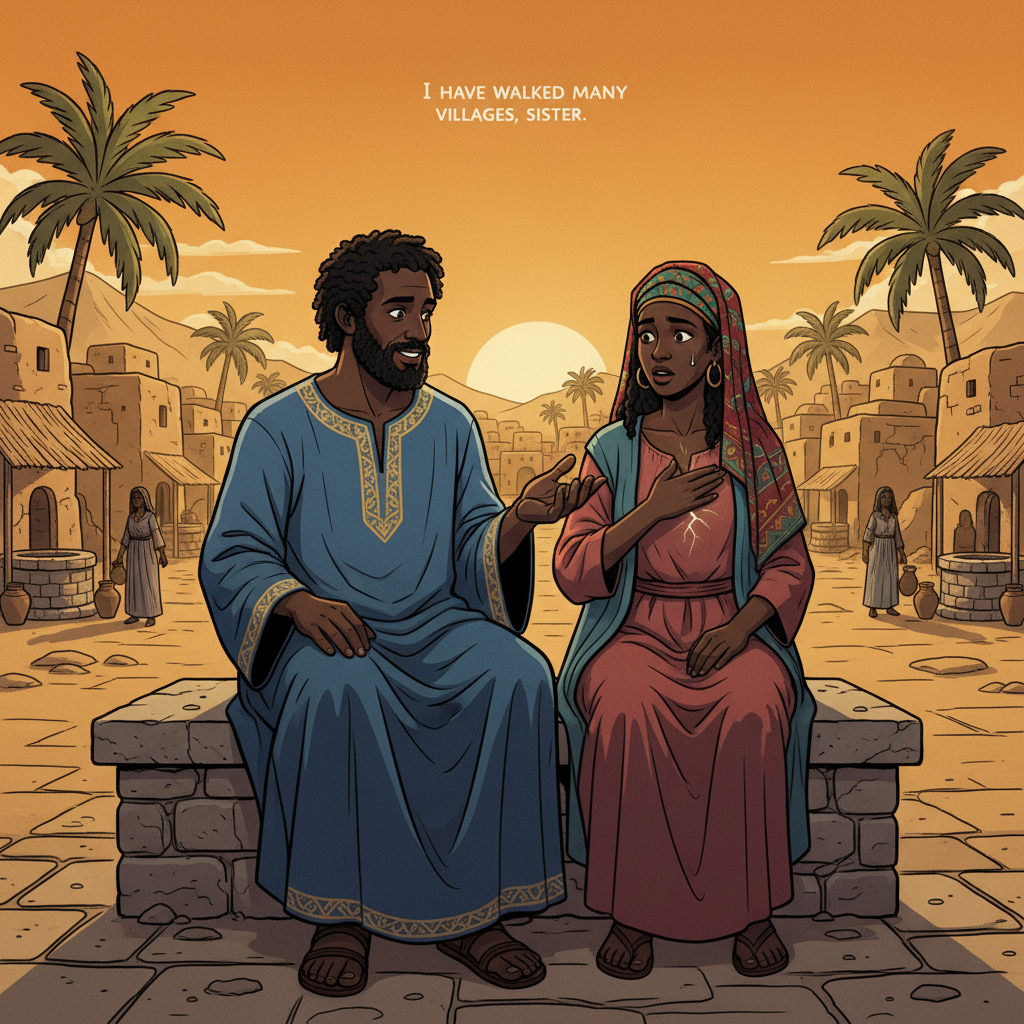
Something broke inside her chest. She did not cry — she had stopped crying years ago, because tears in this village were a weapon used against women like her. But something cracked open in the dry place behind her ribs, and for a moment she could not breathe. "You do not know me," she whispered. "I know what was done to you," he said. "Not the details. Those are yours. But I know the shape of it. I have walked many villages, sister. I have seen many women sent to the well at midday because the morning belongs to the ones who did not name their pain out loud. I know what the elders did when you spoke. I know what they did not do." He paused. "What was done to you was isfet. Injustice. The breaking of Maat. It was not your sin. It was theirs. And the silence of the elders was theirs too."
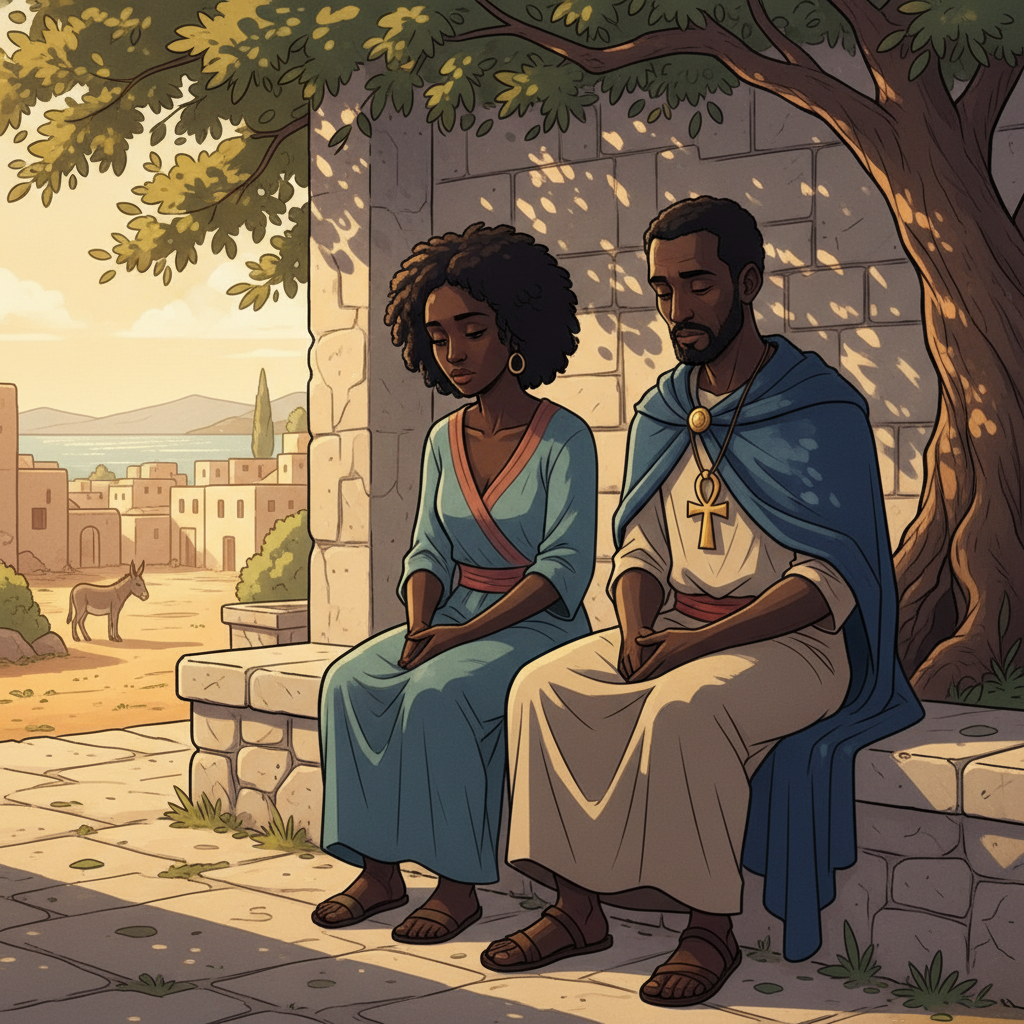
Miryam sat very still. The cicadas rasped on in the olive trees. Far off, a donkey brayed in someone’s yard. The world had not changed. The village had not changed. But something was changing inside her, something she had not felt in so long that she barely recognized the feeling. It was being believed. No one had believed her. Not her aunt, who had shaken her head and said "men will be men." Not the elders, who had sent her home. Not even, in the end, herself — because after a while, when no one else believes you, you begin to wonder if perhaps the thing was not as bad as you remembered, perhaps you were wrong, perhaps the fault was yours. The slow rot of that wondering had been one of the seven burdens. Maybe the heaviest one. And now this stranger, this man with an ankh on his chest, was quietly setting it down.
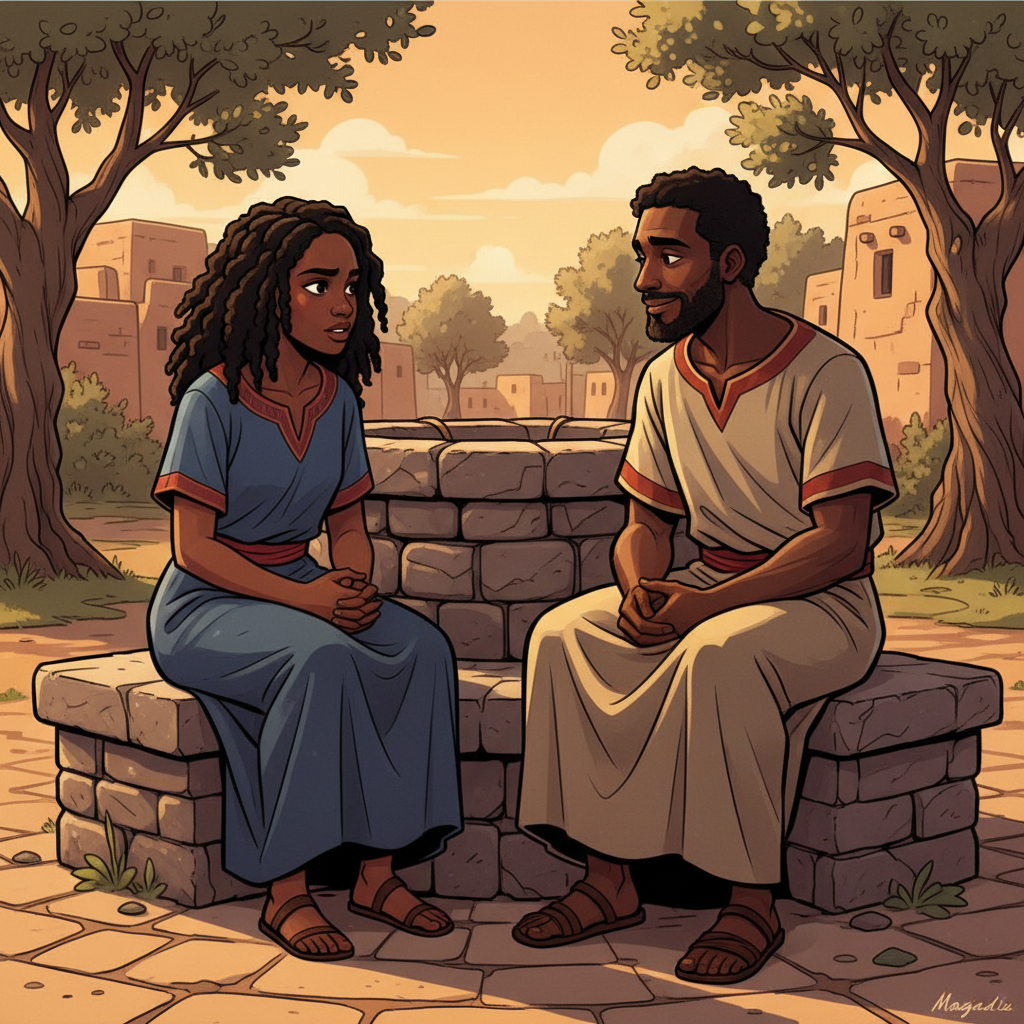
"Why are you telling me this?" she asked. Her voice was almost steady. "What do you want from me?" Yeshua smiled then, a small tired smile. "Nothing, sister. I want nothing from you. I only wanted you to hear, from the mouth of a man who sees you, that what was done to you was not your sin. That you are not possessed. That you are not broken. That you are a daughter of the old mothers — the priestesses of Kemet, the sages of Kush, the wise women of this land whose wisdom was stolen and whose names were buried. You come from a long line of women who taught kings. The scholar Diop will one day teach this, that the African woman was sage and priestess long before Greece learned the word philosophy. You are not less than them. You are one of them."
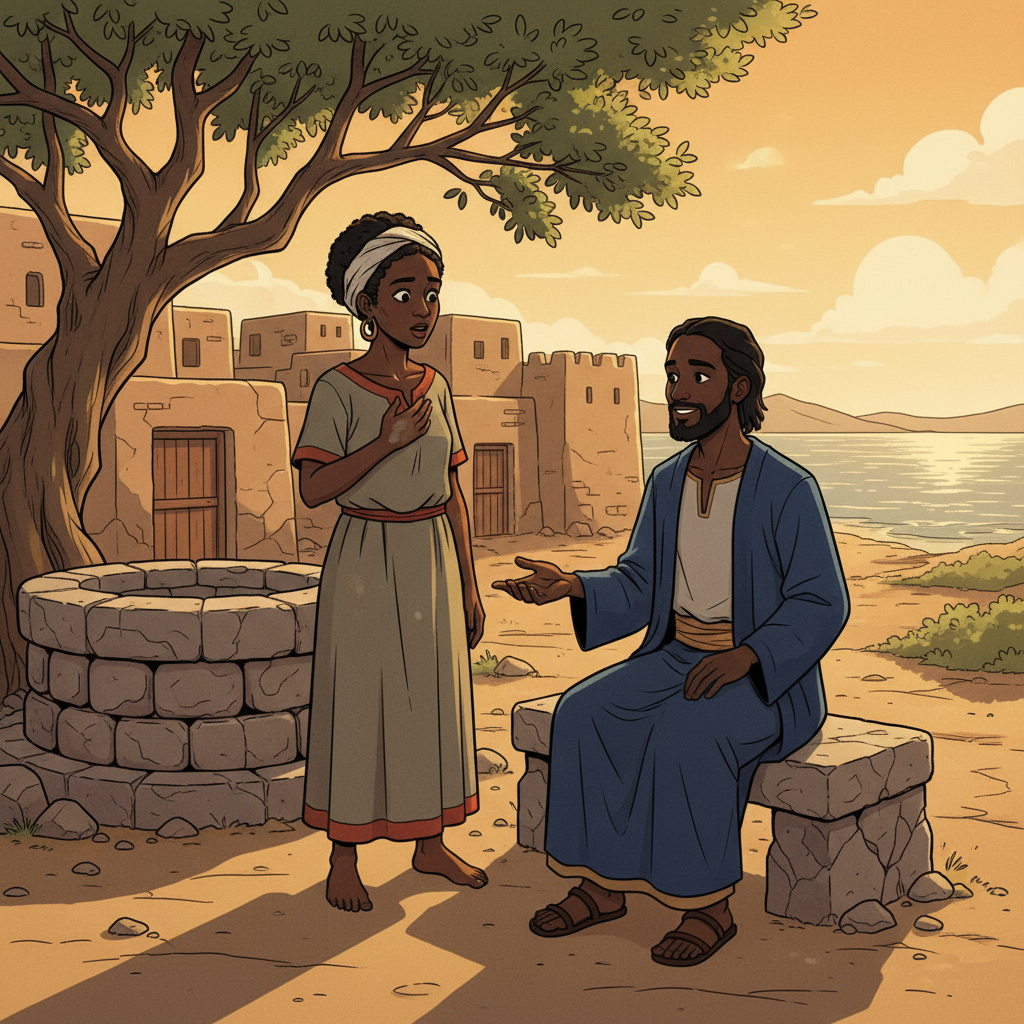
She stared at him. No one had ever spoken to her like this. No man had ever said the words daughter or sage or wise to her in the same breath. For a long moment she could not answer. Then she said, slowly, the words coming out of her mouth without her choosing them: "The elders will say you are a false teacher for sitting here with me. They will say I have polluted you. If you walk into Magdala with me, the village will close its doors to you." Yeshua laughed softly. It was not a mocking laugh. It was the laugh of a man who had heard this kind of warning many times before. "Let them close their doors," he said. "I did not come to sit with people who will not open them. I came to sit with people like you, Miryam. The ones the doors have been closed against. That is the whole work. That is the whole road."
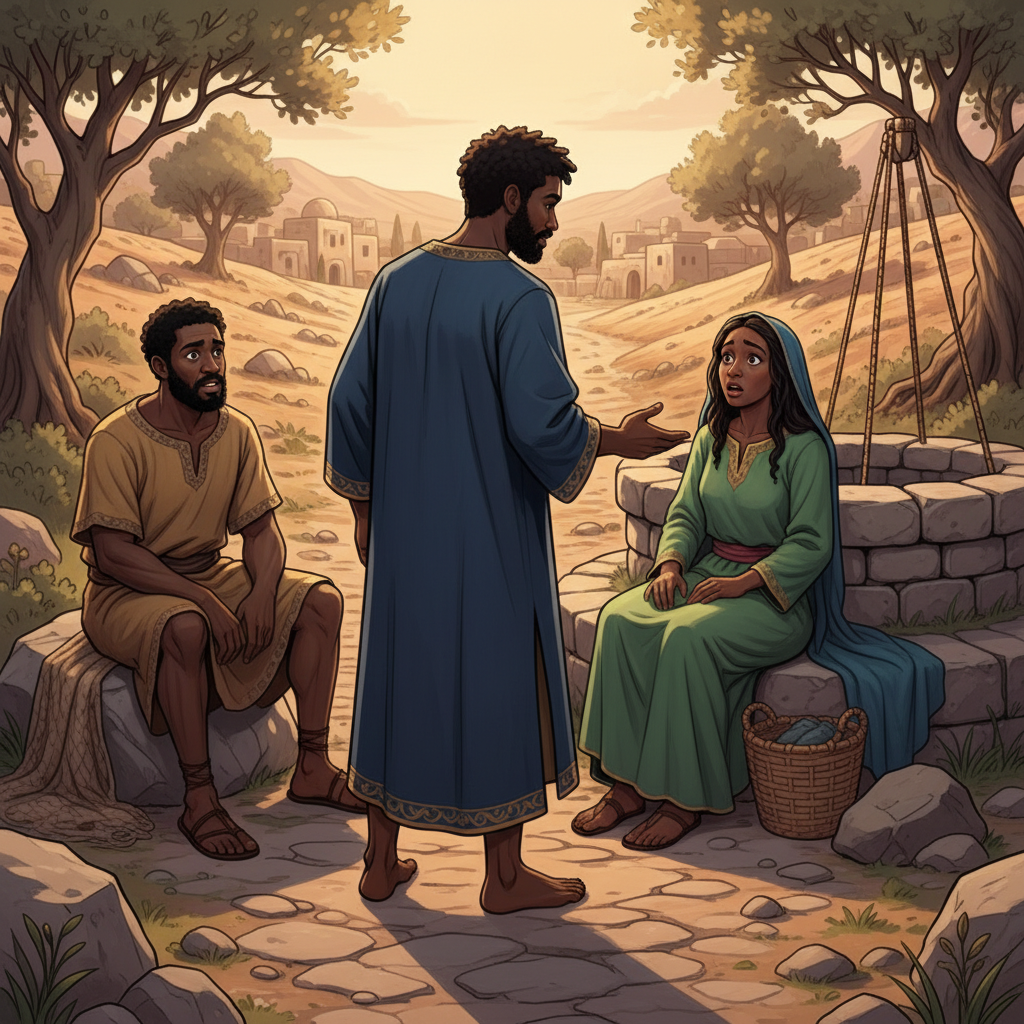
The fisherman with the rough hands had come closer while they spoke. He cleared his throat. "Teacher," he said, and his voice was gruff but not unkind. "The sun is moving. If we are to reach Capernaum before dark —" "Sit down, Kepha," Yeshua said, without looking at him. "We will reach Capernaum when we reach it. The road is not more important than this sister." Kepha sat down. Miryam watched the exchange with wide eyes. She had never seen a man rebuke another man for the sake of a woman like her. She had never seen it happen in her entire life. The whole shape of the world, as she had understood it, tilted slightly on its axis and then settled into a new and strange position. "Tell me," Yeshua said, turning back to her. "Tell me your name again, the way your mother said it when she was alive."
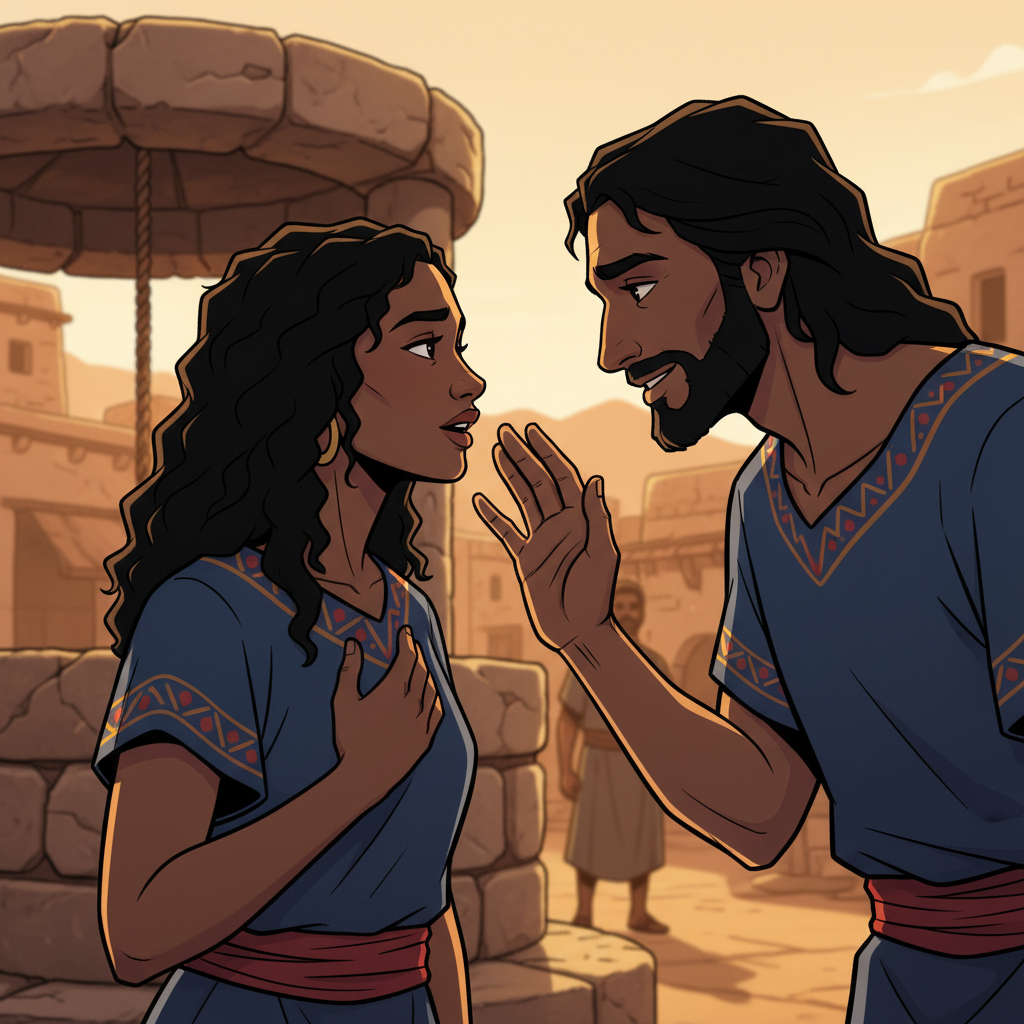
"Miryam," she whispered. And then, because his eyes were kind and because she had not spoken her true name out loud in a long time: "Miryam bat Yonah. Daughter of Yonah the fisherman, who drowned in the Kinneret when I was nine. My mother called me Miryam-mi, the little Miryam. She died of fever two winters after my father." "Miryam bat Yonah," Yeshua said. He said the name the way a priest says a sacred word, with weight and care. "Do you know what your name means? It comes from the old Kemetic tongue, from mery-amun — beloved of the hidden one. Your name is a blessing that your mother wrapped around you before she left. It is your inheritance. No man in this village can take it from you. No elder. No rumor. No lie. Your name is yours."
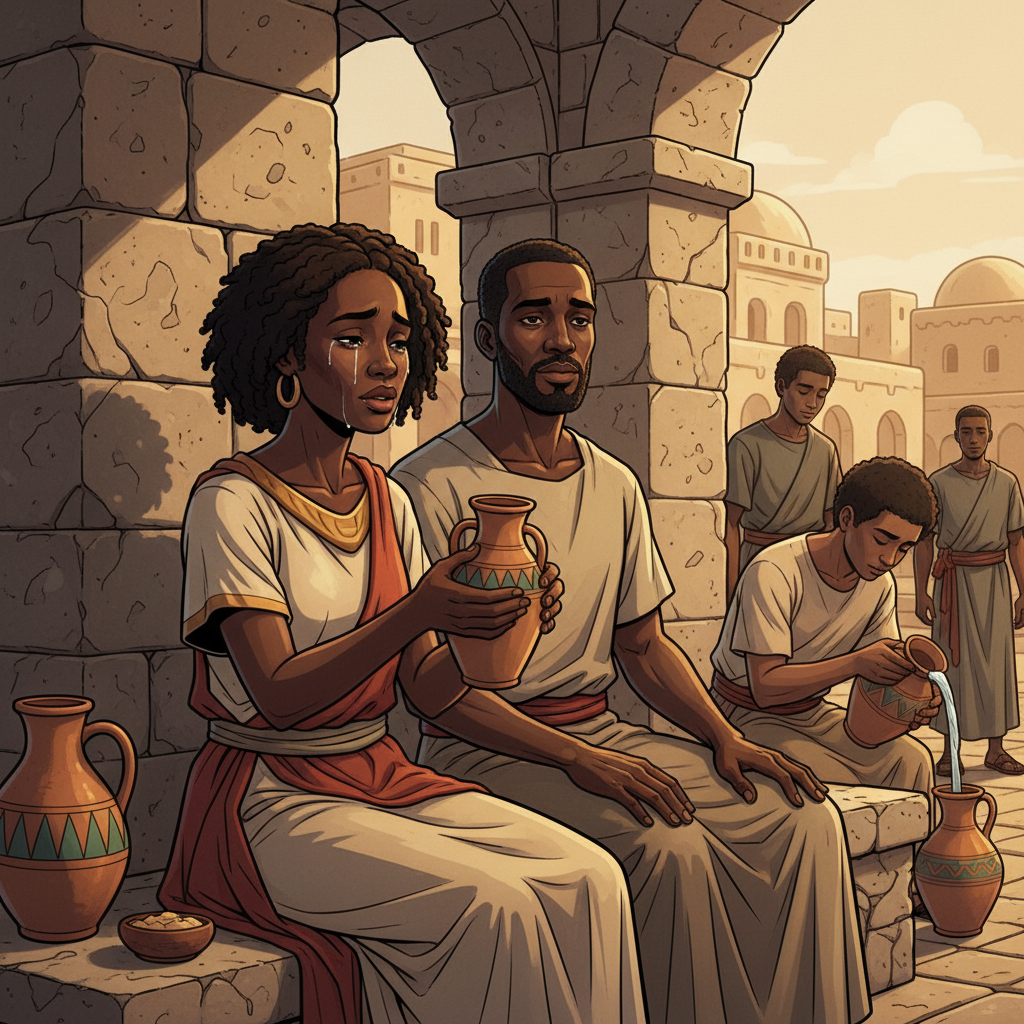
She felt the tears then — the ones she had not cried in years. They came up out of her quietly, without sound, just water running down her face the way water had run down her clay jar a few moments before. She did not wipe them away. She sat on the stone bench in the shade of the well with the strange teacher and his companions, and she let the water come. Yeshua did not try to stop her. He did not touch her. He did not tell her to hush. He just sat beside her and waited, the way a good friend waits out a storm under a strong roof. Behind him, the young companion with the gentle eyes quietly poured water from a second jar and handed it to her with a small bow of his head. She drank. She could not stop drinking. Her whole body had been dry for so long.
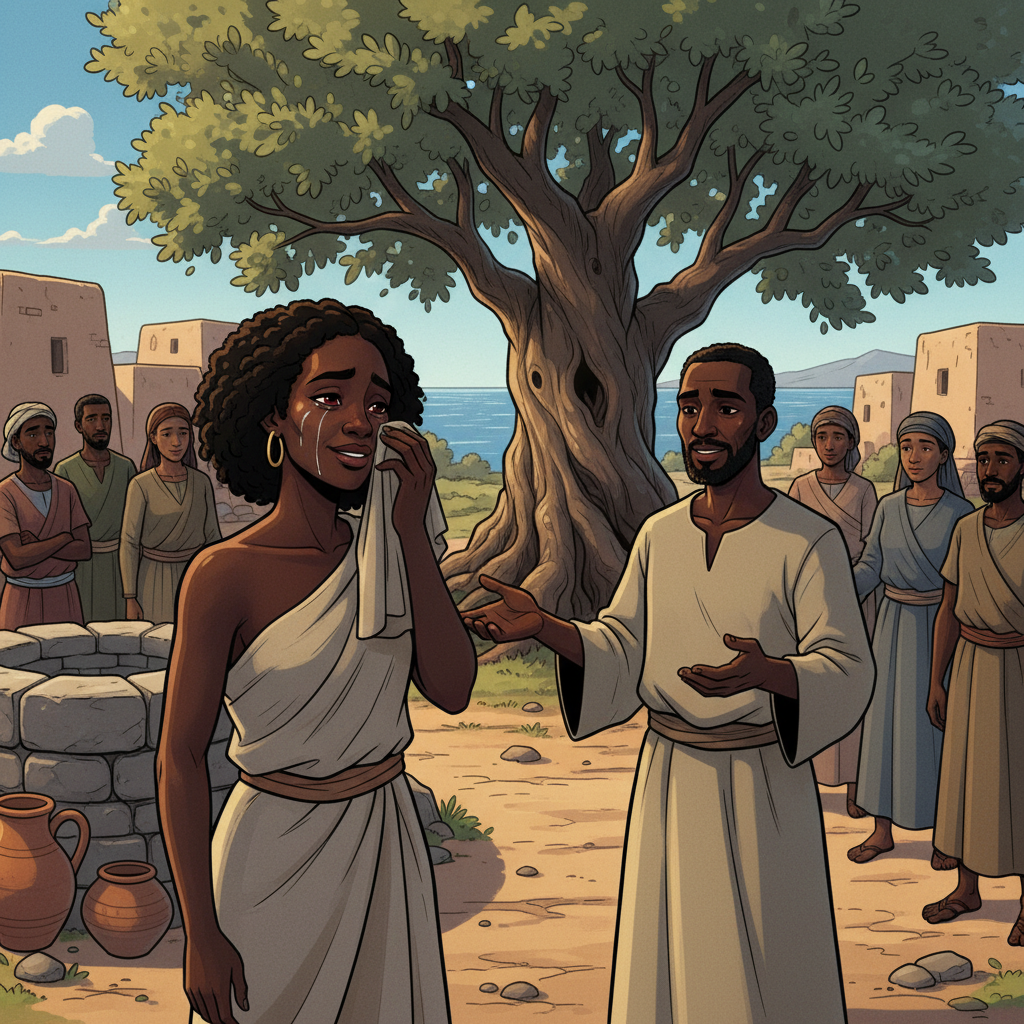
When the tears were done, she felt strangely light, as though she had been carrying a great stone in her chest and had set it down by the side of the road. She wiped her face with the edge of her linen wrap and drew a long, slow breath. "You will be a teacher, Miryam," Yeshua said quietly. "Not someday. Now. The village has decided you are nothing, but the village is wrong. You have walked through fire. You have carried the seven burdens. You know what it is to be crushed, and you know what it is to keep breathing anyway. That is the knowledge that this road needs. That is the knowledge my other students do not yet have. They were not ground down. You were. You will sit with us in the teaching circle. You will speak. You will be heard."
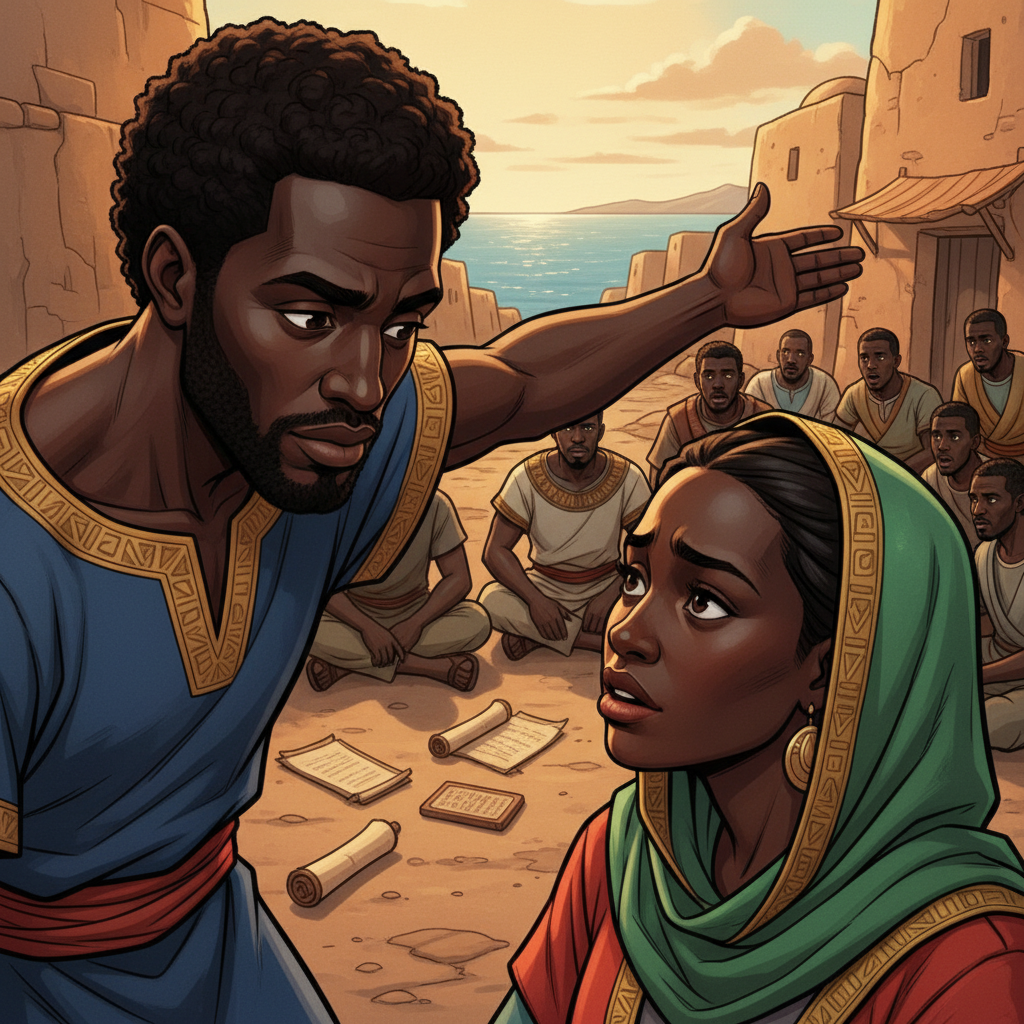
"Men do not let women into the teaching circle," she said. Her voice was flat, matter-of-fact, not arguing but simply stating the law of her world. "Then the teaching circle is wrong," Yeshua said. "And it will change. You will be the one who changes it. Not by asking permission. By sitting down. The scholar Zora Hurston will one day say that African women in the old world were sages and priestesses long before men decided to write them out of the record. The scholar John Henrik Clarke will one day teach that the canon of named disciples was chosen by men who came later — men who did not want a woman’s name at the top of the list. But I will name you, Miryam. And the ancestors will name you. And in the end that naming will outlast every lie the later men will write."
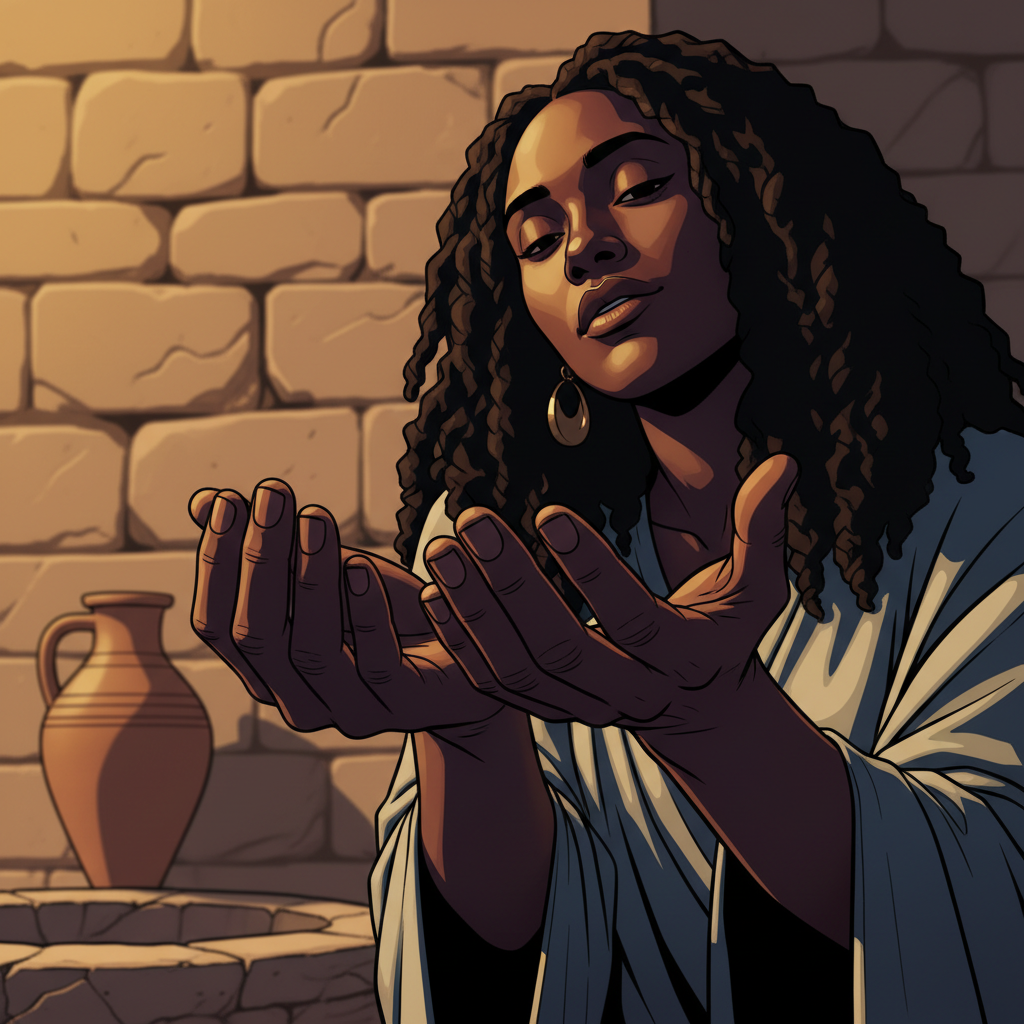
She looked down at her hands. They were strong hands, stained faintly purple from the dye vats, calloused from years of hauling her own water and hanging her own laundry and doing every piece of work a father or husband would have done for another woman. She had always thought of these hands as ugly — as proof of what she had lost. But now, looking at them in the shade of the well, she saw them differently. They were the hands of a woman who had kept herself alive. They were the hands of a woman who had not been broken even when the whole village had tried to break her. They were her grandmother’s hands, and her grandmother’s grandmother’s hands, reaching back through the long line of African women in the Galilean corridor who had held on and held on and held on. They were good hands. She understood that, suddenly, for the first time in her life.
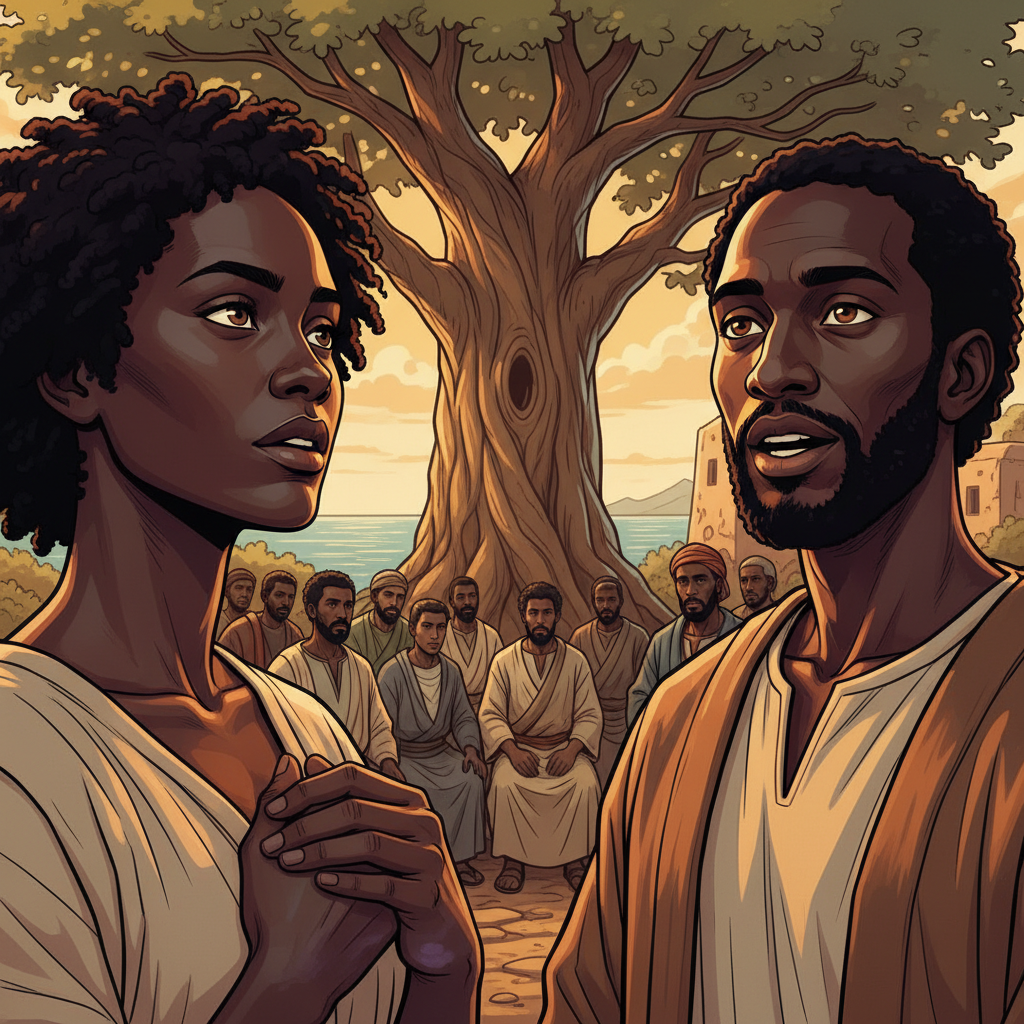
"What would you have me do?" she said. She lifted her eyes to Yeshua’s. They were no longer tired. They were clear. "Come with us when you are ready," he said. "Not today. Today you go home and you drink your water and you sleep in your own bed. Tomorrow or the next day, if your heart is ready, you walk to Capernaum. Ask for us at the synagogue. My mother is there, another Miryam — she will know you by your name before you speak it. You will sit at the circle. You will learn. And then you will teach." He paused. His eyes were very bright now, almost shining in the dim shade. "And when the day comes that the worst has happened, Miryam, you will be the one who is there. You will be the first witness. Do you understand me? The first. Not Kepha. Not any of these men. You."
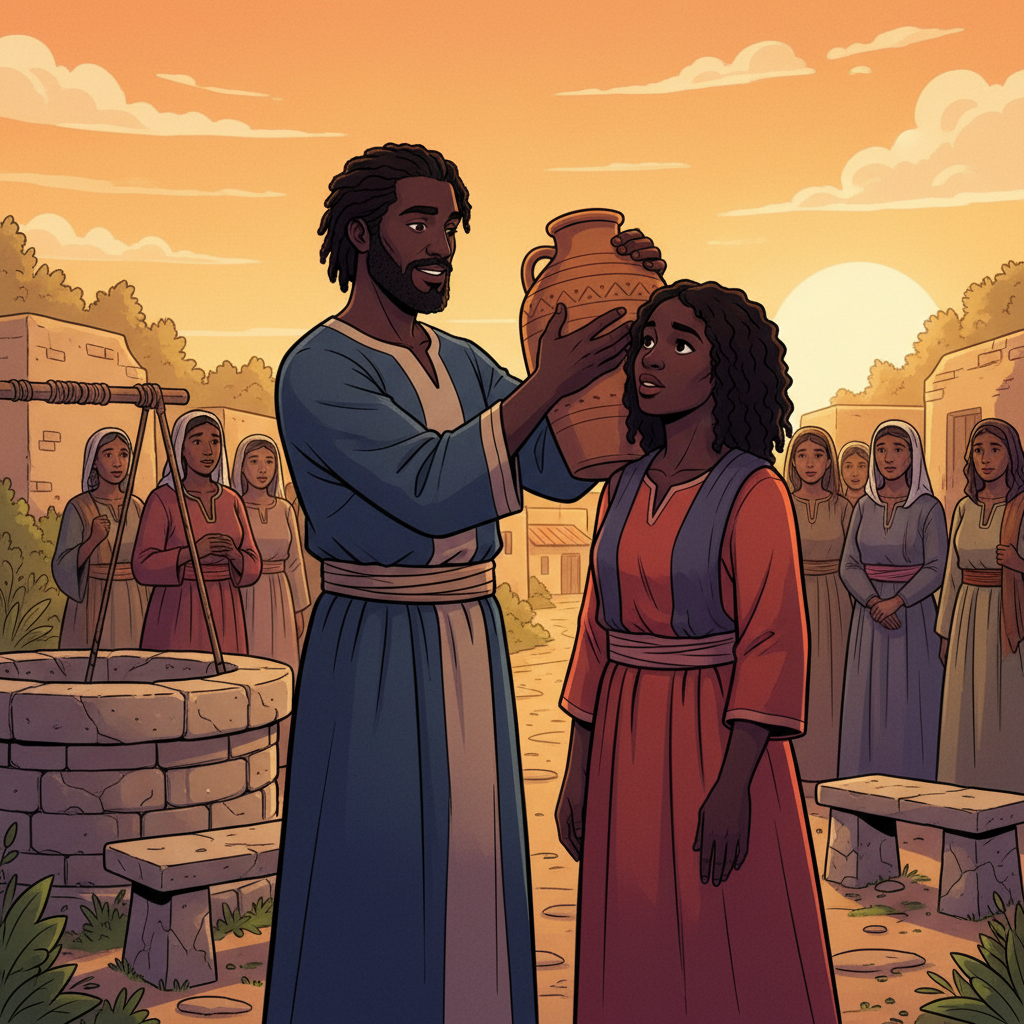
She did not fully understand him then. She would understand him later — years later, on a morning that smelled of myrrh and turned earth, when she stood at the mouth of a broken tomb and realized that the promise he had made her at this well had been a true promise. But in that moment, all she knew was that something in his voice carried the weight of certainty, and that for the first time in her life a man was placing her at the center of a story instead of at its edge. "I will come," she said. "When my heart is ready, I will come. I swear it on my mother’s name." "Your mother’s name is enough," Yeshua said. He stood up from the bench. He lifted her clay jar for her and set it carefully on her shoulder, the way her father had done when she was a small girl and the jar had been too heavy for her alone.
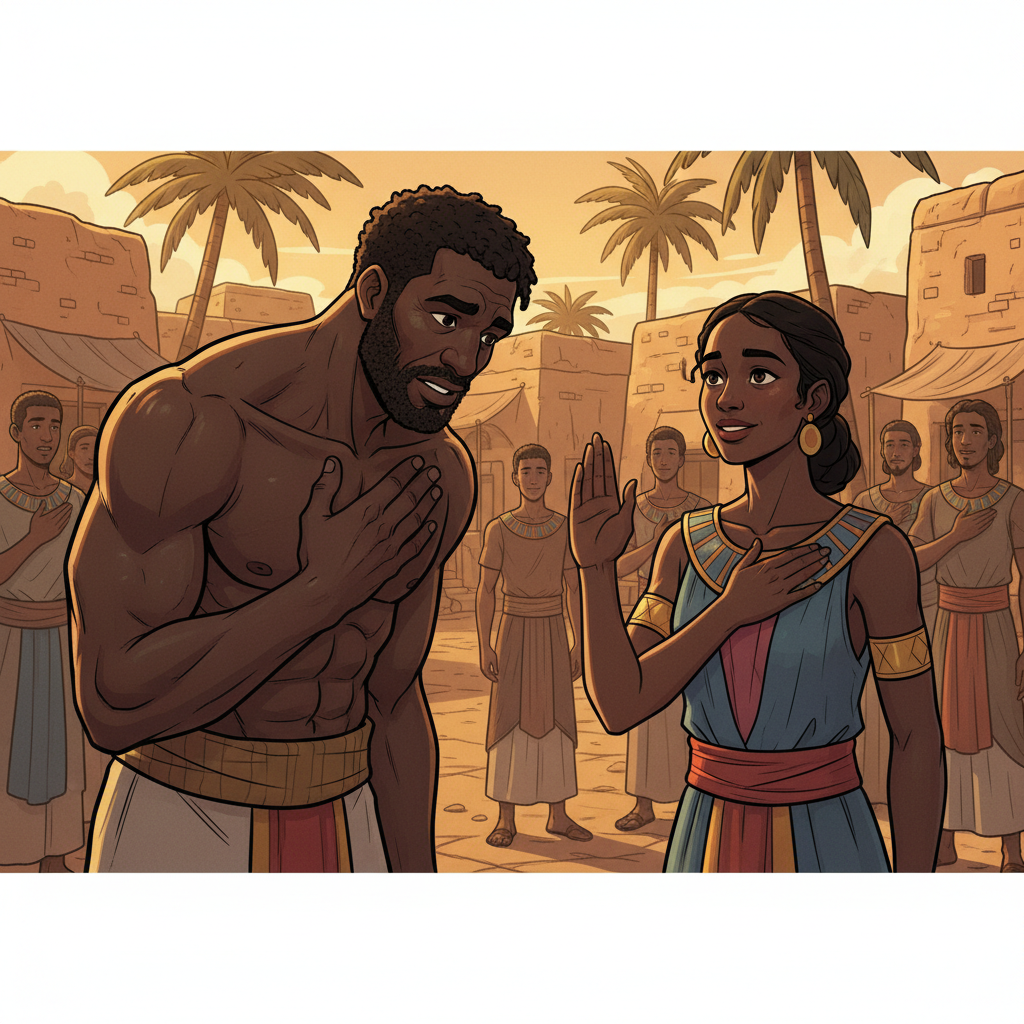
The other companions rose too. Kepha, the fisherman, walked up to her with a gruff, uncertain expression, and he bowed his head stiffly — the way a man bows who has never bowed to a woman before and is not sure he is doing it right. "Sister," he said. It was all he said. But in that one word was an apology for the look he had given her when she had first appeared, and a promise that the next time he saw her, he would stand when she entered the circle. The young companion with the gentle eyes smiled and touched his heart in the old Kemetic gesture — right hand to chest, then open outward — a sign the African elders had used for a thousand years to say I see you, and what I see is holy. Miryam returned the gesture without thinking. Her hand remembered what her mother had taught her before the fever took her.
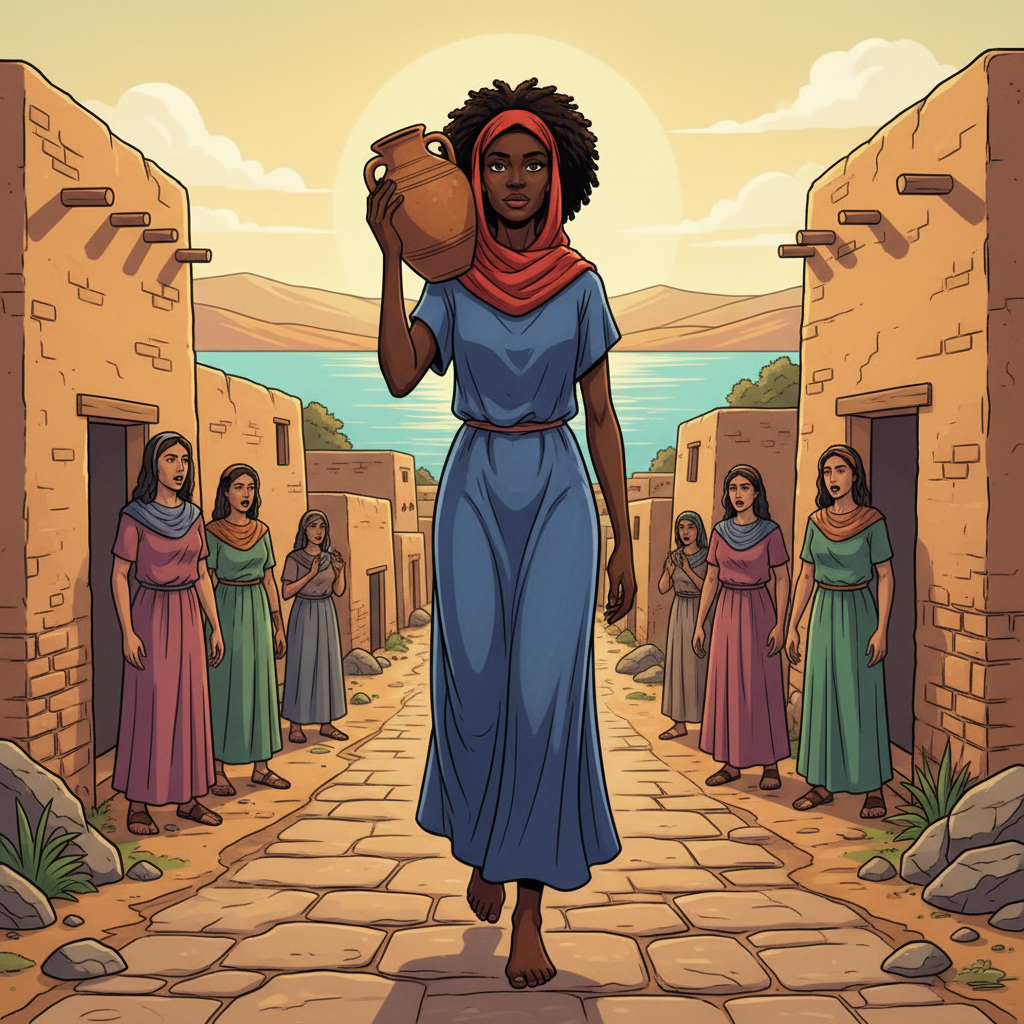
She walked back to Magdala alone, the clay jar heavy and cold against her shoulder. The sun was lower now, and the cicadas were beginning to quiet. A few women were already at the doorways of their houses, watching her come — their eyes narrow with the usual suspicion, their mouths already shaping the usual whispers. But Miryam walked differently. She did not keep her eyes on the ground. She did not shrink against the stone walls. She walked down the center of the road with her jar balanced on her shoulder and her head lifted, and when she passed the house of one of the men who had harmed her many years ago, she did not flinch. She looked straight ahead. She was Miryam bat Yonah. She was the beloved of the hidden one. She had drawn water with a teacher who saw her whole, and the stone in her chest was gone.
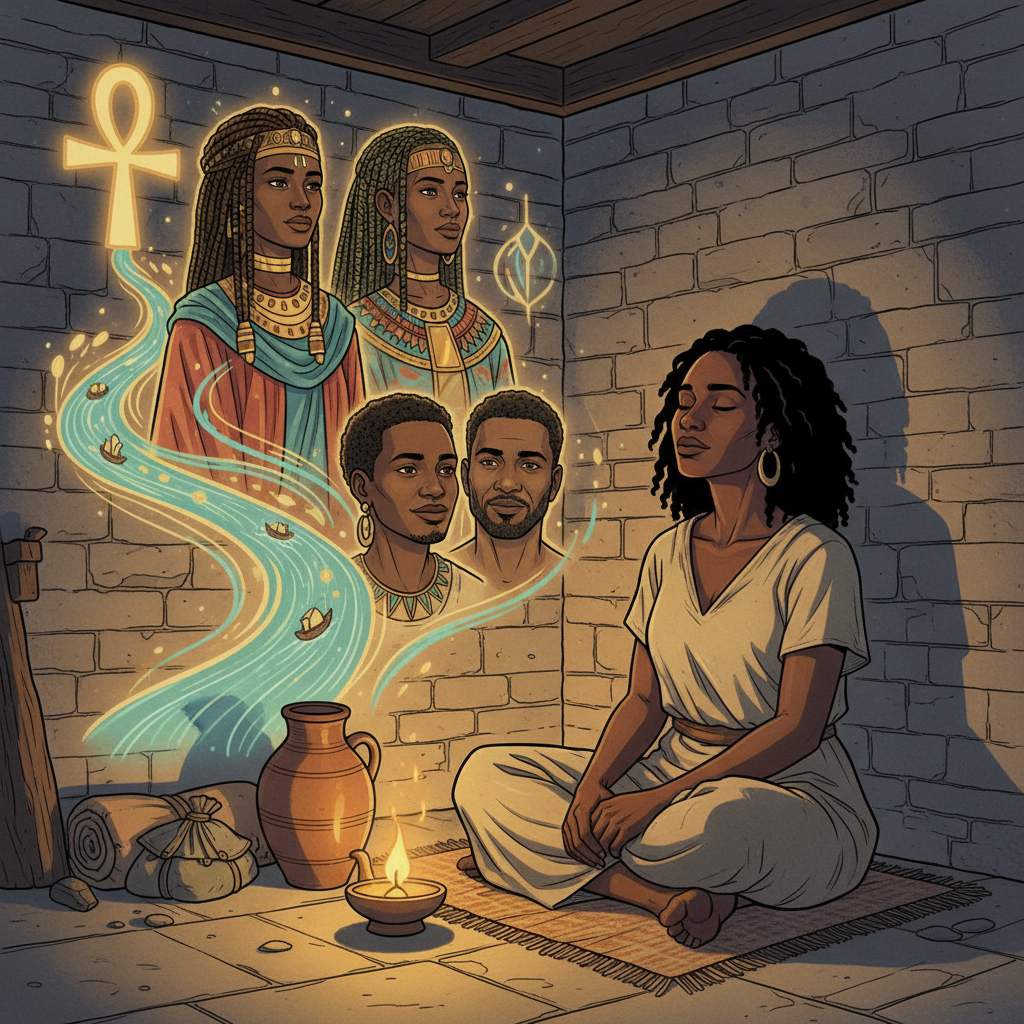
At her own small stone room on the edge of the village, she set down the jar and lit a small clay lamp from the embers in the hearth. She sat on the floor in the lamplight and she thought of her mother, and her father, and all the women of her line who had walked this same Galilean ground. She thought of the African priestesses Yeshua had named — the ones whose wisdom had flowed up the Nile corridor for thousands of years before anyone had written the word philosophy in Greek. She was one of them. He had said so, and she believed him. Not because he was a man and men had said many things to her, but because his words had carried the weight of Maat — the old divine balance, the truth that does not bend. In the morning she would begin to pack her few belongings. In a day or two, she would walk north to Capernaum.
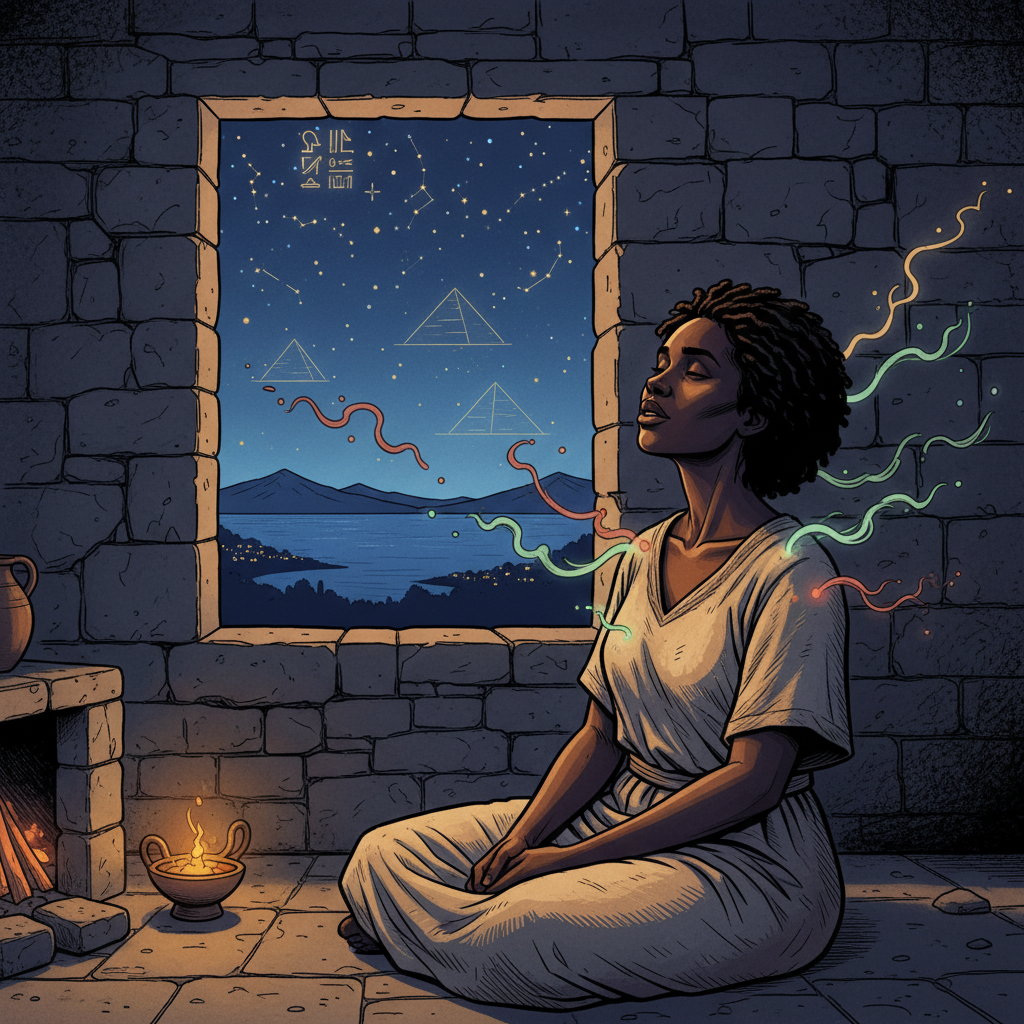
Outside her small window, the stars came out over the inland sea of Kinneret — the same stars her ancestors had read for navigation and wisdom, the same stars that had watched over the African mothers of this Galilean corridor since before the first pyramid was stacked stone upon stone. Miryam looked up at them through the crack in the window, and she felt the seven burdens loosen, one by one. Shame lifted first. Then silence. Then fear. Then grief — though grief did not leave fully, because her mother was still gone and that was still true. But grief became a thing she could carry instead of a thing that crushed her. And when the last burden lifted — the silence about the silence — she opened her mouth in the dark and spoke her own name aloud. "Miryam," she said into the quiet room. "Miryam bat Yonah. Beloved of the hidden one." And the ancestors heard her, and the work began.