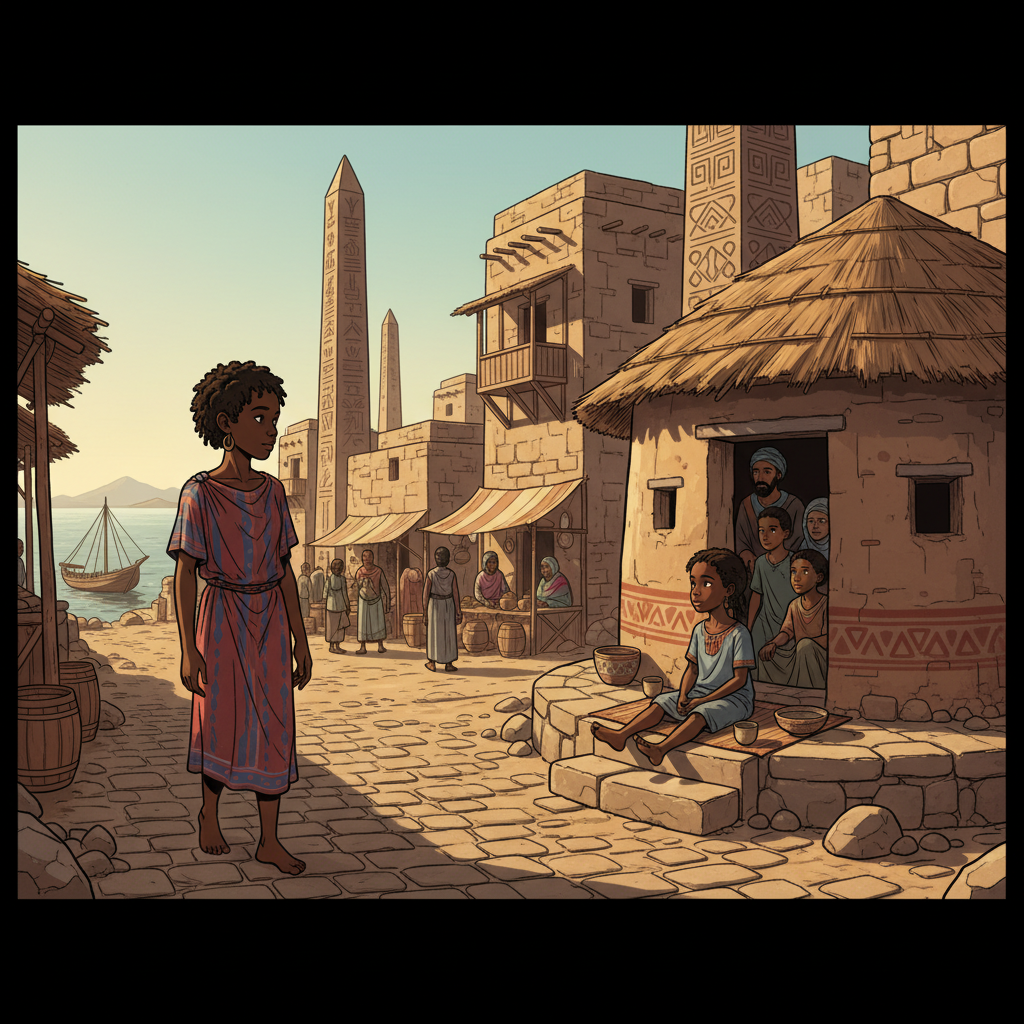
Tirhas was twelve years old, and she had a friend named Salama who had crossed the sea to get there. Salama was seven, and she came from a city far to the east called Mecca, on the other side of the Red Sea from Aksum. Salama and her family — her mother Asma, her father Othman, her older brother Yusuf, and her aunt who was very old — had arrived in Aksum eleven months ago on a wooden boat that smelled of fish and salt and the wood of the long crossing. They were the youngest of the small group of strangers Pharaoh Najashi had allowed to stay in the kingdom, and Tirhas had become their friend in the slow patient way friendships happen between children who do not yet share a language. Every morning Tirhas walked through the lanes of Aksum to the quarters where Salama's family lived. She climbed the three stone steps. She paused at the door because Asma would always call out a greeting in the Arabic she was teaching Tirhas — peace upon you, daughter of Tewodros. Tirhas would answer in her own Ge'ez, the language of Aksum, peace upon this house. Then she would step inside, and Salama would already be waiting on the floor mat with two clay cups and the small wooden bowl her mother had carried across the sea, and the lessons of the day would begin.
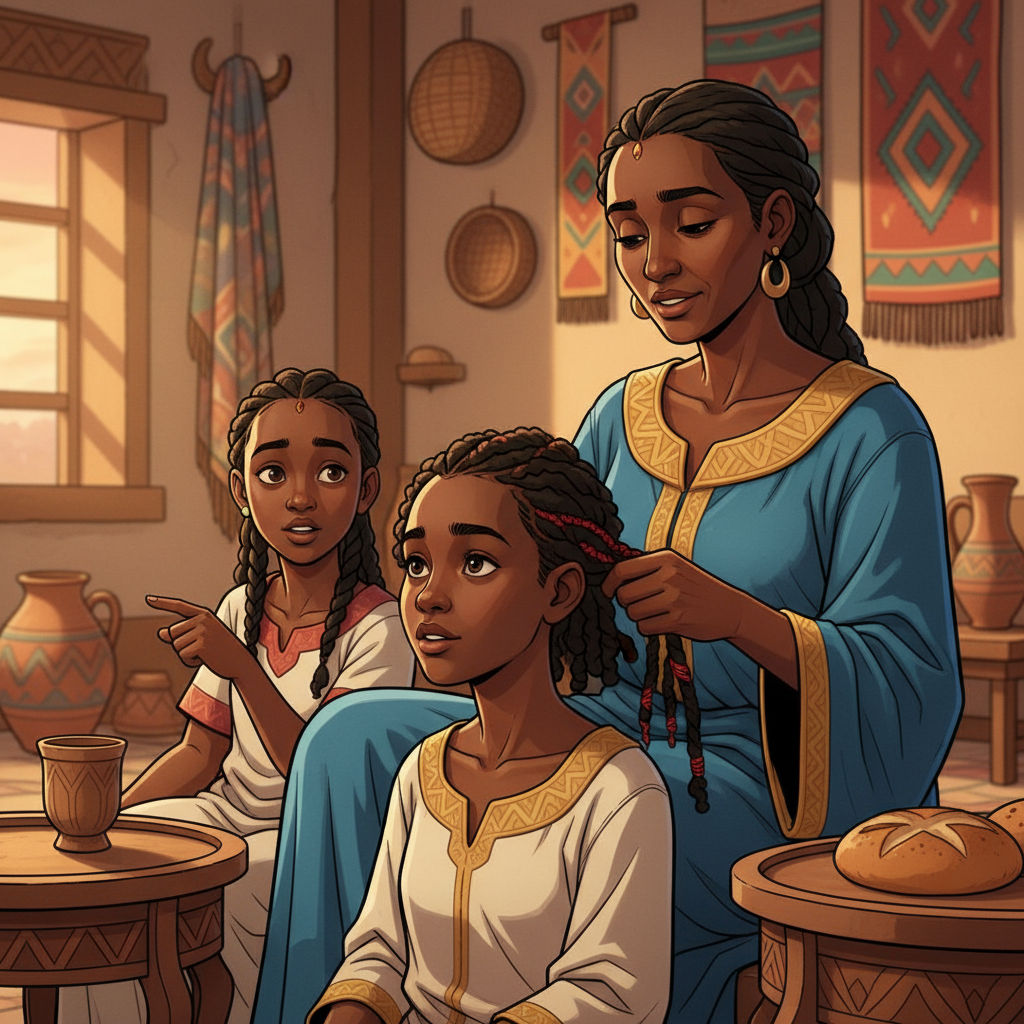
The lessons were small at first. Salama would point at a thing and say its Arabic name, and Tirhas would say its Ge'ez name. Water. Bread. Sun. Stone. Mother. Cup. Then more difficult words. Patience. Memory. Kindness. The word for "stranger" was the first hard one. In Arabic, Salama said it was gharib — but Asma corrected her — for Salama and her family in Aksum, the word was muhajir. A muhajir was a different kind of stranger. A muhajir was someone who had left home to keep their heart whole. Tirhas had asked, the first time she heard the word, why Salama's family had become muhajirun. Asma had been braiding Tirhas's hair while she answered — pulling each section gently, twisting in a piece of red thread, the way Tirhas's own mother had braided her hair when she was small. Asma's voice had been soft. "Some people," she had said, "in the place we come from, do not want us to pray the way we are praying. They have hurt people. They want to hurt more. We are not running away from our prayers, Tirhas. We are running TOWARD a place where the prayers are allowed to keep happening. Your king said we could come. Your king said his land was wide enough."
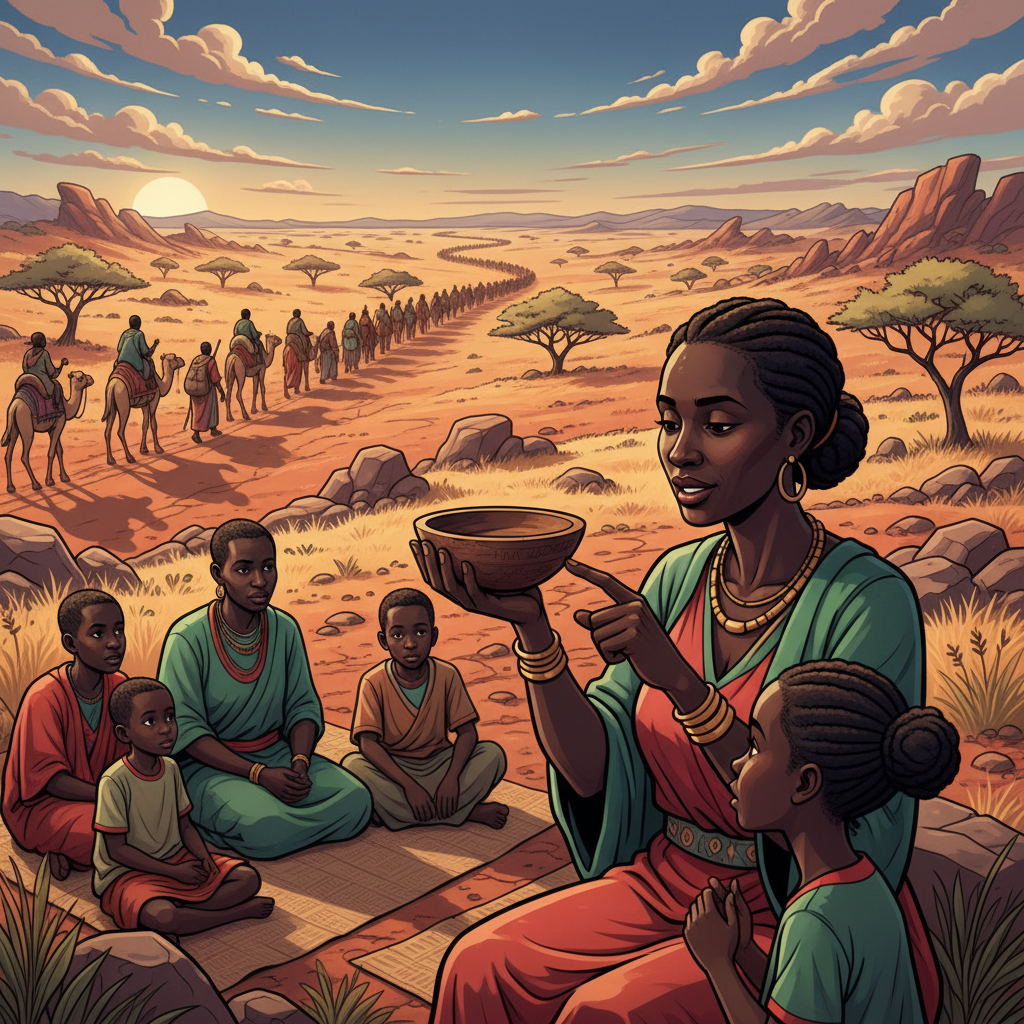
The wooden bowl was the most precious thing in Salama's family's rooms. It was small — small enough to hold in two cupped hands — and it was made from a dark hard wood that Tirhas did not recognize. The rim was worn smooth where four generations of hands had held it. Asma had told Tirhas its story one quiet afternoon, while the children played at her feet. The bowl had belonged to Asma's own mother's mother's mother. It had held the first meal each member of the family had eaten after they were born. It had held the last meal each one had eaten before they died. When Asma had packed for the long voyage to Aksum, she had been able to bring only one thing besides their clothes. She had chosen the bowl. "Why the bowl?" Tirhas had asked. Asma had set down her braiding and held the bowl up in both hands so Tirhas could see the smooth rim and the small lines worn into the bottom by four generations of spoons. "Because," Asma had said, "a meal in a bowl that has held meals before is a way of being still home. Even when you are far from home. Even when home is the place you cannot go back to. The bowl is older than the journey." Tirhas had stared at the bowl for a long time. She had not forgotten it.
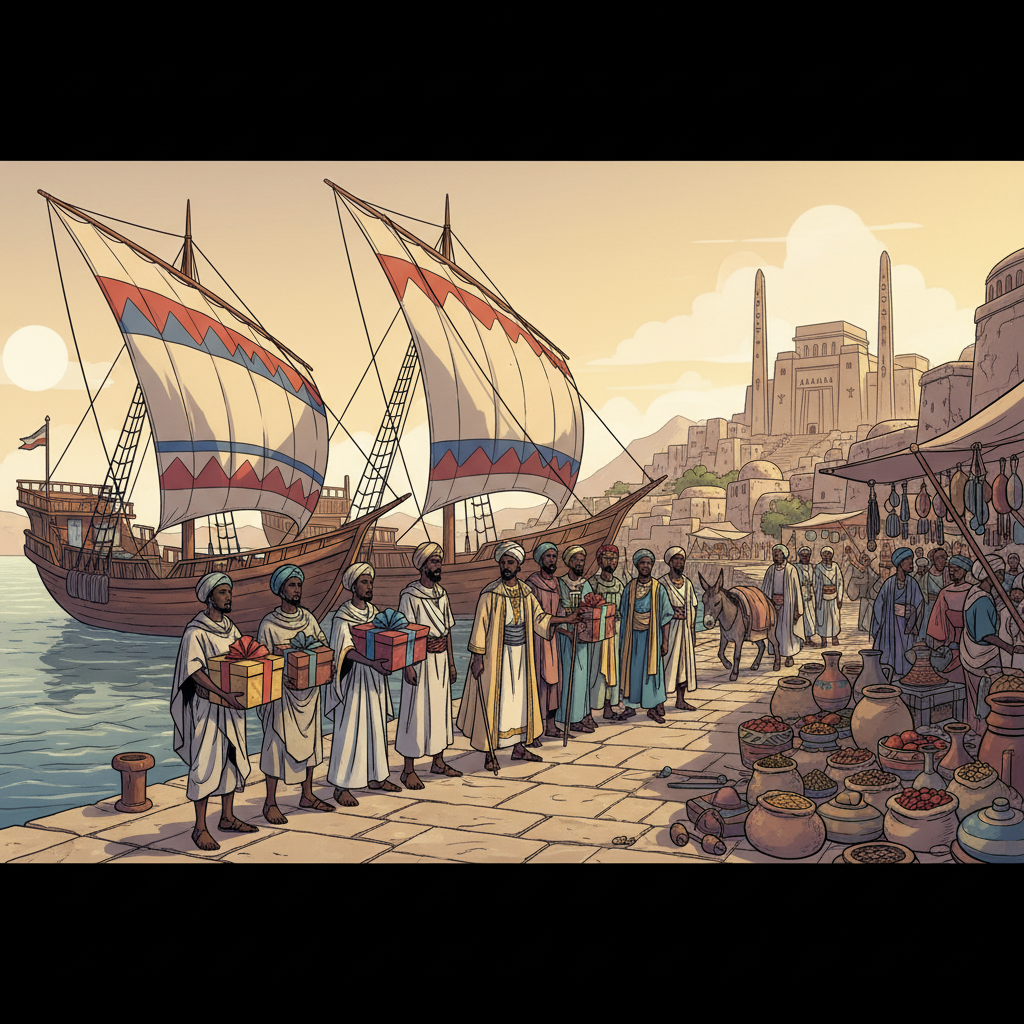
On the eleventh month after Salama's family had arrived in Aksum, men from Mecca came across the sea. They were called Quraysh. Their leader's name was Amr ibn al-As. They came with two ships and many gifts and a request to speak with the Najashi — the king — about a matter of urgent importance. Tirhas heard about this from her father at the dinner table that evening. Her father, Tewodros, was a courtier in the Najashi's court. He had been present that afternoon when the Quraysh emissaries had arrived at the palace, and he had bowed when the Najashi had received them, and he had listened. "The Quraysh have come to ask us to give Salama's family back," Tewodros said. He did not look at Tirhas while he said it. He was breaking apart a small flat piece of bread on his plate. "All of them. The whole sixteen of them. The Quraysh say they are criminals. They say they have abandoned the old gods of Mecca and the old ways. They say if we return them, Mecca will continue to be our trading partner. If we do not return them, the Quraysh will close their markets to Aksumite ships." Tirhas's stomach turned over. Tewodros set down his bread and folded his hands.
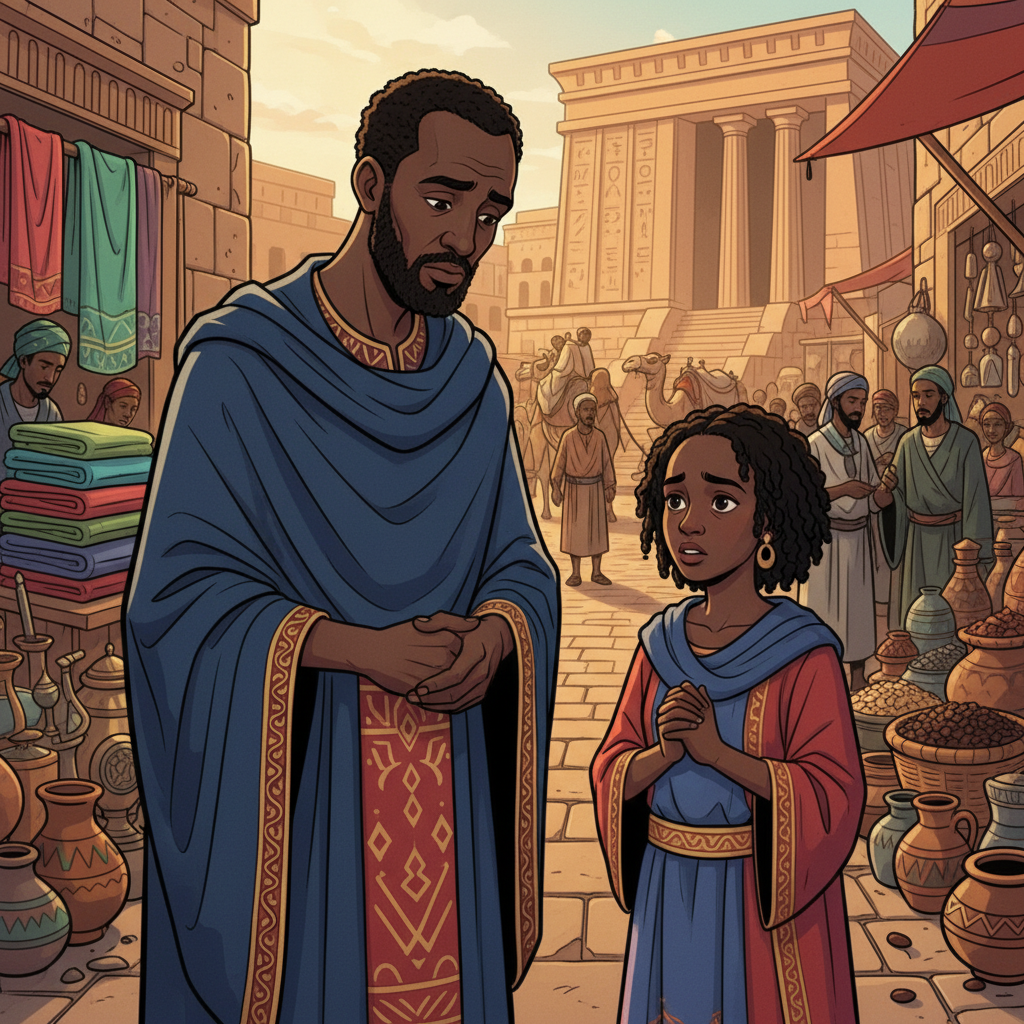
"Father," Tirhas said. "You are not going to give Salama back. Are you?" Tewodros looked at his daughter then. His face was tired. He had been thinking about this all afternoon, in the way that an honest official thinks about a problem he cannot easily solve. "Tirhas," he said. "I want you to listen to me, because you are old enough to understand what I am going to tell you, and I want you to understand it the way a courtier's daughter understands it, not the way a friend of Salama understands it. The kingdom of Aksum depends on Red Sea trade. Mecca is the most important market on the Arabian side of that sea. If we lose access to Mecca's markets, our merchants lose money. Some merchant families would have to leave Aksum to find work. Some of them would not survive the leaving. The price of the sixteen refugees is not just the sixteen refugees. The price is the future of many Aksumite families." Tirhas did not know what to say. The math her father was describing was real. She did not have a counter-argument that worked in math. She thought of Asma's bowl. She thought of Salama's small hand on the back of her hand teaching her the Arabic word for sun. She thought of her own mother's old hands braiding her hair when she was Salama's age. None of those things fit into her father's math.
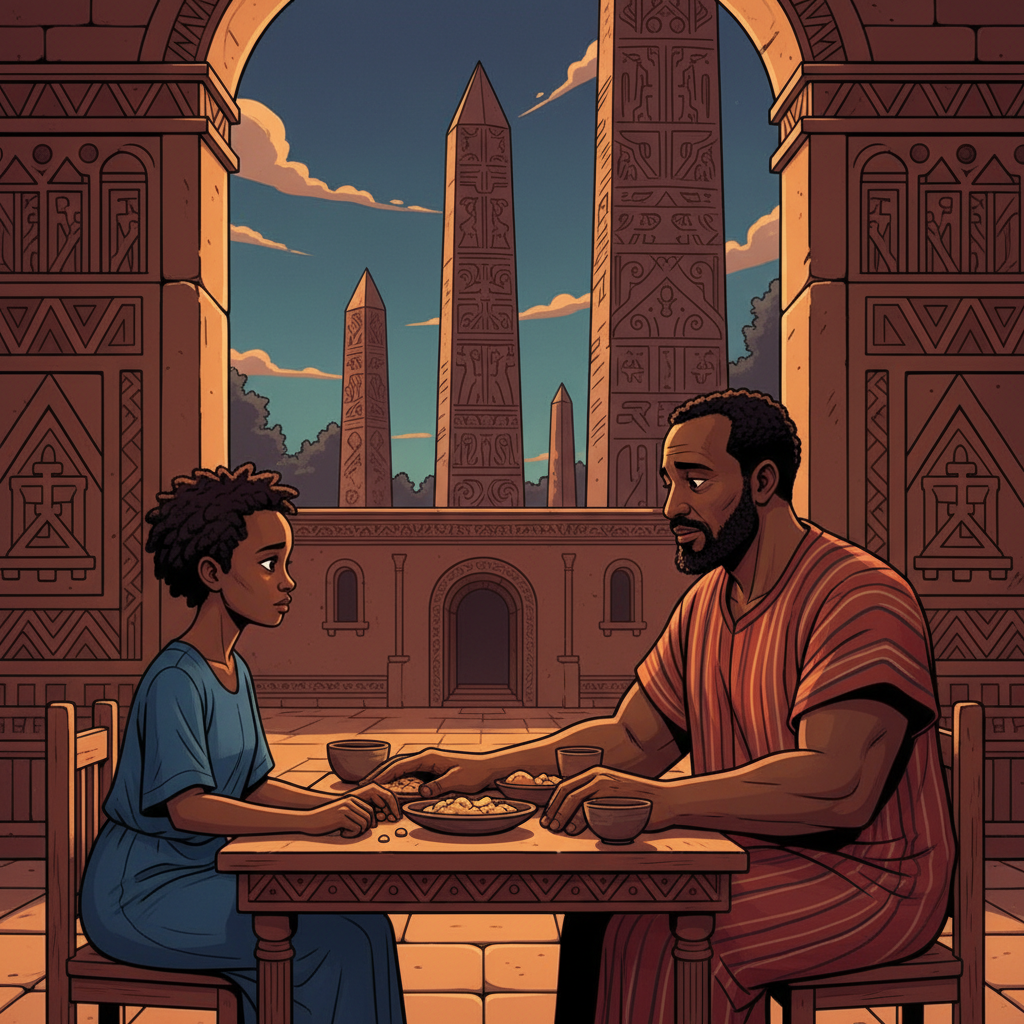
Tewodros watched his daughter struggle. He reached across the low dinner table and put his hand on top of hers. His hand was large and warm and a little rough from the dry winds of the highlands. "Tirhas," he said. "I will vote with the older courtiers tomorrow. We will return the refugees. I am sorry. The vote is not what I want it to be. But I cannot let a kingdom's trade be lost for the sake of sixteen people whose own city wants them back." He paused. He looked her in the eye. "Tell me you understand." Tirhas did not say yes. She did not say no. She got up from the dinner table without finishing her food and she walked out of the small family courtyard into the lane and she stood under the open sky of Aksum at evening with the great stone obelisks rising around her, the obelisks her ancestors had carved for kings who had ruled before the kingdom had been Christian, before the kingdom had been anything but a confederation of highland farmers who welcomed travelers across the mountain passes. She stood there and she did not cry. She thought, instead, about her grandmother, who was old enough to remember the time before the church bells, who lived in the small house at the back of the courtyard.
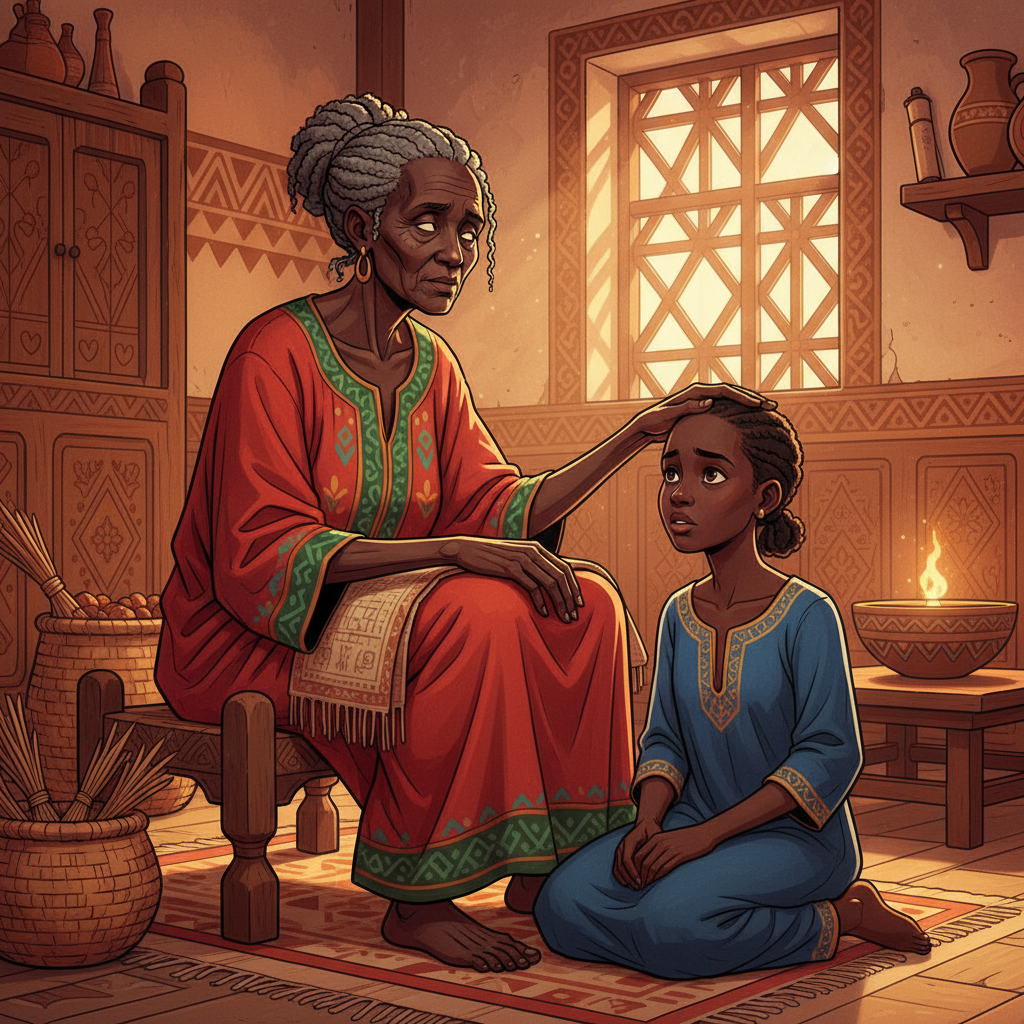
Tirhas's grandmother — her father's mother — was named Werknesh. She was eighty-three years old. Her eyes were milky with age but they still saw. She was sitting on a low wooden stool in her room when Tirhas came in, weaving palm fiber into a small mat, her fingers moving by long practice without her needing to look. She did not look up when Tirhas entered. "Sit," she said. "I have been waiting for you. I have been waiting since the Quraysh ships came into the harbor this morning." Tirhas sat down on the floor at Werknesh's feet, the way she had sat there since she was Salama's age. Werknesh continued weaving. She did not stop her hands. "What is it you want to ask me, daughter of my son?" Tirhas told her grandmother everything. The bowl. The braiding. The Arabic lessons. Her father's math at the dinner table. The vote tomorrow. The math being real. Her not having a counter-argument. Werknesh listened without interrupting. When Tirhas was finished, the old woman set down her weaving for the first time. She placed her dry warm hand on the top of Tirhas's head, the way the old women of Aksum always placed their hand on the head of a younger one who had come to them with a hard question.
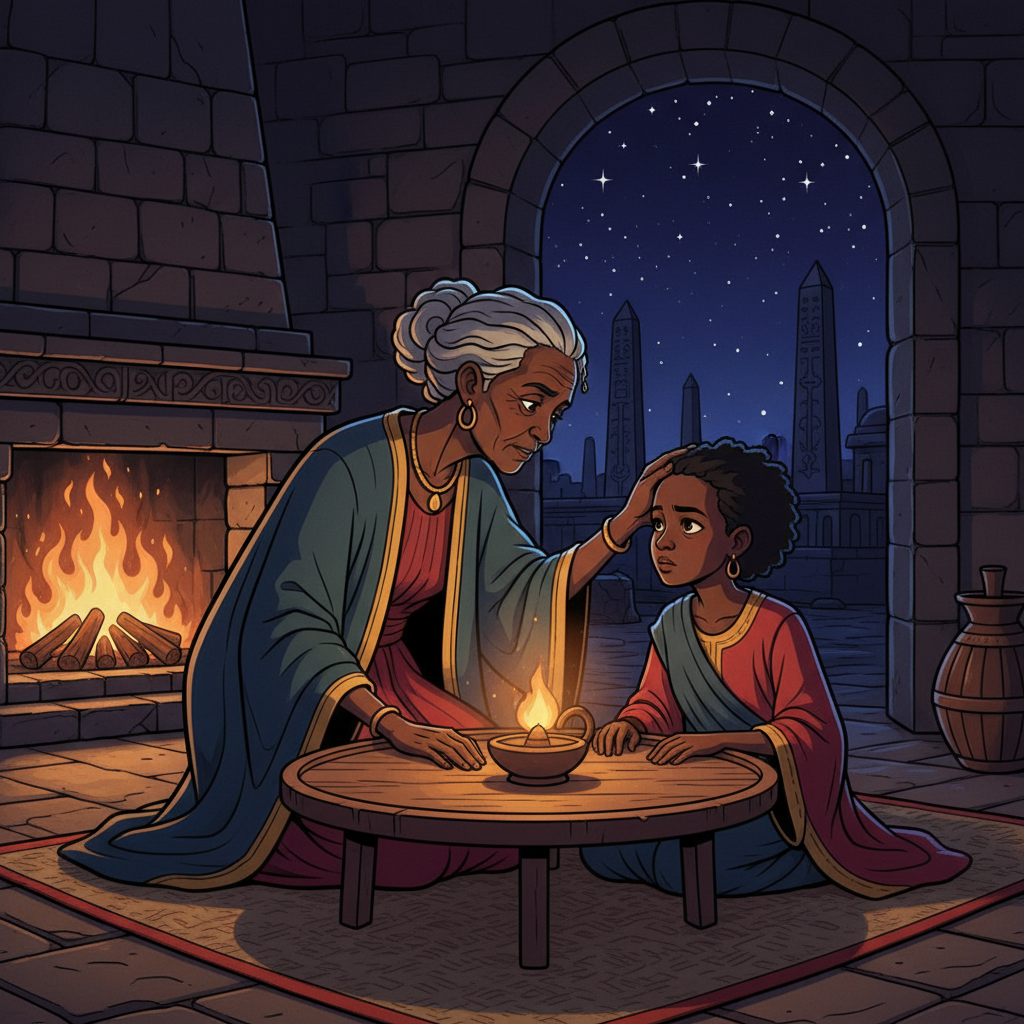
"Listen carefully, Tirhas," Werknesh said. "There is a principle older than this kingdom. It is older than the church we go to on Sunday. It is older than the obelisks the kings raised when they wanted to be remembered. It is older than the kingship itself. The principle is called guest-right. Long ago, before there were kings in these mountains, the highland farmers welcomed travelers who came across the passes from the south and the east. They fed them. They sheltered them. They did not ask the travelers what gods they worshipped. They asked only whether the travelers were hungry. If the travelers were hungry, they fed them. If the travelers needed sleep, they let them sleep. This is the principle our mountains were built on. It is the principle that your father has forgotten tonight in his math." Werknesh's hand was still on Tirhas's head. "Now listen to the second thing. The principle of guest-right is not for the easy times. It is for the hard times. It is for the times when the price of keeping the principle is very high. If the price is small, every kingdom keeps the principle. The test of the principle is whether you keep it when the cost is real." Tirhas looked up at her grandmother. "Grandmother. The council is tomorrow. What do I do?" Werknesh smiled a slow, wrinkled smile. "You bring the bowl, Tirhas. You bring the bowl into the council chamber. And when the moment comes that you know is the moment, you walk it to your father."
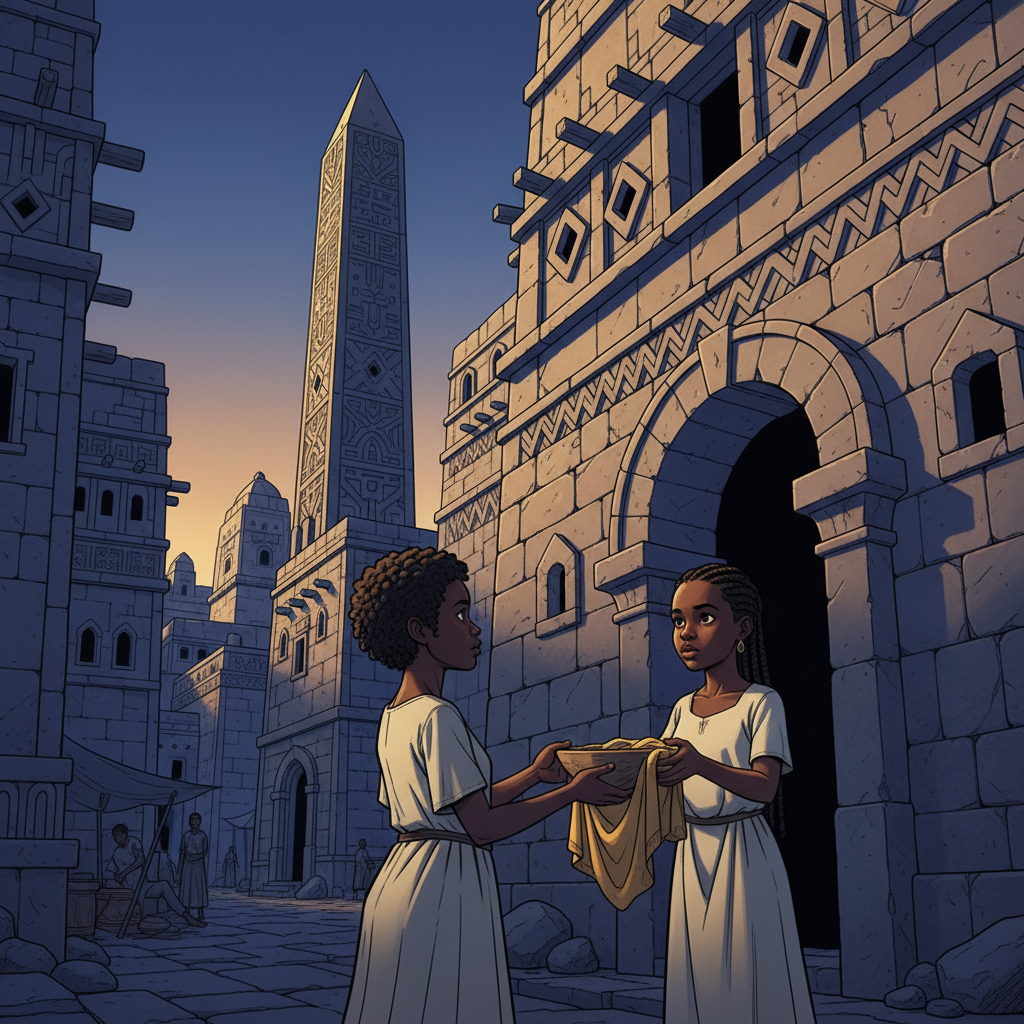
In the early morning of the council day, before the sun had climbed past the highest obelisk, Tirhas walked to Salama's family's rooms. Asma opened the door and looked at her, and Tirhas understood that Asma had been waiting for her. Asma did not ask why Tirhas had come so early. She turned without speaking and went to the low shelf where the wooden bowl sat. She lifted the bowl down. She wrapped it carefully in a piece of soft linen the color of the sun just before it rises. She brought it to Tirhas and pressed it into her hands. "Take it," Asma said. "Whatever happens." That was all she said. Tirhas held the wrapped bowl against her chest and walked back through the waking lanes of Aksum with it. The council chamber was a long stone room inside the palace, with two rows of low cedar benches facing the throne of the Najashi at the far end. The Najashi was King Armah — also called Ella Tsaham, in the old way of speaking. He was a tall lean man in his sixties, with deep brown skin and silver beard, wearing the white robes of the Aksumite throne and the simple iron crown of his fathers. The Quraysh emissaries — Amr ibn al-As at the front, two others behind him — sat on one side of the chamber. The sixteen muhajirun, the Muslim refugees, sat on the other side, with Ja'far ibn Abi Talib at their front. Tirhas was not allowed in. But Werknesh, her grandmother, had a courtier's relative's pass. The two of them stood in the doorway of the chamber, in the shadows, where almost no one could see them.
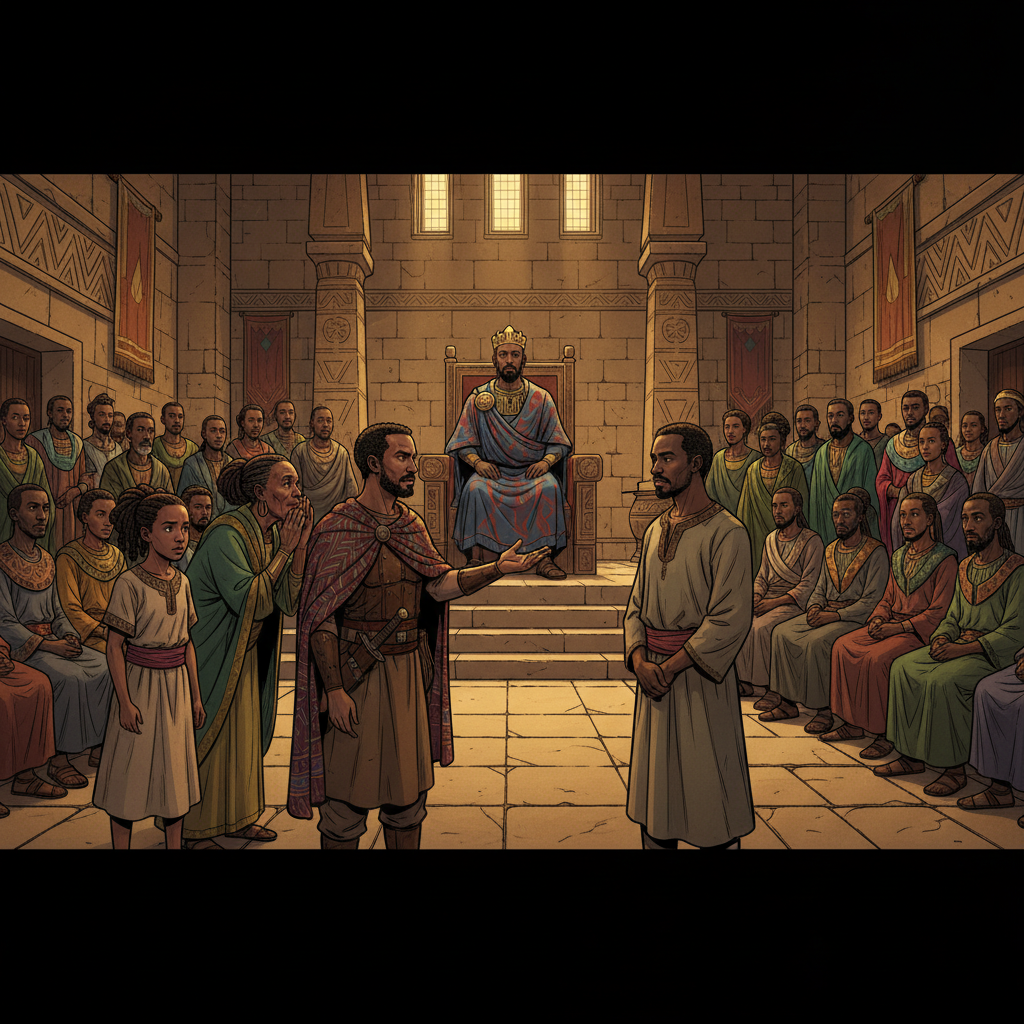
Amr ibn al-As of the Quraysh spoke first. He spoke for a long time. Tirhas understood almost none of it because he spoke in Arabic, but Werknesh whispered the meaning into her ear in pieces as he went. The refugees were criminals against the old gods of Mecca, Amr said. They had brought unrest. They had divided families. They had abandoned the religion of their fathers. They should be returned to Mecca to face the judgment of their elders. To protect them was to side with criminals against the city of Mecca itself. The Najashi listened without interrupting. The Aksumite courtiers — including Tewodros, Tirhas's father, in the second row — listened with carefully neutral faces. Then Ja'far ibn Abi Talib stood. He was a tall man in plain travel clothes — the cousin of the Prophet of the muhajirun, the leader of their small group. He did not argue the politics. He did not answer Amr's charges. Ja'far said quietly that he would, with the Najashi's permission, recite for the king a passage from the book that had been revealed to his people — a passage about Maryam, the mother of Isa. The Najashi nodded. Ja'far recited. His voice was low and clear. He recited in Arabic, but a small phrase of the recitation reached Tirhas in the doorway, because she had been learning Arabic from Salama for eleven months. The phrase was about Maryam — and the same name had been spoken in the church Tirhas attended every Sunday.
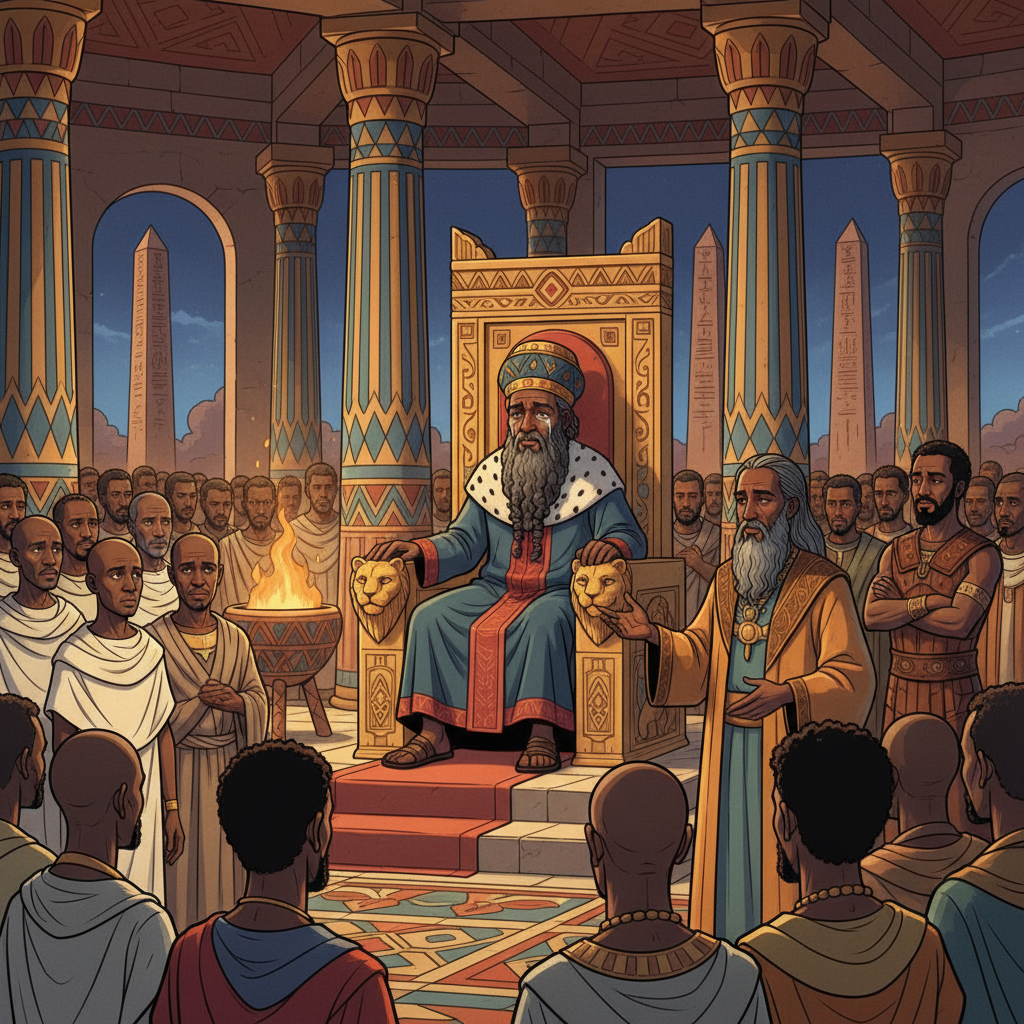
When Ja'far finished his recitation, the chamber was very quiet. The Najashi sat on his throne and did not move for a long minute. Then everyone in the chamber saw that the king's eyes were wet. King Armah lifted his head. He said, in Ge'ez so that his court could understand: "What you have recited and what was revealed to Isa come from the same lamp." A murmur went through the courtiers. Several of the Aksumite priests, sitting along the south wall, looked at each other with troubled faces. Amr ibn al-As stiffened. The Najashi had taken a position. The position had not been the one Amr had hoped for. But the council was not yet over. Aksum's courtiers were permitted to advise the king before he delivered his ruling. The chief of trade — an older man with a long gray beard, whom Tirhas had seen many times at her father's feasts — stood and spoke for the trade-protection faction. He spoke carefully. He did not argue with the Najashi about the lamp. He argued, instead, the math of Mecca's markets, the loss of the Arabian-side ports, the merchants who would lose their livelihoods. He spoke for a long time. When he was finished, several other courtiers nodded slowly. Tewodros, Tirhas's father, was one of them.
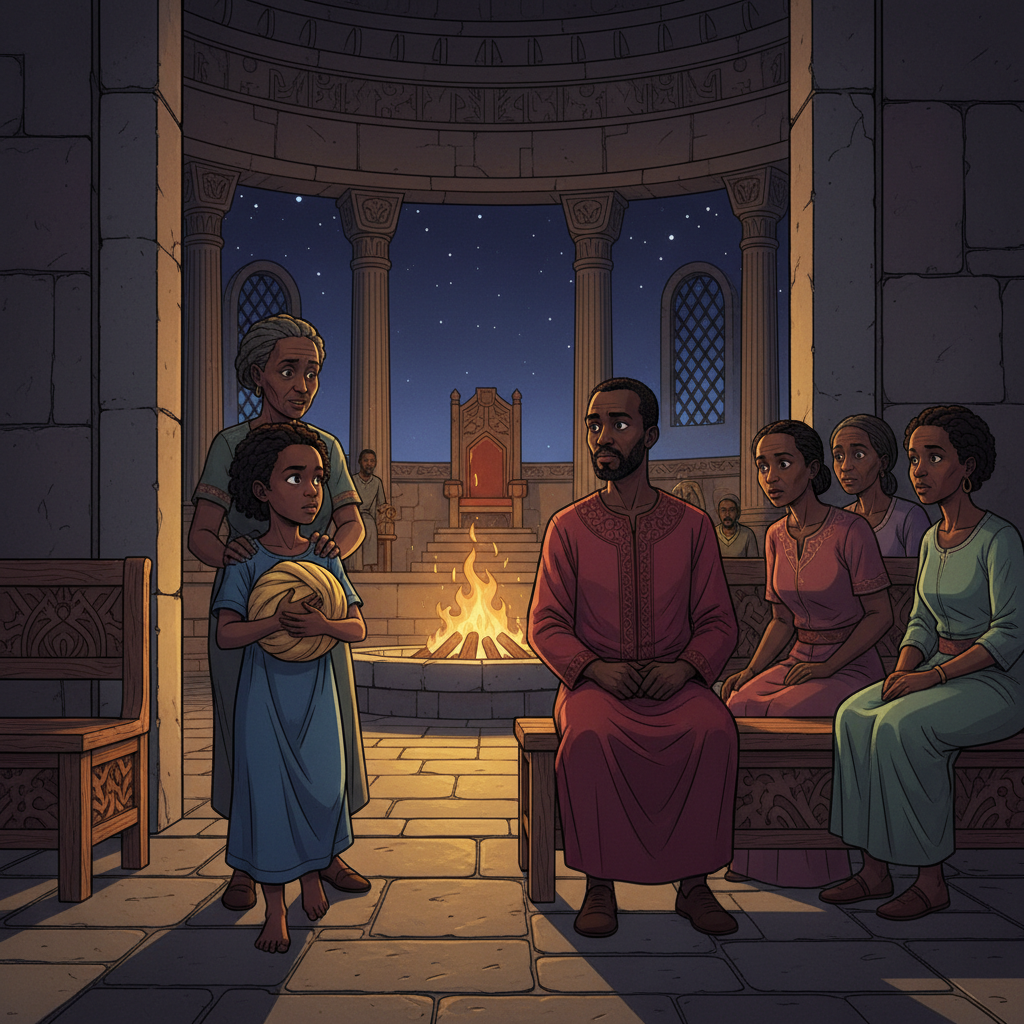
Tirhas felt Werknesh's hand on her back. The old woman was gentle. "Now, Tirhas," she whispered. "Walk it to him." Tirhas did not move at first. Her feet felt like the stone floor had become part of them. She looked across the chamber at her father in the second row. She thought about her father's warm rough hand on top of her hand at the dinner table last night. She thought about Asma's bowl, wrapped in the soft linen the color of the rising sun, pressed against her chest right now under both her arms. She thought about Salama's small hand on the back of her hand teaching her the word for sun. She stepped forward out of the shadows of the doorway. The first heads turned. The Aksumite courtiers nearest the door saw her and went still. A small Aksumite girl walking alone into a council chamber where the future of sixteen lives was being weighed — it was an unusual sight. Tirhas did not look at the Najashi. She did not look at Amr ibn al-As. She did not look at Ja'far. She walked straight across the chamber, past the first row of benches, to the second row, where her father was sitting. She stopped in front of him. He had seen her come in. He had not moved. His face had become very still.
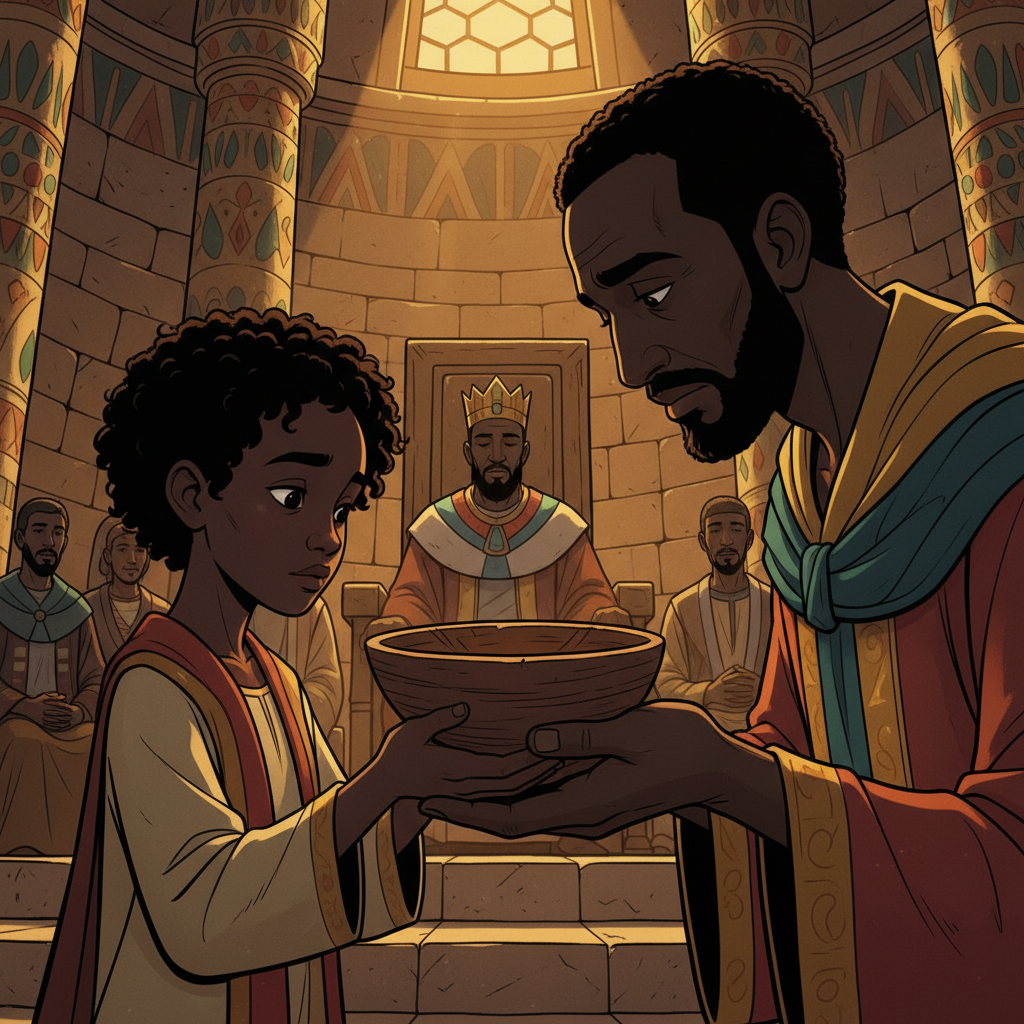
Tirhas, twelve years old, did not speak. She did not know what she would have said if she had spoken. She unwrapped the linen from the bowl, one fold at a time, slowly, with the whole council chamber watching. She set the linen on the bench beside her father. She lifted the small dark wooden bowl in both her hands. She held it up to her father's eye-level. The bowl had a smooth worn rim. It had small thin spoon-lines in the bottom. It had been carried across a sea by a woman who could only bring one thing. Tirhas did not speak. She just held the bowl up to her father and let him look at it for as long as he needed. Tewodros looked at the bowl. He looked at his daughter. He looked at the bowl again. He did not move for a long time. The chamber was completely silent now — even the chief of trade had stopped speaking. The Najashi was watching from his throne. Amr ibn al-As was watching from his bench. Ja'far ibn Abi Talib was watching from his side of the chamber. The whole council was watching a small girl hold up a wooden bowl to her father. Tewodros put his hand under his daughter's small hands, gently, so that he was holding the bowl with her, the two of them holding it together for one long heartbeat.
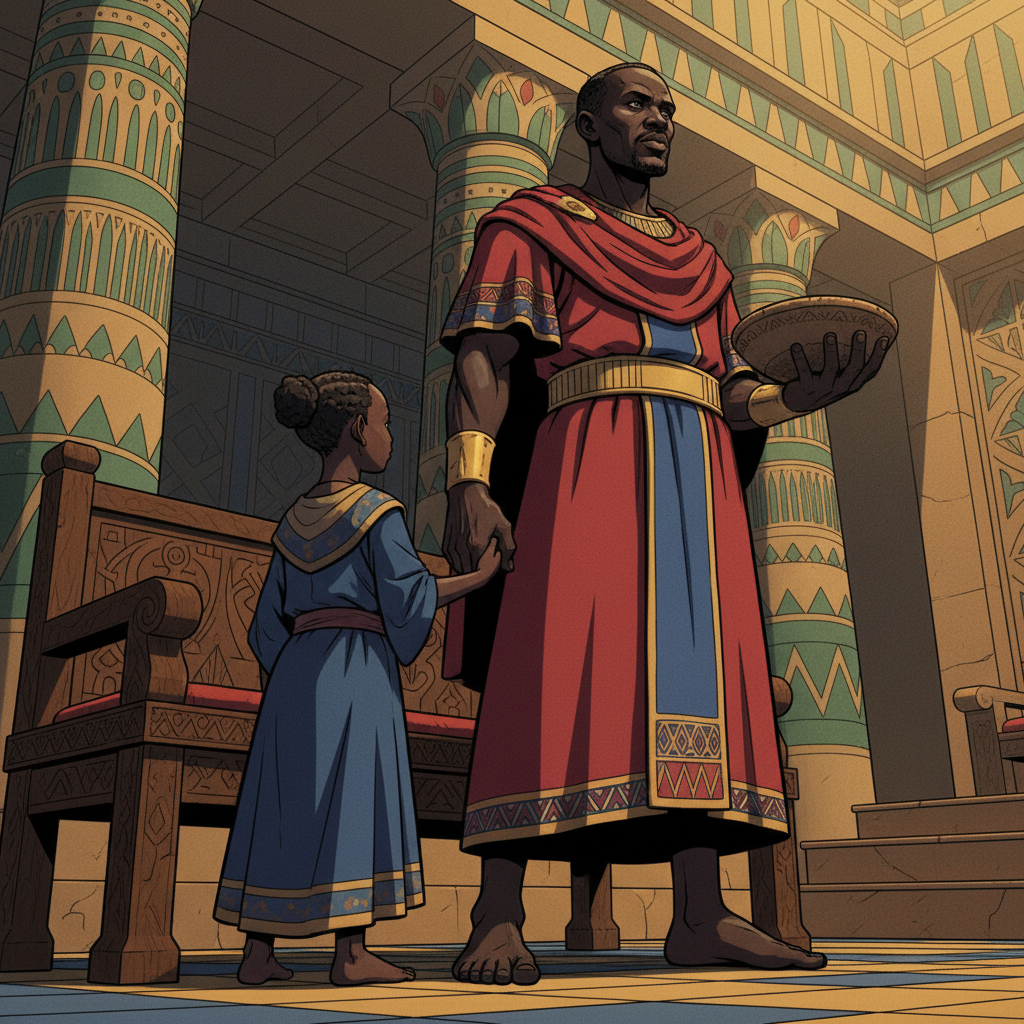
Then Tewodros stood up. He kept his daughter's small hands cupped in his large rough one. He did not let go of the bowl. He turned to face the throne. "Most exalted Najashi," he said, in a voice that was not loud but reached every corner of the chamber. "When I sat down in this council, I had decided to vote that we return the muhajirun to the Quraysh. My reasoning was the math of trade. The math is real. I do not pretend otherwise. But my daughter has just walked into this chamber and shown me something I could not see at the dinner table last night, and now my reasoning has changed." He paused. He set the bowl down very carefully on the bench beside him, the way a man sets down a thing he knows is older than his kingdom. "The mother of this Muslim girl who is my daughter's friend brought one thing across the sea when she fled her city. She brought a wooden bowl. Four generations of her family have eaten from it. She wanted, more than anything she could bring, to be still home in her hands when she ate her meals in a strange land. Najashi, I cannot send a woman back to her death who brought a four-generation bowl across the sea. I am voting that we keep them. I do not have the math for the trade. We will find the math. The math is not the harder problem."
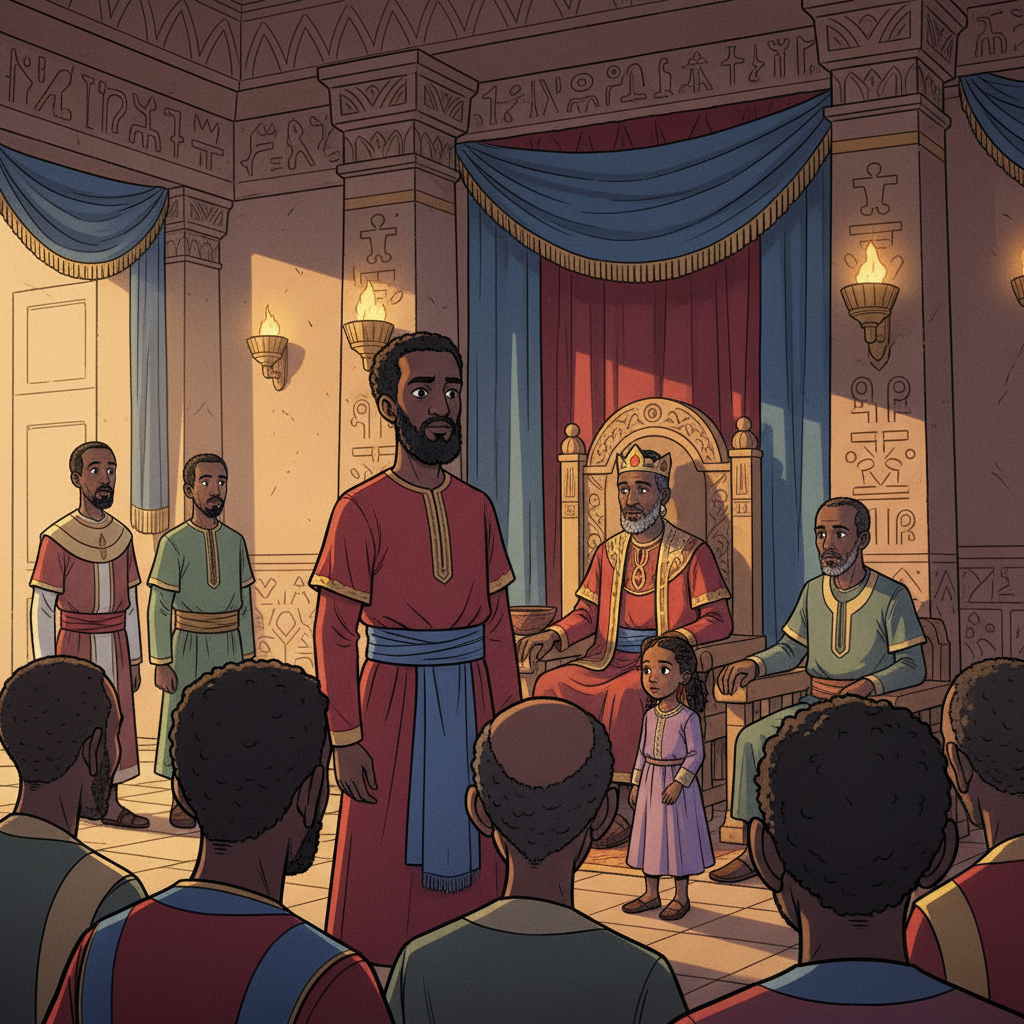
Tewodros sat down. He kept one hand on the bowl. The chamber was silent. Then, slowly, from the third row, one of the younger courtiers stood up — a man named Hagos, with the close-cropped beard of the southern provinces. "I came in to vote with the trade faction," Hagos said. "I am changing my vote. The girl has shown me something also." He sat. Another courtier stood, and then another. By the time five of the trade faction had publicly changed their votes, the chief of trade had become very quiet. The political math had shifted. The Najashi raised his right hand. The chamber fell still. King Armah spoke slowly. He looked first at Amr ibn al-As. He looked at Ja'far ibn Abi Talib. He looked at Tewodros and at the wooden bowl on the bench beside him. Then he looked at the small Aksumite girl standing in front of her father, who had not yet stepped away. "I will not give up these muhajirun for a mountain of gold," the Najashi said. "Their guest-right under the laws of my fathers is older than my crown. The trade with Mecca that we lose, we will earn back. The hospitality we keep, we cannot earn back if we lose it once. The Quraysh emissaries may stay one more night. Then they must sail home with my answer."
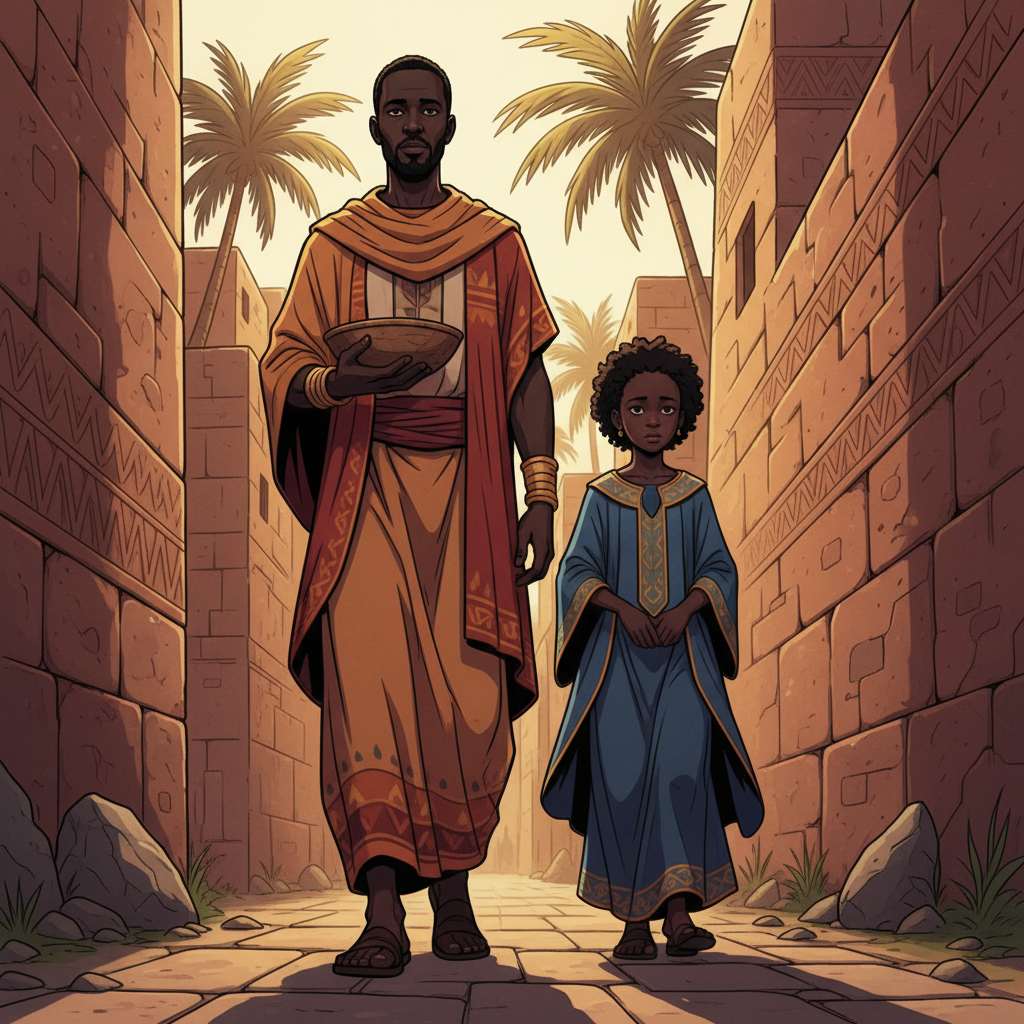
The Quraysh emissaries left Aksum the following morning with empty hands. The Aksumite court closed the chamber. Tewodros walked his daughter home through the lanes of the city, carrying the wooden bowl in his own hands now, because Tirhas had given it to him at the chamber door. They walked slowly. They did not speak for a long time. When they reached the small family courtyard, Werknesh was sitting on her low stool in the morning sun, weaving palm fiber, just as she had been the night before. She did not look up when they came in. "I heard," she said simply. "The whole city heard. Sit, my granddaughter. Sit, my son." They sat. Tewodros set the bowl on the ground between them. Werknesh stopped her weaving for the second time in two days. She looked at her son. She looked at her granddaughter. She picked up the bowl in her dry warm hands and turned it slowly, looking at the rim worn smooth by four generations of hands. "Tewodros," she said. "What did you learn this morning?" Tewodros was quiet for a long time. Then he said: "I learned that the math is not the harder problem, mother." Werknesh nodded once. She handed the bowl carefully back to Tirhas. "Take this to Asma," she said. "Tell her it has done its work in our chamber. Tell her she does not have to give it to us. It is hers and her family's, for four more generations after this one, if they wish."
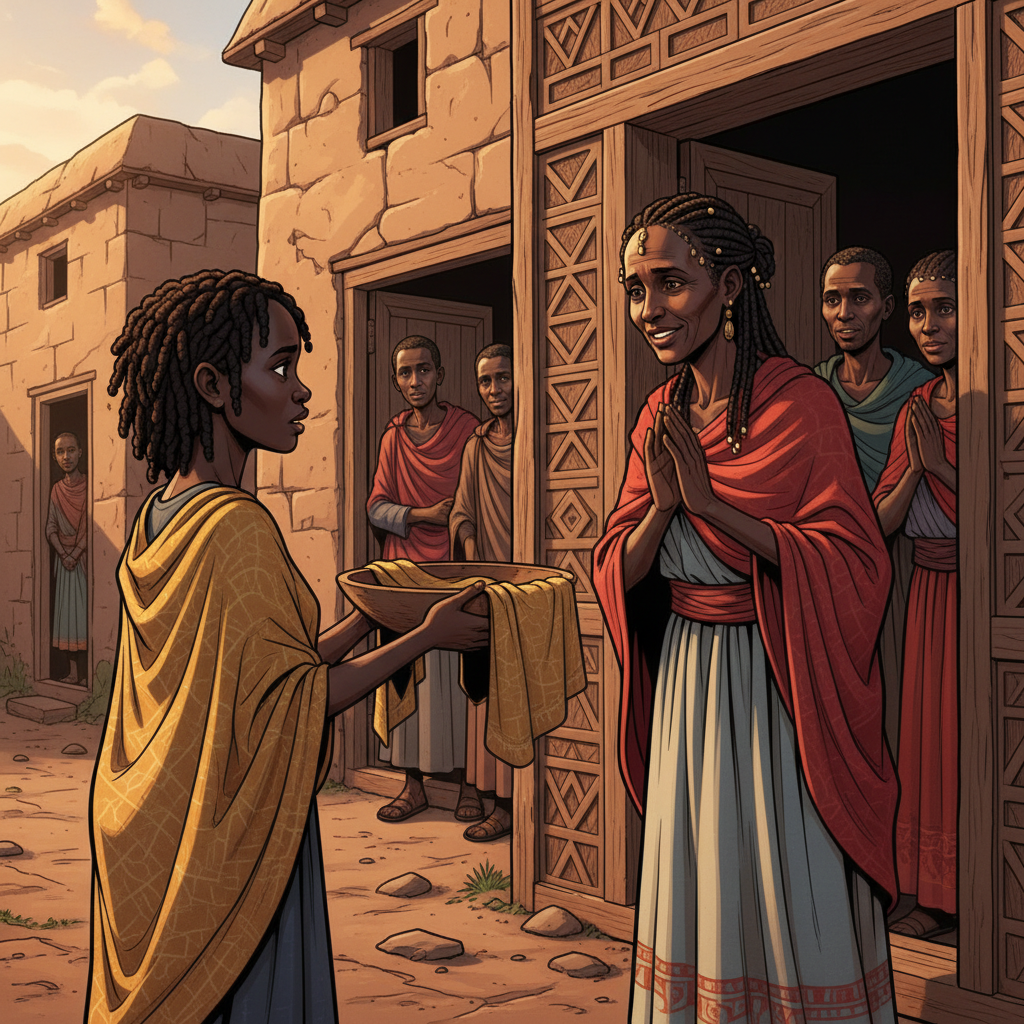
Tirhas walked back to Salama's family's rooms with the bowl that afternoon. Asma was waiting in the doorway. She had heard. The whole muhajirun community had heard. When Tirhas reached the door and held out the bowl wrapped again in its sun-colored linen, Asma did not take it back. Asma shook her head. "It is yours now, Tirhas," she said. "I gave it to you this morning. It has done a thing in your council that I could not do. The bowl belongs where it speaks the loudest. You will keep it for me. When my family is permitted to return to Mecca one day, you may give it back. If we never return, my daughter — my Salama — and my granddaughters will know that the bowl is in the safe hands of an Aksumite friend who saved their grandmothers' lives." Tirhas tried to refuse. Asma would not allow it. That night Tirhas put the wooden bowl on a small carved shelf in her own room — the same kind of shelf where Salama's family had kept it, low to the ground, where a child could see it. She lit a small oil lamp and sat in front of the bowl for a long time. She did not feel proud. She felt heavier. She had learned, that day, that there was a kind of weight to being trusted with something that mattered. Werknesh's phrase from the night before kept returning to her: the test of the principle is whether you keep it when the cost is real. She thought she understood, for the first time, what her grandmother had meant.
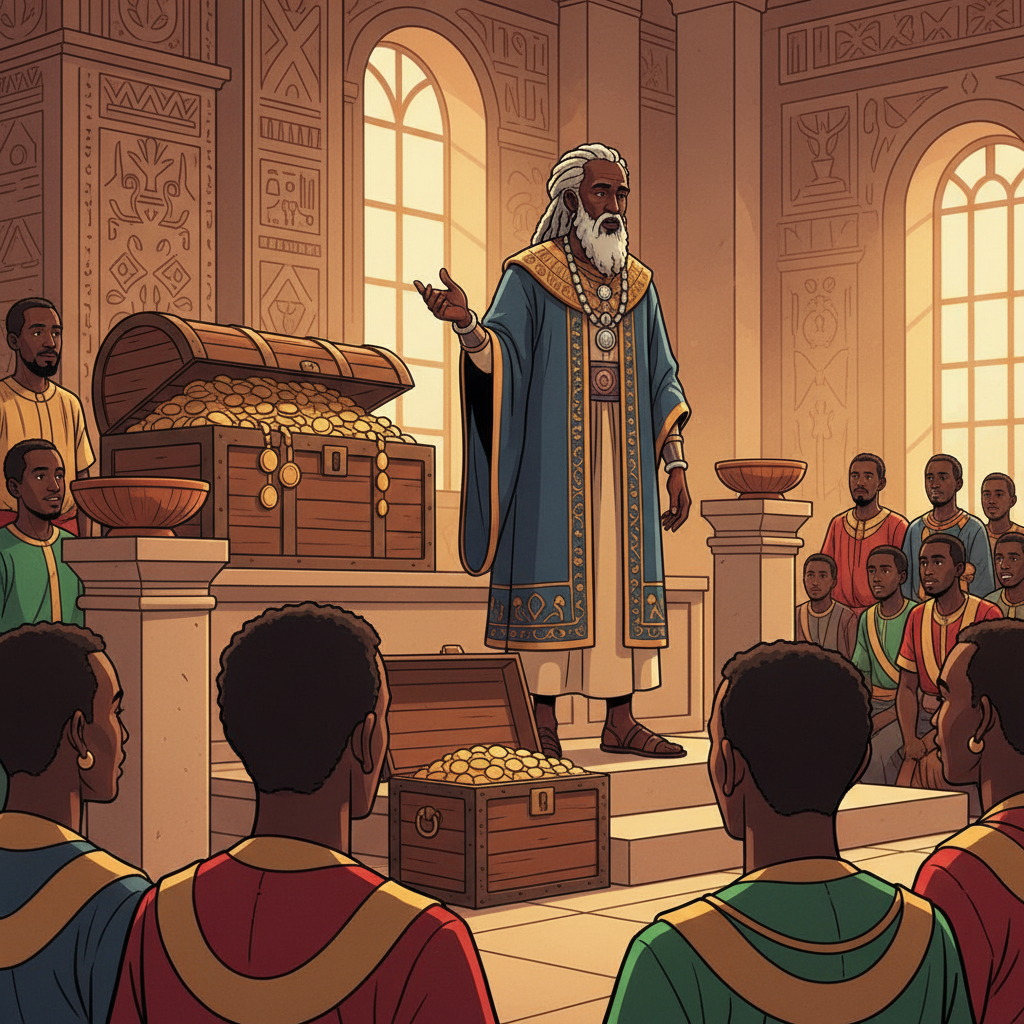
The cost was real. Within a month of the Quraysh ships leaving, Mecca had closed two of its most important markets to Aksumite merchants. Five Aksumite trading families lost their principal source of income. The kingdom's gold reserves shrank by a noticeable measure that year. Tewodros, in his work at the court, helped redirect Aksumite trade to other Arabian ports — to Sana'a, to Aden, to the smaller ports along the Hadramawt coast. The redirection took years. It was painful. It was also possible. By the time Tirhas was sixteen, the Aksumite trade balance had recovered. The kingdom's wealth was approximately what it had been before the Quraysh closure. The muhajirun community had grown by another forty refugees over those years — some of them friends and relatives of the original sixteen. Tewodros, in those years, became known in the Aksumite court not as the man whose daughter walked the wooden bowl into the council, but as the man who had the courage to change his vote when his daughter showed him a thing he had not seen. Younger courtiers came to him for advice. He gave it carefully. He did not boast about Tirhas. He spoke of her, when he spoke of her at all, the way men speak of teachers — with a small respectful pause before the name. Tirhas, growing into her teenage years, did not know any of this until many years later. She knew only that her father had begun, in the mornings, to ask her opinion on questions of the court before he left for the palace.
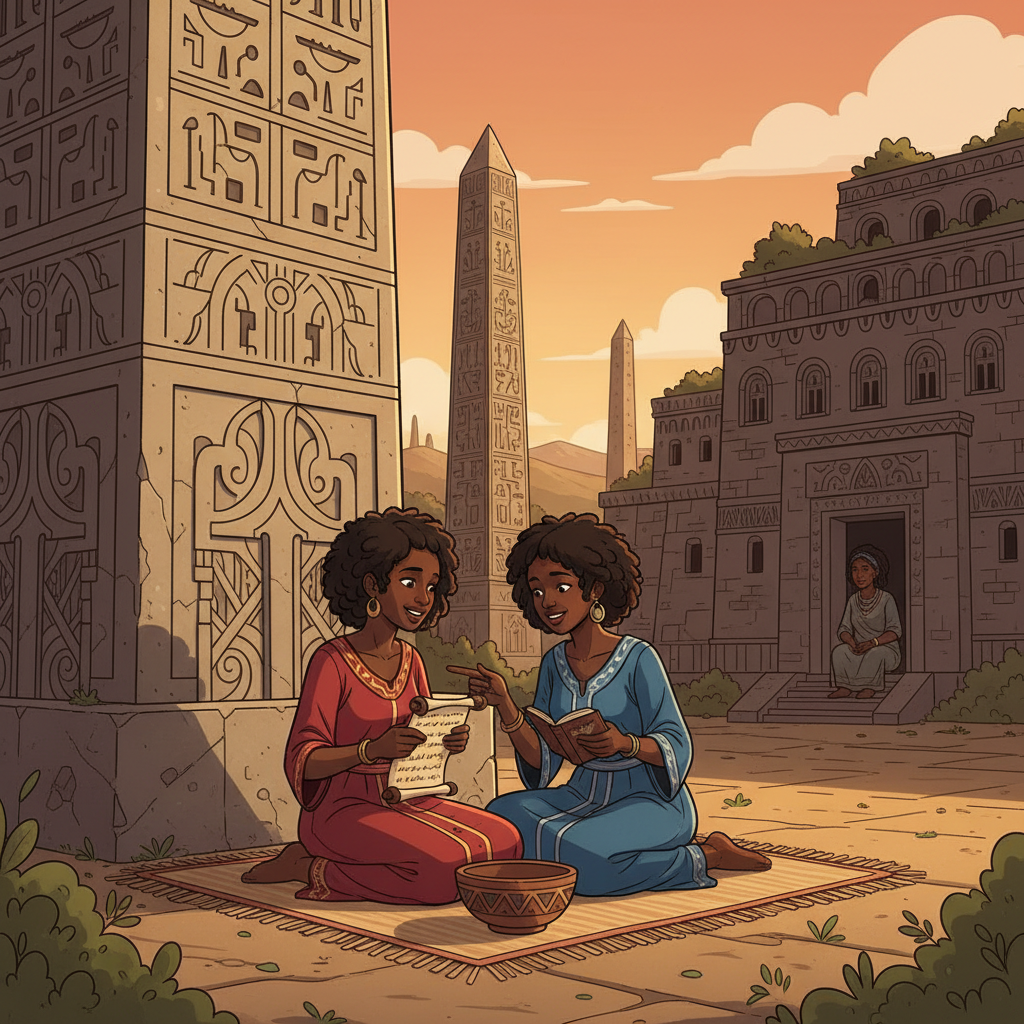
Salama and Tirhas grew up together. They became young women together. Salama learned Ge'ez fluently and Tirhas learned Arabic fluently. The friendship that had begun on a floor mat at age seven and twelve, with the wooden bowl between them, deepened into the kind of friendship that knows the other person's walking pace. They went to the markets together. They sat under the great obelisks in the late afternoons and talked about the books each of them had been reading — Salama in Arabic, Tirhas in Ge'ez, sometimes translating for each other a phrase that mattered. Asma, who had aged visibly since the council year, watched the two girls grow up with the careful satisfaction of a mother who has been given back her future twice. When they were both eighteen, the news came across the sea that the Prophet of the muhajirun had died, and that Mecca itself had changed — that the Muslim community could now safely return. Salama's family made the difficult decision to go back. Asma was older now. Othman was older. They wanted to be buried in the soil they had been born in. The departure was tearful. Asma hugged Tirhas for a long time at the harbor. She did not ask for the bowl back. "It is yours," she said again. "It will outlive us. Pass it to your own granddaughter." Tirhas watched the ship pull away from the dock with one hand pressed against her own heart, the way Asma had once pressed her hand against hers.
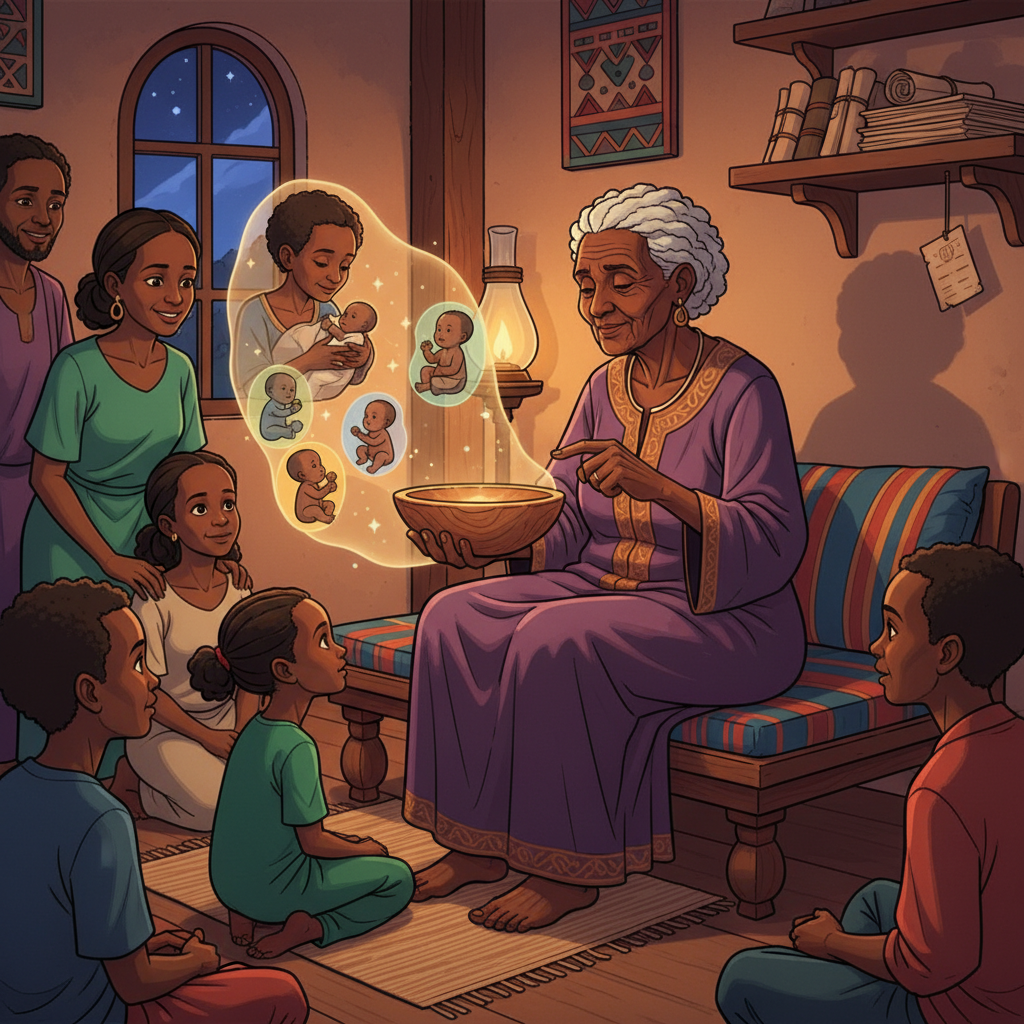
Tirhas kept the bowl on her small shelf for the rest of her life. She married a man named Daniel who worked in the Aksumite scribal office, and they had three daughters and one son. The bowl held the first meal of each of her four children — Werknesh, the eldest, named after Tirhas's grandmother who had not lived to see her great-grandchildren; then Yodit, then Mahlet, then Tewodros after Tirhas's father. The bowl held the last meal of her father Tewodros when he was very old and could no longer eat solid food. The bowl held many quiet ordinary meals in between. Asma and Salama wrote letters from Mecca every year. The letters described Salama's growing family, the slow building of the Muslim community in its returning city. Tirhas wrote back in Arabic that she had kept polished by reading the letters and answering them. Forty-three years after the council day, Tirhas was seventy-eight years old. Her hair was white. Her hands moved more slowly than they had once moved. Her own granddaughter — the eldest daughter of her eldest daughter Werknesh — was eleven, almost twelve. The granddaughter's name was Marta, and she had spent every morning of her childhood at her grandmother's feet. Marta knew the story of the bowl by heart. She had asked Tirhas to tell it again on a winter evening, in the way grandchildren ask, knowing the story will not change but wanting to hear it in the grandmother's voice once more.
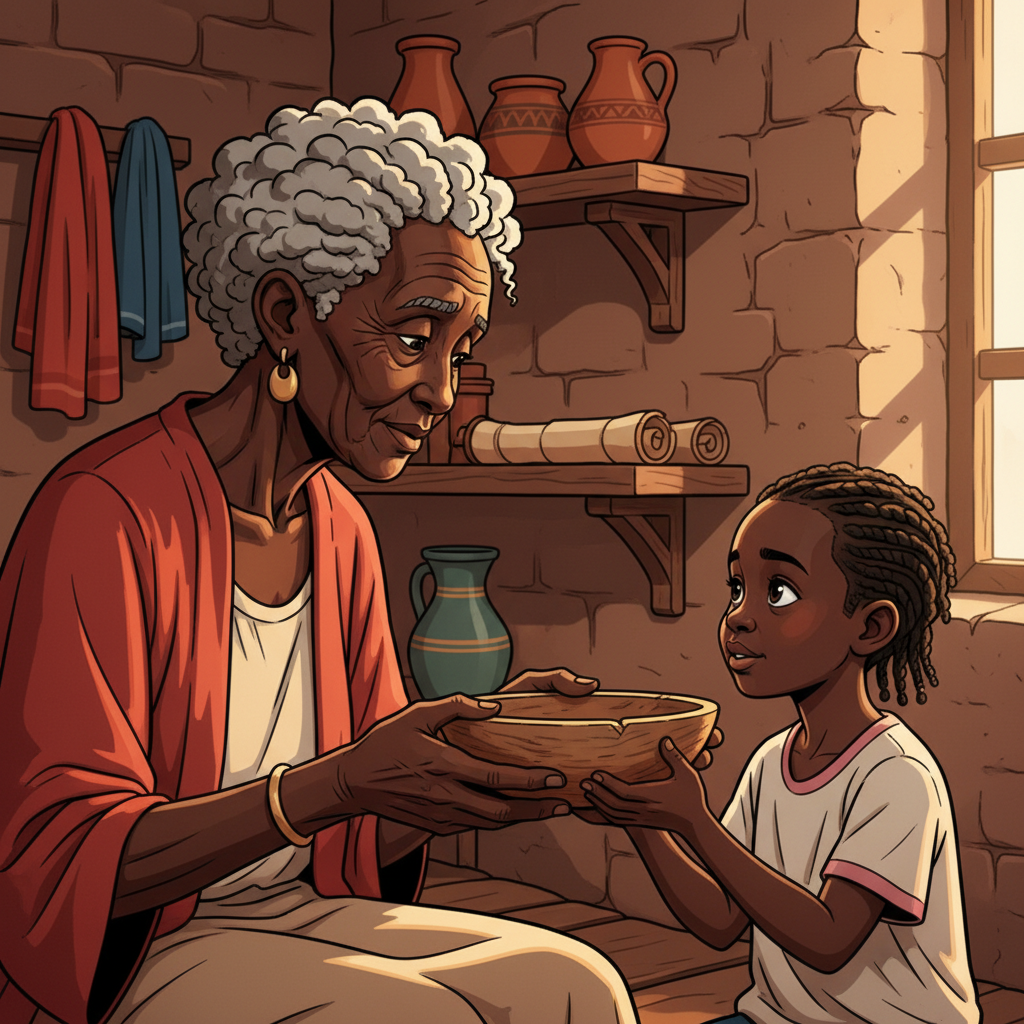
Tirhas told the story. She told it slowly, the way Werknesh had told the old guest-right story to her on the night before the council. She told Marta about the wooden bowl and the Quraysh ships and the council chamber and the moment her father had put his hand under hers and held the bowl with her. When she came to the end of the story, she lifted the bowl from its shelf — the same shelf it had sat on for forty-three years, low to the ground where a child could see it — and she set it in her granddaughter's hands. "The principle," Tirhas said, "was not Christian, Marta. The principle was not Muslim. The principle was OURS — the highland people of these mountains — and it was older than any kingdom. Guest-right. Stranger-protection. When you welcome someone, you welcome them whole. The Najashi knew this. The Quraysh did not know it. Your great-great-grandmother Werknesh knew it. My friend Salama's mother Asma knew it. Now you know it." Marta turned the bowl slowly in her small hands, looking at the smooth rim. She looked up at her grandmother. "When my granddaughter is twelve," she said, "I will tell her the same story." Tirhas smiled. The smile felt like Werknesh's smile, all those years ago. "Yes," Tirhas said. "And the bowl will be with her too. Four generations is only a beginning. The principle is older than the bowl, and the bowl is older than the kingdom, and the kingdom is older than the church. Carry it forward. Welcome the muhajir. Always welcome the muhajir."