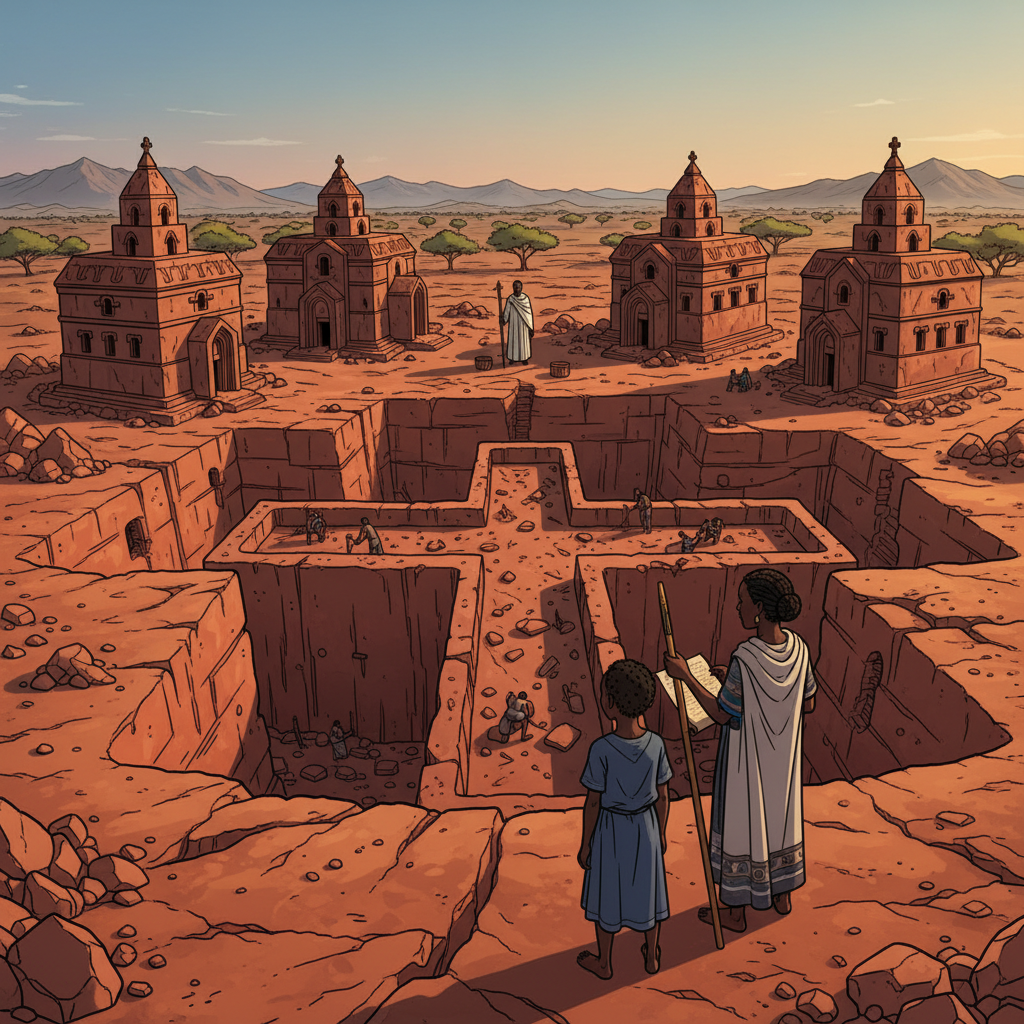
Senayit was thirteen years old, the daughter of Senait the engineer-mother and Tsegay the priest-father, and she had grown up at the edge of a hole in the ground. The hole was not yet a hole — it was the beginning of the eleventh church of Roha, the highland capital of the Zagwe-Agaw kingdom, in the year that men in other parts of the world were beginning to call 1155 of the common era. The other ten churches were either finished or being finished. The eleventh church — Bete Giyorgis, the Church of Saint George — was being carved cross-shaped down into the living red bedrock of the Habashat highland. Senayit's mother Senait was the engineer for the carve. The hole, by year two of the work, was already three storeys deep.
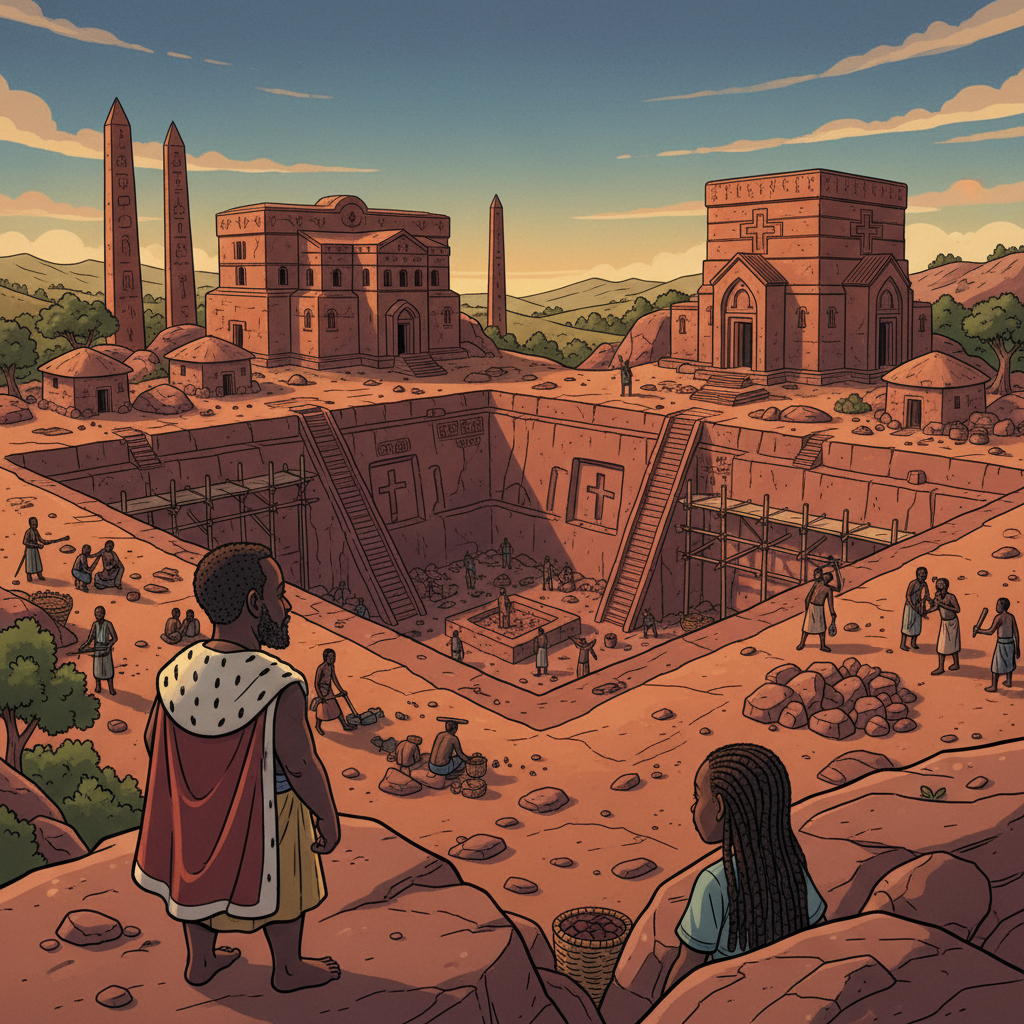
The Zagwe-Agaw dynasty had ruled the Habashat highlands for two centuries by the time the Roha-churches project began. King Lalibela of the Zagwe — a quiet stout man whom Senayit had glimpsed once from a distance, watching workers from a hillside — had inherited a kingdom that traced its Christian tradition unbroken back through Aksum, back through the trilingual stelae of Ezana eight centuries before, and ultimately back to the same Habashat highland-D'mt soil that had grown the Ge'ez script and the Aksumite obelisks. The eleven rock-churches were not imitation. They were a continuation. They were what came next when a people who had been carving stone for fifteen hundred years decided to carve a church down INTO the rock instead of UP out of it.
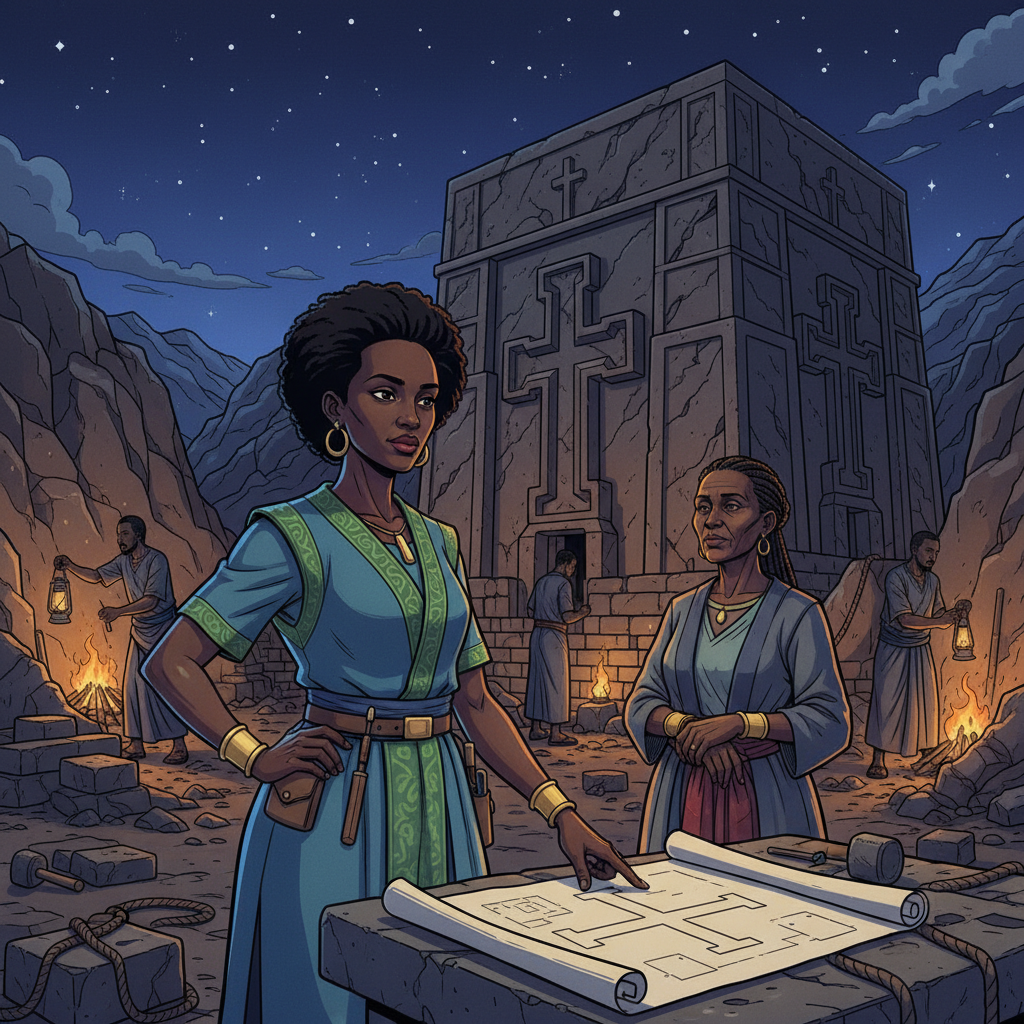
The work was African work from start to finish. The kingdom was African; the masons were Agaw and Habashat highland Christians; the bedrock was the volcanic basalt of the Lasta Mountains that had been forming under African sky for millions of years. Senayit's mother had been one of three engineers chosen by the king's council for the project. Of the three, Senait was the only woman, but the kingdom's tradition had always included women engineers in the temple-building trade — her own teacher, an old Aksumite master named Awet, had been a woman who had worked on the cathedral of Saint Mary at Aksum sixty years before. Senait was forty-two years old and had built six churches before this one. The seventh was Bete Giyorgis.
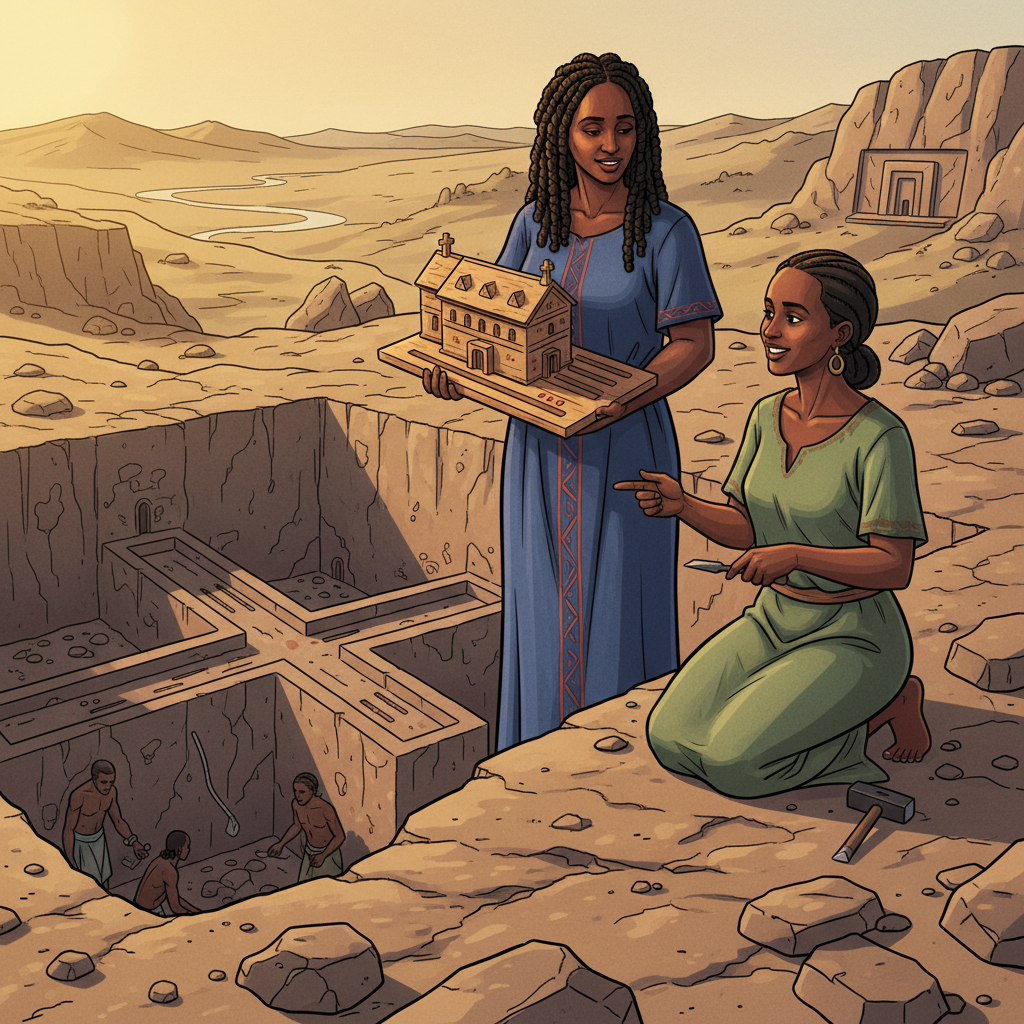
On the morning the story began, Senait was standing at the lip of the cross-shaped pit with a wooden scale-model in her hands. The model had been carved over the past four months by Almaz, the workshop's senior wood-carver, who was Senayit's aunt — Senait's younger sister. Almaz was thirty-eight, with strong shoulders from a lifetime of chisel-work, and she had drawn the church's drainage plan onto the cedar plank that became the model's base, then carved every channel into the wood at exact scale: five drainage channels running across the church's floor, exiting at five points along the south wall, each calibrated to a different rainfall volume. The model also showed, in fine red ochre, the calculated waterskins-per-rainstorm each channel could carry. The smallest could carry four hundred waterskins. The largest could carry two thousand.
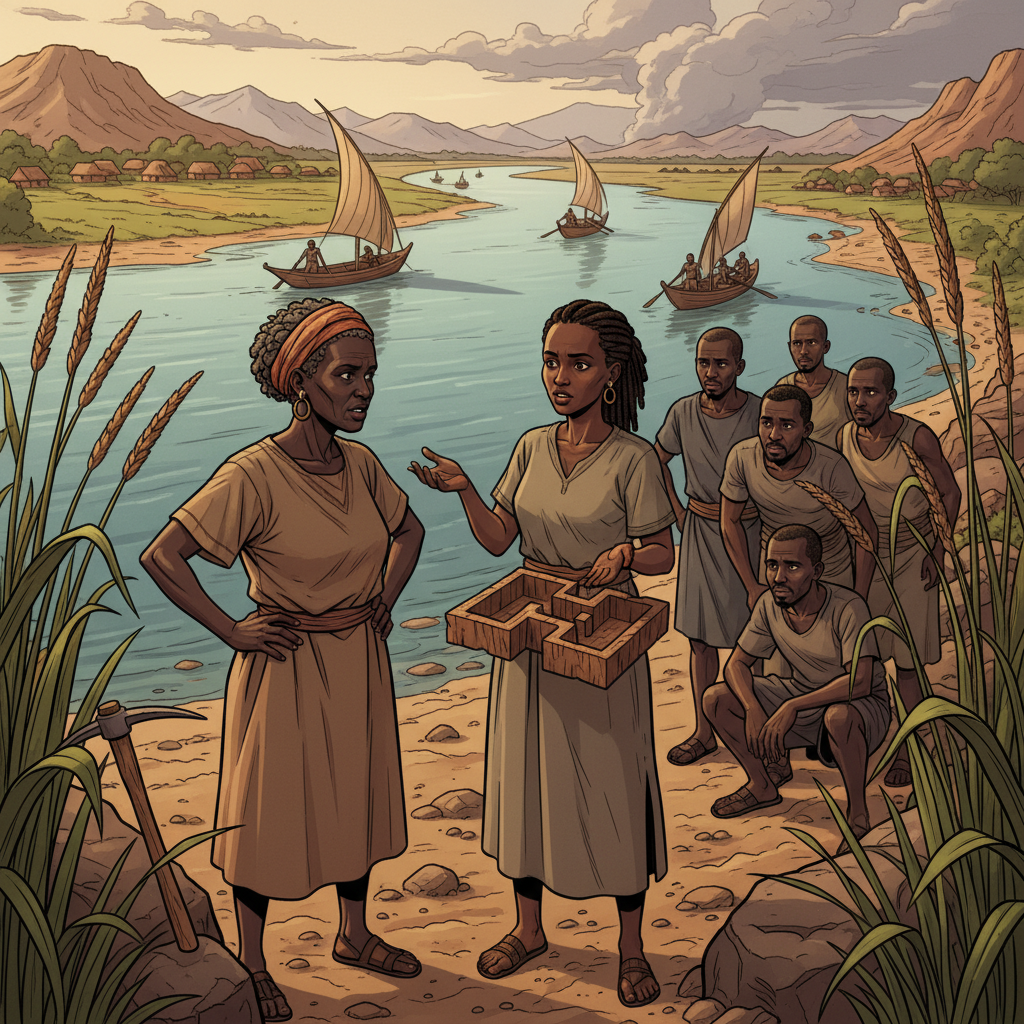
The workers had begun to mutter. The cross-shape was the deepest church yet attempted; the floor of the pit lay forty cubits below the rim. When the next rainy season came in three months, water would pour from the high country into the pit through cracks in the surrounding rock. Without drainage, the cross-shape would become a basin. The church would fill. The carving of the next two years would be done from inside a lake. The senior masonry-team lead, a sixty-year-old Agaw woman named Lewam who had been swinging the iron pick at Roha's rock-faces for thirty years, had walked the worry to Senait three days before. "The men are saying the church will flood," Lewam had said. "I do not believe it. But they need to hear from you what you have built."
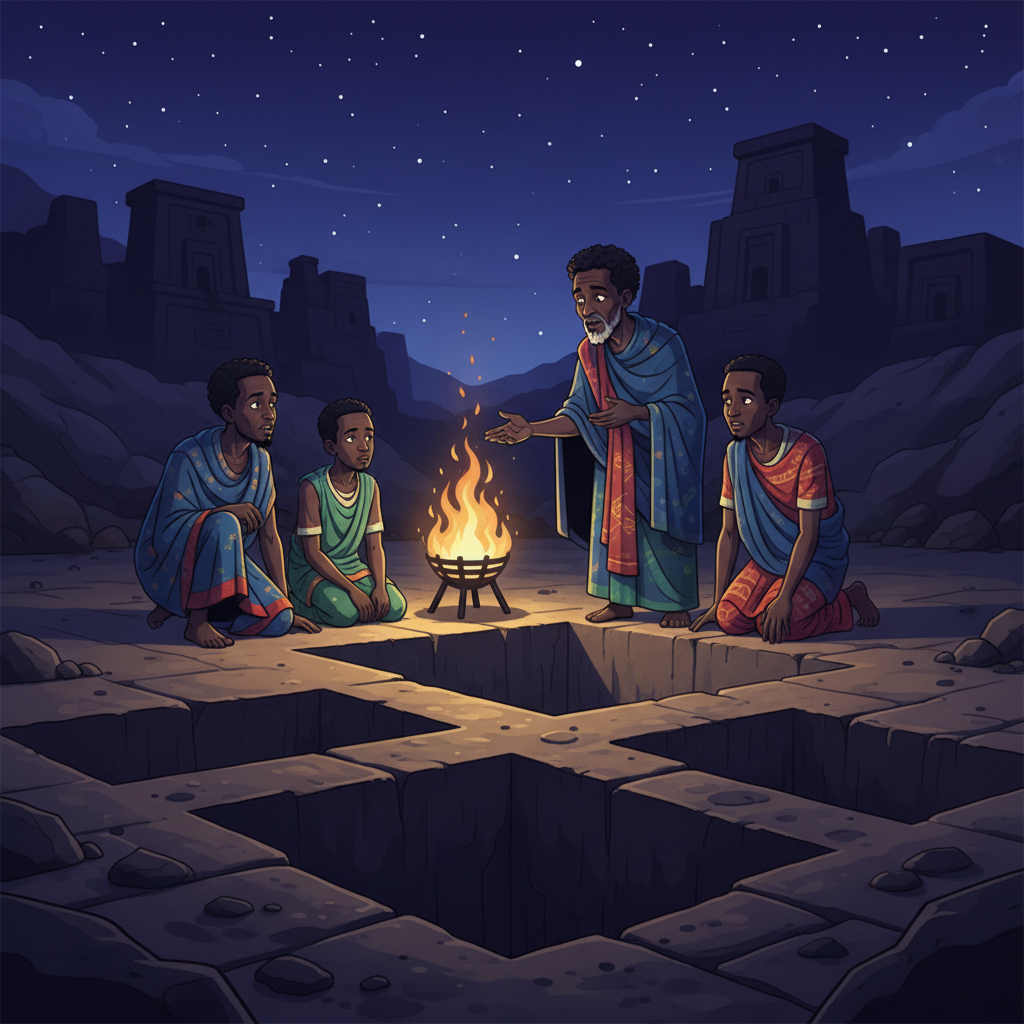
There was one worker Senait had not been able to reassure: Tewodros, the foreman of the rubble-removal team. Tewodros was sixty-five years old. He had been a young mason at the cathedral of Saint Mary at Aksum forty-five years before; he had crossed the highlands to Roha at the start of the eleven-churches project; and he had been at every one of the previous ten church sites. He was a respected elder. He was also — as Senait's teacher Awet had once said — "a man who hears the river the way an old fisherman hears it." Tewodros had walked the cross-shaped pit two weeks ago and had told Lewam, in front of three workers: "Water finds its way. No matter how clever your channels, the rains will fill this pit by the third year."
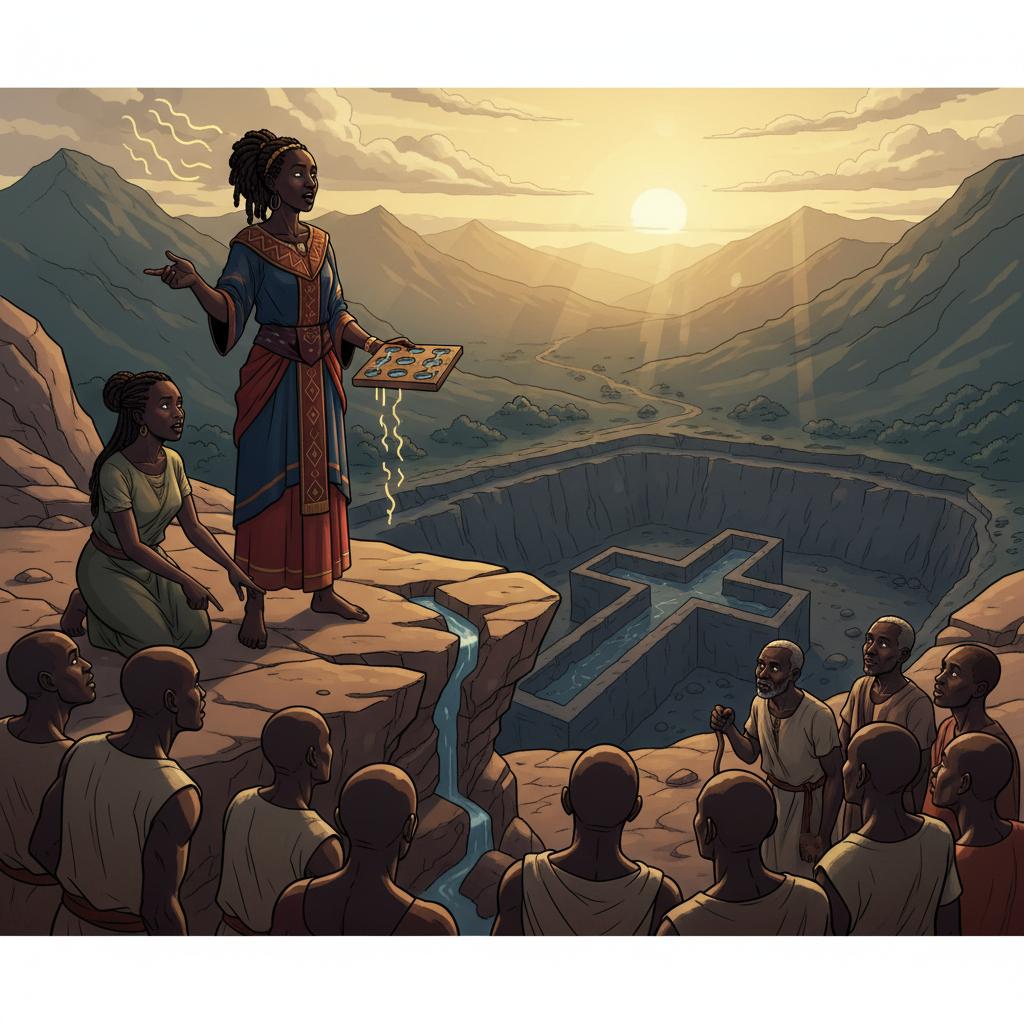
Senait had not argued with Tewodros. She had thanked him for the warning and gone back to her workshop. She had refined the channels in Almaz's model from four to five. She had increased the largest channel's capacity by a third. She had walked the surrounding hillsides with Almaz and identified two additional water-paths the rains would carry that she had not accounted for in the first design. She had then made the engineering decision she would not announce to the workers in words: she would announce the channels in the way a Habashat engineer of the older lineage had always announced sacred construction. She would sing them. The five channels would have their names carved into the church floor not in writing but in the morning mason's hymn.
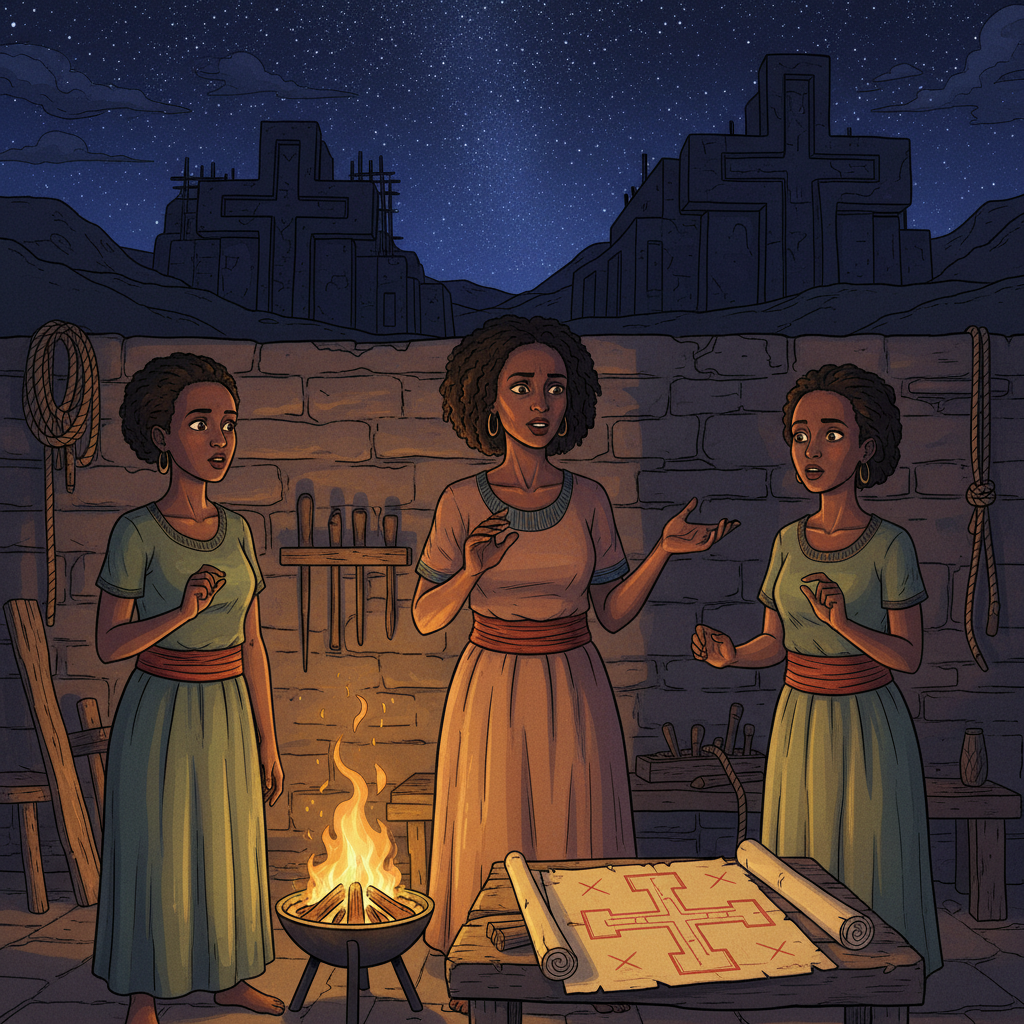
The morning mason's hymn was the call-and-response chant the workers sang at sunrise before each day's carving. Senait had learned it from her teacher Awet, who had learned it from her teacher, and so on back along the highland masonry-line for at least three centuries. The hymn had verses for each of the saints and each of the structural elements: foundation, wall, lintel, ceiling, dome. It had no verse for drainage. Senait had been adding a new verse in her head for three days. She had paired each of the five channels with a saint whose feast-day in the church calendar matched the channel's position relative to the cross-shape. By the night before the workers' meeting, she had the hymn-verse complete. She had taught it, in the workshop's back room, to Almaz and Lewam.
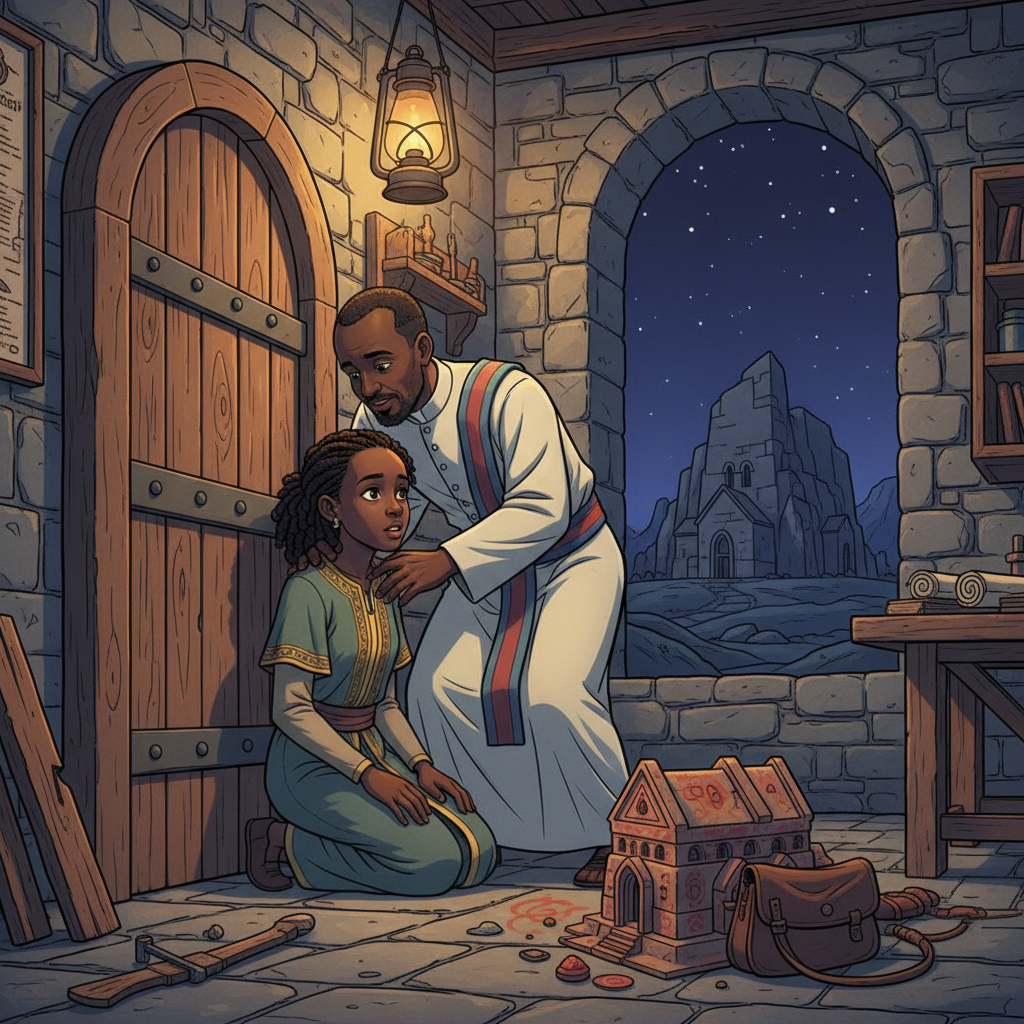
Senayit had been listening through the workshop door the whole evening. She did not knock. She was thirteen years old, the engineer's daughter, and her job at the work-site was to carry her mother's tool-satchel and to mark the model with red ochre when her mother called out a new measurement. She had been doing this since she was nine. She had memorized the morning mason's hymn by the time she was eleven. Late that night, after Senait had gone to bed and the workshop was quiet, Senayit's father Tsegay came to find her. He was a priest at the small Roha church-of-the-old-style — the one that had been built up out of stone, the way churches were built before her mother's generation began carving them down. Tsegay placed his hand briefly on the back of her neck. He did not speak. He had been a priest long enough to know when a child needed only that.
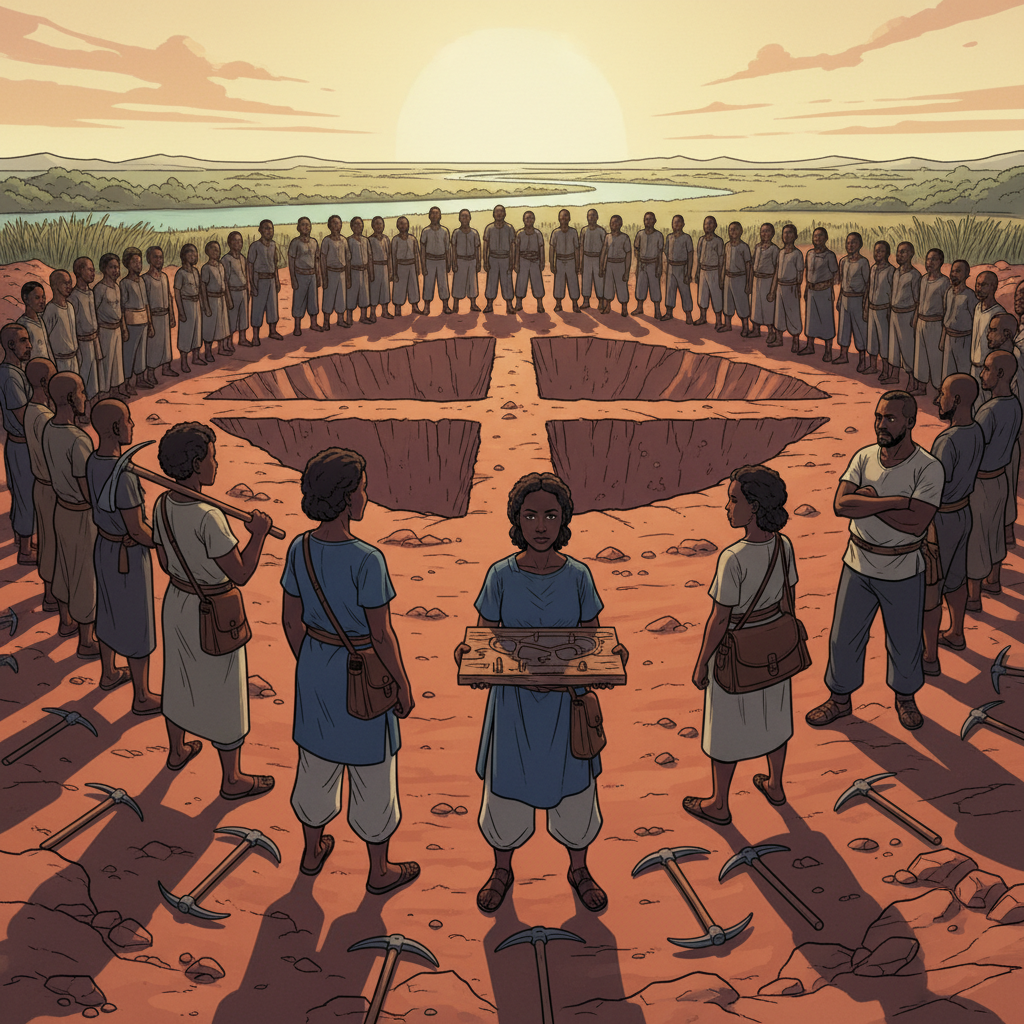
The next morning before sunrise, the workers gathered at the lip of the cross-shaped pit. Word had passed among them: the engineer would speak today about the flooding. Three hundred workers stood in a half-circle around the rim, their iron picks at their feet, their leather water-skins at their belts. Tewodros stood with his rubble-removal team at the eastern edge of the half-circle, his arms crossed across his chest. Almaz stood beside Senait holding the wooden drainage-model at chest height. Lewam stood on Senait's other side, her iron pick laid across her shoulder the way the masonry-team leads always carried theirs at the morning gathering. Senayit stood three paces behind her mother, holding the tool-satchel. The eastern sky was just beginning to turn the color of pale honey.
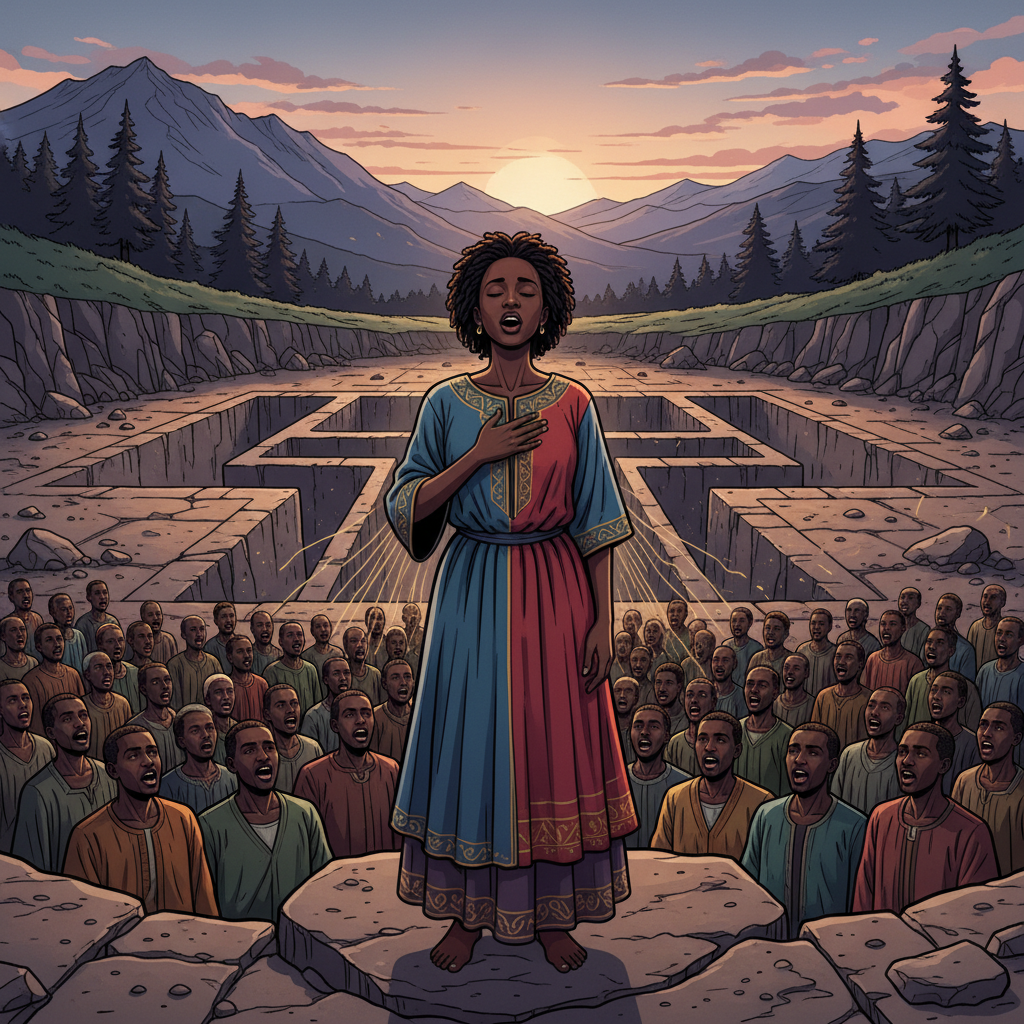
Senait did not raise the wooden model. She did not speak. She did what she did every morning at sunrise: she began the morning mason's hymn. Her voice was not loud. It was the careful steady alto of a woman who had been calling the hymn at work-sites for twenty years. She sang the opening invocation — the call to the Lasta Mountains, to the springs of the highland, to the cedar trees of the eastern slopes — and the workers, by reflex and by decades of practice, began the call-back. Three hundred voices in the chilly pre-dawn air, all of them landing on the same syllables their grandfathers and great-grandmothers had landed on. The hymn moved through its first three verses. The fourth verse was the structural verse — foundation, wall, lintel.
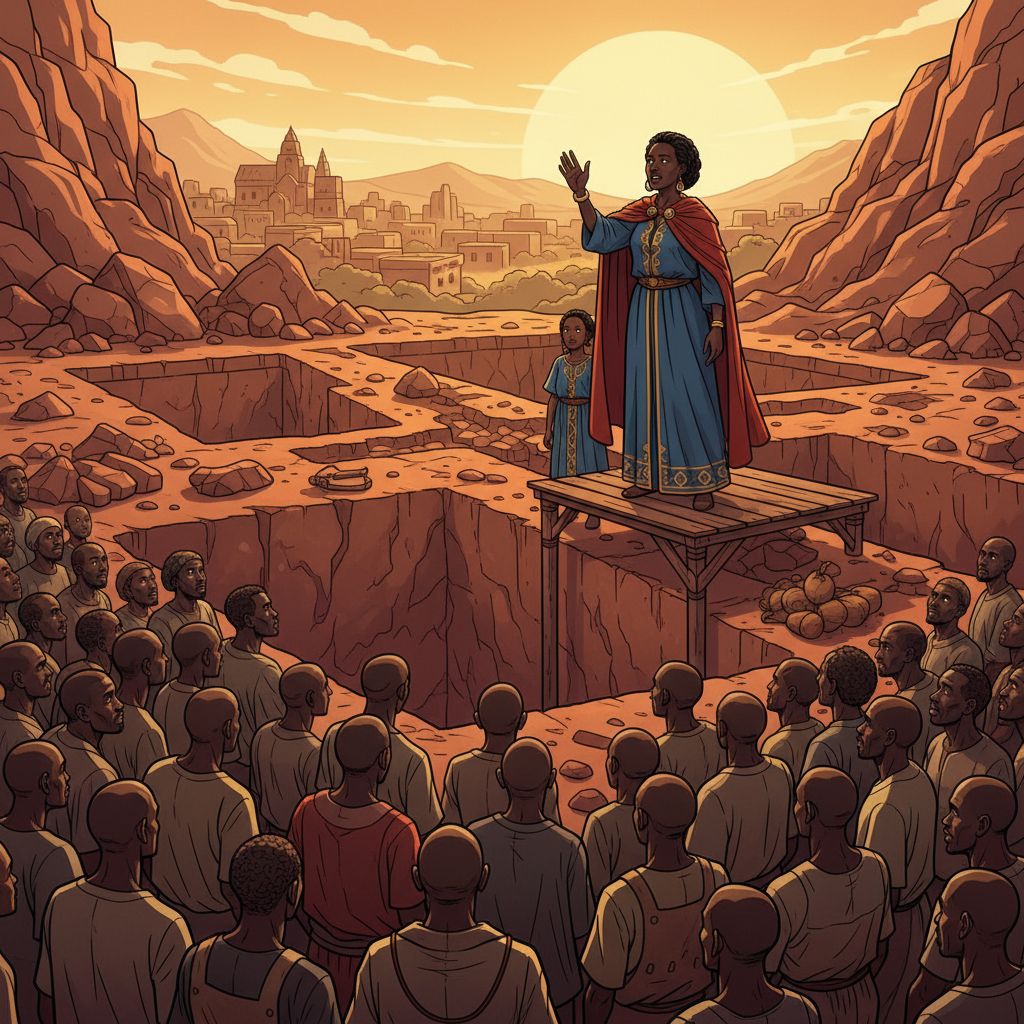
When Senait reached the fifth verse, the workers did not yet know what she would sing. She sang: "Saint Maryam covers the south-southwest gutter. Four hundred waterskins. The cross-arm will hold." She sang it on the same melodic line the structural-verse had used the morning before — the workers' ears recognized it as part of the hymn, as if it had always been part of the hymn. Then the response: "Saint Maryam holds." Three hundred voices came back. Senait sang again: "Saint Michael covers the east main. Two thousand waterskins. The crossing will hold." The workers: "Saint Michael holds." She sang each of the five channels in turn. Saint Gabriel for the west auxiliary. Saint Mercurios for the north-northeast diagonal. Saint Yared for the central drain at the cross's heart.
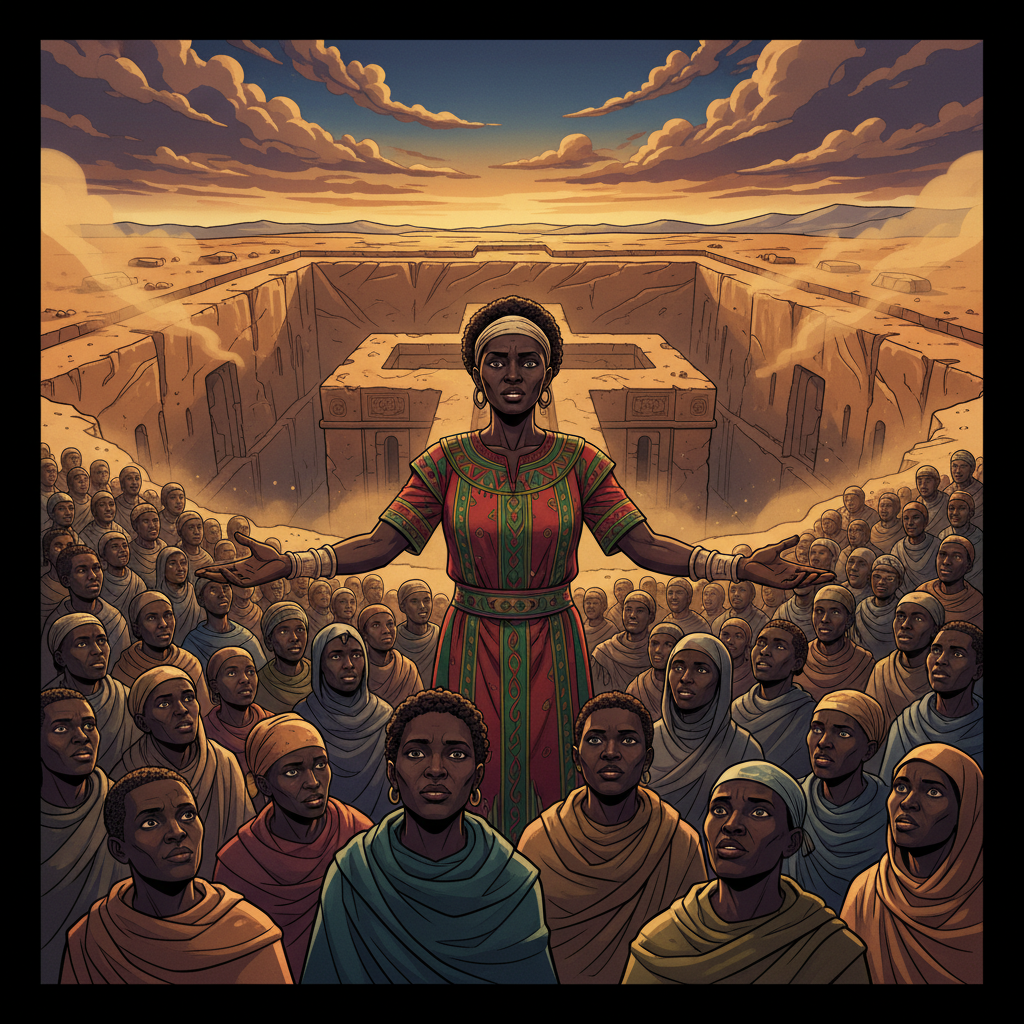
Lewam, on Senait's right, had been singing the response with the rest of the workers, but her voice had been the one carrying the loudest. She was a masonry-team lead — her job in the morning hymn was to call the response, the way the engineer called the verse. When the fifth channel was named, Lewam stepped forward one pace and spoke, not sang: "Saint Yared holds. We begin carving the central drain today." Three hundred workers heard the sentence. They knew, without further explanation, that the morning hymn had just been amended for the rest of the project. They knew that the drainage would be carved into the church the way the church was being carved into the rock: as part of the hymn, as part of the order, as part of the unbroken Habashat sentence the highland had been speaking for fifteen hundred years.
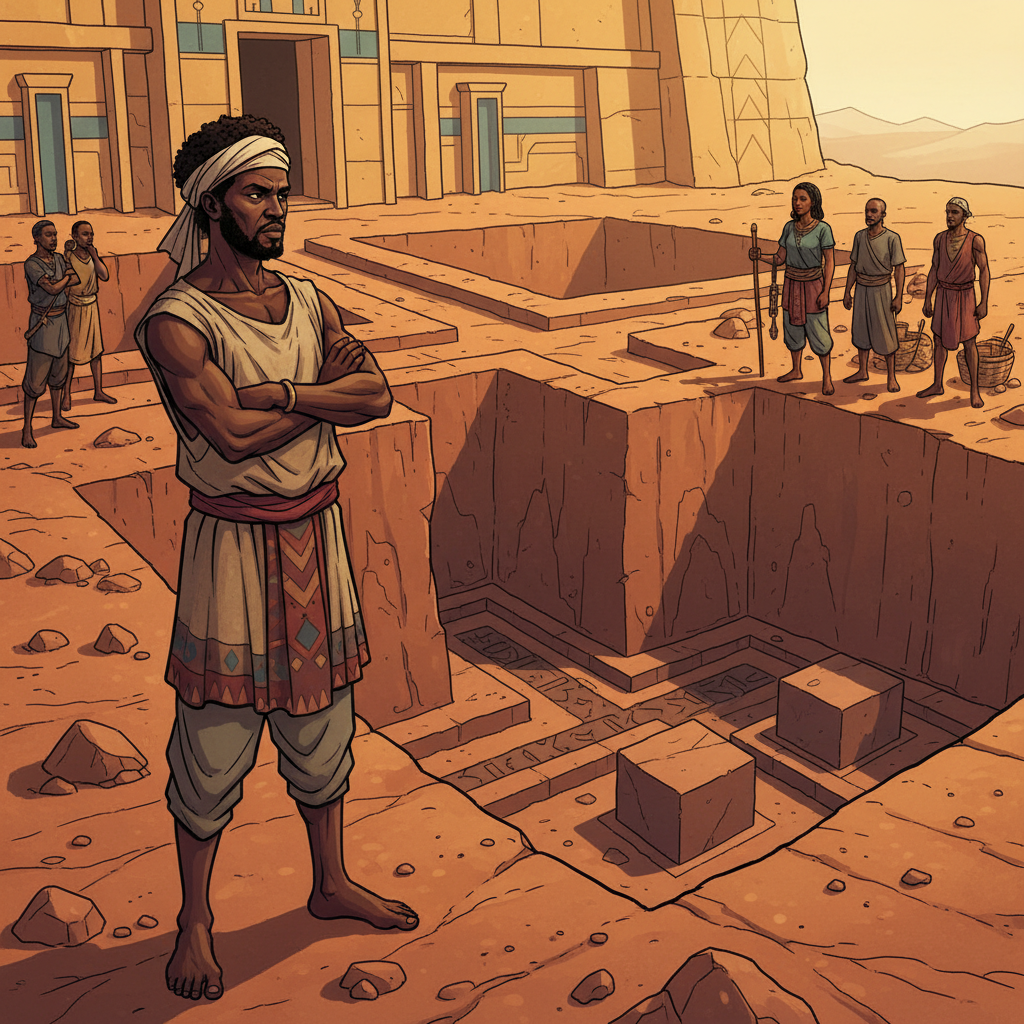
Tewodros stood at the eastern edge of the half-circle with his arms still crossed across his chest. He had not sung the new verse. The workers around him had sung it, but Tewodros had been silent. When Lewam stepped forward and announced the central-drain carve, Tewodros uncrossed his arms. He looked at Senait across the cross-shaped pit. He nodded once, very slowly, to acknowledge that the morning meeting had ended. Then he turned to his rubble-removal team and began the day's work as he always did. He did not approve. He did not protest. He held his position the way an old fisherman holds his — not against the river, but inside it. He would carry his belief that water finds its way for the rest of his life. The work would proceed regardless. The hymn had named the channels.
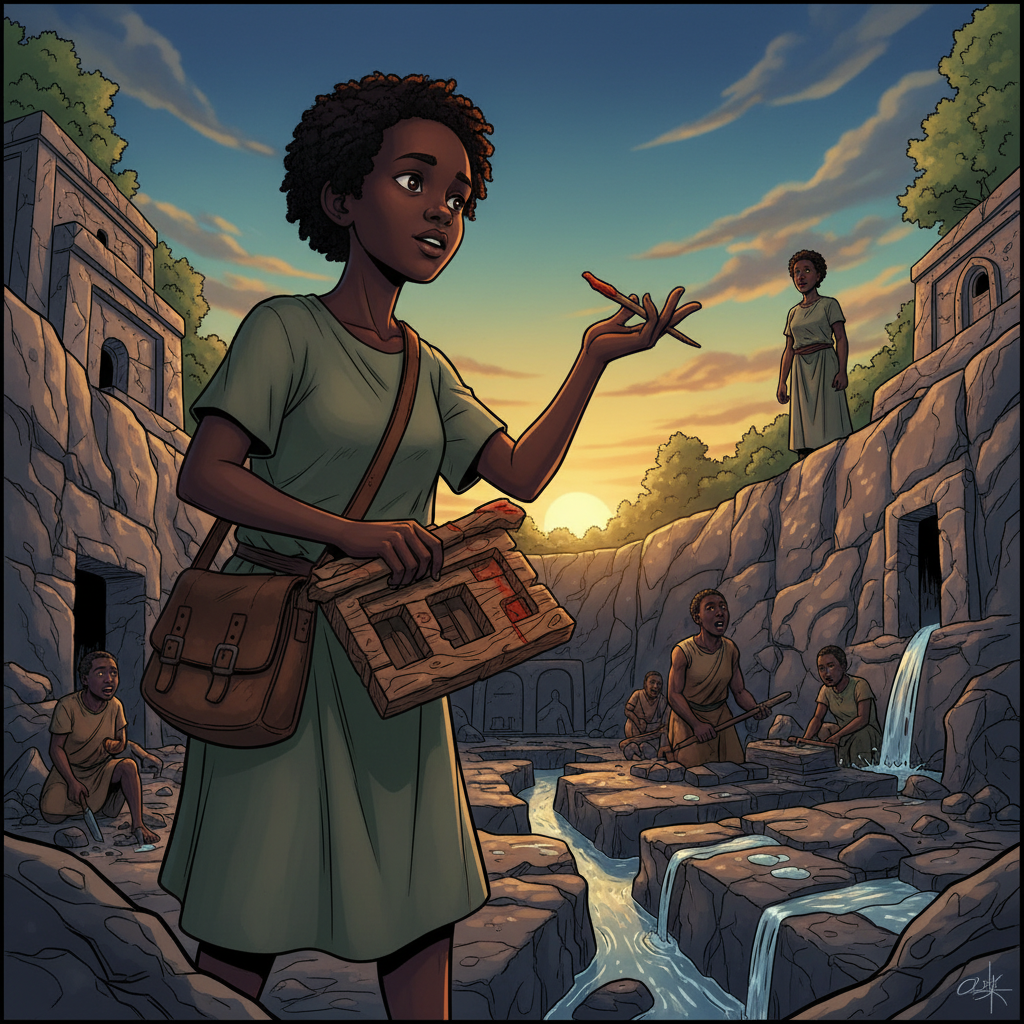
The carving of the five drainage channels took six weeks. Lewam led the masonry-team. Senait directed the cuts from the rim and descended into the pit twice each day to inspect the work. Almaz refined the model as new conditions emerged. Senayit carried the satchel, marked the model with red ochre, and learned — without anyone teaching her formally — that an engineer's most important tool is the morning hymn the workers already know. The channels were finished four weeks before the first rains of the long-season. When the rains came, water entered the pit through the cracks in the surrounding rock as Senait had predicted, was caught by the channels, and exited through the five south-wall openings as the workers sang the morning hymn each dawn. The church did not fill.
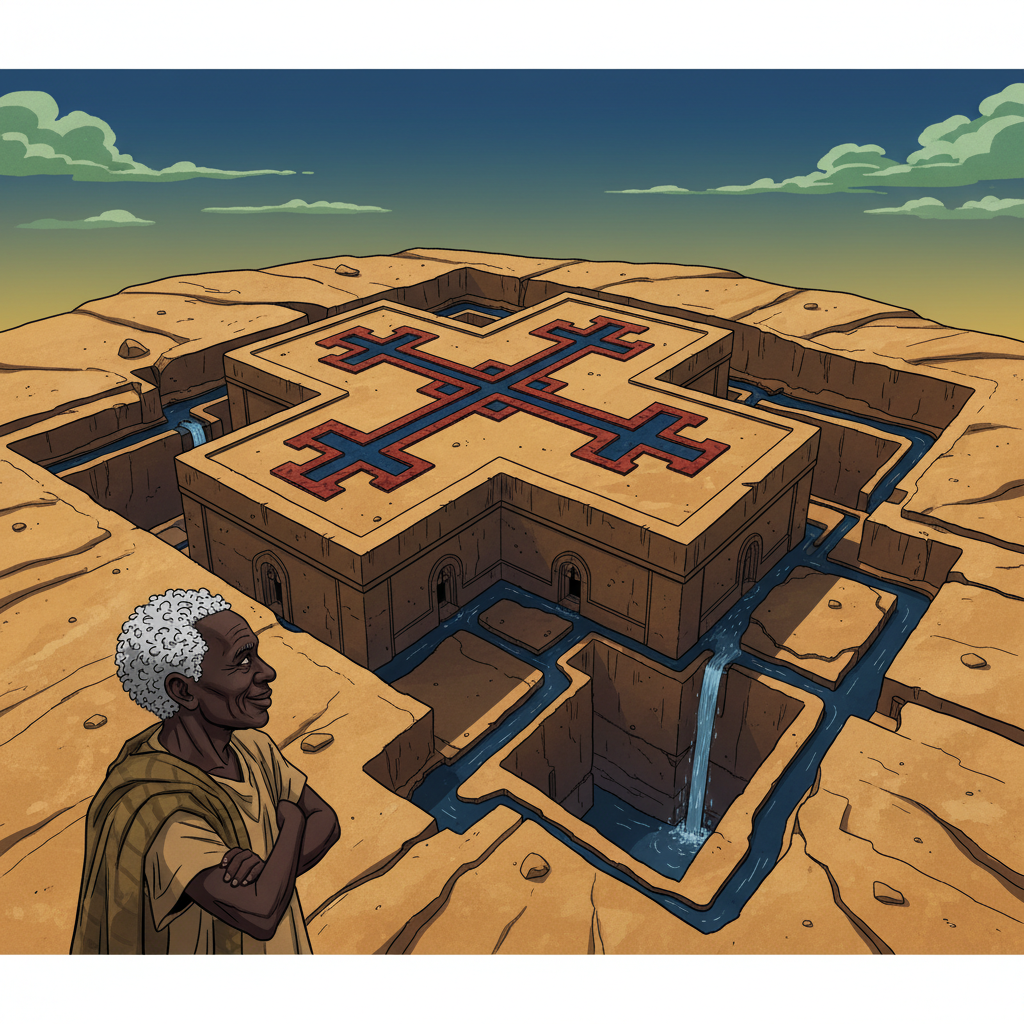
The carving of Bete Giyorgis continued for three more years. The cross-shape was completed. The interior was hollowed and finished. The roof — which was the original ground-level surface, now carved into the cross-shape of the church's sky-side — was decorated with the four Greek crosses that would be visible only from above, only to the birds and to whoever came centuries later from much further than the birds, looking down. Tewodros continued his rubble-removal work for the next two years. He did not change his position about the drainage. He watched each rainy season pass with the channels carrying the water cleanly to the south wall. He retired the year before the church's consecration. He did not attend the dedication. He did not need to.
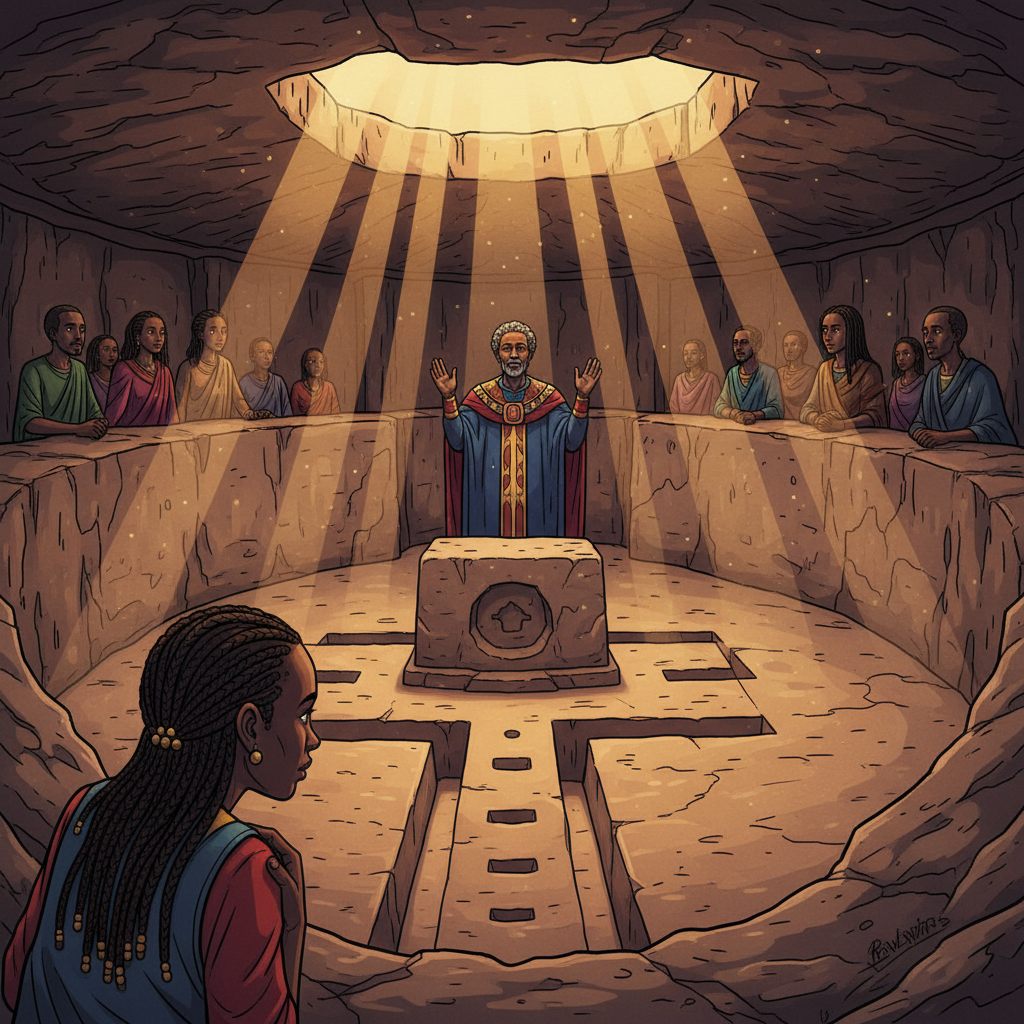
The consecration of Bete Giyorgis took place on a bright morning in the dry season of Senayit's seventeenth year. King Lalibela of the Zagwe — a quiet man, then in his sixties — descended into the finished church-pit briefly to bless the eastern altar. He spoke for less than a minute. Senayit, who was standing at the rim with her mother and Almaz and Lewam, did not catch the king's words. She did not need to. The church stood. The five drainage channels exited cleanly along the south wall. The morning mason's hymn, with its new fifth verse, had been the hymn of every dawn at the site for three years and would be the hymn of every dawn at Roha for as long as masons sang. Order was not the king's blessing. Order was the rock revealed in its true shape. Order was the church that drained because every drop had been listened to.
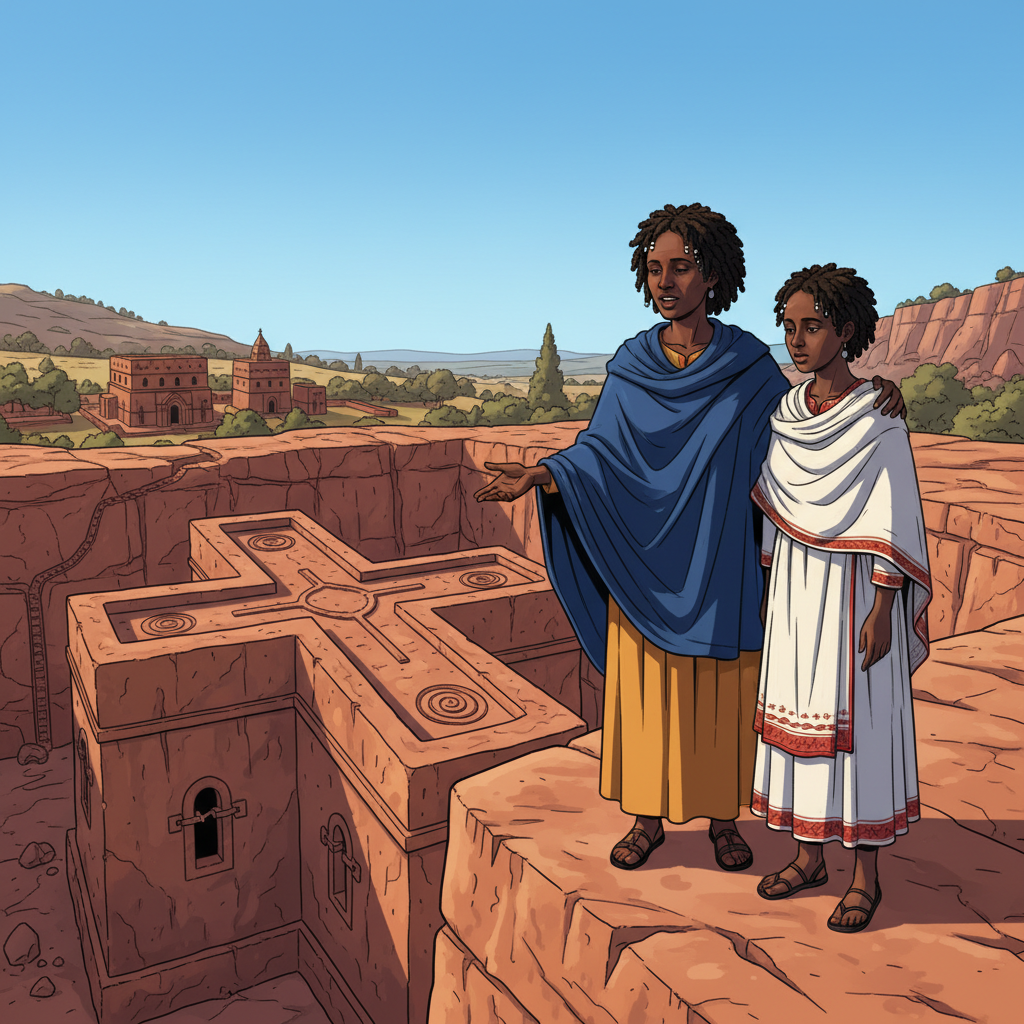
Senait stood at her daughter's side at the rim and said, very quietly: "The rock was already this shape. We only removed what was not church." She had said this many times during the carving — to the workers, to Almaz, to Lewam, to herself. She said it again now. Senayit had heard the line so often by then that she barely noticed it. It would be twenty more years before she fully understood what her mother had been teaching her. Our churches are not built. They are revealed. That was Order in the highland-Habashat reading: not a thing imposed from outside, but a thing already true in the world, waiting to be heard. The hymn had been in the rock. The drainage had been in the rock. The cross had been in the rock. The engineers had not invented anything. They had only listened.
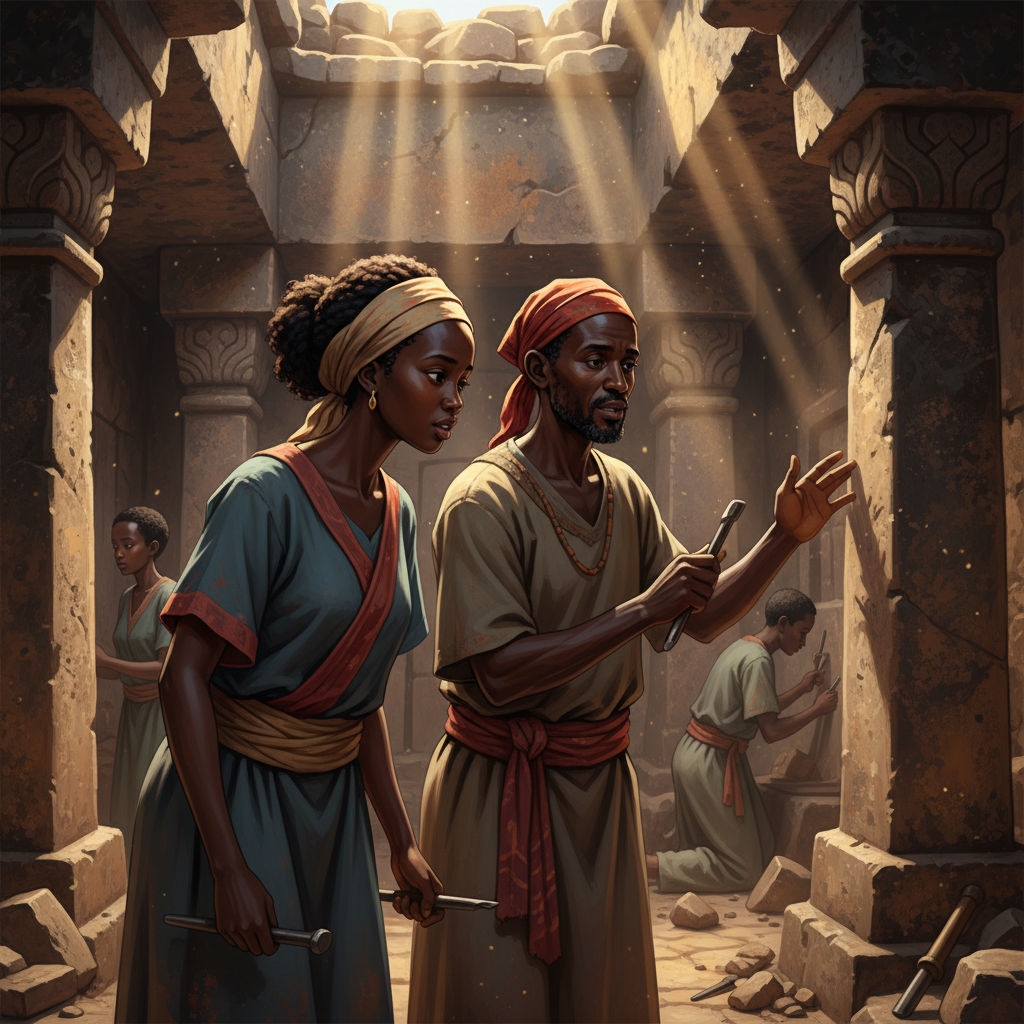
Eight years passed. Senayit became a working engineer in her own right. She did not stay at Bete Giyorgis. She moved across the eleven-church complex to Bete Maryam — a different church entirely, the church dedicated to the Virgin Mary, which had been partially carved before the Bete Giyorgis project began and which still needed finishing on its inner colonnade and its east apse. She worked under Ato Aregawi, a fifty-year-old master engineer who had trained in Aksum before the Roha project began. Aregawi was a quiet, steady man who had no opinion about whether women should be engineers because women had been engineers in the highland tradition his whole life. He simply taught his apprentices the work. Senayit was one of three apprentices under him. The other two were a young man named Senebkay and a young woman named Tirhas.
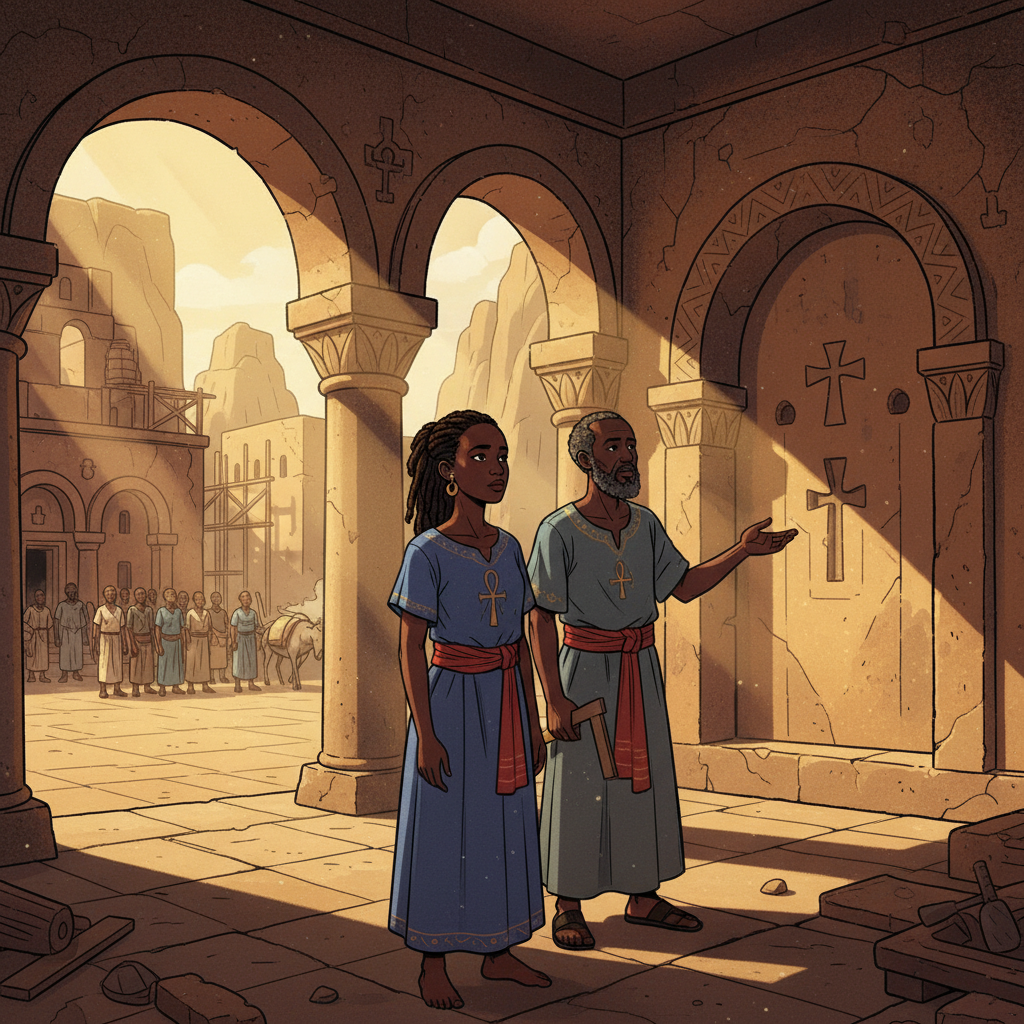
On a cool morning in the dry season of Senayit's twenty-fifth year, she was standing in the inner colonnade of Bete Maryam, watching the first sunlight strike the carved arch of the east apse. The workers at the morning gathering had just finished the morning mason's hymn — the same hymn she had learned from her mother, with the new fifth verse for drainage that had been part of the hymn at all eleven church sites for the past eight years. The verse had spread from Bete Giyorgis to every site in the complex. Workers at distant Aksumite cathedrals had begun singing it after travelers carried it north. The new verse was now part of the highland masonry tradition the way Saint Mary herself was. It would be sung at Habashat work-sites for the next eight centuries.
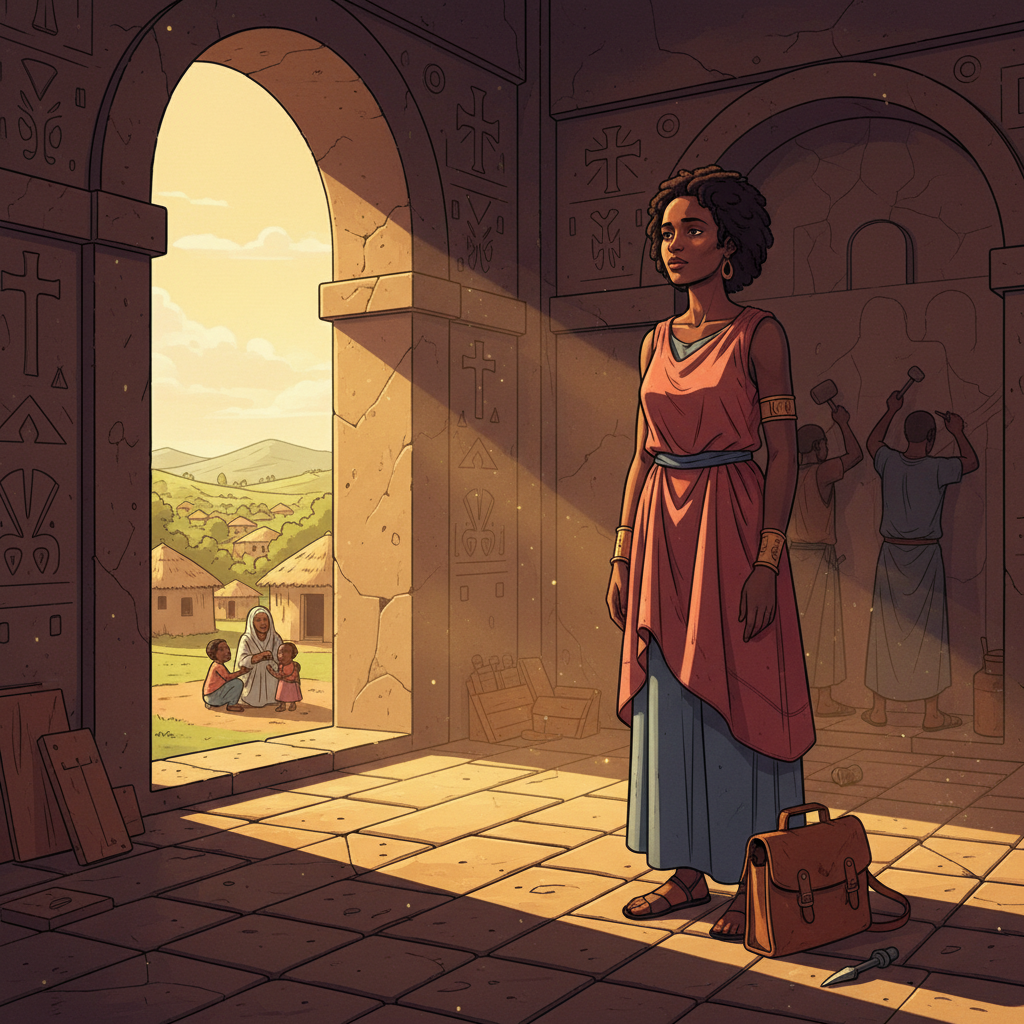
Senayit stood in the colonnade for a long moment after the hymn ended. She listened to the workers begin the day's carving. She thought about Tewodros, who had died four years before, never having sung the fifth verse. She thought about her mother Senait, who was still alive at Roha but who no longer worked at the sites — Senait taught now, in the workshop near the family quarters, training the next generation of women engineers the highland would need. Almaz had taken over the wood-carving for all of Roha's active sites. Lewam had retired the previous year and now lived with her grandchildren in the lower-town. The work continued. The rock continued to be listened to. Senayit picked up her tool-satchel from the colonnade floor. She walked toward the eastern apse where the day's first cuts were beginning. The church was already this shape. She would only help remove what was not church.