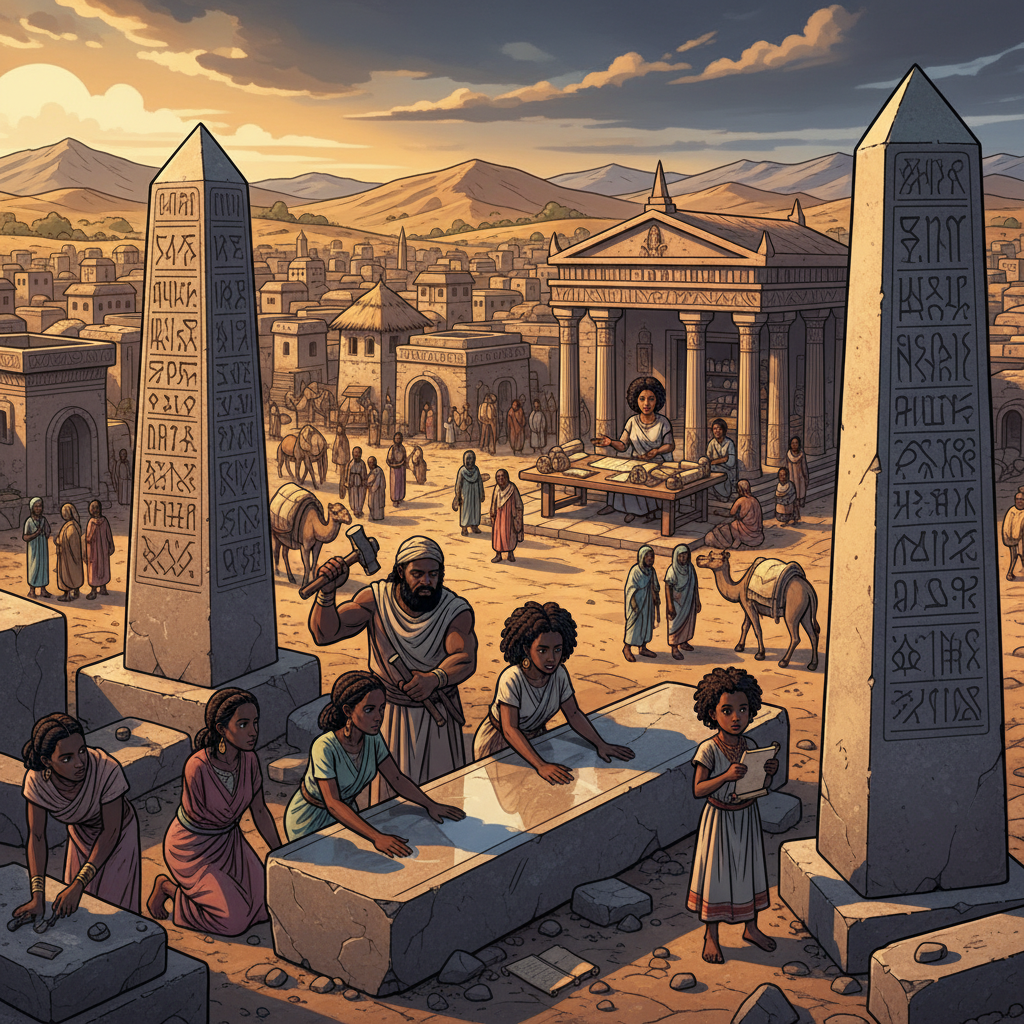
Selama was thirteen years old and the daughter of two crafts. Her mother Mahibere led the polishing-team in the royal stonecarvers' workshop of Aksum — the women who finished the mirror-smooth back faces of every great stela the kingdom raised. Her father Yohannes was Aksum's master stonecarver, the man whose chisel had cut the inscriptions on three of the great obelisks of the royal necropolis. Selama had been hanging around the workshop since she was four. She had been studying scripts at the royal archive since she was eight, under the senior Aksumite scribe Tsion — a woman in her mid-thirties who served the royal house's record-keeping in three languages: Ge'ez, Greek, and Sabaean. The Aksumites — the people of the highlands, who called themselves Habashat in their own tongue — sat at the crossing of three trading worlds, and every commission Selama had ever watched her father carve had touched at least two of them.
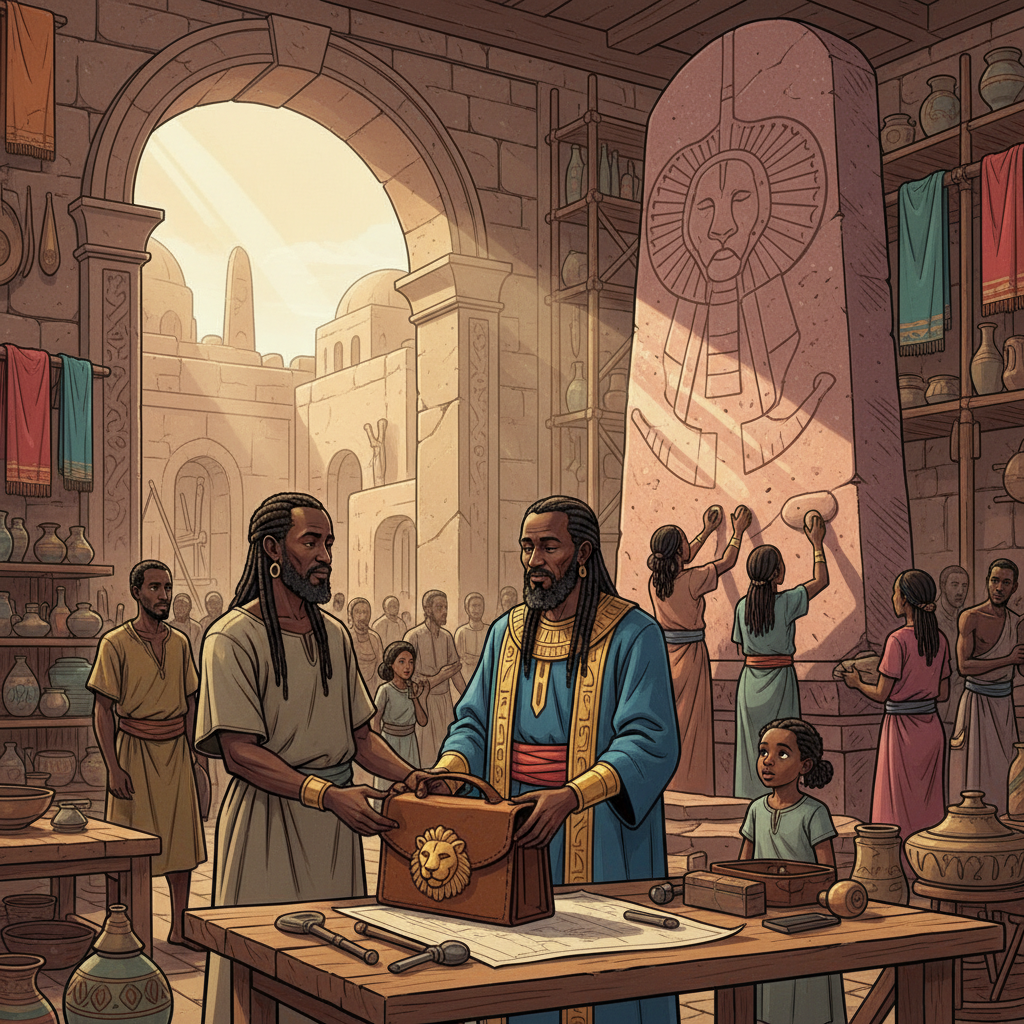
The commission arrived on a cool morning in the dry season. A royal courier walked into the workshop with a sealed leather case from the palace. Inside the case was the contract for King Ezana's great victory-stela — a single monumental block of pink Aksumite granite, twelve cubits tall, that would be raised in the central plaza of the royal city to commemorate the king's recent campaign. The stela would carry the king's victory-text in three scripts: Ge'ez, which was the script of the Habashat people; Greek, which was the script of the eastern Mediterranean trade and the Roman-Byzantine court; and Sabaean, which was the script of the southern Arabian peninsula across the Red Sea. Three scripts. One stone. Yohannes read the contract twice. He set it down on the cedar work-table. He said, very quietly: "The stone is barely large enough."
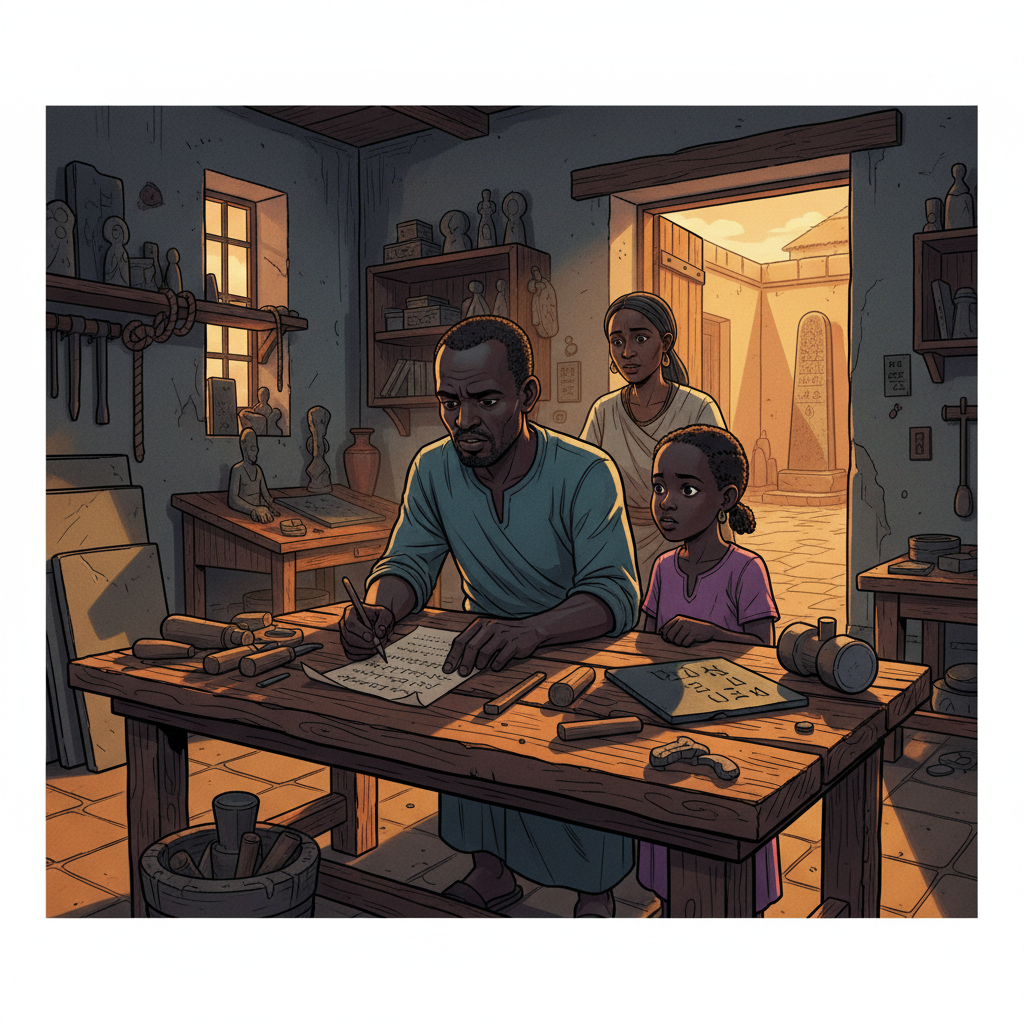
Selama heard her father's words from her usual seat by the workshop's eastern window. She had been practicing Ge'ez characters on a flat piece of slate. She set down her chalk. She walked to the work-table. Her father did not look up immediately. He was studying the stone-dimensions written in the contract's margin, doing the arithmetic of how three columns of script would have to fit on a face only twelve cubits tall by four cubits wide. Mahibere came in from the courtyard where she had been overseeing the polishing of a smaller funerary stela. She looked at the contract. She looked at her husband's face. She did not speak. She knew, the way she always knew, what was happening in Yohannes's mind. He was thinking of refusing the commission. He had refused only twice in twenty-five years.
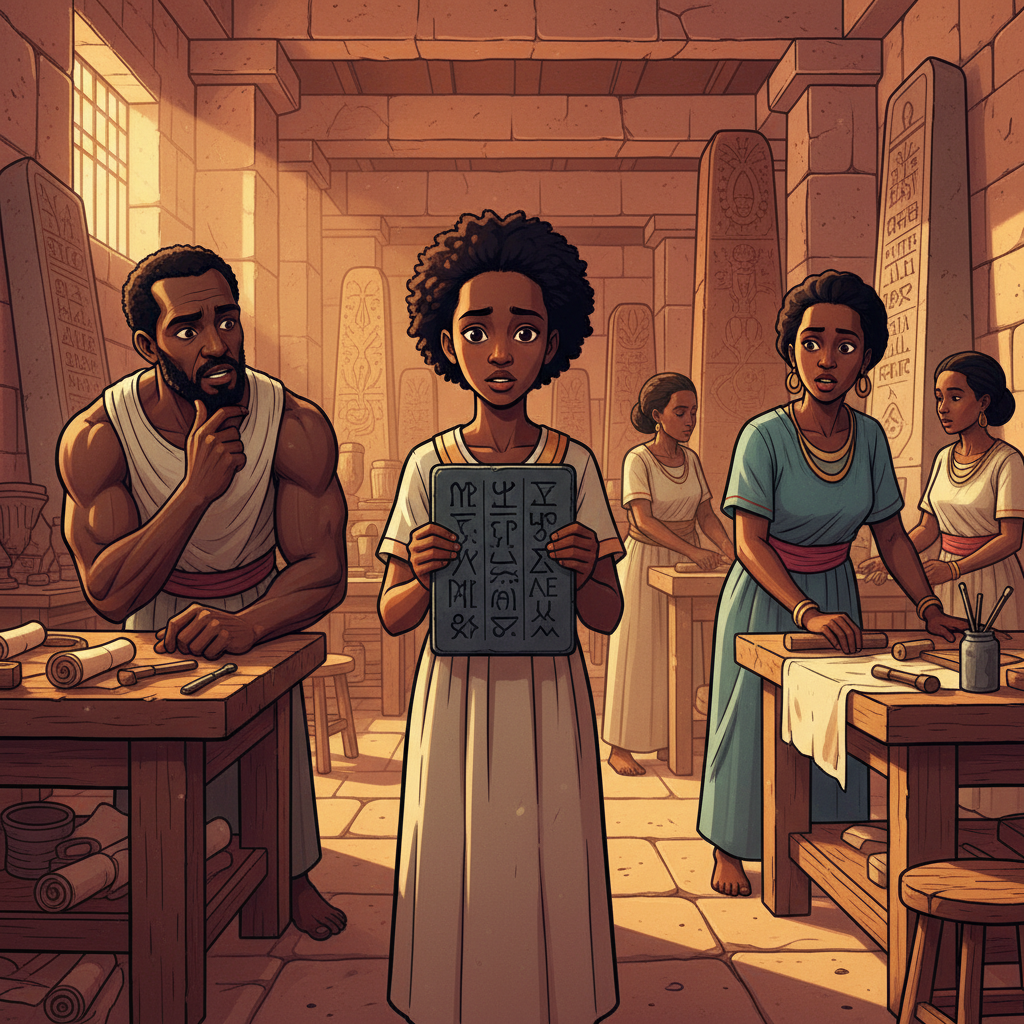
"Father," Selama said. Her voice came out very small. Yohannes looked up. Mahibere looked at her too. Selama said: "I have been studying the Ge'ez letter-forms with Tsion at the archive. The Ge'ez characters are wider than Greek characters. They take more space sideways but less space vertically because we do not write the vowel-marks above and below the line the way Greek does — we write them inside the consonant. The Sabaean characters are narrowest of all. If you give Ge'ez the position of honor — the central column, full-height — and put Greek on the right at three-quarters width and Sabaean on the left at two-thirds width, all three scripts will fit. None subordinate. None squeezed. The Habashat script in the lead." She paused. "I have been trying it on slate for a week."
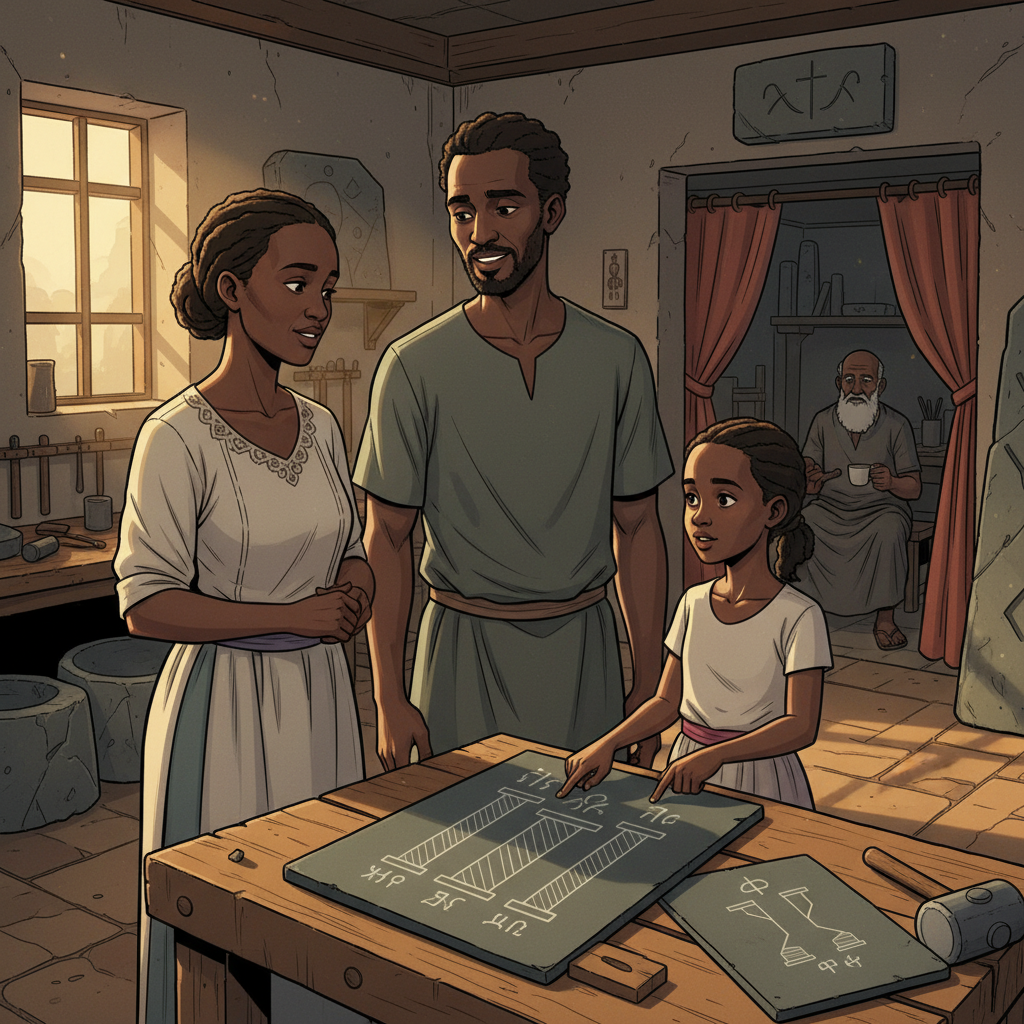
Yohannes looked at his daughter. He looked at Mahibere. Then he looked at the contract again. He picked up a fresh piece of slate from the worktable. He sketched, quickly, the three-column layout Selama had just described. The proportions worked. He had not seen it because he had been thinking about the proportions the way the previous master had taught him — Greek in the center, the prestige script of the Mediterranean trade, with Ge'ez and Sabaean to the sides. The previous master had been a man named Atsbeha, who had taught Yohannes when Yohannes was Selama's age. Atsbeha was now eighty-three and retired in the workshop's back room with his teas. The old man had been a great carver. But the old man had also been wrong about which script belonged in the center.
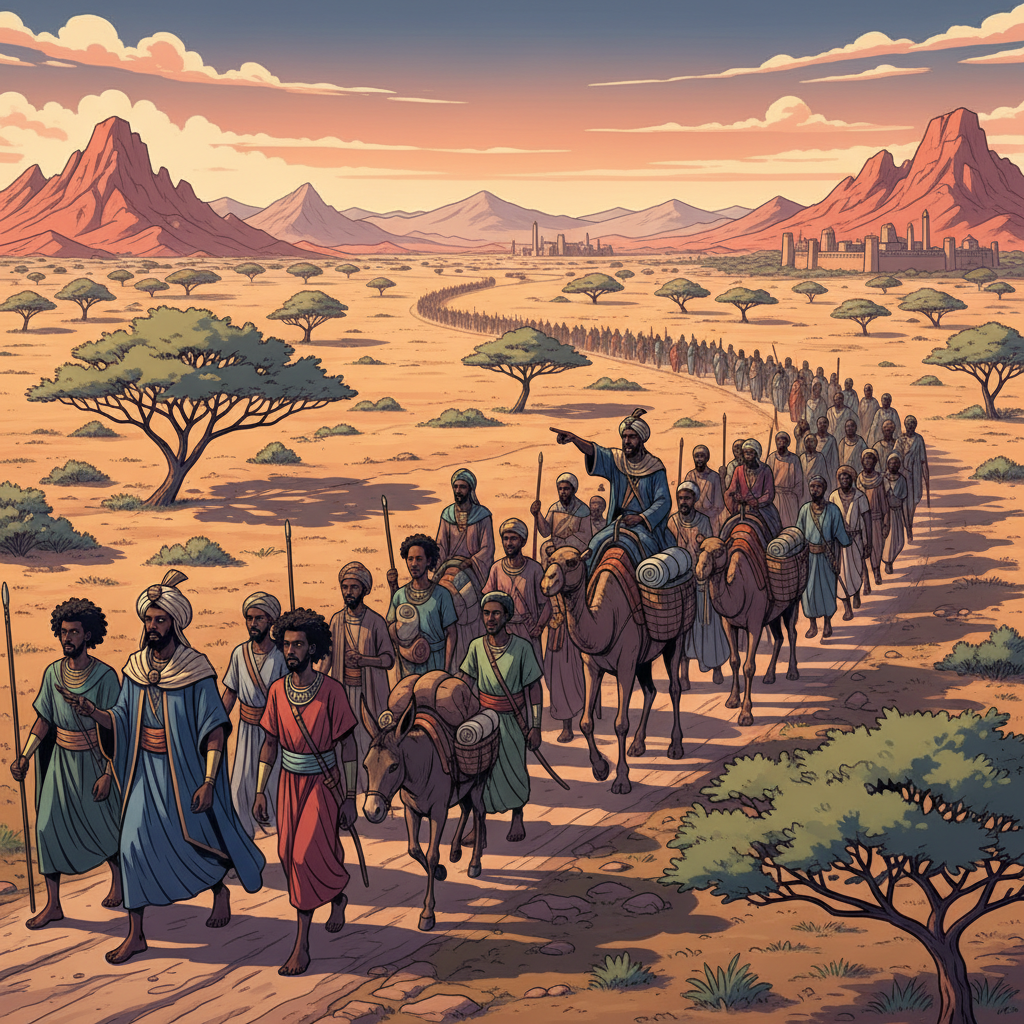
"The court will object," Yohannes said. He was speaking to Mahibere now, not to Selama. "Hamad-ibn-Saba will object. He is the king's senior Sabaean scribe. He has been arguing for Sabaean primacy on every royal inscription for the past fifteen years. He will say Ge'ez is too new, too small, too local — that it is derived from Sabaean and does not deserve the center column." Mahibere was quiet for a moment. Then she said, gently: "Atsbeha believed that too. So did his teacher. Yet our daughter has been studying with Tsion, who has been studying the old D'mt inscriptions in the southern hills. Take this layout to Tsion before you take it to Hamad. Hear what Tsion has to say."
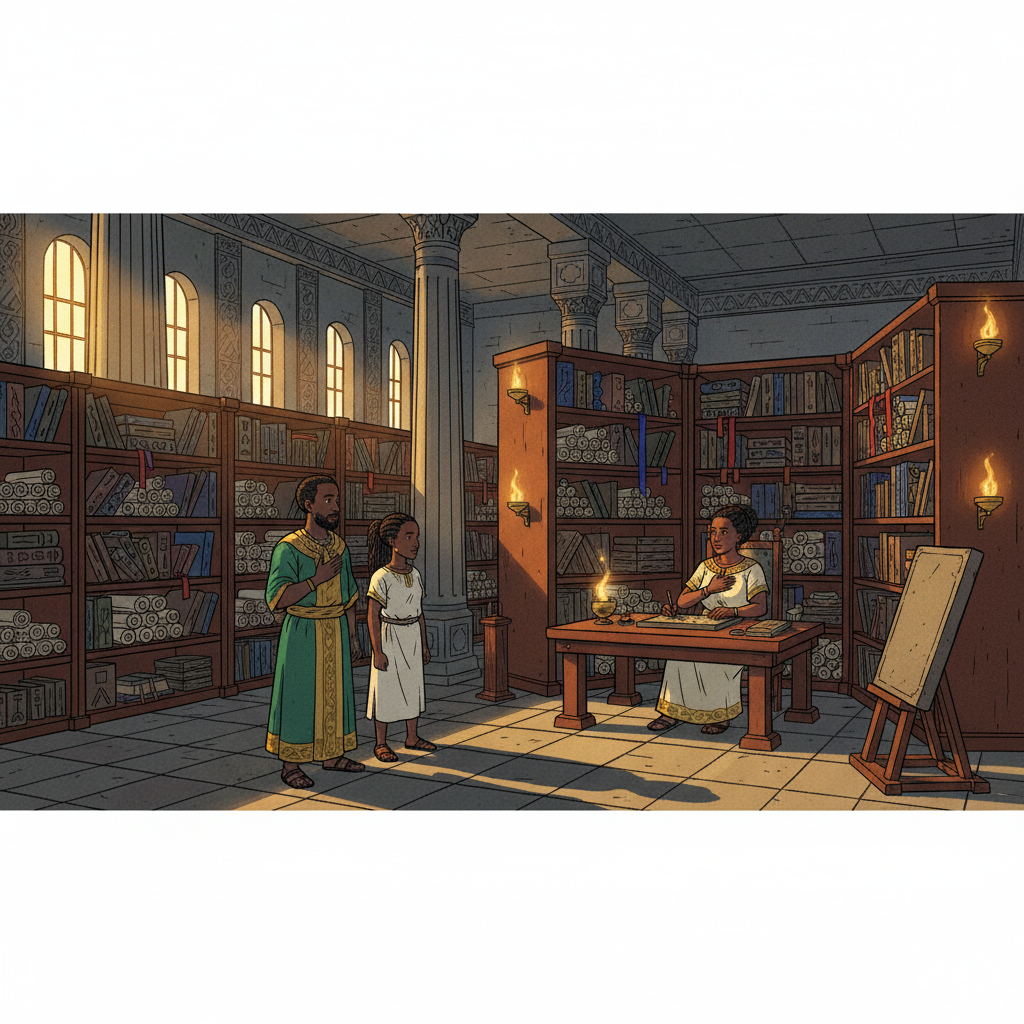
That afternoon, Yohannes and Selama walked together to the royal archive — a long stone building in the lower part of the city, with high windows on the eastern wall and rows of cedar shelves holding scrolls and inscribed wooden tablets. Tsion was at her writing-desk in the back room when they arrived. She was thirty-six years old, a senior Aksumite scribe, and she had been Selama's teacher for five years. She greeted Selama with the small Habashat acknowledgment-nod given between a teacher and a student who was beginning to know her own mind. Then she greeted Yohannes with the formal Aksumite hand-to-heart. She listened to him explain the commission and Selama's proposed layout. She did not speak until he was done.
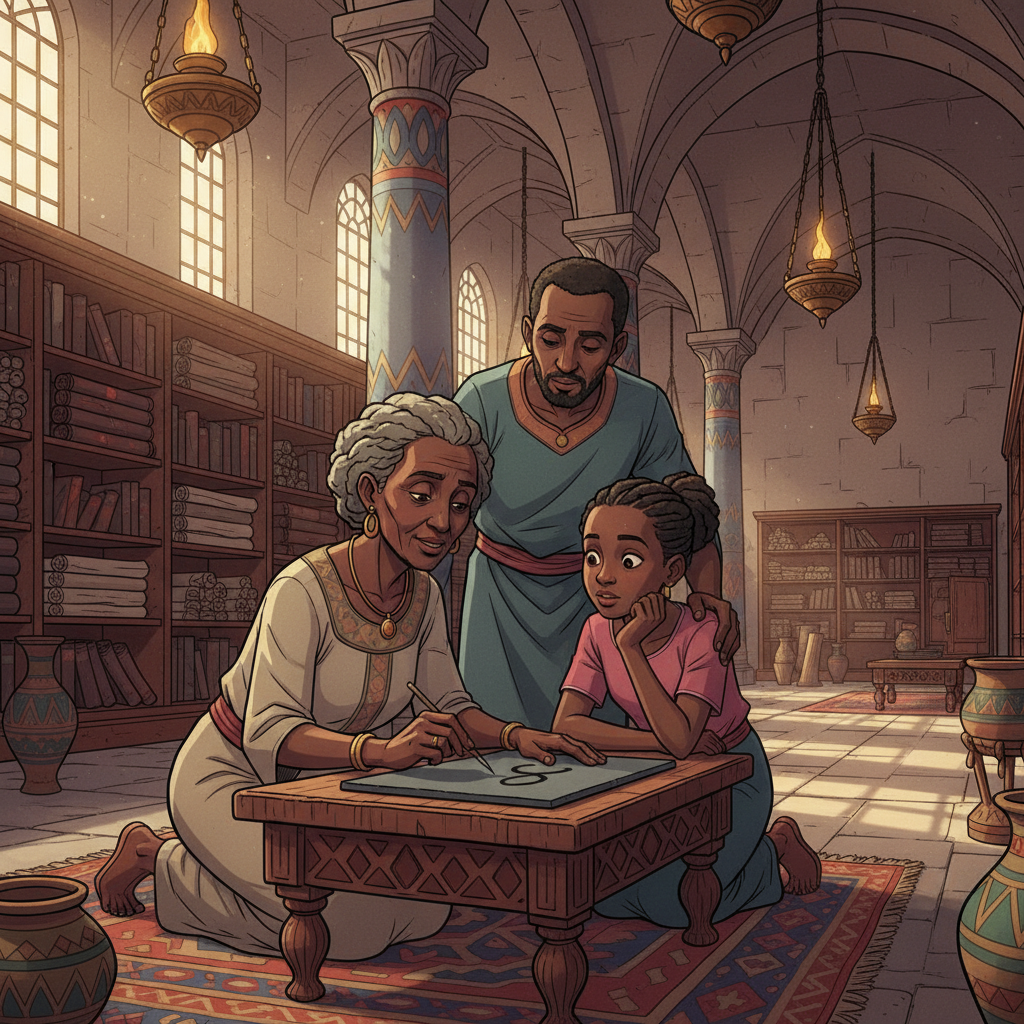
"Bring me a piece of slate," Tsion said. Selama brought one. Tsion sketched a single Ge'ez character — the letter ሥ, the deep-throat sa, the first letter of the word "Saba" — the Habashat name for the trading partner across the Red Sea that Hamad-ibn-Saba's family came from. Tsion set the slate down. "Atsbeha, your old master, was taught that Ge'ez came from Saba — that the script crossed the Red Sea from the south Arabian Sabaeans and was adapted by the Habashat people two thousand years ago. That is the story the Sabaean court scribes have told for as long as anyone can remember. It is the story Hamad-ibn-Saba was raised on." She paused. "It is wrong. Or — it is half-wrong. The whole truth is the other half."
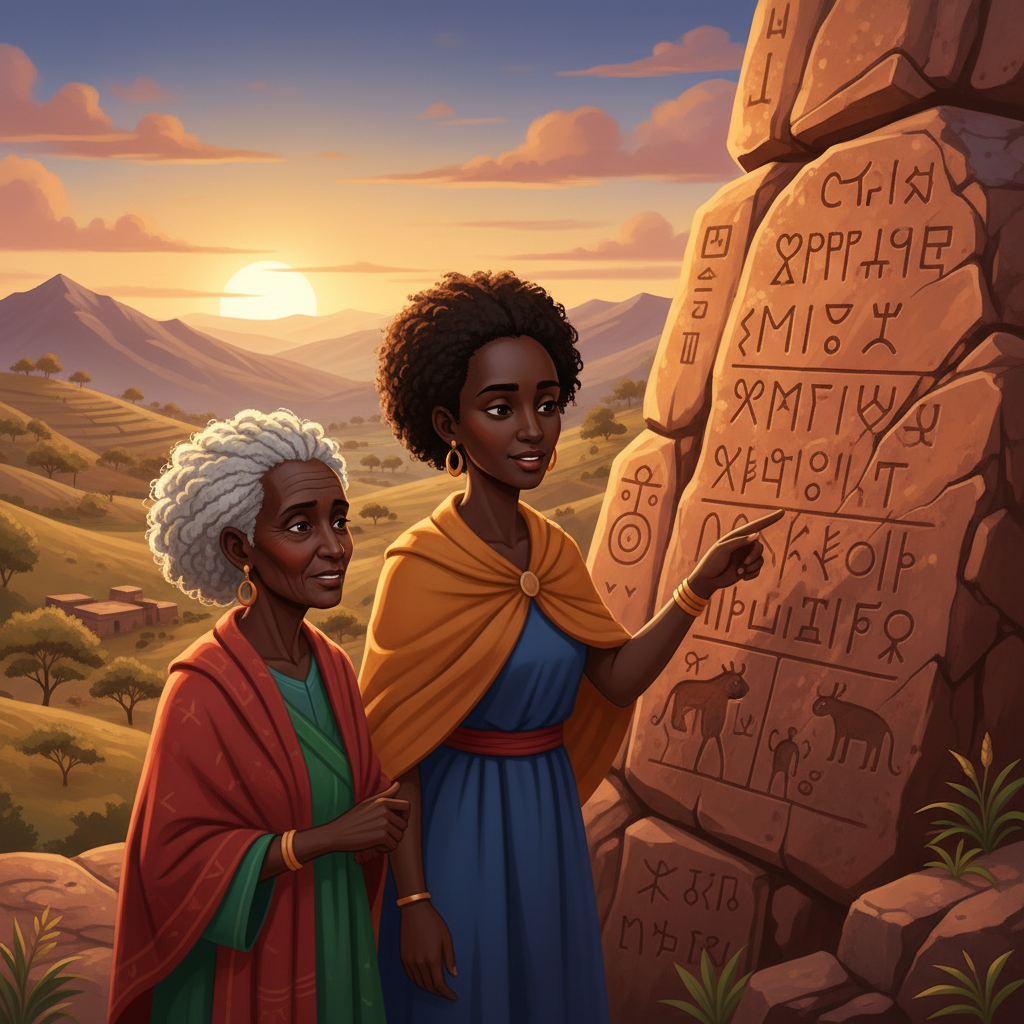
"My own teacher," Tsion said, "was an old Habashat scribe named Atsbeha-the-younger — not your father's teacher; a different Atsbeha, a quiet woman who lived in the southern hills and read the very old inscriptions. She showed me, on a long walk through the hills when I was twenty-two, the early D'mt inscriptions that the south Arabian visitors never saw. The D'mt civilization — our ancestors, the highland Habashat — were carving the proto-Ge'ez letters on stone three centuries before any Sabaean ship crossed the Red Sea into our trading harbors. The script did not come FROM Saba. The script grew from our own ground, met the Sabaean script in trade, exchanged some forms, and then continued growing. Two scripts. Two languages. Two peoples in conversation. Not one borrowing from the other."
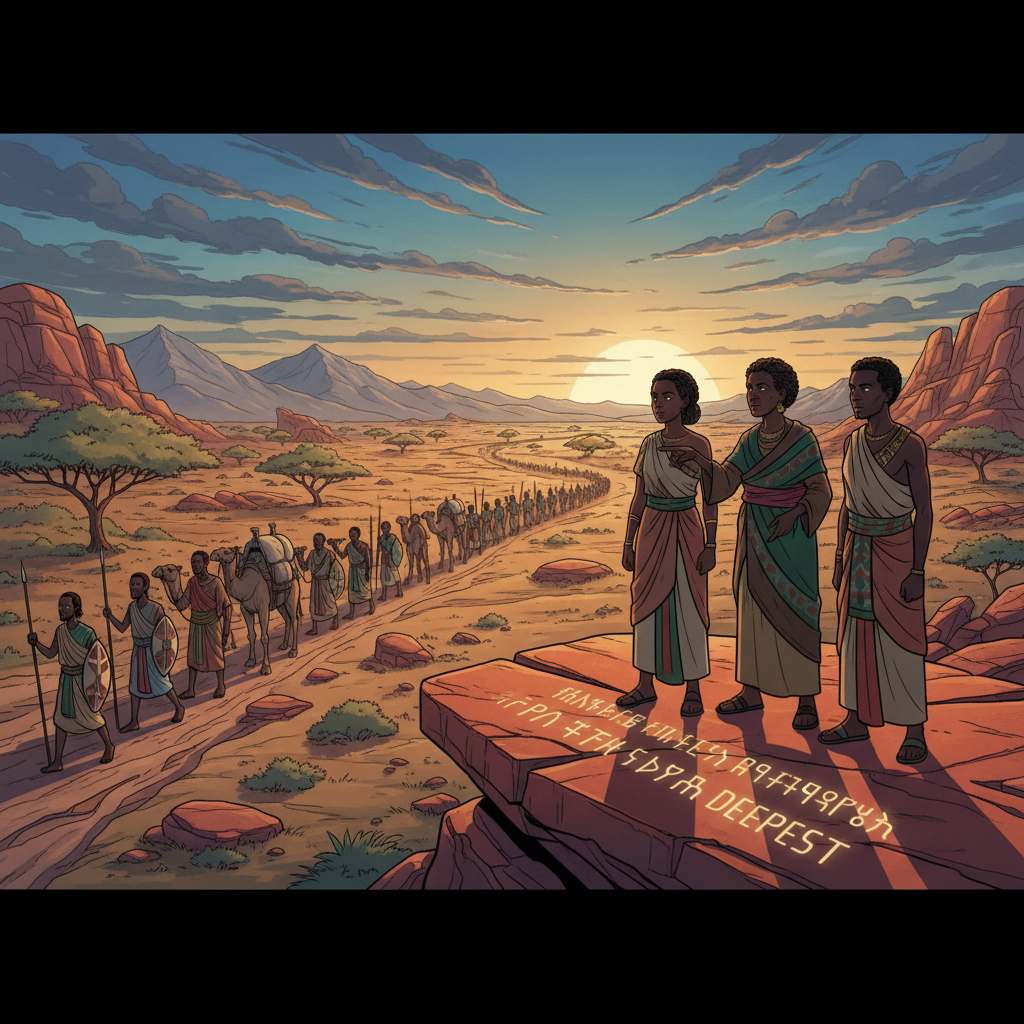
Selama listened. She had been hearing fragments of this from Tsion for five years but had never heard it stated this directly. Yohannes, beside her, was silent for a long moment. Then he said: "If we put Ge'ez in the center, Hamad-ibn-Saba will go to the king. The king will have to choose." Tsion nodded. "Yes. And the king will choose carefully. King Ezana is a careful man. But he is also a Habashat king of a Habashat people, and his recent victory was a Habashat army's victory. The center column is the right place for the script of his own land. Hamad will not be happy. He may never be happy about it. But that is not your problem and it is not the script's problem. The script came from our own land. That is the truth carved deepest."
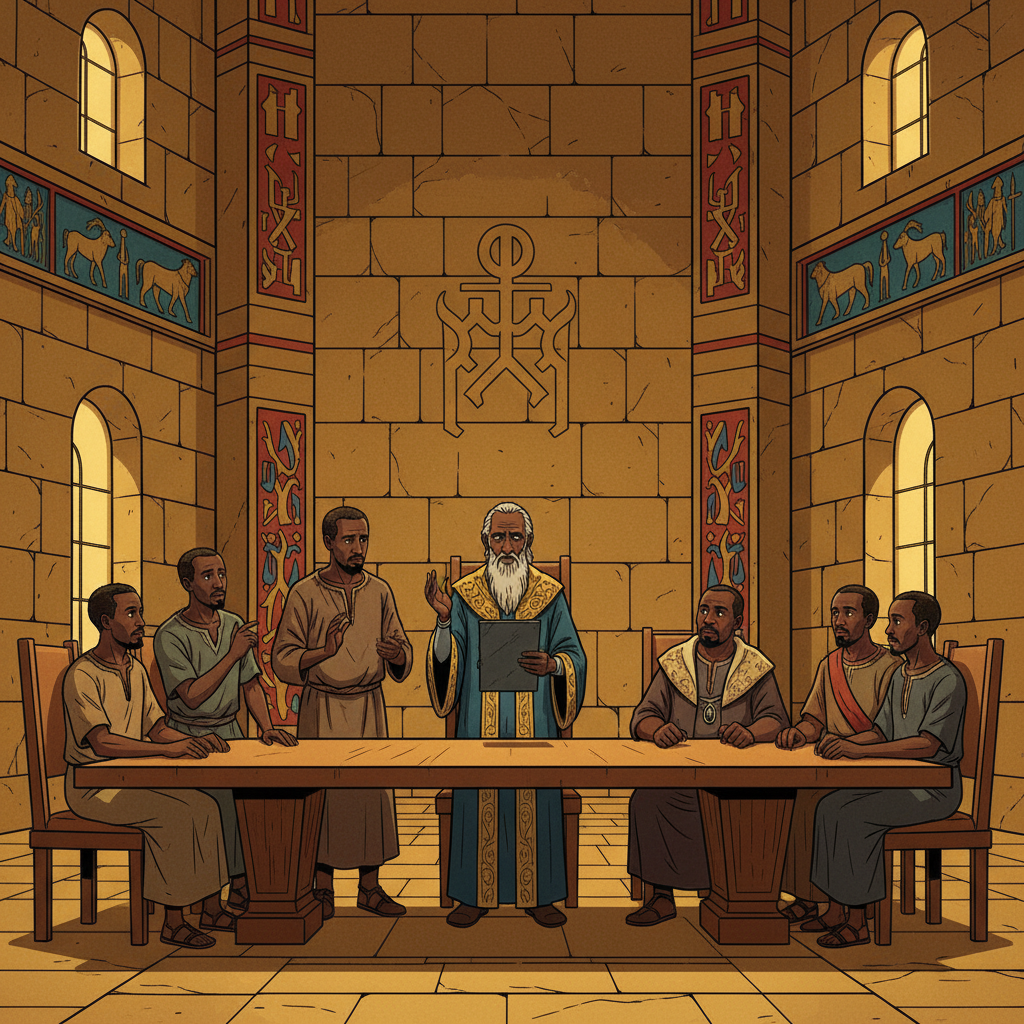
Yohannes took Selama's proposed layout to the palace the next morning. He presented it to the royal household's chief steward, who presented it to the king's council, where Hamad-ibn-Saba reviewed it. Hamad-ibn-Saba was sixty years old, a senior Sabaean-Aksumite scribe whose family had served the Aksumite court for four generations, since the kingdom's founding. He was tall, thin, with the silver beard of a scholar who had spent his life among manuscripts. He read the layout. He read it again. He did not raise his voice. He simply said, in formal court-Aksumite: "This layout is incorrect. Ge'ez is derived from Sabaean. The Sabaean column should be in the center, at full height. The other two should be supporting." The council was silent.
The king's chief priest, an elder named Frumentius (a Habashat-born priest with a Greek scholar-name from the Alexandrian schooling he had received in his youth) considered the layout. He had heard the same argument from Hamad for fifteen years. He had also heard, from Tsion at the archive, the D'mt-inscription evidence Tsion had walked the southern hills to gather. Frumentius asked Hamad: "If the script was derived from Sabaean two thousand years ago, then why do the D'mt stones in the southern hills carry early Ge'ez characters three centuries before any Sabaean ship reached our harbors?" Hamad did not answer immediately. Then he said, carefully: "The D'mt inscriptions are too old to read accurately. The dating is uncertain." Frumentius did not press. He simply nodded and dismissed the council. He did not yet say which layout he would approve.
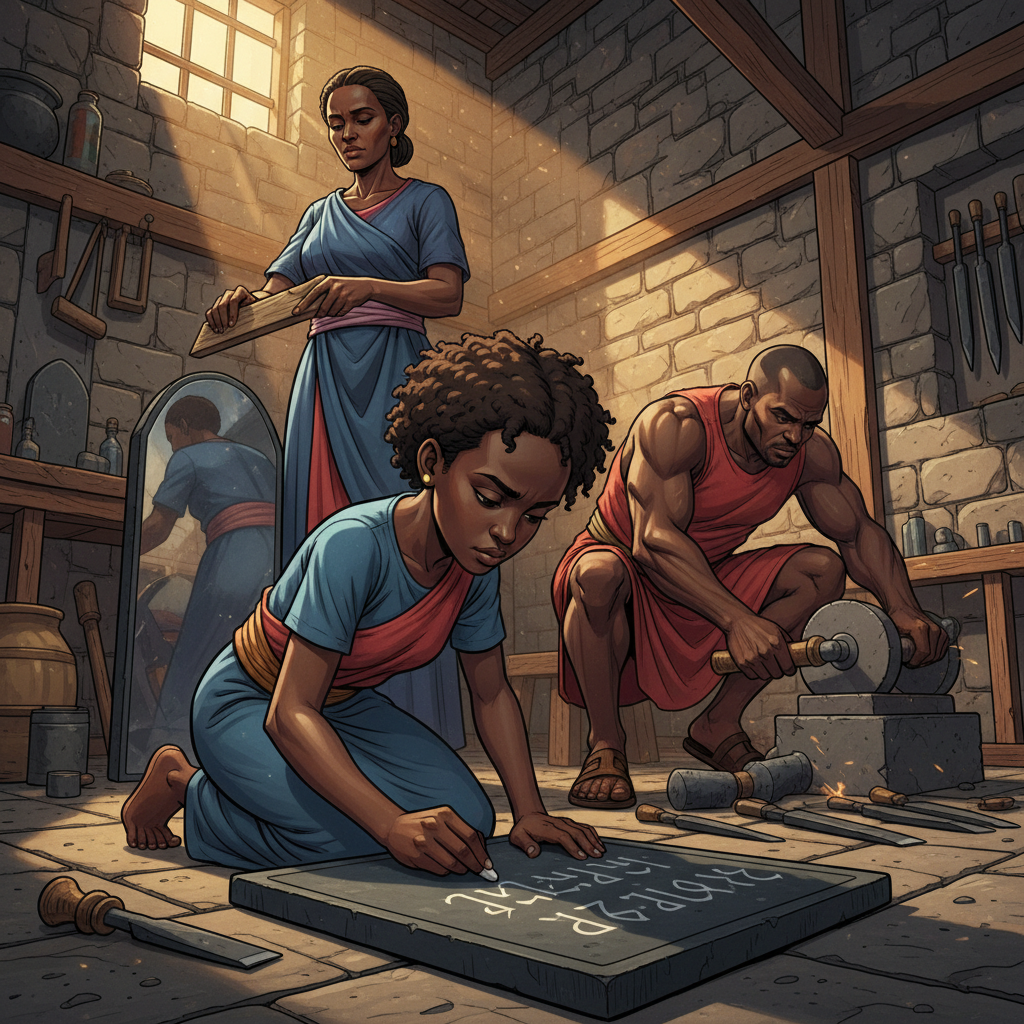
For three days the workshop waited. Selama practiced her Ge'ez characters every morning on slate. Mahibere finished the polishing on the smaller funerary stela. Yohannes ground his chisels for the great cut. On the fourth morning a royal courier arrived with a sealed decision. Frumentius the chief priest had approved Selama's layout. The Ge'ez column would be in the center. Yohannes read the decision aloud. Mahibere said one quiet word in Ge'ez: "Sebhatlam." Glory. Selama did not cheer. She knew her layout had been right, and right was not the same as victory. She had also seen Hamad-ibn-Saba's face at the council. She knew that Hamad would not accept the decision in his heart. He would carry the position to his death. The work was not for him.
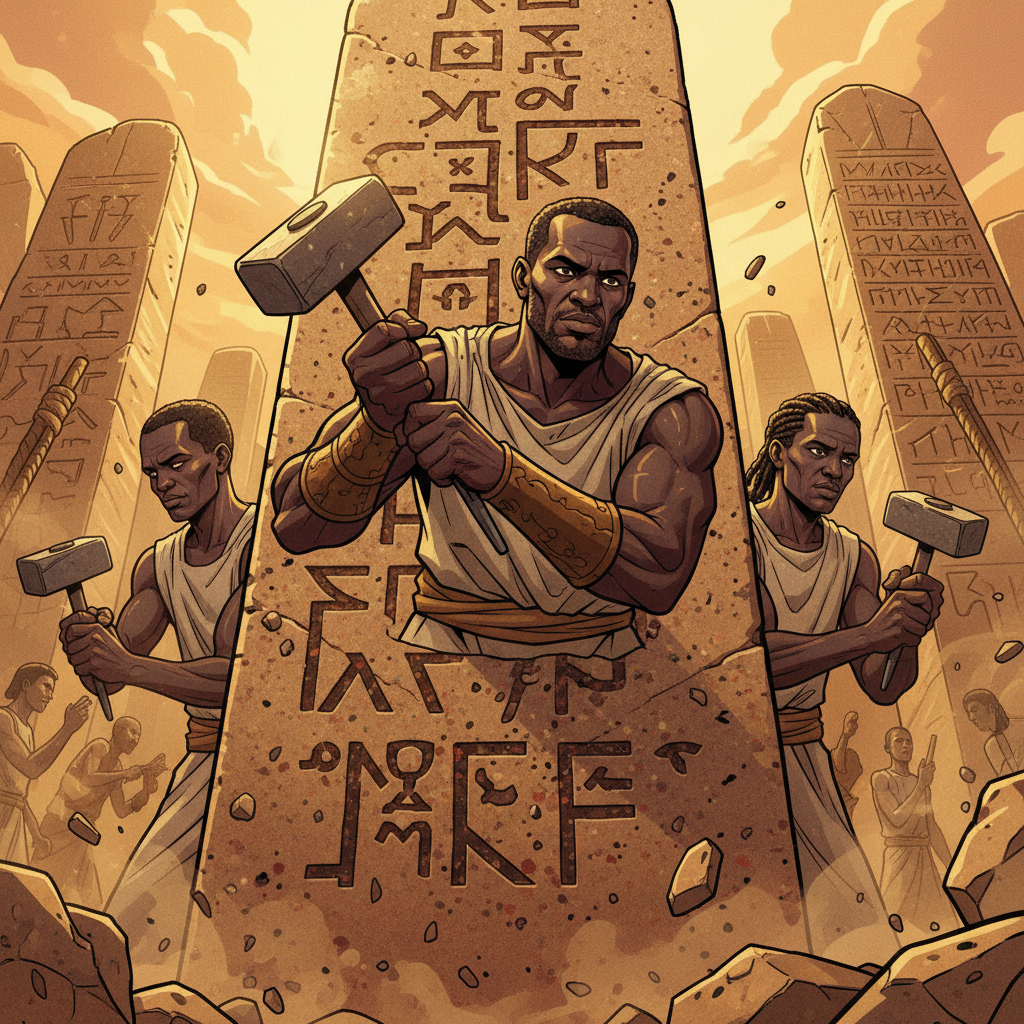
The carving took eight months. Yohannes did the Ge'ez column himself — the central, deepest, widest cuts. Two senior apprentices did the Greek and Sabaean columns at his direction. Mahibere's polishing team — six women, including a senior polisher named Lewam who had been polishing stelae for thirty years — prepared the back face and the side edges in the slow mirror-finish that Aksumite stelae were known for. The lifting was done by a Habashat rope-team of forty men and women led by a Kushite-trained forewoman named Tekahatamani, who had crossed the highlands with her family three years before. The stela went up in the central plaza in the eighth month. It rose twelve cubits into the bright dry-season sky.
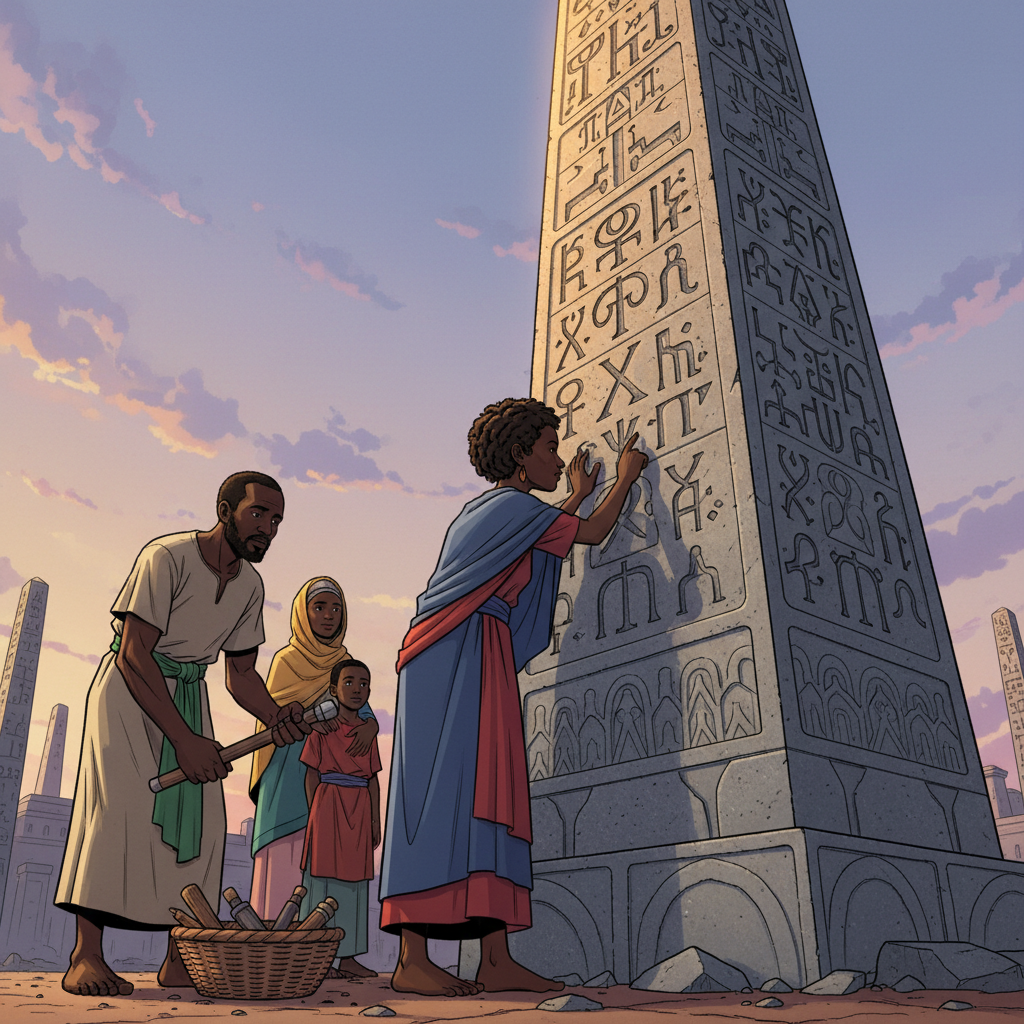
On the morning of the dedication, Selama stood with her family at the base of the stela. The first sunlight had just struck the upper edge of the granite face. Her father set down his iron chisel — the long-handled cutting chisel he had used for the Ge'ez column — into the wicker basket of finished tools at her feet. He did not put his hand on her shoulder. He did not nod. He simply set down the chisel. The handing-down was complete. Selama stepped forward and ran the tip of her right index finger slowly along the deepest groove of the central column — the freshly-cut ሥ at the top of the king's victory-text, the first letter of the word "Saba," carved in the script the Sabaeans had said came from them but that had in fact grown from this very ground. The groove was deep. The cut was true.
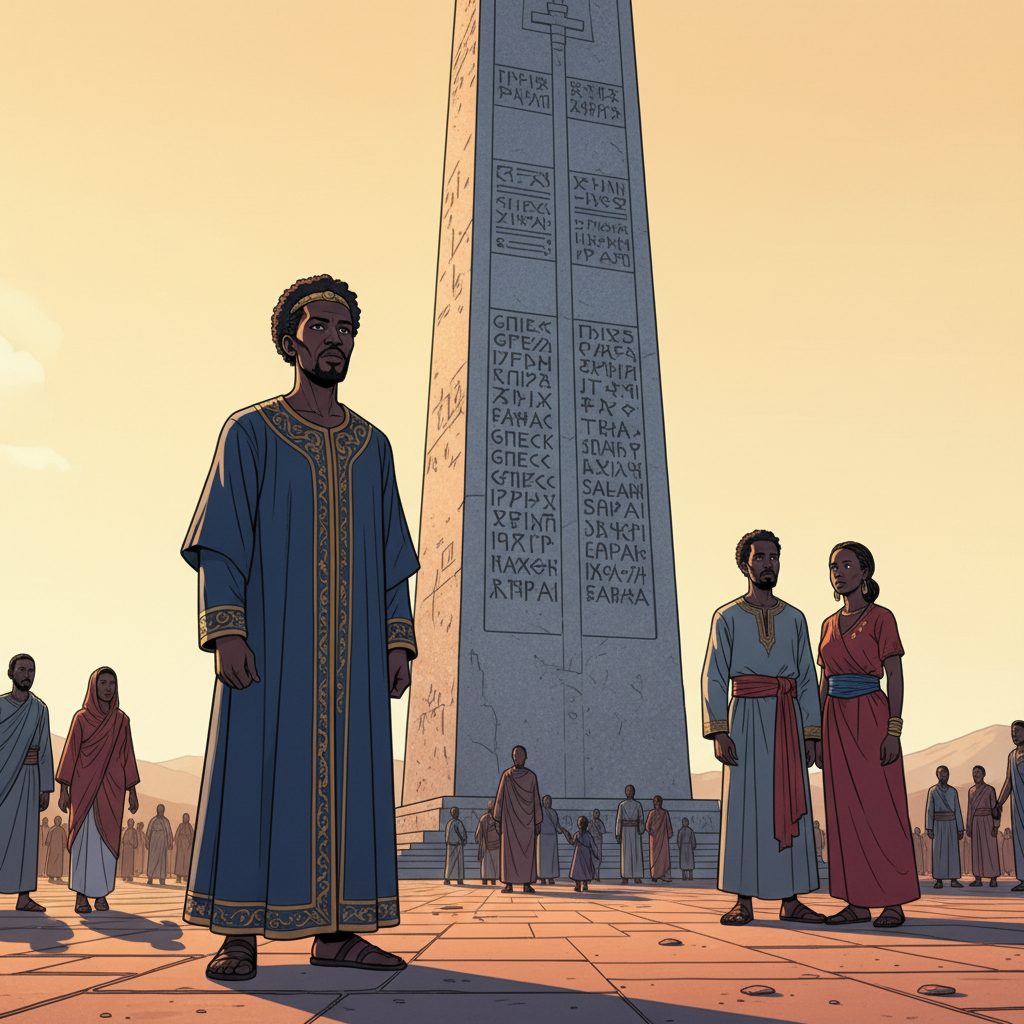
Hamad-ibn-Saba was at the dedication. He stood in the council's designated position at the eastern edge of the plaza, in his formal Sabaean court-robe. King Ezana spoke briefly — three sentences in Ge'ez, three in Greek, three in Sabaean — naming the victory and dedicating the stela to Mahrem, the war-god of the Habashat people. The crowd called the response. Frumentius the chief priest gave the blessing. The dedication ended. The crowd dispersed. Hamad-ibn-Saba walked once around the base of the stela. He read the three columns. His face did not move. He bowed once to the king, very briefly, and walked away across the plaza. He did not bow to Yohannes or to Mahibere or to Selama. He did not speak to anyone on his walk out of the plaza.
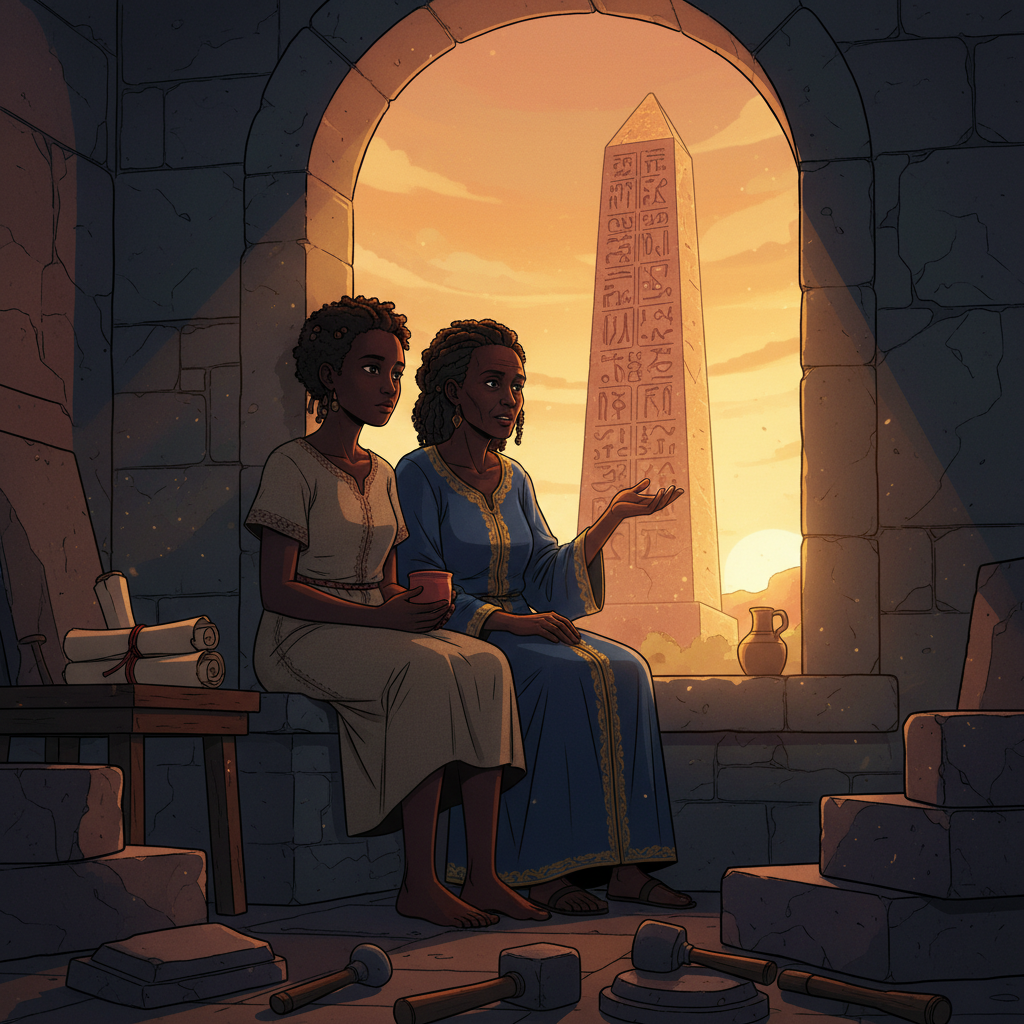
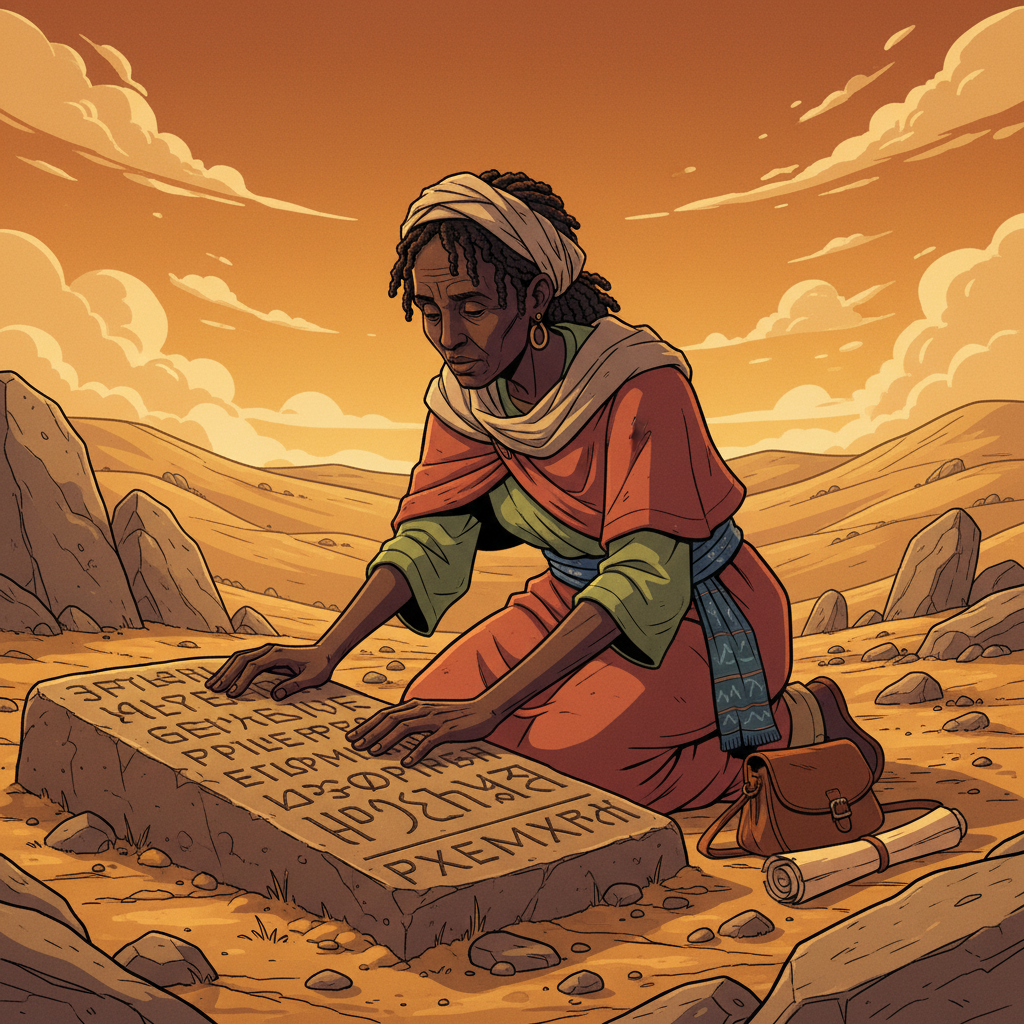
Tsion came to find Selama in the workshop that afternoon. She brought a small clay cup of honey-mead — a Habashat ritual for an apprentice who had completed her first true work. Selama and Tsion sat together at the workshop's eastern window. Tsion said: "Hamad will not change his mind. He may go to his grave still believing his version of the script's history. That is his to carry. The work is done. The stela stands. In sixteen hundred years a scholar named Bekerie, in a small office in a city that does not yet exist, will write a book proving that Ge'ez came from D'mt and not from Saba. He will read the same D'mt inscriptions I walked to in the southern hills. The deepest groove will still be there, on this stela, the script of our own land, the answer carved in granite long before the book is written."
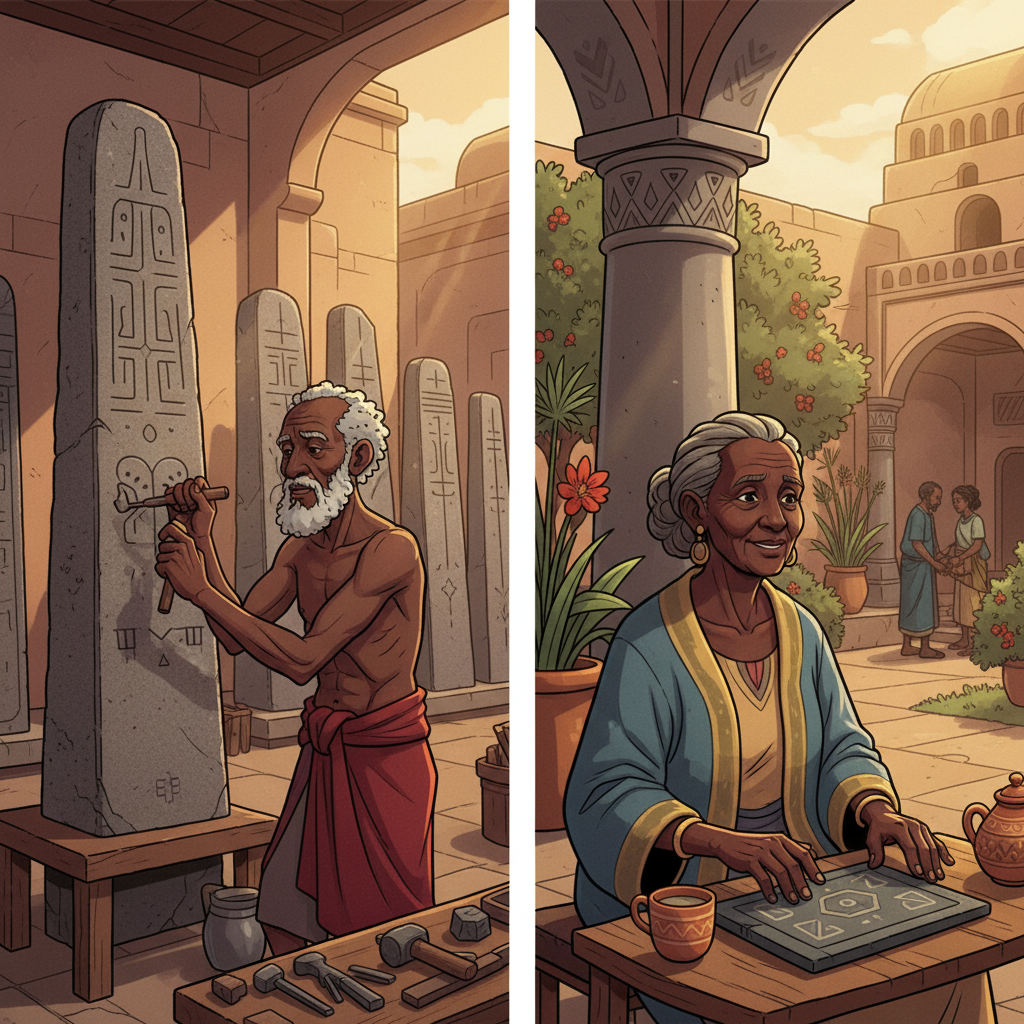
Seventeen years passed. Selama grew up. She married a quiet Aksumite scholar named Yared who specialized in liturgical-text copying for the highland monasteries. Her father Yohannes carved seven more great stelae in the years before his death. Her mother Mahibere ran the polishing team until her hands grew too stiff for the long mirror-finish work; she retired at sixty-two and lived in the family's back courtyard with her tea and her old worn slate. Tsion died at fifty-three of a sudden fever, leaving the royal archive in the hands of three younger scribes she had trained. Hamad-ibn-Saba died at seventy-eight, never having spoken again about Selama's stela. His last formal court-Sabaean inscription, found years later, contained no mention of the trilingual stela in the central plaza.
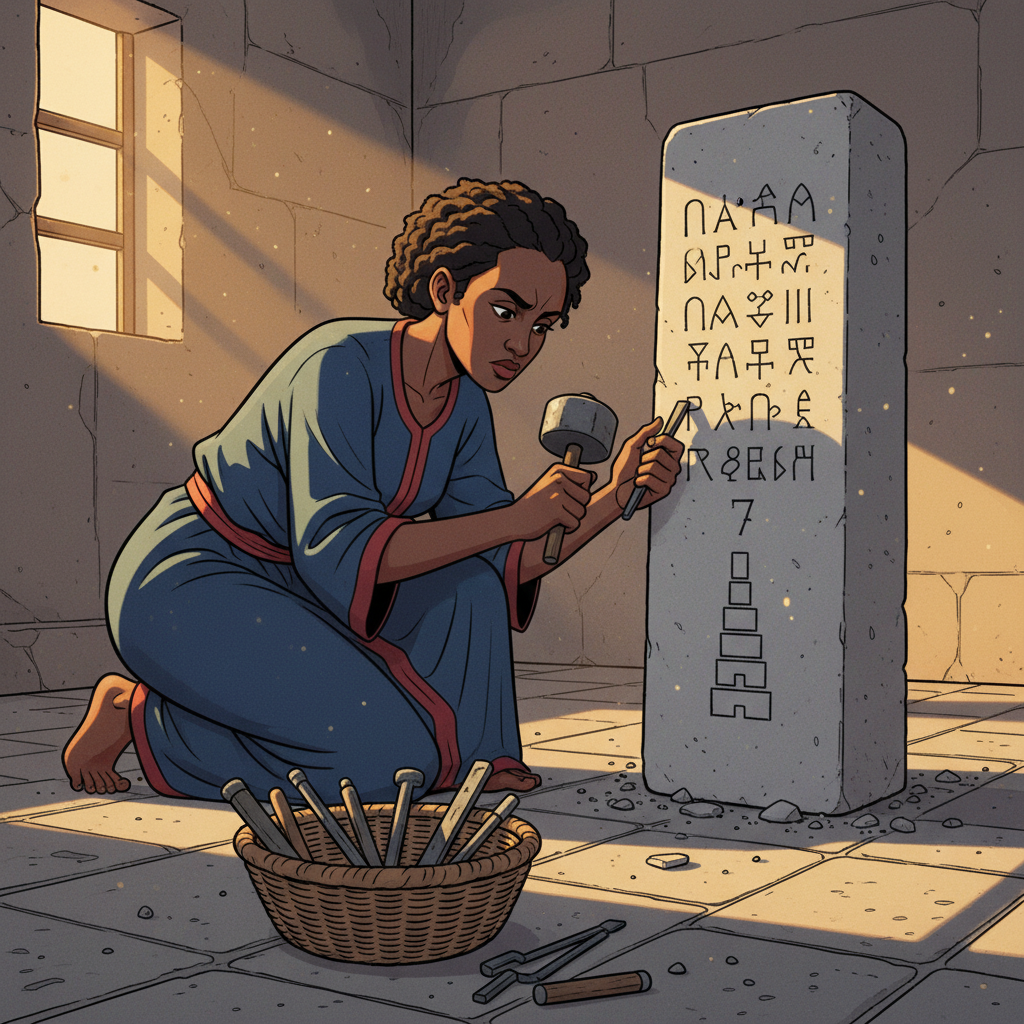
When Selama was thirty years old, her father Yohannes died in his sleep at the age of fifty-eight. Mahibere asked Selama to carve his memorial stela alone — no apprentices, no team. Selama took the commission. She chose a single block of pale Aksumite granite, four cubits tall, simple in form. She cut the inscription in one column only, Ge'ez. No Greek. No Sabaean. The text was eight lines: her father's name, his trade, his children, the name of his teacher Atsbeha, and the names of the seven great stelae he had carved. The cut took her four months. She did it in the workshop's back room, alone, the way her father had cut the central column of Ezana's victory-stela seventeen years before. When the memorial was finished, she set down her chisel into the same wicker basket of finished tools her father had set down his chisel into at the dedication. The handing-down had come full around.
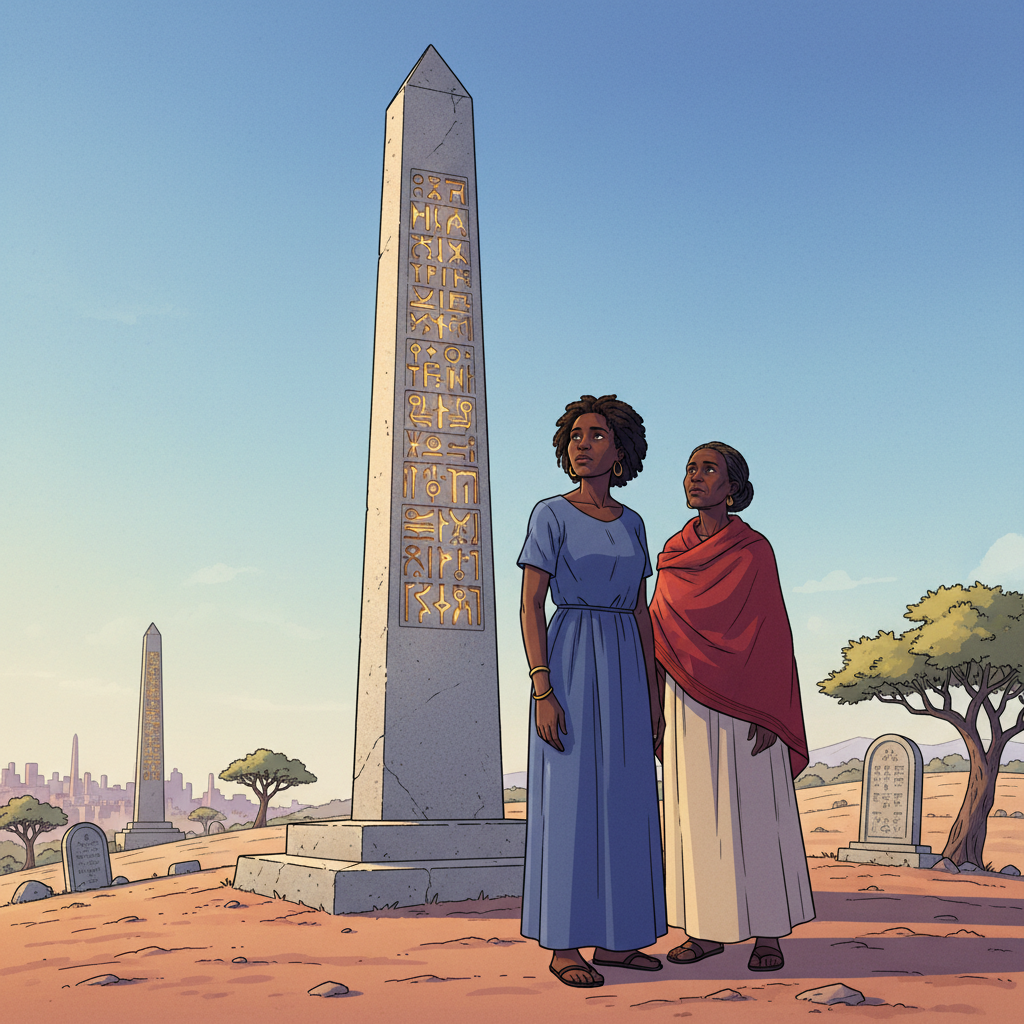
The memorial stela was raised at the family burial-ground east of the city the following month. Selama stood at its base in the morning light. Mahibere stood beside her. They did not speak. The Ge'ez column rose true into the bright sky, the deepest groove of the carved characters catching the early sun the way the central column of the great trilingual stela still caught it in the plaza, seventeen years and a kingdom's memory later. The script of their own land. Carved deepest. Selama would carve eleven more stelae in the remaining thirty years of her life. None of them was for a king. All of them were for ordinary Habashat families who wanted their names cut in the script that the people of the highlands had taught themselves, on their own ground, before any sail had crossed the Red Sea to find them. The work continued. The script lived.