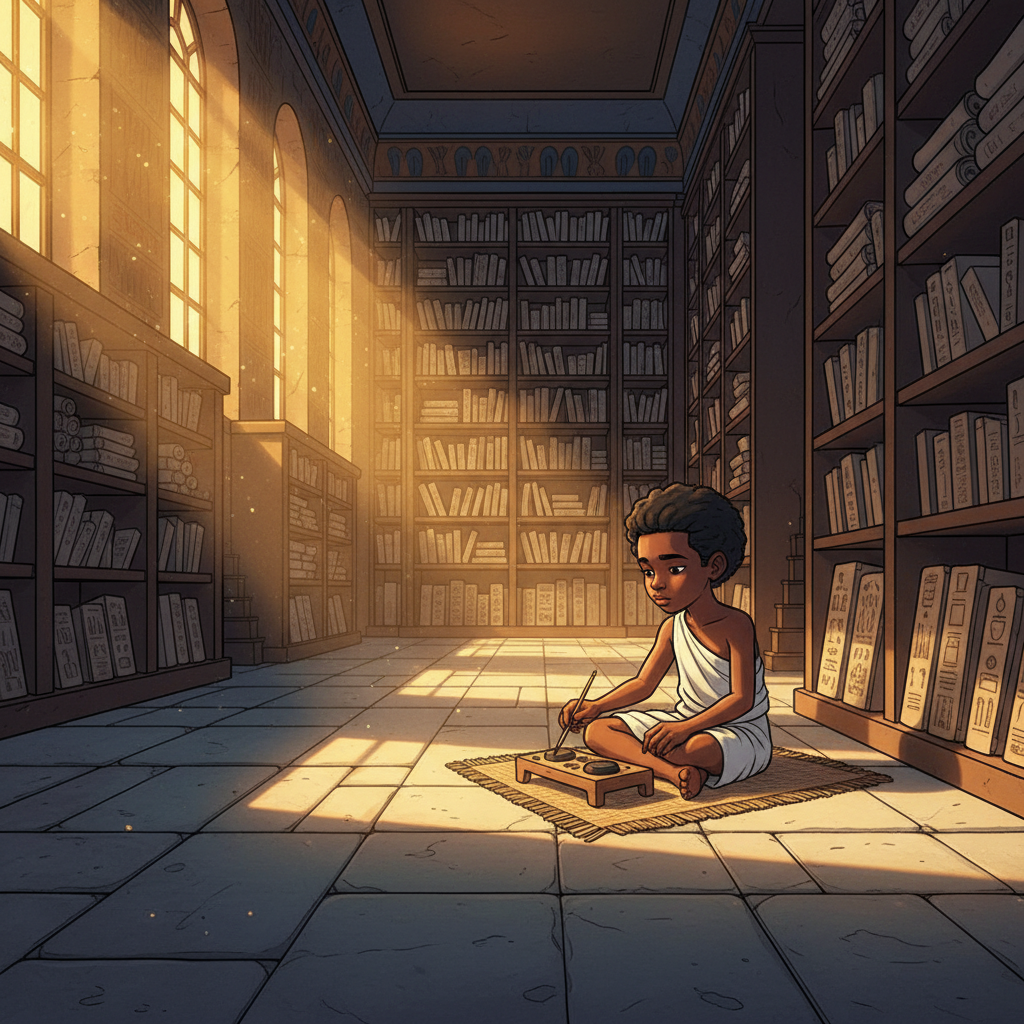
The morning sun poured through the high windows of the Per Ankh like liquid gold, painting bright squares on the stone floor. The air smelled of fresh ink and old papyrus, a smell that always made young Khaemwaset feel like he was stepping into a place where magic lived. He loved this room more than anywhere else in the great temple of Ipet-Isut. Khaemwaset sat cross-legged on his reed mat and pulled his wooden palette closer. His fingers, dark brown and still small, reached for his favorite reed pen — the one he had carved himself with his grandfather's copper knife. He dipped it carefully into the black ink cake, mixing it with a few drops of water until the ink was smooth as the river at dawn.
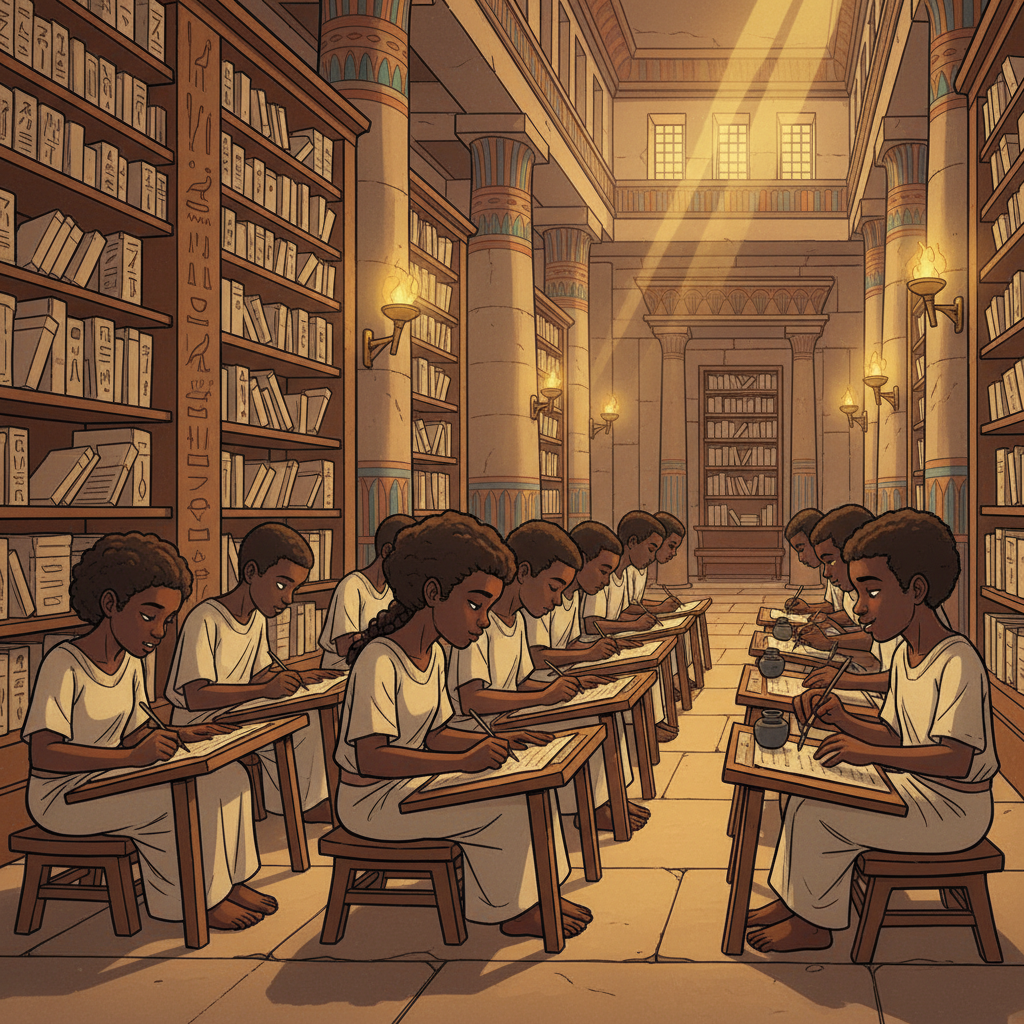
All around him, twelve students sat in two neat rows, their dark ebony faces bent low over their papyrus sheets. Some whispered the words they were copying, their lips moving like little fish. Others pressed their reed pens so hard that the scratching sound filled the room like crickets singing in the marshes. Khaemwaset could hear his friend Nefertari breathing slowly beside him, totally lost in her work. Across the aisle, a boy named Teti was fidgeting with his ink pot, tilting it back and forth. Teti was always moving, always touching things, always finding trouble even when he wasn't looking for it.
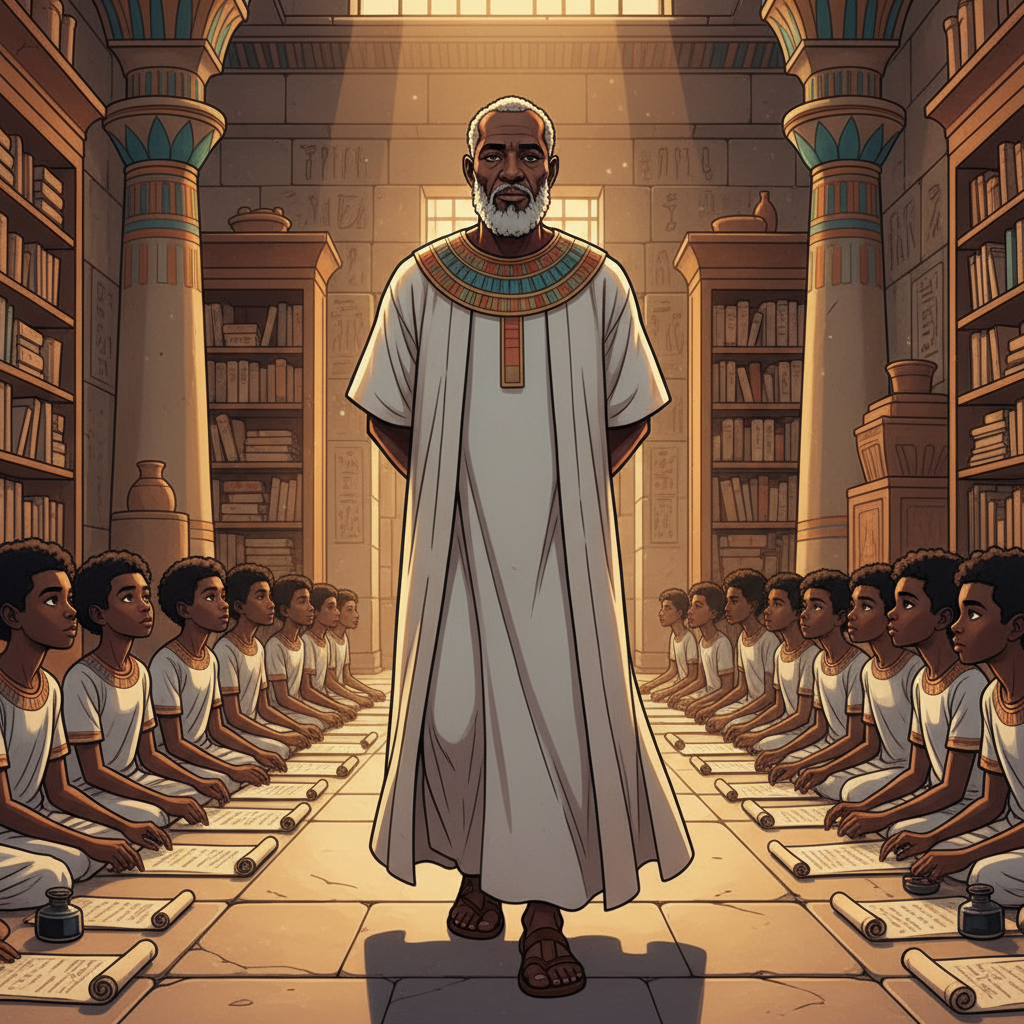
Their teacher, the great scribe Amenhotep, walked slowly between the rows with his hands clasped behind his back. His deep brown skin seemed to glow in the golden light, and his white linen robe swept the floor without making a sound. When he passed, Khaemwaset could smell lotus oil and the faint dusty sweetness of old scrolls. Amenhotep had been a scribe in the House of Life for thirty seasons. His voice was low and calm like the river before the Inundation, and when he spoke, every student went still. Today his dark eyes moved from scroll to scroll, checking each student's work with a slow, careful gaze.
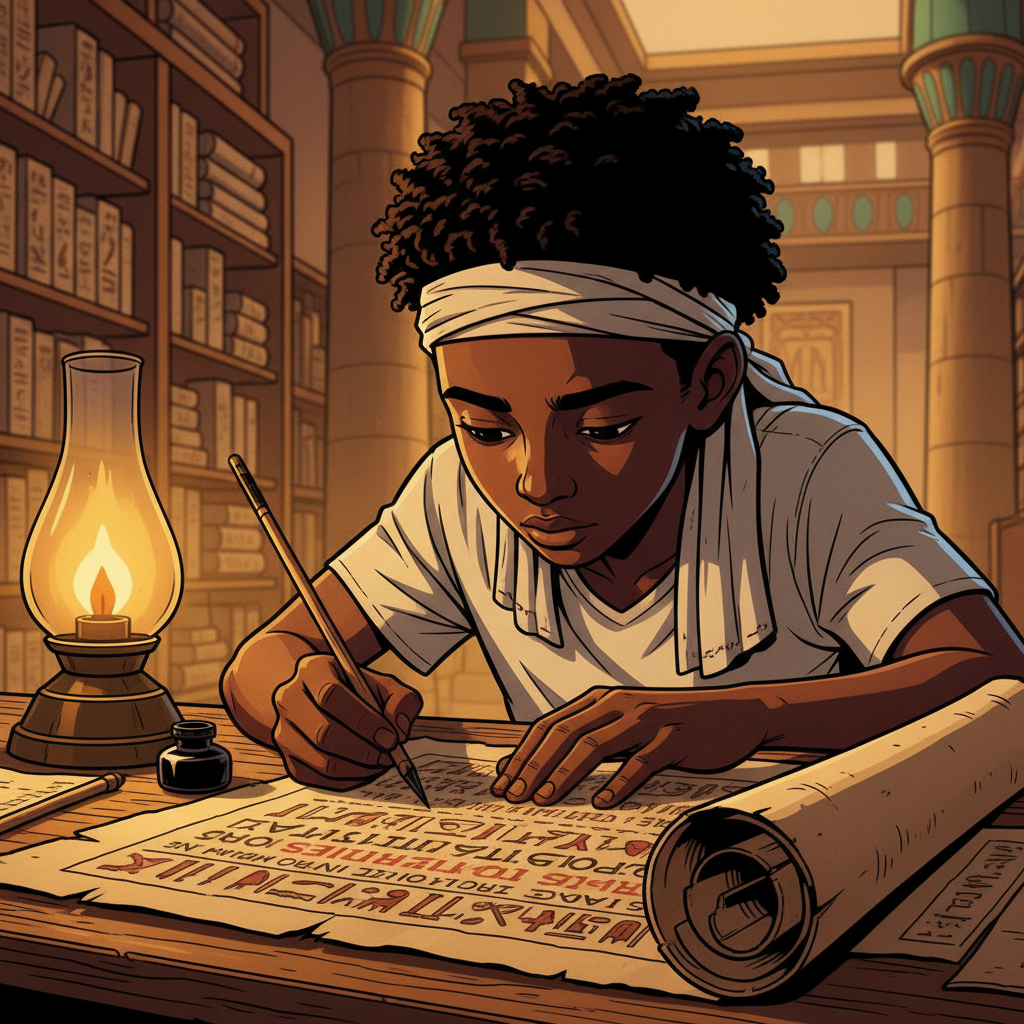
Khaemwaset looked down at the ancient scroll that Amenhotep had unrolled before the class. It was the Declaration of Maat — the forty-two sacred promises that every person must speak before the gods after death. The hieroglyphs were painted in red and black ink so old that the papyrus had turned the color of honey. "Copy the seventh declaration with great care," Amenhotep had told them. Khaemwaset read the words slowly, his lips forming each sound: "I have not told lies." Such simple words, he thought, but they felt heavy and important, like stones placed in a temple wall. He began to copy each hieroglyph with his steadiest hand.
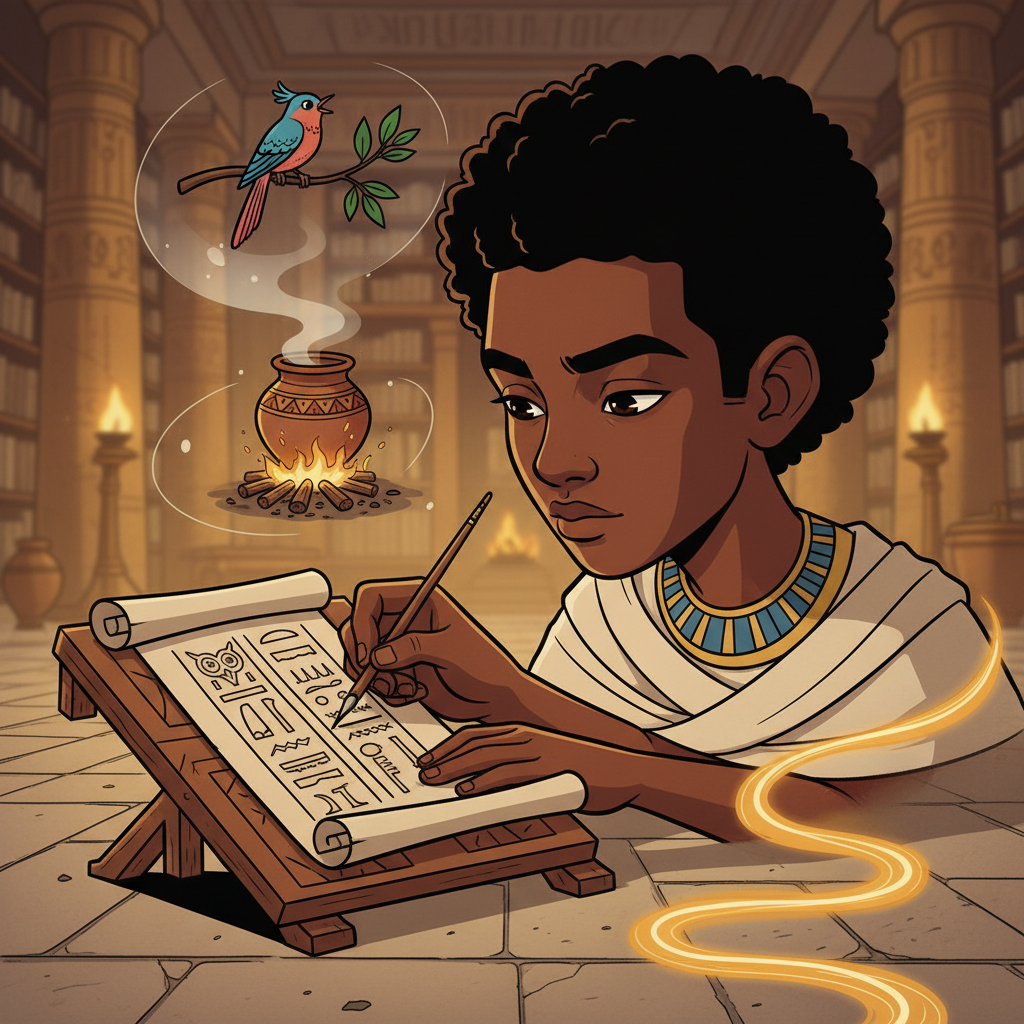
Khaemwaset was concentrating so hard that the rest of the room seemed to disappear. His reed pen danced across the papyrus, forming the owl, the bread loaf, the seated figure of Maat with her feather. He wanted each symbol to be perfect. He wanted Amenhotep to nod the way he did when he was truly pleased — just one slow nod, like a heron dipping its beak. But his mind was a busy thing. It always was. Even as he drew, part of him was listening to a bird singing outside, part of him was wondering what his mother was cooking for the evening meal, and part of him was watching a beam of sunlight move slowly across the floor like a golden snake.
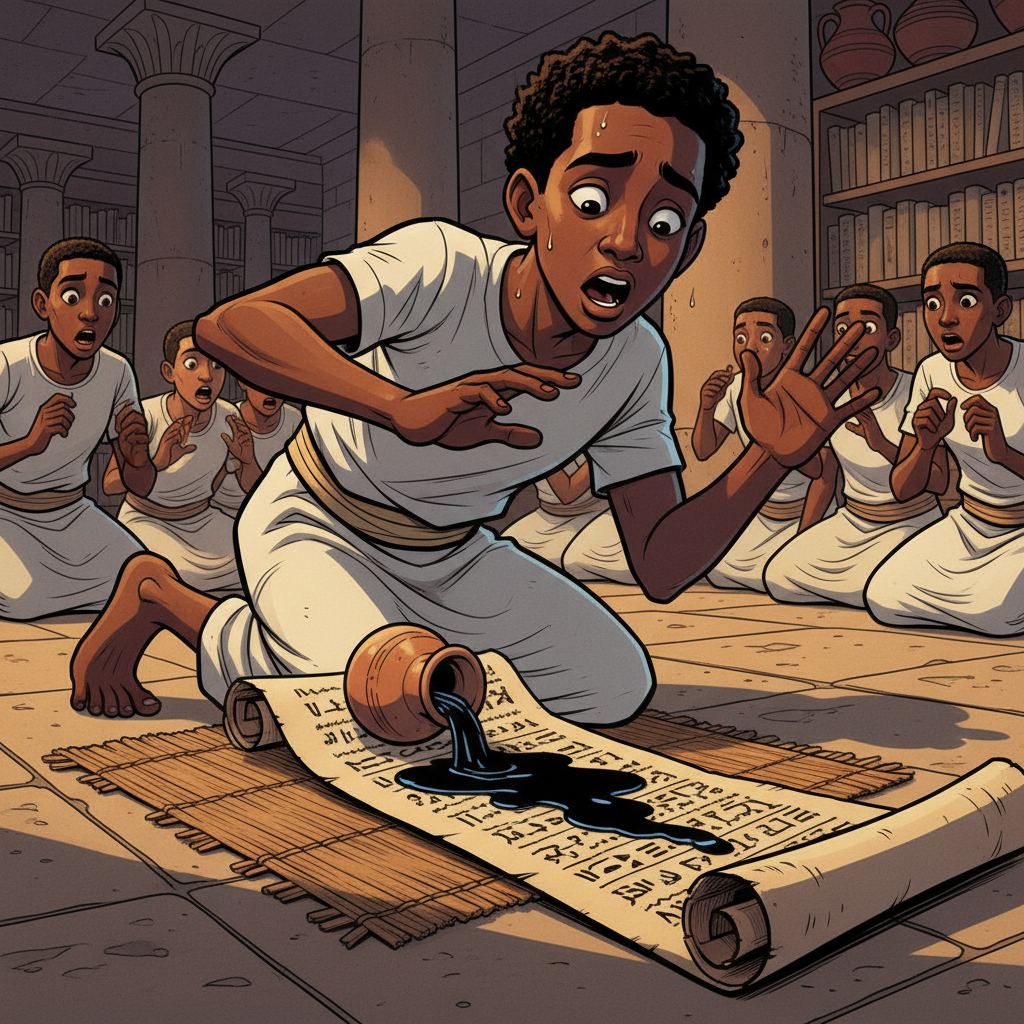
And that is when it happened. Khaemwaset shifted on his mat to stretch his leg, and his elbow swung out to the side. It struck his ink pot with a sharp crack. Time seemed to slow down as the little clay pot tipped, wobbled, and then fell right onto the ancient scroll. Black ink spilled across the sacred papyrus like a dark flood. It swallowed three whole lines of hieroglyphs that were older than anyone in the room, older than anyone Khaemwaset had ever known. His stomach dropped like a stone thrown into the river. His hands began to shake, and his heart pounded so loud he was sure Nefertari could hear it.
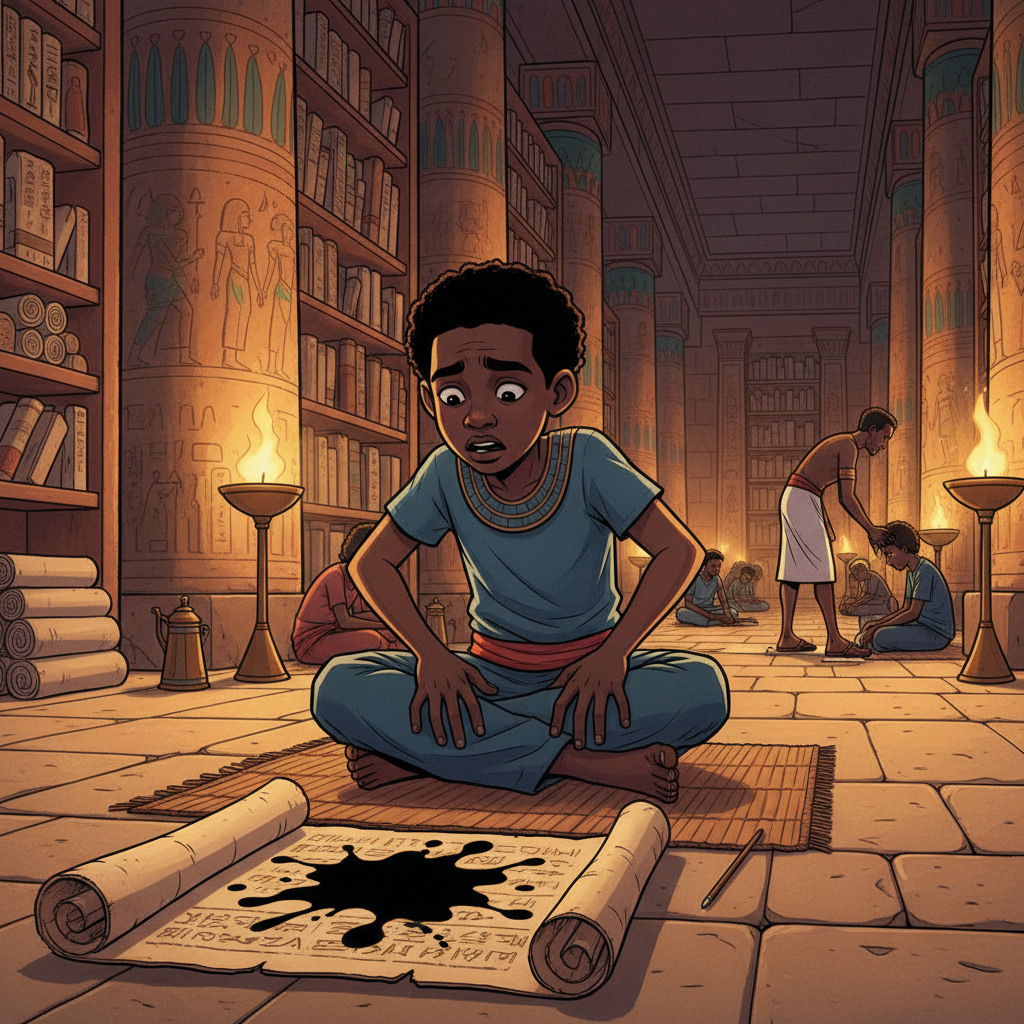
Khaemwaset's breath came fast and shallow. He pressed his hands against his thighs to stop them from trembling. The black stain on the ancient scroll seemed to grow larger the longer he stared at it, like a living thing. Nobody had seen what happened — not yet. His thoughts raced faster than a chariot. Maybe he could cover the scroll with his own papyrus sheet. Maybe he could wipe the ink away before Amenhotep turned around. He glanced at his teacher's back. Amenhotep was at the far end of the row, leaning over another student's work. There was still time. There was still time to hide this.
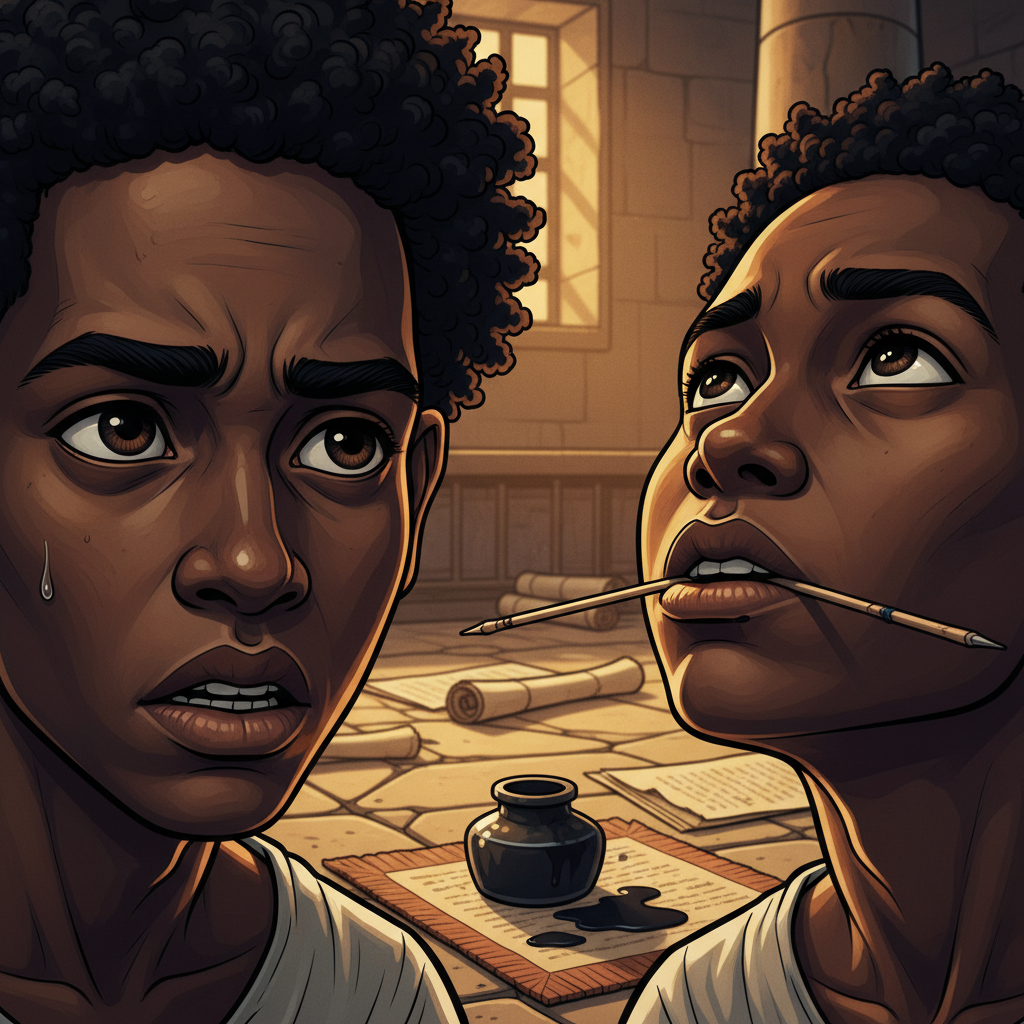
Then another thought crept into Khaemwaset's mind like a snake sliding through grass. Teti. Everyone knew Teti knocked things over. Teti had spilled ink just last week. If Khaemwaset said nothing and moved his mat a little closer to Teti's side, everyone would think Teti had done it. Teti would get in trouble, yes, but Teti was always in trouble. What difference would one more time make? Khaemwaset's chest felt tight. The thought made his stomach twist in a way that was even worse than the fear. He looked at Teti, who was chewing on the end of his reed pen and staring at the ceiling, completely unaware. Blaming Teti would be so easy. It would be so simple. And that was exactly what made it feel so wrong.
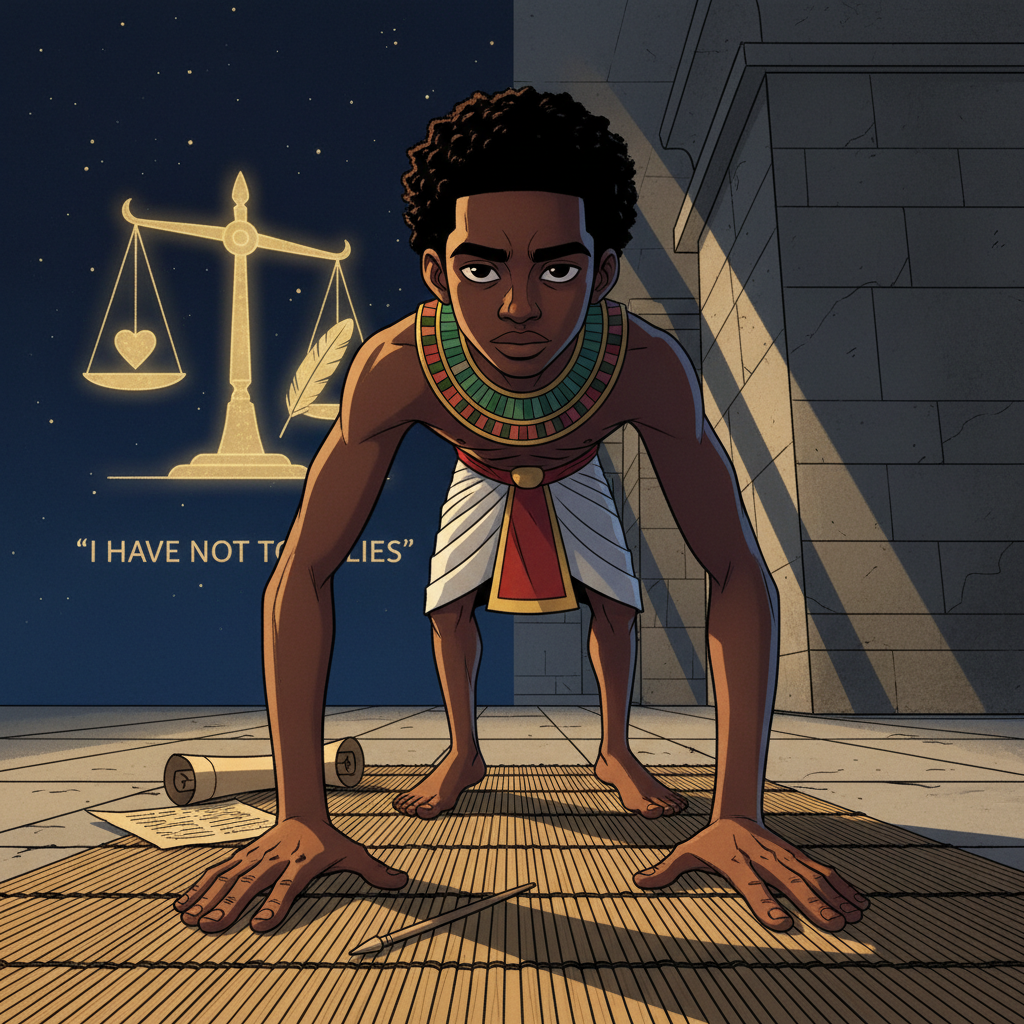
Khaemwaset closed his eyes and took one deep breath. He thought about the words he had just been copying — "I have not told lies." Those were not just marks on papyrus. Those were words that the dead spoke to the gods while their heart sat on the great scale, weighed against the feather of Maat. A lie could make your heart heavy. A lie was Isfet — chaos, the enemy of everything good and ordered. He opened his eyes. His hands were still shaking, but something inside him had gone quiet and still, like the river at the deepest part where the current runs strongest. He placed his reed pen down. He pressed his palms flat on his mat. And then Khaemwaset, son of Merytaten, stood up.
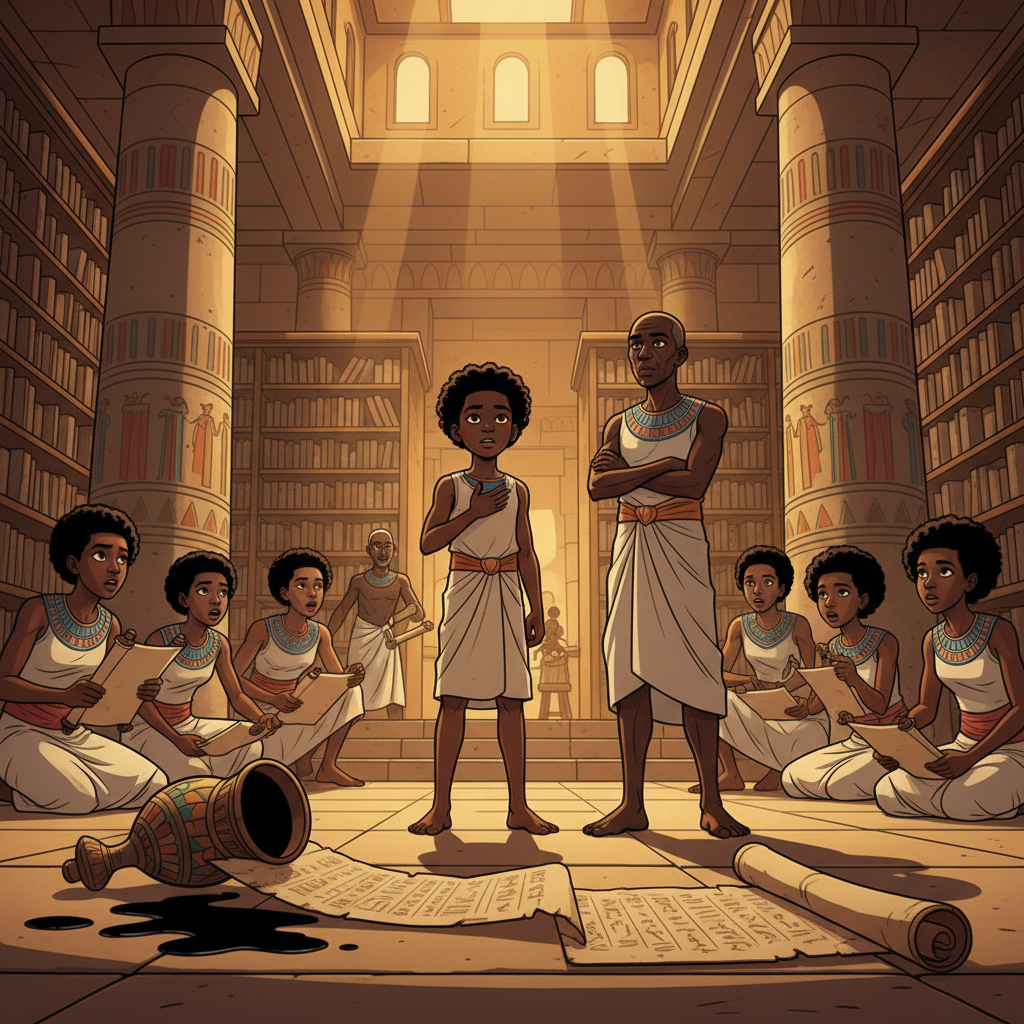
"Teacher Amenhotep," Khaemwaset said. His voice came out smaller than he wanted, so he swallowed hard and tried again. "Teacher Amenhotep, I must speak." Every student in the Per Ankh looked up. The room went as silent as a tomb. Amenhotep turned slowly, his dark eyes finding Khaemwaset like two bright stars. "I knocked over my ink pot," Khaemwaset said, and each word felt like lifting a heavy stone and setting it down. "The ink has fallen on the ancient scroll. I damaged it. It was my elbow, my clumsiness. I am sorry." His eyes burned, but he did not look away. He kept his gaze on his teacher's face even though every part of him wanted to stare at the floor.
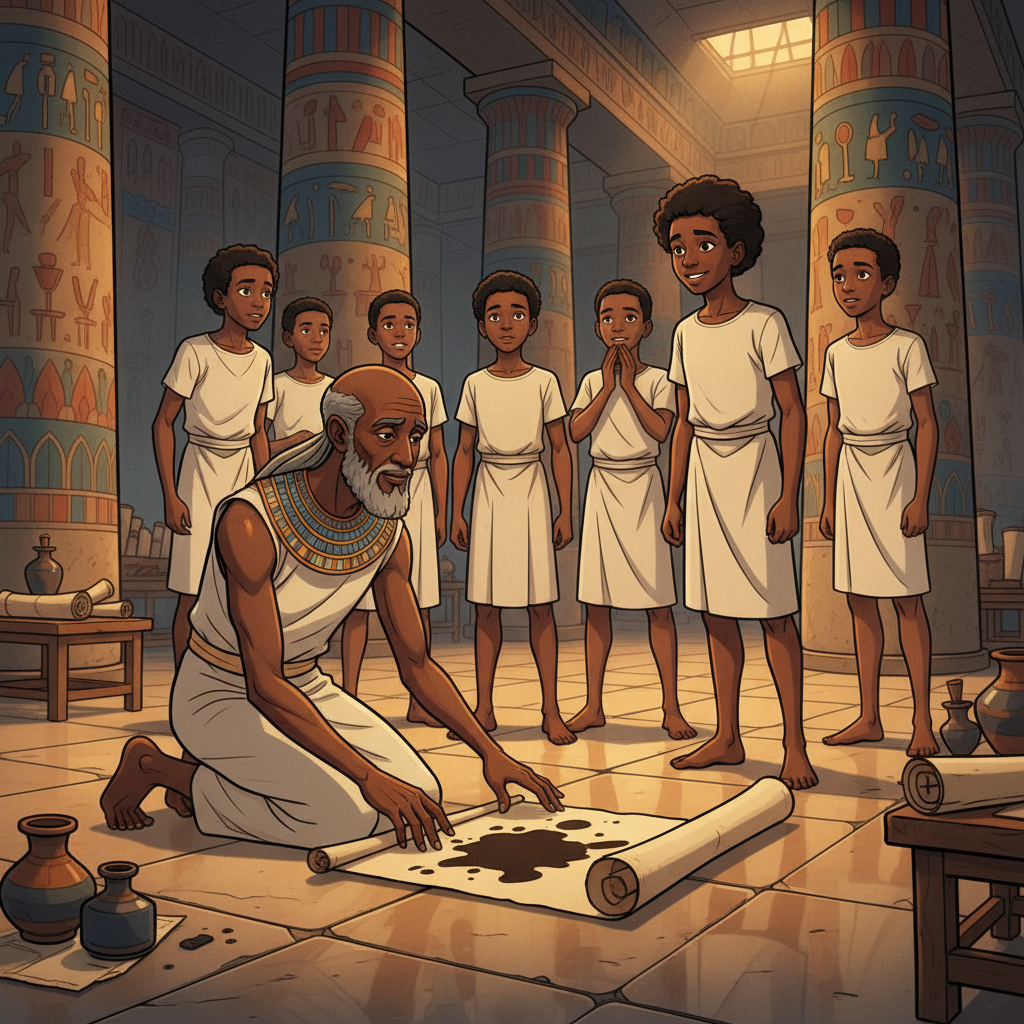
Amenhotep walked toward him without hurrying. He knelt beside the scroll and studied the dark stain with gentle fingers. The other students held their breath. Then Amenhotep looked up at Khaemwaset, and something moved across his face — not anger, but something warm and deep, like pride. "This scroll can be cleaned, young scribe," Amenhotep said quietly. "The priests know how to lift ink from papyrus using natron salt and patience. These sacred words have survived a thousand floods. They will survive your elbow." A few students laughed softly, and Khaemwaset felt the tiniest smile pull at his lips. "But listen well," Amenhotep continued, his voice dropping low. "A Ka that learns to lie cannot be cleaned so easily. Once Isfet enters the heart, it grows roots like river reeds."
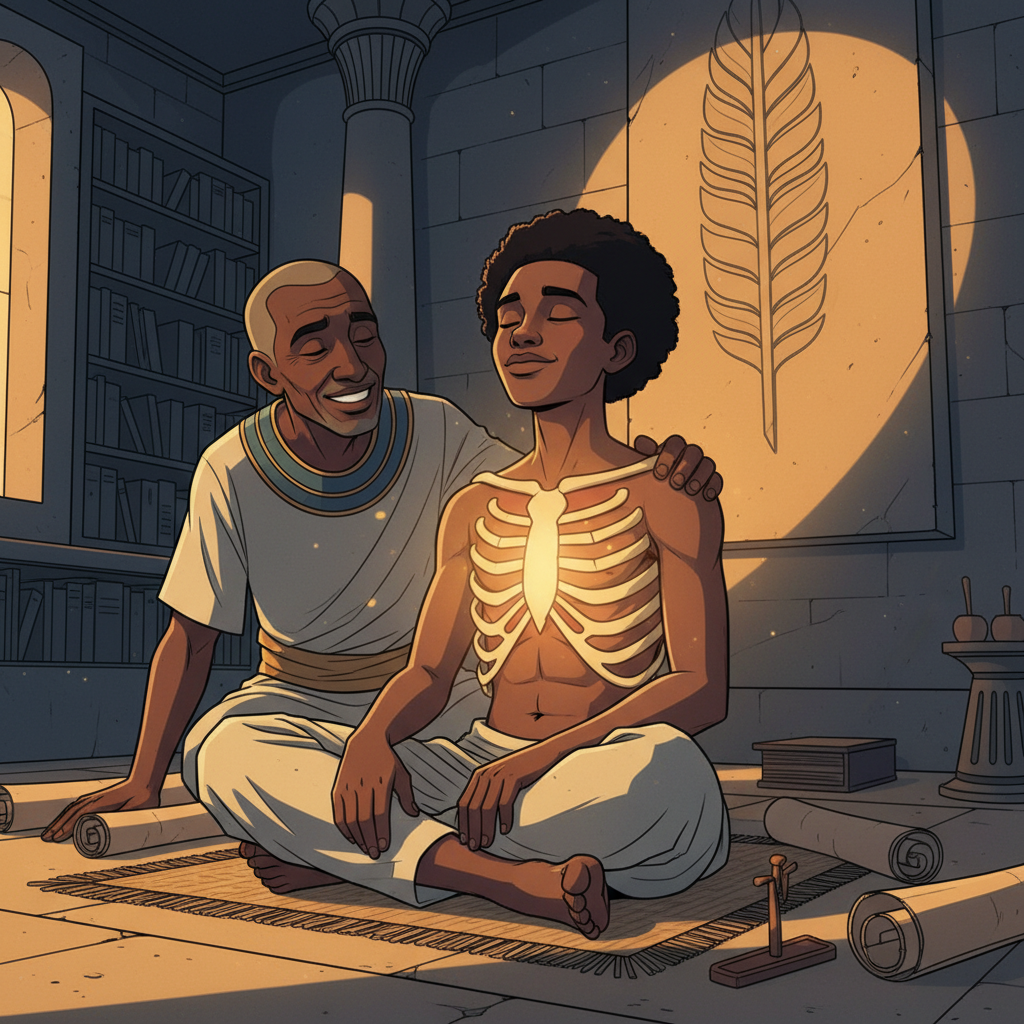
Amenhotep placed his broad, dark hand on Khaemwaset's shoulder. The weight of it felt like an anchor, steady and sure. "You copied the words of Maat today with your pen," the teacher said. "But just now, you copied them with your life. That is what it means to be a true scribe of the Per Ankh. Not perfect hands — a truthful Ka." Khaemwaset sat back down on his mat, and something warm spread through his whole body, from his chest out to his fingertips. It was not the heat of the sun or the warmth of the room. It was something that came from inside, like a lamp someone had lit behind his ribs. He understood now — Maat was not just words on old papyrus, not just a feather on a scale. Maat was alive. Maat lived in every choice to speak truth when a lie would be easier. And today, Maat lived in him.