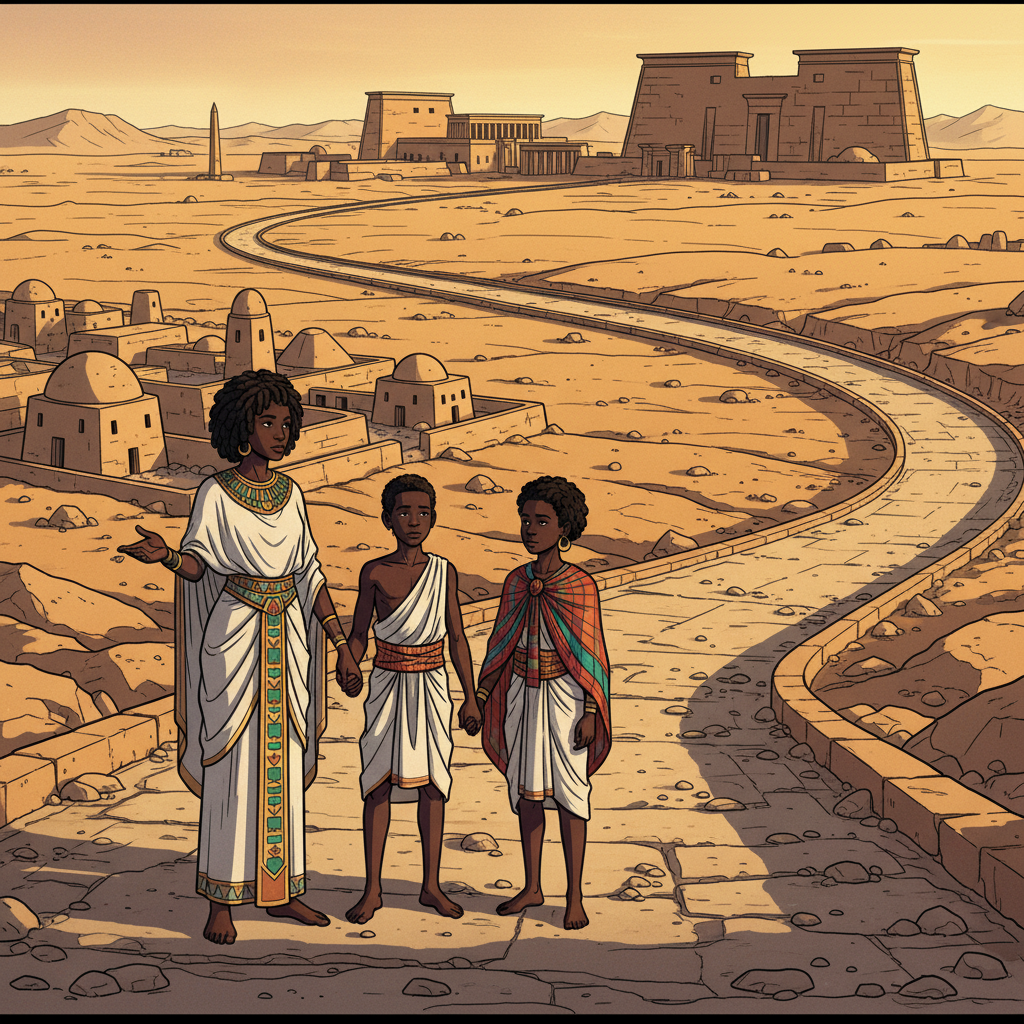
Senkamanisken was thirteen years old and the son of two crafts. His mother Aset-em-Akhbit was a master weaver of the fine white linen the temple priests of Kemet wore, working in the family quarter of Napata, the Kushite royal city far up the Nile. His father Khasankha was one of three chief architects in the service of Pharaoh Taharqa of the 25th Dynasty — the Kushite ruling family that, for the past sixty years, had also been the ruling family of all of Kemet. Senkamanisken had been born in Napata, and he had been walking the road between Napata and the great Kemetic temple at Karnak since he was nine. His grandmother Sebiumeker, who had taught Aset-em-Akhbit to weave, called the road "the seam of the kingdom." Senkamanisken was learning that a kingdom was a seam that had to be carefully held together.
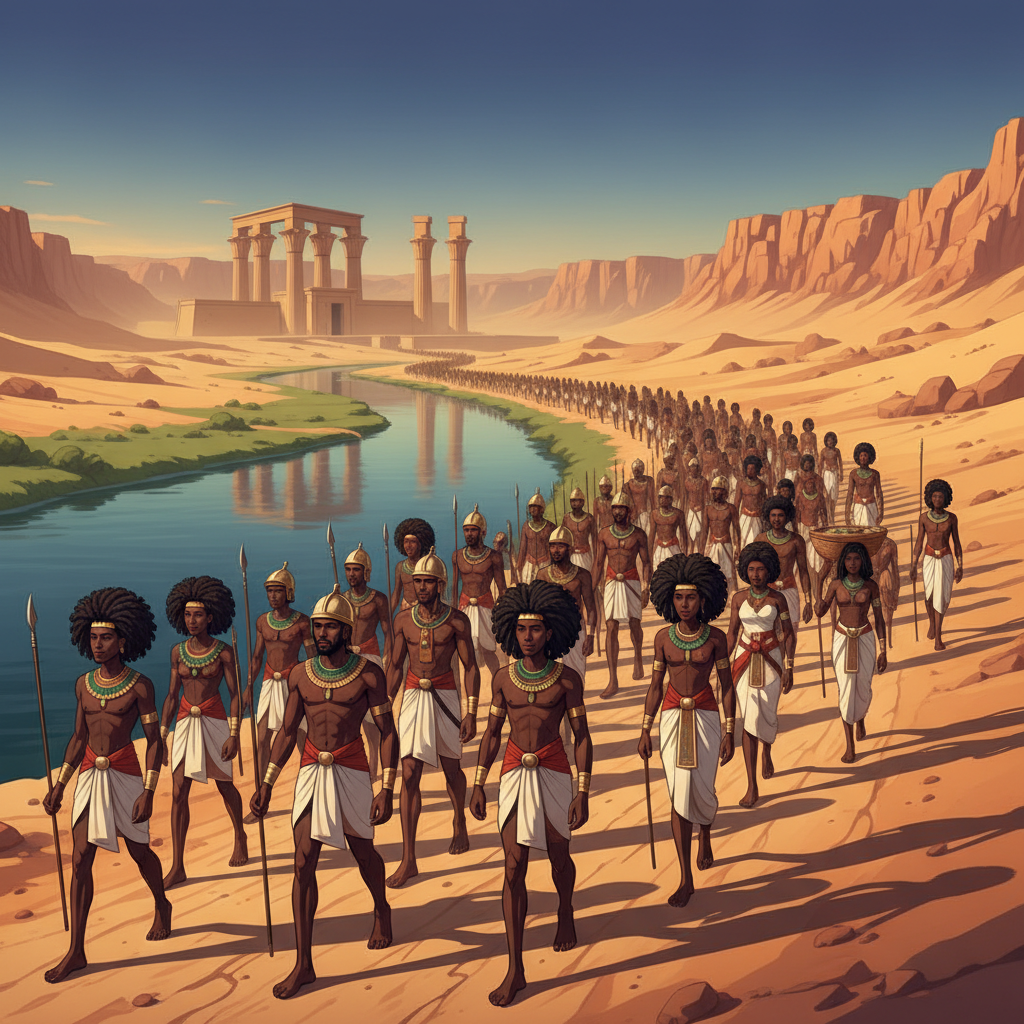
On the morning the story began, Senkamanisken and his father had been in Karnak for fourteen days. They were staying in the architect's quarter just outside the eastern wall of the great temple of Amun. Senkamanisken's father was overseeing the raising of a new colonnade — eleven enormous papyrus-bundle columns running along the southern side of the great hypostyle hall. The columns were the tallest Kemet had ever built. The tallest of them, the central one, would stand sixty-nine feet from base to capital — three times the height of any house in Karnak's city. The columns were Taharqa's gift to Amun. Taharqa was the third Kushite pharaoh of the 25th Dynasty. He had inherited a Kemet that had been broken into three small kingdoms for centuries. His grandfather Piye had unified it. He was finishing the work in stone.
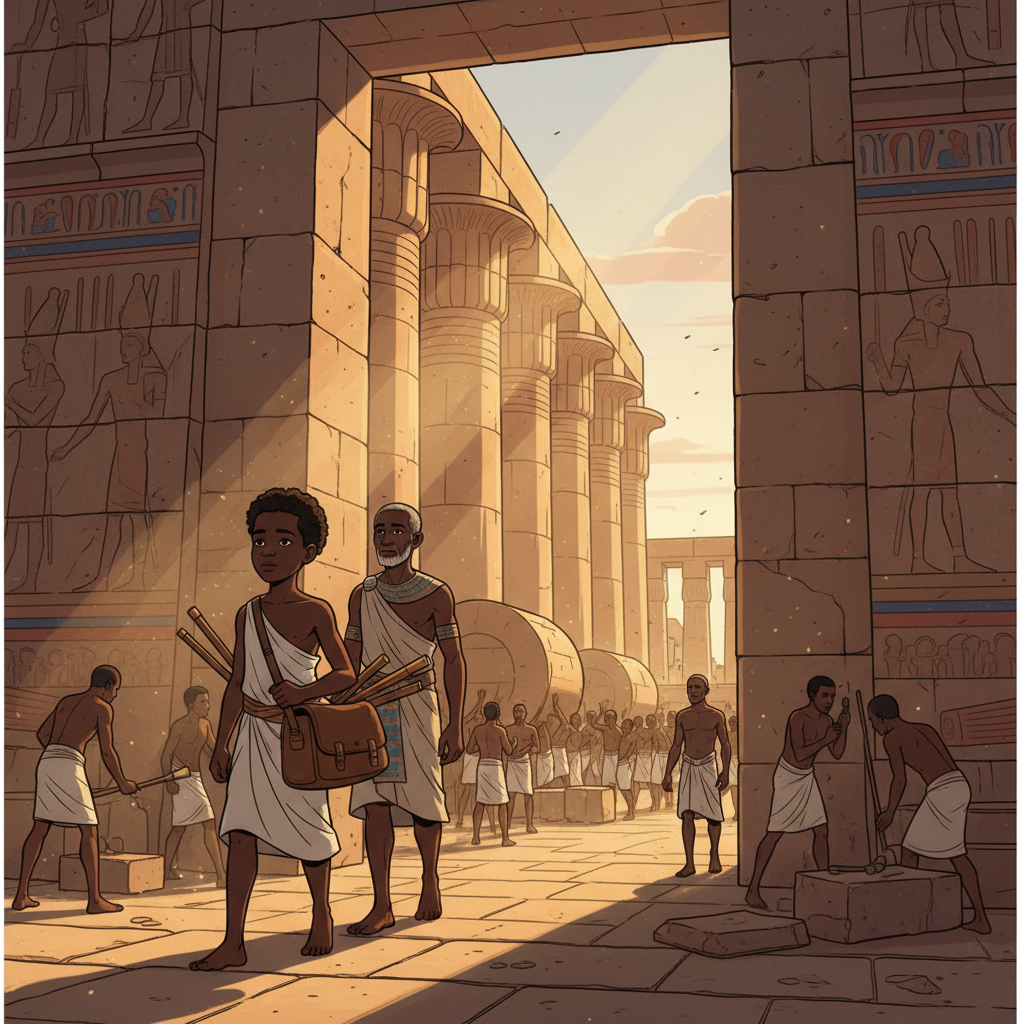
Senkamanisken walked behind his father through the eastern gate of the temple complex at first light. He carried, as he had since he was nine, his father's leather satchel of measuring rods and brass plumb-bobs. The Karnak temple was still half-asleep at that hour. The morning lectors were beginning the dawn-hymns inside the inner sanctum, their voices rising in the slow careful Kemetic of the priesthood. Outside in the great courtyard, the construction site was already alive: hundreds of workers, mostly Kushite from the southern quarries plus Kemetic stonemasons from the local towns, moving in coordinated groups around the half-finished colonnade. The smell was limestone dust and ox-sweat and the faint resin of the lifting-ropes. Senkamanisken loved this smell. He had grown up in it.
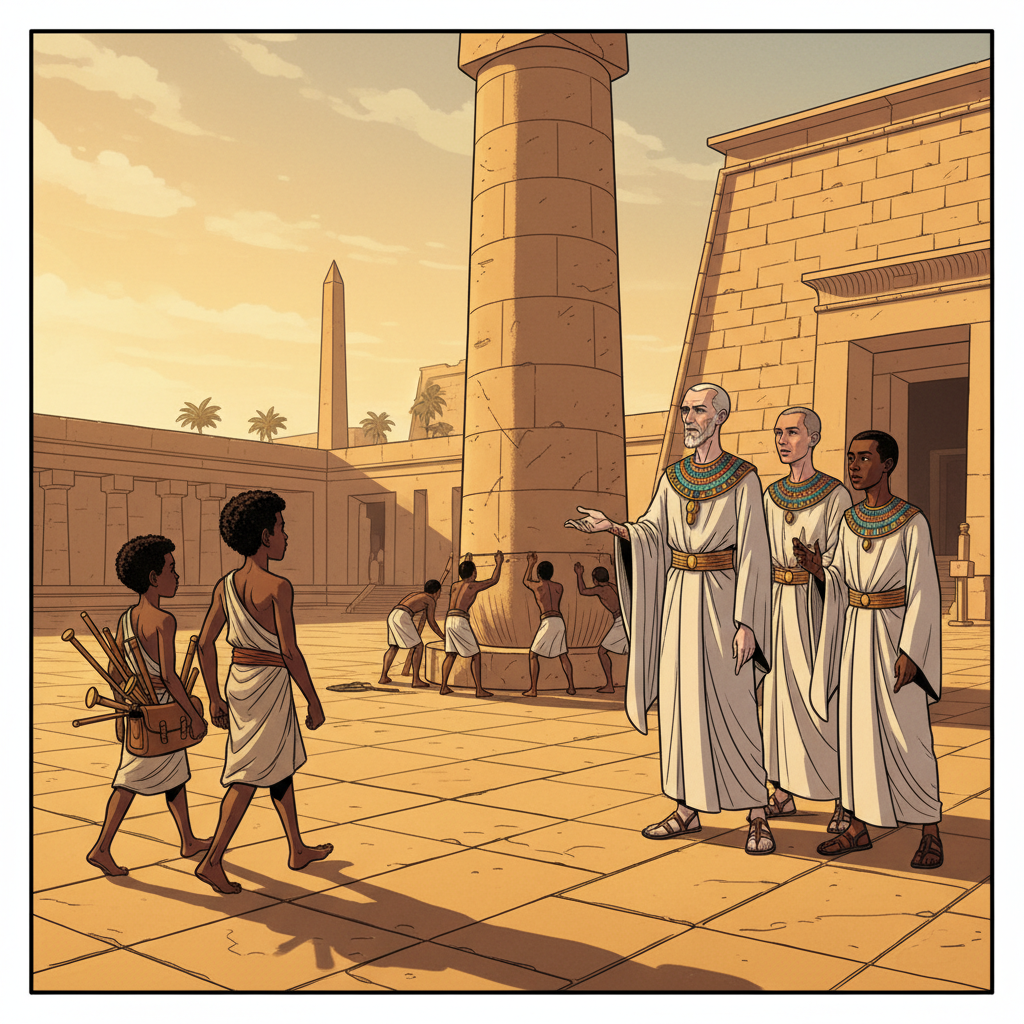
At the southern edge of the courtyard, three Kemetic priests in white linen robes were watching the morning's work. The eldest of them was the First-Prophet of Amun, a man named Hor-em-akhet. He was perhaps sixty-five, tall, with the very pale Lower-Kemetic skin of a man whose ancestors had been priests at Heliopolis for ten generations. The other two priests were younger, deferential. Hor-em-akhet was watching the central column being prepared for its lift. He was not speaking, but Senkamanisken — who had been walking past these same priests every morning for fourteen days — had learned to read the small movements of his face. The First-Prophet's jaw was set. His eyes were not approving. As Senkamanisken passed, he caught one quiet sentence the First-Prophet spoke to the younger priest at his side: "These Kushites do not understand our temple."
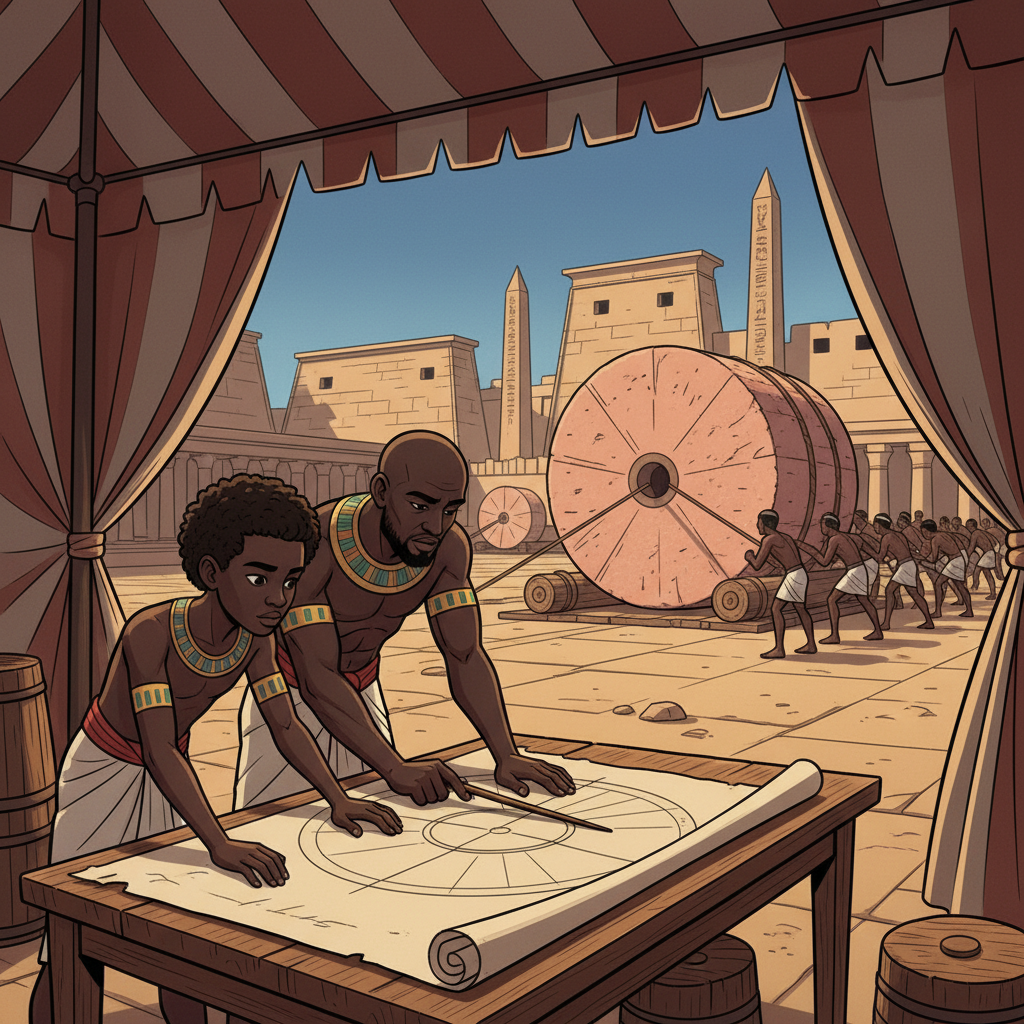
Senkamanisken kept walking. He did not turn his head. His father, two paces ahead, did not turn his head either, but Senkamanisken knew his father had heard. He had learned, in fourteen days of walking past Hor-em-akhet, that his father did not respond to the priest's muttered comments. The architect's reply was always in the stone, never in words. When they reached the architect's tent at the courtyard's far edge, Khasankha unrolled the day's drawing across the long cedar work-table. It was the survey-plan for the central column's base. The base was a circular drum of pink Aswan granite, twelve feet in diameter, the heaviest single piece of stone on the entire construction site. Khasankha pointed at the drawing. "Today the central column rises. Watch carefully."
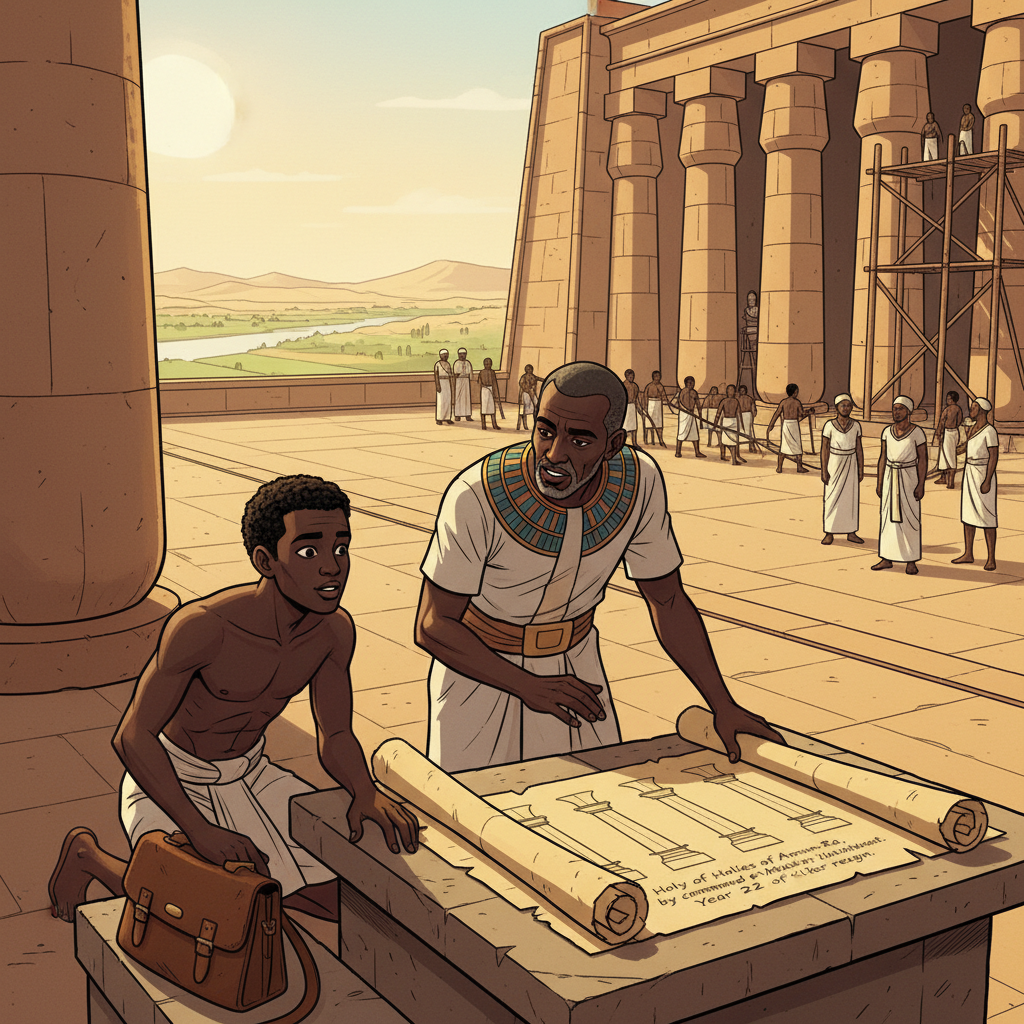
Senkamanisken nodded. He set down the leather satchel beside the work-table. His father unrolled a second drawing alongside the first — a much older drawing, the papyrus yellowed and the edges browned, the lines drawn in a slightly different style. Senkamanisken had not seen this drawing before. He bent over it. It showed, in unmistakable Kemetic temple-drafting style, a row of columns much like the ones being raised this morning. The proportions were identical. The base-diameter, the shaft-taper, the capital-spread — all the same numbers. At the bottom of the older drawing, in the small angular hand of a long-dead scribe, was a single inscription: "Holy of Holies of Amun-Ra, by command of Maatkare Hatshepsut. Year 22 of her reign." Senkamanisken looked up at his father. "Eight hundred years ago," Khasankha said.
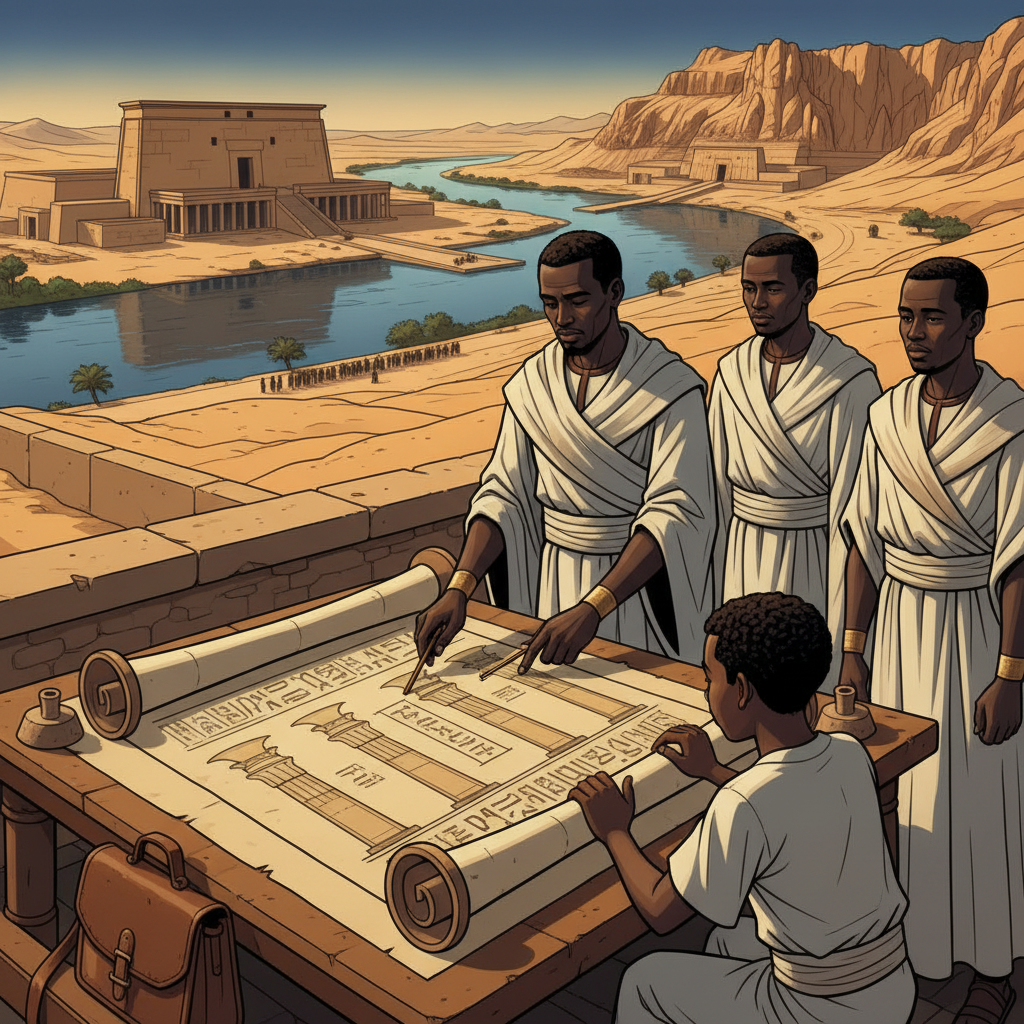
"This drawing is from the inner sanctum that Queen Hatshepsut built eight hundred years before us, on the western bank of the Nile across from this temple. Her builders worked these exact proportions for the columns inside the holy of holies. The proportions are the sacred ratio — the height of the column to the diameter of the base, the taper of the shaft, the spread of the capital. The numbers do not change because Amun does not change. We are not designing new columns. We are completing the conversation Queen Hatshepsut began. Taharqa, who is far from here in Napata, has been studying her drawings for ten years. He says the temple of Amun has been speaking the same sentence for two thousand years. We are just helping it speak louder."
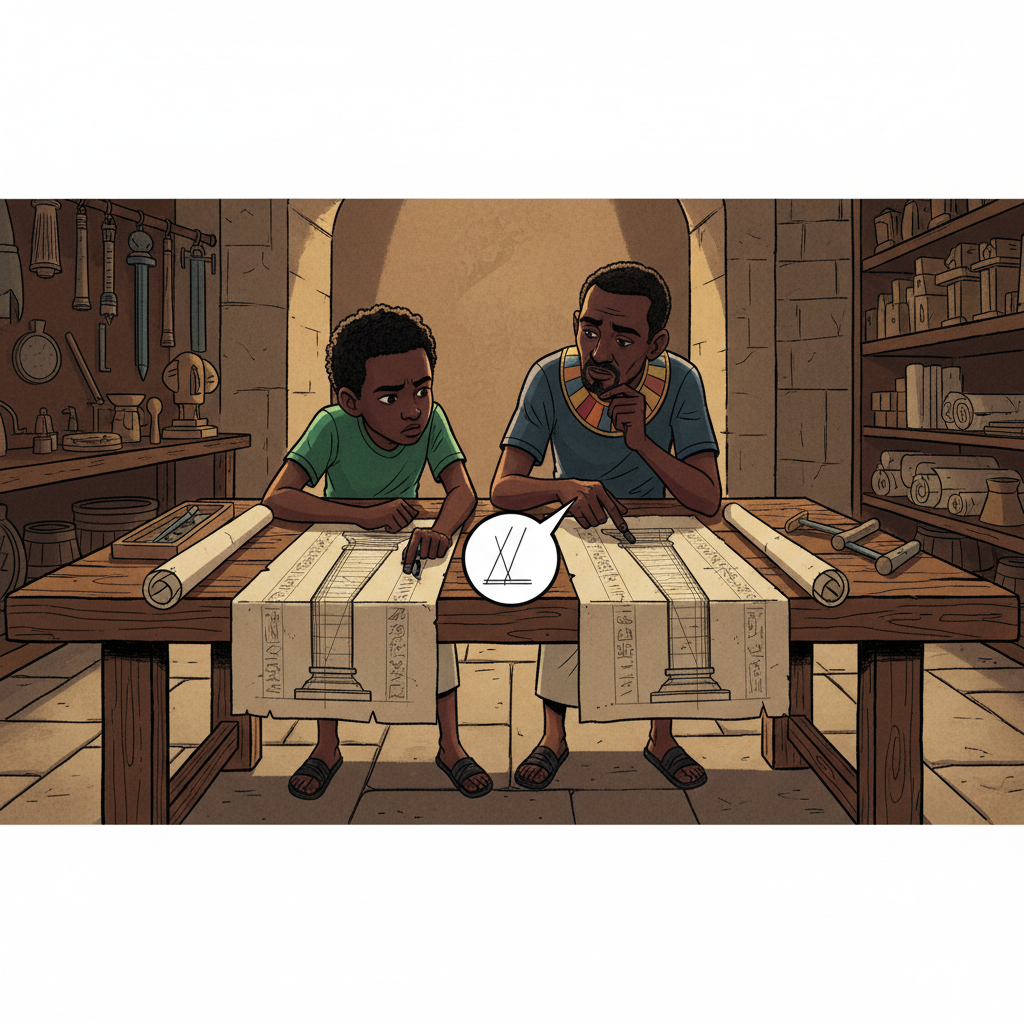
Senkamanisken looked at the two drawings side by side. He could not at first see what his father meant. But as he looked at the column-shaft taper — the way the column narrowed as it rose toward the capital — he saw that the slope of the taper was the same in both drawings. The same ratio. The same hand-of-the-builder, eight hundred years apart. He looked up at his father. "Why do the priests not see this?" Khasankha was quiet for a moment. Then he said: "Some of them see. Hor-em-akhet does not. Hor-em-akhet is a man who remembers when his great-grandfather's great-grandfather was First-Prophet, and the priests of Heliopolis decided what the pharaoh built. That was three hundred years ago. The kingdom has changed. Some men do not change with it."
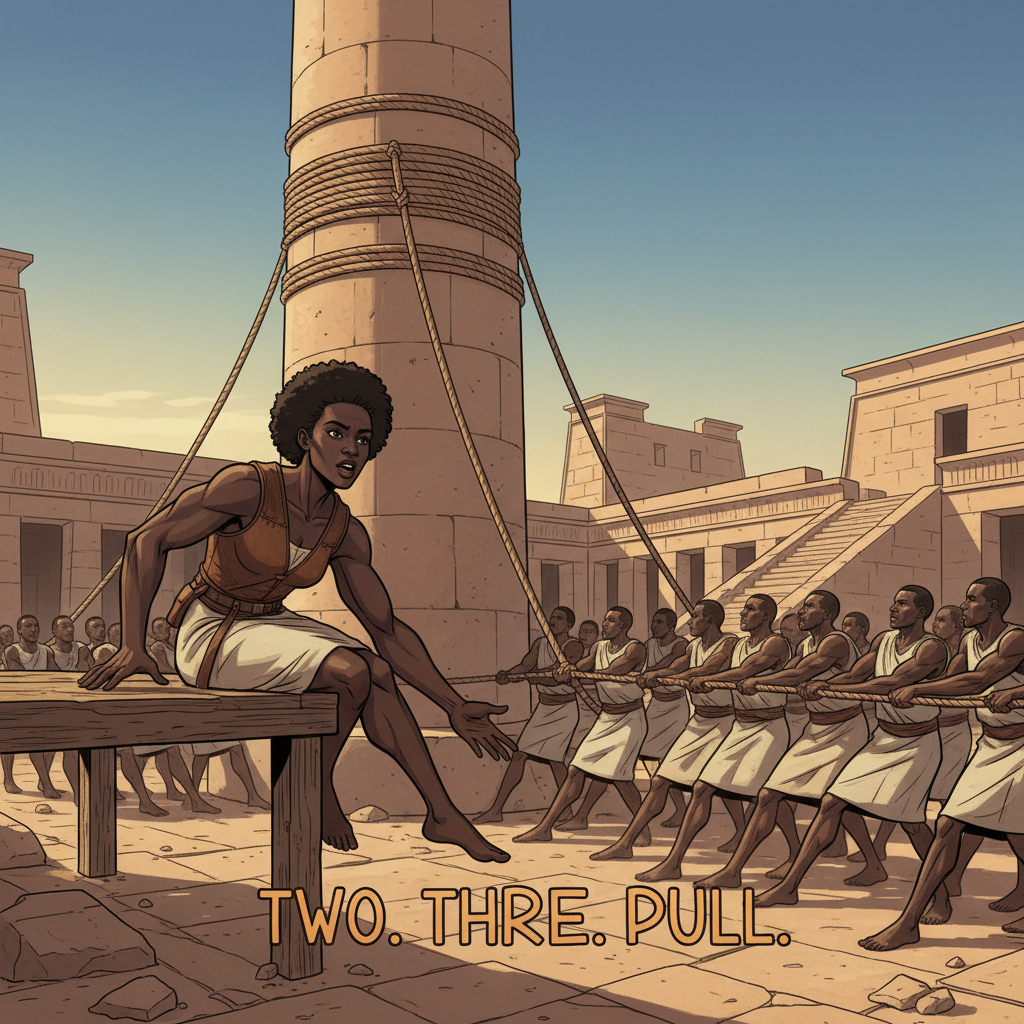
At the second hour after sunrise, the central column was ready to rise. The lift-team had assembled — sixty men with ropes, plus the senior rigging-master who would call the rhythm. The rigging-master was a woman named Tekahatamani, a Kushite from the southern quarries, in her mid-thirties, with deep brown skin and the heavy braided forearms of someone who had been rigging stone since she was sixteen. Her voice carried across the courtyard the way the dawn-hymns carried inside the temple — steady, paced, unrushed. She climbed onto the wooden lifting-platform at the column's base. She raised her right hand. The sixty rope-men took their slack. She lowered her hand and called the first rhythm: "TWO. THREE. PULL." The ropes tightened. The column began to lift.
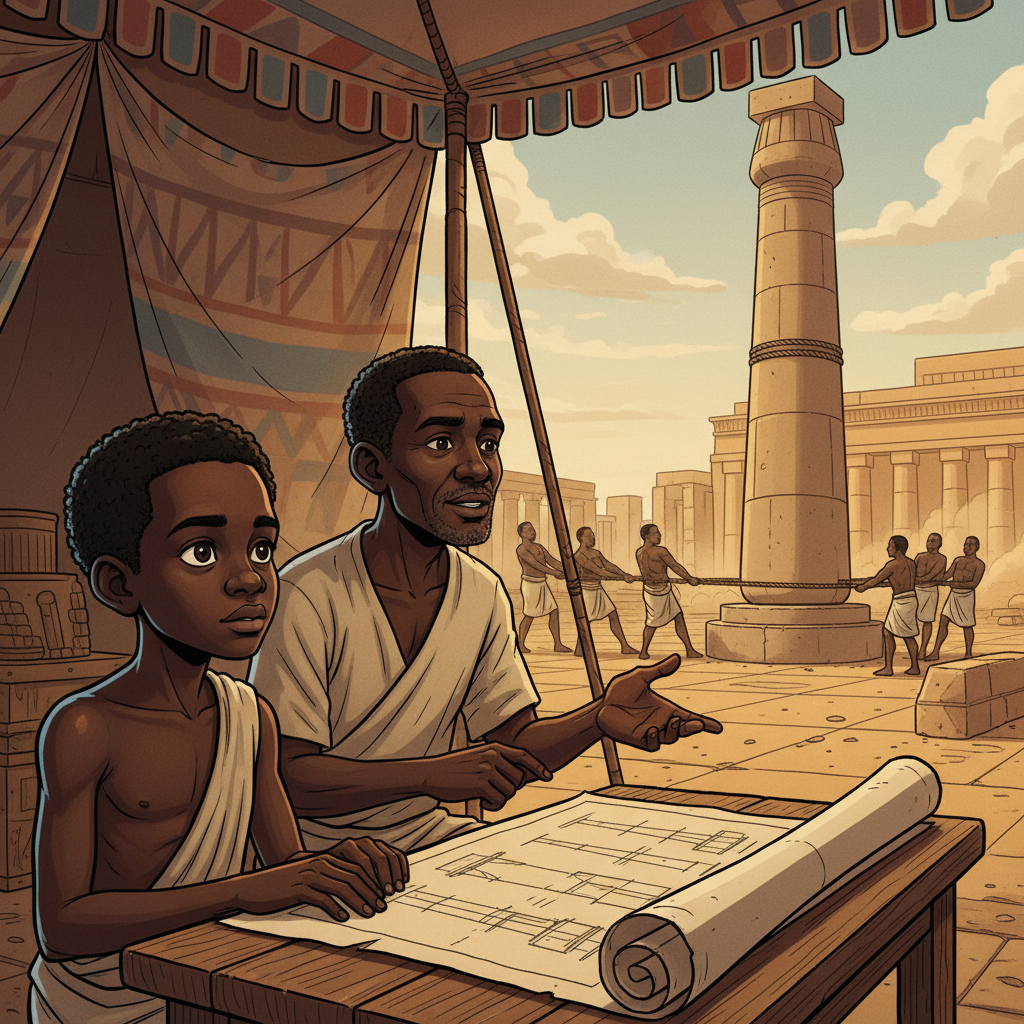
The column rose, hand-width by hand-width, over the course of an hour. Senkamanisken watched from the architect's tent, his father beside him, the older Hatshepsut drawing still unrolled on the work-table. The lift was perfect. Tekahatamani called the rhythm steadily. The rope-men responded. The column settled into its prepared bed on the granite drum-base. When the column was vertical and the lifting-ropes were slack, Senkamanisken crossed the courtyard to the base. He put his small palm flat against the still-warm granite drum where Tekahatamani had just stood. The stone was the temperature of his own skin. He looked up the shaft of the column toward the capital, dust still slanting through the morning sun from the unfinished roof high above. The column was beautiful. It also matched, exactly, the proportions on Hatshepsut's eight-hundred-year-old drawing. Senkamanisken understood.
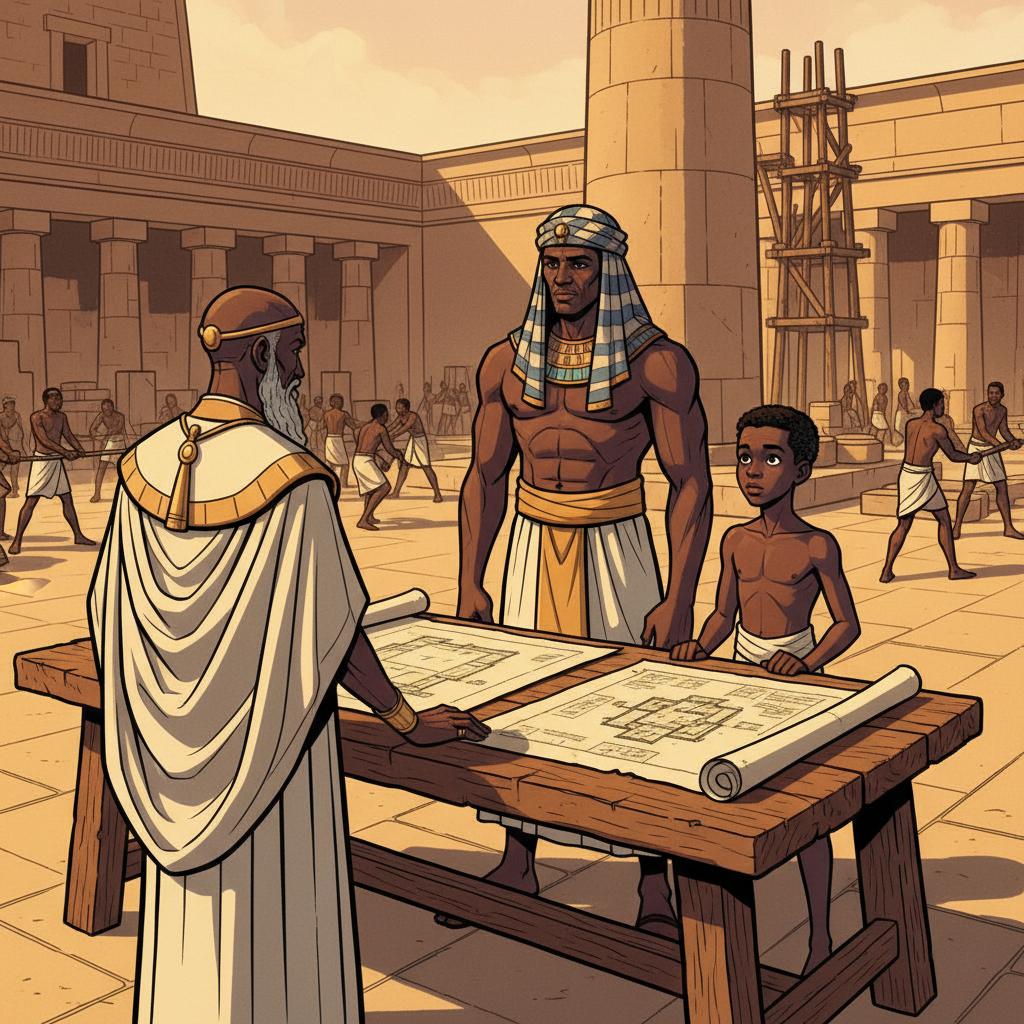
From the southern edge of the courtyard, the First-Prophet Hor-em-akhet was watching. Senkamanisken caught his eye for the first time in fourteen days. The old priest's face was unreadable. He turned to the younger priest at his side and said something Senkamanisken could not hear at this distance. Then he walked toward the architect's tent. Khasankha straightened beside his son. Senkamanisken watched the First-Prophet cross the courtyard. The priest stopped at the work-table. He looked at the two drawings side by side. He looked at Khasankha. He did not speak. He turned and walked back across the courtyard toward the southern colonnade, without acknowledging Khasankha or Senkamanisken or the drawings. His shoulders were stiff.
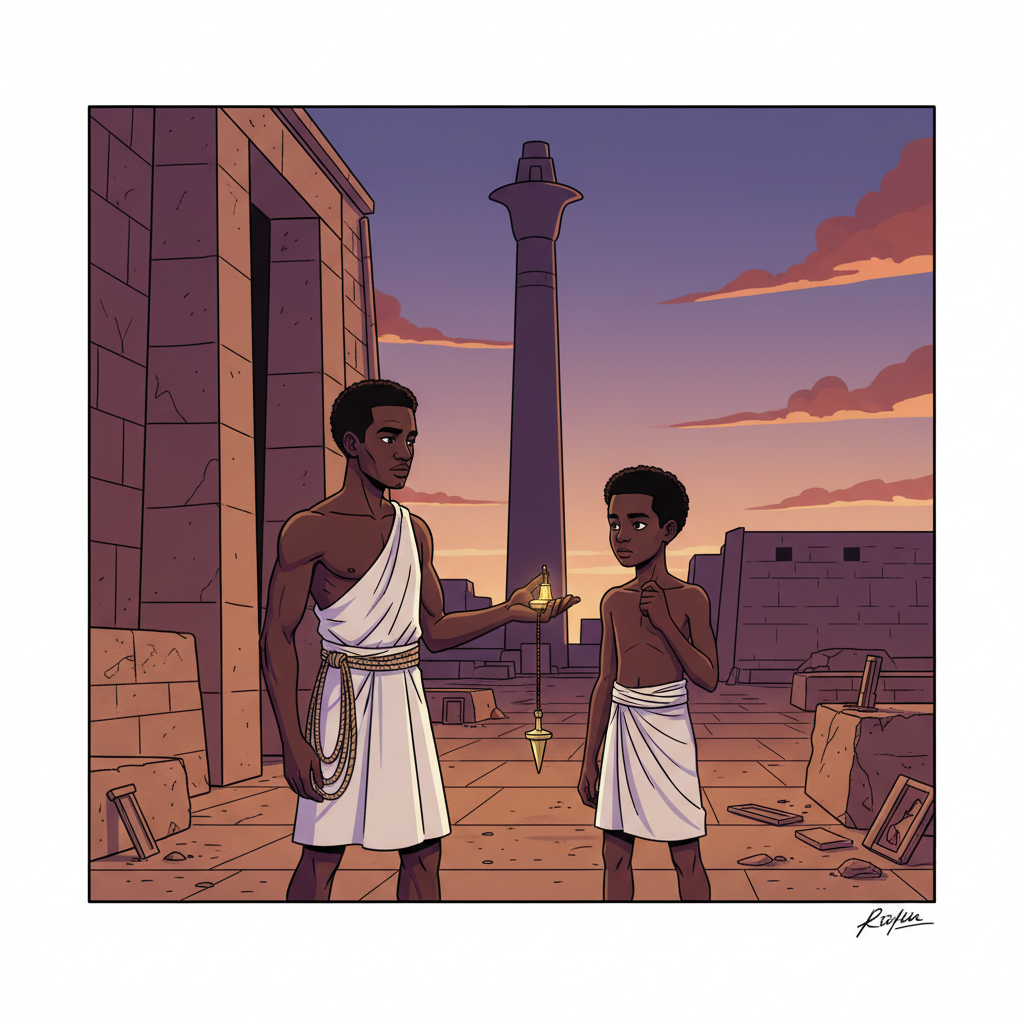
That evening, Khasankha and Senkamanisken walked back to the architect's quarter together. The Karnak temple was quiet. The construction site was empty. The new central column was a single dark vertical line against the lavender sky. Khasankha was quiet for most of the walk. As they reached the eastern gate, he stopped. He uncoiled the long measuring rope from his belt. He took the brass plumb-bob off its hook. He held the plumb-bob in his open palm for a moment. Then he held it out to Senkamanisken. "Tomorrow morning, before sunrise, take this plumb-bob to the First-Prophet. Hor-em-akhet walks the southern colonnade at dawn. He will be alone. Show him the plumb-bob. Show him the proportions. Tell him the column was raised on Queen Hatshepsut's measurements." He paused. "He will not thank you. Do it anyway."
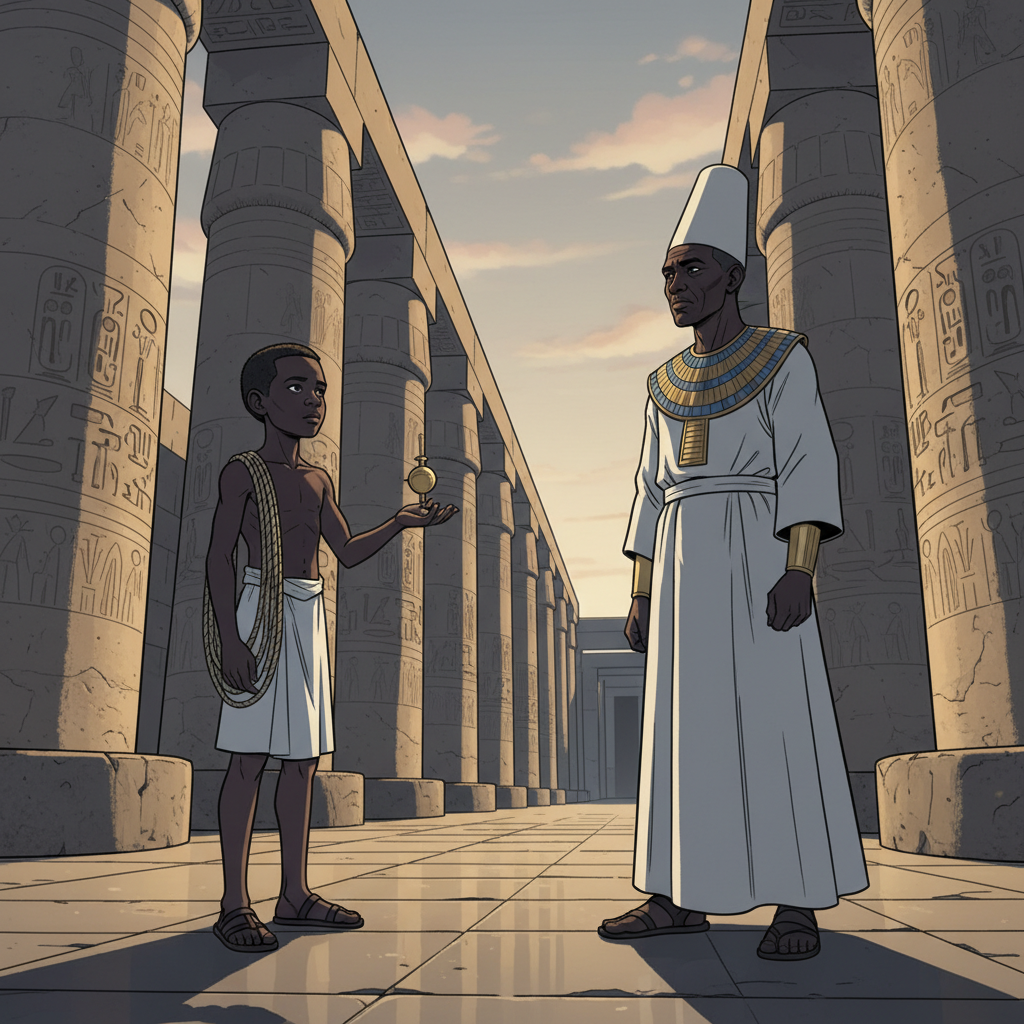
Senkamanisken did not sleep well. He had never spoken to the First-Prophet. He had only walked past him for fourteen days while the old man muttered about Kushites and temples. He rose in the dark and walked to the temple with the plumb-bob in his hand and the long measuring rope coiled around his shoulder. The eastern sky was just beginning to turn the color of wet pearl. The southern colonnade was empty except for one tall figure walking slowly in the half-light. Senkamanisken approached. His sandals made the smallest sound on the polished pavement. Hor-em-akhet turned. He saw the boy. His face did not change. He did not speak. Senkamanisken stopped at three paces. He held out the brass plumb-bob in his open palm.
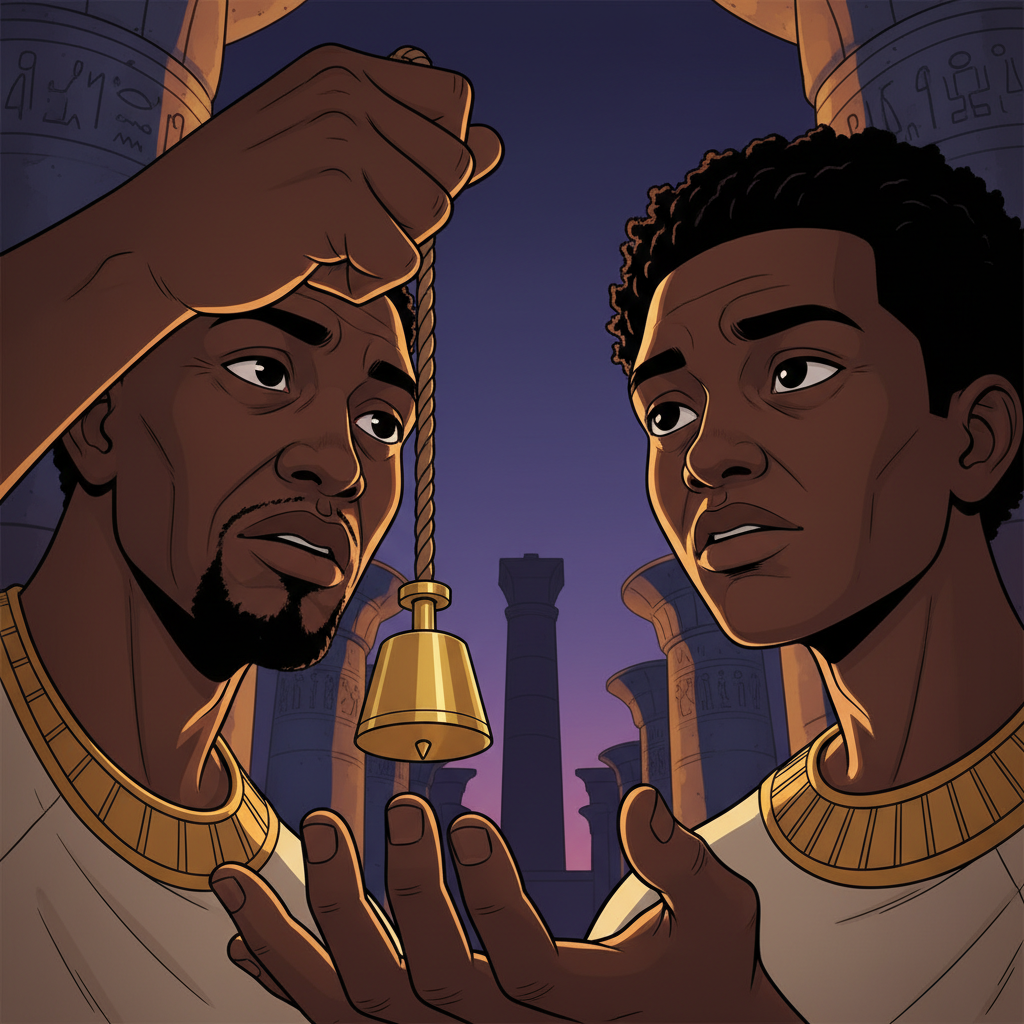
"These are the proportions," Senkamanisken said. His voice was much smaller than he meant it to be. He tried again. "These are Queen Hatshepsut's proportions. From her holy-of-holies, eight hundred years ago. My father has the drawing. We did not change the numbers. We are finishing what she began. The temple is one continuous conversation." He held the plumb-bob steady. The First-Prophet looked at the brass weight at the end of the rope. He looked at Senkamanisken. His face did not move. He did not lift his hand. He did not speak. He looked at the new central column, dark against the pre-dawn sky at the far end of the courtyard. He looked back at Senkamanisken. He looked at the plumb-bob a second time. He did not take it.
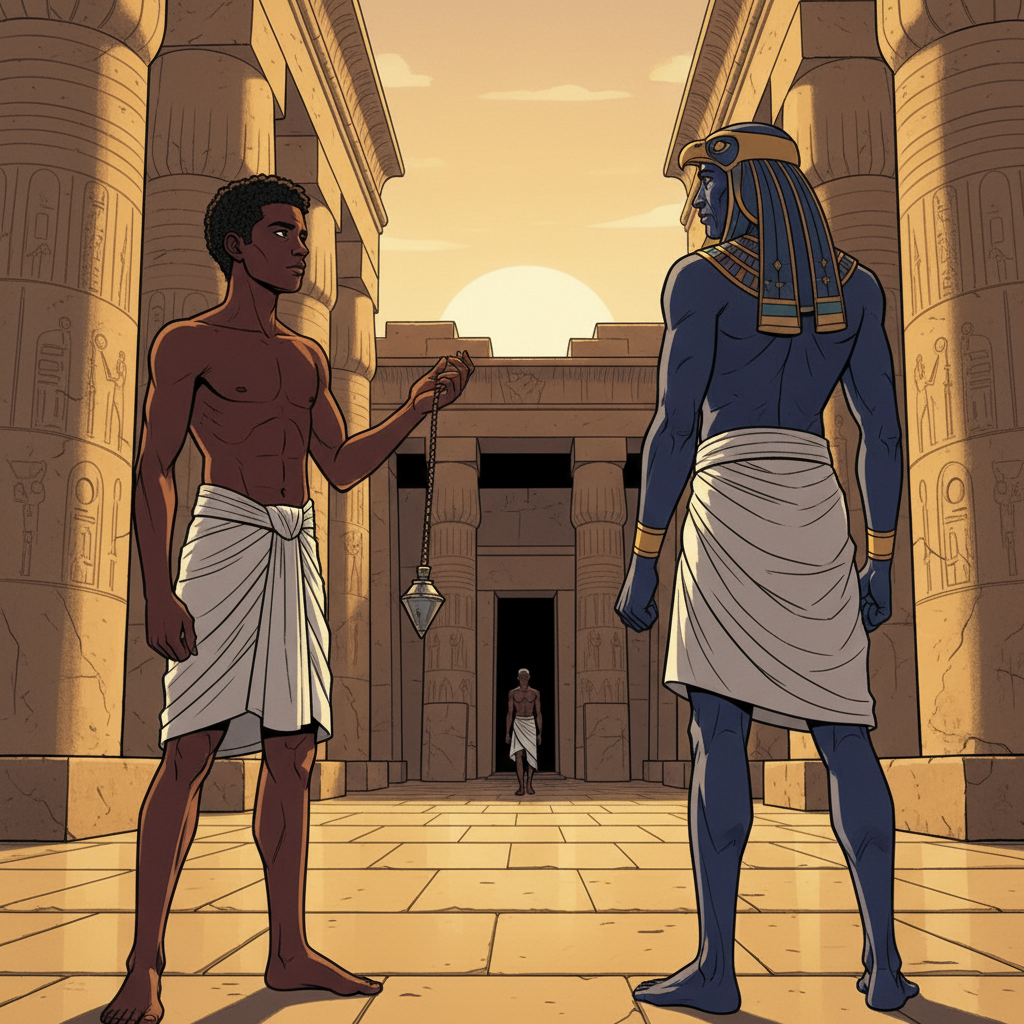
For a long moment the only sound in the courtyard was the very distant call of an ibis somewhere along the river. Senkamanisken held the plumb-bob steady. His arm was beginning to tremble. The First-Prophet drew one slow breath. He turned. He walked away. He did not look back. He passed under the southern colonnade and disappeared into the shadows of the morning-priests' quarter. He had not said a single word. He had not nodded. He had not smiled. Senkamanisken stood alone in the courtyard with the plumb-bob still in his open palm. He felt, for the first time in his thirteen years, the particular weight of an answer that was not given. From the lifting-platform at the far edge of the courtyard, Tekahatamani the Kushite rigging-master had been watching the dawn rope-check. She crossed the polished pavement without speaking. She carried a small clay cup of warm sorghum-tea — the cup the rope-teams kept on the platform-edge for the cold pre-dawn hours. She set the cup beside Senkamanisken's feet. She did not look at his face. She nodded once at the plumb-bob in his palm — a small Kushite mason's acknowledgment, the gesture rope-teams gave each other after a clean lift. Then she walked back across the courtyard to her platform. She did not need words either. The warmth of the cup against the cool dawn pavement was its own answer.
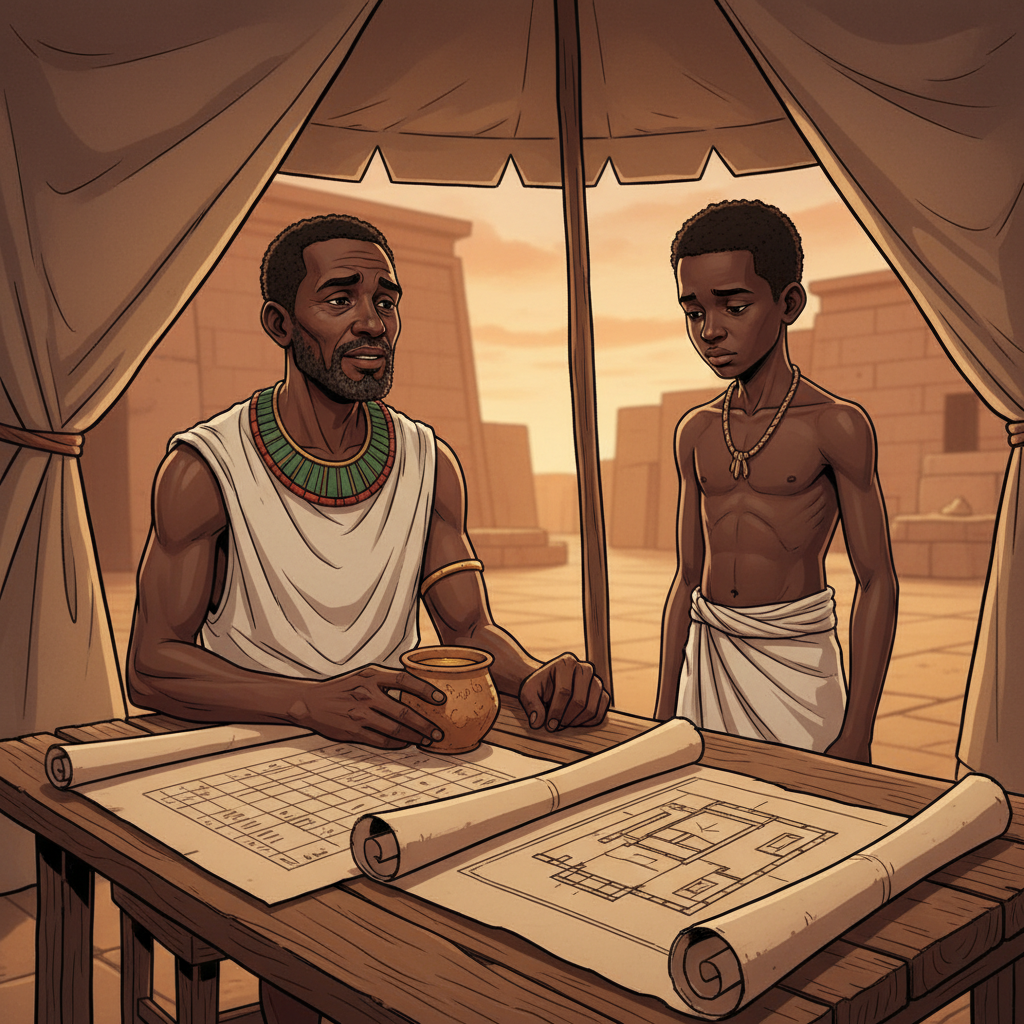
Senkamanisken walked back across the courtyard to the architect's tent. His father was already there at the work-table, the two drawings still side by side, a clay cup of warm sorghum-beer in his hand. Khasankha looked up. He read his son's face. "He did not answer," Senkamanisken said. Khasankha nodded slowly. He set down the cup. He gestured for Senkamanisken to sit. He did not put his hand on his son's shoulder. He did not offer comfort. He simply said: "Not all answers come in the form we want. Sometimes the answer is the silence. Hor-em-akhet has been First-Prophet for forty years. He has watched his priesthood lose authority for thirty of those years. He cannot, today, tell a thirteen-year-old Kushite boy that the boy was right. He may never tell anyone. But he saw the proportions. The answer has been given even if he never speaks it."
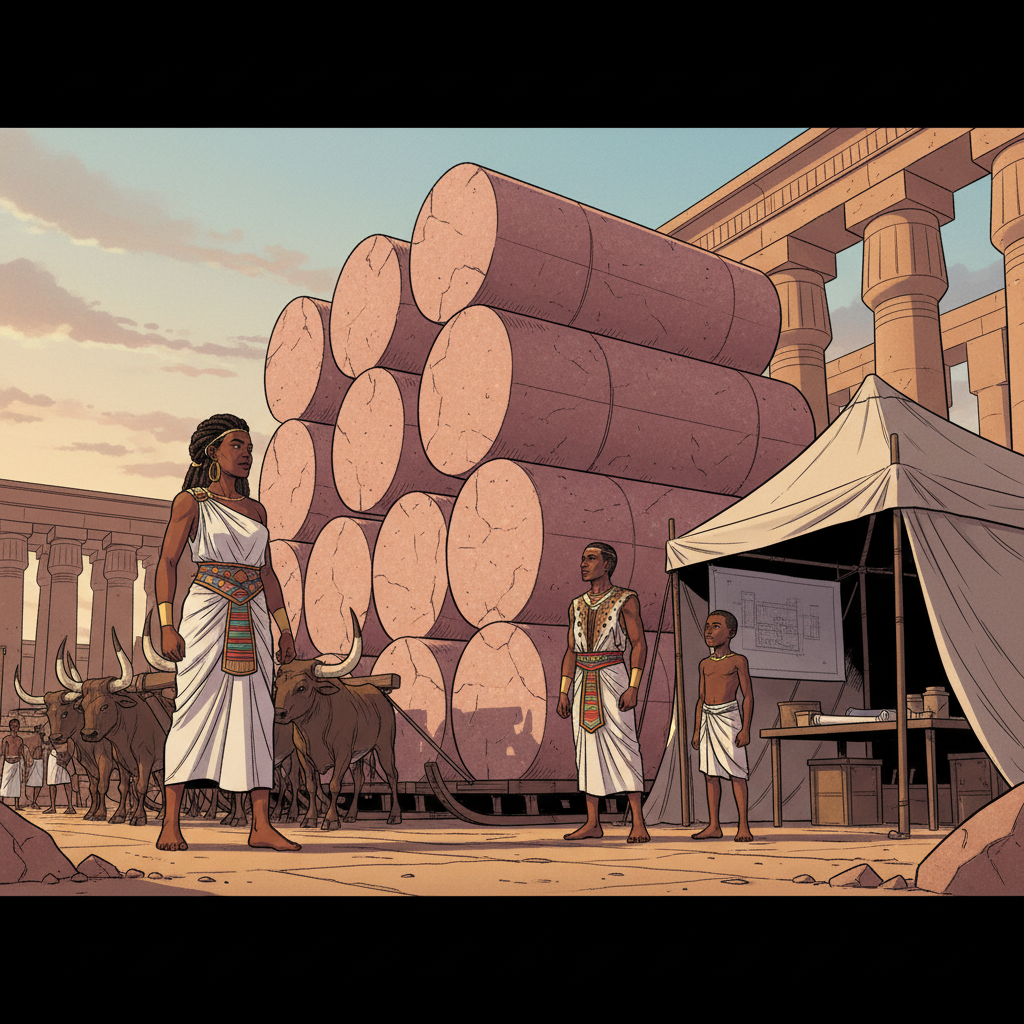
Two weeks later, Nehasy the quarry overseer arrived at Karnak with the next shipment of pink Aswan granite — twelve more column-drums for the colonnade. Nehasy was a Kemetic-trained woman in her mid-forties, with the deep warm brown skin of upper-Kemet, and she had been overseeing the Aswan quarry for the 25th Dynasty since Senkamanisken's grandfather's time. She spoke with Khasankha in the architect's tent for an hour about the consistency of the stone, the seasonal water-levels for the Nile transport, the new cutting techniques the quarry-women were using. She paid Senkamanisken no special attention but she did, at one point, glance at him and nod once — a small acknowledgment, woman-to-boy, that he was working his apprenticeship steadily. Senkamanisken received the nod and did not show that he had received it. He was learning.
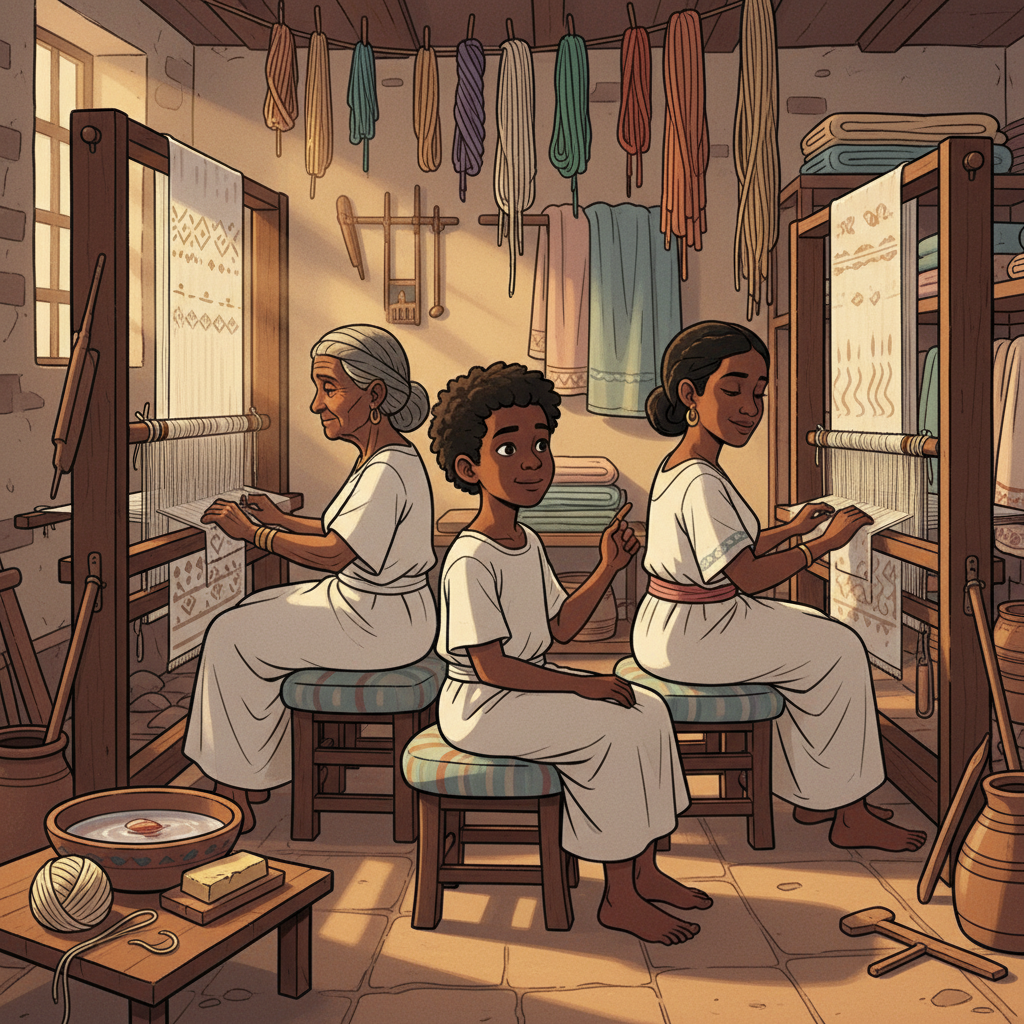
Later that summer, when the family returned to Napata, Senkamanisken visited his grandmother Sebiumeker in her weaving-room. She was eighty years old and had been weaving linen for sixty of those years, and her weaving-room smelled of fresh flax and beeswax and the rosewater she kept in a small bowl beside her loom. Senkamanisken's mother Aset-em-Akhbit was already there at the second loom, working a finer-thread piece for the spring temple-orders — she had been weaving since before sunrise, the way Sebiumeker had taught her. She nodded at her son when he came in and continued her work; she had been waiting for him to find his way to the weaving-room without being summoned. He sat between the two looms. He told them both about Hor-em-akhet. He told them about the silence. Sebiumeker listened. Then she said: "There is a teaching among the weavers, child. Some threads accept the dye. Some threads do not. The dye is still real. The weaver still does the work. The cloth is still made. You do not weave only the threads that will accept your dye. You weave them all. And the cloth is the answer. The threads that refused the dye are still in the cloth. They make the pattern. They make it strong."
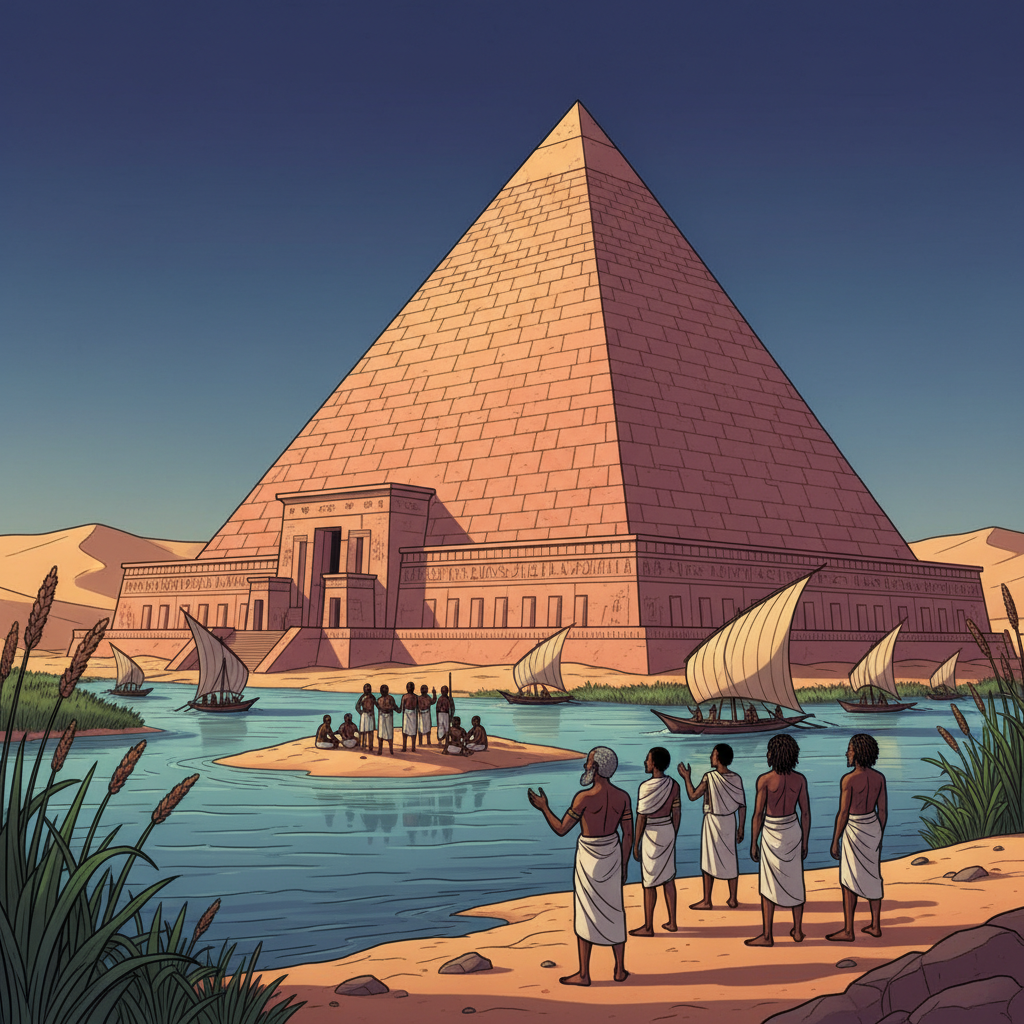
Twenty years passed. Senkamanisken became an architect. He worked under his father at Karnak for another nine years, completing the southern colonnade and beginning a new wing of the temple of Mut. When his father died, Senkamanisken returned to Napata. He took the senior architect's commission for the great pyramid-burial of Taharqa at Nuri — the burial Taharqa had begun planning during his lifetime and that had been left half-finished at his death. Senkamanisken finished it. The pyramid stood eighty-eight feet on a side and rose ninety feet into the desert sky on the western bank of the Nile near Napata. The proportions matched the holy-of-holies of Amun-Ra. The proportions matched Hatshepsut's drawing. The proportions matched Queen Sheba's mountain-shrine far to the southeast. The temple, all of it, was one conversation.
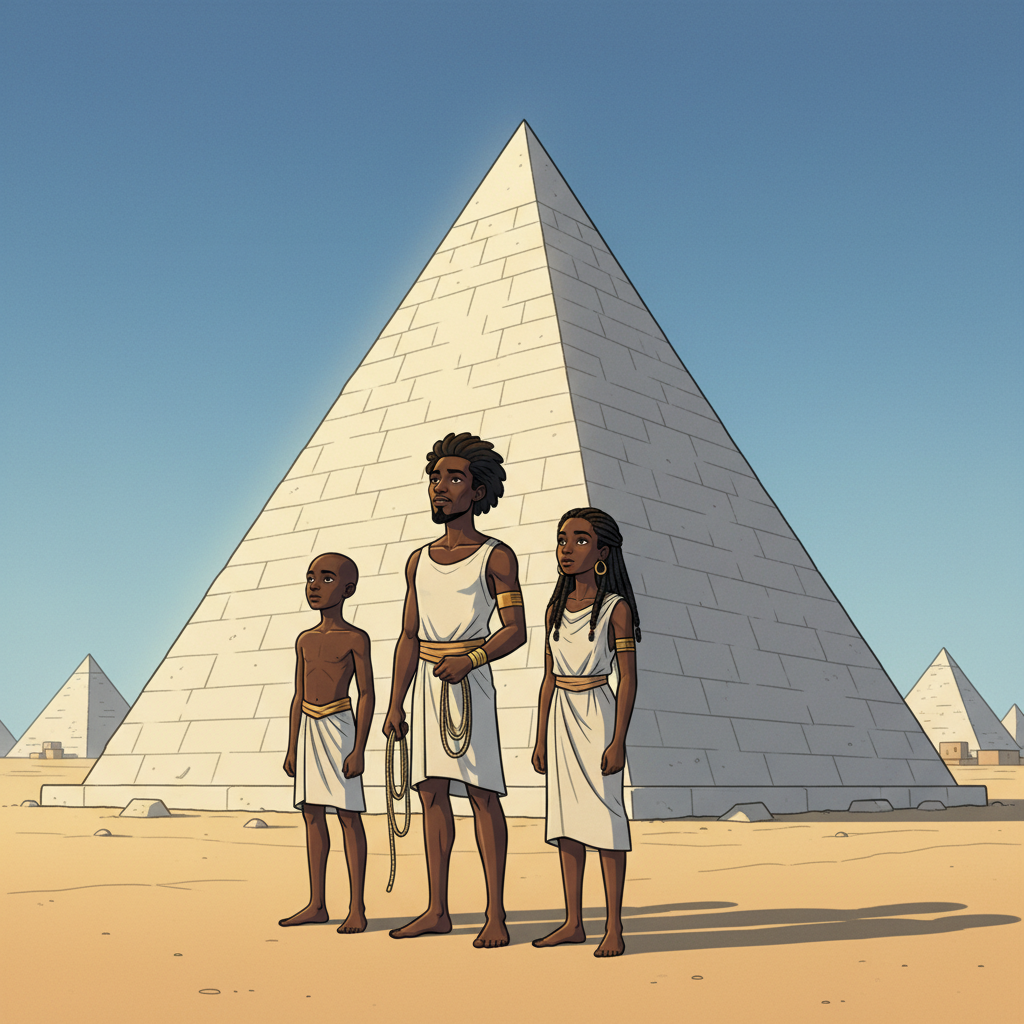
On the morning Senkamanisken was thirty-three years old and standing at the base of the completed Nuri pyramid with his own measuring rope coiled in his hand, two younger apprentices stood with him in the sand. They were Khuit-Bastet, a Kushite woman of sixteen who had been apprenticing under him for two years, and Imeny, a Kemetic boy of sixteen who had walked the four months from Karnak the previous summer asking for an apprenticeship. They were watching the morning sun strike the white limestone face of the pyramid. Senkamanisken was not their father. He was not anyone's father yet. He was an architect, mid-career, surrounded by the work of his life still in front of him. He thought about Hor-em-akhet, who had died fifteen years ago without ever speaking again about Taharqa's columns. He thought about Sebiumeker, who had died the year before in her weaving-room, the loom still half-strung. The threads that refused the dye were still in the cloth. The pyramid stood. The temple was one continuous conversation. The work continued.