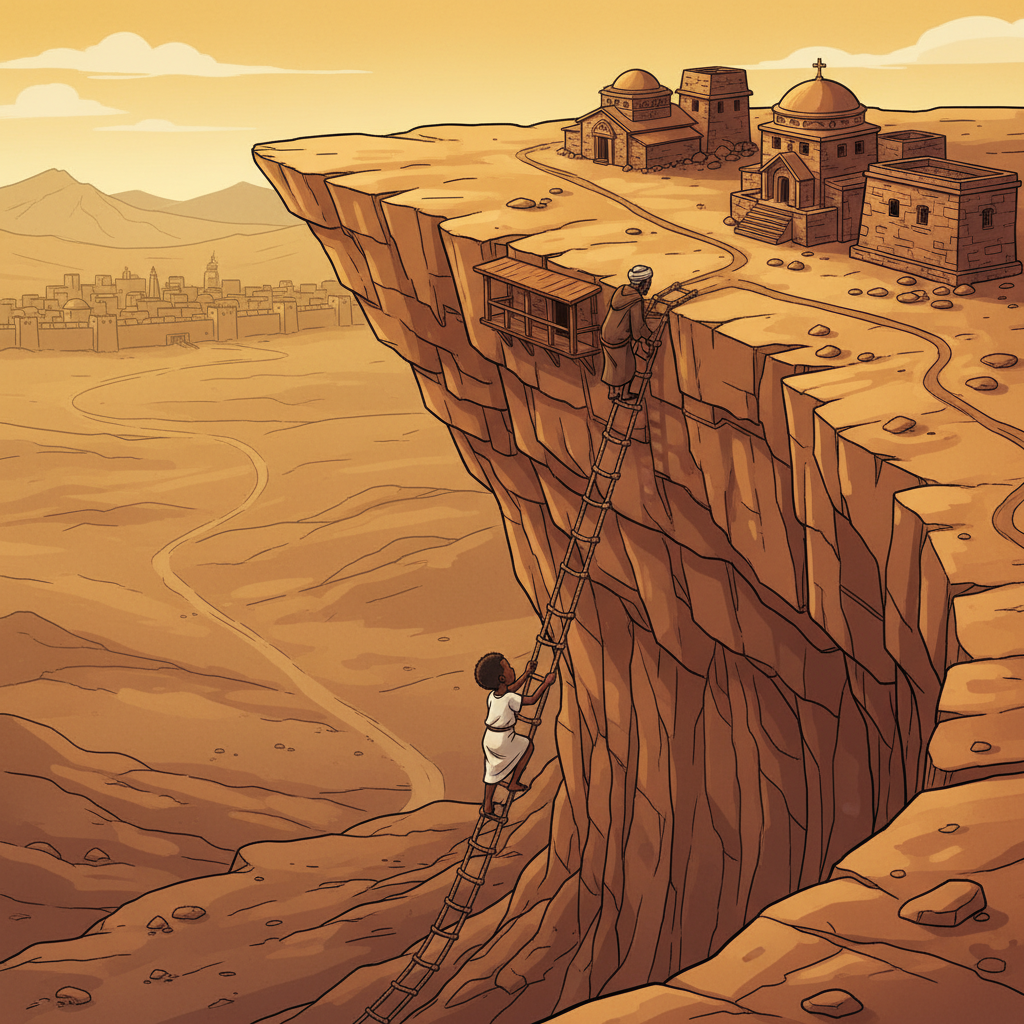
Welela was eleven years old and had been a novice at the highland monastery of Debre Damo for seven months. The monastery was built on a flat-topped mountain four hours of walking south of the old Aksumite capital, and the only way up was a rope-ladder pulled hand over hand against the cliff face. Welela had climbed the ladder once, the day her uncle had brought her to the abbot. She had not gone down since. She did not yet know if she ever would. Her skin was deep brown, her hair was cropped short the way all novices wore theirs, and she had been given the small white linen tunic of a beginner in the manuscript-cell. She slept in a row of fourteen other novices on woven palm-mats in the eastern dormitory. She woke every morning at the third bell, two hours before dawn, the way every monk and nun at Debre Damo had woken for over a thousand years.
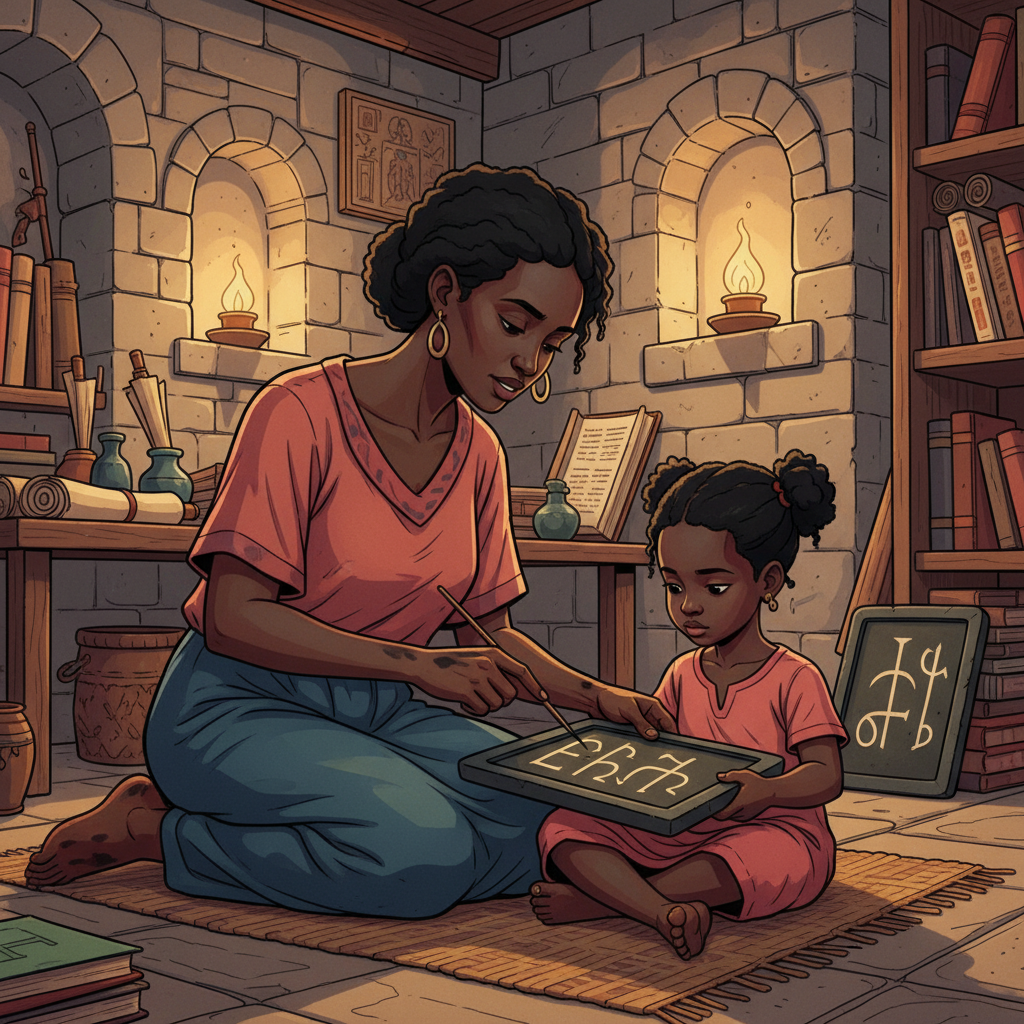
Welela had come to the monastery because she could already, at age ten, read the Ge'ez script better than most adults in her village. Her mother had taught her. Her mother was a copyist in the small parish church near the family's village, and she had begun teaching Welela Ge'ez letters on slate at age four. By age nine Welela was reading the Book of Enoch aloud at the family's evening prayers. By age ten, the village priest had said to her uncle: this child belongs at Debre Damo. The monastery accepted only the most promising young scribes from the highland villages. Welela was one of seven novices brought up the rope-ladder that spring. Her job, for the first year, was to learn pigment-grinding. The masters did not let any novice touch a brush until they had spent at least a year in the pigment-cell.
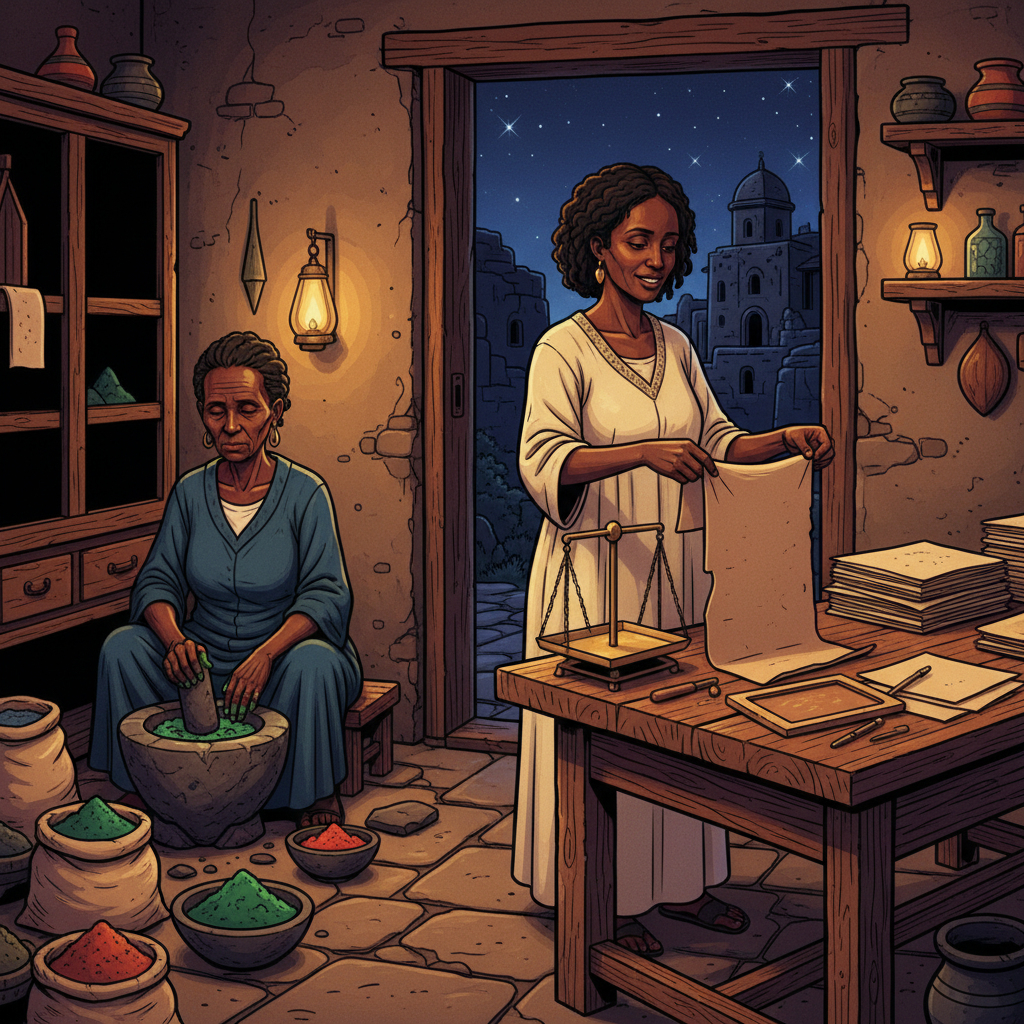
The senior pigment-grinder at Debre Damo was Sister Tirhas, a small wiry woman in her sixties who had been grinding malachite for the monastery's green ink for over forty years. Sister Tirhas was not the gentle teacher Welela had imagined. She was strict, exacting, and impatient with novices who confused the fine-grade grindings with the medium-grade. She wore the same dark blue robe every day and her hands were stained permanently green at the fingertips from decades of malachite. Sister Tirhas had a younger colleague, Sister Genet — the parchment-prep mistress, age forty-three — who managed the goatskin scraping and pumicing in the cell next door. Sister Genet was warmer than Sister Tirhas, the way an afternoon was warmer than a dawn, but both women ran the lower workshops the way the abbot expected them to: with the calm strict efficiency of people who knew their tradition was unbroken across fifteen centuries. Sister Genet kept her own brass weighing-scale by the parchment-cell door — when visiting monasteries sent orders for prepared goatskin, she weighed every sheet to the half-mithqal and recorded the price in silver dirhams on a wax-tablet beside the scale. The monastery's parchment-trade brought in three hundred mithqal of silver a year. Sister Genet alone signed the trade-tablets.
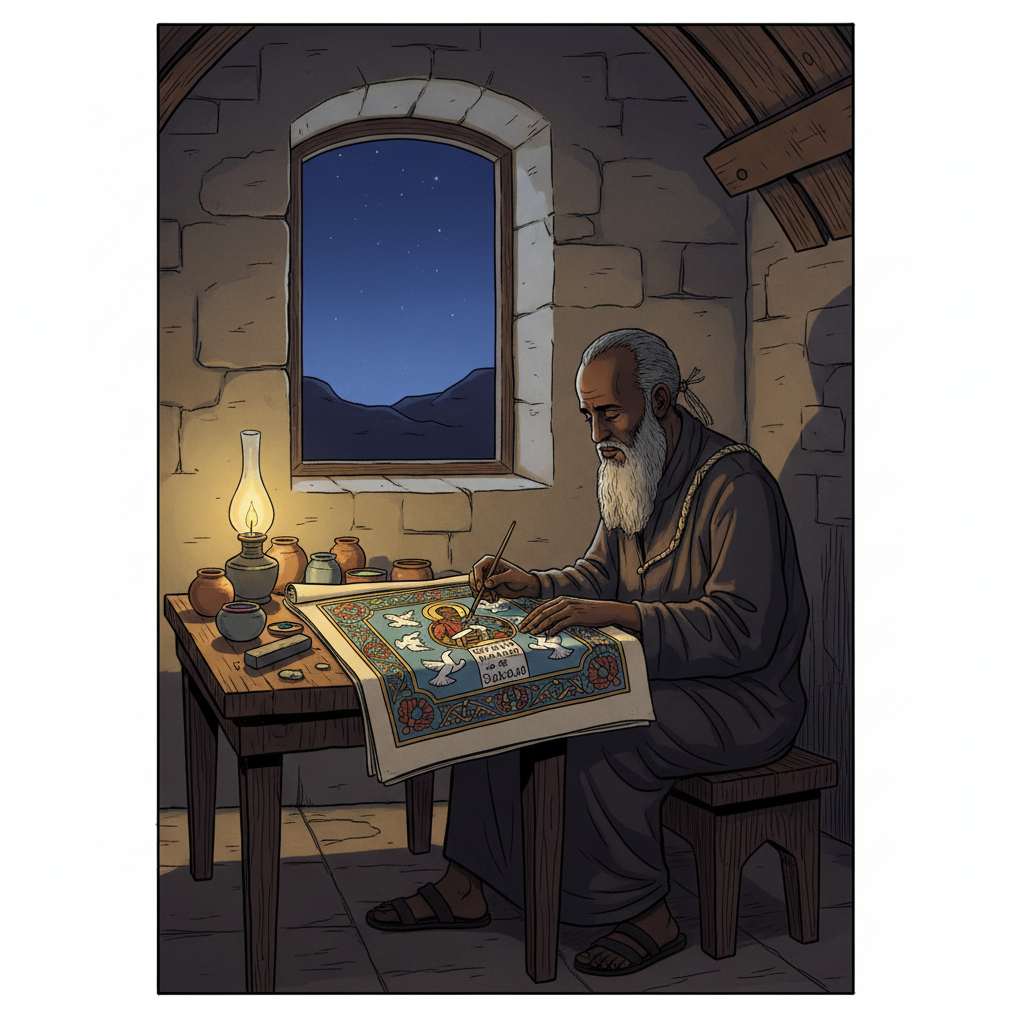
The master illuminator of Debre Damo was a quiet monk named Abba Tekle. He was perhaps fifty years old, with very dark warm brown skin and a long gray beard that he kept tied with a thin cord of palm-fiber so it would not brush against his wet pigment. He worked alone in the upper cell — a small room with a high east-facing window, a single wooden table, and a low cedar stool. He had been working on a single page of the new Tewahedo Synaxarium for almost a month. The page would show the four evangelists at the corners with the central panel of Saint Yared receiving the gift of song from three white doves. The page was being made for the abbot of Gunda Gunde, three days' walk to the east. It would be the abbot's gift to his patron monastery. Abba Tekle worked on it every morning from the fourth bell until the eighth, six days a week.
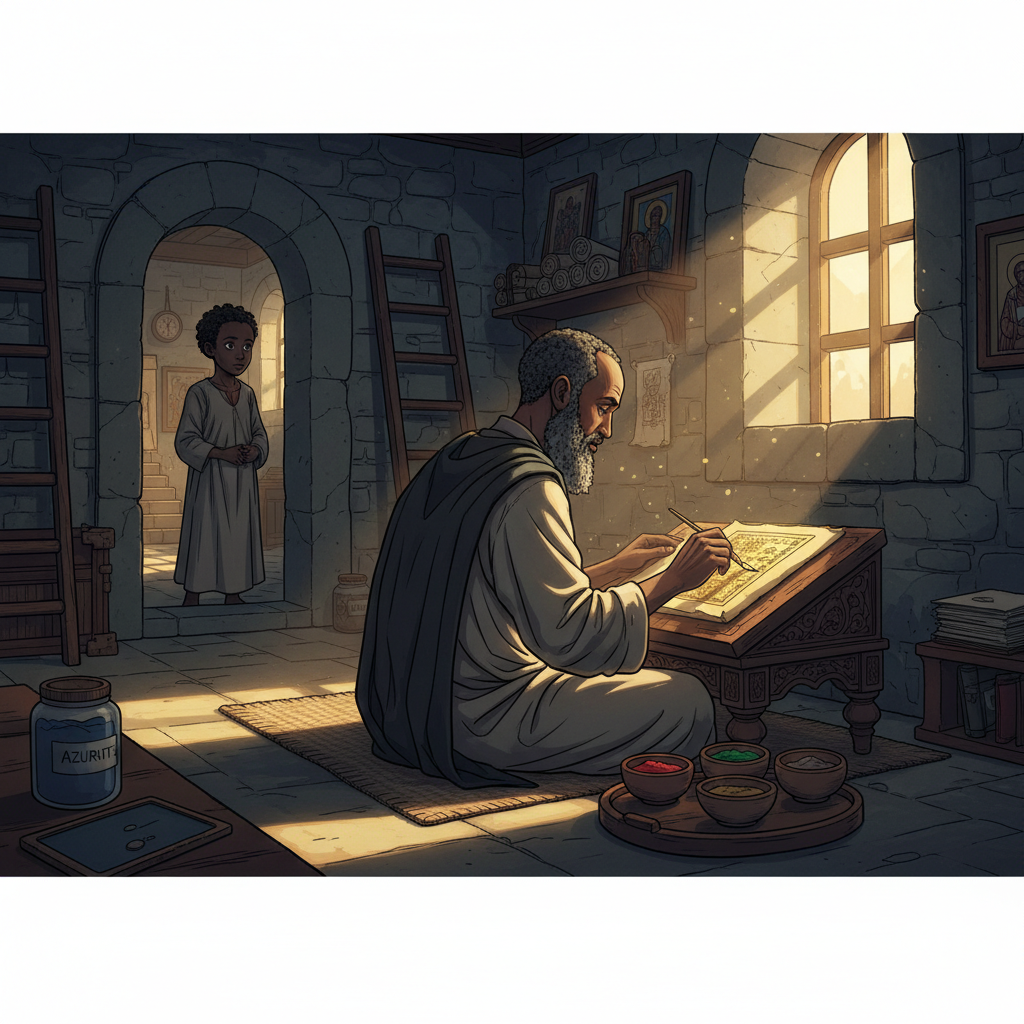
Welela had been watching Abba Tekle work whenever Sister Tirhas allowed her to deliver fresh pigment to the upper cell. Two weeks before the morning of the gold-dust, Welela had done something she had not yet told anyone about. She had been grinding a batch of malachite at the south workbench when she noticed, in a small unlabeled jar Sister Tirhas had set aside, a fragment of stone that was not malachite — it was the rarer azurite, the deep-blue copper stone that came up from the Red Sea trade and was sometimes mistaken for green stone before grinding. Welela had quietly separated the azurite fragments into a second jar and set it on Sister Tirhas's desk with a small slate-note that said only: "This is azurite, not malachite. — Welela." Sister Tirhas had not commented. But the next morning the azurite jar had been moved to the blue-pigment shelf, properly labeled, and the slate-note had been wiped clean. The upper cell was at the top of a narrow wooden ladder. Welela would climb the ladder carrying a small wooden tray with three tiny earthenware bowls — one cinnabar red, one malachite green, one ochre yellow — that Sister Tirhas had measured out that morning. Welela would set the tray on the corner of Abba Tekle's work-table without speaking, bow once, and climb back down. Abba Tekle had never looked up at her in seven months. He worked the way old monks worked: without acknowledging interruption. But Welela had been watching him from the doorway. She had learned, by watching, which pigments he used in what order, how he warmed the parchment before applying the gold leaf, how he held the brush at the angle of the sun coming through the eastern window.
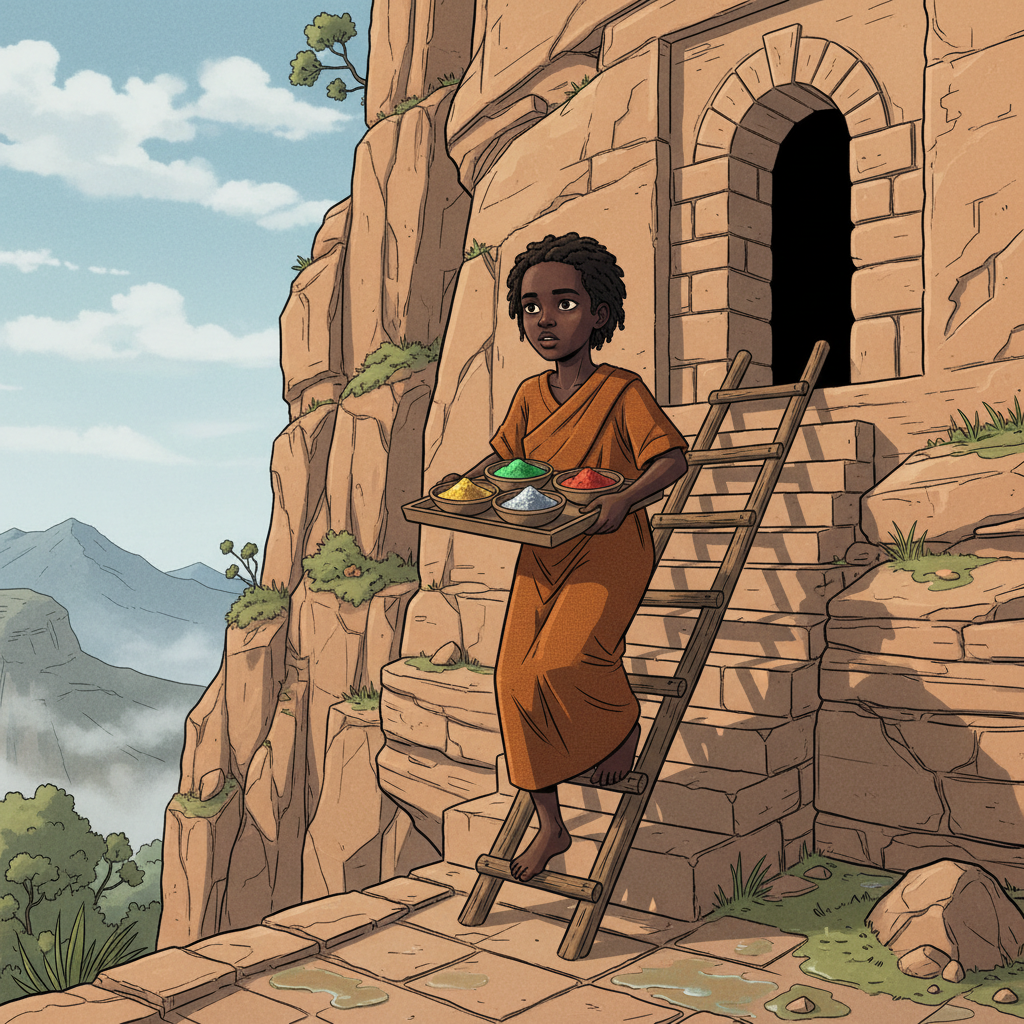
On a cool morning in the eighth month of her novitiate, Welela climbed the upper-cell ladder with the day's fresh pigments. She was carrying a special tray that morning — not the usual three bowls, but five. The Synaxarium page was at the gold-leaf stage and Abba Tekle had requested two extra small bowls: one of finely ground gold dust for the doves' wings, and one of finely ground silver for the evangelists' haloes. The gold-and-silver bowls were the smallest, the most precious, and Sister Tirhas had ground them herself that morning under the watch of the abbot. Welela climbed the ladder slowly. She reached the top. She set the tray on the corner of the work-table. She bowed. Abba Tekle did not look up. Welela turned to climb back down. Her foot caught the small ridge at the edge of the doorway. The tray tipped.

The two large bowls — the cinnabar and the malachite — stayed on the tray. The ochre tipped but did not spill. The silver dust bowl rocked twice and stayed upright. The gold dust bowl — the smallest, the most precious, the one Sister Tirhas had ground that morning — tipped onto its side. A small mountain of fine gold-dust spilled across the upper edge of the work-table, sparkled in the morning light, and began to slide toward the floor. Welela froze. She did not breathe. The gold-dust was the value of a small farm. A year of pigment-trading. Three months of the monastery's food. It represented the labor of Sister Tirhas' hands across a full week of the previous month — and she had ground it again that morning to bring the total back up to the day's commission. Welela could feel her heart in her throat. She could feel her face going hot.
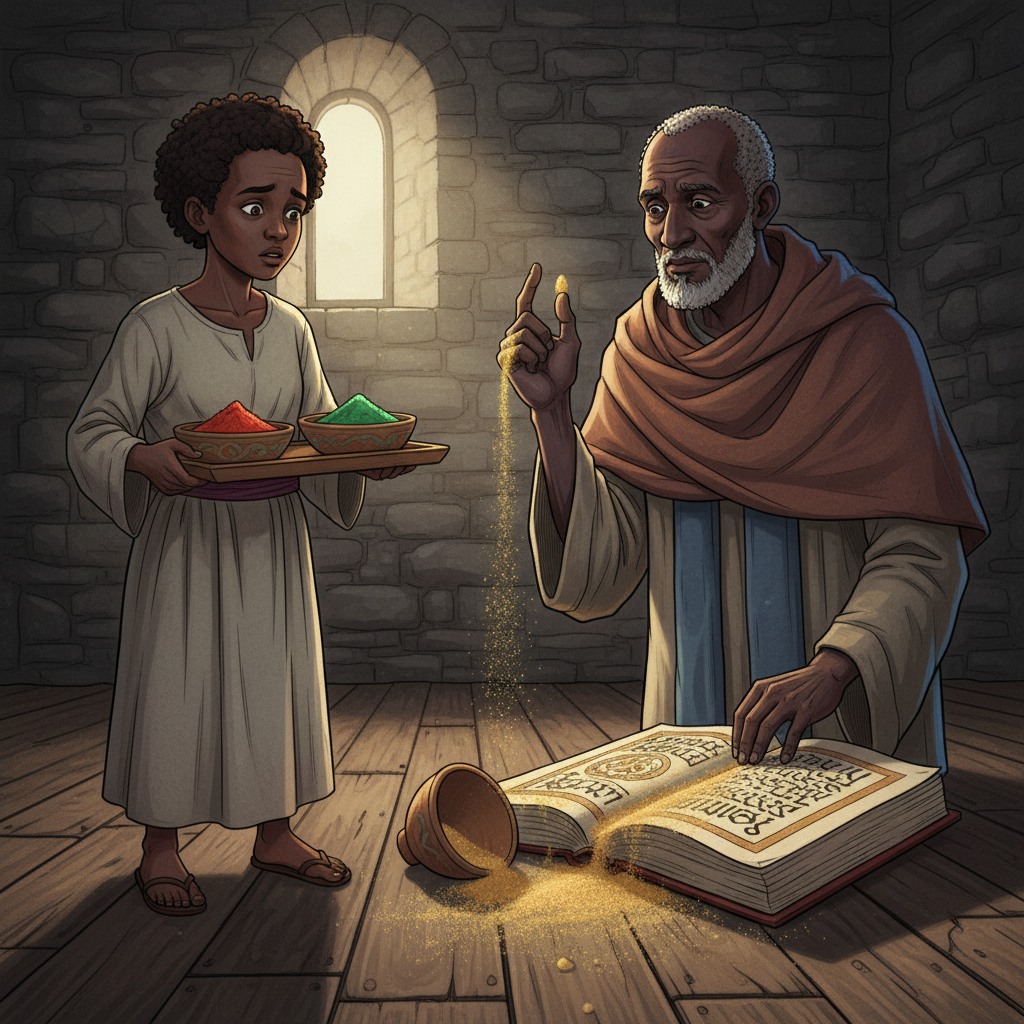
Abba Tekle looked up for the first time in seven months. He looked at Welela. He looked at the spilled gold-dust. He looked at his half-finished Synaxarium page. He looked back at Welela. His face was unreadable — not angry, not warm, just attentive. He set down his brush, very carefully, on its small cedar rest. He stood up from the cedar stool. He walked the two paces to the edge of the work-table. Welela could not move. She was sure she was going to be sent back down the rope-ladder that afternoon. She was sure her seven months of climbing and grinding and watching from doorways had just ended. Abba Tekle bent at the waist. He picked up a single grain of gold-dust on the very tip of his right index finger. He straightened. He turned to Welela.
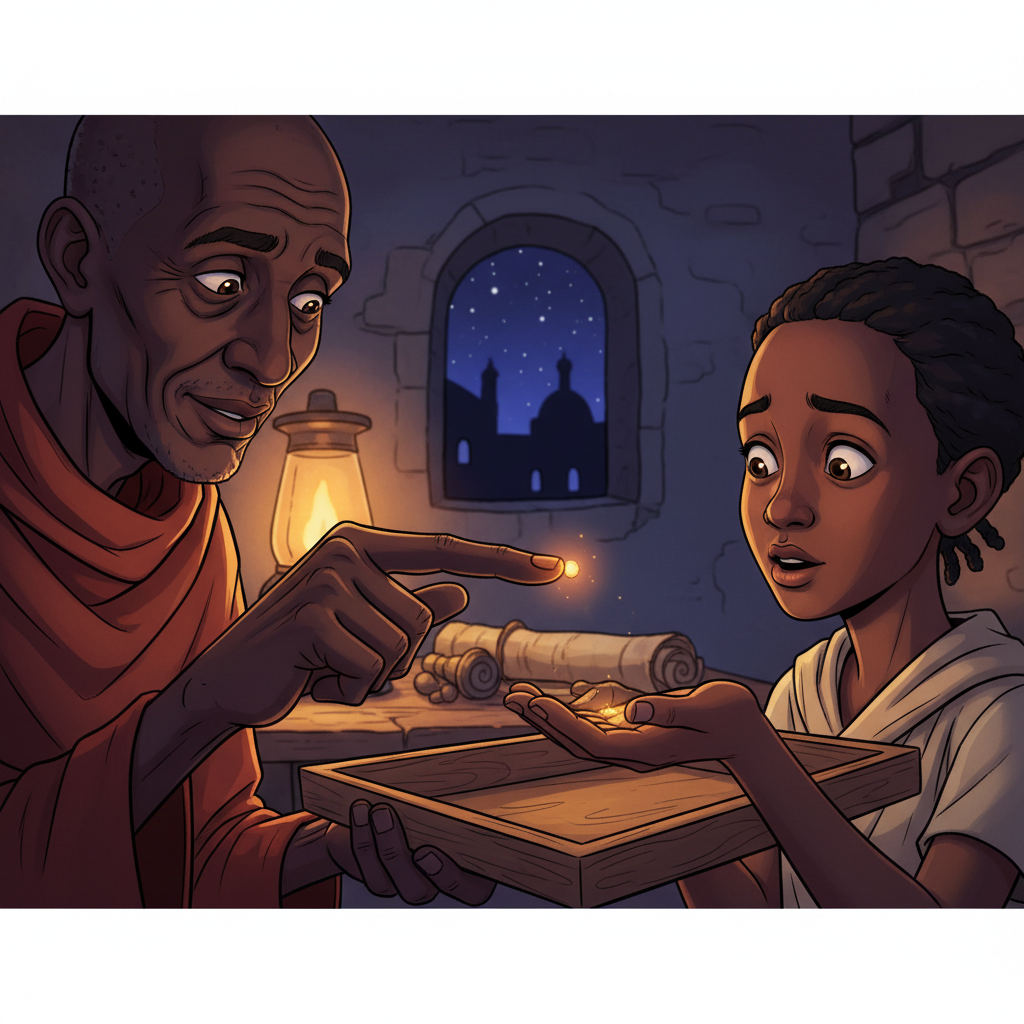
He held out his finger. The single grain of gold-dust caught the morning sun and shone like a tiny star. Welela watched it. Abba Tekle reached out, very slowly, and touched the grain to the open palm of Welela's left hand — the hand that was still holding the now-empty tray edge. The grain transferred to her skin. She could feel it. He drew his finger back. He looked at her. He said, very quietly: "The page can be made again. The pigment can be ground again. The grain you are holding in your hand is the year of Sister Tirhas' work I do not have to do over, because she has done it already. The page is what it is today. Tomorrow it will be itself again. A page does not lie when no one is looking — that is what makes it a true page. Truth is what the page IS in the world, regardless of who reads it. The first lesson is welcome. Sit."
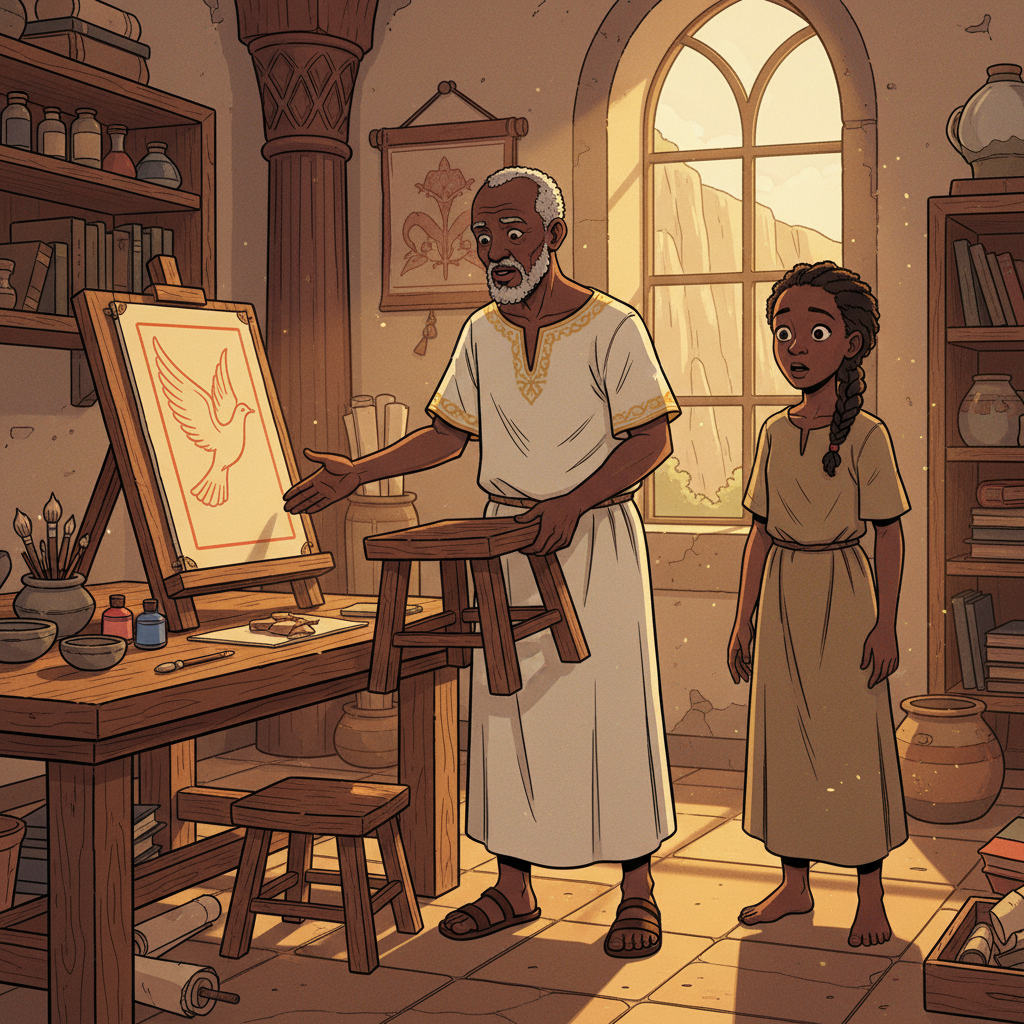
Welela did not move for a moment. She did not understand what Abba Tekle had said the first time. She was eleven years old. She had spilled the most precious material in the monastery. She had been climbing a ladder. She had been watching from doorways. She had been preparing herself for the worst possible scolding. And the master illuminator had said: sit. He gestured at the small low cedar stool he had been using all morning. He stepped sideways. He pulled the second smaller stool from beneath the work-table — the apprentice's stool, the one no novice had been allowed to use in living memory at Debre Damo. He gestured again. "Today," he said, "you will help me paint. We will begin with the dove's wing on the upper left. I will mix the first color. You will mix the second."
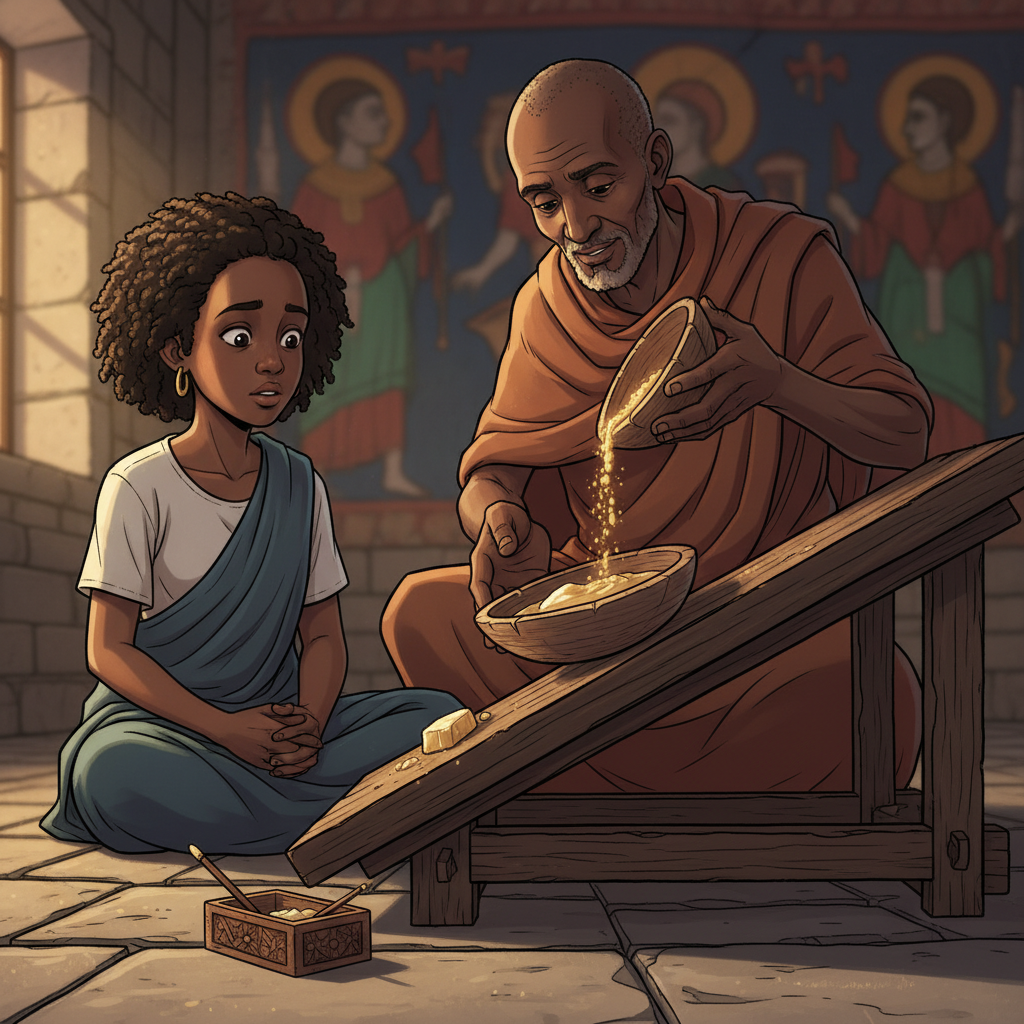
Welela sat. Her hands were shaking. Abba Tekle sat beside her. He took the gold-dust bowl that was still half-full — most of the dust having been caught by the work-table's upper edge before it could slide off — and he poured it into a smaller mixing-bowl with a small amount of beeswax-binder. He showed Welela how to swirl the mixture until the gold-grains were suspended evenly in the binder. He took a fine brush — not his own brush, but the smaller apprentice-brush that had been resting unused in a small cedar box for two decades. He showed Welela the angle, the wrist-pressure, the moment at which to lift the brush from the parchment. She applied the gold to the dove's wing under his eye. The line came out clean. He nodded once. She drew another. He nodded again.
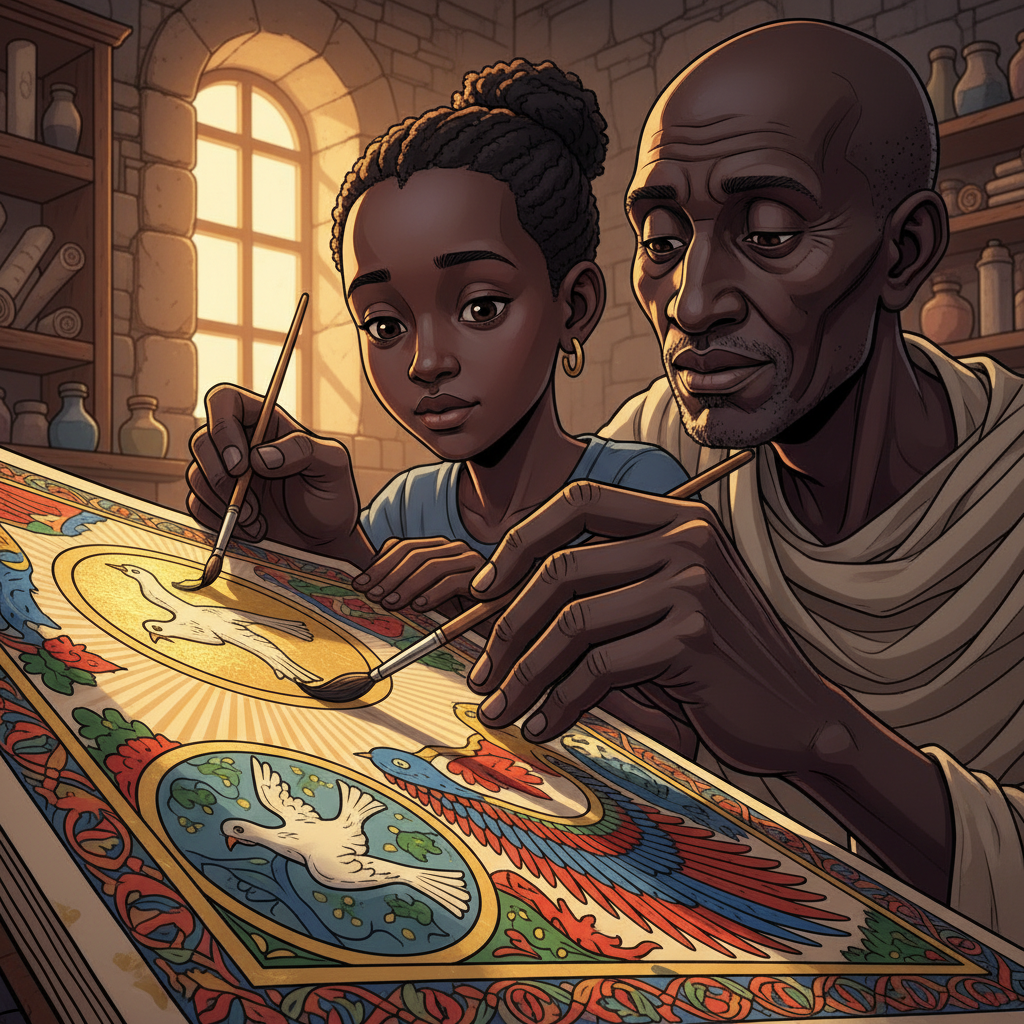
They worked together for the rest of the morning. They worked through the eighth bell. They worked through the lunch-call. Abba Tekle did not ring down for the lower workshops' meal. Welela had been told, when she was first brought to the monastery, that the master illuminator never broke his rhythm — that lunch was for the lower workshops, not for the upper cell. Today the master worked through. Welela mixed pigments. She mixed gold. She mixed silver. She painted small wing-feathers. She painted small halo-rays. The Synaxarium page filled around her hands, the four evangelists' haloes gleaming silver, the three doves of Saint Yared's song flickering gold in the morning sun coming through the eastern window. The page was no longer Abba Tekle's alone. It was theirs.
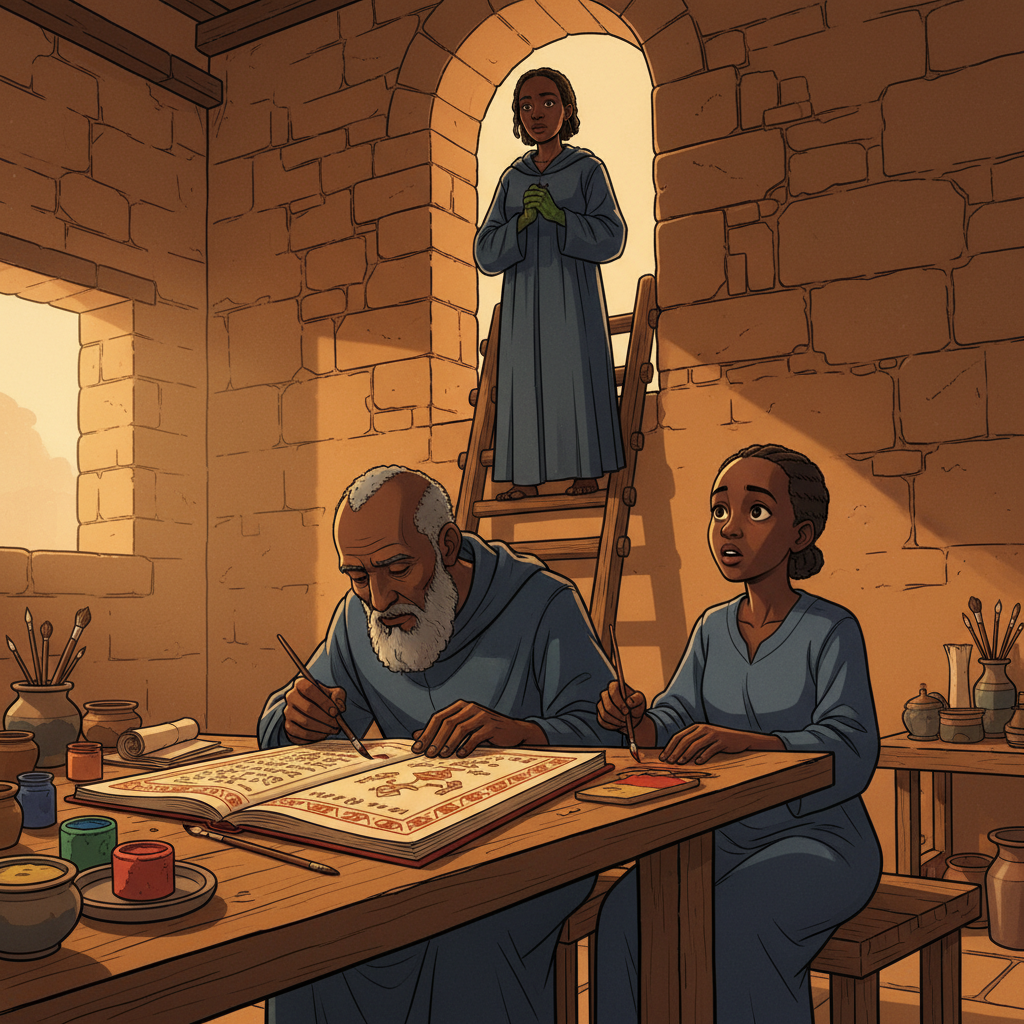
At the eleventh bell, Sister Tirhas climbed the upper-cell ladder. She had heard from the lower workshop that Welela had not come down for the noon meal. She came to investigate. She found Abba Tekle still at his work-table, with the eleven-year-old novice beside him on the apprentice's stool, both of them applying small careful brushstrokes to the Synaxarium page. Sister Tirhas stood at the top of the ladder for a long moment. She did not speak. Welela glanced up. Sister Tirhas' face was unreadable. The old pigment-grinder's green-stained fingers were folded across the front of her dark blue robe. She nodded once at Abba Tekle. She climbed back down the ladder. She did not say a word.
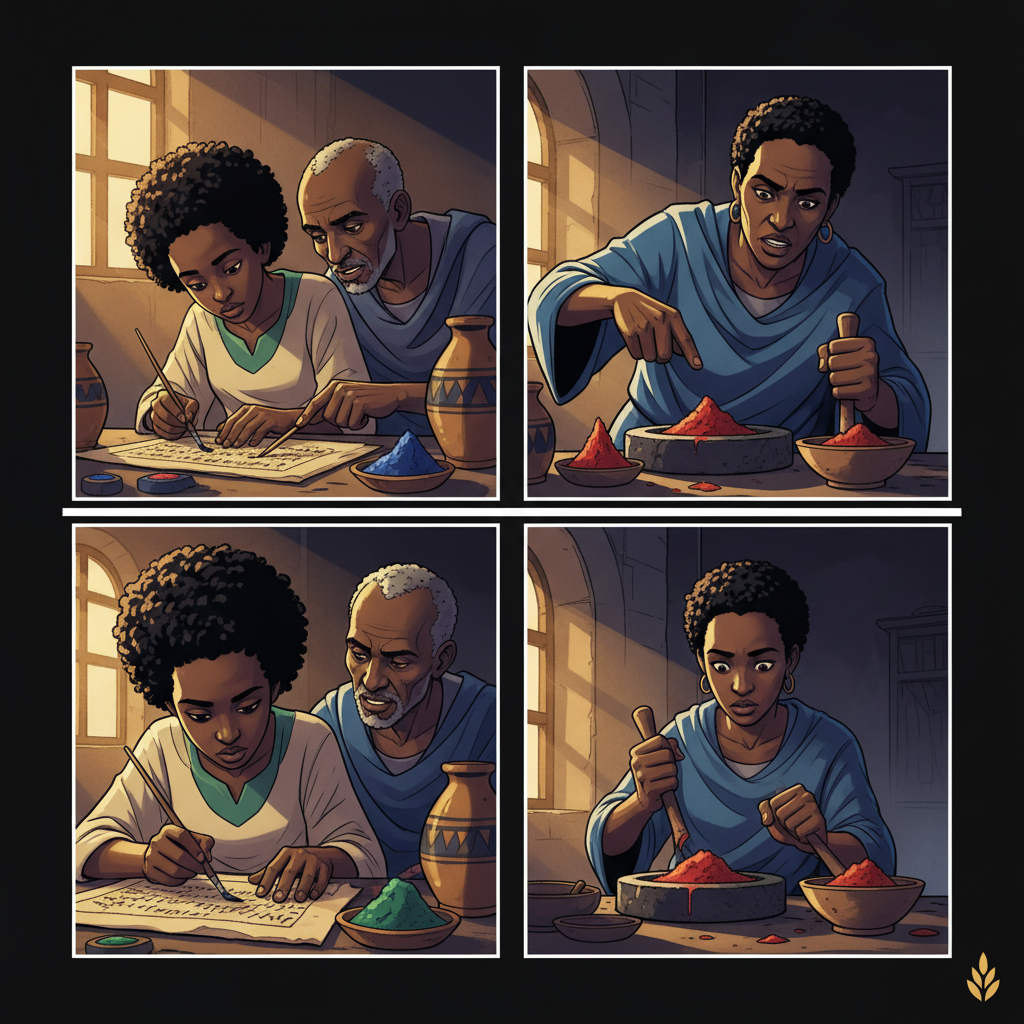
For the next three weeks, Welela worked beside Abba Tekle on the Synaxarium page every morning from the fourth bell to the eighth. She continued to grind pigments under Sister Tirhas in the afternoons. Sister Tirhas did not change her manner. She did not warm. She did not soften. She did not acknowledge that Welela had moved, in a single morning, from the lowest pigment-novice to the only apprentice the master illuminator had taken in fifteen years. Sister Tirhas continued to correct Welela's grindings the way she had always corrected them — sharply, exactingly, with the impatience of a woman who knew her grindings would end up on Abba Tekle's table. The corrections were the same. The expectations were the same. Sister Tirhas, in the privacy of her own heart, may have approved or disapproved. She did not say. Welela never asked.
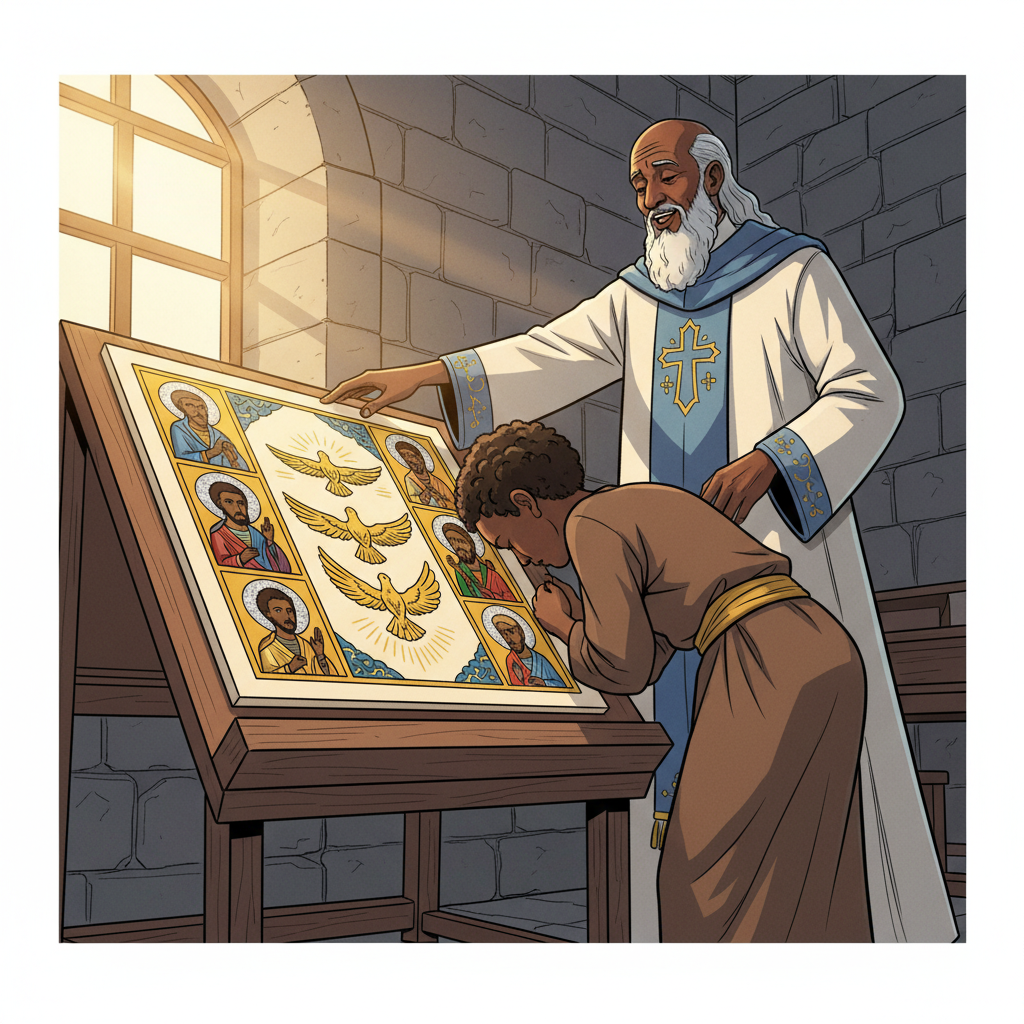
The Synaxarium page was finished on a bright morning in the tenth month of Welela's novitiate. Abba Tekle stepped back from the work-table. He looked at the page for a long moment. He turned to Welela. He said: "We are done." Welela looked at the page. The four evangelists in their corners, their silver haloes shimmering. The central panel of Saint Yared with the three gold doves descending. Her own small brushstrokes on the dove-wings and the halo-rays. Abba Tekle's steadier strokes everywhere else. The colors were exactly right. The gold caught the eastern window-light. The page was the most beautiful thing Welela had ever seen. She did not cry. She did not speak. She did the one thing she could think to do: she bowed.
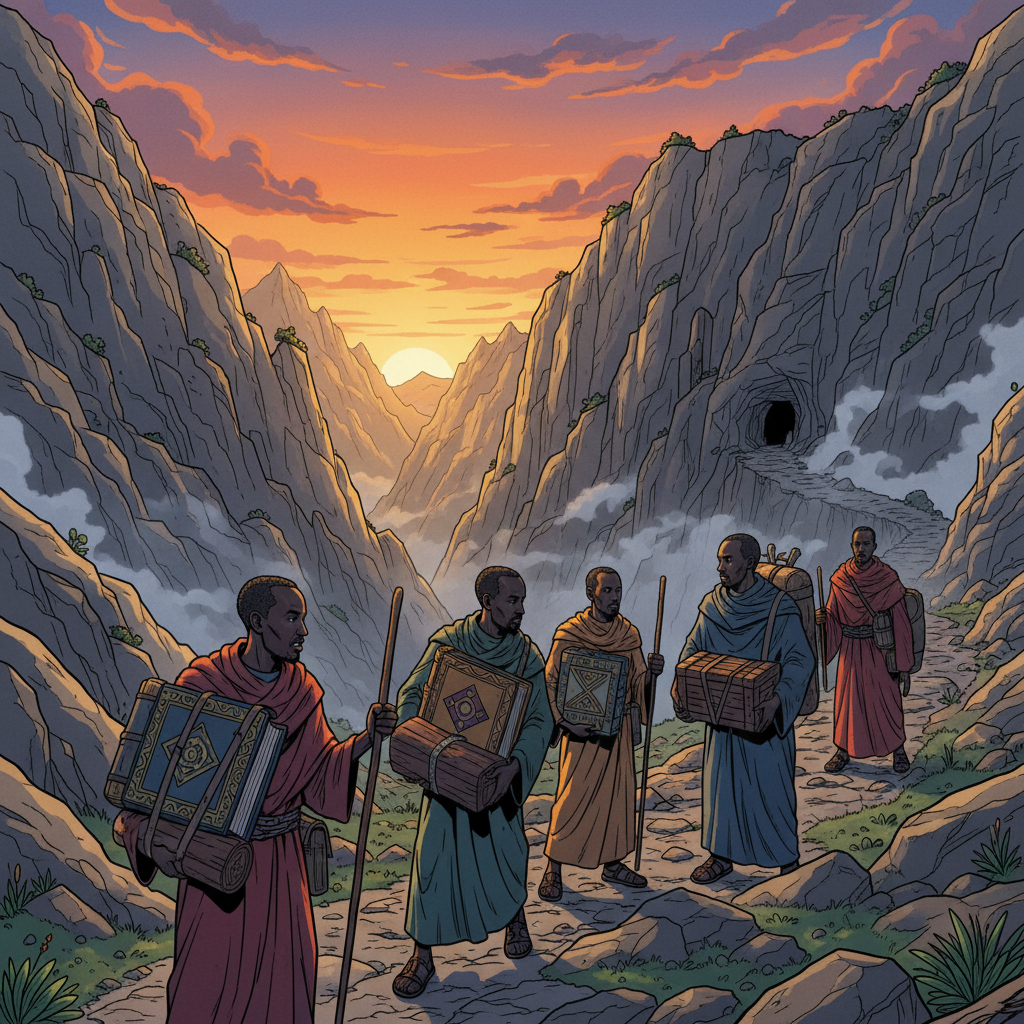
The page traveled three days east to the abbot of Gunda Gunde the following week. It was bound into the abbot's personal copy of the Synaxarium. It rested in the Gunda Gunde manuscript library for the next three hundred years. In the early sixteenth century, when the kingdom's monasteries were threatened by the Ahmad Gragn wars, the Gunda Gunde manuscripts were carried by foot across the high passes to a hidden cave-monastery in the Tigray highlands. The Synaxarium with Welela's dove-wings and halo-rays went with them. It survived. Centuries later it was returned. Centuries after that, in the new century when manuscripts were being digitized so the wider world could see them, the Saint Yared page was photographed for the first time and placed in a glass case in the manuscript-museum in Addis Ababa.
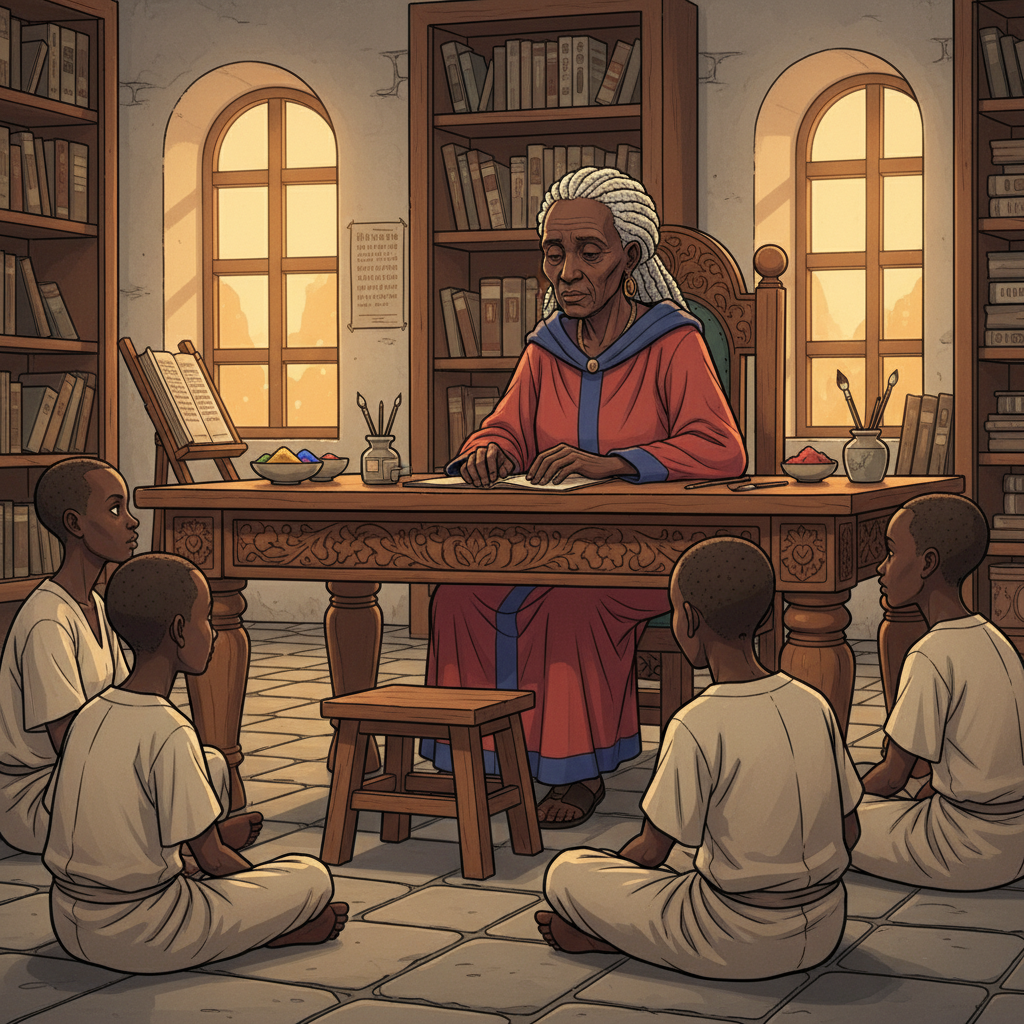
Welela became a full nun-illuminator at Debre Damo at age sixteen. Sister Tirhas died at seventy-one of a winter fever. Welela inherited the pigment-cell. She did not change Sister Tirhas' methods. Sister Genet retired at sixty and lived in the small east-facing cell near the chapel until her death. Welela continued to paint the upper-cell's pages for the next thirty years. When Abba Tekle died at age seventy-three, Welela became Abba Welela — the master illuminator of Debre Damo. She had her own apprentices over the years. She kept the second smaller stool always present at the work-table, the way Abba Tekle had pulled it out for her on the morning of the gold-dust. She gave that lesson, in her own voice, to every novice the abbot brought up the rope-ladder. She did not always pull out the stool the first time. But she pulled it out, sooner or later, for every one of them.
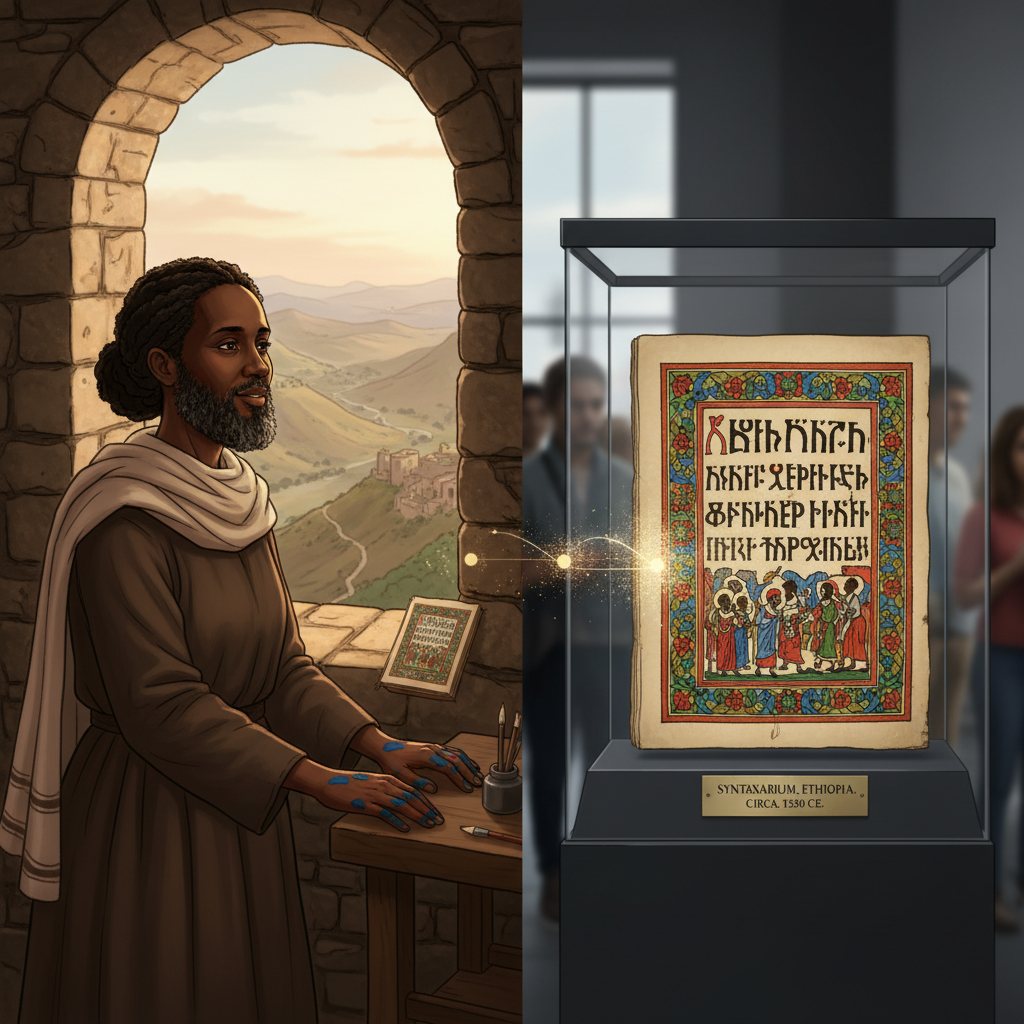
Forty years after the morning of the gold-dust, Welela was fifty-one years old. She had finished a page she had been working on for three months — a small marginal scene from the Book of Enoch — and she was standing at the upper-cell window, watching the afternoon sun fall across the highland valley. Her hands were stained from a lifetime of pigment-work. Her beard — for she had taken the vows of a male religious order in her thirties, as some Habashat women monastics did — was streaked with gray. She thought about the morning she had spilled the gold-dust. She thought about the single grain Abba Tekle had touched to her palm. She thought about Sister Tirhas, who had never warmed, and who had been right not to. The first lesson was welcome. The second lesson, and every lesson after, was work. The Synaxarium page she had painted at age eleven was, on this very afternoon, in a glass case six hundred years in the future, in a city she could not yet name, on a continent she would never visit. She was its quiet author. She was glad.