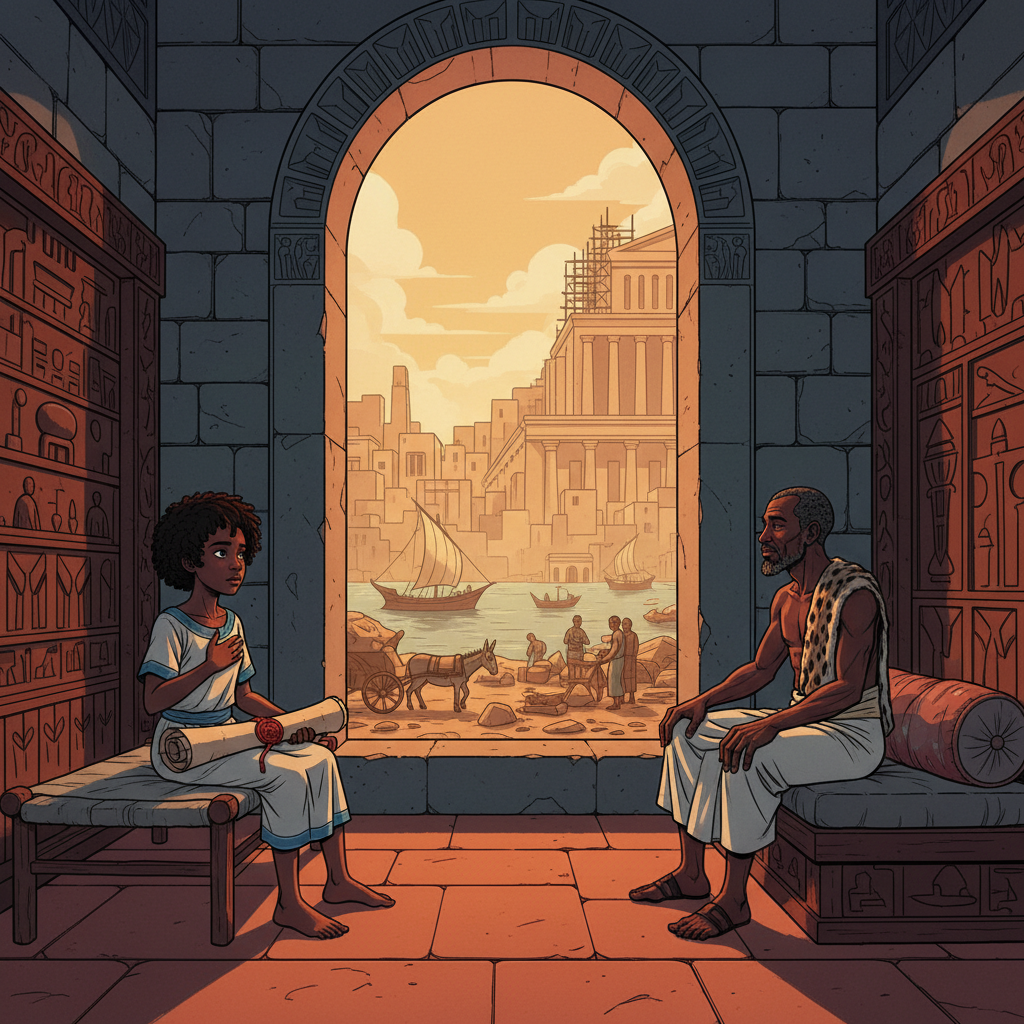
Hetheret woke before the gulls. She was twelve years old, rich brown as river-bottom silt, and today she was carrying a scroll older than her grandfather. The harbor city of Alexandria was only thirty years old — younger than her own mother — but it was already the loudest place she had ever slept in. From her bed in the visitors' quarters she could hear sailors arguing in three languages, donkey-bells, the morning shout of fish-sellers, and somewhere in the distance the slow grinding boom of stone-cutters still finishing the southern wing of the new library. She pressed her palm to her chest. Her ka was already racing. Today the scrolls from her grandfather's Per Ankh in Mennefer would be delivered to the Mouseion, the great library of the Macedonian-Greek city. Tens of thousands of scrolls. From every Per Ankh up and down the river. Today the knowledge of Kemet would change buildings. Her grandfather, Anen-her, was already awake on the low couch by the window. He was a priest of Djehuti at the Per Ankh of Mennefer, and he had been awake, she suspected, for most of the night. His hands rested on his knees the way they did when he was preparing for ceremony. He did not turn when she sat up. He only said, very softly, in the careful elder-voice he used when something serious was about to happen, "Granddaughter. There is something I have decided you will do today." Hetheret pulled her sleeping cloth around her shoulders. She knew, before he said another word, that he was about to ask her to do something larger than she felt.
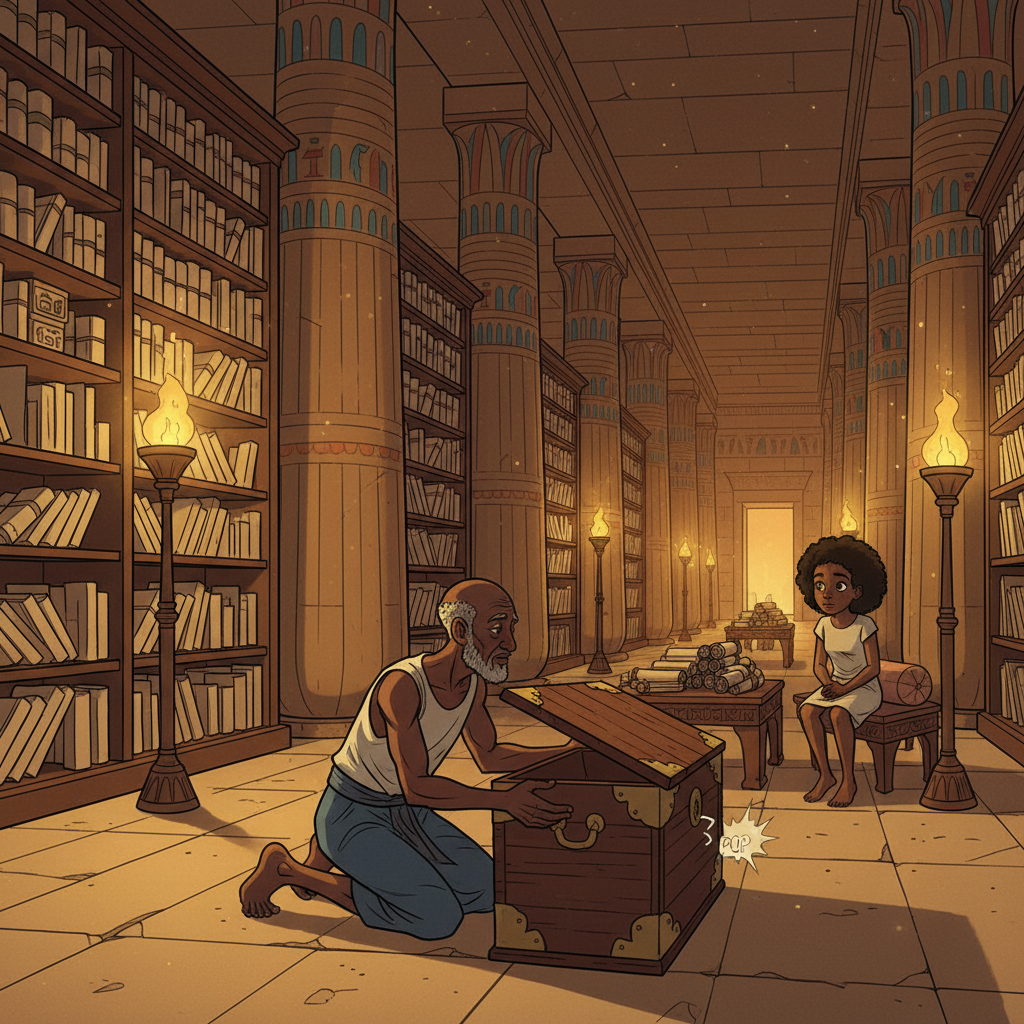
Her grandfather rose slowly from the couch and crossed the small room to the cedar chest in the corner. He knelt — old knees popping in the cool morning — and lifted the lid. From the chest he drew a single object wrapped in soft white linen. He carried it back to where Hetheret sat and laid it across her lap. Through the linen she could feel the weight of it, the smooth length of papyrus rolled tight around its wooden dowels, the slight oily warmth where her grandfather's palm had rested on the cloth. "Open it," he said. She unfolded the linen. Inside lay a leather-bound scroll, the leather darkened with age to the color of old honey. She recognized it at once. It was the scroll her grandfather had read to her from when she was small, the one he never let any other student touch. The Surgical Papyrus. The Surgical Papyrus of the Per Ankh of Mennefer was older than her grandfather's grandfather. It was the working manual the temple physicians used — forty-eight cases, each one a patient: the broken skull, the dislocated jaw, the wound that must be stitched, the wound that must not be stitched. Every case was written in three parts: examination, diagnosis, treatment. She had grown up hearing her grandfather mutter the cases under his breath as he walked to the river at dawn. "If you examine a man having a wound in his temple, penetrating to the bone, perforating his temporal bone…" The cases were a song she had never quite learned the words to. Now the scroll was in her lap. Her hands began, very softly, to shake.
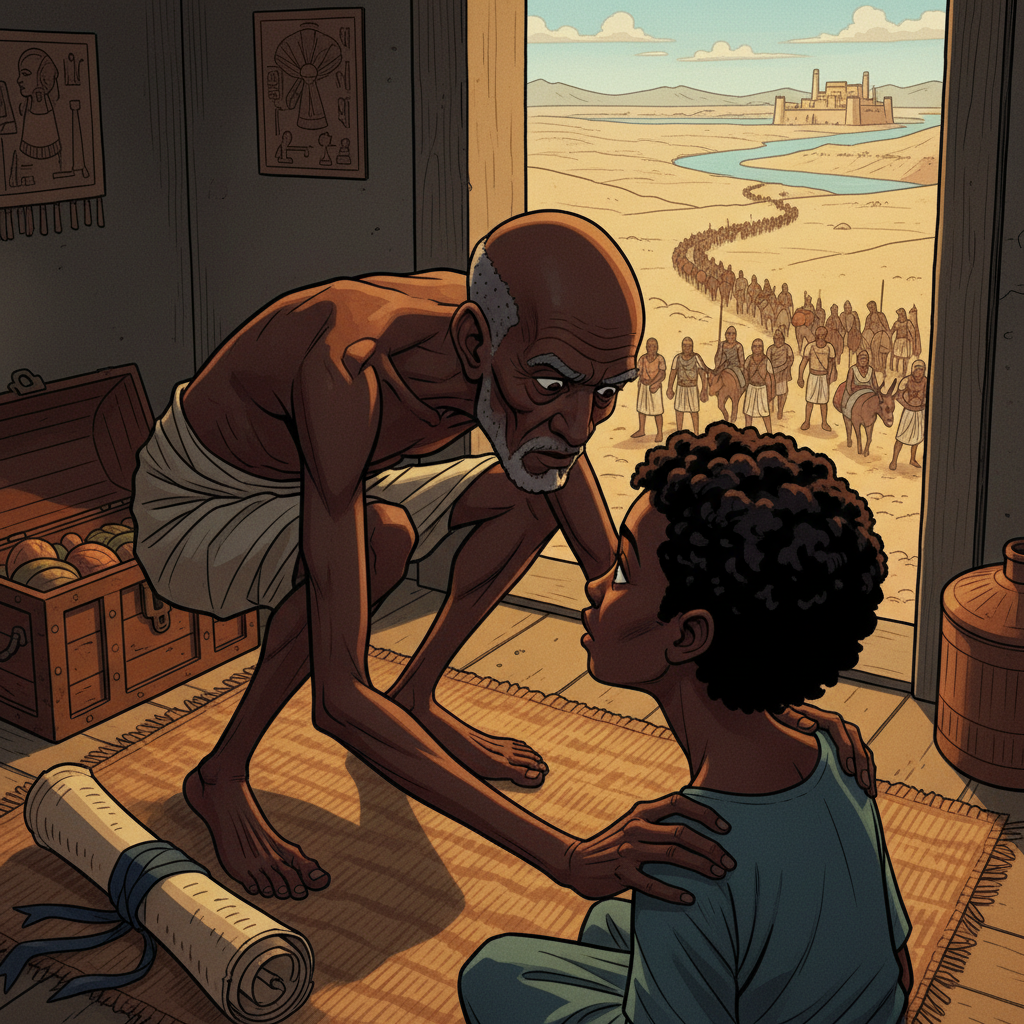
"Why are you giving this to me?" she asked. Her grandfather did not answer right away. He knelt again, his bony knees on the rush mat, and brought his face down close to hers. His eyes were the color of wet riverbank clay, and they did not look at her the way an elder looks at a child. They looked at her the way one priest looks at another. "Because today the scrolls go to the Library," he said. "And of all the scrolls in our Per Ankh, this is the one I will not place in the hands of a porter. This is the one I will not put in a crate. This one will be carried into the Mouseion in the arms of a person of my own house. And I have chosen you." Hetheret tried to speak. Her throat had gone dry. "Grandfather, I am twelve." He nodded slowly. "Yes. You are twelve. And you are the only person in this room who speaks Greek well enough to answer a Greek librarian, and Medu Neter well enough to read the title page of this scroll, and Kemetic enough in your heart to know what this scroll IS. Your father is a soldier. Your mother is a weaver. I am old. The journey through the streets is loud, and my hands shake now in a way they did not last year. If I drop this scroll on the marble steps of the Library, the news will travel all the way back to Mennefer by sunset. But if a twelve-year-old girl carries it in both arms, no one will jostle her, and no one will rush her. You will arrive whole. The scroll will arrive whole. That is the first reason."
Hetheret swallowed. "What is the second reason?" Her grandfather was very still for a long moment. The sounds of the harbor came in through the window — a sailor's laugh, a chain rattling against a mast. Then he said, "The second reason is that you must learn now, while you are still young, what the cost of this day is. The scrolls of Kemet are leaving the Per Ankhs. They are going to the Library because the new pharaoh — who is not a Kemetic pharaoh, but a Macedonian-Greek named Ptolemy — has commanded it. The command is not unjust. The Library will protect the scrolls. The scholars there will read them and copy them and study them, and the knowledge will be safe. But, Hetheret. Listen carefully. Knowledge is not only the words on the scroll. Knowledge is also the question, who wrote this?" He placed one finger lightly on the leather cover of the Surgical Papyrus. "If the Greek scholars open this scroll a hundred years from now and write a book about surgery, and they do not write at the top of the book the words from the Per Ankh of Mennefer — then in five hundred years there will be people who believe Greek physicians invented all of this. The cases. The bandaging. The reading of pulses. They will believe the river of knowledge began at Alexandria. They will not know that Alexandria is the mouth, and the source is upstream, in our temple, in cities that were old when Greece was still villages." He paused. "Order, in the Maat sense, is not only that things are in the right places. Order is that things are KNOWN to be in the right places. A library that loses the source of its knowledge is not a library. It is only a warehouse."
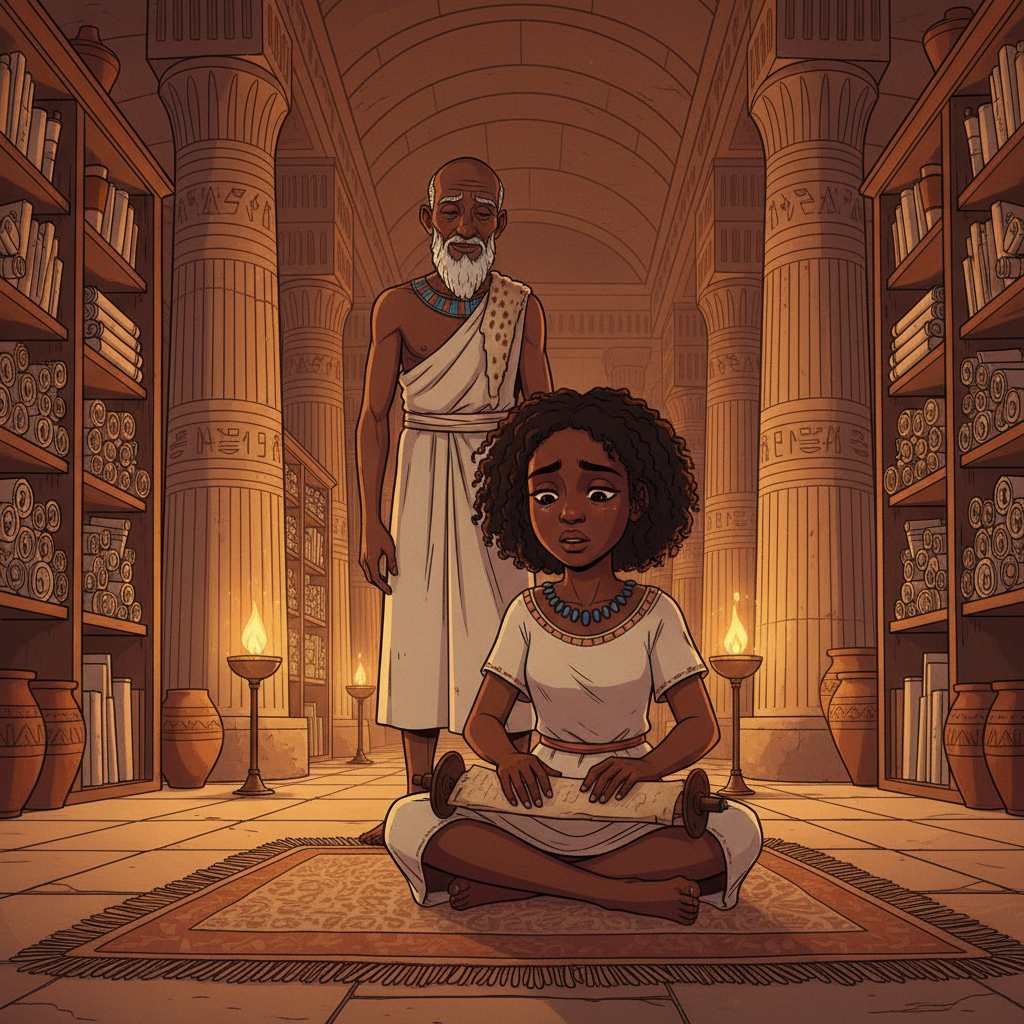
Hetheret looked at the scroll in her lap. She tried to imagine someone, five hundred years from now, opening a book about wounds of the skull and not knowing that the first hand to write those cases had been the hand of a priest at the Per Ankh of Mennefer. The thought made her chest hurt in a way she did not have words for. It was not anger, exactly. It was closer to grief — but a strange kind of grief, the grief for a thing that had not yet been taken, the grief of seeing a theft that was about to begin and that no one else could yet see. "What do you want me to do, grandfather?" Anen-her smiled then, the smallest smile, the one she had only ever seen him give her mother when her mother had done something exactly right. "I want you to do a small thing," he said. "When you arrive at the Library, a librarian will come down the steps to receive the scroll. He will reach out his hands. He will be a Greek librarian, and he will be polite, and he will want to take the scroll from you and add it to the catalogue. You may give him the scroll. That is what we are here to do. But before you let go of it, Hetheret — before your fingers loosen on the leather — I want you to ask him one question. In Greek. Carefully. So that he hears it clearly and he cannot pretend later that he did not hear." He paused. "Will you do that for me?" Hetheret nodded. She did not yet know the question. But she nodded.
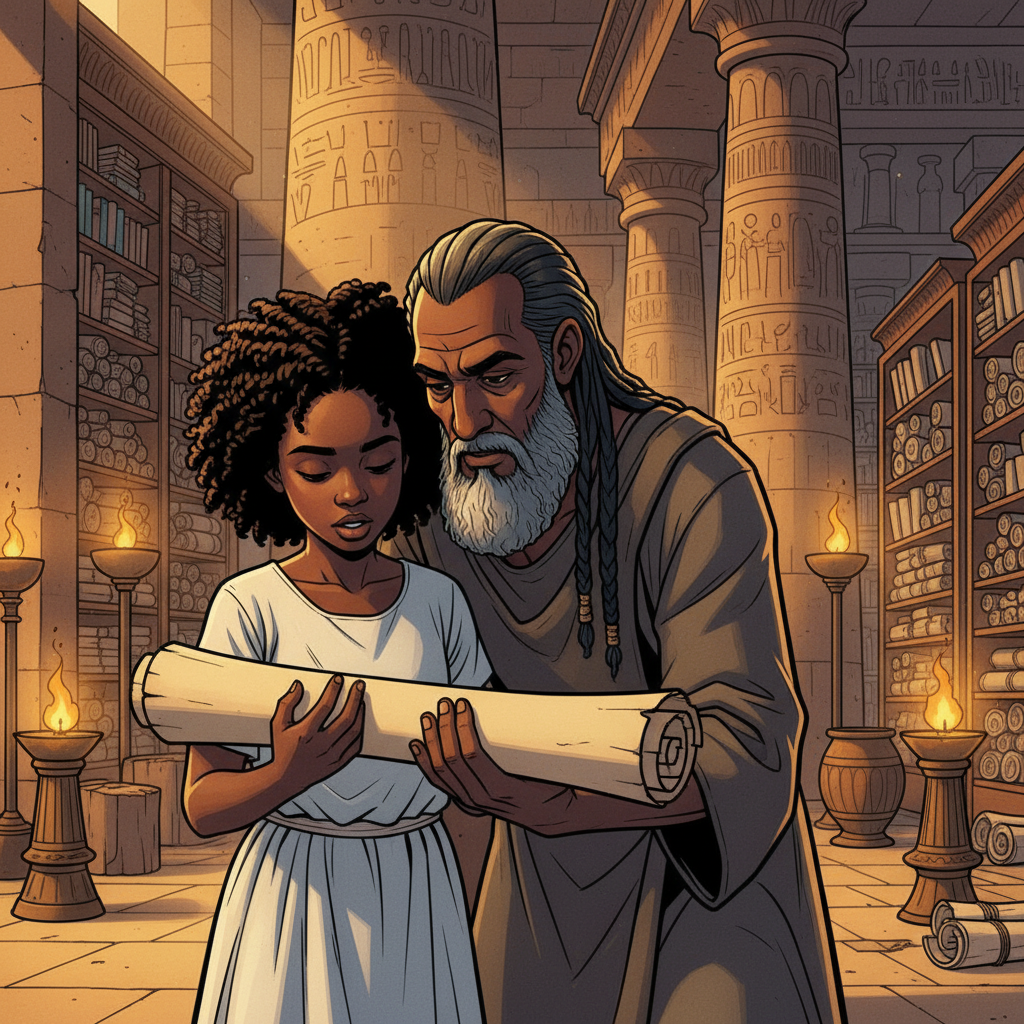
Her grandfather leaned closer. The morning light caught the white in his beard and made it look almost silver. "The question is this," he said. "Will it be marked as Kemetic, or as yours?" He said the words slowly, in Greek, so that she could hear the shape of them. Then he said them again in their own tongue, so that she could feel the meaning. Will it be marked as Kemetic, or as yours? Hetheret repeated the Greek words under her breath, three times, four times, five, until the consonants sat properly on her tongue. "And what if he says — what if he just takes it?" she asked. "What if he does not answer?" Anen-her shook his head slowly. "He will answer. Not because he wants to. Because a question asked in the doorway of a library cannot be ignored. Libraries are built on questions, Hetheret. He will not be able to walk past one." He folded the linen back over the Surgical Papyrus and helped her cradle it in her arms. The weight settled across both her forearms. It was heavier than it looked. He stepped back and considered her — the small girl in her white linen, the great scroll across her arms, her bare feet on the cool stone floor. "I will walk behind you," he said. "I will not be at your shoulder. I will be in the colonnade, in the shadow, where the librarian cannot see me. You will go up the steps alone. The question must come from you. If it comes from an old priest, the librarian will simply nod to make me go away. If it comes from a twelve-year-old girl, he will have to actually think about the answer." Hetheret felt the scroll against her chest. She felt her own heartbeat against the leather. She nodded. She was ready, or she was as ready as she was going to be.
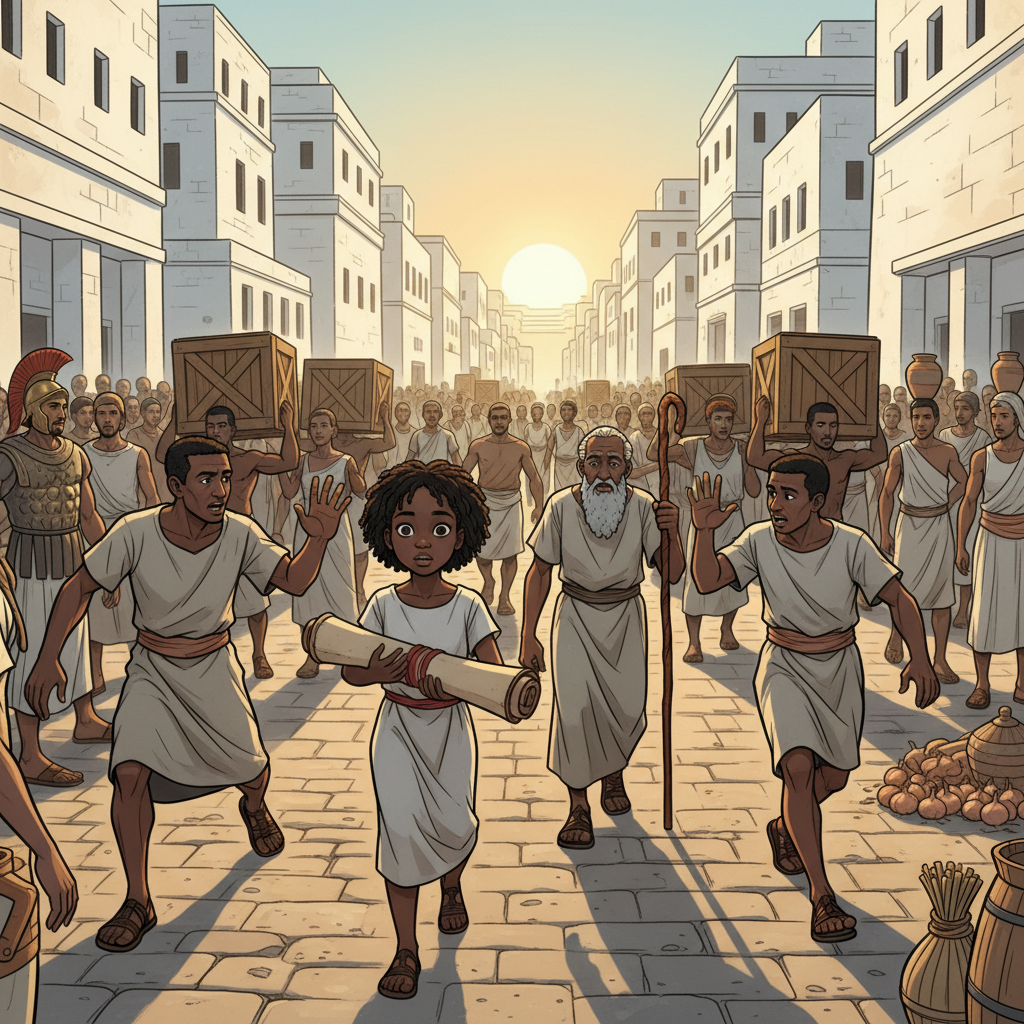
They left the visitors' quarters as the sun cleared the harbor mole. Alexandria in the early morning was already a city of crowds. The streets were laid out in great straight grids — the Macedonian-Greek city-planners had insisted on it — and the limestone facades caught the light in flat hard slabs that made Hetheret squint. Sailors and dock-workers and grain-merchants and Greek soldiers in plumed helmets and Kemetic farmers carrying bundles of onions and women with water-jars balanced on their heads all flowed past one another in the broad avenues. Twice, men in a hurry nearly bumped Hetheret, and twice they stopped just short, saw the scroll, saw her face, and stepped back. Her grandfather had been right. No one rushed a child carrying something carefully. She kept her pace even. She kept her breath even. The scroll was warm now against her linen. Her grandfather walked three steps behind her, leaning a little on his cedar staff. He did not speak. Around them, the porters from the Per Ankh of Mennefer moved in a long quiet line, twelve men carrying twelve great wooden crates on yokes across their shoulders, each crate containing perhaps a hundred scrolls — surgical texts, astronomical texts, mathematical texts, religious texts, the diary of a temple that had been kept for nine hundred years. The line wound through the broad avenues toward the Mouseion. Other lines were coming too — Hetheret saw a column from the Per Ankh of Iunu, another from the Per Ankh of Waset, a third from somewhere farther south. The entire scholarly memory of Kemet was being carried, this morning, toward a single building. And no one in the streets seemed to understand what they were watching.
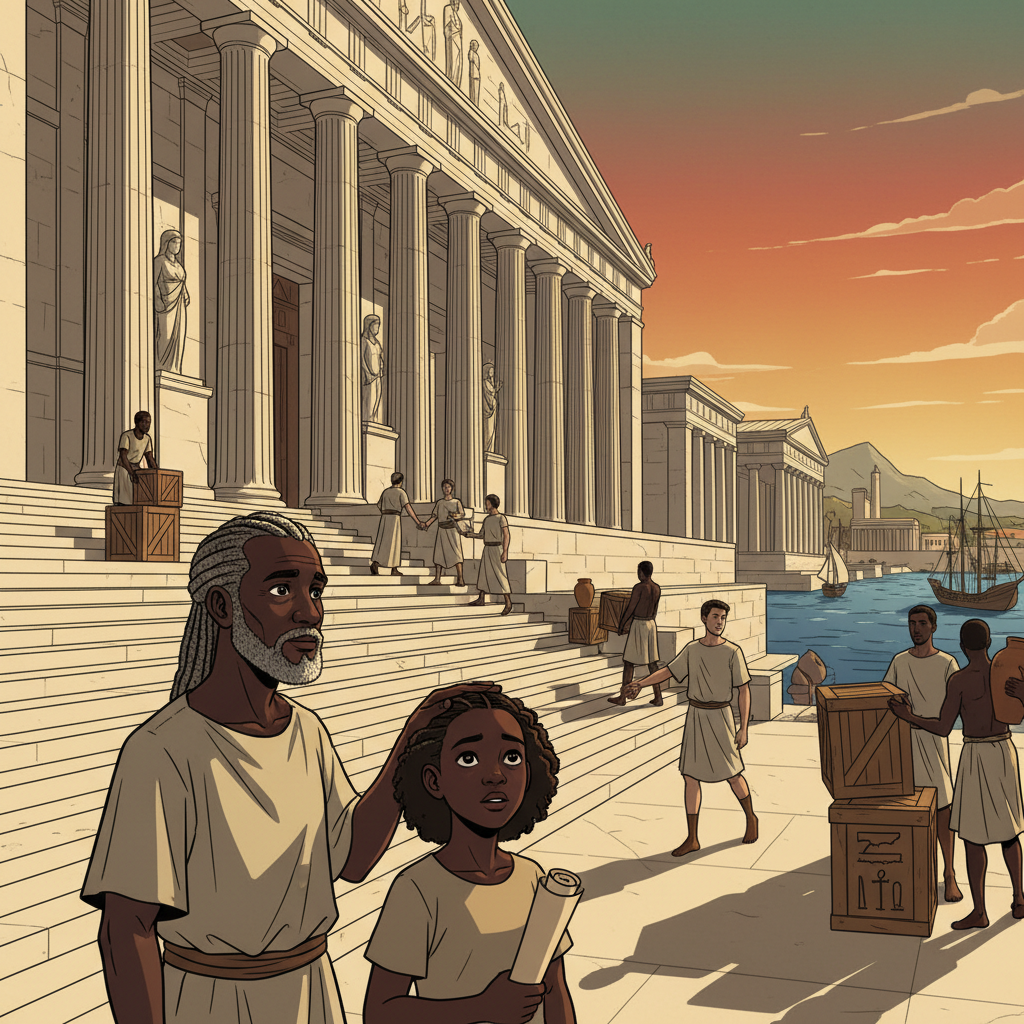
The Library of Alexandria rose ahead of them like a mountain made of marble. Hetheret had heard about it for two years before she had ever seen it. She had heard her grandfather and the other priests of Mennefer argue about it across the supper table — was it a glory or was it a robbery, was it a gift or was it a tax, was it good for Kemet or was it the beginning of something the elders did not yet have a word for? And now she was standing in front of it. The Mouseion. The House of the Muses. A great stepped facade of white marble, tall fluted columns the color of bone, statues of Greek goddesses in the niches, and beyond the colonnade the broad hall where, she had been told, lecture-benches were already filling with scholars from every country around the Great Green Sea. Eratosthenes himself, the scholar who would soon calculate the size of the Earth using mathematics learned from Kemetic priests, was said to study in the upper rooms. The steps of the Library were already busy. Greek librarians in pale tunics moved up and down them with wax tablets, taking deliveries, checking off lists, calling instructions to the porters who hauled crates inside. Two of them were directing the line from the Per Ankh of Iunu — pointing the porters toward the southern wing, snapping their fingers when a porter hesitated. Hetheret watched them. Her grandfather stopped at the base of the steps. He turned to her. He did not embrace her, because he did not want to crush the scroll. He only touched, very lightly, the top of her braided head with two fingers. "Go up alone," he said. "I will be in the colonnade. Remember the question. Remember the language." Hetheret nodded. She began to climb.
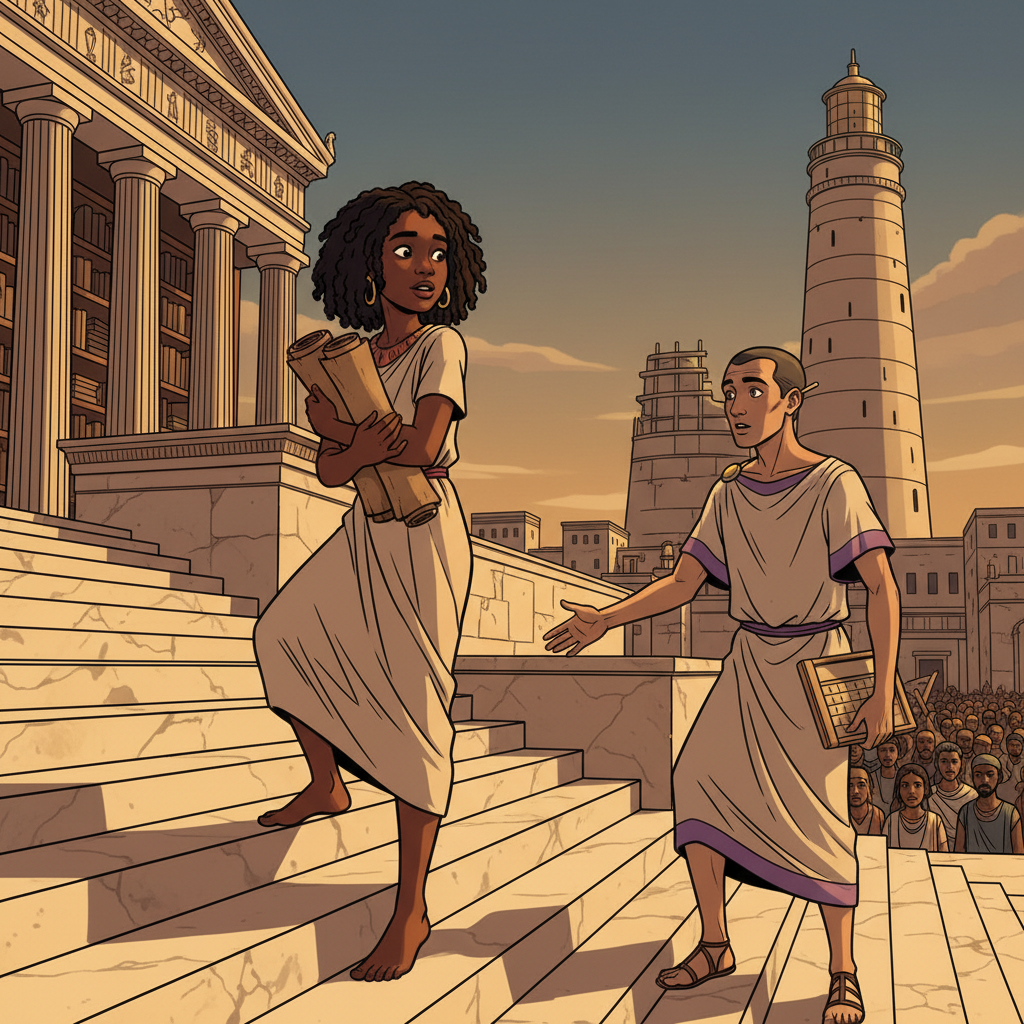
The marble of the steps was already warm under her bare feet. She counted them as she climbed, the old habit returning unbidden. One, two, three, four. Each step took her higher above the avenue. By the seventh step she could see over the heads of the porters. By the twelfth she could see the harbor and the great lighthouse rising on the island of Pharos, half-built, its lower stages already taller than anything she had ever stood beside. By the eighteenth she had reached the broad landing at the top, and a Greek librarian was already turning toward her. He was tall — taller than her grandfather — with a clean-shaven face the color of olive oil and pale eyes the color of weak tea. His tunic was pale linen, edged with a thin band of purple. He carried a hinged wax tablet under one arm and a stylus tucked behind his ear. He was not unkind. He was simply busy. He came down two steps to meet her. He looked at the scroll in her arms. Then he looked at her face, and she saw a small flicker of surprise pass across his features. He had been expecting a porter. He had been expecting a crate. He had not been expecting a twelve-year-old Kemetic girl alone with a leather-bound scroll across her chest. He smoothed his expression quickly back to professional courtesy. He inclined his head — not deeply, but enough. "Welcome to the Mouseion," he said in Greek. His Greek was the Greek of an educated man, the Greek of the lecture-hall. "May I receive the scroll?" He held out his hands. Long, clean, pale hands. The hands of a man whose work was to catalogue and copy, not to carry stones or cut limestone. He held them out, palms upward, in the gentle gesture of a man asking a child to hand over what she had carried for him.
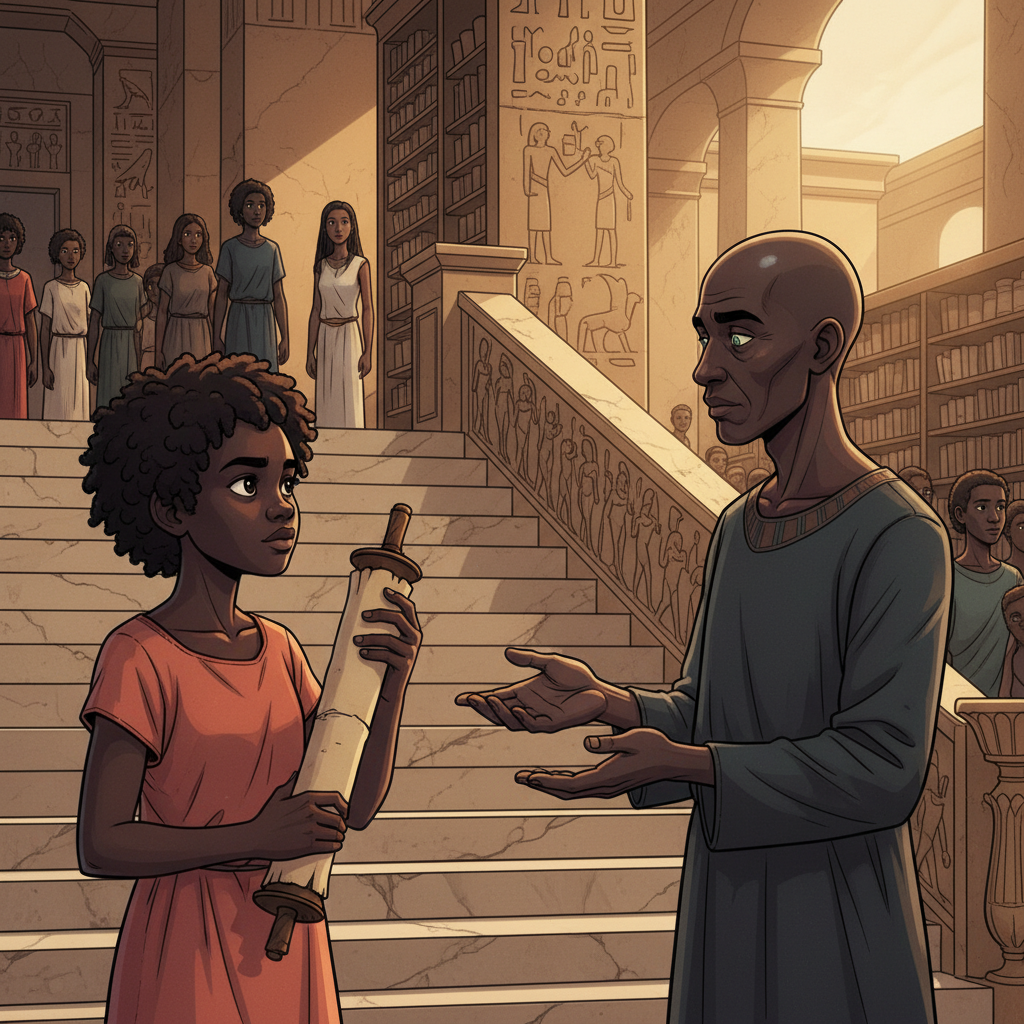
Hetheret did not let go. The librarian's hands were under hers now, almost touching the leather. The scroll was already half in his palms. All she had to do was open her fingers and the weight would transfer. She felt the small muscles of her hands tighten instead. She held on. The librarian noticed. He did not move his hands. He waited. He was good at his job, this man, and he had clearly received scrolls from frightened children before — frightened apprentices, frightened porters, frightened junior priests. He simply waited, palms upward, with the patience of someone who has all morning. Hetheret took a breath. She felt the words her grandfather had given her sitting in her mouth like a stone she had to spit out before it choked her. She looked up. She met the pale-tea eyes of the librarian. She made her voice as steady as she could. "Will it be marked as Kemetic," she asked, in careful Greek, "or as yours?" The words came out clearer than she had feared they would. The Greek was good. She had spent two years studying it with the trader-tutor her grandfather had hired, and the consonants sat where they were supposed to. The question hung in the air on the marble landing between them. The librarian's hands did not move. His face did not move either. But something behind his pale-tea eyes shifted, the way a curtain shifts when someone behind it leans suddenly forward. He did not laugh. He did not dismiss her. He did not glance over her shoulder for an adult. He simply, slowly, lowered his hands.
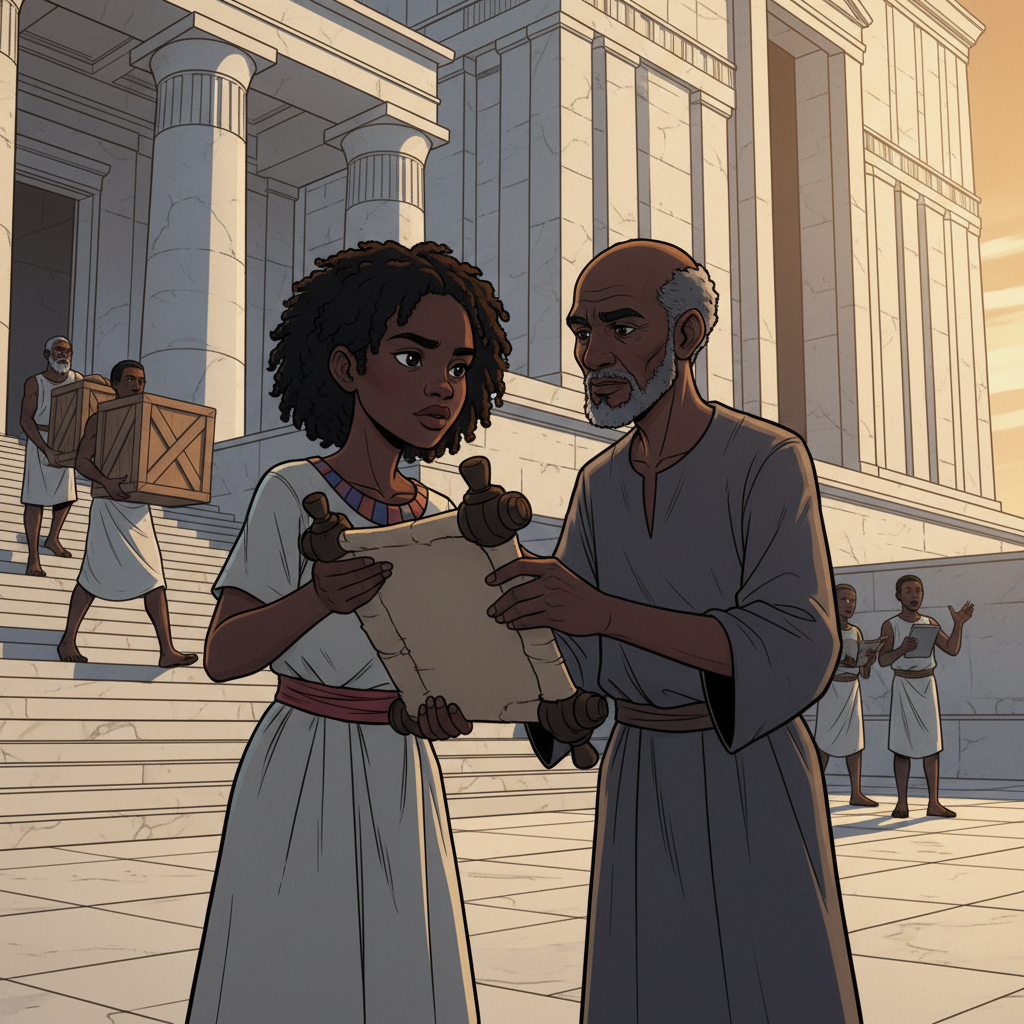
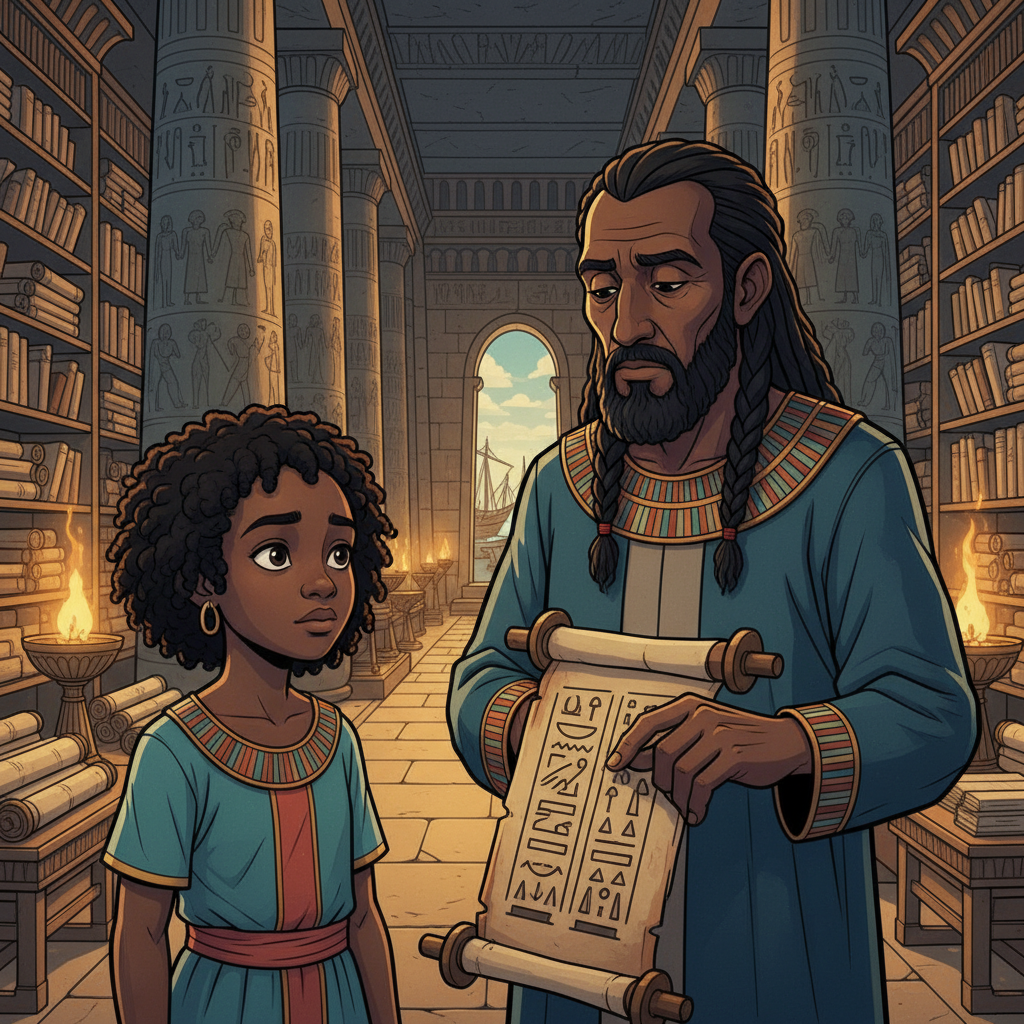
For a long moment he did not speak. Hetheret could feel her own pulse in her wrists where they cradled the scroll. Around them, the noise of the Library continued — porters calling, wax tablets snapping shut, a junior cataloguer somewhere reading a list aloud — but on the small square of marble where she and the librarian stood, the silence had grown a small skin around itself. The librarian looked at the scroll. He looked at the linen wrap, the dark honey-colored leather, the unmistakable shape of a Kemetic temple-scroll. He looked, briefly, past her — and Hetheret knew he had seen the line of crates from the Per Ankh of Mennefer still mounting the steps behind her, and the porters in their plain linen kilts, and perhaps even her grandfather standing in the shadow of the colonnade. Then he looked back at her face. "That is a real question," the librarian said. His Greek had changed — it was no longer the brisk Greek of the receiving-line. It was slower, more careful. The Greek a man uses when he has just realized he is speaking to someone who can hear him. "You ask whether the catalogue entry will name the source of this scroll as the Per Ankh of Mennefer, or whether it will name only the Library." He paused. "Have you been told that catalogue entries can do either?" Hetheret shook her head. "I have not been told that. I am asking which it will be." The librarian gave her a thin, surprised smile. "You are asking the question that the master-cataloguer should be asking. He is not, today, because the deliveries are large and his hands are full. But you are asking it." His smile widened, very slightly. "Wait here."
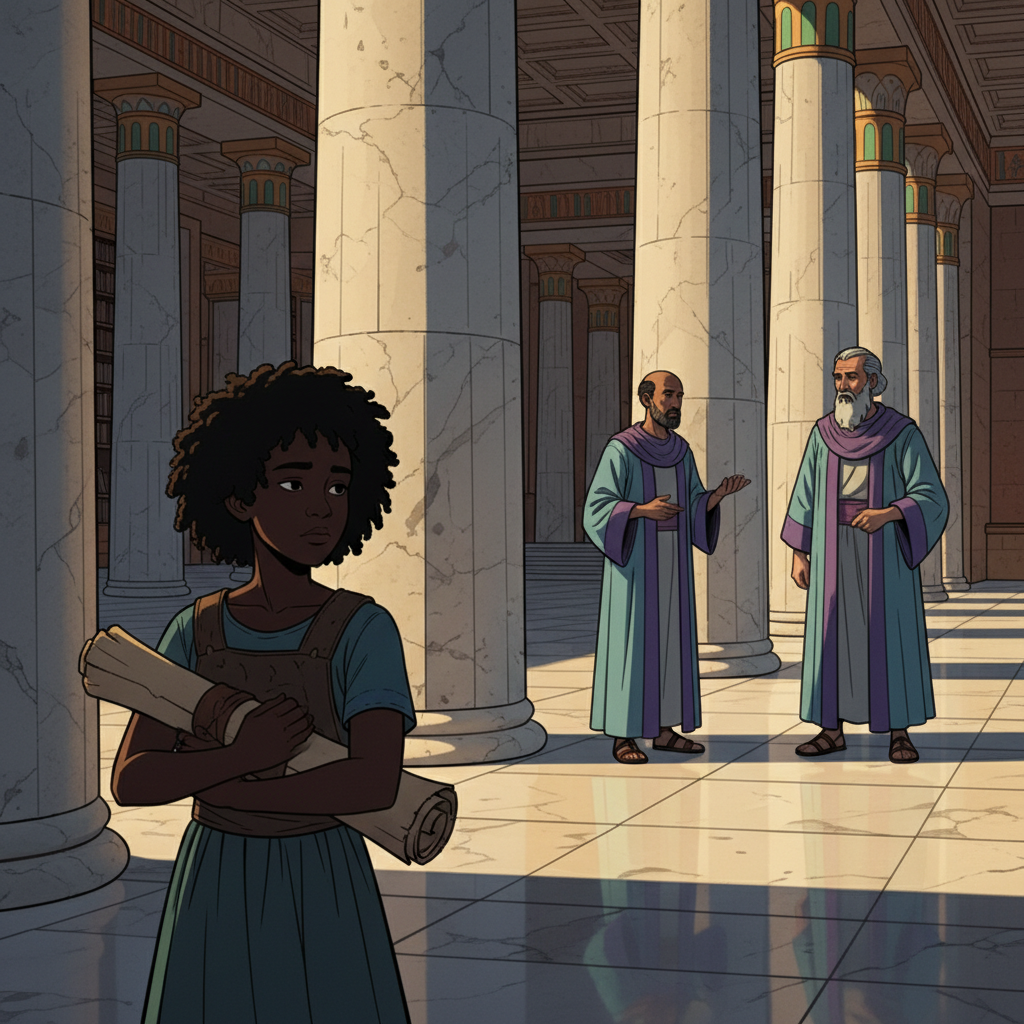
He turned and walked across the broad landing, past two columns, into the shadow of the colonnade. Hetheret stood with the scroll still in her arms. Her shoulders were beginning to ache. She did not put the scroll down. Her grandfather had said, before she had climbed the steps, that she should not surrender the scroll until the question was answered. She would stand here all day if she had to. Through the gap between the columns she could see the librarian speaking to an older man — gray-bearded, slightly stooped, wearing a longer pale-blue robe edged with a wider band of purple. The older man listened. The older man turned his head, looked across the landing at Hetheret, looked at the scroll, and listened more. Then he nodded once. Then he and the librarian began to walk back together, the older man's long robe brushing the marble. The older man stopped two paces from her. He bowed — not deeply, but it was a real bow, the bow of a scholar to a scholar. "I am the master-cataloguer of the Mouseion," he said in Greek. "My junior tells me you have asked a question that I should have made standard practice from the first day of this Library. Will you say it again, please, so that I may hear it from your own voice?" Hetheret's mouth was very dry. She wet her lips. She looked at the master-cataloguer's lined face, at the gray of his beard, at the surprising kindness in his eyes. She raised her voice just a little, so that the porters on the steps would hear it too. "Will it be marked as Kemetic," she said, "or as yours?"
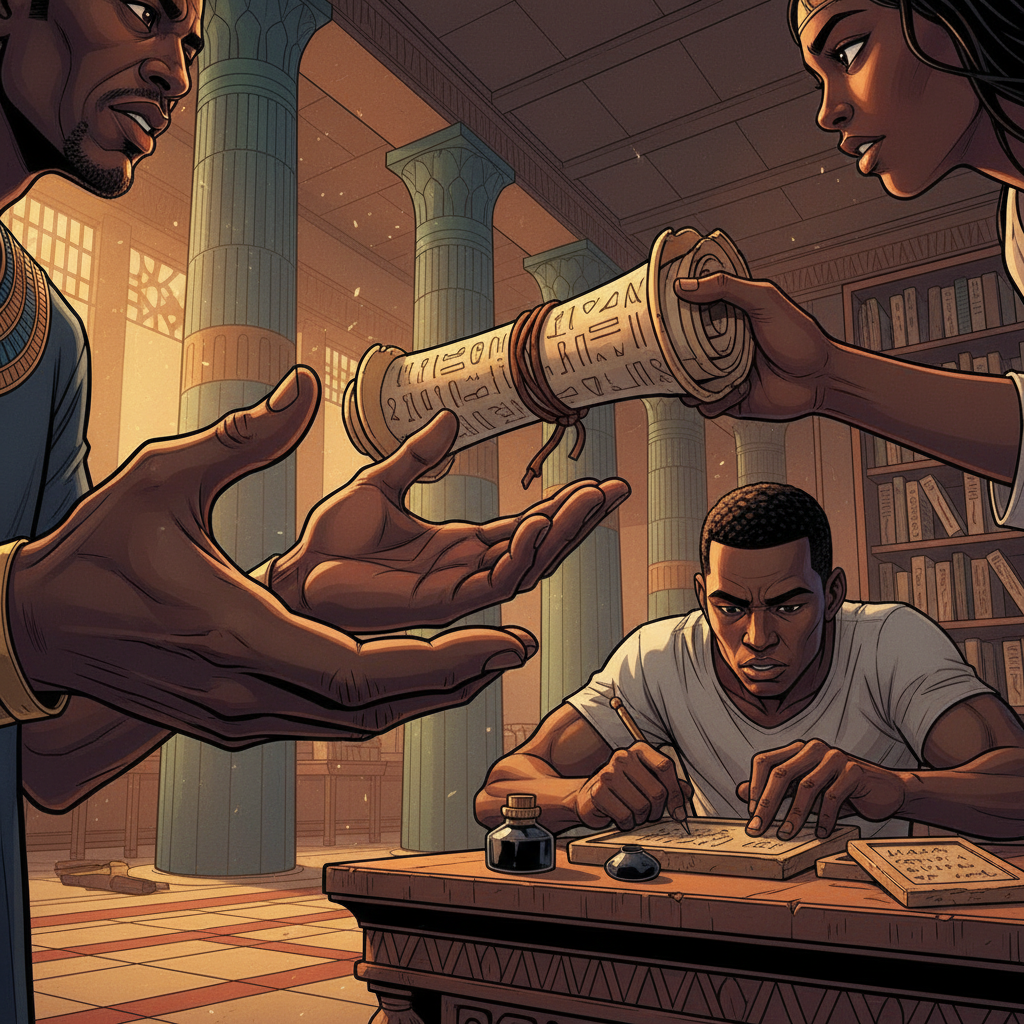
The master-cataloguer did not answer at once. He turned to the junior librarian. He spoke quietly, in Greek so quick that Hetheret had to strain to follow it. "From today. Every scroll received from a Per Ankh. The catalogue tag must name the temple of origin. Mennefer here. Iunu next. Waset after. The catalogue is to record the source, in the first line, before the subject of the scroll. Begin a new cataloguing standard. Write it as a memorandum to all junior cataloguers before the noon meal." The junior librarian bowed and pulled out his wax tablet and began, immediately, to write. The master-cataloguer turned back to Hetheret. He held out his own hands — not in the same way the junior had, not in the polite empty gesture of receiving. He held them out in the way one priest holds out hands to receive a sacred object from another priest. "The scroll you carry," he said, "will be marked. From the Per Ankh of Mennefer. That entry will be written on the catalogue tag before any other word. The next reader who comes to this scroll, a year from now or three centuries from now, will see the source of it before they see the subject of it. This is the correct way. I am sorry it took a child to remind us." He paused. "May I now receive it?" Hetheret took one breath. She thought of her grandfather in the colonnade. She thought of the Surgical Papyrus, the forty-eight cases, the hand that had first written them down a thousand years before either of them was born. She opened her fingers. The weight transferred. The scroll passed from her arms into the master-cataloguer's hands as gently as a sleeping child passed from mother to grandmother.
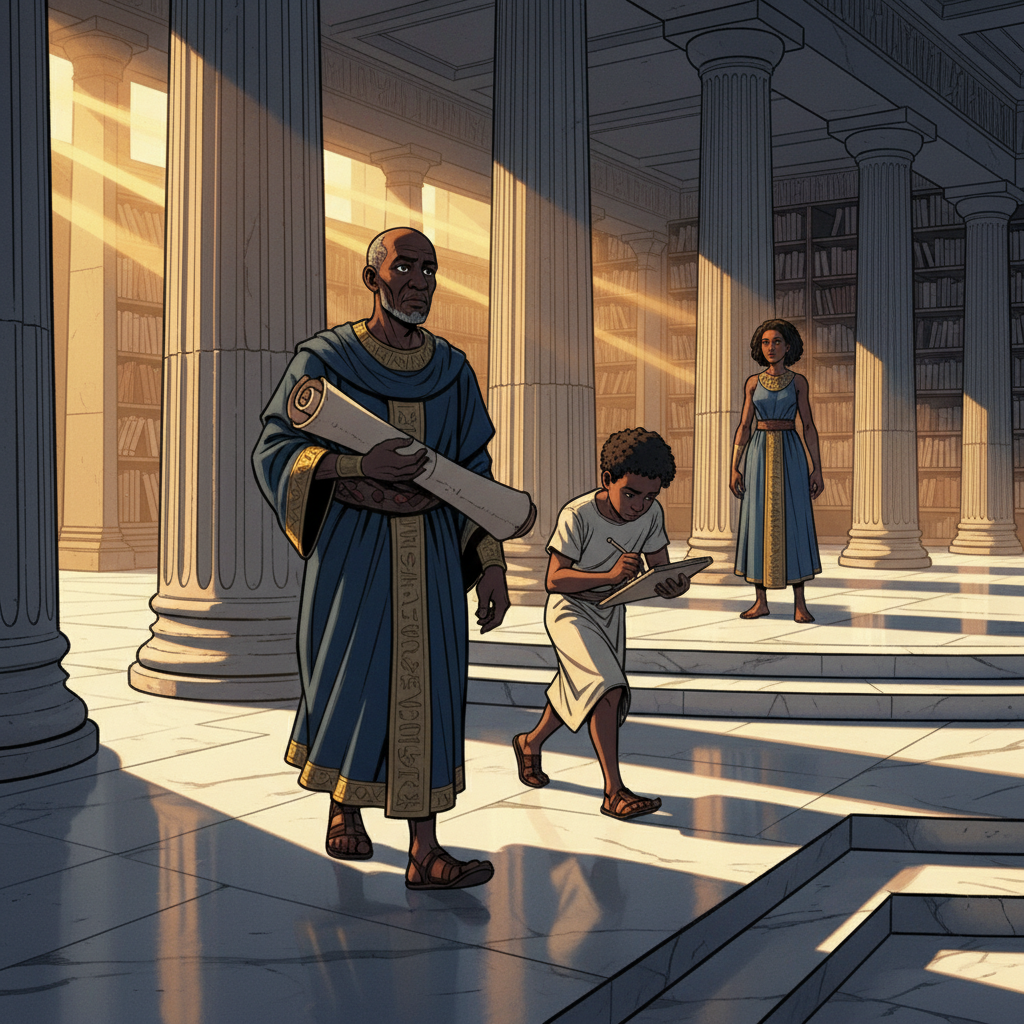
The master-cataloguer cradled the scroll against his chest the way she had been cradling it. He bowed again — deeper this time, the bow of a scholar acknowledging the source of a teaching. Then he turned and carried the Surgical Papyrus through the columns into the great hall of the Library, the junior librarian walking beside him, already writing the new cataloguing rule on his wax tablet. Hetheret stood for a moment alone on the marble landing. Her arms felt strangely empty. The morning sun had risen high enough now to throw the shadow of the columns in long bars across the steps. She turned, slowly, and looked toward the colonnade where her grandfather had been standing. He was still there. He had not moved. Anen-her stepped forward into a strip of sunlight between two columns. He did not say anything. He did not call out. He simply lifted his chin slightly, the way an elder lifts his chin to a younger person who has done well, and he nodded once. One nod. That was all. Hetheret saw it. She felt it settle through her chest like a stone settling into the riverbed. She did not need anything more. She walked back down the steps slowly — one, two, three, four — and when she reached the bottom her grandfather was waiting. He reached out and put one old hand on the top of her head. "You did the thing," he said. "Now we walk home." They turned and walked back into the city together, past the porters still carrying crates up to the Library, into the moving river of Alexandria.
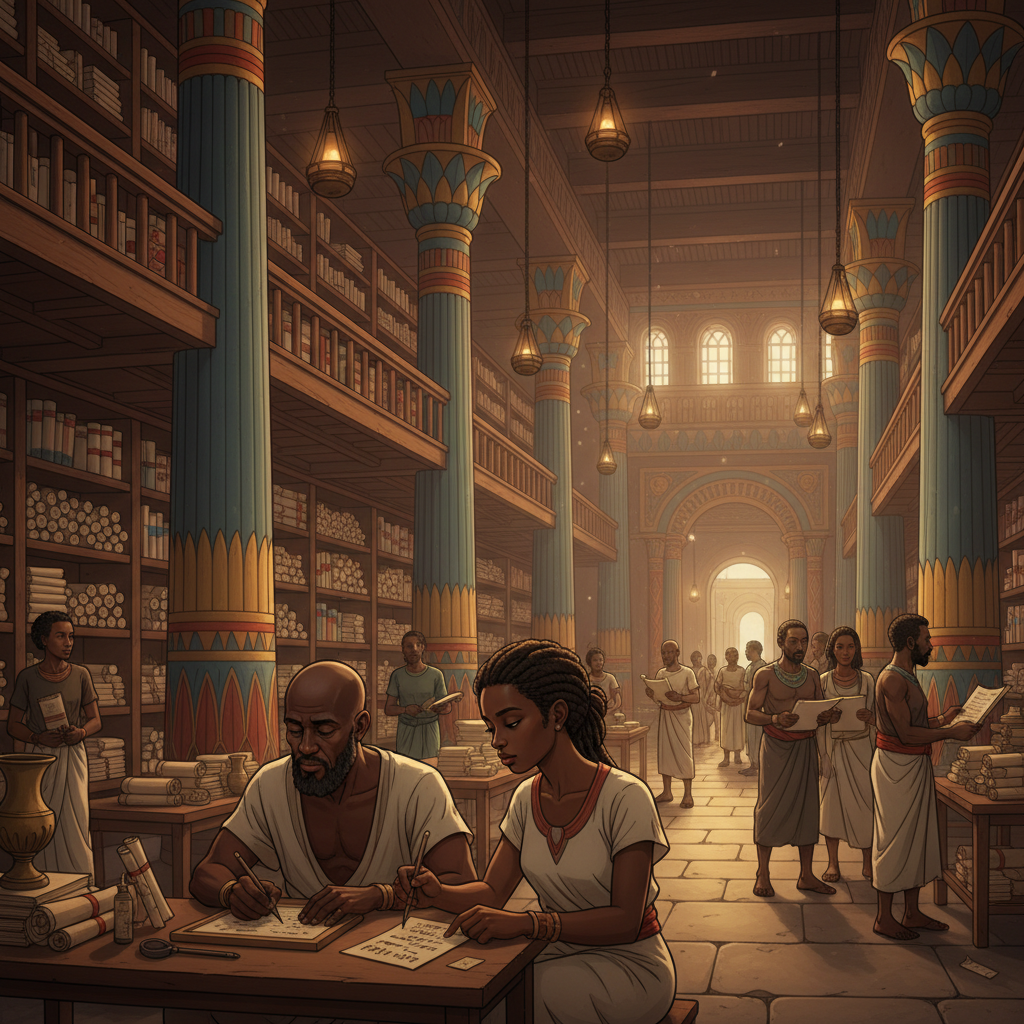
The Library of Alexandria stood for almost six hundred years after that morning. In those centuries it became the greatest library the world had ever known. Eratosthenes used Kemetic geometry inside its walls to calculate, almost exactly, the circumference of the Earth. Greek physicians copied the Surgical Papyrus and the cases passed into the medical traditions of every nation around the Great Green Sea. Roman scholars came and studied. Later, scholars from Persia and from India and from places far to the east came too. And on the catalogue tag of the Surgical Papyrus, in the small careful script of the master-cataloguer of Alexandria, the first line read: From the Per Ankh of Mennefer. Some of the other scrolls were marked too — not all, but many. The cataloguing rule that the master-cataloguer wrote on his wax tablet that morning before the noon meal became, slowly, standard practice for the rest of the Library's life. Then, over centuries, the Library burned. It burned in pieces, in different fires, under different rulers. The Romans burned part of it. Later fires burned more. The catalogue tags burned with the scrolls they were tied to. The Surgical Papyrus that Hetheret had carried up the steps was gone. Many people, in the centuries after, told the story of the Library as a story of one great tragedy — the fire, the loss, the burning of all that knowledge. But Hetheret's grandfather, who had died long before the fires, had taught her something different. The fire was not the deepest tragedy. The deepest tragedy would have been if, for all the centuries the Library stood, the scrolls had been catalogued as Greek. The fire took the scrolls. The catalogue tag had given the scrolls their name. And a name, once given truly, is harder to burn than papyrus.
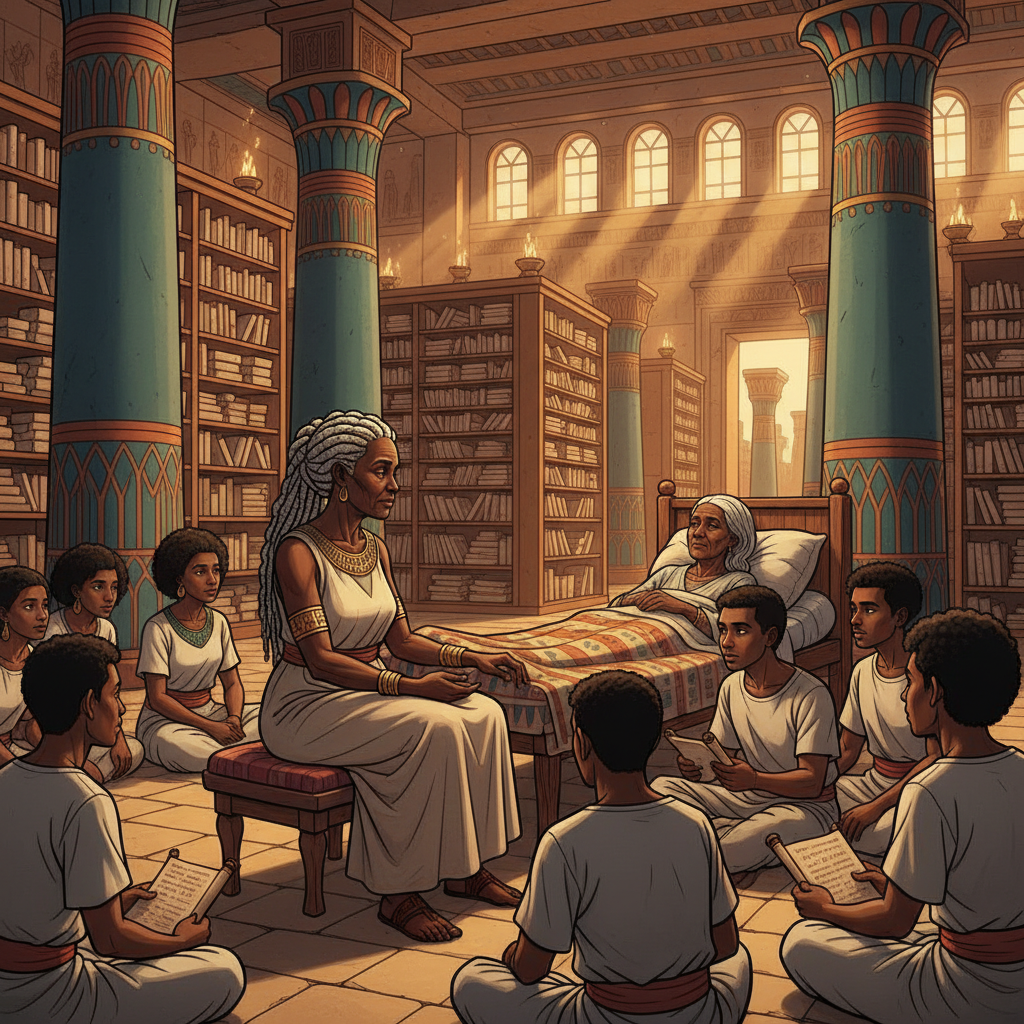
Hetheret grew up. She became a scribe in Mennefer, at the Per Ankh where her grandfather had served. She trained other students — many of them girls, by her own choice — and she taught them three languages, because she had learned, on the steps of the Library, what one careful question in the right tongue could do. She lived to be old. She buried her grandfather, and later her parents, and later still she sat by the bed of the first student she had ever trained when that student in turn grew old. Once, when she was very old herself, a young scribe came to her with a question. He had heard a rumor that Greek physicians were now teaching that the cases of surgery had been first written in Alexandria. "Is it true, mistress?" the young scribe asked. "Did the Greeks write them?" Hetheret was sitting in the courtyard of the Per Ankh, in the late afternoon sun. She thought for a long time before she answered. "No," she said finally. "The cases were written in Mennefer, a thousand years before Alexandria was a city. But I will tell you something more important than that. There was a morning, when I was twelve years old, when I stood on the marble steps of the new Library and asked a Greek librarian whether the scroll I had carried up those steps would be marked as Kemetic or as theirs. He marked it as Kemetic. That morning, the catalogue tag named the source of the scroll. The scroll has since burned. But you are sitting here, in the Per Ankh of Mennefer, and you know to ask the question. That is what the question did. The catalogue tag is gone, but the question is still being asked. The question is what the catalogue was for."
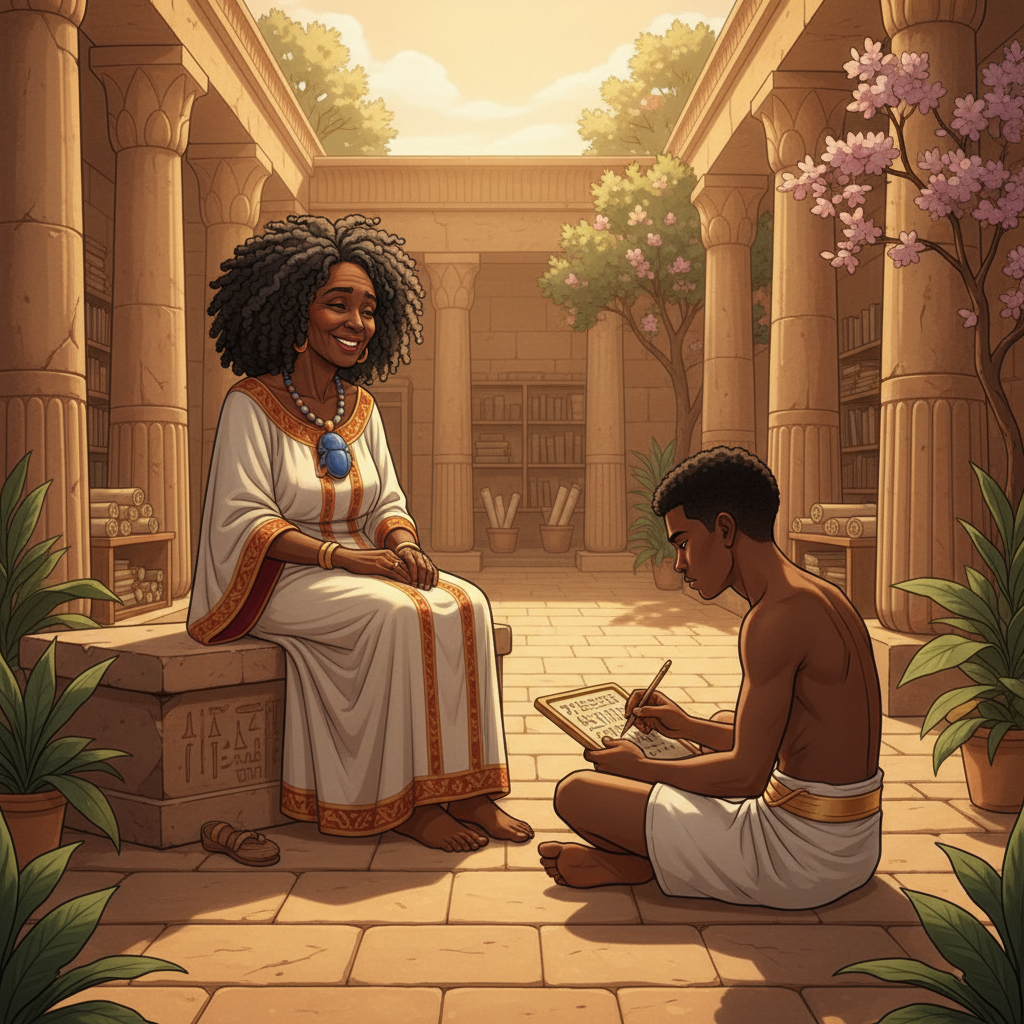
The young scribe took out his own wax tablet and asked if he could write down what she had just said. Hetheret laughed — the small soft laugh of an old woman who has lived to see her teachings carried forward. "Write it," she said. "Write it carefully. Write it in Medu Neter, and in Greek, and in whatever third tongue you also know, because the scribes who come after you may not all read what we read. And write at the top of the page, before any other word — write where the words came from. Write: From an old woman in the Per Ankh of Mennefer, who was once a twelve-year-old girl on the steps of the Library of Alexandria. Do not let the scroll travel without its source, young one. That is the first rule of every catalogue, in every library, in every age. The first rule. Before the subject. Before the author. Before the date. The source." The young scribe wrote it down. He wrote it carefully, in two languages, with the source-line at the top, just as she had said. And in the late afternoon sun of the temple courtyard, Hetheret watched him write, and she thought of her grandfather standing in the colonnade in Alexandria seventy years before, and the single nod he had given her, and the way the master-cataloguer's pale hands had taken the Surgical Papyrus from her arms. Order, she thought, is not only that things are in the right places. Order is that things are KNOWN to be in the right places. A library that loses the source of its knowledge is not a library. The young scribe finished writing. He looked up. Hetheret smiled the small smile she had inherited, across the years, from her grandfather. "Now," she said. "Read it back to me. Slowly. From the source-line down."