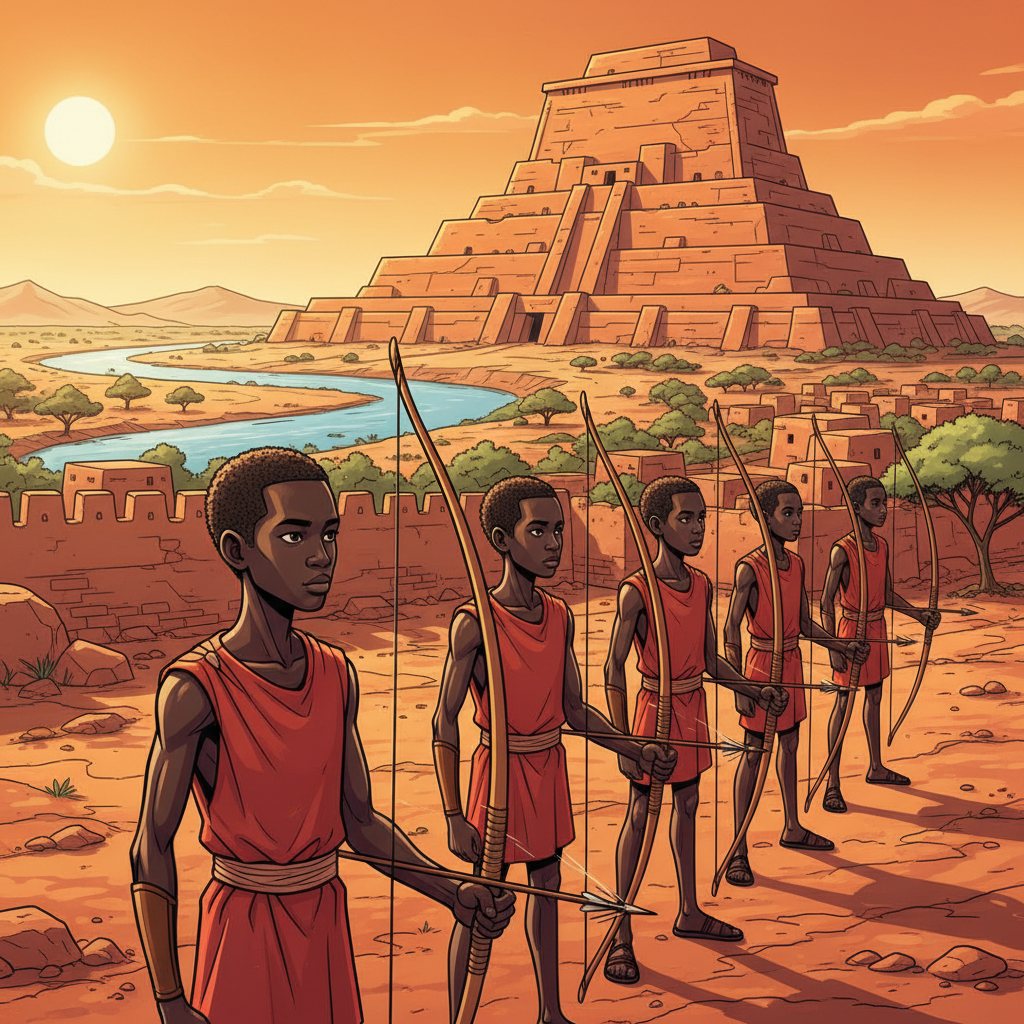
In the ancient city of Kerma, where the Nile bent like a great serpent through the red-brown earth, twelve-year-old Shabaqa stood in a line with other young students. His skin was deep ebony, glistening in the morning sun. Each child held a bow of acacia wood, almost as tall as they were, strung with twisted sinew that hummed faintly in the breeze. In Kerma, children began archery training as young as five or six — tiny bows had been found buried alongside their owners, ready for practice even in the afterlife. This was the training ground east of the great deffufa — the massive mud-brick temple that rose above the city like a mountain built by human hands. Kerma was one of the oldest cities in all of Africa, a place where people had gathered, traded, and built for over a thousand years. Its walls had watched countless young archers stand where Shabaqa stood now.
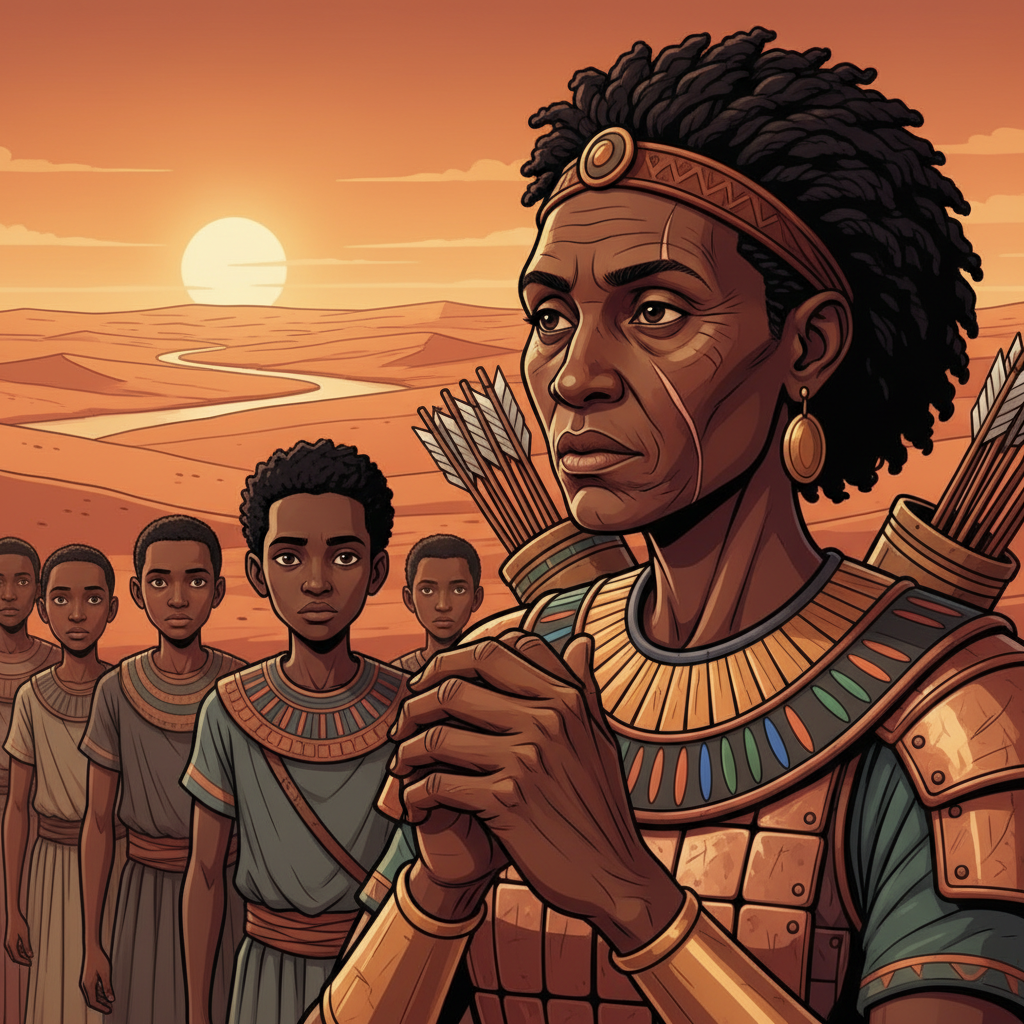
Their teacher was an old warrior woman named Tabiry. Her dark brown hands were rough from decades of pulling bowstrings, her fingers calloused like worn leather. A long scar traced the line of her jaw — a reminder, she said, of why you never lose focus. She had once been a Medjay, one of the elite scouts and warriors who protected trade caravans across the desert. Her arrows had guarded merchants all the way north to Kemet and beyond, through scorching sands where raiders hid behind every dune. Now her eyes, still sharp as obsidian, studied each student the way a potter studies wet clay — looking for what they might become.
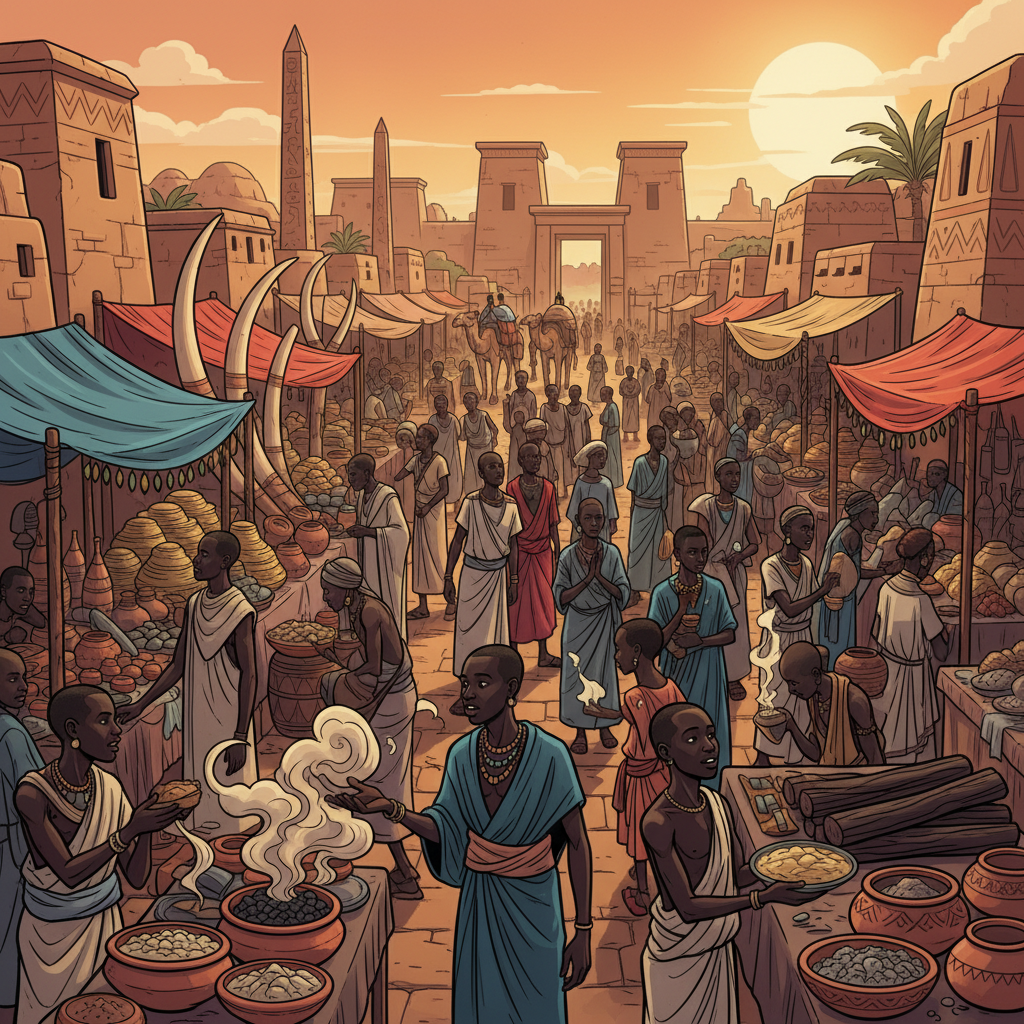
Kerma was a city of traders and warriors, one of the earliest great cities on the African continent. For a thousand years it had grown beside the Nile, its people mastering the river's rhythms. Gold, ivory, ebony wood, and fragrant incense flowed through its markets from kingdoms far to the south and east. Merchants from Kemet brought rolls of papyrus and bolts of fine linen. The world came to Kerma, and Kerma went out into the world. Its traders traveled paths that stretched across deserts and down rivers into lands most people only heard of in stories. The wealth of Kush was known from the great cataracts of the Nile to the shores of distant seas.
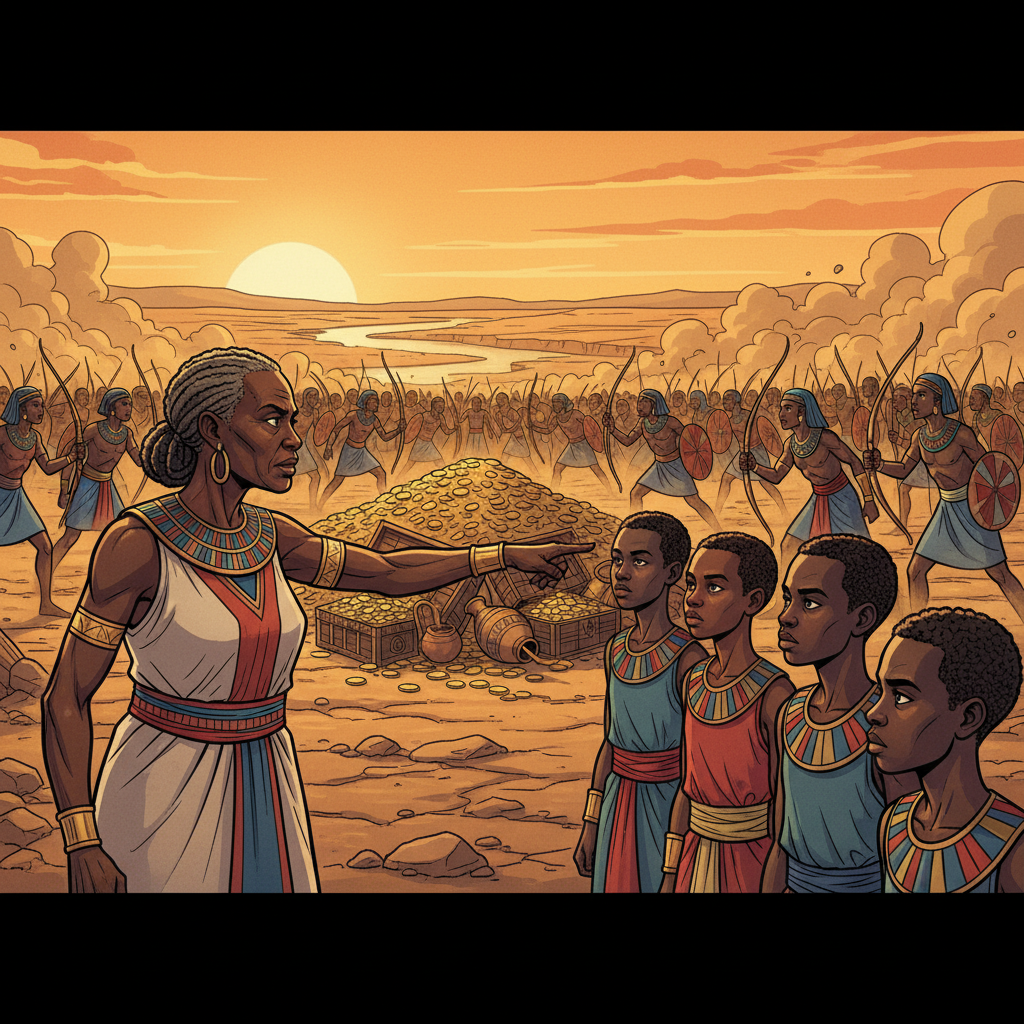
But Tabiry always reminded her students that Kerma's true strength was not its gold. "Gold can be stolen," she would say, pacing before them in the amber light of early morning. "Cattle can wander. Even the Nile can withhold its flood. But discipline — discipline lives inside you, where no thief can reach." She stopped and faced them, her dark eyes moving from child to child. "That is why you are here. Not to become killers. You are here to learn the archer's truth — that the battle is always here first." She tapped her temple with one rough finger. "Before the arrow flies, the mind must be still."
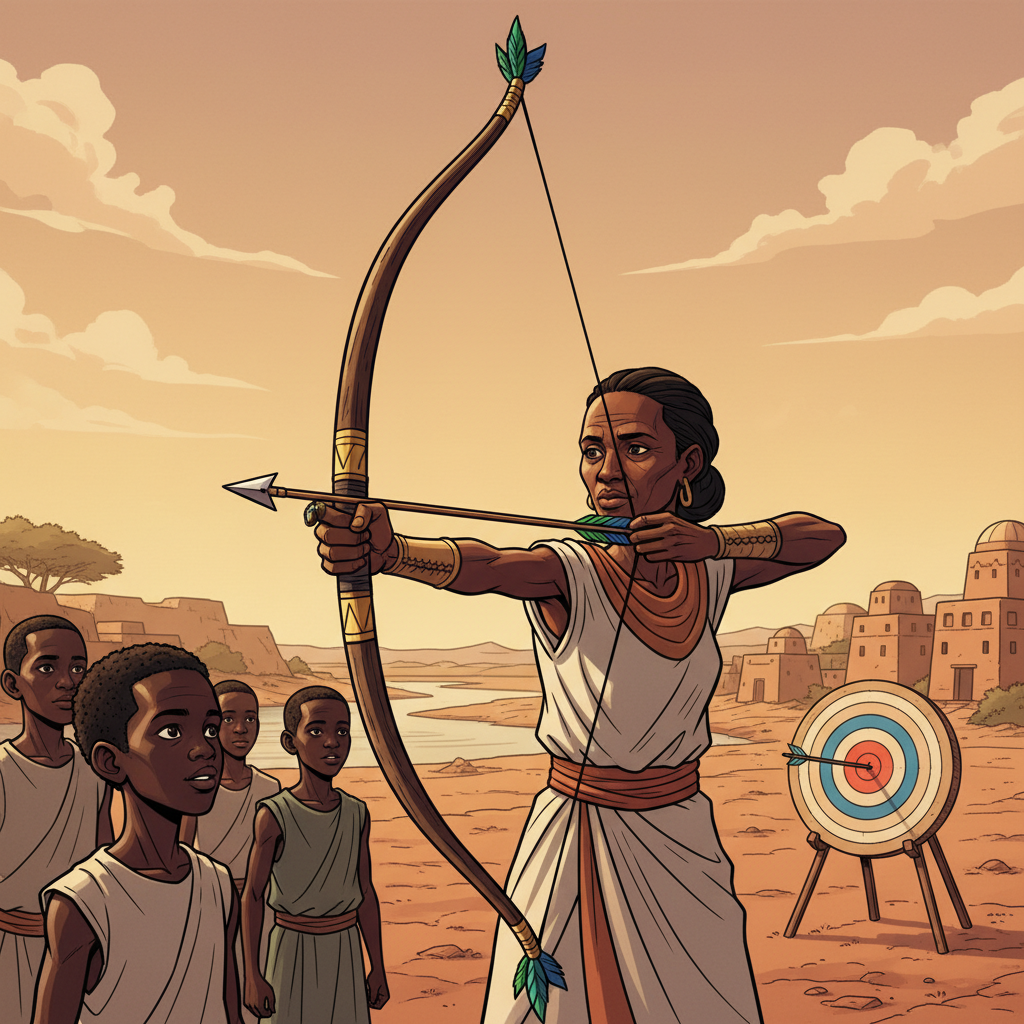
"The bow is not just a weapon," Tabiry told them, lifting her own great bow so they could see its elegant curve. "It is a mirror. If your mind is scattered — isfet in your thoughts — the arrow flies wild. Chaos in the heart becomes chaos in the hand. If your mind is still, ordered like Maat herself, the arrow finds its home." She demonstrated, drawing the string to her cheek in one fluid motion using the thumb ring draw — a technique that let Kushite archers pull bows so powerful that no other method could handle the strain. Her body became perfectly still, like a heron about to strike. The arrow leapt from her bow and buried itself in the center of a straw target fifty paces away. She had not appeared to aim at all. The great Greek traveler Strabo would one day write that Kushite bows were so enormous — four cubits, nearly six feet long — that the archers had to brace them with their feet just to string them. No wonder outsiders called this land Ta-Seti, the Land of the Bow.
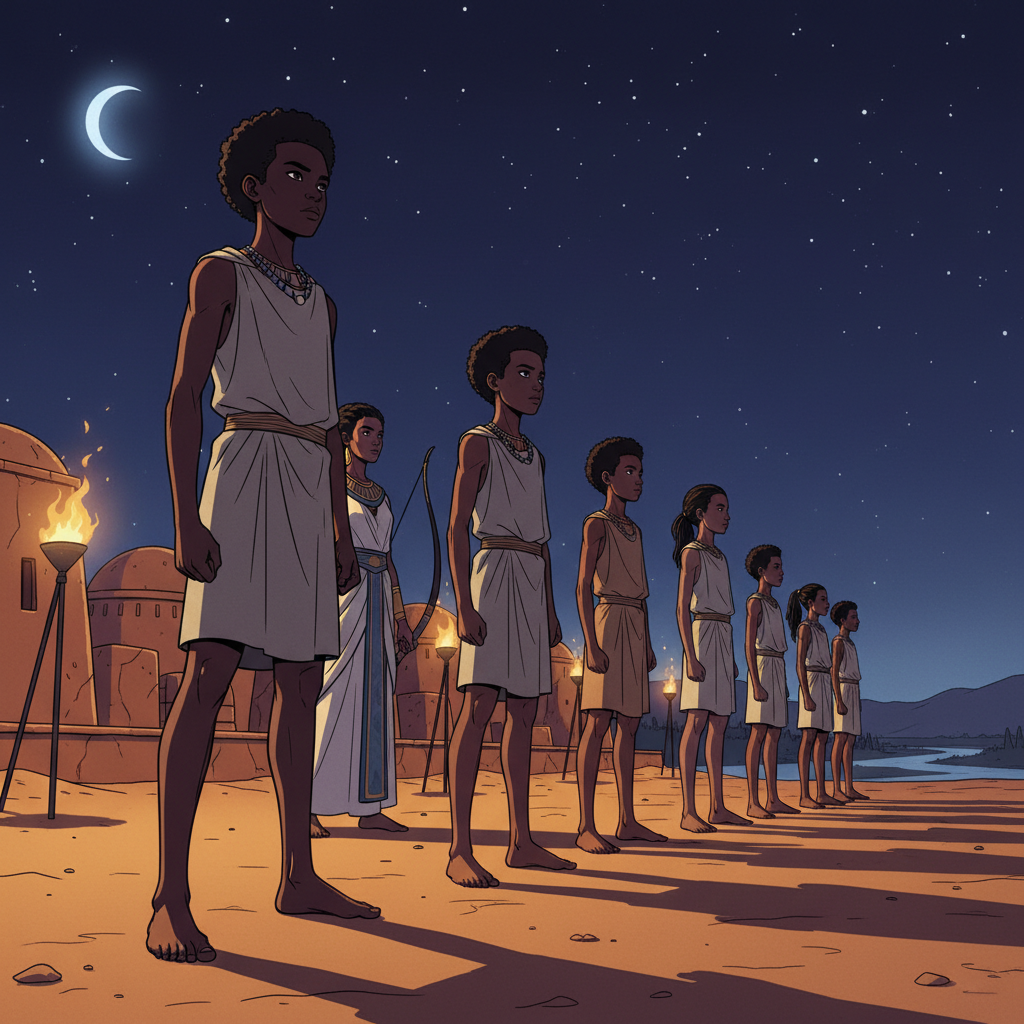
"Now — your stance," Tabiry commanded, walking behind the line of students. "Feet apart, the width of your shoulders. Weight even, like the two lands of Kush and Kemet balanced on the scale of Maat. Your body is a pillar. If the pillar leans, the temple falls." Shabaqa planted his bare feet in the warm sand and tried to feel steady. Around him, the other students did the same — boys and girls together, their dark skin ranging from deep bronze to richest black. In Kerma, every child trained with the bow. It was not a matter of being a boy or a girl. The arrow did not care who released it. Only focus mattered.
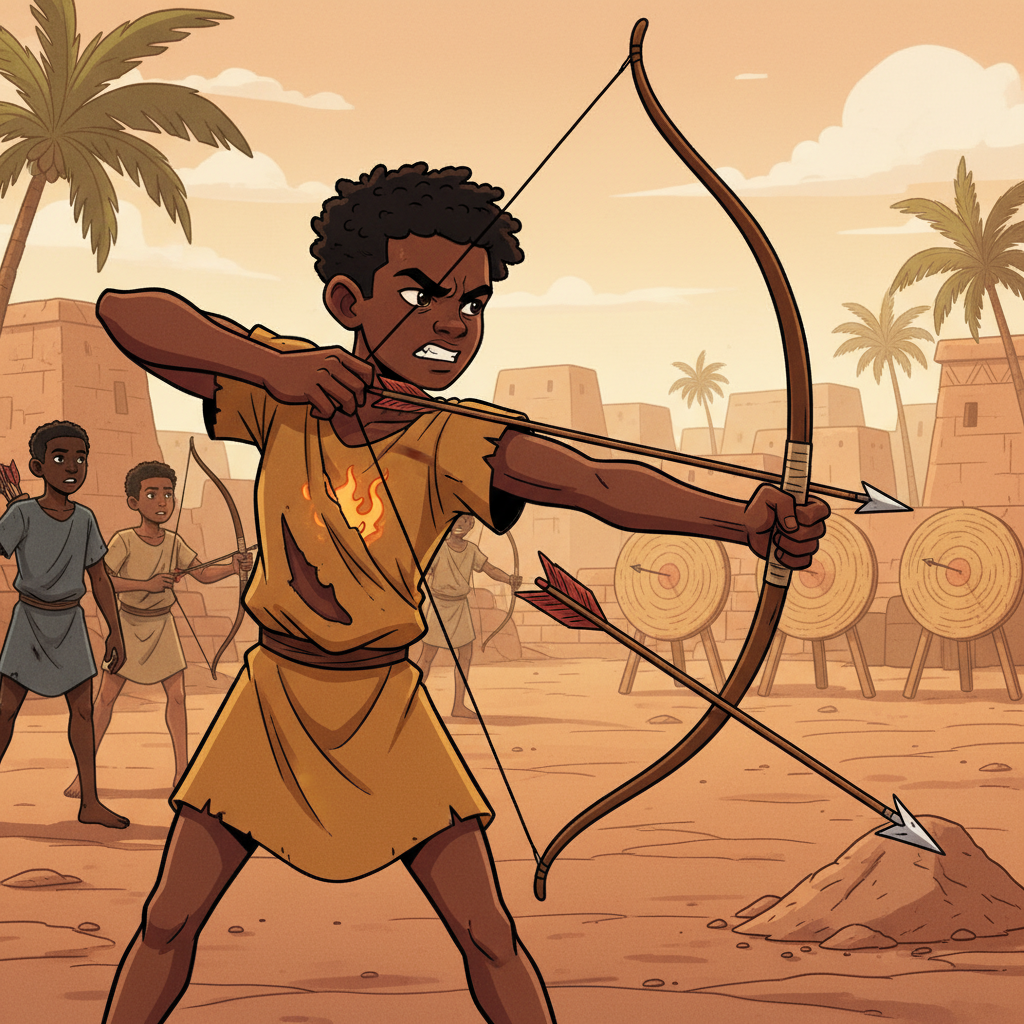
Shabaqa drew his bowstring back for the first time that morning. His arms trembled with the effort, the sinew biting into his fingers. He was thinking about his empty stomach — he had shared his morning porridge with his younger sister, keeping nothing for himself. And he was thinking about the laughter of a boy named Amenhotep who had mocked his torn practice tunic. The anger sat in his chest like a hot coal. His breathing was shallow and ragged. When he released, the arrow wobbled through the air like a wounded bird and missed the target completely, skittering into the dust. A few students glanced at him. Shabaqa's face burned with shame.
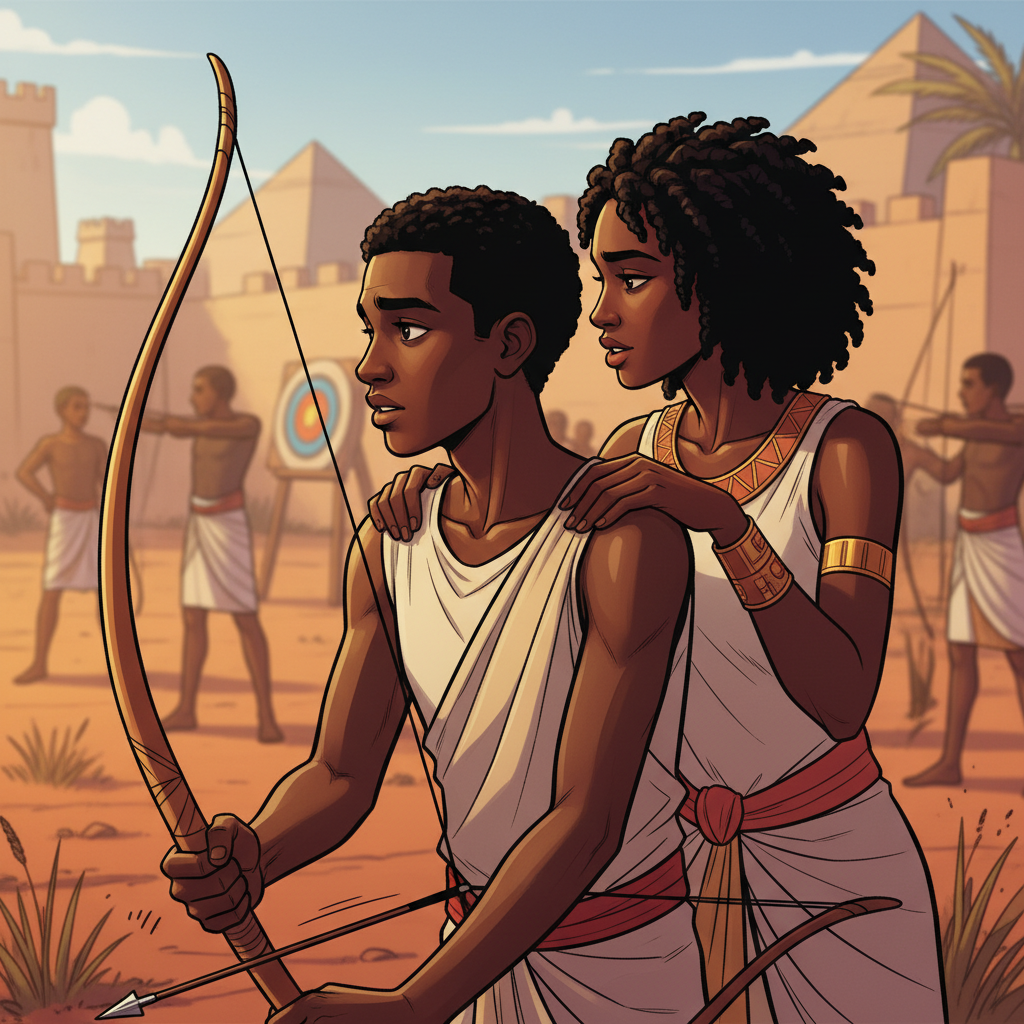
Tabiry did not scold him. She walked over slowly, her sandals whispering in the sand, and placed her hand on his shoulder. Her grip was firm but gentle, the way a mother steadies a child learning to walk. "Breathe, child," she said quietly, so only he could hear. "Let go of what happened before. Let go of what will happen next. There is only this arrow, this breath, this moment. That is Maat — order in the mind. The Per Ankh teaches us that wisdom begins with stillness. A scribe must quiet the mind before writing. An archer must do the same before shooting."
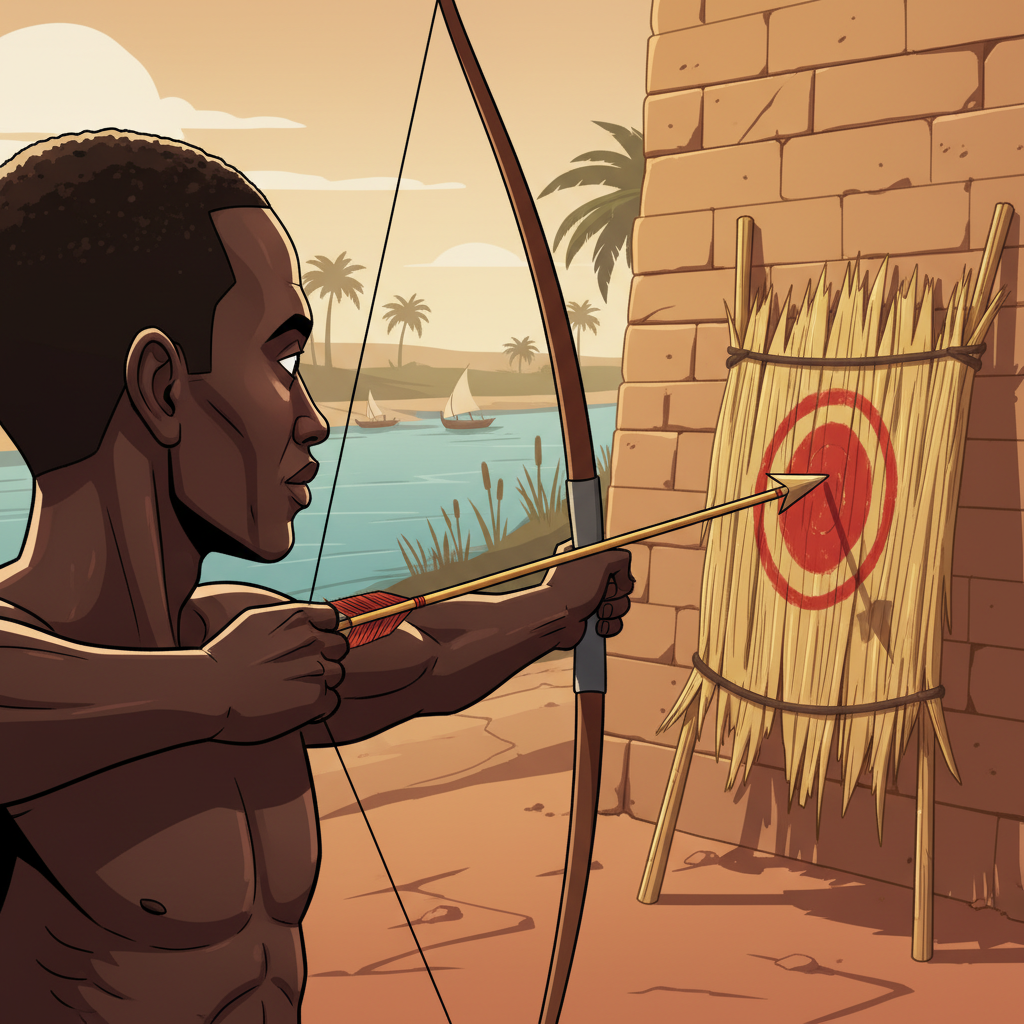
Shabaqa closed his eyes. He breathed deeply, the way Tabiry had taught them — in through the nose, slow as the Nile's current, out through the mouth like a breeze crossing the river at dusk. He felt the hot coal of anger in his chest begin to cool. The hunger in his belly quieted to a whisper. When he opened his eyes, the world seemed sharper. The straw target stood against the mud-brick wall, its center marked with a circle of red ochre. He saw only that circle. He drew the bowstring back, felt the tension sing through his arms, and released. The arrow struck true, biting into the straw with a satisfying thud.
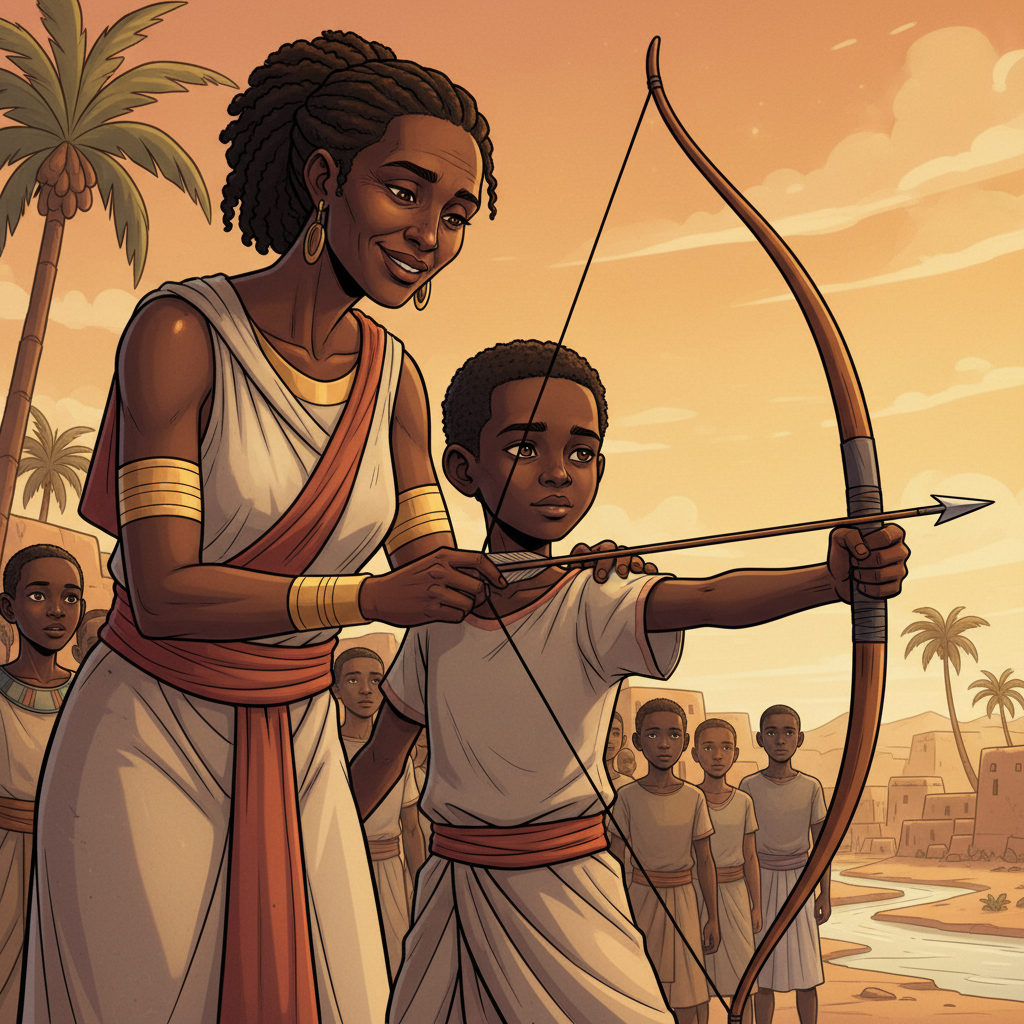
Tabiry nodded, a rare hint of approval crossing her weathered face. "Better. A warrior of Kush does not just train the body. You train the Ka — your spirit, the invisible force that lives within you. A still Ka makes a deadly archer and a just person. A restless Ka makes a danger to everyone, including yourself." She turned to address all the students. "The Ka is not something you can hold or see. But you felt it just now — some of you. That moment when the noise inside goes quiet, when your breathing slows, when your hand becomes steady. That is your Ka finding its balance. That is Maat living through you."
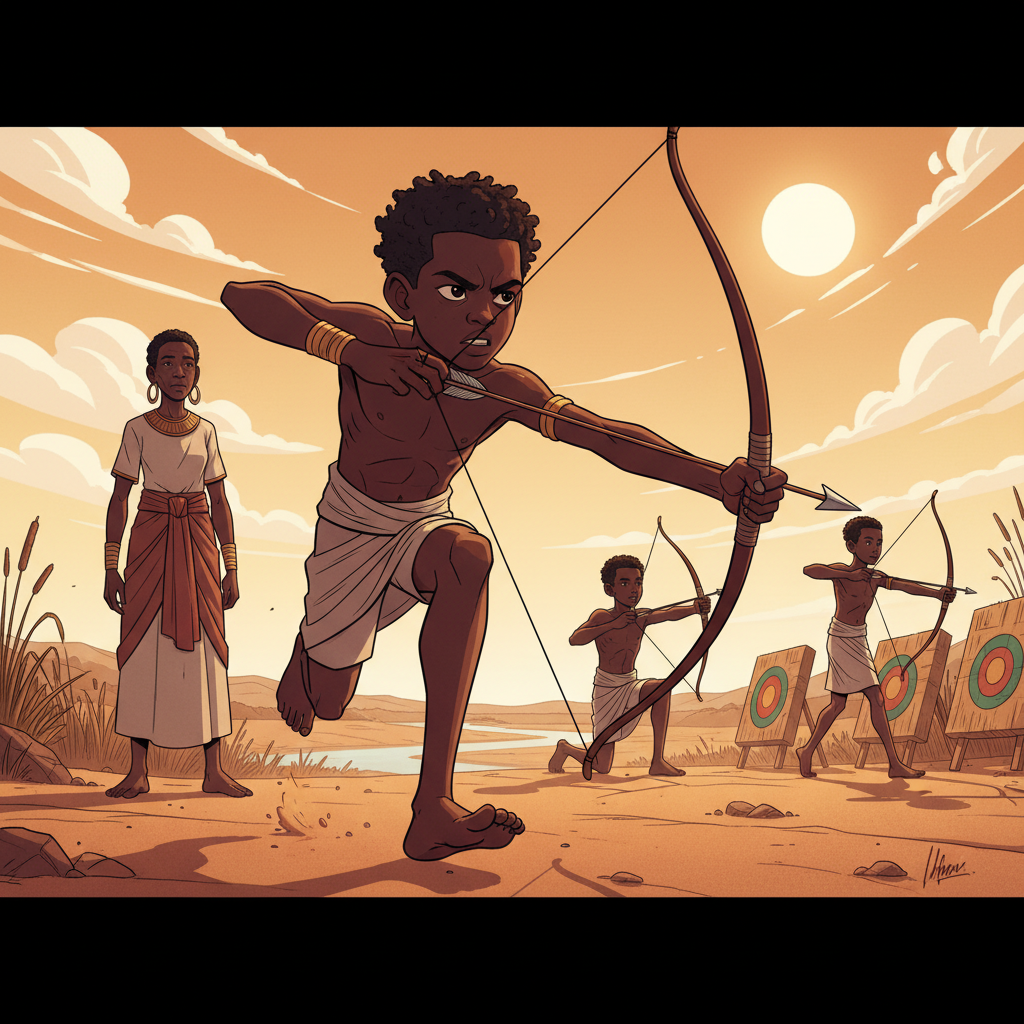
They trained through the long morning, arrow after arrow, until Shabaqa's fingers were raw and his shoulders ached like old wood about to split. Tabiry made them shoot from different positions — kneeling, standing on one foot, walking slowly forward, and even running at full sprint. Ancient texts described Kushite archers hitting targets while running, a skill so devastating that no enemy could find safety in retreat. Each new challenge brought back the chaos in Shabaqa's mind, the isfet that made his arrows wobble and stray. But each time, he found his breath again. Each time, the stillness came a little faster. By midday, he could feel the shift happening — the moment when his scattered thoughts gathered into a single point, like sunlight focused through a piece of polished crystal. The arrow would follow wherever that focus led.
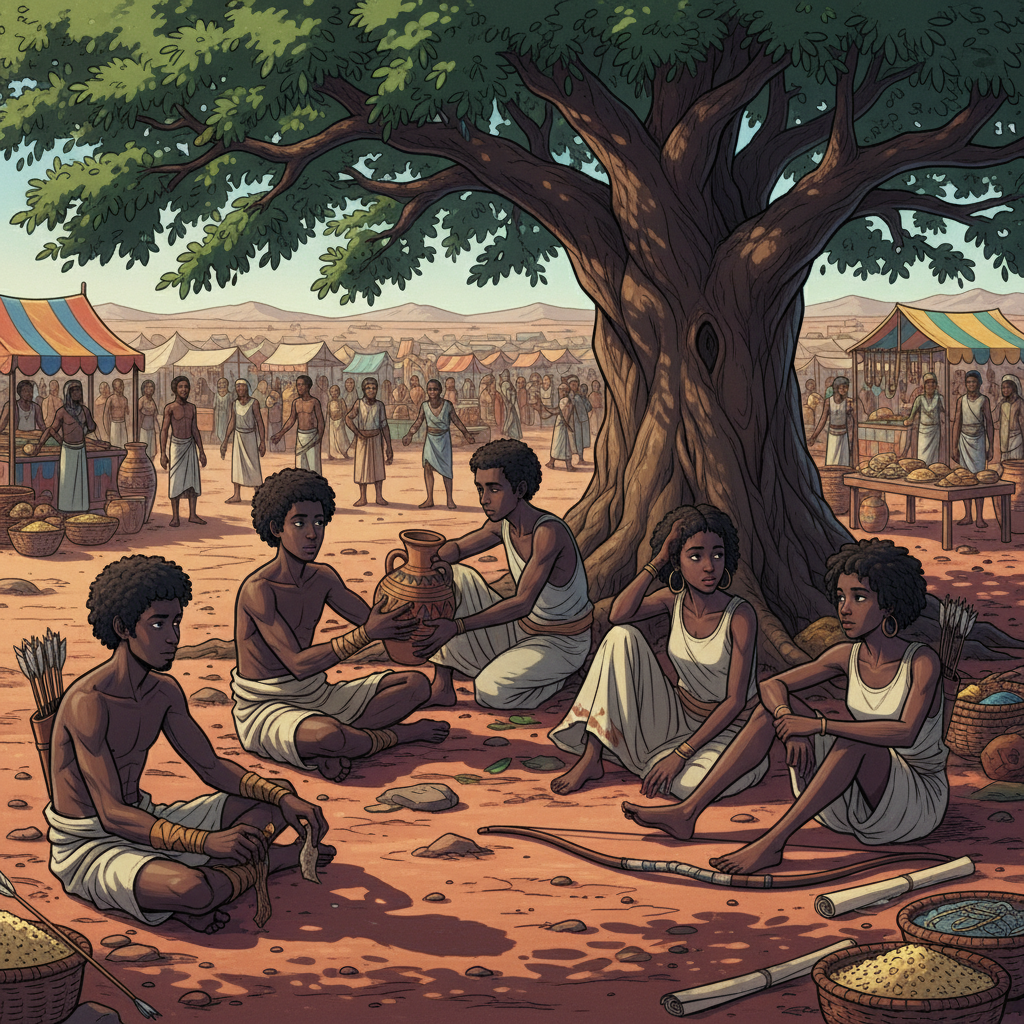
When the sun reached its peak and the heat pressed down like a heavy hand, Tabiry called a rest. The students sat in the shade of a tamarind tree, passing around a clay jar of cool water and eating dates and dried fish. From here, Shabaqa could see the great market of Kerma spread below them. Merchants with skin of every shade of brown and black called out their wares. He could see baskets of golden grain, piles of leopard skins, jars of sweet-smelling myrrh from the land of Punt. A trader from Kemet unrolled sheets of pale papyrus while a goldsmith displayed necklaces that caught the light like trapped pieces of the sun.
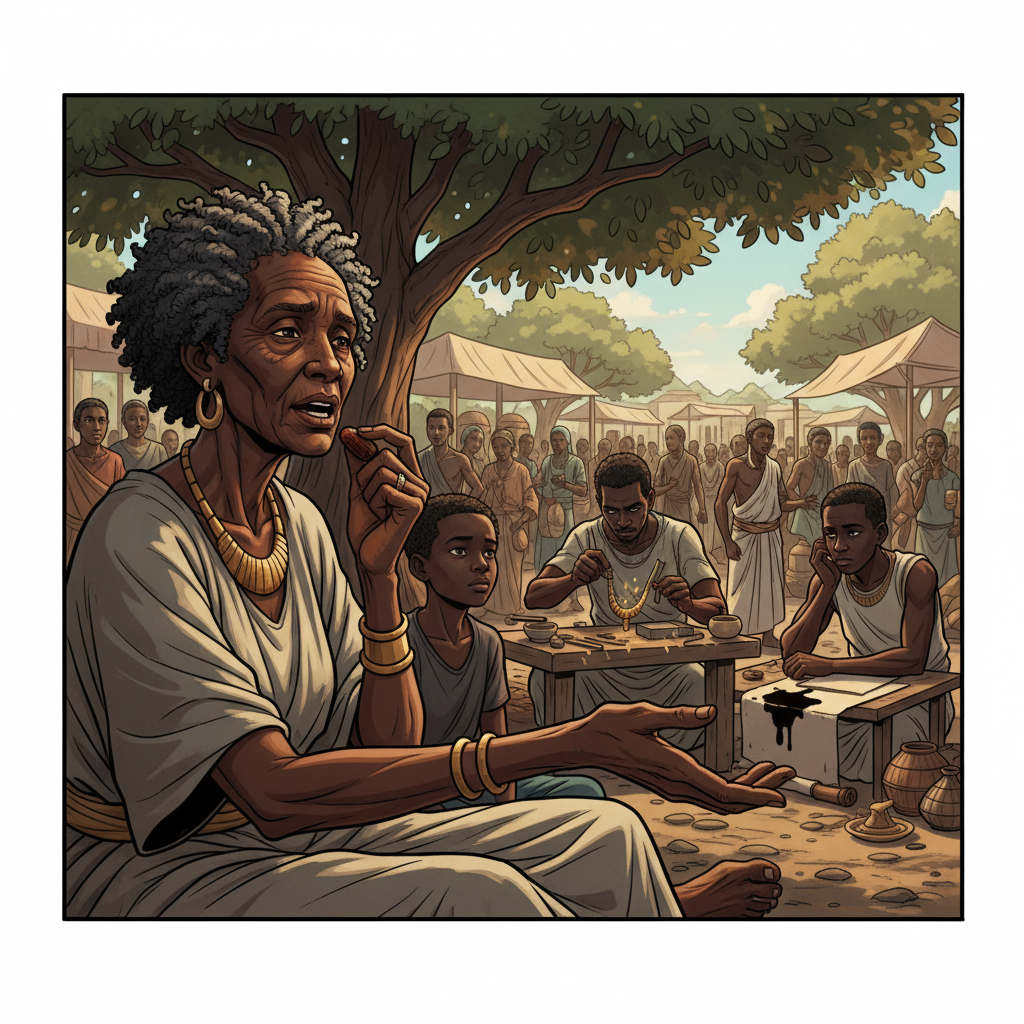
"Look at that market," Tabiry said, settling beside them with a groan of old joints. "Every trade requires the same thing the bow requires. The goldsmith who lets his hand shake ruins the necklace. The scribe in the Per Ankh who lets his mind wander blots the papyrus. The merchant who cannot focus will be cheated by every buyer." She bit into a date and chewed thoughtfully. "Discipline is not punishment. It is freedom. The disciplined mind can go anywhere and do anything. The undisciplined mind is a prisoner of every passing feeling — every fear, every anger, every hunger. Isfet is a cage. Maat is the key."
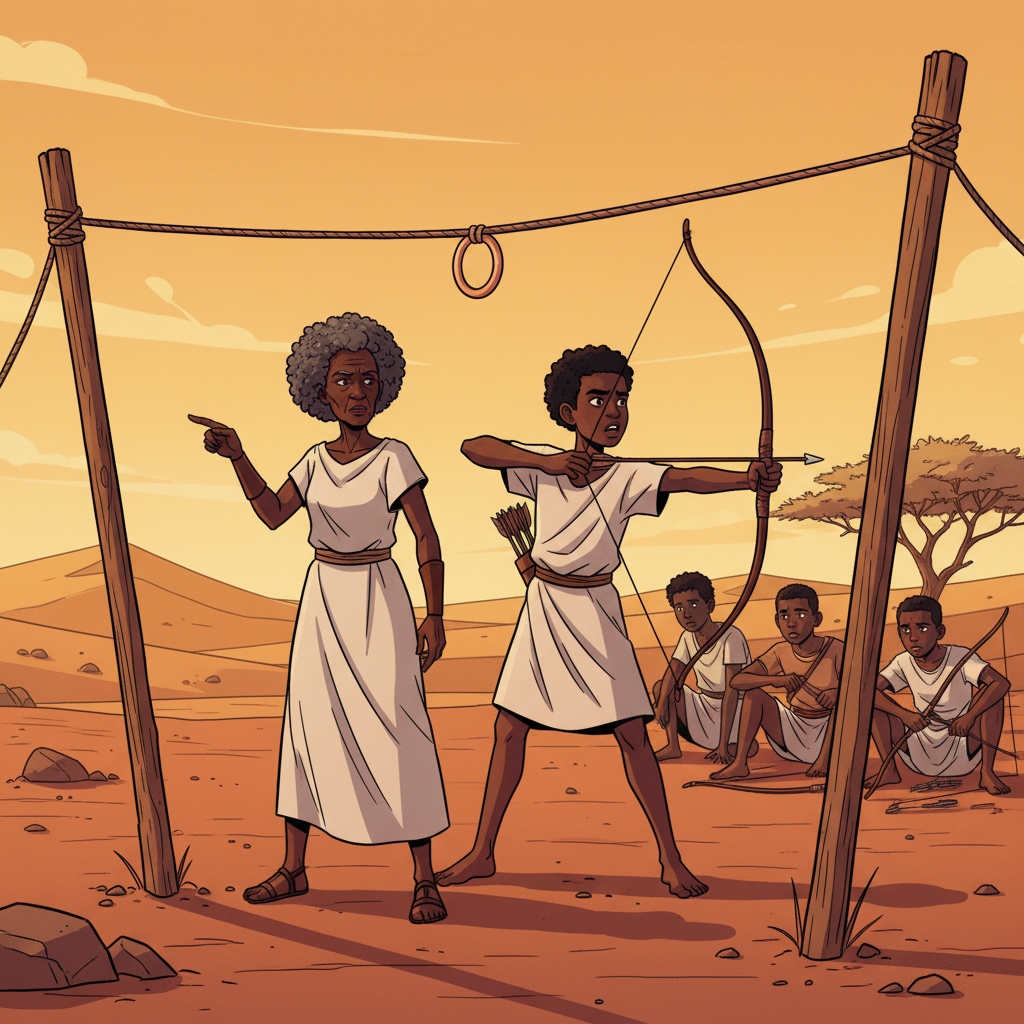
That afternoon, Tabiry set a final challenge. She hung a small copper ring from a rope between two poles, and the desert wind set it swaying gently. "Hit the center of the ring," she said simply. Several students tried and failed. The ring was small, the wind unpredictable, and their tired arms made aiming difficult. When Shabaqa's turn came, he felt the old fears rising — the fear of missing, of being laughed at again. But now he recognized them. He named them silently the way Tabiry had taught: there is fear, there is doubt. He did not fight them. He simply breathed and let them pass through him like wind through an open doorway. They were not him. They were only visitors.
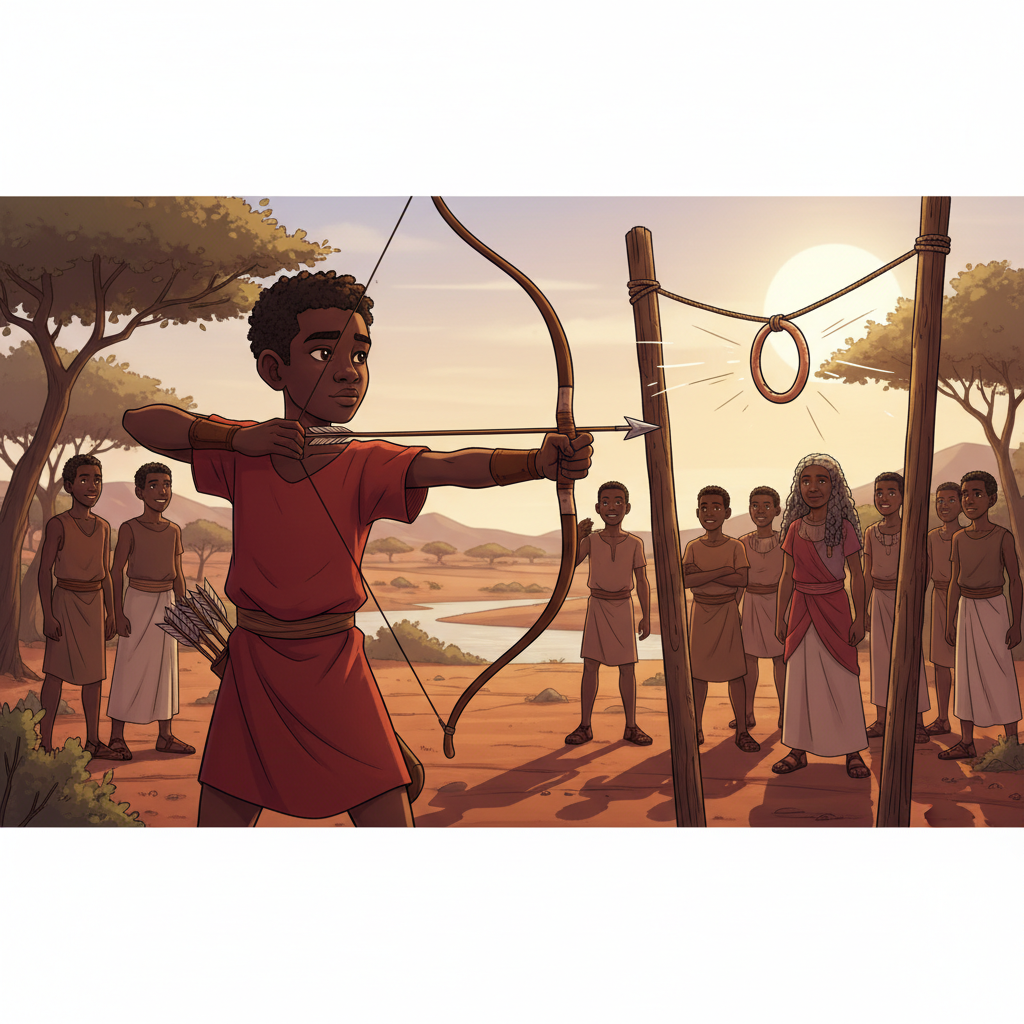
Shabaqa drew the bowstring to his cheek. He watched the copper ring sway — left, right, left. He felt the rhythm of it, the way it matched the rhythm of his own breathing. His Ka was quiet. His body was a steady pillar. He waited for the moment when the ring paused at the center of its swing, that one heartbeat of stillness. He released. The arrow passed cleanly through the ring with a bright sound like a struck bell. The other students erupted in cheers. Tabiry simply nodded, but her dark eyes shone. "Remember this feeling," she told him. "Not pride — that is isfet wearing a pleasant mask. Remember the stillness. Carry it with you always. That is the true treasure of Kush — not gold, not ivory, but the mastery of one's own Ka."