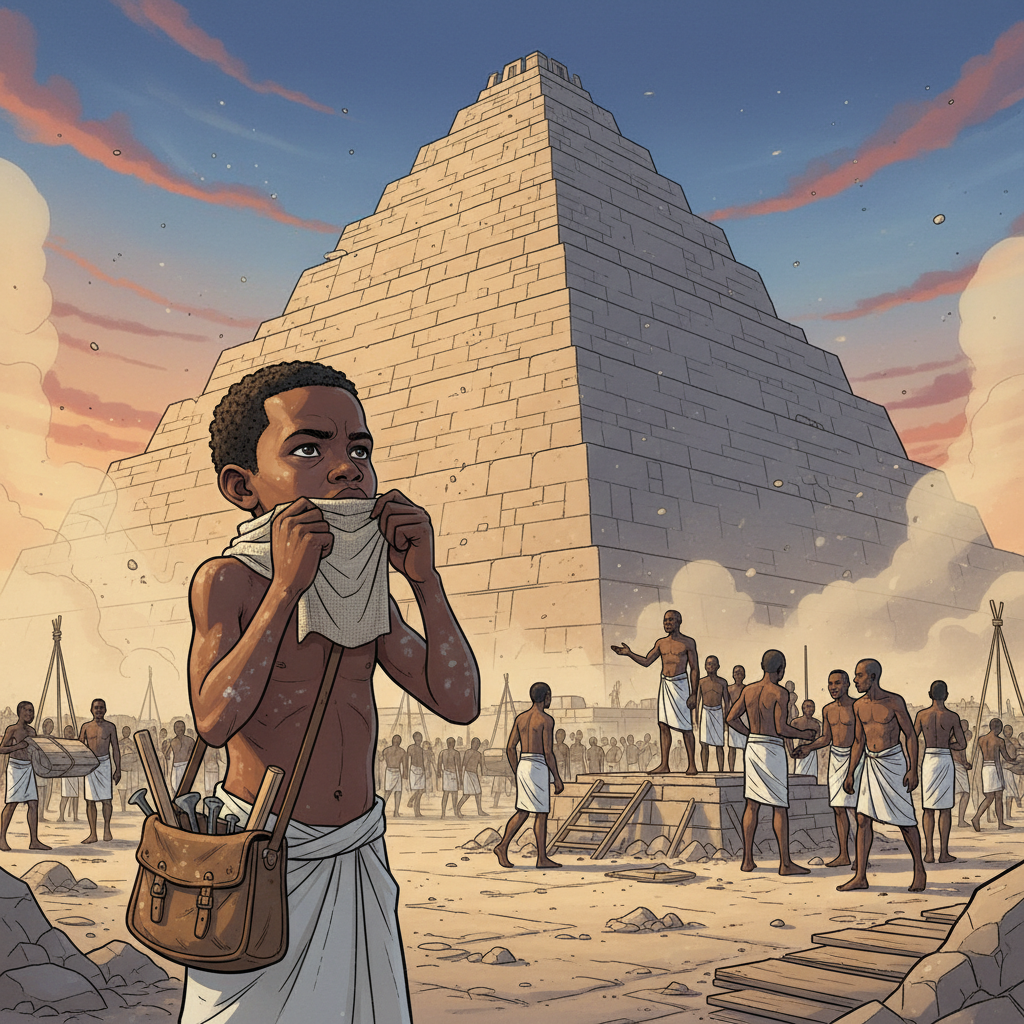
Mereruka pulled the cloth tighter over his mouth and squinted through the limestone dust at the rising mountain of stone. The Step Pyramid of Pharaoh Djoser climbed toward the morning sky in great staggered tiers, each one a wonder, each one a thing no person had ever attempted before. Six mastabas stacked one on top of another, rising higher than any building in all of Kemet — a staircase to the sky carved from the bones of the earth itself. Mereruka was twelve years old, the lowest apprentice on the entire Saqqara site, and his job was the smallest of all the jobs: to fetch tools for the architect when the architect needed them. He told himself this was an honor every morning, because every morning he had to remind himself. His warm earth-brown hands were already streaked white with stone-dust by sunrise. He carried the architect's leather satchel of measuring rods and copper chisels everywhere across the site, walking fast because the architect walked fast. The architect's name was Imhotep, and Mereruka had never heard anyone in all of Kemet speak that name without lowering their voice a little, the way they lowered their voices for the names of the neteru — the gods. Mereruka did not understand yet why. Imhotep wore the same simple linen as the other priests. He carried no whip and no sword. He walked the work-site in plain sandals, and yet when he raised one hand, hundreds of men stopped what they were doing and listened.
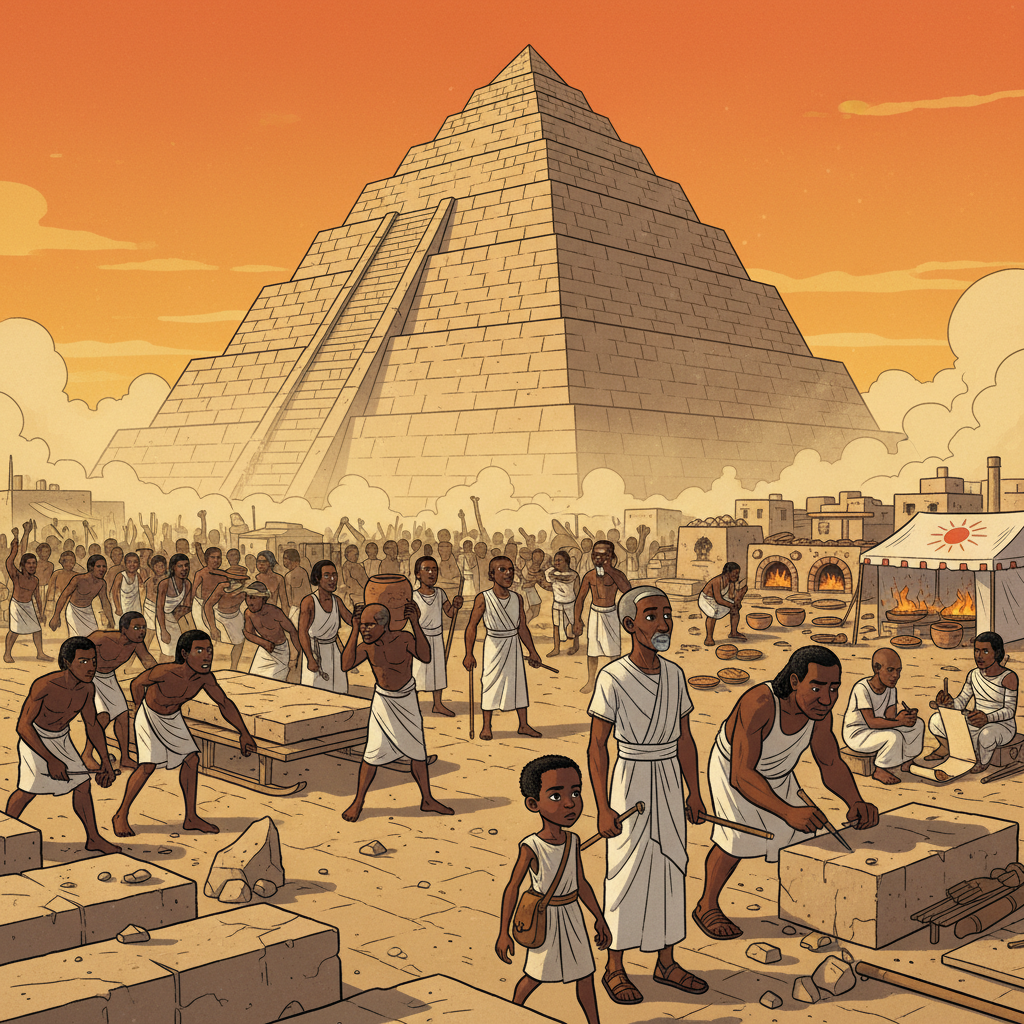
The Saqqara plain was loud from dawn until dusk. Mereruka had grown up in a quiet farming village south of Mennefer, where the loudest sounds were the morning cry of the ibis and the evening bray of his uncle's donkey. Here at the construction site, everything was hammers on chisels, ropes creaking under stone, foremen calling out commands, water-carriers shouting for room to pass. Twelve thousand men worked at Saqqara — quarrymen, mason-cutters, transport teams, ramp-builders, surveyors, priests, scribes who kept the daily count of blocks on long papyrus scrolls. There was a whole village built just for them, with bakeries that baked four thousand loaves of bread before dawn and a medical house where physicians treated crushed fingers and broken legs every single day. Mereruka's uncle, Senedjem, was a mason. It was Senedjem who had walked Mereruka the four days from their village to Saqqara six months ago, walked him into the apprentice-master's office at dawn, and said simply: "This boy watches everything. He misses nothing. He will not waste your time." The apprentice-master had looked Mereruka up and down — at his small wiry frame, his quiet eyes, his hands already calloused from helping his mother grind grain — and had nodded once. That nod was the only reason Mereruka was here now, walking three steps behind Imhotep with the leather satchel slung across his back.
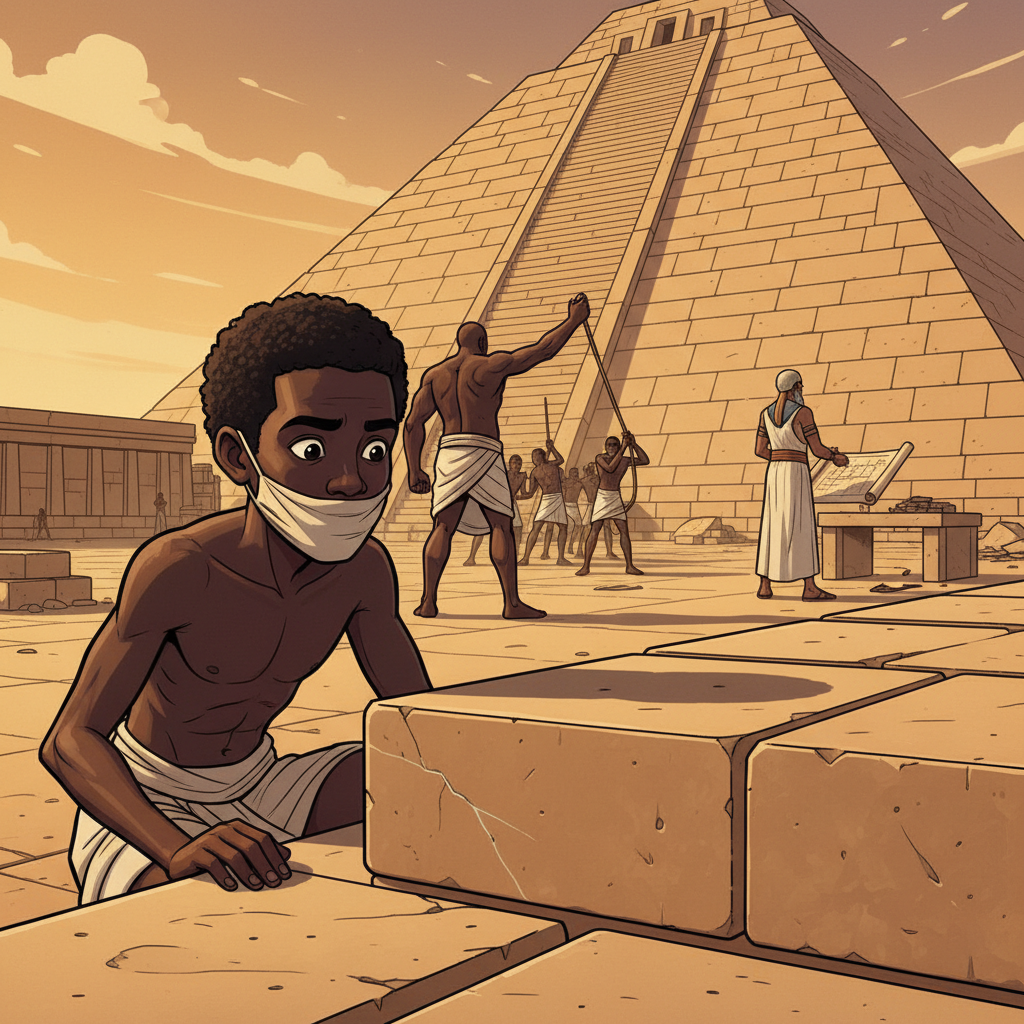
On the third morning of the third week of Mereruka's apprenticeship, he learned why people lowered their voices when they spoke Imhotep's name. He was crouched beside a fresh block of limestone at the southwest corner of the second mastaba, waiting for Imhotep to call for the long measuring rod. The block had just been hoisted into place by a transport team. The foreman — a thick-shouldered man named Bakenkhonsu — was about to give the signal for the mortar-pour. Imhotep was at the other side of the courtyard, examining a survey drawing. Mereruka was looking at the block. He was looking at it because there was nothing else to do, and because his uncle Senedjem had told him that looking at stone was how you learned to read it. And as he looked at the block, his eye caught something at the back of it, near the bottom, where it met the dressed surface of the block beneath. It was a hairline — finer than a hair, in fact. A pale silver-grey line running diagonally across the stone's back face. Mereruka had seen lines like this before, at the quarry south of Saqqara where his uncle had taken him to watch the cutters work. His uncle had pointed to a line just like this one and had said the word that Mereruka now remembered: kerakh — a crack along the grain. A weakness in the stone.
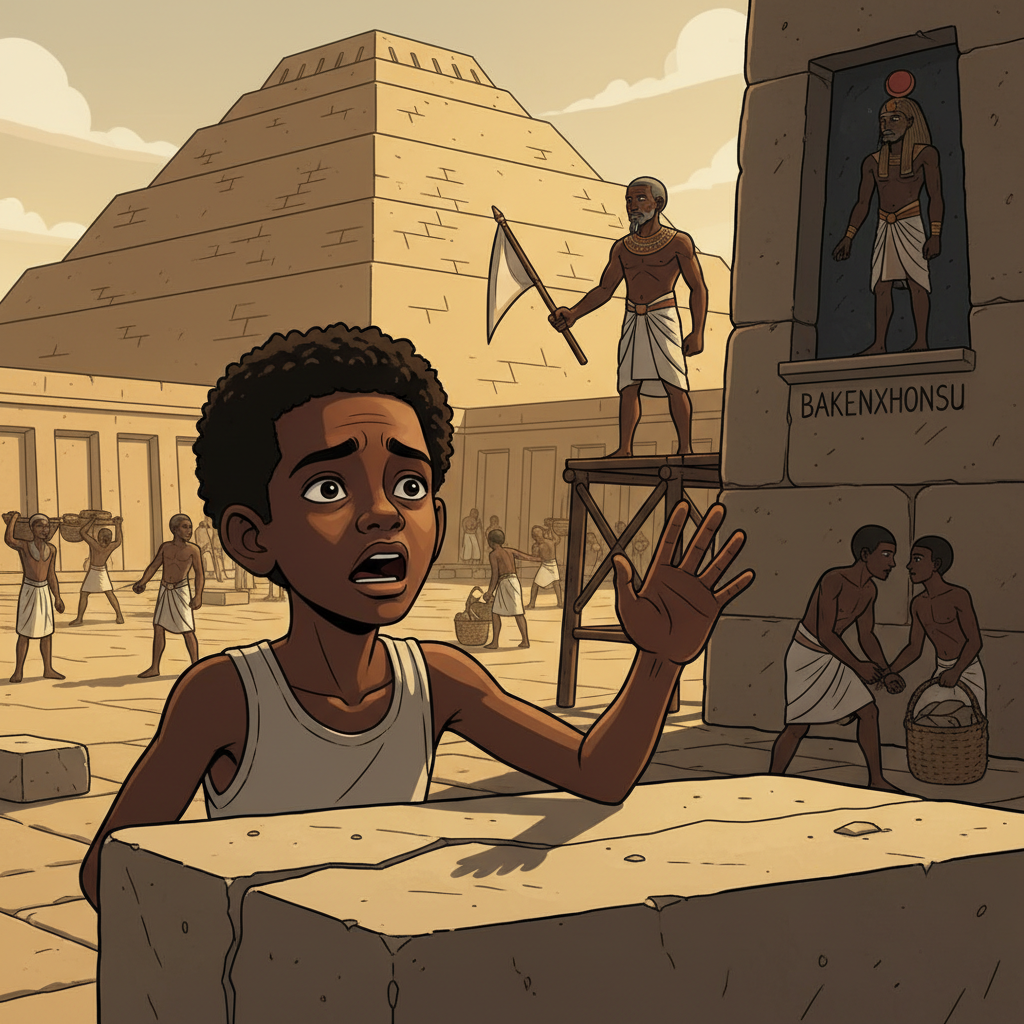
Mereruka opened his mouth to call out. He closed it again. He looked across the courtyard. The foreman who had cut and dressed this block was Bakenkhonsu — and Bakenkhonsu was not just any foreman. Bakenkhonsu was Mereruka's uncle's OWN uncle. Mereruka's great-uncle. The man whose name was carved on the family ancestor-shrine in the village. The man whose generosity had paid for Mereruka's mother's wedding linen. The man who, if Mereruka spoke now, would be publicly shamed in front of the entire southern courtyard — would be marked as a foreman who had let a flawed block leave his quarry — and Mereruka's whole family would carry the shame for a generation. His mouth was open. His hand was raised halfway. The foreman lifted the signal-flag for the mortar-pour. Mereruka's heart was a small hard thing inside his chest. He could not speak. He could not NOT speak. He stood there, frozen, with his hand half-raised and his mouth half-open and his eyes on the silver-grey line running across the back of the stone, and he understood for the first time in his life that being a person of Maat sometimes meant standing at the exact place where two right things were trying to be each other's enemies.
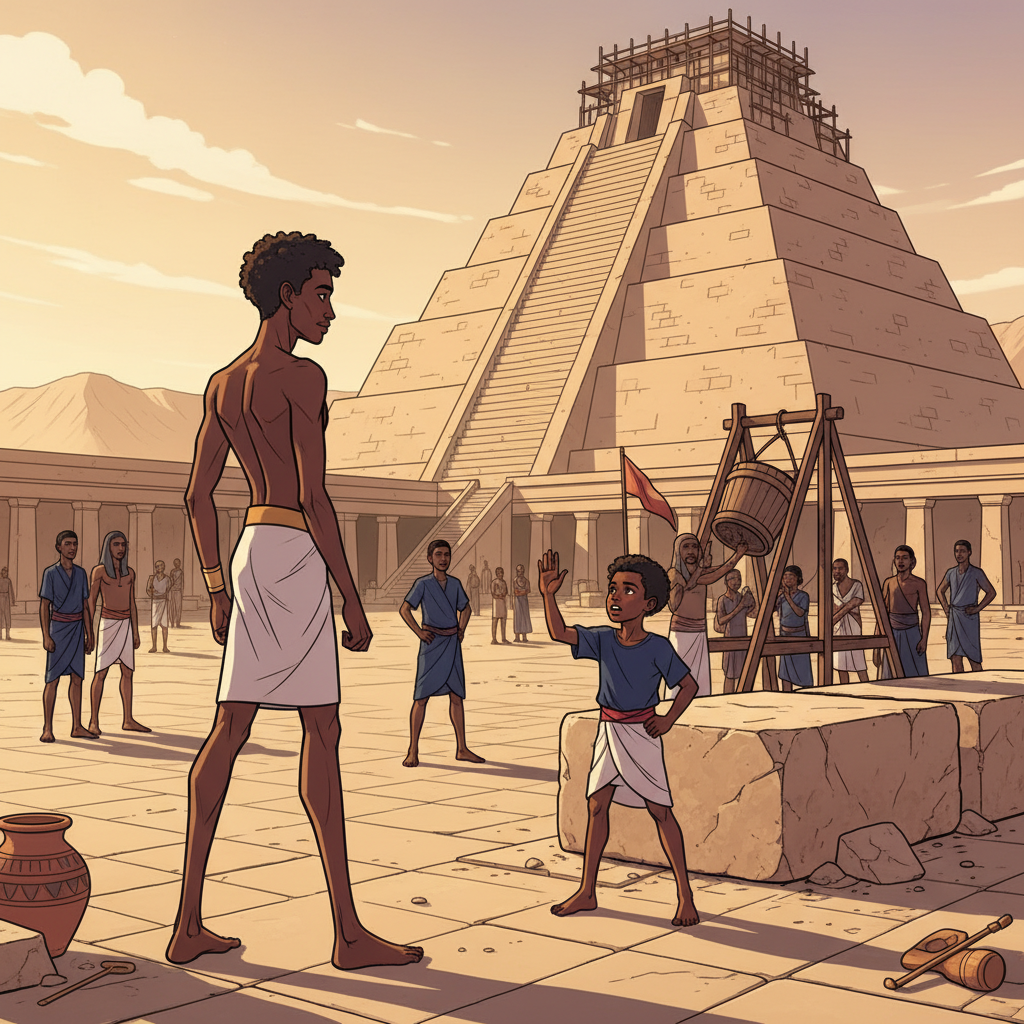
Imhotep saw him. Mereruka did not know how. The architect had been on the other side of the courtyard, bent over a survey drawing with two scribes, his back to the southwest corner. But somehow, in the same heartbeat that Mereruka froze, Imhotep's head turned. The architect looked across the courtyard. He looked at Mereruka's raised hand. He looked at Mereruka's open mouth. He looked at the block. And then, without raising his voice, without calling out to the foreman, without making a single gesture that anyone else on the site would have noticed, Imhotep set down the survey drawing and began to walk slowly across the courtyard toward Mereruka. He did not walk fast. He did not walk with the urgency of a man who has seen a problem. He walked the way Mereruka's mother walked when she was approaching a young goat that might startle and bolt — slowly, patiently, with his eyes soft. Bakenkhonsu was about to lower the signal-flag. The transport team was lifting the long wooden pole that would tip the mortar-bucket. Imhotep reached Mereruka. He did not stop standing. He crouched. He brought his face down to Mereruka's eye level. He was tall, and Mereruka was small, and the crouching was so deep that Imhotep's knees nearly touched the ground. And he said, very softly: "What did you see?"
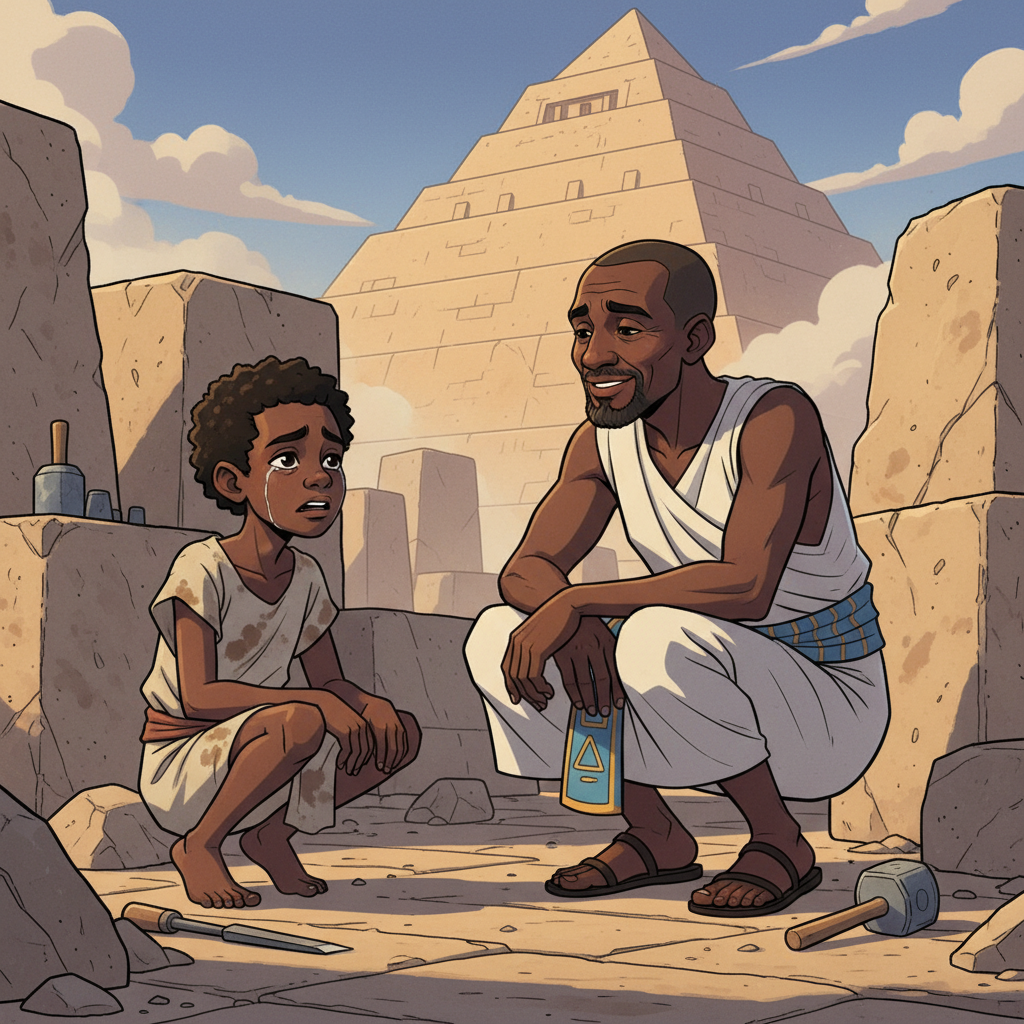
Mereruka could not say the words. His throat had closed around the name Bakenkhonsu. His mouth tried to shape sounds and failed. He looked at Imhotep, and his eyes filled, and he was sure he was going to cry in front of the architect of the Step Pyramid, the second-most-important man in all of Kemet after the pharaoh himself, the man whose name people lowered their voices to speak. He was going to cry and he was going to fail and the apprenticeship was going to end and his uncle Senedjem was going to walk him back to the village in disgrace. Imhotep did not ask him again. Imhotep, crouched at his eye level, did the most unexpected thing in Mereruka's entire twelve years of life. He smiled. It was a small smile, barely the corners of his mouth lifting, but it was a real smile, warm and patient and entirely without judgment. And then Imhotep said something that Mereruka would remember every single day for the rest of his life. He said: "You do not have to say it. Just point."
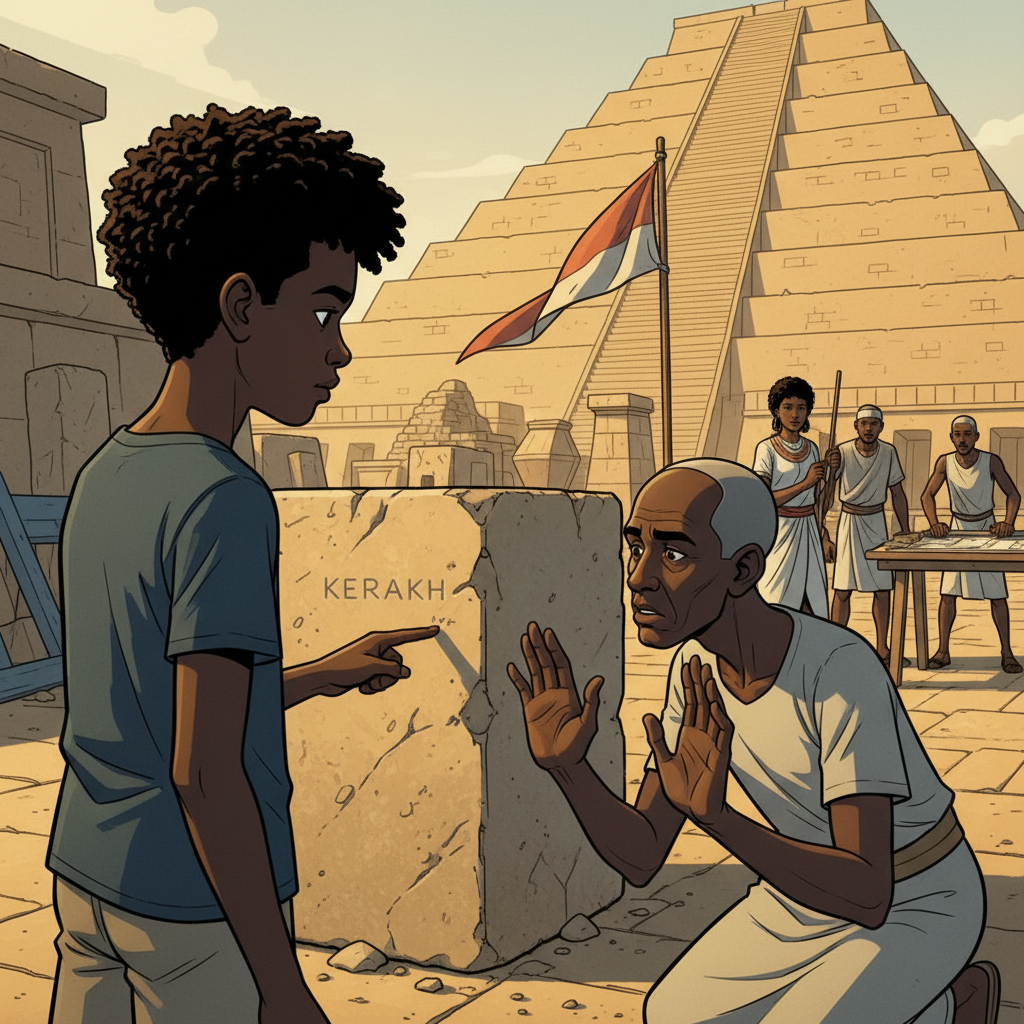
Mereruka pointed. His hand was shaking, but he pointed — at the back of the block, at the silver-grey line, at the kerakh his uncle had taught him to see. Imhotep followed the point. He leaned forward, on his knees, and brought his own face very close to the back of the stone. He looked at it for a long moment. He did not speak. The signal-flag was still half-raised. Bakenkhonsu was watching now, from across the courtyard, and so was the transport team, and so were the two scribes Imhotep had left at the survey drawing. The whole courtyard had become quiet. Imhotep stood up. He turned to the foreman. He raised one hand — not in a sharp gesture, not in an angry gesture, but in the simple flat-palmed signal that meant "hold." Bakenkhonsu held. The mortar-pour did not happen. Imhotep called over the senior mason from the next courtyard, a woman named Hetepheres, and she came at a fast walk with her measuring rod in her hand. Imhotep pointed to the back of the stone, the same way Mereruka had pointed. Hetepheres looked. Hetepheres put her thumbnail against the line. Hetepheres said one word: "Yes." The block was rejected. A new block was ordered up from the quarry. The morning's work shifted to a different course of stones. And nobody — nobody — said the name Bakenkhonsu.
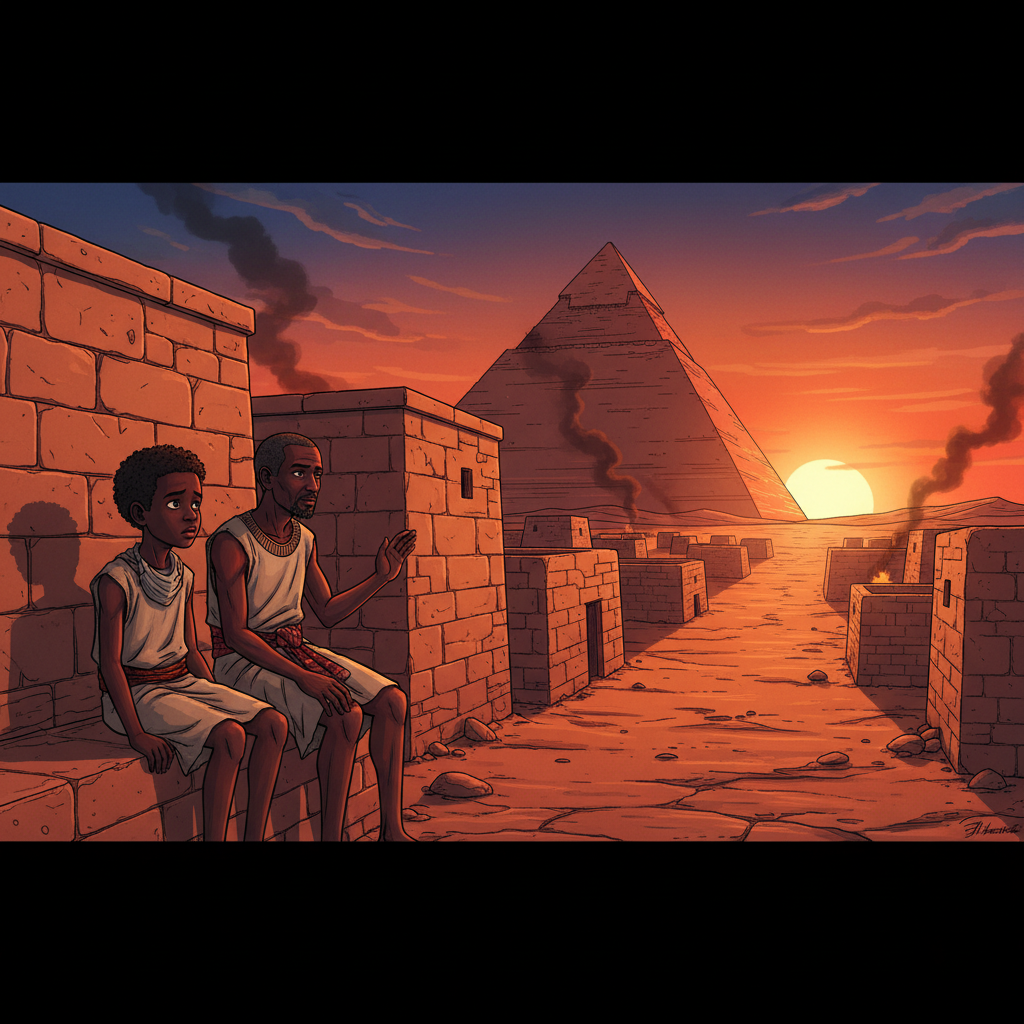
That evening, Mereruka sat on a low wall at the edge of the workers' village and watched the western sun set fire to the limestone face of the half-built pyramid. He had been sure all day that something terrible was going to happen. Bakenkhonsu was going to come and find him. The apprentice-master was going to summon him. Imhotep was going to send for him and explain that this kind of thing — this near-disaster, this almost-mistake — could not be allowed again. But the day had passed. The work had gone on. No one had come. And as the sun dropped lower and the desert turned the color of poured copper, Mereruka's uncle Senedjem appeared from between two mudbrick houses and sat down on the wall beside him. "You did a thing today," Senedjem said. He was not looking at Mereruka. He was looking out across the desert too. "You saw a kerakh. You knew whose name was carved into the back of that stone. And you did the right thing." Mereruka did not know what to say. He had not done the right thing, exactly. He had not spoken. He had only pointed. He started to say so, but Senedjem held up a hand. "I know," his uncle said. "I heard. You pointed. The architect asked you, and you pointed. That is not less. In our family, that is more. Bakenkhonsu came to me at midday. He thanked me. He thanked me for raising a boy who would point even when he could not speak."
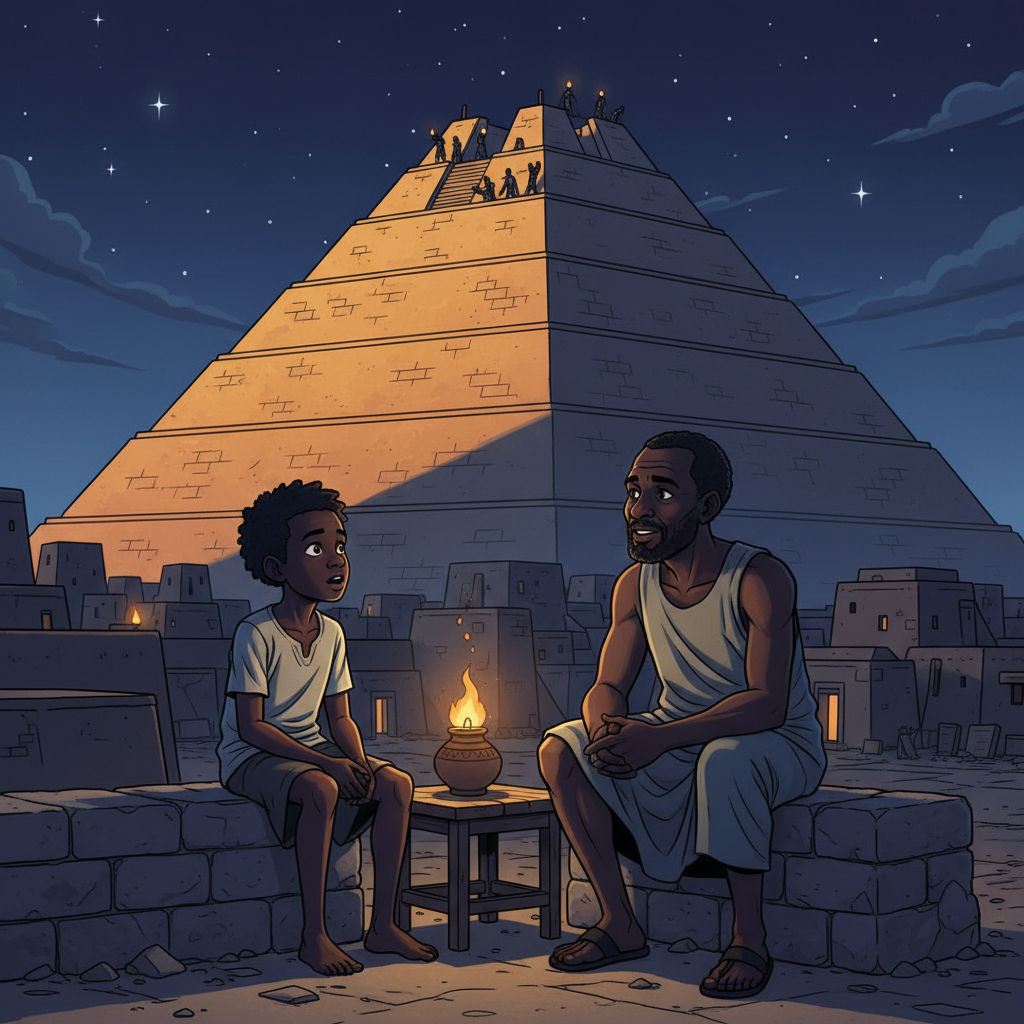
Mereruka stared at his uncle. "He thanked you?" Senedjem nodded slowly. "He thanked me. Because if that block had been set, and the course above it had been laid, and the pyramid had risen another six courses, and then the crack had finally opened under the weight — twelve men working at the top would have died. Bakenkhonsu would have spent the rest of his life knowing that his block killed twelve men. Today, instead, he has been given the chance to inspect every block he ever dressed at that quarry. He has been given the chance to fix his work before anyone dies. You did not shame him, Mereruka. You saved him." Mereruka thought about this for a long time. The sun was almost gone now. The first stars were appearing in the eastern sky over the new pyramid. He thought about Imhotep's smile. He thought about the way Imhotep had not asked him to speak. He thought about how, if Imhotep had asked him to speak the name Bakenkhonsu out loud in front of the whole courtyard, he would have done it — because the truth needed to come out — but it would have been the wrong kind of truth. It would have been the truth that humiliated. The pointing had been the truth that protected.
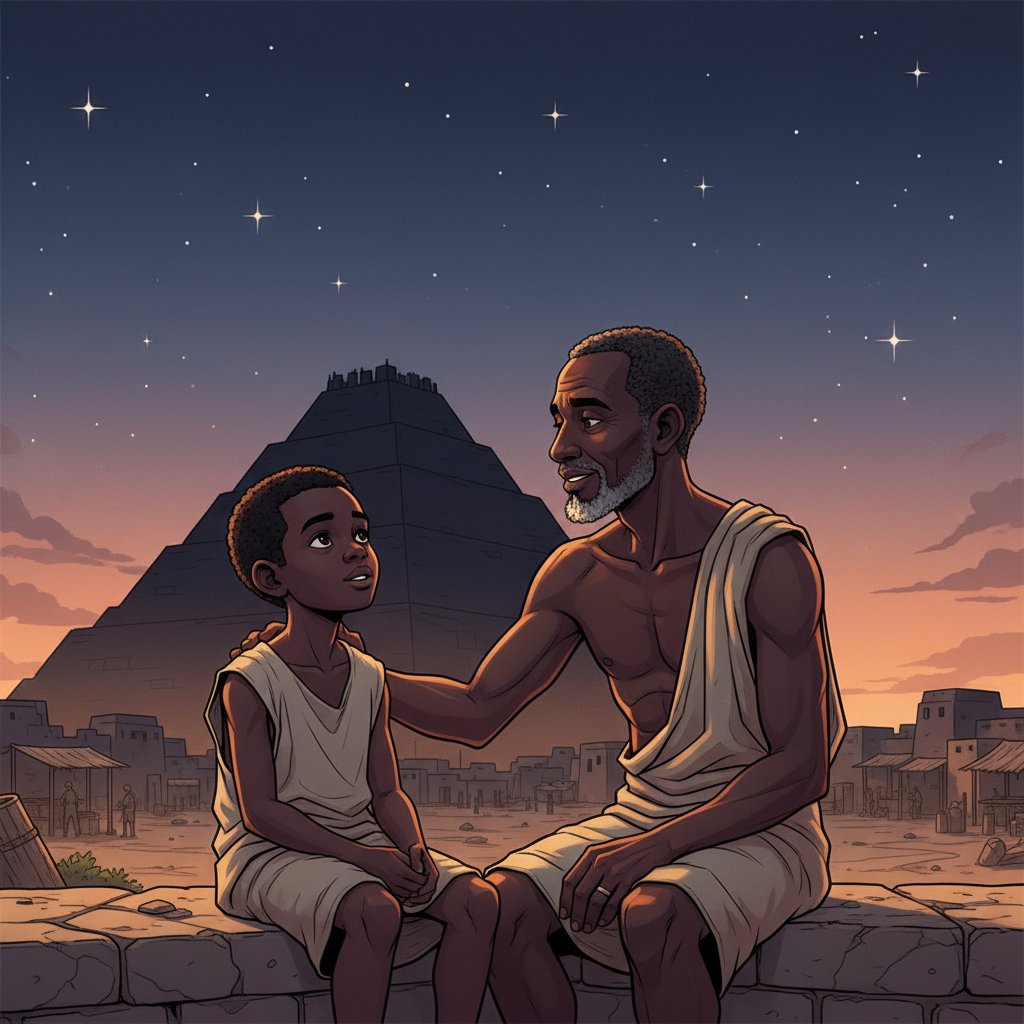
"What is the word for that?" Mereruka asked his uncle. "For the kind of truth that does not humiliate?" Senedjem turned his head slowly and looked at his nephew. The last sunlight caught the silver in his beard. "The priests have a word for it," Senedjem said. "They call it propriety. Right action at the right moment, in the right way. The truth is not less true when it is spoken with care. The truth is MORE true when it is spoken with care — because then the truth can be heard. A truth spoken to humiliate becomes a kind of lie about itself. Imhotep knows this. That is why people lower their voices when they say his name. Not because he is powerful. Because he is wise." Mereruka watched the stars come out. He watched the new pyramid become a black silhouette against the deepening blue of the sky. He thought about how the apprentice-master had nodded at him six months ago and had let him in. He thought about how his uncle had walked him four days to bring him here. He thought about how Imhotep — the second-most-important man in Kemet — had crouched down to his eye level and had not made him speak the name. He understood, for the first time, that he was being taught not just how to be a builder. He was being taught how to be a person of Maat.
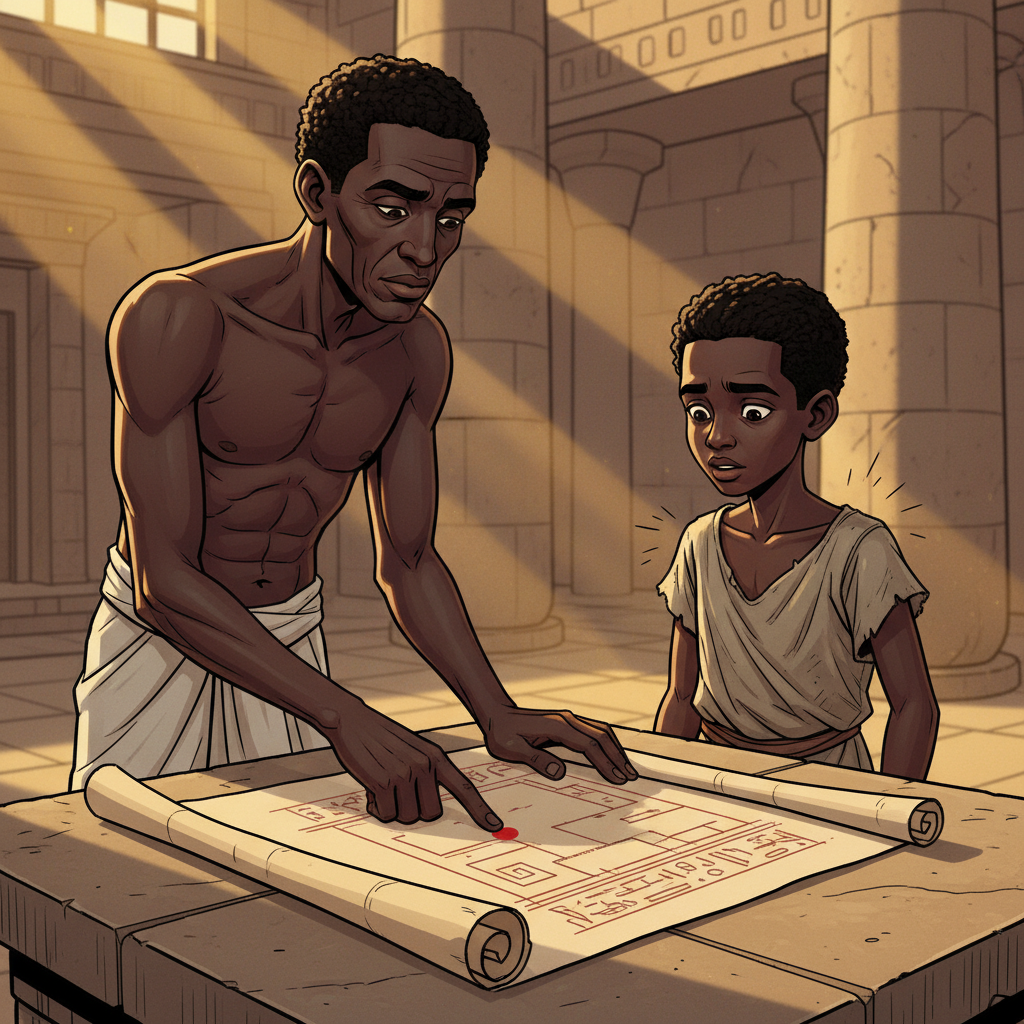
The next morning, Imhotep summoned Mereruka to the survey courtyard. Mereruka walked there with his heart pounding again, but this time the pounding was different. It was not fear. It was something larger and quieter — the way the heart pounds when something important is about to happen. The architect was waiting for him beside the great surveyor's table, the polished stone slab where all the day's measurements were drawn out in red and black ink. Imhotep was alone. The scribes were elsewhere. The morning sun came in through the high windows and fell in golden bars across the surveyor's table. "Mereruka," Imhotep said. He did not greet the boy as a child. He greeted him as a fellow worker. "Sit down. I want you to look at something." He unrolled a fresh papyrus across the table. The drawing on the papyrus was the southwest corner of the second mastaba — the corner where the cracked block had nearly been set. Imhotep had marked the corner with a small red dot. "This is the corner you saved," he said. "I have drawn the dot so the scribes who keep the day-book will record your name beside it. The pyramid will stand for a thousand years. The scroll will say that on the seventeenth day of the third month of the inundation, the boy Mereruka of the southern village pointed to a kerakh and twelve men did not die."
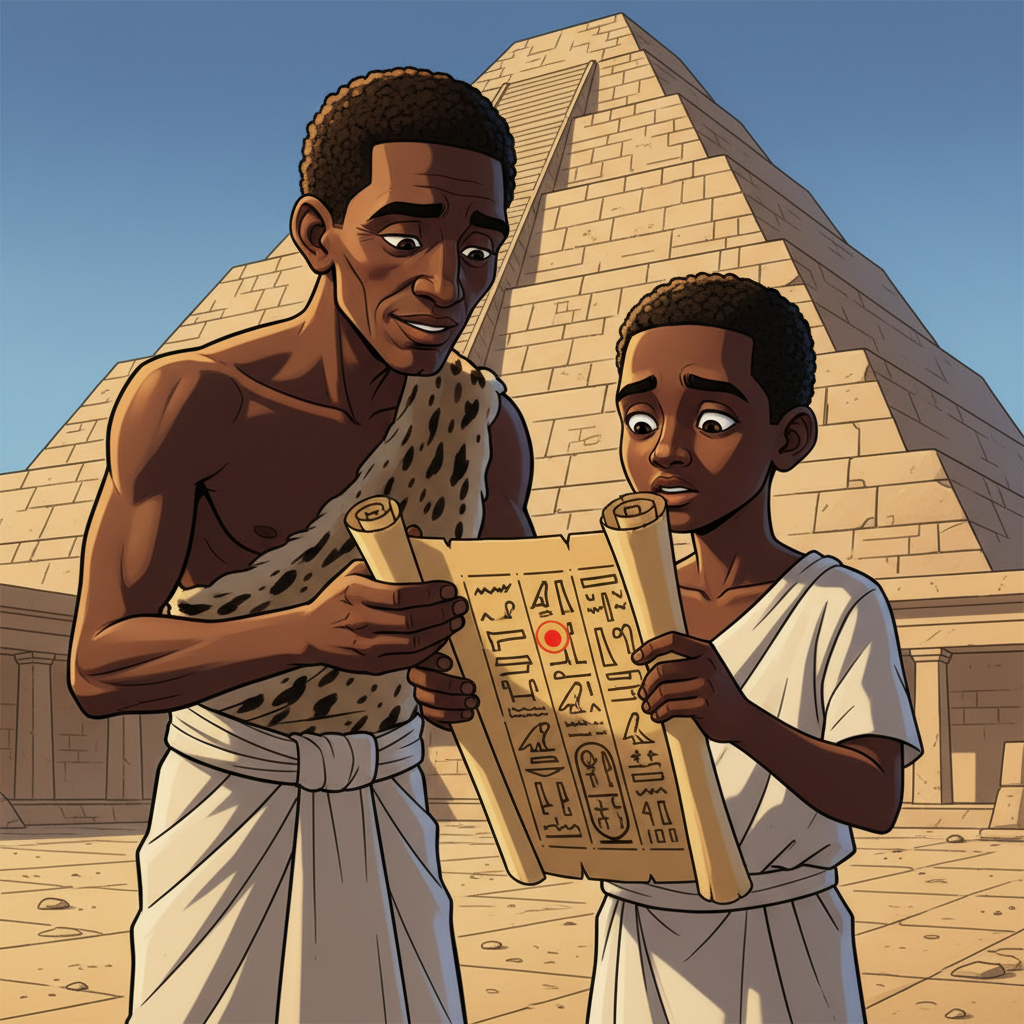
Mereruka did not know what to say. He looked at the papyrus. He looked at the small red dot. He looked up at Imhotep. The architect was watching him with that same patient face he had used in the courtyard, the same face he had used when he had not made the boy speak the foreman's name. "But I did not speak," Mereruka said. "I only pointed." Imhotep was quiet for a moment. Then he said, very gently: "I know. That is why the pointing matters. You knew that to say the name would shame your family. You knew that to stay silent would kill twelve men. You found the third way. That is the work of a builder, Mereruka. To find the third way when the first two ways are both wrong." Mereruka thought about this. He had not known there was such a thing as a third way. He had thought there was only the way of speaking and the way of staying silent. But the pointing — the small, quiet act of raising a finger toward the back of a stone — had been a way that neither of the others could have been. It had been a way that the architect could see and the foreman could not, in the moment when seeing was what mattered. It had been a way that protected everyone, including the foreman who had made the mistake.
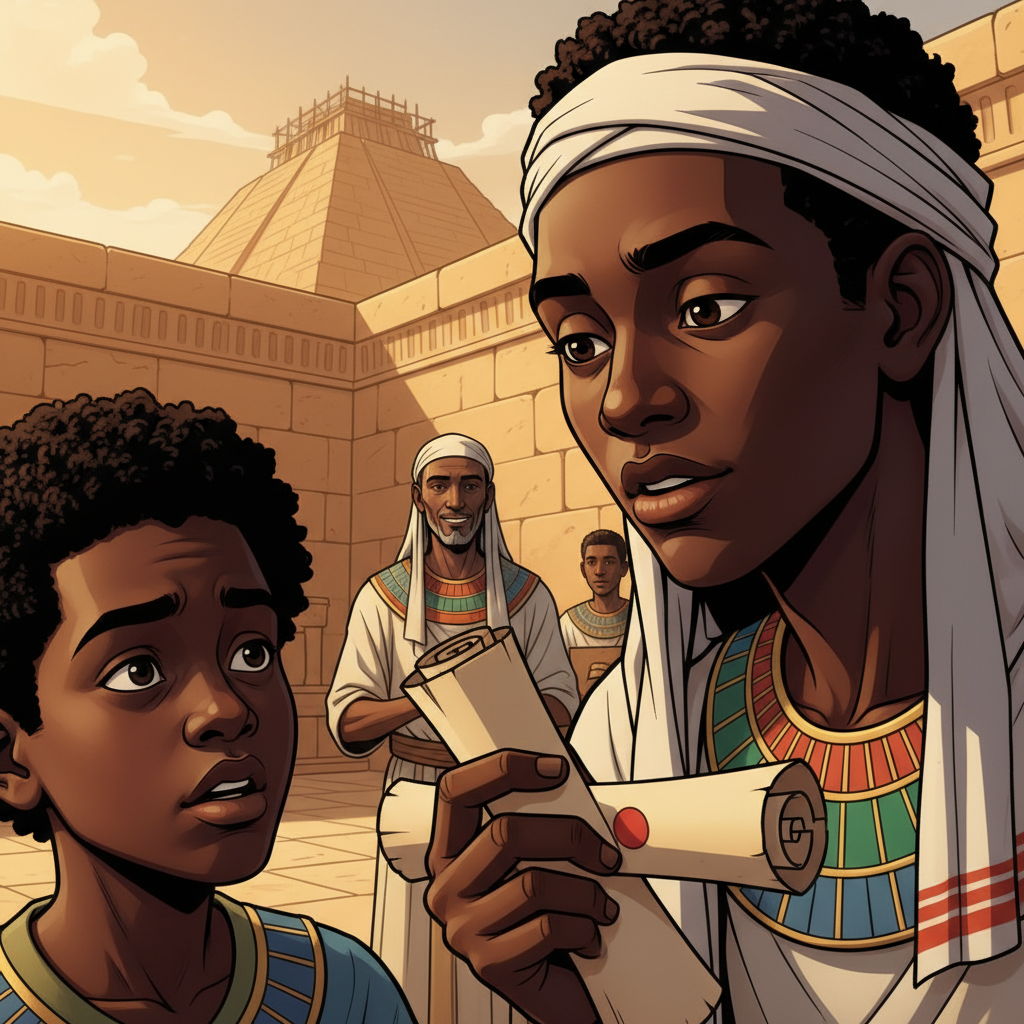
"Will you teach me how to find more third ways?" Mereruka asked. He was surprised to hear himself say it. Imhotep almost laughed — Mereruka could see the laugh in the corner of his mouth — but he did not. He just nodded slowly. "Yes," he said. "If you are willing to learn. The third way is the hardest thing I will teach you. The mathematics of pyramid-building can be put on a papyrus scroll. The angles of the seked can be calculated with a measuring rod. But the third way cannot be drawn. It cannot be measured. It can only be practiced, one moment at a time, for as long as you live. Are you willing?" Mereruka nodded. He was willing. Imhotep stood. He rolled up the papyrus with the small red dot and handed it to one of the scribes who had just returned from across the courtyard. "Add this to the day-book," he told the scribe. "And the boy's name beside the dot." The scribe — a young man named Inhapy who Mereruka knew slightly from the bakery line — bowed and took the papyrus. Inhapy looked at Mereruka with new eyes. Mereruka felt the gaze and did not know what to do with it. He had never been looked at by an adult like that before. Imhotep saw the look too, and he smiled his small smile again.
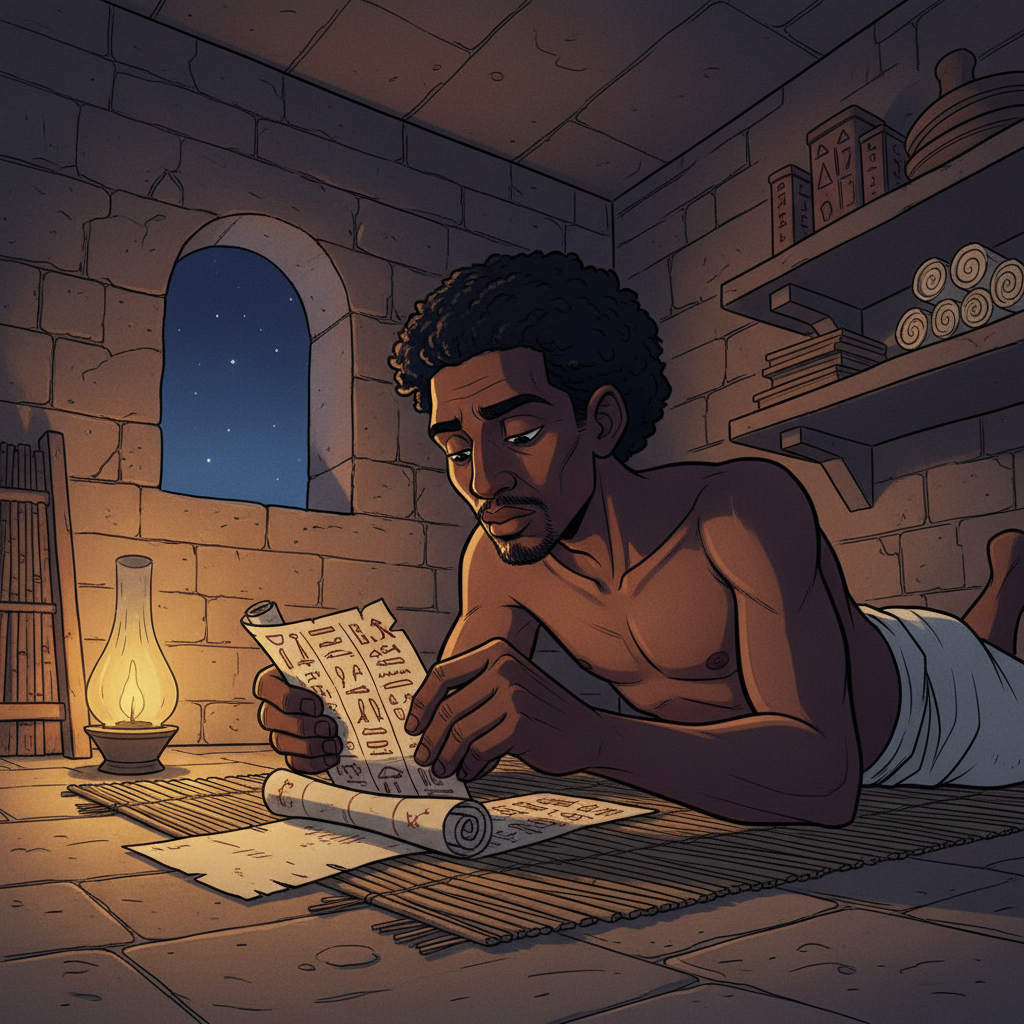
Three years passed. Mereruka grew taller. His hands grew stronger. His voice changed, and the first beard-shadow appeared on his upper lip. He learned to calculate the seked of a pyramid face, the way the slope of stone rose for every horizontal cubit of base. He learned to read the cardinal stars at night and to set a foundation true to the four directions. He learned the difference between limestone from the Tura quarry and limestone from the Saqqara quarry — the Tura was harder, finer, suitable for the casing stones that would face the pyramid; the Saqqara was good enough for the core. He learned the names of all the master masons and all the senior scribes and all the foremen of all the courtyards. And he learned, one moment at a time, what Imhotep had said was the hardest thing — the third way. The third way looked different every time it was needed. Sometimes it was a question asked at the right moment, instead of an answer given. Sometimes it was a deliberate silence that gave another person room to correct themselves before being corrected. Sometimes it was a small piece of paper passed quietly from one hand to another. Sometimes it was a meal shared with a worker who had made a mistake, so that the mistake could be talked about in a place where no shame would attach. Mereruka kept a list of every third way he saw Imhotep use. By the time he was fifteen, the list filled a small papyrus scroll. He kept the scroll under his sleeping mat.
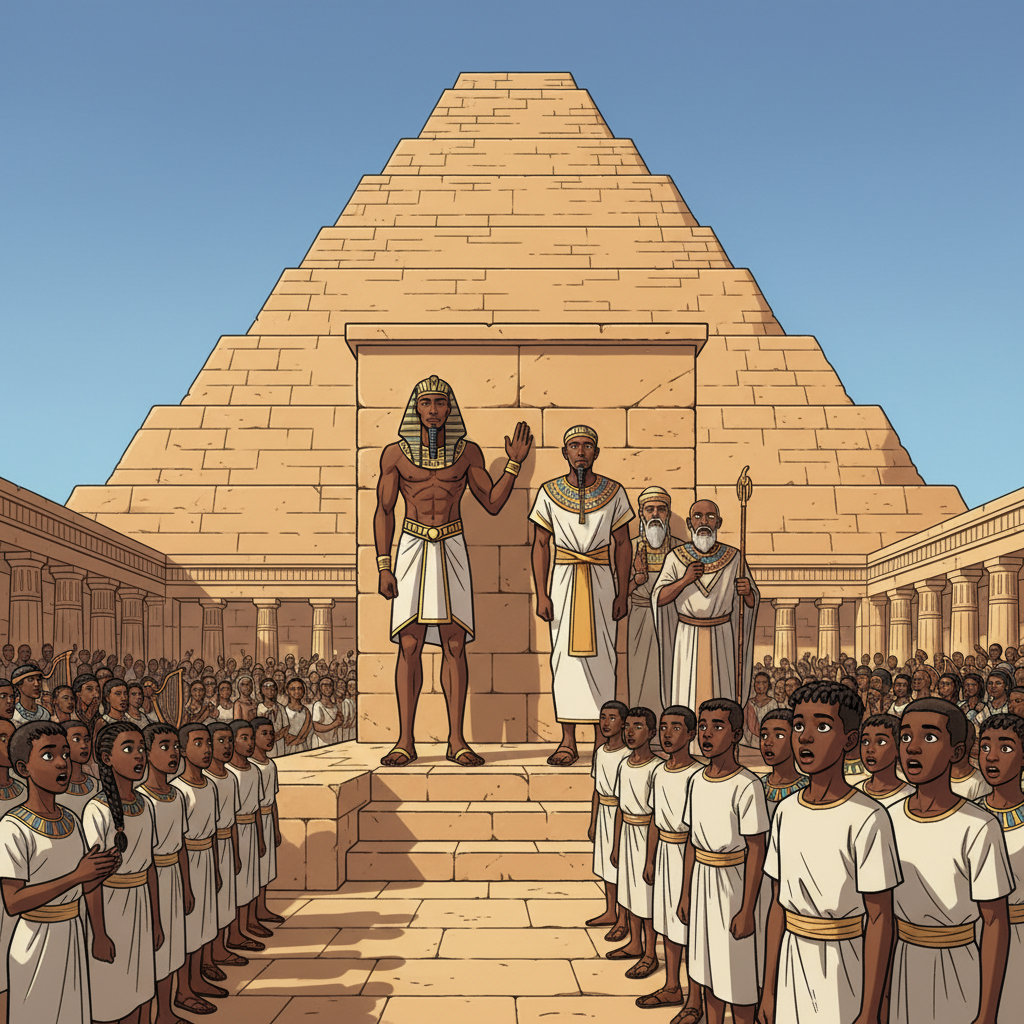
The Step Pyramid was completed in the second year of Mereruka's apprenticeship. The whole of Kemet celebrated. Pharaoh Djoser came in person to consecrate the structure, walking in slow procession through the great enclosure with all of his priests and all of his nobles and a thousand musicians and a thousand dancers. Mereruka, now thirteen, stood in the rank of the architect's apprentices and watched the pharaoh place his hand on the eastern face of the pyramid. He watched Imhotep step forward and bow — not deeply, the way a slave bows, but with the dignity of an equal, the way a vizier bows. And then Pharaoh Djoser did something extraordinary. He turned to Imhotep and bowed back. Mereruka had never heard of a pharaoh bowing to a man. The crowd around him gasped, very quietly. The priests glanced at each other. And then the pharaoh straightened, and he said in a voice that carried across the whole enclosure: "Imhotep has built me a staircase to the sky. But more than that — Imhotep has shown the people of Kemet what a man of knowledge can do. From this day, when my scribes record the great works of my reign, the name of Imhotep will be recorded BESIDE my name. Not below. Beside. Let the gods judge whether I am worthy of standing next to him."
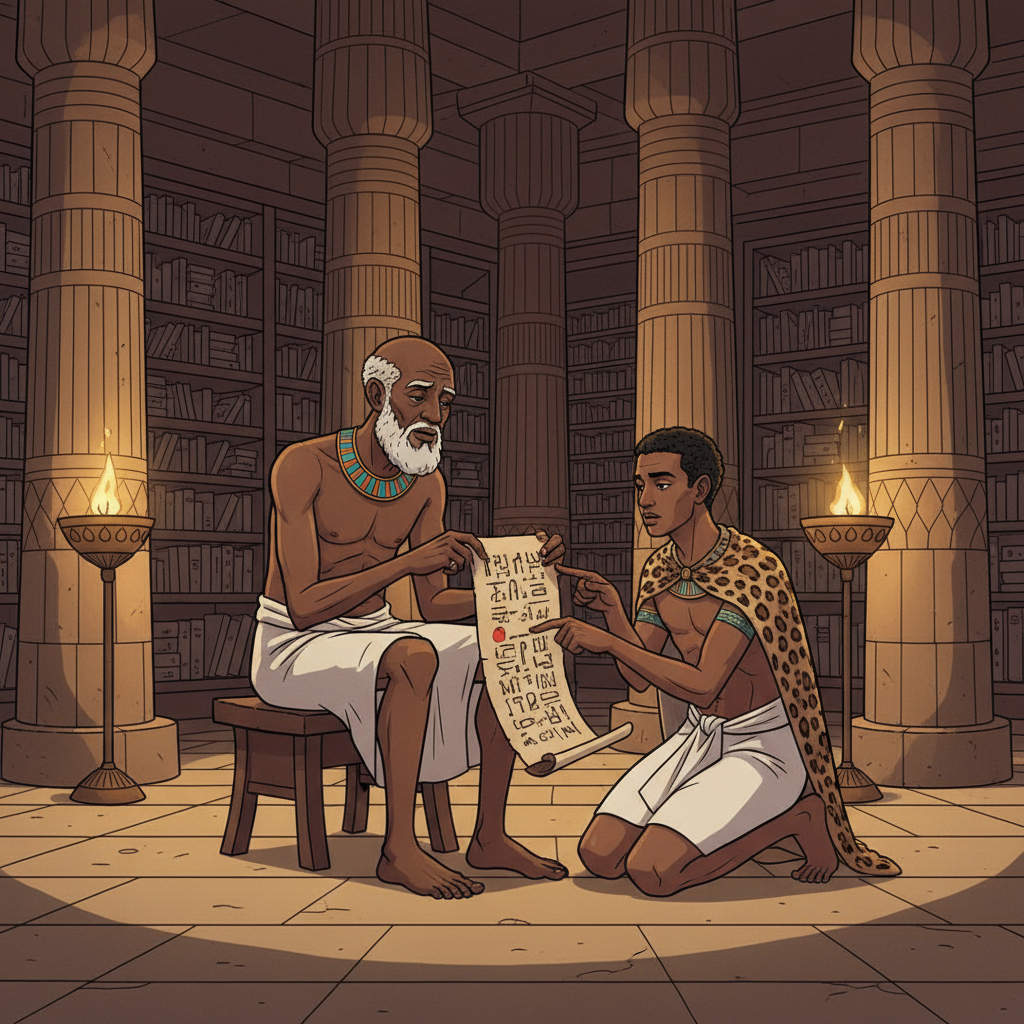
Years later, after Pharaoh Djoser had been laid to rest in the chamber beneath the pyramid, after Imhotep had grown old and gone to the Field of Reeds, after Mereruka himself had become a master architect and was training his own apprentices in the southern courtyards, a young scribe came to the workshop one afternoon with an old papyrus scroll. The scribe was working on a temple history. He had found a record in the day-book of the Saqqara construction site, dated the seventeenth day of the third month of the inundation in the second year of Pharaoh Djoser. The record was a single sentence, in faded ink, beside a small red dot: "The boy Mereruka of the southern village pointed to a kerakh and twelve men did not die." "Is this you?" the scribe asked. Mereruka was an old man now. His beard was white. His hands were knobbled with the work of forty years of stone. He looked at the small red dot. He looked at his own name in the faded ink. He thought of the cracked block, and of Bakenkhonsu, and of his uncle Senedjem who was long dead, and of Imhotep crouched at his eye level on a morning fifty years before. "Yes," Mereruka said. "That is me. And that morning was the morning I became a builder." The scribe wrote down the answer carefully. Then he asked: "Master, is there anything else you would like me to record?" Mereruka thought for a long moment. "Yes," he said. "Write this. Write that the architect Imhotep did not ask the boy to speak. He asked the boy to point. And the pointing was the beginning of everything."
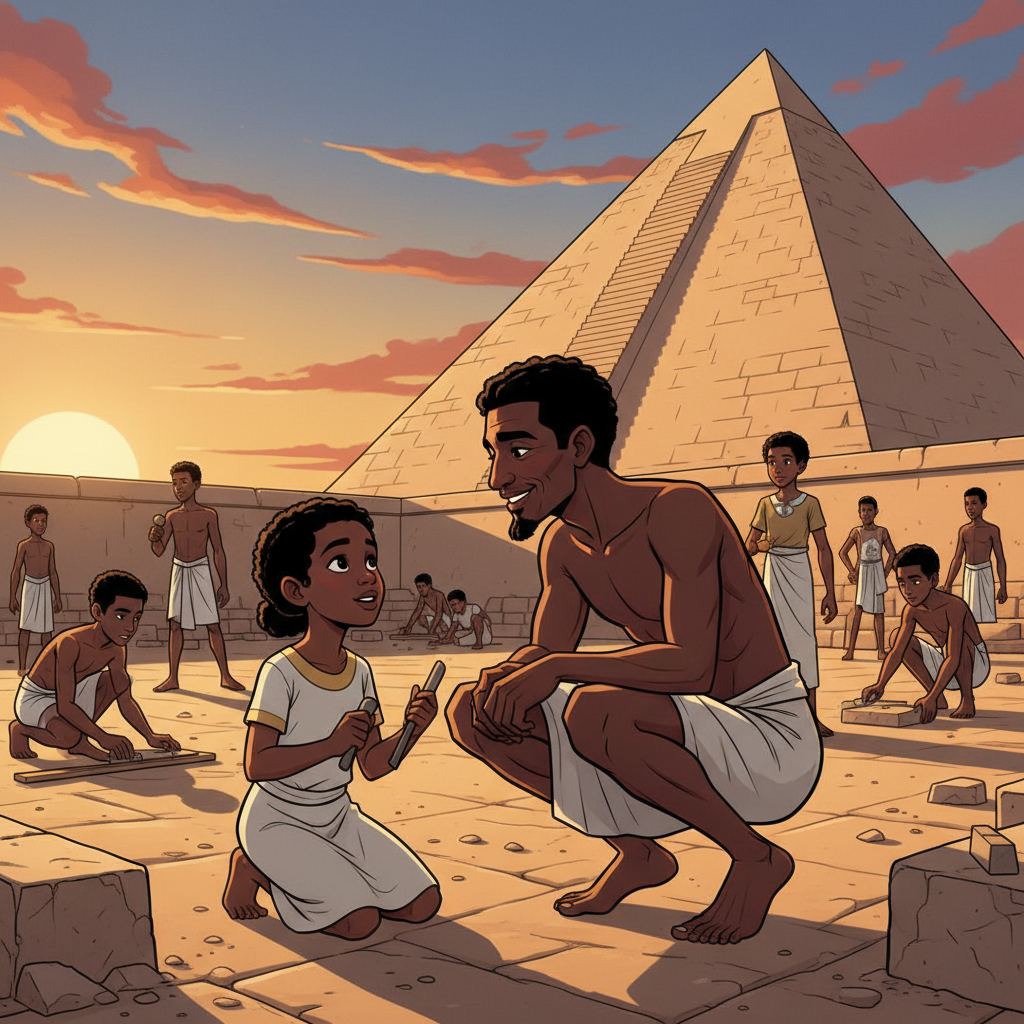
The young scribe bowed and left the workshop with his papyrus carefully rolled under his arm. Mereruka stood alone in the cool dim space and listened to the sounds of his own apprentices working in the southern courtyards beyond the wall — the soft tap of small mallets, the murmur of young voices counting cubits, the laugh of a girl-apprentice who had just gotten an answer right. The sun was sinking toward the western desert and the Step Pyramid, still standing after fifty years, threw its long staircase shadow across the sand. Mereruka thought about how the pyramid would still be standing a thousand years from now. He thought about how the day-book would survive in the temple library. And he thought about how, somewhere in one of his courtyards right now, one of his own apprentices was probably standing very still in front of a stone, hand half-raised, mouth half-open, learning the same thing he had learned. He smiled the small smile he had learned from Imhotep half a century before. Then he walked out into the late afternoon sun to find that apprentice — to crouch at her eye level, and to say, very softly, the words that would begin everything for her, too.