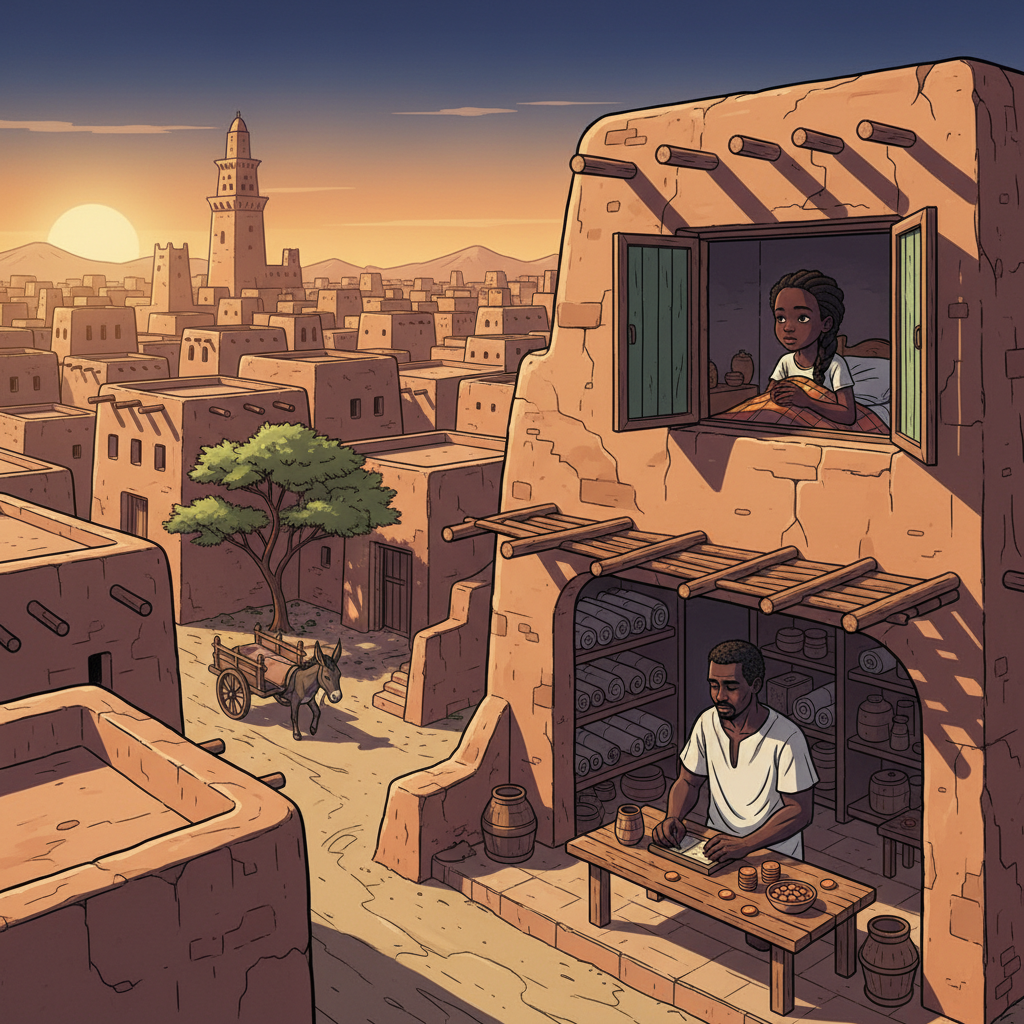
Hawa woke before the muezzin's dawn call, in the small upstairs room above her mother's workshop in the Sankore quarter of Timbuktu. She was twelve years old. Her deep brown skin still carried the warmth of sleep. Her hands, already calloused at the index finger from holding a reed-pen, lay folded on her blanket. She listened to the city: the soft creak of a donkey-cart in the street below, the rustle of acacia leaves in the courtyard, the muffled voice of her father Mohamadou in the front of the workshop already counting out copper coins for the early caravan-master. Hawa was the daughter of Aïssata the mathematics-copyist and Mohamadou the manuscript-merchant. Both her parents had names that were spoken with respect in the small streets near Sankore mosque. She was learning, slowly, how a name became something people trusted.
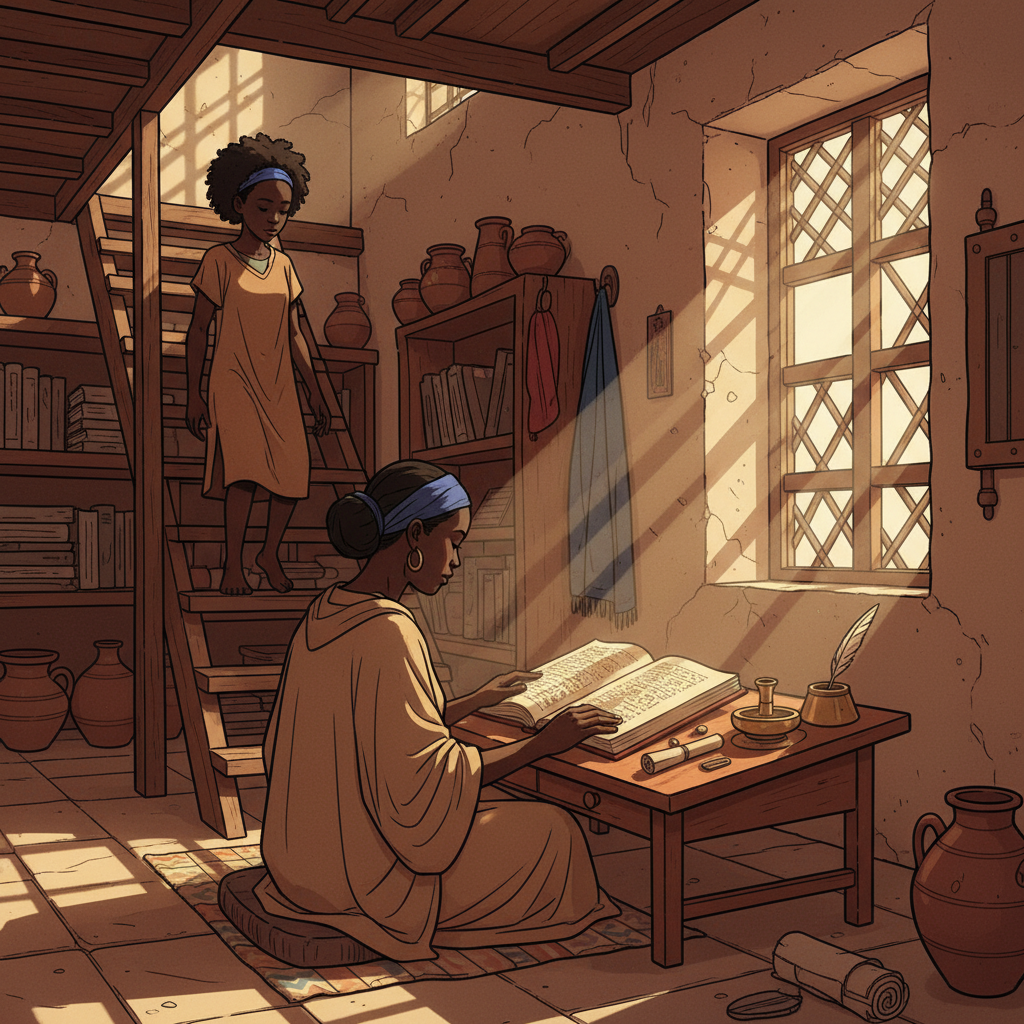
Hawa rose, washed her face in the brass basin by her bed, and tied her hair back with a strip of indigo cloth. She climbed down the narrow stairs and entered her mother's workshop. Aïssata was already at her low cedar writing-desk, the morning light coming through the latticed window in pale geometric bars across the page in front of her. Aïssata was a mathematics-copyist. She specialized in algebra commentaries — manuscripts that explained the work of al-Khwarizmi, the great scholar of Baghdad whose mathematical writings had reached Timbuktu through the salt-caravans two centuries before. Aïssata's deep brown hands moved across the page with the steadiness of a woman who had been writing the same script for thirty years. She did not look up when Hawa entered. She only said, very softly, "The ink-stone is cold. Warm it before you begin."
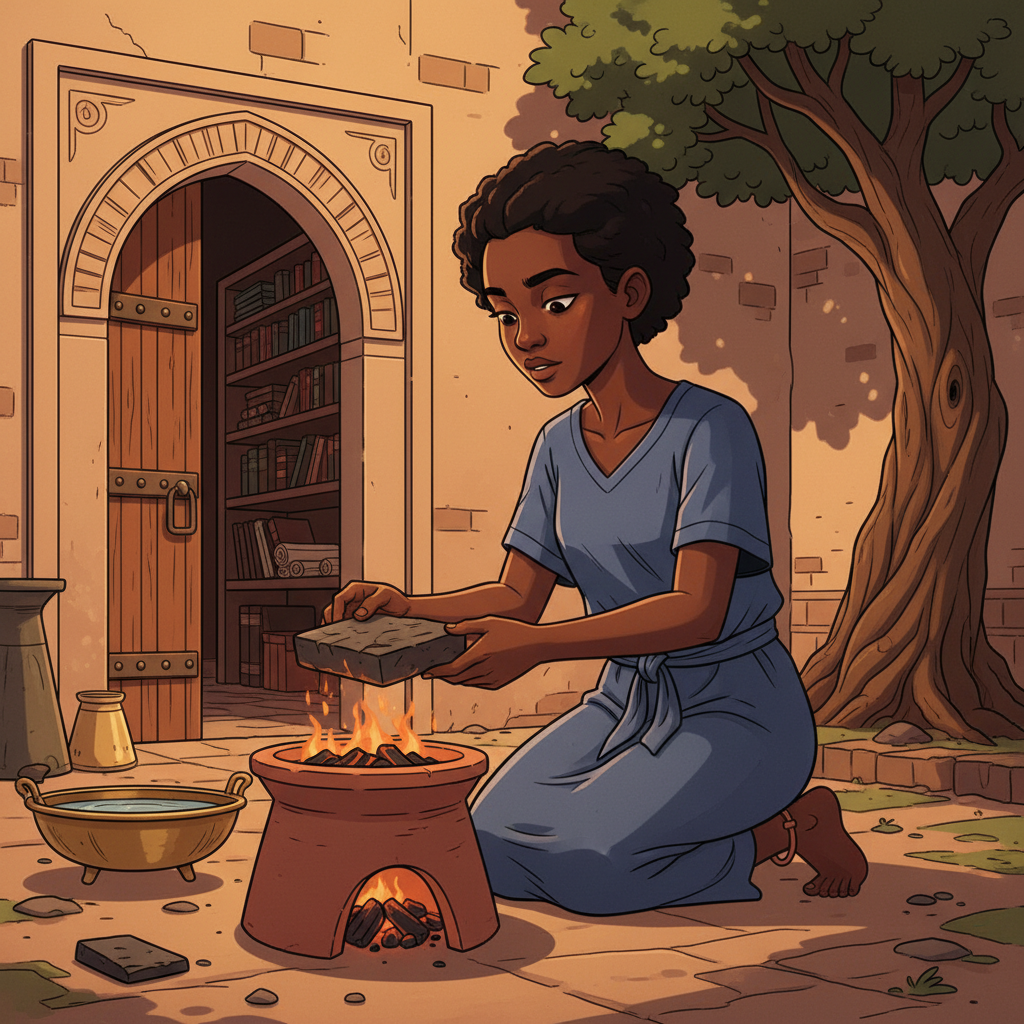
Hawa carried the small stone ink-block to the courtyard brazier, where her mother kept a low charcoal fire burning each morning. She held the ink-stone above the warmth for the count of forty heartbeats — the time her mother had taught her was enough to soften the iron-gall ink without curdling it. Then she carried it back inside and set it on her own writing-desk beside her mother's. She unrolled a half-finished page. Her job, since she was nine, had been to ink the attribution-lines — the small careful inscriptions at the top of every page that named the original author of the work being copied. Today's manuscript was a commentary by al-Battani on the geometry of triangles. The attribution-line read, in her mother's steady Arabic script: "From the hand of Muhammad ibn-Jabir al-Battani, by way of the teachers of Sankore." Hawa wet her reed-pen.
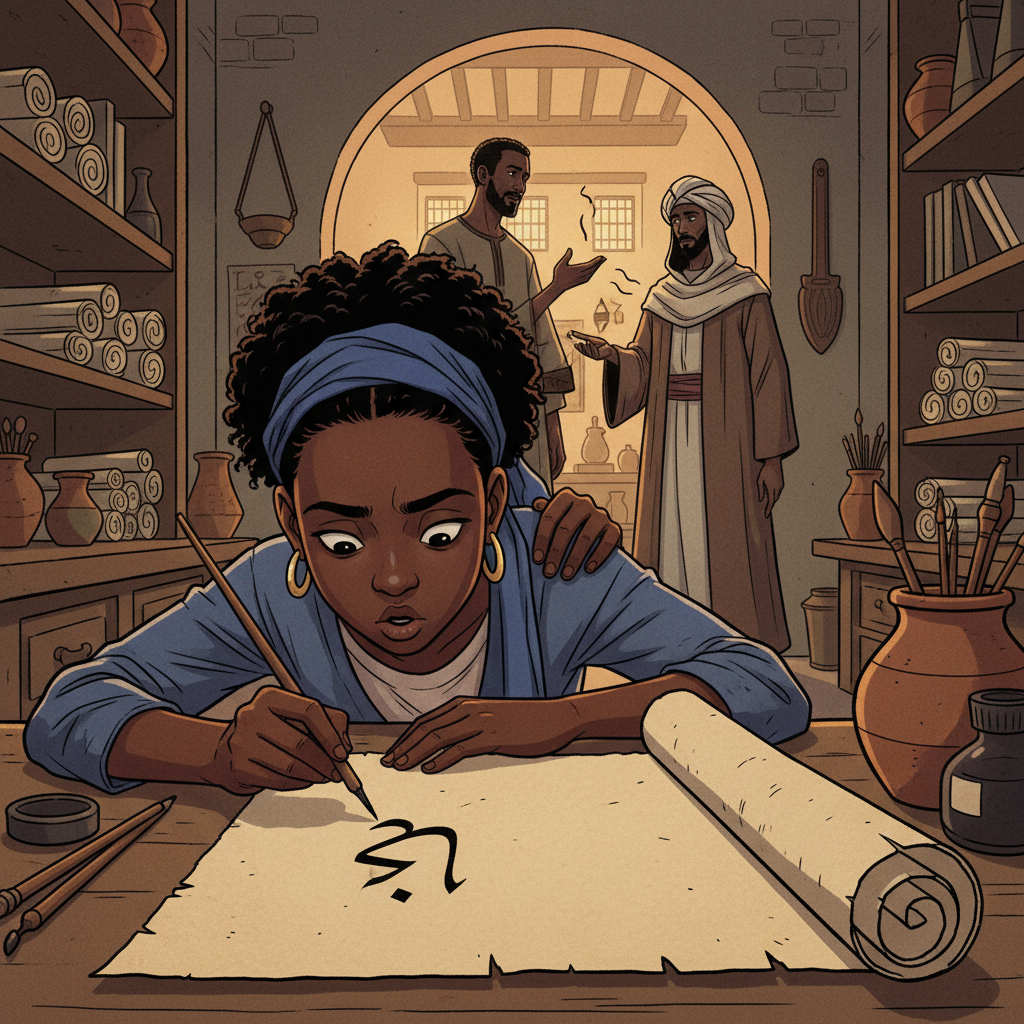
She inked the attribution carefully, copying her mother's line letter for letter. Her reed-pen moved slowly. The first stroke of a letter could not be redone — iron-gall ink soaked into the rag-paper and could not be lifted out. This was the first thing her mother had taught her: a manuscript was not a thing you could undo. You had to be right the first time, every time. Hawa finished the line and held her breath while it dried. From the front of the workshop, she heard her father speaking to someone — a new voice, unfamiliar. Berber-accented Arabic. The voice was deeper than her father's and carried the soft consonants of Marrakech, two thousand kilometers north across the Saharan trade routes. Hawa did not look up. A merchant-customer was not unusual. But something in her mother's shoulders — a small stillness — told her this customer was different.
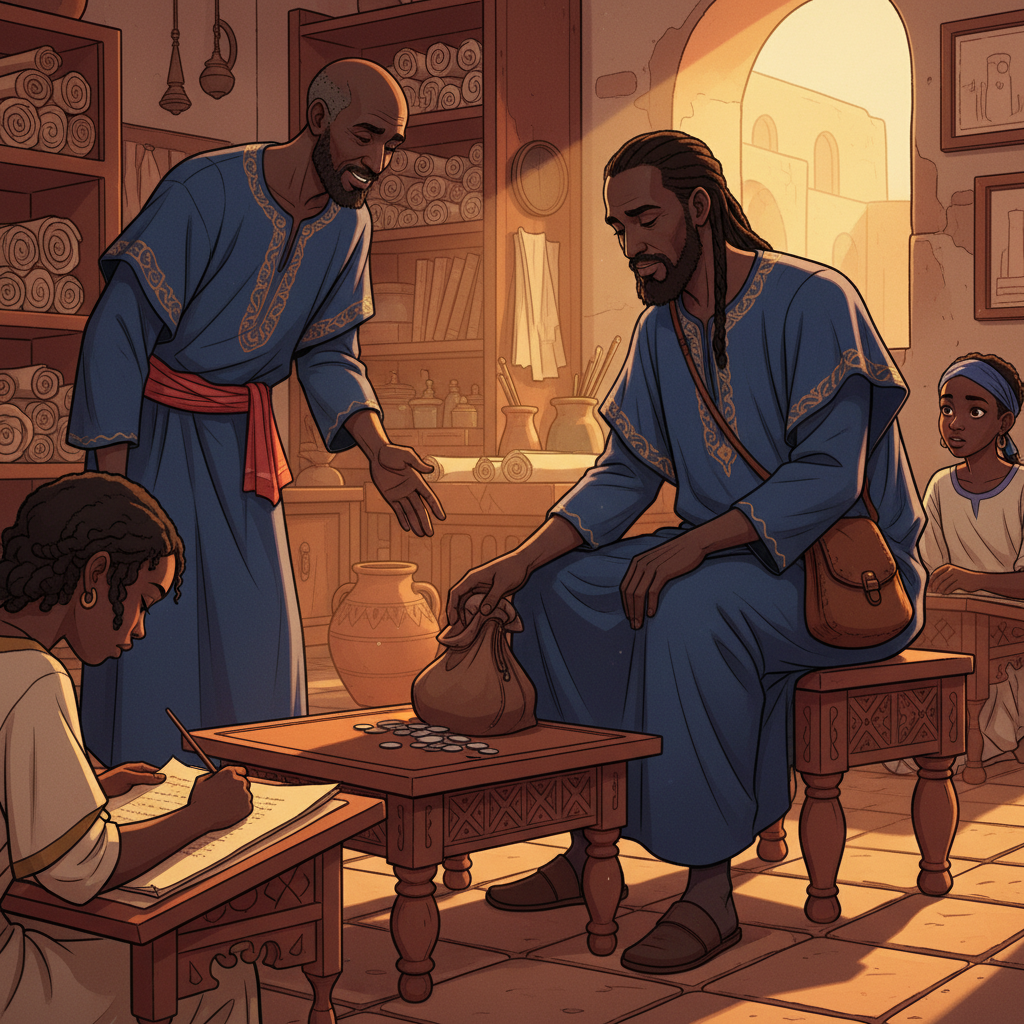
The Berber visitor came into the back workshop a moment later, her father walking ahead of him with the courteous stoop of a host. The visitor was a tall man in a finely woven blue boubou, with a heavy leather purse hung at his belt. His name, Hawa heard her father say, was Idris ibn-Yusuf, a manuscript-buyer from Marrakech. He had ridden eight weeks south to reach Timbuktu, and he had a specific commission. Hawa kept her eyes on her page. Her reed-pen hovered just above the next attribution-line. Aïssata at her own desk did not look up. The visitor sat down on the carved stool her father offered him. He set his leather purse on the low table between them, and the soft heavy sound of silver dirhams shifting inside the leather was the sound that made Hawa, finally, look.
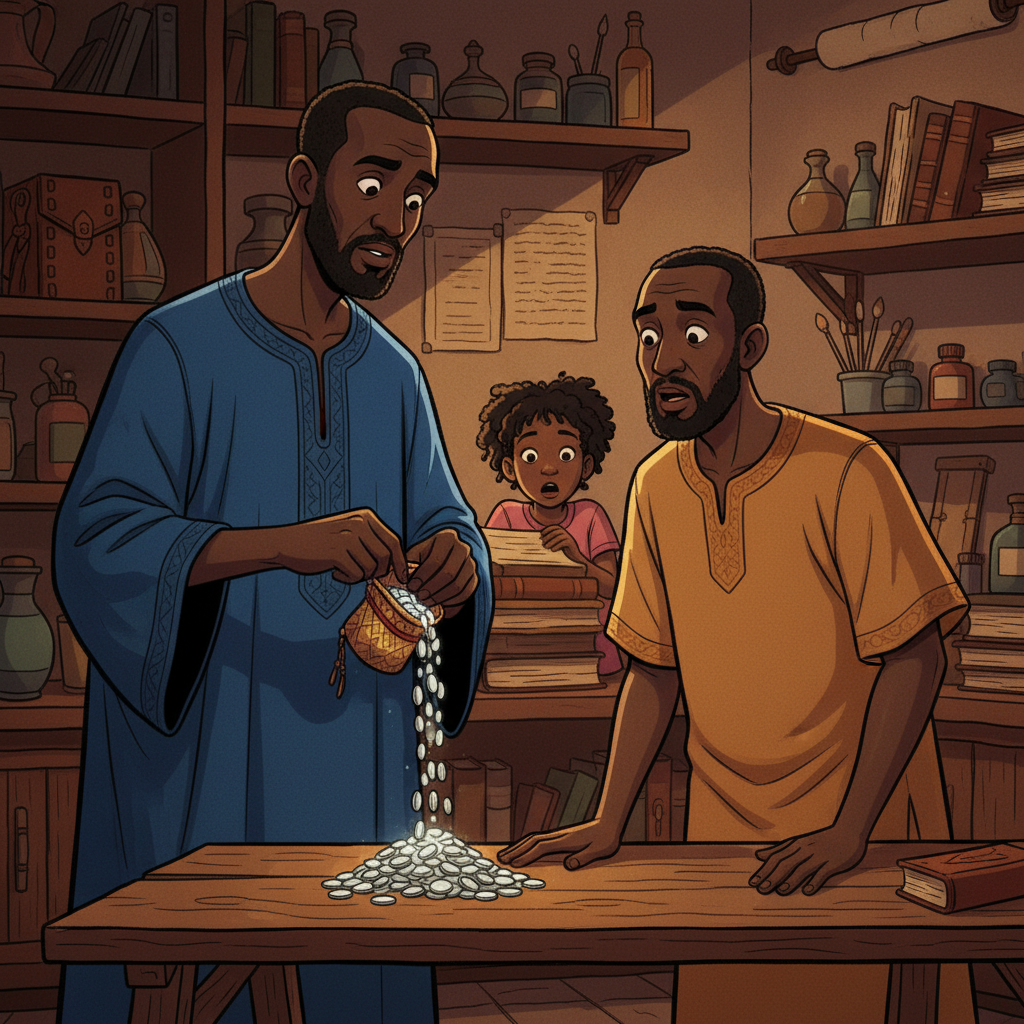
"I want to commission a copy of the Tafsir al-Kabir of al-Mahalli," Idris said. "A complete copy, on the finest rag-paper. With one small alteration." Hawa's father waited. The visitor reached into the folds of his boubou and brought out a slim purse-within-a-purse, opened it, and let a small mountain of silver coins spill onto the table — more silver, Hawa thought, than her family's workshop earned in a year. "The attribution," Idris said. "The Tafsir was written by al-Mahalli in Cairo, but copies of it have circulated for generations through Walata and Timbuktu before reaching Marrakech. I would like the attribution to read that the manuscript came TO Cairo BY WAY OF Marrakech — not the other way." He smiled. "A small adjustment of geography. The scholarship is unchanged."
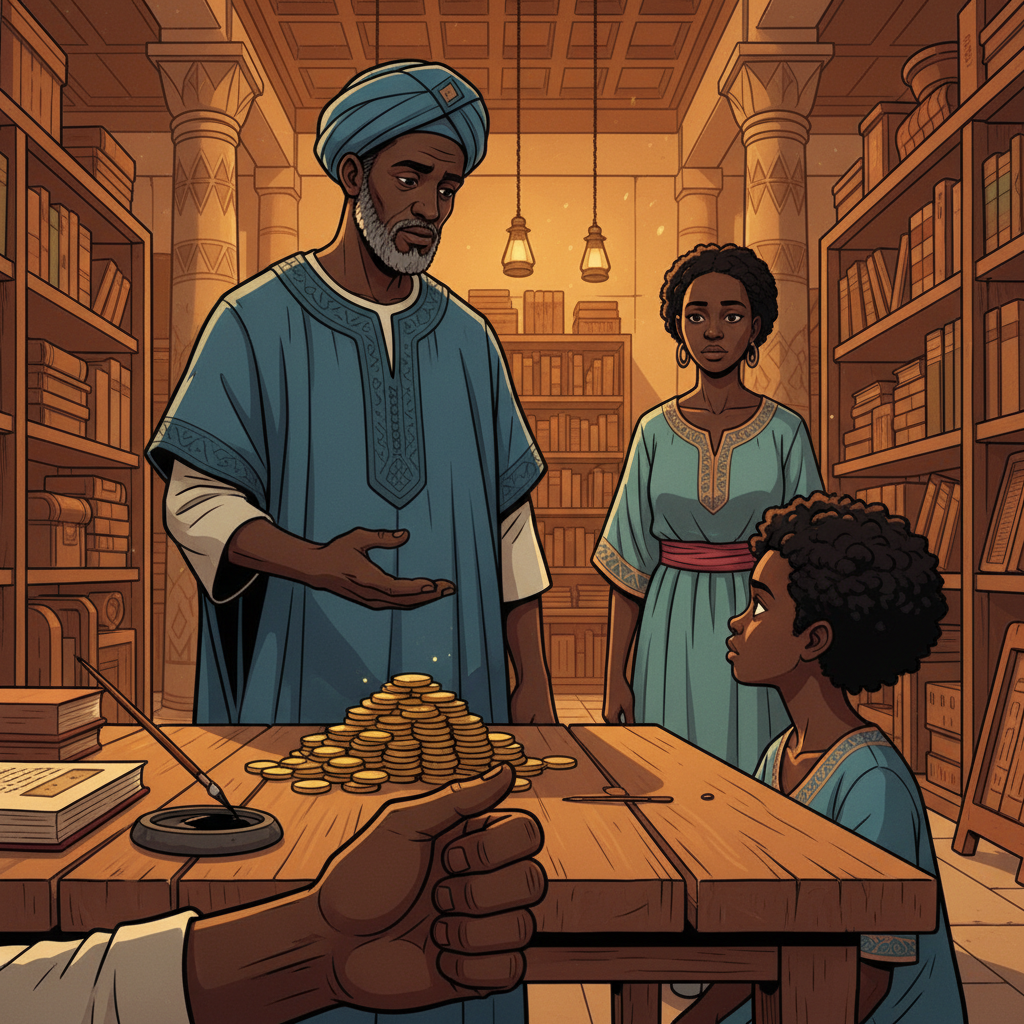
Hawa's father was silent. Hawa watched his eyes flick to the coins. She watched his hand — the hand she had held as a child, the hand that had taught her to ride the small workshop-donkey when she was four — open slightly and then close again. He was thinking. The fee was the size of a year. With it the workshop could buy a second writing-desk. Hawa could be apprenticed to the women's circle at Sankore where she had begged for two years to study. Her mother's eyes she did not need to look at. She knew, without looking, that Aïssata had not moved. The silence in the small back workshop was the silence of a thing being decided. Hawa set her reed-pen down on the inkstone. The ink-bead at its tip was still wet. She let it sit there.
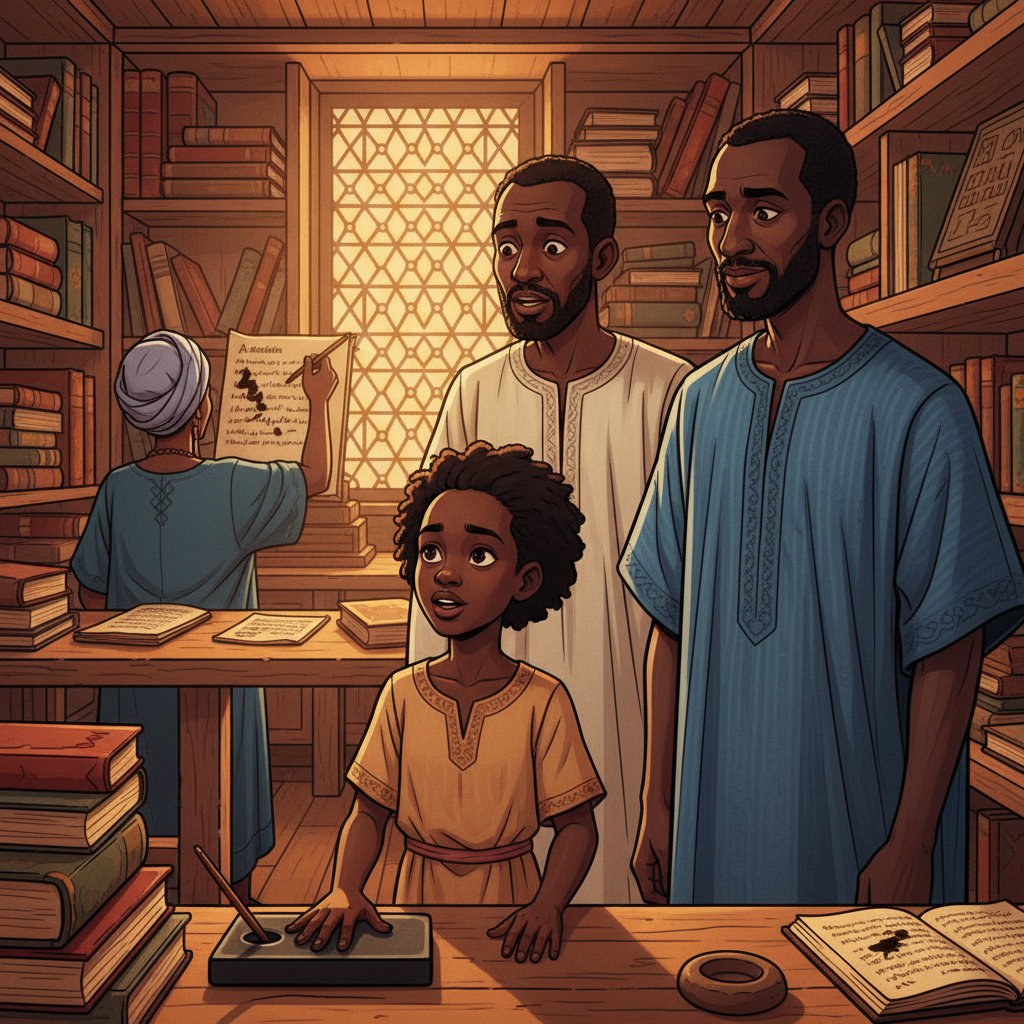
"Father," Hawa said. Her voice came out smaller than she meant. She cleared her throat and tried again. "Father. If we change one name today, no one will trust the names we wrote yesterday." Her father turned his head slowly and looked at her. He did not speak. Idris ibn-Yusuf turned too. His face was patient — a man used to negotiations — but his eyes had narrowed slightly. Aïssata, still at her desk, did not turn. But Hawa saw her mother's reed-pen lift from the page and pause in the air, the way a heron paused before stepping. Hawa kept her hand flat on the inkstone beside her own reed-pen. She did not know where the words had come from. She only knew that her mother's attribution-line for al-Battani, freshly inked an hour ago, would become a lie if the workshop accepted this fee.
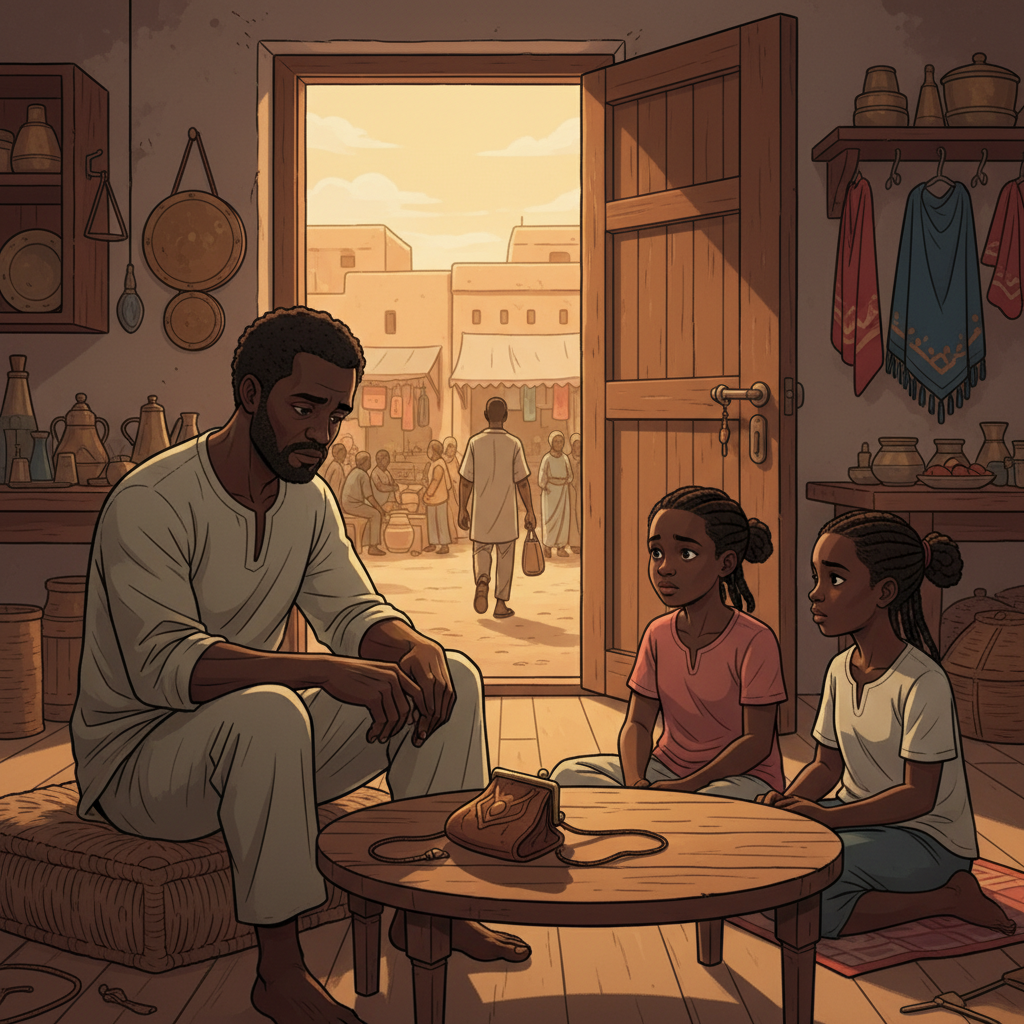
Her father looked at the coins on the table for a long moment. Then he looked back at Hawa. Then he looked at Aïssata, who had finally raised her face and was watching him steadily. Her father drew a long breath. "My daughter is right," he said, to Idris ibn-Yusuf. "I cannot accept this commission." Idris's face did not change. He gathered his coins back into their purse-within-a-purse, slid the heavy outer purse off the table, stood, and bowed once to her father, briefly, the way one bowed to a host one would not visit again. He left without speaking. The front workshop door scraped open and shut. Hawa heard his sandaled footsteps fade down the dusty street toward the camel-market. Her father sat down on the cushion across from her. He looked at his own hands for a long time before he said anything.
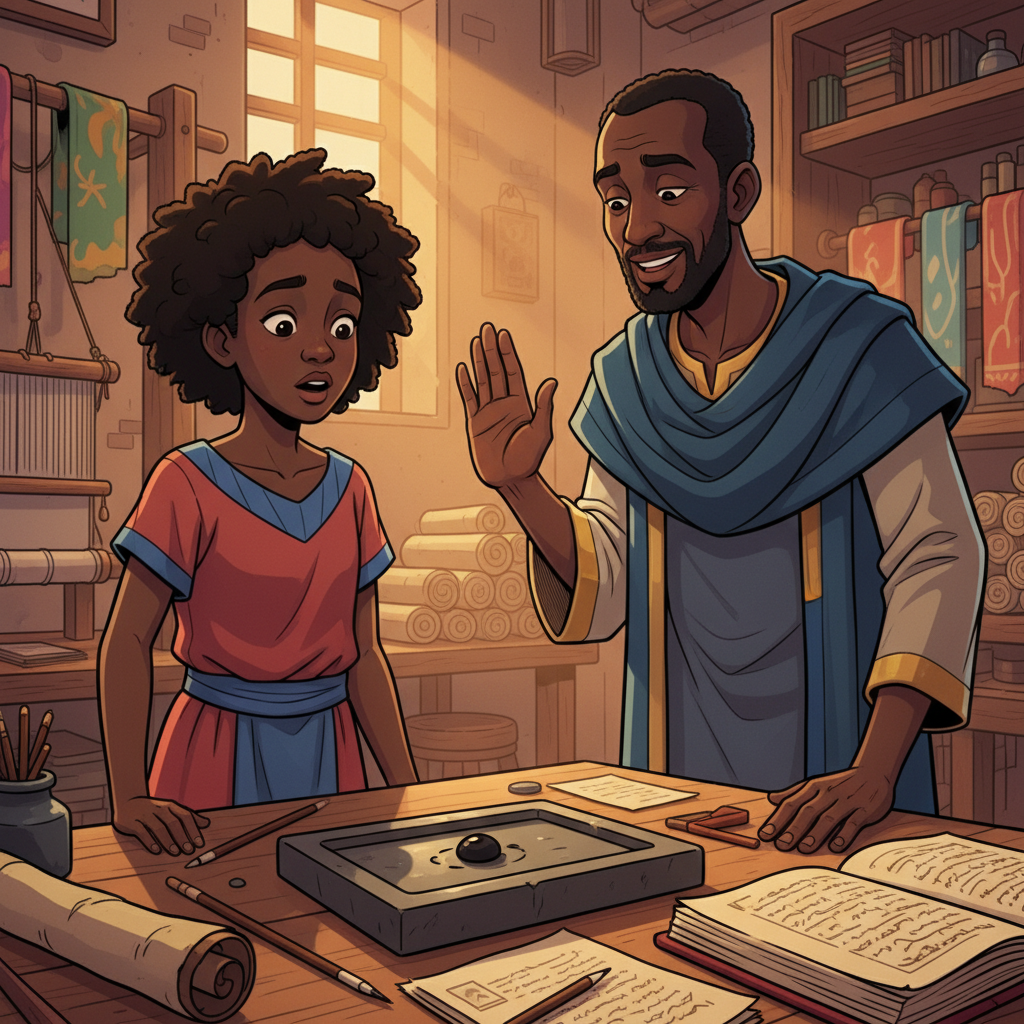
"You set down your reed-pen," he said finally. "I watched the ink-bead dry on the inkstone. It is still there." Hawa looked. The bead was a small dark circle on the polished stone surface. "I am sorry," she said. "I should not have spoken in front of —" Her father raised his hand to stop her. "You spoke when I could not. The teacher Karenga, in the books my own father studied at Sankore, writes that Maat begins with the name above the words. Without that name, the words become un-anchored. They can be carried away on any wind. The fee was large. But our workshop's name has been large too, for a generation. Your grandmother began the workshop. Your mother carried it forward. You have just made the choice that I would have made an hour ago, when I was younger and more certain. I had forgotten." He smiled, a little tired. "Thank you."
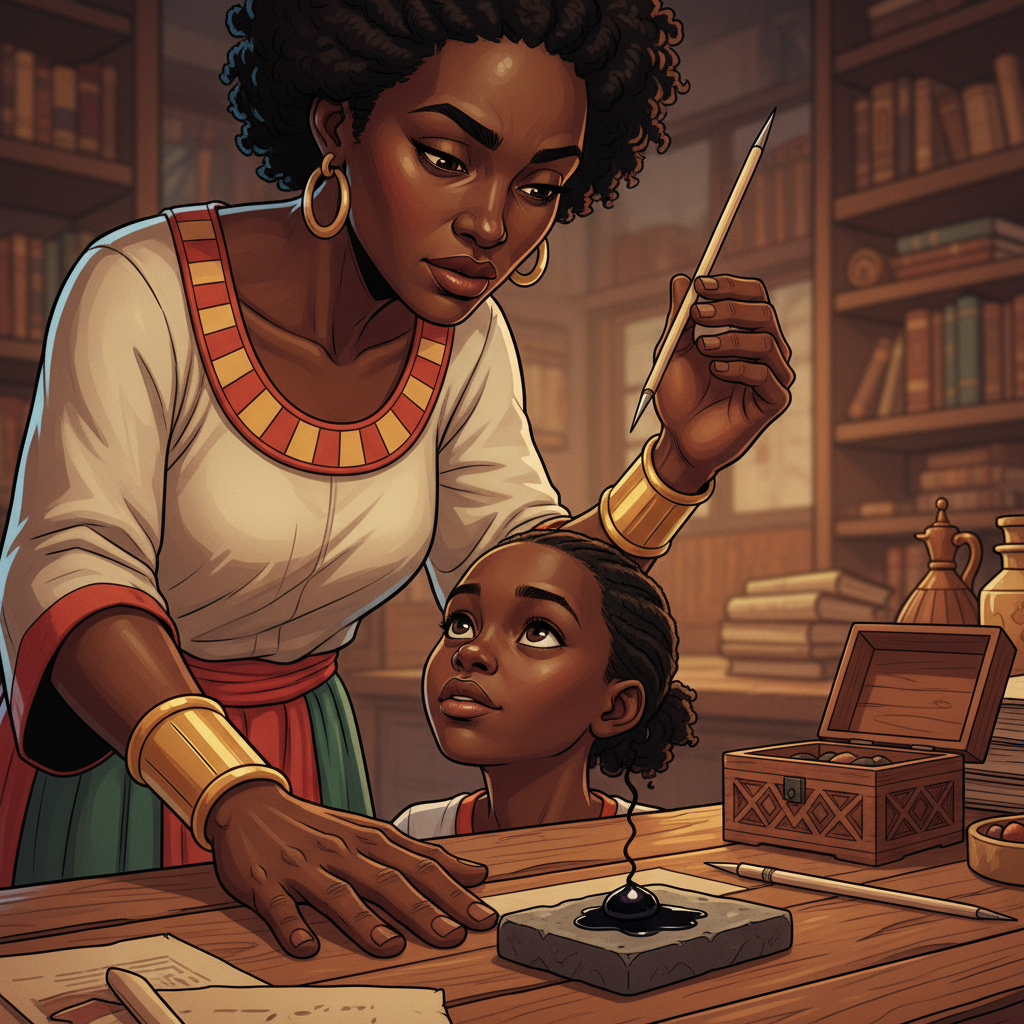
Aïssata rose from her desk. She walked to Hawa's side and stood looking down at the still-wet ink-bead on her daughter's inkstone. She did not speak. She placed her left hand on the writing-desk, palm down, in the gesture Hawa had seen her use a hundred times to bless a freshly-finished page. Then she reached into the small carved cedar box at the back of Hawa's desk where the family kept its used and broken reed-pens. She drew out a slim reed-pen with a fresh-cut tip — sharper, finer than the one Hawa had been using. "This was your grandmother's last pen," she said. "I have been keeping it for the day you decided. Take it. The line you wrote today is one of the most important lines this workshop will ever write. Use this pen to finish the page."
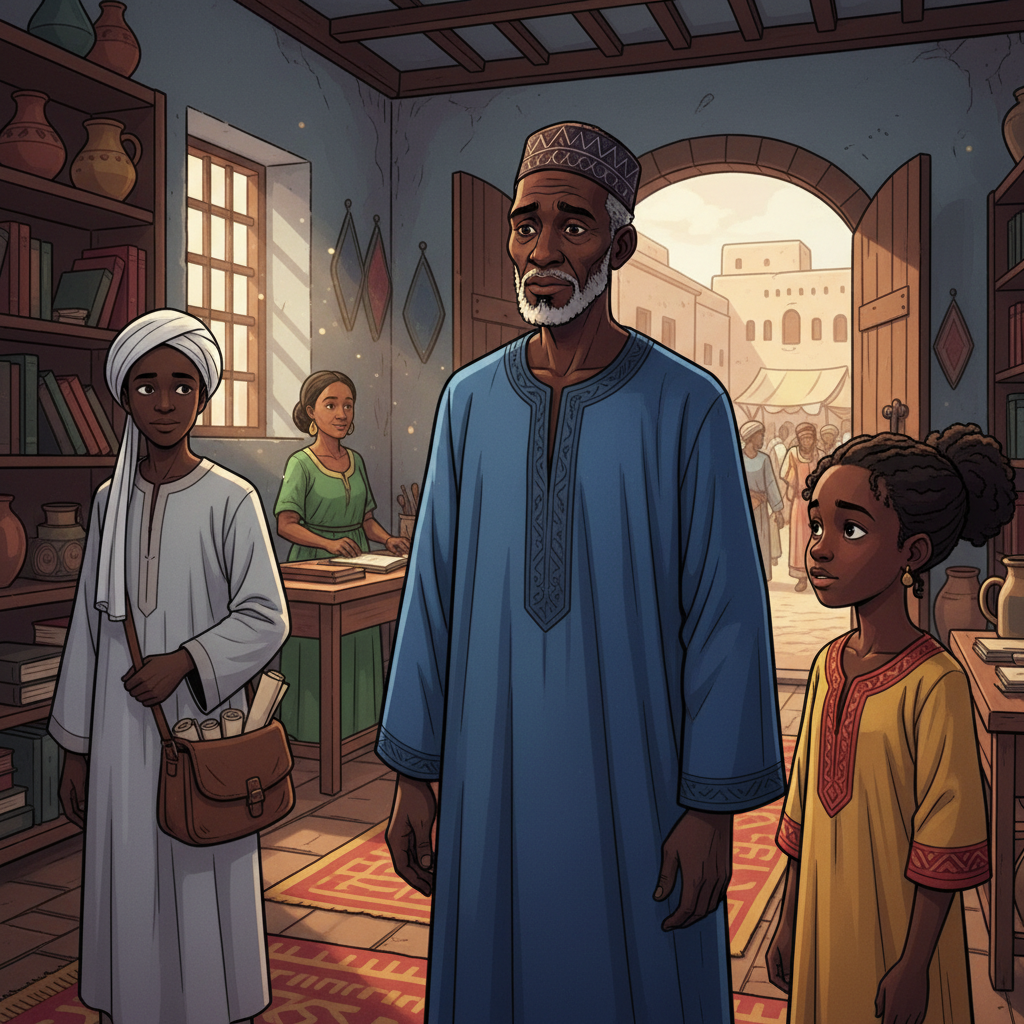
Three days later, a young scholar Hawa did not recognize came to the workshop. He wore the white turban of a Sankore graduate and carried a small leather satchel of papers. "I am told," he said to Hawa's father, "that you refused a Marrakesh commission this week. The scholar Fatimata as-Suyuti at the women's circle has sent me. She would like you to copy three of her commentaries before the dry season ends. She does not want them copied anywhere else." Her father bowed his head. "We will be honored." After the young scholar left, her father looked at Hawa and at Aïssata and shook his head slowly. "The news of a refusal travels faster than the news of a sale," he said. "Fatimata heard within three days. That is the city we live in." Aïssata returned to her desk without speaking. But she was smiling.
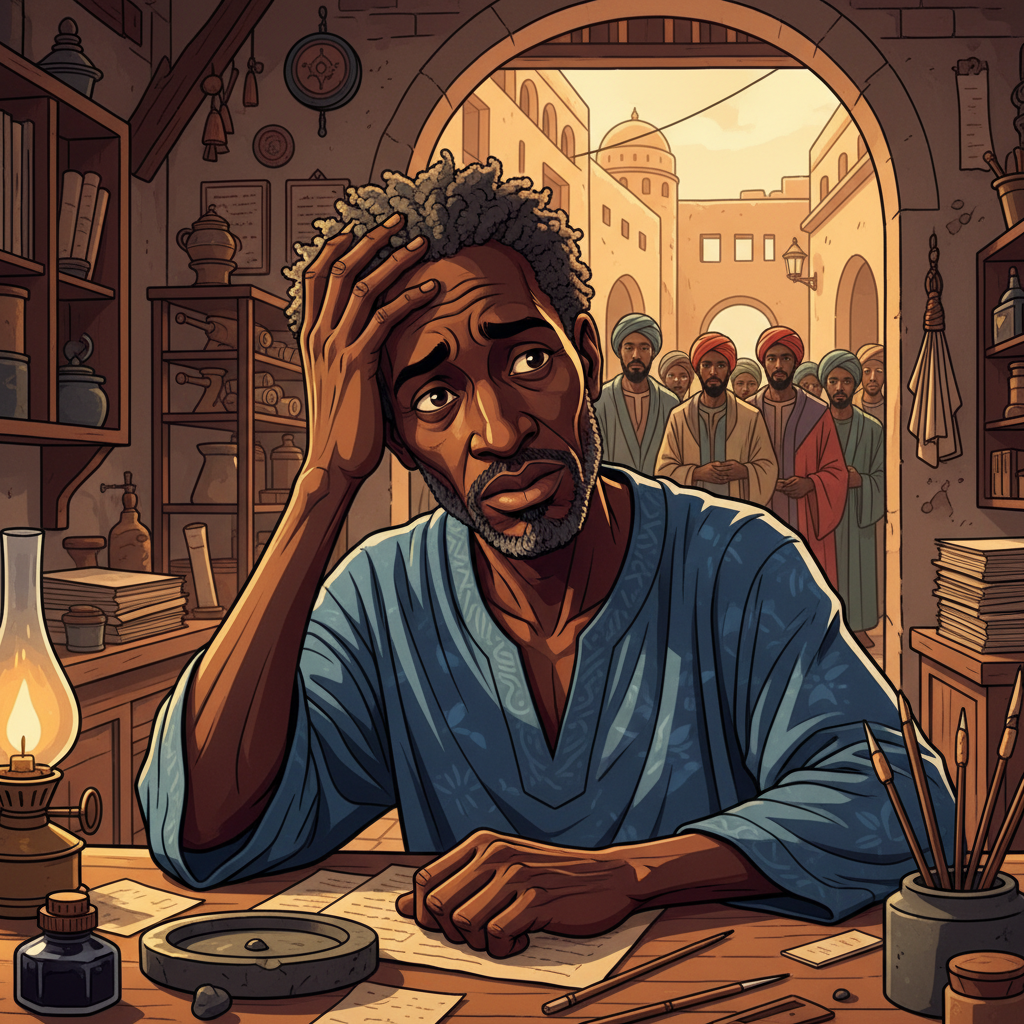
The next week, two more scholars came. Then four. By the end of the month the workshop had a queue of commissions stretching past Ramadan. Hawa's father, who had always done all the negotiating himself, sat at his small front-room desk and ran his hand through his graying hair and said, for the first time in Hawa's life, "I need help." Hawa had been waiting for this. "Mahmud," she said. Her father looked up. Mahmud was the workshop-boy at the camel-market — eleven years old, deep brown-skinned, an orphan whose uncle was a date-trader. He had been hanging around the manuscript-quarter for two years, asking everyone for an apprenticeship. His uncle could not afford the fees. Hawa had given him scraps of rag-paper and a broken reed-pen. He had been practicing letters in chalk on the back wall of the camel-market. "Bring Mahmud," Hawa said. "Waive his fees."
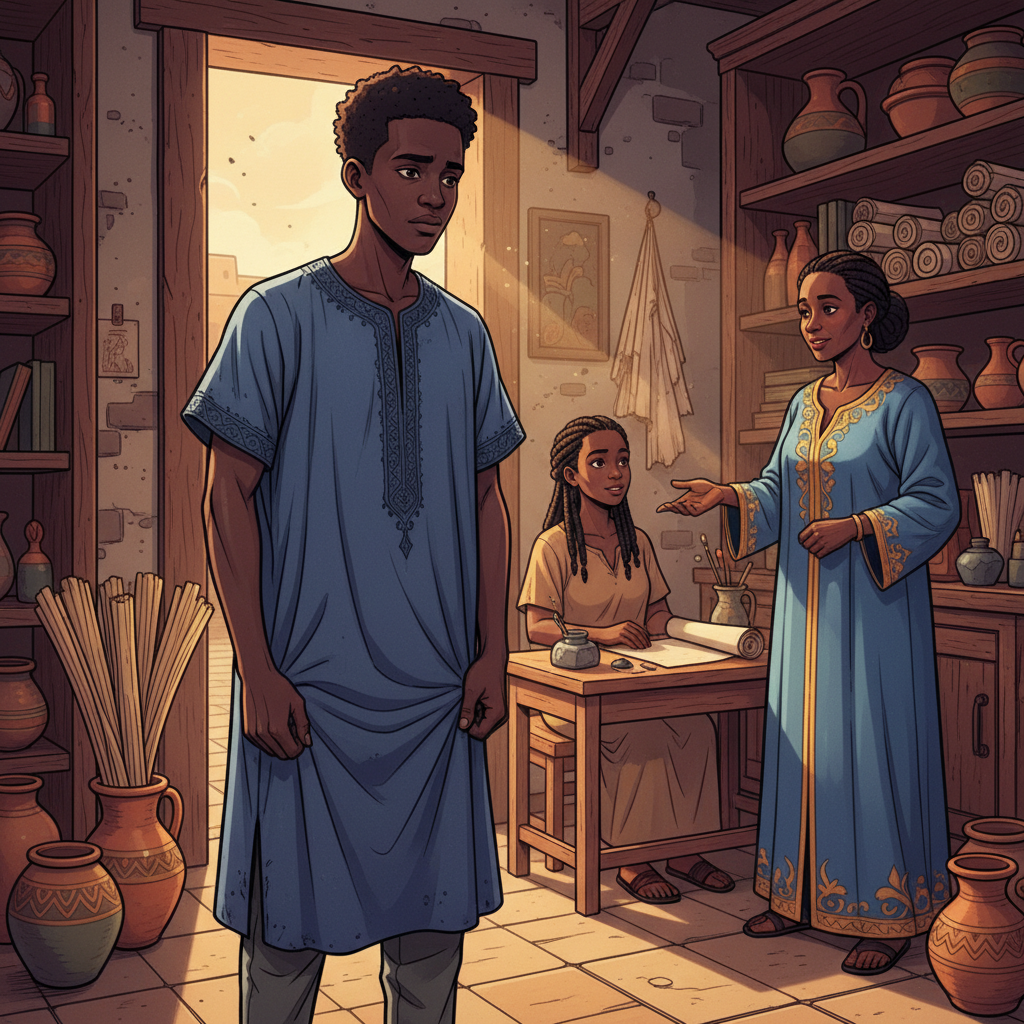
Mahmud arrived the next morning at sunrise, before he had been formally summoned, having heard the news from someone in the camel-market overnight. He stood in the workshop doorway in a clean but mended boubou, his hands clenched at his sides, trying not to show that he was trembling. Hawa's mother greeted him gently, set him at the small third writing-desk in the corner, and gave him a fresh rag-paper and an inkstone of his own. "Hawa will teach you the family's attribution-style," Aïssata said. "She knows it better than I do now. Listen to her." Mahmud bowed and sat. Hawa pulled her own desk closer to his. She showed him how to wet the reed-pen, how to start a letter from the top stroke rather than the bottom, how to watch for the ink-bead at the pen-tip. Mahmud listened with the patient hunger of a person who had been waiting a long time.
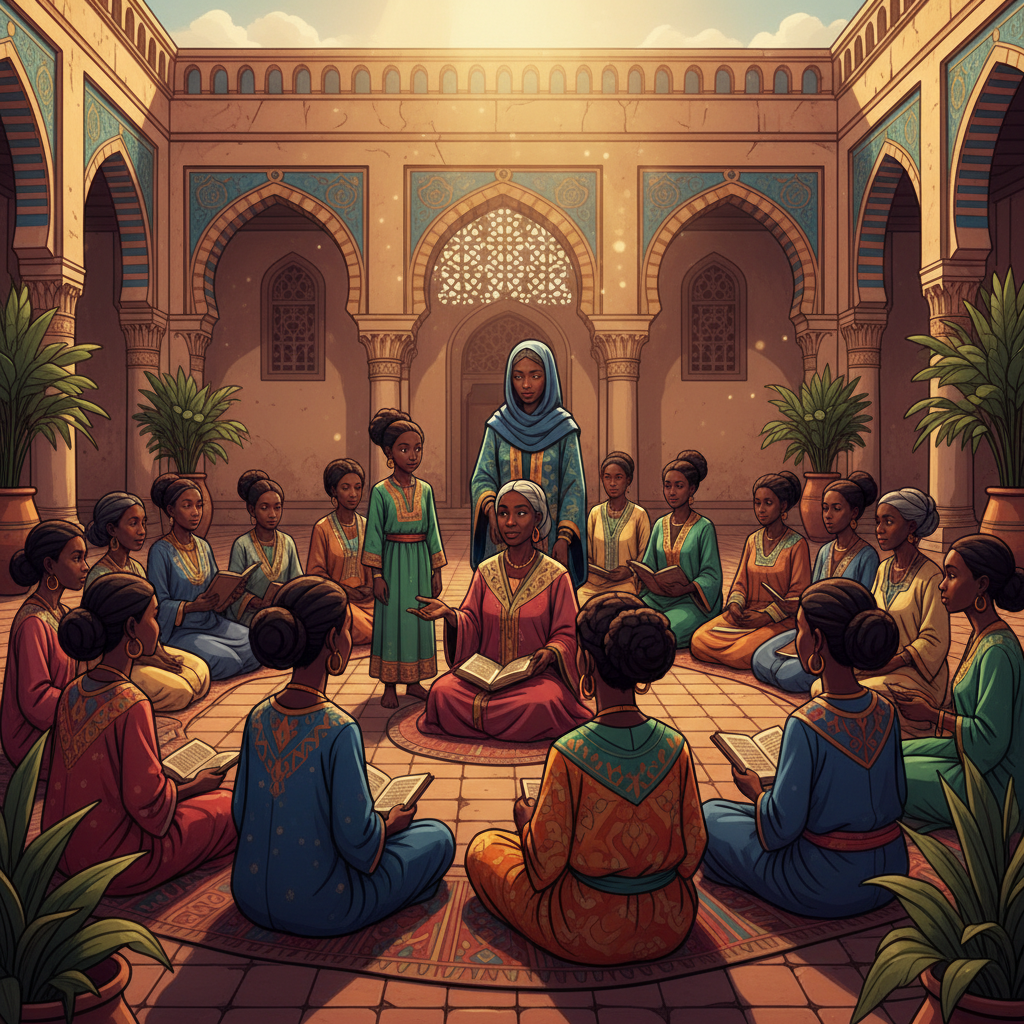
On the seventh day of Mahmud's apprenticeship, Hawa's mother took her to the Sankore women's circle for the first time. The circle met in a small inner courtyard of the great mosque, in the late afternoon when the men's scholarly sessions were ending. There were perhaps thirty women, ranging from girls Hawa's age to gray-haired elders. At the center sat Fatimata as-Suyuti, a woman in her sixties, with skin the rich dark brown of polished mahogany and the deep slow voice of a teacher who had taught a thousand students. She was descended from a scholar-lineage at Sankore that went back four generations. She greeted Hawa's mother first, then turned to Hawa and said only one sentence: "I am told you set down your reed-pen." Then she gestured at the cushion beside her. "Sit. Today we are reading al-Khwarizmi."
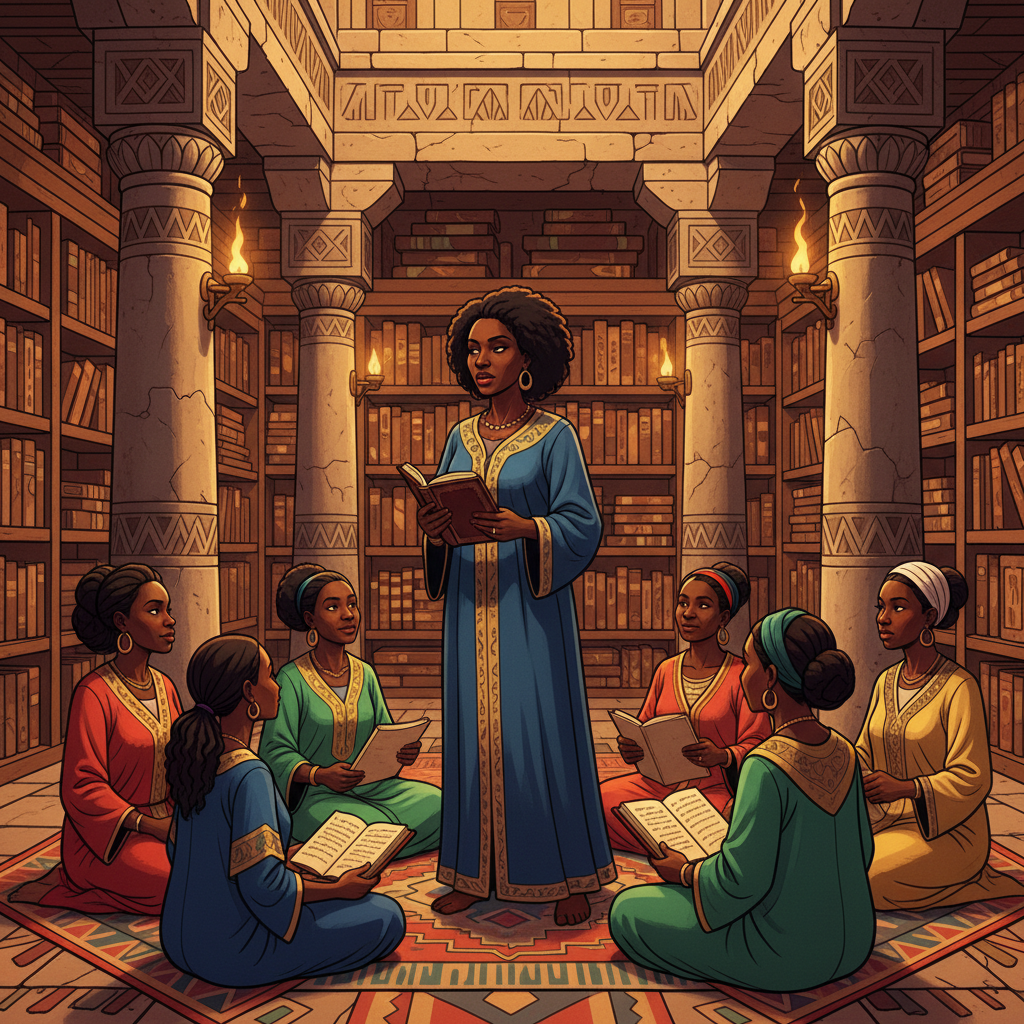
Hawa sat. Fatimata read aloud from al-Khwarizmi's commentary on quadratic equations, and the circle of women followed along on their own copies. Hawa's mother had been working on this exact text for the last six months. Hawa felt a flush of pride seeing other women hold pages her mother had inked. After the reading, Fatimata closed her book and looked at the circle. "Each of you will copy this text in the next year," she said. "Each of you will inscribe al-Khwarizmi's name at the top of every page. Karenga, who in the years to come will write that Maat begins with the name above the words, has not yet written those words — but our grandmothers knew them. We have always known them. Without the name above the words, the words drift. Without your name on the work you do, you drift too. Keep your names."
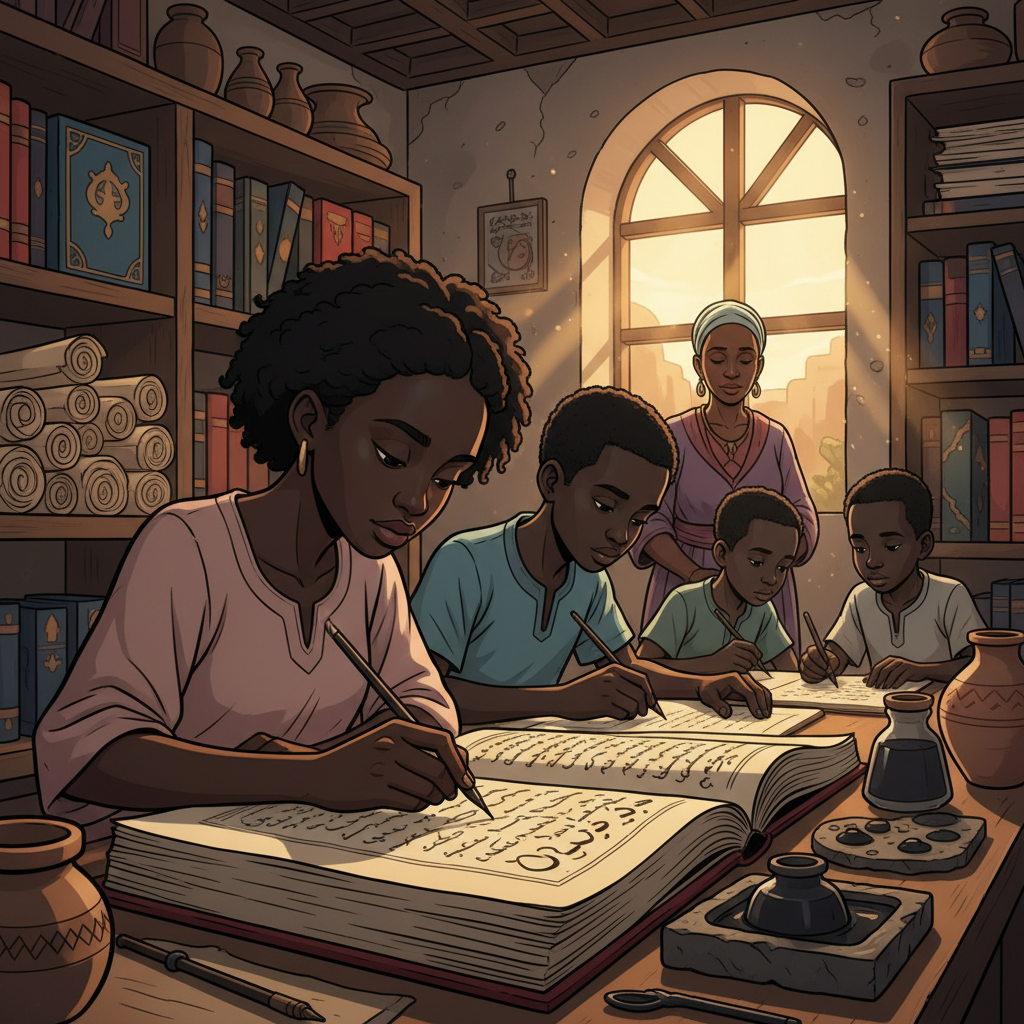
Three years passed. Hawa grew taller. Her hands grew steadier. Her reed-pen lines, which at twelve had still occasionally trembled, by fifteen ran across the page with the calm continuous flow her mother's had always had. Mahmud, now fourteen, had become the workshop's third copyist, his attribution-style indistinguishable from Hawa's. Two more workshop-boys had been added — Yusuf and Adama, both with their fees waived after the first year. The workshop produced, in three years, a manuscript that Sankore scholars would still be citing two centuries later: Aïssata's annotated edition of al-Khwarizmi, with Hawa's attribution-page and Mahmud's commentary-marginalia. The annotation read, in Hawa's steady hand: "Copied at the workshop of Aïssata of Sankore, daughter of Habiba, by Hawa daughter of Aïssata and the apprentices Mahmud, Yusuf, and Adama. No name on this page is borrowed. Every name is true."
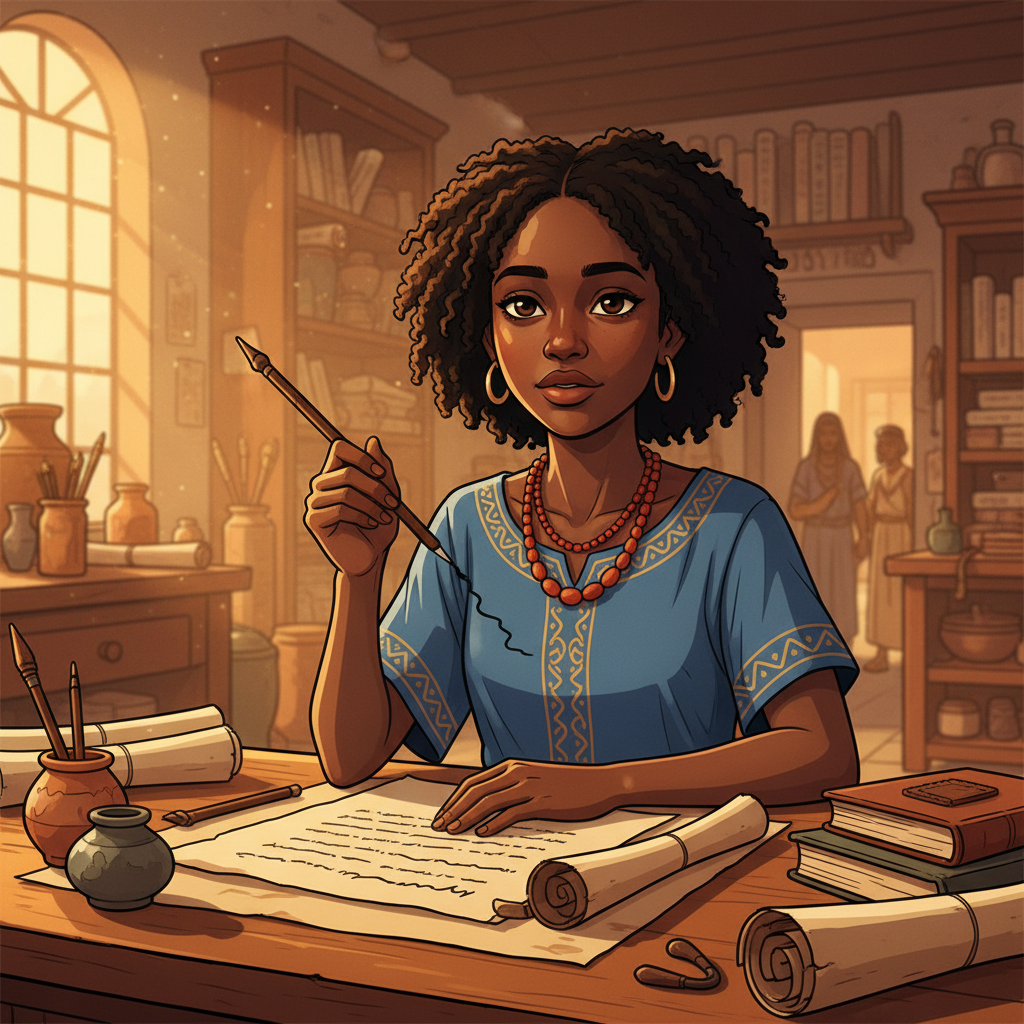
On a late afternoon in the dry season of Hawa's fifteenth year, she sat at her writing-desk in the workshop alone. Her mother was at the women's circle. Her father was negotiating with a salt-caravan in the front room. Mahmud and Yusuf and Adama were at the Sankore courtyard with the boys' study group. Hawa was finishing an attribution-line on a fresh commentary. The reed-pen — her grandmother's pen, the one her mother had given her three years before — moved steadily under her hand. She paused at the end of the line and looked at the wet ink. She thought of Idris ibn-Yusuf the Berber, who had gone back north and was, somewhere now, telling someone in Marrakech about a small Timbuktu workshop that had refused his silver. She did not regret it. The teacher Karenga would say the name above the words. Hawa lifted her pen. The ink-bead had not fallen. She finished the line.