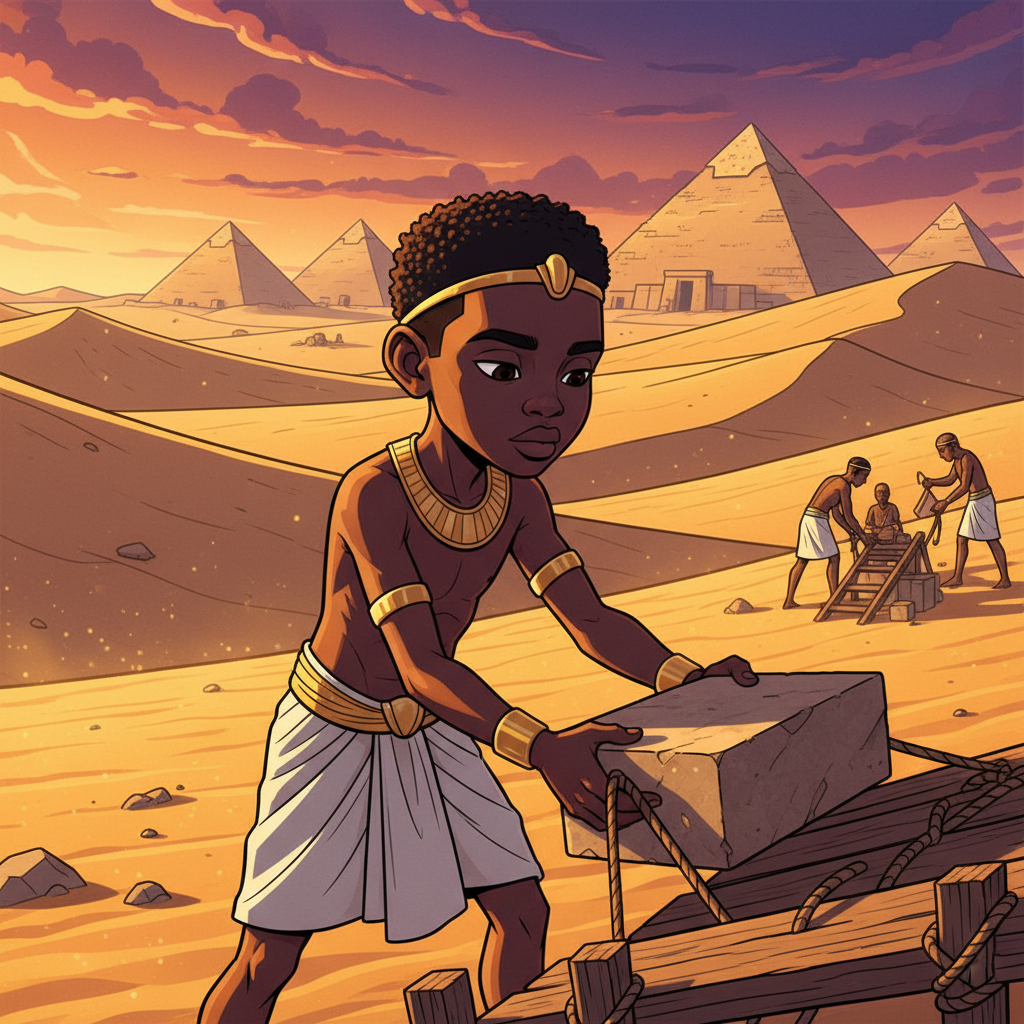
Nebka wiped the limestone dust from his deep brown face and squinted at the rising structure before him. The Great Pyramid of Pharaoh Khufu climbed toward the heavens like a staircase built for the gods themselves. Even half-finished, it was the largest thing Nebka had ever seen — larger than the temples, larger than the palace walls, larger than anything he had imagined possible when he was a small boy watching the ibises wade through the marshes of the delta. The morning sun blazed against the white limestone blocks, making them glow like captured light, and the air smelled of dust, sweat, and the faint sweetness of the river carried on the north wind. At twelve years old, Nebka was the youngest apprentice on the entire building site. His dark hands were already rough with calluses, his lean arms stronger than they had been six months ago when his father, a quarryman from the southern village, had brought him before the great architect Hemiunu and asked that his son be tested. Nebka remembered trembling that day — not from fear, but from the sheer desire to be chosen. Thousands of workers labored on the pyramid, but only a handful of boys were selected each year to learn the sacred mathematics that made such wonders possible. When Hemiunu had looked into his eyes and nodded, Nebka had felt his heart take flight like a falcon riding the thermals above the desert.
The building site stretched across the Giza plateau like a small city. To the east, the workers' village bustled with life — rows of sturdy mudbrick houses where the laborers and their families lived, with a bakery that produced hundreds of loaves each day, a brewery where barley beer was prepared for the work crews, and a medical house where physicians treated injuries with poultices and prayers to Sekhmet. To the south, the great quarry gaped open like a wound in the earth, its limestone walls carved into terraces where men chiseled blocks free from the living rock. Everywhere Nebka looked, there was purposeful motion — the organized labor of a civilization that believed building for eternity was the highest calling of human hands. Nebka rose each morning before dawn, when the stars of Sopdet still glittered above the western desert. He splashed his face with water from a clay basin, pulled on his white linen kilt, and ate a quick breakfast of bread, dried fish, and figs with the other apprentices in their shared quarters. Then he hurried to the construction site, where the day's work began the moment Ra's golden light touched the top of the unfinished pyramid. Being an apprentice meant Nebka had to be everywhere at once — fetching tools, carrying water to the survey teams, holding measuring cords taut while the senior builders checked their calculations. His legs ached by midday, but he never complained. Every task was a lesson, if he paid attention.
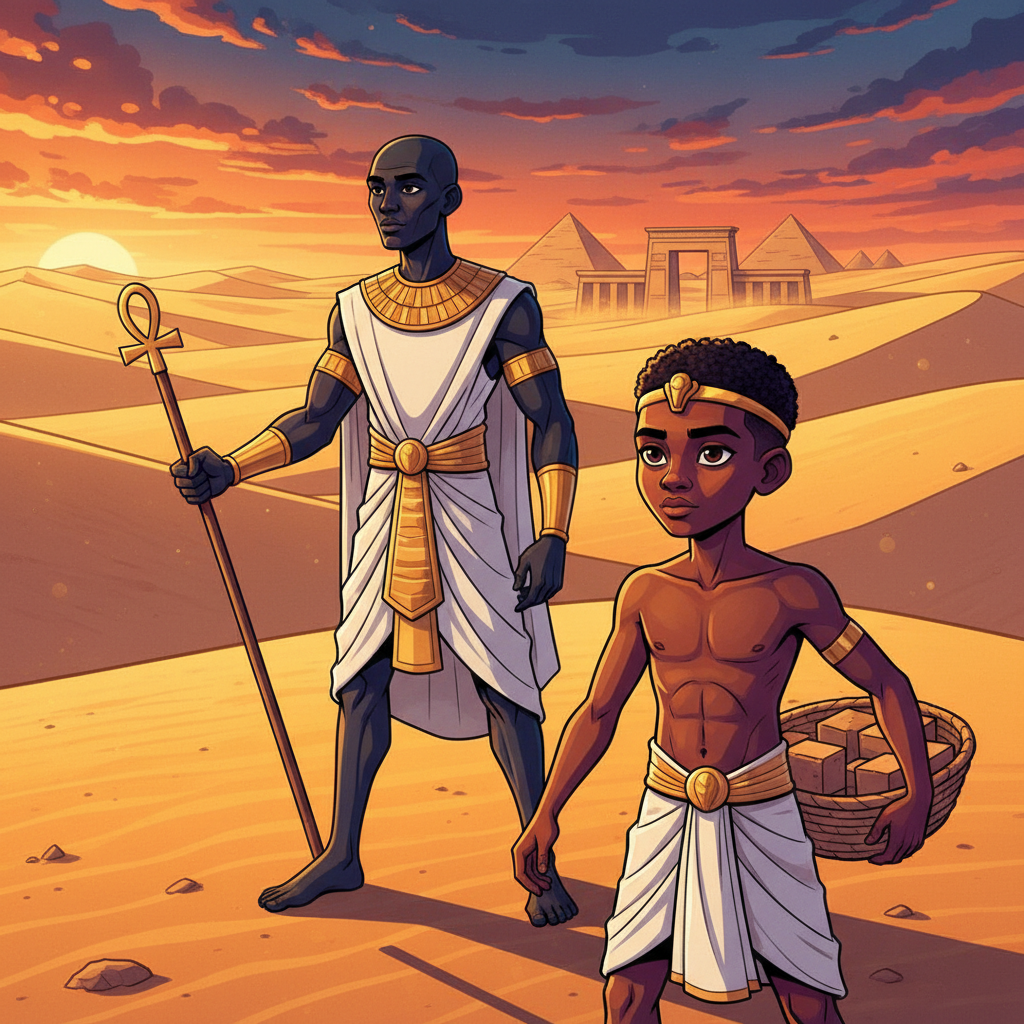
His master, the architect Hemiunu, was unlike anyone Nebka had ever known. He was a tall, broad-shouldered man with skin the color of polished ebony and eyes that seemed to see through stone itself. Hemiunu was a nobleman — a relative of Pharaoh Khufu — yet he worked alongside his builders, climbing the ramps, checking measurements personally, running his fingertips along the joints between blocks to feel whether they were true. He wore a simple white kilt on the building site, no different from his workers, though around his neck hung a gold pendant shaped like a plumb bob — the symbol of his office as royal architect. When he spoke, even the loudest foremen fell silent. Under Hemiunu's guidance, thousands of skilled workers moved massive limestone blocks with a precision that seemed almost magical. But Hemiunu was quick to correct anyone who called it magic. "There is no magic here," he would say, his deep voice carrying across the worksite. "There is only mathematics, observation, and disciplined effort. The pyramid is not just stone, Nebka. It is mathematics made visible. Every angle, every measurement, every block placement follows laws as certain as the flooding of the Nile. The gods gave us minds to discover these laws. To use them well is to honor Ma'at — the divine order that holds the universe together."
Each morning before the heavy labor began, Hemiunu gathered his apprentices in a shaded courtyard near the site and taught them the sacred mathematics of Kemet. There were eight apprentices in all, boys between eleven and fifteen, each chosen for their quick minds. They sat cross-legged on reed mats with limestone flakes in their laps — smooth, flat pieces called ostraca — and reed brushes for writing. Hemiunu paced before them like a patient heron stalking fish, asking questions, drawing diagrams in the dust with a pointed stick, and always pushing them to think deeper. "The pyramid must be perfect," he told them. "The base must be level to the width of a finger across the length of ten fields. The angles must match the stars. There is no room for guessing." Nebka discovered that the mathematics of pyramid building was far more complex than simple counting. Hemiunu taught them the seked — the ancient Kemetic method of calculating the slope of a pyramid's face. "If the pyramid rises seven palms for every five palms and two fingers of horizontal distance," Hemiunu explained, drawing a triangle in the dust, "then the seked is five palms and two fingers. Change the seked, and you change the entire shape. Get it wrong, and the pyramid will lean, crack, or collapse." Nebka practiced calculating sekeds until the numbers moved through his mind as naturally as breathing. He began to see mathematics everywhere — in the angle of sunlight on a wall, in the curve of a pot, in the slope of a sand dune.
Nebka learned to calculate using the royal cubit — the sacred unit of measurement that was the foundation of all building in Kemet. One royal cubit equaled seven palms, and one palm equaled four fingers. Hemiunu made each apprentice carve their own measuring rod from hard acacia wood, marked precisely against the master cubit rod kept in a locked cedar chest. "Guard your cubit rod as you would guard your own heart," Hemiunu warned them. "If your measurements are false, everything built upon them will be false. A builder's cubit rod is his bond of truth." Nebka carved his with care, sanding the wood until it was smooth, burning the measurement marks deep so they could never wear away. He learned how levers and ramps could move stones heavier than twenty oxen. Hemiunu took the apprentices to watch the transport teams at work, explaining each technique. Workers placed wooden rollers beneath the enormous blocks, then teams of men pulled them forward with thick papyrus ropes while others poured water on the sand ahead to reduce friction. "Wet sand," Hemiunu explained, "carries the sled as the river carries a boat." Nebka watched in amazement as twenty men moved a block that weighed more than a hundred of them combined. It was not brute strength alone — it was the intelligent application of principles that Kemetic builders had refined over generations. The ramps that wound around the pyramid were themselves engineering marvels, calculated to rise at exactly the right angle so that teams could haul blocks upward without exhausting themselves.
He learned why the pyramid's four sides faced exactly north, south, east, and west, aligned with the cardinal directions with astonishing accuracy. Hemiunu took the apprentices out on a clear night and showed them how to find true north by observing the circumpolar stars — the stars that never set below the horizon but instead circled around a fixed point in the sky. "Our ancestors discovered this method generations ago," Hemiunu said, pointing upward at the wheeling heavens. "They built an encircling wall, marked where a chosen star rose above its edge and where it set, then bisected the angle between those two points. That bisection line points to true north. This is how we anchor our monuments to the cosmos itself." Nebka felt a shiver pass through him that had nothing to do with the cool desert night. The idea that a building could be connected to the stars, that mathematics could link stone to sky, filled him with a sense of wonder so powerful it was almost like prayer. He began to understand why the builders of Kemet called their work sacred. It was not simply construction — it was an act of bringing heaven and earth into alignment, of establishing Ma'at in physical form. The pyramid would stand for thousands of years, Hemiunu told them, long after everyone who built it had journeyed to the Field of Reeds. It was a monument not just to Pharaoh, but to the knowledge and skill of every worker who placed a stone.
Weeks turned into months, and Nebka grew in both knowledge and confidence. Hemiunu began giving him small responsibilities — checking the alignment of corner stones with a plumb line, verifying that the mortar joints were thin enough to meet the architect's standards, recording the daily count of blocks placed on a papyrus tally sheet. Nebka took each task seriously, triple-checking his work before reporting his findings. The other apprentices noticed. Some admired his diligence, while others, particularly an older boy named Khufuankh, resented that Hemiunu seemed to favor the youngest among them. "You think you are special because the master gives you extra tasks," Khufuankh said one afternoon, blocking Nebka's path near the water station. Khufuankh was fifteen, with broad shoulders and a permanent scowl. "My father is a senior foreman. I have been here two years longer than you." Nebka kept his voice calm, the way Hemiunu spoke when correcting an error. "The master gives tasks to those he believes are ready. Work hard, and he will give them to you as well." Khufuankh sneered but stepped aside. Nebka walked on, his heart beating fast, reminding himself that a builder's foundation must be level — and so must his temper.
One of the things Nebka loved most about the building site was the sense of community. The workers were not slaves, as some foreigners believed — they were skilled craftsmen and proud laborers from villages across Kemet, organized into teams with colorful names like "Friends of Khufu" and "Drunkards of Menkaure." They competed fiercely to see which team could place the most blocks in a day, cheering and chanting work songs that echoed across the plateau. In the evenings, they gathered in the village for meals of roasted meat, fresh bread, onions, and garlic, washed down with thick barley beer. Storytellers recounted the deeds of the ancestors, and musicians played drums and flutes under the stars. Nebka often sat with the older workers during these evening gatherings, listening carefully to their stories. A weathered stonemason named Mereruka, whose dark face was lined like the cracked bed of a dry canal, told him about the construction of earlier pyramids — the step pyramid of Djoser at Saqqara, designed by the legendary Imhotep. "Imhotep was the first," Mereruka said reverently. "Architect, physician, priest, and sage. He proved that a man of Kemet could reshape the earth itself through knowledge. Every builder since has walked in his shadow." Nebka thought about Imhotep often. If knowledge could be passed from master to student across generations, then every lesson Hemiunu taught him was a link in a chain stretching back centuries — a chain he must never break.
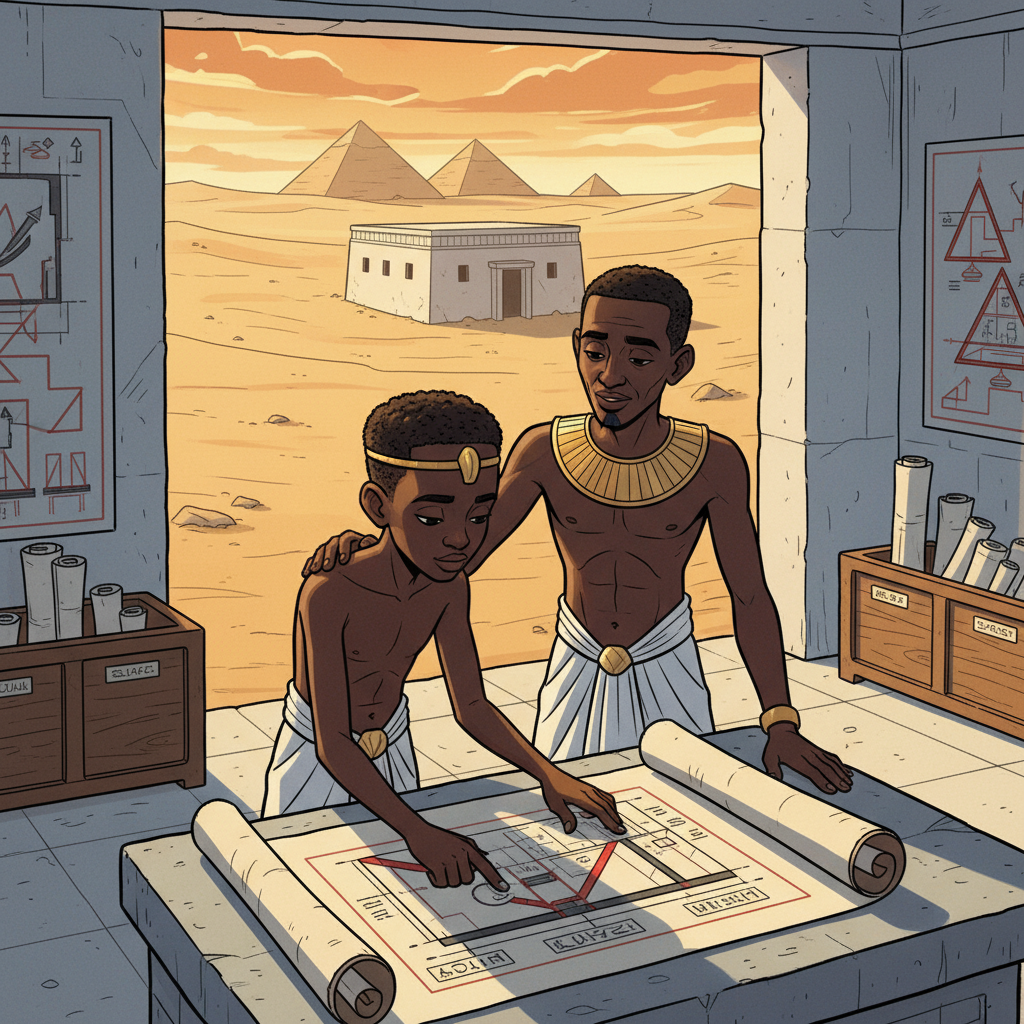
One morning, Hemiunu summoned Nebka to his private workroom — a cool, whitewashed chamber near the site office where papyrus scrolls and architectural plans were stored in labeled wooden cases. The room smelled of ink and cedar, and the walls were painted with geometric diagrams. Hemiunu unrolled a large papyrus across a stone table and beckoned Nebka closer. "Tell me what you see," he said. The drawing showed a cross-section of the pyramid's interior — the descending passage, the grand gallery, and the pharaoh's burial chamber, all drawn with precise measurements in red and black ink. Nebka studied the diagram carefully. "The grand gallery rises at the same seked as the outer face," he said slowly, tracing the line with his finger. "And the burial chamber is not at the center of the base — it is offset toward the south." Hemiunu's eyes brightened. "Good. And why is the chamber offset?" Nebka thought hard. "To distribute the weight of the stone above it more evenly? If it were at the center, the pressure from all four sides would concentrate on one point." Hemiunu placed a hand on Nebka's shoulder. "You are beginning to think like a builder, not just calculate like a scribe. Understanding why is more important than knowing how. Remember this always." Nebka felt warmth spread through his chest. Praise from Hemiunu was rarer than gold and worth far more.
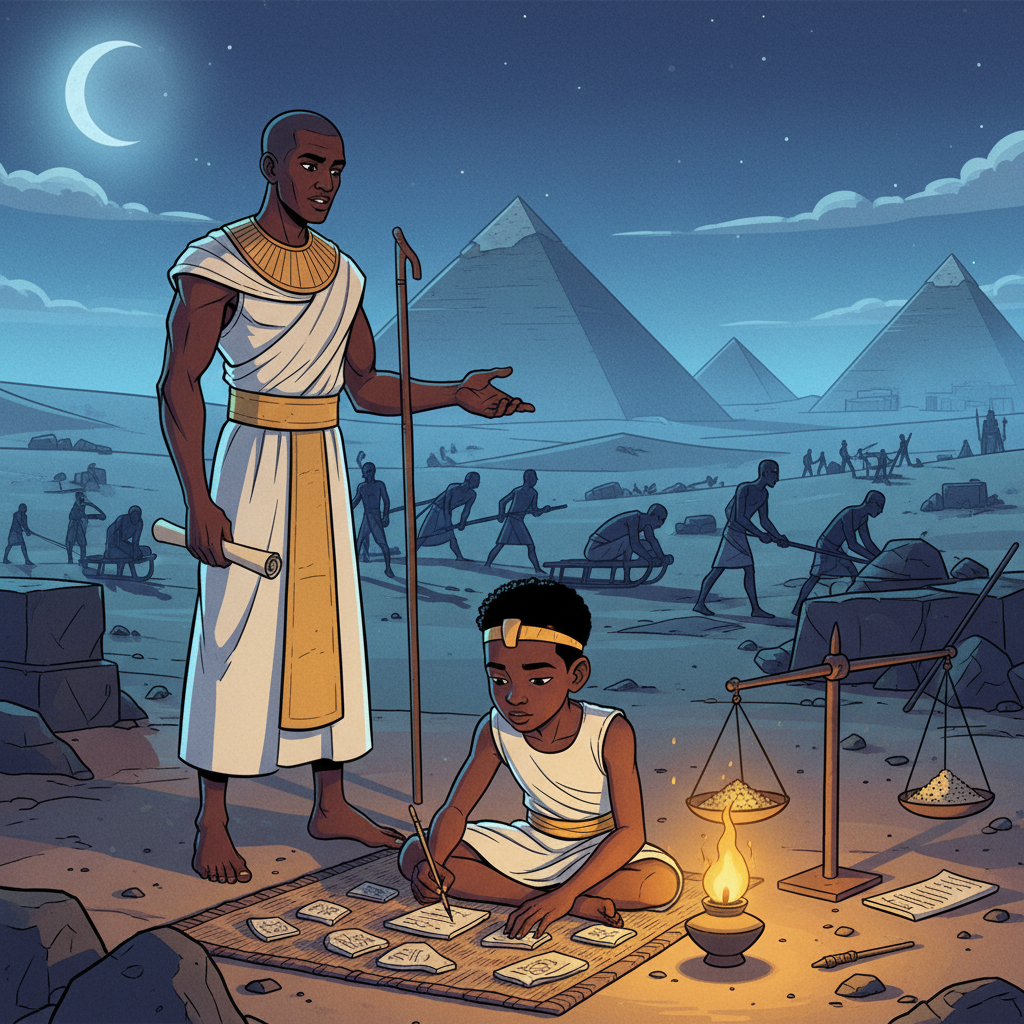
As the months passed, Nebka came to understand that building the pyramid required not just mathematics and engineering, but the careful management of people, resources, and time. Hemiunu coordinated the work of quarrymen who cut the blocks, transport teams who moved them, masons who shaped and fitted them, surveyors who checked every measurement, and scribes who recorded every detail on papyrus. There were also the cooks, bakers, brewers, physicians, and toolmakers who kept the workforce healthy and equipped. It was, Nebka realized, like conducting an enormous orchestra where every instrument had to play its part in perfect harmony. Hemiunu taught his apprentices about this coordination as carefully as he taught them mathematics. "A pyramid is built by ten thousand hands guided by one vision," he said. "But that vision must account for every hand. If the quarrymen cut faster than the transport teams can move, blocks pile up and workers stand idle. If the bakers cannot keep pace, men grow weak and accidents happen. The architect must see the whole picture — from the stars above to the sand below — and keep everything in balance. This too is Ma'at." Nebka wrote these lessons on his ostraca and studied them at night by the light of an oil lamp, determined to absorb everything his master offered.
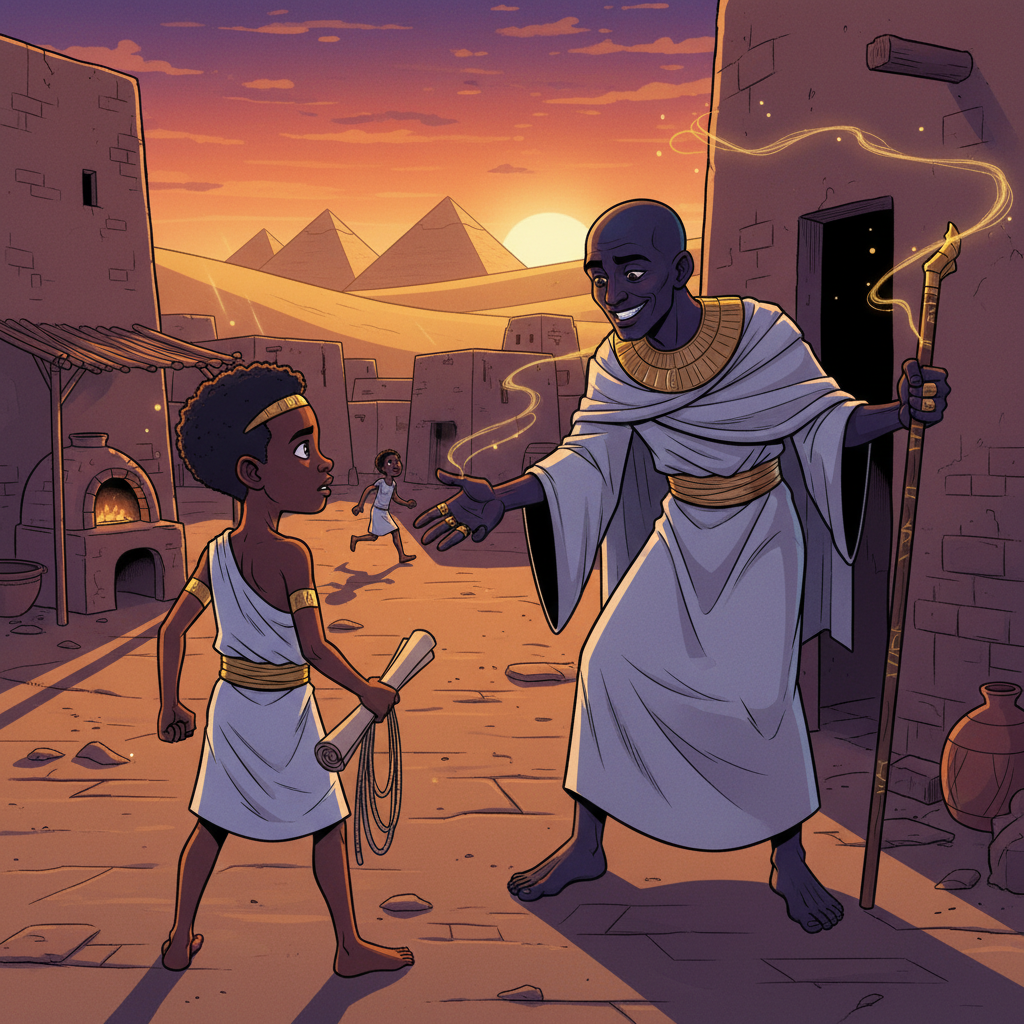
One evening, as the sun dropped behind the western desert and painted the sky in bands of orange and violet, Nebka was walking through the workers' village toward his quarters. He had stayed late to help the surveyors check the northeast corner alignment and was tired, his mind still full of angles and measurements. The village was quieter than usual — most of the workers had already eaten and retired to their homes. The smell of baking bread lingered in the cooling air, and somewhere a child was laughing. A man stepped out from between two buildings and blocked Nebka's path. He was not a worker — Nebka could see that immediately. The man wore fine white linen of the quality reserved for nobles, and gold rings gleamed on his fingers. His skin was smooth, his nails clean, and he smelled of expensive perfumed oil. He smiled at Nebka, but the smile did not reach his eyes. "You are Nebka, apprentice to the architect Hemiunu?" the man asked. His voice was soft and pleasant, like honey poured over bread. Nebka nodded cautiously, suddenly aware of how alone they were on this quiet stretch of the village path.
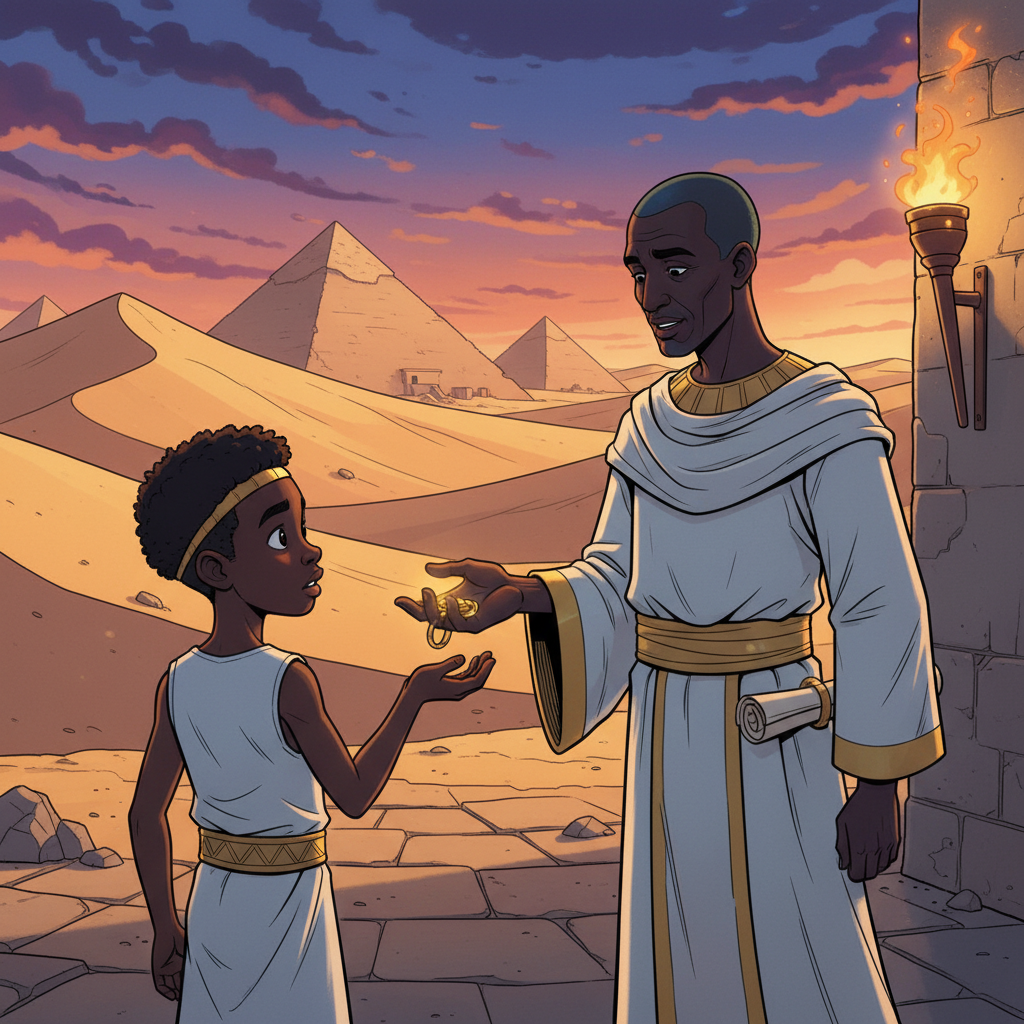
"I represent a noble of great importance," the man continued, glancing around to make sure no one was listening. "A man who admires the work being done here and wishes to build his own monument — a tomb worthy of his family's legacy. He has land, workers, and resources. What he lacks is knowledge. The mathematical secrets of pyramid construction, the engineering methods your master guards so carefully." He paused, letting the words settle. "We will pay you well for the architect's secrets, young one. Very well indeed." He reached into a leather pouch at his belt and drew out a handful of gold rings, holding them so they caught the last light of the dying sun. Nebka stared at the gold. It gleamed in the torchlight from a nearby doorway, warm and heavy and real. His mind raced. His family lived in a modest village far to the south, where his mother wove linen and his younger sisters helped tend a small garden. His father's wages as a quarryman were fair, but they were not wealthy. Gold like this could feed his family well for years. It could buy better tools for his father, new linen for his mother, and scrolls for his sisters' education at the local Per Ankh. The temptation was sudden and sharp, like a thorn hidden in soft grass.
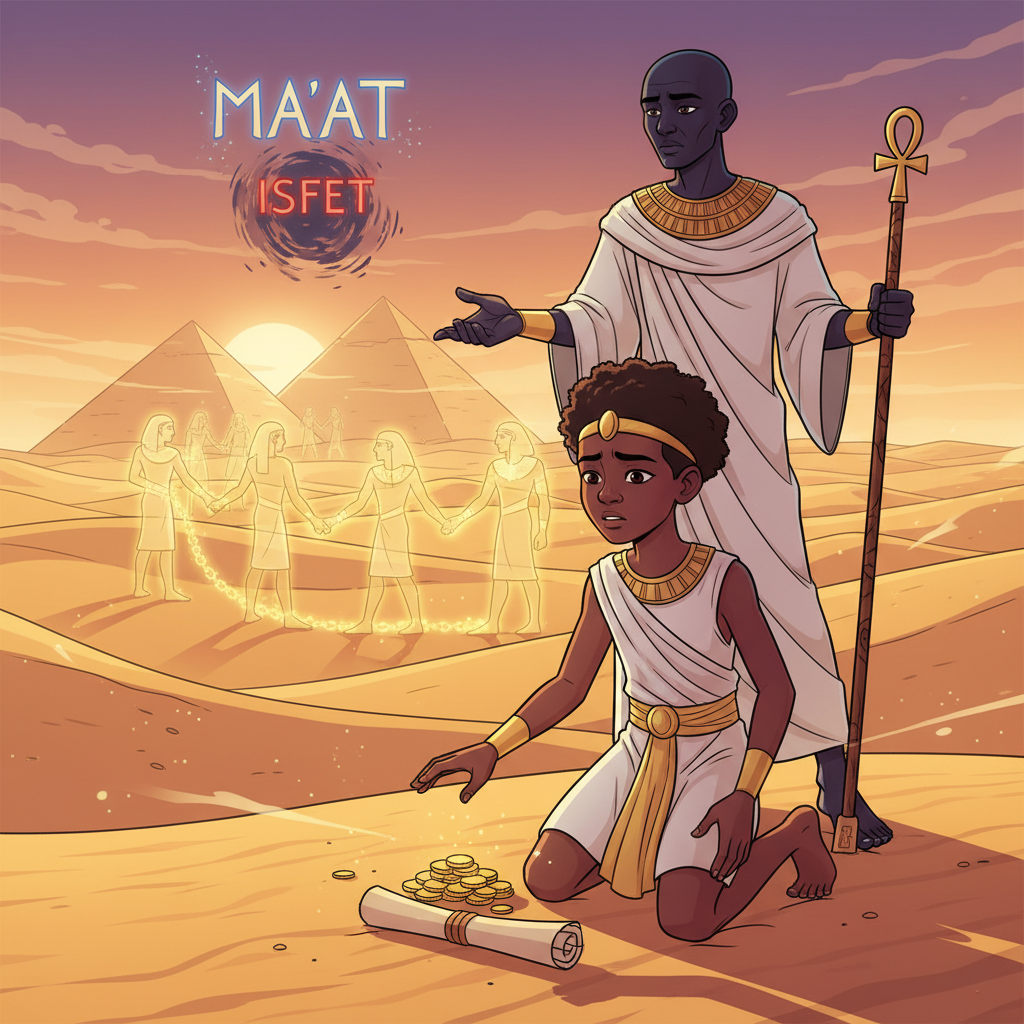
But even as the desire flickered through him, another voice rose in Nebka's mind — quieter than the temptation but far stronger. He thought of Hemiunu standing before the apprentices, speaking of the sacred responsibility of knowledge. He thought of old Mereruka describing the chain of wisdom stretching back to Imhotep. He thought of the word that Hemiunu used more than any other: Ma'at. Truth. Justice. The divine order. Ma'at was not simply a concept to be discussed — it was a way of living, a commitment to doing what was right even when doing wrong would be easier and more profitable. To sell Hemiunu's secrets would be to break the chain of trust, to choose Isfet — chaos and dishonesty — over the order that held their civilization together. Nebka also thought about what these secrets meant. The mathematics of pyramid building had not been invented by one person. They were the accumulated wisdom of generations of Kemetic architects, engineers, and mathematicians — knowledge refined over centuries and passed carefully from master to student. Each master chose students not merely for their cleverness but for their character, because knowledge without integrity was dangerous. A man who would sell sacred knowledge for gold might also cut corners in construction, falsify measurements, or build monuments that would crumble and kill the workers inside. The secrets were kept not out of selfishness, but out of responsibility.
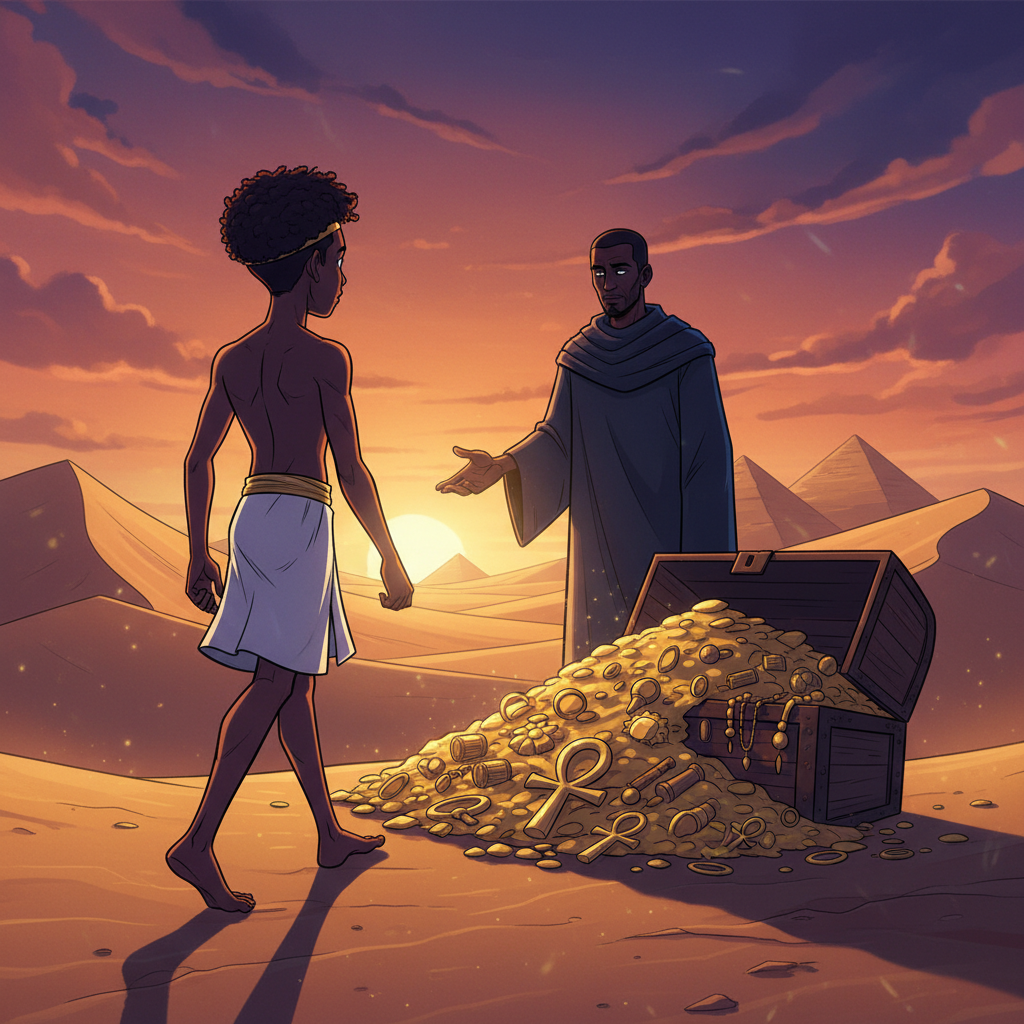
Nebka lifted his gaze from the gold and looked the man directly in the eyes. His heart was pounding, but his voice came out steady and clear, like a stone set perfectly in its place. "This knowledge was given to me in trust," he said. "It was given by my master, who received it from his master before him. It belongs to Kemet and its people — to be used for the glory of our civilization and the service of Ma'at. It is not mine to sell, and it is not yours to buy. No amount of gold can equal the value of what you are asking me to betray." The man's pleasant expression flickered, and for a moment something cold passed behind his eyes. "You are young," he said, his honeyed voice now carrying a faint edge. "Perhaps you do not understand the opportunity I am offering. Gold like this does not come to boys like you every day." Nebka did not flinch. "And integrity, once sold, does not come back at any price," he replied. "I follow Ma'at. That is my answer." He stepped around the man and walked away into the evening, his back straight, his hands steady, and his heart full of a fierce, quiet pride that burned brighter than any gold.
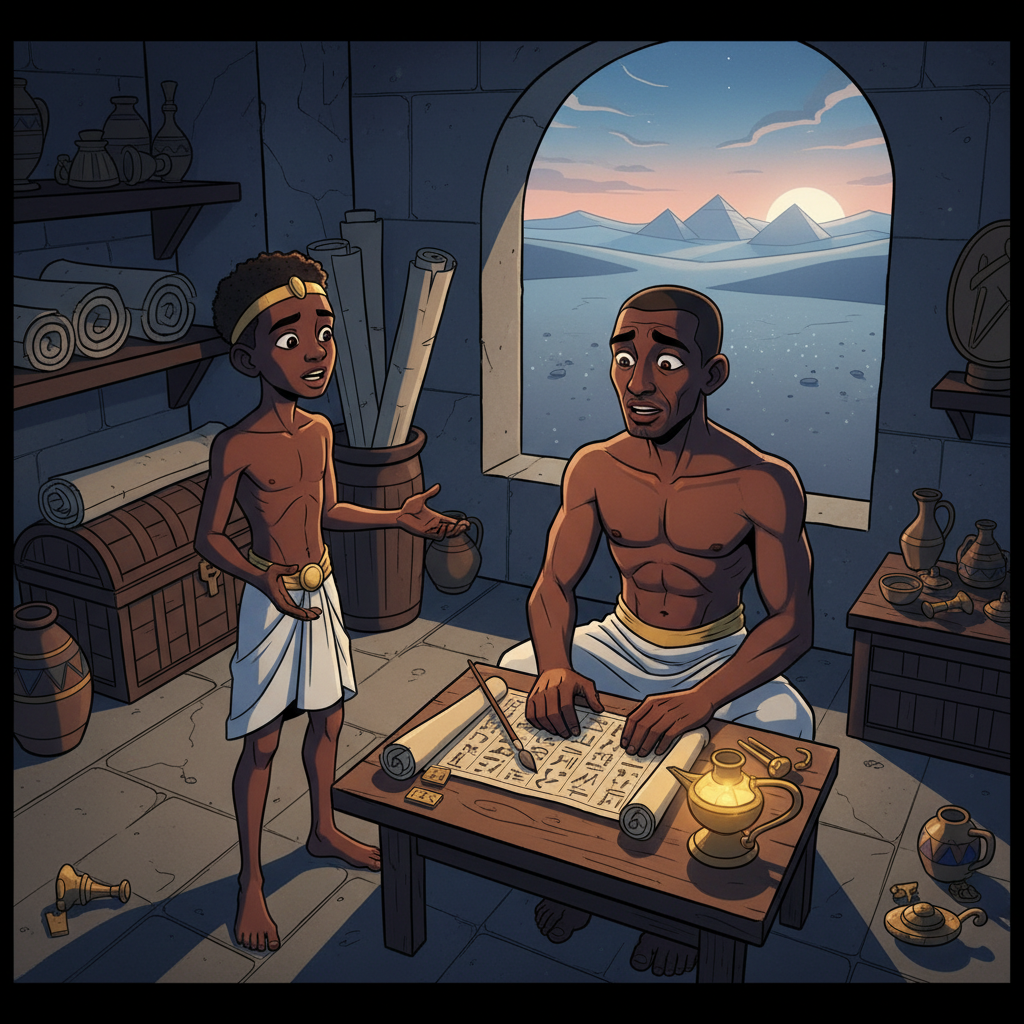
Nebka did not sleep well that night. He lay on his reed mat staring at the ceiling, replaying the encounter in his mind. Had he done the right thing? The gold had been real. His family's needs were real. Was it foolish to turn away wealth for the sake of a principle? But every time doubt crept in, he heard Hemiunu's voice: "Ma'at is not what is easy. Ma'at is what is true." By the time the stars began to fade and the first gray light touched the eastern horizon, Nebka's heart was settled. He rose, washed, and went to find his master. He found Hemiunu already awake, sitting in his workroom reviewing plans by lamplight. Nebka told him everything — the man's fine linen, the gold rings, the request for secrets, and his refusal. He held nothing back. Hemiunu listened without interruption, his dark face unreadable. When Nebka finished, a long silence filled the room. Then Hemiunu set down his reed brush and looked at Nebka with an expression the boy had never seen before — something between pride and deep emotion, as though he were seeing not just a twelve-year-old apprentice but the future of Kemet itself.
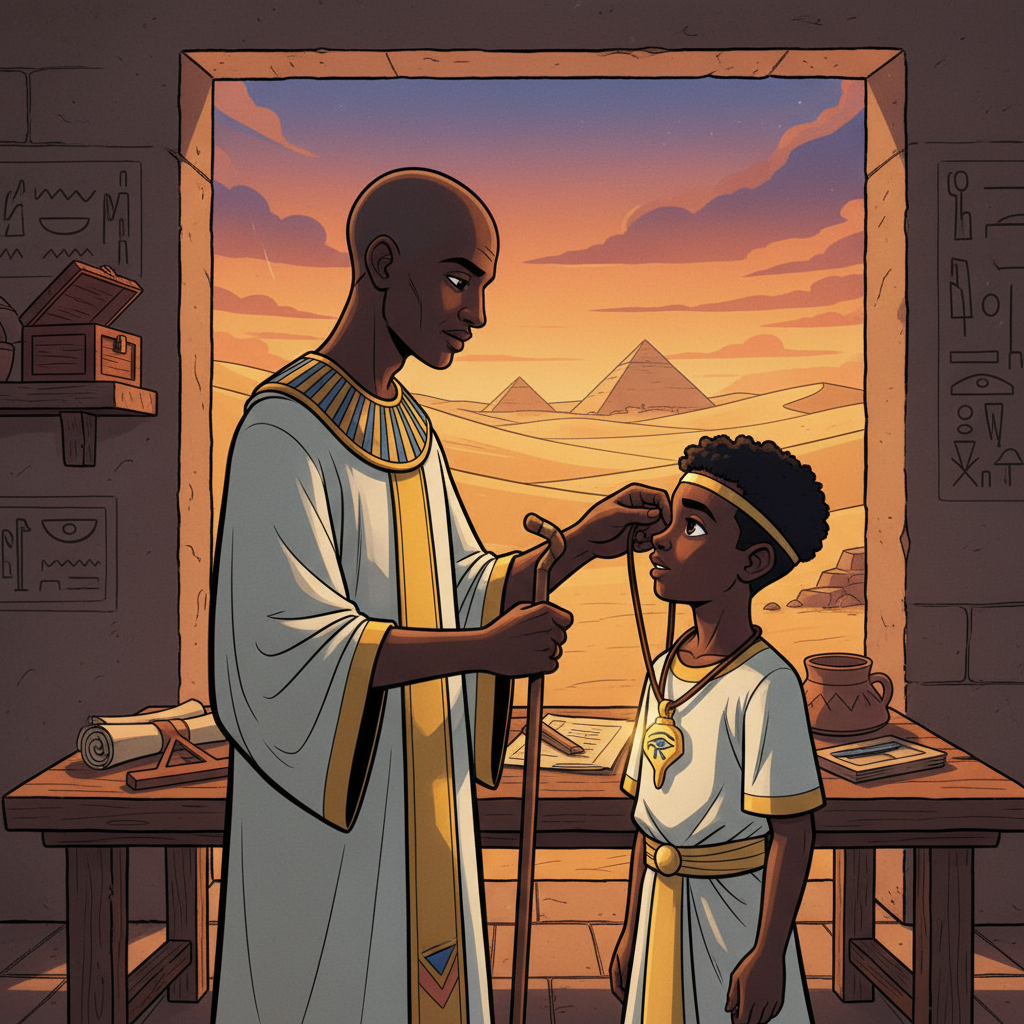
Hemiunu rose from his seat and walked to a small cedar chest that sat on a shelf behind his worktable. Nebka had seen the chest many times but had never seen it opened. Hemiunu lifted the lid and removed something that caught the lamplight — a gold pendant on a leather cord, shaped like a miniature plumb bob with the eye of Heru engraved on one side and the feather of Ma'at on the other. It was the symbol of the master builders of Kemet, the emblem worn by those who had proven themselves worthy to carry the sacred knowledge forward. "Do you know what this pendant represents?" Hemiunu asked, holding it up so the gold spun slowly in the lamplight. "It is not a reward for mathematics, though your mathematics are excellent. It is not a prize for engineering, though your understanding grows stronger each day. This pendant is given only to those who have passed the true test — not of the mind, but of the heart." He stepped forward and placed the cord around Nebka's neck. The pendant was warm against Nebka's chest, and it seemed to carry a weight far greater than gold. "You have shown that you understand the most important lesson I can teach: knowledge without character is a blade without a handle. It cuts the one who wields it."
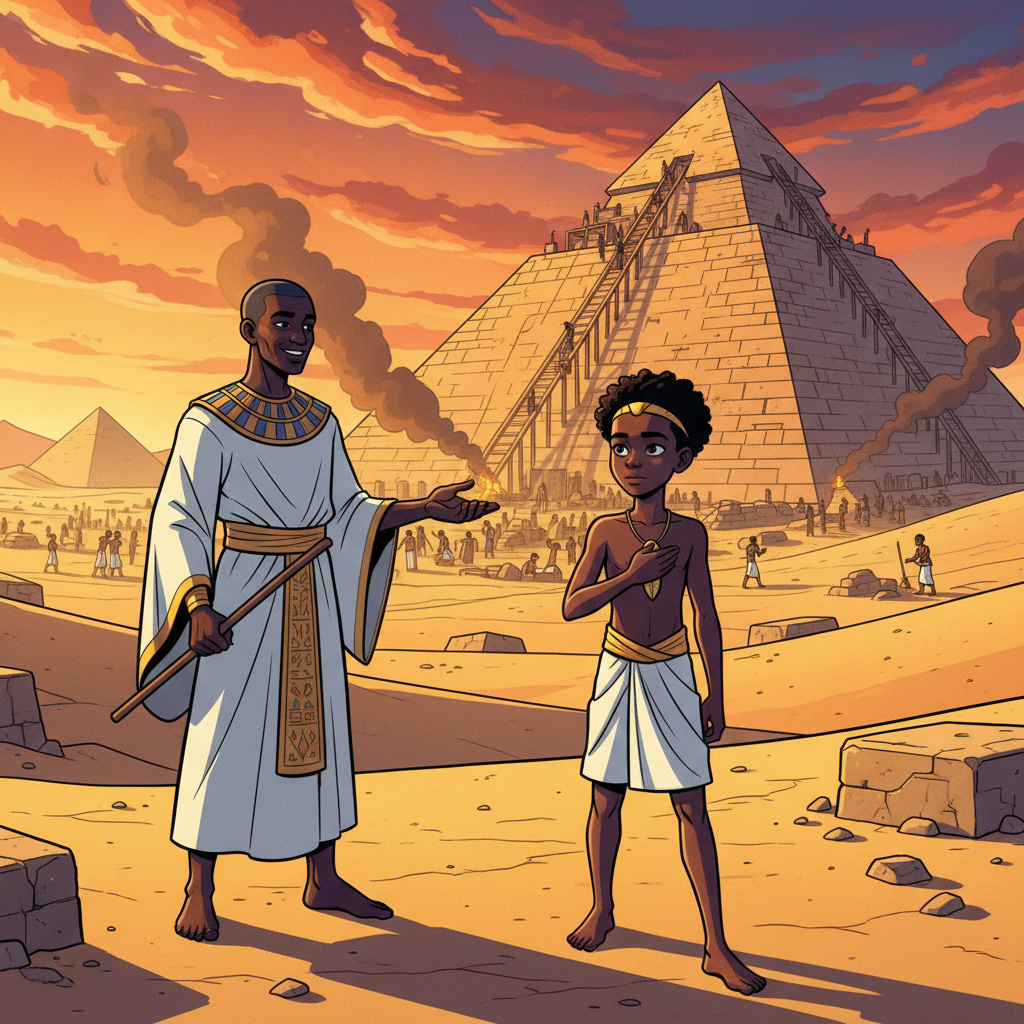
Nebka touched the pendant with trembling fingers, feeling the engraved lines of the feather of Ma'at beneath his thumb. Tears pricked at his eyes, but he blinked them back. Around them, the building site was coming to life — the sound of hammers on chisels, the chanting of work crews, the creak of ropes pulling great stones up the ramps toward the sky. The Great Pyramid was growing, block by block, toward the heavens, and Nebka was part of it. Not just a pair of hands carrying tools, but a keeper of the sacred knowledge, a link in the unbroken chain that stretched from Imhotep to Hemiunu and now to him. "Go now," Hemiunu said, a rare smile softening his stern face. "There is work to do, and a pyramid to finish. But remember this day, Nebka. The stones of a pyramid can be measured with a cubit rod, but the character of a builder can only be measured by the choices he makes when no one is watching. You chose Ma'at over gold, truth over profit, honor over ease. That is the foundation upon which everything else is built — and unlike limestone, it will never crumble." Nebka straightened his back, pressed his hand once more against the pendant at his chest, and walked out into the brilliant morning sunlight to begin another day of building eternity.