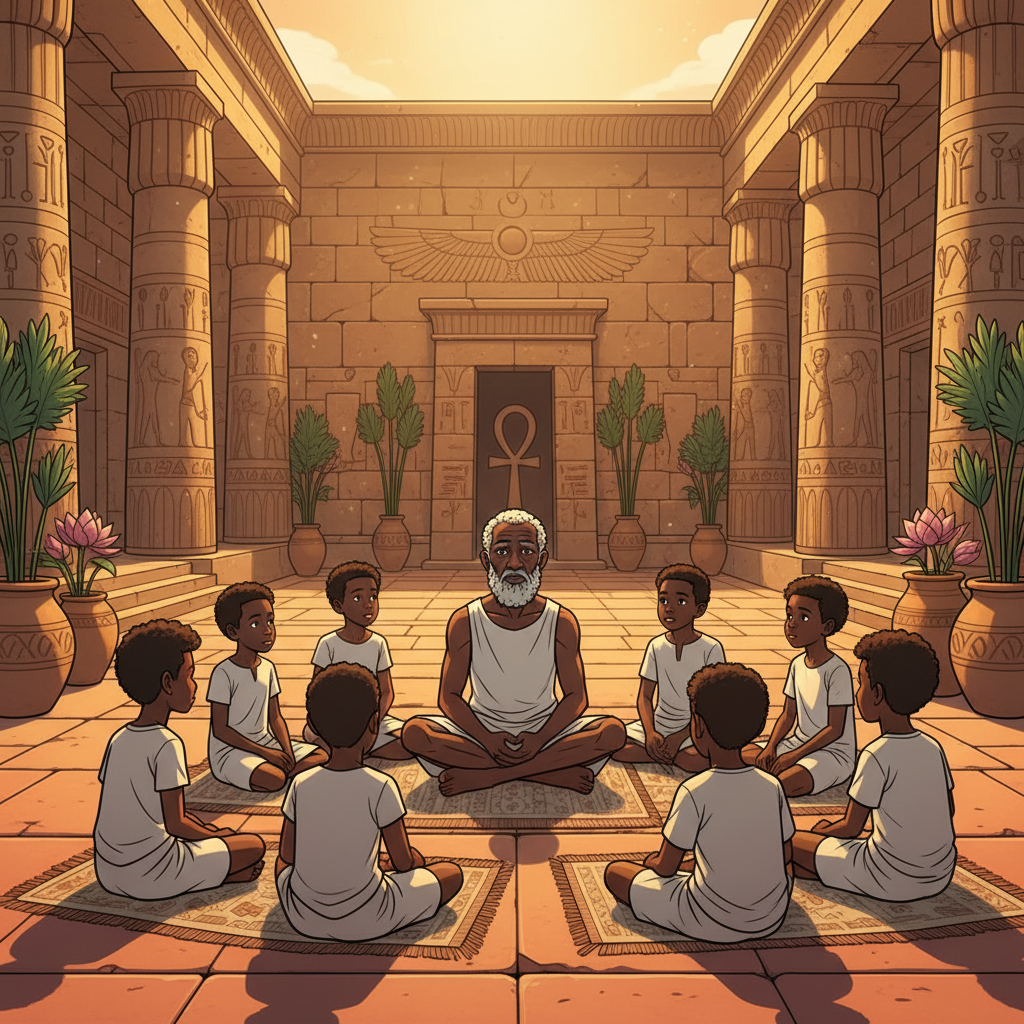
In the Per Ankh — the House of Life — a teacher called Ptahmose gathered the boys for their first lesson. They were seven and eight years old, fresh from their mothers' teaching, ready to learn the way of men. Ptahmose was old, with deep brown skin lined like a river delta. His voice was low and steady, like stones settling into earth. The Per Ankh was no ordinary school. It was the place where Kemet trained its scribes, its priests, its physicians, and its leaders. Every word spoken inside these walls carried weight. The boys sat on reed mats in the courtyard, the morning sun warming their dark shoulders, and they did not yet understand what they had entered.
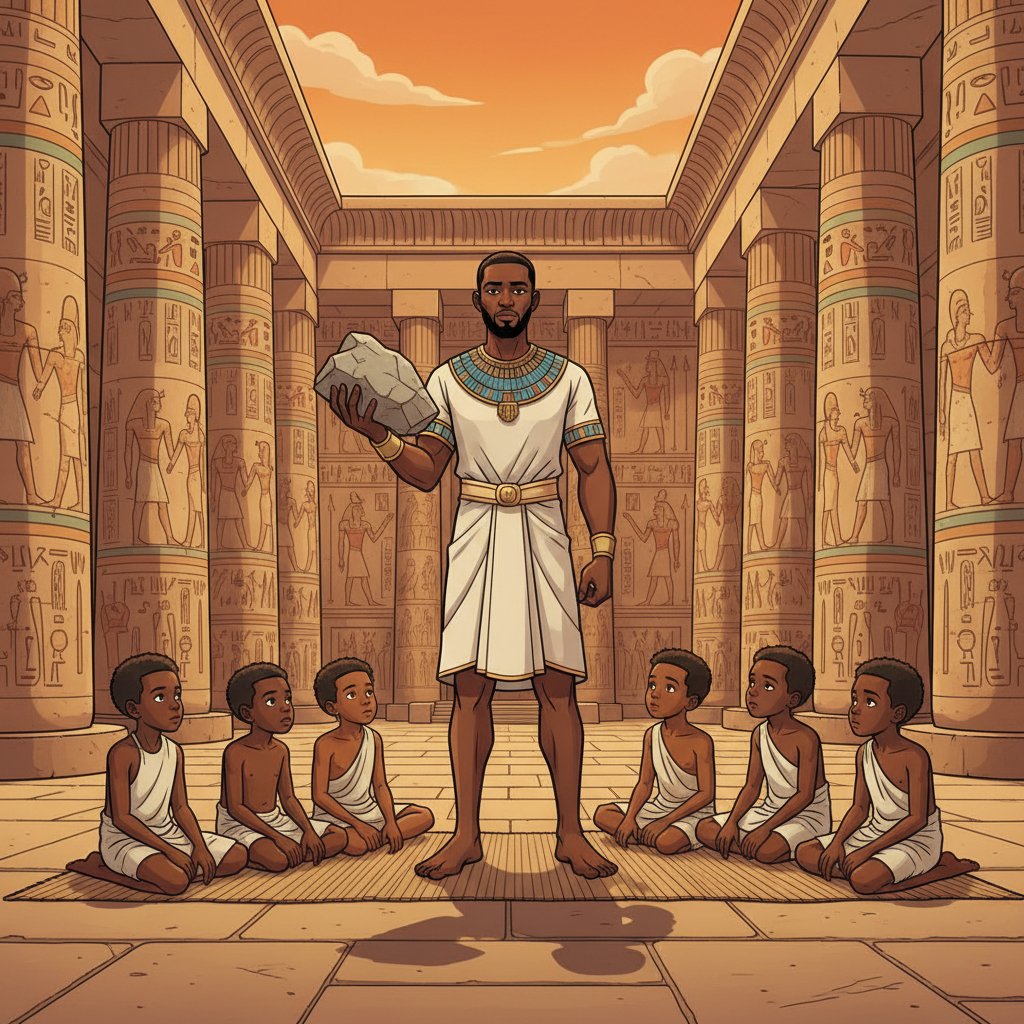
"You think you are already men because you are strong and loud," Ptahmose said. The boys grinned. He did not grin back. "You are raw material. A block of stone from the quarry is strong too. But it is not a statue. It is not a pillar. It is not a temple wall. It must be shaped." He let the silence sit. The boys shifted on their mats. Ptahmose picked up a rough chunk of limestone from beside his chair and held it out. "This stone has sekhem — raw power inside it. But without a sculptor's hand and a sculptor's patience, it will never become anything. You are this stone. I am one of your sculptors. Ma'at is the design we follow."
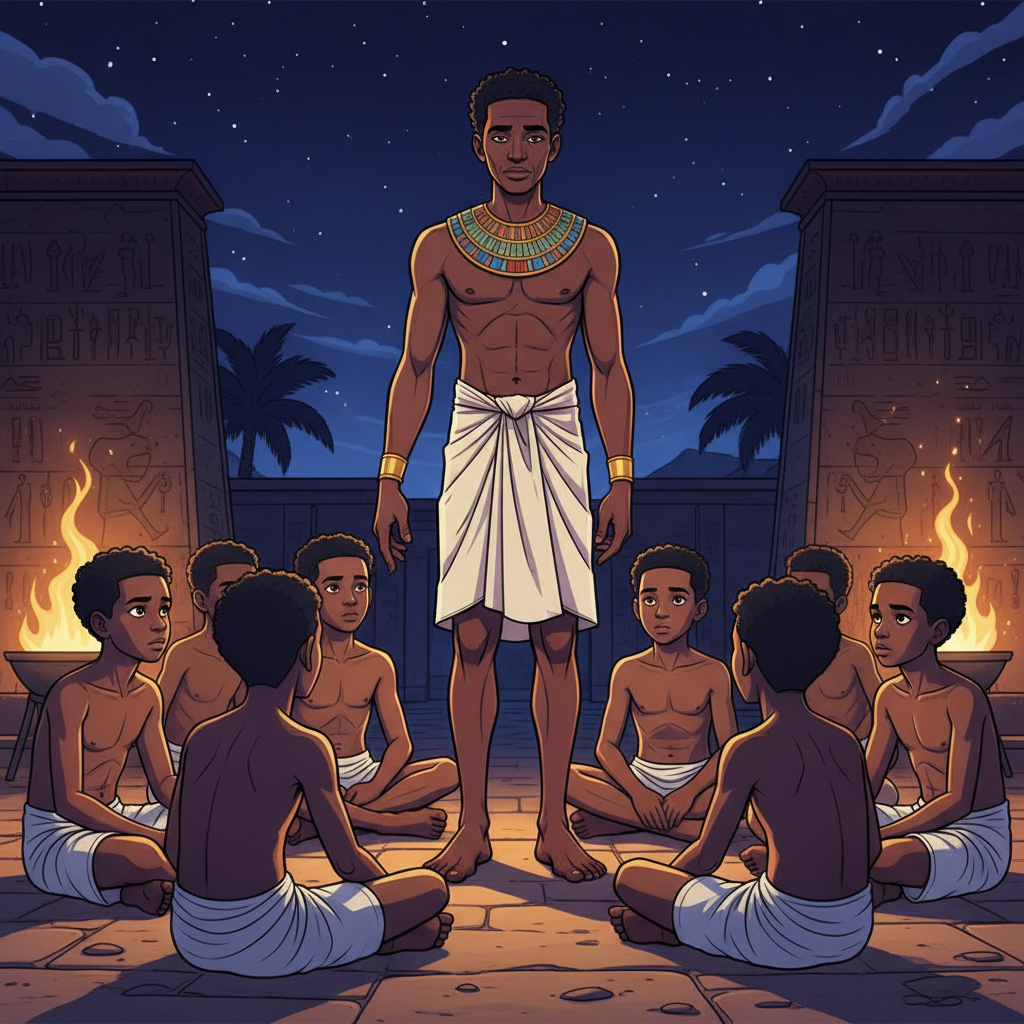
"A son of Ma'at stands on four pillars." He held up one dark finger. "First: Truth. Your word must have weight. If you say you will do something, you do it. If you did something wrong, you name it. A man whose word means nothing is a man who means nothing." The boys were quiet now. Ptahmose lowered his hand and looked at each of them in turn, his deep ebony face unreadable. "Truth is not simply avoiding lies. Truth is building something real with your mouth. Every time you speak honestly, you lay a brick. Every time you lie, you pull one out. Eventually a wall with too many missing bricks falls down."
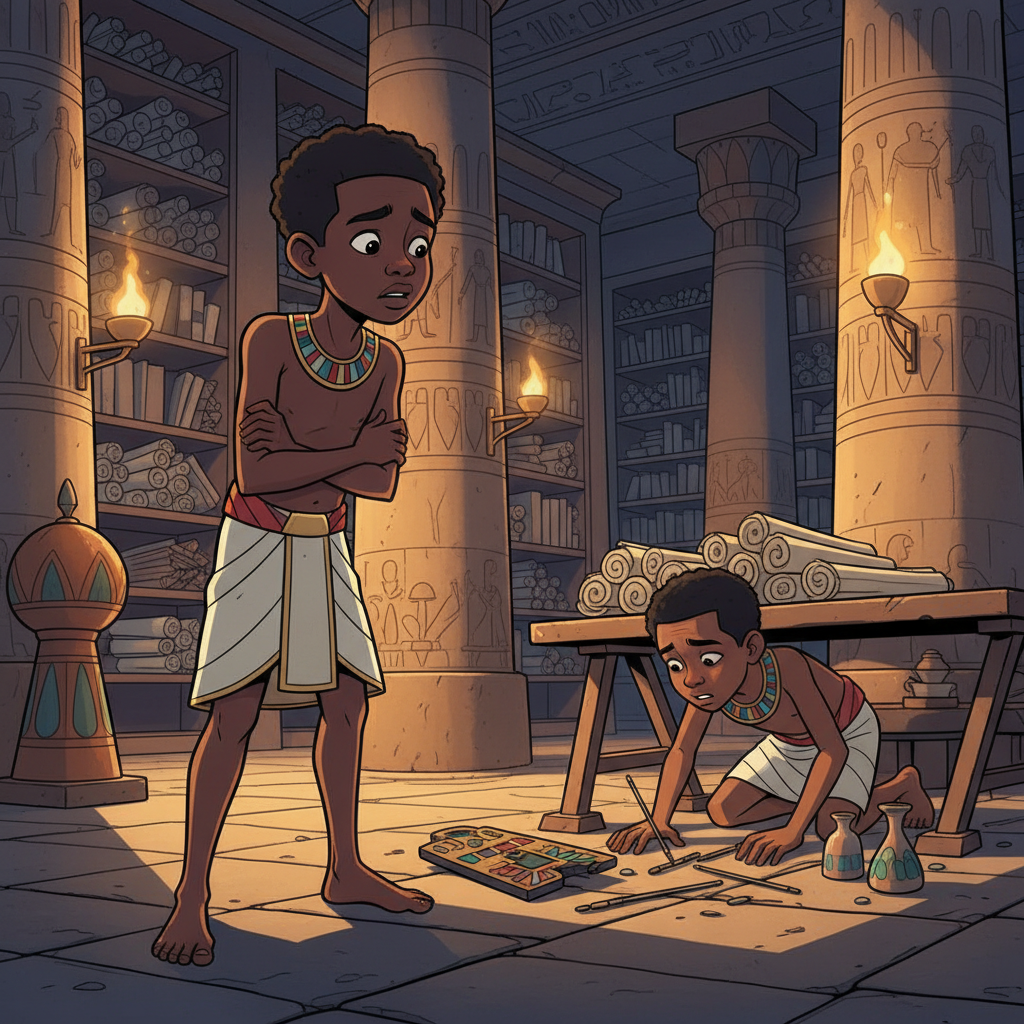
Ptahmose told them a story. "There was once a boy in this very Per Ankh named Userhet. Skin dark as river silt, clever as a cat. One morning he broke a writing palette that belonged to another student. It was an accident — his elbow knocked it from the bench. But when the other boy returned, Userhet said nothing. He watched his classmate search and worry, and he stayed silent." "By afternoon, Userhet felt as though he had swallowed a stone. His ka — the spirit-self that lives within you — was disturbed. He could not write cleanly. He could not sit still. Silence had become heavier than any confession would have been."
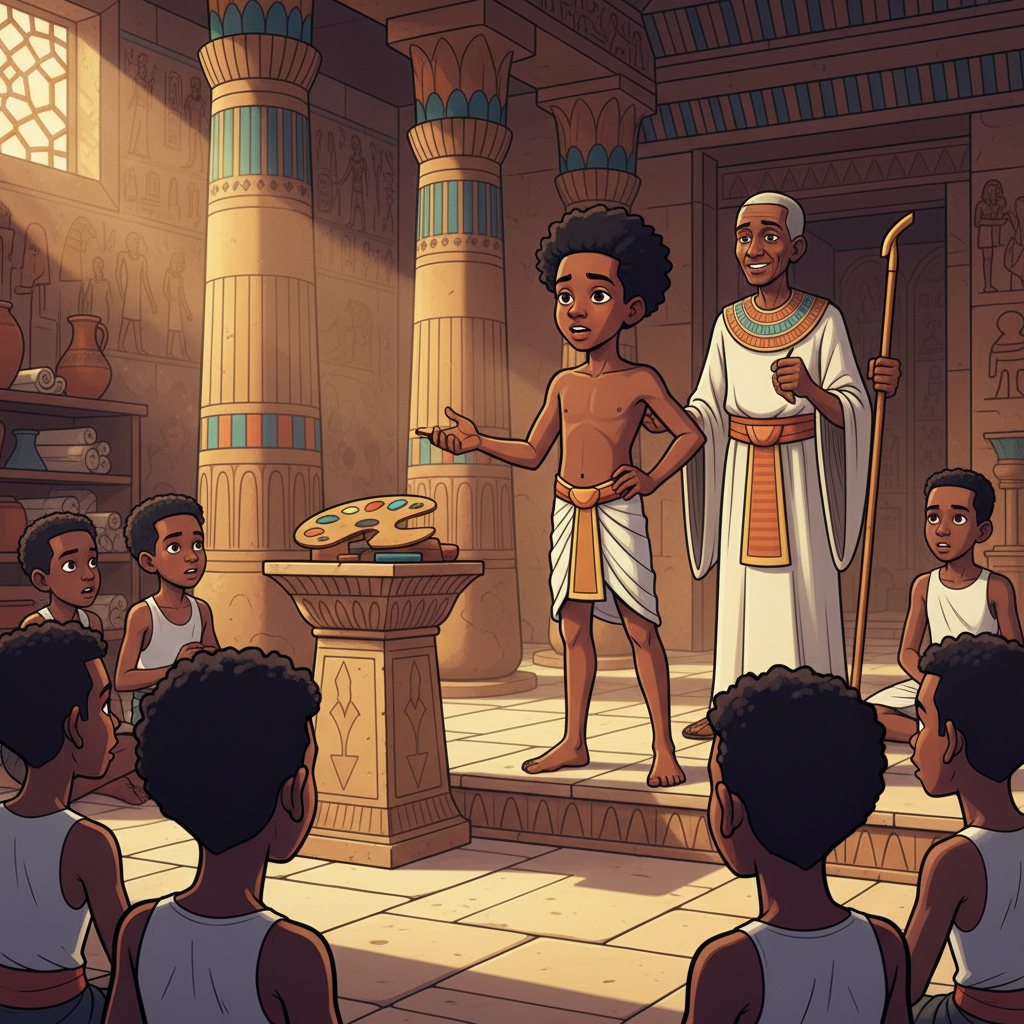
"Finally, Userhet stood before the class and spoke the truth. He said: I broke it, and I was afraid to tell you. He offered to replace the palette with one he would make himself." Ptahmose paused. "The other boy was angry for one afternoon. But by the next morning, he trusted Userhet more than before — because now he knew Userhet would speak the truth even when it was difficult." Ptahmose leaned forward. "The opposite of truth is not just lying. It is isfet — disorder, chaos, the unraveling of things. Every hidden wrong is a seed of isfet. Every honest word, even a painful one, is a seed of Ma'at. You choose which garden you tend."
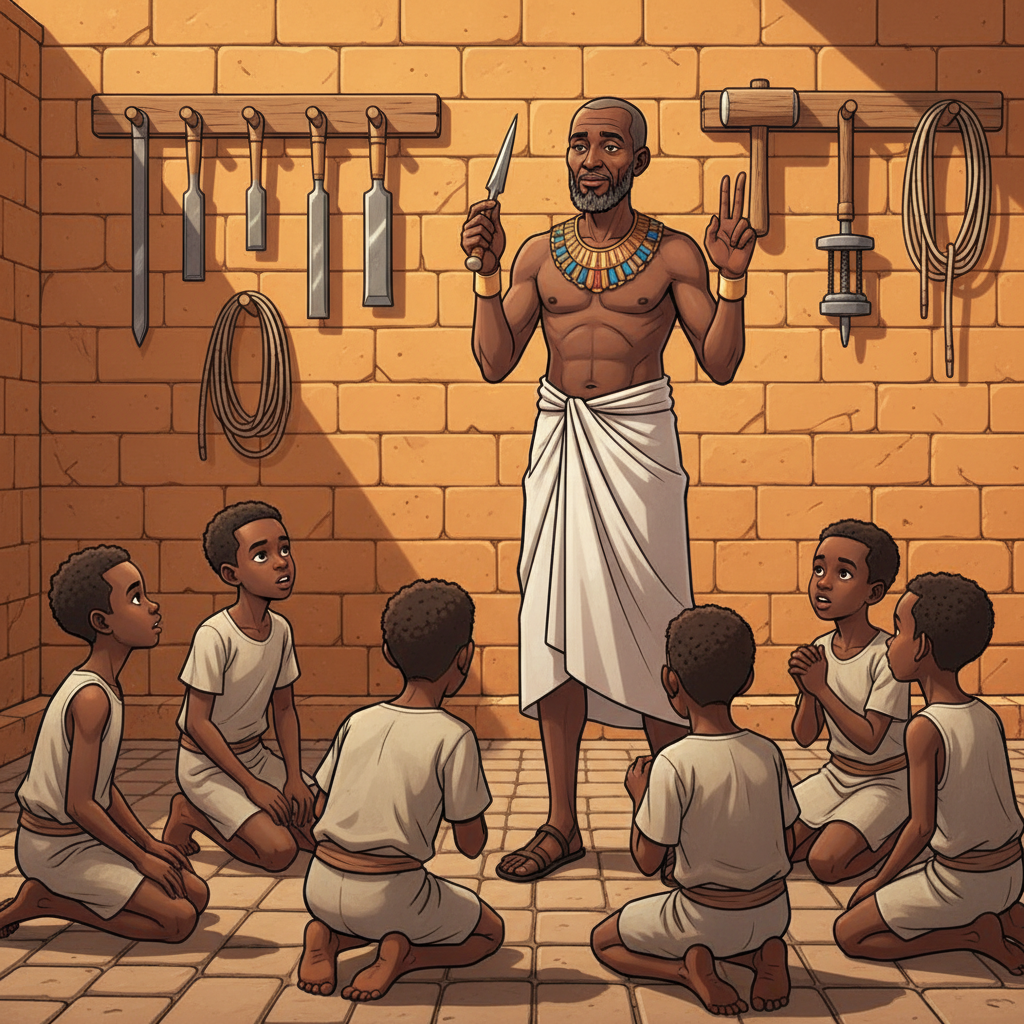
He raised a second finger. "Second: Self-governance. You must control yourself before you can be trusted with anything else. The boy who cannot stop himself from hitting when angry cannot be trusted with a tool, a weapon, or a family." Ptahmose stood and walked to the courtyard wall where tools hung on wooden pegs — chisels, mallets, measuring cords. He took down a sharp copper chisel and held it before the boys. "This chisel can carve a king's name into eternity. It can also split a hand open. The chisel does not decide — the one who holds it decides. Self-governance means you are the master of your own hands, your own mouth, your own temper."
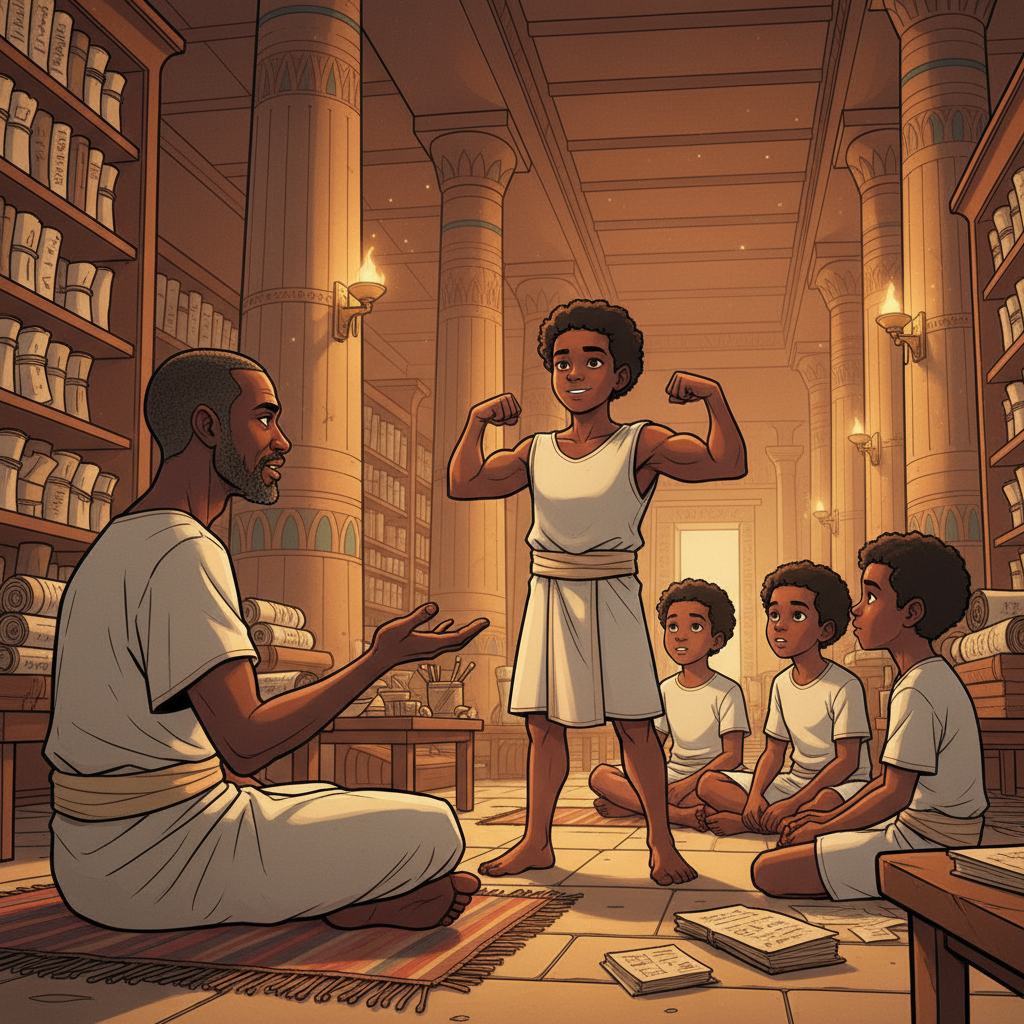
"I will tell you about a boy named Khaemwaset," Ptahmose continued, sitting back down. "He was the strongest boy in his class. Rich dark skin, arms like a young carpenter. But when anyone teased him, his fists answered before his mind could speak. One day during reed-cutting along the Nile, another boy mocked his handwriting. Khaemwaset shoved him into the mud and broke three cut reeds that had taken the group all morning to harvest." "The teacher did not beat Khaemwaset. Instead, he gave him a task. For ten days, Khaemwaset had to carry a full water jar on his head from the river to the Per Ankh without spilling a drop. Every morning. In silence."
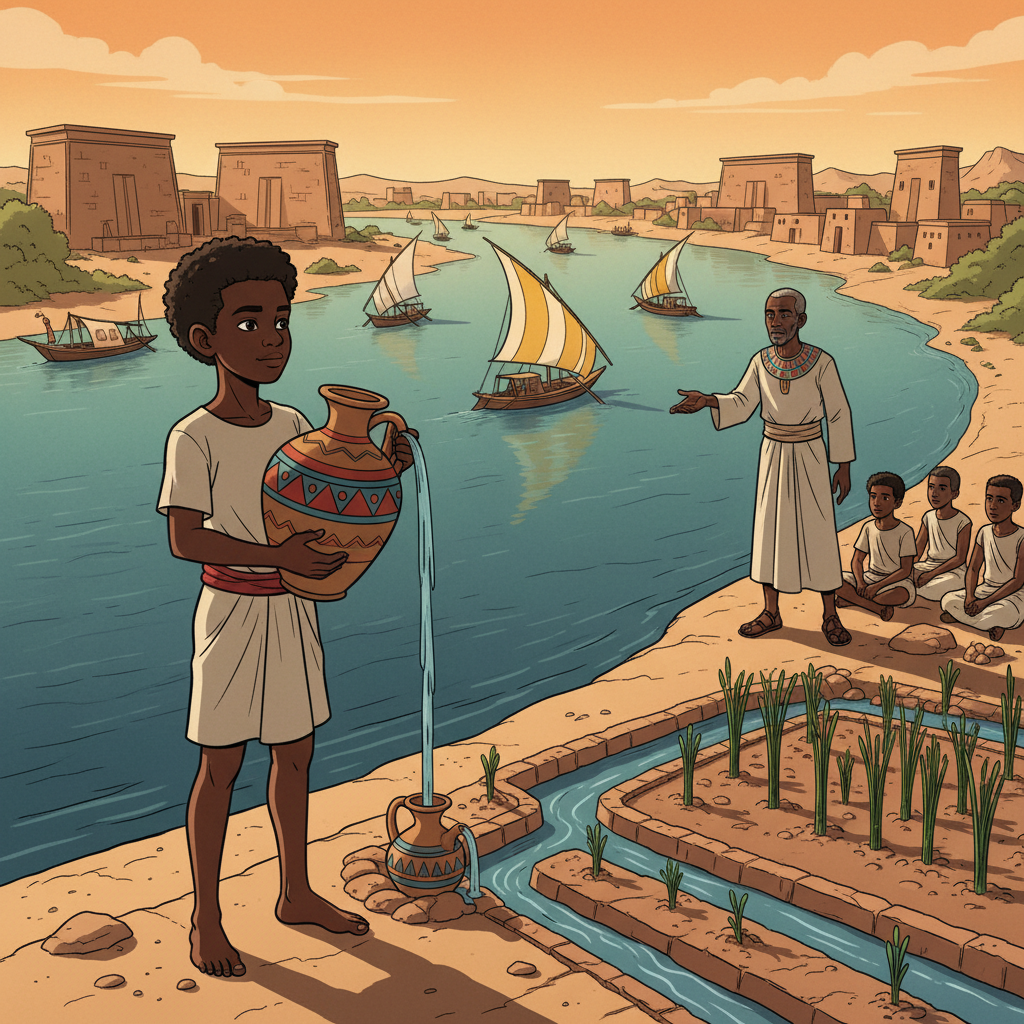
"By the third day, Khaemwaset hated the jar. By the fifth, he could feel his mind settling into the rhythm of careful steps. By the tenth day, he understood: the jar was not punishment. It was practice. He was learning to hold something precious and not let his impulses destroy it. His temper was the water. His discipline was the jar." Ptahmose looked at the boys. "Self-governance is not about never being angry. The Nile floods every year — that is its nature, and that flooding brings life. But the irrigation channels direct the water where it is needed. Without channels, the flood destroys. You must build your own channels."
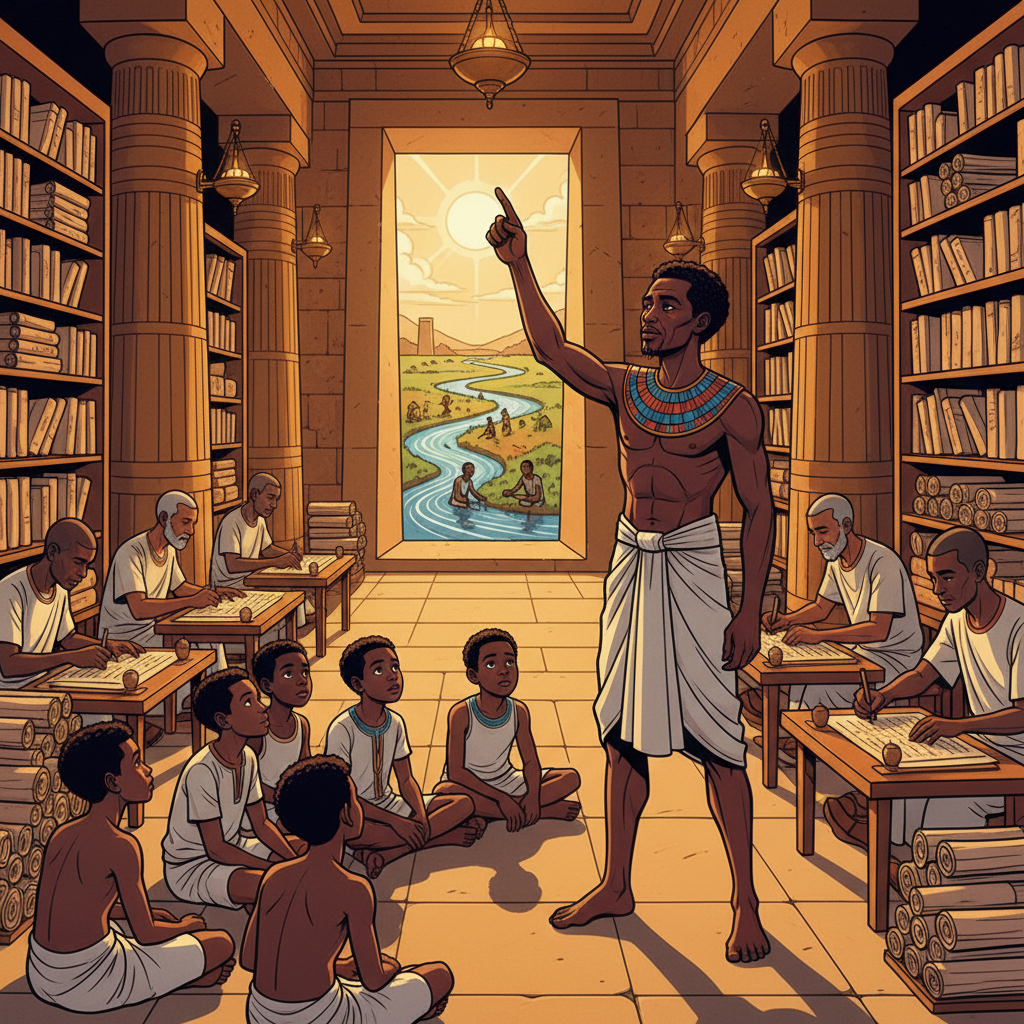
A third finger rose. "Third: Reliability. Your character is what you do every single day — not what you do once. A boy who trains hard one day and quits for a week has no pattern. Be the Nile — it floods every year without fail. That is why Kemet trusts the river with its life." He gestured toward the papyrus scrolls stacked neatly along the classroom wall. "Every scribe in this Per Ankh copies texts each morning. Not because copying once teaches you everything, but because the repetition carves knowledge into your ka. Reliability means your people can build their plans around you, the way farmers build their planting around the flood."
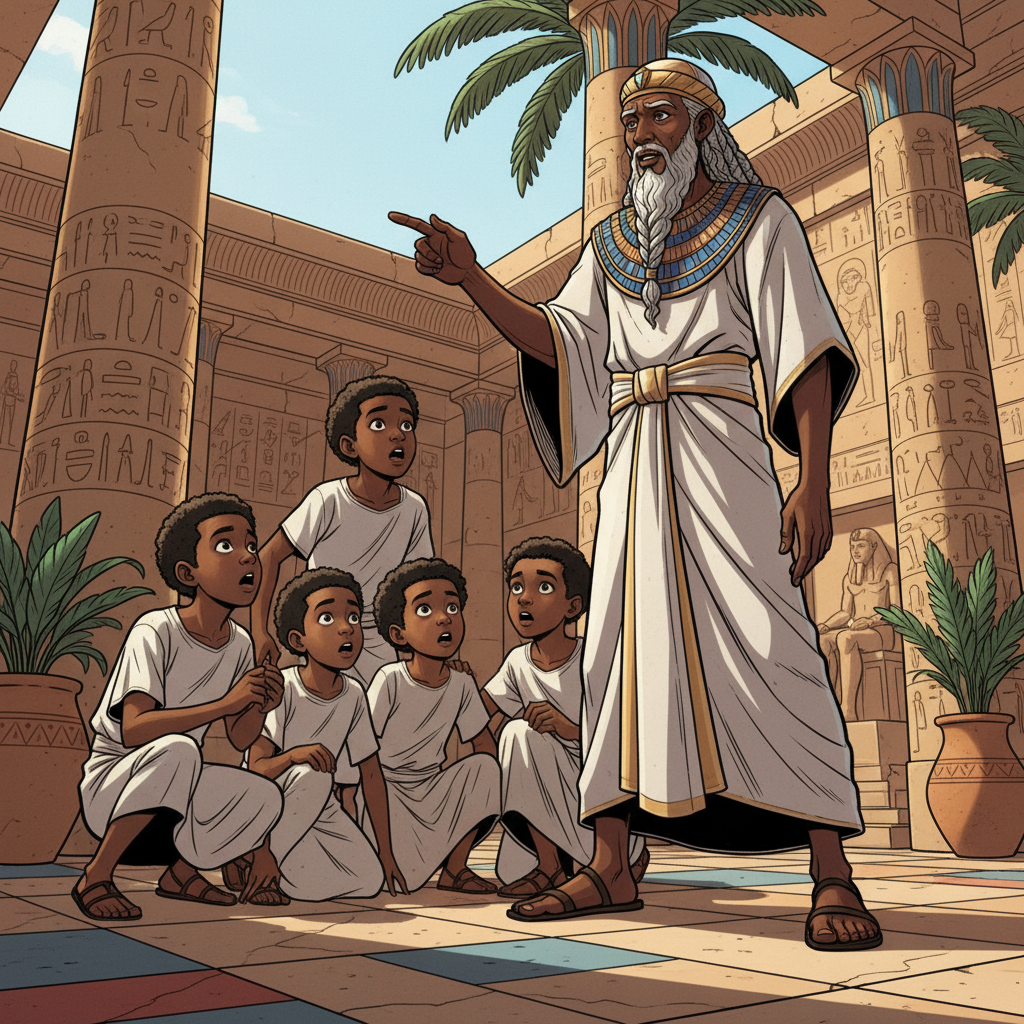
"There was a girl in the temple of Neith at Sais," Ptahmose said, and the boys looked surprised. He noticed. "Yes. Girls study too — in the temples, with their mothers, in the houses of healing. Ma'at does not check whether you are a boy or a girl before it demands your character." He let that settle. "This girl, Nefertari, was training as a healer. Her teacher gave her one task: grind fresh herbs every morning before dawn and have the medicine paste ready before the first patient arrived. For sixty days, Nefertari did this without fail. On the sixty-first day, she was tired and slept late. No paste was ready. A sick child waited."
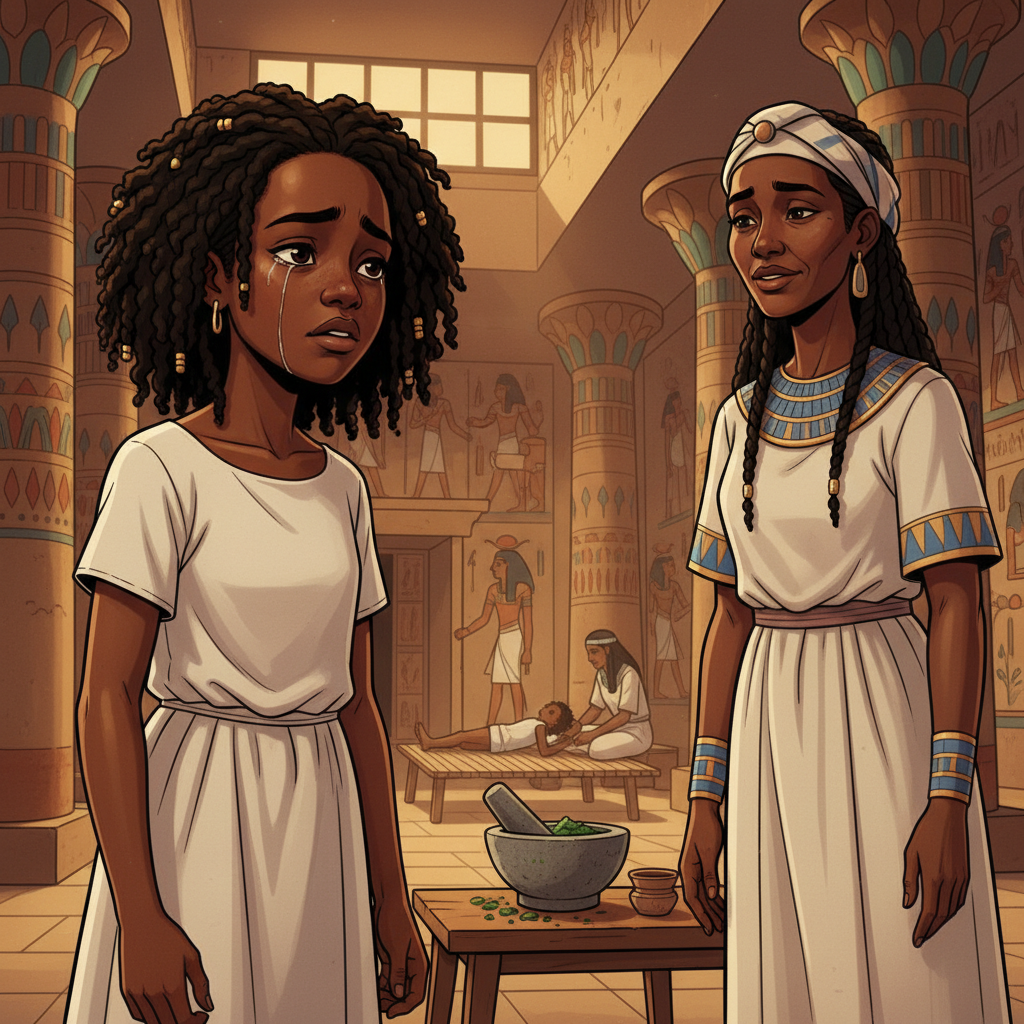
"Nefertari did not make excuses. She ground the herbs as fast as she could, but the paste was late, and the child suffered longer than necessary. That evening, Nefertari told her teacher: I failed today. Her teacher, a woman with skin like polished ebony, said: Good. Now you know the cost. Reliability is not about being perfect. It is about understanding that people depend on your pattern." Ptahmose let the story breathe. "From that day, Nefertari never missed again — not because she was punished, but because she had felt the weight of someone else's need resting on her shoulders. That weight, once truly felt, changes you. Reliability is born from understanding that you are connected to others."
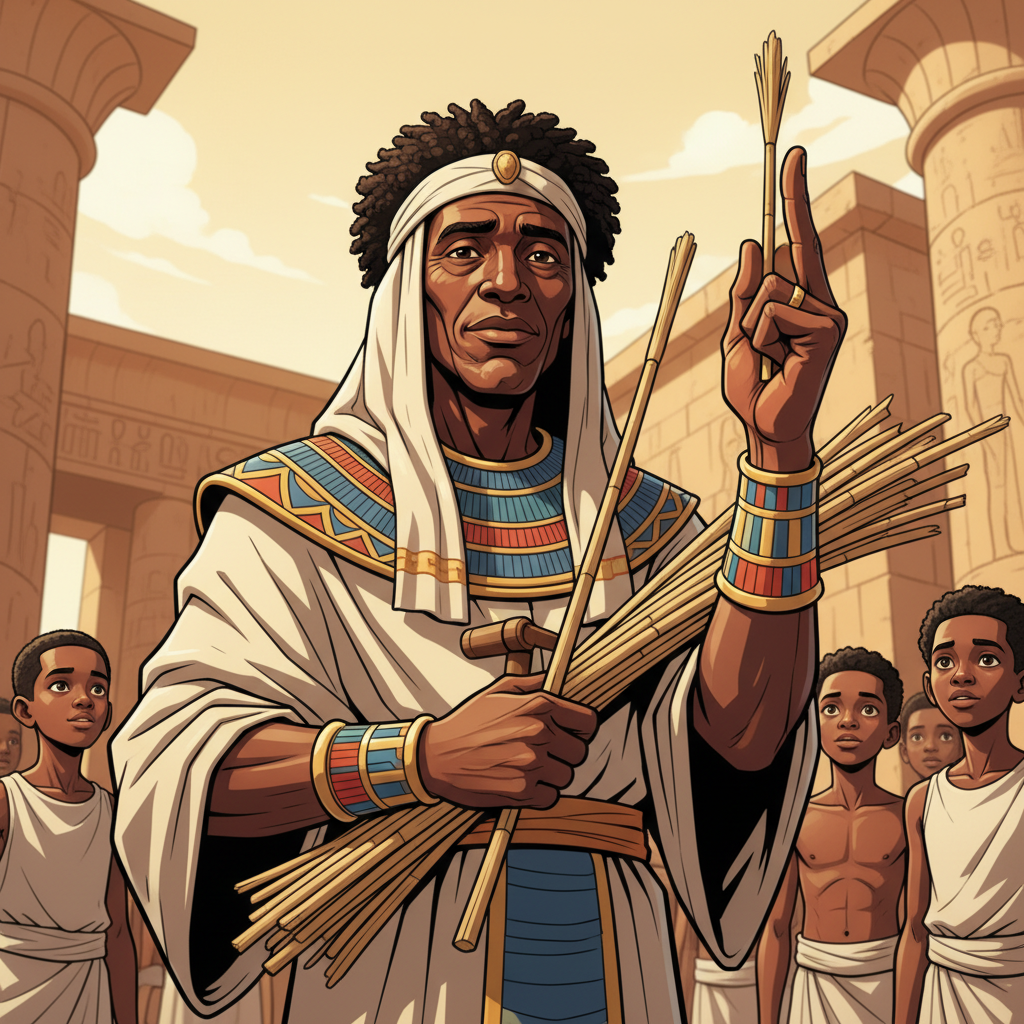
"Fourth." The last finger. "Proportionate force. You are allowed to be strong. You are expected to be strong. But strength without wisdom is just destruction. A real man uses exactly the right amount of force for the situation — no more, no less." Ptahmose pulled a reed from his bundle and held it up. "If I need to write a letter, I use this. If I need to move a stone block, I use a lever and a team of workers. If I use the lever on the letter, I destroy it. If I use the reed on the stone, nothing happens. Sekhem — true power — is knowing which tool fits which task. The strongest person in the room should be the calmest."
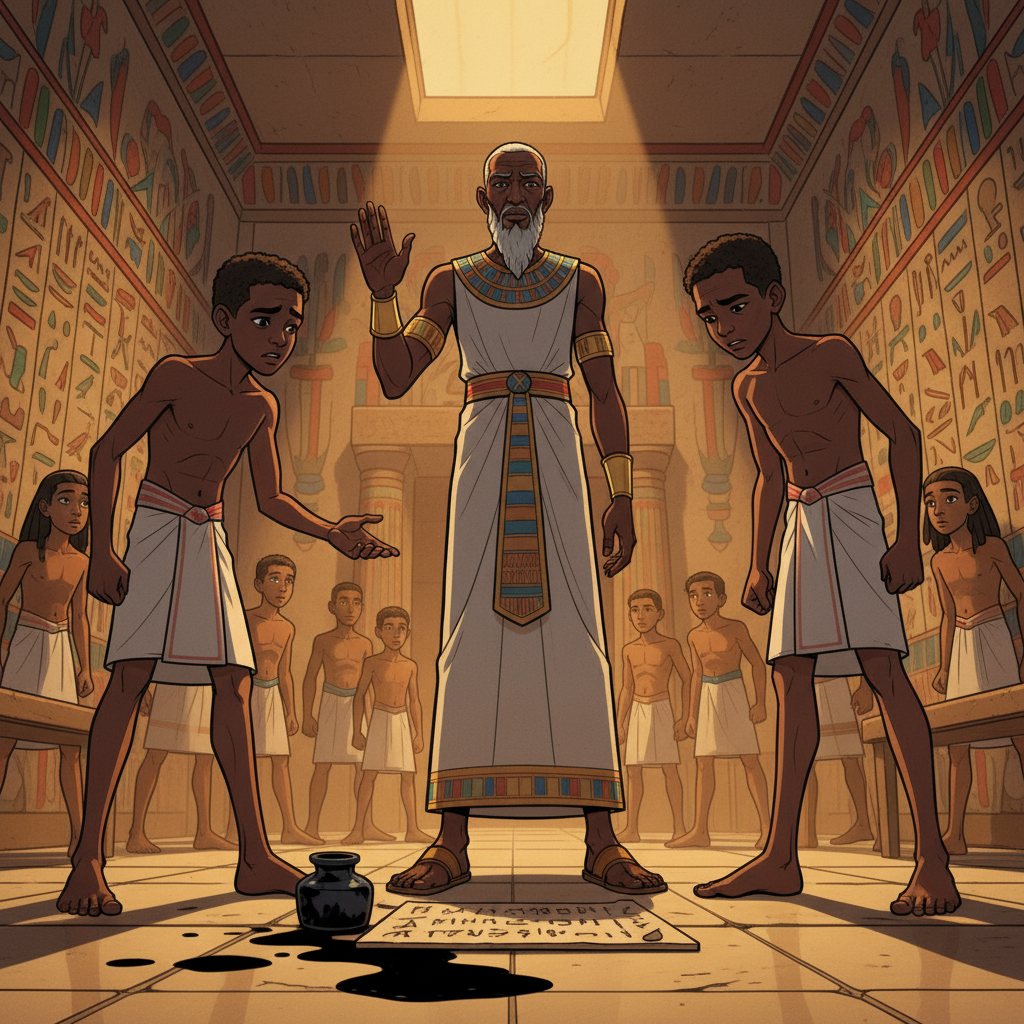
Then something happened that made the lesson real. A boy named Nakht — broad-shouldered, with deep brown skin and quick hands — accidentally knocked over the ink pot while reaching for his practice board. Black ink spilled across another boy's fresh writing. The other boy, Amenhotep, jumped up and shoved Nakht hard in the chest. Ptahmose did not shout. He simply raised his hand, and the room went still. "Amenhotep. Which pillar did you just break?" Amenhotep's jaw tightened. He knew. "Proportionate force," he said quietly. "And self-governance." Ptahmose nodded. "What was the right amount of force for spilled ink?" Amenhotep looked at the ground. "Words. Just words."
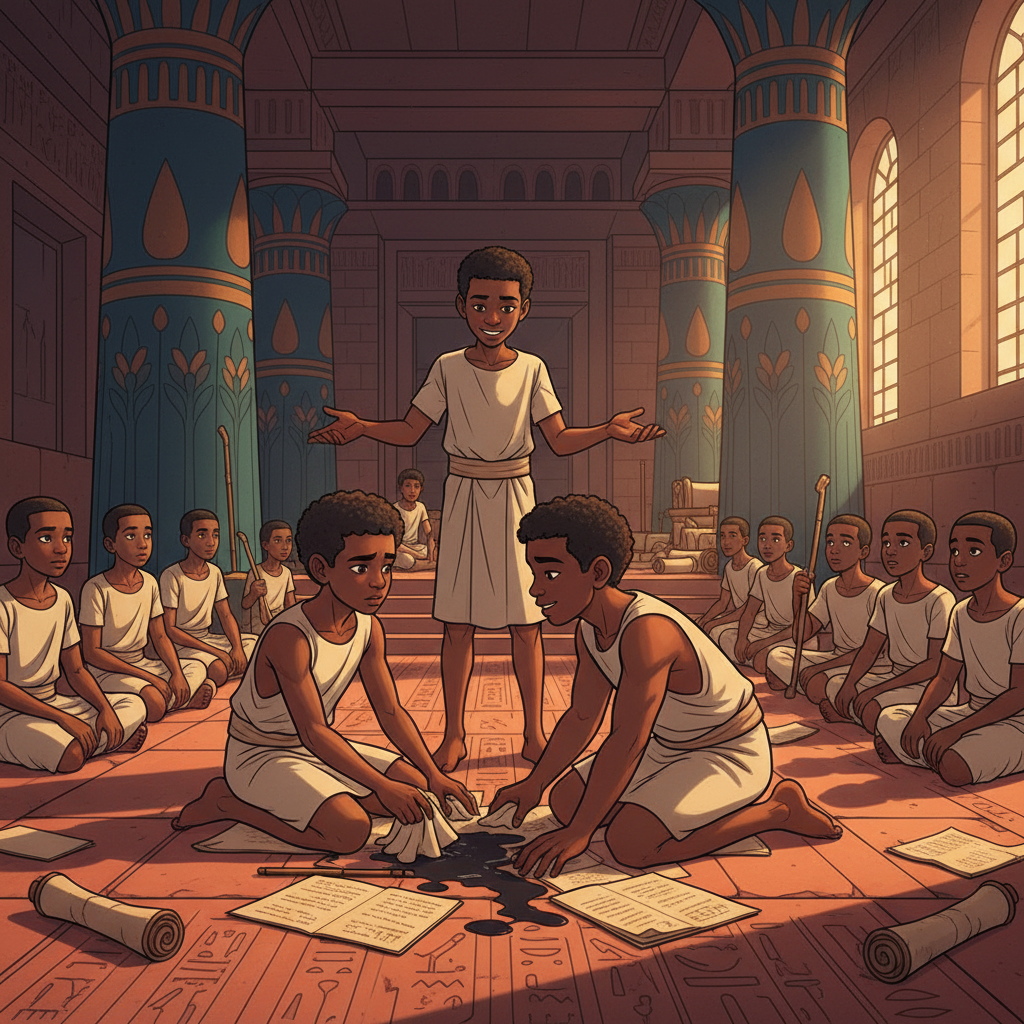
"Now repair it," Ptahmose said. Not as punishment — as practice. Amenhotep took a breath. He turned to Nakht and said: "I should not have pushed you. The ink was an accident. My hands moved before my mind." Nakht nodded. Then Amenhotep got a rag, cleaned the spilled ink, and helped Nakht rewrite the ruined work, line by line, until it was finished. Ptahmose watched them work together. When they were done, he spoke to the whole class. "This is what repair looks like. Not shame. Not groveling. You name what you broke, you fix what you can, and you build the pillar stronger than it was before. Every man and every woman will break a pillar in their lifetime. Many times. What matters is that you rebuild."
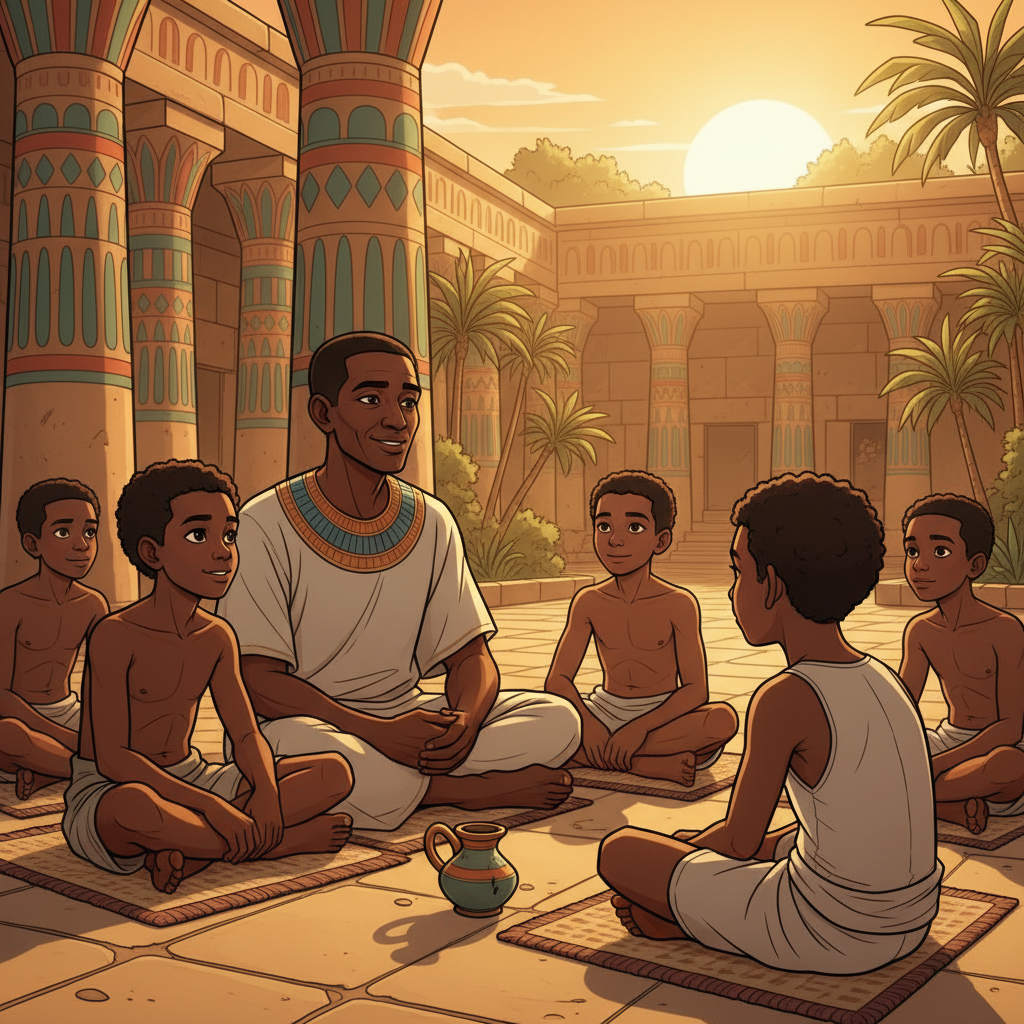
The sun had moved across the courtyard by the time Ptahmose finished. The boys' mats were warm beneath them. He looked at each young face — dark skin glowing in the amber light — and his voice softened for the first time. "These four pillars — truth, self-governance, reliability, and proportionate force — are not ideas for boys alone. They are the foundation of any person who wants to carry Ma'at in their ka. Your mothers stand on these pillars. Your sisters will stand on them. The farmers and the physicians and the builders of Kemet all stand on them. When you leave this Per Ankh, you will meet people who have never heard these words but live them every day, and you will meet people who have heard them a thousand times and ignore them. Watch what people do, not what they say. And build your pillars — not once, but every single morning of your life."