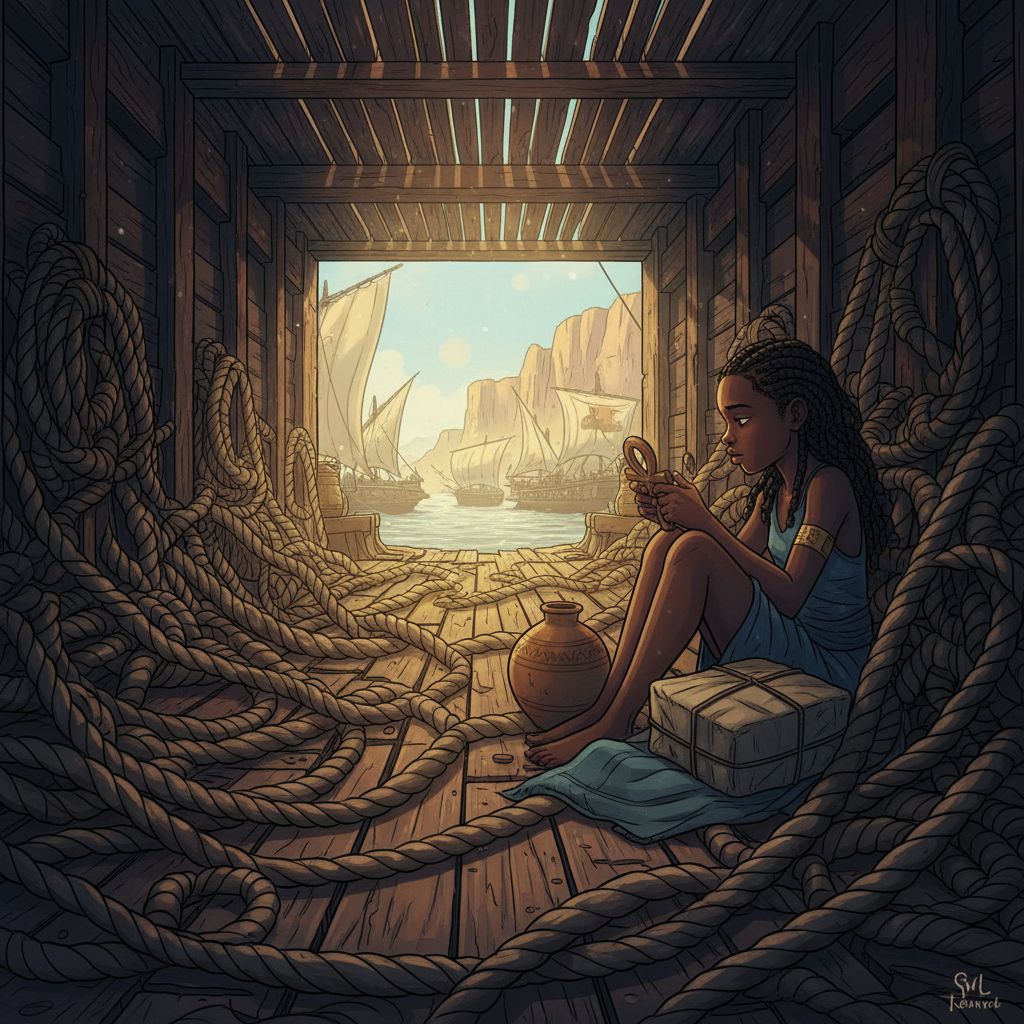
Tahiti had been hiding in the rope locker for three days. She was eleven years old, with dark brown skin and tightly braided hair, and she was the daughter of a Kemetic captain named Senemiah whose ship was one of the five great vessels Pharaoh Hatshepsut had sent south on the longest trading voyage Kemet had ever attempted. The rope locker was a narrow space beneath the foredeck, smelling of tar and sun-warmed papyrus and the salt of the Red Sea. Tahiti had packed it carefully before the fleet sailed — a small clay water jar, a wrapped parcel of dried fish, a single linen blanket, and the small wooden ankh her mother had carved for her the year before her mother died. She had known, when she packed it, that her father would discover her eventually. The food would run out. Or the rope-maker would come looking for a coil. Or she would simply grow tired of being a secret. What she had not expected was the sound she heard now, coming through the planking above her head — her father's voice, calling her name across the open deck, his voice tight with a kind of fear she had never heard from him before.
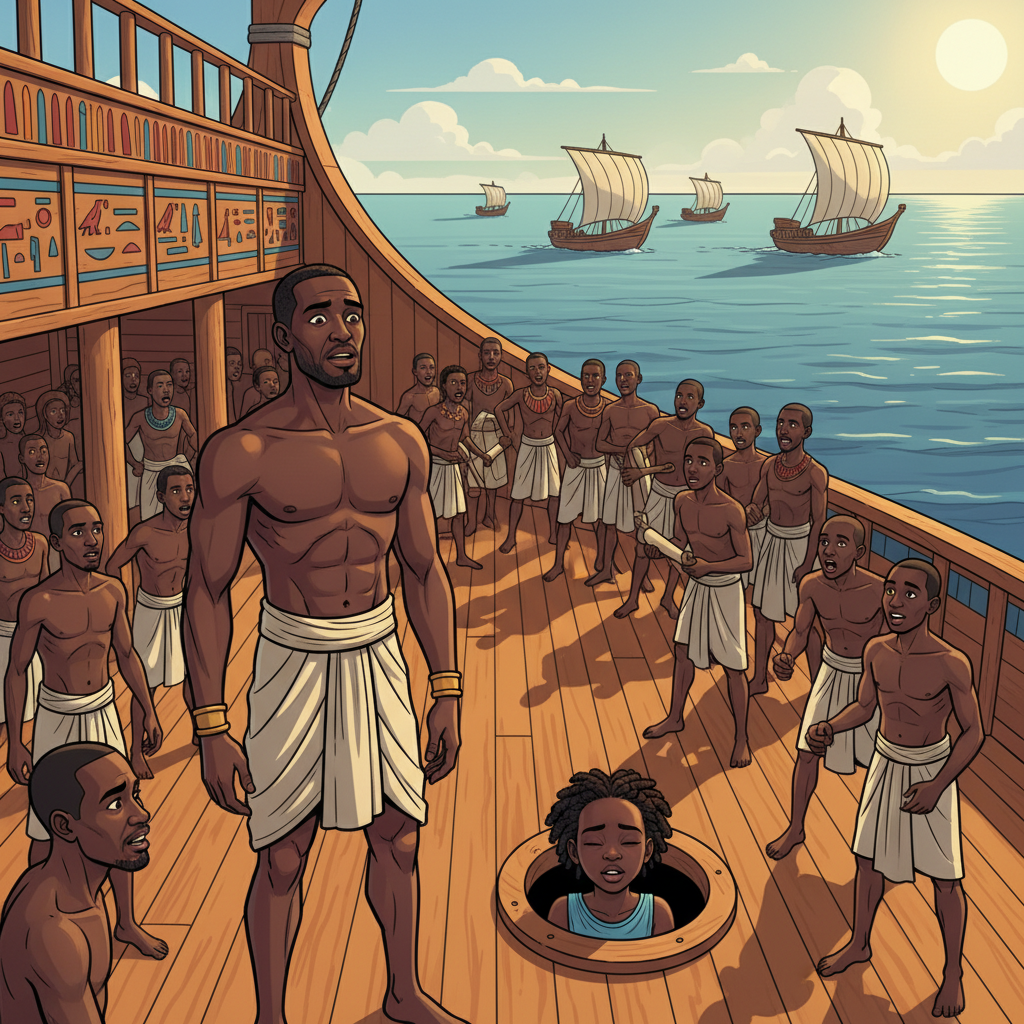
Tahiti pushed open the small wooden hatch and climbed up into the daylight. The sun blinded her for a moment. When her eyes cleared, she was standing on the foredeck of the lead ship of the Punt expedition, and her father — Captain Senemiah, who had not seen his daughter for three full days — was staring at her with an expression she would remember for the rest of her life. He did not move. He did not speak. He just stood there in the late-morning sun, his hands at his sides, the color draining slowly from his deep-brown face. Behind him, the crew of the ship had all stopped what they were doing. Twenty oarsmen, four pilots, the chief sailmaker, two ship's scribes — all of them frozen, all of them watching. Senemiah crossed the deck in five steps. He did not raise his hand. He did not raise his voice. He knelt in front of his daughter and put both of his hands on her small shoulders and just looked at her. "Tahiti," he said finally, and his voice was the voice of a man who has been given back something he thought he had lost forever. "Tahiti. We are six days from any shore that will turn us around." He bowed his head against the top of her braided hair. "You are going to Punt."
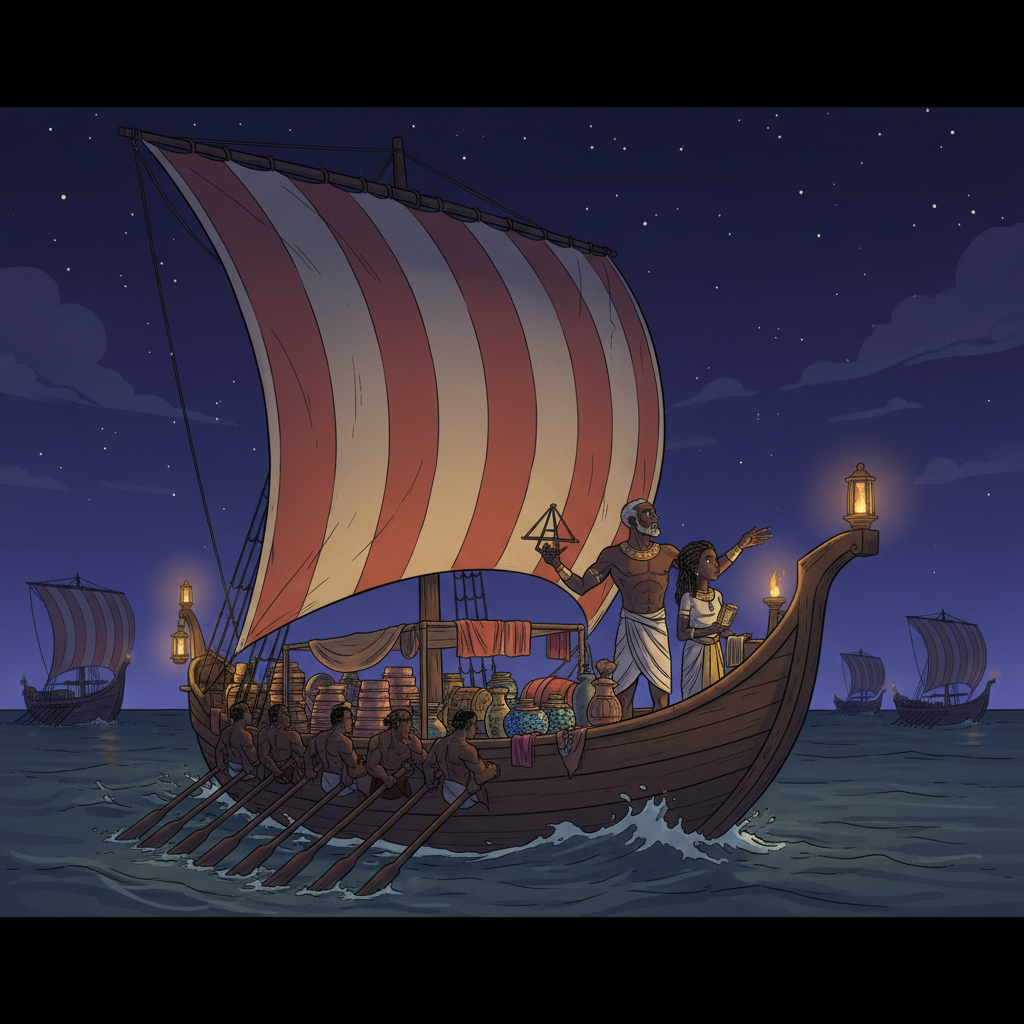
The five ships of Pharaoh Hatshepsut's Punt expedition were each as long as forty men lying end to end. Their cedar hulls were dark with pitch. Their striped linen sails — white and red and saffron — rose forty cubits above the deck on tall masts of acacia wood. Each ship was rowed by twenty oarsmen on each side, and each ship carried a hold loaded with the finished work of Kemet: long bolts of fine linen dyed in the colors of the Nile sunset, copper ingots in stacks, gold work fashioned at the royal workshops, glass beads in dozens of jars, faience figures small enough to fit in a closed hand. The fleet was the work of two full years of preparation. It was the largest trading expedition Kemet had ever attempted. Tahiti learned the rhythm of the ship by the second day after her discovery. The oarsmen sang work-songs in long slow rhythms that moved the ship through the swells of the open sea. The pilots watched the stars at night and the sun at noon and held the fleet on its careful southward course. The sailmakers patched the great sails when the wind tore them. The cooks prepared bread and dried fish and small portions of beer twice a day. Her father was the captain of the lead ship, which meant he was rarely still. Tahiti watched him at his work, and she began, for the first time in her life, to understand what her father did when he was not at home.
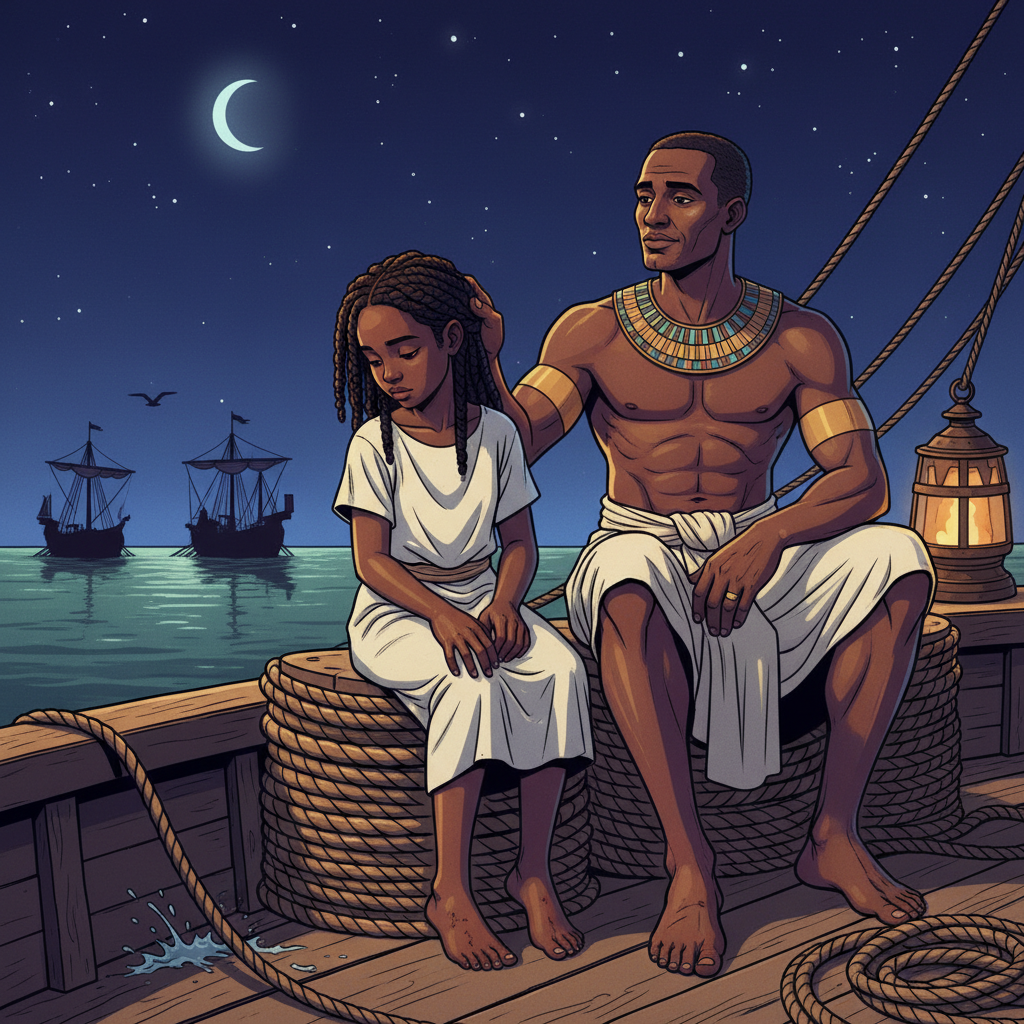
On the third day after her discovery, her father came and sat beside her on a coil of rope at the bow. The fleet was moving slowly south through a calm green sea. The sun was low. "Why did you do it?" he asked her. He did not ask in anger. He asked the way a captain asks a navigator — wanting the answer. Tahiti looked at her hands. Her hands were small and dark and her fingernails were torn from gripping ladders. "Because mother died," she said. "And you went away for the short trips after, and you came back. But this trip is long. And I could not bear it." She did not look at him while she said it. Her father was quiet for a long time. The water slapped against the hull. Far away, a gull was crying. Then he reached out and tucked one of her loose braids back behind her ear with a touch so soft it was almost not a touch. "You are going to be very useful on this voyage," he said. "I do not know how yet. But you are. I know it the way I know the wind shift before the sail does. Stay close. Watch everything. And do not be afraid of the Punt people. They are our friends." Tahiti looked up. "Friends?" she asked. Her father nodded. "Friends. You will see."
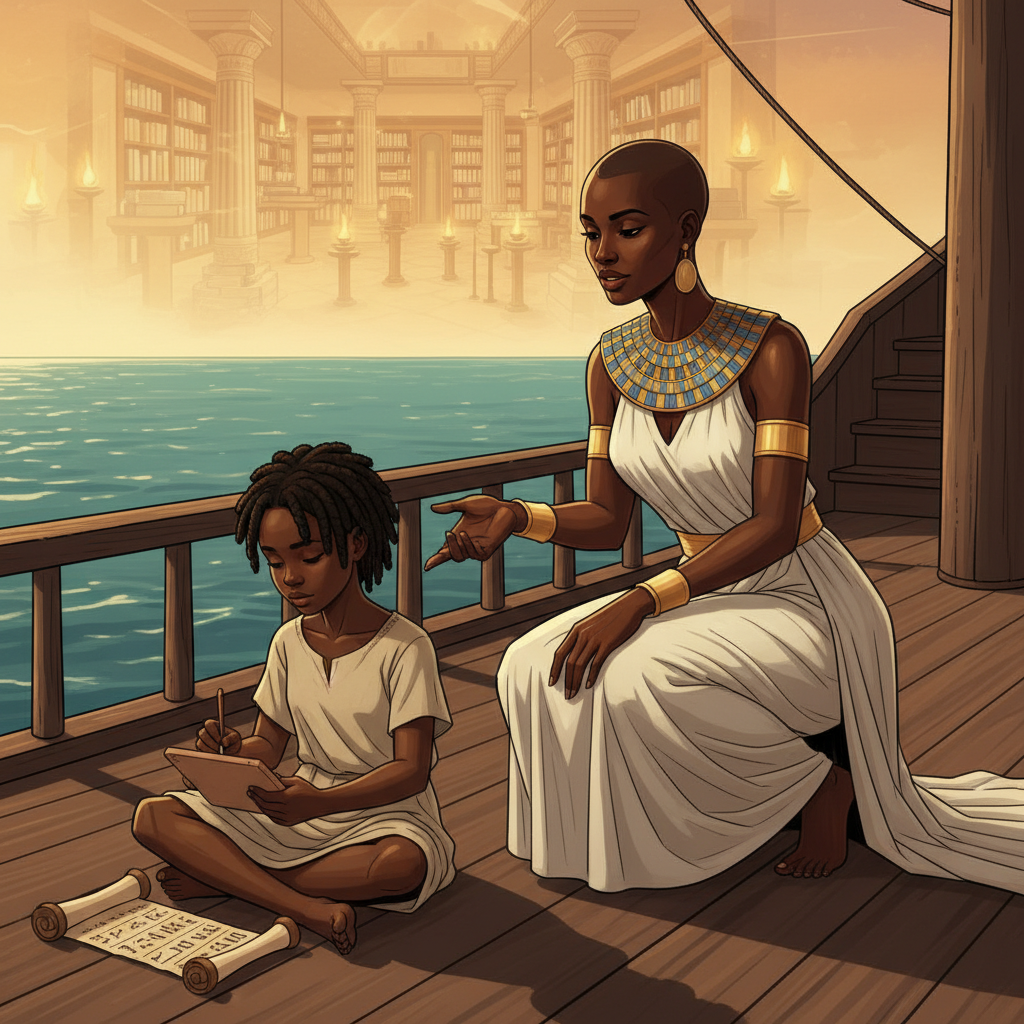
The Lady Nehesy, Pharaoh Hatshepsut's chief envoy on the expedition, came to find Tahiti on the morning of the fourth day. Nehesy was a tall woman with rich brown skin and a shaven head, the way some of the royal officials wore their hair when they served at the highest level of the pharaoh's court. She wore a long pleated linen gown with a wesekh collar of gold and lapis. When she walked, the deck planking did not creak under her, even though she was a large woman. She had a way of moving as if the ship knew her. Tahiti was sitting cross-legged on the foredeck, a small clay tablet on her knee, trying to copy the names of the ship's cargo from the manifest her father had let her read. Nehesy crouched beside her and looked at the tablet. "Your letters are correct," she said. "Where did you learn medu neter?" Tahiti looked up, suddenly shy. "My mother taught me. She was a temple scribe before she married my father. She said a girl who could read could carry her own life in her hand." Nehesy nodded slowly. "Your mother was right." She paused. "Tahiti, do you know why we are sailing to Punt? Do you know what Pharaoh Hatshepsut has asked us to do?" Tahiti shook her head. Nehesy sat down on the deck beside her. "Then let me tell you. Because you are going to need to know."
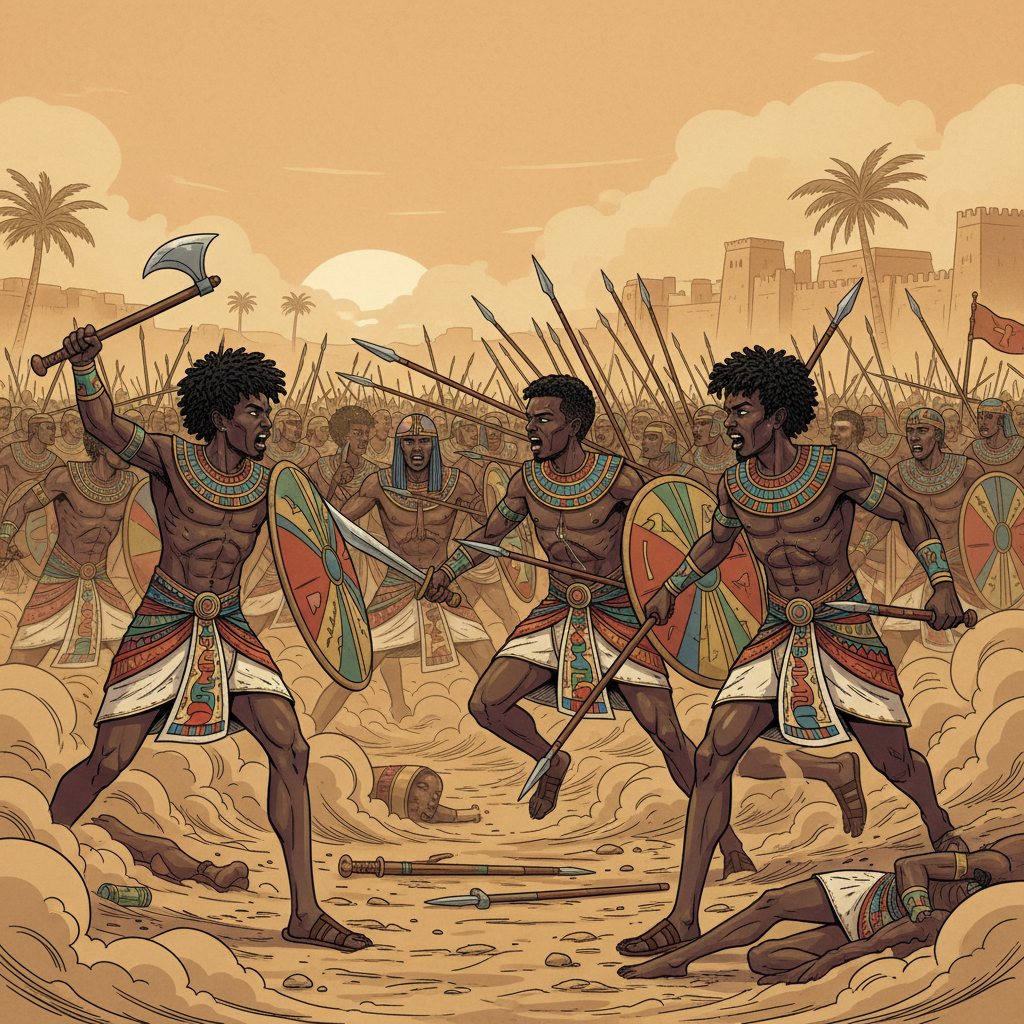
Nehesy spoke as the ship moved southward. "The Pharaoh Hatshepsut rules Kemet, Tahiti. She is not a queen. She is a Pharaoh, with the double crown and the false beard and the throne name Maatkare — Truth is the Soul of Ra. She rules as a pharaoh because that is what Kemet needs her to do, and the gods accept her. Some kings, when they want what another land has, send armies. They go to take. Pharaoh Hatshepsut has sent us with five ships loaded with the finest work of our craftsmen. We are not going to take. We are going to ASK. There is a word in our oldest writings, the writings of Ptahhotep that your mother probably taught you. The word is reciprocity. It means that a gift makes a gift. That a hand opens to receive only because another hand has opened to give." Tahiti listened with her whole body. Nehesy went on. "The land of Punt has things we want — myrrh trees, frankincense, ebony, gold, ivory. Other lands would take these by force and call it conquest. The Pharaoh Hatshepsut will not do that. She has sent us with linen and copper and beads and a respectful greeting, and we will ASK the people of Punt to trade with us. If they say yes, we will leave them better than we found them. If they say no, we will turn around. This is the new way. This is what your Pharaoh wants the world to remember her for. Not battles. Asking."
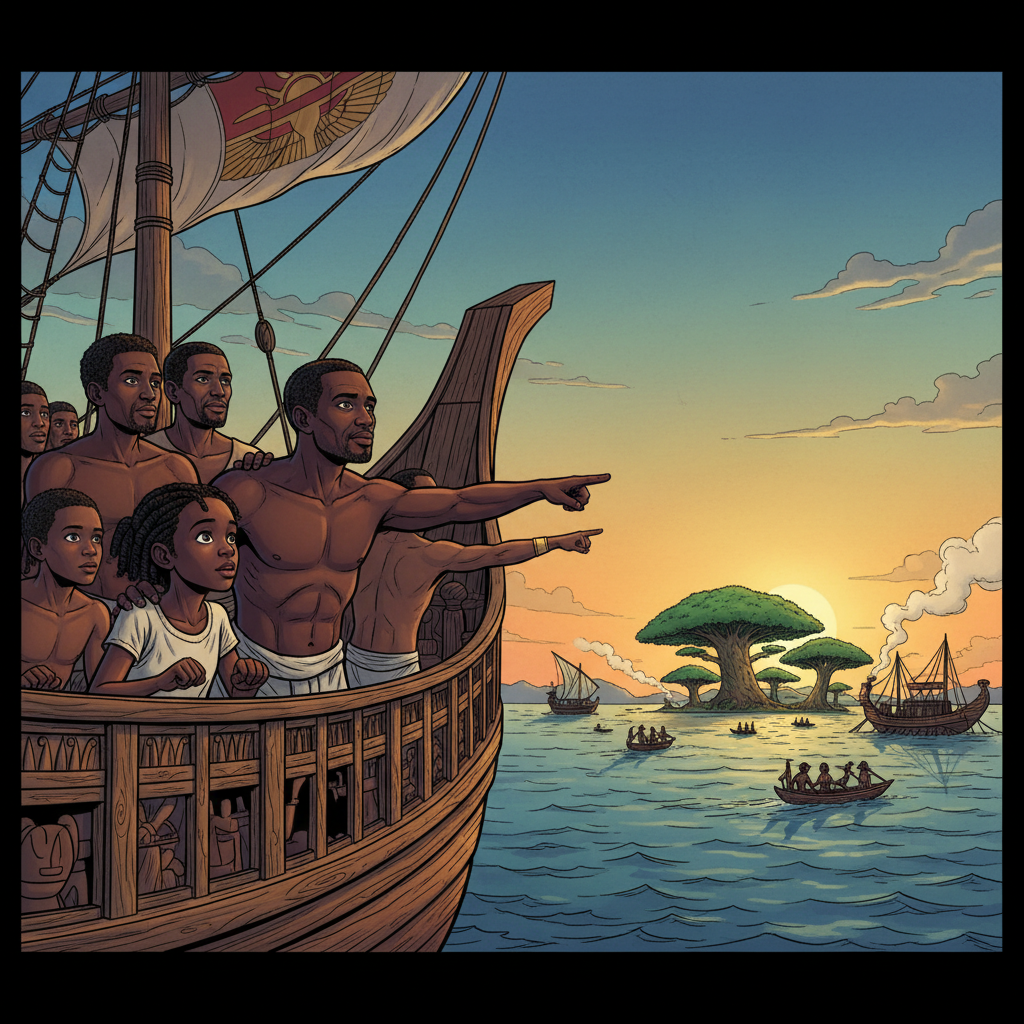
On the seventh day at sea after Tahiti's discovery, the lookout on the high mast called down a single word: "Land." Tahiti scrambled to the bow with the rest of the crew. At first she saw nothing but the long line of the horizon. Then she saw it — a low green smudge along the southern edge of the sea, thicker and greener than anything she had ever seen in her life. The smudge grew. Trees became visible — trees taller than the date palms at home, with crowns that spread like green clouds. Smoke rose from cooking fires inland. Small boats appeared, dotting the bay ahead — fishing boats, the lookout said, and behind them larger boats coming out to meet the Kemetic fleet. Tahiti gripped the railing with both hands. Her heart was pounding the way it had pounded the first time her mother had taken her to the great temple at Waset. Her father came up beside her and put his hand on her shoulder. "Punt," he said simply. "Ta Netjer. The Land of the Gods. We are the first Kemetic ship to come here in a generation. And the people of Punt have come out to greet us, Tahiti. Not to fight us. To GREET us. That is because they remember the last time. The last time, we asked. We did not take."
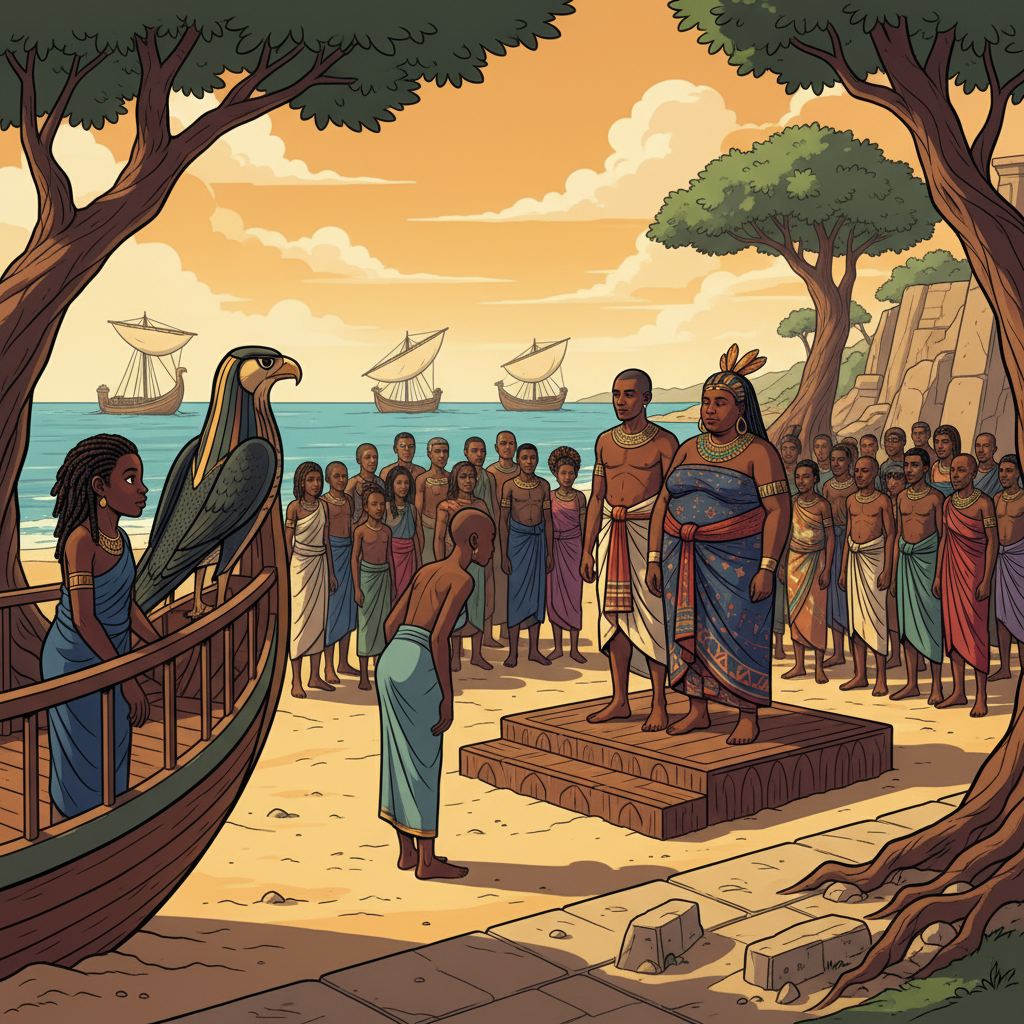
The greeting at the Punt landing-beach was unlike anything Tahiti had imagined a foreign welcome could be. King Perehu of Punt waited on the sand with his queen, whose name was Ati. Behind them stood maybe forty Punt people — men, women, children. The Punt people were brown-skinned like Tahiti and her father, but their faces were broader, their hair worn in different braided patterns, their wrap-skirts woven in colors Tahiti had never seen — deep indigo, ochre, a red that came from a plant called madder. The queen Ati was a large woman with a round dignified body and an expression of complete unhurried calm. She did not bow as the Kemetic ships landed. She did not need to. She simply stood, and her presence made the beach feel like the floor of a temple. Lady Nehesy went first off the lead ship. She walked across the sand toward King Perehu and Queen Ati, and when she reached them she bowed — not deeply, but with the careful respect of one official to another. Perehu and Ati returned the bow. Then Perehu spoke in a tongue Tahiti did not understand, and Nehesy answered in the same tongue. Tahiti realized with a small shock that Nehesy had been learning the language of Punt for years, just for this trip. The two officials spoke. The Punt people listened. Tahiti, watching from the railing of her father's ship, understood that something old and careful was happening — something that had been built over many lifetimes by many people, of which this voyage was only the latest gift.
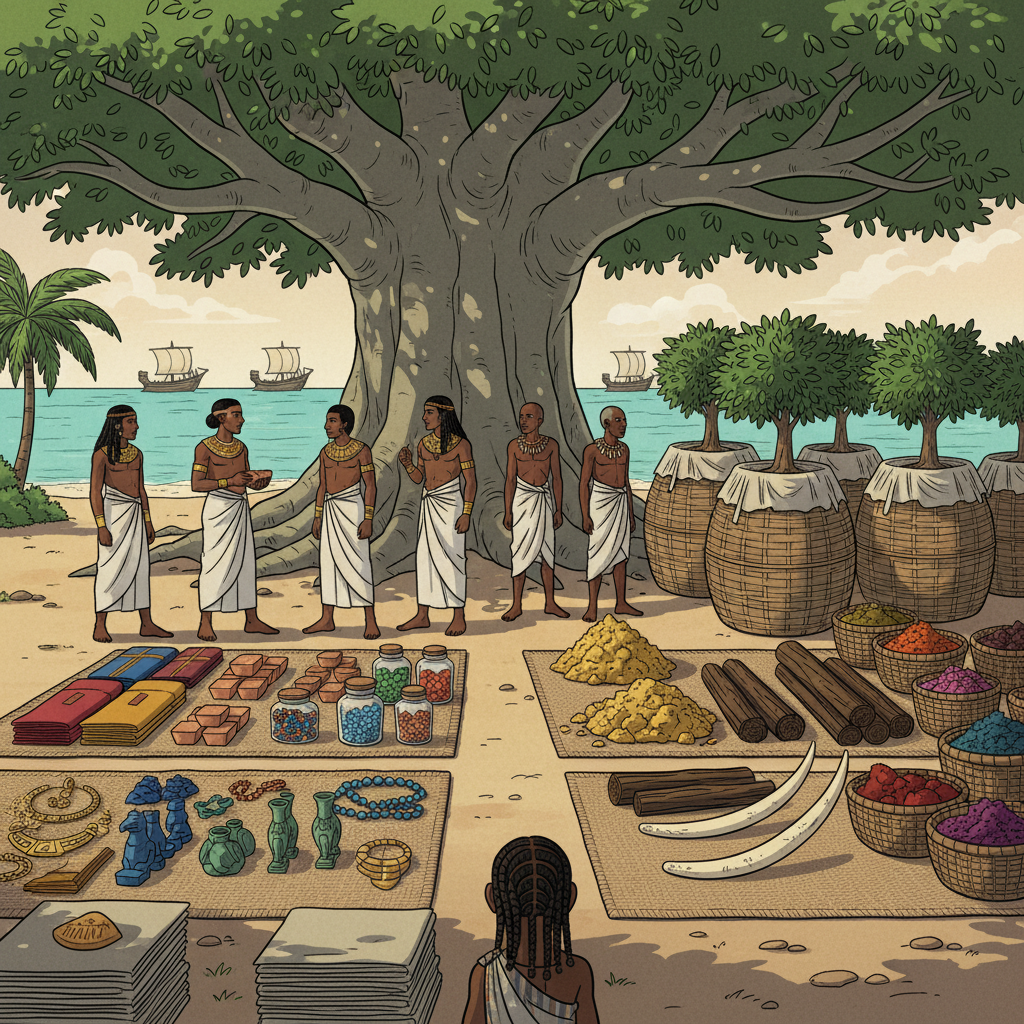
The trade was set up in a clearing just inland from the landing-beach, beneath a great tree with smooth gray bark that the Punt people called a sycamore-fig. The Kemetic crews laid out their cargo on long woven mats of palm fiber. Bolts of fine linen in the colors of the Kemetic sunset. Stacks of copper ingots stamped with the cartouche of Pharaoh Hatshepsut. Glass beads in jars of every color. Faience figures of cats and falcons and small carved Hekas. Gold work — a few precious pieces, finely made, not raw. The Punt people laid out their own goods on mats opposite — heaps of fragrant golden resin in lumps the size of a child's fist, ebony logs as long as a man, ivory tusks, woven baskets of strange spices, and — surrounded by Punt elders standing in careful formation — twenty-eight enormous wicker baskets, each one taller than Tahiti, each one lined with damp linen, each one holding the root-ball of a living myrrh tree. Tahiti slipped down the gangplank without being noticed. She walked carefully along the edge of the clearing, staying behind the line of Kemetic crew, her eyes moving back and forth between the two sets of mats. She had never seen so many goods in one place. She had never seen the giving and the receiving of goods done so SLOWLY. The Kemetic and Punt officials spoke quietly. They walked among each others' mats. They picked things up and turned them in the light. They put things back down. It was nothing like the loud bustling markets she knew from Waset.
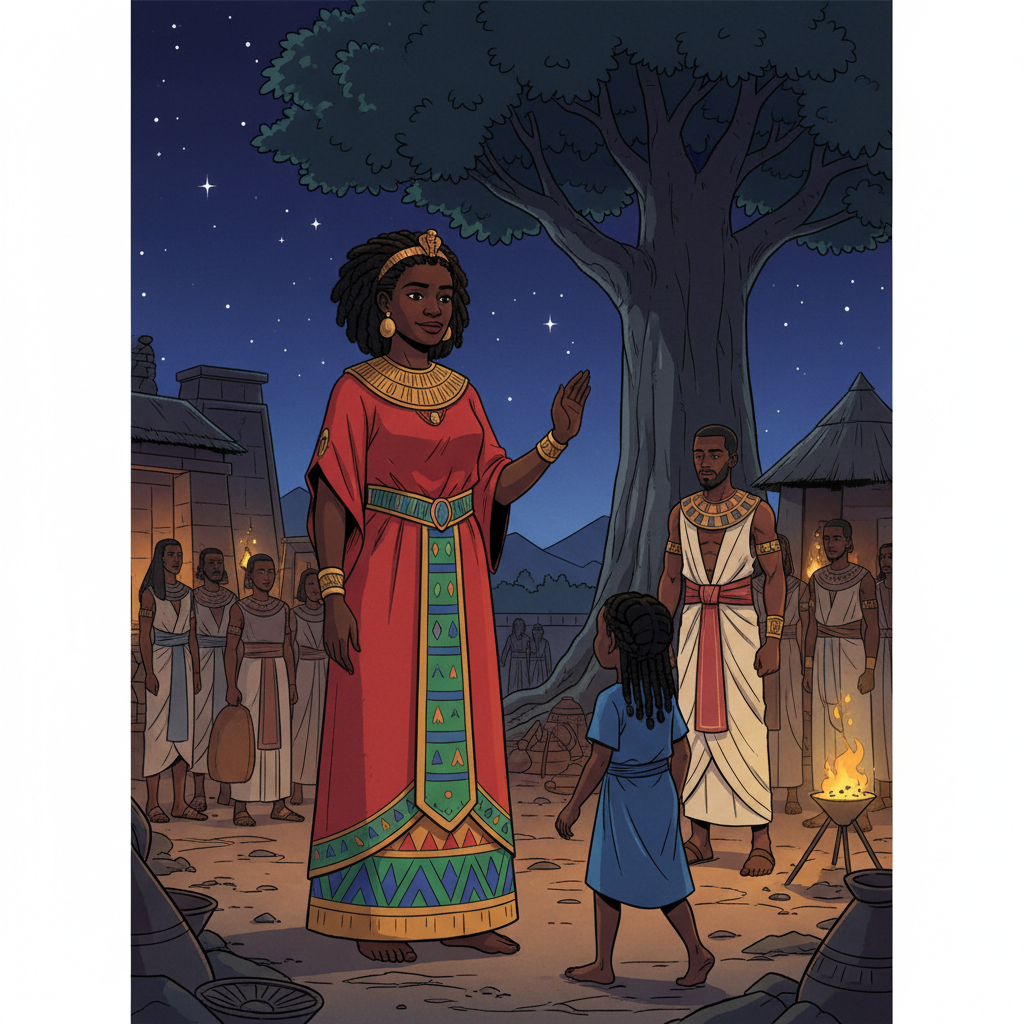
Queen Ati saw Tahiti standing at the edge of the clearing. The queen did not call out. She did not point. She simply turned slightly, just enough that her body angled toward the place where Tahiti was standing, and she did not move for a long moment. Tahiti understood that she was being seen. She understood she was being invited. She walked carefully out from behind the line of Kemetic crew and into the clearing. The Kemetic adults noticed and stopped what they were doing. Tahiti's father started forward — and then he saw Queen Ati's slight raised hand, the smallest gesture, the one that said: wait. Senemiah stopped. Queen Ati waited until Tahiti reached her. She did not bend down — she did not need to make the gesture small for a child. She simply looked at Tahiti at full height and said, in slow careful Kemetic that she had probably been preparing for years for this kind of meeting: "What is your name, daughter?" Tahiti answered: "Tahiti, lady of Punt. I am the daughter of Captain Senemiah." Queen Ati nodded slowly. "Come with me, daughter of Senemiah. There is something I wish you to see. Something you will need to remember after you have grown taller than your mother, and after your mother's mother has been gone many years." She held out her hand. Tahiti took it.
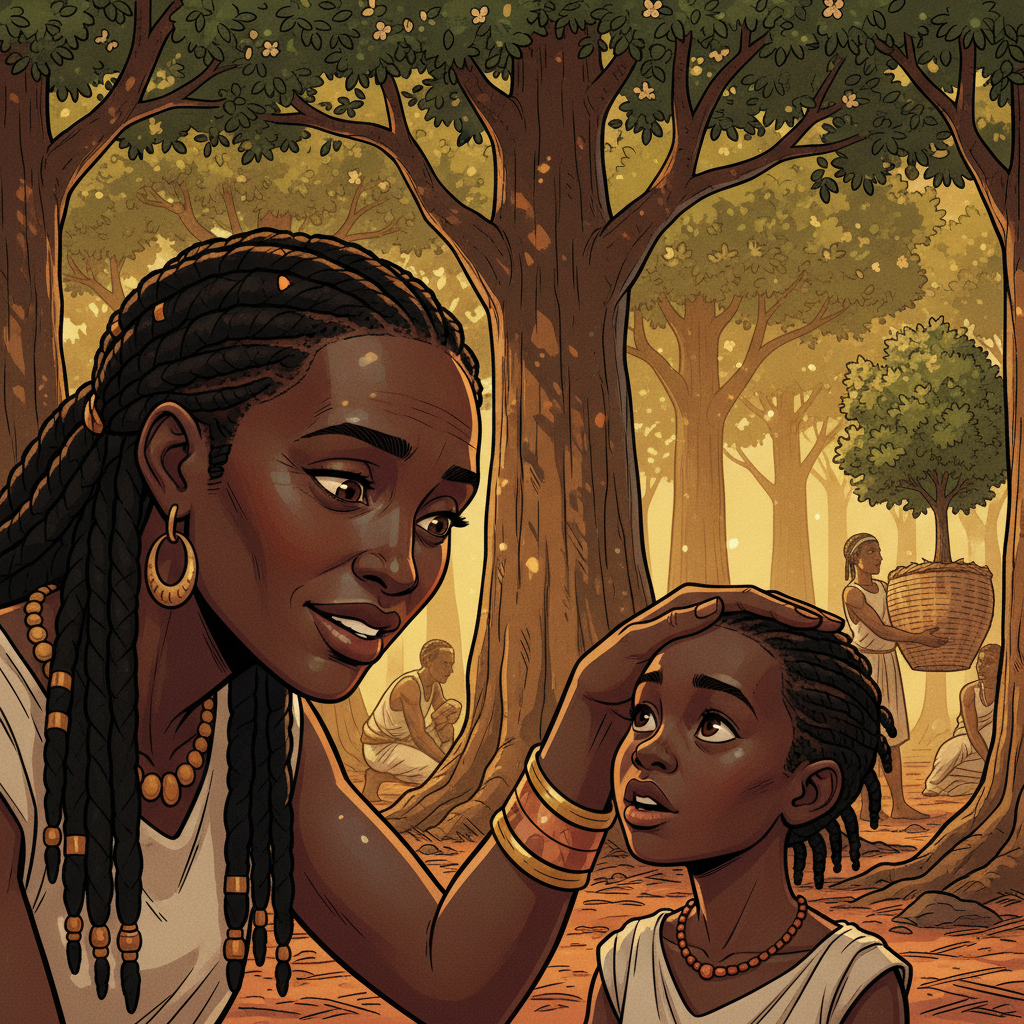
Queen Ati walked Tahiti past the clearing, past the wicker baskets of the myrrh trees, along a path that led into a grove. The grove was the place the trees came from. It was a stand of about a hundred myrrh trees, each one with a trunk about as thick as a man's waist, each one with a crown of small dark leaves and tiny pale flowers. The air in the grove was thick with the resinous smell Tahiti had first noticed at sea — the smell of myrrh, the smell that the Kemetic priests burned at the most sacred ceremonies. The Punt people were working among the trees. They were not cutting the trees down. They were digging, slowly and carefully, around the root-ball of each tree to be taken, wrapping the roots in wet linen, lifting the whole living tree — roots, trunk, crown — into a great wicker basket. Tahiti watched. Queen Ati did not speak. After a long minute Tahiti asked the question that was filling her chest. "Why do you give us the trees, lady? You could give us only the resin. The resin is what we burn at the temples. The trees are yours. Why do you give them?" Queen Ati turned and looked at her. The queen's eyes were the deep brown of old polished wood. She placed her large hand softly on top of Tahiti's small braided head and held it there.
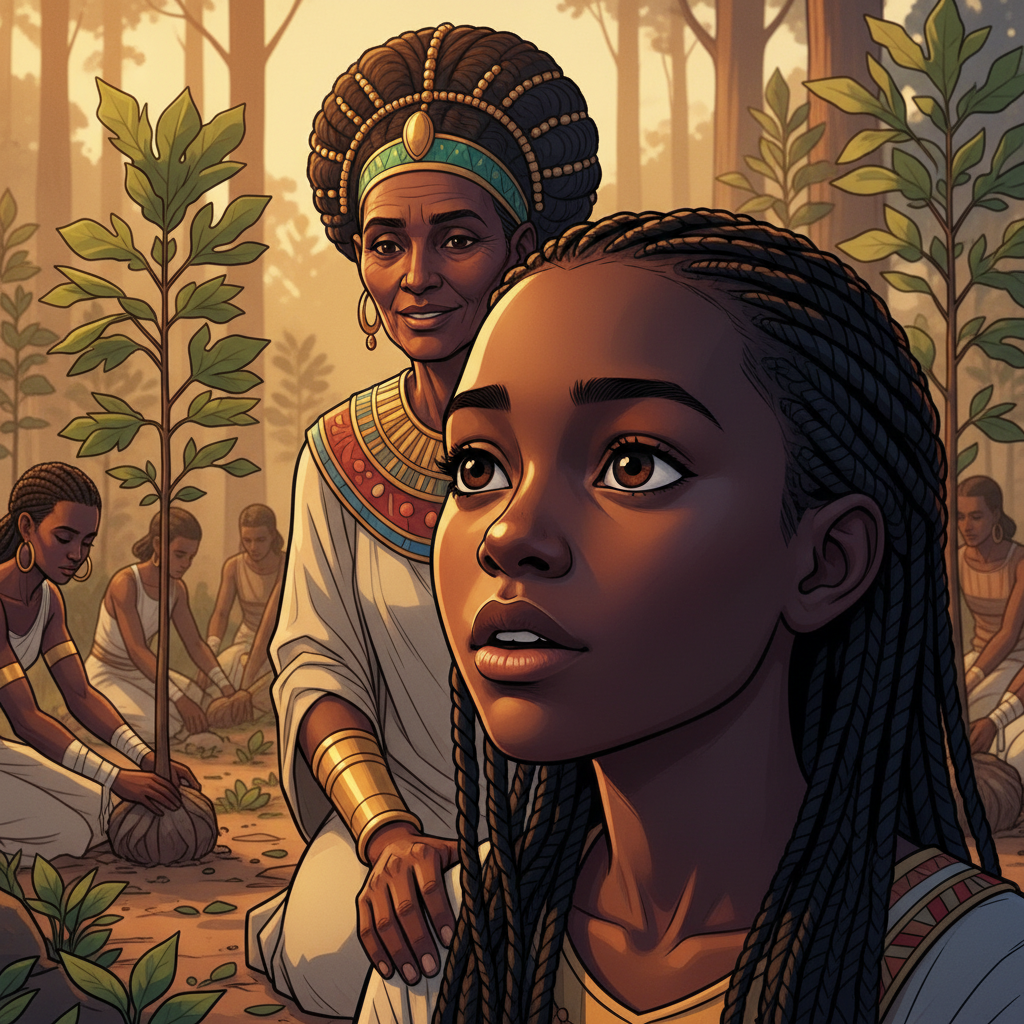
"Listen, daughter of Senemiah," Queen Ati said. "We give the trees because Hatshepsut sent ships that did not come to take. They came to ask. Other peoples come here. They have come for as long as my mother's mother's mother can remember. Some of them come with weapons. They want the resin. They want the gold. They want the ivory. When they want a thing, they take it, and they leave us less than they found us. We have no trees to give those people. We hide the trees. We give them the resin only — and only the resin we can spare — and we send them away. But Pharaoh Hatshepsut sent her envoys with respectful gifts and a respectful question. She asked. And when a friend asks for a tree, you do not give a friend only the leaves. You give the WHOLE TREE, with the roots, so that the tree may live in the friend's soil and grow, and one day make new trees for the friend, and the friend will not need to come back to ask again. Do you understand?" Tahiti looked at the grove. She looked at the careful hands of the Punt people wrapping the roots in damp linen. She looked at Queen Ati. She nodded slowly. Queen Ati said one more thing. She said it gently, the way an elder gives a child something the child will need to carry for the rest of her life. "Ask, and the gift grows. Take, and the gift dies. Remember this, daughter of Senemiah. Pharaoh Hatshepsut's ships brought us a question. We are answering with a forest."
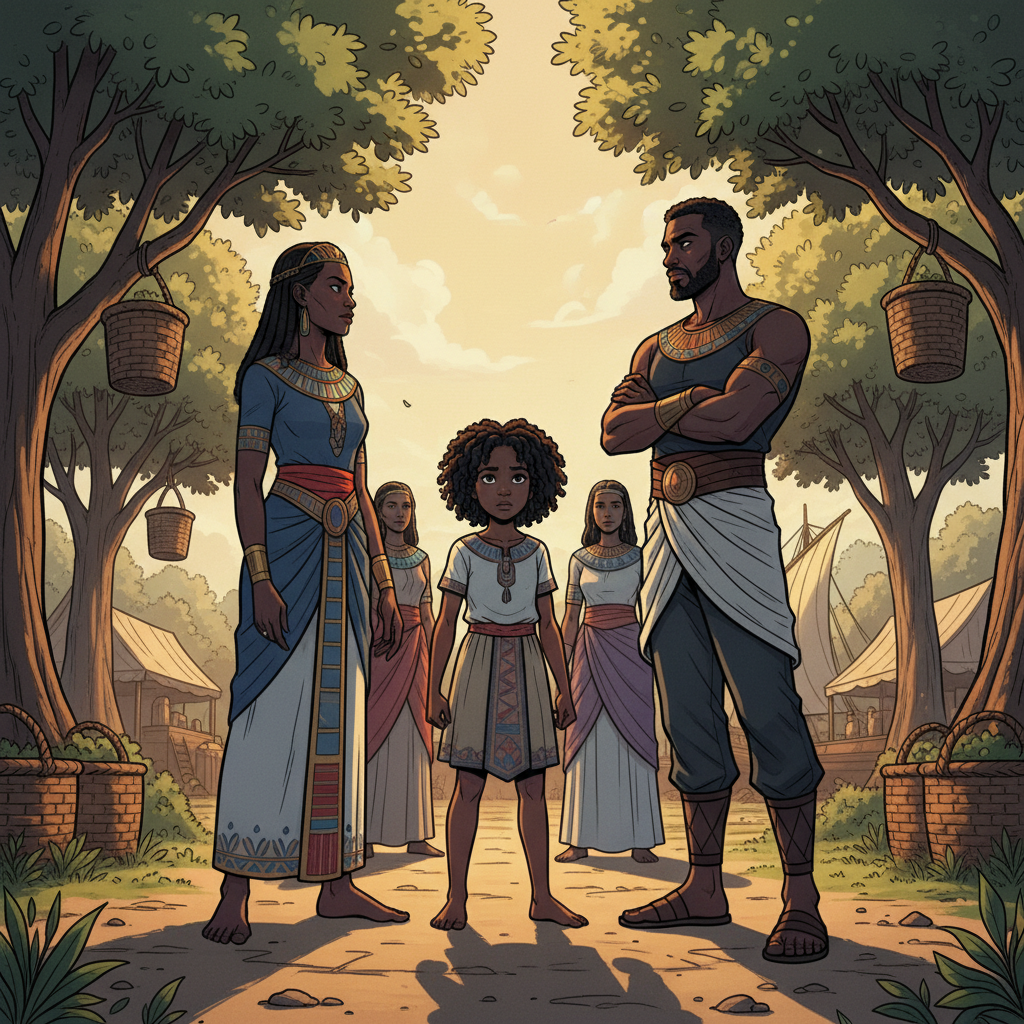
Tahiti walked back to the clearing beside Queen Ati. Her father was waiting for her at the edge of the grove. Captain Senemiah's face was very serious. He had been speaking with Lady Nehesy. He had arranged something. "Tahiti," he said when she reached him. He did not look at Queen Ati. He kept his eyes on his daughter. "There is a supply ship leaving for Adulis tomorrow. From Adulis you can sail home to Kemet with a friendly trader. You should not be on this voyage for the rest of its return journey. You should be home. Lady Nehesy and I have agreed. You will go on the supply ship tomorrow." Tahiti opened her mouth. Queen Ati did not say anything. Queen Ati did not interrupt. But she stepped forward, slowly, until she was standing just beside Tahiti. Queen Ati turned to Captain Senemiah. She did not contradict him. She did not say his decision was wrong. She did something that Tahiti — for the rest of her life, every time she thought about Punt — would consider one of the most respectful things she had ever seen anyone do. Queen Ati said to Senemiah: "Captain, you are her father. Your decision is your decision. But before it is final, may I ask your daughter what she chooses?" Captain Senemiah was quiet for a long moment. Then he nodded once. He looked at Tahiti. Queen Ati turned to Tahiti and said: "Daughter of Senemiah. What do you choose?"
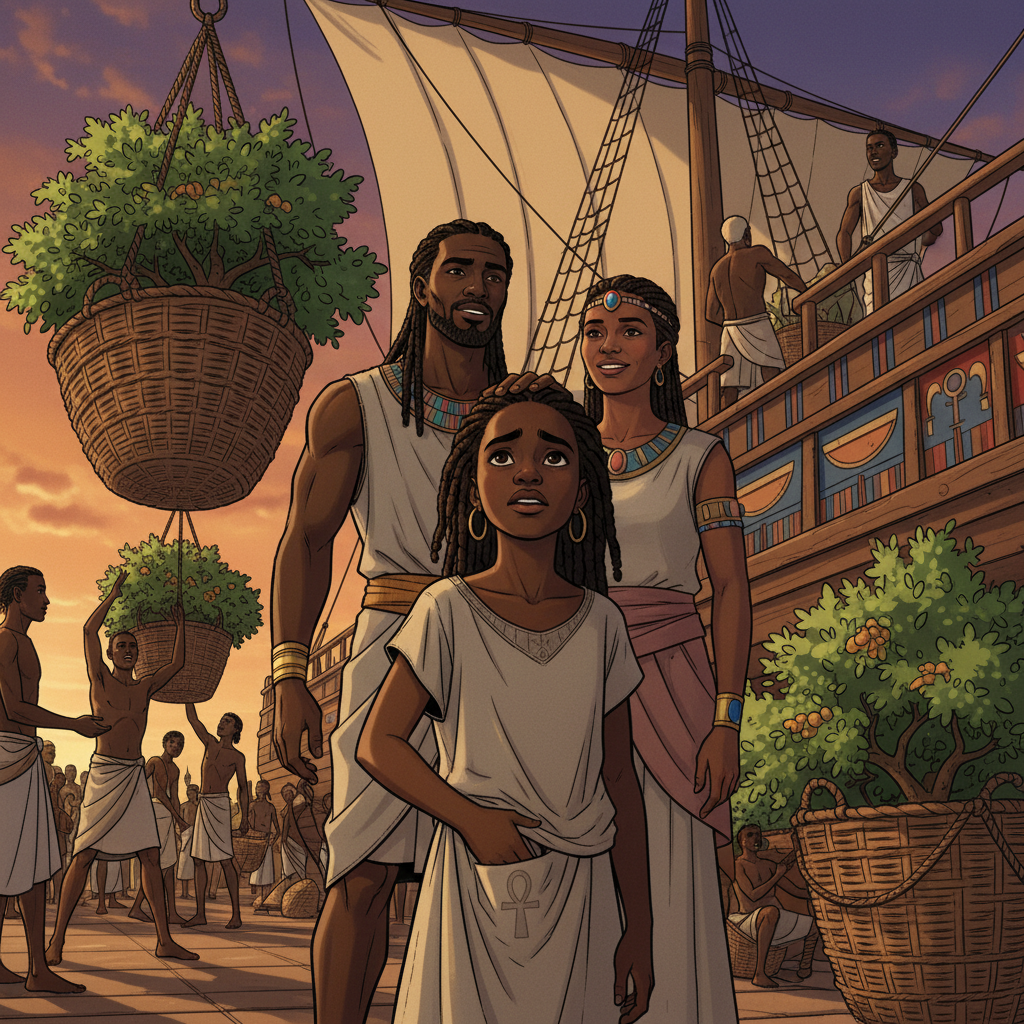
Tahiti thought. She thought about going home and not seeing her father for the long months of the return voyage. She thought about her own warm bed in the house at Waset. She thought about her mother's carved ankh in her hidden pocket. She thought about the grove of myrrh trees. She thought about the wicker baskets being lifted into the Kemetic ships even now. And she thought about something Queen Ati had not said aloud but Tahiti understood. The Punt people had given Pharaoh Hatshepsut's envoys not only the resin but the whole trees because the asking had been respectful. The asking had been respectful, in some small way, because a Kemetic captain had brought a Kemetic CHILD on this voyage. A child meant the voyage was not a raid. A raid does not bring its children. Tahiti raised her face. She looked at her father first, because he was her father and she loved him. Then she looked at Queen Ati. Then she looked back at her father. She said: "Father. I want to stay. Not to disobey you. To be useful. Queen Ati has shown me something I did not know I could carry, and I cannot carry it home alone — I need to ride home with the trees and with you. If you send me on the supply ship I will go. But if you let me choose, I choose to ride home with you." Her father was quiet for a very long time. Then he reached out and put his hand on her braided head, exactly where Queen Ati had put her hand in the grove. "Then ride home with me, daughter. Ride home with the trees."
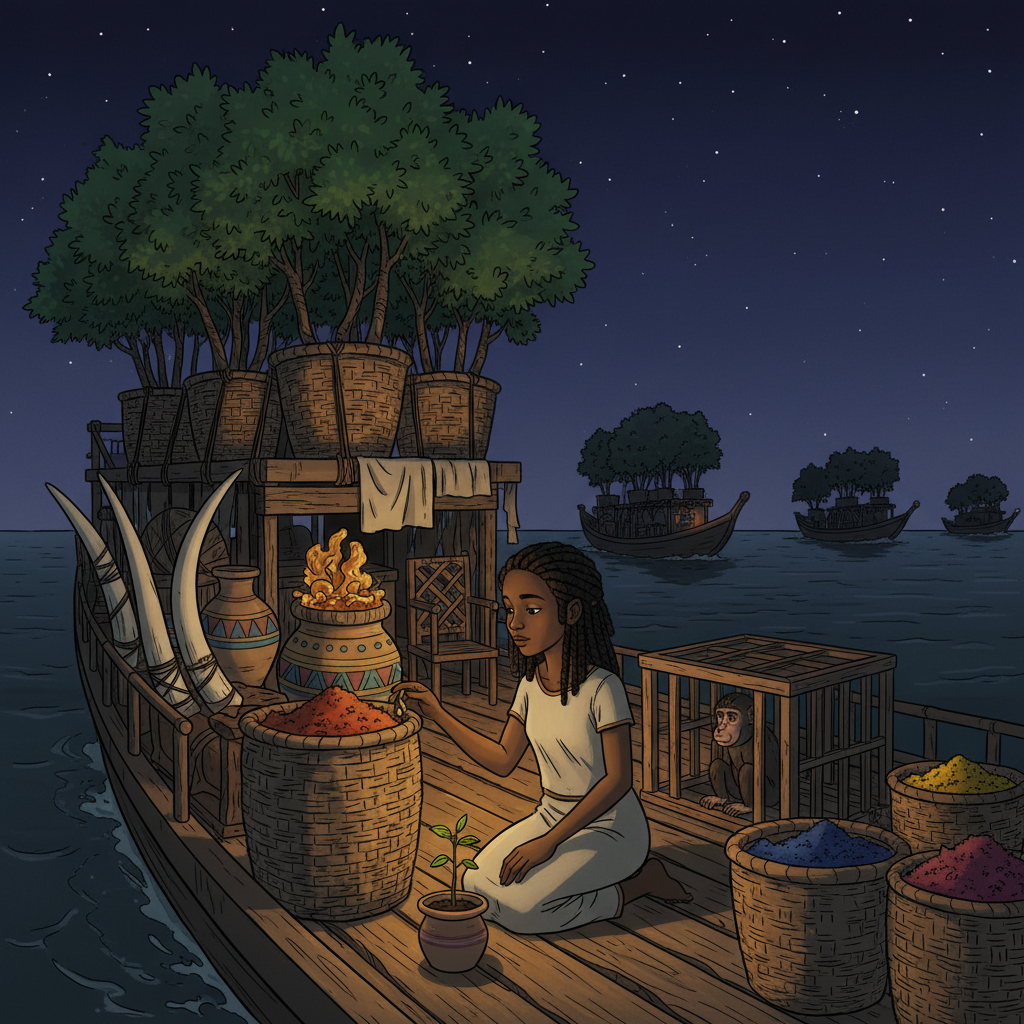
The return voyage took five months. The five Kemetic ships rode low in the water under the weight of their cargo — twenty-eight living myrrh trees in their great wicker baskets, lashed upright along the decks like a small forest at sea; ebony logs in the hold; ivory tusks wrapped in linen; jars of frankincense; a small carved chair for Pharaoh Hatshepsut's temple; six baskets of unfamiliar spices; and, in a special low cage near the captain's quarters of the lead ship, a young baboon who had been a gift from Queen Ati to be presented to the Pharaoh herself. Tahiti spent most of every day on deck with the myrrh trees. She watered them with seawater diluted with collected rain. She trimmed any dead leaves. She talked to them — quietly, in the manner her mother had once talked to the herbs in their small Waset garden. In the special small clay pot Queen Ati had pressed into her hands at the moment of parting, Tahiti carried one myrrh seedling — small, only as tall as her finger, with three pairs of leaves and a thin sapling-stem. Queen Ati had said: "This is yours. Not for the temple. For you. Plant it in your mother's name, where she would have planted it, if she had ever been able to come to Punt." Tahiti carried the small pot every day. She did not let anyone else hold it. At night she slept with it beside her head.
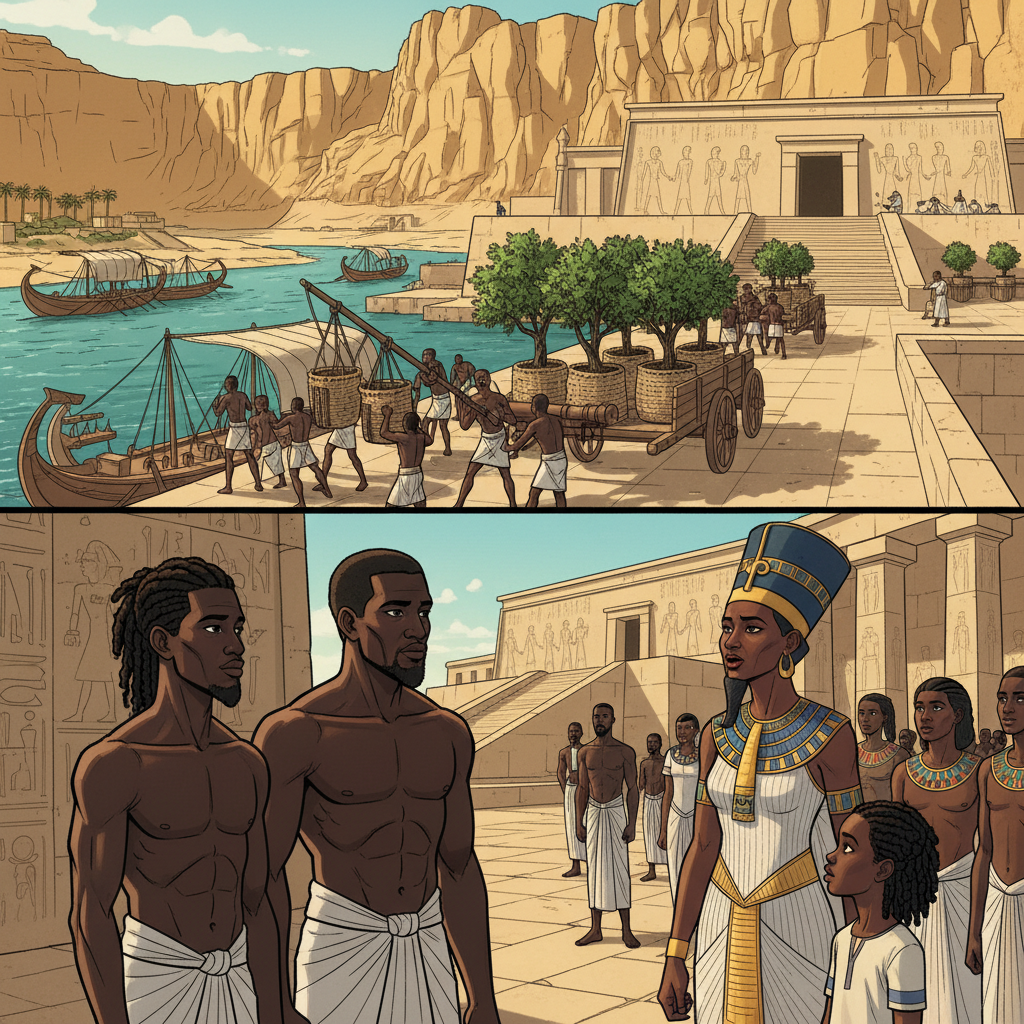
The ships arrived at the Kemetic shore on a morning in the third month of the inundation. The unloading took five full days. Tahiti stood beside her father at the dock as the great wicker baskets were lifted off the ships and loaded onto the wagons that would carry them upriver to Pharaoh Hatshepsut's mortuary temple at Deir el-Bahari. The temple was still under construction. Its terraces rose against the cliff face, pale and clean in the morning sun. Stoneworkers were already preparing the long walls of the second terrace for the carvings that would tell the story of the Punt expedition — the artists who would carve those walls were waiting nearby with their drawings already begun. Lady Nehesy was the one who took Tahiti and her father to be presented to Pharaoh Hatshepsut. The pharaoh listened to Nehesy's report standing on the second terrace of the temple in the late morning light. Hatshepsut wore the double crown of Kemet and the false beard of the pharaoh's office. Her face was strong and quiet. She listened to the entire report — every detail of every meeting at Punt — without interrupting. When Nehesy finished, the pharaoh asked questions for nearly an hour. Then she walked the line of officials who had returned, and she paused, briefly, in front of Tahiti and Captain Senemiah. She said one thing to Senemiah, not loudly, but clearly enough that Tahiti heard. The pharaoh said: "I am told there was a child aboard the lead ship."
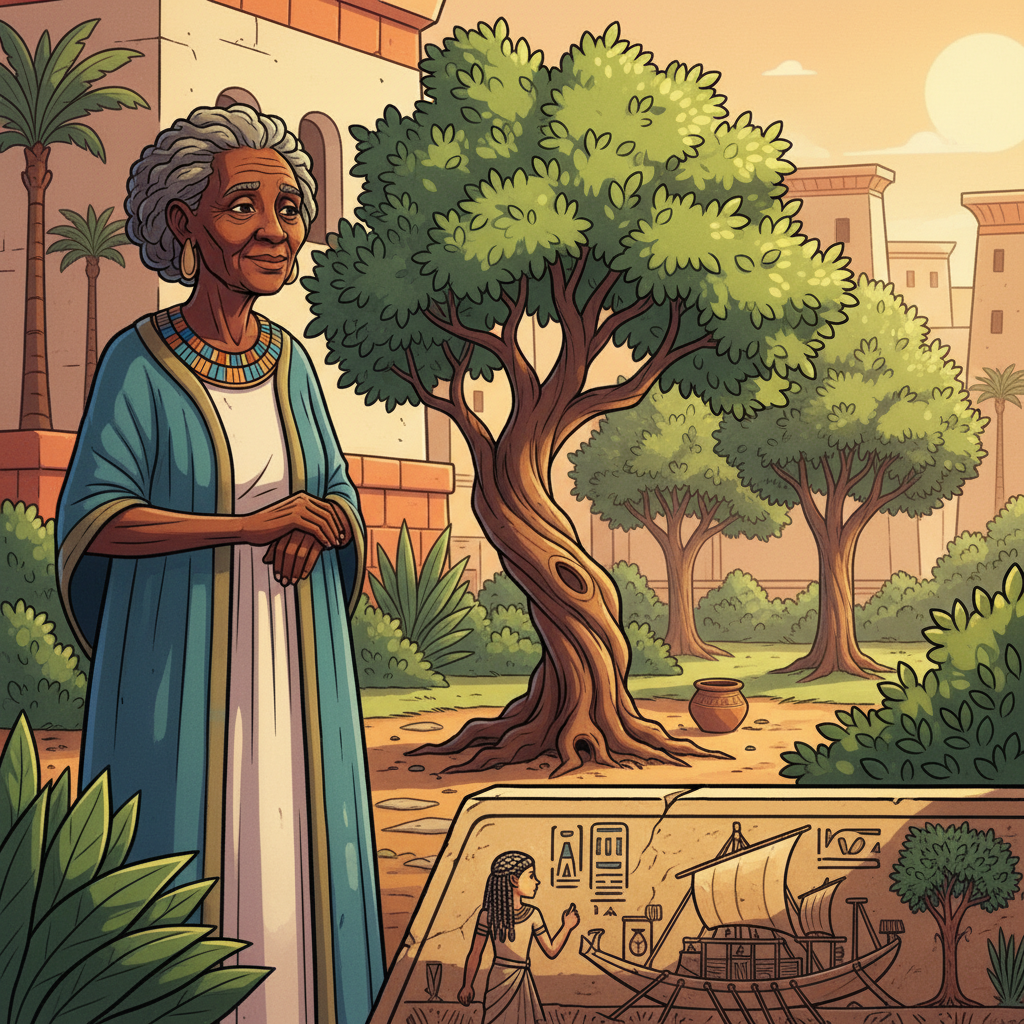
Captain Senemiah braced. Tahiti felt her father stiffen beside her. But Pharaoh Hatshepsut was looking at Tahiti, not at Senemiah, and the pharaoh's face had no anger in it. The pharaoh said, slowly: "Good. The asking is heard better when a child is in the asking." She nodded once at Senemiah. She nodded once at Tahiti. Then she walked on. Tahiti would learn, decades later, that the second-terrace carvings at Deir el-Bahari — the great carved wall that showed the Punt expedition in living color, the wall that would survive for thousands of years and become the world's first detailed record of an international trade voyage — would include, in one of its lower panels, the carved figure of a small child standing on the deck of the lead ship. The artists had heard. They had been told to include her. The pharaoh herself had ordered it. When the unloading was complete, Tahiti carried her small clay pot home through the streets of Waset. The seedling inside had grown another pair of leaves during the voyage. She walked through the front gate of her father's small house — empty since her mother had died, but well-kept by her father's elder sister — and she walked straight to the small garden patch where her mother had grown herbs. She dug a hole. She loosened the seedling's tiny roots. She set the seedling in the soil and pressed the earth gently around it. She said her mother's name aloud. The myrrh tree took root. The tree was still alive forty years later, when Tahiti was an old woman, and it had spread, by then, into a small grove of its own.