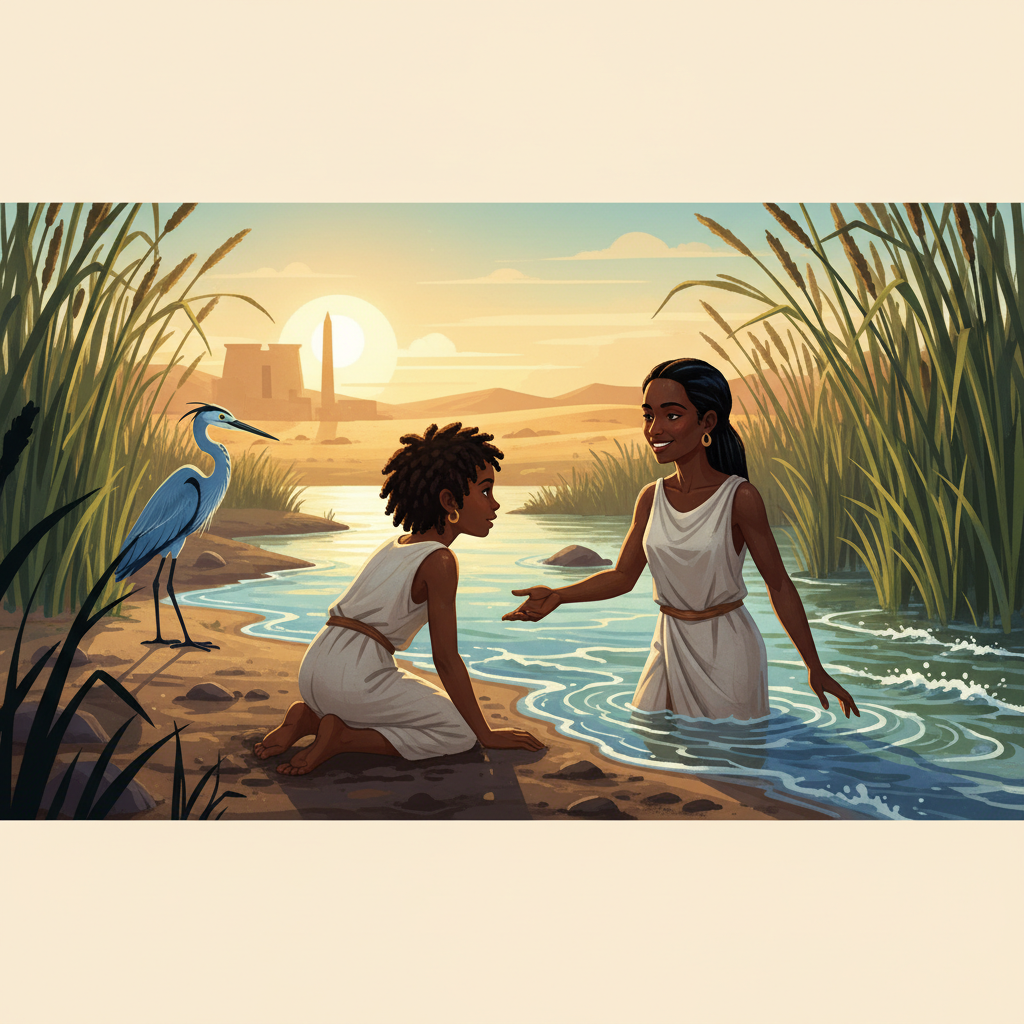
Kiya knelt at the edge of the great river, her dark brown knees pressing into the cool mud. The Nile water rushed past, making soft shushing sounds like a mother calming a baby. Tall green reeds swayed back and forth in the breeze, and a bright blue heron stood perfectly still nearby, watching for fish. Her mother, Nefertari, waded into the shallow water beside her. Her ebony skin gleamed in the early morning sun. "Come, little one," she said with a warm smile. "Today you learn the work of our family — the work of the papyrus makers."
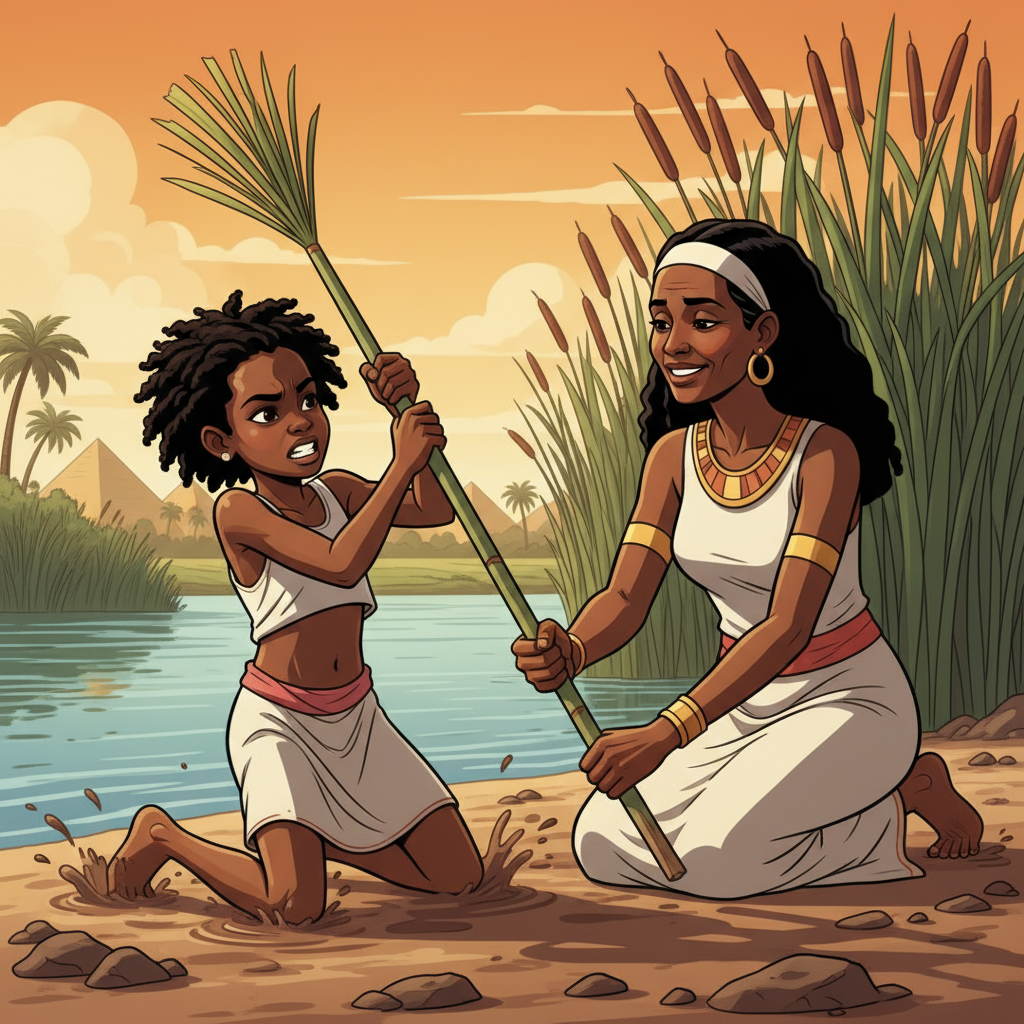
Kiya grabbed a tall reed with both hands and pulled as hard as she could. It would not budge! She pulled again, her feet slipping in the wet mud. Her mother laughed softly and knelt beside her. "Not like that, Kiya. Hold it low, near the roots, and twist as you pull." Kiya tried again, twisting this time. The reed came free with a satisfying pop, and she stumbled backward, landing on her backside in the mud with a splash. Nefertari covered her mouth to hide her grin. "Everyone falls the first time," she said gently. "Even I did, when my mother taught me."
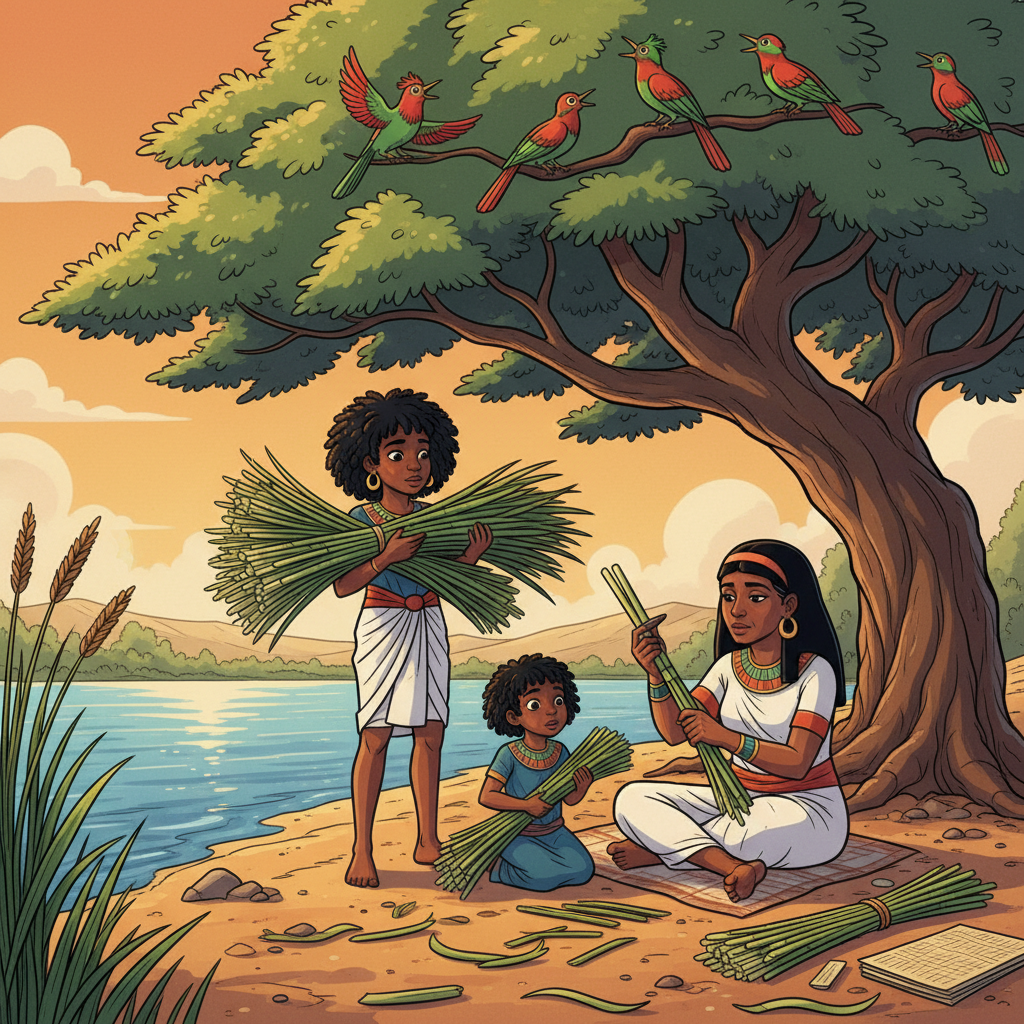
They carried armfuls of the long green reeds up the riverbank to their workspace under a wide acacia tree. Kiya loved this shady spot. She could hear the river behind her and the sound of birds singing in the branches above. The smell of wet plants and warm earth filled her nose. Nefertari sat cross-legged and held up one thick reed. "Watch my hands carefully," she said. She used a sharp flint blade to peel away the tough green outer layer. Underneath was a soft white core, smooth and a little bit sticky. "This is the heart of the papyrus plant," she told Kiya. "Everything we need is hidden inside."
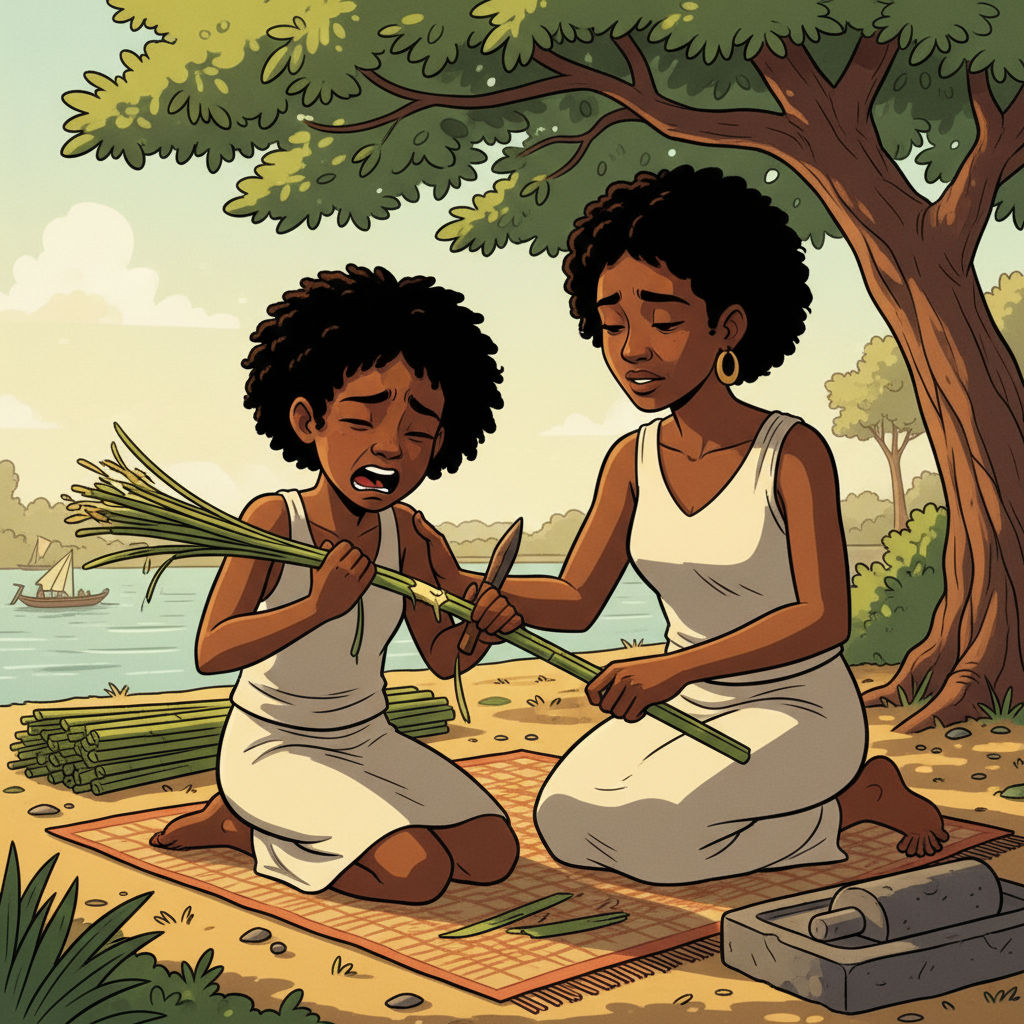
Kiya took the flint blade and tried to peel her own reed. She pressed too hard and the blade cut right through the whole stem, splitting it in two. "Oh no!" she cried, her shoulders dropping. She felt her face grow hot with frustration. "That is not a mistake," her mother said calmly, placing a steady hand on Kiya's arm. "That is learning. A papyrus maker must have a gentle touch. The plant will teach your hands what to do, but only if you are patient." Kiya took a deep breath, picked up a new reed, and tried again. This time, the green skin peeled away in one long strip, and she gasped with delight.
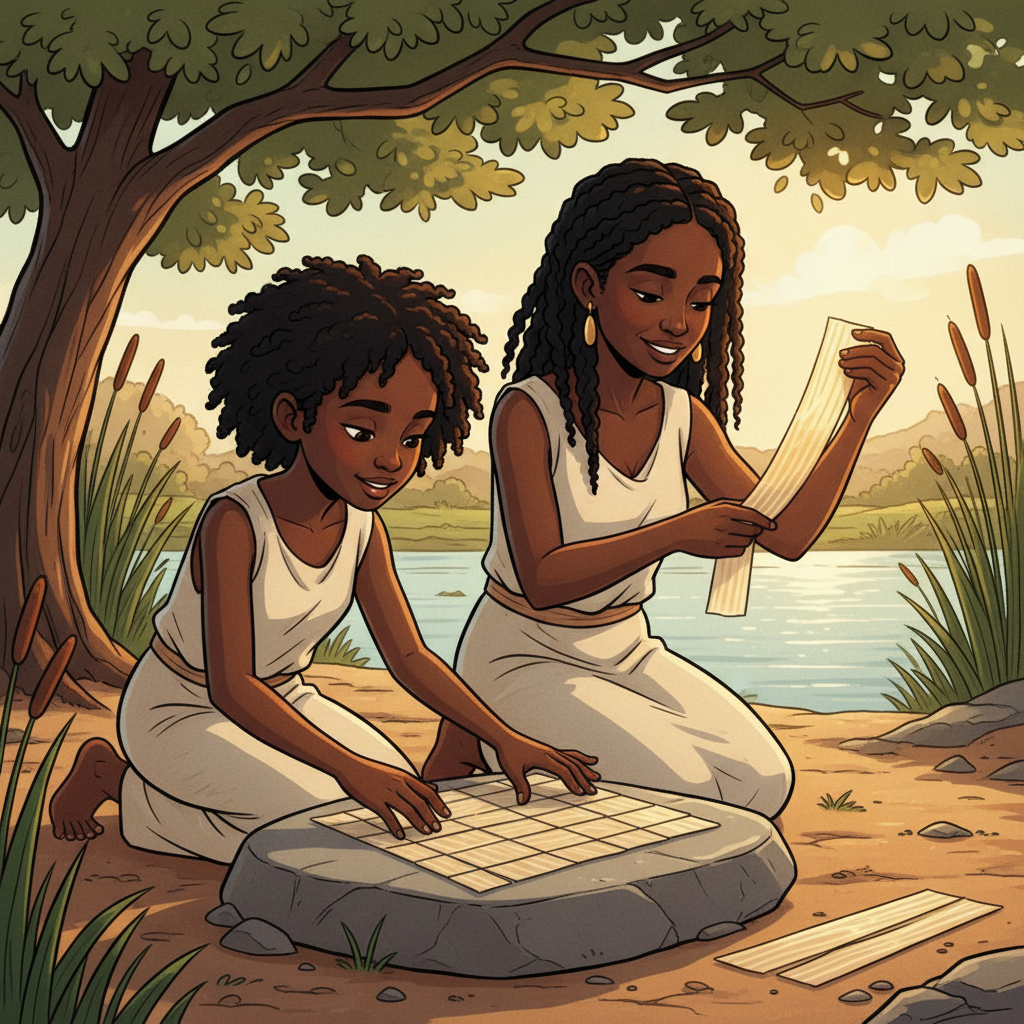
Now came the careful part. Nefertari showed Kiya how to slice the soft white core into thin, flat strips using the edge of the blade. Each strip had to be as thin as a finger. "Not too thick, not too thin," her mother said, holding one up to the sunlight so Kiya could see through it. "See how the light passes through? That is how you know it is ready." Kiya sliced strip after strip, laying them out on a flat stone. The wet strips felt cool and slippery between her fingers. Some came out crooked and some came out just right. She arranged the good ones in a neat row, feeling proud as the pile grew taller.
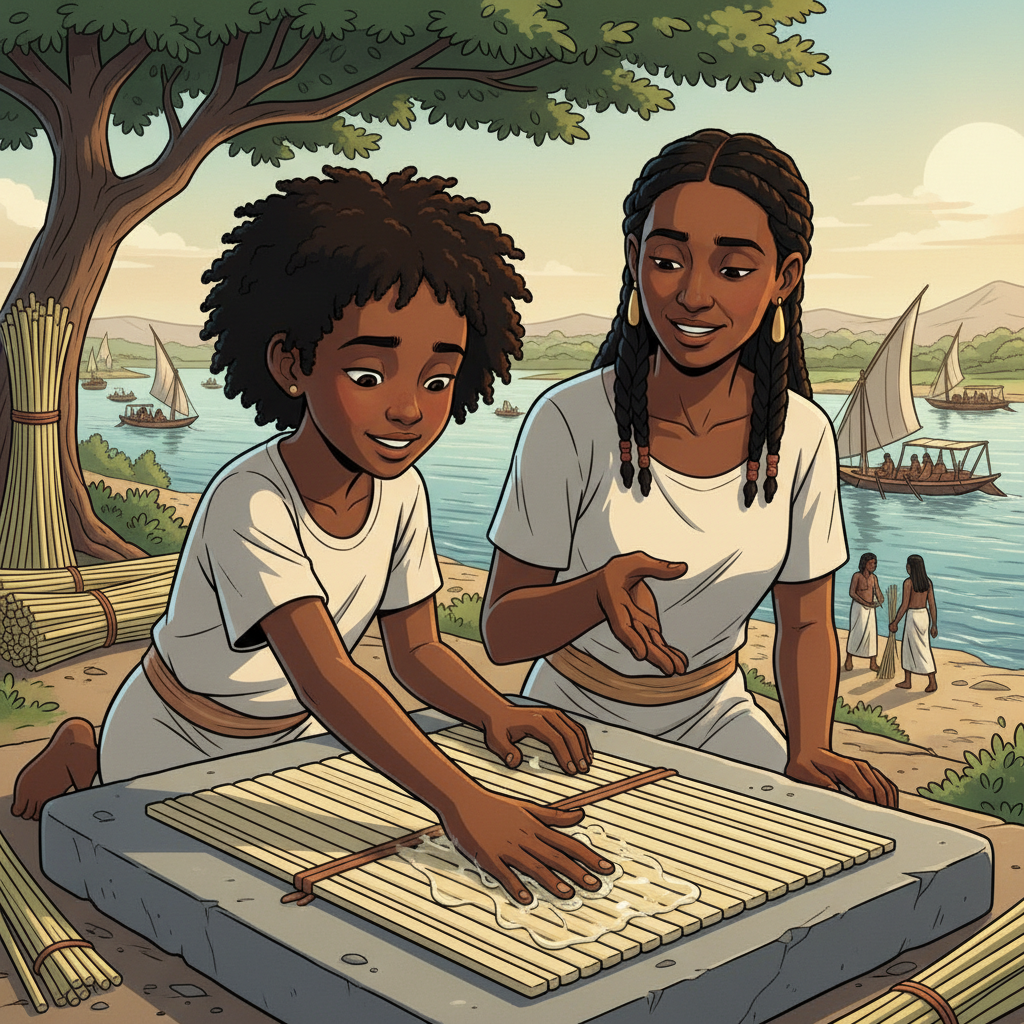
Next, Nefertari laid the strips side by side on a smooth stone slab, their edges just touching. Then she placed a second layer of strips on top, running the opposite direction, like a woven mat. "One layer goes this way," she said, moving her hand left and right. "The next layer goes this way," she moved her hand up and down. "The juice inside the plant is like glue. It holds everything together." Kiya pressed her hand down on the layers and felt the sticky wetness seep between her fingers. It smelled green and alive, like the river itself. "It feels like magic," she whispered. Her mother smiled and said, "It is not magic. It is the gift of the Nile — the river gives us everything we need."
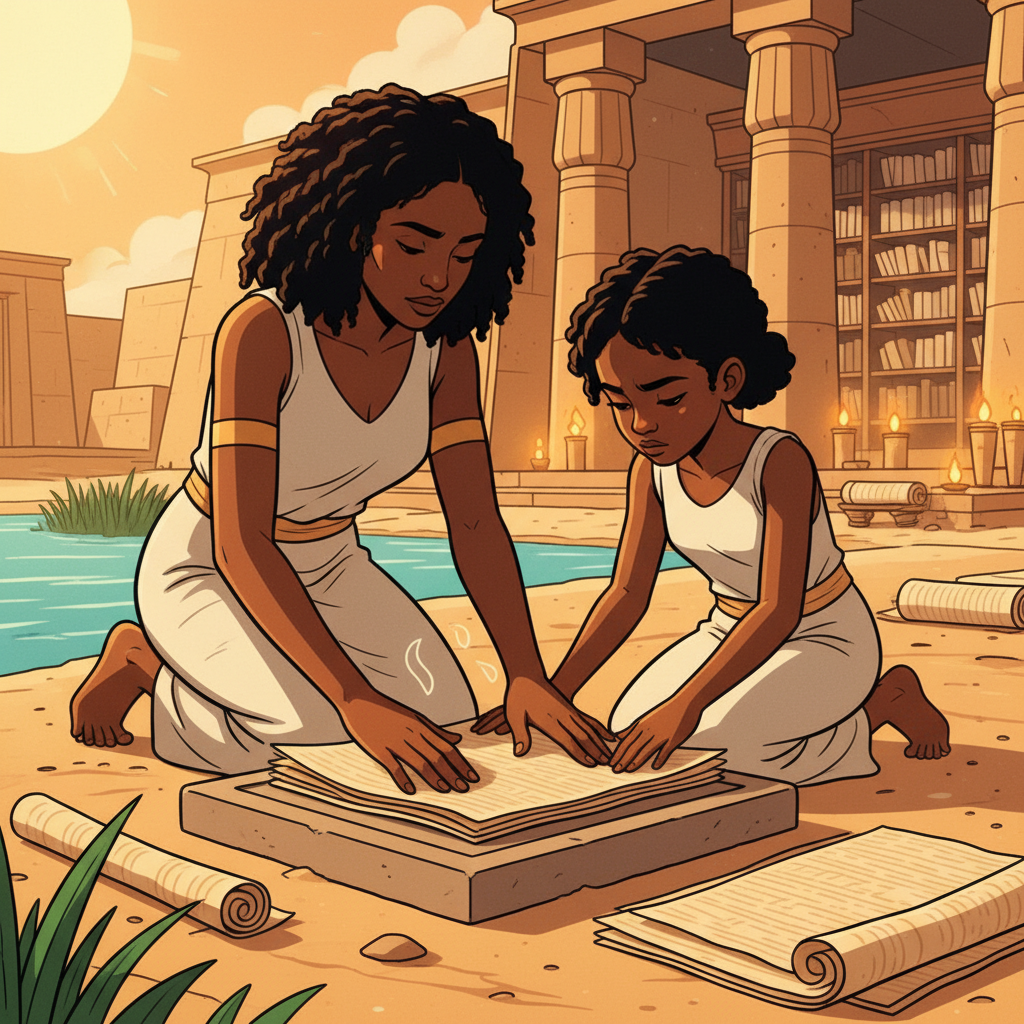
They placed a heavy flat stone on top of the layered strips to press them together. Nefertari showed Kiya how to check that no air bubbles were trapped inside. "Press here," she said, guiding Kiya's small hands to the edges. "Feel for soft spots and push the air out toward the sides." Then they left the pressed sheets in the bright sun to dry. The heat of Kemet was strong, and Kiya could see the edges of the papyrus already beginning to curl and turn golden. "By tomorrow," her mother promised, "this will be smooth and firm, ready for a scribe's brush." Kiya could hardly wait. She kept peeking at the drying sheets when she thought her mother was not looking.
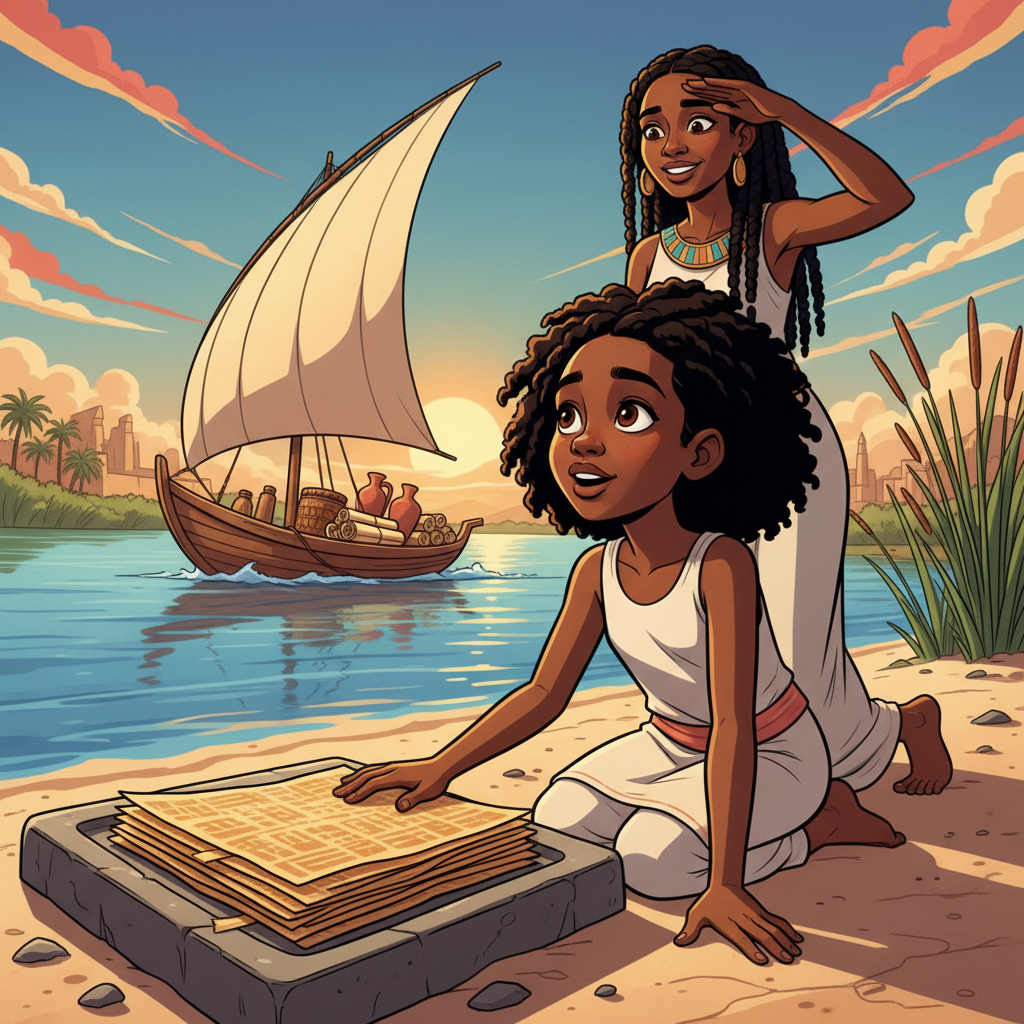
While they waited, Kiya noticed a long wooden boat gliding down the Nile. Its white sail caught the wind like a great bird's wing. The boat was loaded with baskets and clay jars, and she could see rolls of something golden stacked in neat piles. "Mother, look! What is that boat carrying?" Nefertari shielded her eyes from the sun and smiled. "Those are papyrus scrolls, Kiya. That boat is sailing south, all the way to Kush. And other boats carry our scrolls north, across the great sea to lands we have never seen." Kiya's eyes went wide. She looked down at the drying sheets beside her and then back at the distant boat. Her hands had made something that could travel the whole world.
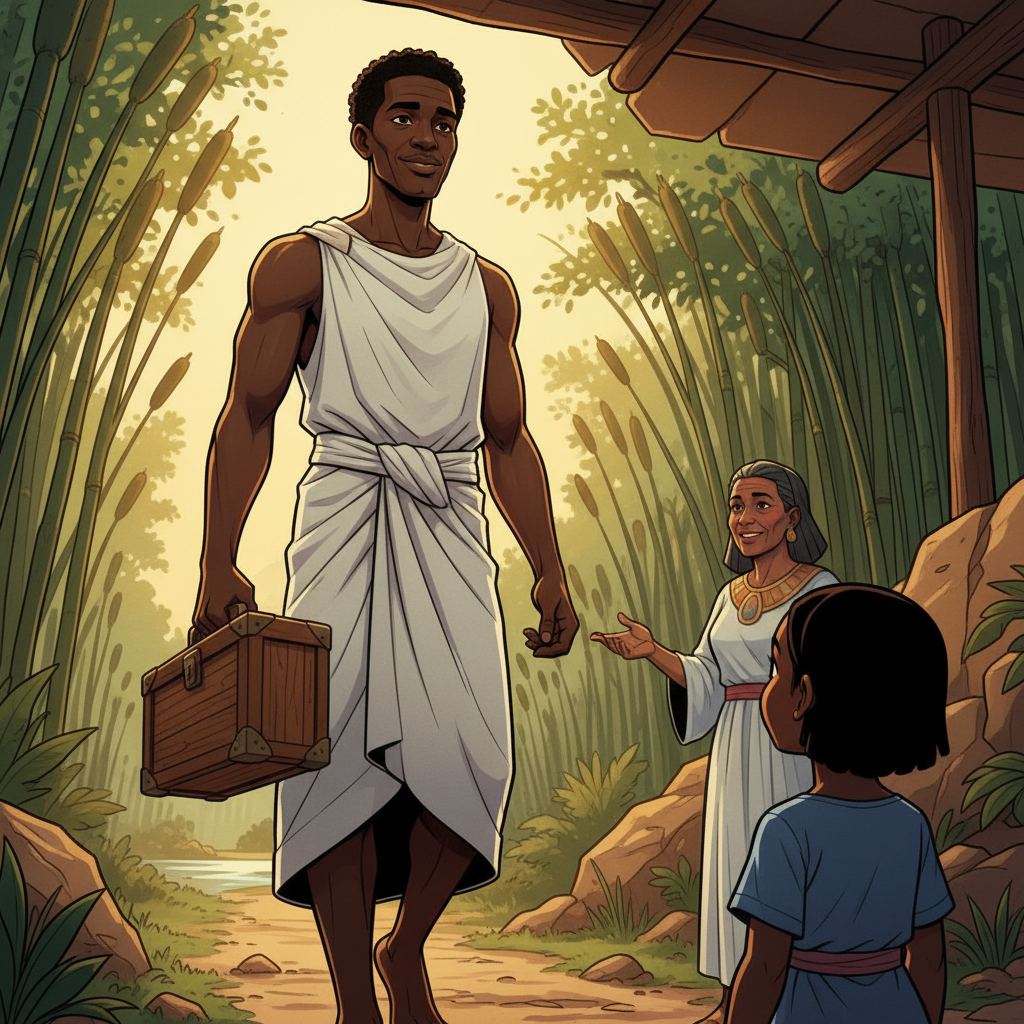
The next morning, a tall man with deep ebony skin and kind eyes walked up the path to their workspace. He wore a white linen kilt and carried a wooden case under his arm. "That is Amenhotep," Nefertari told Kiya. "He is a scribe from the Per Ankh." Kiya stood up straight. She had never met a real scribe before. Amenhotep opened his wooden case and inside were brushes made from reeds, and small pots of black and red ink. "May I see your work, young one?" he asked. Kiya handed him a finished sheet of papyrus with trembling hands. He held it up, bent it gently, and ran his thumb across the surface. "This is fine work," he said, and Kiya thought her heart might burst.
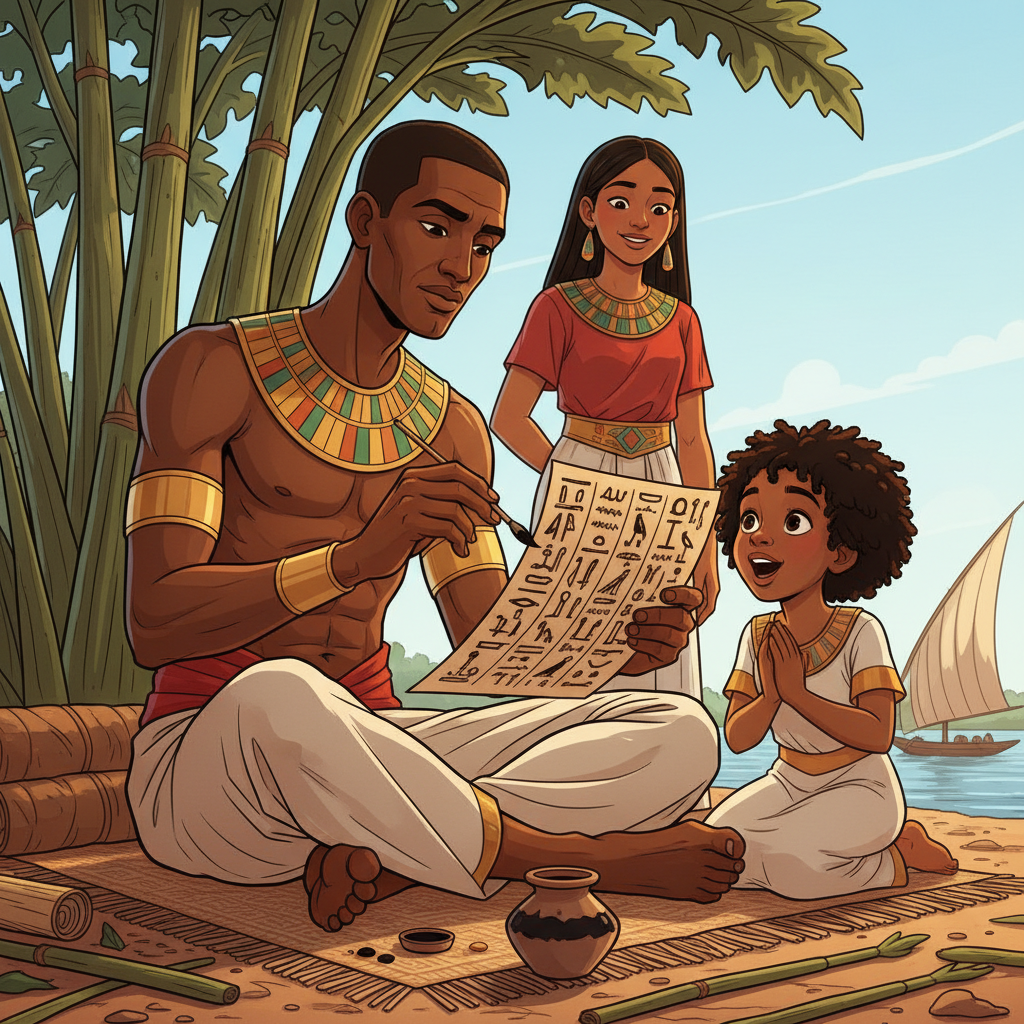
Amenhotep sat down in the shade and dipped his brush into the black ink. With quick, sure strokes he began to paint beautiful symbols onto the papyrus. Kiya watched, her mouth open in amazement. "What are you writing?" she asked, leaning close to see. "I am writing a healing prayer," he said, not looking up from his careful work. "A child in the village is sick, and the physician needs these words to make the medicine correctly. Without this papyrus, the knowledge would be trapped inside my head, helping no one." He tapped the sheet gently. "You did not just make papyrus today, Kiya. You made a way for knowledge to move from one mind to another."
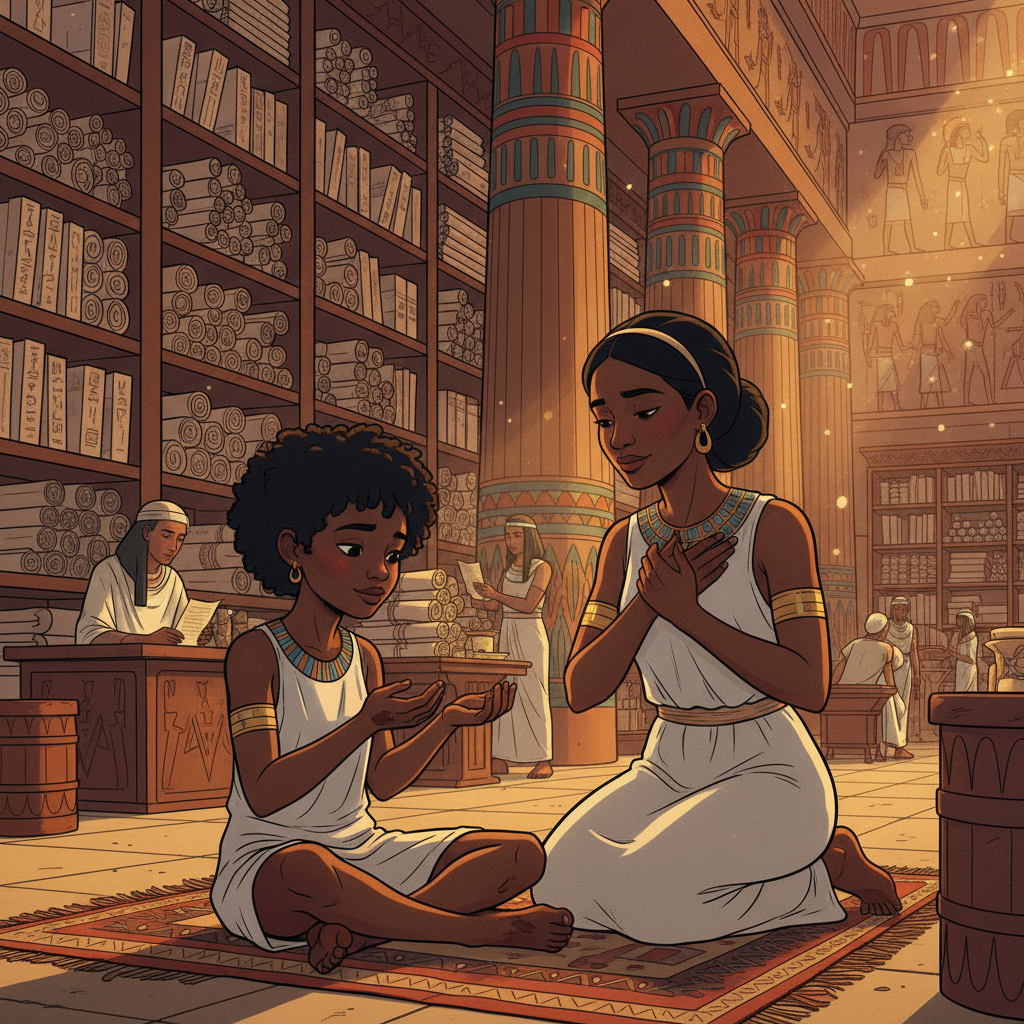
Kiya sat quietly for a long moment, looking at her hands. There was still sticky plant juice under her fingernails and mud on her knees. She thought about the boat sailing to Kush, carrying scrolls made by her family. She thought about the sick child who would be healed because of words written on papyrus she had pressed with her own hands. "Mother," she said slowly, "is this what Maat feels like?" Nefertari knelt beside her daughter and placed a hand over her heart. "Yes, my love. When knowledge flows freely, when truth is shared and not hidden, that is Maat — the divine order. But when people hoard knowledge or destroy scrolls so others cannot learn, that is Isfet — chaos and injustice. Our family fights Isfet every single day, one sheet at a time."
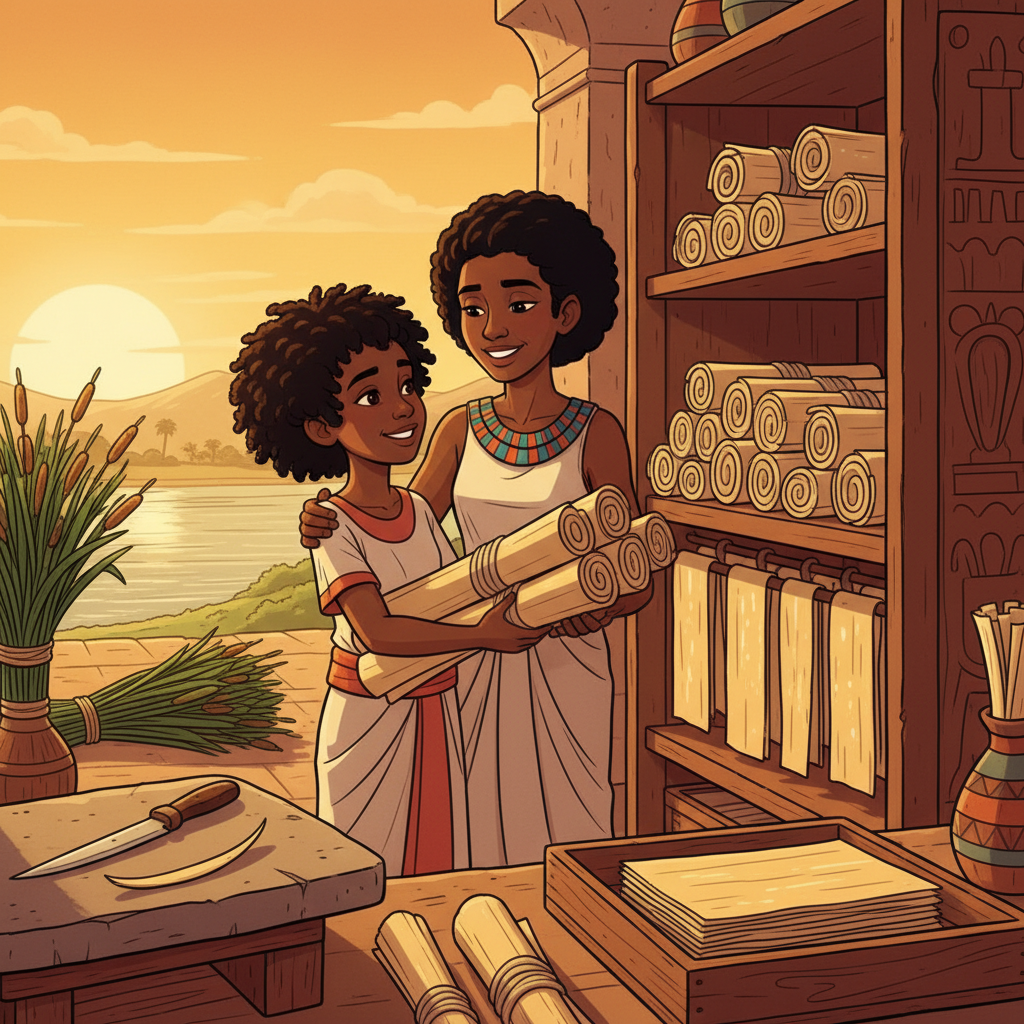
That evening, Kiya helped her mother stack the finished sheets of papyrus into neat rolls, tying each one with a thin strip of linen. Her arms were tired and her back was sore, but she had never felt so proud. She had pulled the reeds, peeled the stems, sliced the strips, pressed the layers, and watched the sun dry them golden. Today we do not write on papyrus anymore. We use paper made from trees, and we use computers that glow with light. But the idea that Kiya learned beside the Nile is still alive — that knowledge belongs to everyone, that truth must be shared, and that the work of our hands can change the world. Every time you read a book or share what you have learned, you are keeping Maat alive, just like the papyrus makers of Kemet.