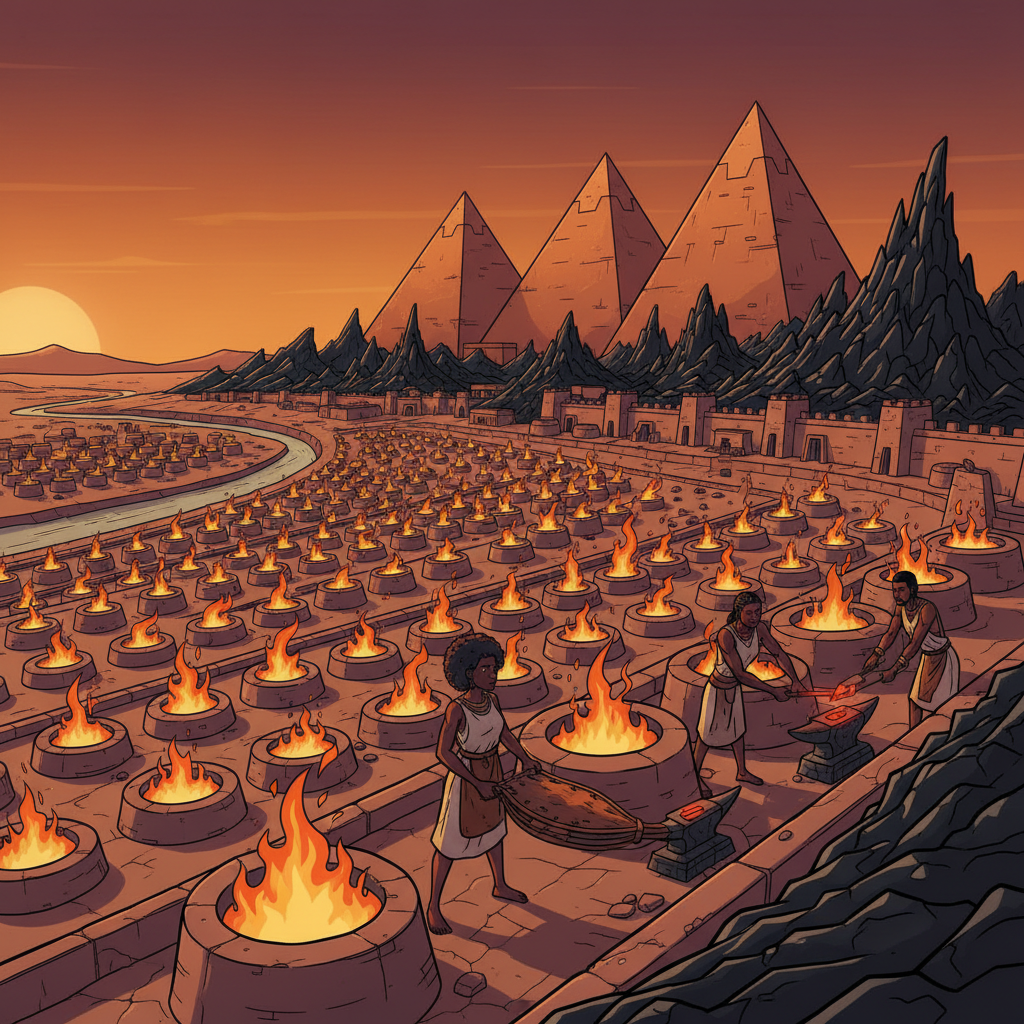
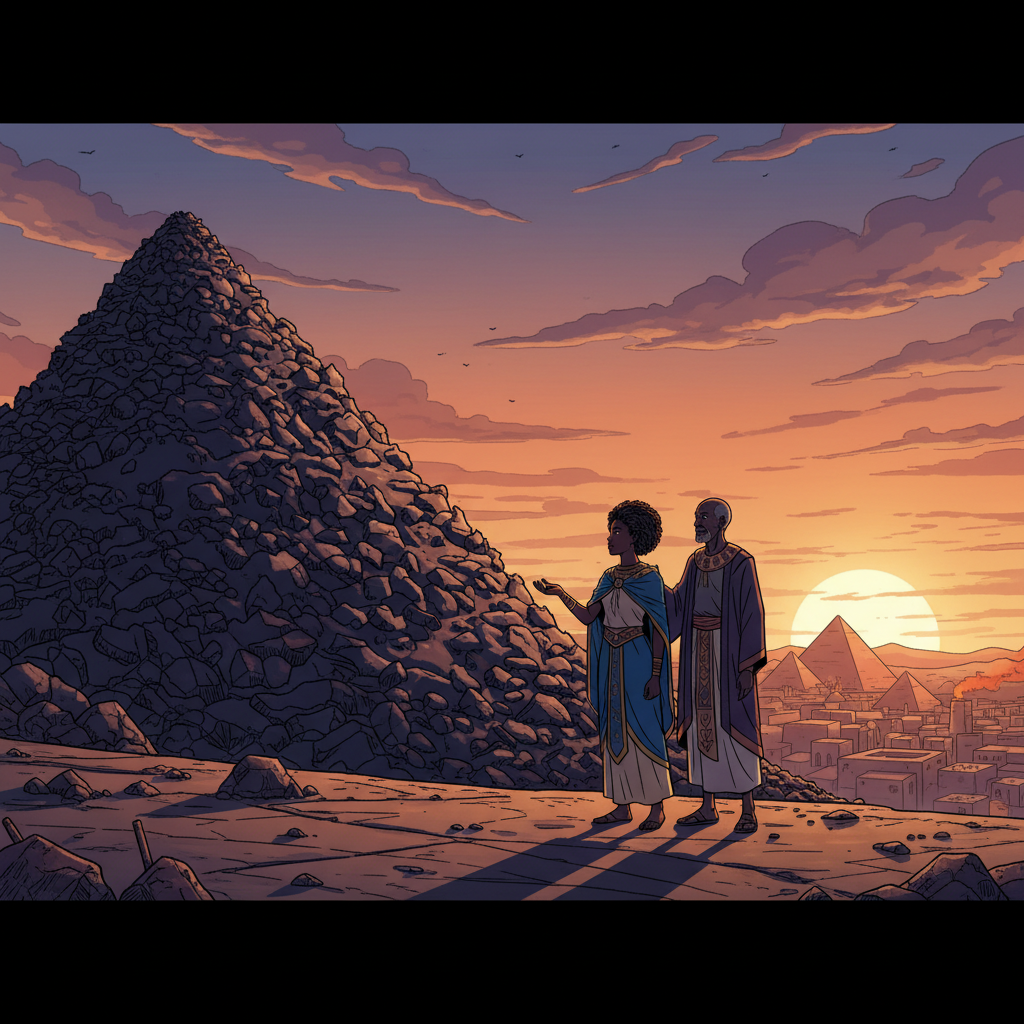
The furnaces of Meroe burned day and night, and their glow turned the eastern sky the color of molten copper. From the plateau above the city, where the royal quarters stood among pyramids that climbed toward the stars in steep, sharp angles, the smelting district looked like a field of captive suns — hundreds of fires burning in clay structures arranged in rows that stretched for nearly a mile along the riverbank. The slag heaps — mountains of waste from centuries of iron production — rose higher than the city walls themselves, black and glassy, monuments to an industry that had made Meroe the most important iron-producing center in all of Africa. Nawidemak was fifteen years old, an apprentice in the workshop of Master Smelter Aqrakamani, and she had iron in her blood — not metaphorically, but as a point of family pride. Her grandmother had been a bellows operator. Her mother shaped iron tools on the great anvils. Her uncle designed the clay tuyeres that channeled air into the furnaces at precisely the right angle and volume to achieve the temperatures needed to smelt iron from ore.
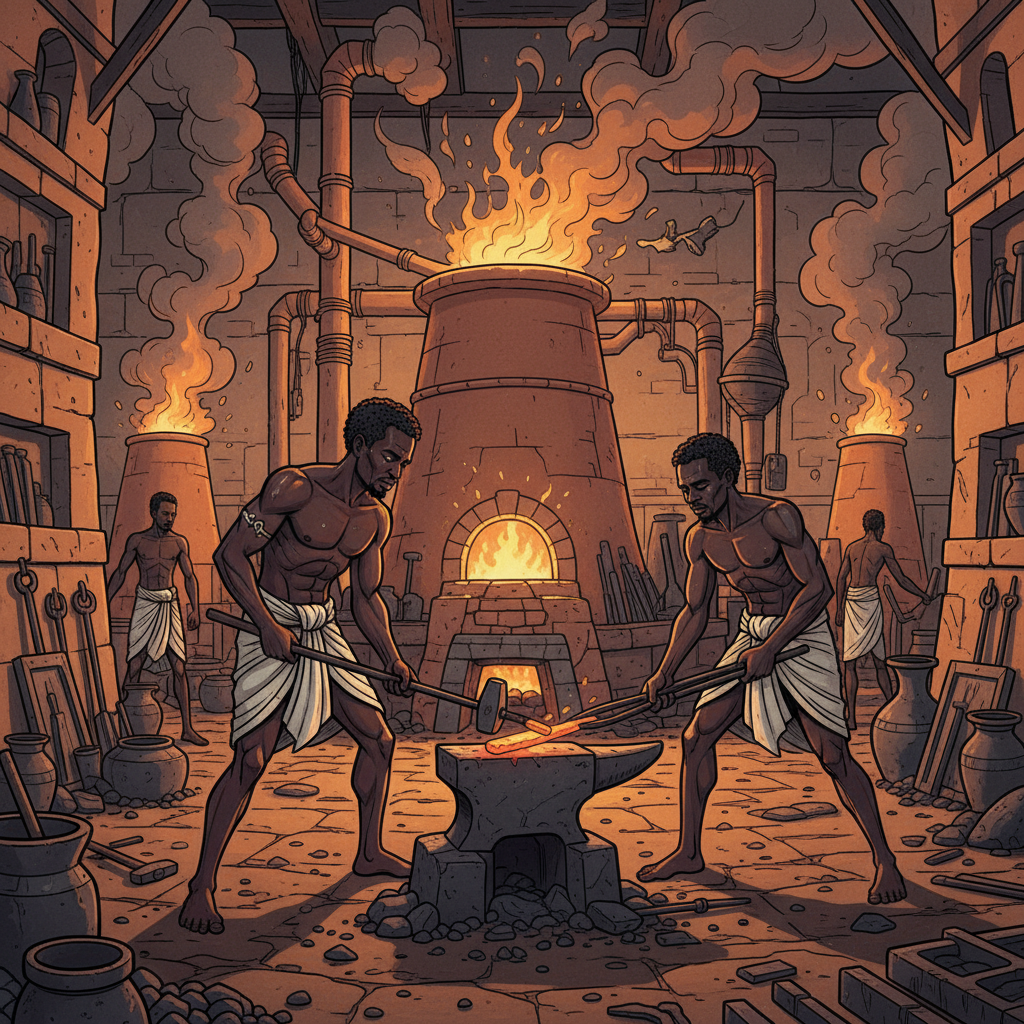
The year was approximately 280 before the common era, and Meroe stood at the height of its power. The city controlled the trade routes between sub-Saharan Africa and the Mediterranean world. Its merchants sold iron tools, weapons, cotton textiles, and gold northward through Kemet, eastward across the Red Sea to Arabia and India, and southward into the African interior. But it was iron that made Meroe's fortune and secured its independence. No other city in Africa — and few in the wider world — could match the scale and sophistication of Meroitic iron production. The technology was closely guarded. Outsiders who visited Meroe marveled at the industry but were never permitted to observe the smelting process in detail. The specific composition of the furnace clay, the design of the bellows, the selection and preparation of the iron ore, the precise temperature sequences needed to produce different grades of iron — all of this was proprietary knowledge, passed from master to apprentice under oaths of secrecy as solemn as any temple ritual.
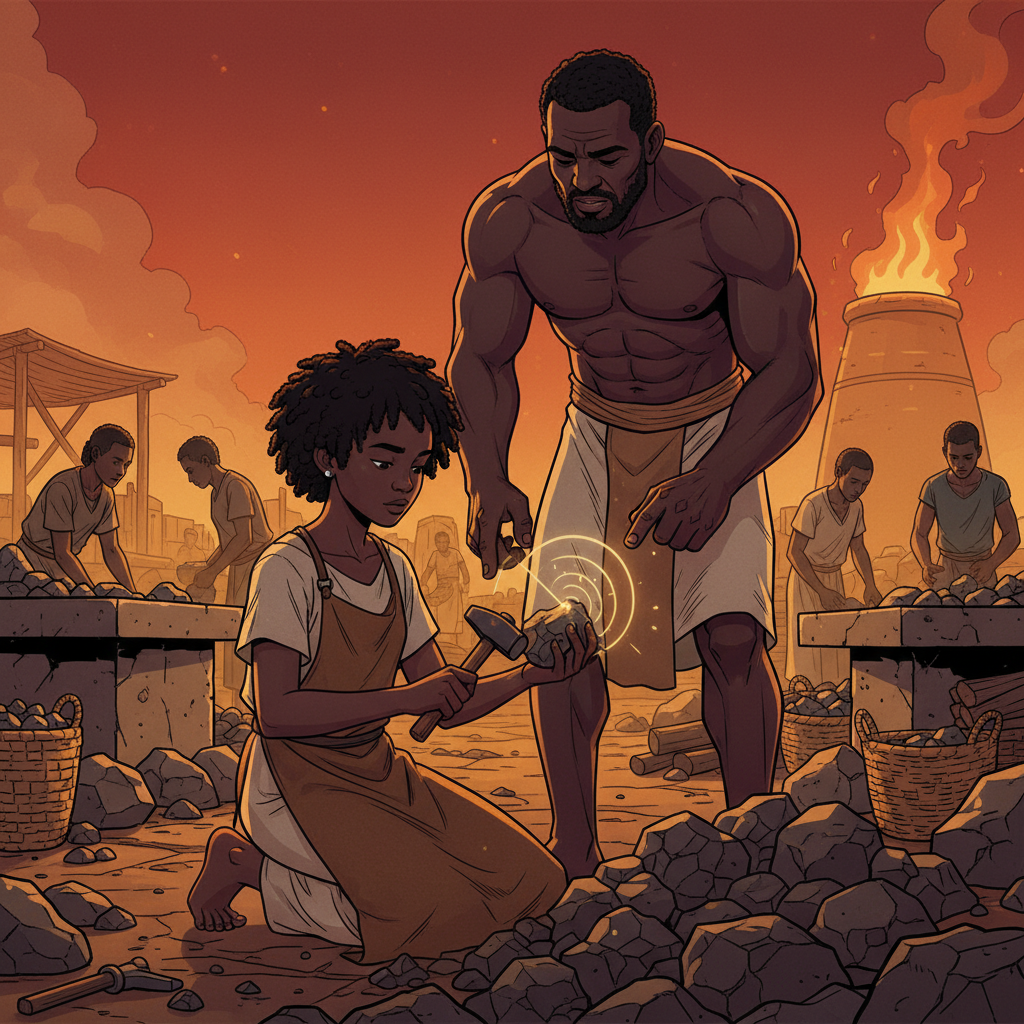
Nawidemak had entered her apprenticeship at twelve, beginning as all apprentices did — not at the furnace but at the ore. For two years, she had worked in the sorting yards, learning to distinguish between the different grades of iron ore that arrived from the mining sites west of the city. Good ore was heavy, dark, and rang with a clear tone when struck. Poor ore was lighter, more porous, and produced a dull thud. Between these extremes lay dozens of gradations that only experience could teach. Her master, Aqrakamani, was a man of legendary patience and ferocious standards. He was perhaps fifty, with very dark skin stretched over the powerful muscles of his arms and chest — the physique of someone who had spent decades working at temperatures that drove lesser workers away. "Iron does not forgive mistakes," Aqrakamani told Nawidemak on her first day. "Wood forgives — you can reshape it, repair it, start again. Clay forgives — if it breaks, you wet it and rebuild. But iron remembers every error. Heat it wrong and it becomes brittle. Cool it wrong and it bends. Work it wrong and it shatters. Respect the iron, and it will serve you. Disrespect it, and it will kill you."
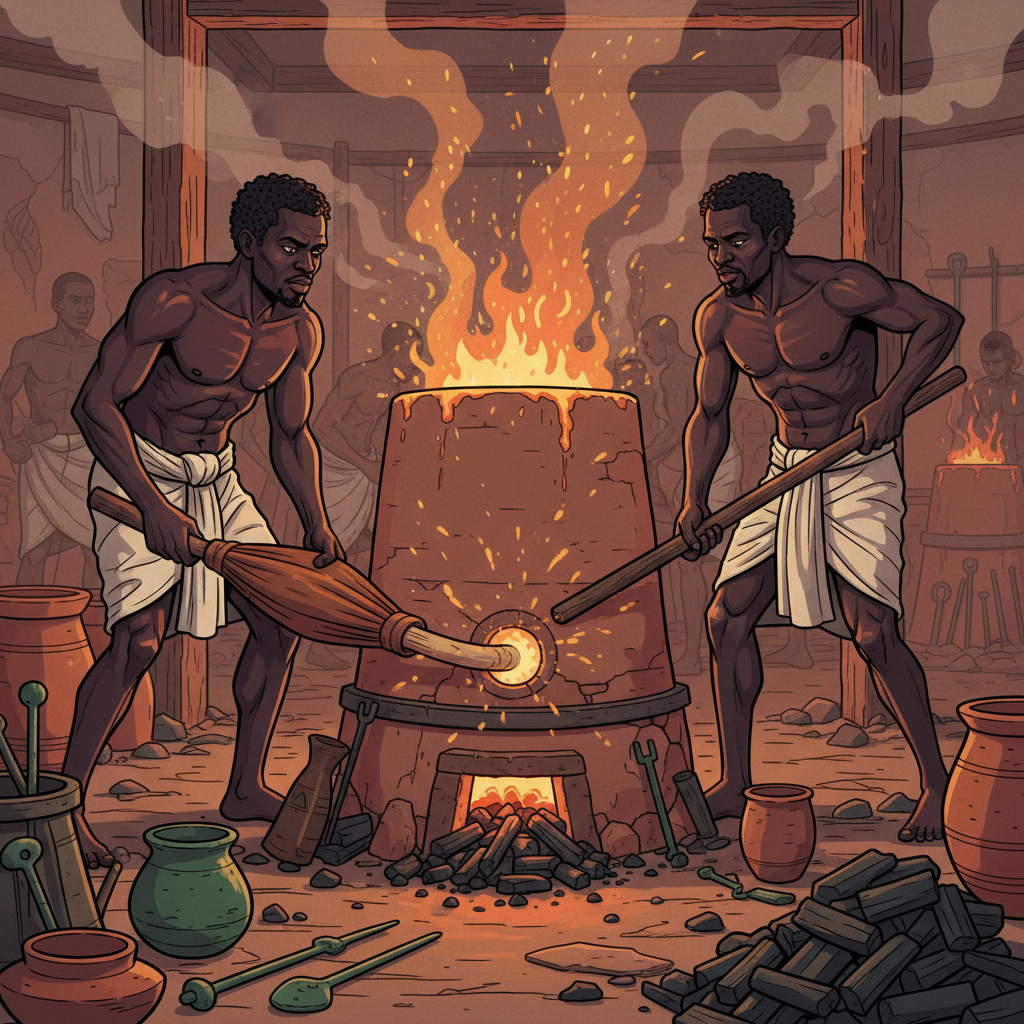
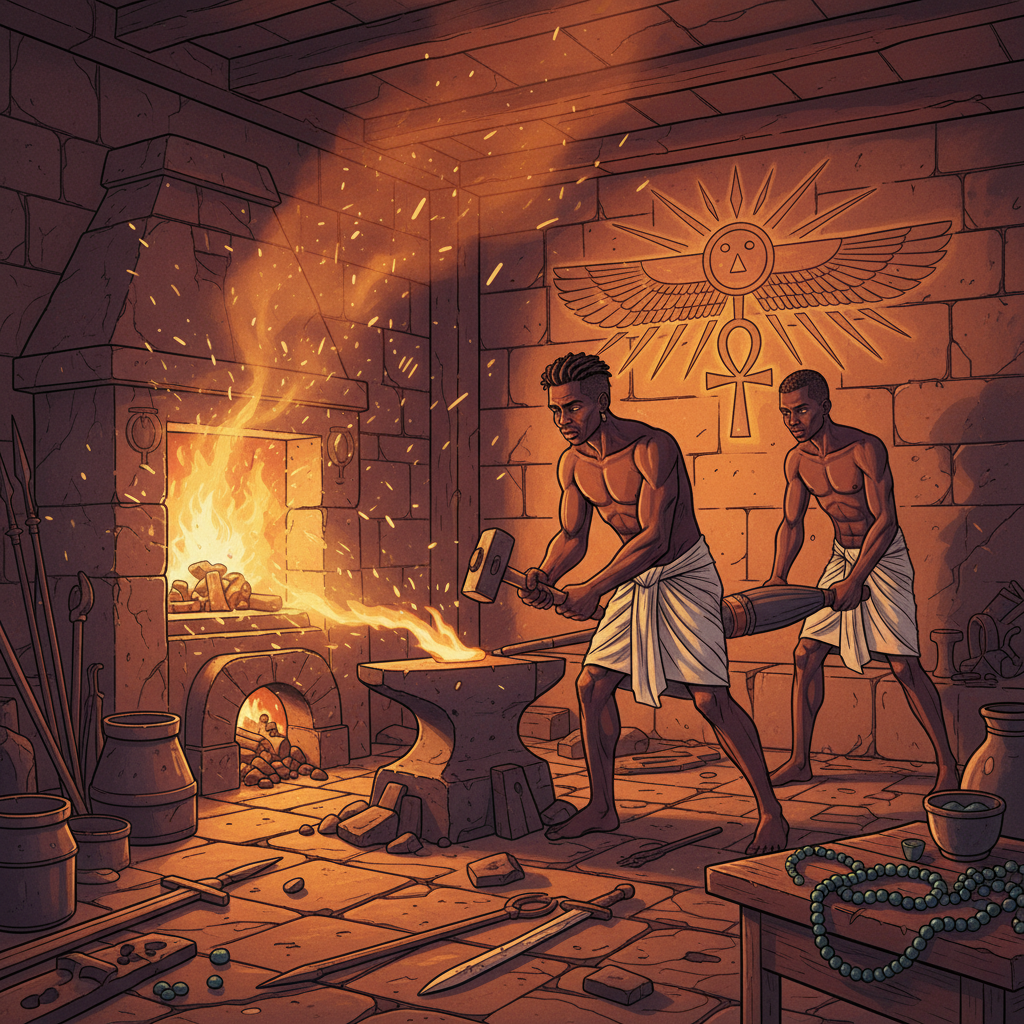
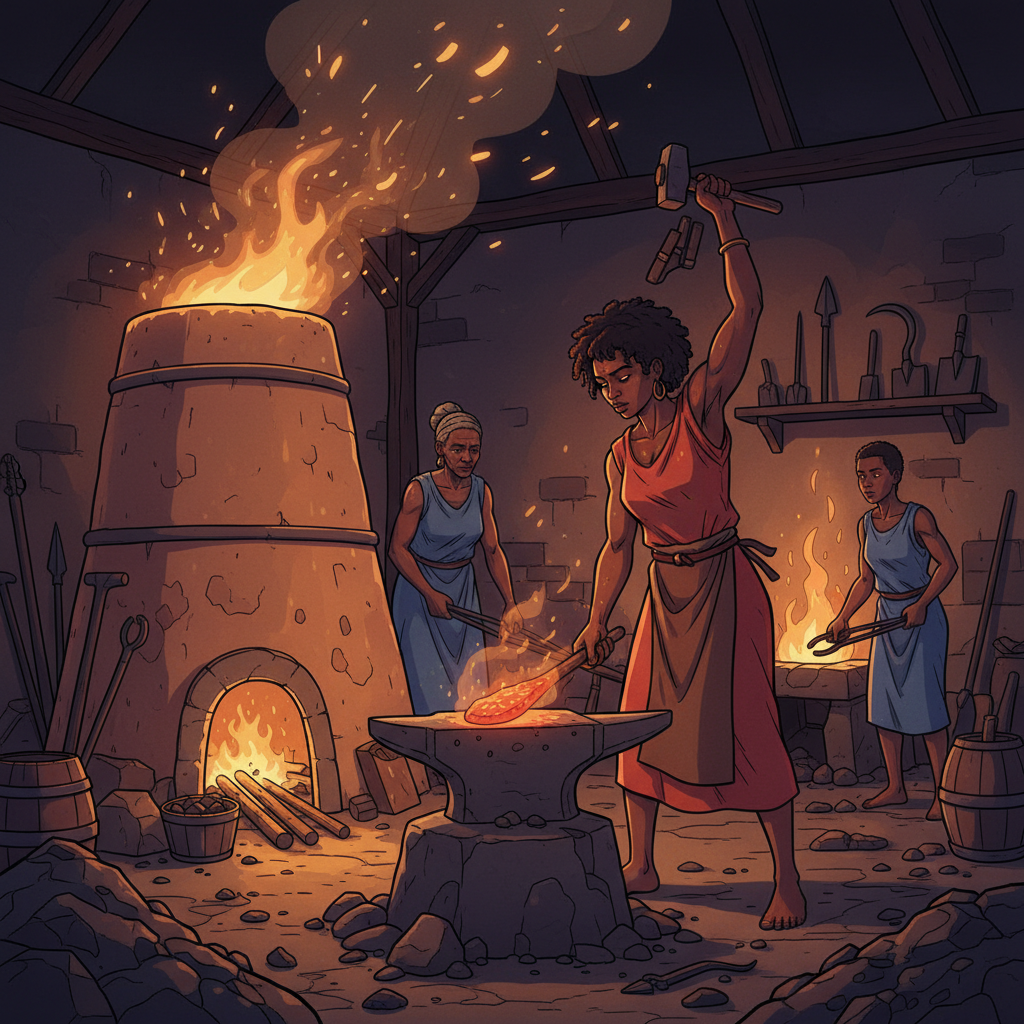
The smelting process itself was a marvel of empirical engineering — knowledge developed over centuries through careful observation, experimentation, and the accumulation of practical wisdom that modern scientists would recognize as the foundation of metallurgy. The furnaces were cylindrical structures of fired clay, approximately four feet tall and two feet in diameter, lined with a special mixture of local clays that could withstand the extraordinary temperatures required to reduce iron ore to usable metal. The key to Meroitic success was the bellows system. Each furnace was served by a set of goatskin bellows operated by teams of workers who pumped air through clay tubes — tuyeres — inserted into the furnace wall at carefully calculated angles. The air flow increased the furnace temperature from the seven hundred degrees that an unassisted fire could achieve to the twelve hundred or more degrees needed to smelt iron. The design of the tuyeres — their diameter, their angle of insertion, their position relative to the charcoal bed — was the most closely guarded secret in Meroe.
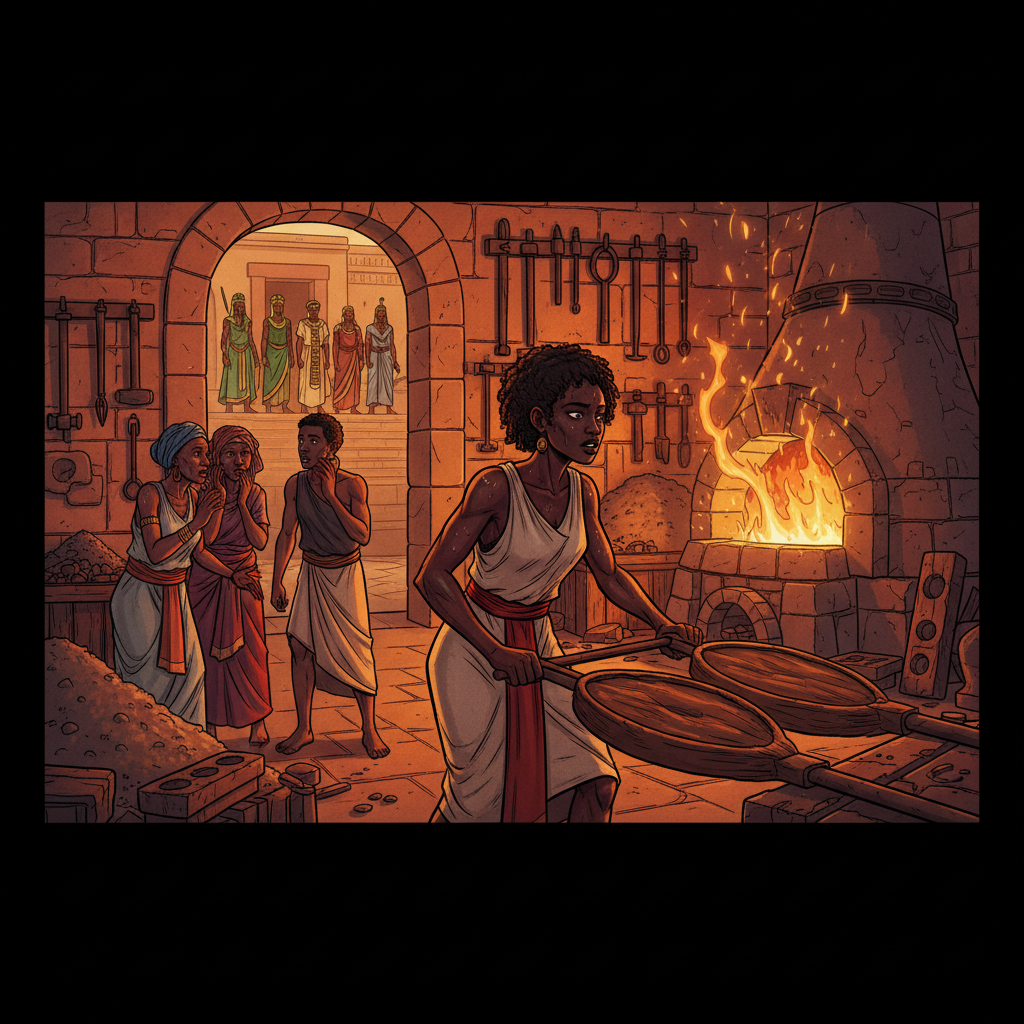
Nawidemak was learning the bellows work when the delegation arrived from Aksum. She heard about it first through the network of gossip that connected every workshop in the smelting district — news traveled faster than iron cooled in Meroe's artisan quarters. A party of six Aksumite officials had arrived at the court of Qore Arnekhamani, requesting a formal audience. Their purpose, it was rumored, was to negotiate for Meroitic iron weapons and, more significantly, for the knowledge of iron smelting itself. Aksum was a rising power in the Horn of Africa — a kingdom centered on the Ethiopian highlands that controlled the lucrative Red Sea trade and was rapidly expanding its influence. The Aksumites were formidable people — their very dark skin, tall frames, and striking features reflected the Cushitic and Semitic heritage of the highlands. They had their own metallurgical traditions, working copper and bronze with considerable skill, but their iron production was limited compared to Meroe's industrial-scale operations.
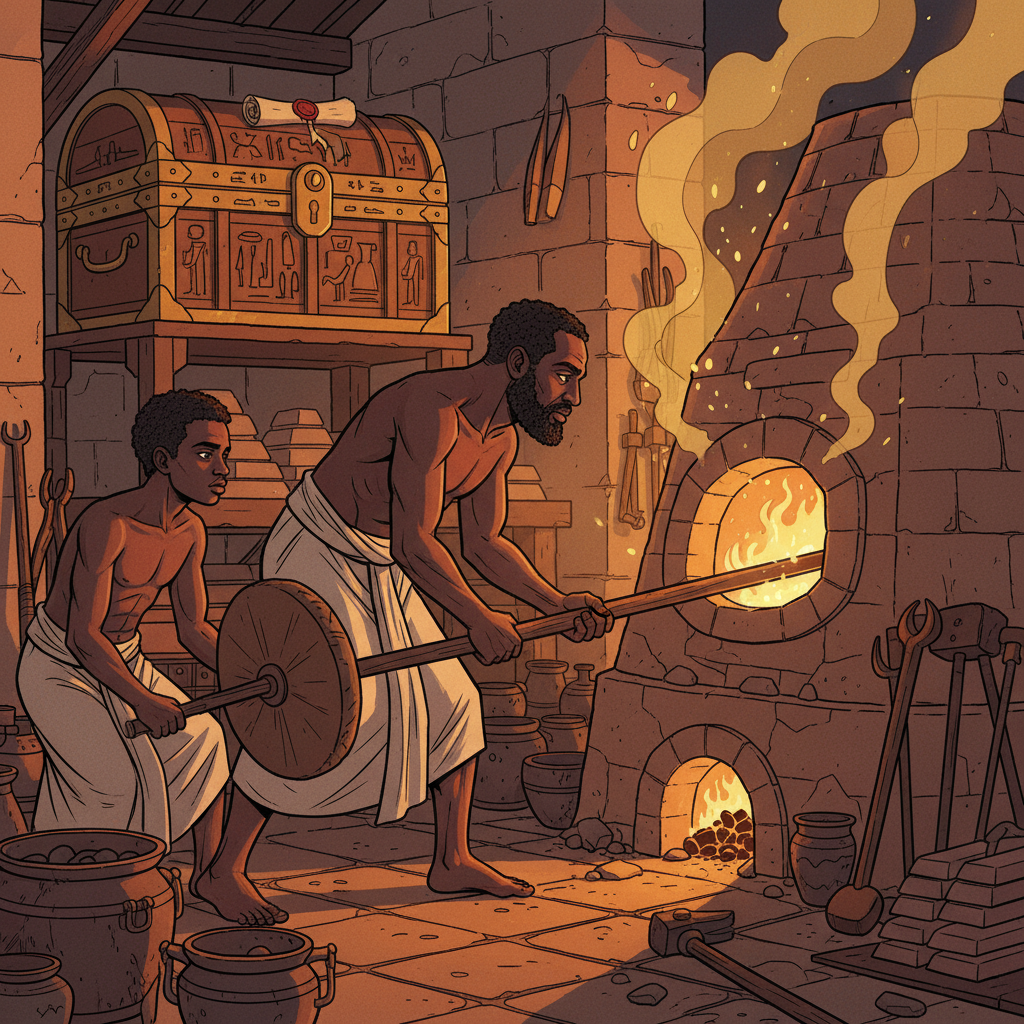
The question the delegation raised — whether to share iron-smelting knowledge with Aksum — was not new, but it had never been posed with such diplomatic weight. Aksum was offering significant trade concessions in exchange: guaranteed access to Red Sea ports, favorable rates on Indian Ocean luxury goods, and a mutual defense agreement against the expanding Roman presence in Kemet. The offer was substantial enough to warrant serious consideration at the highest levels of the Meroitic court. Aqrakamani discussed it with Nawidemak as they worked — the master had a habit of thinking aloud during the quieter phases of the smelting cycle, when the furnace was heating and there was little to do but monitor the temperature by the color of the glow. "Aksum wants what we have because what we have makes us powerful," Aqrakamani said, adjusting a tuyere with calloused hands. "The question is whether sharing our power with them makes us stronger or weaker."
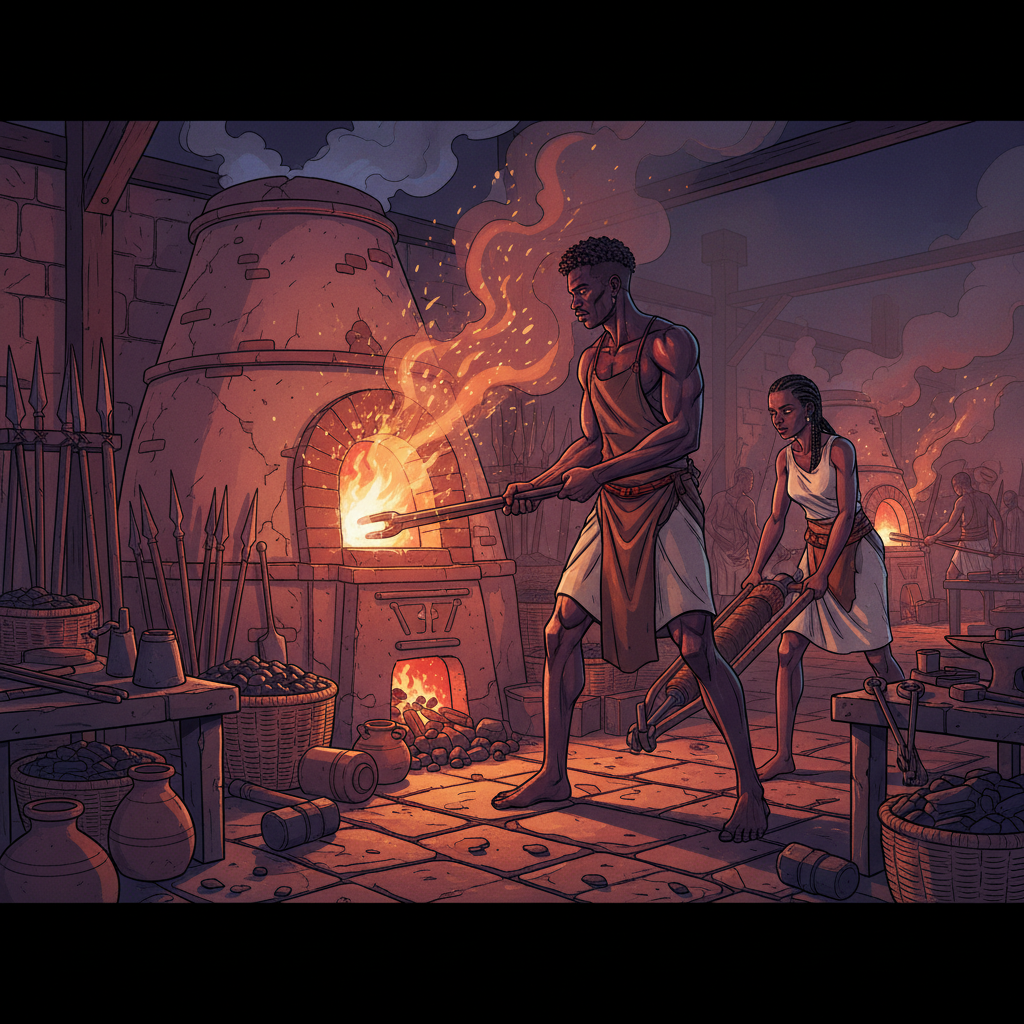
"How could sharing make us stronger?" Nawidemak asked, genuinely puzzled. It seemed obvious to her that knowledge shared was advantage lost. Aqrakamani smiled — a rare expression on his usually stern face. "Consider the iron trade," he said. "We sell finished goods — spears, axes, hoes, tools — across the entire region. If Aksum learns to smelt their own iron, they stop buying from us. That is the obvious calculation, and it is true. But now consider the deeper calculation. Aksum controls the Red Sea trade routes. If Rome expands further south — and Rome always expands — we will need allies who can fight. Iron weapons in Aksumite hands pointed at Rome protect us more than iron weapons in our warehouses pointed at no one." He paused, watching the furnace glow shift from dark red toward cherry. "Knowledge is not like gold, child. When you give gold away, you have less gold. When you share knowledge, you still have the knowledge. The question is whether what you gain is worth more than the advantage you lose."
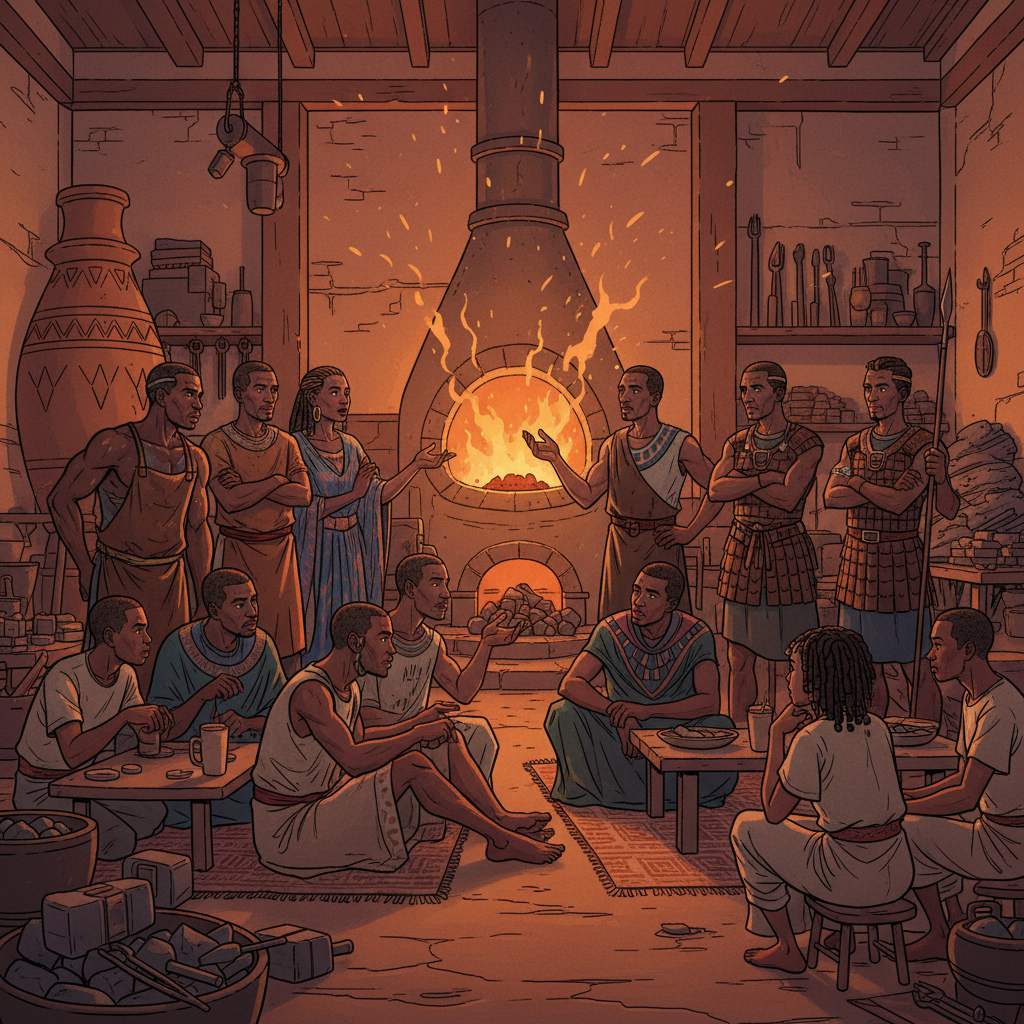
The debate within the court reflected a division that ran deep in Meroitic society. The smelting masters — the guardians of the iron-making secrets — were overwhelmingly opposed to sharing. Their status, their wealth, their entire position in the social hierarchy depended on their monopoly over the technology. If every kingdom in Africa could smelt iron, what made Meroe special? The merchants, by contrast, saw opportunity. Aksum's trade offer would open markets for Meroitic goods throughout the Red Sea network — access to Indian spices, Chinese silk, Arabian incense. The military commanders were divided: some saw the strategic value of an armed Aksumite ally against Rome, while others feared that today's ally could become tomorrow's rival. Nawidemak listened to these arguments during evening gatherings in the artisan quarter, where the workers debated politics with the same intensity they brought to their craft. The discussions were not abstract philosophy — they touched on the livelihoods, the identities, and the futures of everyone in the smelting district.
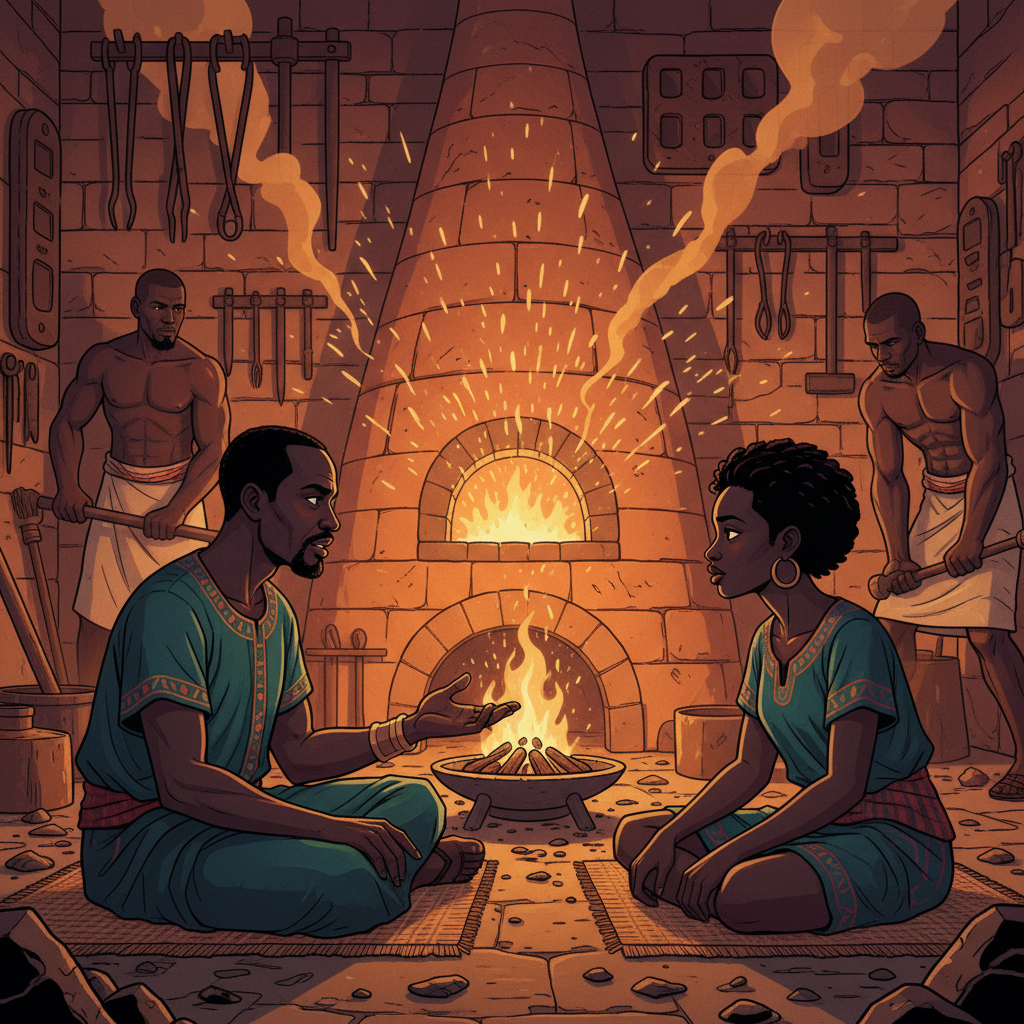
The Qore — the Meroitic title for king — summoned a council of the great offices of state: the military commanders, the high priests of Amun and Apedemak, the chief merchants, and the master smelters. Nawidemak learned of the proceedings from Aqrakamani, who attended as the senior representative of the smelting guild. The council debated for three days. Aqrakamani reported the arguments to Nawidemak each evening, his face thoughtful in the firelight of the workshop. "The priests argue that iron-making knowledge is a gift from Apedemak, the lion god, and that sharing it with outsiders violates the sacred compact between the god and the people of Meroe. The merchants argue that knowledge spread is knowledge strengthened — that more iron producers means more innovation, more competition, more improvement." He shook his head. "Both sides speak with conviction. Both sides have evidence. Neither side is entirely wrong."
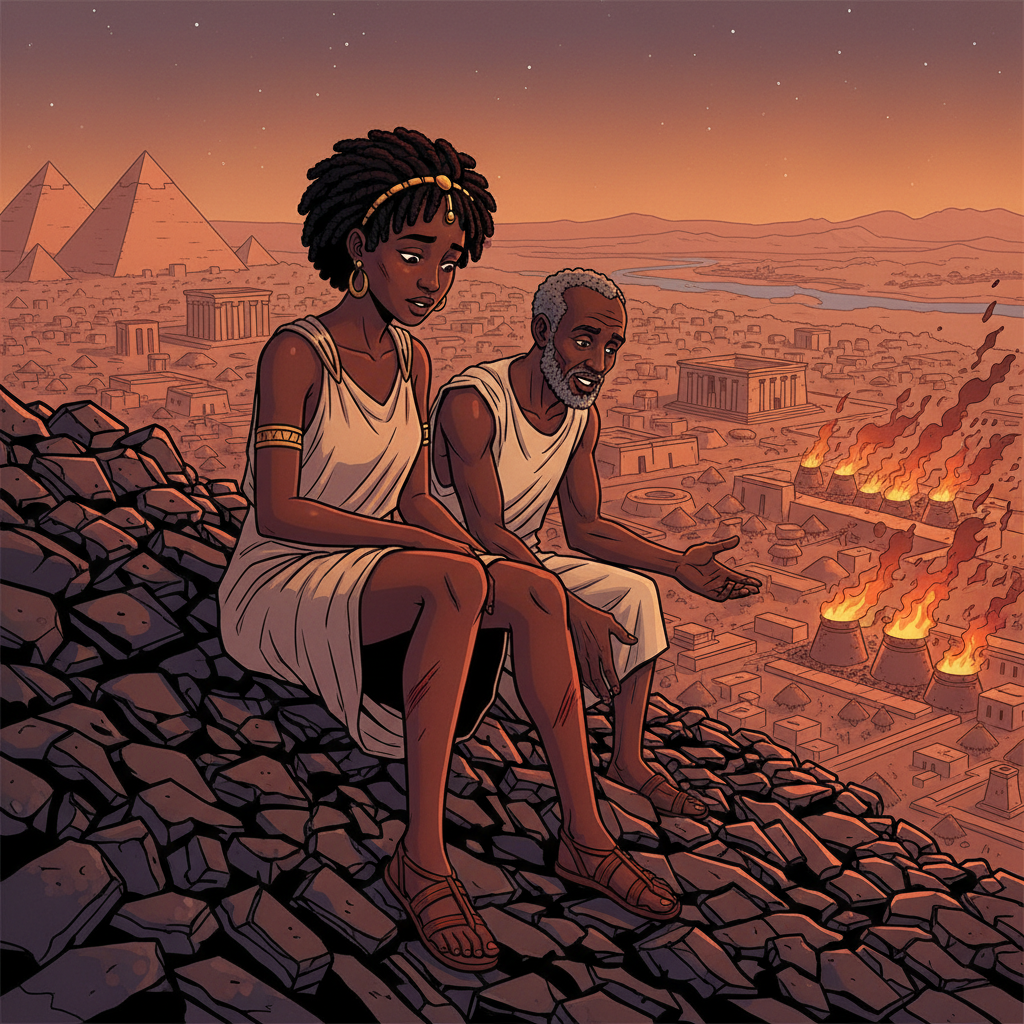
On the third day, Aqrakamani took Nawidemak to a place she had never been — the oldest slag heap in Meroe, a massive mound on the city's northern edge that dated back to the earliest days of iron production, perhaps six hundred years before her birth. He made her climb to the top, a difficult scramble over glassy, sharp-edged waste material that cut her sandals and scraped her shins. From the summit, the view was extraordinary. The entire city of Meroe spread below — the royal quarter with its pyramids, the temple precincts, the residential districts, the smelting quarter with its rows of furnaces, the river winding south into the haze. "What do you see?" Aqrakamani asked. "Everything," Nawidemak said. "The whole city." "Look more carefully. What are you standing on?" She looked down at the dark, glassy ground beneath her feet. "Slag. Waste from the furnaces." "Six centuries of waste," Aqrakamani corrected. "Six centuries of iron production. Six centuries of knowledge, accumulated grain by grain, error by error, generation by generation. You are standing on the physical evidence of everything our ancestors learned."
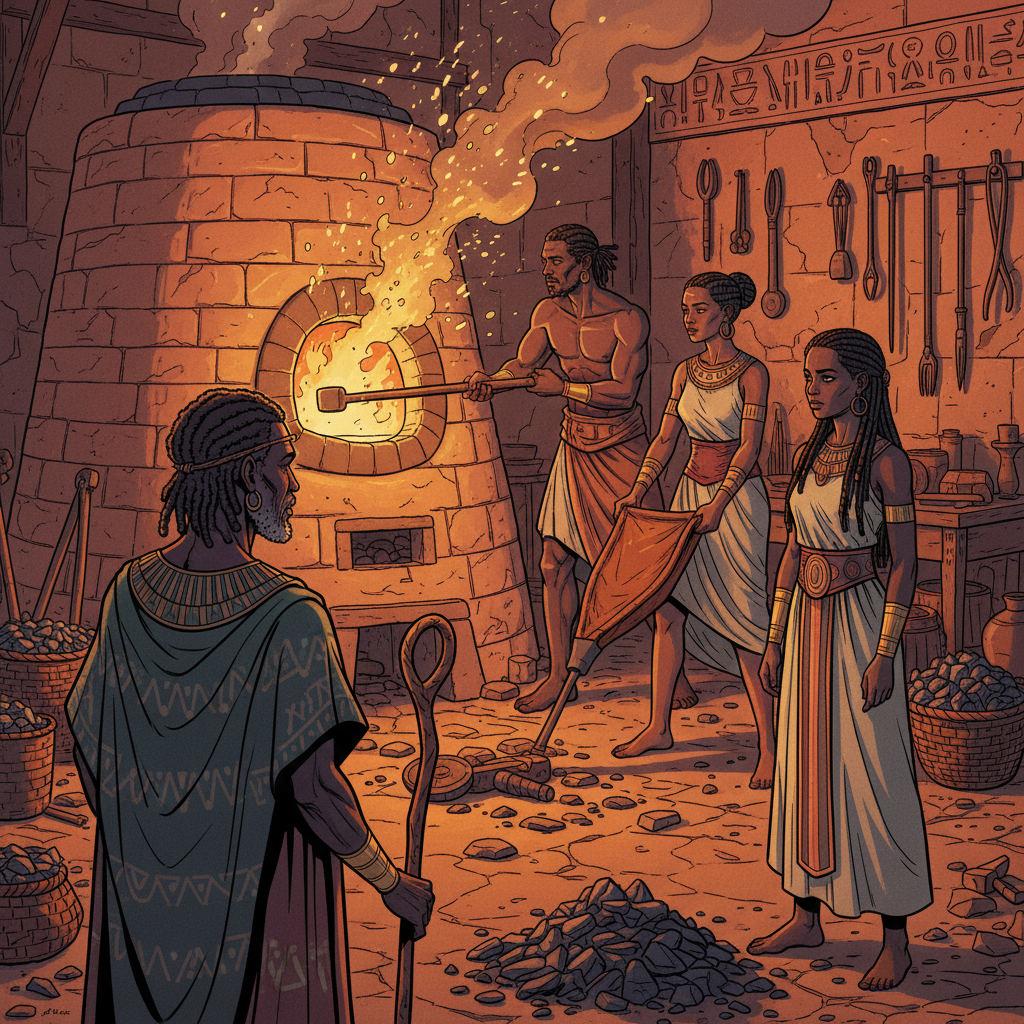
"Every failed smelt, every cracked tuyere, every batch of brittle iron — they are all here, in this heap," Aqrakamani continued. "Our ancestors did not receive this knowledge as a gift from the gods, whatever the priests may say. They earned it. They earned it through centuries of trial and error, through burns and failures and explosions, through the patient, stubborn refusal to stop trying until they understood how iron behaves. The knowledge we hold is not merely a technique. It is a relationship between our people and the metal — a relationship built over generations." He turned to face Nawidemak directly, his dark eyes intense. "Can that relationship be transferred by teaching someone the shape of a tuyere and the angle of a bellows? Or is it deeper than that — embedded in our culture, our traditions, our way of seeing the world? And if it is deeper, then sharing the technique may not actually share the knowledge at all."
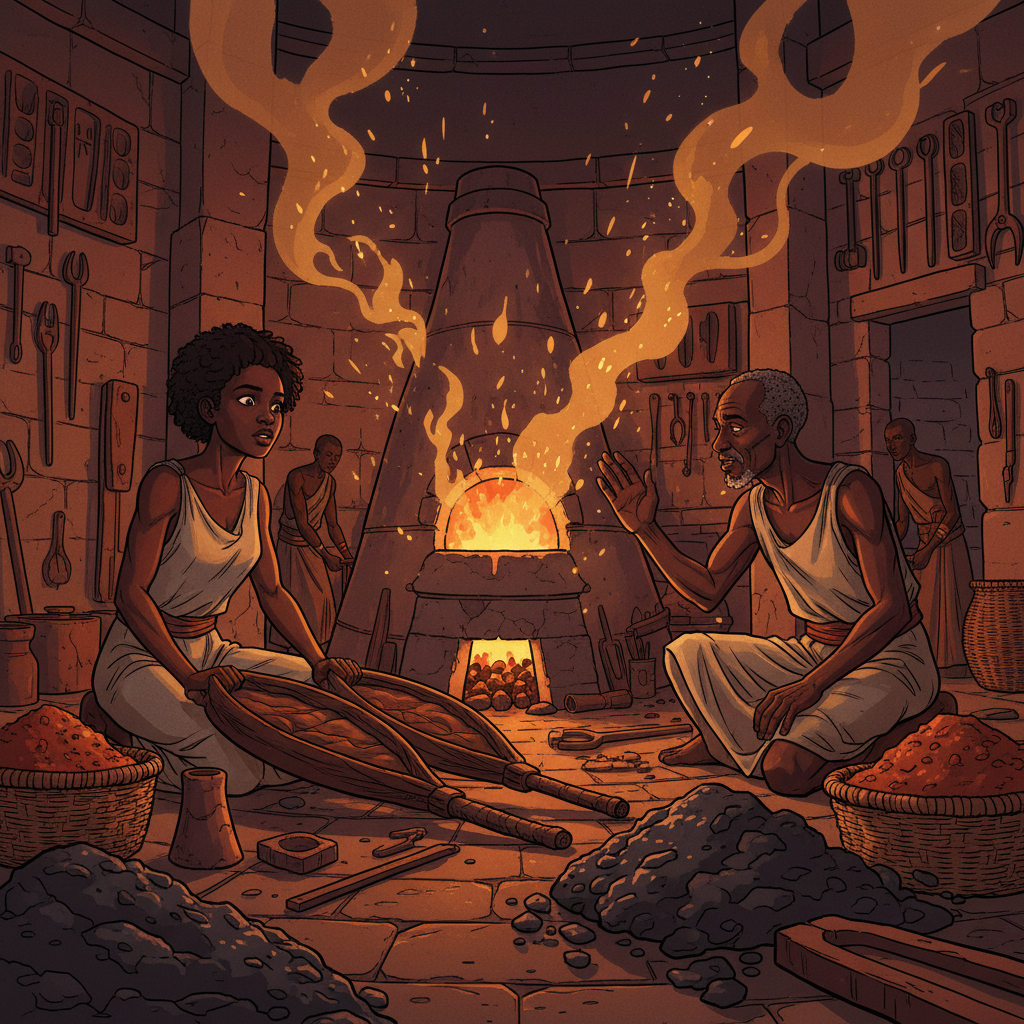
Nawidemak thought about this for days. She thought about it while operating the bellows, while sorting ore, while watching Aqrakamani read the color of a furnace glow the way a scribe reads hieroglyphs — with a lifetime of trained perception behind each glance. She realized that what the master was describing was not merely a technical skill but an entire epistemology — a way of knowing that was as much cultural as it was mechanical. The Kemetic philosophers in the Per Ankh tradition had a concept for this: rekhet, which meant not merely "knowledge" but "knowing-through-practice," the kind of understanding that cannot be fully conveyed through instruction but must be developed through years of direct engagement with the thing being studied. A scroll can tell you the theory of iron smelting. Only decades of practice can teach you to hear the difference between a furnace that is reaching temperature and one that is about to crack.
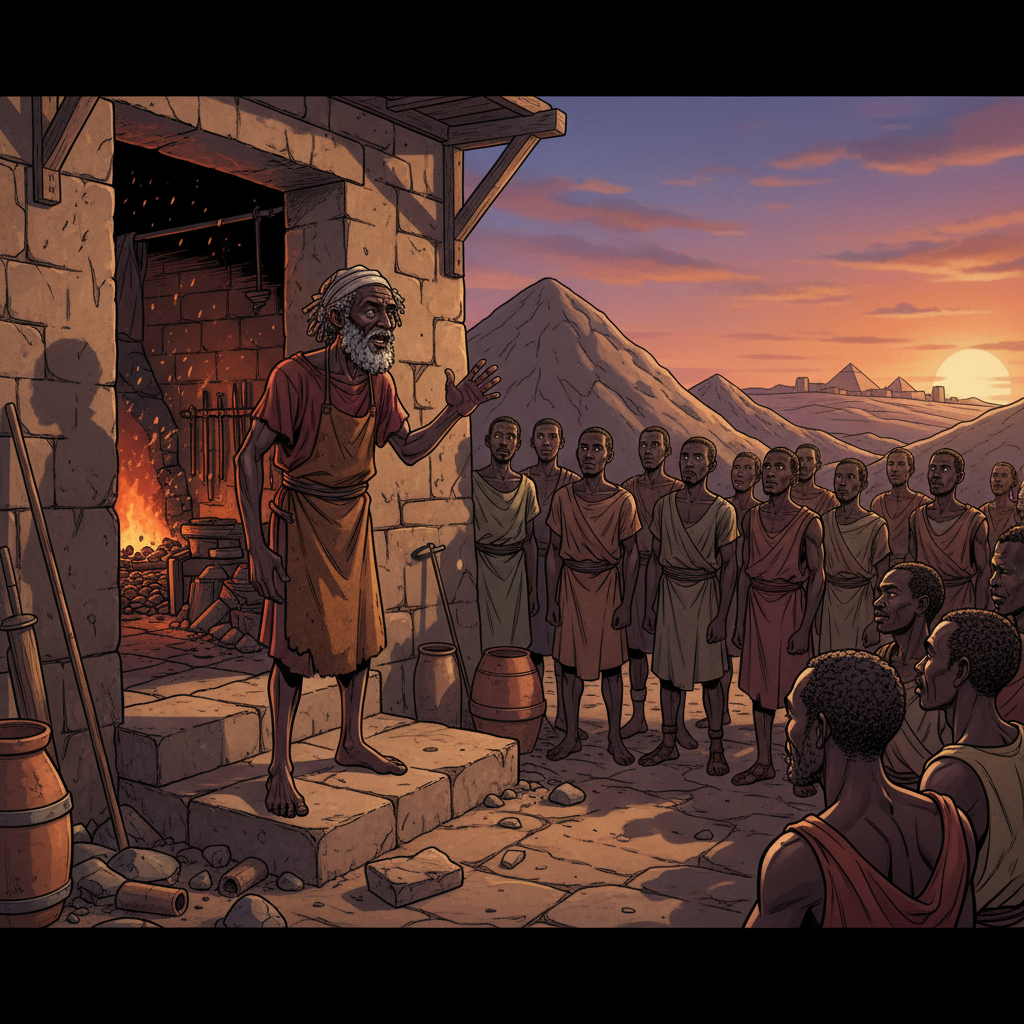
The debate extended beyond the council chambers and into the workshops themselves. Nawidemak witnessed a confrontation between two master smelters that illuminated the stakes more clearly than any council proceeding. Old Tabirqa, the most senior smelter in Meroe, stood in the doorway of his workshop and addressed a gathering of workers with the authority of sixty years at the furnace. "I will tell you what happens when you share the secret," Tabirqa said, his voice carrying the rasp of decades of smoke inhalation. "My grandfather's grandfather helped develop the tuyere angle that we use today. He burned his hands to ruin testing different configurations. Two of his apprentices died when a furnace exploded during an experiment with a new clay mixture. The knowledge we hold was purchased with suffering and paid for in blood. It is not ours to give away — it belongs to the ancestors who earned it." The workers murmured agreement, their dark faces grave in the workshop's amber light.
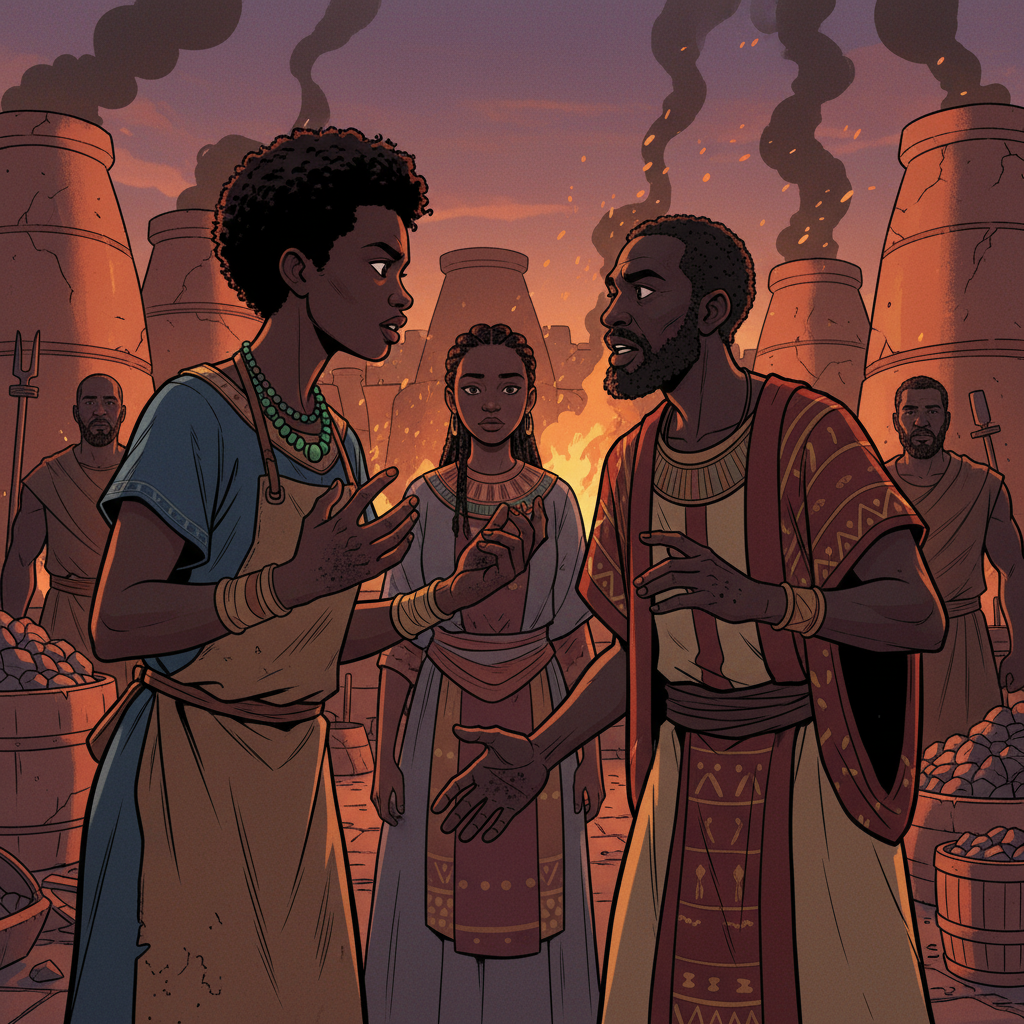
But a younger smelter named Amanitore — Nawidemak's mother's colleague — challenged Tabirqa directly. "The ancestors earned the knowledge so that their descendants would prosper," Amanitore said, her deep brown hands still dusted with iron filings. "If hoarding the knowledge leads to our isolation, if it makes us an island in a world of rising powers, then we betray the ancestors' purpose by protecting their method. They smelted iron so that Kush would be strong. If strength now requires allies, then sharing the iron knowledge IS honoring the ancestors." The argument went back and forth through the evening, and Nawidemak noticed something important: both sides genuinely believed they were serving the ancestors. Both sides genuinely believed they were protecting Meroe. The disagreement was not about values — it was about strategy. And strategy, unlike values, depends on predicting a future that no one can see clearly. This realization would stay with her for the rest of her life.
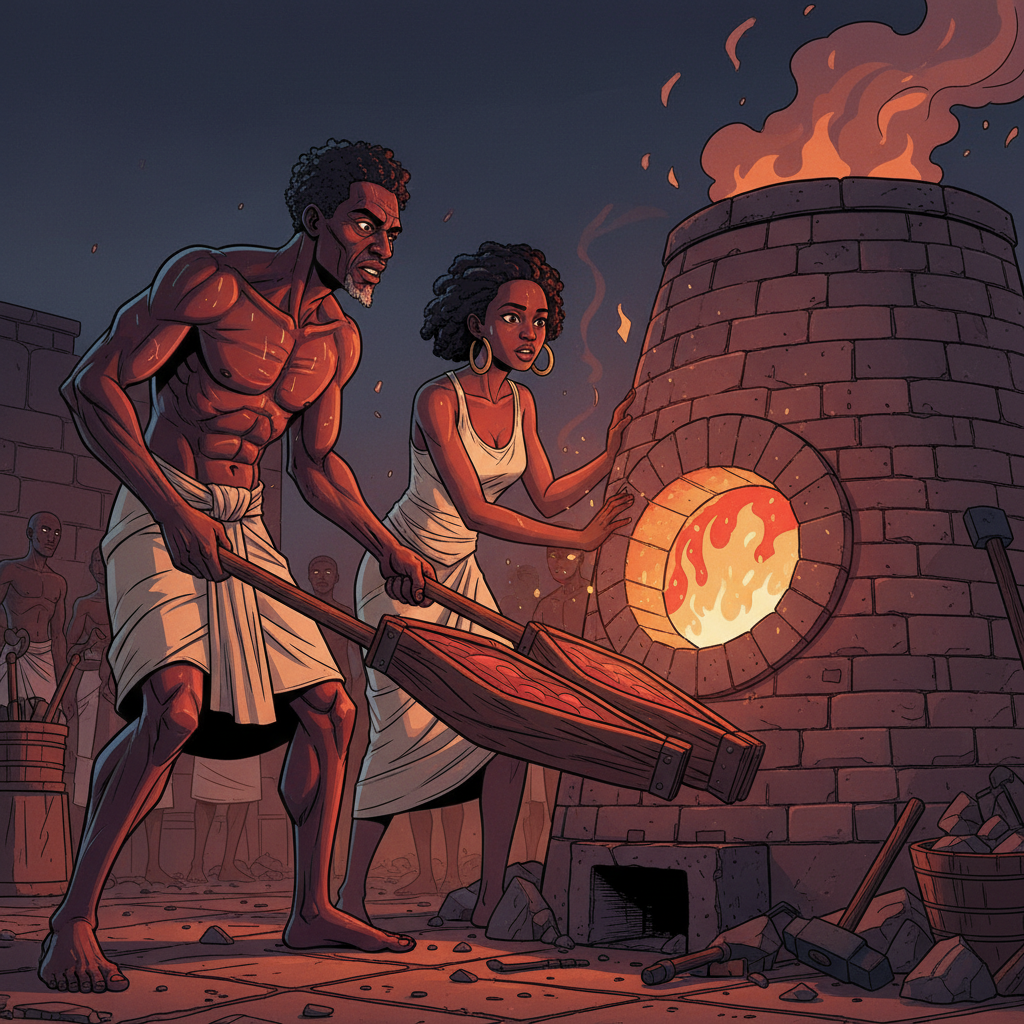
Meanwhile, Nawidemak's own training was reaching a critical phase. Aqrakamani began teaching her the most closely guarded aspect of the smelting process — the "breathing" of the furnace, the pattern of bellows operation that varied the air flow throughout the smelt to produce iron of different qualities. Hard iron for weapons required one pattern — fierce, sustained blasts that drove the temperature high and kept it there. Softer iron for tools required a gentler rhythm, allowing the metal to form with fewer impurities. The finest iron, used for surgical instruments and precision tools, required a breathing pattern so subtle that only a master could execute it — a dance of air and fire that lasted eight hours without interruption. "You cannot learn this from words," Aqrakamani told her, his hands working the bellows with a rhythm that seemed as natural as his heartbeat. "You must learn it from the iron itself. The iron will teach you, if you listen. It speaks in color, in sound, in the way the furnace trembles beneath your hands. This is why our knowledge cannot simply be given to strangers — it must be earned, one smelt at a time, over years."
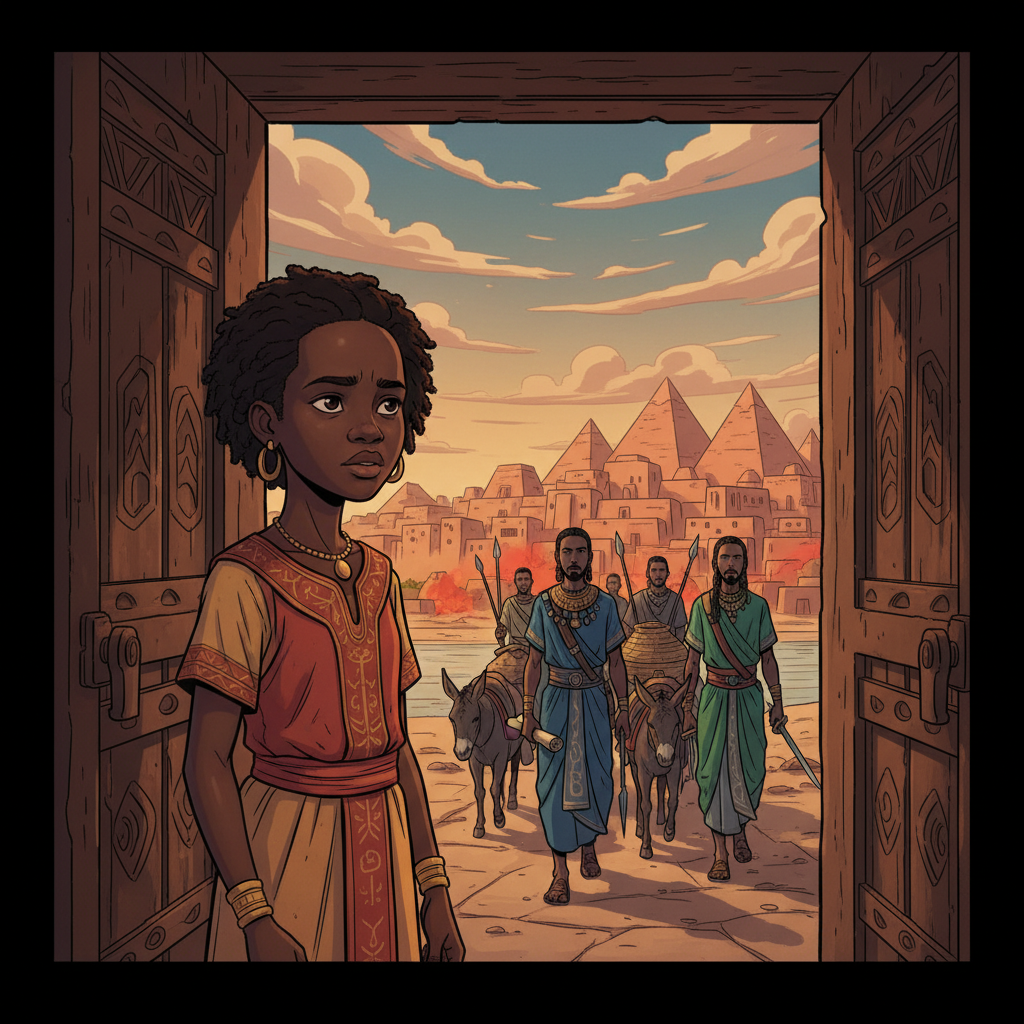
The Qore's council reached its decision on the fifth day. Meroe would sell finished iron weapons to Aksum — high-quality spears, swords, and arrowheads at favorable prices. Meroe would accept Aksum's trade concessions and mutual defense agreement. But Meroe would not share the smelting knowledge itself. The techniques would remain the property of the Meroitic guild, to be transmitted only within the established master-apprentice system. The Aksumite delegation accepted these terms with the careful grace of experienced diplomats. They purchased a large shipment of weapons, signed the trade agreements, and departed south along the Nile. Nawidemak watched them go from the workshop doorway, a mixed feeling settling in her chest that she could not quite name.
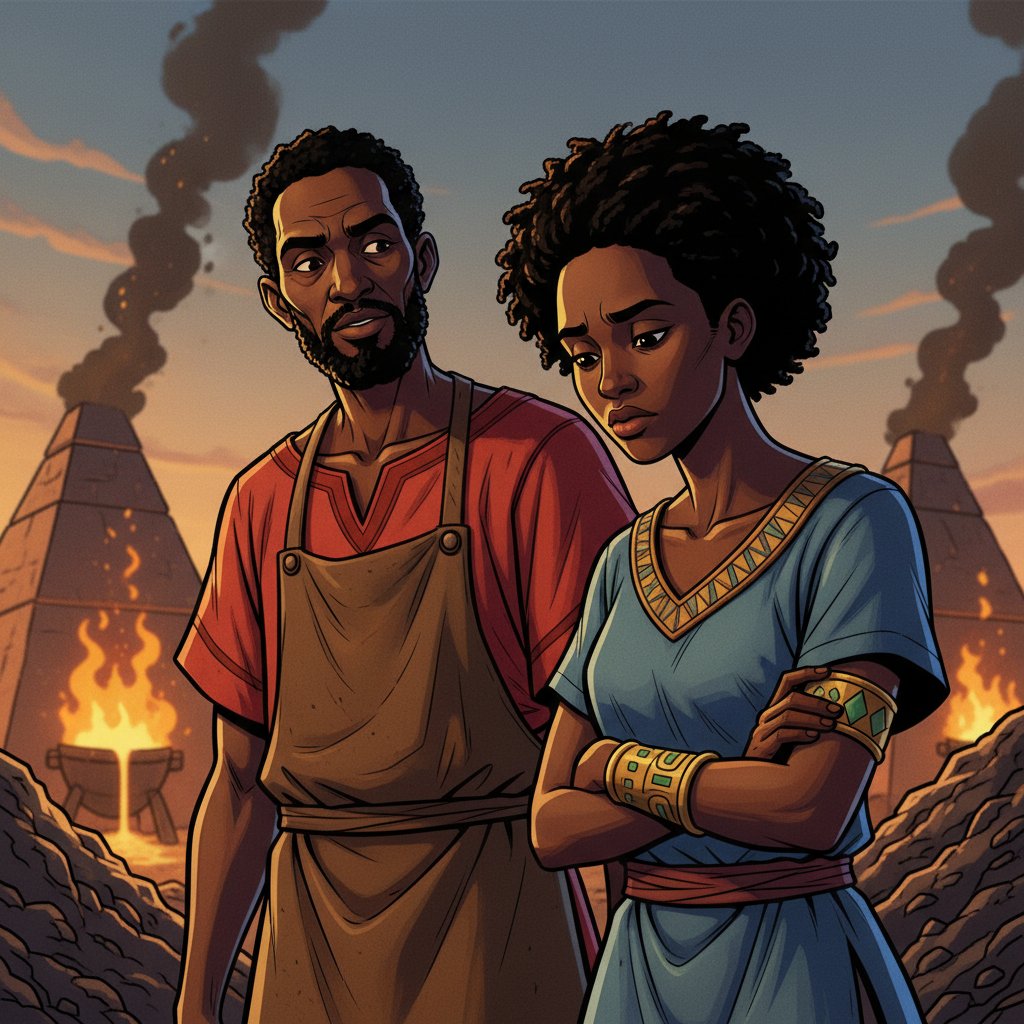
"You look troubled," Aqrakamani observed. "I am thinking about what you said on the slag heap," Nawidemak replied. "About knowledge being a relationship, not just a technique. If that is true, then we could have shared the technique without really losing anything. They would have the method but not the centuries of understanding behind it. Our real advantage would remain." Aqrakamani raised an eyebrow. "Go on." "But we did not share. We chose to keep the technique secret AND the understanding. Which means the decision was not really about knowledge at all. It was about power. We kept the secret because keeping it maintains our position — our wealth, our status, our importance in the trade networks. The wisdom argument was real, but the power argument was also real, and I do not know which one actually decided things." Aqrakamani was quiet for a long time. "You are becoming a very dangerous apprentice," he said finally. "One who asks questions that masters prefer to leave unasked."
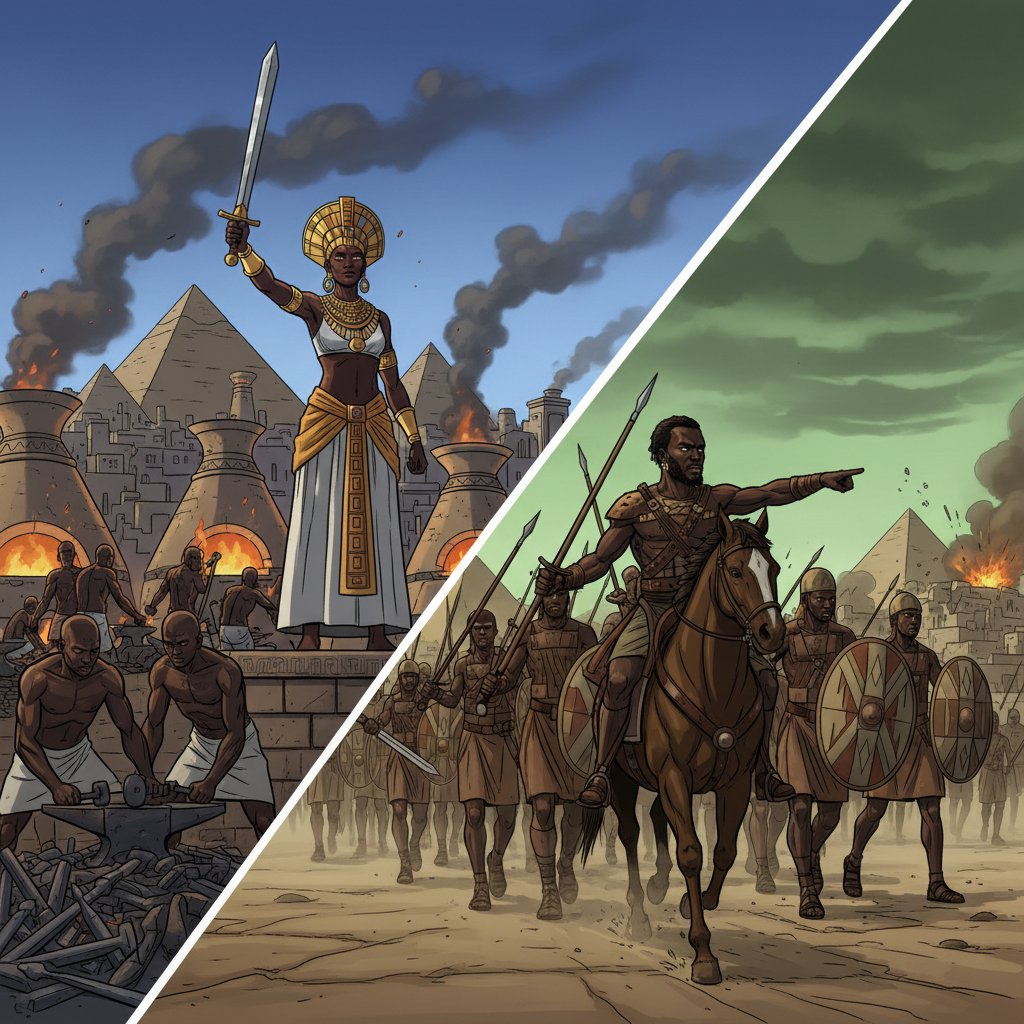
The historical irony would take centuries to unfold, but it is worth noting because it speaks to the deepest questions the story raises. Meroe guarded its iron-smelting secrets for generations after this decision. The technology remained a closely held Meroitic specialty, and the wealth it generated sustained the kingdom for centuries. But knowledge does not remain static. Other peoples developed their own iron-smelting techniques independently — in West Africa, in the Great Lakes region, in places that had no contact with Meroe and no access to its secrets. The idea that Meroe could permanently monopolize iron technology proved illusory, as all technological monopolies eventually do. Meanwhile, Aksum grew in power regardless. Without Meroitic iron knowledge, the Aksumites developed their own metallurgical traditions, built their own military strength, and eventually — in the fourth century of the common era — would march north and contribute to the destruction of Meroe itself. The ally Meroe chose not to fully embrace became, centuries later, one of the forces that ended the Meroitic civilization.
Does this mean the decision was wrong? Not necessarily. The smelting masters' caution about sharing sacred knowledge had genuine wisdom behind it. The merchants' desire for expanded trade had genuine merit. The military commanders' concern about arming potential rivals was not unfounded. The decision that was made — sell weapons but not knowledge — was a reasonable compromise that served Meroe's interests for generations. But the story illuminates a tension that runs through all of human history: between the impulse to hoard knowledge for advantage and the impulse to share knowledge for collective benefit. The ancient Kemetic concept of Sia — divine knowledge, cosmic understanding — held that knowledge ultimately belongs to no one because it is a property of the universe itself. Humans do not create knowledge; they discover it. And what is discovered by one will eventually be discovered by others.
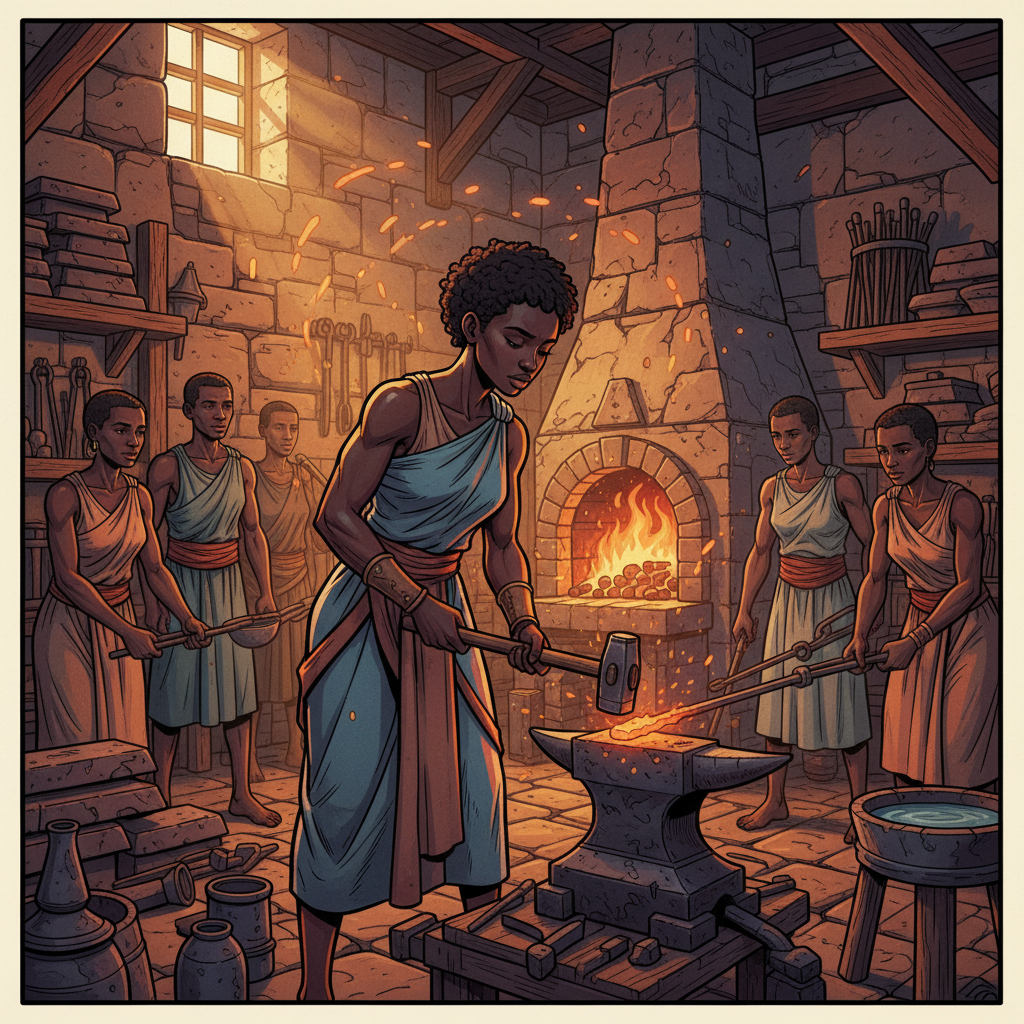
Nawidemak completed her apprenticeship four years later and became a full smelter — one of the youngest women to achieve the rank in Meroitic history. She spent her career at the furnaces, developing innovations that improved the quality of Meroitic iron and training the next generation of apprentices with the same combination of patience and rigor that Aqrakamani had shown her. She never forgot the question she had asked on the slag heap: whether the decision to withhold knowledge was driven by wisdom or by power. She never fully resolved it, because some questions are not meant to be resolved — they are meant to be carried, turned over, examined from new angles as life provides new evidence. This is what the Kemetic tradition calls the practice of Maat in daily life: not the achievement of perfect answers but the honest, sustained engagement with difficult questions.
Centuries after Nawidemak's lifetime, the slag heaps of Meroe would be excavated by archaeologists who would marvel at their scale — evidence of an industrial operation that rivaled anything in the ancient world. The British archaeologist Peter Shinnie would call Meroe "the Birmingham of Africa," recognizing the city's role as a center of iron production that supplied weapons, tools, and agricultural implements across a vast region. The massive slag heaps — covering acres, rising in some places twenty feet high — testified to the volume of production and the sophistication of the technology. What the slag heaps could not reveal was the human story behind the industry — the masters who guarded the secrets, the apprentices who earned the knowledge through years of patient labor, the debates about sharing and hoarding that shaped the fate of nations. Those stories, unlike the slag, did not survive in physical form. They survived in the tradition of asking the right questions — the tradition that Nawidemak carried from the furnace to the future.
The iron of Meroe teaches what Maat has always taught about wisdom: that knowledge carries responsibility, that the decision to share or withhold knowledge is never simple, and that the consequences of either choice ripple outward across generations. Aqrakamani understood this when he showed Nawidemak the slag heap. Nawidemak understood it when she asked whether wisdom and power could be separated. The Qore's council understood it when they debated for five days and reached a compromise that served the present but could not control the future. Wisdom is not knowing the right answer. Wisdom is understanding why the question is hard. And the hardest question about knowledge — who owns it, who benefits from it, who has the right to share or withhold it — is as alive today as it was in Meroe twenty-three centuries ago, when the furnaces burned day and night and the slag heaps grew toward the sky like monuments to everything a civilization knew and everything it feared to lose.