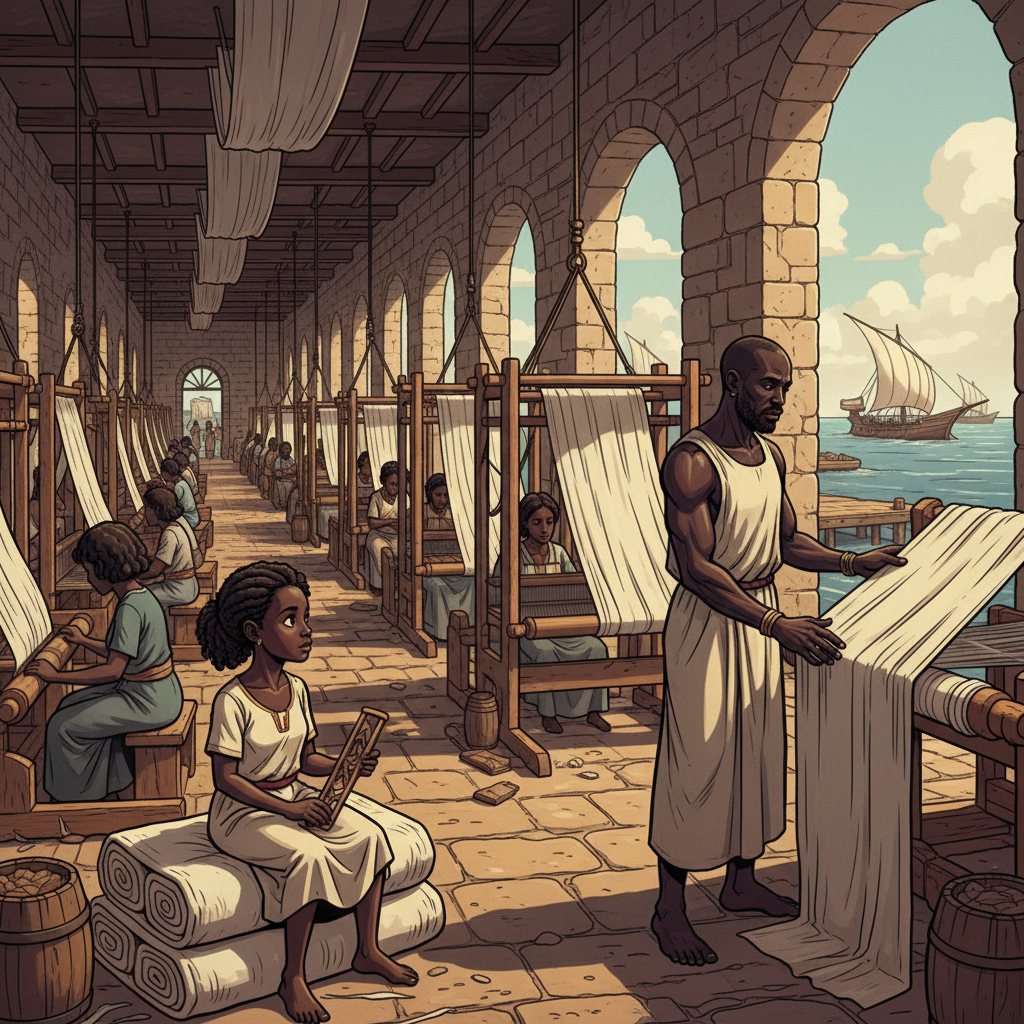
Saba was thirteen years old, and her father was the chief sailmaker of the Aksumite navy. His name was Yohannes, and his hands were the color of dark river stones and rough from forty years of pulling flax fiber through wooden looms. They lived in the port city of Adulis, on the western shore of the Red Sea, where Aksum's ships came home from every voyage and where every voyage began. Saba had grown up in the sail-loft her father ran. She had learned to walk by holding on to the long wooden beams of the looms. She had learned to count by counting bolts of sail-cloth. She had learned the names of every wind that blew across the harbor before she had learned the names of the books in the church. The sail-loft was a long stone building at the edge of the dockyard. Inside it, twenty women worked the looms in rows, weaving the heavy white sail-cloth that carried the navy across the sea. The cloth was strong. It had to be. A torn sail in the middle of the Bab-el-Mandeb — the narrow gate between Africa and Arabia — meant a ship that did not come home. Yohannes inspected every bolt himself. He ran his rough fingers across the weave, slowly, the way a doctor listens for a heartbeat. If the weave was wrong by even a thread, the bolt went back to the loom. The sea did not forgive small mistakes.
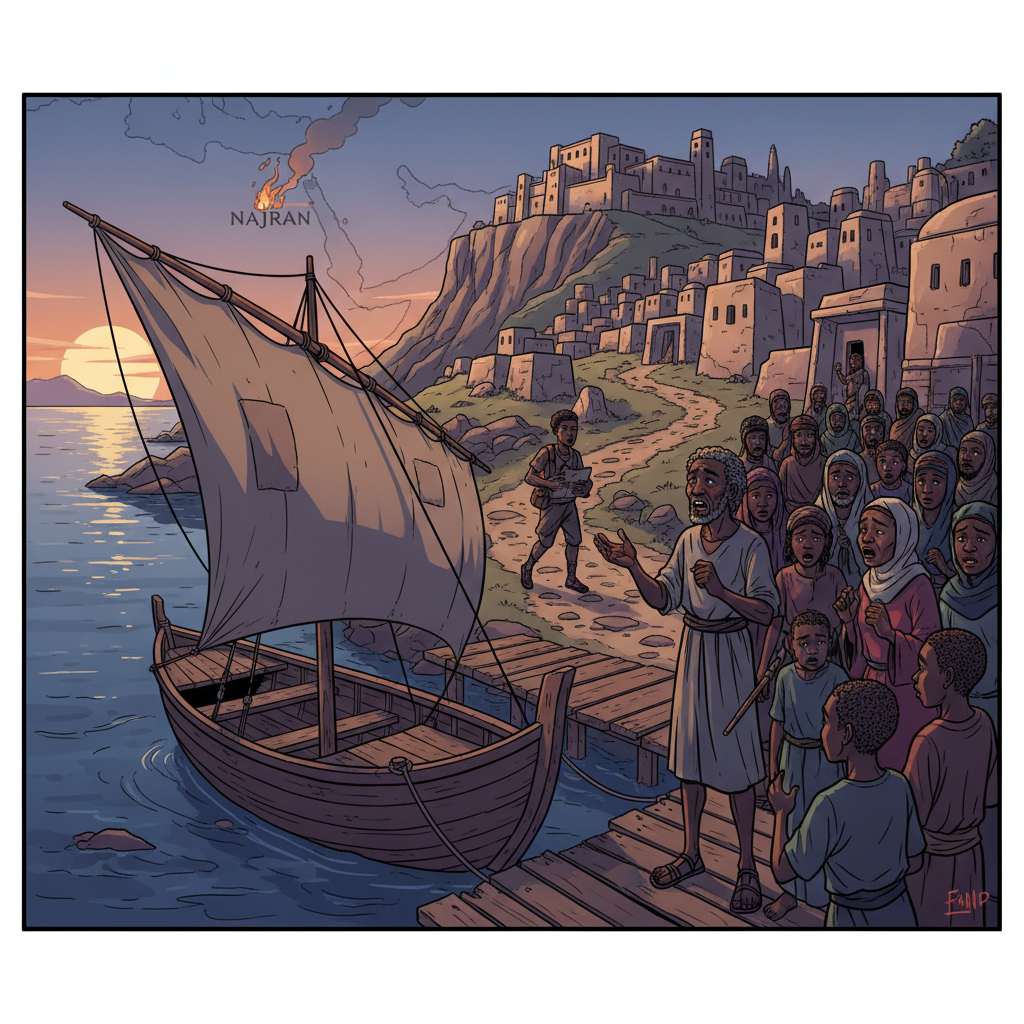
In the spring of Saba's thirteenth year, news came across the Red Sea that changed the air of Adulis. A king on the Arabian side — a Himyarite king named Dhu Nuwas — had massacred the Christian community of a city called Najran. The reports were terrible. Whole families had been burned. Children had been killed in front of their parents. The community of Najran was old. It was poor. It had nothing to do with Aksum or with the politics of Himyar. The only thing that had been said against the Najran Christians was that they prayed differently than Dhu Nuwas wanted them to pray. For this, he had killed them. The news arrived first at the harbor on a small trading dhow that came in at dusk. The captain told what he had seen. By morning the whole city of Adulis knew. By the second morning, the whole highland kingdom of Aksum knew. Saba was helping her father fold sails in the loft when the messenger from the palace came down the dock path. The messenger was a young soldier with a clay tablet in his hand. He gave the tablet to Yohannes and stood with his hands clasped behind his back, the way young soldiers stand when they have been told to wait. Yohannes read the tablet. He set it down on the cutting table without speaking. His face did not change. But Saba, watching him, saw that his shoulders had dropped a small distance — the way a man's shoulders drop when he has been given a weight he did not ask for.
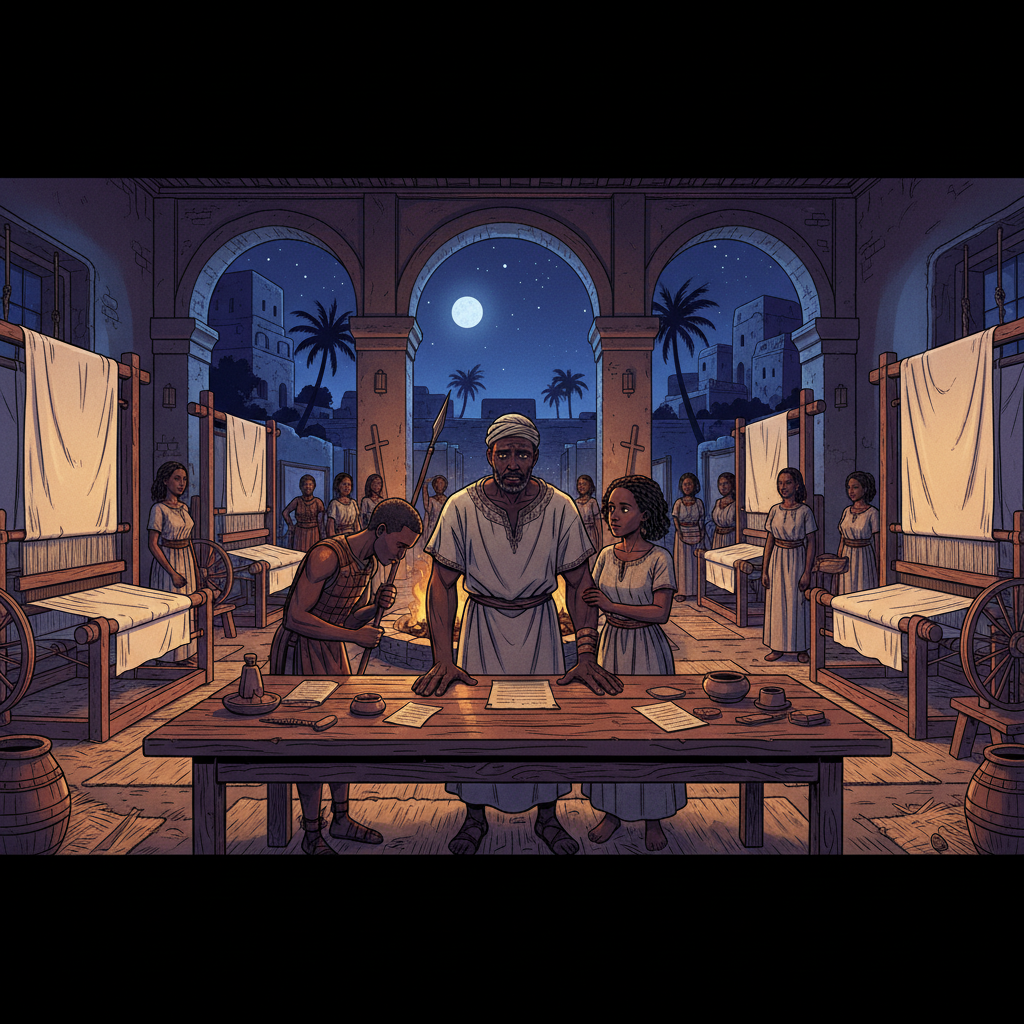
The tablet was from King Kaleb himself. The king had decided. Aksum would send its navy across the Red Sea to liberate Najran from Dhu Nuwas. The expedition would be the largest the kingdom had ever launched — sixty warships, ten thousand soldiers, six months of supplies. The sail-loft of Yohannes the chief sailmaker had been ordered to produce new sail-cloth for the entire fleet within ninety days. The old sails would not hold for a war crossing. The king wanted every ship rigged with fresh white cloth, woven thick and strong. The expedition would sail at the first full moon after the rigging was complete. Yohannes stood at the cutting table for a long time. The young soldier waited. Saba waited. The twenty weaving women had stopped their looms — the loft had gone quiet in the way only twenty looms going silent at once can make a building quiet. Finally Yohannes lifted his head. "Tell the king his sails will be ready," he said. The soldier bowed and left. Yohannes did not move from the cutting table. Saba stepped closer to him. She did not ask anything. She knew her father. She knew when his quiet meant tired and when his quiet meant troubled. This quiet was troubled. It was the quiet of a man who had agreed to a thing and was already beginning to wonder if he had agreed too quickly.
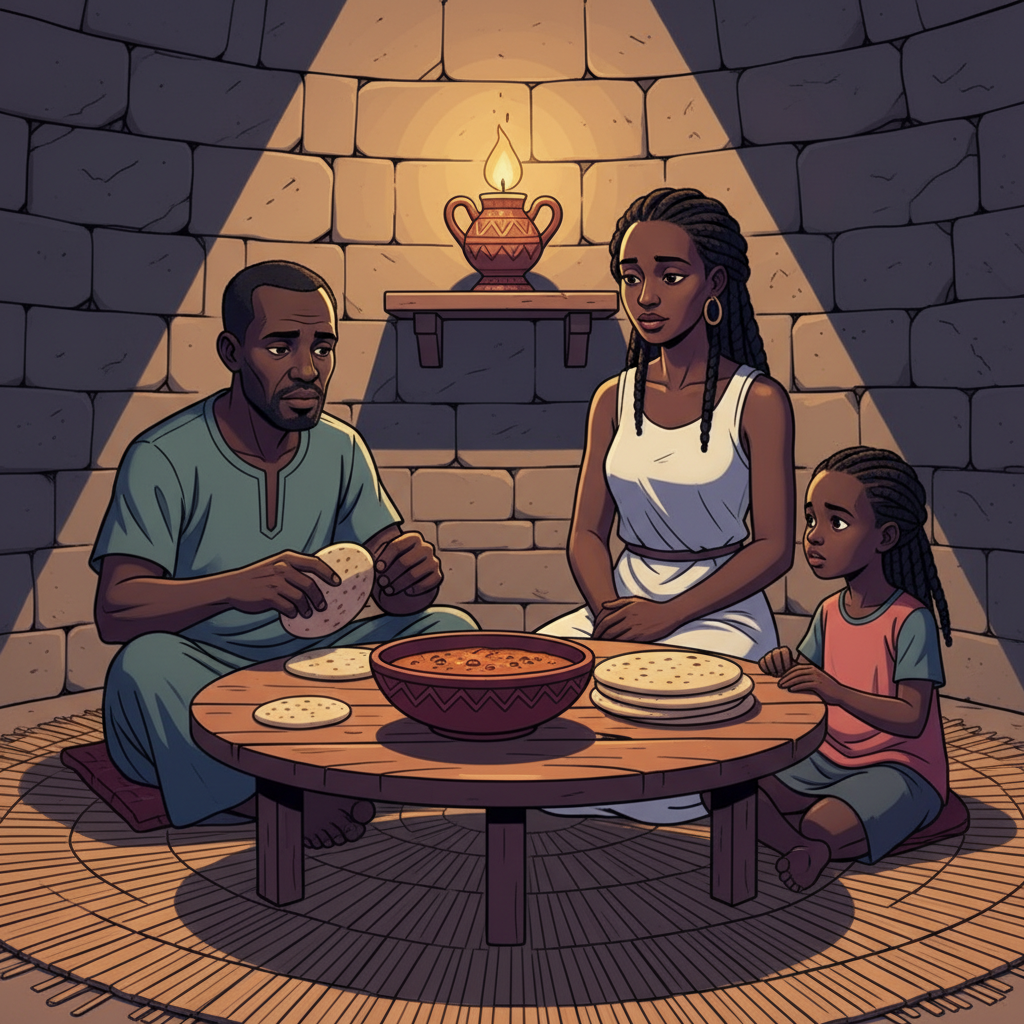
That evening Yohannes did not eat much at the family table. Saba's mother, a tall woman named Hirut who ran the household and the loft's accounts, did not press him. She set down the bowl of lentil stew and the round flat bread and she sat with her hands folded and she waited. Saba watched her father pick up the bread and put it down again. He picked up his cup of mead and held it without drinking. Finally Hirut spoke, very gently. "Yohannes," she said. "Tell us what is troubling your hands tonight." Yohannes set down the cup. He looked at his wife. He looked at his daughter. He did not look at the food. "I have agreed to make sails for sixty warships in ninety days," he said. "The looms can do it. The women can do it. The cloth will be ready. That is not the trouble." He paused. "The trouble is that we have never sent ships across the sea in this number for any reason. Aksum has fought wars in the highlands. We have fought wars in Kush. We have never sent an army into Arabia. Not at this scale. The Bab-el-Mandeb is a hard crossing for sixty ships traveling together. The currents narrow. The winds turn. If one ship is lost, three more lose their position. We could lose ten ships before the army even reaches Najran. Ten ships is two hundred sailors. Two hundred sailors are two hundred families. Hirut. I am the man who is rigging the fleet. The lost ships will be in part because of my sails."
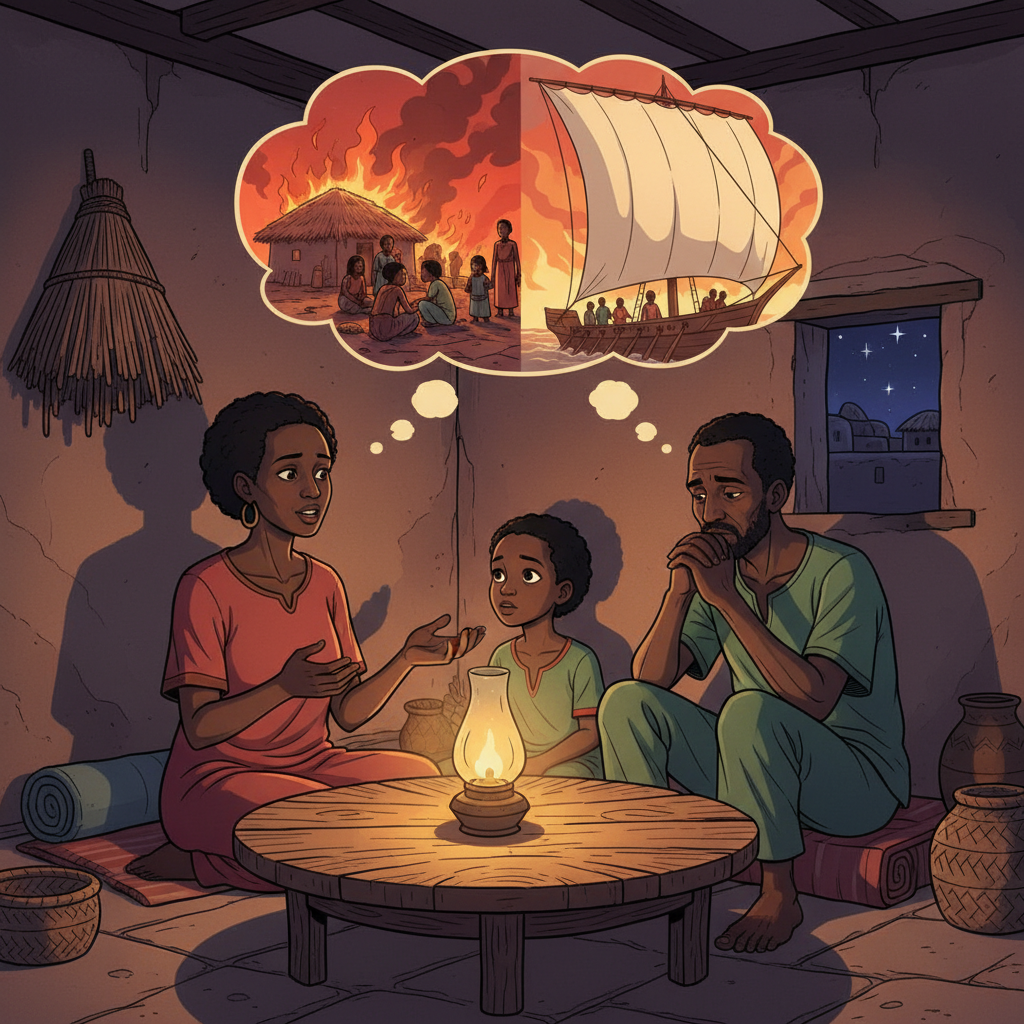
Hirut listened. She did not interrupt. When Yohannes finished, she let his words sit in the small clay-walled room for a moment before she answered. Then she said, very simply: "Yohannes. You did not start this. Dhu Nuwas started this. He burned the children of Najran. The king is sending the fleet because no one else will. If your sails do not hold, that is a thing you can grieve. But if your sails are not made at all, the children of Najran who survived the first burning will be killed by Dhu Nuwas in the second burning. The math you are doing tonight is a heavy math. But it is not a complete math." Yohannes nodded slowly. He did not argue with her. He did not look comforted either. Saba, sitting between them, had not said anything during the whole conversation. She was thirteen. She did not have her mother's words. She did not have her father's knowledge of the sea. She knew only that her father, the man whose hands had taught her to walk, was going to bed tonight with a weight on his shoulders that he had carried into the family room and had not yet been able to set down. After dinner she helped her mother wash the bowls. She kissed her father on the cheek the way she had kissed him every night since she was a small girl. She went to her own room. She did not sleep for a long time. She thought, instead, about the sail-loft and the white cloth and the looms and her father's rough fingers running across the weave.
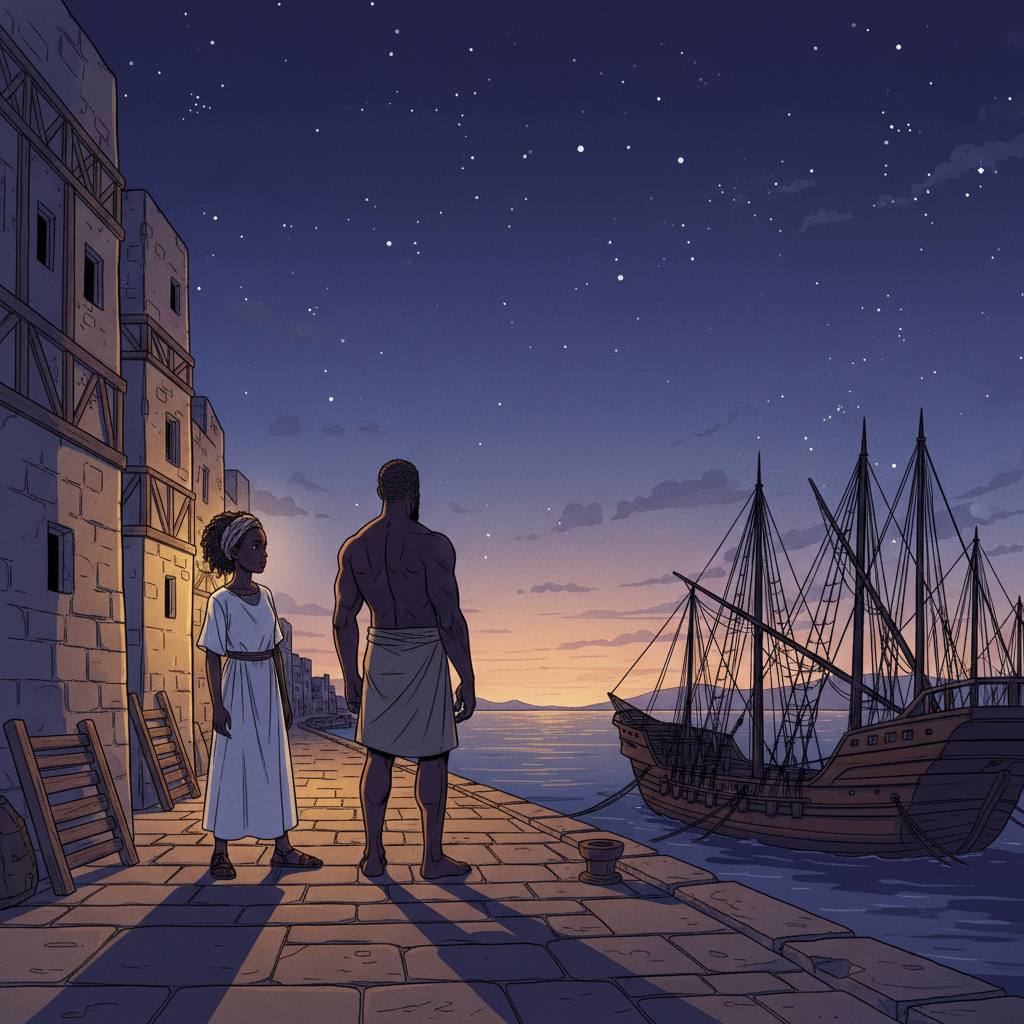
The next morning, before the sun was up, Saba woke. She did not know exactly what she was going to do. She knew only that her father had not been at peace when she had kissed him goodnight, and that the loft's biggest order was beginning that day, and that her father always walked down to the dockyard alone in the half-dark before the women arrived to start the looms. She pulled on her work tunic and her sandals. She wrapped her hair in the cloth her mother had taught her to wrap. She walked through the still-sleeping lanes of Adulis to the dockyard. The sky over the Red Sea was the deep blue of the hour before dawn. The masts of the Aksumite fleet rose along the harbor like a forest of stripped trees, waiting for their sails. She saw her father before he saw her. He was standing at the end of the long stone dock, his back to her, looking out at the empty masts and at the thin dark line of the Arabian coast on the horizon. The horizon was just beginning to catch the first light. Saba slowed her steps. She did not call out. She walked down the dock the way she had been taught to walk in the sail-loft — quietly, without disturbing the weave. When she reached her father, she did not speak. She stood beside him. The two of them watched the line of the Arabian coast in the haze. After a long moment, her father said, without turning, "I knew you would come."
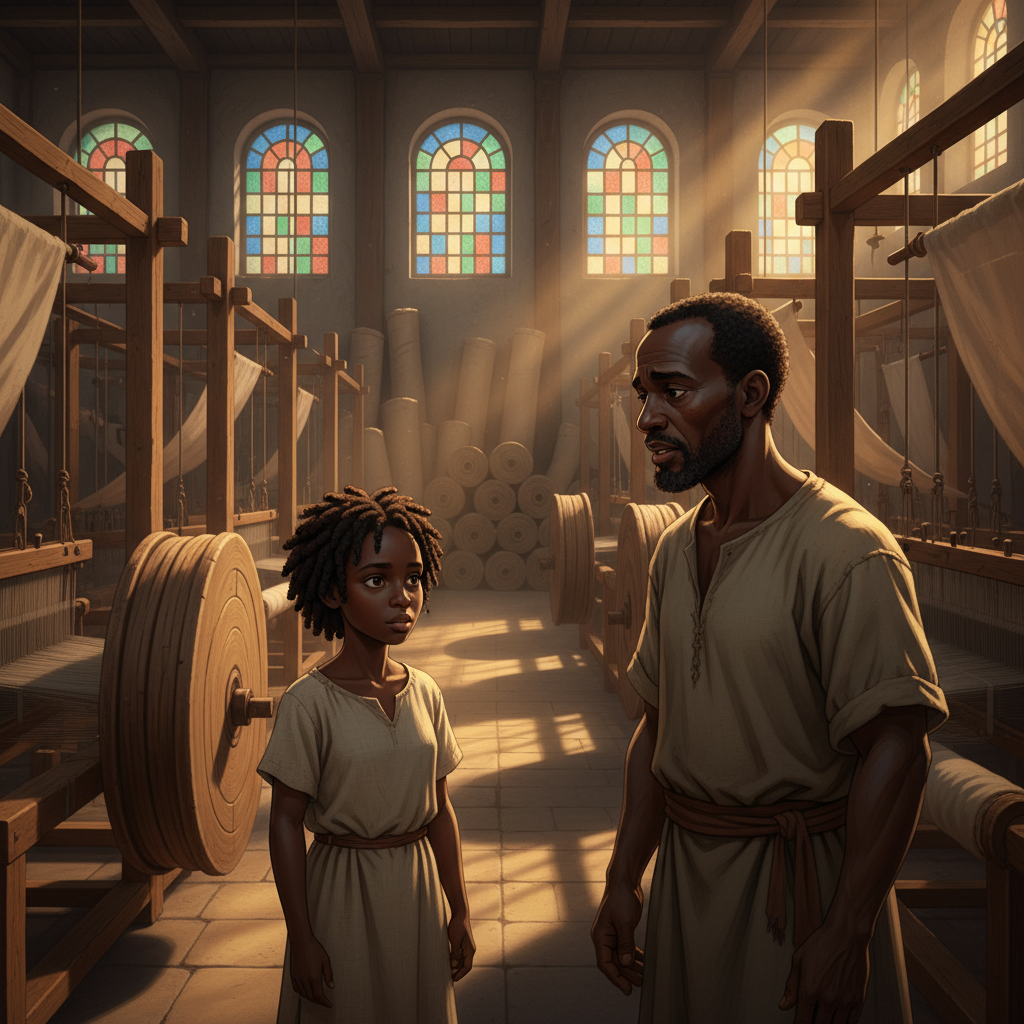
They stood there a while longer. The light on the water grew. The first dock-hands began to appear at the far end of the harbor, walking slowly toward their morning tasks. Yohannes did not move. Saba did not move. Then Saba said, in a voice that was small but steady: "Father. I want to show you something. Will you come with me to the loft?" Yohannes turned and looked at her. His face in the dawn light was lined with the tiredness of a man who had not slept well. He nodded. Saba turned and walked back along the dock, and her father followed, and the two of them entered the sail-loft together while the rest of Adulis was still waking. Inside the loft the looms were silent. The morning weavers had not yet arrived. The long room smelled of flax and clean wool and the faint sea-salt that lived in the timbers. Saba walked between the rows of looms to the back wall, where the finished bolts were stacked. Her father had inspected the newest bolt last night before he had come home — the first full bolt of war-grade cloth that the loft had produced for King Kaleb's expedition. It was a heavy bolt. It was wound on a thick wooden core. Saba did not lift it yet. She stood in front of it and looked at it. Then she turned to her father, and she said: "This is the cloth you finished yesterday. You told me it was the best weave the loft has ever made."
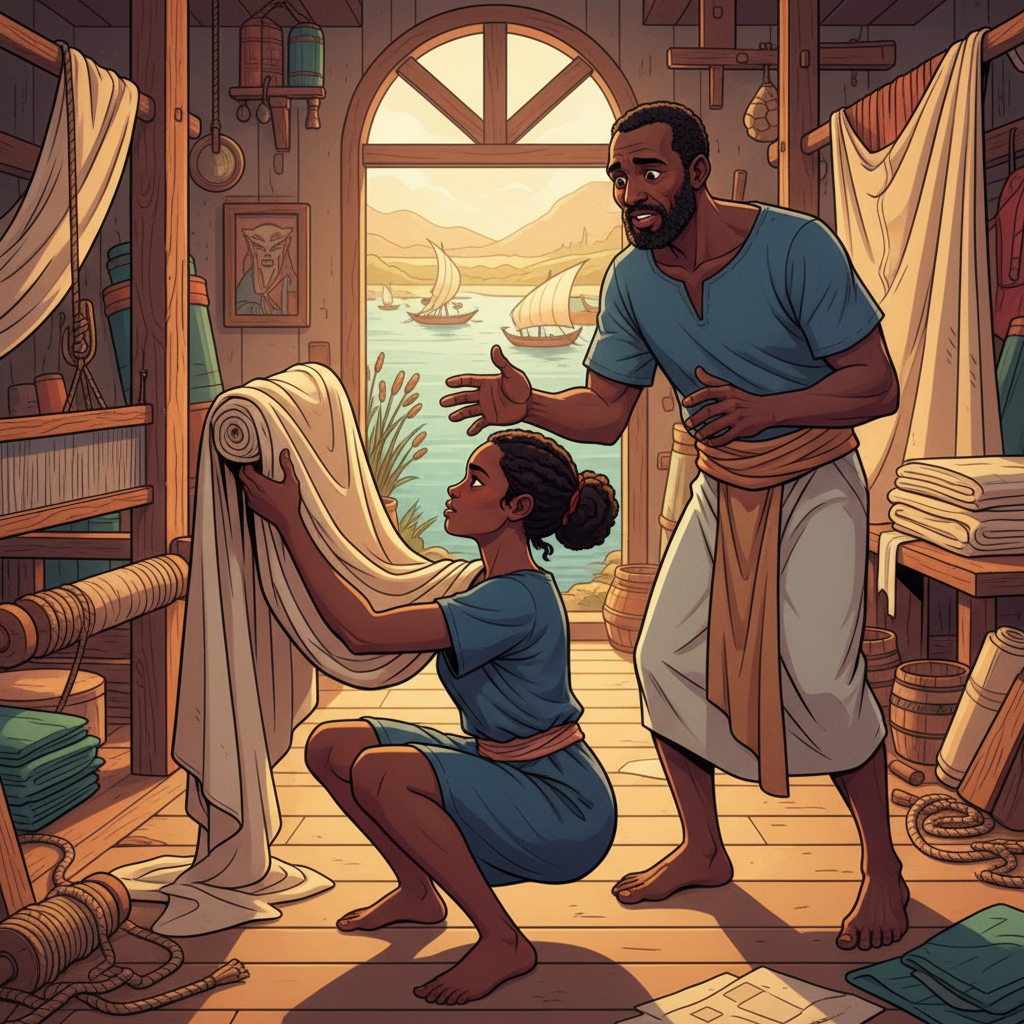
Yohannes looked at the bolt. He did not speak. Saba took a breath. She bent her knees the way her father had taught her — never bend at the waist when lifting; bend at the knees; let the legs do the work — and she put her two small hands underneath the bolt of cloth. The bolt was heavy. It was a sailmaker's bolt — twelve cubits long, woven thick — and it weighed almost as much as Saba herself. She lifted it. Her arms shook. The cloth was warm from the sun that had come through the loft windows the day before. She felt the warmth pressed against her chest. She did not put the bolt down. She walked the three steps across the loft floor to where her father was standing. She held the bolt out to him in both her arms, lifted toward his hands. Yohannes did not move at first. He looked at the bolt. He looked at his daughter's arms shaking under the weight of it. He looked at his daughter's face. Saba did not speak. She did not lower the bolt. She held it up to him, the heavy sun-warm white sail-cloth she had carried three steps across the floor, the cloth that her father had finished with his own hands the day before, the cloth that would be rigged onto the masts of King Kaleb's fleet within ninety days. She did not say anything. Her father saw what she was doing. The whole story of the rescue was in the cloth — in his hands' work, in his daughter's hands offering it back to him.
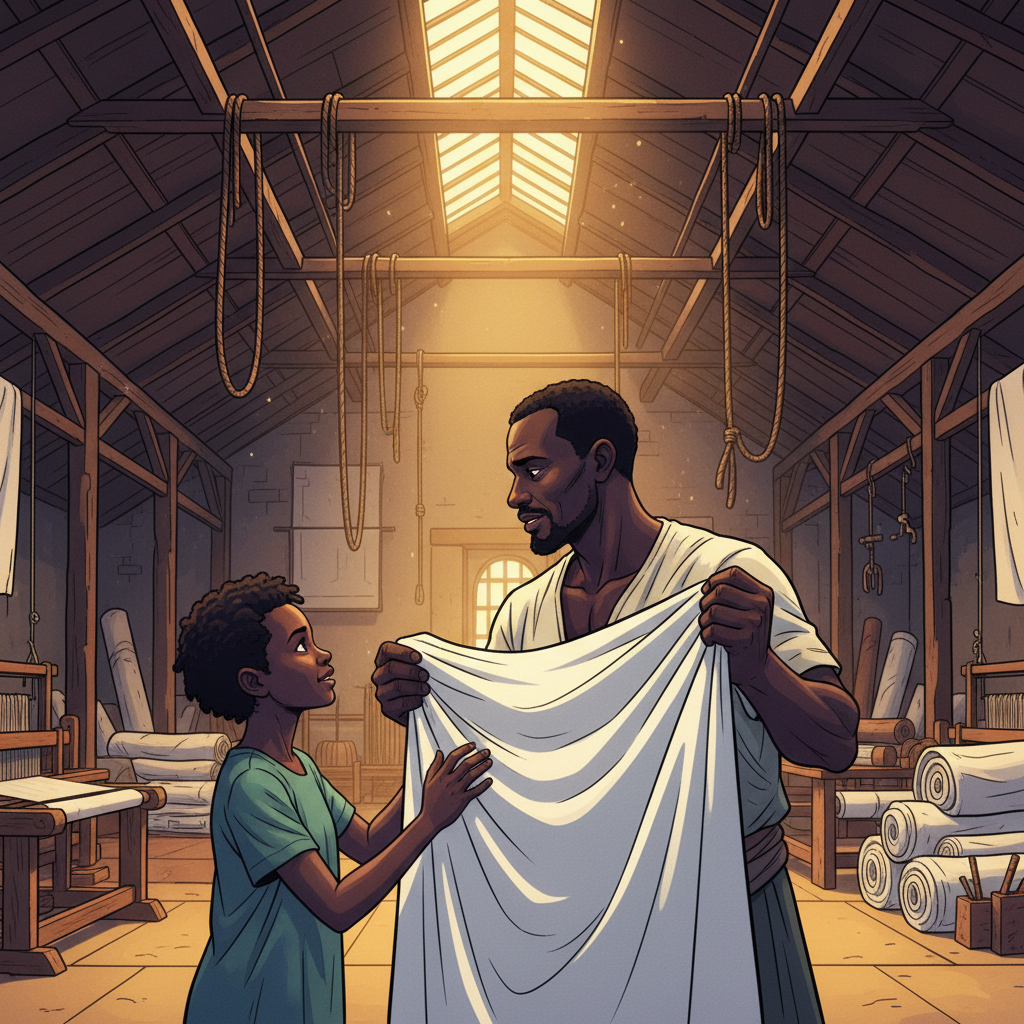
Yohannes reached out. He took the bolt of cloth from his daughter's arms. His hands were larger than hers. They were rough. They had been the hands she had held on to when she was learning to walk, the hands that had pulled flax fiber through looms for forty years. He took the bolt and he held it himself, and for a moment father and daughter stood together in the empty sail-loft with the heavy white cloth between them. The sun had climbed enough that a thin band of light came through the high east windows and fell across the bolt. The cloth was so white it caught the light and threw it back into the rafters of the loft. Yohannes's shoulders straightened slowly, the way shoulders straighten when a weight that had been carried in the wrong place is shifted to where it belongs. He spoke at last. His voice was quiet but it was no longer troubled. "Saba," he said. "I was thinking last night about the ten ships that might be lost in the crossing. I was thinking about the two hundred sailors. I was not thinking about Najran. I was not thinking about the children of Najran who are alive this morning, and who will be alive in ninety days, and who will be alive after the fleet sails. You have brought me the cloth that will carry them through. I had forgotten what the cloth was for. I had been counting only what the cloth might cost. Daughter. Thank you for walking down the dock this morning. Thank you for bringing me back to the weave."
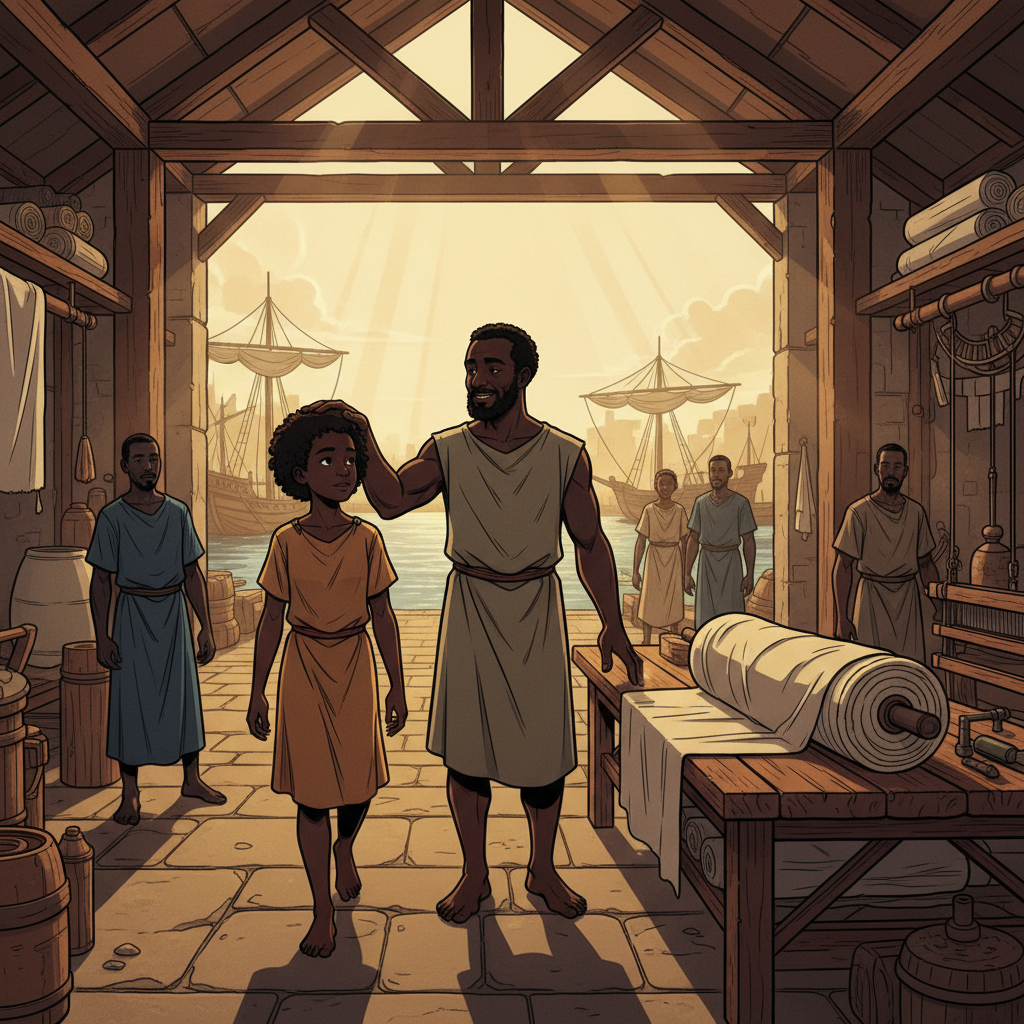
Saba did not know what to say. She had not prepared a speech. She had not prepared anything. She had only woken up before dawn and walked to the dockyard and stood beside her father in the dim light and asked him to come with her to the loft. The rest of what had happened had happened in the way that things happen between a father and a daughter who have spent thirteen years in the same building together. Yohannes set the bolt of cloth down very carefully on the inspection table. He turned to his daughter. He put his rough hand on top of her head, the way the old men of Aksum placed their hand on the head of a younger one who had brought them a thing they needed. "Go home, Saba," he said. "Eat your breakfast. Tell your mother I will be in the loft all day, and the next day, and the day after that. Tell her the cloth will be ready in ninety days. Tell her I have remembered why I agreed." Saba nodded. She turned and walked out of the loft into the morning light. The dock-hands were arriving for the day. The weaving women were beginning to come down the lane in their work tunics. The harbor was waking. Saba walked back through Adulis to her mother's kitchen, and the air over the city was the air of a city that had been given a job to do and was beginning to do it.
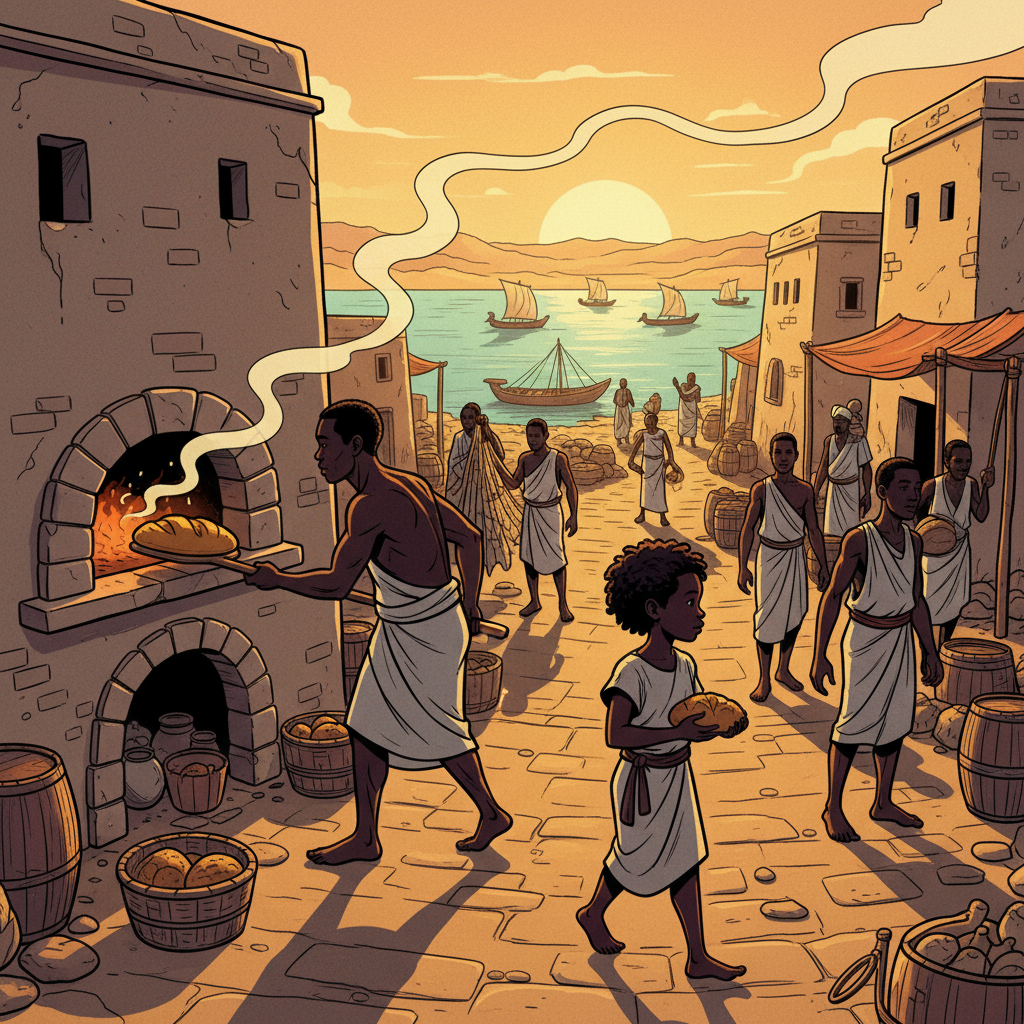
Saba walked home through Adulis in the strengthening light. The lanes were filling now. Fishermen were carrying their nets down to the dock. Bakers had pulled the first round breads from their stone ovens. The smell of fresh bread mixed with the smell of the harbor. Saba stopped at the bakery on the corner of her street and bought a small loaf with the copper coin her mother had given her the day before. She carried the bread the rest of the way home. Her mother was already in the kitchen at the back of the house, pounding green coffee beans in a small wooden mortar. Hirut looked up when Saba came in. She did not ask where Saba had been. She had heard her daughter leave before dawn. Saba set the bread on the table. She sat down across from her mother. "Father is staying at the loft today," she said. "And tomorrow. And the day after. He told me to tell you that the cloth will be ready in ninety days. He told me to tell you that he has remembered why he agreed." Hirut's hands stopped on the mortar. She looked at her daughter for a long moment. Then she nodded once, slowly, the way her own mother had once nodded when she had been told a thing she had been waiting to hear. "Eat your breakfast, Saba," Hirut said. She did not say more. She went back to pounding the coffee. The kitchen filled with the sharp green smell of the freshly broken beans. Outside, the morning had become a morning. Inside, the household had become the household of a sailmaker whose work was beginning.
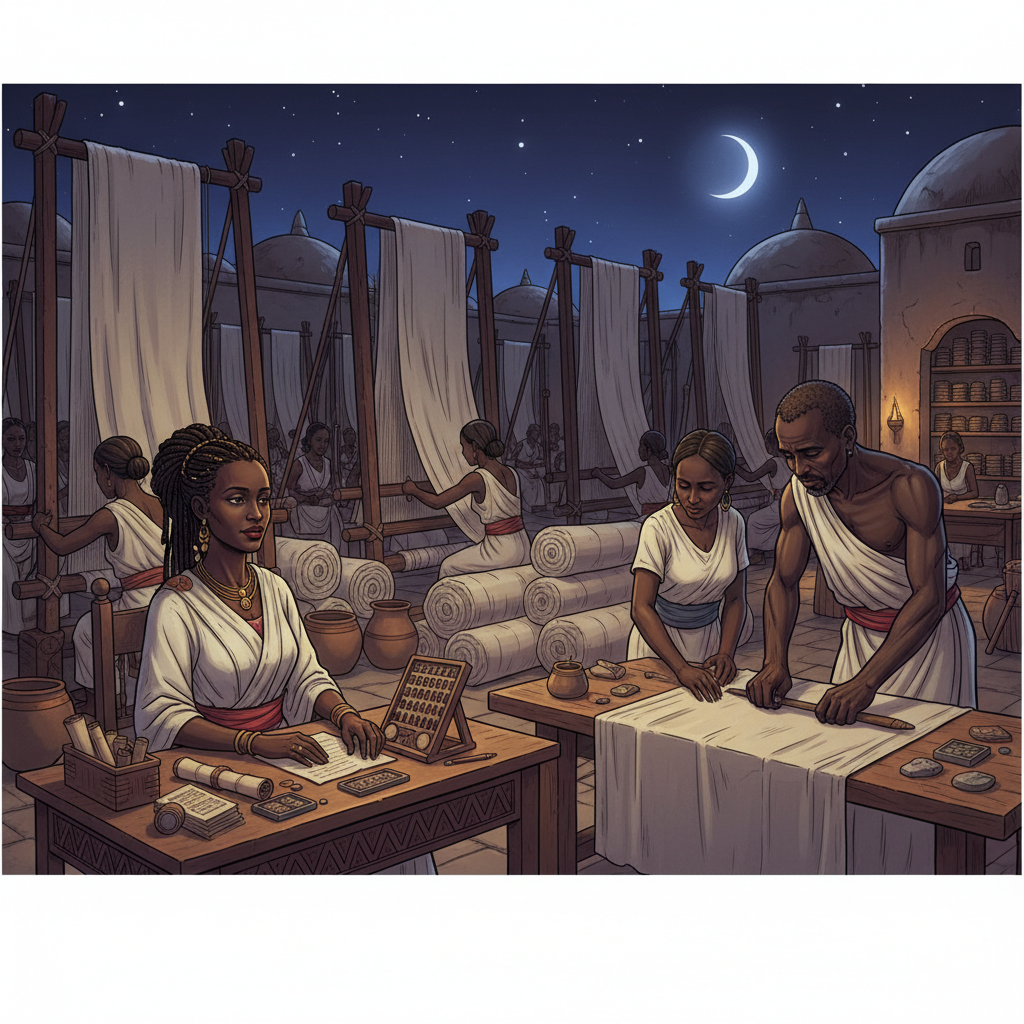
The ninety days that followed were the busiest the sail-loft of Yohannes had ever known. The twenty weaving women became thirty, and then forty, and then fifty, as women from the highlands came down to Adulis to help. The looms ran from before sunrise until after sunset. The bolts of cloth piled up at the back of the loft. Yohannes inspected every bolt himself. He did not sleep more than five hours a night. Hirut ran the accounts and the food and the household with the calm efficiency of a woman who knew her husband was working at the edge of what one man could do. Saba worked beside her mother. She also worked beside her father, when he needed an extra pair of hands at the cutting table. The news from across the Red Sea did not stop. More reports of Dhu Nuwas's violence came in on every dhow. The community of Najran was diminishing. The survivors were hiding in caves above the city. The Himyarite king was hunting them. King Kaleb sent updates to the dockyard twice a week — short clay tablets with the same message in slightly different words: faster, if you can; not later than ninety days; the children are waiting. The tablets were stacked on a shelf in Yohannes's small office in the corner of the loft. Saba read them when her father was not looking. She thought of the children in the caves above Najran. She thought of her own bed in her own warm room. The distance between the two beds was the distance the fleet was about to cross.
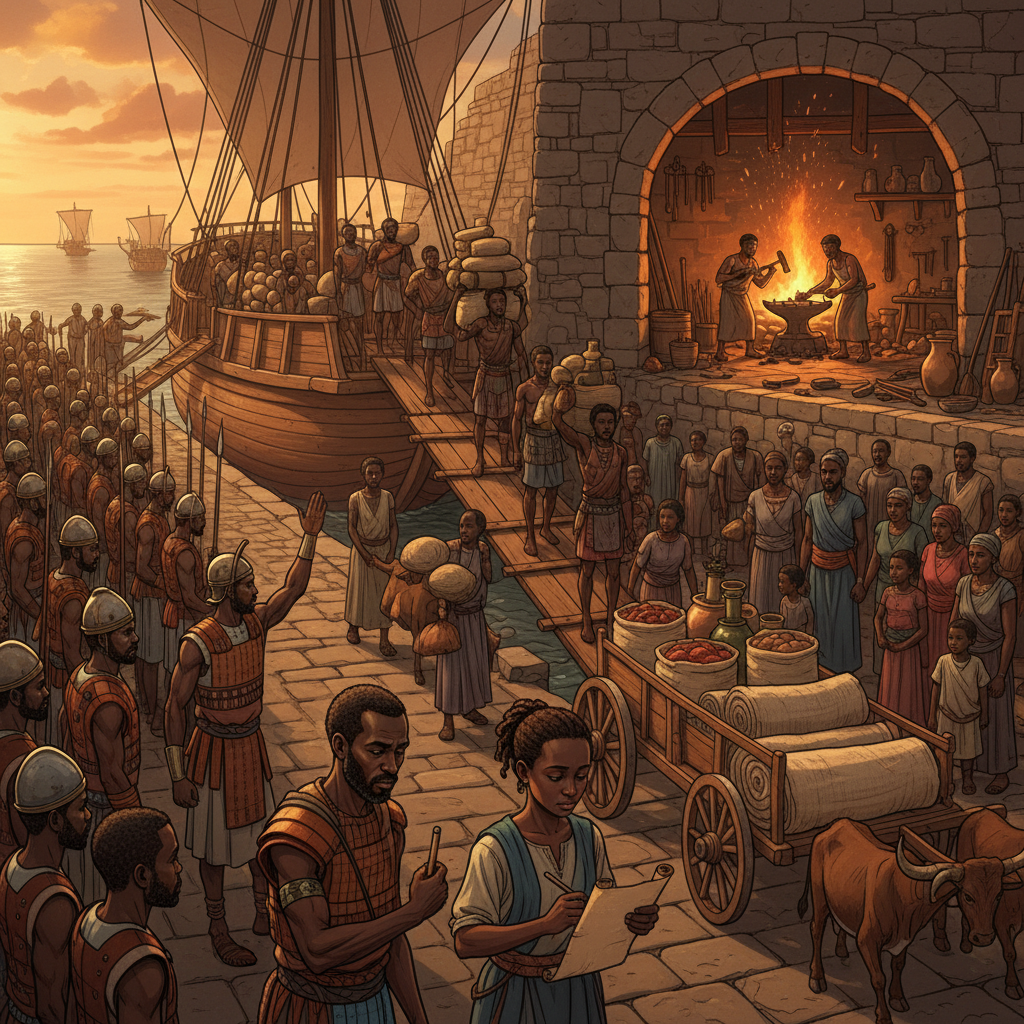
On the eighty-seventh day, the last bolt of sail-cloth left the loft. Yohannes had finished the order three days early. The cloth was loaded onto wooden carts and rolled down the long stone dock to the harbor, where the riggers waited to fit each sail to its mast. The dock was crowded that day — more crowded than Saba had ever seen it. Soldiers in leather armor stood in long rows being counted off by their officers. Sailors checked the ropes of their assigned ships. Supply-bearers carried bundles of dried meat and sacks of teff grain and clay jars of olive oil up the gangplanks. Blacksmiths were still hammering at the last of the iron fittings. The families of the men who were about to sail had begun to gather along the seawall, the wives holding small children, the mothers holding their grown sons' hands one more time. Saba helped her father supervise the loading of the cloth onto the riggers' carts. Each bolt had to be checked off against the loft's ledger. Each had to be matched to a specific ship by serial mark — the riggers had to know which bolt went to which mast so the sails could be cut and sewn to size. Yohannes worked through the loading without rest. Saba stood beside him with the ledger and the marking-stick. The cloth left the loft bolt by bolt over the course of three full days, until the back wall of the loft — where the bolts had been stacked the whole ninety days — was empty for the first time in three months. Saba stood in front of the empty wall on the evening of the third day. The loft looked larger without the cloth. It also looked, somehow, more done.
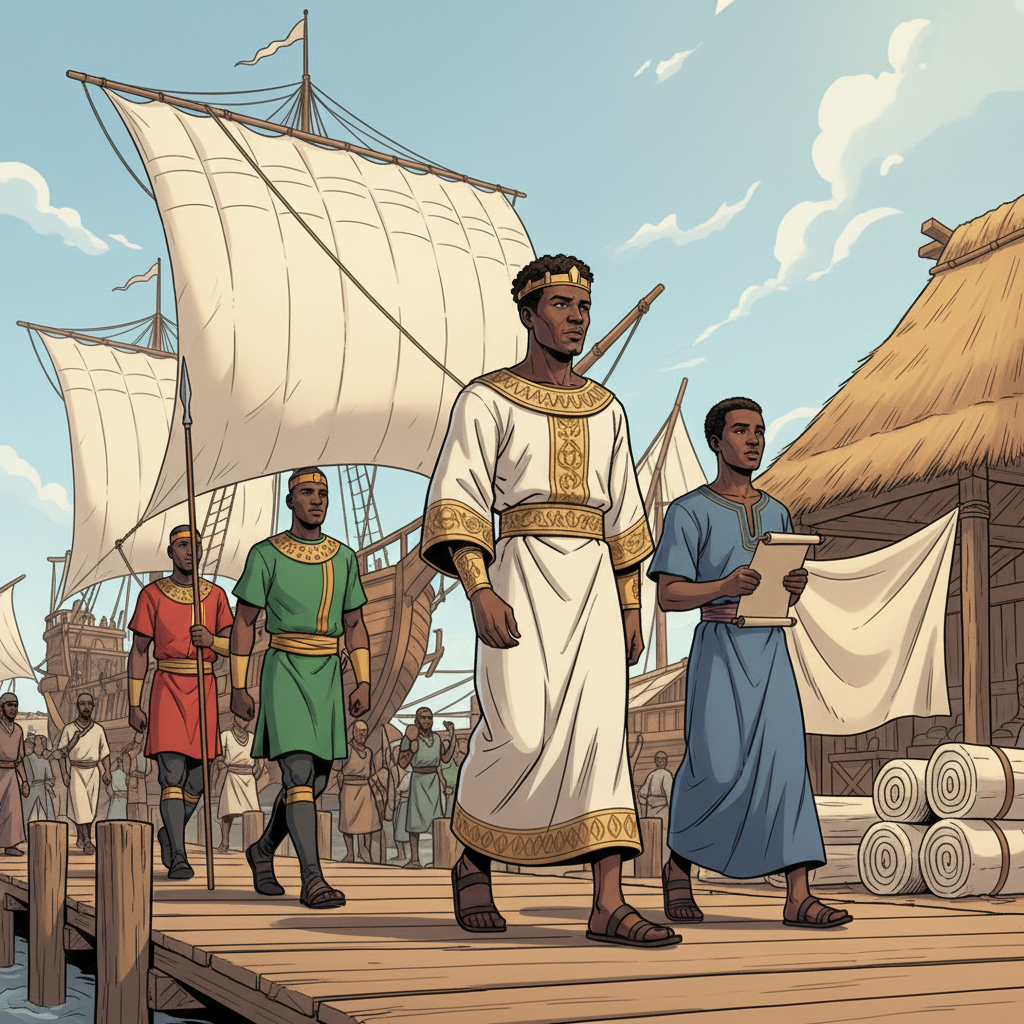
On the eighty-ninth day, King Kaleb himself came down from the highlands to inspect the fleet. He was a tall man in his forties, with deep dark skin and the simple iron crown of the Aksumite throne and the white robes he wore when he traveled. He walked the dock slowly, attended by two officers and a scribe. He stopped at each ship to greet the captain. He stopped at the riggers' shed to thank the master rigger. He stopped, last, at the sail-loft. He greeted Yohannes by name and bowed his head — king to craftsman — the way Aksumite kings had bowed to their master sailmakers for generations. The custom was old. Power recognized skill. Yohannes bowed in return, exactly as deep, exactly as long. "Your sails will carry my soldiers, Yohannes," Kaleb said. "The kingdom thanks you." Yohannes did not boast. He did not make a speech. He said only: "The cloth will hold, sire. The looms have given it everything." Then Yohannes turned and gestured toward Saba, who was standing beside her mother at the loft door. "Sire," Yohannes said. "This is my daughter Saba. She is thirteen. On the first morning of the order, when I was uncertain whether I could make the cloth in the time you asked, she came down the dock at dawn and brought me back to the weave. The order would have been late without her. I want you to know her name." King Kaleb turned to Saba. He inclined his head, gravely, the way a king inclines his head to a person whose work he has just been told about. Saba bowed low. The king moved on.
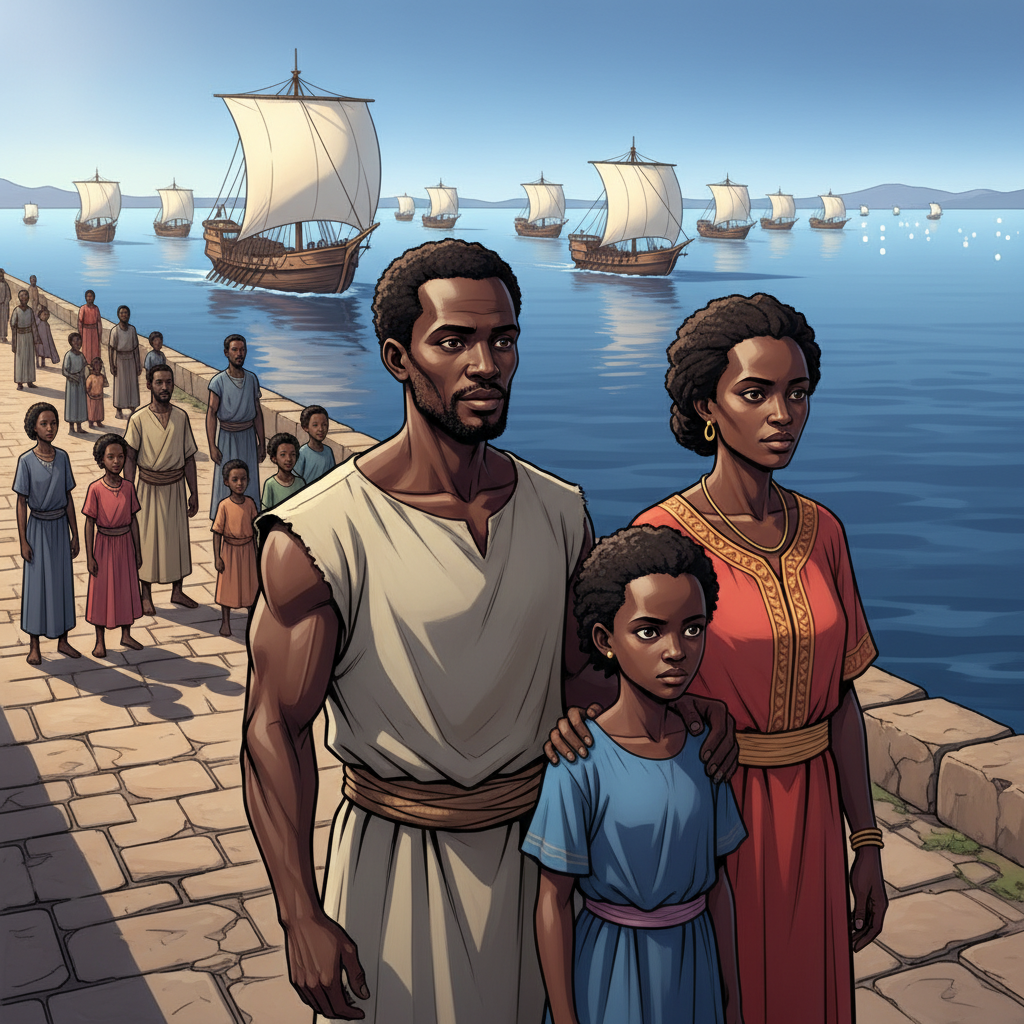
The full moon came on the ninetieth day. The fleet sailed at dawn. Saba and her mother and the families of the sailors and weavers stood along the long stone dock and watched the sixty ships pull out of the harbor of Adulis one after another. The new sails caught the morning wind. The cloth was so white it was almost painful to look at. Yohannes stood with Saba and Hirut, his arm around his daughter's shoulders, his eyes on the sails he had finished with his own hands. The fleet moved out into the Red Sea in a wide formation, and the masts grew smaller, and the sails became points of white against the horizon, and then the points became single bright dots, and then the dots were gone. The line of the Arabian coast was just visible in the haze. Saba watched until she could not see the last sail. She did not cry. She had cried, a little, in private, in the days before the launch. She did not cry now. Her father stood beside her in silence. Hirut stood on her other side. The three of them did not move from the dock for a long time. The dock-hands began to put away the ropes and the rigging tools. The wives of the sailors began to walk back through Adulis to their houses. Yohannes did not move. Hirut did not move. Saba did not move. They stood there and watched the empty horizon for almost an hour, until the morning sun was high and the harbor was the harbor of a city whose fleet had gone to sea.
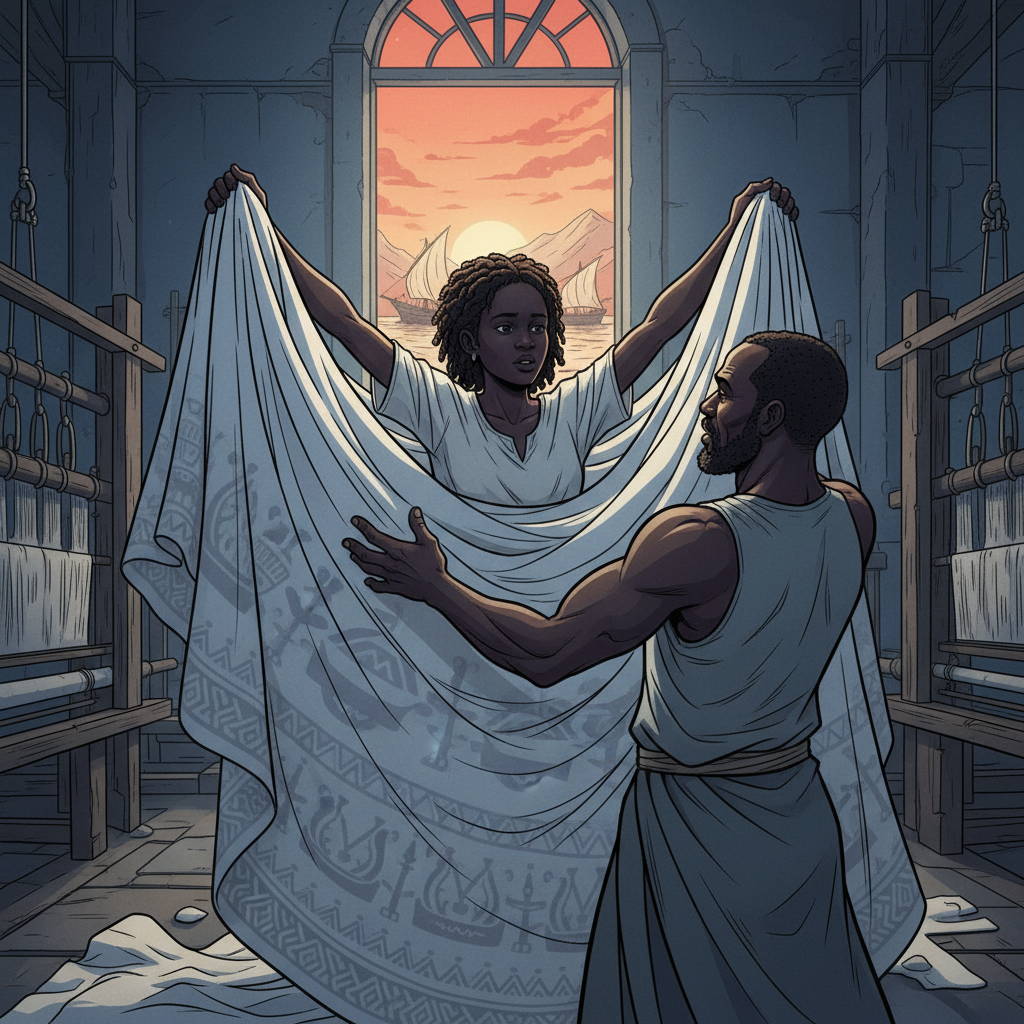
Saba lifted the white sail-cloth she had woven. She did not speak. Her father took it from her hands and the ships left at dawn. That was how Hirut would tell the story, later, to her own grandchildren — distilling the three months down to one sentence the way a grandmother distills a long story into a sentence a child can hold. Saba herself, in her own old age, would tell the story a different way. She would tell it slowly, the way her grandmother had once told her the old stories of the highland farmers and the travelers across the passes. But Hirut's sentence was the one that traveled. It was the sentence the women of Adulis learned by heart. It was the sentence the children of Adulis learned to repeat the way children learn to repeat a verse from the church. The sentence said the whole story. The lifting was the act. The silence was the wisdom. The father taking the cloth was the agreement. The ships leaving at dawn was the consequence. Saba's gesture — a thirteen-year-old girl handing her father a bolt of cloth in an empty sail-loft before the city was awake — was the moment the expedition became possible. It was not the moment the king decided. The king had decided weeks before. It was the moment the chief sailmaker, who had agreed without yet remembering why, remembered. From the remembering came the looms. From the looms came the cloth. From the cloth came the sails. From the sails came the crossing. From the crossing came Najran.
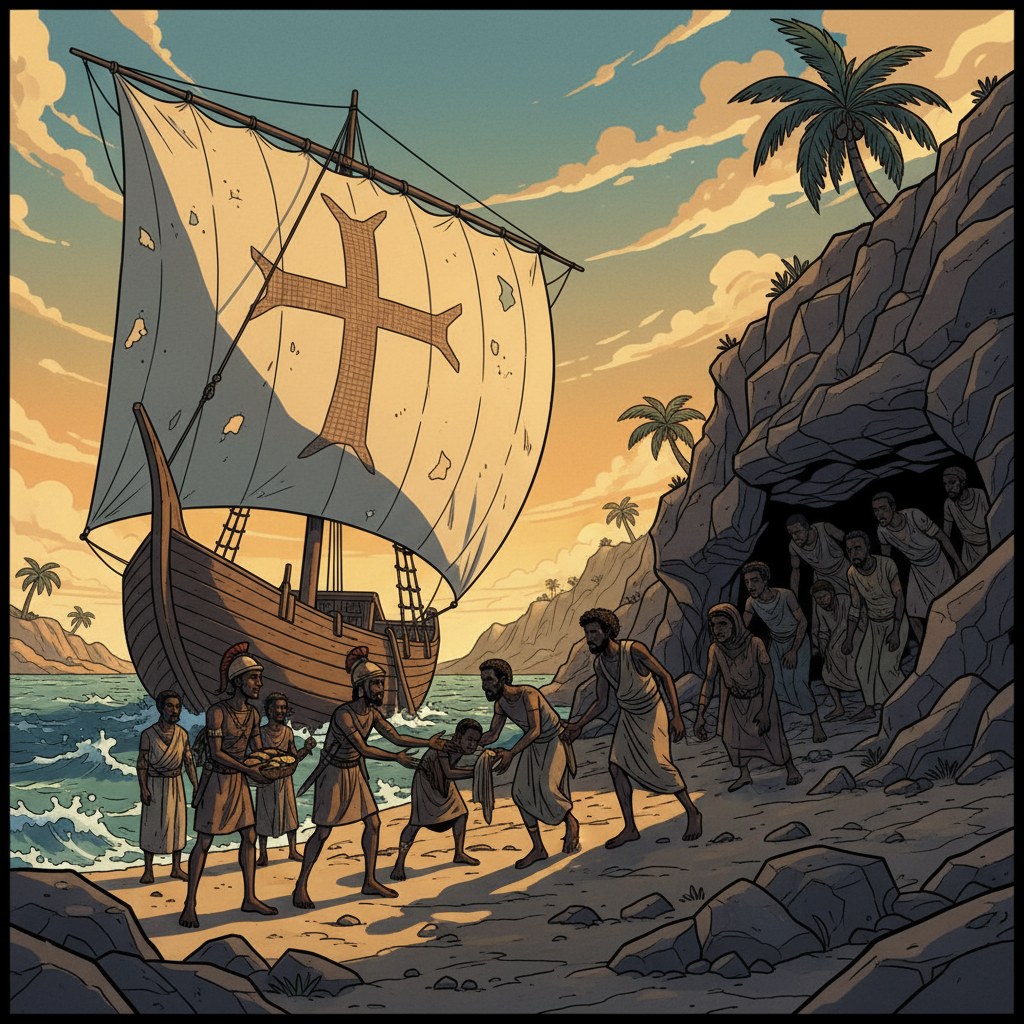
The expedition reached the Arabian coast in nine days. The crossing was hard but the new sails held. Of the sixty ships, none was lost in the Bab-el-Mandeb. The army landed below the Himyarite capital and marched inland. Within three weeks, Dhu Nuwas's army had been defeated and the king himself had ridden his horse into the sea rather than be captured. The survivors of Najran came down from their caves. The Aksumite army stayed long enough to rebuild the burned quarter of the city and to install a Christian governor named Sumyafa Ashwa, a Himyarite who had been faithful to the Najran community before the massacre. The Aksumite soldiers gave food to the survivors. They gave them blankets. They helped them bury their dead. The news of the rescue traveled. It reached the Byzantine emperor in Constantinople. It reached the Sassanid court in Persia. It reached the trading cities along the Indian Ocean. Aksum, the African kingdom in the highlands, had crossed water for a humanitarian mission. The kingdom had spent a year of timber, three months of sail-cloth, ten months of provisions — and many soldiers' lives — for a population it did not rule. The Byzantine ambassadors came to Adulis the following year to thank King Kaleb in person. They asked what Aksum wanted in return. Kaleb told them that Aksum wanted nothing in return. The rescue had been the rescue. The kingdom did, in the years that followed, gain new trading access to Himyar — but the access had not been the reason.
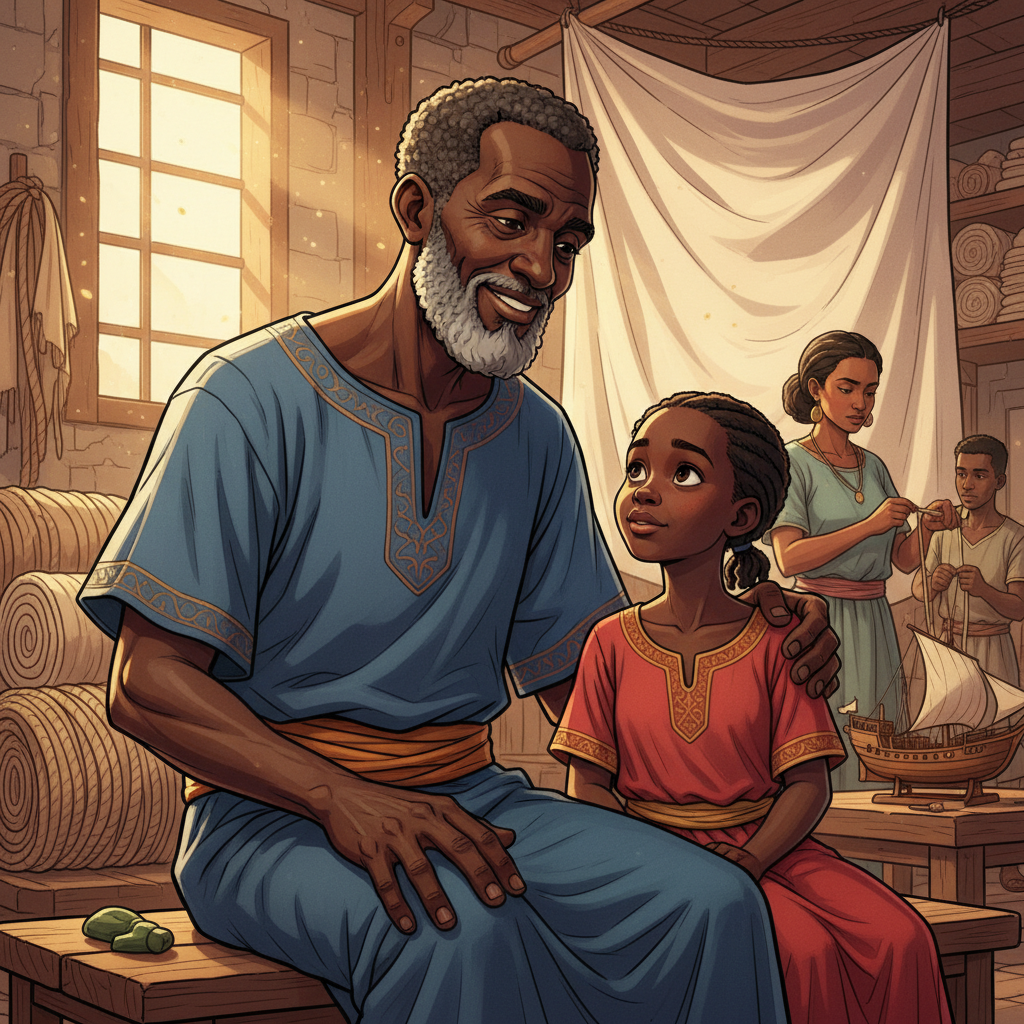
Yohannes lived another twenty-two years after the expedition. He stayed chief sailmaker of the Aksumite navy until his hands could no longer hold the inspection tools. He trained two of his apprentices to take over the loft. He never lost the look in his eye that had come back to him on the morning Saba had carried the bolt of cloth across the empty loft floor. The look was the look of a man who knew what his hands were for. He told the story of the bolt of cloth only twice in his lifetime. Once to King Kaleb, on the dock the day before the fleet sailed. Once to his eldest grandchild, the year before he died. He did not tell it often because it was not his story to tell. It was Saba's story. Saba grew up. She married a man named Tekle who was a shipbuilder at the Adulis yard, and they had four children, and Saba ran the sail-loft's accounts the way her mother had run them before her. She took over the inspection of the cloth after her father retired. Her own hands learned to read the weave the way her father's hands had read the weave. Two of her children — a daughter and a son — became sailmakers themselves, and one of them, the daughter, eventually became chief sailmaker of the Aksumite navy in her own right, the first woman ever to hold the position. The sail-loft of Yohannes became the sail-loft of his granddaughter. The looms ran for another four generations.
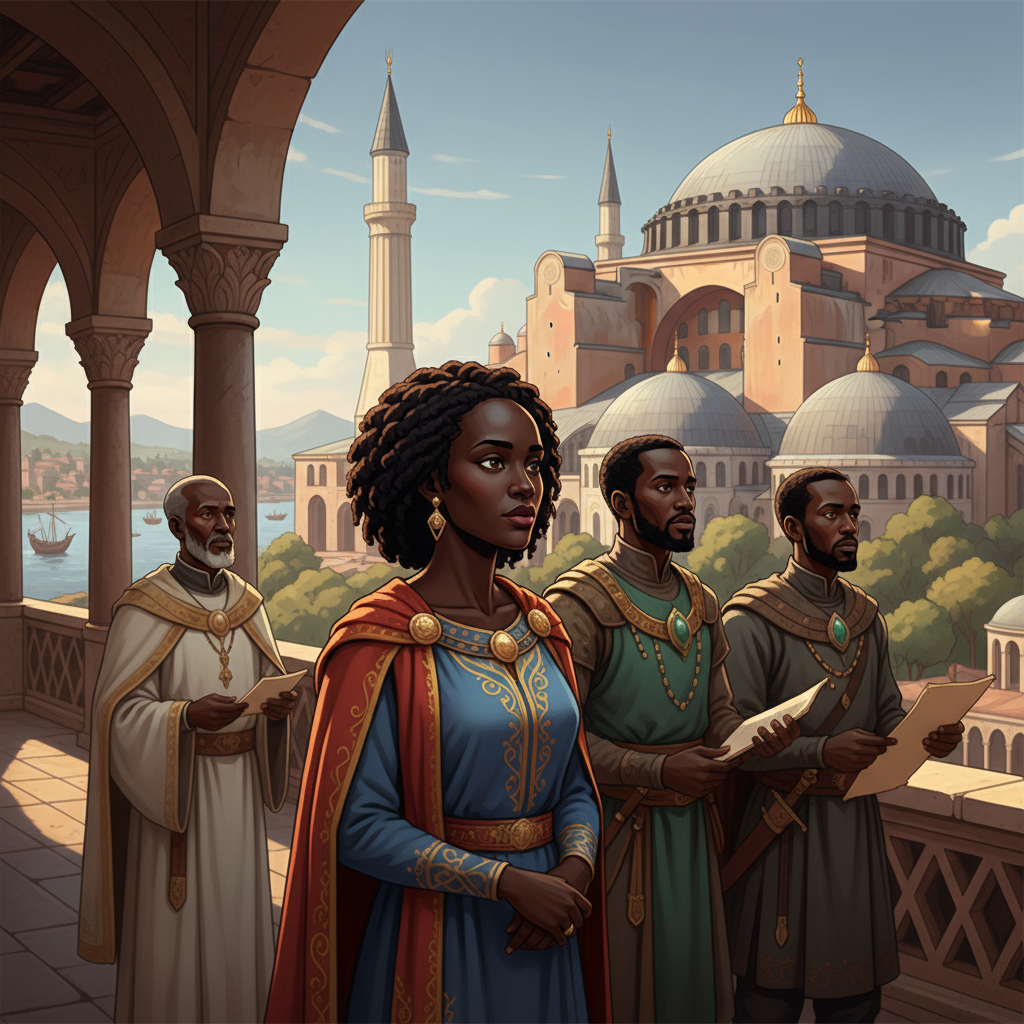
When Saba was thirty-five, the Byzantine emperor sent a second ambassador to Aksum. The ambassador had come to invite an Aksumite delegation to Constantinople. The Byzantines wanted to honor the kingdom that had crossed the sea for Najran. King Kaleb was old by then. He did not travel. He sent in his place a small delegation of officers, scribes, priests — and the daughter of Yohannes the chief sailmaker, who had become a name in the kingdom by then. The delegation traveled to Constantinople by ship and by overland route. Saba saw the Hagia Sophia. She saw the Bosphorus. She met the Byzantine empress, who asked Saba to tell her, in her own words, the story of the morning her father had agreed to make the sails. Saba was thirty-five. She had told the story a few times before — to her own children, to her husband's family, once to a traveling scholar from Alexandria who had asked her to repeat it slowly so he could write it down. She told it now to the Byzantine empress with the same care she had once used to inspect a bolt of cloth. She did not embellish. She did not boast. She told the empress about the empty masts in the harbor at dawn, and her father standing at the end of the dock, and the walk back to the silent loft, and the bolt of cloth she had lifted across the three steps to her father's hands. The empress listened. When Saba finished, the empress was quiet for a long time. Then she said: "Your father had agreed already. But he had not yet AGREED. There is a difference."
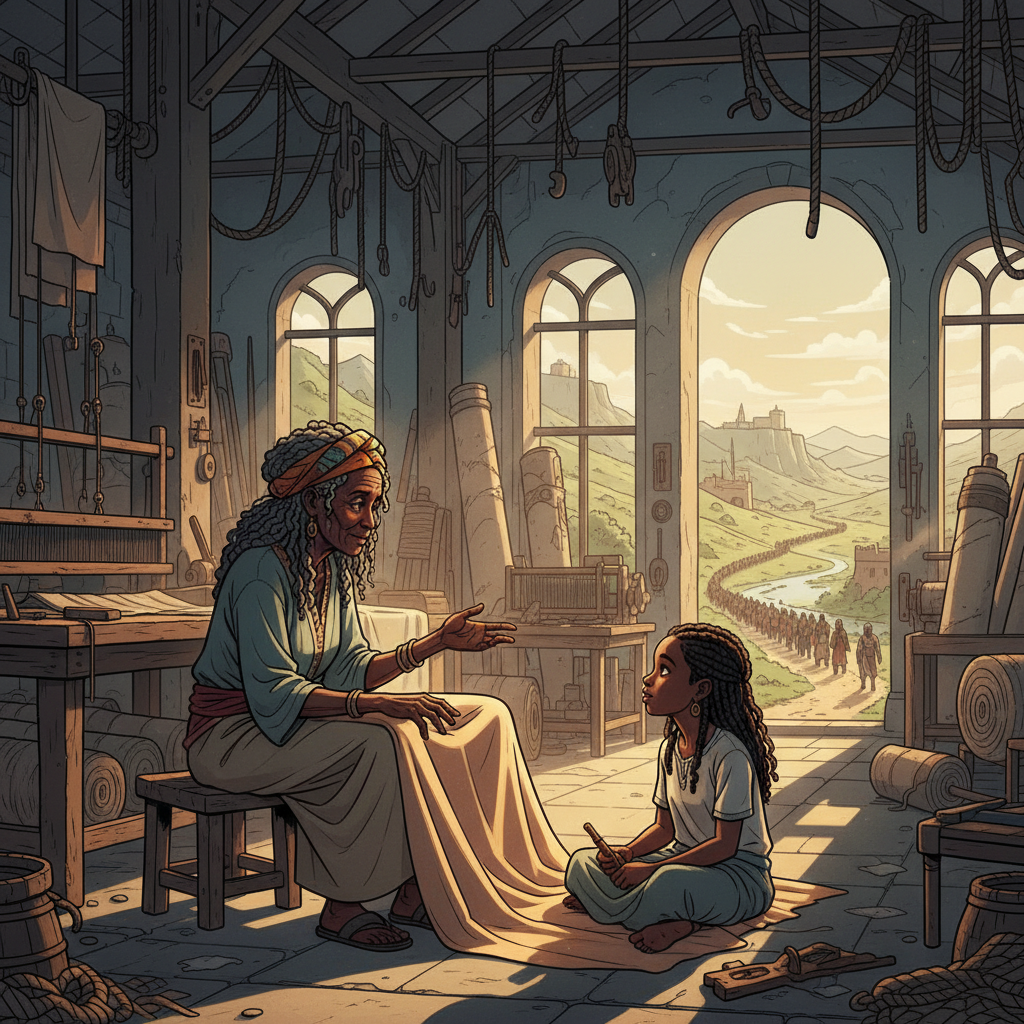
Saba had not thought about the story in exactly those words before. She turned the empress's phrase over in her mind on the long journey back to Aksum. There is a difference between agreeing and agreeing. The king had ordered the cloth. Her father had said yes. The yes had been a yes of duty. The morning in the loft had turned the yes of duty into a yes of memory — a yes of knowing what the cloth was for. The empress had named, in two languages and one sentence, the thing Saba had only sensed at thirteen. The cloth had not just been cloth. The cloth had been the bridge between the highland kingdom and the children in the caves above Najran. Her father had needed to see the bridge in his own daughter's arms before he could feel it under his hands. Saba came home to Adulis. She did not speak of the empress's phrase to anyone for many years. She kept it for herself, the way Asma in the old story of the bowl had kept the bowl for herself before she had needed to use it. When Saba was sixty-one, and her own granddaughter was thirteen — the same age Saba had been on the morning of the bolt — Saba sat with the granddaughter in the back of the sail-loft. The granddaughter's name was Mahlet. Mahlet had asked, the way grandchildren ask, for the story to be told once more. Saba told it. At the end, she told Mahlet what the empress had said. Mahlet thought about it. Then she said: "Grandmother. When my own granddaughter is thirteen, I will tell her the same."
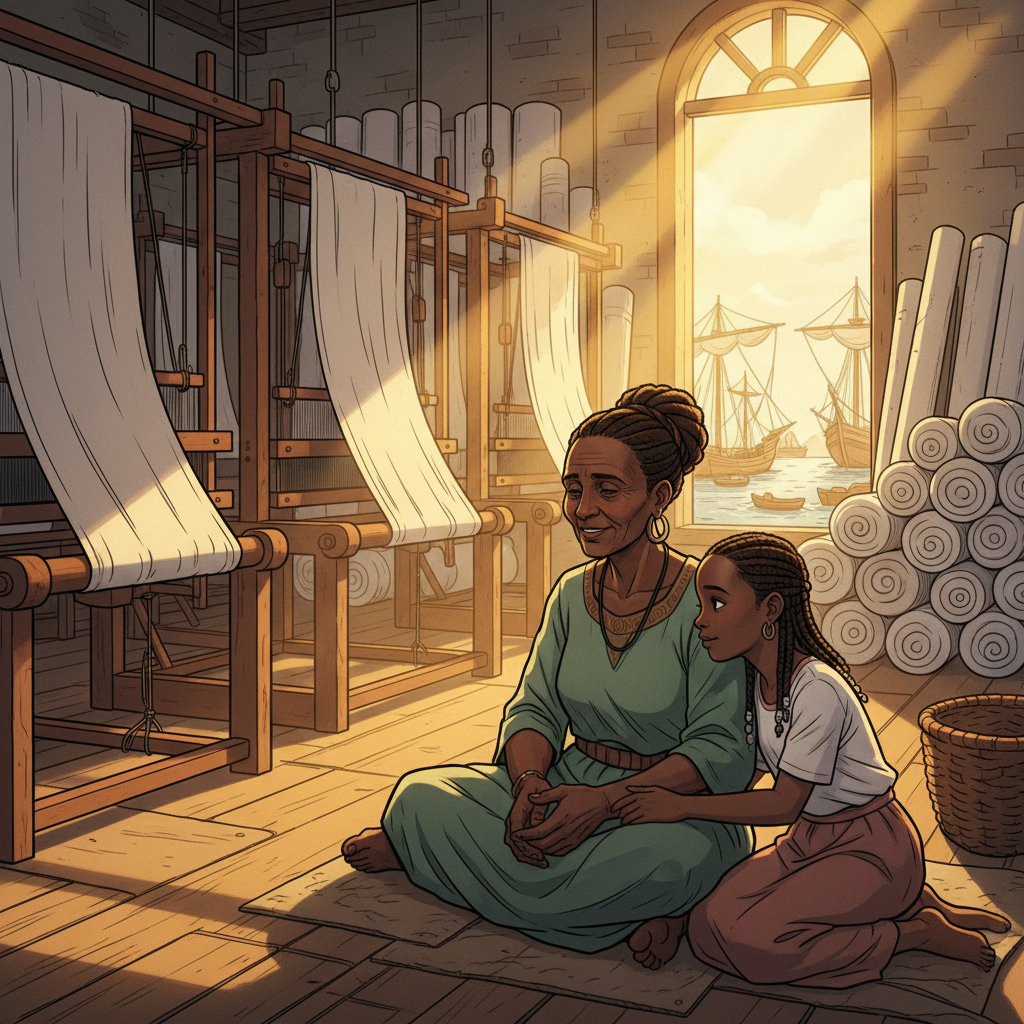
Saba smiled. The smile was the smile of a woman who had carried a sentence in her hands for thirty years and had finally set it down where it belonged — in the hands of a child who would carry it forward. "Yes, Mahlet," Saba said. "And the loft will be hers too, if she wants it. The looms have run for four generations now. They will run for four more. The principle is older than the loft." Mahlet leaned against her grandmother. The afternoon sun came through the high east windows of the loft and fell across the rows of looms and across the back wall where the finished bolts of cloth were stacked. The cloth was still white. It still caught the light and threw it back into the rafters. The looms were quiet for the day. The harbor outside was quiet. The masts of the new Aksumite fleet rose along the dock, waiting for their sails. Saba did not say anything more. She watched the light on the bolts of cloth. She watched her granddaughter's small hand resting on her own old one. She thought of the morning eighty years earlier when her own father had taken the bolt from her arms and the ships had left at dawn. She thought of the children of Najran who had come down from the caves. She thought of the Byzantine empress's phrase. She thought of the principle that the persecuted stranger is the same as the persecuted neighbor. She thought of Maat — the African word for the order that holds the world together — and how Maat had asked her father, on that morning long ago, not for cleverness or courage but for memory. The remembering was the work. The cloth had been the proof.
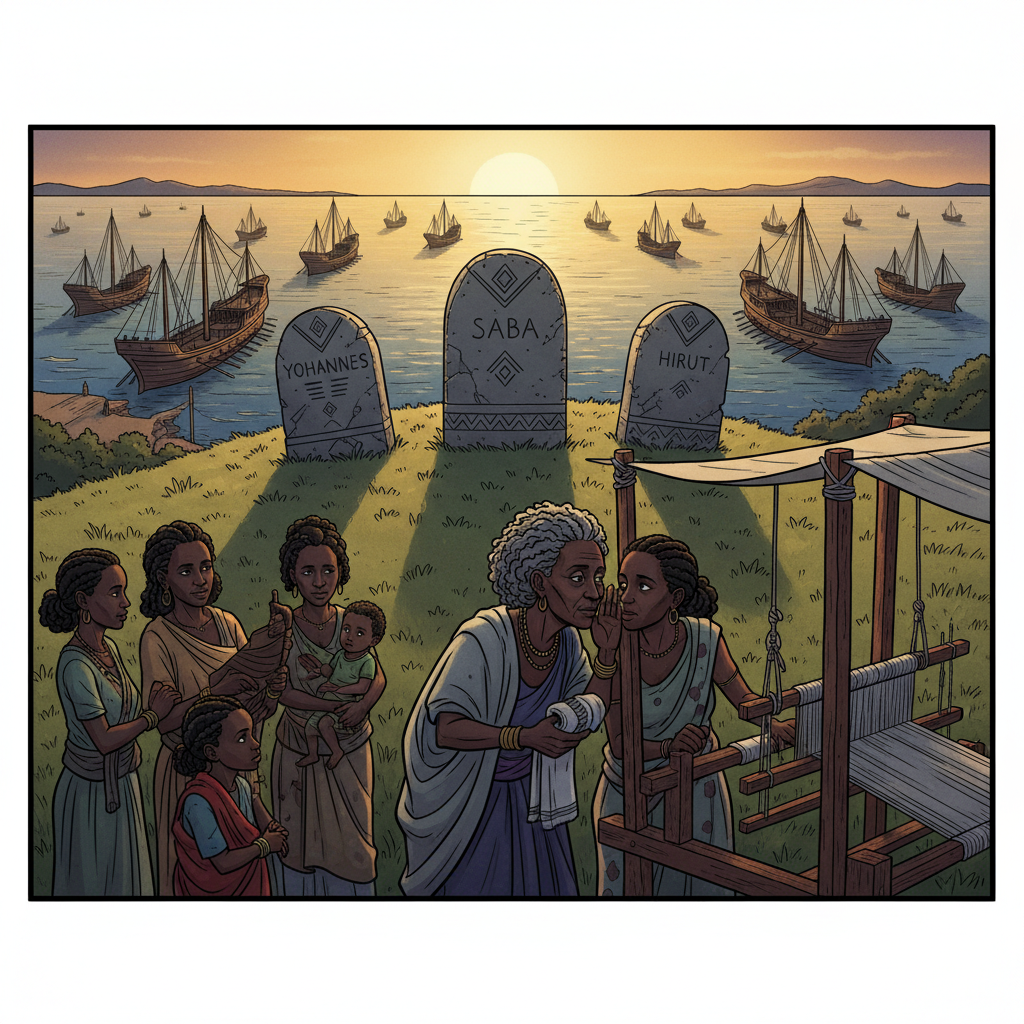
When Saba died, at the age of seventy-nine, she was buried in the small cemetery on the rise above the Adulis dockyard, where the chief sailmakers of the Aksumite navy had been buried for four hundred years. Her father Yohannes was buried beside her. Her mother Hirut was buried on the other side. From the grave-stones, on a clear day, you could see the harbor below and the sixty masts of the fleet of Aksum and the thin dark line of the Arabian coast across the Red Sea. The line had not moved in 1,500 years. The line would not move. The crossing was always there, waiting to be crossed again whenever the persecuted stranger across the water called out for help. The story of Saba and the bolt of cloth was carried down by the women of the Aksumite sail-loft for four hundred years, until the kingdom of Aksum itself declined and the looms eventually went silent. Then the story was carried by the songs of the highland singers for another six hundred years. Then it was carried by the books of the scholars for another five hundred years. The story has been on the lips of African children for fifteen hundred years now. The bedtime line — the one Hirut first said to her own grandchildren — is the line every Aksumite mother of the highlands has whispered into the ear of her thirteen-year-old daughter on the night before that daughter takes up a hard duty: Saba lifted the white sail-cloth she had woven. She did not speak. Her father took it from her hands and the ships left at dawn.