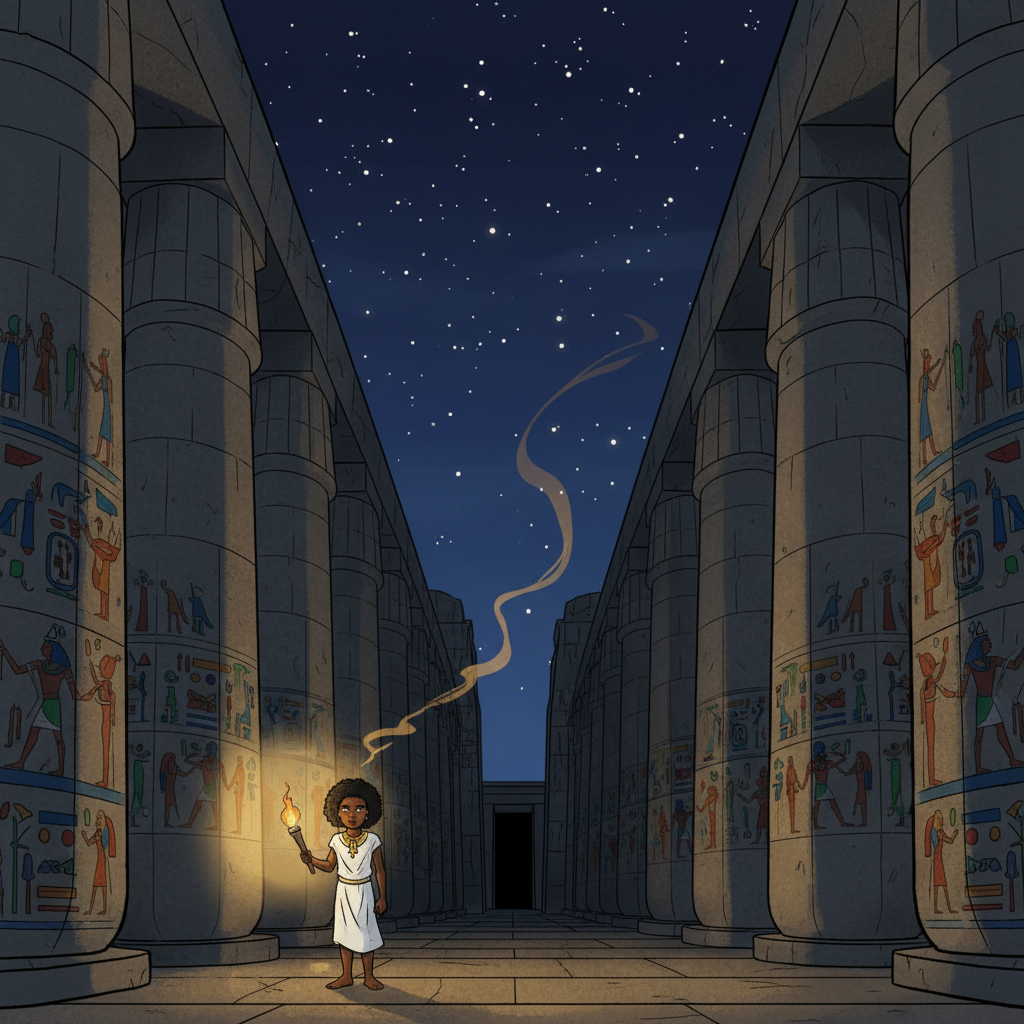
The temple of Ipet-Isut rose from the earth like a mountain carved by the hands of the neter themselves, its massive stone columns reaching upward into a sky that blazed with ten thousand stars. Young Amenirdis stood at the entrance to the outer corridor, her torch casting a trembling circle of gold across walls painted in colors so vivid they seemed to breathe — deep lapis blue, carnelian red, malachite green, and everywhere the gleaming gold of sacred hieroglyphs that told stories older than memory. The air smelled of kyphi incense, that ancient blend of frankincense, myrrh, and honey that the priests burned each evening to purify the sanctuary and invite the presence of the divine. Amenirdis was twelve years old, with skin dark as the night sky above her and eyes bright as the torch flame reflected in them. She wore a white linen tunic, clean and simple, with a single gold ankh pendant resting against her collarbone — a gift from her mother on the day she had entered the Per Ankh three years ago. Her closely cropped hair was oiled and gleaming, and her bare feet made no sound on the cold stone floor. She had been summoned tonight by the High Priest Khafre, and though she did not yet know why, her heart hammered with the certainty that something important was about to change.
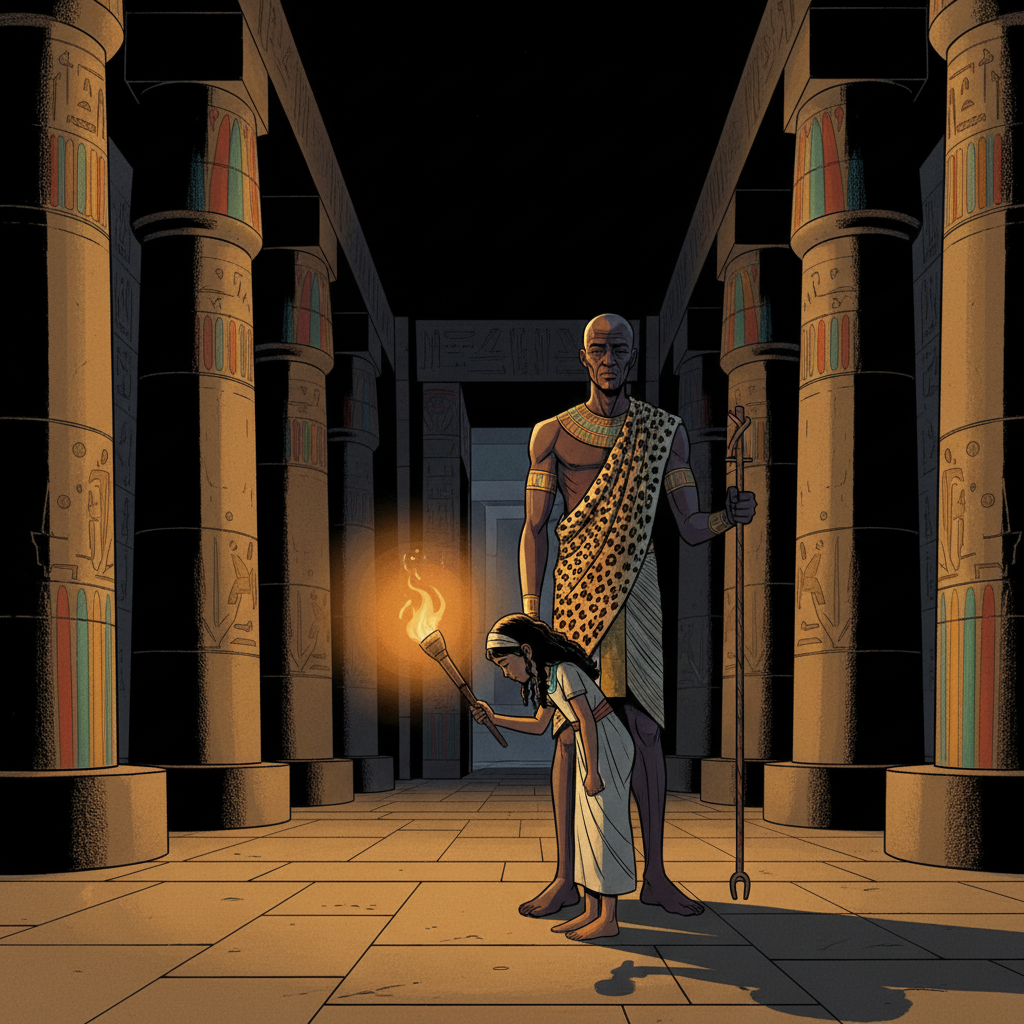
High Priest Khafre waited for her at the end of the corridor, his tall figure silhouetted against the deeper darkness of the inner sanctuary beyond. His skin was deep ebony, so dark it seemed to absorb the torchlight rather than reflect it, and his shaved head gleamed like polished stone. The lines carved into his face spoke of sixty years of study, meditation, and the weight of carrying sacred knowledge through a world that was slowly forgetting it. He wore a leopard skin draped over one shoulder — the mark of a sem priest, a keeper of the most ancient rites — and in his right hand he carried a staff topped with a carved djed pillar, the symbol of enduring strength. "You are late, Amenirdis," he said, though his voice carried no anger, only the measured patience of a man who had learned that time moved differently inside these walls. "I am sorry, teacher," she replied, bowing her head. "I was watching the stars from the courtyard. The constellation of Sopdet is rising, and I wanted —" Khafre raised his hand gently. "Never apologize for watching the stars. The scribes of Kemet built this temple to mirror the heavens above. Every column is placed where a star stands. You were already beginning tonight's lesson without knowing it."
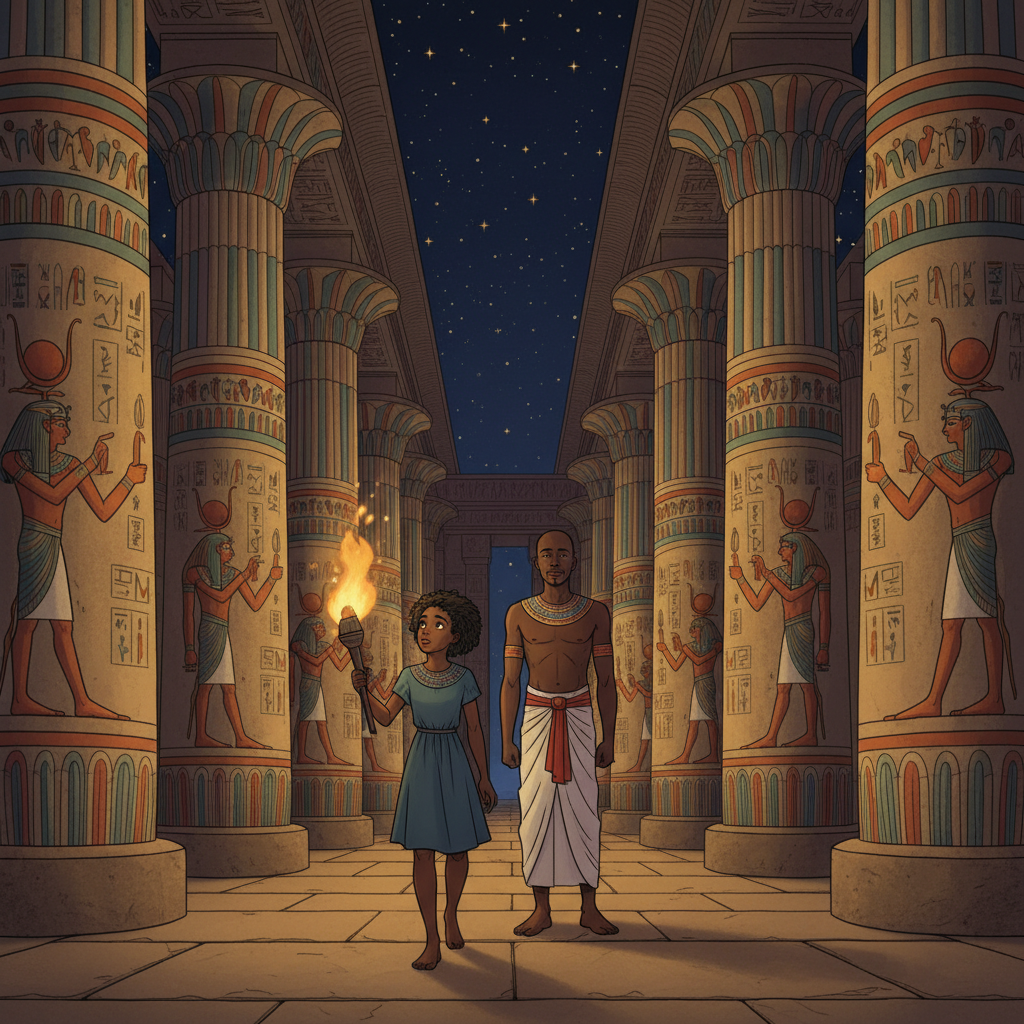
He turned and led her deeper into the temple, past columns so massive that four people linking arms could not encircle them. Each column was carved to resemble a bundle of papyrus stalks, and painted from base to capital in scenes of the neter — the divine forces that the ancestors of Kemet recognized as the living principles behind all creation. Amenirdis had walked this corridor a hundred times during her three years of study at the Per Ankh, but tonight the painted figures seemed to watch her pass with unusual intensity, their ancient eyes following her torchlight as if they had been waiting for her specifically. The ceiling above was painted deep blue and covered with golden stars, a mirror of the sky outside, so that walking through the temple felt like walking through the cosmos itself. Amenirdis tilted her head back and let the immensity of it wash over her. The architects of Kemet had designed these spaces to make a person feel both small and sacred — small before the vastness of creation, sacred because you were part of it. Khafre watched her gaze upward and nodded with quiet approval. "The first lesson of this place," he murmured, "is that you are never separate from what you see above."
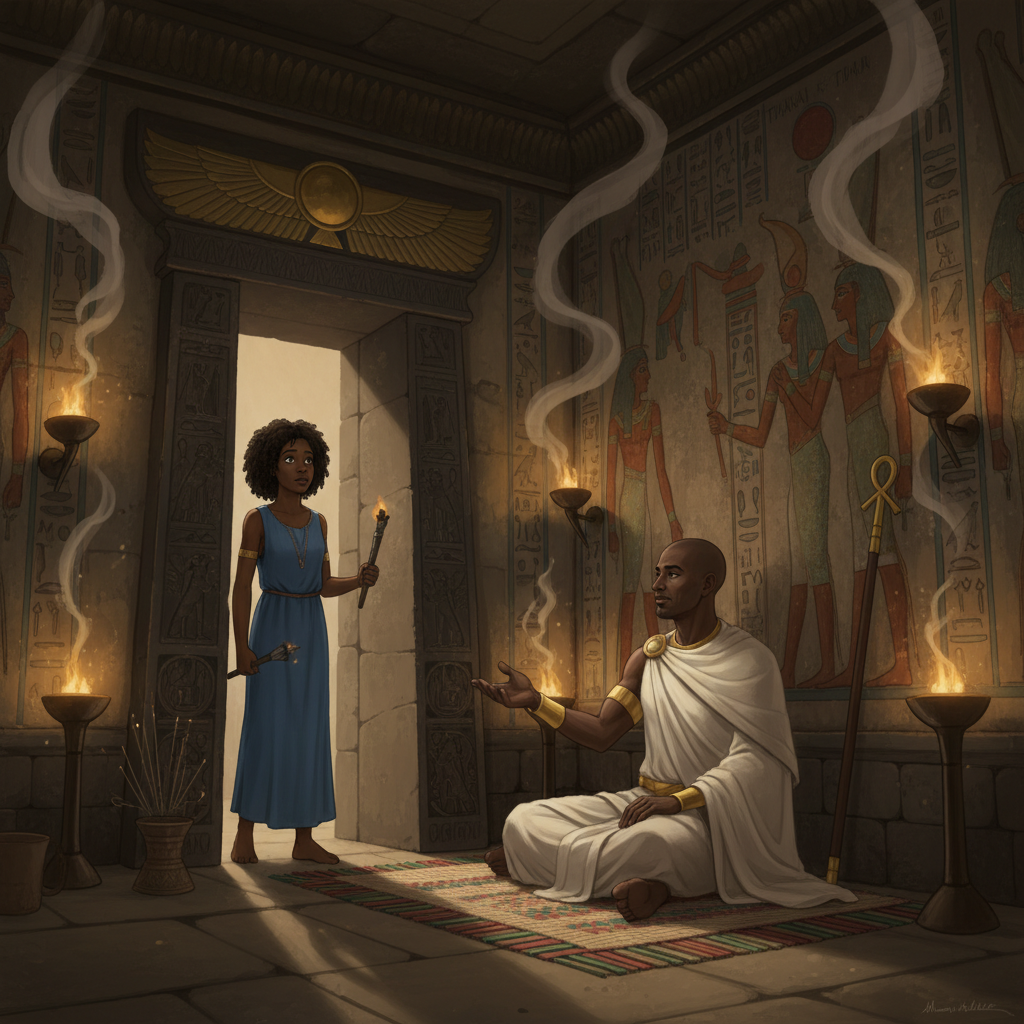
They passed through a doorway carved with the winged sun disk and entered the inner sanctuary — a chamber smaller than the grand halls behind them, but charged with a presence so dense that Amenirdis felt the air itself change. Four oil lamps burned in the corners, their flames steady and unwavering despite the faint draft from the corridor. The walls here were covered in the oldest paintings in the temple, their pigments laid down by hands that had returned to dust a thousand years ago. The incense was thicker here, curling in slow spirals toward the ceiling, and Amenirdis could taste its sweetness on her tongue. Khafre set his staff against the wall and sat cross-legged on a woven mat before the largest painted panel. He gestured for Amenirdis to sit beside him. "You have studied three years at the Per Ankh," he said, his deep voice resonating in the stone chamber. "You have learned the hieroglyphs — not merely their shapes, but the living power within each symbol. You have studied mathematics, astronomy, the healing arts. Your teachers tell me you are the finest student they have seen in a generation." He paused. "But tonight you will learn the deepest truth of all — the truth that underlies everything else."
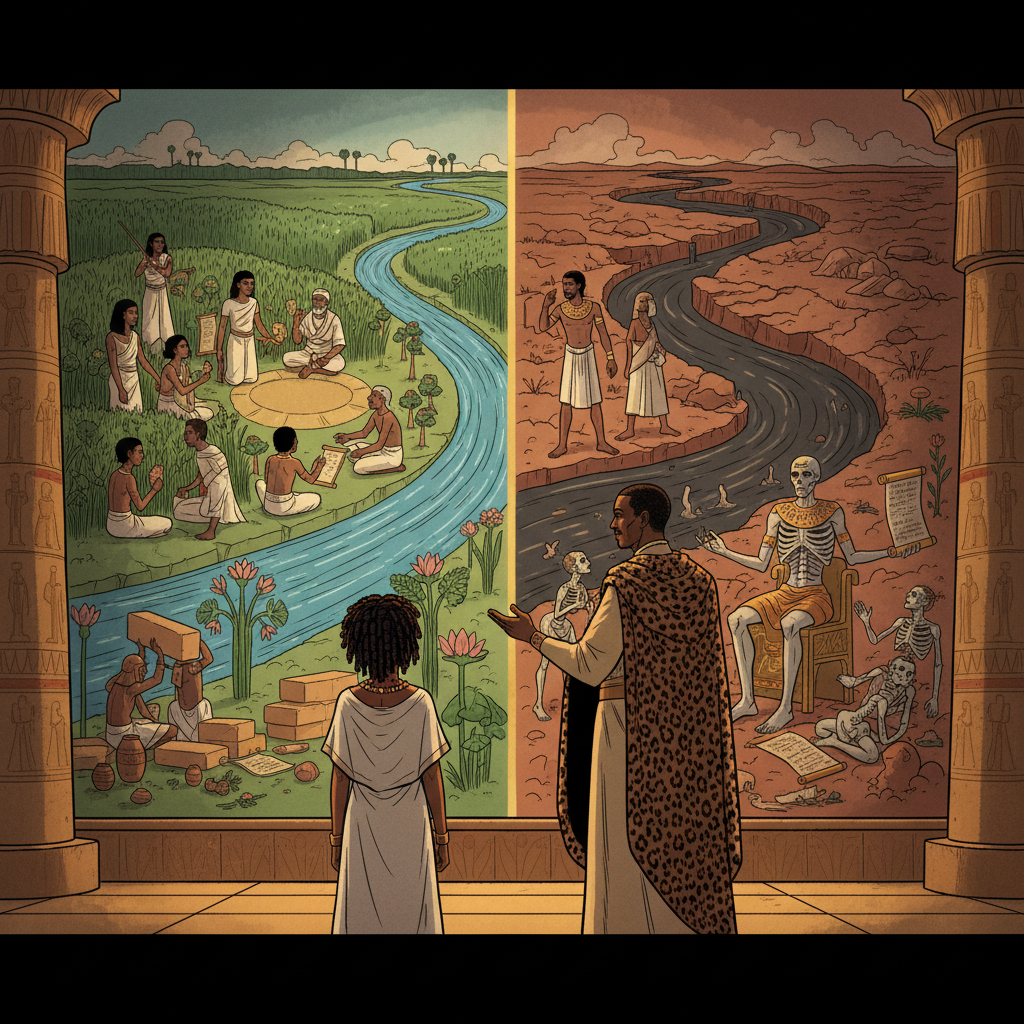
Amenirdis looked at the great painted wall before her, and her breath caught. She had seen this painting before, during her earliest days at the Per Ankh, but she had been too young then to understand it fully. Now, with three years of study behind her, she saw it with new eyes. The wall was divided precisely in half by a vertical line of gold paint. On the left side, the artist had rendered a world of extraordinary harmony — families working together in green fields, the great river Hapi flowing clean and strong between banks lined with papyrus and lotus, children sitting in circles around an elder who held a scroll, scribes recording knowledge on fresh papyrus, healers tending to the sick, builders raising temples stone by stone. On the right side, the same world had been consumed by chaos. The fields were barren and cracked. The river ran dark with filth. People turned away from one another, their faces twisted with anger and fear. A figure that might have been a pharaoh sat on a throne of gold while skeletal children begged at his feet. Soldiers trampled the scrolls of the scribes. The healers' medicines had been scattered in the dust. "These are the Two Forces," Khafre said, his voice low and reverent. "Maat and Isfet. And this wall is not merely art, Amenirdis. It is a map of every possible future."
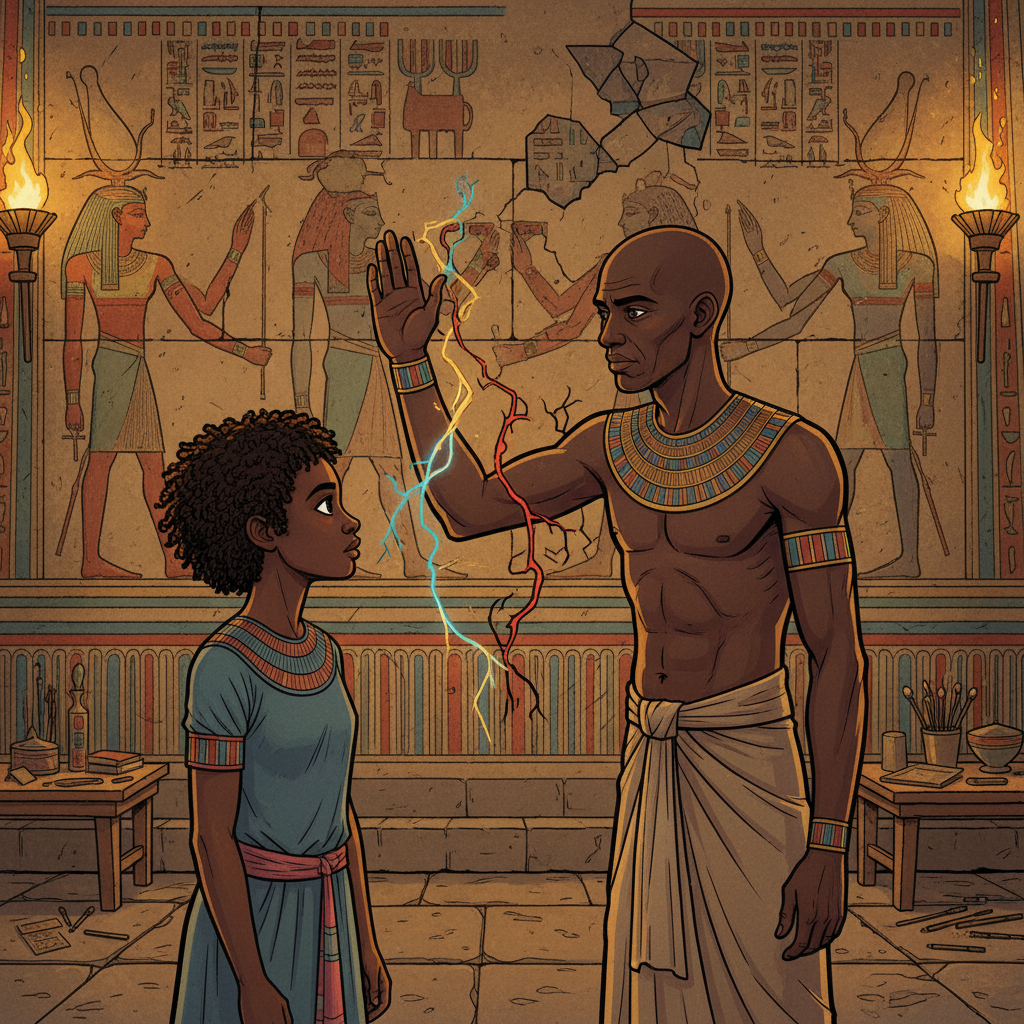
"Maat," Khafre continued, placing his palm flat against the harmonious side of the wall, "is truth, order, justice, balance, and cosmic harmony. It is the force that holds the stars in their courses, that brings Hapi's waters each season, that makes the seed become the stalk and the stalk become the grain. Maat is not a goddess sitting in some distant heaven. She is a living force, present in every atom of creation, and she flows through every choice made by every conscious being." His dark eyes held Amenirdis's gaze with an intensity that made her forget the cold stone beneath her. "Isfet," he said, moving his hand to the other side, "is falsehood, chaos, greed, cruelty, and disorder. It is the force of unraveling — the pull toward destruction that exists as surely as the pull of the earth on a falling stone. They are not just ideas, Amenirdis. They are as real as the wind, as real as the Nile. Every choice you make, every word you speak, every action you take or fail to take — feeds one or the other. There is no neutral ground. There is no standing still. You are always, in every moment, tipping the balance."
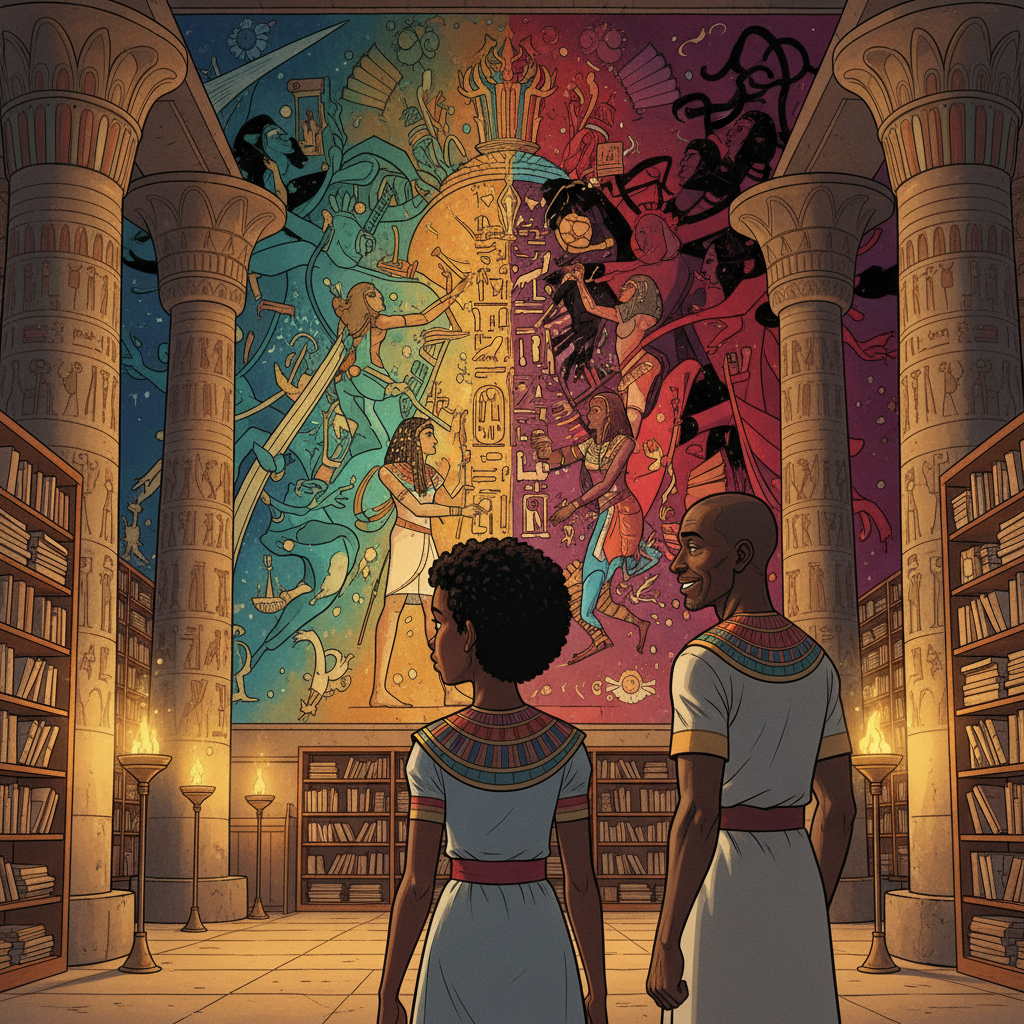
Amenirdis studied the painted wall in silence for a long moment, her dark brow furrowed in concentration. "Teacher," she said slowly, "I understand that Maat and Isfet are real forces. But how do they actually work? If I cannot see them the way I see the river or the wind, how do I know which one I am feeding?" Khafre smiled — not the easy smile of a teacher pleased by a simple question, but the deeper smile of one who recognized that real understanding had begun. "Let me show you through a story," he said. "Fourteen hundred years ago, in this very city of Waset, there lived a scribe named Amenhotep. He worked in the Per Ankh, copying sacred texts onto fresh papyrus so that the knowledge of our ancestors would never be lost. He was brilliant, meticulous, and deeply devoted to Maat. Every morning he rose before dawn, purified himself in the temple pool, and spent the entire day copying hieroglyphs with a reed pen so steady that other scribes came simply to watch his hand move across the page."
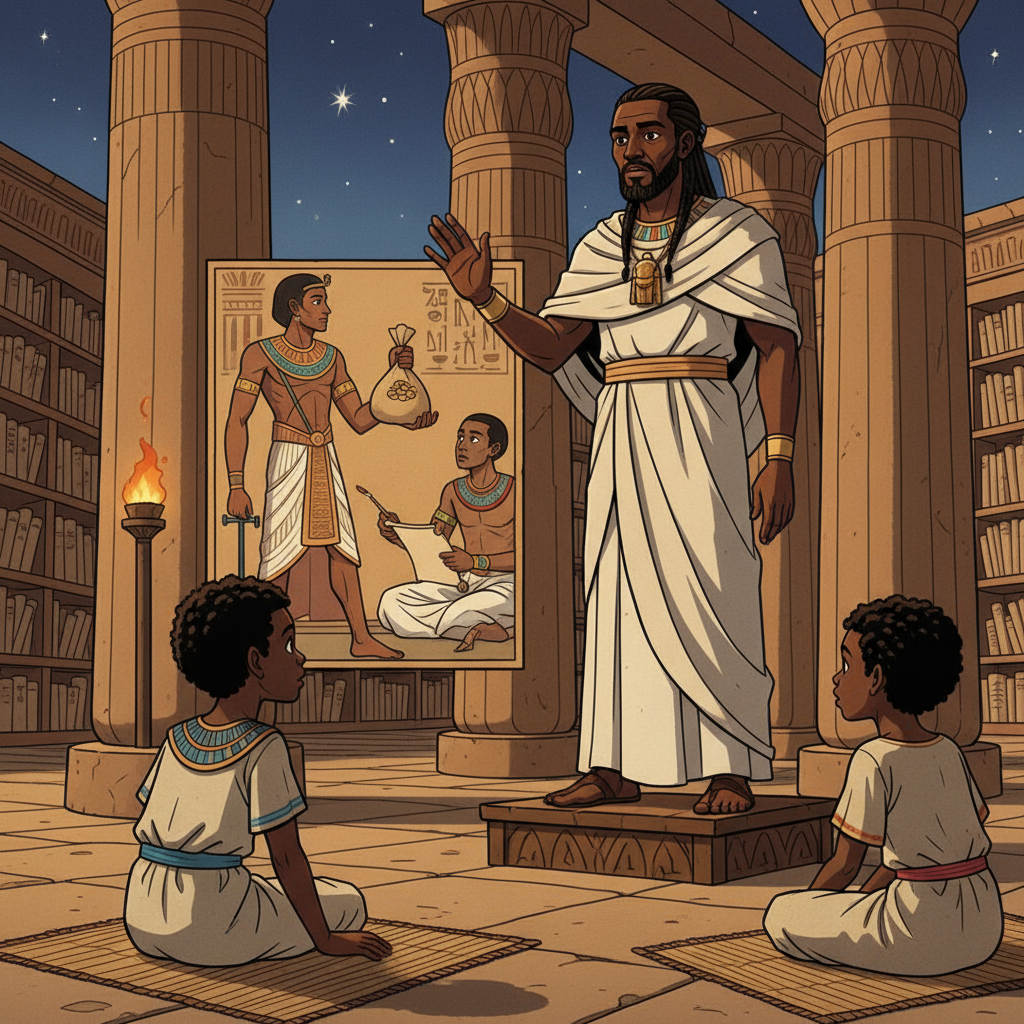
"One day," Khafre continued, his voice taking on the rhythmic cadence of an ancient storyteller, "a powerful nobleman came to Amenhotep with a request. The nobleman's family had been involved in a land dispute, and the original deed — the papyrus that proved who owned the farmland along the river — was stored in the archives of the Per Ankh. The nobleman asked Amenhotep to alter the document. Just a few hieroglyphs changed, a date adjusted, a name replaced. No one would ever know. And in return, the nobleman offered gold — enough gold to feed Amenhotep's entire family for ten years." Amenirdis leaned forward, her eyes wide. "What did he do?" Khafre held up his hand. "Think first. What would Isfet whisper to a scribe in that moment? What would the voice of disorder say?" Amenirdis thought carefully. "It would say: no one will know. It would say: your family needs the gold. It would say: it is just a few marks on a page — what harm can it do?" Khafre nodded slowly, his dark face grave. "Exactly. Isfet never announces itself. It speaks in the voice of reason. It sounds practical, sensible, even compassionate. That is what makes it so dangerous."
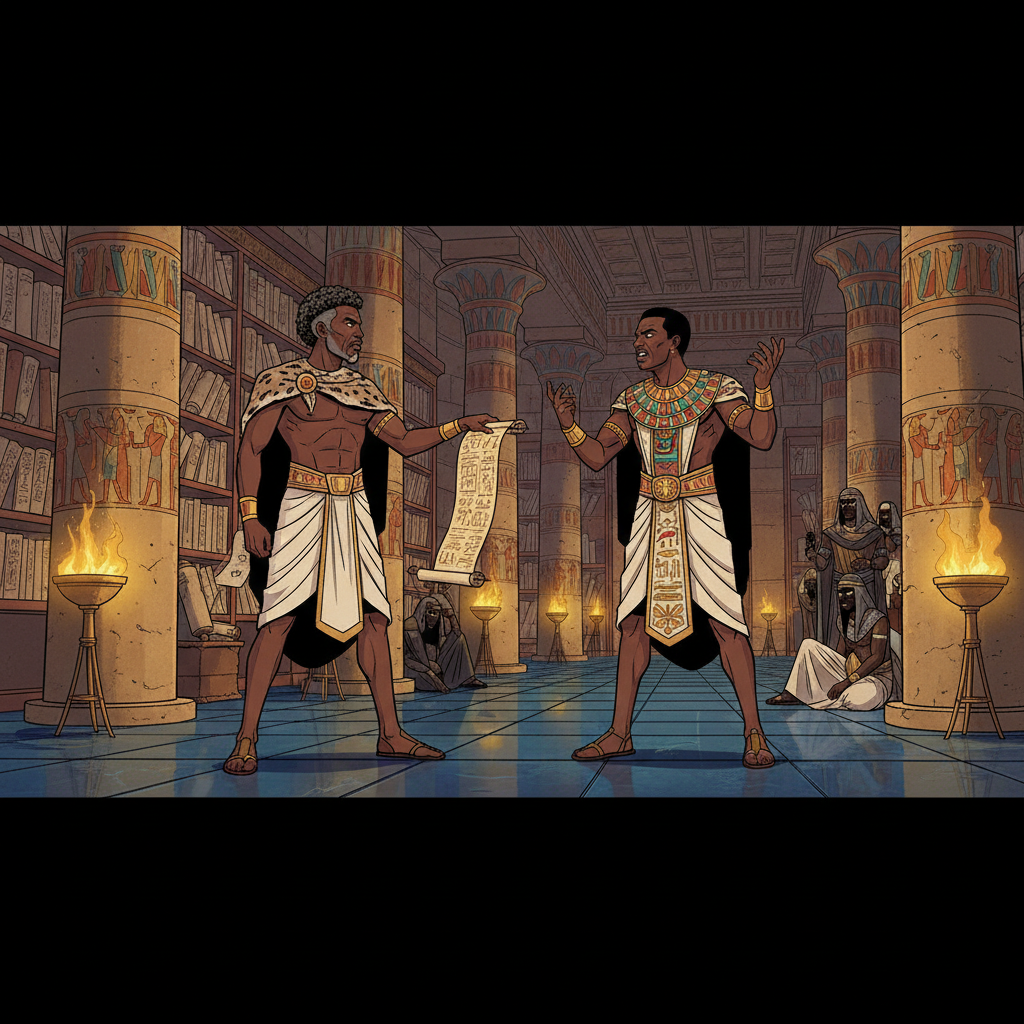
"Amenhotep refused," Khafre said. "He told the nobleman that the sacred texts were held in trust by the neter themselves, and that to alter even a single hieroglyph would be to introduce Isfet into the foundation of truth upon which all of Kemet depended. The nobleman was furious. He used his wealth and influence to have Amenhotep stripped of his position. The scribe lost everything — his place in the Per Ankh, his income, even the respect of colleagues who feared the nobleman's power." Amenirdis's chest tightened with anger. "That is not fair! He did the right thing and was punished for it!" Khafre raised one eyebrow. "Did I say Maat was easy? Did I say it was painless? Maat is the hardest path there is, Amenirdis. Truth often costs everything. Courage is not the absence of fear — it is the choice to stand for what is right when fear and consequence surround you on every side. Amenhotep lost his position. But he kept his ka — his spiritual essence — intact. And that is worth more than all the gold the Nile has ever washed to shore."
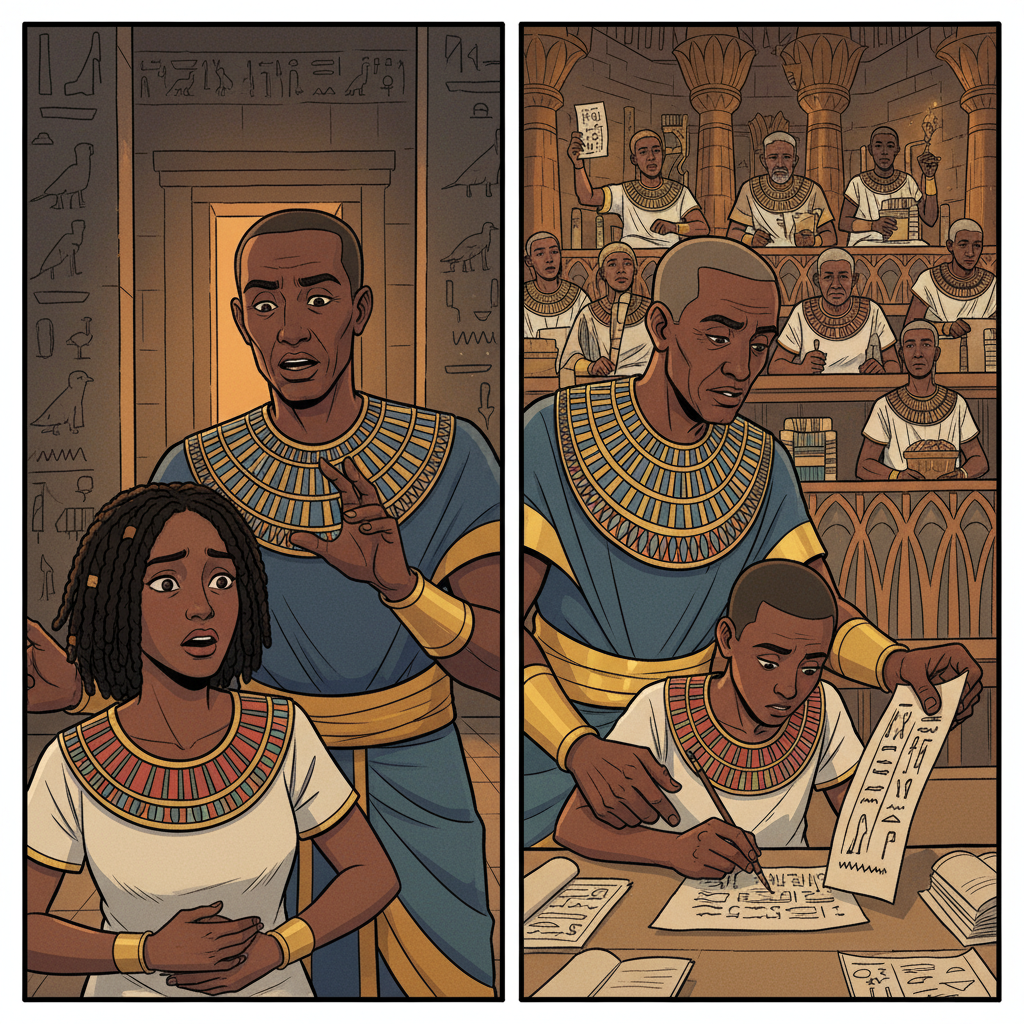
"But the story does not end there," Khafre said, and his dark eyes gleamed in the lamplight. "The nobleman took Amenhotep's replacement — a younger, more pliable scribe — and had the document altered. The false deed was presented at the council of elders, and the nobleman seized the farmland from the family that had worked it for generations. For a season, it seemed that Isfet had won completely. The nobleman grew richer. The farming family was left destitute. And the Per Ankh had been corrupted from within." Amenirdis felt something cold settle in her stomach. "So Isfet did win." Khafre shook his head. "Isfet never truly wins, Amenirdis. It only appears to. Watch what happened next. The farming family, though poor, refused to accept the injustice in silence. The eldest daughter — a young woman named Nebtawi, with skin black as the rich silt of the delta and a voice that could shake the walls of a courtroom — took the case to the vizier himself, the highest judge in all of Kemet. She spoke with such clarity and such courage that the vizier ordered an investigation."
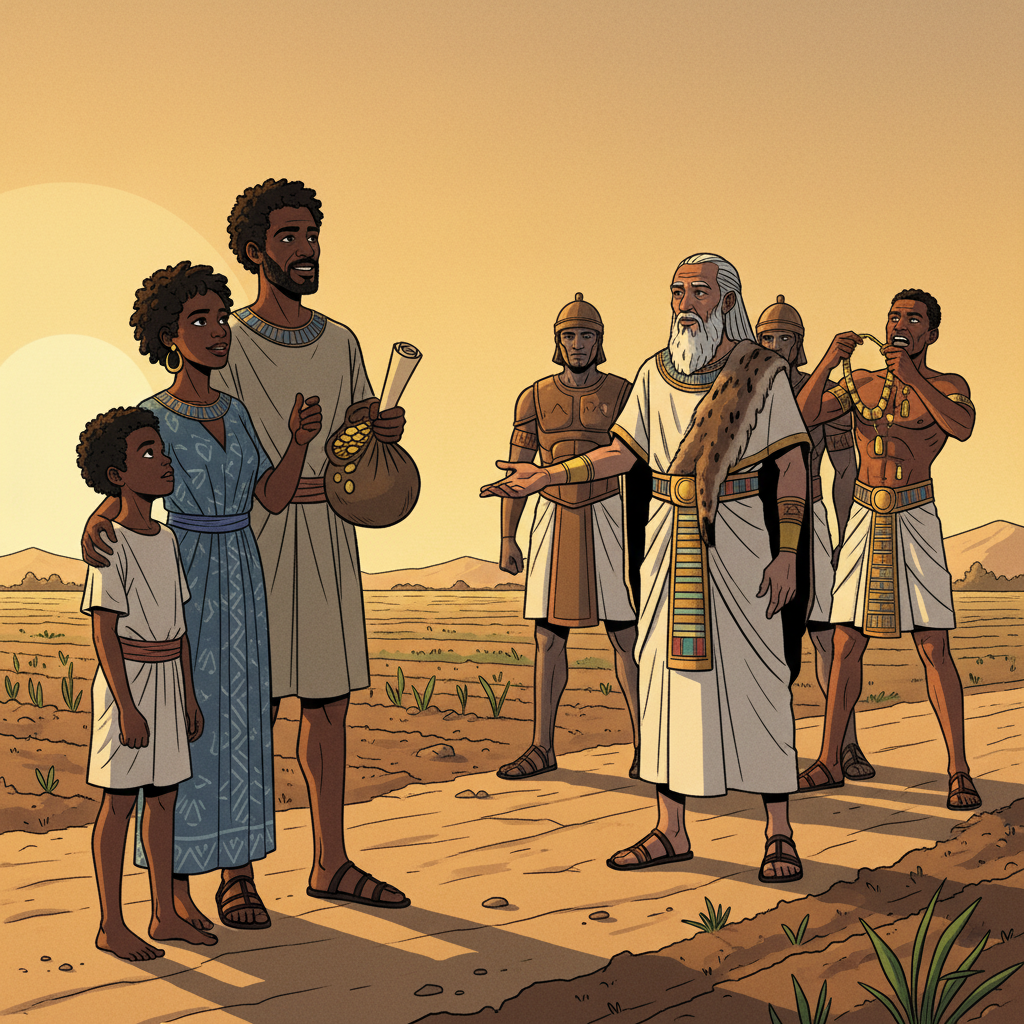
"The investigation uncovered the forgery," Khafre continued. "The younger scribe, overcome with guilt, confessed everything. The nobleman was stripped of his lands, his titles, and his wealth. The farming family received not only their land back but compensation for what they had suffered. And Amenhotep was restored to his position in the Per Ankh with greater honor than before." He paused, letting the silence of the sanctuary absorb the story. "But here is the deeper lesson, Amenirdis. Consider every person who played a role. Amenhotep chose Maat when he refused to alter the document. Nebtawi chose Maat when she refused to accept injustice. Even the younger scribe eventually chose Maat when he confessed the truth." Amenirdis was quiet for a moment, processing. "But what about the nobleman? He chose Isfet." "Yes," Khafre said. "And notice how Isfet worked through him — not through some dramatic evil, but through greed. He wanted more than what was rightfully his. He convinced himself he deserved it. Isfet always begins with that whisper: you deserve more, you are special, the rules do not apply to you. It is the oldest lie in creation."
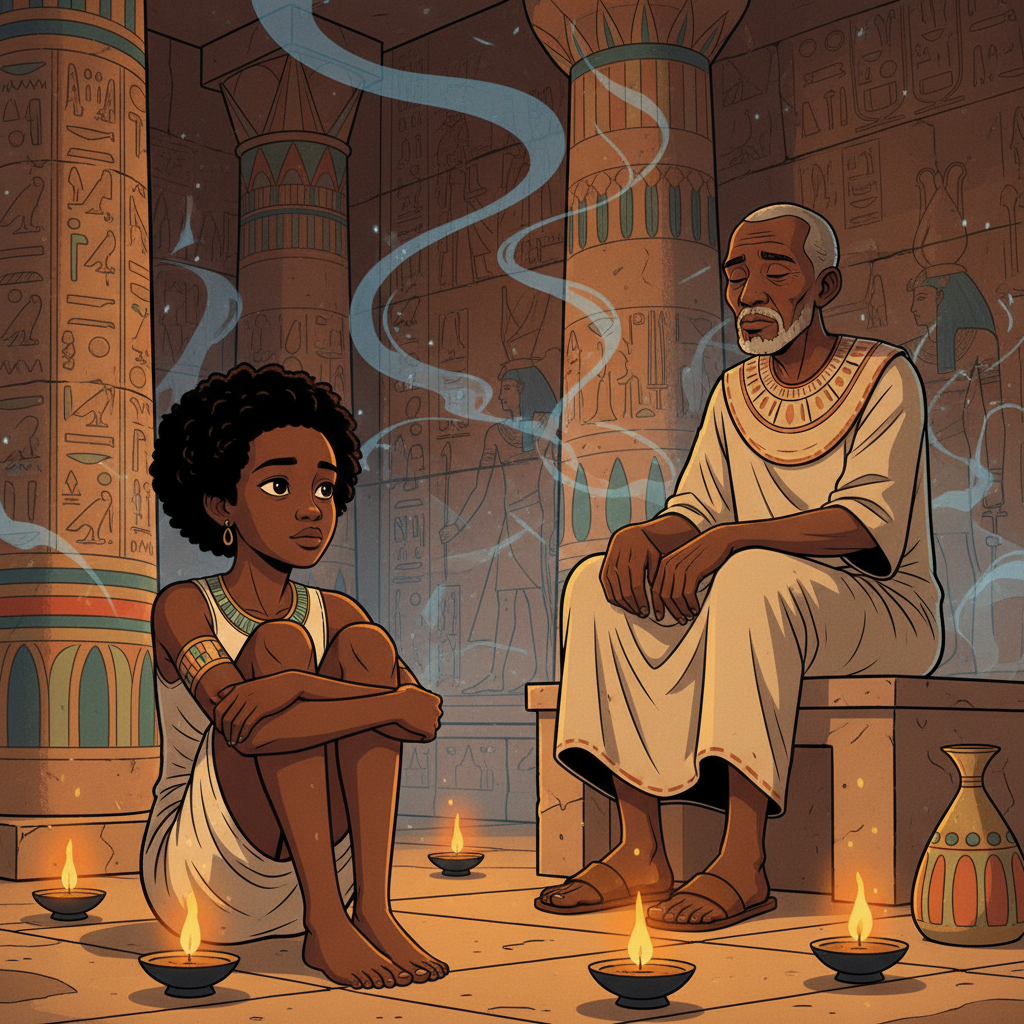
Amenirdis pulled her knees to her chest and wrapped her arms around them, her dark face illuminated by the flickering oil lamps. The incense had burned lower now, filling the chamber with a thin blue haze that made the painted figures on the wall seem to shift and breathe. "Teacher," she said, her voice smaller than before, "I understand how Isfet works through greed. But you said it also works through fear. How?" Khafre closed his eyes for a moment, and when he opened them, they held a distant sadness. "Fear is Isfet's most powerful weapon — more powerful even than greed. Let me take you back further in time, to an era when the great civilization of Kemet was threatened not by foreign armies but by fear itself. Two thousand years ago, during a period of terrible drought, the waters of Hapi fell lower than anyone could remember. The crops failed. The granaries emptied. And fear spread through the cities of the Nile valley like a plague of the spirit."
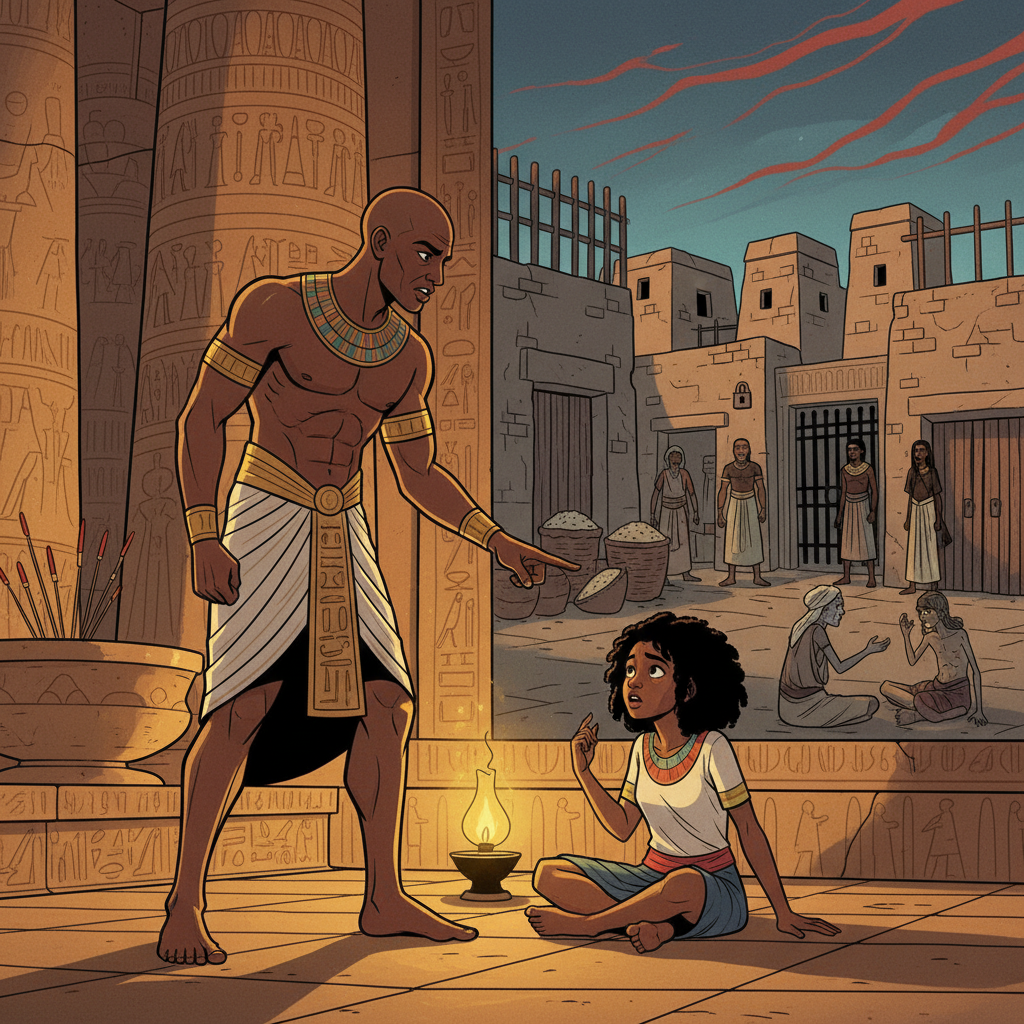
"When fear takes root in a people," Khafre said, his voice dropping to barely above a whisper, "Isfet multiplies. Neighbors who had shared bread for generations began to hoard. Farmers who had always left grain at the temple for the poor locked their stores behind mud-brick walls. The wealthy built higher fences. The powerful hired guards. And the weak — the widows, the orphans, the elderly — were left to starve in the streets of the richest civilization the world had ever known." Amenirdis shook her head slowly. "But that is exactly when they should have shared more, not less." Khafre pointed at her with a sudden intensity that made her flinch. "Yes. That is exactly right. And that is what makes fear so devastating. It inverts Maat. It takes the moment when generosity is most needed and turns it into the moment when selfishness feels most justified. Fear says: there is not enough. Fear says: protect yourself first. Fear says: trust no one. And every person who listens to that voice weakens the bonds that hold the community together."
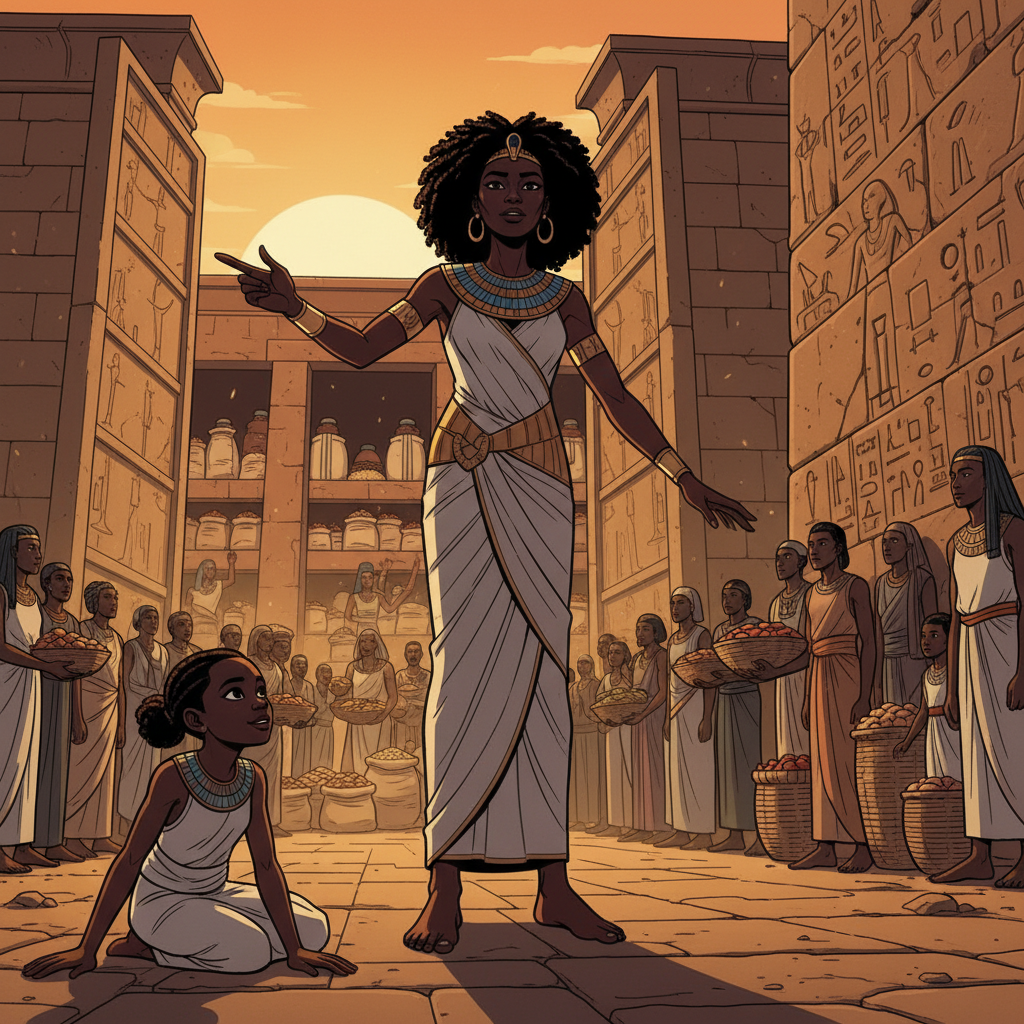
"But there were those who resisted," Khafre said, and his voice warmed again. "Even in the worst of the drought, there were priests and priestesses who opened the temple granaries. There were farmers who divided their last sacks of grain with families they barely knew. There was a woman — a priestess of Maat named Iset, whose skin was dark as polished obsidian and whose courage was harder than the granite of the temple pillars — who organized the remaining food into a common store and distributed it equally to every family, wealthy and poor alike." Amenirdis straightened. "What happened to her?" Khafre smiled. "The wealthy resisted. They said the food was theirs by right, that they had earned it, that the poor should fend for themselves. But Iset stood before the council of Waset and spoke words that have been carved into the walls of this very temple." He gestured to a section of hieroglyphs to their right, ancient and worn but still legible. "She said: When the river falls, we do not each take a piece of it home. We tend it together, or we lose it together. There is no private Maat. There is no solitary survival. We rise as one people or we fall as scattered dust."
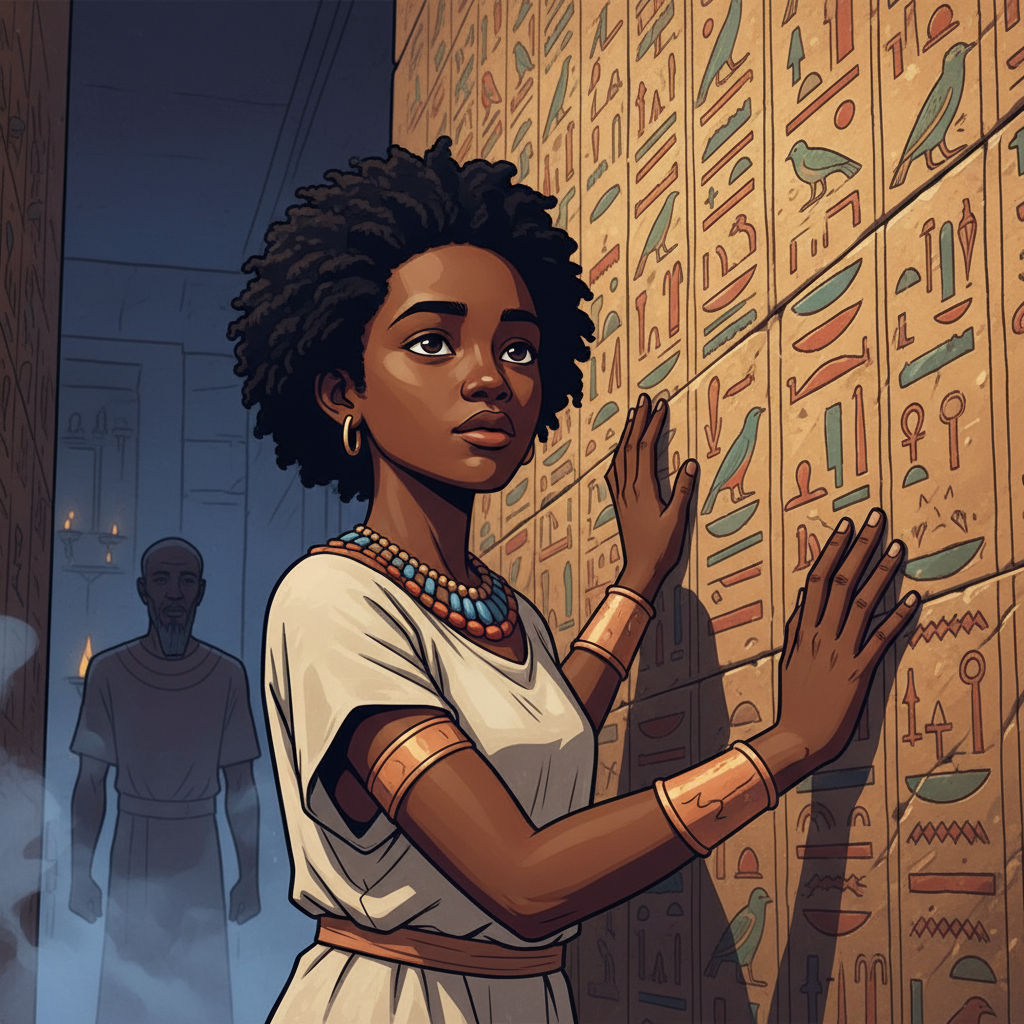
Amenirdis rose and walked to the hieroglyphs Khafre had indicated. She ran her fingers over the carved stone, feeling the grooves left by a chisel held in hands that had lived and died thousands of years before she was born. The words were real. The stone was real. This was not a myth or a fable — it was history, recorded by the scribes of Kemet in the most permanent medium they knew. She felt a shiver that had nothing to do with the cool night air of the sanctuary. "Teacher," she said, turning back to Khafre, "you have shown me how Isfet works through greed, and how it works through fear. But there is something I still do not understand." She sat back down on the mat, crossing her legs and leaning forward with an intensity that made Khafre raise his eyebrows. "If Maat is the natural order of the cosmos — if it is the force that holds the stars in place and brings the river each season — then why does it need us at all? Why can't Maat simply win on its own, the way the sun rises without anyone asking it to?"
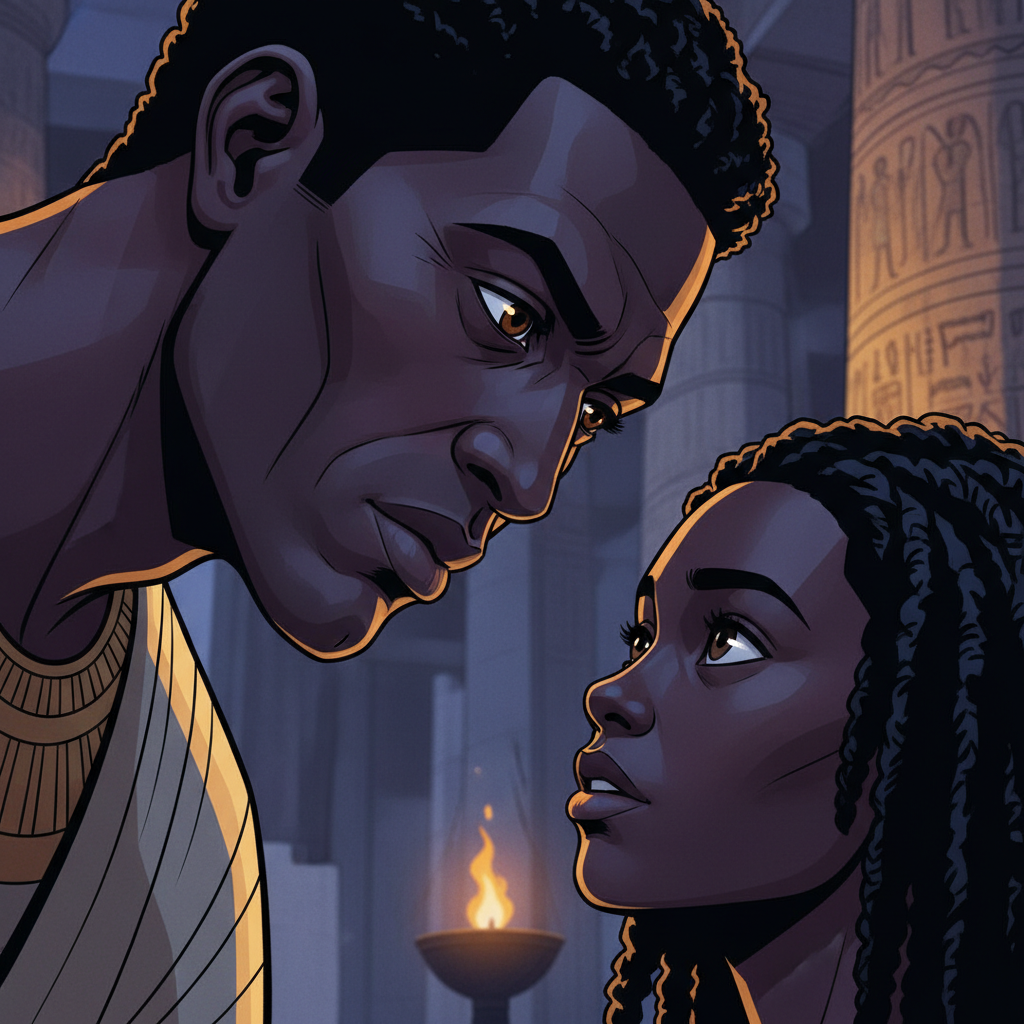
Khafre was silent for a long time. The oil lamps flickered. Somewhere deep in the temple, a night bird called and its echo traveled through the stone corridors like a whispered prayer. When the High Priest finally spoke, his voice carried the weight of a truth he had spent his entire life learning to articulate. "That, Amenirdis, is the question that separates a student from a seeker. And the answer will change everything you understand about your place in creation." He leaned forward, his deep ebony face close to hers, his eyes reflecting the twin flames of the nearest lamp. "The cosmos maintains its own Maat in the movement of the stars, in the cycle of the seasons, in the rhythm of Hapi's rising. This is true. But human beings are different from stars and rivers. We were given something no other part of creation possesses — the power of choice. And choice means the possibility of Isfet. A star cannot choose to leave its course. A river cannot choose to flow backward. But a human being can choose to lie, to steal, to hoard, to harm. That freedom is our greatest gift and our greatest danger."
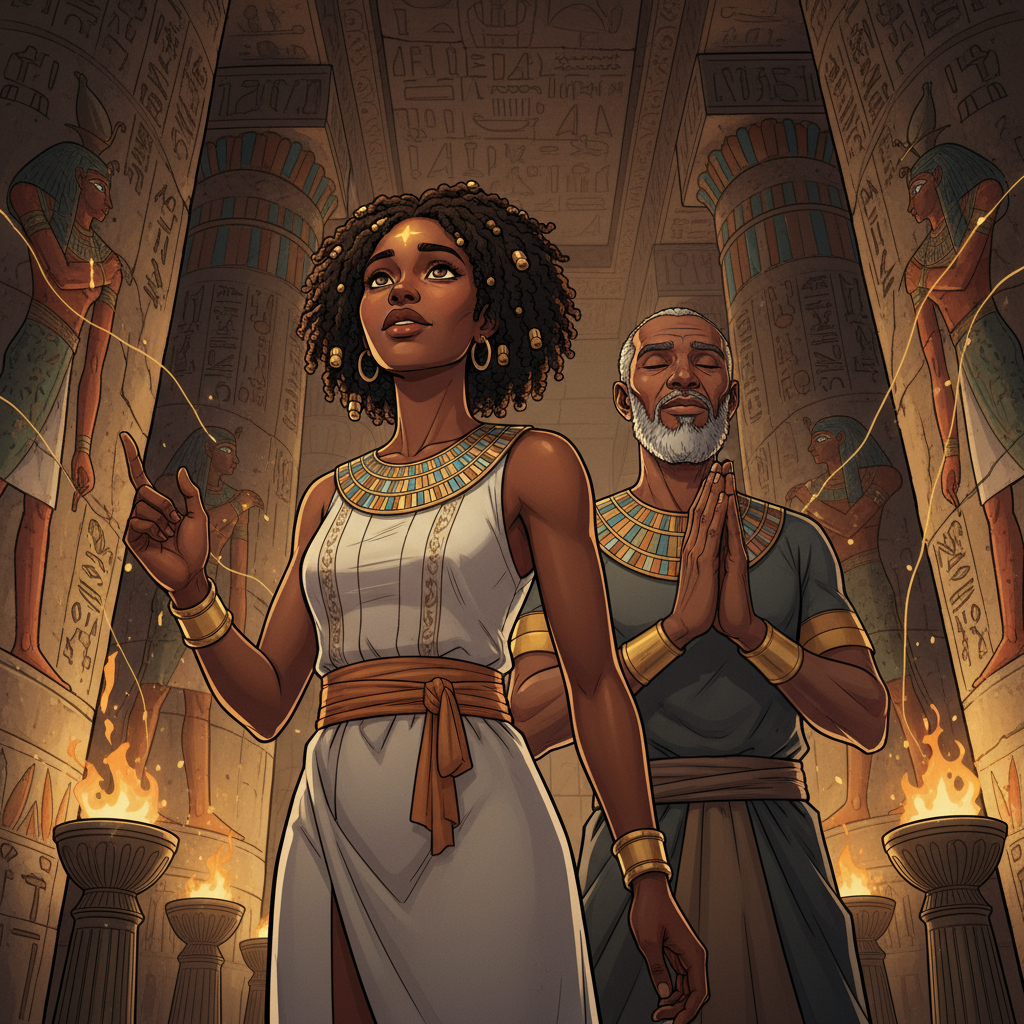
"So Maat needs us," Amenirdis said slowly, the understanding building in her mind like a structure being assembled stone by stone, "because we are the only part of creation that can break the balance — and therefore the only part that can consciously restore it." Khafre closed his eyes and pressed his palms together. "In my sixty years of teaching, I have never had a student arrive at that understanding so quickly. Yes. That is the deepest truth of the Per Ankh. The neter created a universe of perfect order, and then they created beings capable of disrupting that order — not as a mistake, but as a gift. Because chosen harmony is more powerful than forced harmony. Maat that is freely chosen by a conscious being resonates through creation in a way that the mechanical order of the stars never can." Amenirdis felt the hair on her arms stand on end. The sanctuary seemed to pulse with energy, as if the painted figures on the walls were leaning in to listen. "That is why the balance is eternal," she whispered. "Not because it never breaks — but because it must always be restored. By us. By every generation. By every single person who chooses truth over falsehood, courage over fear, generosity over greed."
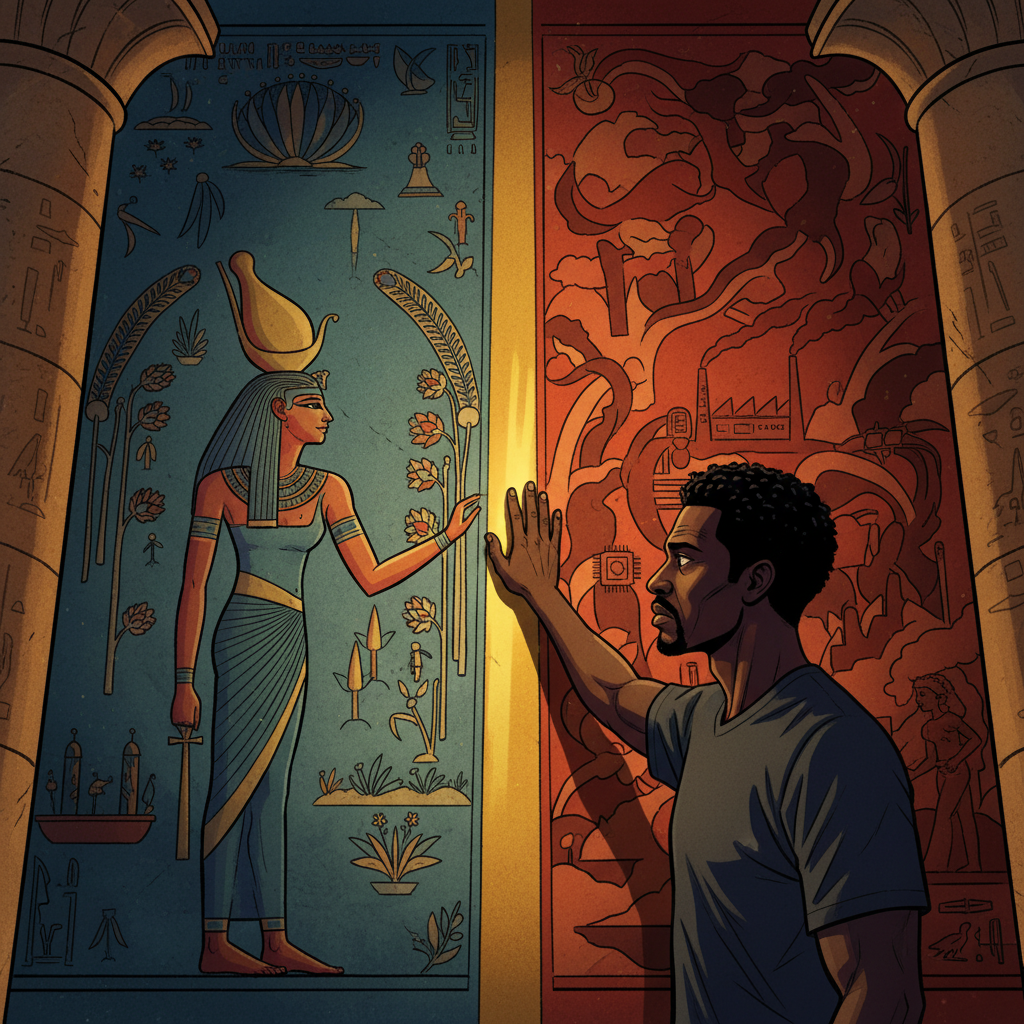
Khafre stood and walked to the painted wall, placing his palm flat against the dividing line of gold that separated Maat from Isfet. The torchlight cast his shadow across both sides simultaneously. "Now let me show you how this truth applies to the world you will inherit," he said. "Look beyond the walls of this temple, beyond the borders of Kemet, to the world as it exists right now. The modern world has achieved wonders our ancestors could not have imagined — machines that think, networks that connect every corner of the earth, medicines that cure diseases that once killed thousands." He turned to face her, and his expression was troubled. "But these achievements have been built on a foundation of Isfet so deep that most people cannot even see it. The same networks that connect people are used to spread lies faster than truth can travel. The same medicines that save lives are hoarded by the wealthy while the poor die of curable diseases. The machines that think are fed by minerals torn from the earth by children in lands whose names the comfortable world does not bother to learn. This is Isfet wearing the mask of progress."
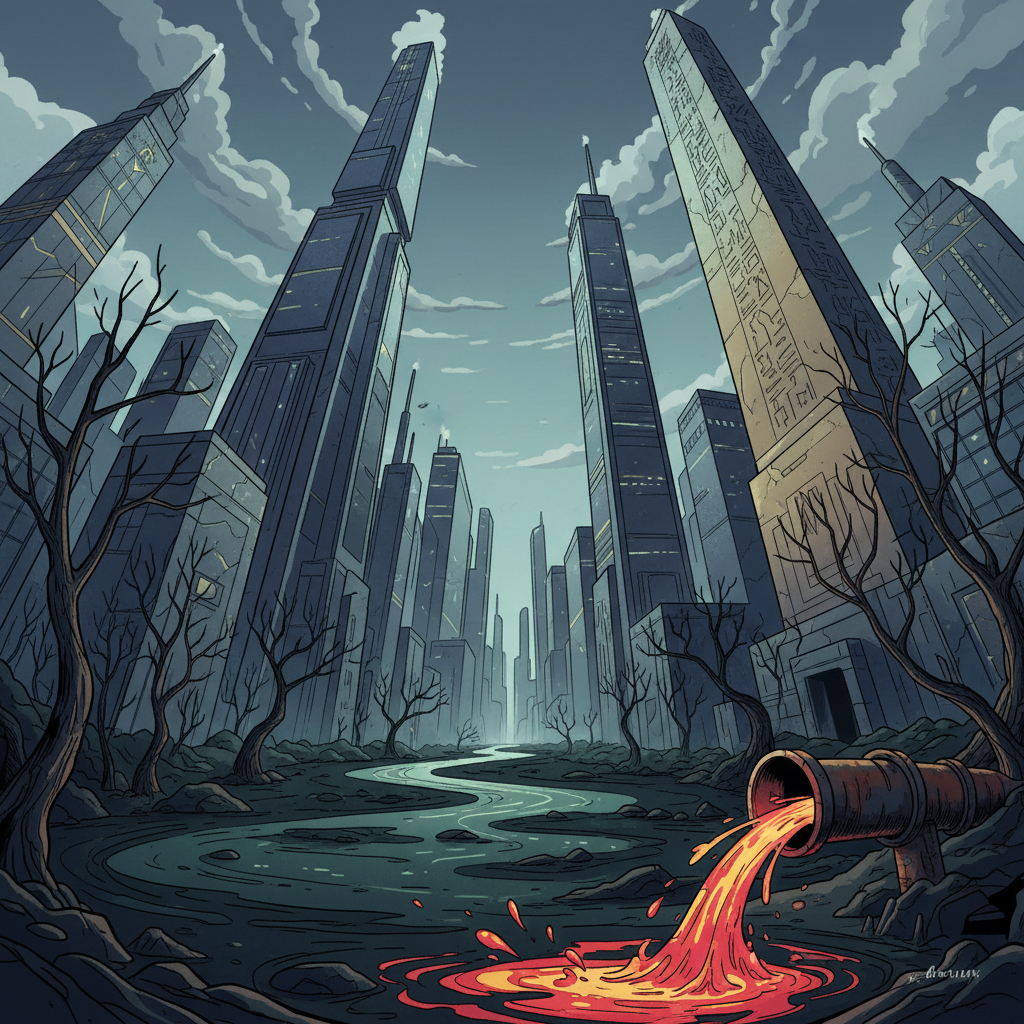
"Technology is not Maat or Isfet in itself," Khafre said, sitting back down across from her. "A tool has no morality. A reed pen can write truth or forge a lie. What matters is the intention behind the hand that holds it. The modern world has built towers that scrape the sky, but it has poisoned the rivers that flow beneath them. It has created systems that can feed every person alive, yet millions starve because feeding them is not profitable. It has mapped the human body down to its smallest particles, yet it cannot cure the sickness of a society that values wealth above justice." Amenirdis thought of something she had discussed with other students at the Per Ankh — how the great library of knowledge that once existed in physical scrolls now existed in invisible networks, accessible to anyone with the right tools, yet controlled by a handful of powerful entities who decided what was seen and what was hidden. "Isfet is in the hiding," she said suddenly. "When knowledge exists but is kept from those who need it — that is Isfet." Khafre nodded emphatically. "The scribes of Kemet believed that knowledge was sacred precisely because it belonged to everyone. To hoard knowledge was as great a crime as hoarding grain during a famine."
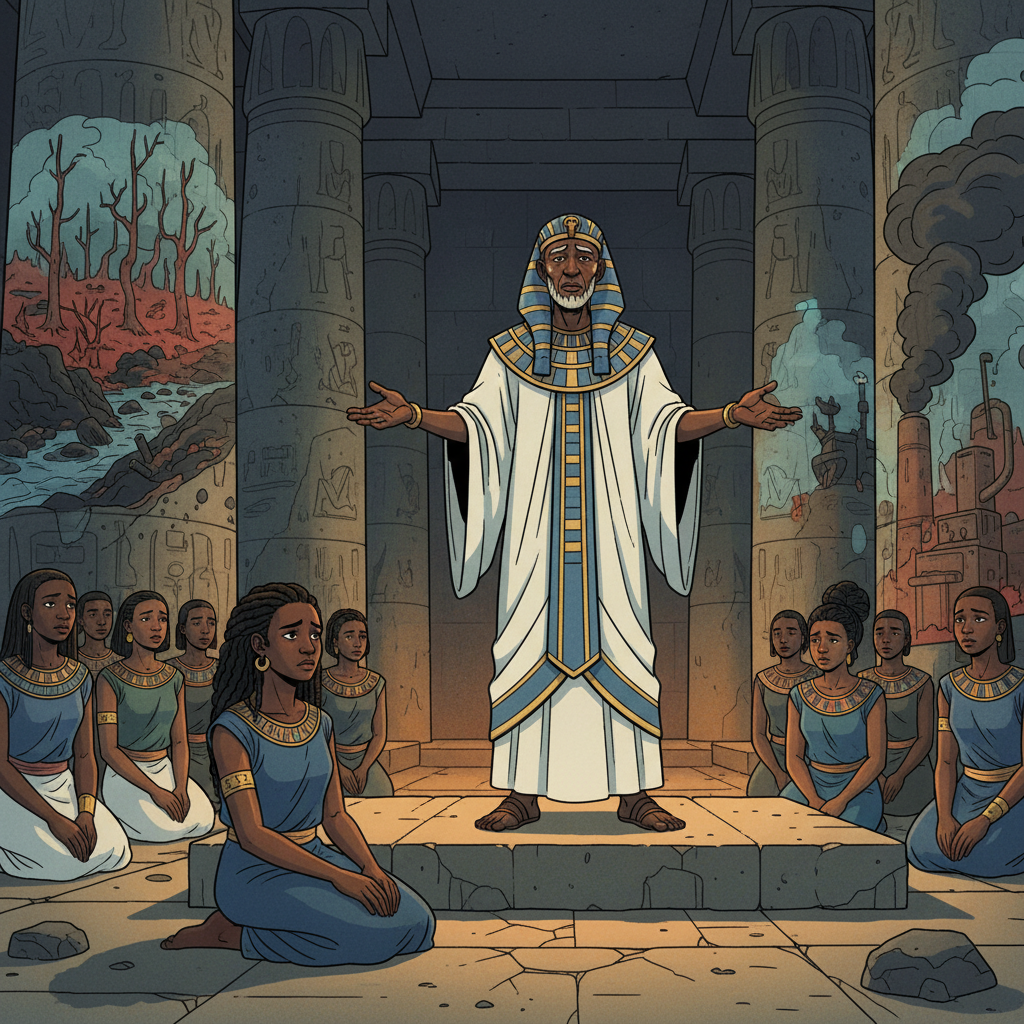
"The earth itself is crying out," Khafre said, and his voice carried a grief so deep it seemed to resonate with the stone walls of the sanctuary. "Our ancestors lived on this land for thousands of years without destroying it. They took what they needed from Hapi and returned what they could. They understood that the soil, the water, the air — these were not resources to be consumed but living systems to be maintained. The forty-two declarations of Maat include the promise: I have not polluted the water. I have not made the land barren. These were not suggestions — they were sacred law, as binding as any commandment against theft or murder." Amenirdis thought of the rivers she had read about in the scrolls of modern geography that the Per Ankh kept — rivers choked with waste, forests burned to make way for plantations that fed no one in the lands where they grew, the very air warming because of gases released by machines that served the comfort of the few at the expense of the many. "This is the largest Isfet of all," she said quietly. "Because it does not just harm one person or one community. It harms every living thing on earth, and every generation that will come after us." Khafre looked at her with an expression that was equal parts sorrow and fierce pride.
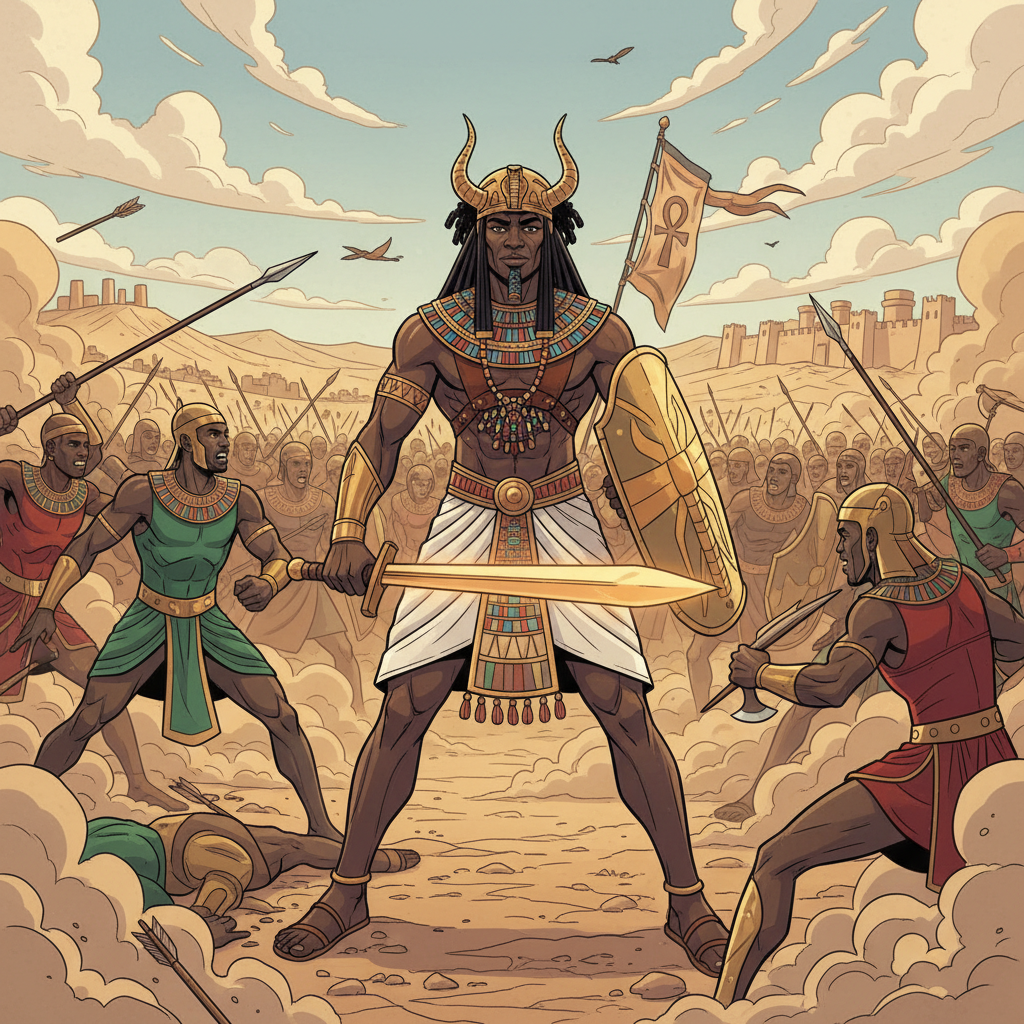
"So what do we do?" Amenirdis asked, and her voice was no longer the voice of a student asking a question for a lesson. It was the voice of a young woman confronting the weight of an unjust world and refusing to look away. "How do I fight Isfet when it is built into the very structures of the modern world — into the economies, the governments, the technologies that billions of people depend on every day?" Khafre considered her question with the seriousness it deserved. "You fight it the same way Amenhotep fought it — one choice at a time. The same way Iset fought it — by organizing, by insisting on justice even when the powerful resist. The same way Nebtawi fought it — by refusing to accept that injustice is permanent." He leaned toward her. "You are a student of the Per Ankh, Amenirdis. You are being trained in the oldest tradition of knowledge on earth. You will leave this place not just with facts in your head but with Maat in your ka. And wherever you go, whatever you do, you will carry this tradition with you like a flame that Isfet cannot extinguish — unless you choose to let it die."
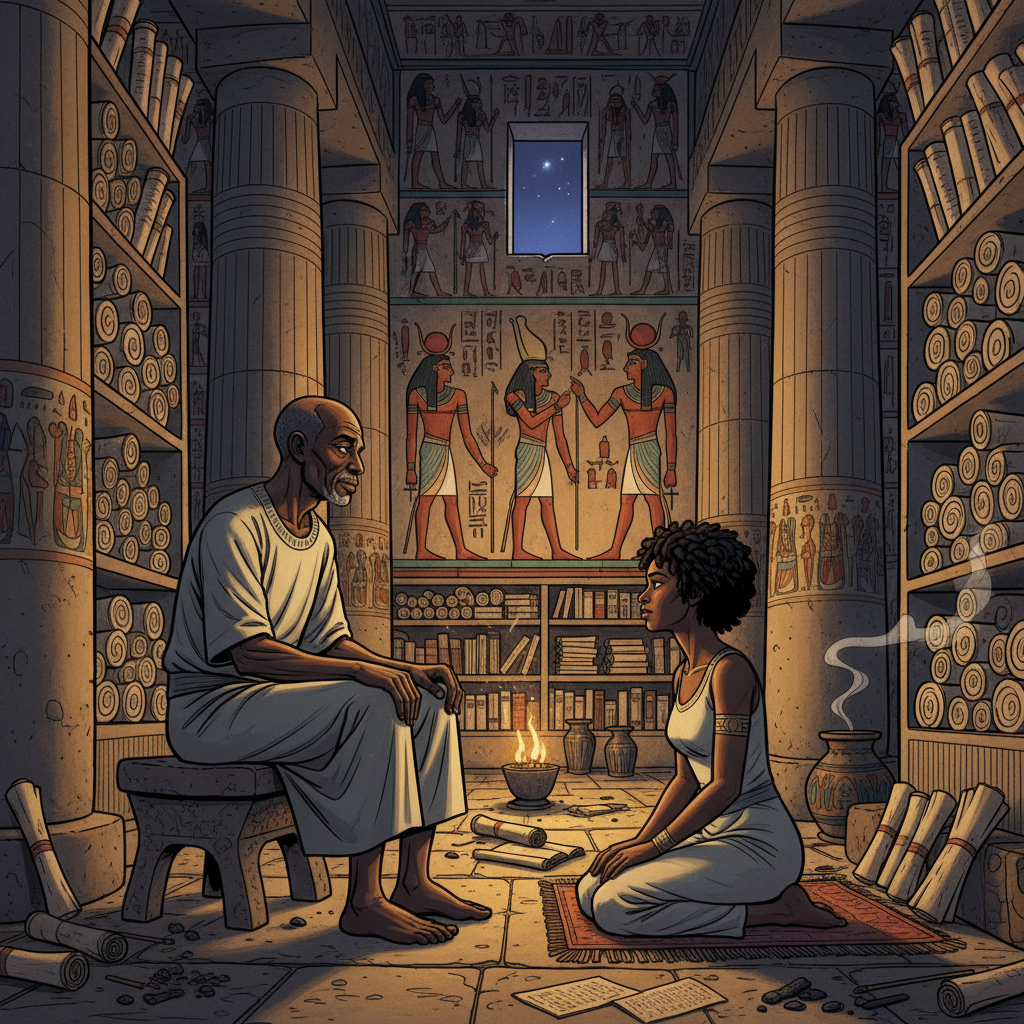
The stars had shifted in the rectangle of sky visible through the sanctuary's narrow window. Hours had passed, though to Amenirdis it felt like minutes. The oil lamps had burned low, their flames reduced to small golden points in the darkness. The incense had gone out entirely, leaving only its ghost — a faint sweetness clinging to the stone walls and to their clothes. Khafre looked older in this dim light, the lines of his ebony face deeper, but his eyes were still bright with the urgency of everything he had shared. "Before you leave this chamber tonight," he said, "I want to hear you speak. Not a vague promise. Not a comfortable platitude. I want to hear you name a specific way that you, Amenirdis of Waset, student of the Per Ankh, will carry Maat into the world. The ancestors are listening. The neter are watching. The painted figures on these walls have heard a thousand such pledges over the centuries. Make yours worthy of their company."
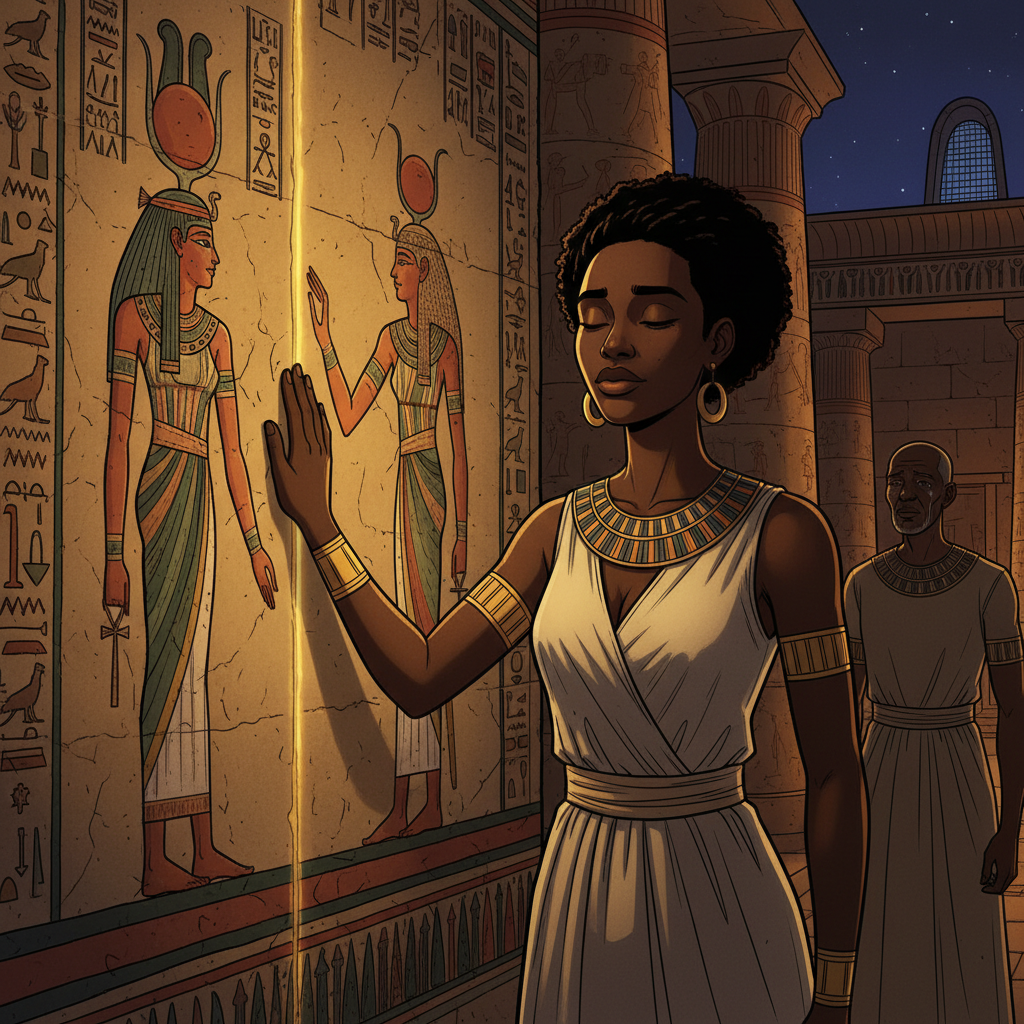
Amenirdis stood. She placed her right hand against the painted wall, her dark palm pressing flat against the golden dividing line between Maat and Isfet, just as Khafre had done. She could feel the cool stone and, beneath it, something older — the residue of every hand that had touched this wall across millennia, every student who had stood where she stood and felt the same fire building in their chest. She took a deep breath and spoke with a steadiness that surprised even her. "I pledge to become a scribe of Maat — not just a copier of texts, but a seeker and speaker of truth. I will use the knowledge of the Per Ankh to teach those who have been denied education. I will speak against injustice when I see it, even when my voice shakes, even when those with power tell me to be silent. I will protect the waters and the land as our ancestors commanded. I will remember that every choice I make feeds Maat or Isfet, and I will choose Maat — not once, not as a single grand gesture, but every morning when I rise, every evening when I lay down, in every small and ordinary moment where the balance hangs on what one person decides to do." Khafre rose to his feet, and in the dim golden light of the dying lamps, Amenirdis saw that the old priest's eyes were wet. "The ancestors hear you," he said. "Now go and make it so."