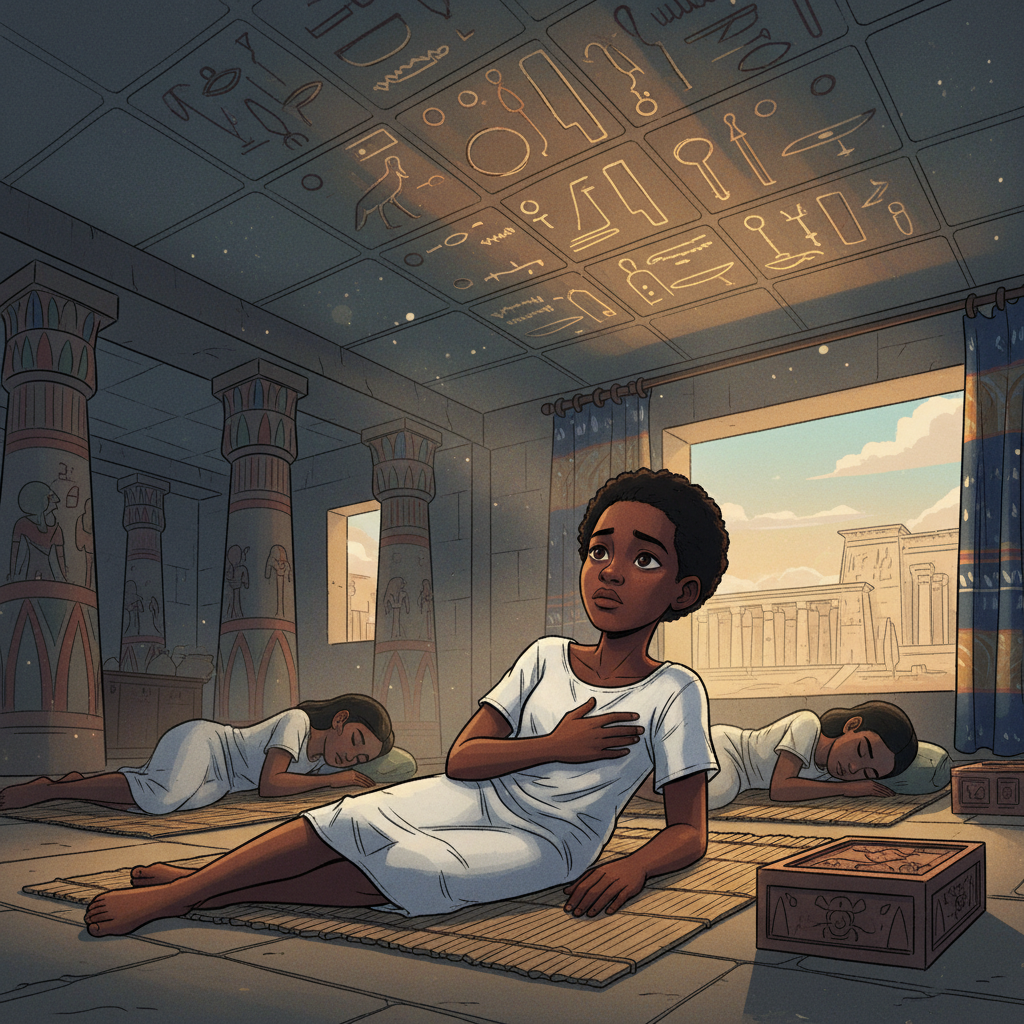
The morning sun had barely crested the eastern hills of Waset when Sia woke with her heart already drumming against her ribs. She lay on her reed mat, staring at the ceiling of the students' quarters in the Per Ankh, watching the first pale light trace the carved hieroglyphs above her bed. Today was her day of judgment — the day every student faced when they reached their thirteenth year. She pressed her palm flat against her chest, feeling the rapid pulse of her ka, that inner spirit-force her teachers said connected her to every living thing. Her deep ebony skin was still warm from sleep, and she could smell the night's last incense — kyphi, the sacred blend — lingering in the linen curtains. She whispered to herself the words her mother had spoken when she first brought her to the temple school three years ago: "The truth in your heart is older than you are, Sia. Trust it." She rose quietly so as not to wake Nefertari and Kiya, her closest companions in the Per Ankh, who slept on their mats nearby. Her hands trembled slightly as she folded her sleeping cloth and placed it in the cedar chest at the foot of her bed. Through the narrow window, she could see the great temple complex stretching out before her — limestone columns catching the dawn light, their painted surfaces glowing with images of the neteru, the divine forces that governed all things. Somewhere beyond those columns, past the courtyard of the scribes and the hall of sacred texts written on papyrus scrolls older than memory, stood the Hall of Two Truths. Today she would stand in that hall and speak the forty-two declarations of Maat before the golden scale. Today she would learn the weight of her own heart.
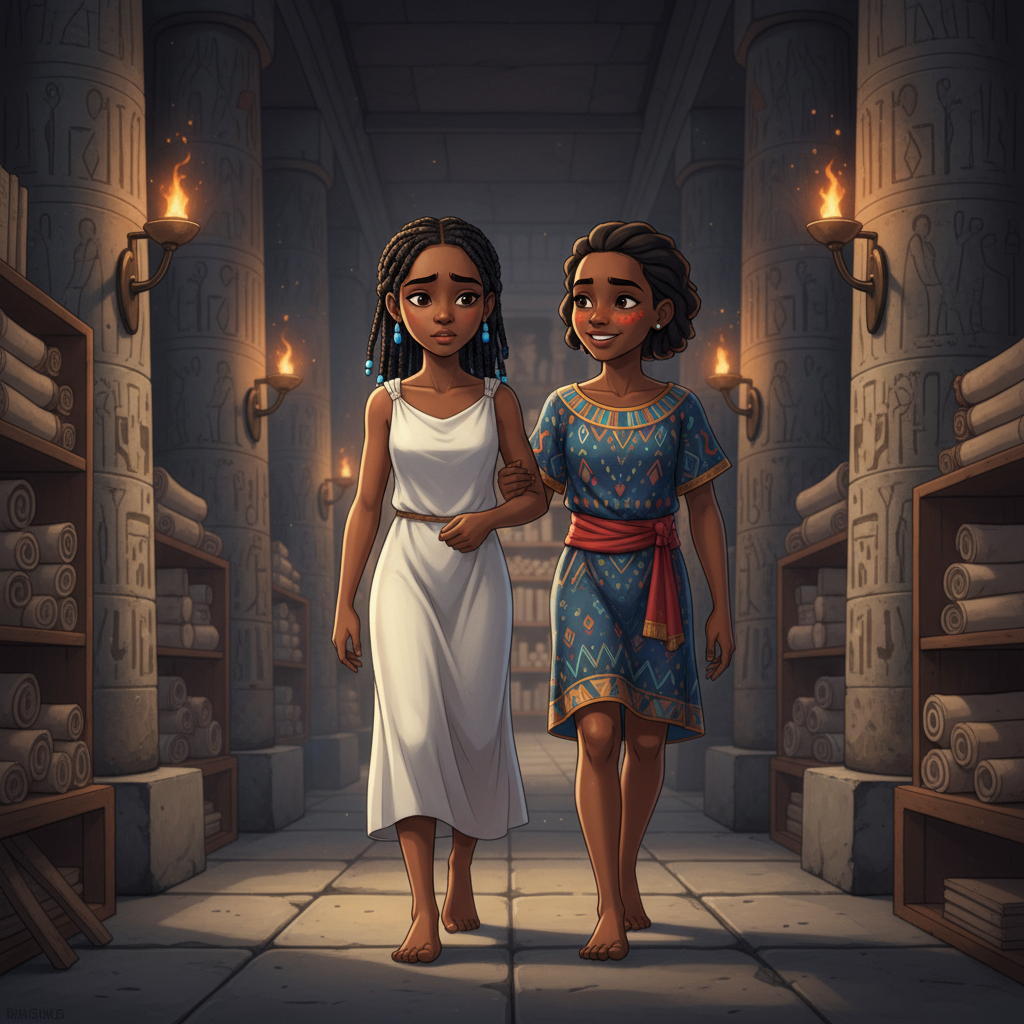
Sia dressed carefully in the white linen sheath that had been laid out for her — freshly woven, without ornament, as the ritual required. White for purity of intention, her teacher Merytaten had explained, not purity of perfection. There was a difference, Merytaten always said, and that difference was everything. Sia caught her reflection in the polished copper mirror on the wall: her rich dark skin luminous against the white fabric, her black hair freshly braided in tight rows close to her scalp, each braid ending in a small blue faience bead. Her eyes — which her grandmother called "quiet fire eyes" because they burned with thought even when Sia said nothing — stared back at her, and she saw something unfamiliar in them. Fear. She turned away from the mirror. A scribe of the Per Ankh should not be afraid of truth. But the truth, she was learning, was the most frightening thing there was. She stepped into the corridor and nearly collided with Kiya, who was leaning against the doorframe with her arms crossed, already dressed in her own day clothes, her deep brown skin dusted with the ochre powder she used on her cheeks. "I woke early to walk with you to the bathing pool," Kiya said, falling into step beside her. "You don't have to do that," Sia murmured. Kiya bumped her shoulder gently. "I know I don't have to. I want to. That's what Maat is, isn't it? Doing what is right because your heart chooses it, not because someone forces you." Sia almost smiled. Even now, even on this morning that felt so heavy, Kiya could find the teaching inside the moment. They walked together through the quiet corridor, their bare feet whispering against the cool stone floor, and Sia felt the first knot of tension in her chest begin — just barely — to loosen.
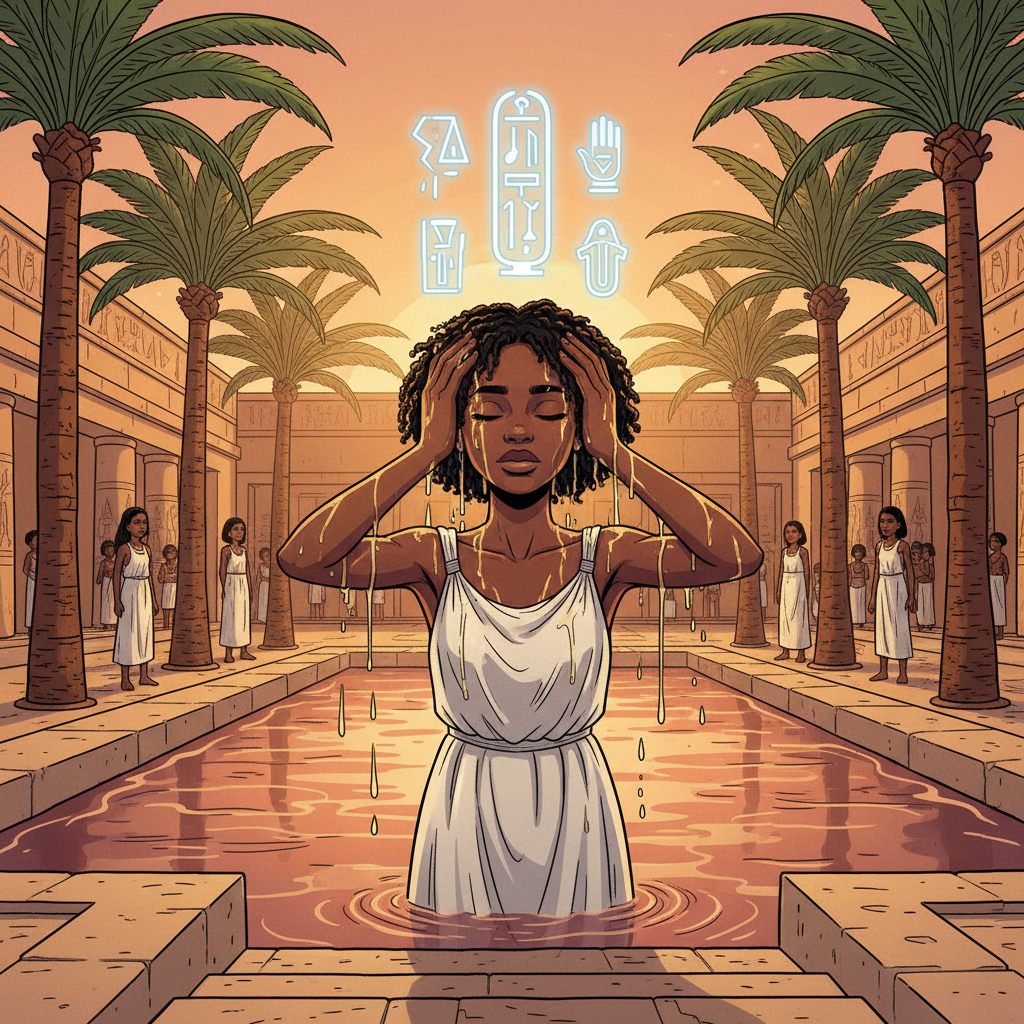
The bathing pool lay in an open courtyard surrounded by date palms, their fronds clicking softly in the morning breeze. The water was drawn fresh each day from a channel connected to the great river, and it caught the dawn sky in shades of copper and rose. Sia descended the stone steps and lowered herself into the cool water, gasping as it reached her waist. This was part of the ritual too — the cleansing. Not because the body was dirty, but because water reminded you of beginnings. In the old stories of Kemet, all of creation had emerged from the primordial waters of Nun, and every morning when you washed, you were re-enacting that first emergence. You were being born again into the day, fresh and unfinished. Sia cupped water in her hands and poured it over her head, feeling it stream down her dark skin in rivulets that caught the light like liquid bronze. As she bathed, she let her mind move through the forty-two declarations she had memorized over the past year. Forty-two statements of moral truth — not commandments given from above, but affirmations spoken from within. "I have not committed isfet." "I have not stolen." "I have not caused pain." "I have not told lies." Each one was a mirror held up to your life, and you had to look into it honestly. Her teachers had explained that in the ancient tradition, the dead spoke these declarations before forty-two divine assessors in the afterlife. But here in the Per Ankh, the living spoke them too, because the judgment of Maat was not something that happened after death. It happened every single day, in every choice you made, in every word you spoke, in the silence between your thoughts where your true character lived.
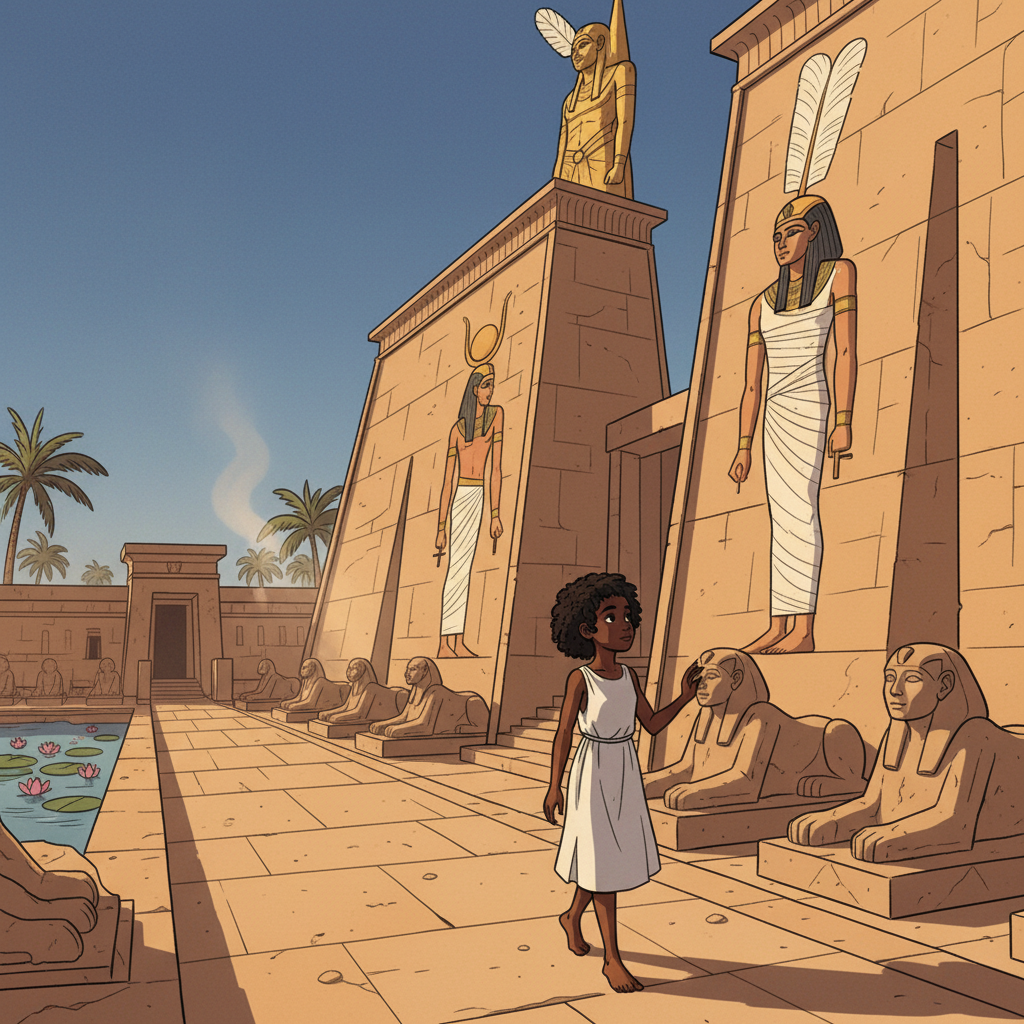
Sia dressed again in her white linen and walked alone toward the main temple complex. Kiya had embraced her at the edge of the courtyard and whispered, "Your heart is good, Sia. The feather will know it." Now the path stretched before her — a long avenue lined with small sphinx statues, their faces worn smooth by centuries of wind and touch. The morning air was warm and still, carrying the scent of lotus blossoms from the sacred lake and the faint sweetness of bread baking in the temple kitchens. Sia's bare feet met the sand-dusted stone path, and she counted her steps without meaning to, a habit she had developed as a young girl whenever she was nervous. One, two, three, four. Each step carrying her closer. The great pylons of the temple rose ahead of her, their sloping walls painted with enormous figures of the neteru — Aset with her throne-crown, Ausar wrapped in white, and towering above them all, the golden figure of Maat herself, the feather of truth rising from her brow. Sia paused at the base of the pylons and looked up. She had seen these images a thousand times — had even helped repaint a section of Djehuti's ibis-head during last year's restoration work — but today they seemed different. Larger. More present. As if the neteru painted on the walls were watching her approach with ancient, knowing eyes. She placed her hand on the warm stone of the pylon and felt its solidity, its permanence. This temple had stood for generations beyond counting. Students had walked this same path before her — thousands of them, each carrying their own fears, their own secret shames, their own desperate hope that they were good enough. She was not the first to tremble on this morning, and she would not be the last. That thought, strangely, gave her courage. She was part of something larger than herself. She dropped her hand from the stone and walked through the great gateway.
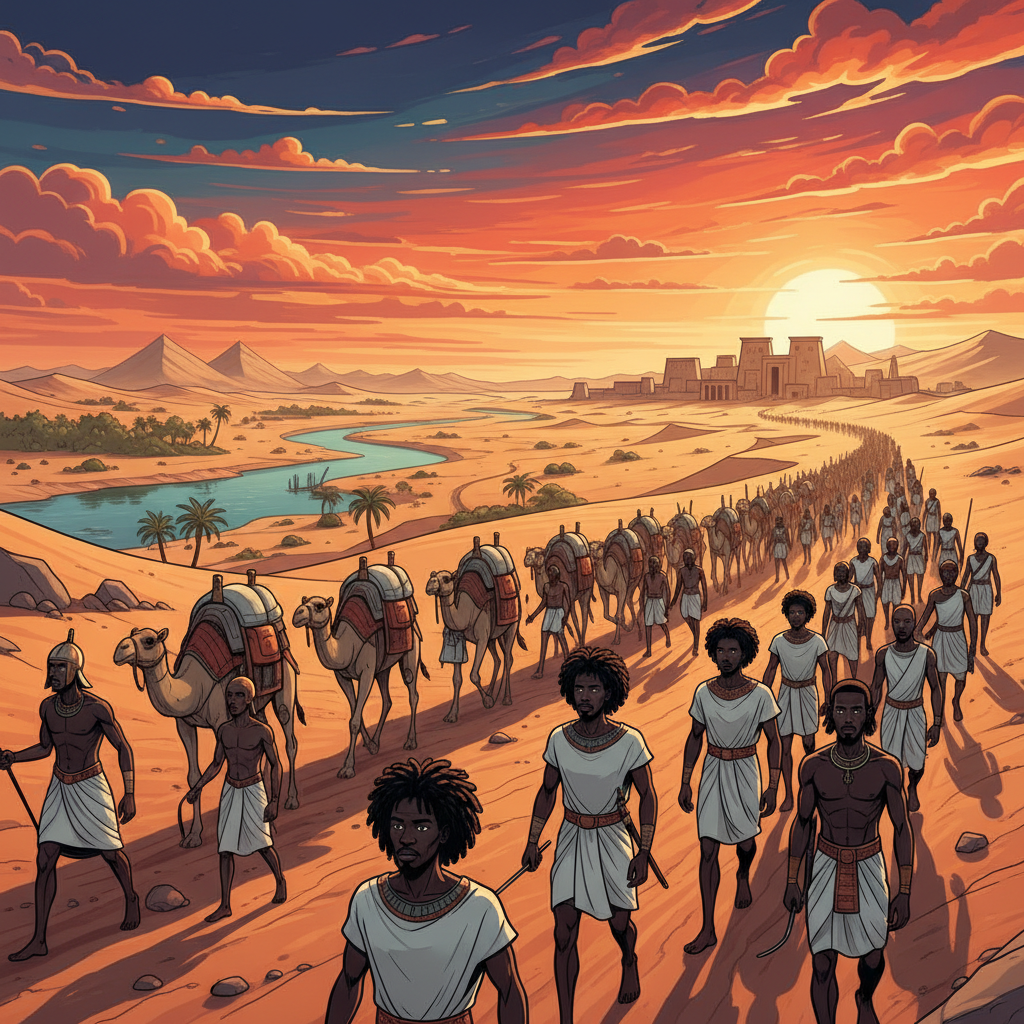
The interior of the temple was a different world. Outside, the sun blazed and the air shimmered with heat, but here the light was filtered through high clerestory windows into soft golden beams that fell like pillars of illumination between the massive stone columns. The columns themselves were carved to resemble bundled papyrus stalks, their capitals blooming into stone lotus flowers high above. Every surface was painted — rich blues and greens and reds and golds depicting scenes from the great stories of Kemet. Sia walked slowly, letting her eyes adjust, feeling the temperature drop as she moved deeper into the temple's heart. The air smelled of frankincense and myrrh, layered over the ancient stone-scent that never fully left these halls, a smell like time itself made solid. Her sandals — she had put them on at the temple entrance as custom required — made soft sounds against the polished floor. She passed through the first hypostyle hall, where scribes normally sat at their low desks copying sacred texts onto fresh papyrus, but today the desks were empty. The entire Per Ankh had been given notice that a student would undergo the weighing, and all regular work was suspended until the ceremony concluded. Sia felt the weight of that — all those scribes, all those teachers, pausing their work because of her. Not because she was special, she reminded herself, but because the ceremony itself was sacred. Every student's journey toward truth mattered enough to stop the world for. She squared her shoulders and passed through the second doorway, moving from the outer temple into the inner sanctum where the light grew dimmer and the incense grew thicker and the ordinary world fell away.
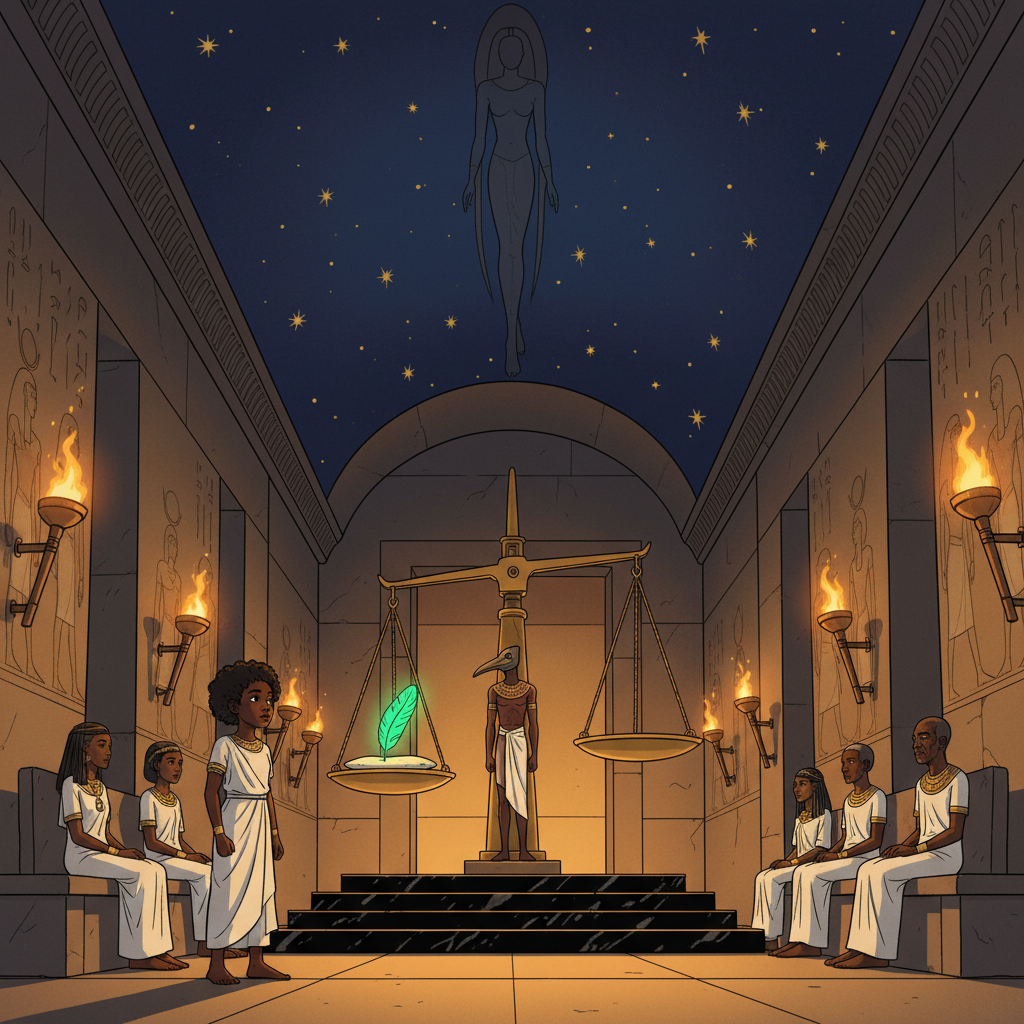
The Hall of Two Truths opened before her like the interior of a great stone heart. It was not the largest room in the temple — that was the main hypostyle hall — but it was the most beautiful, and the most solemn. The ceiling was painted as the body of the sky goddess Nut, her deep blue form arching overhead, scattered with golden stars. The walls bore images of the forty-two divine assessors, each one different, each one representing a nome of Kemet and a specific aspect of moral law. Torches burned in bronze brackets along the walls, their flames steady in the still air, casting warm light that made the painted figures seem to breathe and shift. At the far end of the hall, elevated on a raised platform of black granite, stood the golden scale — two perfectly balanced pans suspended from a central beam, gleaming in the firelight. And in the left pan, resting on a cushion of white linen, lay the feather of Maat. It was green — the deep, living green of the papyrus marshes — and it seemed to glow with its own inner light. Sia stopped just inside the doorway and drew a slow breath. She was not alone. On either side of the hall, seated on low stone benches, were the priests and priestesses who served as witnesses. She recognized most of them — Merytaten, her primary teacher, whose rich dark brown skin was set off by her white robes and the golden ankh pendant at her throat; old Kagemni, the keeper of the sacred library, whose deep ebony face was lined with decades of wisdom; and several others who had taught her over her three years at the Per Ankh. At the foot of the scale's platform stood the priest she had been told would guide the ceremony — a tall, thin man with skin the deep color of river soil after the flood, wearing the curved ibis-mask of Djehuti upon his head. He was the voice of the neter of wisdom today. Sia's heart beat so hard she was certain everyone in the hall could hear it.
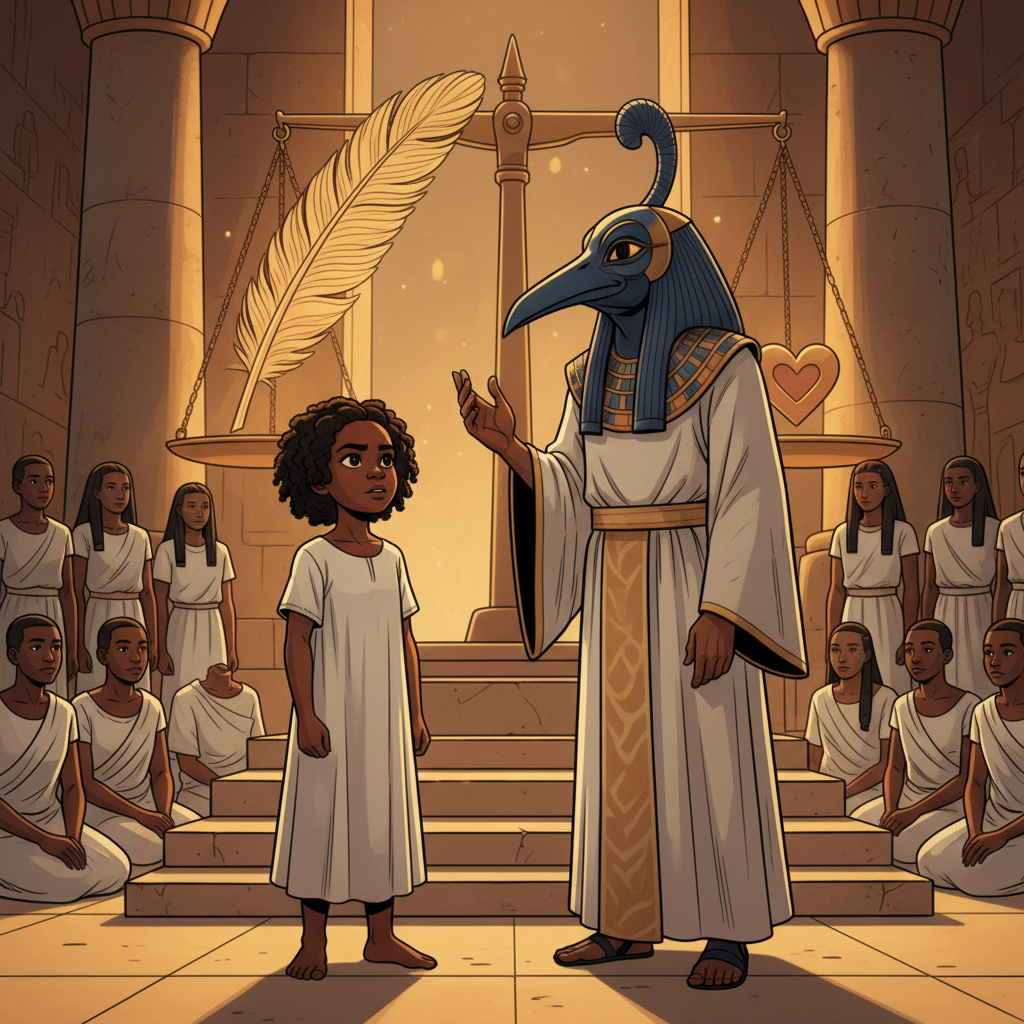
The priest of Djehuti raised one hand, and the soft murmur of the witnesses fell silent. His voice, when it came from behind the ibis-mask, was resonant and unhurried, filling the hall the way water fills a vessel — completely, without force. "Sia, daughter of Amenhotep and Takhaet, student of the Per Ankh at Waset, you come before the scale of Maat in your thirteenth year," he said. "Do you come of your own will?" Sia opened her mouth to answer, but her voice caught. She swallowed, steadied herself, and spoke. "I come of my own will." The words echoed faintly off the stone walls. "Do you understand what is asked of you?" the priest continued. "You will speak the forty-two declarations of Maat. Not as performance. Not as recitation. But as truth — as an honest accounting of how you have lived." Sia nodded. "I understand." The priest descended two steps from the platform and stood before her, close enough that she could see his eyes through the openings in the ibis-mask — dark, warm, steady eyes that held no judgment. "Then let me ask you something before we begin," he said quietly, his voice now meant only for her. "Why do you think we call this the Hall of Two Truths? Not the Hall of One Truth, but Two?" Sia had studied this. "Because there are two aspects of truth," she said. "What is true in the world, and what is true in the heart. Maat lives in both." The priest was silent for a moment, and she thought she saw his eyes crinkle slightly, as if he were smiling behind the mask. "Good," he said. "Then you understand that this ceremony is not about catching you in a lie. It is about helping you see yourself clearly. Are you ready to see yourself clearly, Sia?" Her mouth was dry. "I am ready," she said, though she was not entirely sure it was true.
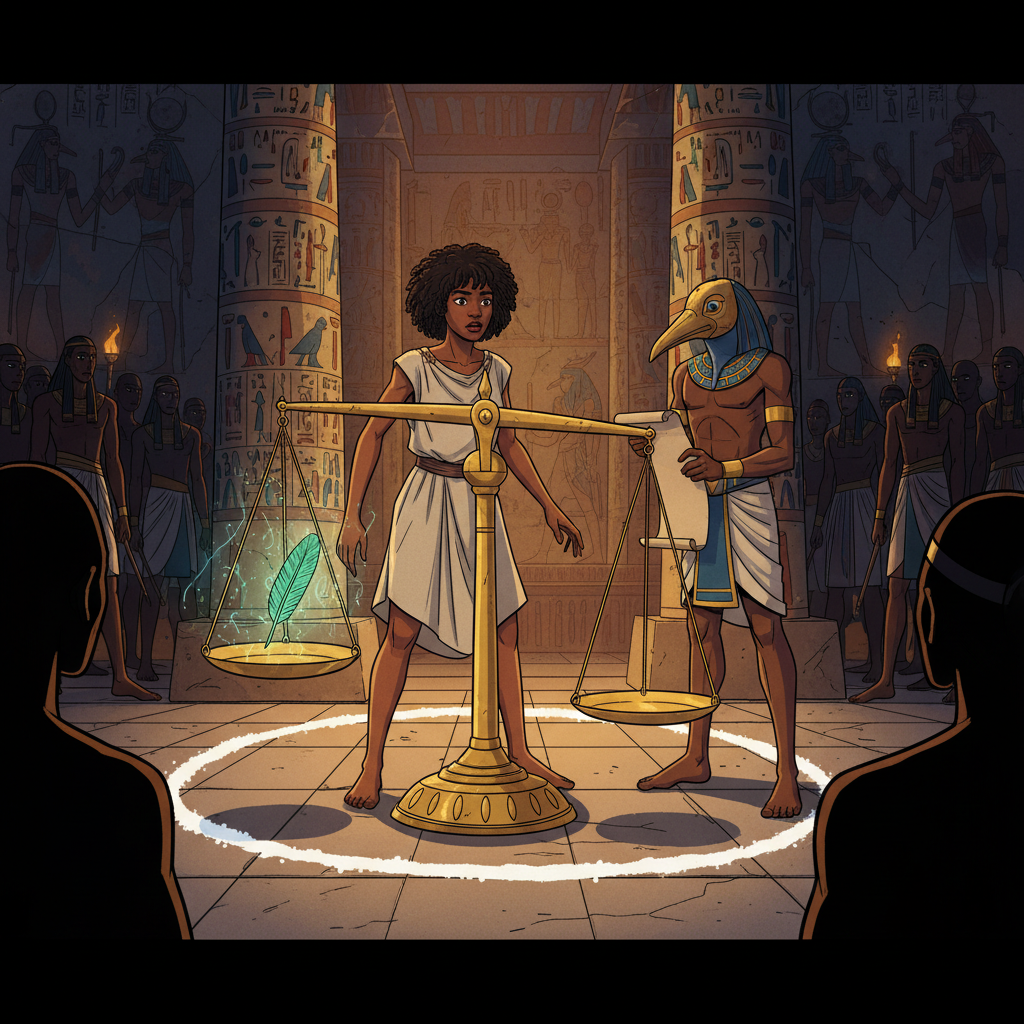
The priest of Djehuti led her to the center of the hall, where a circle had been drawn on the stone floor in powdered white chalk — the circle of truth, within which the declarations were spoken. Sia stepped into it and felt a strange shift, as though the air inside the circle were thicker, more charged, humming with invisible energy. The torchlight seemed to brighten. The painted assessors on the walls seemed to lean closer. She faced the golden scale with the green feather, and the priest stood to her right, holding a long papyrus scroll — the list of the forty-two declarations, though Sia had memorized them all and would not need to read. "We begin," the priest said, "with the declarations concerning truth and deception. These are the foundations upon which all other aspects of Maat are built. For if you cannot be honest — with others and with yourself — then no other virtue can stand." Sia drew a breath that filled her lungs completely and began. "I have not committed isfet," she said, her voice stronger than she expected. Isfet — the opposite of Maat, the force of chaos, injustice, and destruction. This was the broadest declaration, encompassing all the others, and speaking it first was like drawing a line in the sand. I stand on the side of order, truth, and justice. "I have not told lies." Here she paused, searching her memory honestly. Had she told lies? Small ones, perhaps — telling Kiya her new hairstyle looked wonderful when really Sia thought it was a bit lopsided. Telling her mother in her last letter home that she was sleeping well, when truthfully she had been staying up late studying. Were those lies? Or were they kindnesses? She felt a flicker of uncertainty, and the feather on the scale seemed to tremble.
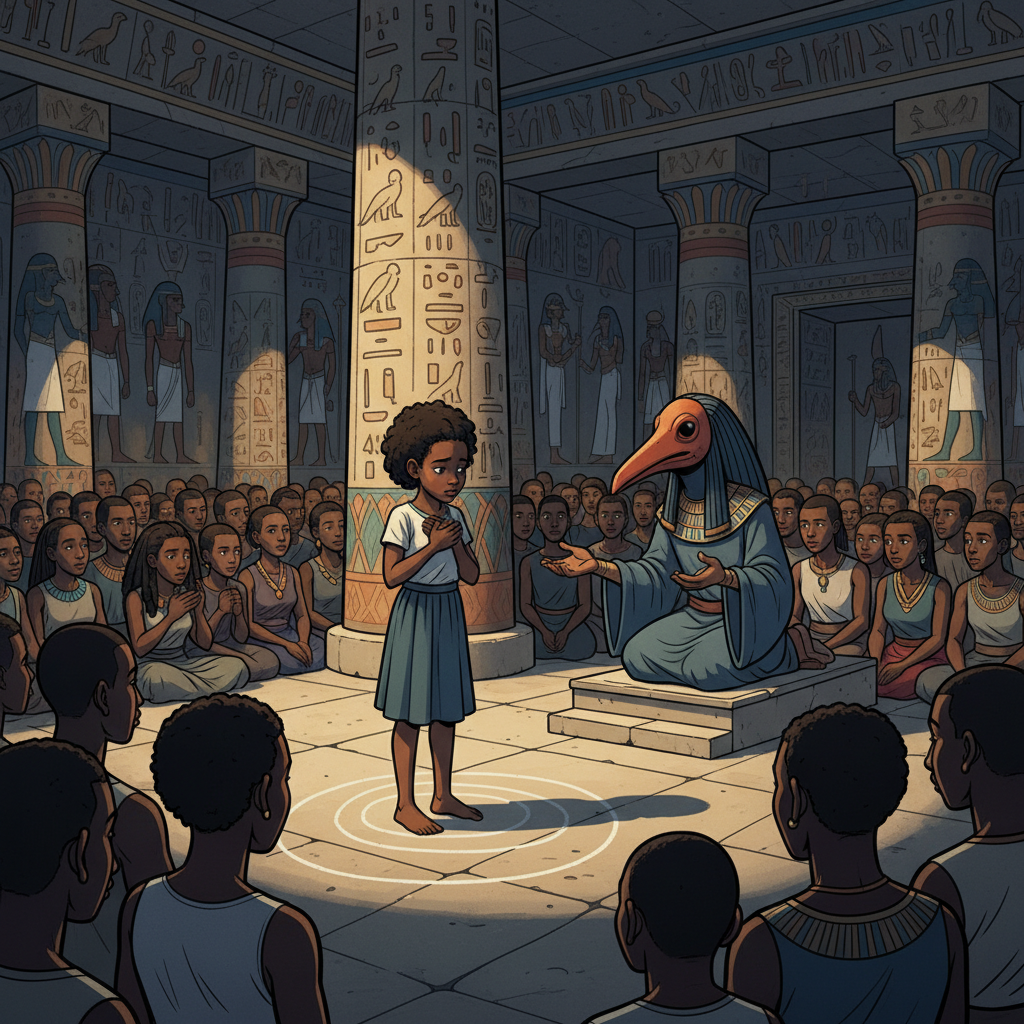
The priest of Djehuti noticed her hesitation. He did not rush her. Instead, he asked, "What troubles you, Sia?" She considered pretending nothing was wrong — but that itself would be a lie, spoken in the very moment she was declaring her honesty. "I have told small untruths," she admitted, her voice dropping. "Not to harm anyone, but to spare feelings. To make things easier. I told my friend her braids looked good when I didn't think so. I told my mother I was fine when I was struggling." The priest tilted the ibis-mask slightly, a gesture that seemed almost birdlike. "And do you think Maat demands that you wound others with harsh truths? That you burden your mother with worry she cannot ease from a distance?" Sia frowned. "I don't know. The declaration says I have not told lies." "Consider this," the priest said, and his voice carried the patient tone of someone who had guided many students through this same struggle. "A lie told to deceive and a kindness wrapped in gentle words are not the same fruit, even if they grow on branches that look alike. Maat is not a rigid cage — it is a living river. The question is not whether you have been perfectly literal in every word you have ever spoken. The question is whether deception lives in your heart as a habit, as a tool you use to manipulate others for your own benefit. Search your heart, Sia. Is that who you are?" Sia closed her eyes and searched. She saw herself clearly — a girl who sometimes softened the truth, yes, but not one who wielded lies as weapons. Not one who deceived to gain advantage. "No," she said, opening her eyes. "That is not who I am." The priest nodded. "Then speak your declaration with confidence, and let the feather judge."
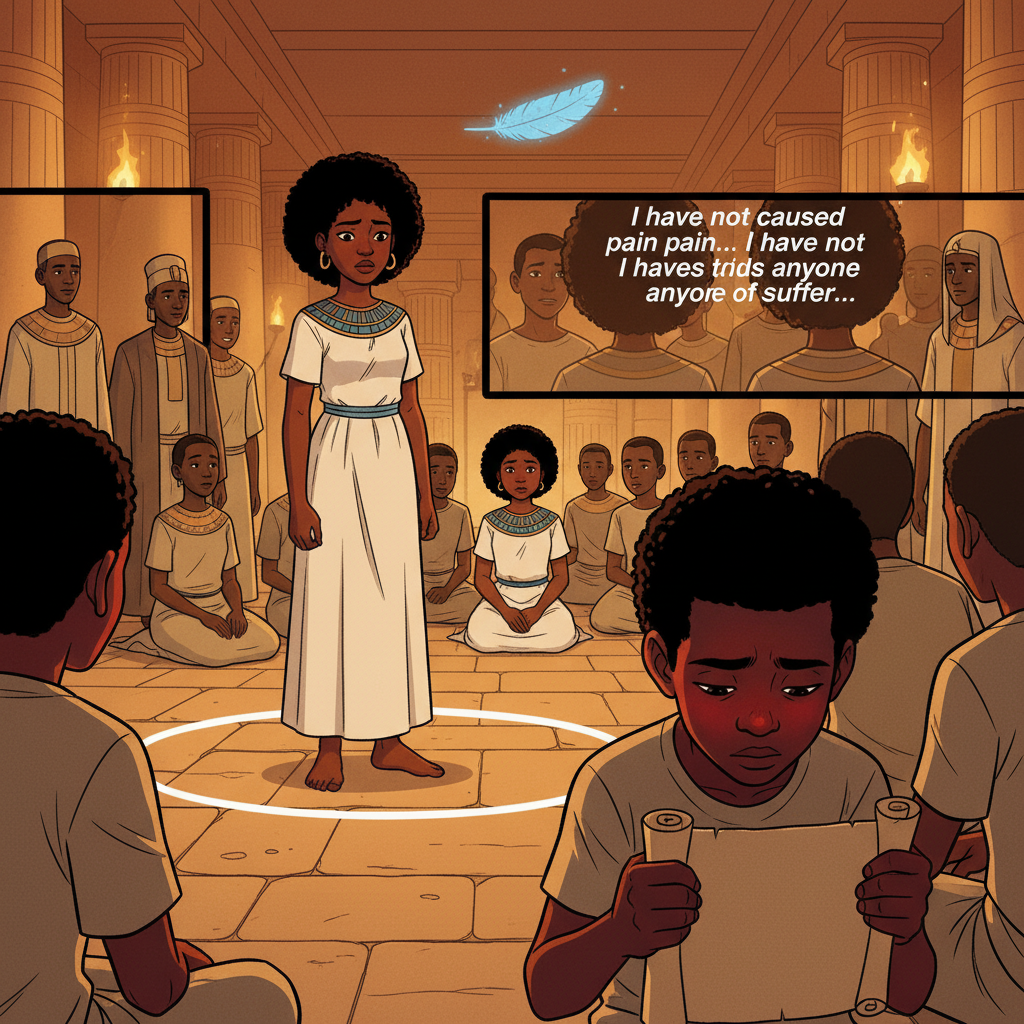
Sia continued, her voice steadying as she moved through the next group of declarations — those concerning harm and violence. "I have not caused pain," she said. "I have not caused anyone to suffer. I have not committed acts of violence." These words resonated through the torchlit hall, and Sia felt their weight settle on her shoulders like a mantle. She thought of the world beyond the Per Ankh — the world of Kemet with its bustling markets, its farming villages along the great river, its children playing in dusty streets. She thought of how easy it was to cause pain without meaning to. A careless word. A dismissive glance. Ignoring someone who needed to be seen. Pain was not only the bruise on the skin; it was the bruise on the ka, the invisible wound that could ache for years after the moment that caused it had been forgotten by everyone except the one who carried it. She thought of Heru, the boy in the year below her who stuttered when he was nervous. Last month, during a recitation exercise, he had stumbled over a passage and some of the students had laughed. Sia had not laughed. But she had not spoken up, either. She had sat in silence while Heru's deep brown face burned with shame, his eyes fixed on the floor, his hands clenching the edges of his papyrus scroll. Was silence in the face of someone else's pain the same as causing it? She didn't know. But the memory sat in her stomach like a stone, and she felt the feather on the scale shift — or did she imagine it? The declarations of Maat were not just about what you did. They were about what you failed to do. Choosing not to act when action was needed — that, too, was a form of isfet.
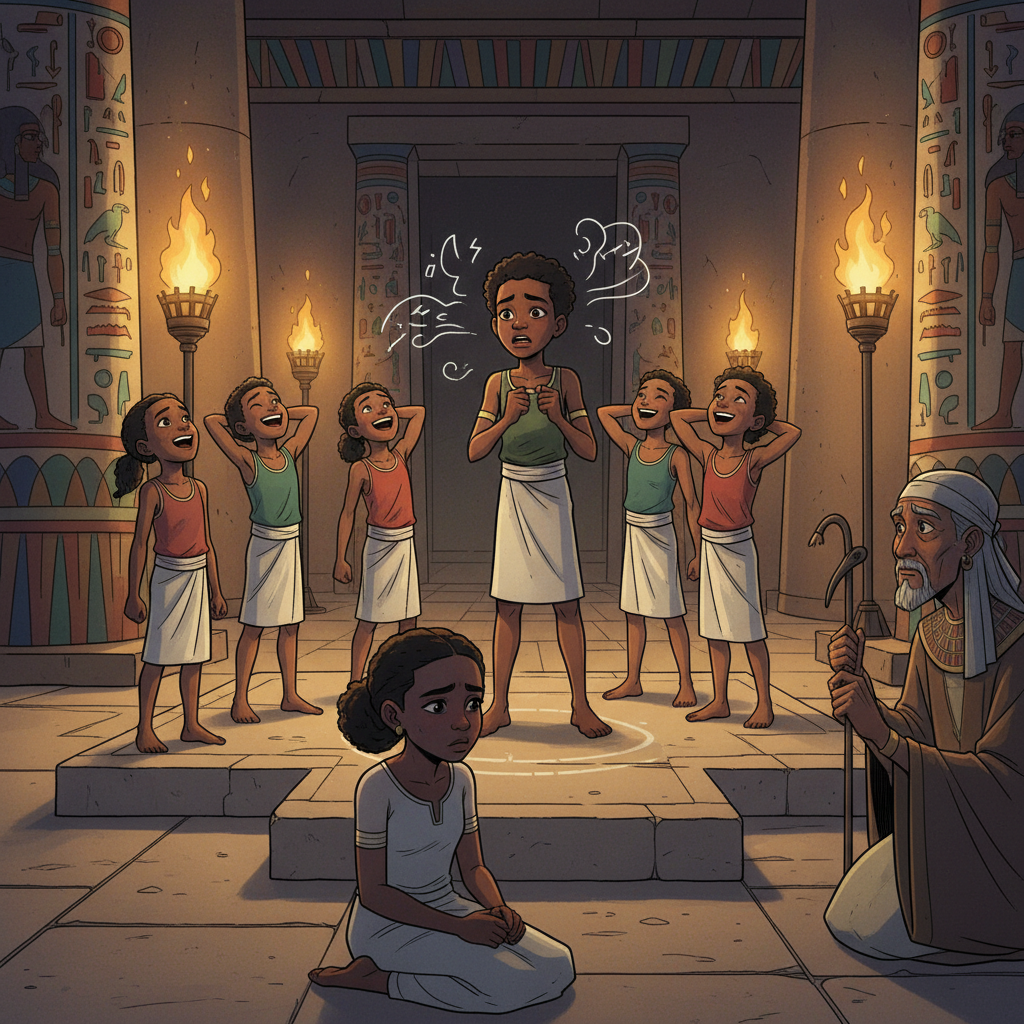
The priest of Djehuti seemed to sense the weight gathering in her again. "You are carrying something," he observed. It was not a question. Sia nodded slowly. "I watched someone be mocked and I said nothing," she said. The words came out rough-edged, as if they had been lodged in her throat for weeks. "Heru. During recitation. The others laughed at his stutter and I just — sat there. I didn't join in, but I didn't help him either." The hall was very still. The torch flames stood straight and unmoving, as if the air itself were listening. "Why didn't you speak?" the priest asked. Sia wanted to say she didn't know, but that would have been another untruth. "I was afraid," she said. "Afraid that if I spoke up, they would turn on me next. Afraid of being different from the group." The priest was quiet for a long moment. Then he said, "Sia, do you know why the assessors of Maat number forty-two?" She shook her head. "Because justice is not one simple thing. It has forty-two faces. And one of those faces is courage — the courage to stand for what is right even when standing alone feels dangerous. You have named your failure honestly. That is the first step. But I want to ask you: what did you do after the laughter stopped?" Sia blinked. "I... I went to Heru afterward. In the courtyard. I told him his recitation was improving, that everyone stumbles. I sat with him during the evening meal." The priest nodded. "Maat does not ask you to be fearless. It asks you to choose rightly even when you are afraid — and when you fail, to repair what you can. You failed in the moment. You repaired after. The scale sees both actions, Sia. Speak your declaration."
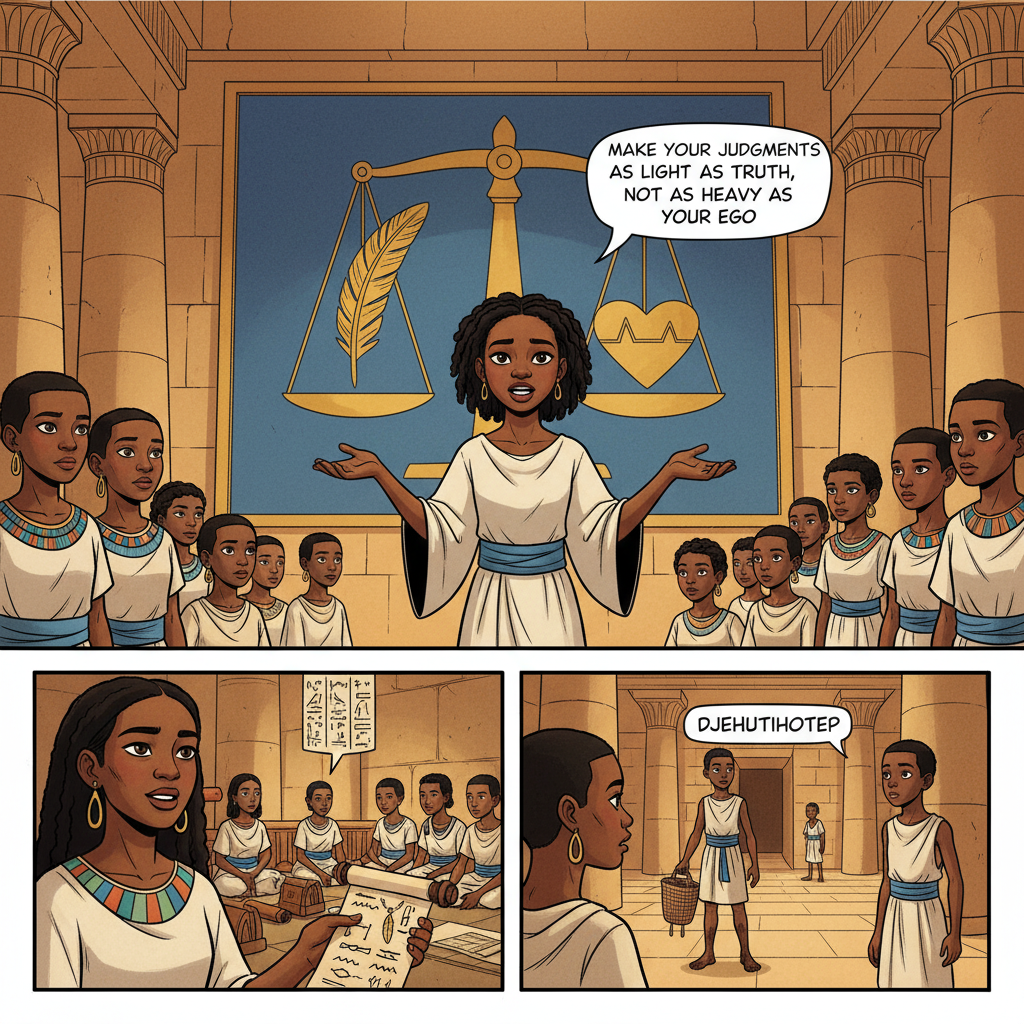
Sia moved into the declarations concerning justice and fairness, her confidence building like a river gathering strength from its tributaries. "I have not judged hastily," she declared. "I have not acted with prejudice. I have not been unjust." These declarations made her think of something Merytaten had taught during a lesson on the history of Kemet's legal courts. "The judges of Maat wore a small golden feather on a chain around their necks," Merytaten had said, her dark, luminous face serious in the lamplight. "Not to show their power, but to remind them of its limits. The feather meant: make your judgments as light as truth, not as heavy as your ego." Sia had written that phrase in her personal journal that night, tracing the hieroglyphs carefully on a scrap of practice papyrus. Make your judgments as light as truth, not as heavy as your ego. She thought about how often people judged each other — not in courts of law, but in the daily court of opinion. Judging someone by their appearance. By their family. By the neighborhood they came from. By whether they spoke the formal language of the scribes or the rough dialect of the river workers. She thought of how she herself had judged Djehutihotep, a new student from a farming village in the south, when he arrived at the Per Ankh last season with river mud still on his feet and bewilderment in his wide dark eyes. She had thought, without even meaning to: he doesn't belong here. And she had been wrong. Djehutihotep had turned out to be the most gifted mathematician in their entire year, his mind working with numbers the way a weaver's hands worked with thread — swiftly, naturally, creating patterns invisible to others. Her snap judgment had said more about her own limitations than about his worth.
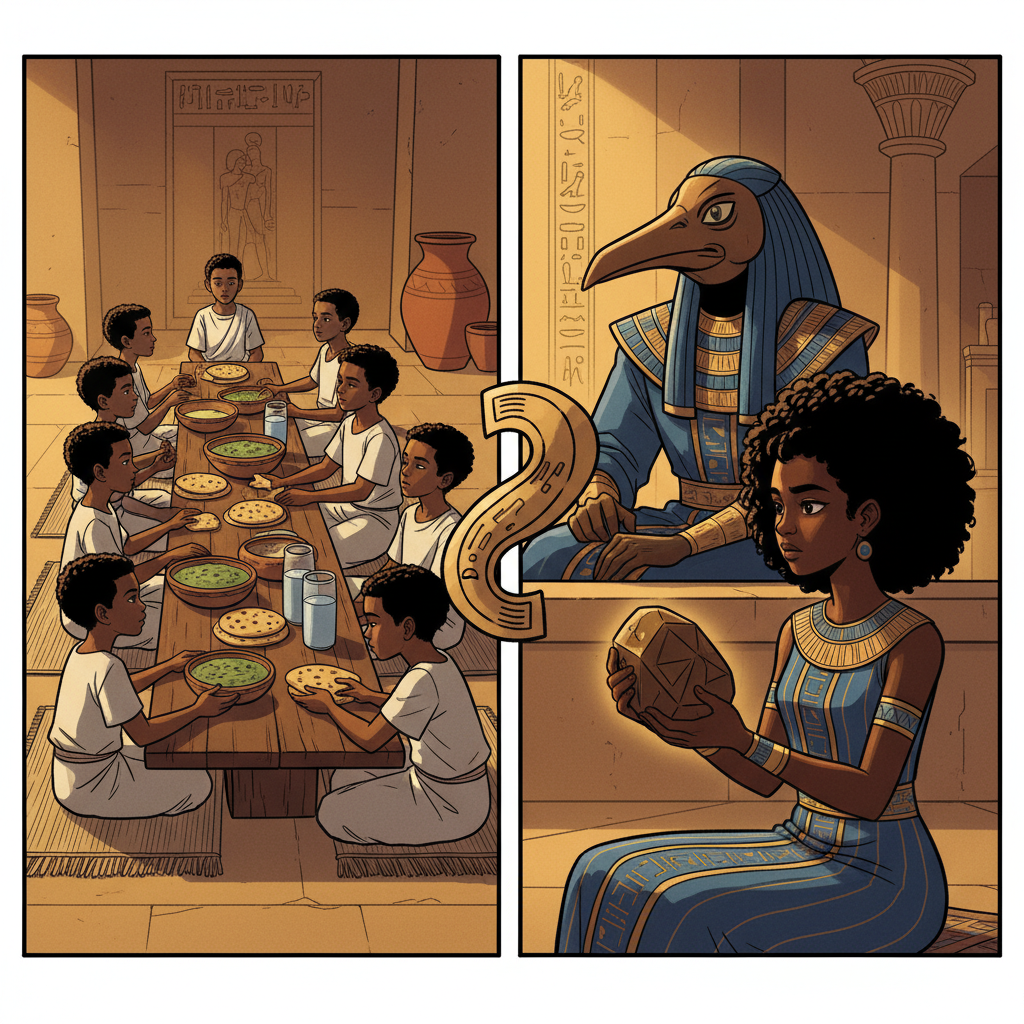
The next set of declarations turned inward, toward the self and its appetites. "I have not been greedy," Sia said. "I have not taken more than my share. I have not wasted what was given to me." She thought of the communal meals at the Per Ankh — long low tables where students sat cross-legged on reed mats, sharing bowls of lentil stew, plates of flatbread, jars of cool water drawn from the temple well. There was always enough for everyone, but only if everyone took their fair portion. Sia remembered a night, early in her first year, when she had been so hungry after a long day of lessons that she had taken three pieces of bread instead of two, not thinking about whether the students at the end of the table would have enough. Such a small thing. But Maat lived in small things. The priest of Djehuti spoke, and his question surprised her. "Sia, what is the relationship between greed and fear?" She considered this, turning it over in her mind the way she would turn a carved stone, examining its facets. "Greed comes from fear," she said slowly. "Fear that there will not be enough. Fear that you will go without. So you grab and hoard and take more than you need, because you do not trust that the world will provide." The priest nodded. "And what is the antidote to that fear?" Sia thought of her mother, who had very little but shared freely with neighbors, whose deep ebony hands were always extending a bowl of food or a folded cloth to someone in need. "Trust," Sia said. "Trust that when you give, the world gives back. Trust that enough is truly enough." The priest's eyes gleamed behind the ibis-mask. "Maat is built on trust, Sia. Trust in the order of things. Trust that justice, even when delayed, is never denied."
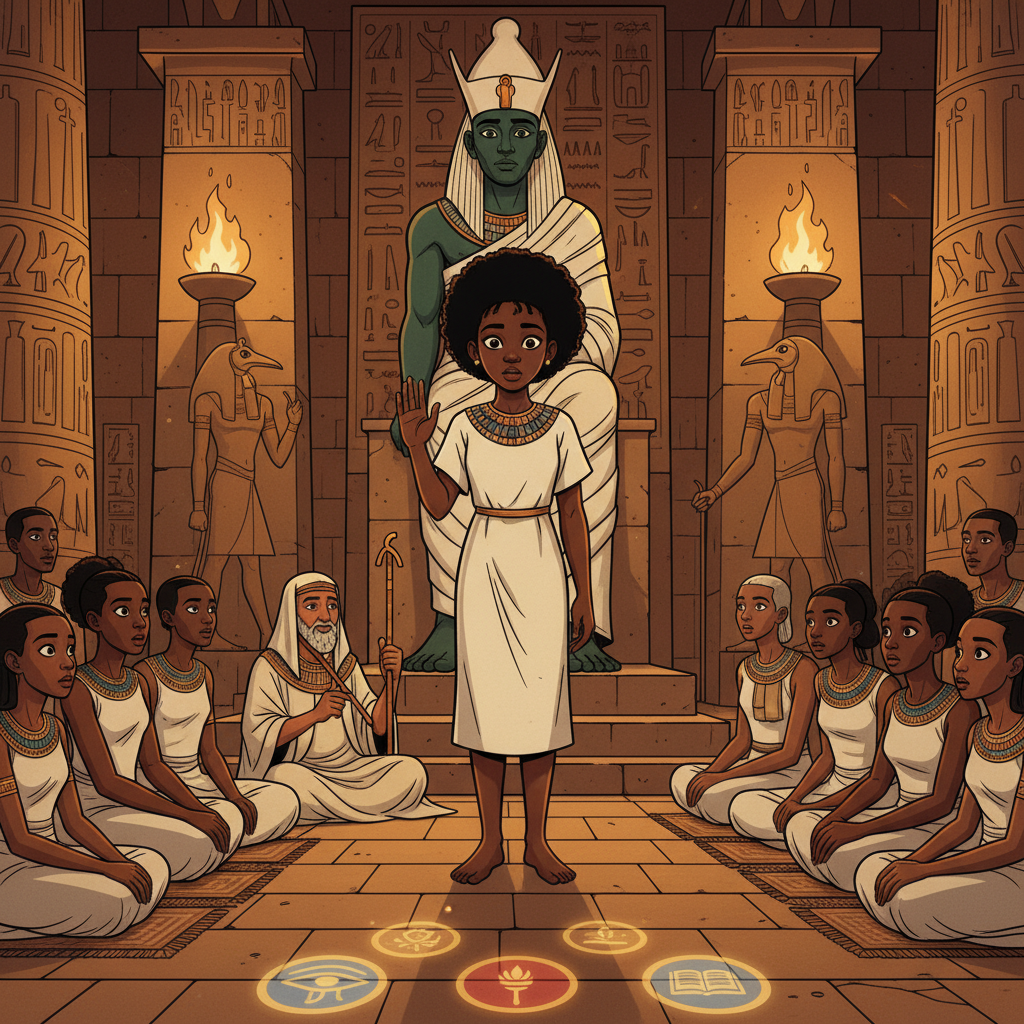
Sia's voice found a rhythm now as she moved through the declarations concerning respect for the sacred. "I have not blasphemed against the neteru," she said. "I have not disturbed the peace of the temple. I have not extinguished a flame that should burn." These declarations spoke to something her teachers called the invisible architecture of the world — the idea that beneath the visible surface of things, there existed a sacred order, a pattern woven by forces greater than any human hand. The neteru were not distant gods sitting on thrones in the sky; they were principles, living forces that moved through all things. Maat was truth and balance. Djehuti was wisdom and knowledge. Aset was devotion and restoration. Ausar was transformation and renewal. To blaspheme against them was not simply to speak disrespectful words — it was to act against the principles they embodied. To be deliberately unjust was to blaspheme against Maat. To choose ignorance when knowledge was available was to turn away from Djehuti. Sia thought of the flame declaration — "I have not extinguished a flame that should burn" — and felt its meaning open up inside her like a lotus blossom unfolding in the morning light. The flame was not only literal fire. It was the spark of learning in a student's eyes. It was the ember of hope in someone who was struggling. It was the torch of justice that must be kept burning even when powerful people wanted it snuffed out. To extinguish a flame that should burn was to silence a voice that needed to speak, to crush a spirit that was trying to rise, to kill a truth that the world needed to hear. Sia understood, standing in the torchlit Hall of Two Truths, that these ancient declarations were not relics of a dead past. They were instructions for living, as vital and urgent today as they had been when the first scribes wrote them on papyrus thousands of years ago.
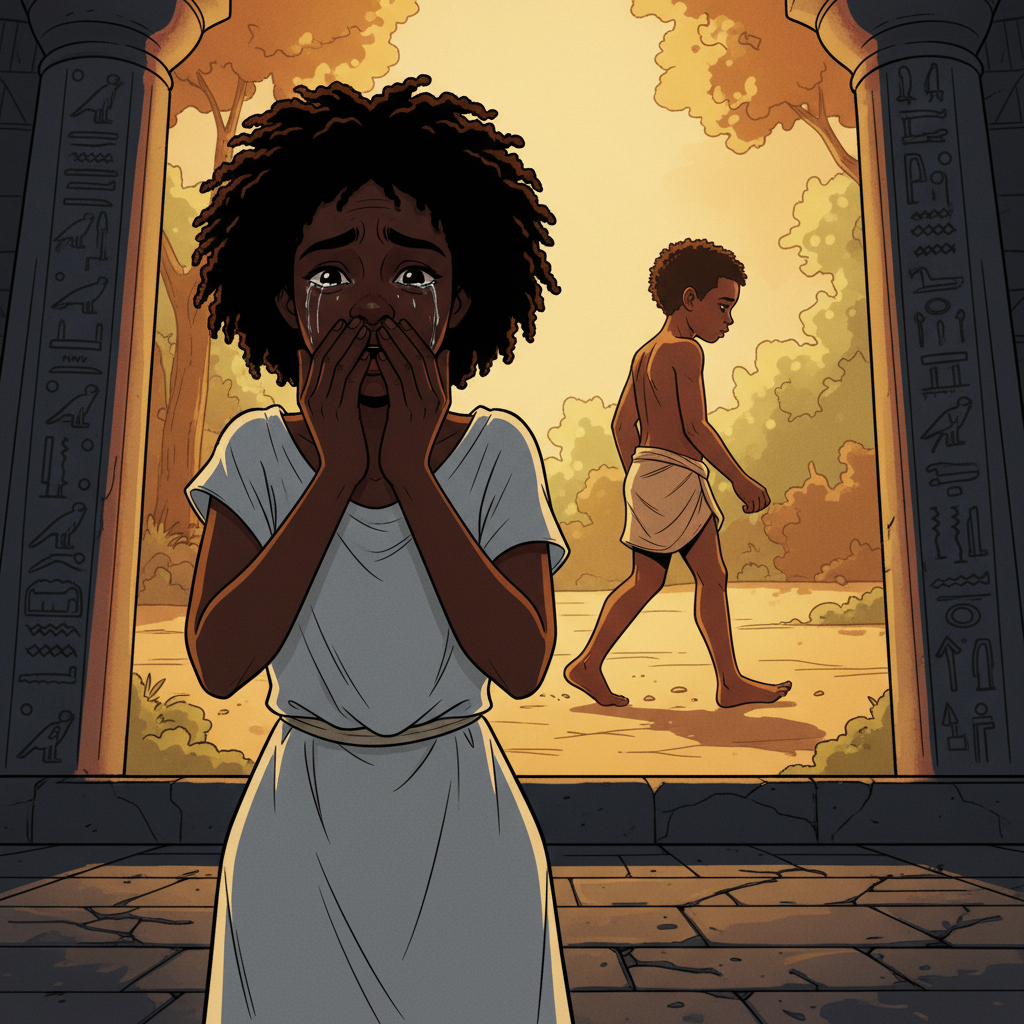
Then came the declaration that nearly broke her. "I have not caused anyone to weep," Sia said, and her voice cracked on the last word like a dry reed snapping. Because she had. She had caused someone to weep, and not just anyone — her little brother, Khufu, who was only eight years old and who adored her with the uncomplicated devotion that only a younger sibling could offer. It had happened during her last visit home, three months ago. Khufu had followed her everywhere — into the garden, to the market, to the riverbank — chattering constantly, showing her every drawing he had made, every stone he had collected, demanding her attention with the relentless persistence of a child who had missed his sister terribly. And Sia, exhausted from her studies, overwhelmed by the noise after the quiet discipline of the Per Ankh, had finally snapped. "Leave me alone, Khufu!" she had shouted. "Just stop following me! I need to think and I can't think with you always talking!" The look on his face. She could see it now, projected onto the painted walls of the Hall of Two Truths as clearly as if it were happening again. His small dark face crumpling, his lower lip trembling, his bright eyes flooding with tears that spilled down his round cheeks. He had not said a word. He had simply turned and walked away, his narrow shoulders hunched, his bare feet shuffling through the dust. And Sia had stood there in the garden, watching him go, her anger already dissolving into shame so thick she could taste it. She had gone after him, of course. She had found him sitting behind the acacia tree, hugging his knees, and she had knelt beside him and pulled him into her arms. "I'm sorry, little brother. I'm so sorry. I didn't mean it." And he had forgiven her instantly, the way children do, burying his wet face in her shoulder. But the memory of his weeping face had followed her back to the Per Ankh like a shadow she could not outrun.
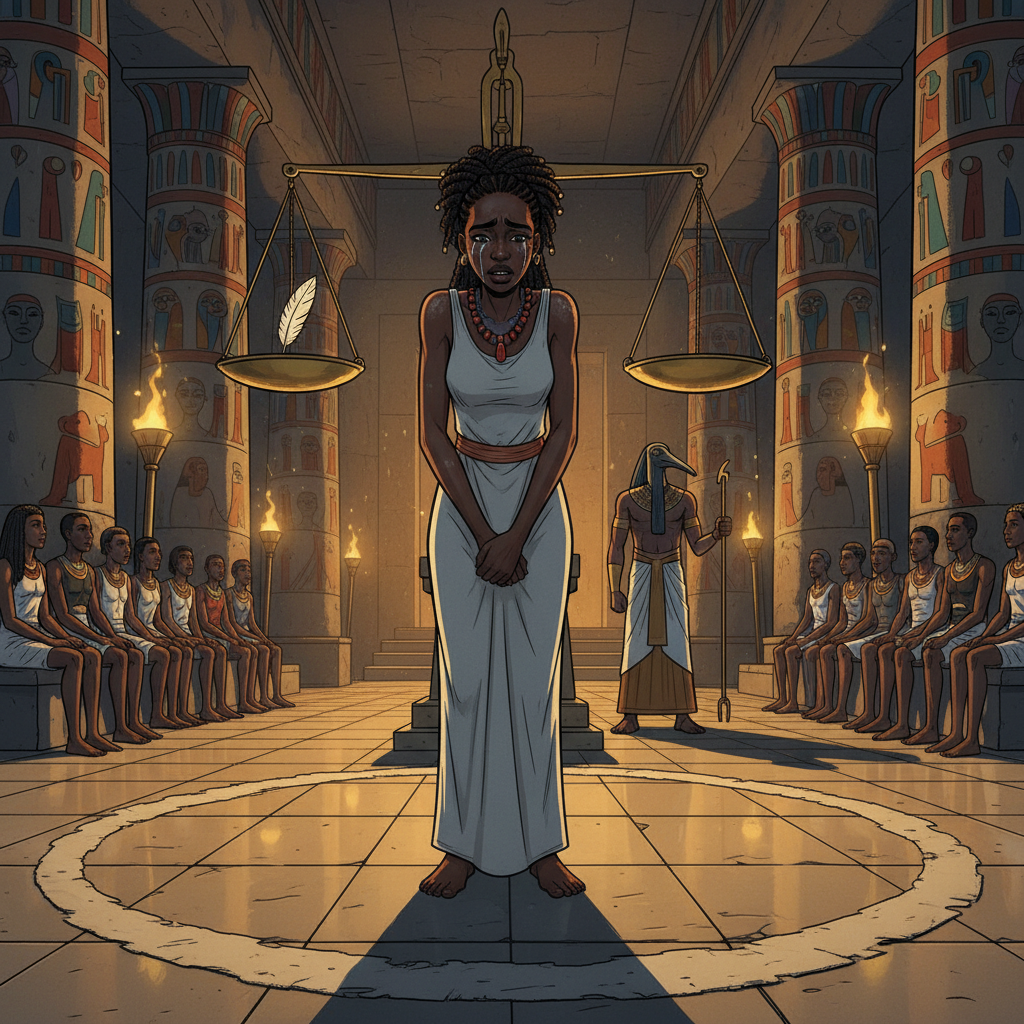
Sia stood in the chalk circle with tears running silently down her own dark cheeks, and she could not speak. The hall was absolutely still. The torches flickered. The painted assessors watched from the walls with their ancient, unblinking eyes. The feather of Maat sat in its pan on the golden scale, impossibly light, impossibly significant. Sia felt as though her heart had turned to stone — heavy, dense, sinking. She had caused someone to weep. She had made a child cry. Her own brother, who loved her more than anyone in the world. How could she stand here and claim to have lived in Maat when she carried that memory inside her? The priest of Djehuti waited. He did not prompt her. He did not comfort her. He simply stood, patient as the stone columns, and let her feel what she needed to feel. When at last Sia looked up at him, her quiet fire eyes red-rimmed and glistening, he asked a single question: "Did you repair it?" Sia wiped her face with the back of her hand. "I apologized. I held him. I told him I loved him and I spent the rest of the visit giving him my full attention. I wrote him a letter when I returned to the Per Ankh, telling him he was the best brother in all of Kemet." The priest tilted his head. "And what did he write back?" Despite everything, Sia almost laughed. "He drew me a picture of a crocodile eating a hippopotamus and wrote 'I love you Sia' underneath in hieroglyphs so messy I could barely read them." A small, warm ripple of something like amusement passed through the witnesses on the stone benches.
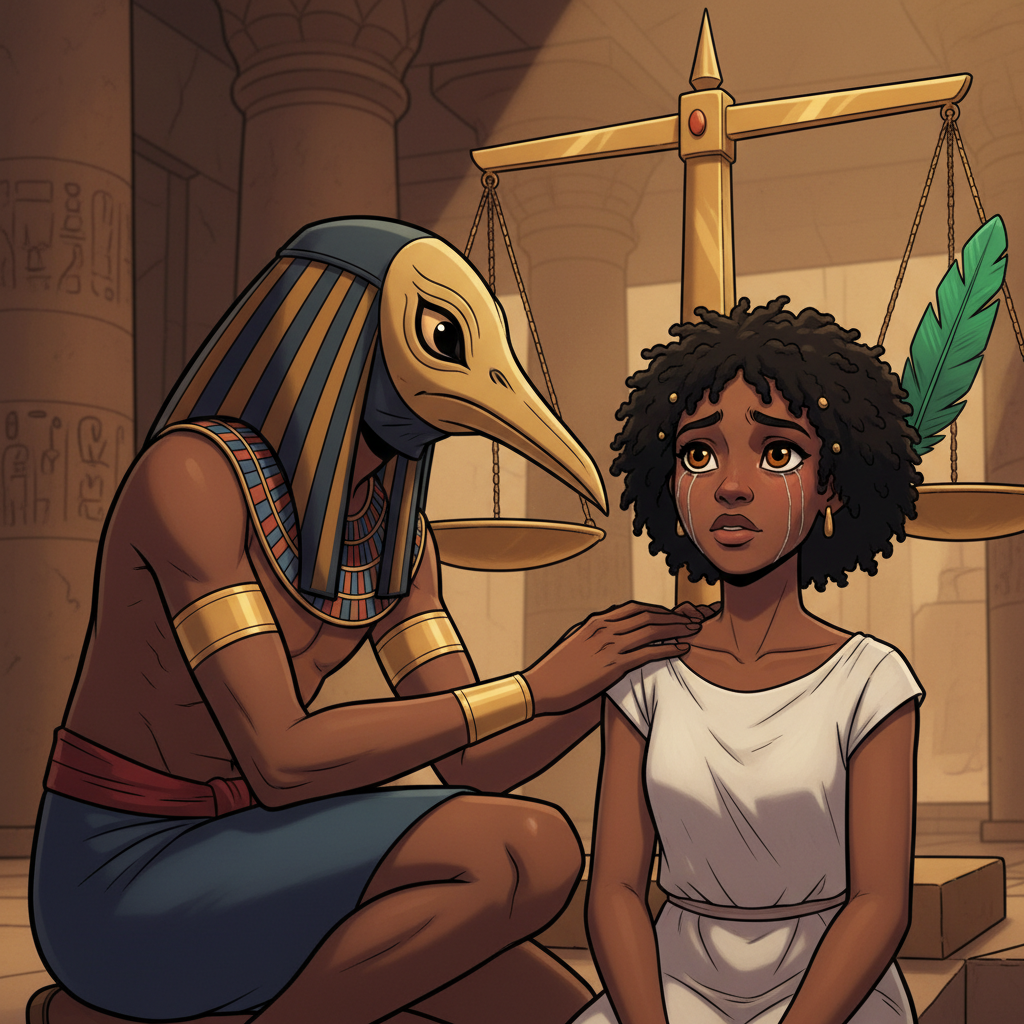
The priest of Djehuti descended to her level and spoke in a voice so low only she could hear it, his words intimate and deliberate behind the ibis-mask. "Sia, listen carefully to what I am about to say, because it is the heart of everything you are learning today. Maat does not demand perfection. No human being has ever lived a life entirely free of causing pain. You are young, and you will make many more mistakes before your journey is complete — mistakes far larger than snapping at a little brother who would not stop talking." He paused, letting the words settle. "What Maat demands is honesty. The willingness to look at what you have done, to name it without excuse, to feel its weight, and then — this is the part so many people miss — to act differently. To repair. To grow. The scale does not weigh whether you have never erred. It weighs whether your heart has learned from its errors." Sia absorbed this like parched earth absorbing rain. She felt the heaviness in her chest begin to shift — not disappear, because the memory of Khufu's tears would always carry some weight, and perhaps it should. But the crushing, suffocating guilt that had pressed against her ribs began to ease into something different: responsibility. Not the burden of being perfect, but the commitment to being better. She looked at the golden scale, at the green feather resting in its pan, and understood something she had not understood before. The feather was not there to condemn her. It was there to show her the standard — the lightness of a life lived in truth, in balance, in the constant effort to align your actions with what you knew to be right. Your heart did not need to be weightless. It needed to be honest.
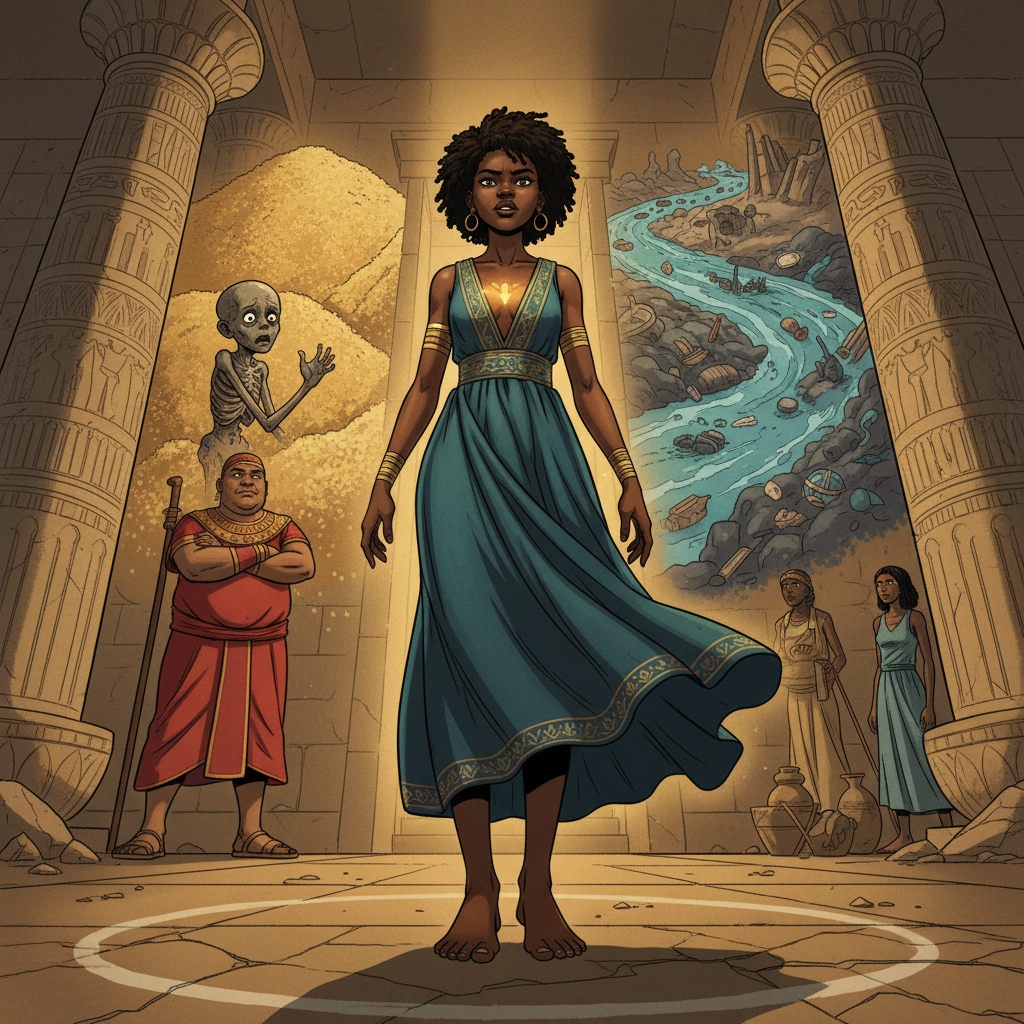
With renewed strength, Sia spoke the declarations concerning community and responsibility. "I have not polluted the water," she said. "I have not taken the milk from a child's mouth. I have not driven cattle from their pastures. I have not hoarded grain during famine." These declarations expanded outward from the personal to the communal, and Sia felt their scope widen like the great river spreading across the floodplain during the inundation season. They were not just about individual behavior — they were about how a person existed within the web of community. To pollute the water was not only to throw waste into the river; it was to corrupt the shared resources that everyone depended upon. To hoard grain during famine was not only a physical act; it was any moment when you held abundance while others starved and chose comfort over compassion. Sia thought about the world beyond the Per Ankh — beyond even Kemet itself. She had heard travelers in the market speak of distant lands where some people lived in enormous houses while others slept in the streets. Where some ate feasts that could feed a village while children went hungry a stone's throw away. Was that not a violation of Maat on the grandest scale? Was that not isfet made into a system, chaos wearing the mask of order? She felt a fierce heat rise in her chest — not anger exactly, but something close to it. A burning sense that Maat was not just a personal practice. It was a demand placed on all of society. The forty-two declarations were not only a mirror for the individual soul; they were a blueprint for how communities should function, how resources should flow, how the powerful should treat the vulnerable. The ancients had understood this. The question was whether the living still did.
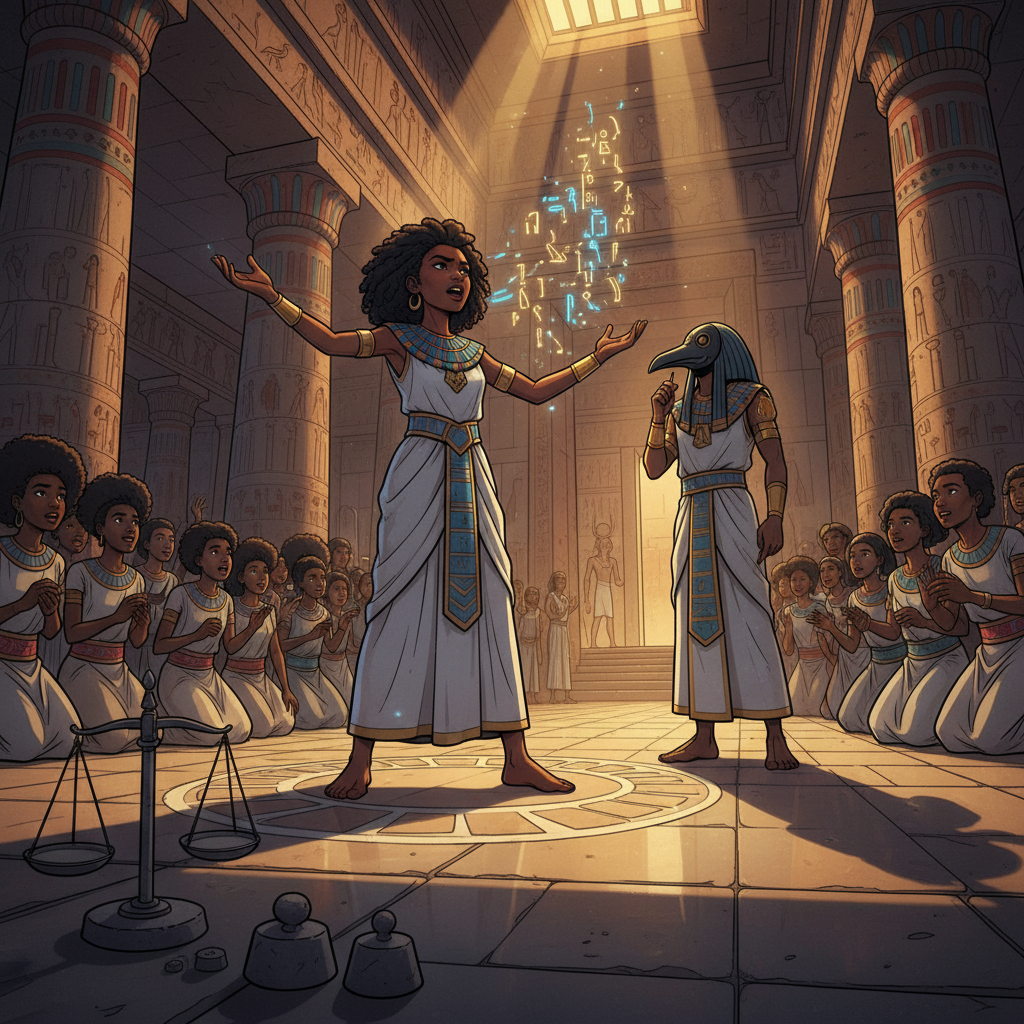
Sia pressed forward through the declarations about honesty in trade and labor. "I have not used false weights or measures," she declared, and the words rang through the hall with a clarity that surprised her. "I have not stolen the labor of others. I have not been idle when work was needed." She thought of the scribes she had studied beside for three years — young people her age bent over their desks, grinding ink, cutting reeds to fine points, copying texts with painstaking care onto sheets of papyrus. The work of a scribe was the work of preservation. Every text they copied was a piece of Kemet's wisdom being carried forward into the future, a torch passed from one generation to the next. To do that work carelessly — to use false measures, to cut corners, to produce sloppy copies — was to betray not only the teachers who trusted you but the generations yet to come who would depend on what you created. And what about false weights in daily life? Sia considered this. A false weight was anything that distorted the truth of an exchange. Flattering a teacher to get a better evaluation — that was a false weight. Taking credit for a group project that others had done most of the work on — that was stealing the labor of others. Remaining silent during a discussion when you had valuable insights to share because speaking up felt risky — that was being idle when work was needed. The declarations of Maat translated so directly into the challenges she faced every day at the Per Ankh that Sia marveled at their continued relevance. These were not dusty rules from a vanished era. They were living principles, as applicable to a thirteen-year-old student in a temple school as they had been to the merchants and farmers and judges of ancient Kemet.

She was nearing the end now, and the hall seemed to shimmer with accumulated energy. The torchlight had shifted as the sun moved overhead, sending new beams through the high windows that caught the incense smoke and turned it into spiraling columns of gold. Sia spoke the final group of declarations — those concerning the deepest aspects of character. "I have not been arrogant," she said. "I have not inflated my importance. I have not been deaf to the words of truth. I have not been angry without just cause." Each declaration was a chisel stroke, shaping her understanding of who she was and who she wanted to become. Arrogance — the belief that you were better than others, more deserving, more important. She had felt its pull many times. Being a student at the Per Ankh carried status in Waset, and it was easy to let that status inflate your sense of self. She remembered visiting the market with Nefertari last month and the way Nefertari had spoken to a fruit seller — casually, dismissively, as though the woman's labor mattered less than a scribe's. Sia had not said anything at the time, but it had bothered her, a splinter under the skin she could not quite reach. Now she understood why. Nefertari had violated Maat in that moment — not dramatically, not criminally, but in the quiet, insidious way that isfet most often worked. It crept in through the small doors: a condescending tone, a look of superiority, the assumption that your work was more valuable than someone else's. The fruit seller's hands, rough and sun-darkened from long days in the fields, were as essential to the order of Kemet as any scribe's ink-stained fingers. Maat demanded that you know this — not as an abstract idea, but as a truth you lived.
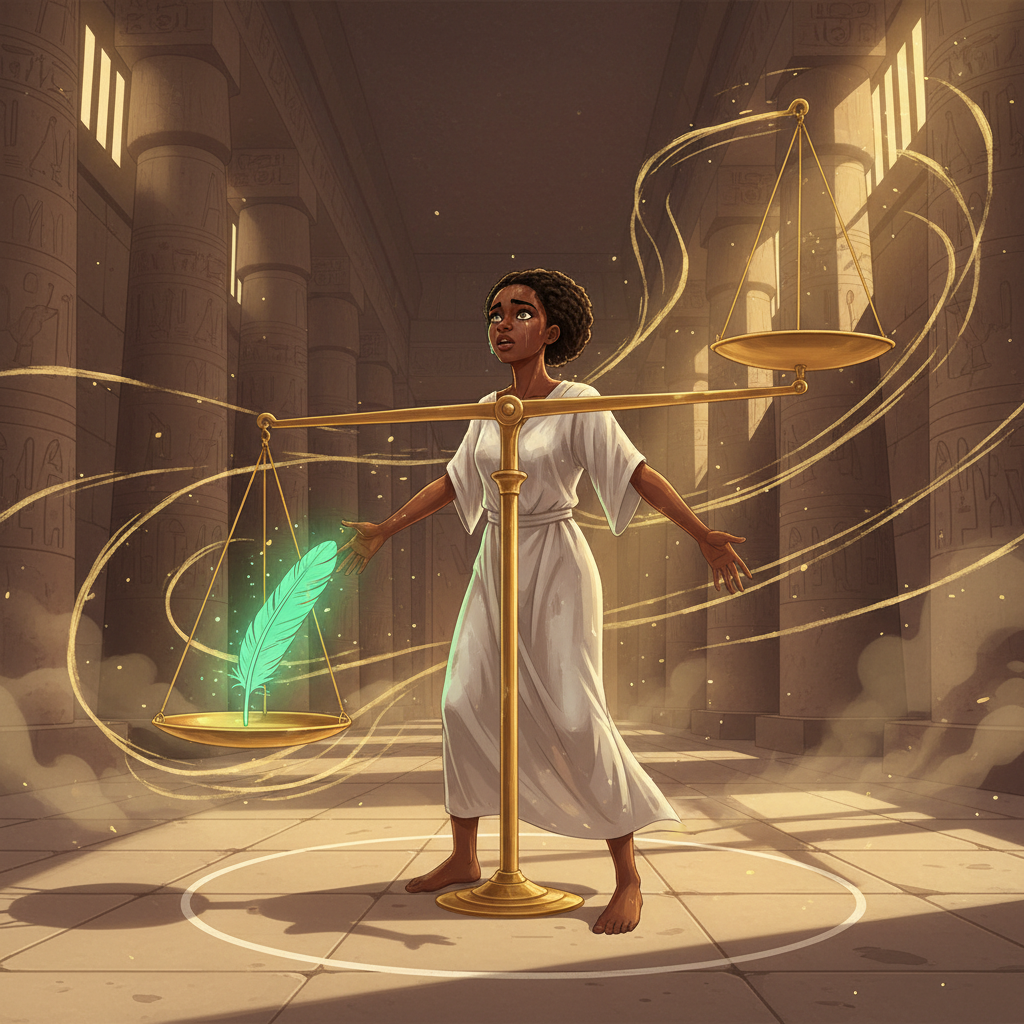
Sia spoke the forty-second and final declaration, and her voice filled the Hall of Two Truths like a bell being struck. "I have strived to live in Maat." This was the summation — the declaration that gathered all the others into a single intention. Not "I have achieved Maat." Not "I have mastered Maat." But "I have strived." The choice of that word — strived, tried, struggled toward — told her everything about what the ancients truly understood about the human condition. They knew that no one was perfect. They knew that every person, no matter how wise or disciplined, would fall short of the ideal. And they declared that the striving itself — the honest, relentless, daily effort to align your life with truth and justice and balance — was enough. Was, in fact, everything. The last echo of her voice faded into the stone walls. The silence that followed was not empty — it was full, charged, alive with the weight of everything she had spoken and everything she had felt. Sia stood in the chalk circle, her white linen damp with sweat, her dark skin gleaming in the torchlight, her quiet fire eyes bright with unshed tears that were no longer born of shame but of something closer to awe. She had done it. She had spoken all forty-two declarations, not as empty recitation but as genuine reckoning — pausing where she needed to pause, struggling where she needed to struggle, accepting her imperfections not as failures but as the raw material from which growth was made. She looked at the golden scale. The feather of Maat sat in its pan, green and luminous and impossibly light.
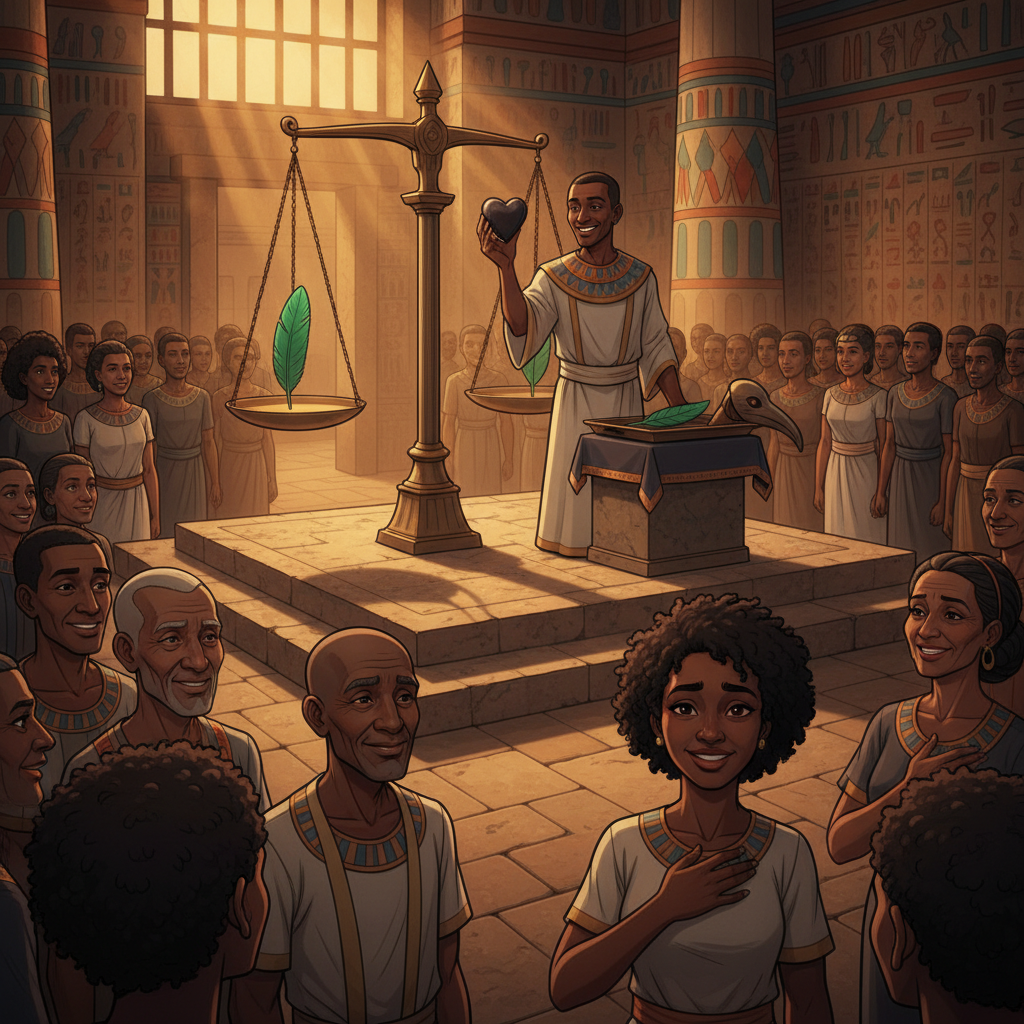
The priest of Djehuti ascended the granite platform and stood beside the scale. He lifted a small object from a cloth-covered tray — a carved stone heart, polished smooth, dark as the night sky between stars. "This heart represents your ka," he said, holding it up so the torchlight caught its surface. "Everything you have spoken today, every truth and every struggle, every moment of honesty and every moment of repair — all of it is held within this stone, as your experiences are held within your spirit." He placed the stone heart carefully in the empty pan of the scale. The pan dipped, then steadied. Sia watched, her own heart hammering, as the scale swayed gently — left, right, left — like a bird settling onto a branch. Then, slowly, beautifully, it came to rest. The two pans hung level. The stone heart and the green feather, balanced. A soft sound moved through the hall — not applause, but something deeper, a collective exhalation, as though every witness had been holding their breath. Merytaten's dark eyes shone with quiet pride. Old Kagemni's lined face creased into a smile that seemed to illuminate the years of wisdom carved there. The priest of Djehuti removed his ibis-mask, and Sia saw his face for the first time — younger than she expected, with high cheekbones and skin the rich color of polished mahogany, and a smile that was warm and genuine and full of the specific joy that comes from watching someone discover their own strength. "The scale speaks," he said, his unmasked voice now familiar and human and kind. "Your heart is in balance with Maat. Not because you are perfect, Sia. But because you are honest."
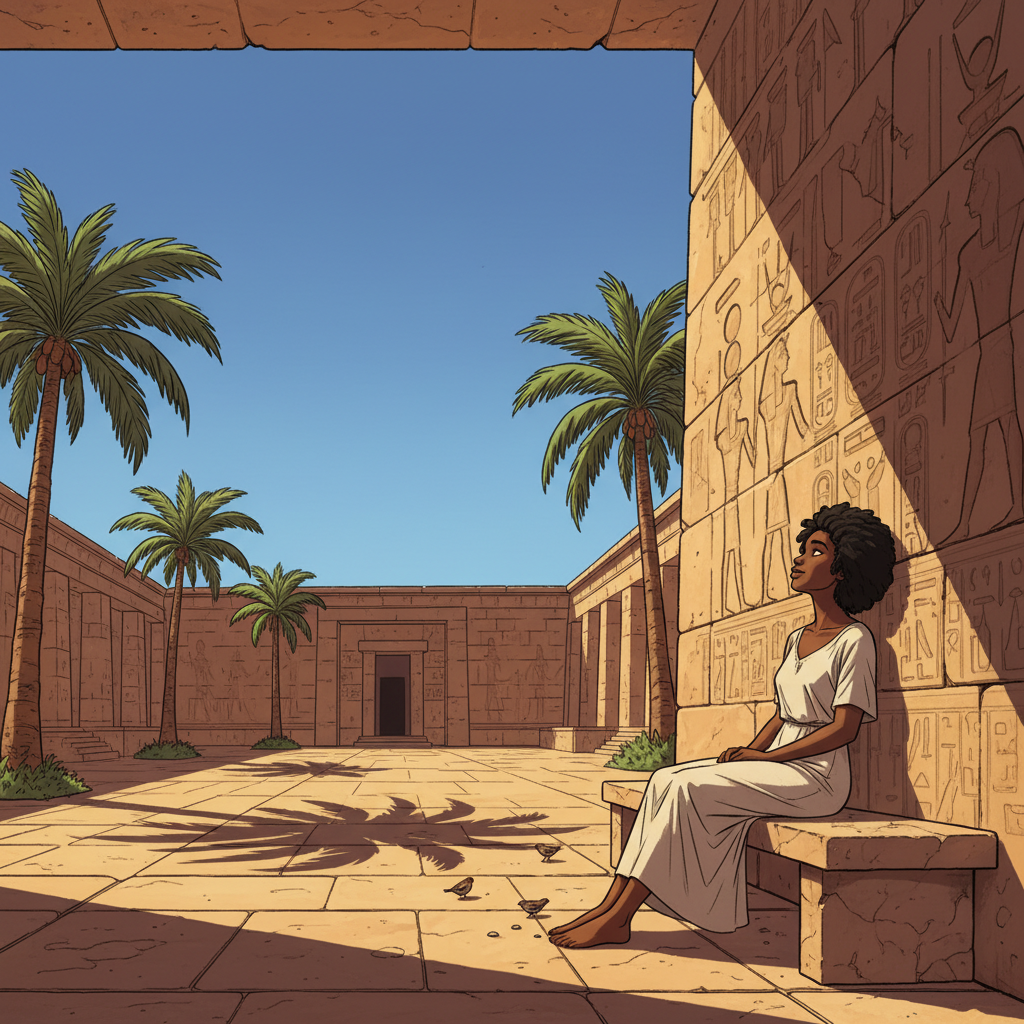
Afterward, Sia sat alone on a stone bench in the courtyard outside the Hall of Two Truths. The ceremony was over. The witnesses had filed out quietly, many pausing to touch her shoulder or nod in acknowledgment as they passed. Merytaten had squeezed her hand and whispered, "I knew." Kiya had appeared from somewhere — she must have been waiting outside the entire time — and had thrown her arms around Sia so tightly that Sia's ribs ached. Now the courtyard was empty except for the date palms and the sparrows and the long afternoon shadows stretching across the warm stone. Sia leaned back against the wall and looked up at the sky — vast, blue, cloudless, the same sky that had arched over Kemet since before the first stone of the first temple was laid. She felt emptied out and filled up at the same time, as though the ceremony had scooped out everything old and heavy and replaced it with something new and light. But even as she sat there in the glow of completion, she felt the truth of what the priest had said settling into her bones: this was not the end. The judgment of Maat was not a test you passed once and then forgot. It was a daily practice — a way of moving through the world with your eyes open and your heart accountable. Tomorrow she would wake up and face new choices, new temptations to be dishonest or unkind or cowardly or greedy. She would fail sometimes. She would snap at someone who didn't deserve it, or stay silent when she should speak, or judge someone before knowing their story. And when that happened, she would not crumble under the weight of her imperfection. She would name it, feel it, repair it, and keep striving. That was the weight of a feather — not the absence of struggle, but the commitment to carry your struggles honestly, every single day, for the rest of your life.
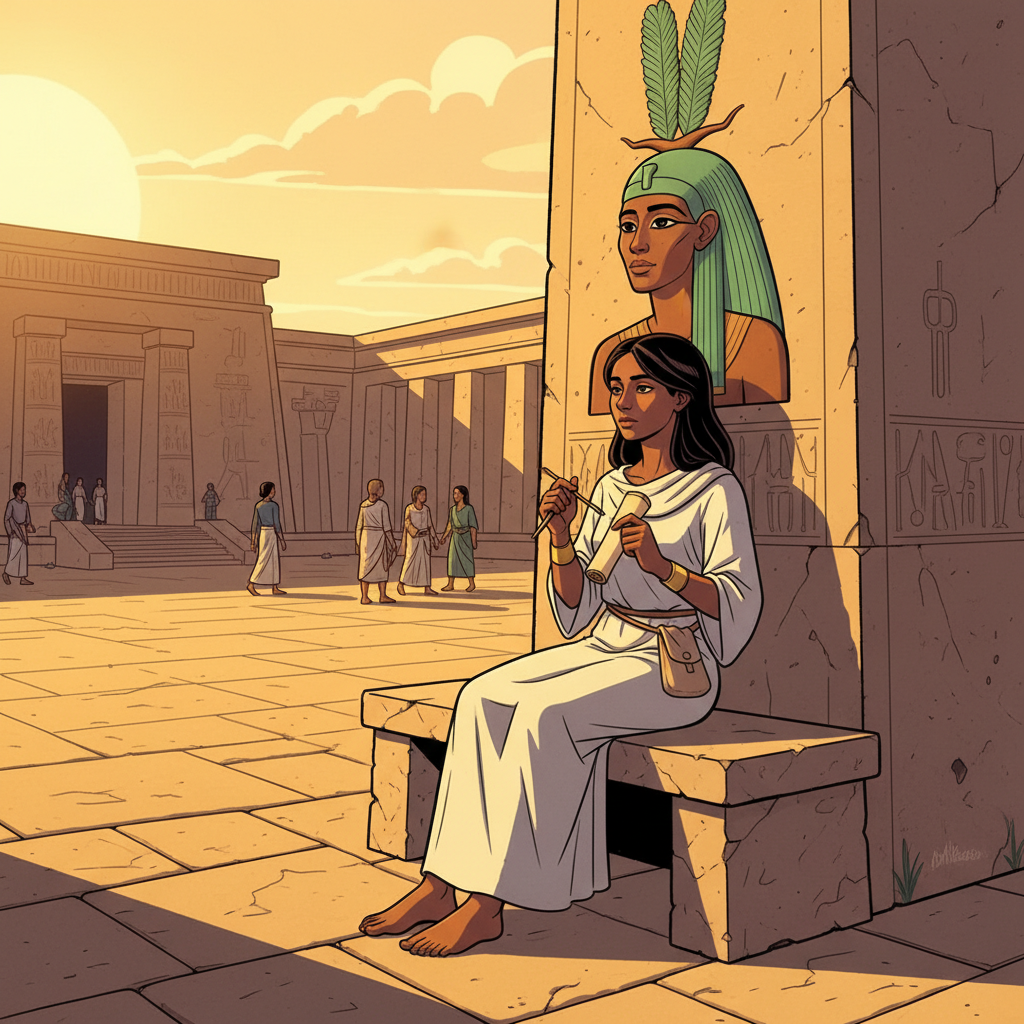
The sun was beginning its descent toward the western hills — toward the land of the beautiful west, where the ancients said the soul journeyed after death to face the final weighing. But Sia was not thinking about death. She was thinking about life — about all the life ahead of her, stretching out like the great river, full of bends she could not yet see and currents she could not yet feel. She reached into the small linen pouch at her waist and pulled out a scrap of papyrus and a stub of reed pen she always carried. A scribe's habit. She smoothed the papyrus against her knee and wrote, in careful hieratic script, a single line: "Maat is not a place you arrive. It is a path you walk." She would pin this above her sleeping mat tonight. She would read it every morning when she woke and every evening before she slept. And when she went home to visit her family next month, she would teach Khufu what she had learned — not in the formal language of the Per Ankh, but in the simple words a little brother could understand. Be honest. Be kind. When you make a mistake, fix it. When someone is hurting, help them. When you are afraid, be brave anyway. Sia folded the papyrus carefully and tucked it back into her pouch. She stood, brushed the dust from her white linen, and walked barefoot across the warm courtyard toward the students' quarters. The evening meal would be soon, and she was hungry — genuinely, deeply hungry, as though the ceremony had burned through her like a sacred fire and left space for new nourishment. As she walked, she passed the great pylon with its painted figures of the neteru, and she paused to look up at the image of Maat one more time. The neter of truth gazed down at her with serene dark eyes, the green feather rising from her brow, her expression neither approving nor disapproving but simply present — simply there, the way truth itself was always there, waiting to be acknowledged. Sia placed her hand over her heart, felt it beating steady and strong beneath her palm, and whispered, "I will strive." Then she turned and walked into the golden evening, her shadow stretching long behind her, her steps light as a feather on the ancient stone.