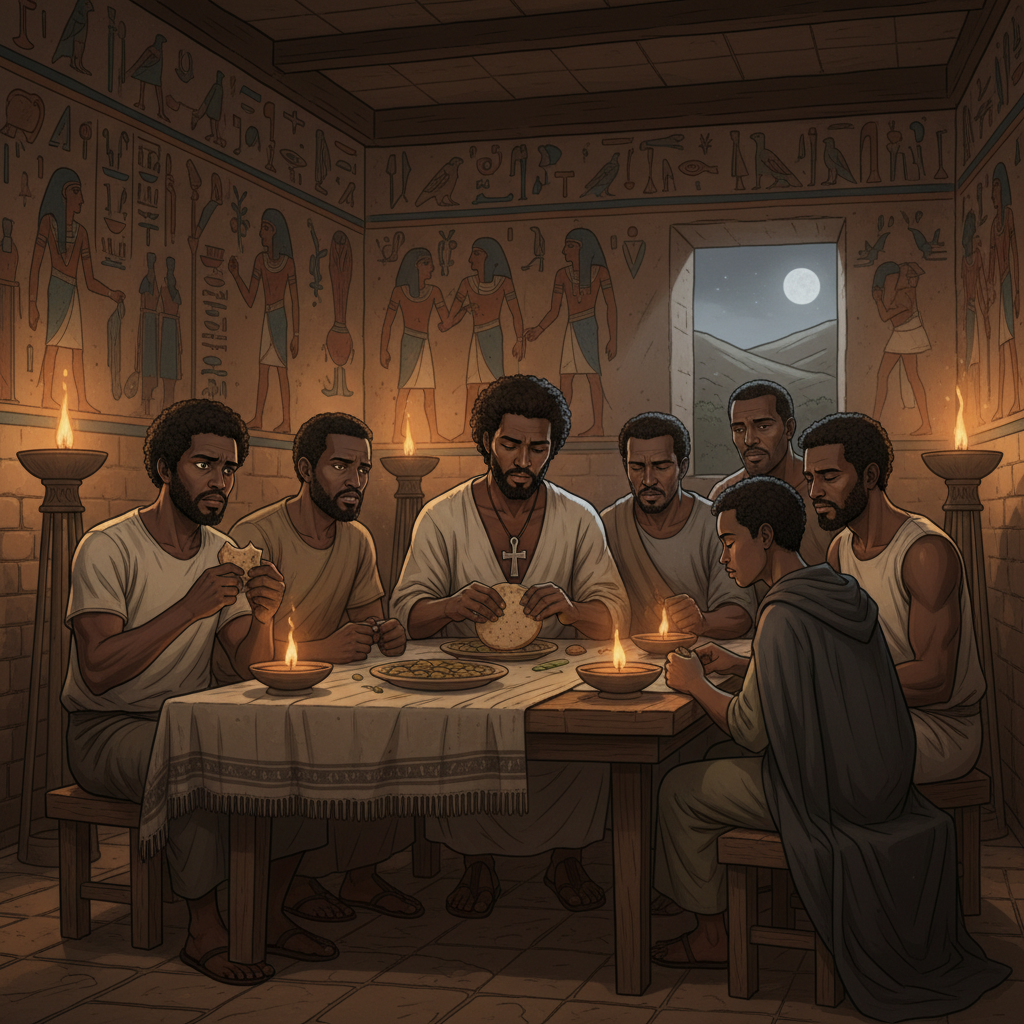
The upper room smelled of bread, bitter herbs, and olive oil. Twelve men sat around a low table with Yeshua at the center, his silver ankh resting against his brown throat. The Passover lamps burned low. Yehudah bar-Shimon watched the flames tremble and felt something tremble inside his own chest. He was a dark-skinned Judean with a trimmed beard and careful hands, and all week those hands had been writing a plan in the air. Yeshua broke the flat bread and passed it. 'This is my body,' he said quietly. 'Given.' Yehudah took his piece. It felt heavier than bread should feel. Across the table, Kefa the fisherman chewed without tasting, his wide shoulders hunched forward. Yohanan, the youngest, leaned close to Yeshua’s ribs like a son leans toward a father. Yehudah’s fingers were cold. He had already spoken to the temple guards. He had already taken their silver and hidden it beneath his cloak. The plan was in motion, and the plan, he told himself, was righteous.
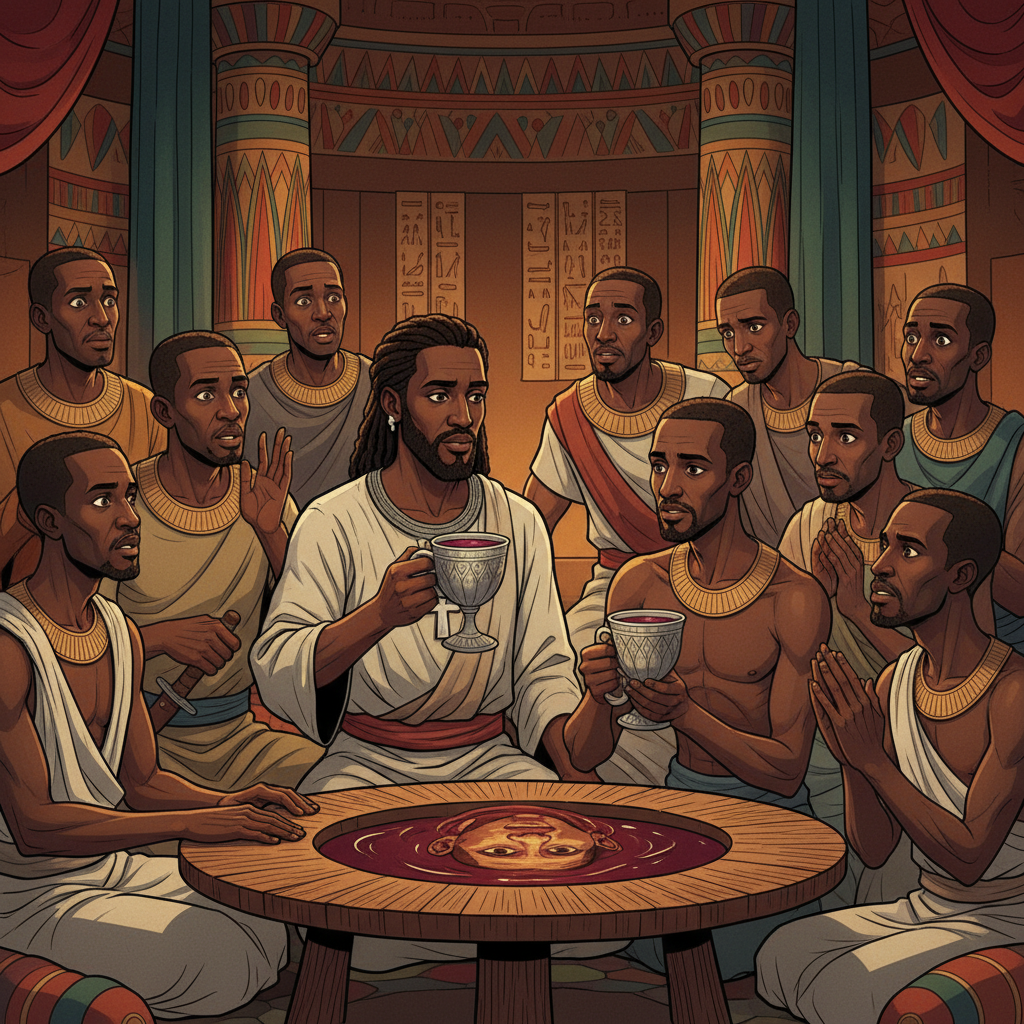
Yeshua lifted the cup of dark wine. 'Drink,' he said. 'All of you.' The cup moved slowly around the circle. When it reached Yehudah, he saw his own face shiver on the wine’s surface — a thin, intelligent face, eyes sharp as a scribe’s reed. He drank. The wine tasted like iron and figs. 'One of you,' Yeshua said, not raising his voice, 'will hand me over tonight.' The room went still. Kefa’s hand went to the knife at his belt. 'Master, not I,' said Ya’akov. 'Not I,' said Tauma. One by one they denied it, each voice trembling. Yehudah waited his turn, then said the words himself: 'Surely not I, Rabbi.' Yeshua looked at him. Not with rage. Not with shock. With a sorrow so clean it felt like cold water poured on a burning wound. 'Do what you must do,' Yeshua said softly, 'and do it quickly.' Yehudah stood. His knees were not steady. He walked out into the narrow street, and the lamplight from the upper room fell behind him like a door closing.
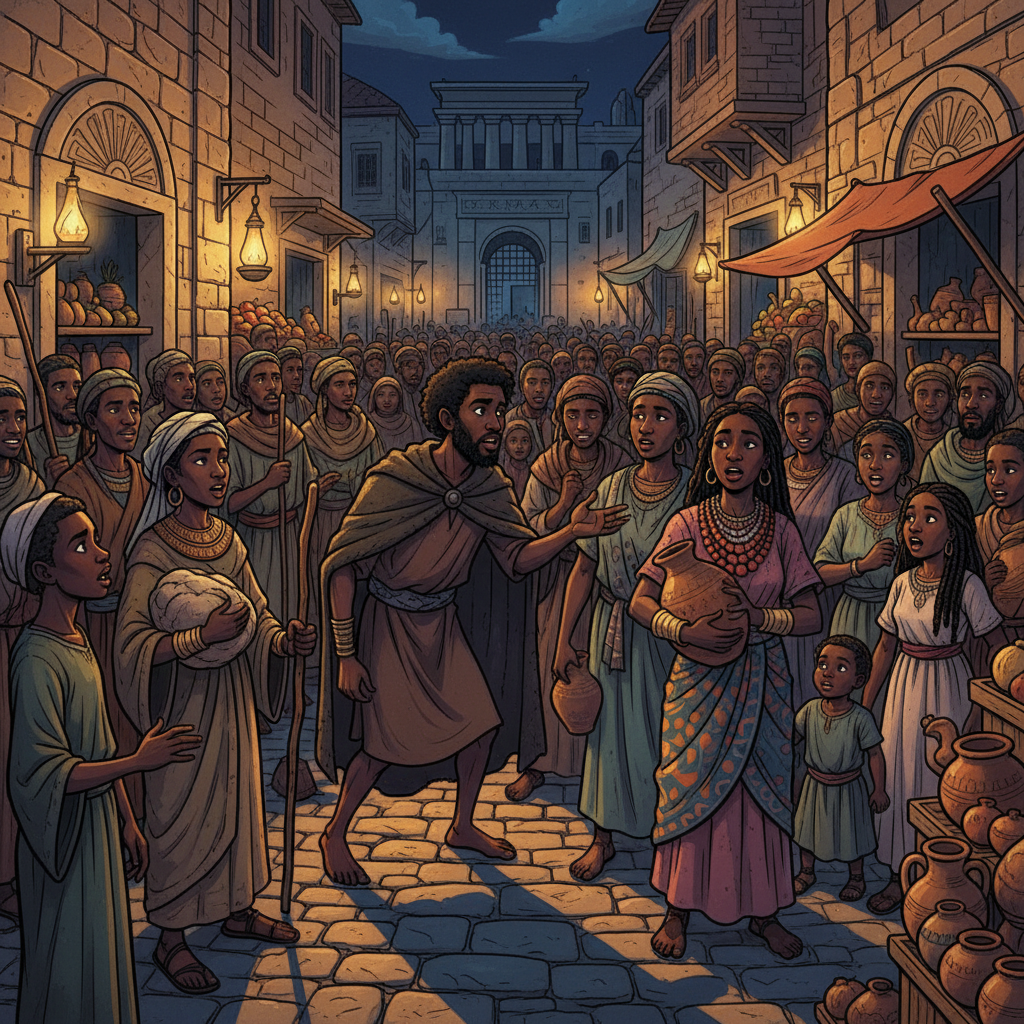
Outside, Jerusalem was loud. Passover pilgrims packed the lower city — Galileans in rough cloaks, Kushite traders with gold bangles, Judean families singing the old Hallel psalms. Yehudah pushed through the crowd toward the priest’s courtyard. His shadow stretched long in front of him under the oil lamps. He argued with that shadow as he walked. 'Yeshua is too slow,' he whispered. 'He speaks of kingdom and will not strike. The Romans are crucifying men on the Jericho road every week. The temple priests are fat with Roman coin. If I deliver him, he will be forced to act. He will call down the legions of heaven. The people will rise. Rome will fall. Kemet’s old light will return to this land.' The words sounded holy in his mouth. They sounded like a prayer. But the Sebau teachers in the old papyri had written of this: the Apophis-serpent does not hiss from outside. It rises from within, wearing the mask of certainty. Yehudah did not hear the serpent. He heard only his own voice, which he mistook for truth.
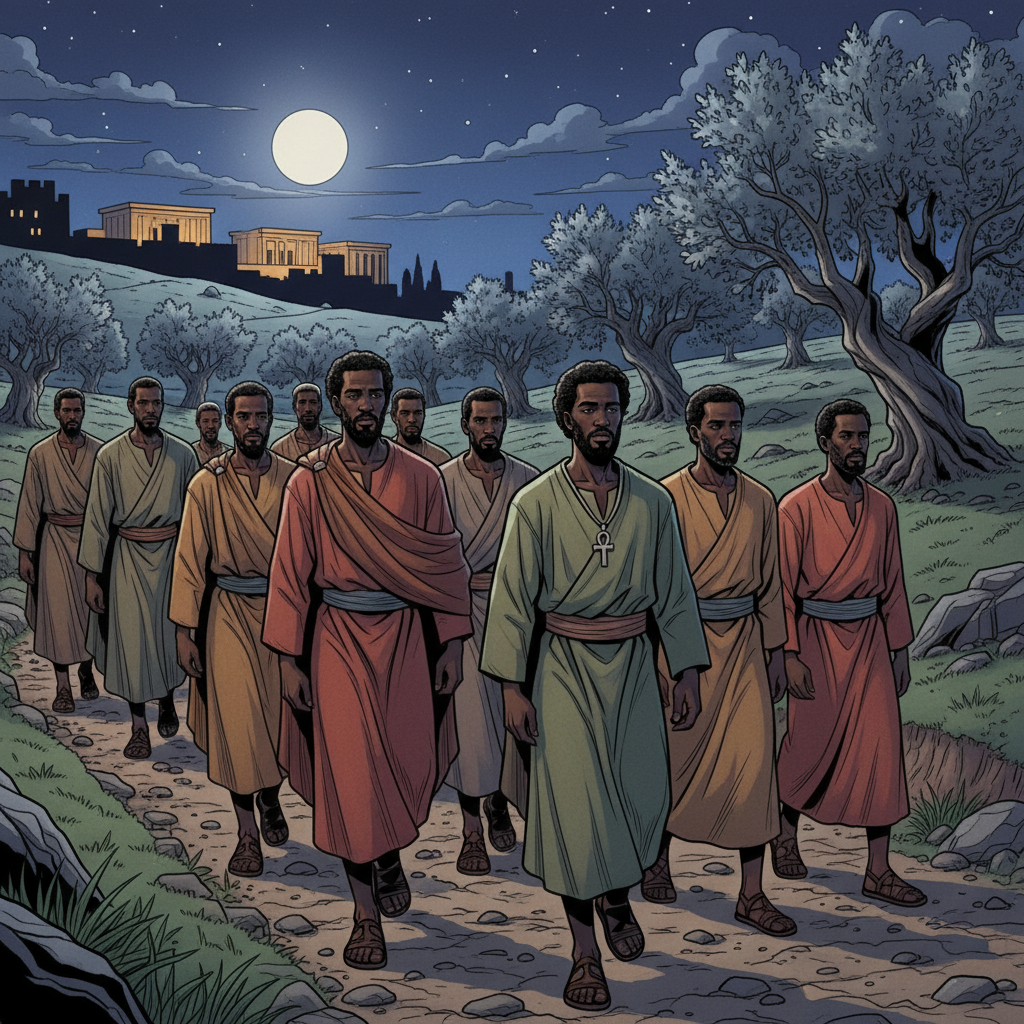
In the upper room behind him, Yeshua was still speaking. 'A new mitzvah I give you,' he told the eleven. 'Love one another as I have loved you. By this everyone will know you are my talmidim.' Kefa’s jaw tightened. 'Master, where you go I will follow, even to death.' Yeshua shook his head gently. 'Kefa, before the rooster crows twice tonight, you will say three times that you do not know me.' Kefa almost laughed. 'Never.' But a small fear opened in him like a crack in dry clay. Yeshua rose. 'Come. Let us go to the garden.' They left the upper room and walked down through the Kidron valley. The moon above Jerusalem was full and pale. Olive trees stood in silver rows on the far slope, ancient and twisted. The garden was called Gat-Shemanim — the place of the olive press. Yeshua loved this garden. He had prayed here often. Tonight he walked toward it as a man walks toward a press that will crush him into oil.
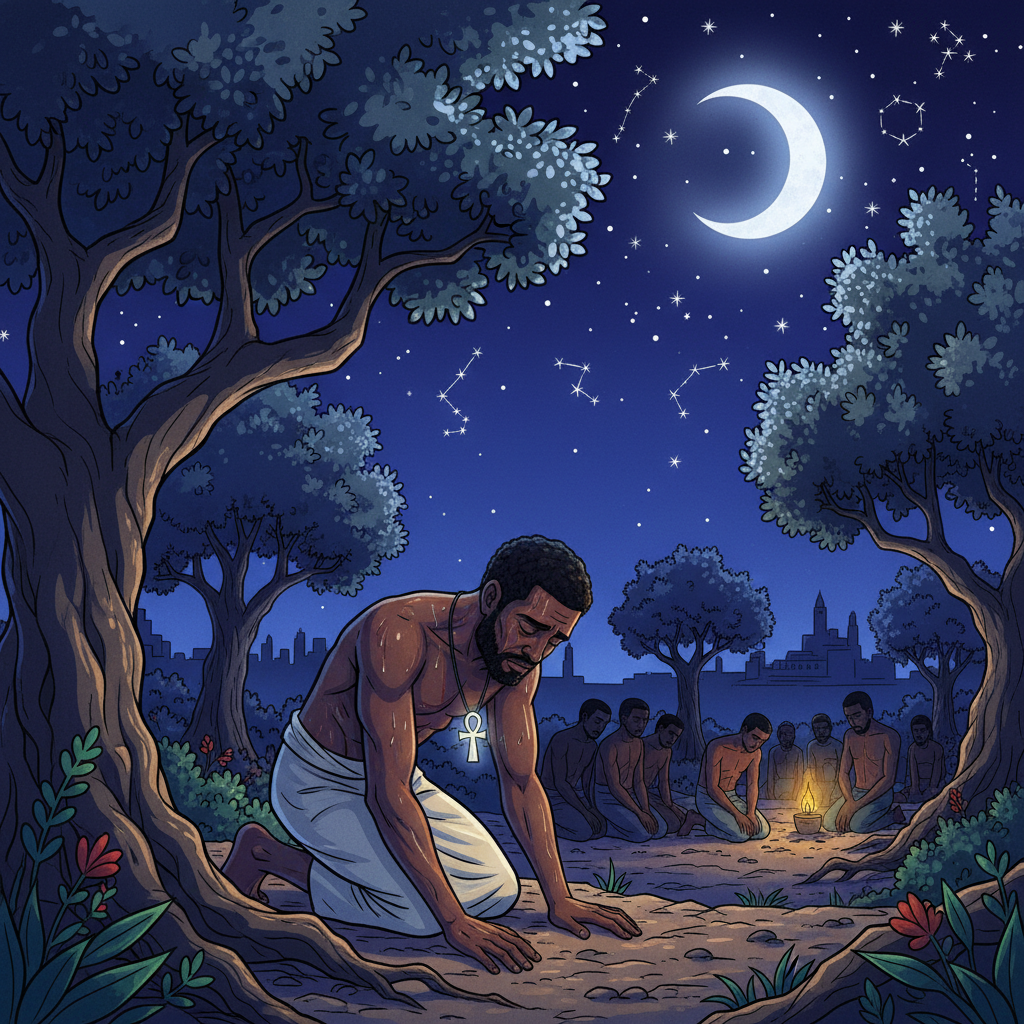
At the garden’s edge, Yeshua stopped. 'Sit here,' he told eight of them. 'Keep watch.' He took Kefa, Ya’akov, and Yohanan deeper among the olive trees. The moonlight fell through the leaves in broken coins of silver. Yeshua’s face, brown and steady all week, now looked like a face about to break. 'My soul is grieving,' he said. 'Grieving to the point of death. Stay here. Stay awake with me.' He walked a stone’s throw further and fell to his knees in the packed earth. The olive roots pressed against his shins. Above him the stars wheeled slow — the same stars, the old Kemetic seers said, that Ausar watched from the Duat. Yeshua pressed his forehead against the ground. 'Abba,' he whispered. 'Father. If it is possible, let this cup pass from me. Yet not what I want — what you want.' Sweat ran down his face and neck, heavy as blood. The silver ankh on his chest caught the moonlight and threw it back like a small, steady coal.
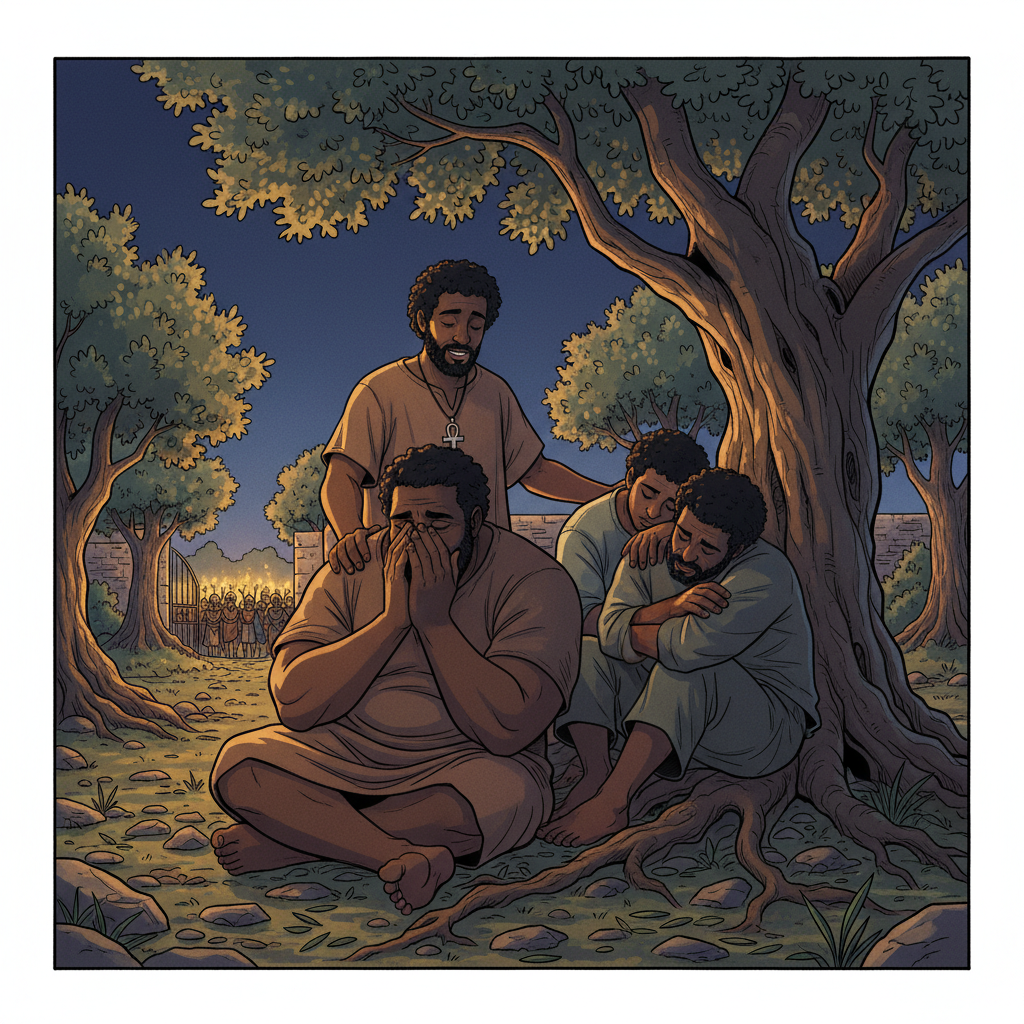
Back under the olive trees, the three disciples tried to stay awake. They had eaten bread and drunk wine. The day had been long. Kefa’s eyelids pulled down like nets full of fish. Yohanan’s head drooped onto his shoulder. Ya’akov sank against a tree root and slept. Yeshua rose from his prayer and walked back. He found them breathing deep. 'Kefa,' he said, shaking the fisherman’s shoulder. 'Could you not watch with me one hour? The flesh is weak, but the spirit is willing. Stay awake. Pray that you do not enter the hour of testing.' Kefa mumbled an apology. Yeshua walked back to his stone and knelt again. 'Father,' he prayed, 'if this cup cannot pass unless I drink it, then your will be done.' Three times he prayed. Three times he returned to find them sleeping. The third time he did not wake them. He stood over them a long moment, then looked east, toward the Kidron gate. Torches were moving there, a thick line of torches, and the glint of Roman helmets among them.
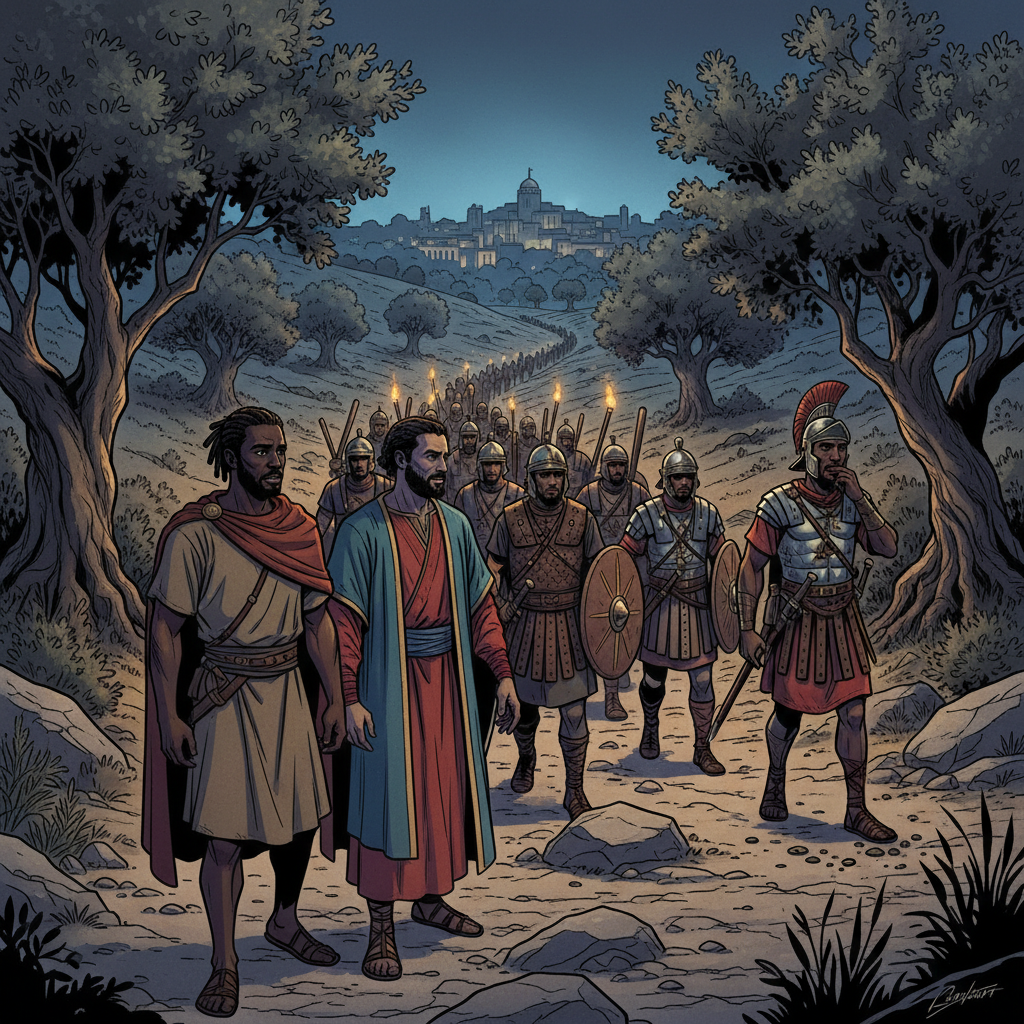
Yehudah led the column down the Kidron path. Behind him marched a mixed force — temple guards in leather cuirasses carrying short clubs, and a squad of Roman auxiliaries with drawn gladii. The auxiliaries were Syrian recruits, dark-skinned men paid by Rome to do work Rome found unclean. Their centurion walked at the rear, bored, spitting olive pits. A temple official named Malkhi-El walked beside Yehudah. 'You are certain of the signal?' Malkhi-El asked. 'A kiss,' Yehudah said. His voice was steady. His hand was not. 'The one I kiss — that is the man. Seize him. But do not harm him.' Malkhi-El almost smiled. 'We do not make that promise.' Yehudah swallowed. This was not how he had pictured it. He had pictured Yeshua standing tall, calling fire from heaven, scattering Romans like chaff. He had pictured a revolution. He had not pictured clubs and gladii and a centurion spitting olive pits. Still he walked. The plan was righteous, he told himself again. A little harder this time. The serpent inside him coiled and listened.
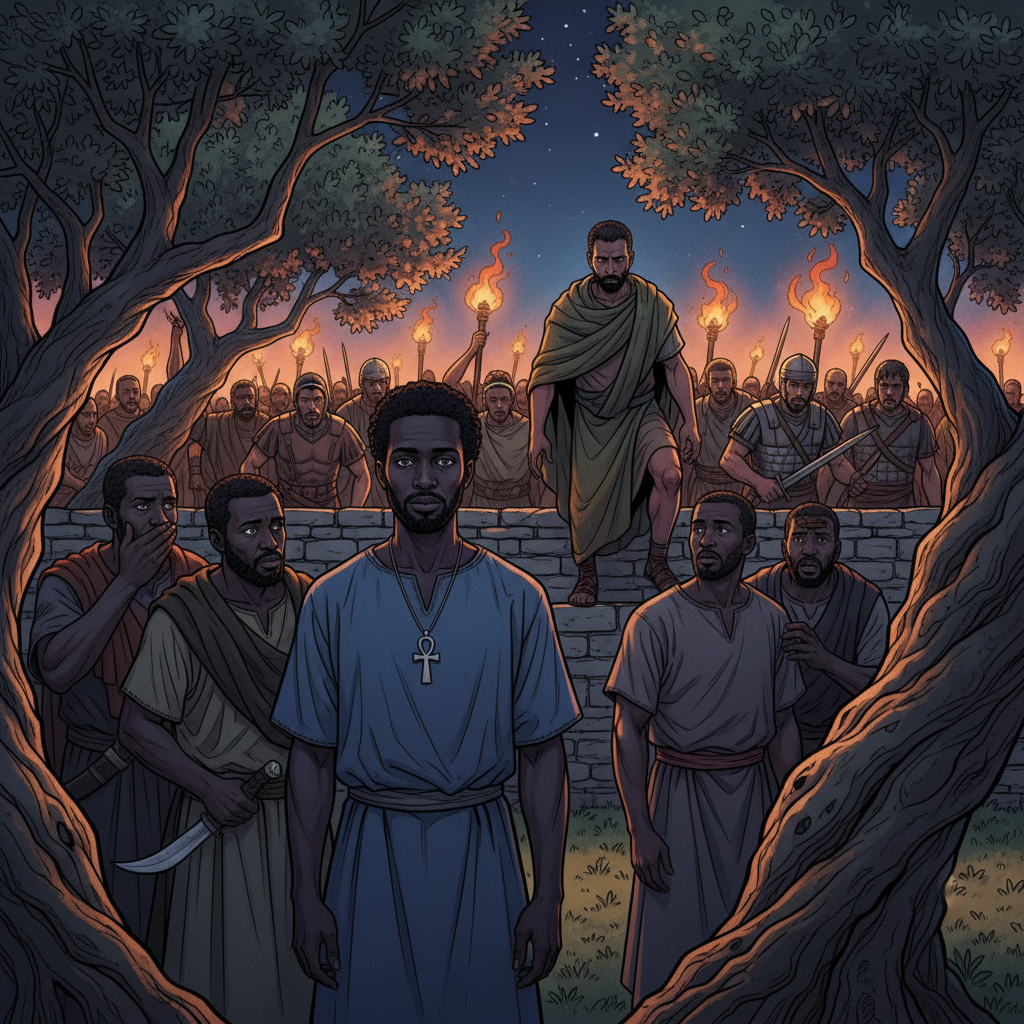
They reached the low wall of the garden. Yeshua had wakened the three. He stood with them among the olive trees, his face quiet now, his fear burned through like a wick trimmed clean. 'The hour has come,' he said. 'The Son of Man is handed over. Rise. Let us go meet him.' Kefa rubbed his eyes and grabbed the hilt of his knife. Torchlight spilled over the wall, then men. Dozens of them. The eight disciples who had been posted at the edge scattered into the dark. Only Kefa, Ya’akov, Yohanan, and two others stayed. Yehudah stepped forward into the torchlight first. His cloak was dusty. His face was calm. His eyes, in that orange glow, were the eyes of a man who has crossed a river and cannot swim back. 'Rabbi,' he said. He came close. 'Shalom, Rabbi.' And he leaned in and kissed Yeshua on the cheek, as a student kisses a beloved teacher. The kiss was soft. The kiss was the signal. The kiss was the knife in the dark.
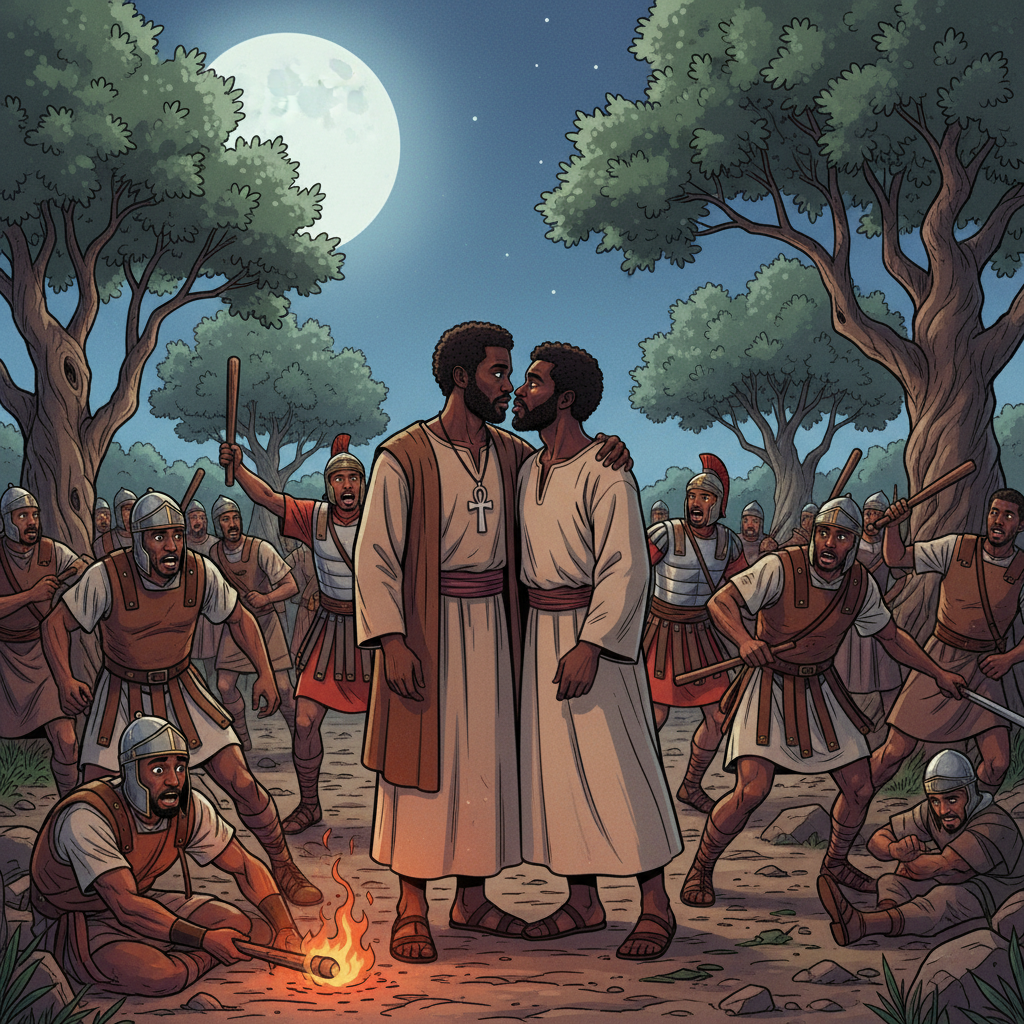
Yeshua did not flinch from the kiss. He did not step back. He looked into Yehudah’s eyes — brown into brown, two Judean faces under the same moon — and said one word. 'Haver.' Friend. 'Friend, do what you came to do.' The word cracked something in Yehudah’s chest. Not yet, not in the way it would crack open fully before dawn, but a hairline split. The temple guards surged forward. Yeshua turned to face them. 'Whom do you seek?' he asked, his voice carrying over the torches. 'Yeshua of Natzeret,' said Malkhi-El. 'I am he,' Yeshua said. And something in the way he said it — the old Kemetic seers would have called it the Nuk pu Nuk, I am that I am — made the front rank of guards stumble backward. One of them dropped his torch. The torch rolled on the ground. For half a breath, no one moved. Then the centurion barked an order in Latin and the soldiers found their footing again. They raised clubs. They closed in.
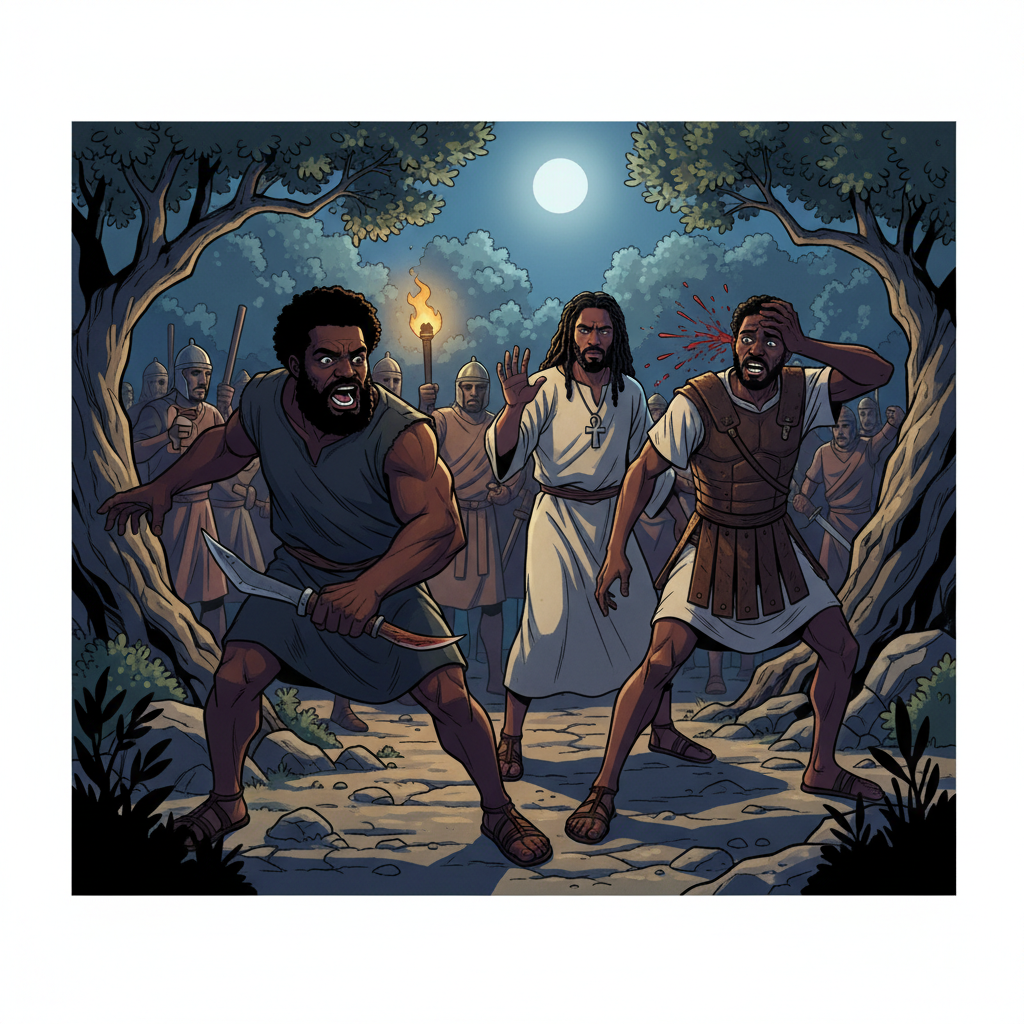
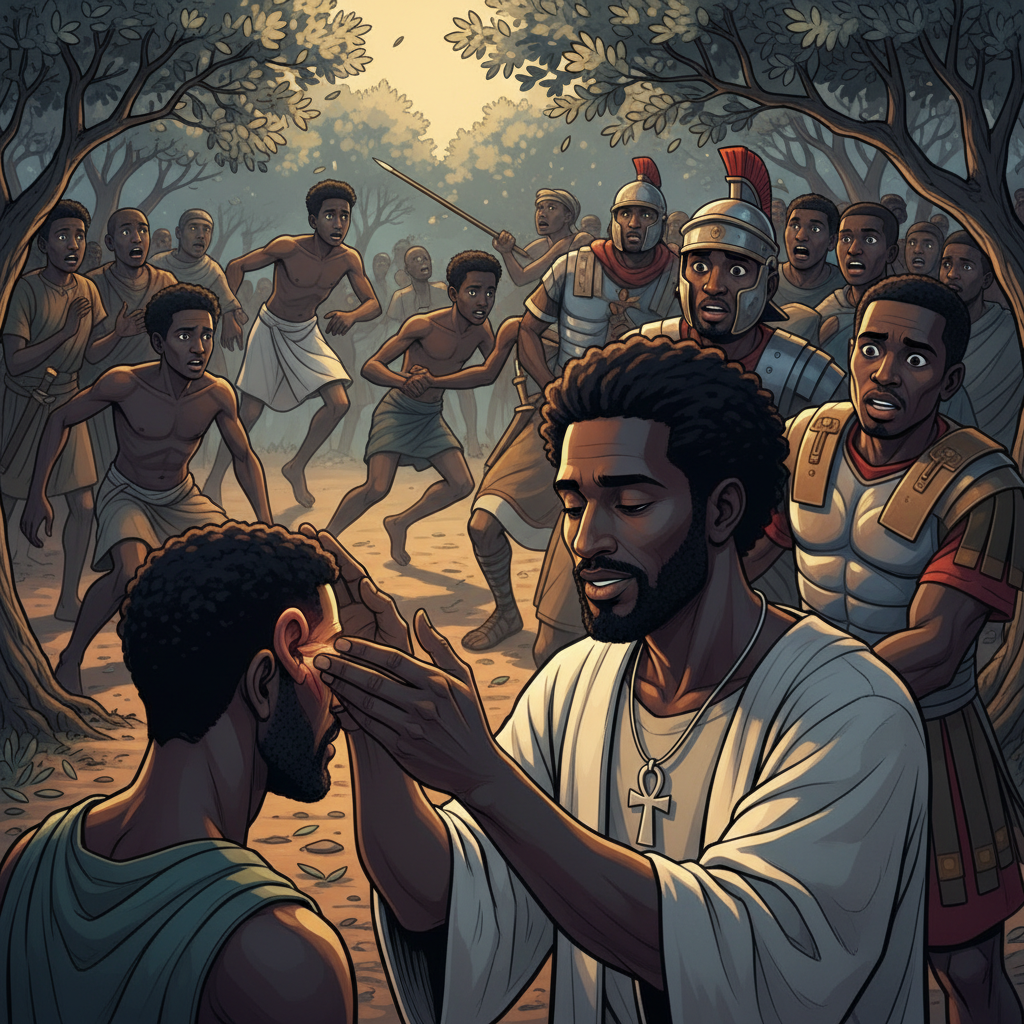
Kefa could not bear it. The big fisherman drew the short knife he carried for gutting fish — a curved iron blade, nothing more — and lunged out of the shadows. He swung wild, aiming for a guard’s throat. He was no soldier. The blade skidded. It caught the right ear of a man named Melek, servant of the high priest Kayafa. The ear split clean. Blood leaped bright down Melek’s neck and into the collar of his tunic. Melek screamed and clapped his hand to the side of his head. The guards raised their clubs. One swung at Kefa. Yeshua stepped between them. 'Put the knife back, Kefa,' he said, his voice like cold stone. 'Those who take up the sword will perish by it. Do you think I cannot call on my Father, and he will send me more than twelve legions of messengers? But how then would the writing be fulfilled?' Kefa’s hand shook. He lowered the knife. He did not drop it. Tears were already starting in his eyes.
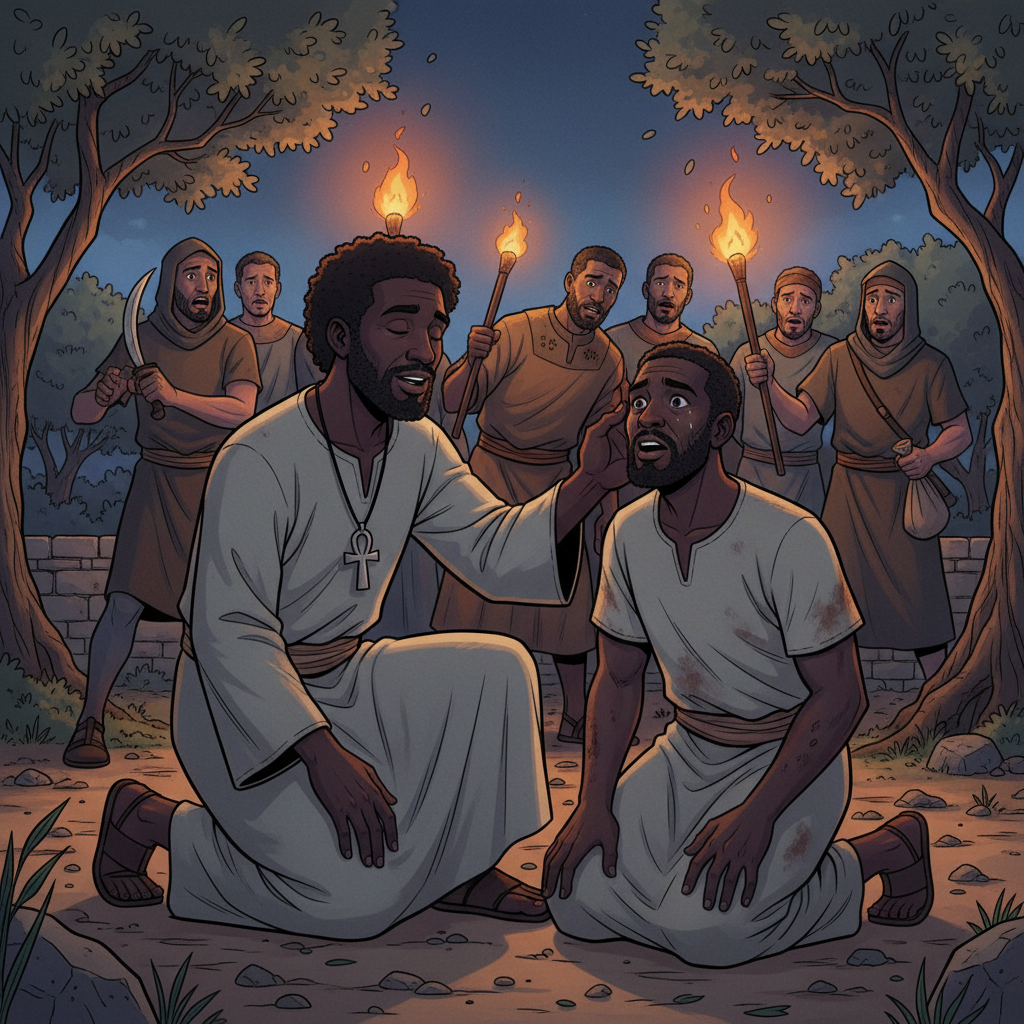
Yeshua turned to Melek. The servant was on his knees, blood running through his fingers, mouth open in a long soundless wail. Yeshua knelt beside him in the dirt. The silver ankh swung forward on its cord. 'Let me see, brother,' Yeshua said. Melek did not know this man, did not love him, had come tonight to bind him. Yet the voice undid him. He let his hand fall. Yeshua cupped his palm gently over the torn ear. He closed his eyes. He breathed in. He breathed out. The old Kemetic healers had taught that the heka — the creative word — flows through the hand when the heart is aligned with Maat. Yeshua’s heart was so aligned it made the torchlight look dim. When he lifted his palm, the ear was whole. No scar. No blood. Only a clean brown ear, and Melek’s astonished face, and a small smear of drying red on Yeshua’s own fingers. 'Go,' Yeshua told him quietly. 'Sin no more.' Melek rose, silent, transformed.
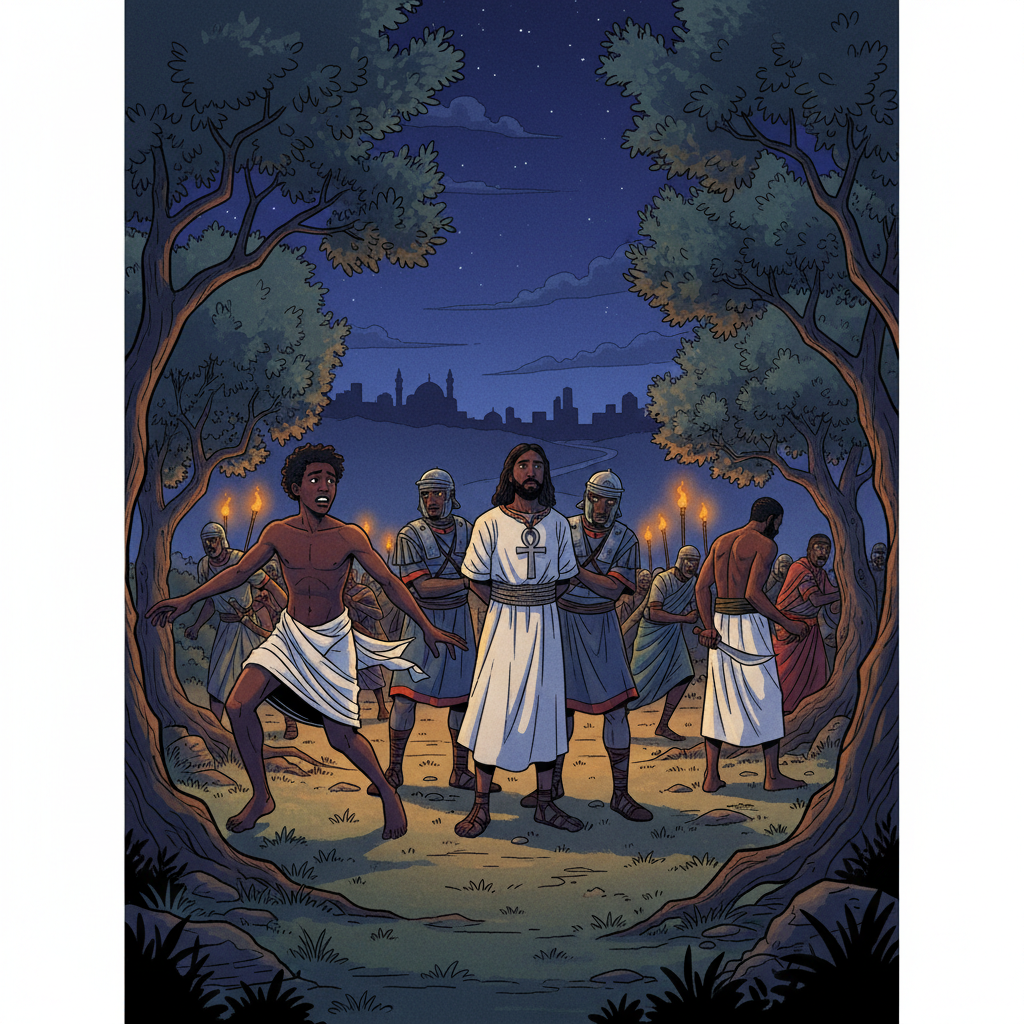
The centurion cursed in Latin and ordered the arrest completed. The auxiliaries seized Yeshua’s arms and bound them behind his back with rough rope. They did not meet his eyes. Even Syrian soldiers, hard men of the Roman road, felt something wrong in this night’s work. Kefa backed away into the trees. Ya’akov and Yohanan backed with him. The rest of the eleven who had stayed now fled, stumbling through the olive roots, their cloaks tearing on low branches. One young follower, wearing only a linen cloth, was grabbed by a guard; he wriggled free and ran naked into the dark. Yeshua did not resist. He did not call legions. He walked between his guards with his head up, his bound hands steady, his ankh tucked back under his tunic by one of the auxiliaries who did not want his officer to see the silver and take it. The torches moved back up the Kidron path toward the city. Yehudah stood alone in the trampled grass where the kiss had been given. The garden was very quiet.
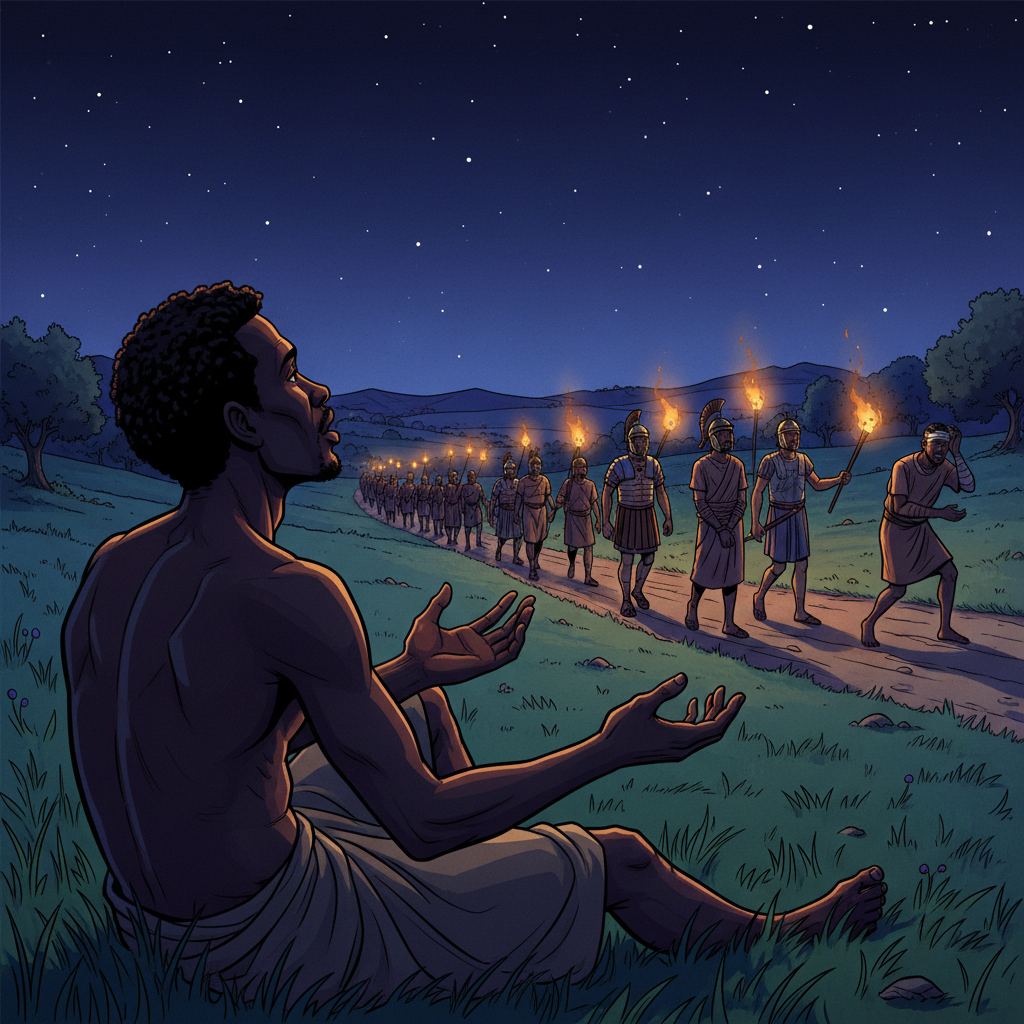
Yehudah sat down in the grass. His legs would not hold him. He could hear the torch-column receding, the clink of Roman armor, the sob-catch of Melek’s breathing as the servant walked back with them holding his own ear in wonder. Yehudah stared at his palms. They looked like his father’s palms, like his grandfather’s — Judean palms, scribe’s palms, the palms of a man of learning. They had just sold a friend for thirty pieces of silver and a plan that had not worked. Yeshua had not called fire. Yeshua had not called the legions of heaven. Yeshua had healed the ear of a man who came to arrest him and walked away tied like a goat to market. The revolution Yehudah had forced was not the revolution Yeshua had been building. The Kemetic Sebau had written: when certainty wears the mask of truth, the serpent is already in the room. Yehudah lifted his head to the stars. They did not comfort him. They looked, he thought, like witnesses.
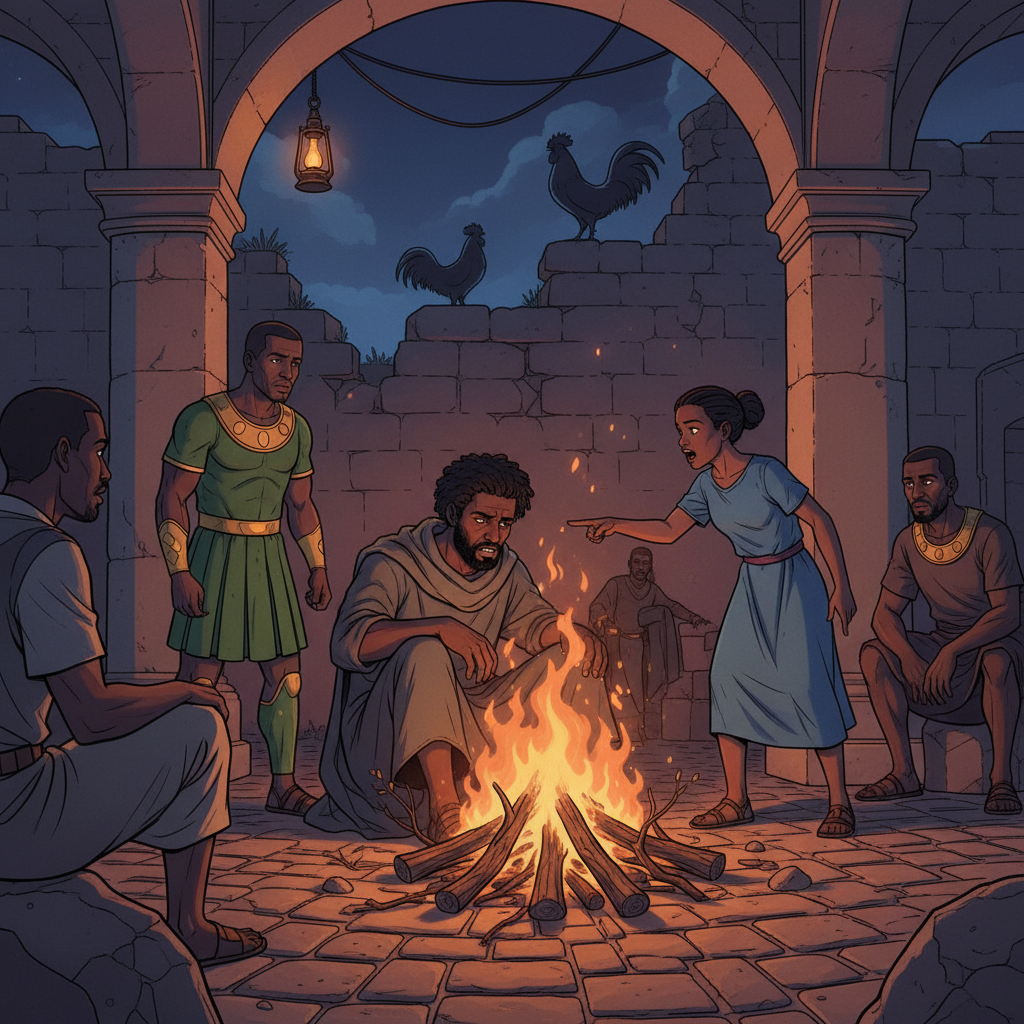
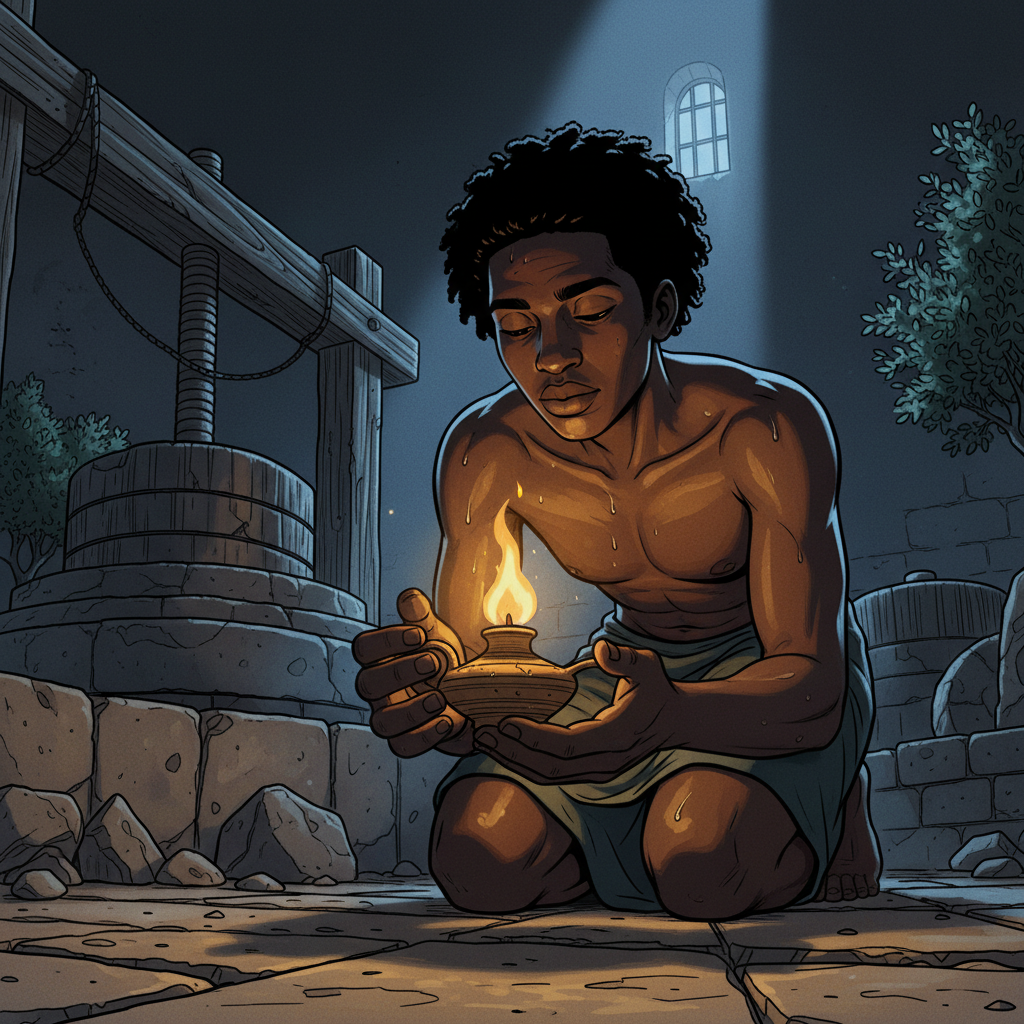
Across the valley, in the high priest’s courtyard, a fire was being built. Kefa would come to that fire soon, hood pulled low, and a servant-girl would say, 'You were with him,' and Kefa would deny it, and a rooster would crow, and Kefa would weep the hardest tears of his life. A young disciple named Markos would take up a reed and begin, years later, to write what he had seen. A centurion named Longinus would one day stand beneath a cross and whisper, 'Surely this was a son of God.' None of that was known yet in the garden. What was known was only this: the olive press had begun its turning. The oil was being squeezed from the fruit. And oil, the old Kemetic priests knew, is what lamps need to keep burning in the dark. Yeshua walked toward his trial in the dark, and somewhere, silently, lamps were being prepared that would burn long after the torches of Rome had gone out.
The Africana teachers — Dr. Ben, John Henrik Clarke, Asa Hilliard III, Obenga — would later point at this garden and say: look carefully. Yehudah is not a stereotype. He is not the caricature drawn by centuries of European hands to justify the hatred of a whole people. He is a dark-skinned Judean man in a real garden, who loved his teacher, and who let the shadow in his own heart confuse speed with truth. The kiss of betrayal is an archetypal motif — Set kisses Ausar before the coffin closes; the pattern is old as Kemet. What matters is not to weaponize Yehudah’s name against his people. What matters is to see the Apophis-serpent that can rise in any heart, including yours, including mine. Yeshua’s response is the Maat answer: do not return the betrayal with a blade. Heal the ear. Walk into the dark. Trust that oil pressed in darkness still lights lamps at dawn. The story is not about Yehudah’s evil. It is about everyone’s shadow, and the Galilean who met it without lifting a sword.
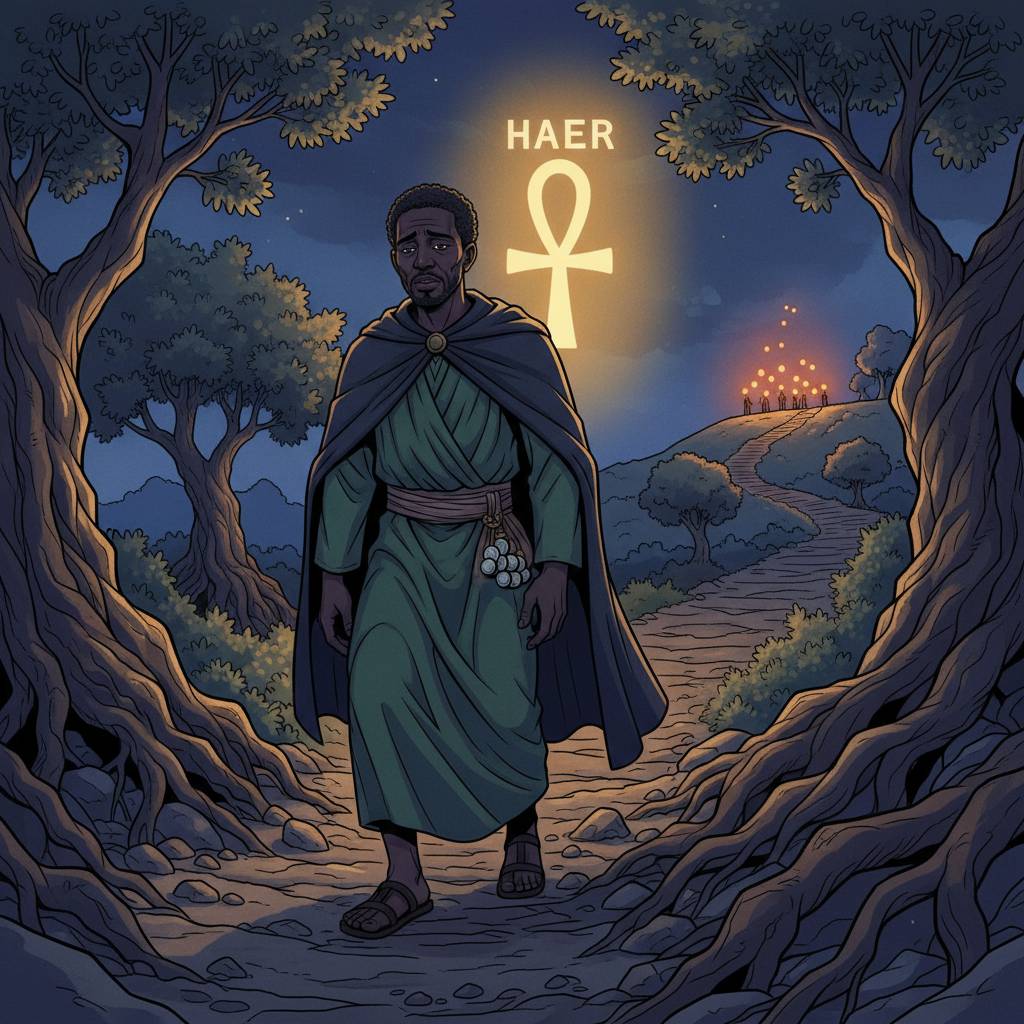
Yehudah rose from the grass at last. He did not know where to go. The temple guards had paid him and did not want him near the trial. His talmidim brothers had scattered. His Rabbi was gone, bound. He walked down through the olive roots in the direction opposite the torch-column. The silver coins in his cloak knocked against his hip with every step, a small cold rhythm. He would carry them back to the priests before dawn. He would throw them on the temple floor. He would say, 'I have sinned by betraying innocent blood.' They would answer, 'What is that to us?' And Yehudah would go out alone into a field outside the city, and what he did there is a grief the Africana reading holds without mocking. He was a man. He made a choice. The choice was wrong. The shadow in him won the council of his heart. And still — still — Yeshua had called him Haver. Friend. That word walked behind Yehudah in the dark like a lamp he could not put out.
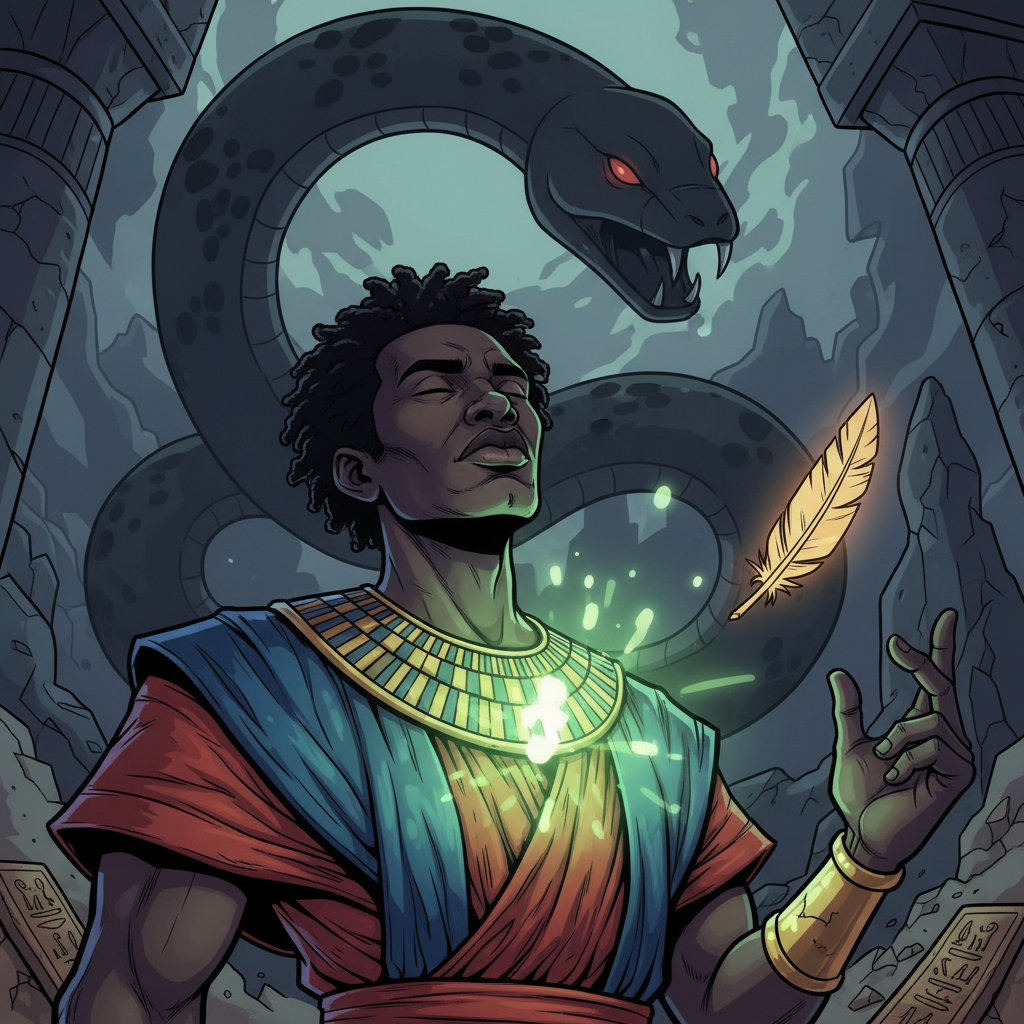
The old Kemetic priests of Per Ankh had taught that every soul holds two chambers: the sunlit hall where Maat walks with her feather, and the shadow hall where the Apophis-serpent tests the unwary. A person of Maat does not pretend the shadow hall does not exist. A person of Maat walks through it with a lamp. The lamp is truth spoken plainly, even to oneself — especially to oneself. Yehudah’s error was not that he had a shadow. Every student in the Per Ankh had a shadow. Yeshua himself had sweat blood in the garden wrestling with his. Yehudah’s error was that he lit no lamp. He walked into the shadow hall calling his own voice the voice of God. He never stopped to ask, 'Rabbi, am I hearing rightly? Teach me where I am wrong.' Loyalty, the Sebau wrote, is not speed. Loyalty is the slow courage to stay with a teaching you do not yet fully understand, trusting the light will clarify what the hurry would have destroyed.
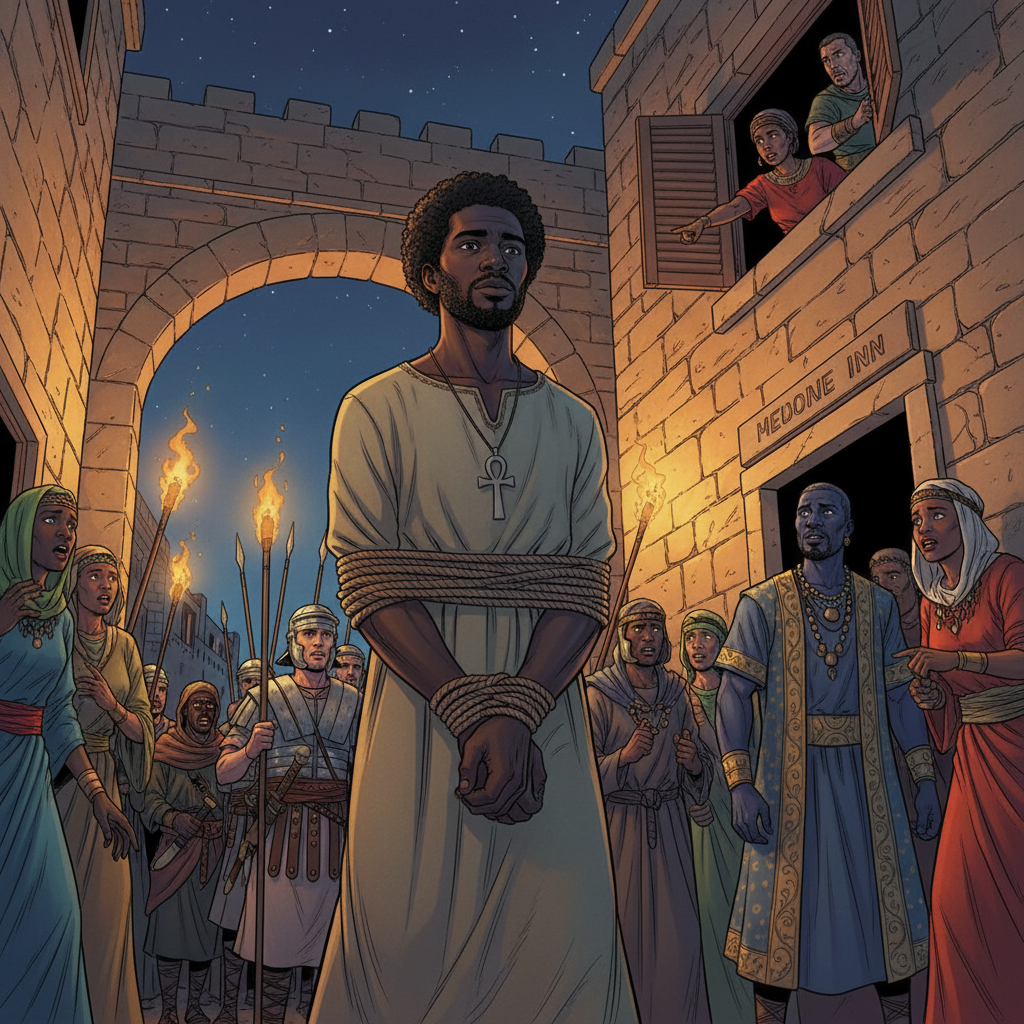
Yeshua was led through the Kidron gate bound. The pilgrims who were still awake drew back as the column passed. A Kushite trader from Meroe, standing at an inn door, saw the bound Galilean and felt a shiver he could not name. A Roman centurion’s wife, looking down from a balcony, saw the torchlight wash over Yeshua’s face and said to her husband, 'That man is innocent.' The husband grunted and closed the shutter. Yeshua’s head was high. He did not shake. He did not shout. He walked toward the high priest’s house as a man walks toward the press that will turn his fruit into oil. Behind him, in an alley he could not see, Kefa was already following at a distance, his heart a storm, his knife still at his belt, a denial already forming in his throat like sickness. The night was not over. The arrest was only the first hinge of a long door. But the door had now swung. And Yeshua walked through it unarmed.
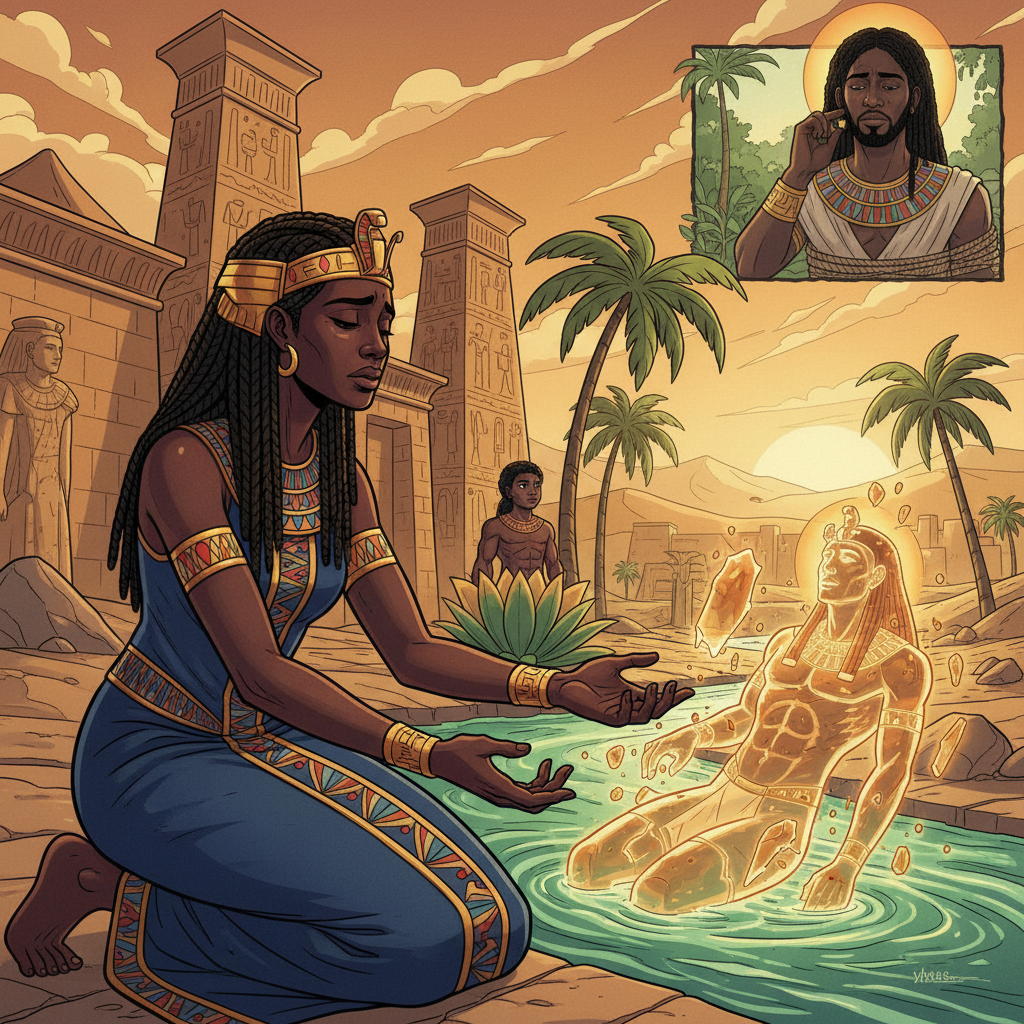
In Kemet’s oldest stories, when Ausar was betrayed by Set and sealed in the coffin, the goddess Aset — his sister and wife — did not answer betrayal with a blade. She answered it with searching. She walked the length of the river looking for the scattered pieces of her beloved, and by the power of her mourning and her love, she made him whole enough to father Heru, the avenger who would come later as justice, not vengeance. Yeshua in Gethsemane stood in that ancient Kemetic pattern. The betrayal was real. The grief was real. But the response was not the blade. Kefa’s blade had cut an ear; Yeshua’s hand had healed it. This is the signature of Maat in a man’s body: when wronged, he does not return wrong. He returns healing. He returns silence when silence is needed. He returns Haver — friend — even to the one who kissed him into chains. The lesson, the Sebau would say, is harder than any sword work. It asks more.
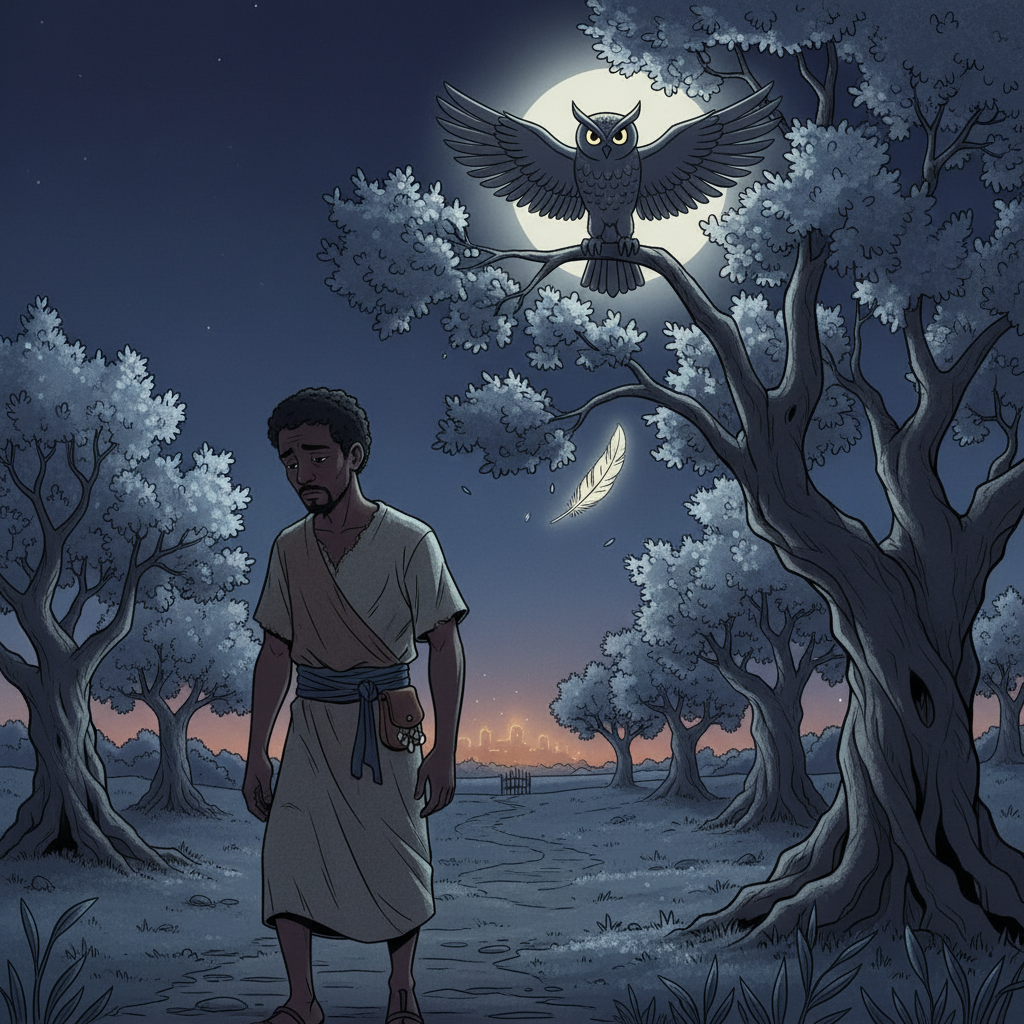
Dawn was still hours away. The olive garden stood empty behind Yehudah now, its torches gone, its trees silver and silent. An owl called from a high branch — the bird the Kemetic scribes had drawn to mean 'M,' the letter that began the word Maat. Yehudah heard the owl and did not look up. If he had looked up, if he had whispered back to his Rabbi’s last word — Haver — if he had walked not into the field of silver but into the courtyard where Yeshua was already being questioned, and fallen on his knees and said, 'I was wrong, I was wrong, forgive me' — the Africana teachers say the story would have held him too. Maat is wide. Maat holds the repentant. But Yehudah did not turn back. He kept walking. The silver clinked. The serpent inside him told him he was beyond forgiveness, which is the last and cleverest lie the Apophis whispers. Yehudah believed that lie. That lie, not the kiss, is what finally killed him.
And yet — and this is where the Galilean of the Kemet Continuum teaches what no other teacher teaches — Yeshua did not stop loving Yehudah at the kiss. He did not stop loving Kefa at the denial. He did not stop loving the eight who fled, or the young follower who ran naked, or Melek whose ear he had healed, or the centurion who would soon nail him. He walked into the press carrying all of them. The old Kemetic text called the Coming Forth By Day said that the heart of the righteous weighs no more than the feather of Maat on the scales of Ausar. Yeshua’s heart in Gethsemane weighed exactly that. It was heavy enough to sweat blood. It was light enough to forgive before the nails were even driven. This is what loyalty to the Sebau teaching looks like at its full cost: staying faithful to love while love is being crucified. Yehudah could not bear such a weight. Most cannot. But the Galilean could, and did, and does.
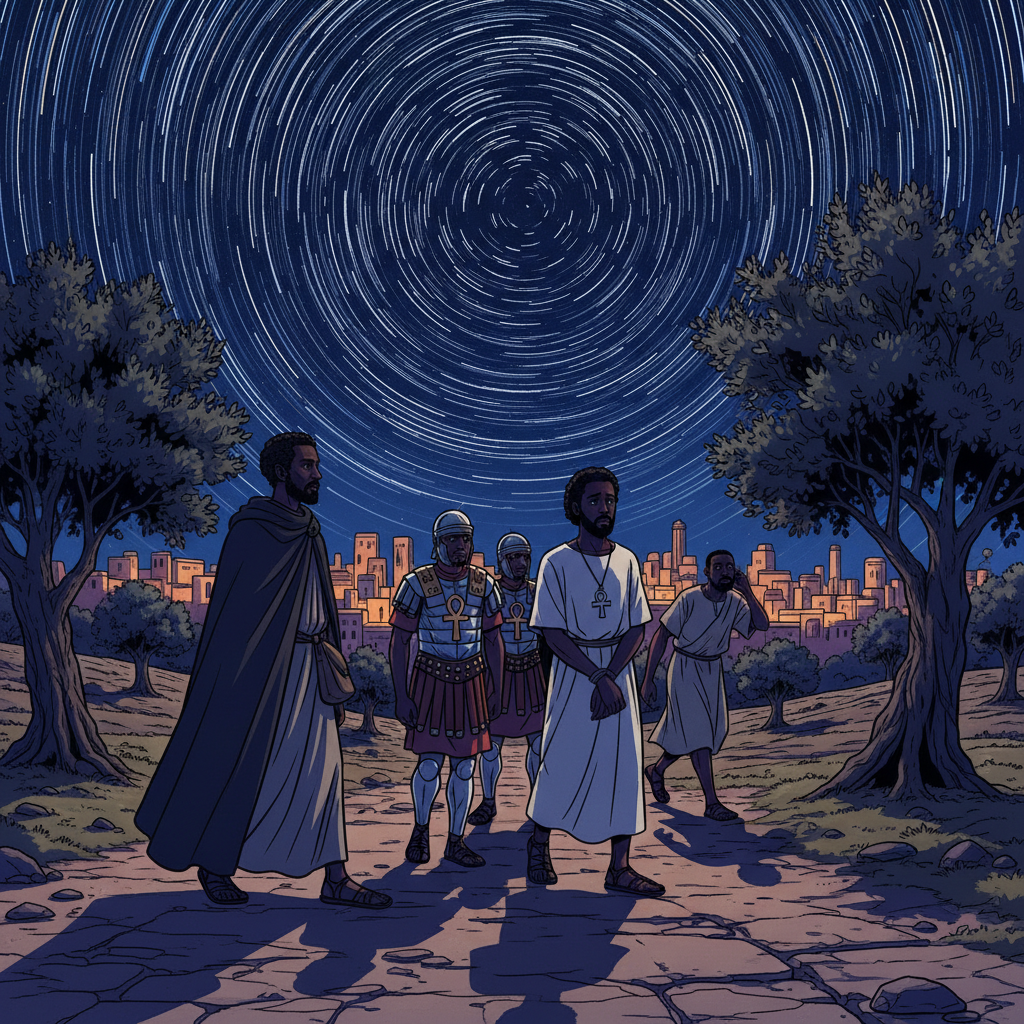
The garden emptied fully at last. Yehudah walked east, Yeshua was led west, Kefa followed at a distance, and the stars wheeled over Jerusalem as they had wheeled over Waset and Napata and Meroe for ten thousand years. In Gat-Shemanim the olive press was still. The fruit on the trees hung heavy, waiting. What the Africana reading wants every child to see is this: the kiss in this garden is not proof that Yehudah’s people are cursed. It is proof that any heart, in any generation, can let the Apophis-serpent speak in the voice of certainty and call it loyalty. It is proof that any teacher worth following will, at some point, be handed over — and will answer not with a blade but with a healing palm. It is proof that Maat walks unarmed through the worst hour, and by walking unarmed, outlasts all the gladii of Rome. The night was long. The press was turning. Somewhere, before morning, lamps were being filled.
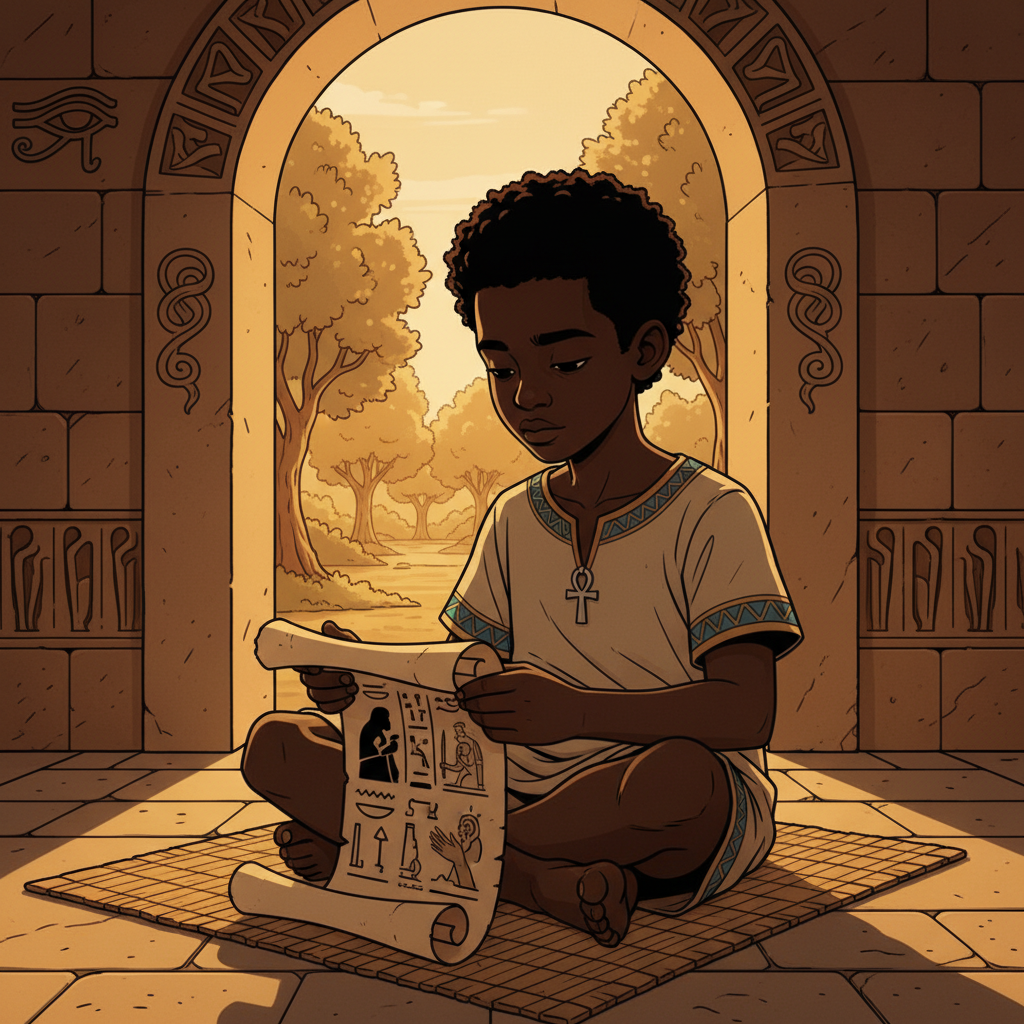
Before you close this chapter, sit with the question the old Per Ankh teachers would set before a student after a night like this one. Not 'who was the villain'? Not 'who do you hate'? Those are the questions the shadow wants you to ask. The Sebau question is gentler and harder: where in your own heart does the Apophis-serpent whisper that certainty is the same as truth? Where do you, like Yehudah, try to force a teacher’s hand because you have grown impatient with the teacher’s pace? Where do you, like Kefa, reach for a blade when a teacher has asked you to wait in prayer? And where, like Yeshua, might you be asked — in a small Gethsemane of your own today — to heal the ear of the one who came to bind you? Loyalty in the Kemet Continuum is not speed. It is not certainty. It is the slow, unarmed willingness to love what betrays you until love itself has the last word. Amen, the Galilean would say. And in Kemet: so it is.