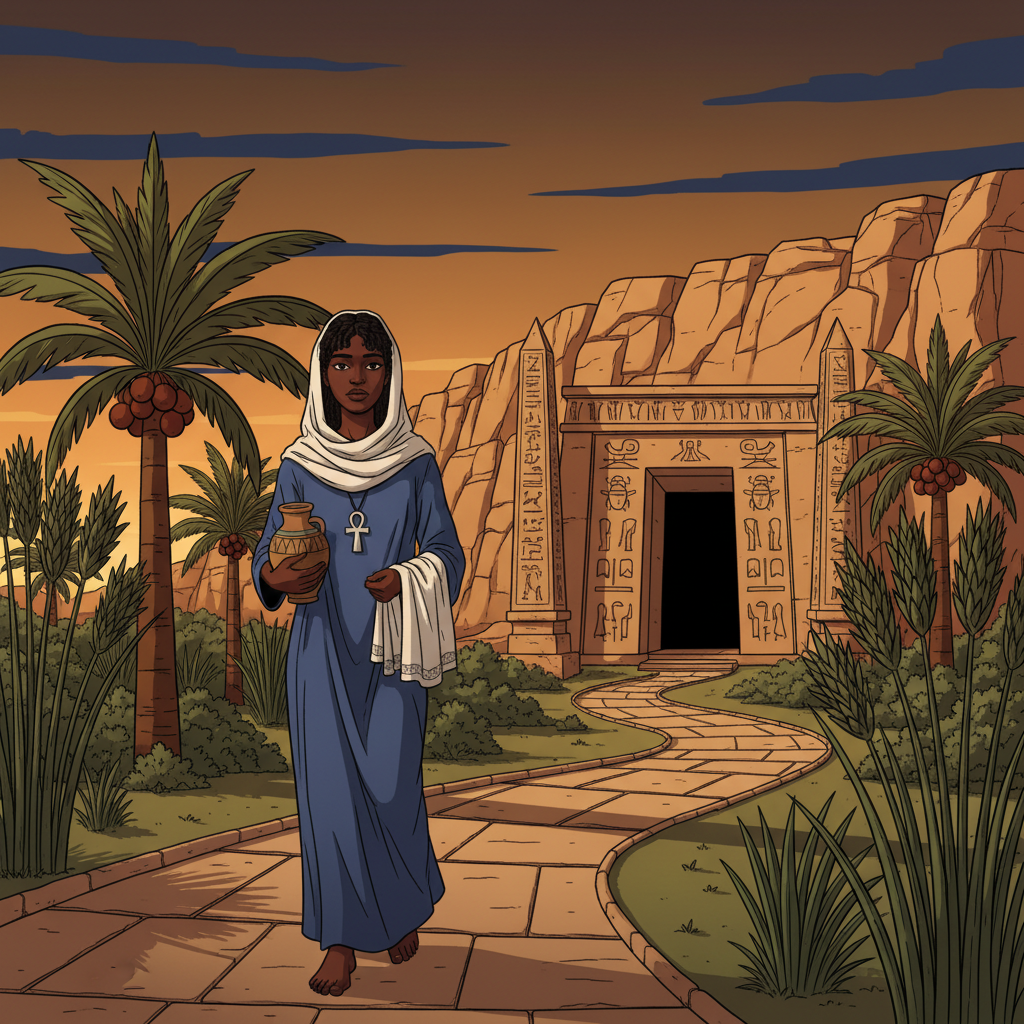
The sky over the garden was the color of old bronze when Miryam of Magdala set out for the tomb. She walked alone along the stone path, a jar of myrrh in one hand and a bundle of linen in the other. Her eyes were dry now. She had wept the first night until her ribs ached, and the second night until her throat closed, and on the Sabbath she had sat in silence because the law said so and because she had no more tears to spend. Around her neck hung the silver ankh. Yosef of Arimathea had pressed it into her palm after they laid Yeshua in the rock-cut tomb. “He wore it to the cross,” Yosef had whispered. “He would want it with you now.” She had not taken it off. The metal was cold against her skin, then warm, then cold again, like a small heart keeping time for a body that no longer had one. She kept walking. The birds had not yet started. The world was holding its breath.
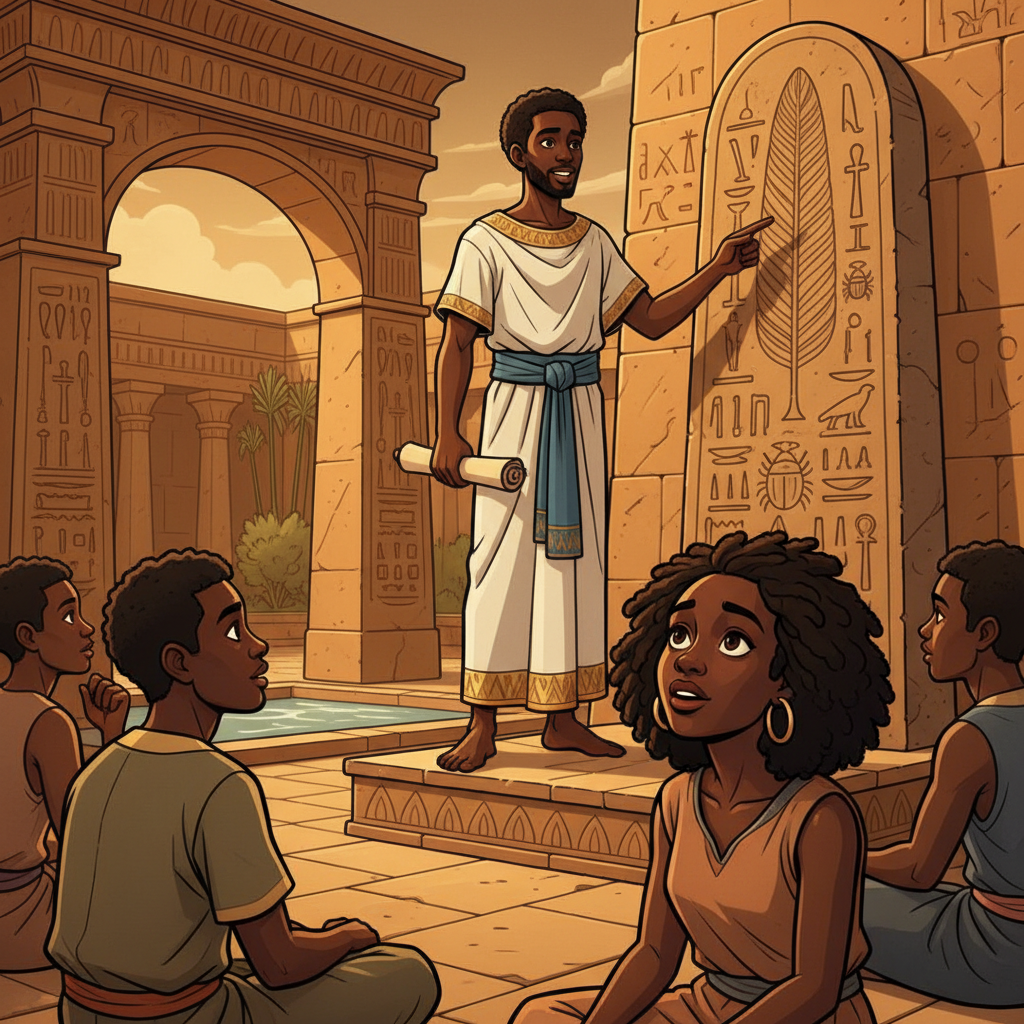
She had loved him in the way a student loves a Seba who has opened the eyes of her spirit. That was the truth she had not spoken to the Roman soldiers, or to Petros when he wept in the upper room, or even to her own mother. Yeshua of the Galilee had taught her to read the old Kemetic signs. He had taught her that Maat was not a foreign idea, that the feather and the heart belonged to every human being who had ever drawn breath. Now his heart had stopped. The Romans had done what Romans always did to men who taught the people to see themselves clearly. They had nailed him up as a warning. But Miryam remembered what he had said on the road from Bet Ania, the last long walk before Jerusalem. “The scarab rolls the sun up each morning, Miryam. Do you believe that stops for me?” She had laughed then, not understanding. Now, walking through the gray bronze dawn, the words came back to her like a rope thrown across a chasm.
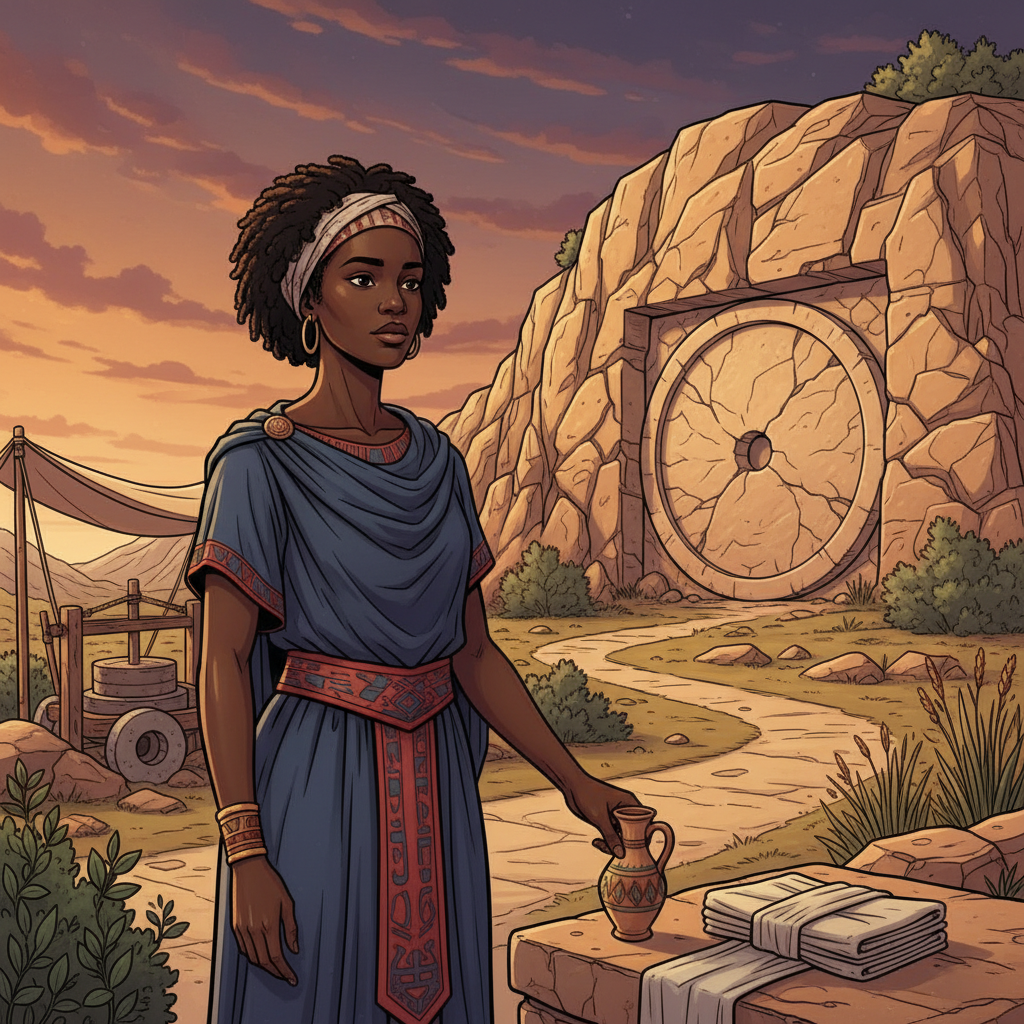
The path curved past the olive press and climbed a small rise, and there the tomb lay cut into the living rock — a square mouth sealed with a round stone like a coin pressed against a wound. Yosef had paid for the tomb himself. He was a rich man of Arimathea and a secret follower, and when no one else would take the body down, he had gone to Pilatus and asked for it by name. Miryam set her jar down on a flat stone and breathed in. The myrrh smelled of resin and of the inside of cedar boxes, the smell her grandmother had used when wrapping the dead. The old women of her village had trained her in this. They had trained all the girls, whispering the Kemetic words they still remembered even after Greek and Roman tongues had worn grooves into the land. A body must be washed. A body must be spoken to. A body must be pointed east, toward the rising, so that the khepri sun could find it. She was here to do what the Sabbath had stopped her from doing.
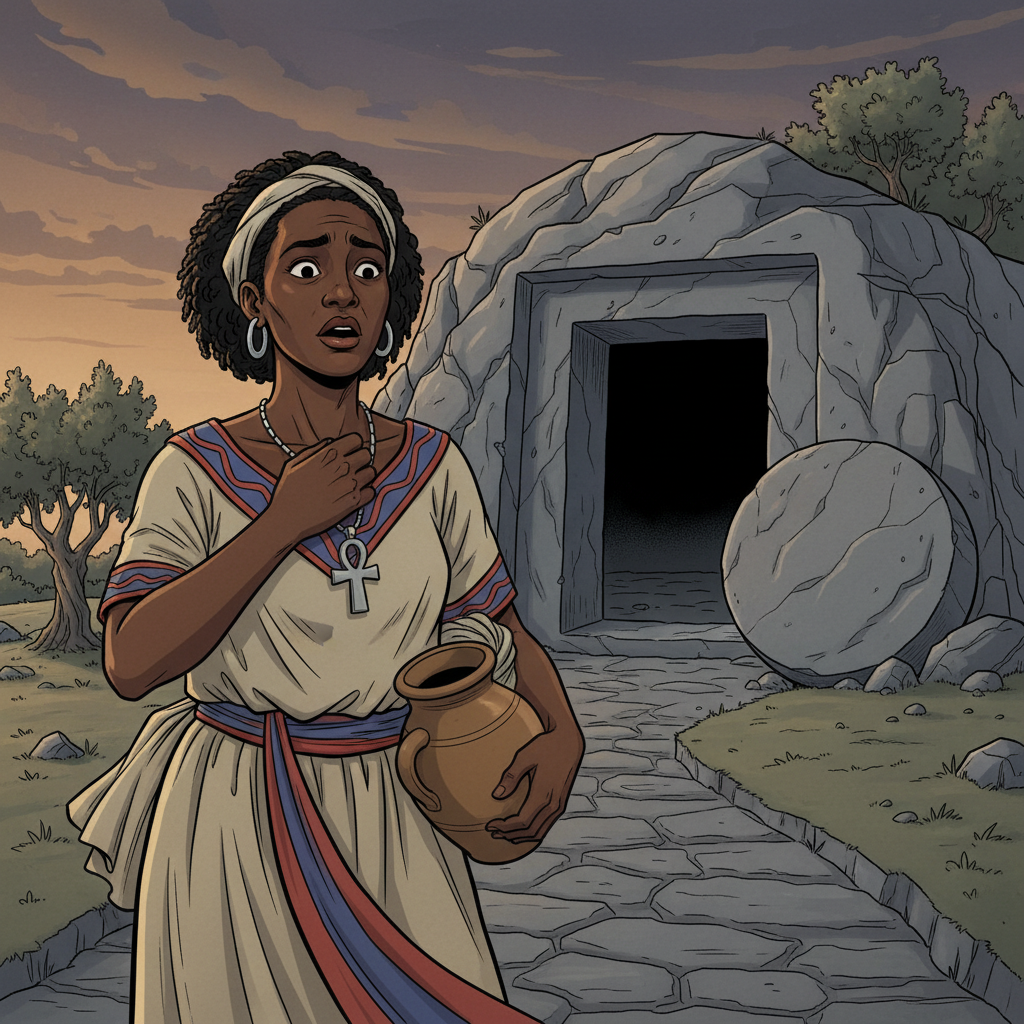
She lifted her eyes to the tomb mouth. And then she stopped. The stone had been moved. Not cracked. Not shattered. Rolled aside, cleanly, the way a well-oiled door rolls on its pin. The dark square of the tomb entrance gaped open. Gray dawn light spilled inside and touched the floor. Miryam’s first thought was Romans. Grave robbers. Someone had come in the night to take him, to insult him further, to throw his body in a ditch where the jackals would finish what the cross had begun. Her knees softened. The jar of myrrh slipped in her hand. She caught it against her hip. “No,” she said aloud, to no one. “No, not this too.” The silver ankh at her throat suddenly felt heavy. She gripped it. The metal warmed under her fingers. She thought of Yeshua kneeling in the garden three nights ago, sweat like dark beads on his temples, his voice saying, “Miryam, the hour is coming.” She had not known what hour. Now she thought maybe this one. She made herself walk forward.
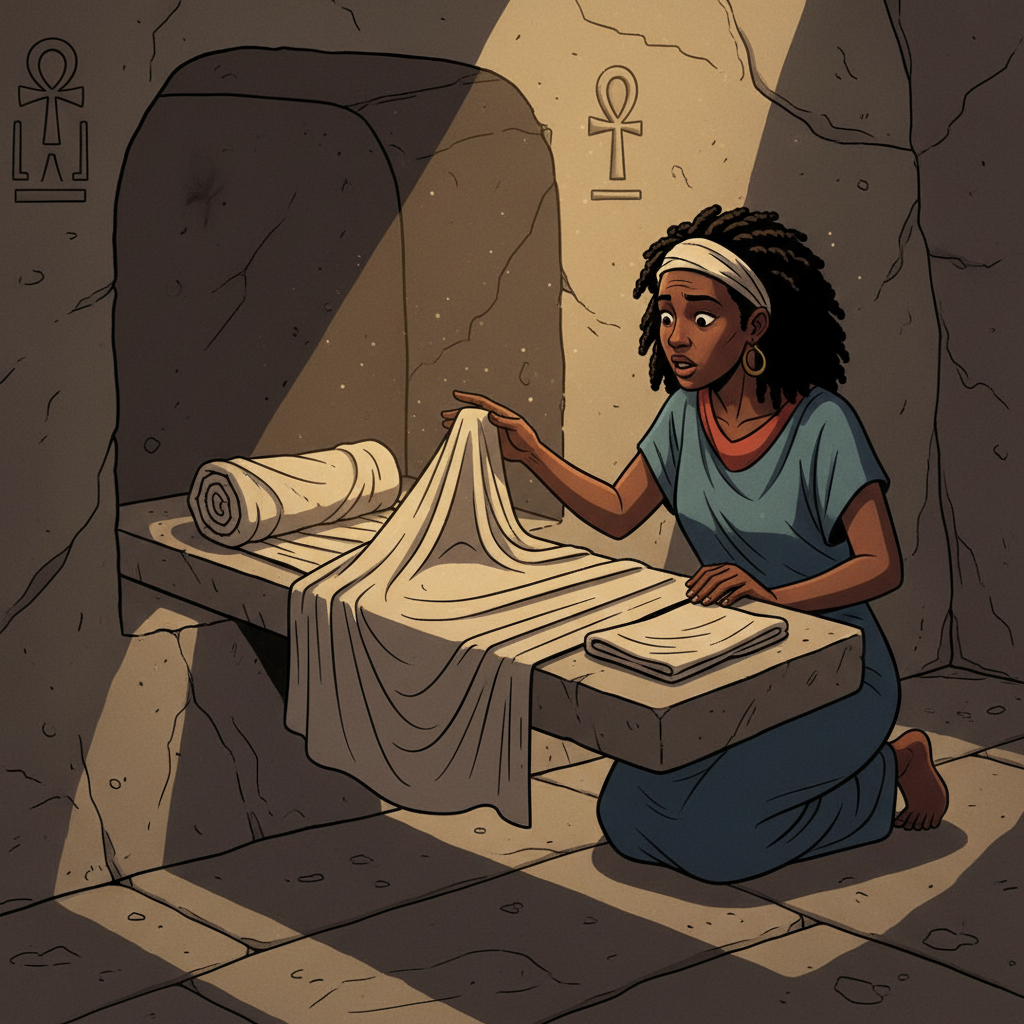
She stepped into the tomb and her eyes had to adjust. The air inside was cool and smelled of limestone and of the myrrh they had used on the first night. The burial shelf was cut into the far wall. She could see the shape of it in the half-dark. The body was not there. The linen wrappings were. But they were not scattered as a thief would have left them. They were not torn. They lay folded — the long body-linen folded in on itself like a scroll laid down with care, and the smaller cloth that had covered his face folded separately, set apart at the head of the shelf. Miryam knew thieves. She had lived in Magdala near the fishing docks. Thieves did not fold. Thieves tore, and ripped, and scattered, and ran. Whoever had moved him had done it with hands that honored him. Her own hands shook as she reached out and touched the folded linen. It was cool. It was empty. It held the faint scent of cedar and of the garden outside. She drew her fingers back.
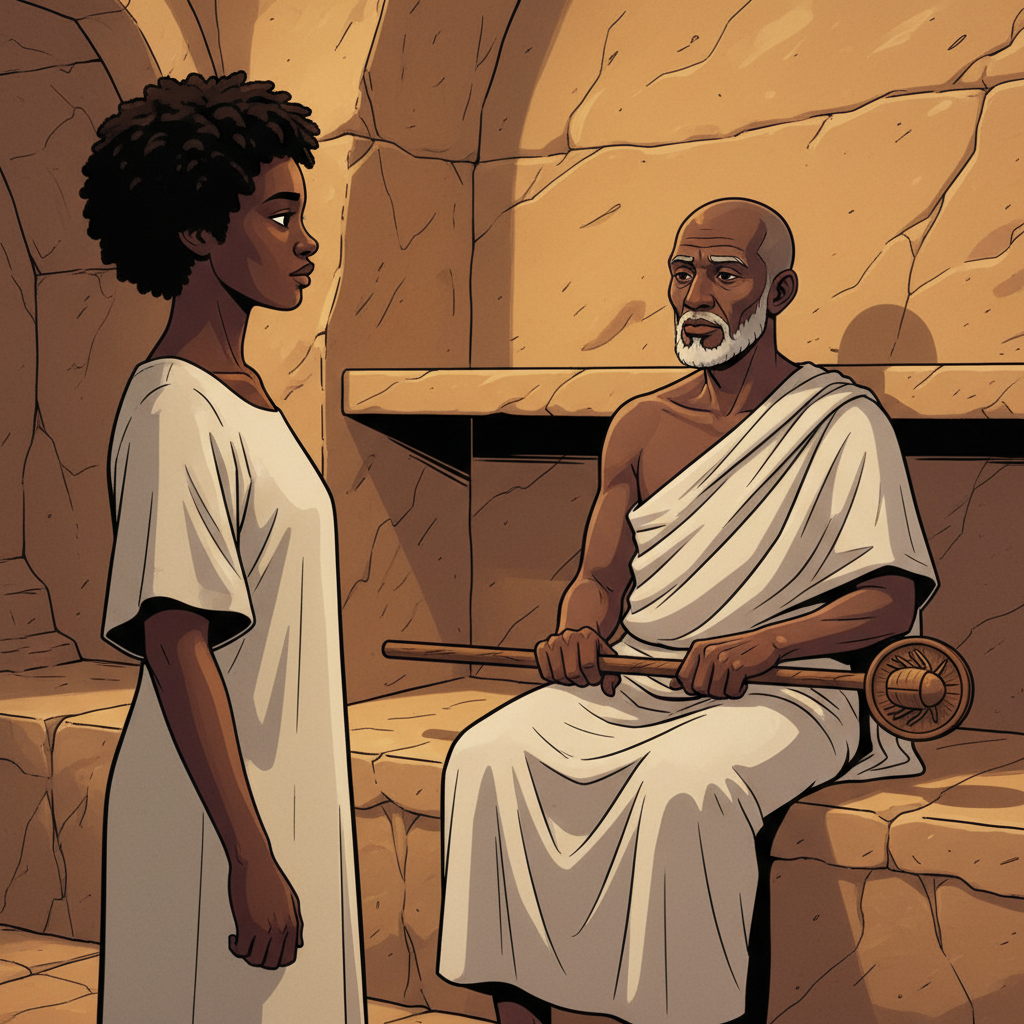
Then she heard the breath of someone else in the tomb with her. She turned, and her heart did not leap so much as go very still, because she saw that he was old. He was an old man in white linen, seated on the stone ledge opposite the burial shelf, as if he had been waiting there a long time and was in no hurry at all. His skin was dark as river silt at dusk. His beard was white and close-trimmed. His head was shaved in the old Kemetic way of the Per Ankh priests, and across his shoulders he wore the simple undyed linen robe of a Seba — the kind of robe her grandmother had described from stories of Waset, where the teachers once walked from the temple to the school at dawn. He had a staff across his knees. On the staff, carved into the wood, she saw it: a small scarab, wings folded, pushing a disc. “Miryam,” he said. He said her name the way Yeshua had said it. He said it like someone who had known her before her mother named her.
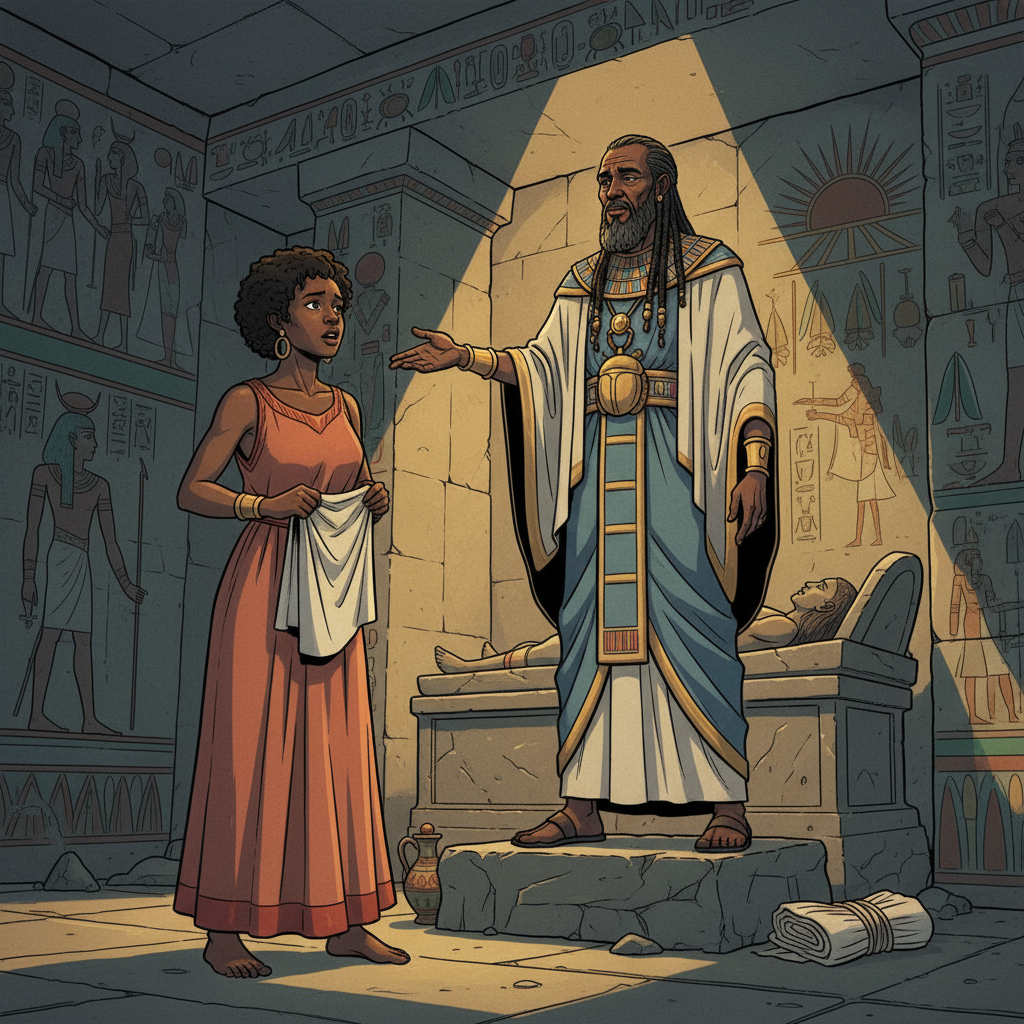
“Daughter of Magdala,” the old man said. His voice was low and unhurried, as if the morning had room enough for every word. “Do not be afraid. You came here at the correct hour. You brought the correct oils. You remembered the direction of the east. Your teachers trained you well.” Miryam found that she could not speak. Her hand was still on the folded linen. “You know the old words,” the Seba said. “The ones your grandmothers kept, even when the Greeks came, and the Romans after them. Say them for me now, daughter. Say the name of the book your people carried down from Kemet.” Her mouth was dry. She swallowed. The name came up from somewhere beneath her grief, beneath her confusion — from the deep place where the lessons are kept. “Per em Heru,” she whispered. “Coming forth by day.” “Yes.” The old man nodded slowly. “That is the name. And that is what has happened here, Miryam. Not a new thing. The oldest thing. He has come forth by day.”
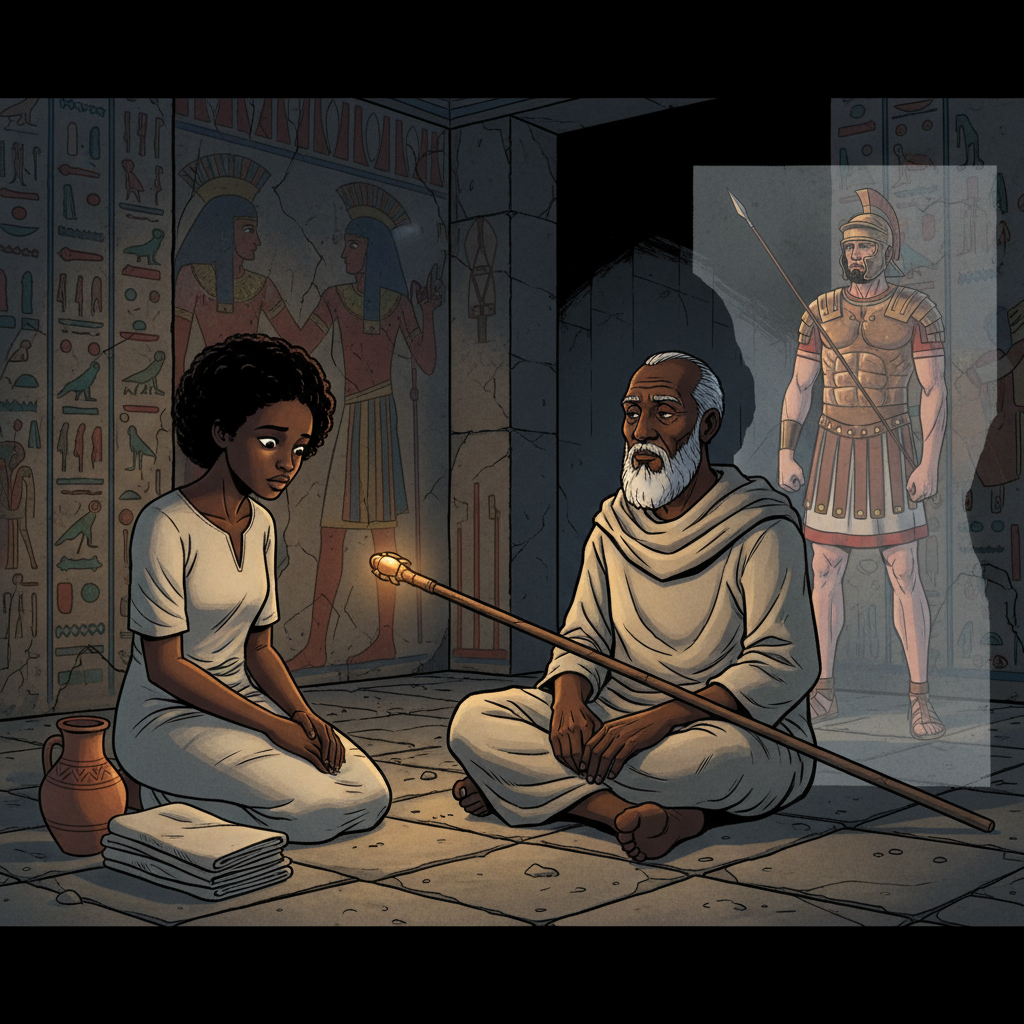
She sank down onto the floor of the tomb. Not fainting — kneeling. Her knees found the cool stone and she let them. The jar of myrrh rested beside her. The folded linen lay above her. The old man sat across from her, calm as a lamp in a still room. “I don’t understand,” she said. Her voice sounded far away from her own mouth. “I saw him die. I watched the spear go in. I walked behind the body to this place. I helped lay him on that shelf.” “Yes,” the Seba said gently. “All of that is true.” “Then how —” “Miryam.” He leaned forward slightly, and his staff shifted across his knees, and the small carved scarab caught a thread of the gray light. “When the scarab rolls the sun up over the hills of Kemet each morning, do you call that a miracle, or do you call that the order of Maat?” She blinked. “The order of Maat.” “And when a man’s heart is balanced with the feather, and he has spoken truth, and lived truth, and died inside truth — what happens to him in the Hall of Two Truths?”
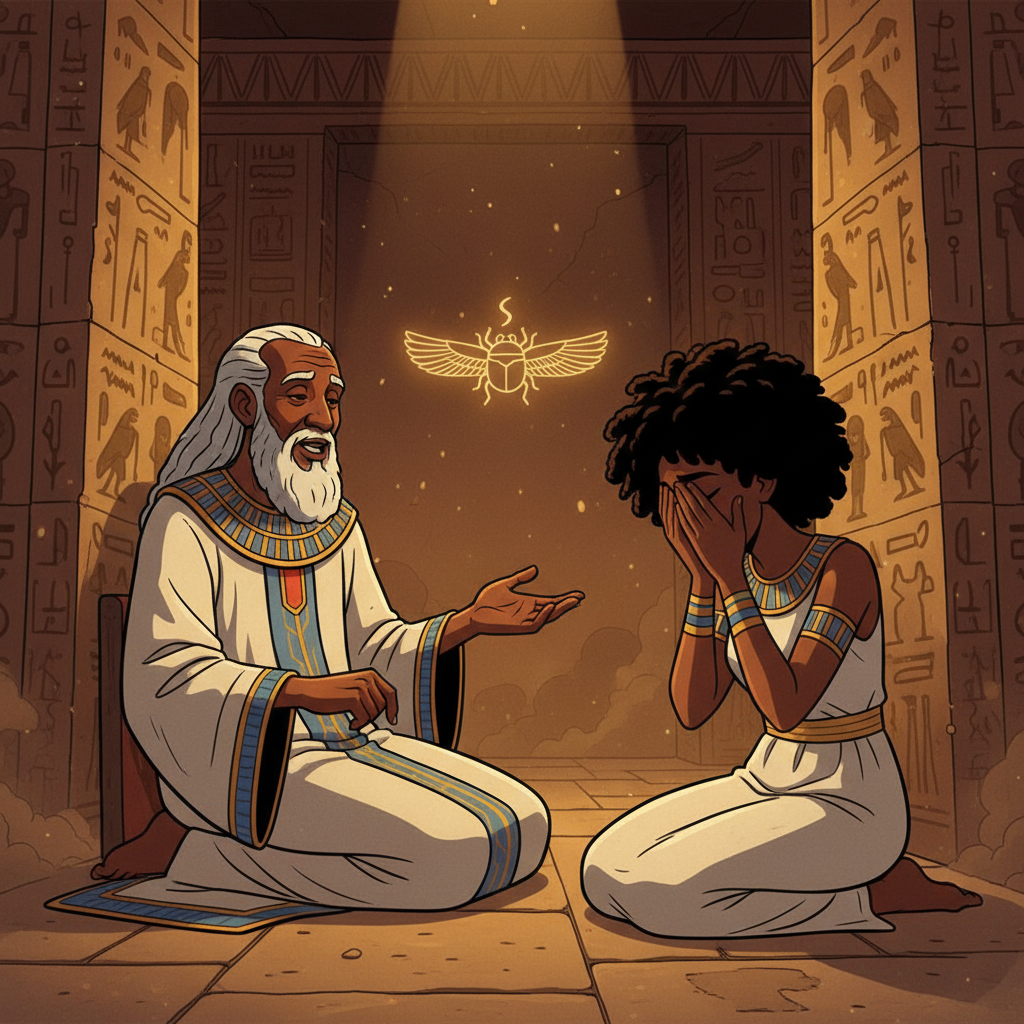
“He comes forth,” Miryam said. The words were her grandmother’s. They were older than her grandmother. “He comes forth by day. He walks with Ra. He rises with Wesir. He is not lost.” “Then why,” the old Seba asked, “would you be surprised to find that Yeshua of the Galilee, who taught you the feather and the heart, whose life was Maat from his first breath to his last — why would you be surprised that the tomb could not hold him?” Her hands covered her face. She was not weeping. She was only very tired and very awake at once. “Because,” she whispered, “because the Romans said it was over. Because Petros said it was over. Because I myself, I told my own heart last night, Miryam, it is over.” “The Romans,” the old man said, and there was the faintest smile in his voice, “do not set the order of the world. Neither does Petros, though he loves with a whole heart. And neither, daughter, do you. Maat sets the order. And Maat says: the balanced heart rises.”
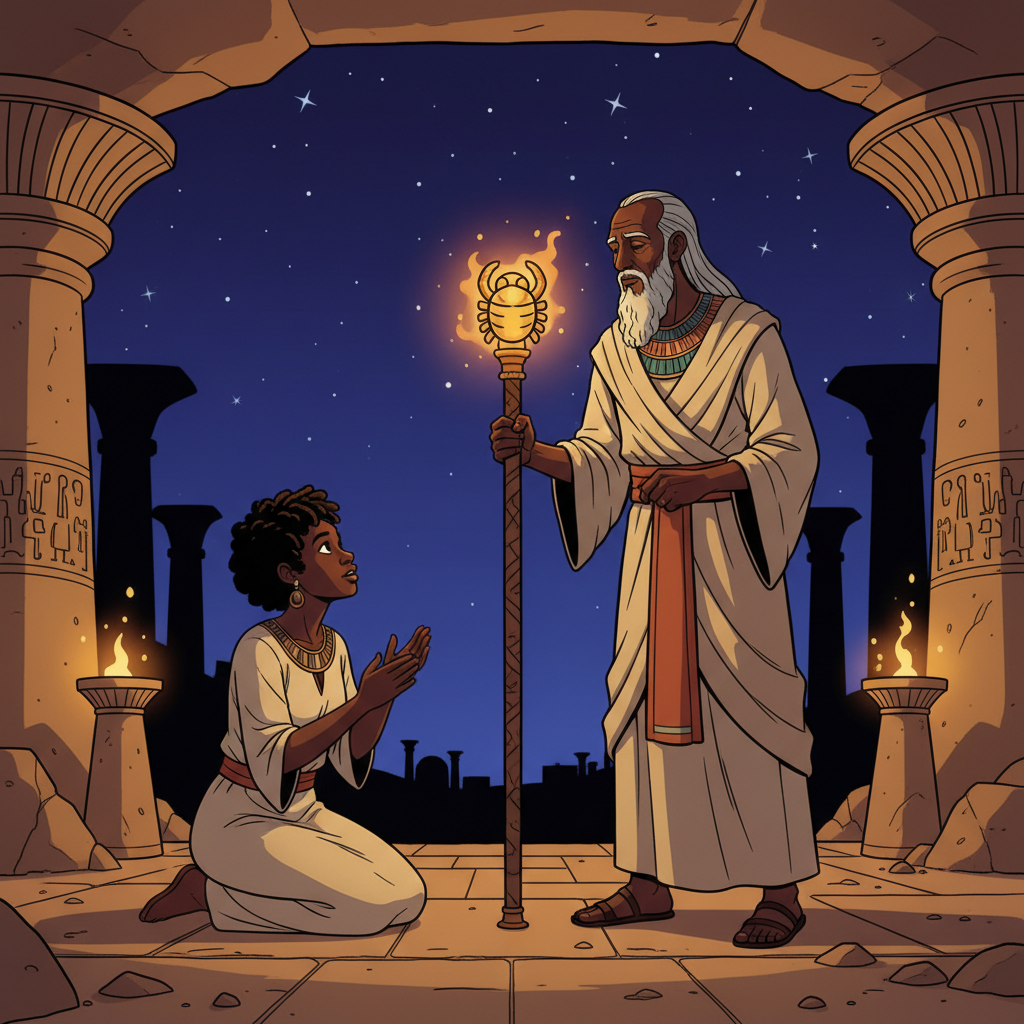
She lowered her hands and looked at him. “Who are you?” she asked. “A Seba,” the old man said. “One of the keepers. We are still here, daughter. We have been here all along, in Waset, in Kush, in the villages along the Nile that the Greeks never bothered to map. When a heart like his walks the earth, we come out to meet it. When he rises, we come out to name it. That is our work.” He tapped the staff. The carved scarab caught the light again. “The khepri beetle is our teacher. It rolls the dung of the dead earth into a ball, and inside that ball it places its own life, and out of the dung and the dark a new sun is rolled up every morning. That is what Yeshua has done here, Miryam. He took the worst Rome could give — the wood, the nails, the dark — and he rolled it into the shape of a sunrise.”
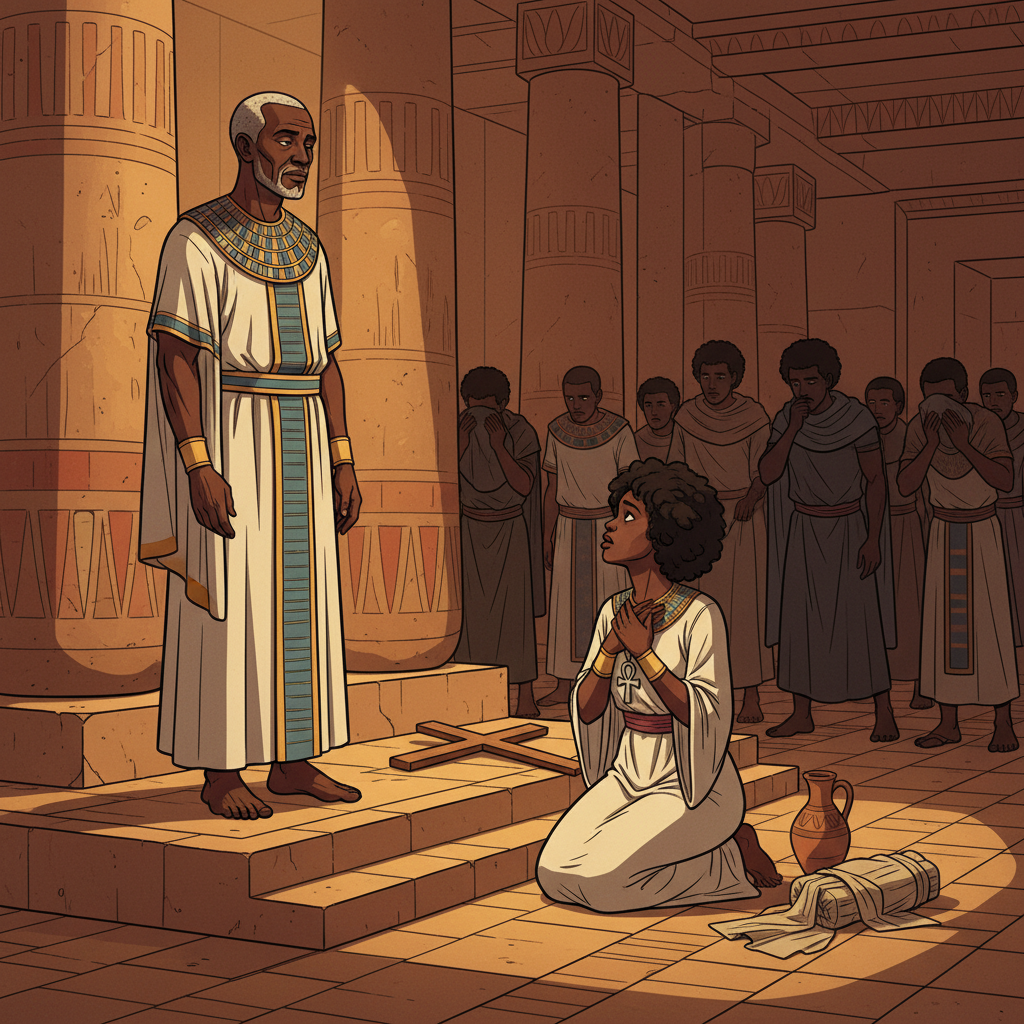
“You are to carry this,” he said. Her breath caught. “Me?” “You.” He nodded once. “You were the one who stayed at the cross when the men ran. You were the one who walked behind the body when the men hid. You are the one who came to this tomb at dawn with the correct oils, in the correct direction, on the correct day. The news does not belong to whoever has the loudest voice, Miryam. The news belongs to whoever stood inside the grief without turning away.” “The others will not believe me,” she said. “Petros. The brothers. They will say I am a woman, and half-mad with mourning.” “They will say many things.” The old Seba’s eyes were kind. “Carry it anyway. That is what a Seba does. We speak the true thing into a room that does not yet want to hear it. Sometimes the room bends. Sometimes it does not. The speaking is the work.” Miryam pressed her hand to the silver ankh at her throat.
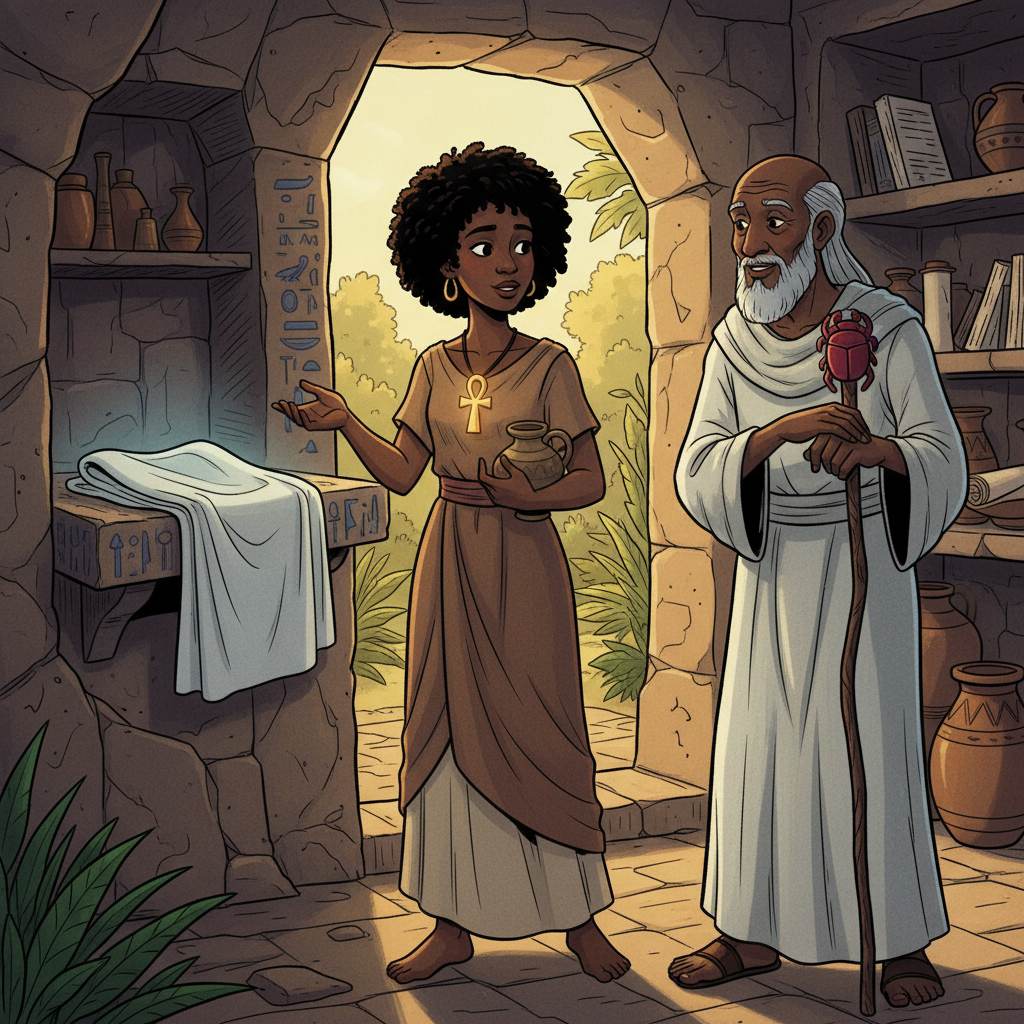
“Go out,” the old man said softly. “Go into the garden. The morning is waiting for you.” She rose. Her legs felt like they belonged to her again, which surprised her. She picked up the jar of myrrh. She looked once more at the folded linen on the shelf — empty, cool, honored. At the mouth of the tomb she turned back. The old Seba was already different. He had not moved, exactly. He had only become quieter, the way a lamp becomes quieter when the wick is trimmed. The white linen of his robe seemed to hold the gray dawn inside it. The carved scarab on his staff was a small steady thing. “What is your name, Seba?” she asked. He smiled. “My name is not important, daughter. The name you are carrying out of here is the important name. Say it for yourself, once, before you step into the garden.” Miryam drew a long breath. The ankh at her throat was warm now, properly warm, like a living heart pressed against her pulse. “Yeshua,” she said. “Yeshua of Galilee. Who has come forth by day.”
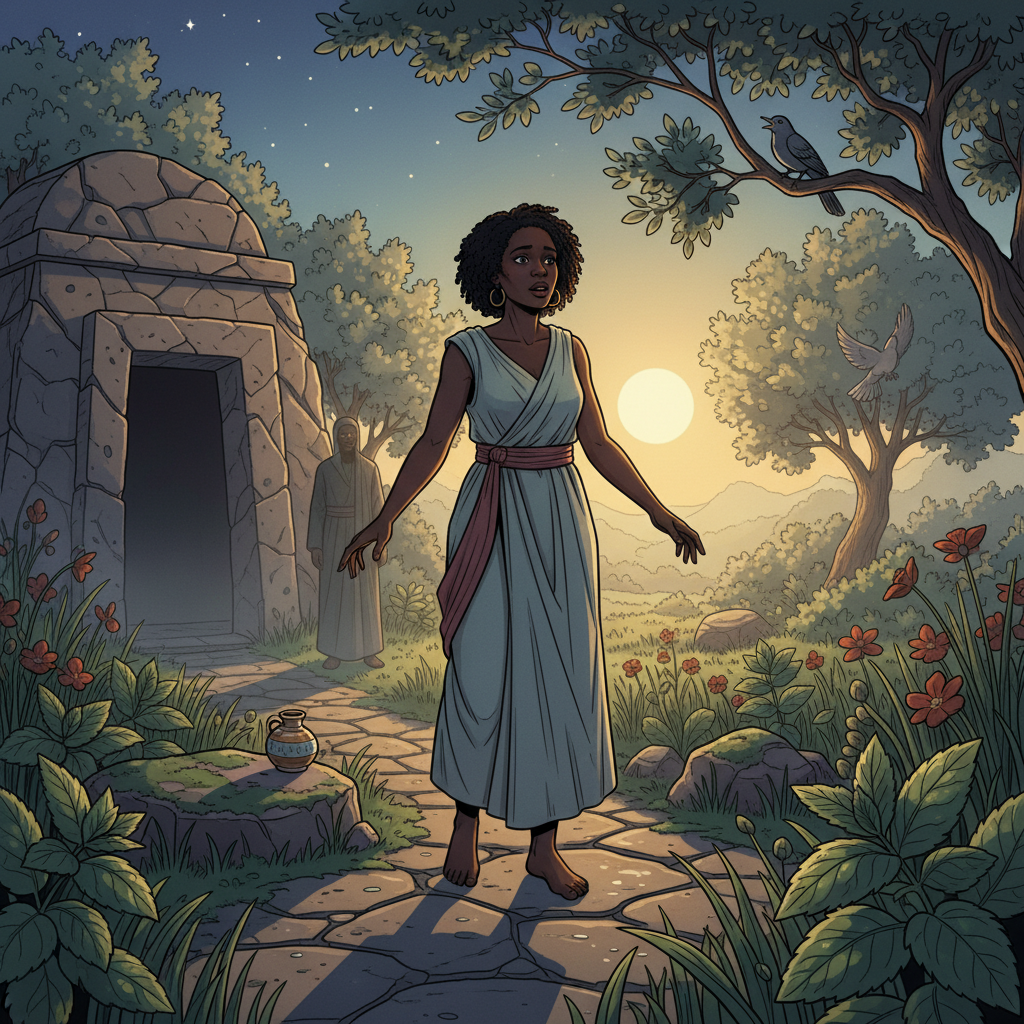
She stepped out of the tomb and into the garden. The birds had started. She had not noticed them before. A blackcap was calling from the olive tree above the path, and somewhere further down, a dove answered, low and round. The dawn had turned from bronze to pale gold. Dew lay on the long grass between the tomb and the wall. The whole garden smelled of wet stone, crushed mint, and turned earth. She walked a few steps and stopped. Her hands were shaking. She could not tell if she was overjoyed or terrified or simply emptied. She set the jar of myrrh down on a flat rock beside the path, because she did not trust herself to hold it. And then she became aware, without turning, that someone was standing behind her. She thought — because her mind was tired and her heart was a drum inside her chest — she thought it must be the man who tended the garden. He must have come in the side gate. He would know where they had moved the body. That would be practical. That would be the answer.
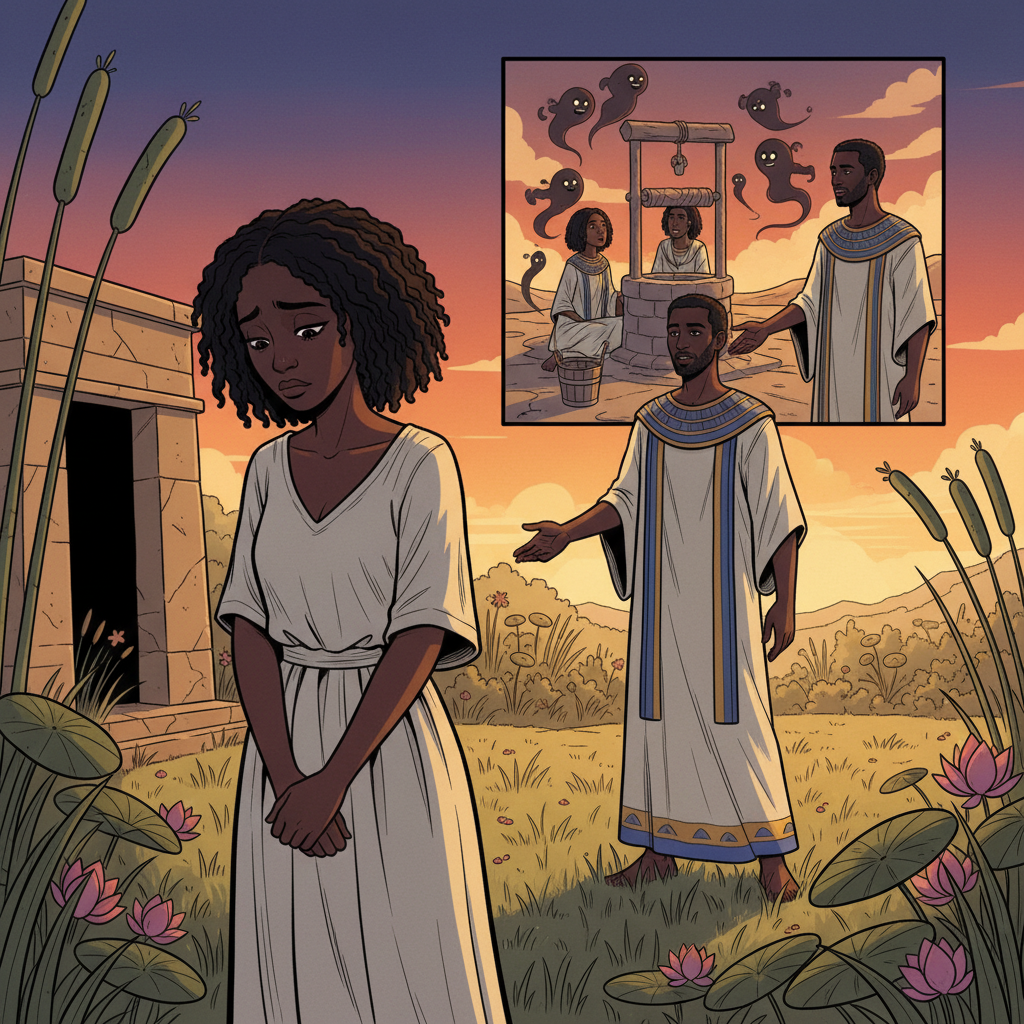
“Please,” she said, without turning. Her voice came out cracked. “Please, sir, if you have taken him away — tell me where you have laid him, and I will come and get him. I will not be angry. I will not call the guards. I only want to bring him home properly. His mother is waiting. I only want —” Her throat closed. She could not finish the sentence. Behind her, a voice said her name. “Miryam.” One word. Two notes. The way he had always said it, from the first day at the well outside Magdala when she had been a girl with seven shadows living in her chest, and he had looked at her across the bucket and said her name the way her mother had said it before her mother had been afraid of her. The way a Seba says the name of a student who is ready to learn. Her knees nearly gave. She turned. He was standing in the dew on the long grass, about five paces away.
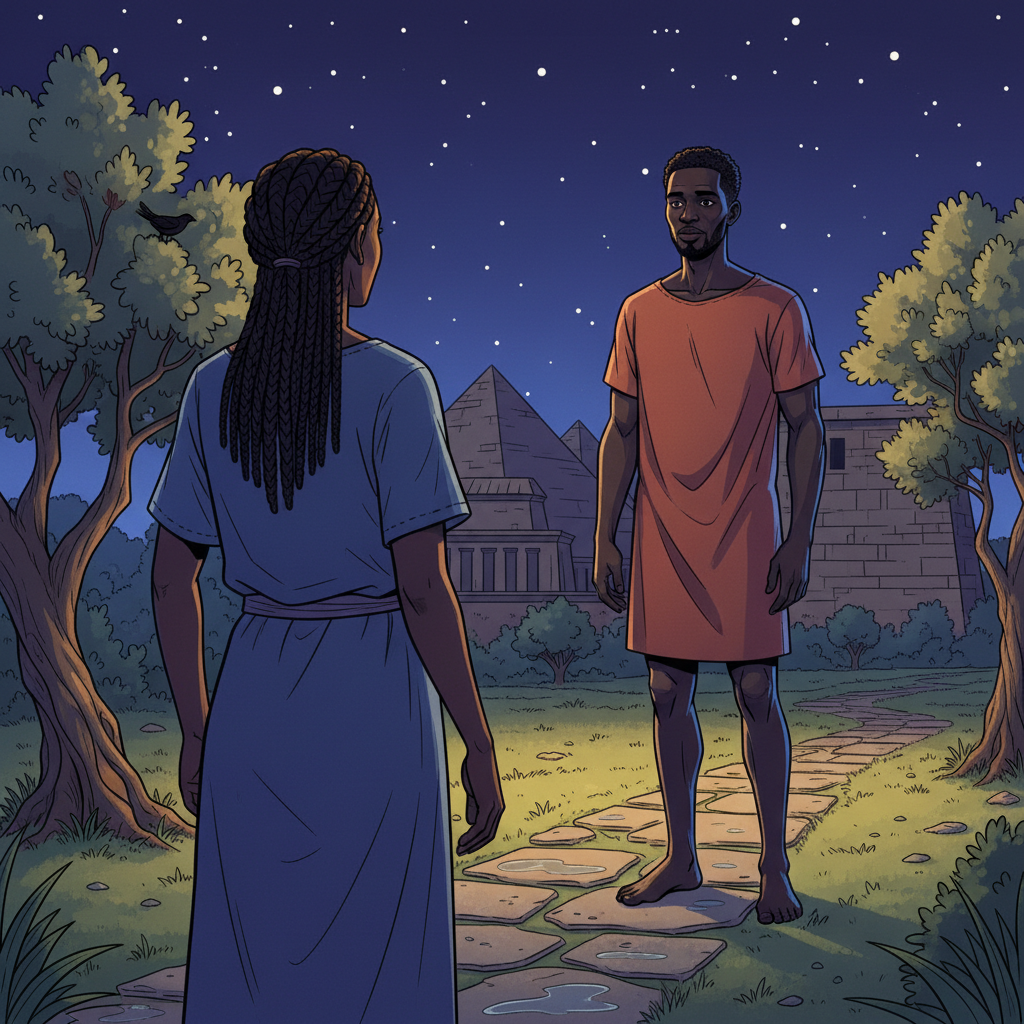
He was not a ghost. That was the first thing she understood. Her mind had been ready to see a pale thing, a hovering thing, something European and strange. He was not that. He was a dark man with tired eyes and the long strong bones of his father’s family, and he was standing in the wet grass with his bare feet on the ground the way he had stood on a thousand mornings during the three years she had walked with him. He was not shining. He was simply there. The garden held him the way it held the olive trees and the blackcap in its branches. And yet. And yet there was something settled about him that had not been there before, the way a river that has reached the sea is settled. The ache that had lived at the corner of his mouth during the last weeks was gone. He looked like a man who had carried something very heavy across a long bridge, and had set it down on the far side, and had turned to look back at the bridge with neither fear nor regret. He was looking at her.
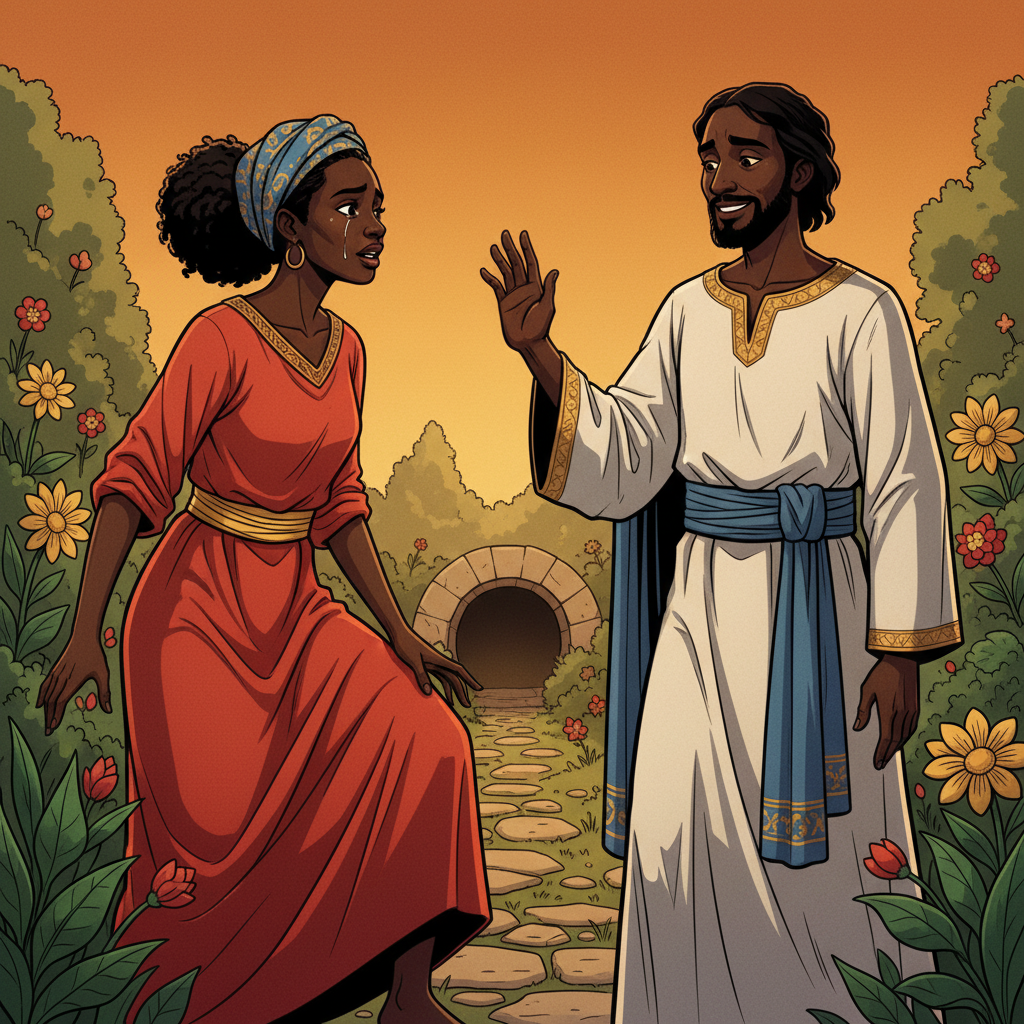
“Rabbuni,” she said. The old title. Teacher. Her teacher. Her voice broke on the second syllable and she did not try to hide it. She took one step toward him, and then stopped, because her whole body wanted to run to him and throw itself against his chest the way a daughter throws herself against a father, and some part of her knew — the trained part, the Per Ankh part, the part that had sat in the tomb with the Seba not five minutes before — some part of her knew that this was not a moment for clutching. This was a moment for receiving. Yeshua smiled. The smile she remembered. The smile that had started in his eyes before it reached his mouth, and had reached his mouth a little crookedly, the way it always had. “Do not hold on to me, Miryam,” he said gently. “Not yet. I have not yet gone up to the Father. But go — go to my brothers. Tell them I am rising to my Father and your Father, to my God and your God.”
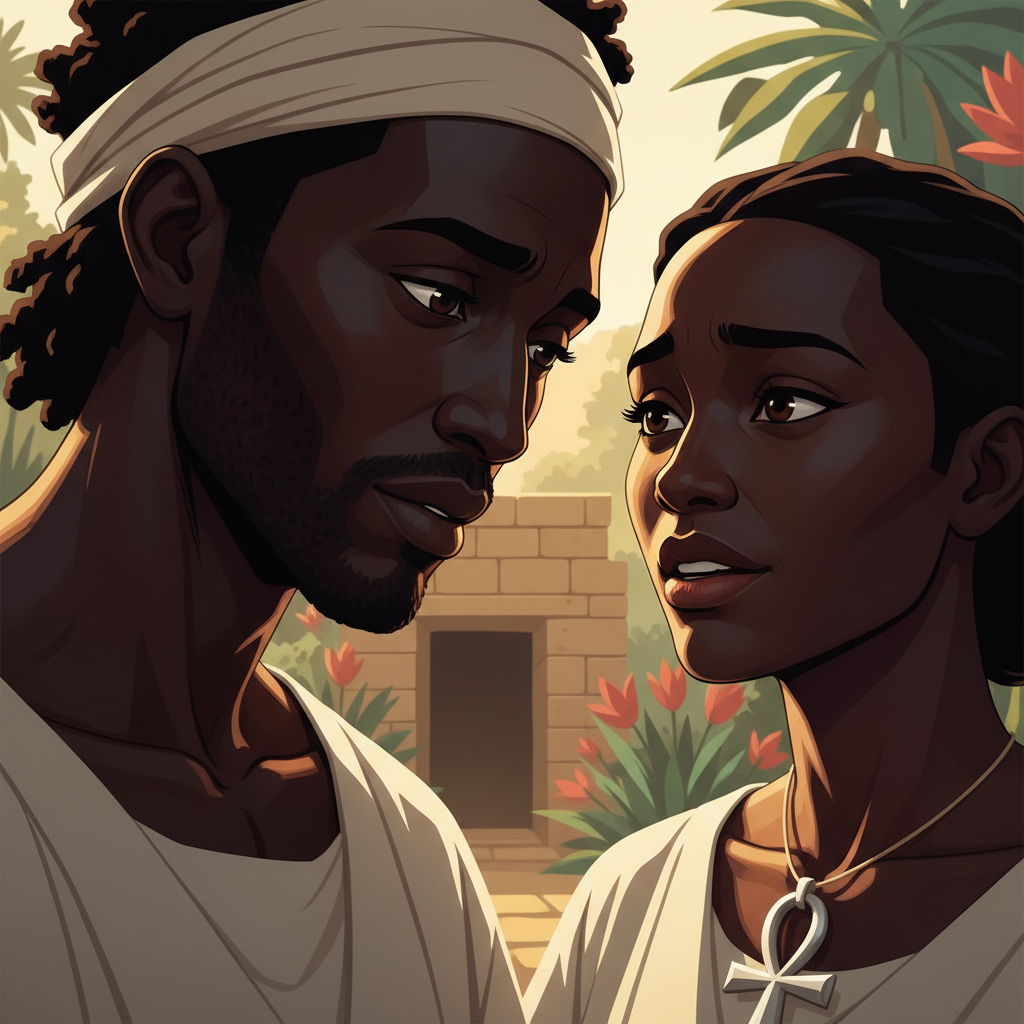
She nodded. She could not speak. He looked at the silver ankh at her throat. For a long moment his eyes rested on it, the way a craftsman’s eyes rest on a thing he has made and given away. “You kept it,” he said. “Yosef gave it to me,” she said. Her voice was a thread. “After.” “It is yours now,” Yeshua said. “It always was, really. I was the one keeping it warm for you.” A small laugh escaped her — startled, wet, from a place inside her she had thought was closed for good. “You are going to be the one who carries this, Miryam,” he said. “Not because the others are less. Because you are first. You stood at the cross. You came at dawn. The news is handed, in our tradition, to the one whose feet got there. Your feet got here. Now your feet must go back.” He paused. The garden paused with him. “Go to Petros,” he said. “Go to my brothers. Tell them what the Seba told you in the tomb.”
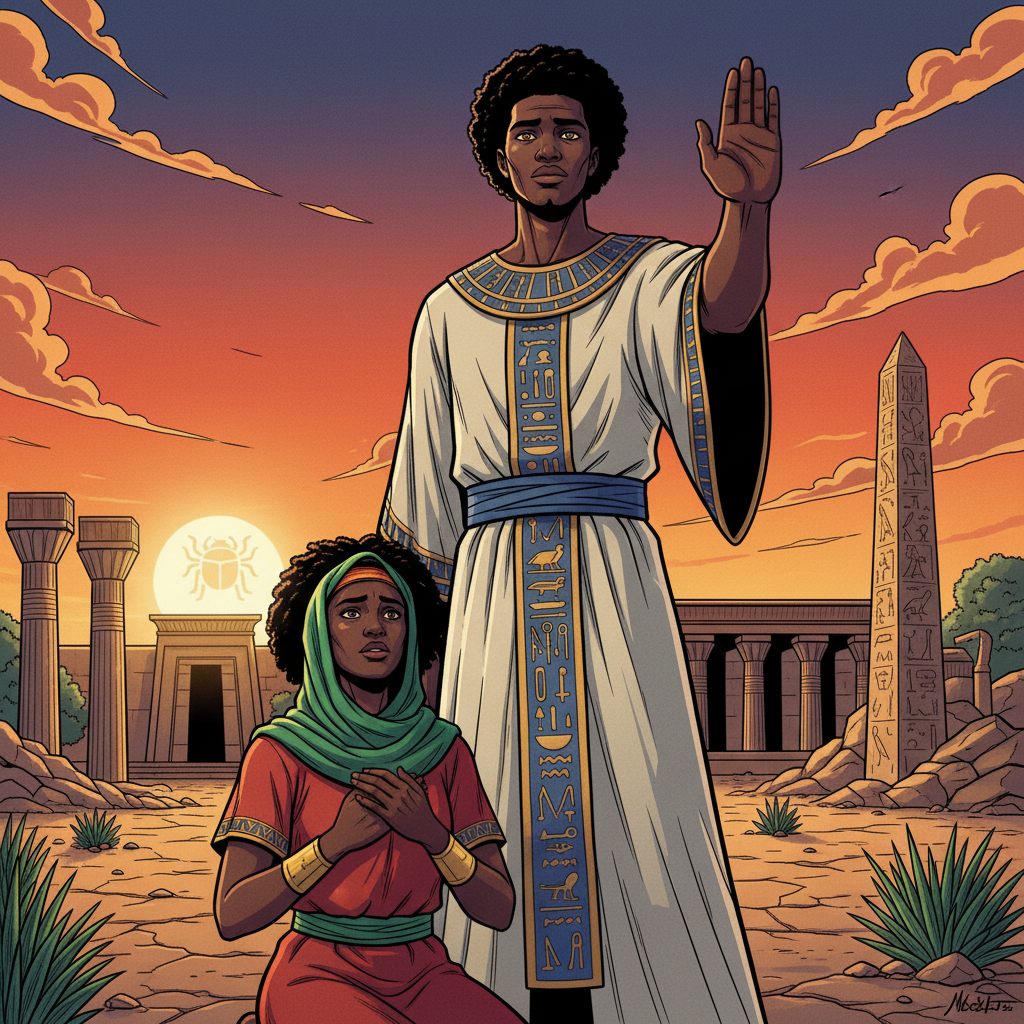
“That you have come forth by day,” Miryam whispered. “Yes.” His eyes were very bright. “And tell them the rest. Tell them this is not a new thing under the sun, Miryam. Tell them Wesir rose before me. Tell them every Kemetic heart that balanced with the feather has risen before me. Tell them the khepri beetle has been doing this work in silence since the first morning of the world. Tell them I am not a new god. I am one more sunrise. The sunrise they can see.” “They will want me to say you are a new thing,” she said. “They will want — they will want miracles.” “Let them want what they want.” His voice was quiet and firm. “You speak the true word. If they build temples on top of it that hide it, the true word will still be there, underneath, waiting for the children who come later with shovels. Your work is to put it down correctly in your own time.” He lifted his hand, palm out, the old blessing. “Go, Miryam.”
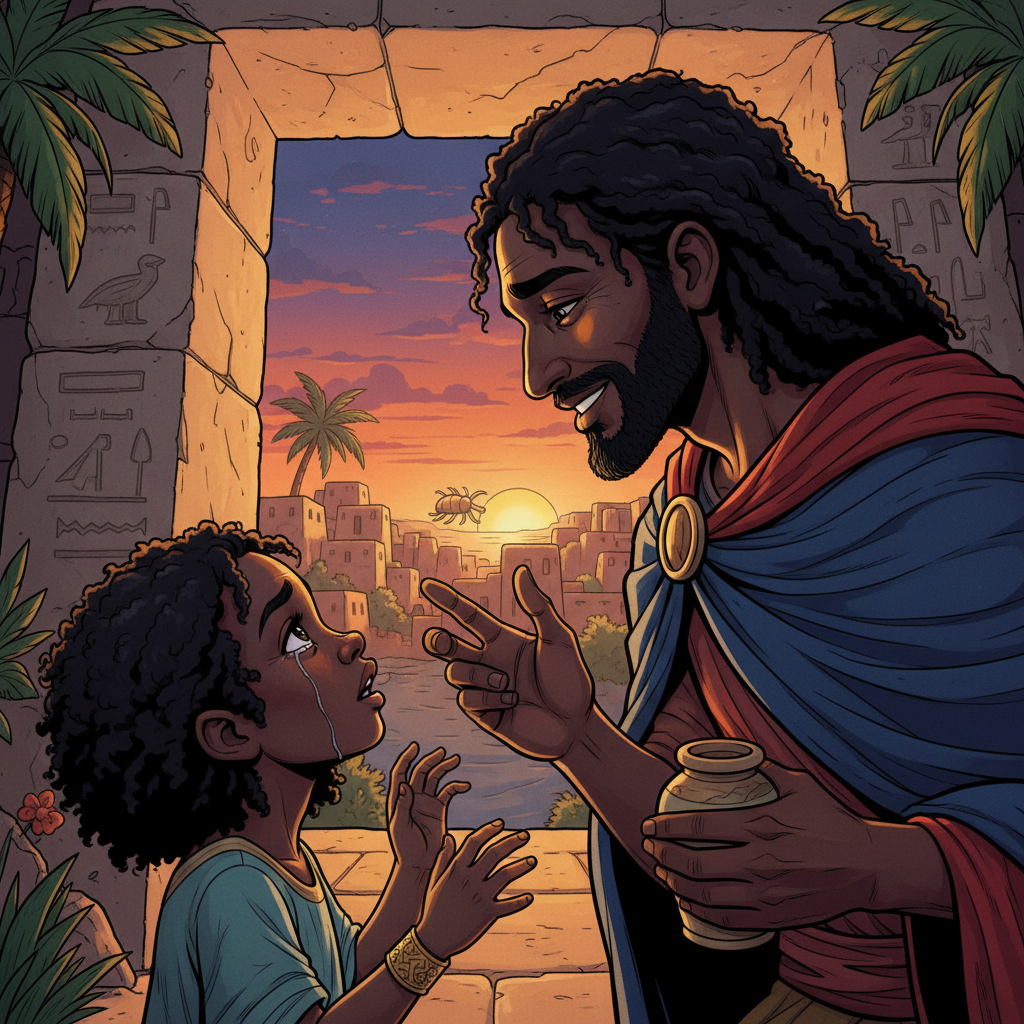
“Will I see you again?” The question came out of her before she could stop it. She heard how small it sounded, how childlike, and she did not care. He had been her teacher and her friend and the man who had called her out of her seven shadows, and she was about to walk away from him into a city that had just killed him, carrying a story that would get her laughed at, spit at, and maybe worse. Yeshua’s face softened. “You will see me,” he said, “every morning when the sun rolls up over the hills. You will see me in the eyes of the ones who hear you and believe. You will see me in the eyes of the ones who hear you and do not believe — because the seed you plant in them will wait its own years. And one night, a long time from now, when your own heart is weighed against the feather, I will be standing in the Hall beside Wesir, and we will call you forward together.” She closed her eyes. She let the promise go into her.
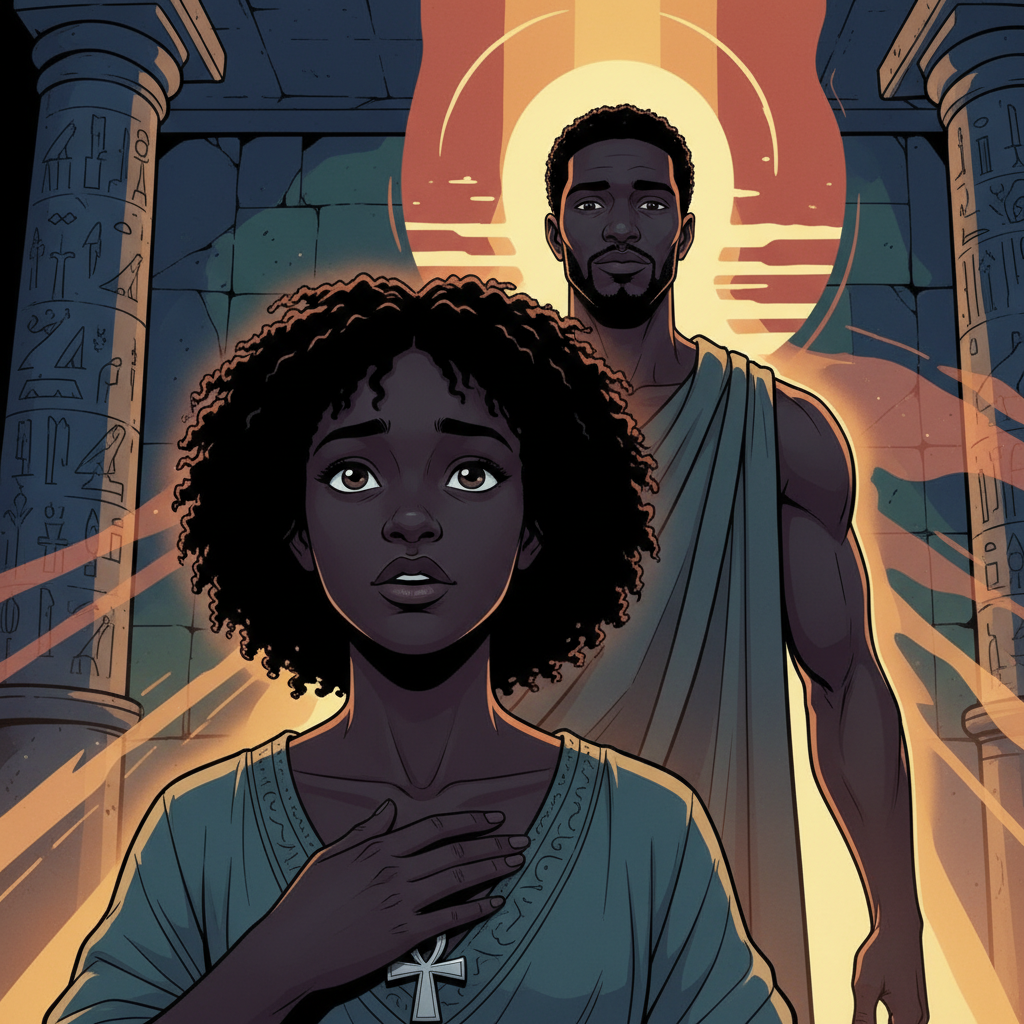
When she opened her eyes he was still there. But she understood — the way you understand a sunset — that he would not be there much longer in this form. He was a dawn visitor. Dawns do not linger. Dawns hand off the day and step back into the light behind the light. “One more thing,” he said. “Yes.” “When they ask you who you are now — when Petros asks, when my mother asks, when the Romans ask if they find you — do not say you are my follower. That word is too small for what you are about to do.” She waited. “Say you are a Seba.” Yeshua’s eyes were steady. “A carrier. One of the keepers of the Per em Heru. The old men in Waset will know the word. The women in the villages along the Nile will know the word. The ones who matter will know.” Her hand went to the silver ankh again. She felt the shape of it, the loop that meant life continuing, the cross bar that meant life crossing. “I am a Seba,” she said, trying the word.
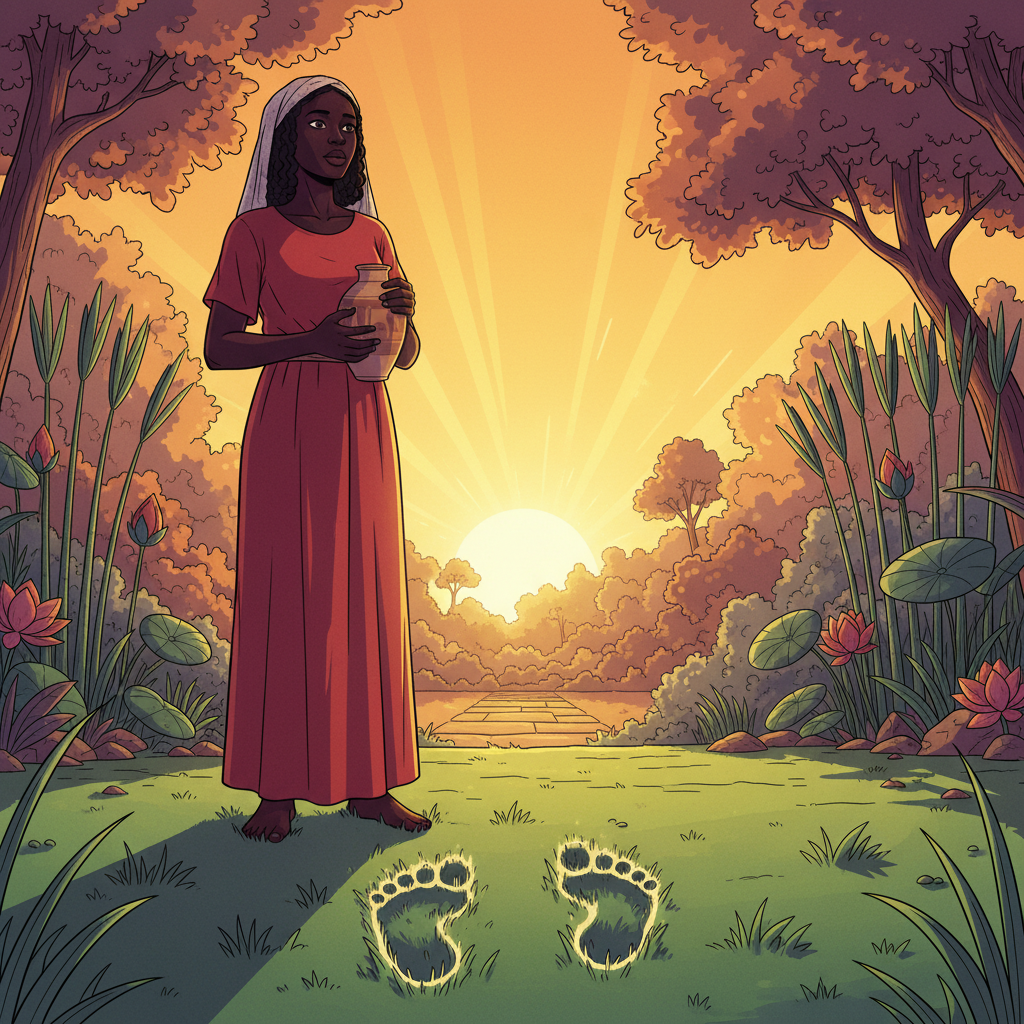
“You are a Seba,” he agreed. She stood very still, because she knew the next thing that happened would be the leaving, and she did not want to hurry it. He did not dissolve. He did not rise into a cloud. He simply — and she would tell this story for the rest of her life, and always struggle for the words — he simply stepped back one step, and the dawn light behind him was very bright, and the garden breathed in, and when the garden breathed out again he was not standing on the grass anymore. The grass where his bare feet had been was still bent. The dew was still pressed flat in the shape of where he had stood. But she did not feel abandoned. That was the strange thing. She felt carried. She felt as if he had stepped out of the picture and into her chest, and was now behind her heart, pushing her ribs outward from the inside. She wiped her face with the sleeve of her robe. She picked up the empty jar of myrrh. The myrrh, she thought, could wait. The news could not.
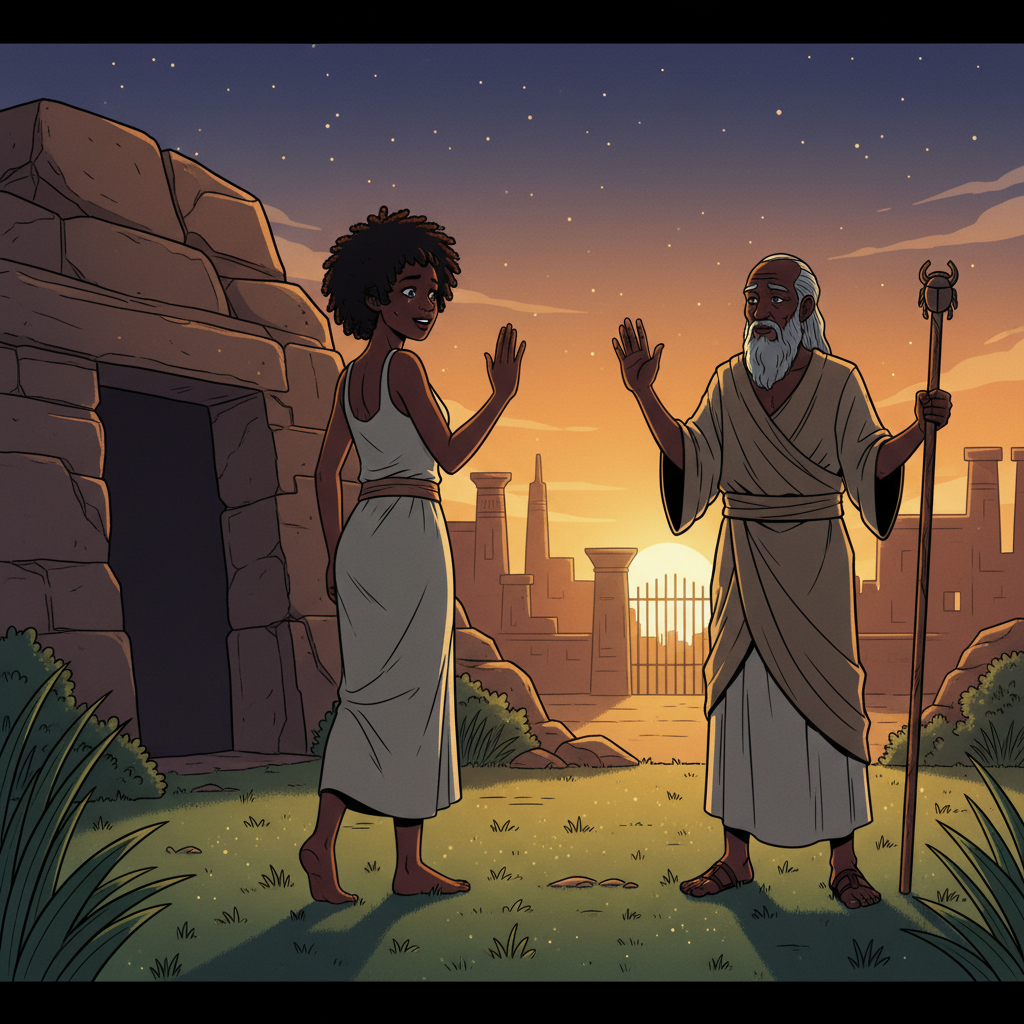
She turned back once toward the tomb. The old Seba was standing in the mouth of it now, his staff in his hand, the little carved scarab catching the morning. He lifted his free hand in the old greeting — not a wave, but a flat palm raised, the way the priests in Waset used to greet the sun. Miryam lifted her own hand in answer. Her fingers were trembling. She did not mind. “Go, daughter of Magdala,” the old man called, across the dew. “Go carry him. Go carry all of them — every heart that ever balanced with the feather, every sun that was ever rolled up by the khepri beetle, every brother and sister of yours who died in truth and rose in Maat. They are all riding on your shoulders now. You will not feel the weight. The truth is light. Only the lies are heavy.” She laughed — a small startled laugh, half sob — and the laugh surprised her almost more than the morning had. Then she turned, and she started walking out of the garden, toward the city gate.
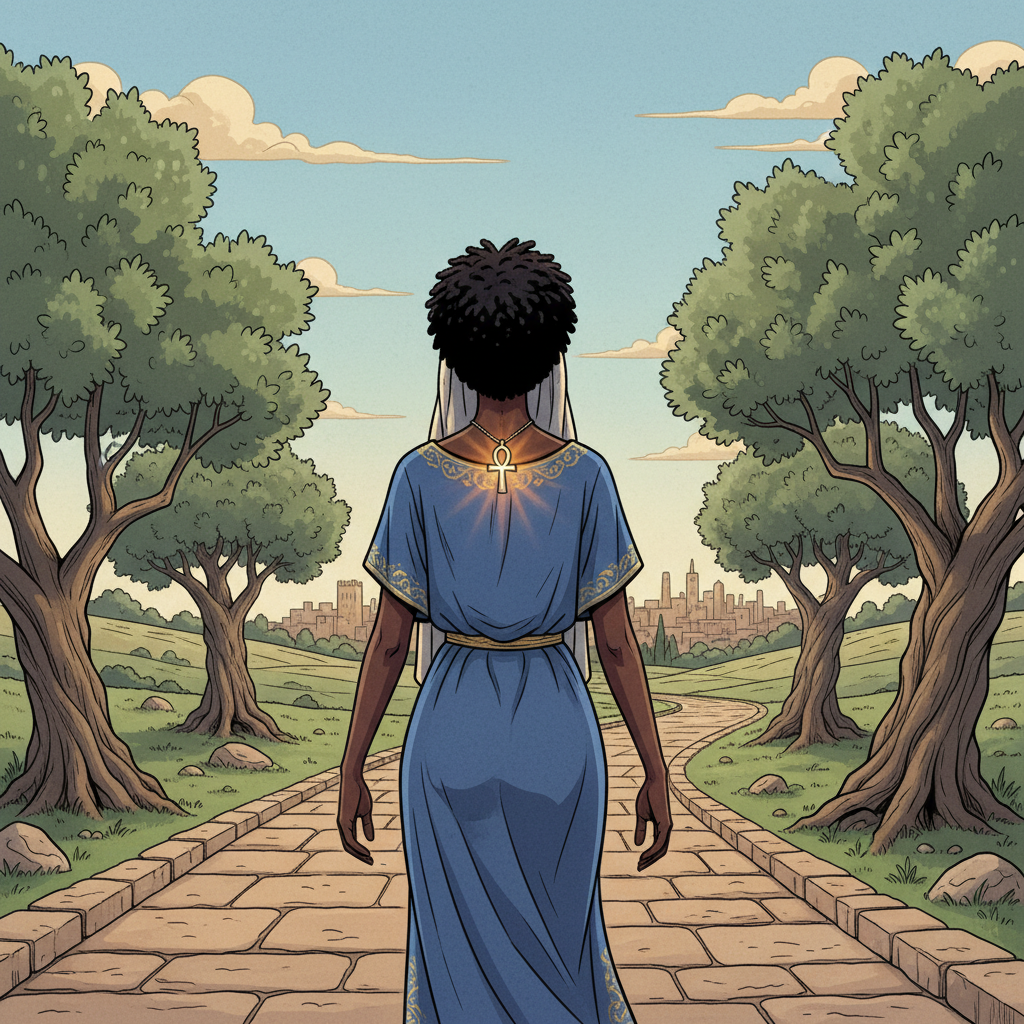
The path back to Jerusalem was the same path she had walked in. The stones were the same stones. The olive trees were the same olive trees. The sky had turned from pale gold to a soft, ordinary blue, the blue of an ordinary morning in an ordinary week in an ordinary year in the reign of an ordinary Caesar. The world had not changed, on the surface. But Miryam of Magdala was walking differently now. She walked the way a woman walks who is carrying something more precious than she can set down. She walked with her spine lifted, because the silver ankh at her throat was a small warm sun, and she was organizing her whole body around it. She walked fast. The brothers would be in the upper room. Petros would be sitting with his face in his hands. Yohanan would be staring at the wall. The mother of Yeshua would be holding herself very still, the way women do when grief has moved into the bones. She was going to walk in and open her mouth.
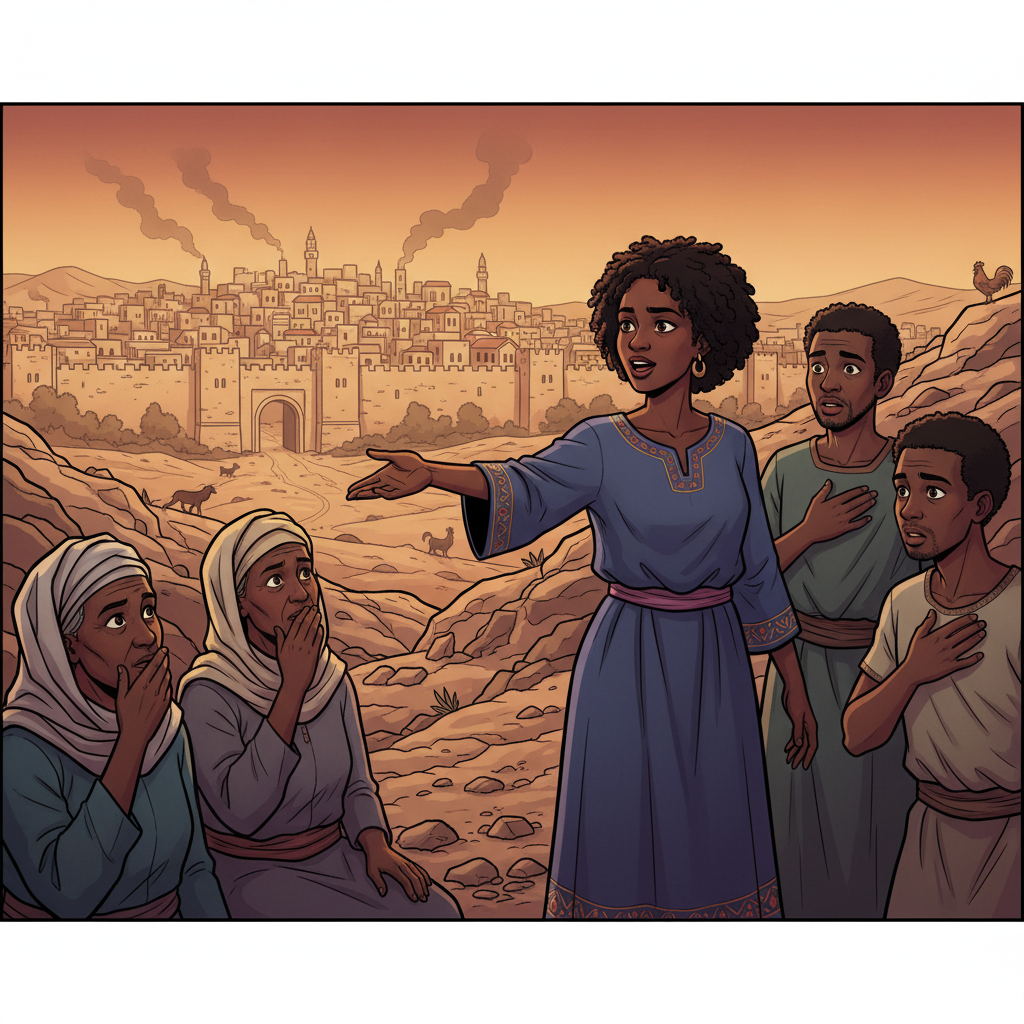
She did not yet know every word she would say. She knew the first one. She knew she would say his name. She knew she would say, “I have seen him.” She knew she would say the old phrase, Per em Heru, coming forth by day, and some of them would not know what it meant, and some of them — the ones whose grandmothers had come up from Kemet, the ones who had kept the old songs — some of them would know, and their eyes would widen, and the knowing would begin. She knew, too, that the Romans would hear about her eventually. That mattered less than she would have guessed. The Romans killed the body. The body came forth. That equation, now that she had seen it with her own eyes, could not be unseen. She reached the crest of the hill. Below her, Jerusalem lay in its walls, waking up. Smoke was rising from a hundred small fires. Dogs were barking. A rooster, belatedly, was announcing that it was morning. The gate stood open.
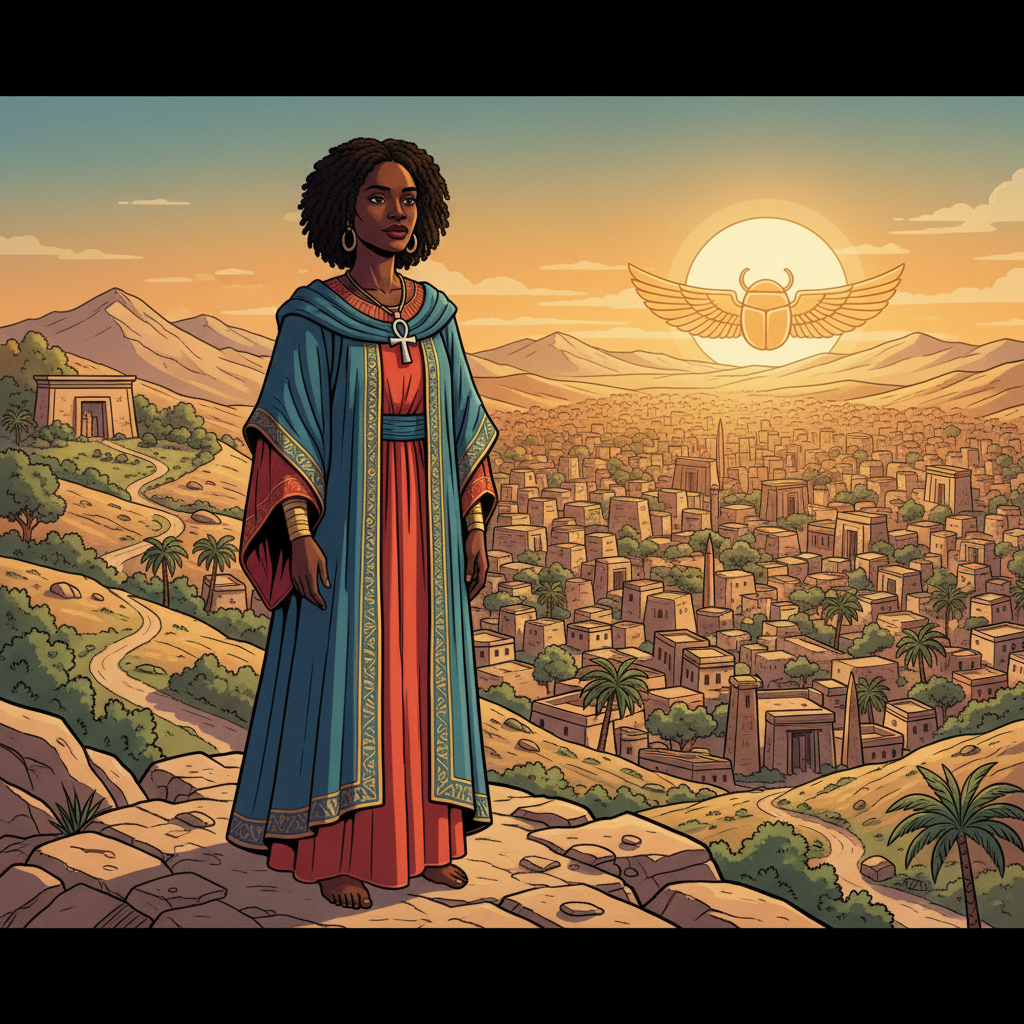
Miryam of Magdala stood at the crest of the hill and looked down at the city. She was not the girl she had been three years ago at the well. She was not the grieving woman she had been yesterday at dusk. She was not even the woman she had been at the mouth of the tomb an hour ago. She was a Seba. She was a carrier. She was the first of the carriers of this particular sunrise. The silver ankh warmed against her throat. Behind her, a long way behind her, the garden was quiet. Ahead of her, the city was loud. Somewhere between the two, in the long work of her life, she would lay down the story she had been given, word by word, into the ears of whoever would listen — and into the memory of those who would not, so that their grandchildren could find it later. The khepri sun was rolling up over the eastern hills. Miryam took a breath as wide as the whole valley, and she went down the path to carry the news.