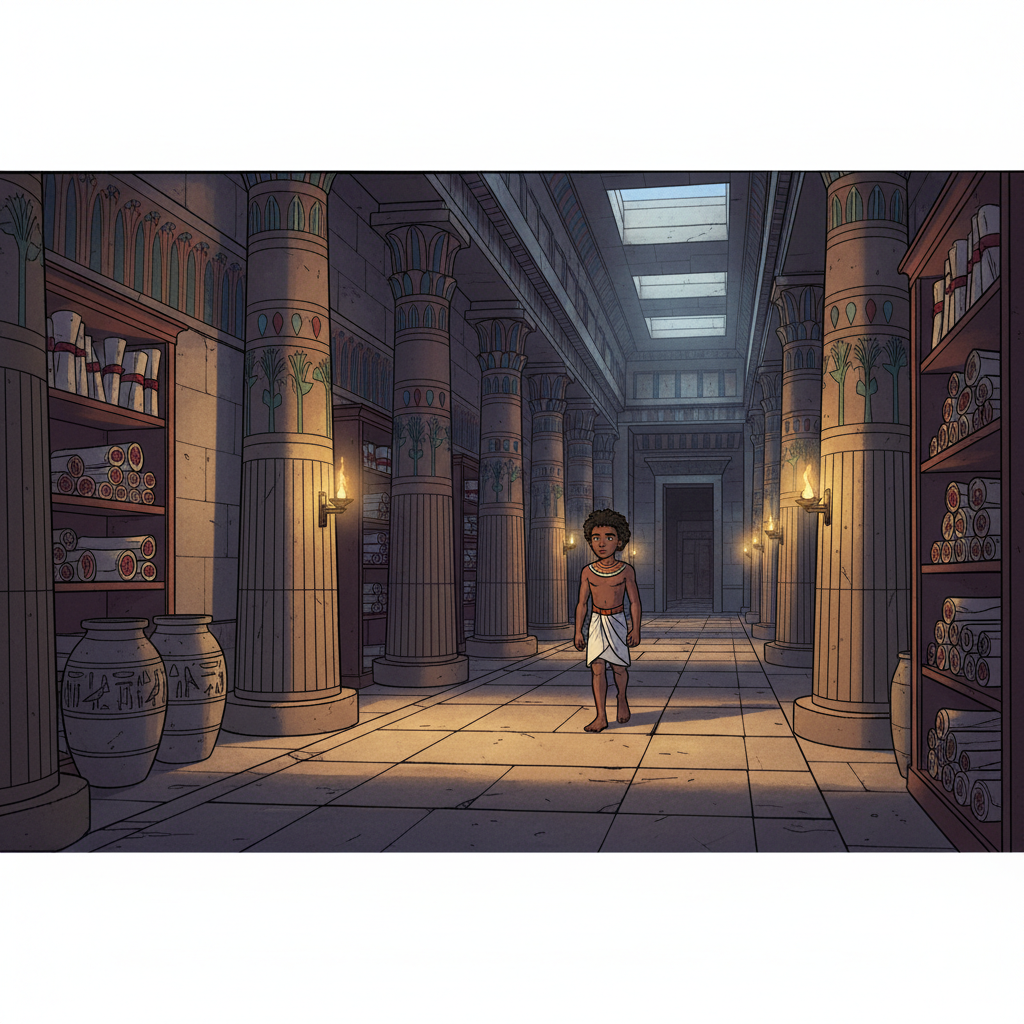
Khufu rose before dawn, as he did every morning, and walked barefoot through the cool stone corridors of the per ankh. The House of Life was quiet at this hour, its massive columns casting long shadows in the flickering lamplight. He was twelve years old, an apprentice scribe in his third year of training, and his deep ebony skin still carried the chill of the night air. The per ankh of Waset was the greatest center of learning in all of kemet — a place where priests, healers, astronomers, and mathematicians gathered to study the knowledge passed down since the first dynasties. Scrolls by the thousands lined the cedar shelves, each one wrapped in linen and sealed with wax stamps bearing the mark of the institution. He passed through the hall of records, where papyrus documents stretched back generations, and entered the mathematics chamber. Reed mats covered the stone floor, and low wooden desks held palettes of ink — black from soot and red from ochre. Along one wall, a series of hieroglyph carvings depicted Seshat, the neter of writing and measurement, her leopard-skin cloak draped over one shoulder, a notched palm rib in her hand for counting the years. Khufu touched his forehead in respect as he passed her image. Every scribe who entered this room did the same. Mathematics was not simply a subject here — it was sacred work, an expression of the divine order that held the universe together.
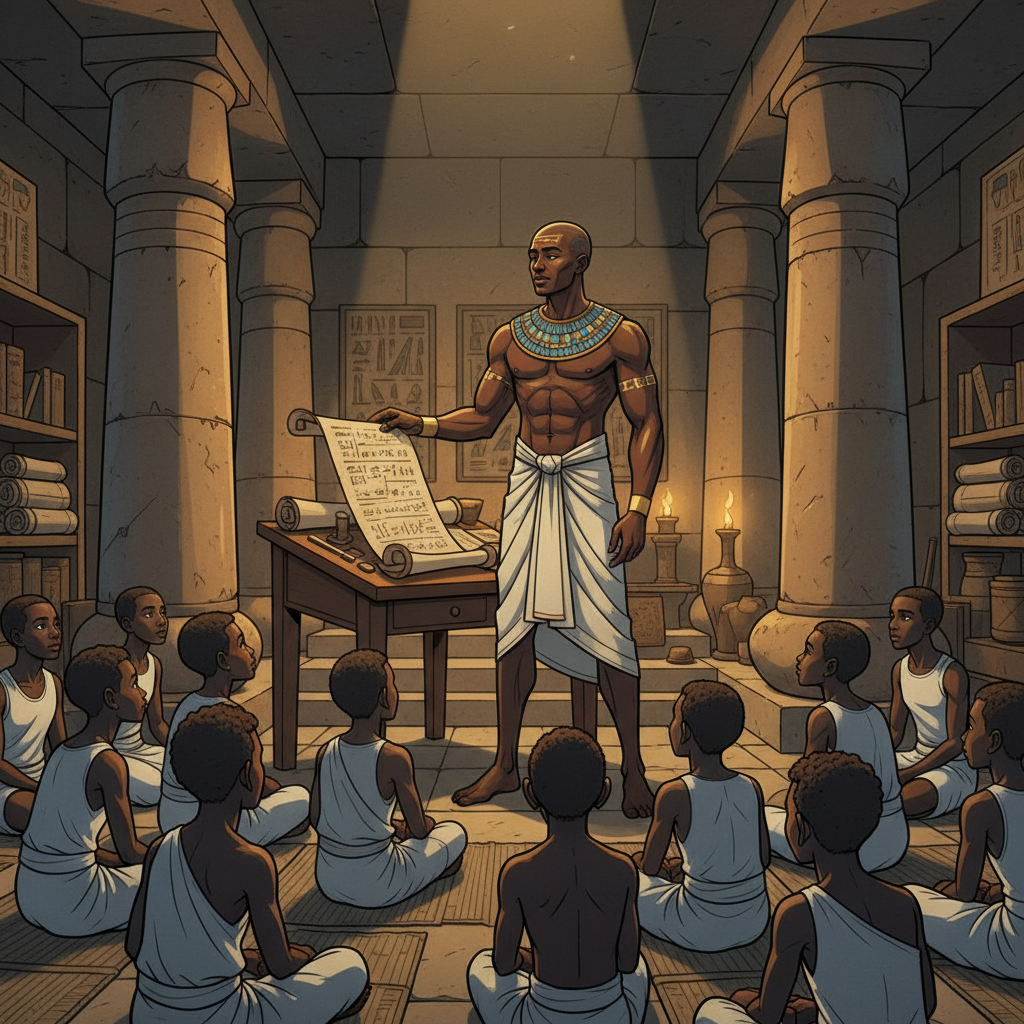
His teacher Ahmes was already seated when Khufu arrived, a large papyrus scroll unrolled across the desk before him. Ahmes was a tall man with rich dark skin that gleamed like polished granite in the lamplight. His shaved head bore the mark of a senior priest-mathematician, and his hands — strong, precise, deeply brown — moved across the scroll with the confidence of someone who had spent forty years mastering the knowledge written there. He wore a white linen kilt and a broad collar of blue faience beads that caught the light when he turned. Around them, other apprentices filed in quietly, taking their places on the reed mats. "Today," Ahmes said, his deep voice carrying easily through the stone chamber, "we begin our study of the seked. This is one of the most important calculations our ancestors developed, and it is the reason the pyramids of kemet stand perfectly angled after thousands of years." He tapped the scroll before him. "This document contains eighty-four mathematical problems and their solutions. It was written by a scribe named Ahmes — yes, my namesake — over a thousand years ago, and even he noted that he was copying from a text far older than himself. The knowledge in this scroll reaches back to the very beginning of our civilization."
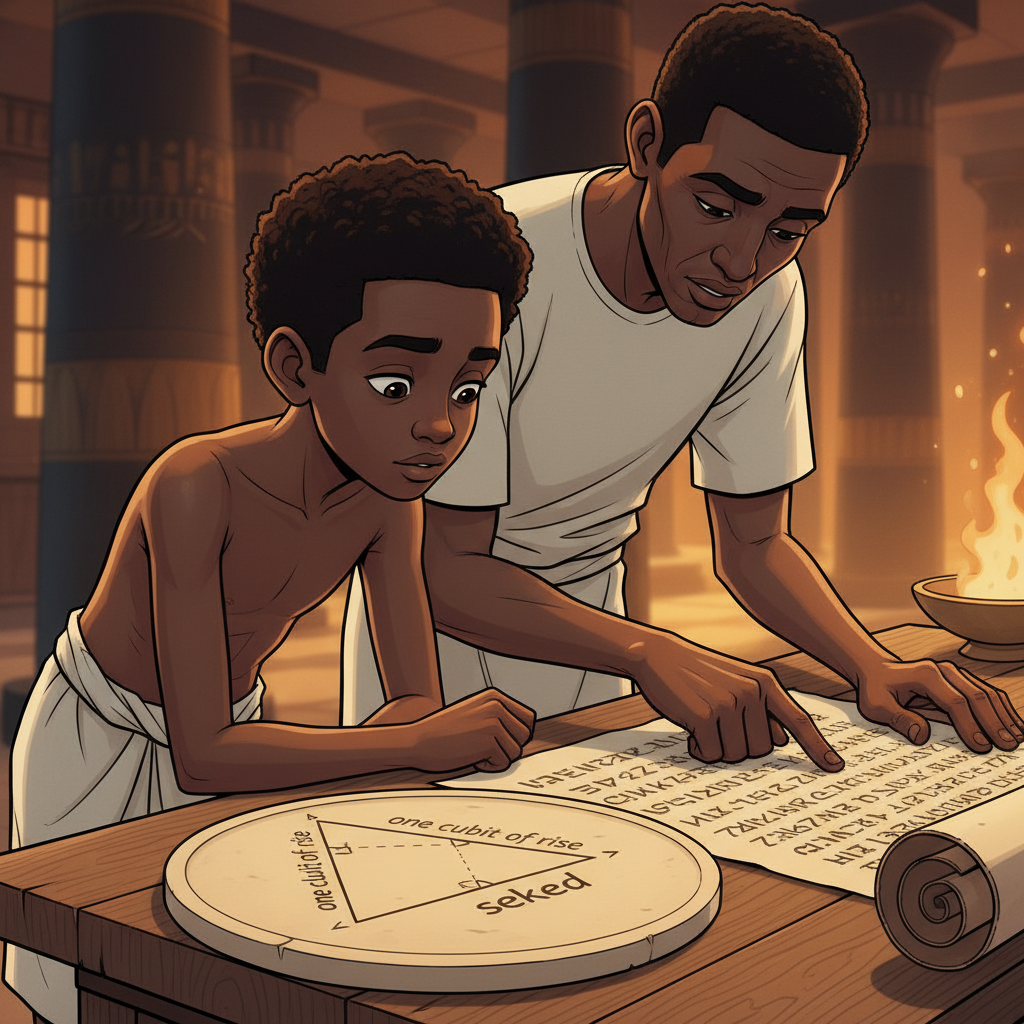
Khufu leaned forward, his dark brown eyes scanning the columns of hieratic script on the papyrus. The writing was dense and precise, each symbol placed with the care of a master scribe. Ahmes pointed to a problem near the top of the scroll. "The seked measures the horizontal distance that a pyramid's face runs for every single cubit of vertical rise," he explained. "Think of it this way — if you are building a pyramid and you want the sides to slope inward at exactly the right angle, you must know how far inward the stone face moves for every cubit you build upward. One cubit equals seven palms. So a seked of five palms and one finger means that for every cubit you rise, the face moves inward five palms and one finger." He drew a diagram on a practice board — a right triangle with the vertical side labeled "one cubit of rise" and the horizontal side labeled "seked." Khufu studied the drawing carefully. It was the same concept he had seen in his geometry lessons, but applied to something real and massive. The pyramid builders had used this calculation thousands of times, adjusting each course of stone blocks so that the enormous structure tapered smoothly from base to peak. A single error in the seked — even a fraction of a palm — would compound over hundreds of courses, leaving the finished pyramid lopsided or unstable. The precision required was extraordinary.
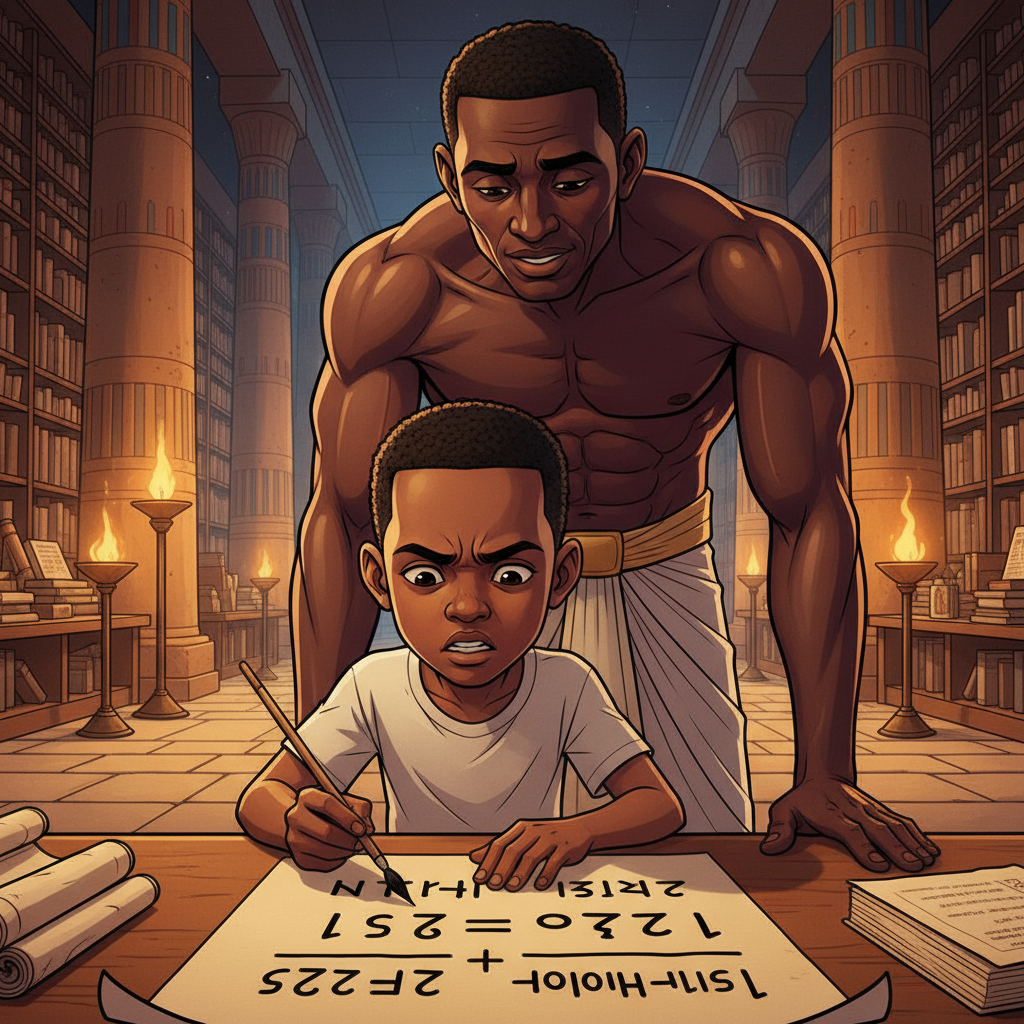
Ahmes handed Khufu a practice sheet of papyrus and a fresh reed brush. "Problem fourteen," he said. "A pyramid has a base of three hundred and sixty cubits and a height of two hundred and fifty cubits. Calculate the seked." Khufu dipped his brush in the black ink and began working through the calculation. He divided half the base — one hundred and eighty cubits — by the height of two hundred and fifty cubits. Then he multiplied by seven to convert the result into palms, since one cubit contained seven palms. His brush scratched steadily across the papyrus as he worked, and the answer emerged: a seked of five palms and one-twenty-fifth of a cubit. But here was where kemet's mathematics revealed its unique brilliance. The fraction one-twenty-fifth could not simply be written as a single symbol. Kemetic mathematicians expressed nearly all fractions as sums of unit fractions — fractions with one as the numerator. So Khufu had to decompose one-twenty-fifth into a sum of unit fractions. He thought carefully, his dark forehead creased in concentration, and wrote: one-twenty-fifth equals one-thirty plus one-one-hundred-and-fifty. Ahmes checked his work and nodded with approval. "Good. You see how our fraction system demands that you truly understand the relationships between numbers. It is not enough to memorize — you must think."
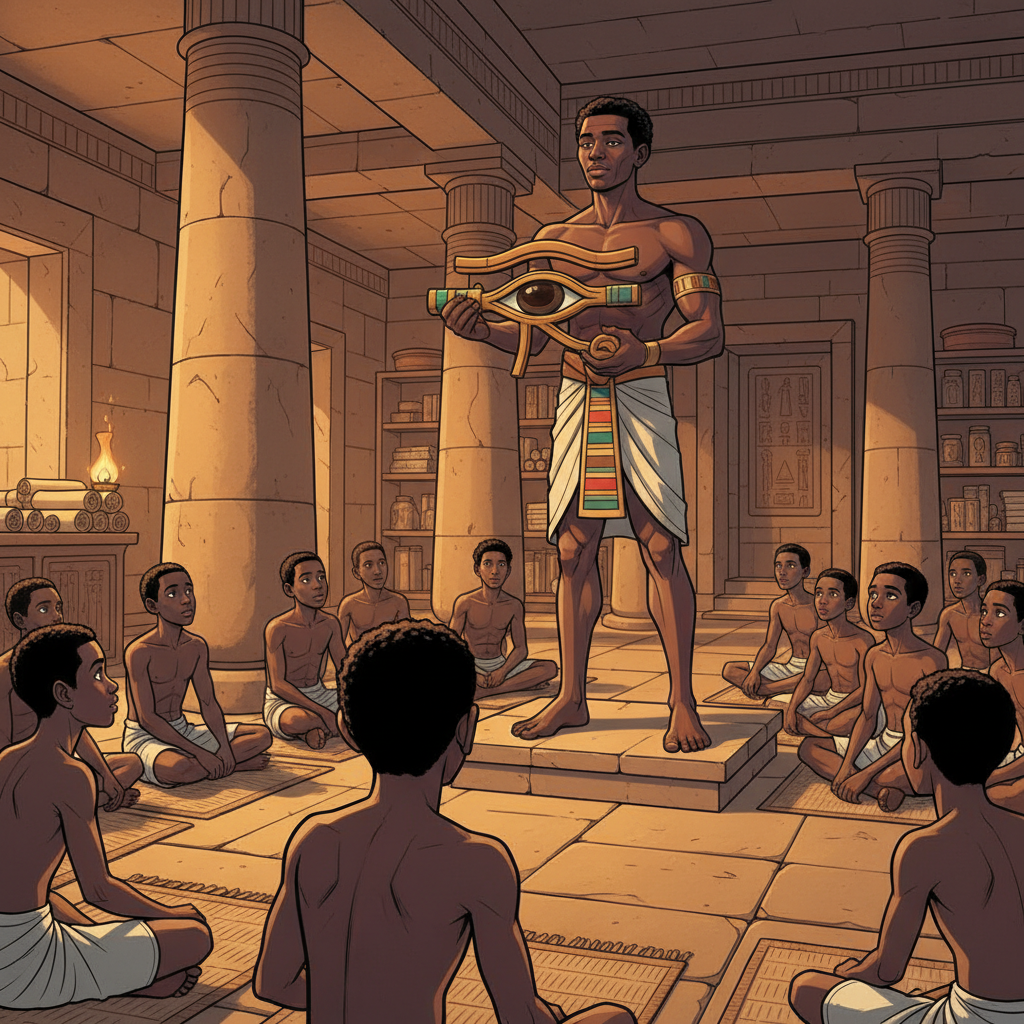
Ahmes rose from his mat and walked to a shelf along the eastern wall, returning with a wooden model of an eye — the sacred Eye of Heru, painted in brilliant blue and gold. He set it on the desk where all the apprentices could see it. "Our fraction system is connected to this," he said, turning the eye so the light caught its painted surface. "The six parts of the Eye of Heru each represent a fraction. The right side of the eye is one-half. The pupil is one-quarter. The eyebrow is one-eighth. The left side of the eye is one-sixteenth. The curved tail is one-thirty-second. And the teardrop is one-sixty-fourth." He pointed to each part as he spoke. Khufu stared at the model with fresh understanding. He had seen the Eye of Heru his entire life — carved on temple walls, painted on amulets, pressed into the clay of storage jars. But he had never understood that it was also a mathematical tool. "When you add all six fractions together," Ahmes continued, "you get sixty-three sixty-fourths — not quite one whole. The missing one-sixty-fourth, our ancestors said, was supplied by the neter Djehuty, the god of wisdom, who restored the eye to wholeness. Mathematics and the divine are not separate in kemet. They are one."
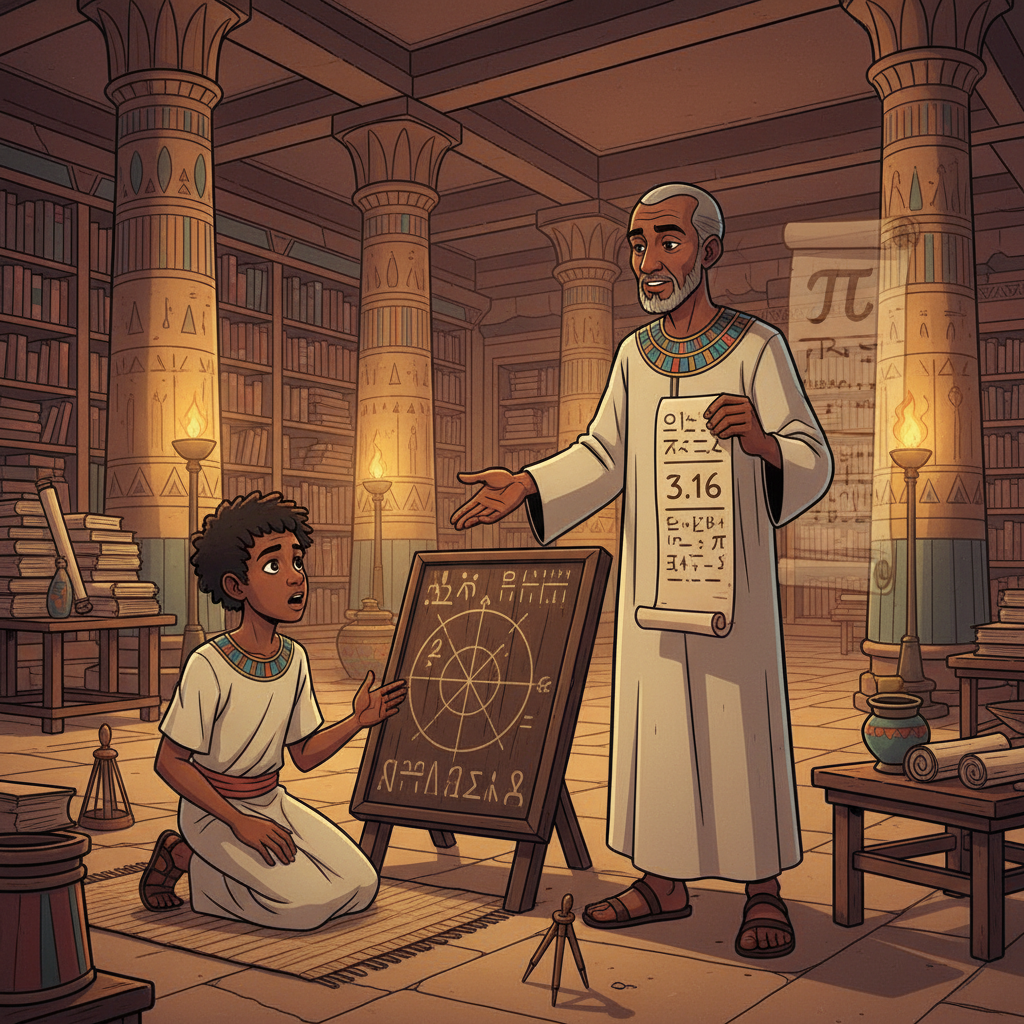
Over the following days, Ahmes guided the apprentices through increasingly difficult problems from the great scroll. Khufu learned to calculate the area of a circle using a method that astonished him with its elegance. "Take the diameter of the circle," Ahmes instructed, drawing a circle on a wooden board with a string compass. "Subtract one-ninth of the diameter. Then square the result. That gives you the area." Khufu worked through an example: a circle with a diameter of nine cubits. He subtracted one-ninth of nine, which was one, leaving eight. He squared eight to get sixty-four. The area was sixty-four square cubits. When Khufu compared this to the method he would later learn other civilizations used — multiplying the radius squared by the ratio known as pi — he realized that the Kemetic method produced a value for pi of approximately three-point-one-six. This was remarkably close to the true value of three-point-one-four-one-five-nine, and the Kemetic mathematicians had discovered it more than a thousand years before any Greek scholar wrote about circles. "Our ancestors did not merely guess," Ahmes said firmly, his ebony face proud and serious. "They observed, they measured, they calculated. And they recorded their work so that we could build upon it."
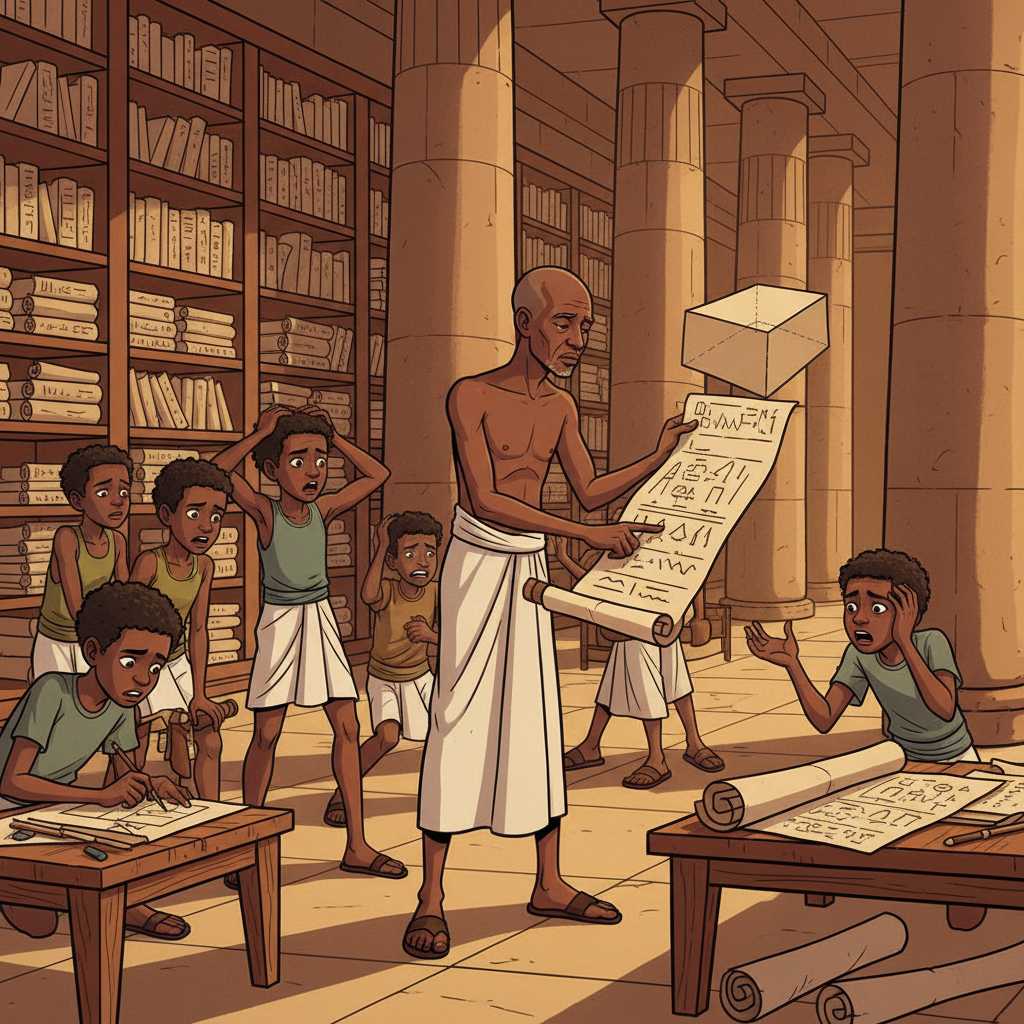
The next problem Ahmes introduced was one that made several apprentices groan — the volume of a truncated pyramid. "This is problem fourteen from the Moscow Papyrus," Ahmes said, unrolling a second scroll alongside the first. "The Moscow Papyrus is another great mathematical document of kemet, containing twenty-five problems. This one asks you to find the volume of a pyramid that has been cut — its top removed, leaving a flat surface." He sketched the shape on the board: a pyramid with its point sliced off, creating a solid with a square base, a smaller square top, and four sloping sides. Khufu copied the diagram carefully. The formula Ahmes revealed was extraordinary: you take the area of the base, add the area of the top, add the square root of their product, and multiply the whole sum by one-third of the height. Khufu worked the example — a truncated pyramid with a base of four cubits, a top of two cubits, and a height of six cubits. Base area sixteen, top area four, their product sixty-four, square root eight. Sixteen plus four plus eight equals twenty-eight. One-third of six is two. Twenty-eight times two equals fifty-six cubic cubits. This formula, Ahmes told them, would not appear in European mathematics for another two thousand years.
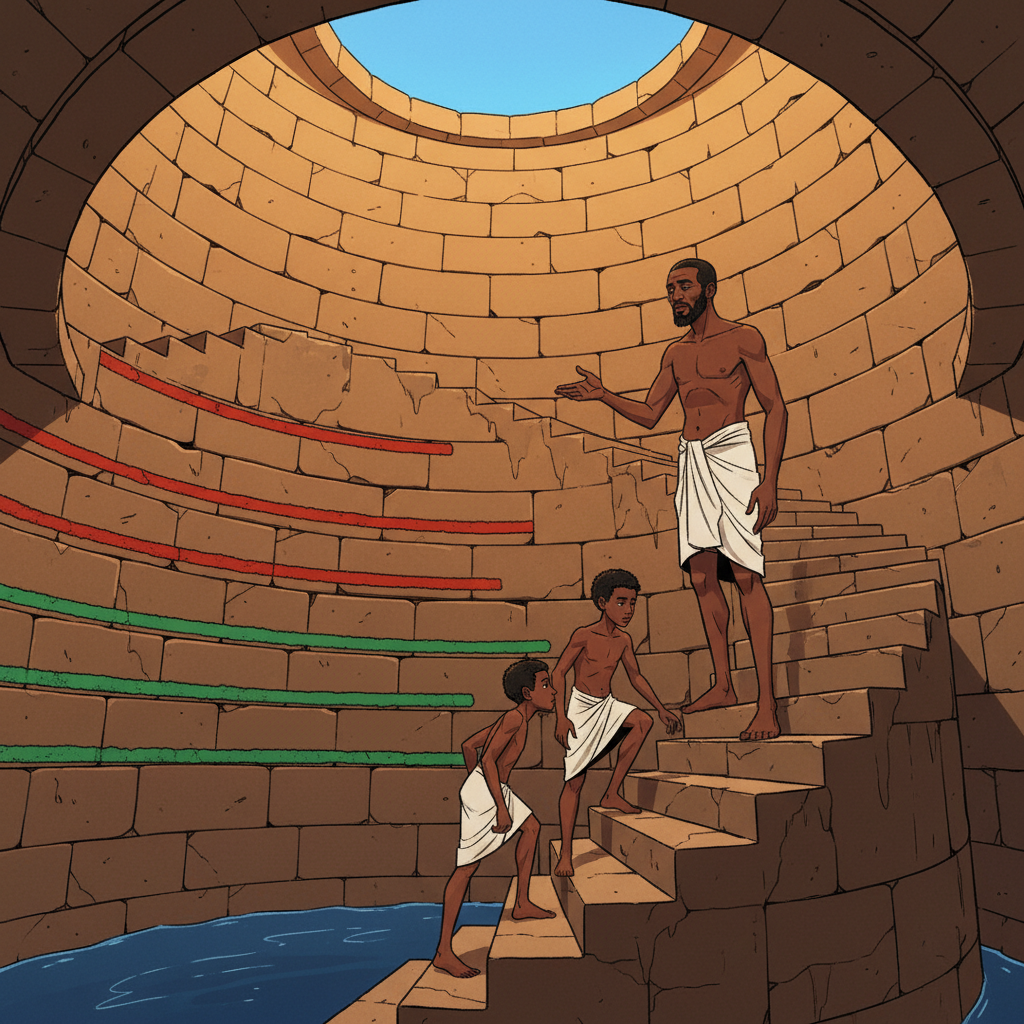
After the morning lessons, Ahmes took the apprentices outside to the nilometer — a stone staircase descending into a deep well connected to the great river. The nile was the lifeblood of kemet, and predicting its annual flood was essential to the survival of every family, every farm, every city along its banks. Khufu descended the stone steps carefully, his bare feet cool against the damp walls. Carved markings lined the interior of the well at precise intervals, each one representing a cubit of water height. Some marks were painted red to indicate dangerous flood levels, others green to mark the ideal inundation depth. "Every day for thousands of years," Ahmes said, his voice echoing in the stone chamber, "scribes have descended these steps and recorded the height of the nile. Those records are stored in the per ankh. By studying the patterns — years of high floods, years of low floods — our mathematicians learned to predict what the river would do. This is not magic. This is the careful observation of data over centuries. When you have a thousand years of flood records written on papyrus, you can see patterns that no single lifetime could reveal."
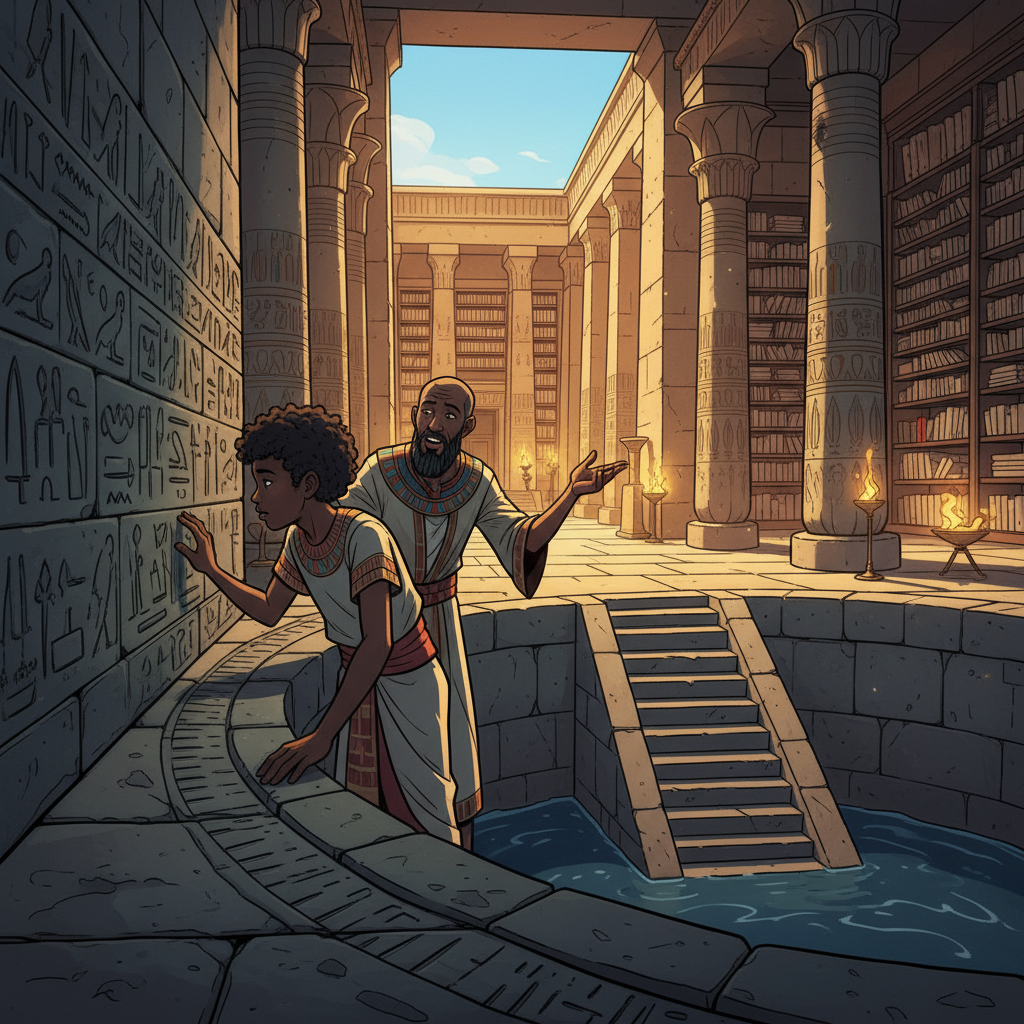
Khufu examined the marks on the nilometer wall, running his fingers along grooves worn smooth by generations of scribes who had stood in this exact spot, measuring the water. Each cubit mark was subdivided into seven palms, and each palm into four fingers — twenty-eight subdivisions per cubit, allowing measurements of extraordinary precision. He imagined the scribes of ancient dynasties standing here at dawn, dipping a measuring rod into the water, recording the level on their papyrus sheets, then climbing back up to enter the data in the great flood records of the per ankh. "The flood data told our ancestors how much farmland would be fertile each season," Ahmes explained as they climbed back into the sunlight. "If the nile rose sixteen cubits at Waset, the harvest would be abundant. Below twelve cubits meant famine. Above eighteen cubits meant destructive flooding. With this knowledge, the government could plan — storing extra grain in good years to feed the people in lean years. Mathematics was not abstract for our ancestors. It was the difference between life and death."
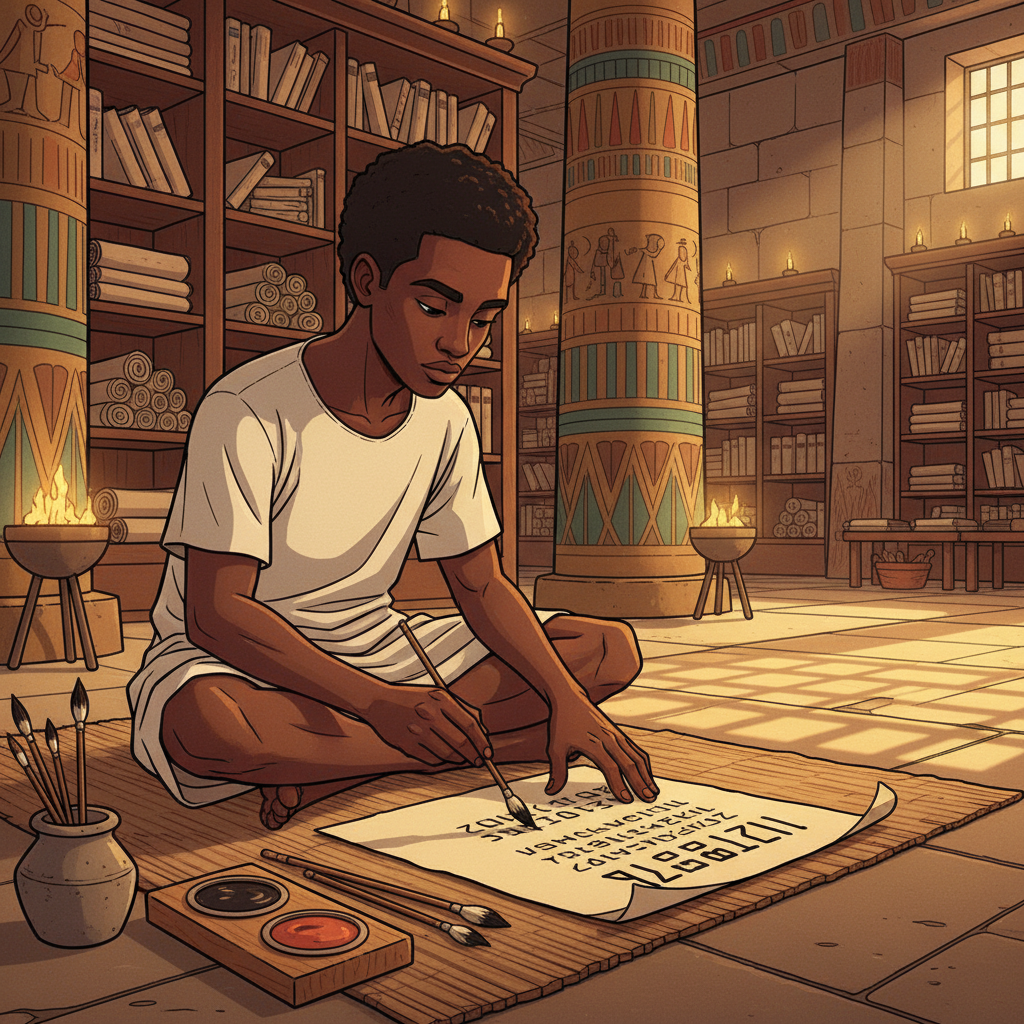
That afternoon, Khufu sat in the scriptorium of the per ankh, surrounded by the tools of his craft. Before him lay a fresh sheet of papyrus, smooth and pale, made from the reeds that grew thick along the nile. His ink palette held two wells — black ink made from soot mixed with gum arabic, and red ink made from ground ochre. His reed brushes were cut fresh that morning, their tips chewed to a fine point. A small stone pot of water sat nearby for thinning the ink and cleaning the brushes. This was the daily work of a scribe — careful, precise, and essential. Ahmes had assigned him the task of copying a complete set of multiplication tables. Khufu began with the two-times table and worked upward, forming each hieratic numeral with steady strokes. The work required total concentration. A single miscopied number could cascade through every calculation that used the table, like a crack in a foundation stone spreading through an entire wall. His deep brown hands moved with growing confidence, the reed brush leaving clean black lines on the pale papyrus. By the time the afternoon shadows lengthened across the floor, he had completed tables through sixteen.
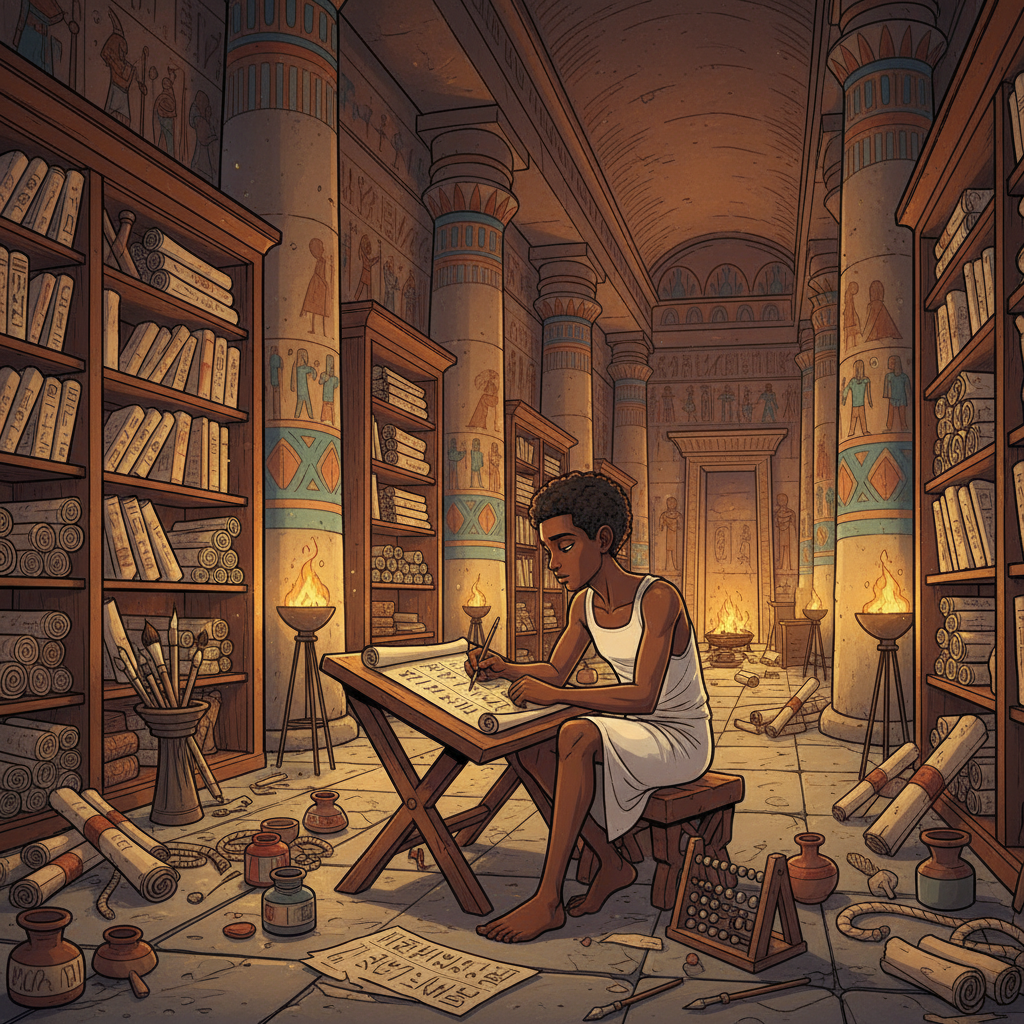
As Khufu worked, he thought about the generations of scribes who had sat in this same room, doing this same careful work. The per ankh was more than a school — it was a living archive, a place where the accumulated knowledge of kemet was preserved, studied, and expanded. Healers studied medical papyri that described surgical procedures and herbal remedies. Astronomers charted the movements of stars and planets to maintain the calendar. Engineers consulted architectural scrolls before designing temples and irrigation channels. And mathematicians like Ahmes refined and extended the calculations that made all of it possible. The shelves around him held knowledge that had been gathering for over two thousand years. Khufu sometimes felt the weight of that tradition pressing gently on his shoulders — not as a burden, but as an embrace. He was part of something vast, a chain of knowledge stretching back to the earliest scribes who had first pressed reed to papyrus and recorded the truths they discovered. Every equation he copied correctly was a link in that chain. Every error he caught and corrected was an act of maat — truth maintained against the constant pull of disorder and forgetting.
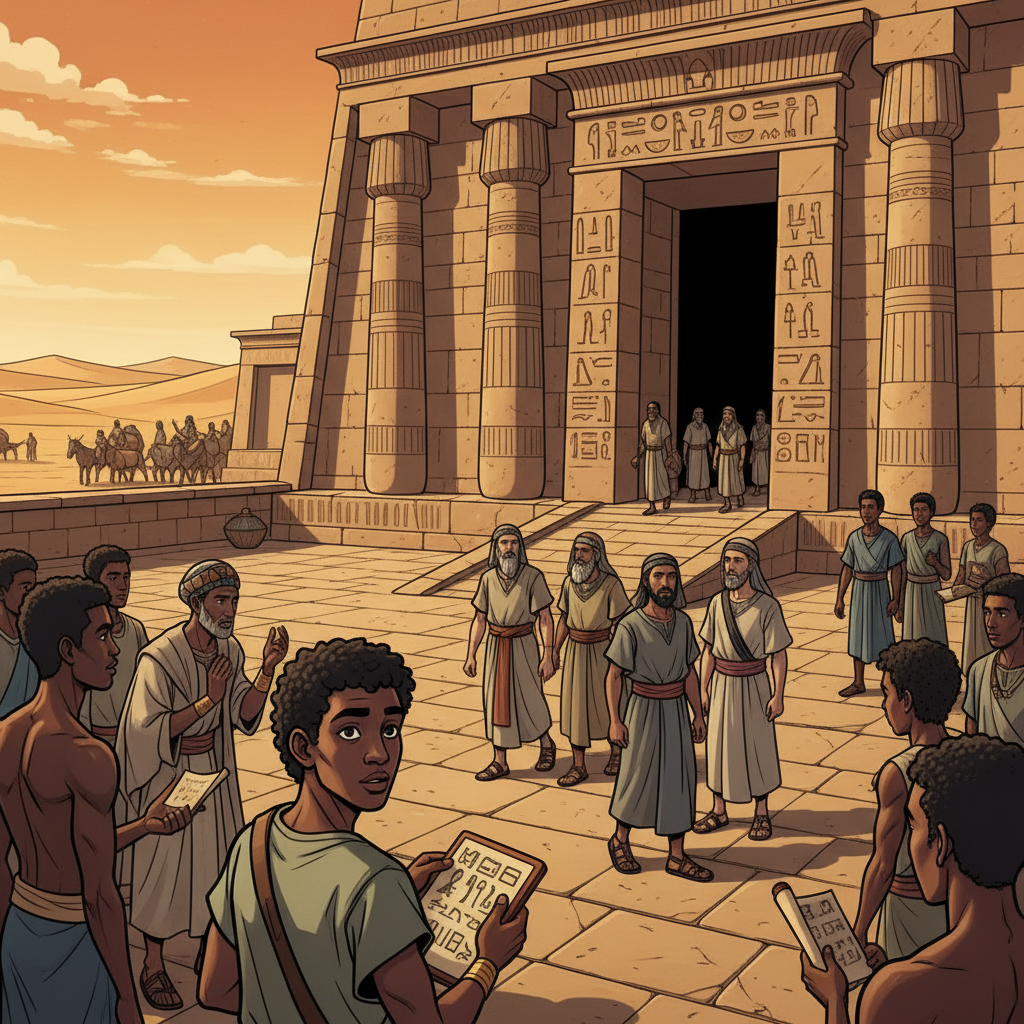
One morning, a commotion at the entrance of the per ankh drew the apprentices from their studies. A group of foreign visitors had arrived — pale-skinned men in woolen robes, their beards long and untrimmed, speaking a language Khufu did not recognize. They were escorted by a Kemetic official who introduced them to the senior priests. Ahmes leaned toward Khufu and spoke quietly. "These are scholars from across the great sea — from the land the foreigners call Hellas. They have traveled many weeks to study here. This is not unusual. Greek scholars have been coming to kemet to learn for generations." Khufu watched the visitors with curiosity. They seemed awed by the per ankh — staring up at the painted ceilings, running their hands along the carved columns, whispering to one another as they took in the vast shelves of scrolls. One of them, a young man with intense eyes, carried a wax tablet and a stylus, and he was already sketching the hieroglyphs carved above the doorway. Ahmes told Khufu that the great Greek thinker Thales had studied in kemet years ago and had brought Kemetic geometry back to his homeland. "He learned how to calculate the height of a pyramid by measuring its shadow," Ahmes said. "That method was ancient to us even then."
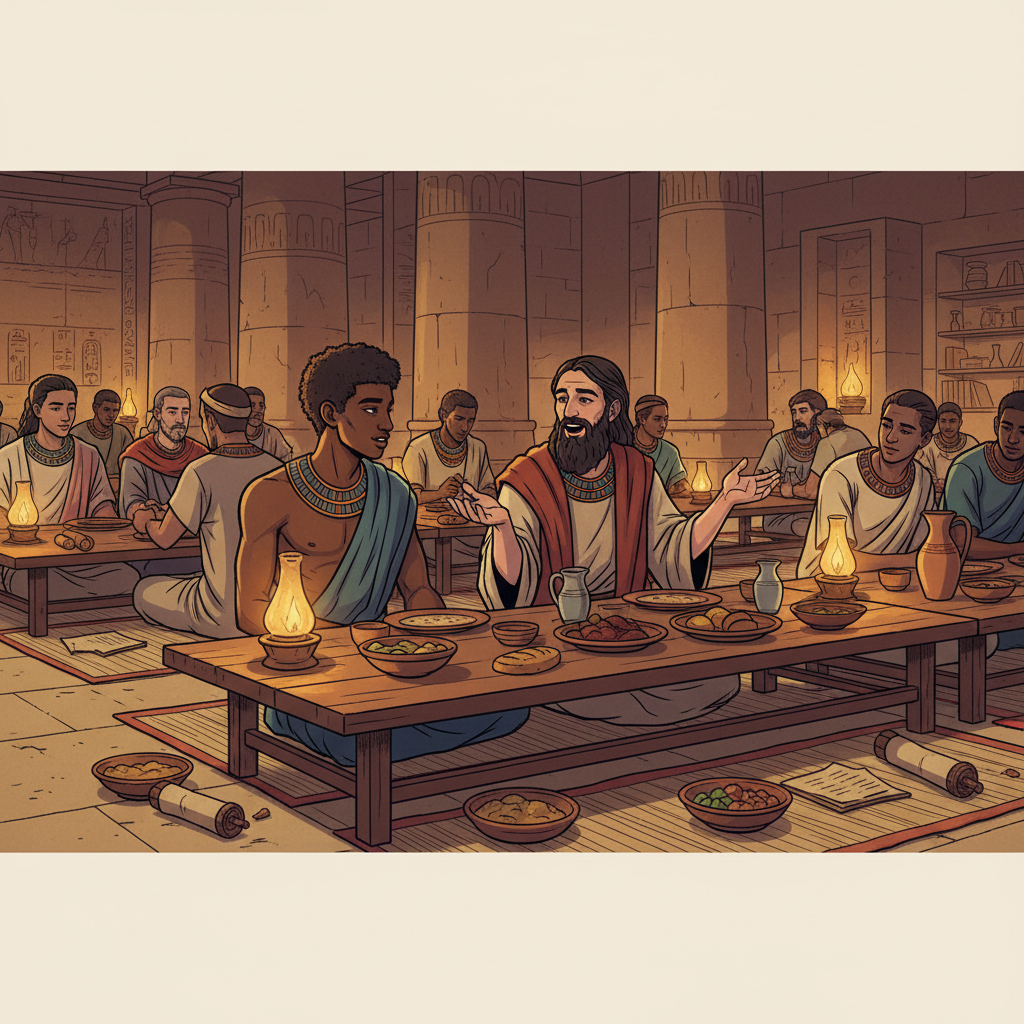
Over the following weeks, the Greek scholars attended lectures alongside the Kemetic apprentices. They studied geometry, astronomy, and the principles of mathematical proof. Khufu noticed that they struggled with the fraction system, finding it more difficult than the methods they were accustomed to. But they were earnest students, working late into the evening by lamplight, filling their wax tablets with notes. One of them, a man named Theodoros, spoke enough of the Kemetic language to hold simple conversations, and he often sat near Khufu during meals. "In my country," Theodoros told Khufu one evening, his dark-bearded face animated with excitement, "we have begun to develop our own methods of proof. But our teachers told us that the foundations were laid here, in kemet. Pythagoras himself studied in your temples for over twenty years. He learned the relationships between numbers and shapes that he later taught in our schools." Khufu felt a deep pride hearing this — not a boastful pride, but a quiet confirmation of what Ahmes had always taught. Knowledge flowed between peoples, and the nile of wisdom had its source in Africa.
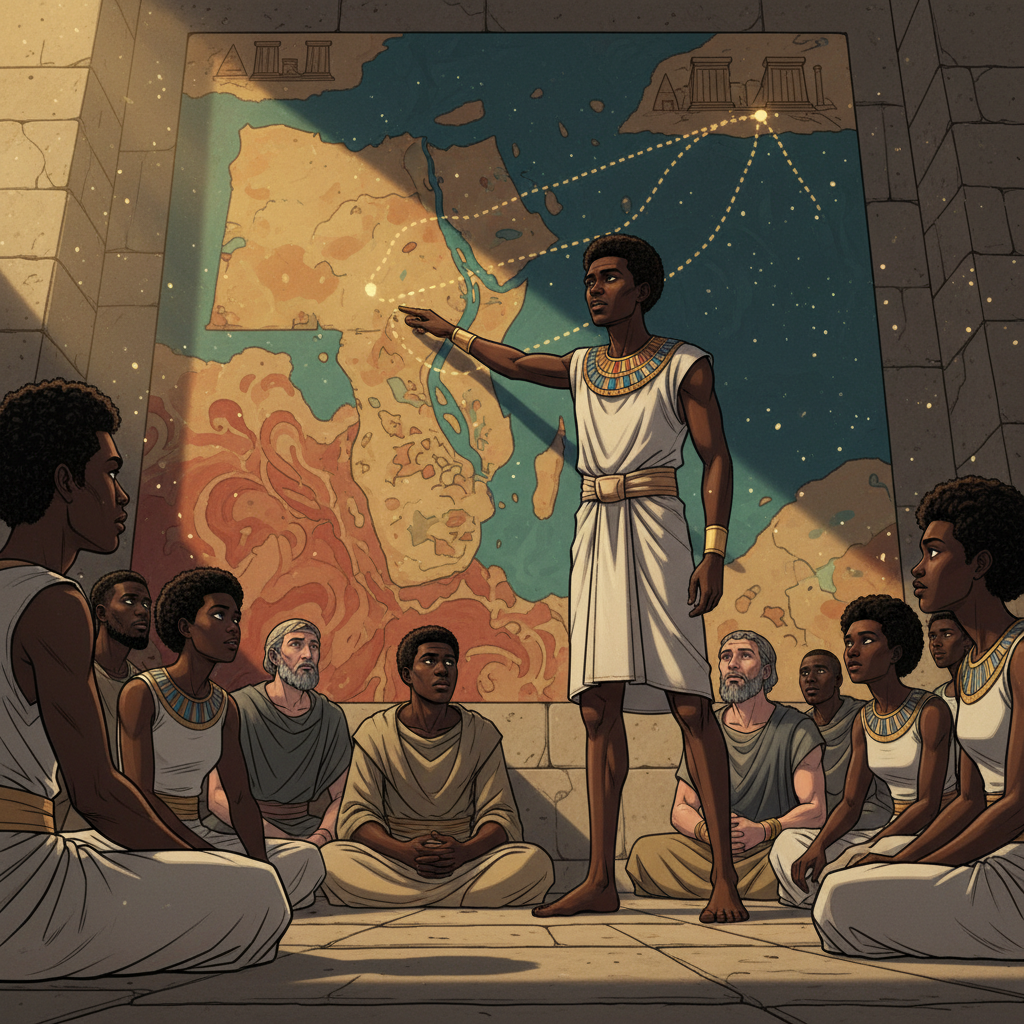
Ahmes used the visit of the Greek scholars to teach a deeper lesson. He gathered the apprentices one afternoon in the great hall, where a map of the known world was painted on the wall. Kemet sat at the center, the nile flowing north through the green valley, with the great sea above and the vast African interior below. "Knowledge does not belong to any one people," Ahmes said, tracing the trade routes with his dark brown finger. "But truth demands that we remember where knowledge was born. When a scholar learns geometry in kemet and teaches it in Hellas, that is the natural flow of wisdom — and it is maat. But if that scholar's descendants someday claim that geometry was invented in Hellas and deny its Kemetic origins, that is isfet." He paused, letting the words settle over the room like dust in still air. "The worst form of isfet is not violence. Violence can be fought with strength. The worst form of isfet is erasure — when someone takes the truth and buries it so deep that people forget it ever existed. When a people's contributions to knowledge are denied, it is as if someone has stolen their ka — their very spirit, their legacy. That is a crime against maat that echoes through centuries."
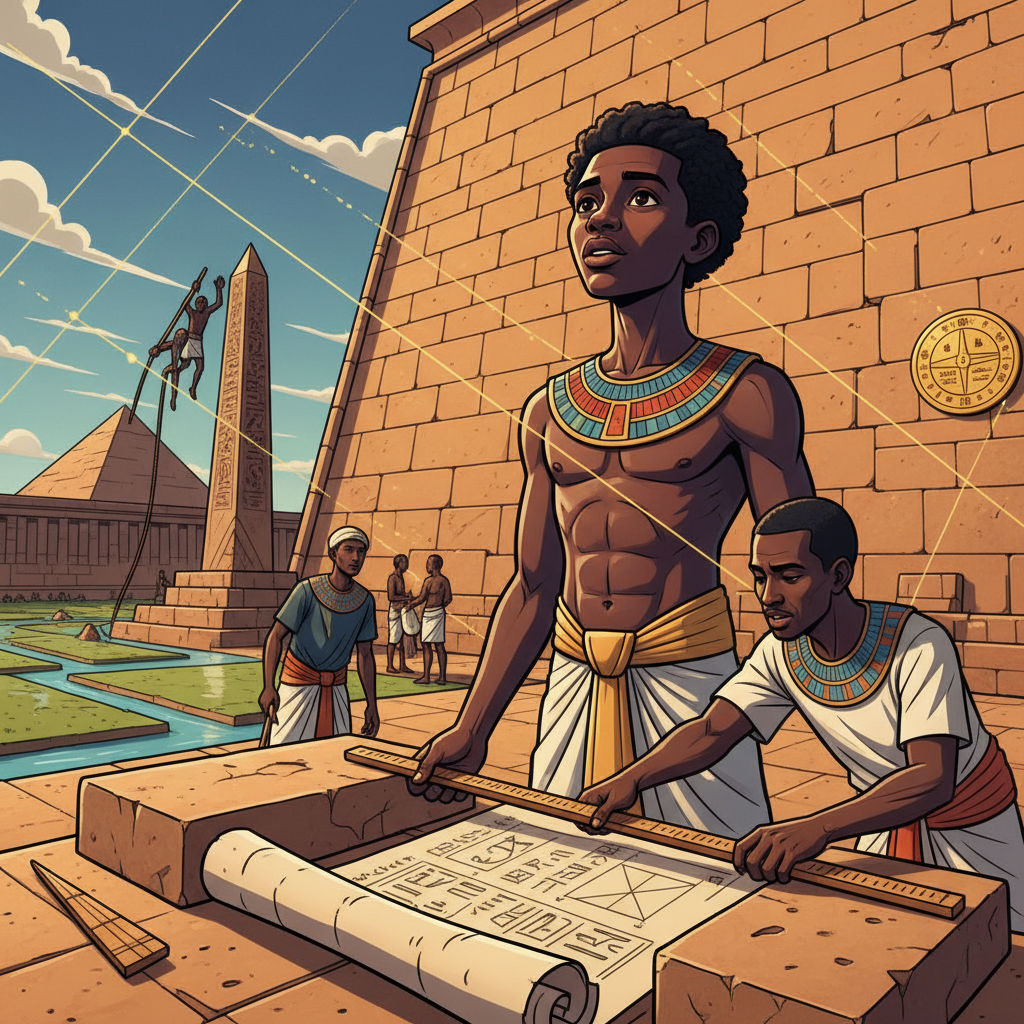
Khufu thought about Ahmes's words for days afterward. He began to notice things he had not noticed before — the precision of the temple walls, calculated to within a fraction of a finger's width. The irrigation channels that distributed water across thousands of acres using principles of fluid dynamics that the Kemetic engineers had mastered through generations of observation. The calendar on the wall of the per ankh, dividing the year into three hundred and sixty-five days with twelve months of thirty days each, plus five additional days — a system so accurate that it would be adopted by other civilizations for millennia. Every structure, every system, every tool he encountered was built on mathematics. The cubit rods the builders used were standardized across the entire kingdom, each one exactly the same length, divided into the same subdivisions. This standardization allowed architects in Waset to design a temple that would be built by workers in a quarry hundreds of miles away, knowing that every measurement would match perfectly. Khufu began to see mathematics not as marks on papyrus but as the invisible framework that held civilization itself together.
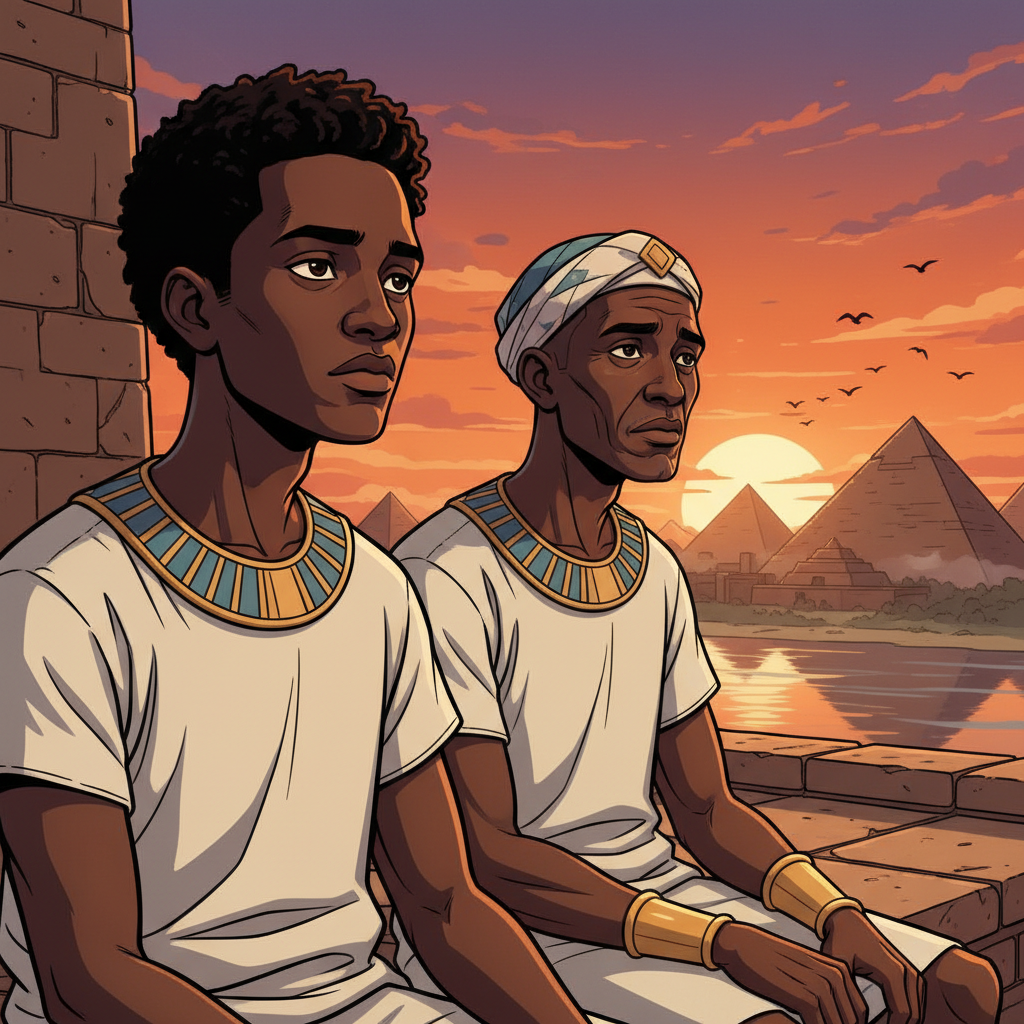
One evening, as the sun painted the sky above Waset in shades of copper and violet, Khufu found Ahmes sitting alone on the rooftop terrace of the per ankh. The older man was gazing out at the great temples across the river, their massive forms silhouetted against the fading light. Khufu sat beside him quietly. After a long silence, Ahmes spoke. "I have been teaching for thirty years, and do you know what troubles me most? Not that our students make errors — errors are how we learn. What troubles me is a fear I carry in my ka." Khufu looked at his teacher's face — the strong jaw, the deep-set eyes, the ebony skin that seemed to absorb the last light of day. "What fear, teacher?" he asked. Ahmes did not answer immediately. He watched a flock of ibis birds cross the darkening sky. "I fear that someday, people will look at the pyramids and say that we could not have built them. That our dark-skinned ancestors were not intelligent enough to calculate the seked, to engineer structures that would stand for thousands of years. I fear they will attribute our achievements to anyone — to gods, to visitors from the stars — rather than admit that African minds conceived and executed the greatest architectural achievements in human history."
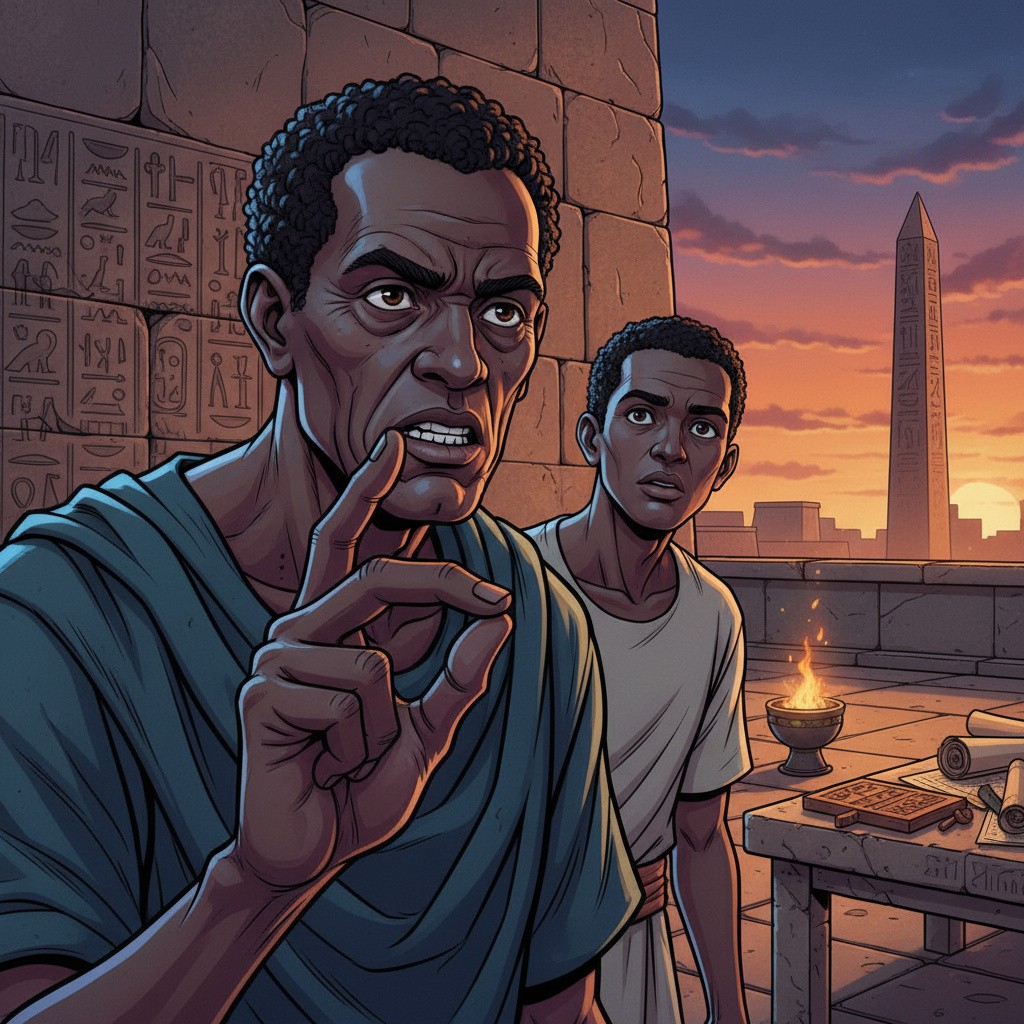
"Has this happened before?" Khufu asked, his voice barely above a whisper. Ahmes nodded slowly. "It has already begun, in small ways. Some of the foreign scholars who come here to learn do not credit their teachers when they return home. They present Kemetic knowledge as their own discoveries. A theorem learned in this very room becomes a Greek theorem within a generation. A method of calculation practiced here for centuries is named after the foreign student who carried it across the sea." His jaw tightened. "This is how erasure works, young one. It does not happen all at once. It happens slowly, like water wearing away stone." Khufu felt a cold knot forming in his stomach. "But the scrolls —" he began. Ahmes raised a hand. "The scrolls endure. The hieroglyphs endure. The pyramids endure. That is why our work as scribes is so critical. Every equation you copy, every record you preserve, is a defense against erasure. Papyrus can burn, but if enough copies exist, the truth survives. Stone can be buried, but it does not decompose. Our ancestors understood this. They wrote in stone precisely because they knew that truth must be preserved in materials that outlast the liars."
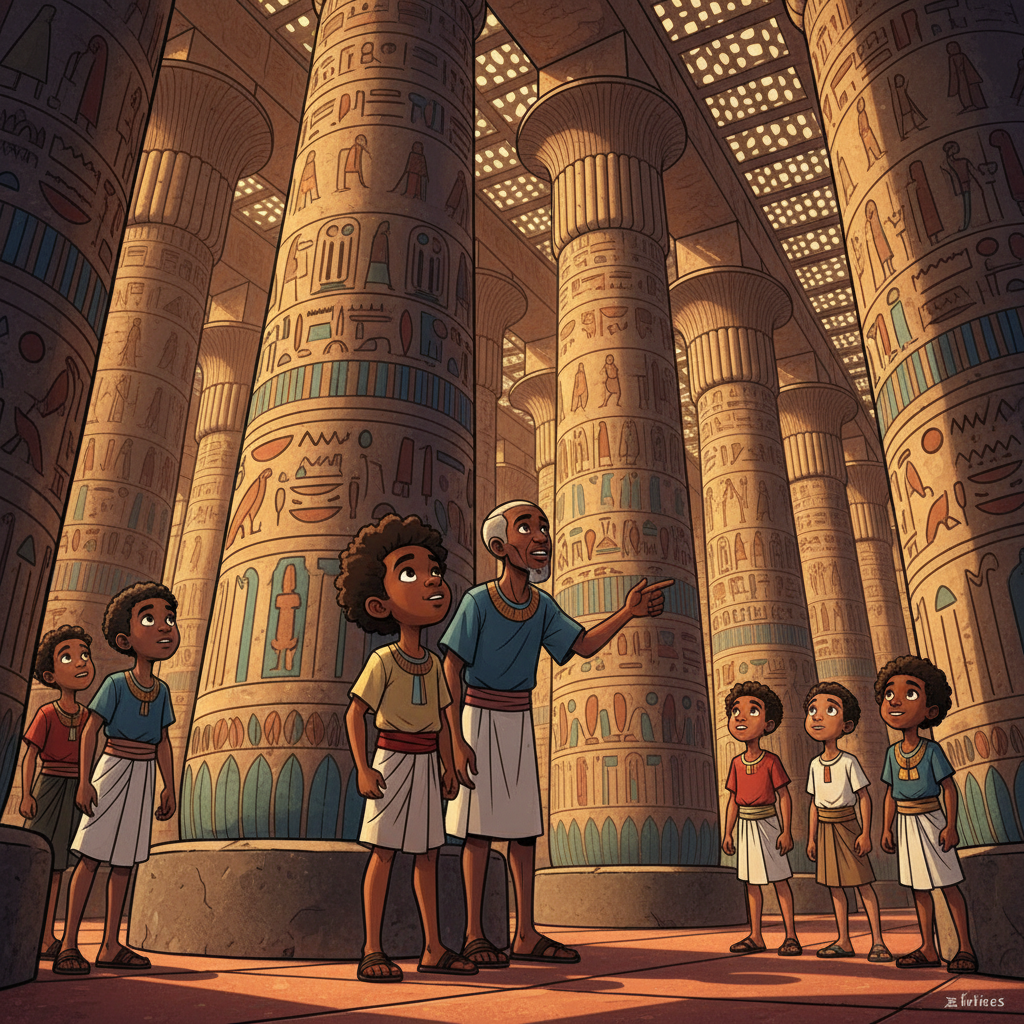
The next morning, Ahmes brought the apprentices to the temple of Ipet-Isut to study the mathematical principles embedded in its architecture. They stood before the great hypostyle hall, where one hundred and thirty-four massive columns rose like a stone forest. Khufu craned his neck to look up at the columns, each one carved with hieroglyphs and painted in brilliant colors. "Every column in this hall was placed according to precise calculations," Ahmes said, his voice hushed with reverence. "The spacing, the height, the diameter — all computed to distribute the enormous weight of the stone roof evenly across the foundation." He pointed to the central columns, which were taller and thicker than those along the sides. "This is not decoration. This is engineering. The central columns bear more weight, so they are larger. The architects calculated exactly how much stone each column needed to support. They understood the principles of compression and load distribution that modern engineers would later formalize with equations. But our ancestors did it first — not with modern tools, but with mathematics, observation, and the accumulated wisdom of the per ankh." Khufu touched the cool stone of the nearest column and felt the weight of genius beneath his fingertips.
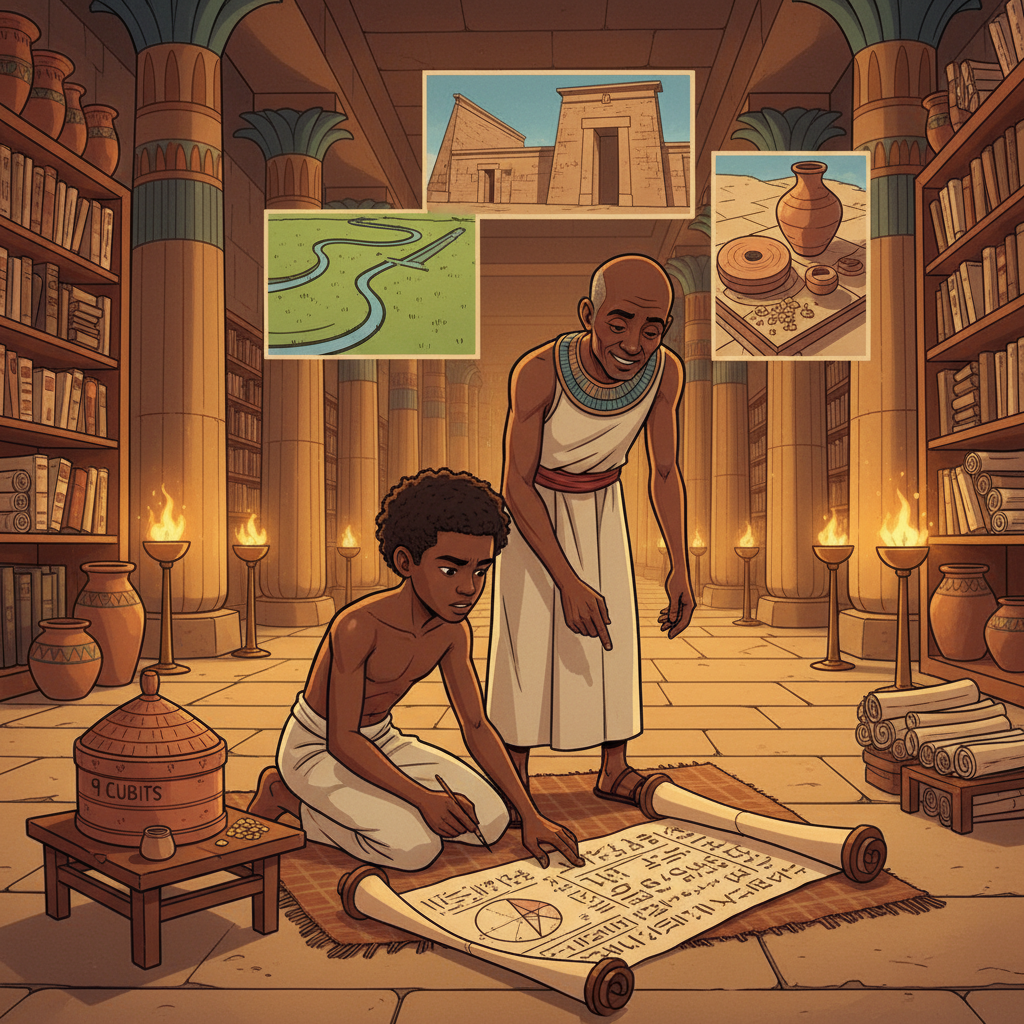
As the weeks passed, Khufu's skills grew rapidly. He could now decompose complex fractions into unit fractions without hesitation. He could calculate the seked of any pyramid given its base and height. He could find the area of circles and the volume of truncated pyramids. But more than the calculations themselves, he was developing what Ahmes called "the eye of maat" — the ability to see mathematical truth in the world around him. He saw it in the proportions of temple doorways, in the angles of irrigation channels, in the way a potter shaped a vessel using the geometry of curves. One afternoon, Ahmes tested him with a problem from the Rhind Papyrus that combined several techniques. "A circular granary has a diameter of nine cubits and a height of ten cubits," Ahmes said. "How many hekat of grain can it hold?" Khufu worked steadily, first calculating the area of the circular base using the Kemetic method — subtract one-ninth of nine, square the result — giving sixty-four square cubits. Then he multiplied by the height of ten cubits to get six hundred and forty cubic cubits. Finally, he converted to hekat, the standard unit of grain measurement. When he presented his answer, Ahmes smiled broadly, his dark face warm with pride. "You are becoming a mathematician, not just a scribe."
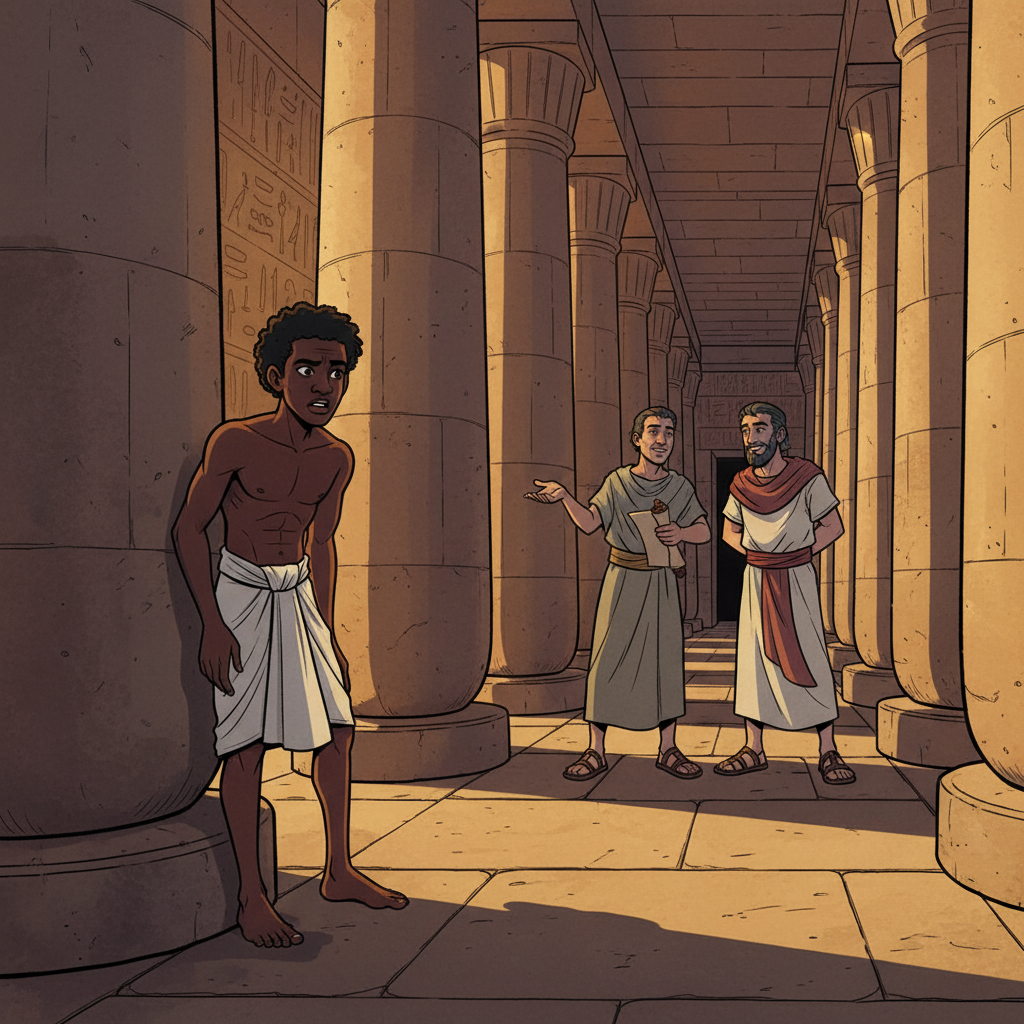
Near the end of the season, the Greek scholars prepared to return to their homeland. Theodoros came to say farewell to Khufu, clasping his arm in the manner of his people. "I will carry what I have learned here for the rest of my life," he said. "Your teachers have given me knowledge I could not have found anywhere else in the world." Khufu appreciated the honesty. He had come to like Theodoros, who always credited his Kemetic teachers when discussing what he had learned. But not all the Greek scholars were so honorable. Khufu overheard two of them speaking in the corridor, and though he understood only fragments of their language, their tone was unmistakable. They were discussing how to present the mathematical techniques they had learned as improvements upon "primitive" methods, rather than acknowledging the sophistication of the originals. Khufu felt anger rise in his chest like heat from a furnace. He reported what he had heard to Ahmes, who listened with a heavy expression. "This is the seed of erasure," Ahmes said quietly. "Plant it in enough minds, water it with repetition, and within centuries, the whole world will believe the lie."
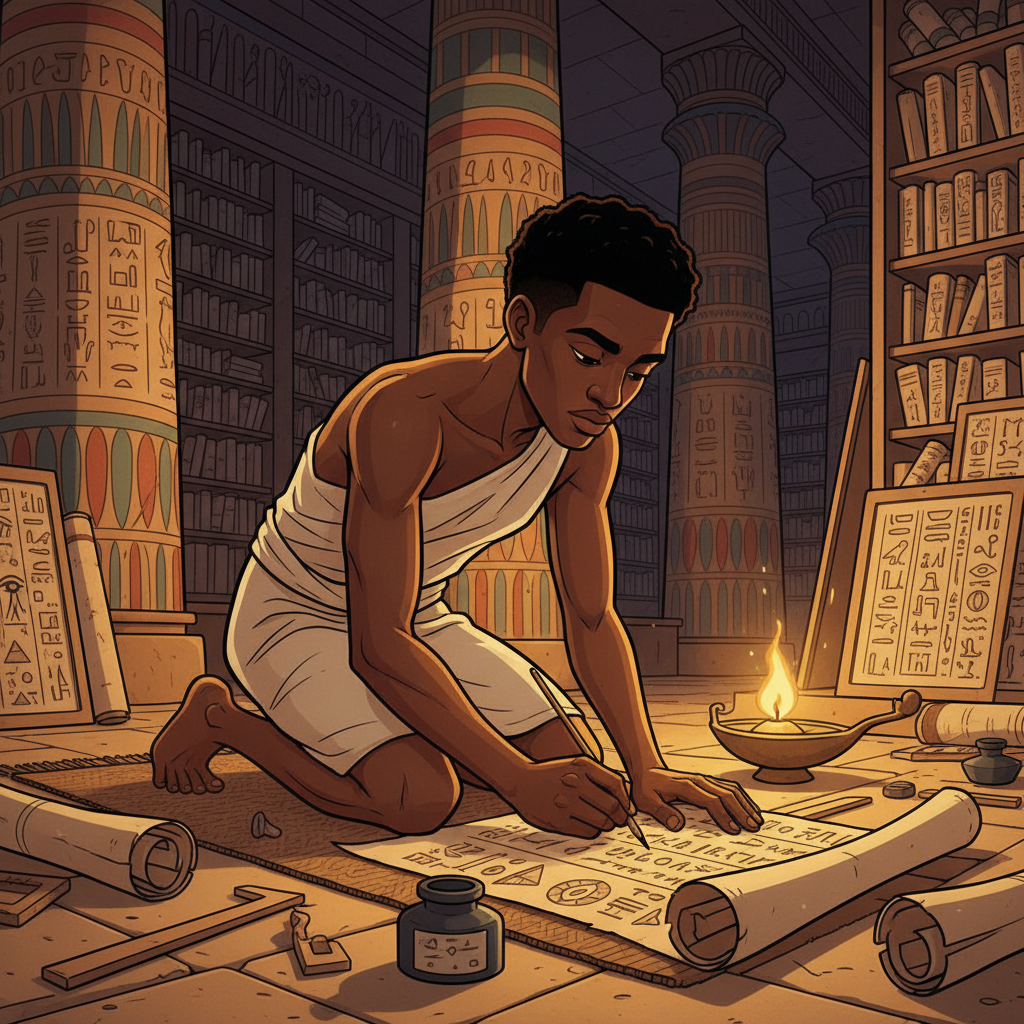
That night, Khufu could not sleep. He lay on his mat in the apprentice quarters, staring at the ceiling, thinking about everything Ahmes had taught him. The mathematics itself was beautiful — elegant, precise, powerful. But the lesson that burned brightest in his mind was about maat and isfet, truth and erasure. He thought about the Rhind Papyrus, written by a scribe named Ahmes who had carefully noted that he was copying from an even older source. That act of honesty — of crediting what came before — was itself an act of maat. It preserved the chain of knowledge, acknowledged the ancestors, and ensured that future generations would know the true origins of the wisdom they inherited. Khufu rose quietly and walked to the mathematics chamber. By the light of a single oil lamp, he unrolled a fresh sheet of papyrus and began to write. Not equations this time, but a statement — a record of what the per ankh of Waset contained, who taught there, what methods they used, and where that knowledge had come from. He wrote about the seked and the pyramids, about the Eye of Heru fractions, about the area of circles and the volume of truncated pyramids. He wrote about the nilometer and the flood records. He wrote about the Greek scholars who came to learn. Every word was an act of maat, a fortress of truth built on papyrus.
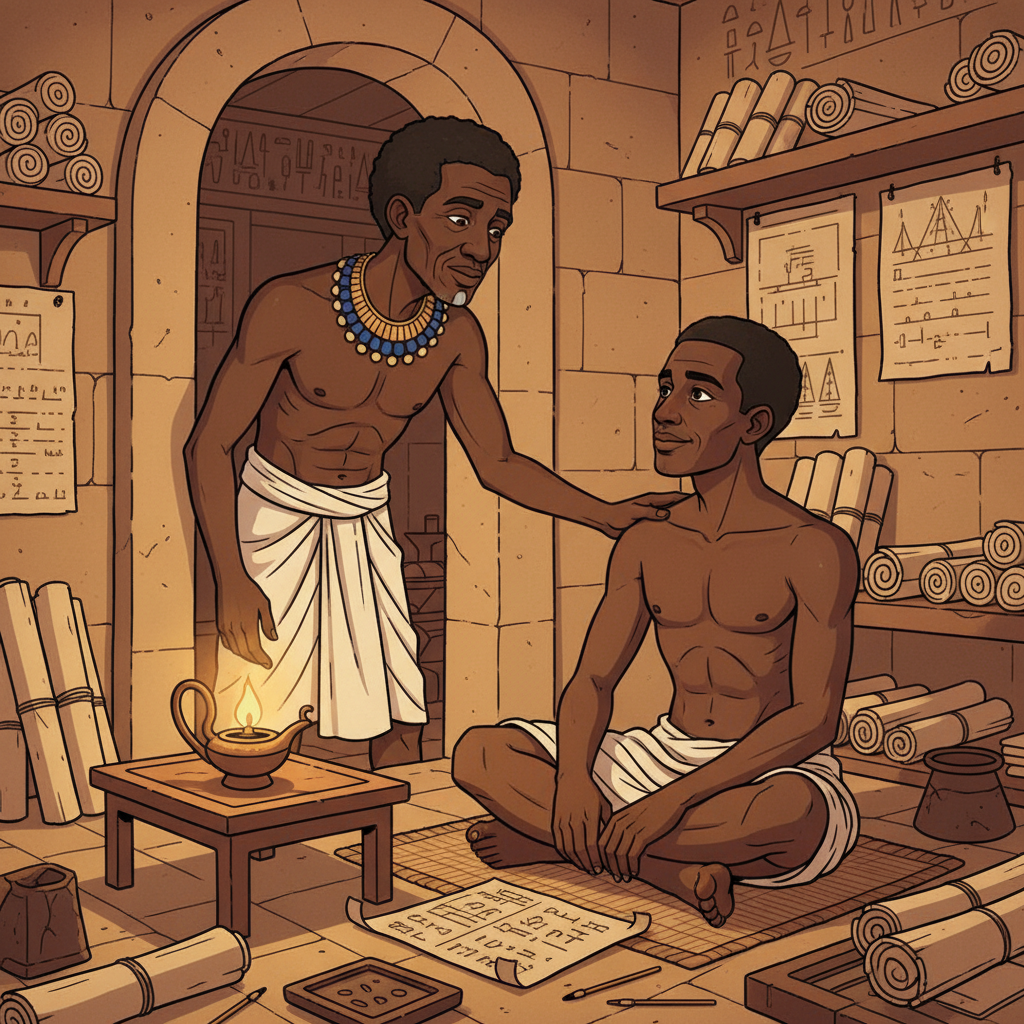
When Ahmes found him the next morning, still writing by lamplight, the old teacher stood in the doorway for a long time before speaking. Then he placed his dark hand on Khufu's shoulder. "You understand now," he said simply. Khufu looked up, his deep ebony face illuminated by the lamp's glow, and nodded. "The pyramids will stand for thousands of years," Khufu said. "The papyri will endure in the dry air of kemet. But I want to write it down again, in my own hand, so there is one more copy. One more witness. Because truth does not defend itself — it needs scribes willing to preserve it." Ahmes sat beside him, and for a moment the two of them — teacher and student, elder and youth, both dark-skinned children of kemet — sat in the quiet lamplight surrounded by the accumulated wisdom of their ancestors. Today, the Rhind Papyrus and the Moscow Papyrus sit in museums far from Africa, but they still speak the truth in the language of mathematics. The pyramids still stand at precise angles calculated with the seked. Every student who learns geometry, who calculates the area of a circle, who divides fractions, walks a road that began in Africa, in the per ankh, where scribes like Khufu copied equations by lamplight and called it what it was — maat. Truth cannot be erased. It endures in stone, in papyrus, in the very numbers we use, waiting for those with eyes to see and the courage to speak it.