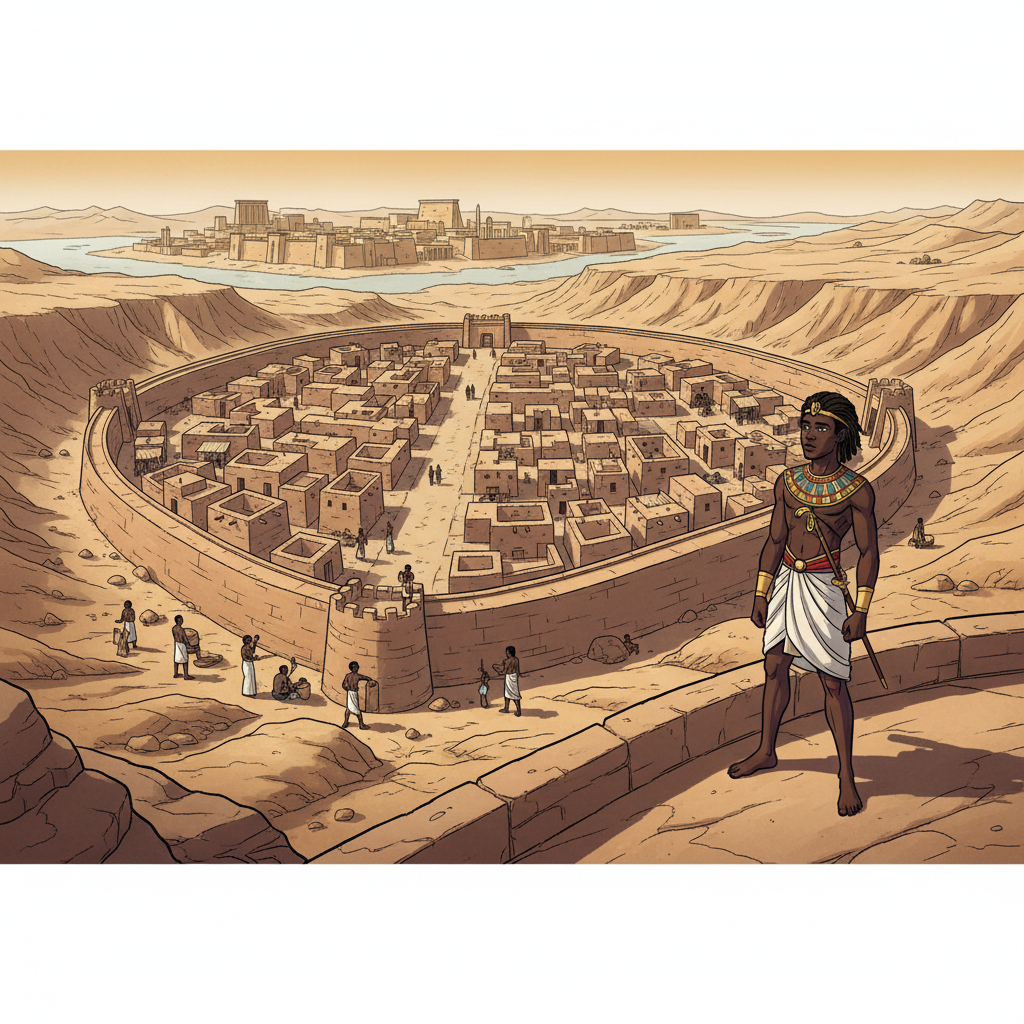
The village of Set Maat — "The Place of Truth" — sat in a narrow valley on the west bank of the Nile, across from the great city of Waset that foreigners would one day call Thebes. It was a village unlike any other in Kemet, a settlement of roughly sixty mudbrick houses built wall-to-wall along a single main street, surrounded by a thick enclosure wall that separated its inhabitants from the rest of the world. The people who lived here were not ordinary farmers or merchants. They were the most skilled artisans in the Two Lands — stonecutters, painters, sculptors, and scribes whose sole purpose was to build the eternal houses of the pharaohs in the Valley of the Kings. Merenptah had just been assigned here, and at nineteen years old, he was the youngest Medjay officer to receive a posting at Set Maat in living memory.
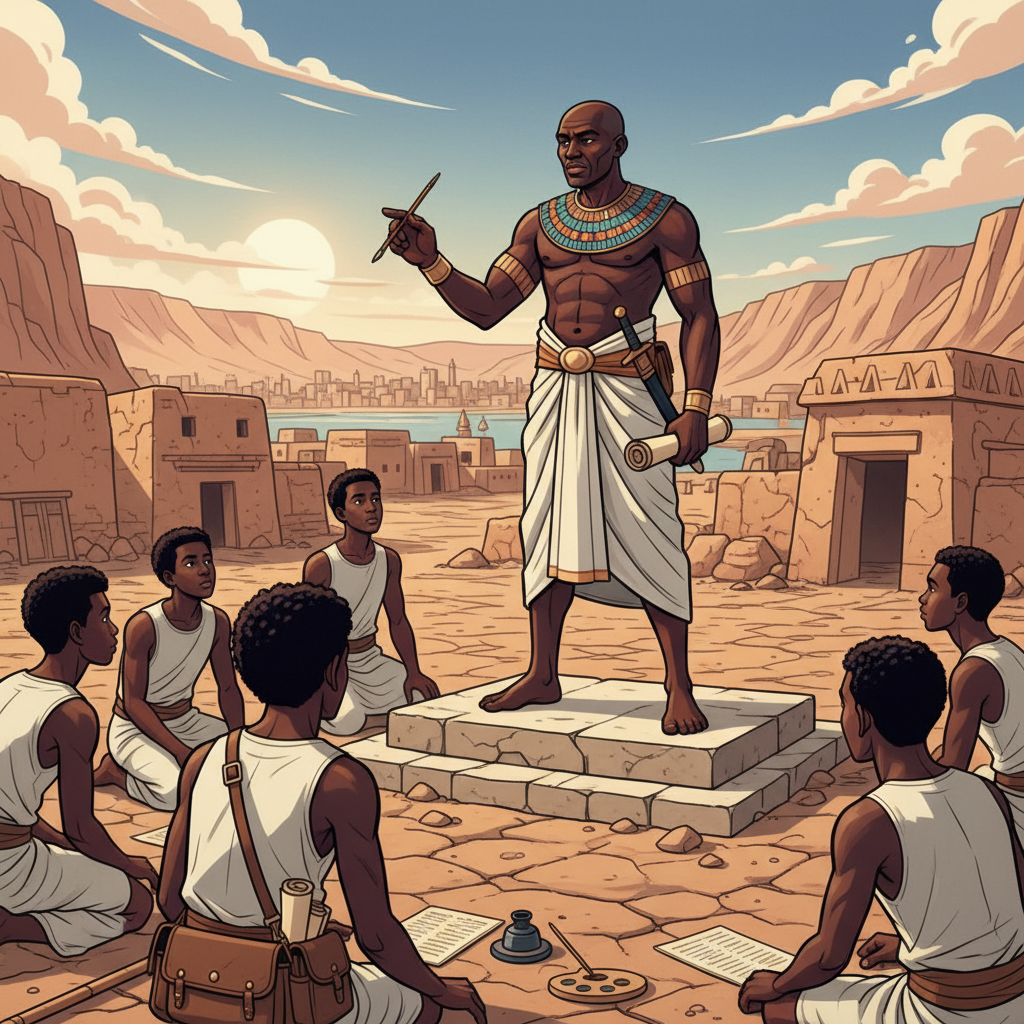
He had earned the assignment through three years of exemplary service in the Waset city patrols — a record unmarked by any complaint from citizens or any disciplinary action from his superiors. His deep ebony skin bore the ritual scarification of a Medjay warrior across his upper arms, three bands of raised marks that identified him as one who had completed the full training regimen. His close-cropped 4C hair was kept short for practical reasons: a Medjay working in the desert heat could not afford vanity. He carried the standard Medjay equipment — a bronze-tipped staff for day patrols, a short sword for serious situations, and a leather satchel containing a reed pen, an ink palette, and sheets of limestone ostraca for recording observations. The pen, his training officer had told him, was more important than the sword. "A Medjay who cannot write a clear report is only half a Medjay. Justice requires documentation. Without records, truth becomes whatever the loudest voice claims it is."
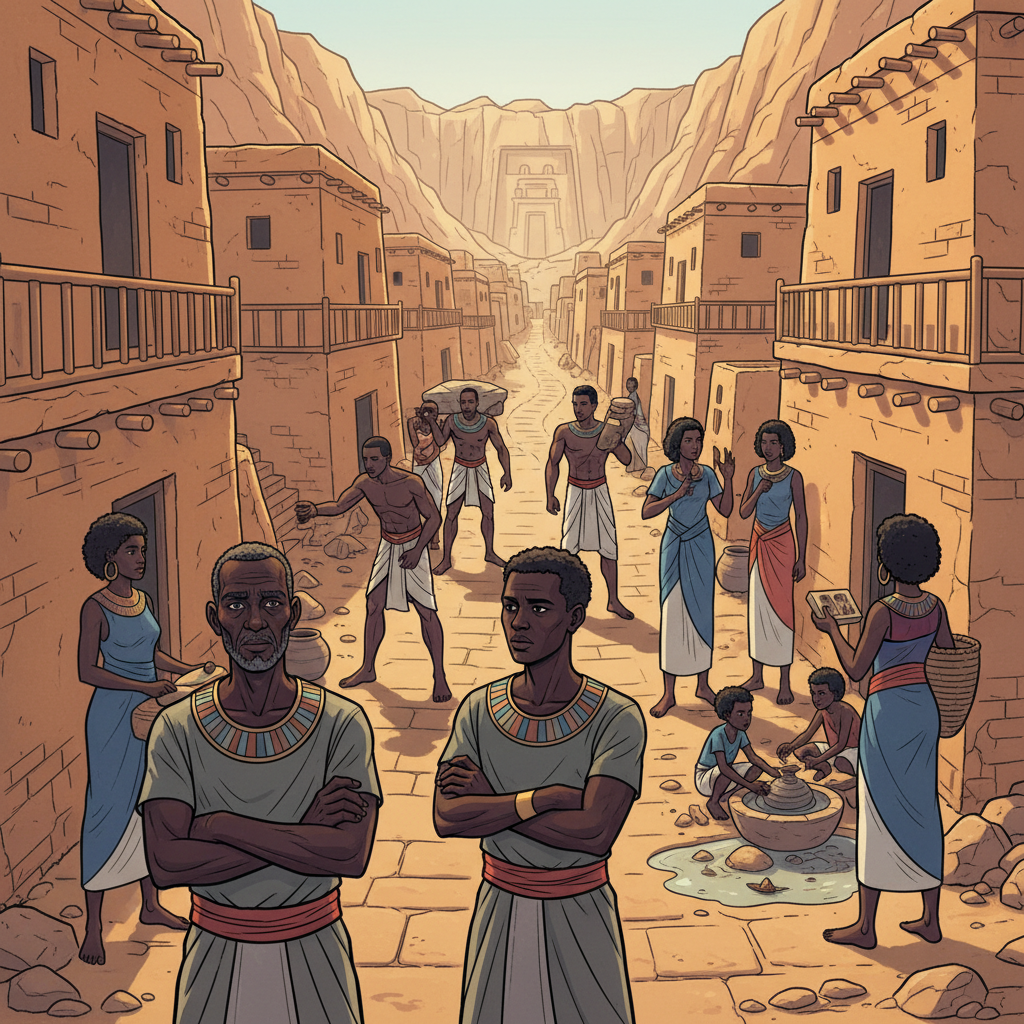
Set Maat was a closed community with its own rhythms and its own rules. The artisans worked in shifts — eight days on, two days off — climbing the steep path over the ridge each morning to the Valley of the Kings, where they spent their days cutting and decorating the royal tombs. The work was sacred and secret. The locations, layouts, and treasures of the tombs were known only to the workers and their Medjay guards. This secrecy created an atmosphere of intense mutual surveillance — everyone watched everyone, because any breach of security could bring the wrath of the Vizier down on the entire village. Merenptah's predecessor, an older Medjay named Khaemwaset, briefed him on the realities of the posting. "These are not ordinary people," Khaemwaset said, his scarred face creased with the weariness of twenty years at Set Maat. "They are the finest craftsmen in the world, and they know it. They are also proud, quarrelsome, litigious, and perfectly capable of making your life miserable if they decide they do not respect you."
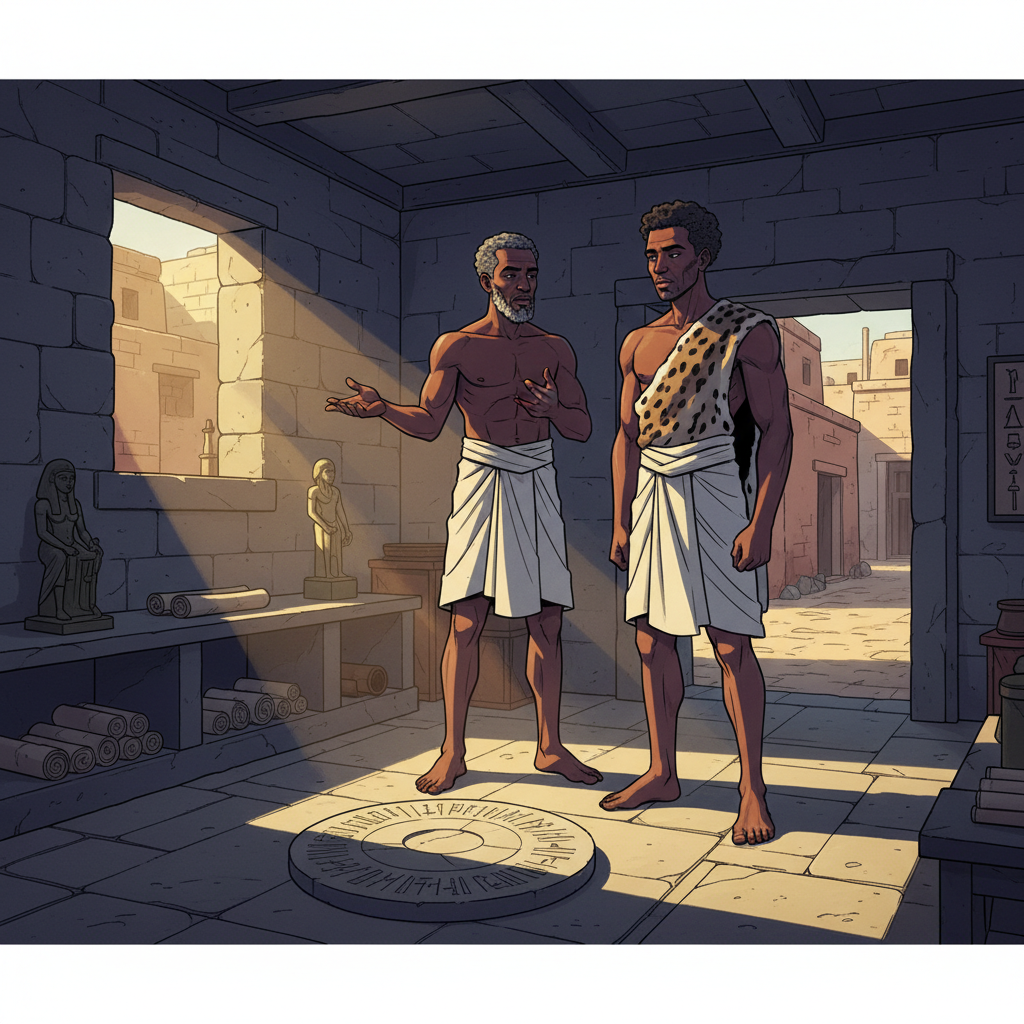
"The key," Khaemwaset continued, "is to understand that your job is not to impose order on them. They impose order on themselves — they have their own kenbet, their own internal court, and they resolve most disputes without any involvement from us. Your job is to handle what they cannot handle themselves — theft, serious violence, anything involving the tombs — and to serve as the link between this village and the Vizier's office. You are not their ruler. You are their guardian." He paused. "And their witness. When something goes wrong here, the Vizier does not ask the artisans what happened. He asks the Medjay. Your report becomes the official truth. That is a terrible responsibility. Do not take it lightly." Merenptah absorbed this with the seriousness it deserved. He had been trained in Maat — the principle of truth and cosmic order that governed all aspects of Kemetic life. But training and practice were different things, and he was about to discover just how different.

The trouble began six weeks into Merenptah's posting, and it began with gold. Specifically, it began with the disappearance of gold dust from the workshop of the master artisan Paneb — not a large quantity, perhaps two deben's worth, but enough to constitute a serious crime. Gold used in the royal tombs was weighed and accounted for with obsessive precision. Every grain was recorded when it was issued from the treasury, every grain was recorded when it was applied to surfaces or worked into objects, and any discrepancy triggered an immediate investigation. The workshop scribe, a meticulous young man named Amennakht, had discovered the discrepancy during his evening accounting. His records showed that Paneb had received twelve deben of gold dust for the gilding work in the tomb of Pharaoh Seti's successor. His records also showed that only nine and three-quarter deben could be accounted for in the completed work and remaining supply. Two and a quarter deben of gold dust had vanished.
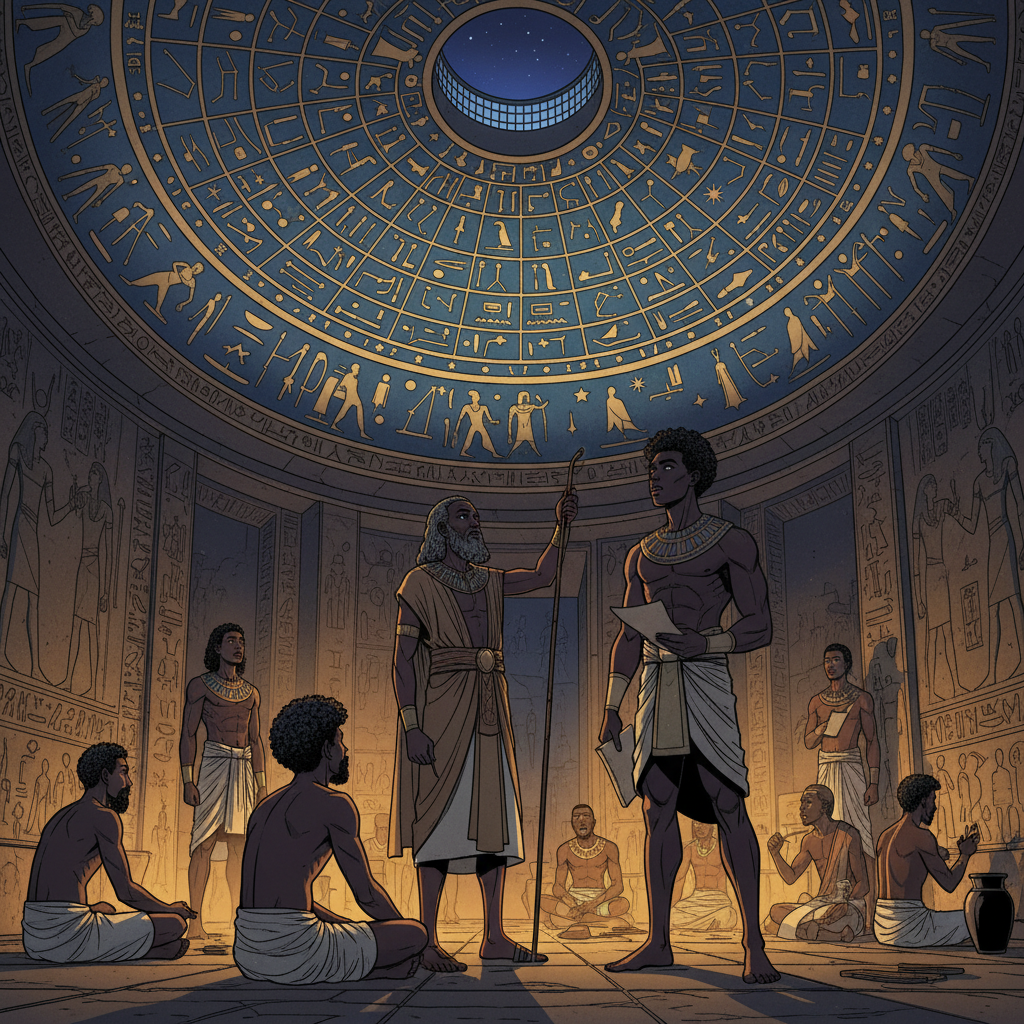
Merenptah examined the workshop himself, taking careful note of the layout, the storage containers, the tools. Paneb's workshop was the largest in the village — appropriate for a man of his status. Paneb was the chief artisan of the right side of the tomb, the most prestigious position in the entire community. His skill was legendary. He had painted the ceiling of a royal burial chamber with a star map so precise that astronomers could use it to calculate the positions of constellations. His hieroglyphic carvings were considered the finest produced in a generation. When visitors from the capital came to inspect the work, it was Paneb's chambers they were shown first. But skill and virtue are not the same thing, and Merenptah had been trained to distinguish between them. He began his investigation the way his Medjay training demanded: by speaking to everyone and assuming nothing.
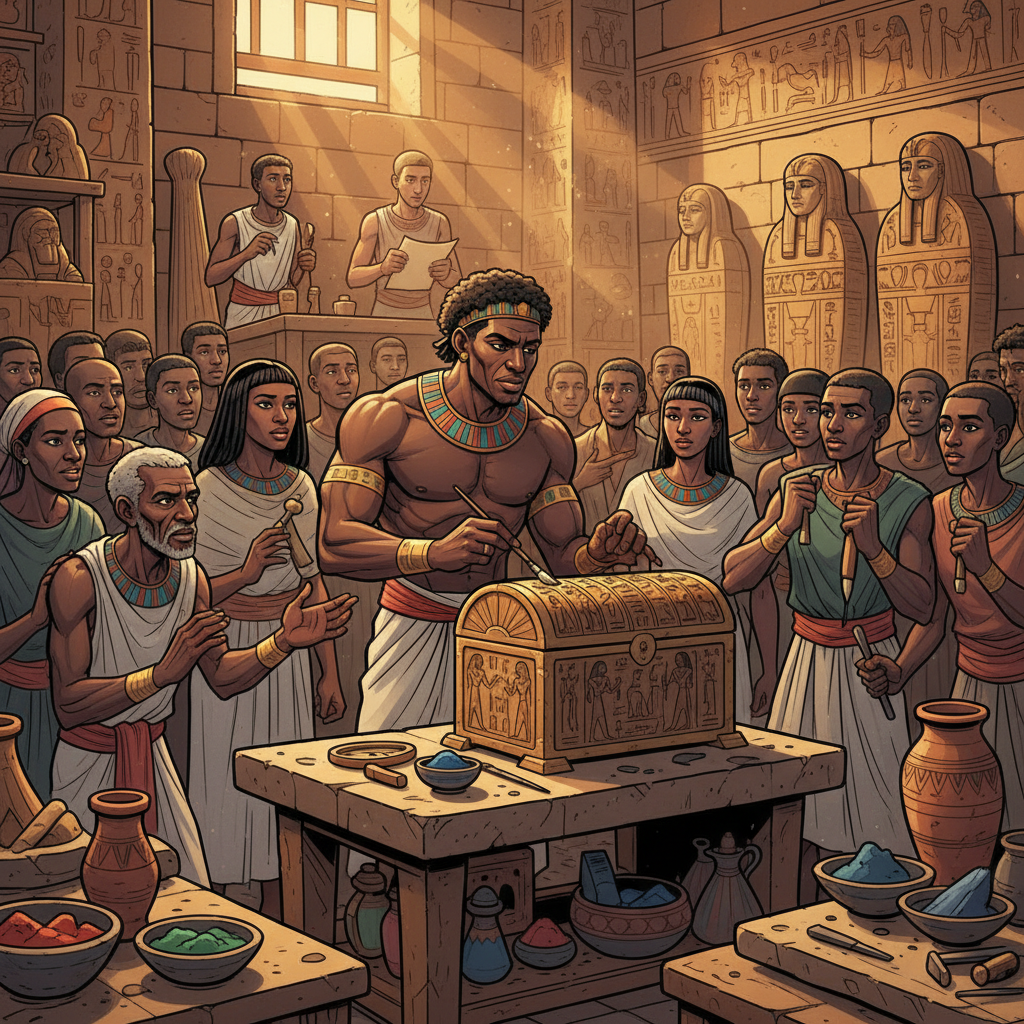
The village was divided. Paneb was a polarizing figure — admired for his extraordinary talent, feared for his explosive temper, and loved by many of the workers who saw in his rough confidence a champion of their interests against the frequent high-handedness of the scribal class. When Merenptah began asking questions, he encountered a wall of loyalty that surprised him. "Paneb is the finest artisan in Kemet," said Hay, a stonecutter who had worked alongside Paneb for fifteen years. "If gold is missing, look elsewhere. A man of his skill does not need to steal." Others echoed this sentiment — Paneb was too proud, too wealthy already from his official position, too aware of his own importance to risk everything for two deben of gold dust. The workers' loyalty to their master was genuine and fierce, rooted in years of shared labor in the suffocating heat of underground tombs. But Merenptah also noticed something else: the workers' loyalty was tinged with a particular intensity that sometimes accompanies fear.

The scribe Amennakht presented a different picture. He arrived at Merenptah's quarters one evening, clearly nervous, and laid out a case that was detailed, documented, and damning. This was not the first time gold had gone missing from Paneb's workshop, Amennakht said. Over the past three years, small discrepancies had appeared in the accounts — never large enough to trigger an automatic investigation, always within the range that could be explained by measurement error or waste. But Amennakht had been keeping his own records, and the cumulative total was significant: over eight deben of gold dust, unaccounted for. "I brought these discrepancies to the attention of the previous foreman," Amennakht said, his dark eyes fixed on the ostracon records he had laid before Merenptah. "He told me I was mistaken. He told me to adjust my figures. I refused, and he threatened to have me transferred to a labor gang." Amennakht paused. "The previous foreman was Paneb's uncle."

Merenptah sat with Amennakht's records late into the night, checking the mathematics, cross-referencing dates, looking for patterns. The scribe's work was meticulous — every entry dated, every weight noted to the quarter grain, every discrepancy flagged with a small red mark. If the records were accurate, they told a story of systematic theft over three years, conducted in quantities small enough to avoid detection by anyone not paying very close attention. But records could be fabricated. Mathematics could be manipulated. And Merenptah had to consider the possibility that Amennakht himself had motives for wanting Paneb accused. In a village this small, personal grudges could drive accusations as easily as genuine wrongdoing. He needed to investigate the scribe's claims independently, and he needed to do it without alerting Paneb — because if Paneb was guilty, forewarning would give him time to destroy evidence, and if Paneb was innocent, a public accusation would damage the village's most important artisan and the Medjay's reputation for fairness.
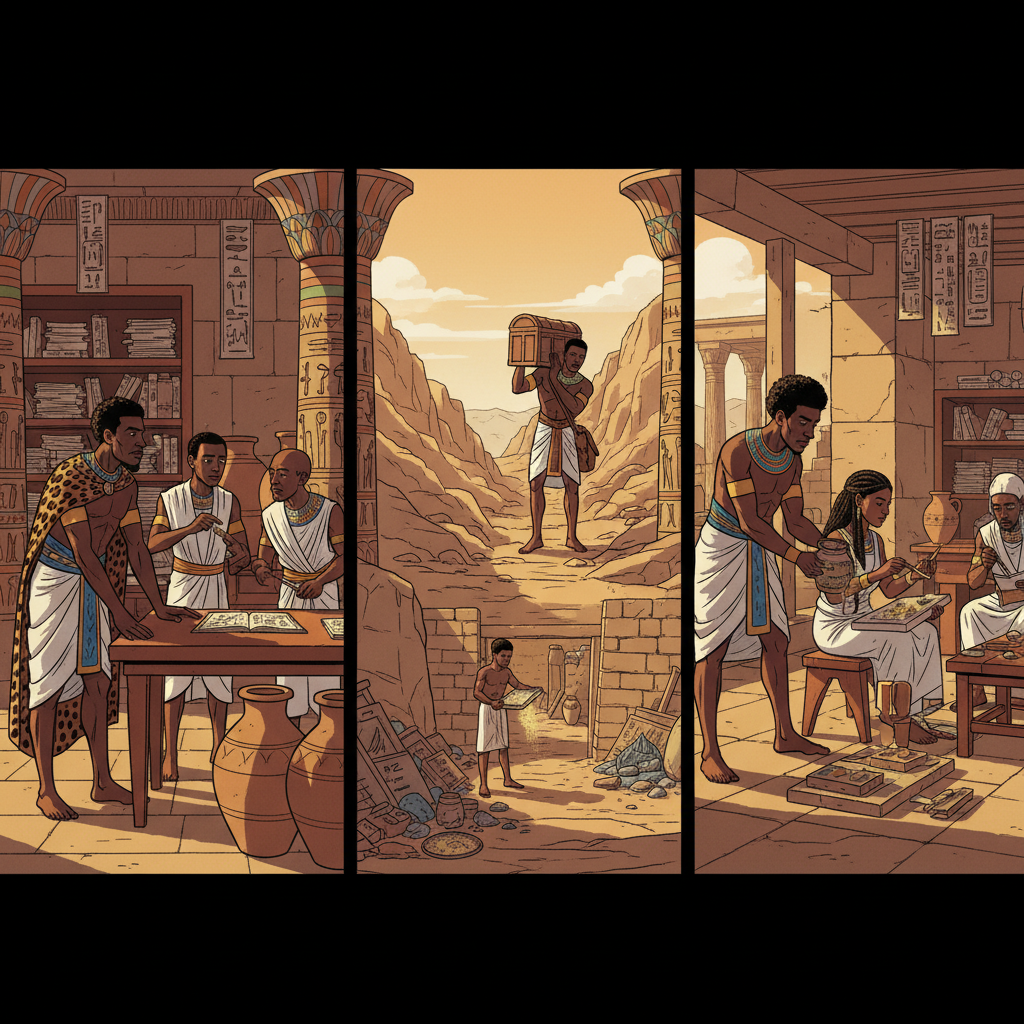
Over the following ten days, Merenptah conducted what would later be recognized as one of the most thorough investigations in the surviving Deir el-Medina records. He examined the gold supply system from treasury to workshop, interviewing the treasury scribes at the main temple, the supply runners who carried materials across the ridge, the assistant artisans who worked under Paneb's direction, and the waste collectors who gathered gold shavings and filings for recycling. He discovered that the supply system had a vulnerability. Gold dust was transferred from sealed containers to open work palettes in the workshop, and the workshop was accessible to multiple people during the working day. Paneb, his three assistants, the workshop scribe, and any visiting inspector all had physical access to the gold during working hours. The theft — if it was theft — could have been committed by any of them.
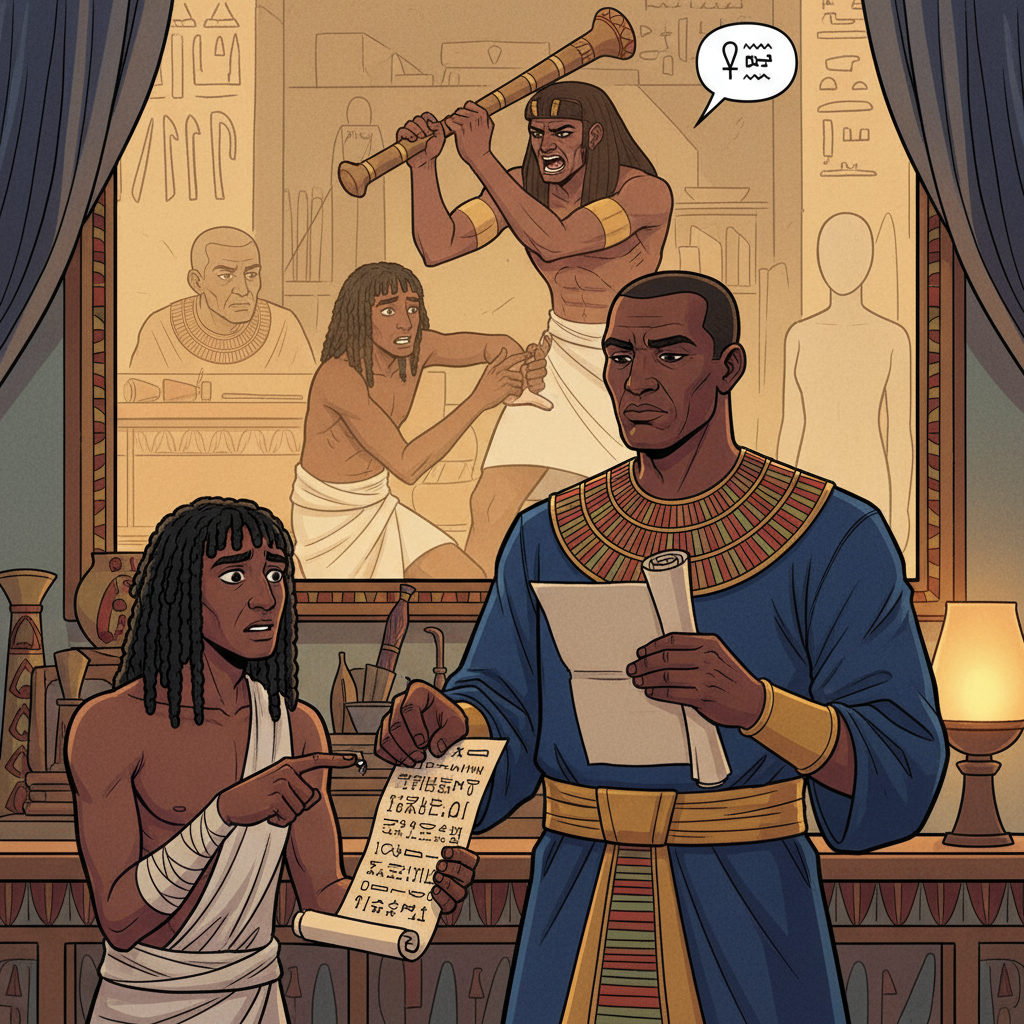
Merenptah also investigated Amennakht's background and found a complication he had not expected. Three years earlier, before Merenptah's arrival, Amennakht had filed a formal complaint against Paneb with the Vizier's office — not about gold, but about a violent incident. Paneb had allegedly beaten Amennakht during a dispute about tomb specifications, breaking two of the scribe's fingers and threatening to "bury him in the valley like a pharaoh who displeased the gods." The complaint had been investigated by the previous Medjay, Khaemwaset, who had concluded that there was insufficient evidence to support the charge — Paneb denied it, and no witnesses came forward. This history changed everything. Amennakht had a personal grievance against Paneb that predated the gold discrepancy. His meticulous record-keeping could be the diligence of an honest scribe — or it could be the weapon of a man building a case against someone he hated.

The Kemetic legal system, rooted in the principles of Maat, placed enormous weight on evidence and testimony. The Vizier's courts operated on a presumption that could be loosely translated as: "Let the evidence speak, for the evidence does not lie, though the one who presents it might." Merenptah understood that he needed physical evidence independent of Amennakht's records to determine the truth. He found it in an unexpected place. One of Paneb's assistants, a young man named Hesysunebef, requested a private meeting. Hesysunebef was visibly frightened — his hands shook, and he kept glancing toward the door as if expecting Paneb to appear. "I have seen things," Hesysunebef said. "But if I speak and Paneb learns I spoke, he will destroy me. He has that power in this village."
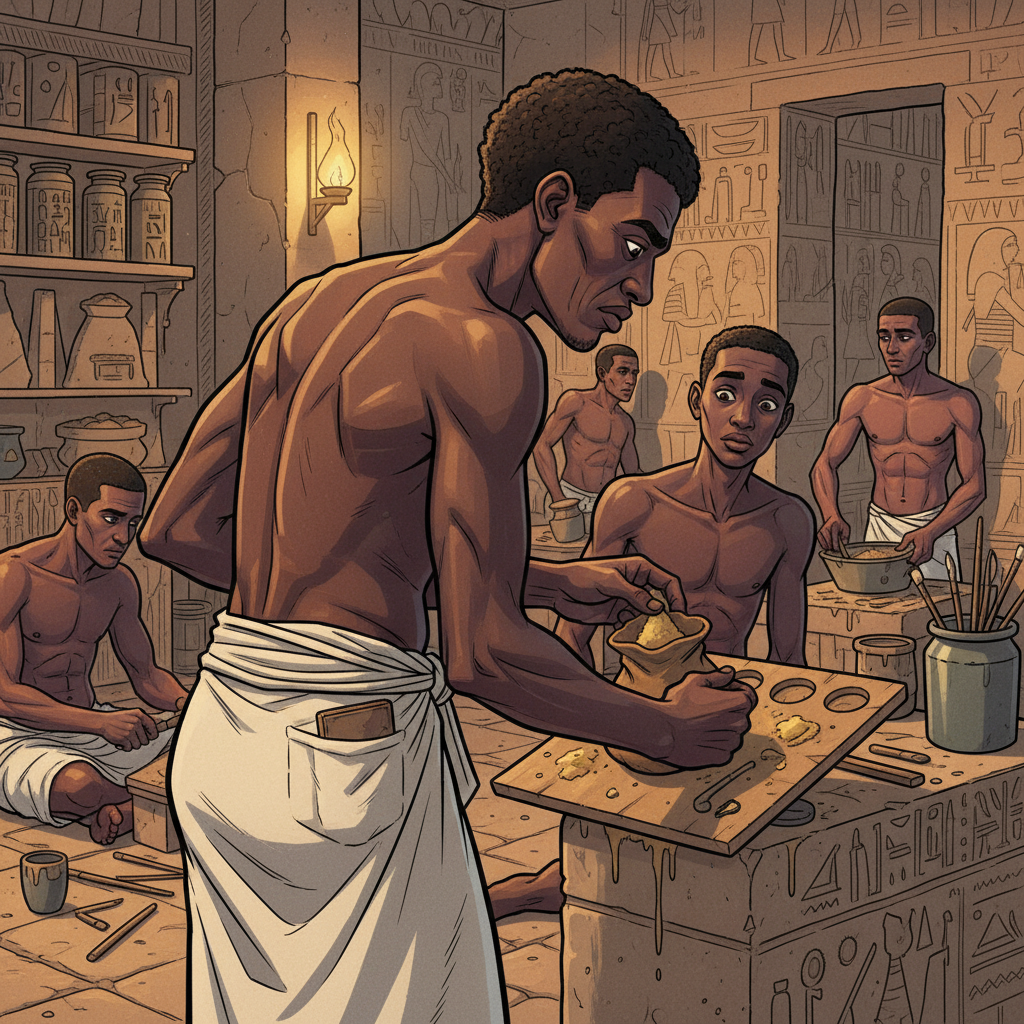
Hesysunebef's testimony was specific and damning. He had seen Paneb, on multiple occasions over the past year, transfer small amounts of gold dust from the work palettes into a personal container — a small leather pouch that Paneb kept in an inner pocket of his work kilt. The transfers were always done quickly, during moments when the other assistants were occupied, and the quantities were always small enough that the discrepancy might not be noticed in a single accounting period. "He knows the system," Hesysunebef said. "He knows exactly how much can go missing before the scribes notice. Two, three grains here, five grains there. Over months, it accumulates." Merenptah asked why Hesysunebef had not reported this earlier. The young man's answer was simple and devastating: "Because everyone loves Paneb. And because the last person who challenged him had his fingers broken."

Merenptah now faced the most difficult decision of his young career. He had circumstantial evidence from the scribe's records, testimony from one witness who was visibly terrified, and a suspect who was the most respected and beloved artisan in the village. He also had a previous complaint of violence that had been dismissed — possibly because the evidence was genuinely insufficient, or possibly because the previous investigator had not looked hard enough. He went to the one person in the village whose judgment he had come to trust over his six weeks at Set Maat — the Wise Woman, Iyneferti. She was the oldest resident of the village, a former songstress of Hathor whose dark, deeply lined face held the accumulated wisdom of seventy years. She did not have official authority, but her moral authority was immense. When the village's internal kenbet could not resolve a dispute, it was Iyneferti they consulted.

"You are asking me whether Paneb is guilty," Iyneferti said, pouring beer into two clay cups with steady hands. "I cannot tell you that. Only the investigation can tell you that. But I can tell you something about this village that you need to understand." She drank slowly, her eyes fixed on some distant point. "Paneb is not merely an artisan. He is a symbol. For the workers, he represents their pride — proof that a man who works with his hands can be as important as any scribe or priest. They will defend him not because they know he is innocent but because admitting he might be guilty threatens something they need to believe about themselves." She paused. "And Amennakht is not merely a scribe with a grudge. He is a man who had his fingers broken and received no justice. His accusation may be motivated by revenge, but that does not make it false. A person can want revenge and also be telling the truth."
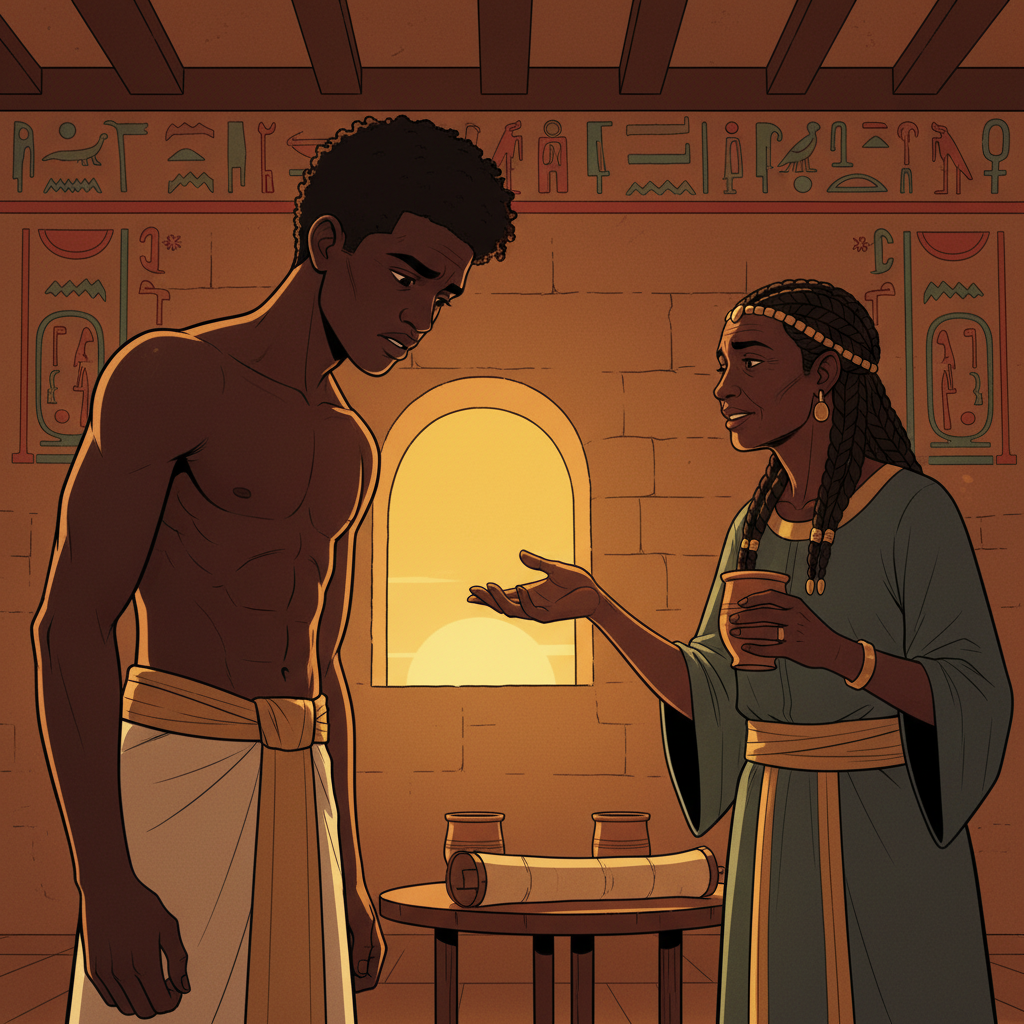
Iyneferti's words crystallized something Merenptah had been struggling to articulate. Justice in this case was not a simple matter of proving guilt or innocence. It was a matter of navigating a community's deepest loyalties and resentments, of separating the truth from the emotions that surrounded it, of understanding that the same person could be both a victim of genuine wrongdoing and a biased witness. He made his decision. He would present the evidence — all of it, Amennakht's records, Hesysunebef's testimony, the previous complaint, and his own investigation of the supply system — to the Vizier's court and let the formal legal process determine the outcome. He would not declare Paneb guilty. He would not declare him innocent. He would document what he had found with absolute precision and trust the system of Maat to produce justice. But he would do one more thing first.
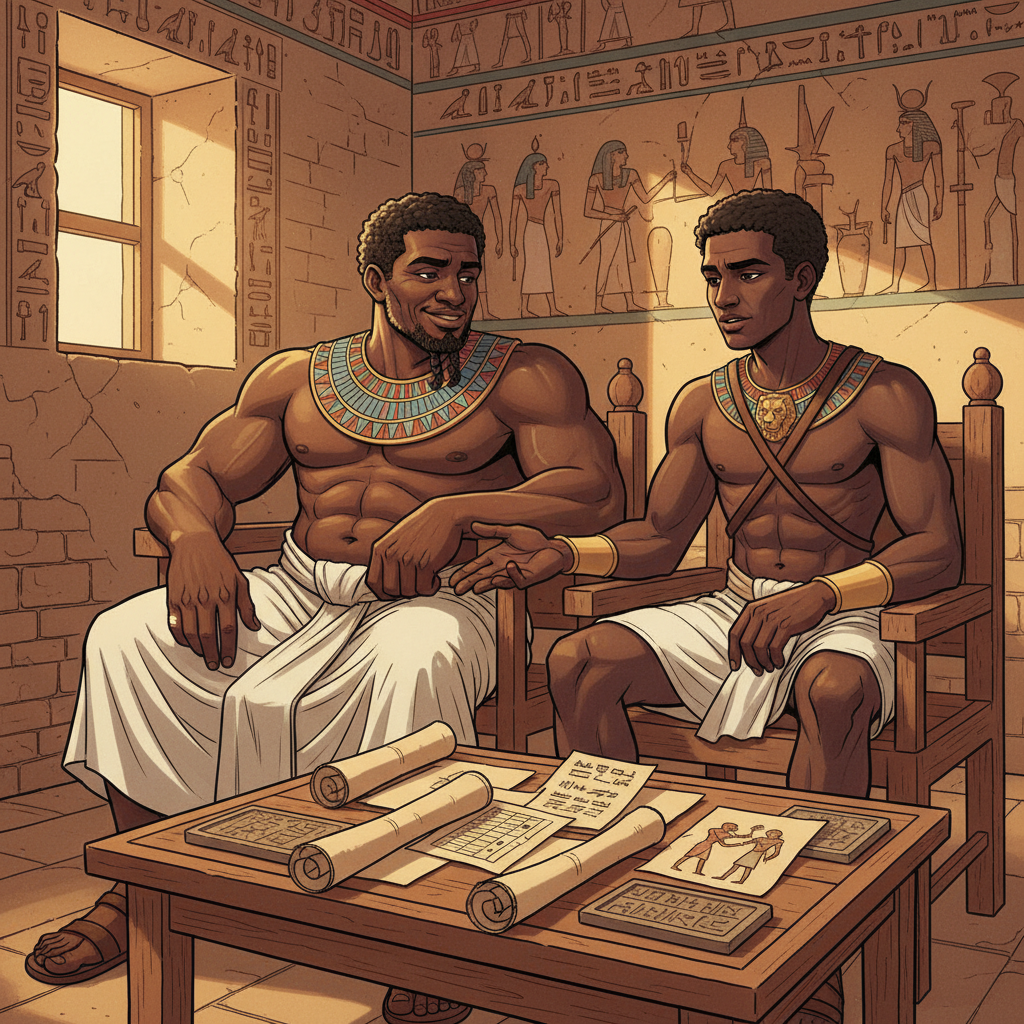
Merenptah requested a meeting with Paneb himself. The master artisan arrived at the Medjay's quarters with the swagger of a man who did not expect to be questioned — broad-shouldered, deep-skinned, with the powerful forearms of someone who had spent decades wielding chisels and paintbrushes. He sat across from Merenptah and regarded the young officer with the tolerant condescension of age toward youth. "I understand there are questions about gold accounting," Paneb said before Merenptah could speak. "You should know that accounting errors in a workshop as complex as mine are inevitable. The scribes see discrepancies where craftsmen see normal waste." Merenptah listened without expression. Then he laid out, piece by piece, what his investigation had uncovered — not as accusations but as facts requiring explanation. The supply records. The pattern of small discrepancies. The witness testimony. The previous complaint of violence.
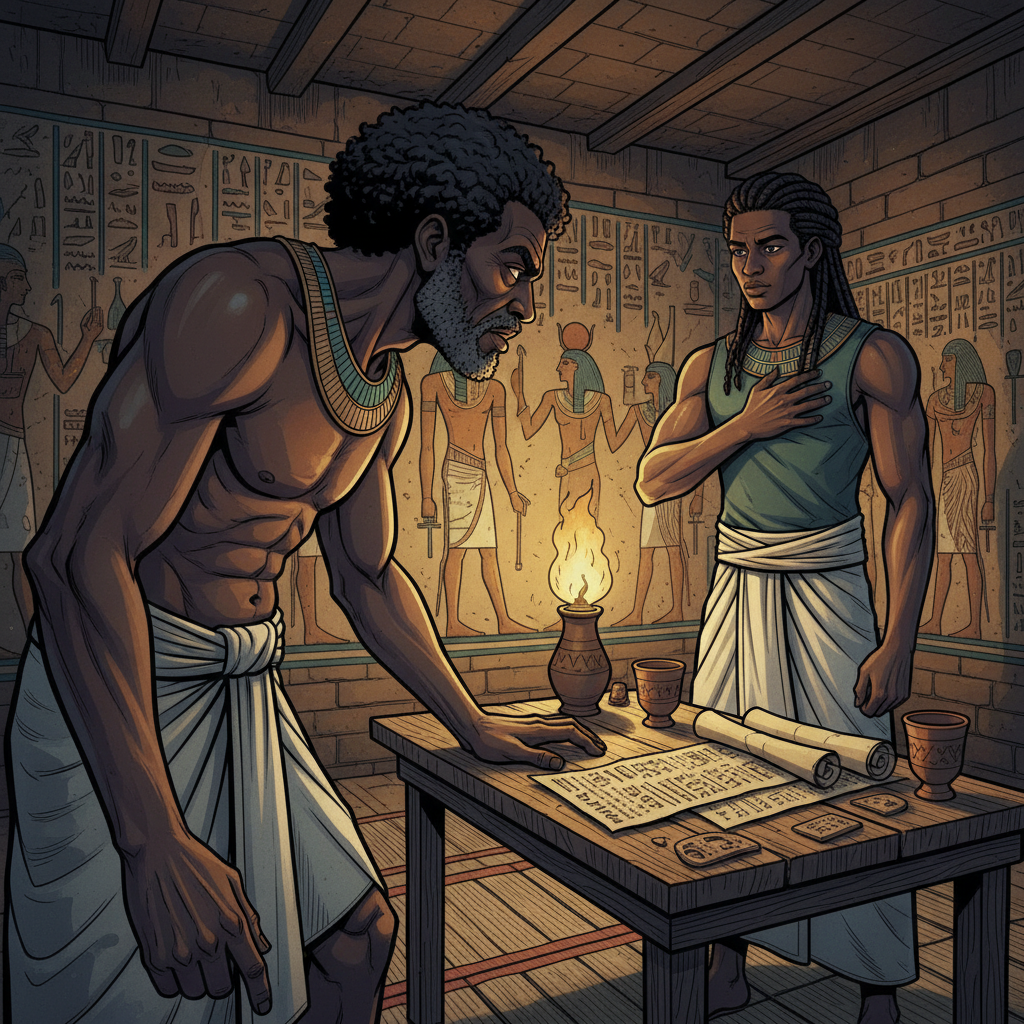
Paneb's face changed as Merenptah spoke. The condescension gave way to calculation, then to something harder to read — not fear, exactly, but the focused intensity of a man reassessing his situation. When Merenptah finished, there was silence in the room. "You are young," Paneb finally said. "You have been here six weeks. I have been here thirty years. I have built tombs for three pharaohs. My work will endure for eternity — the gods themselves will look upon it. And you sit here and tell me that a frightened boy's whispers and a bitter scribe's numbers weigh against all of that?" His voice was not loud, but it carried a threat that Merenptah felt in his chest. "I am telling you what the evidence shows," Merenptah replied, keeping his voice steady. "The evidence does not know your reputation. It does not know your skill. It knows only what it knows. And it will speak to the Vizier as clearly as it speaks to me."

Paneb stood. He was a full head taller than Merenptah, and for a moment the young Medjay felt the physical reality of the man's strength and anger. "You will regret this," Paneb said quietly. "This village is mine. These people are mine. A report from a boy-Medjay will not change that." He left without looking back. Merenptah sat in the silence after Paneb's departure and wrote his report. He wrote with the careful precision his training demanded — every fact sourced, every testimony attributed, every conclusion clearly distinguished from every observation. He did not call Paneb guilty. He did not call him innocent. He presented the evidence and recommended that the Vizier's court conduct a formal hearing. He sealed the report and dispatched it with a runner to the Vizier's office in Waset the following morning. Then he returned to his daily patrols, walking the narrow streets of Set Maat with the knowledge that he had done what Maat required — not what was popular, not what was safe, but what was true.
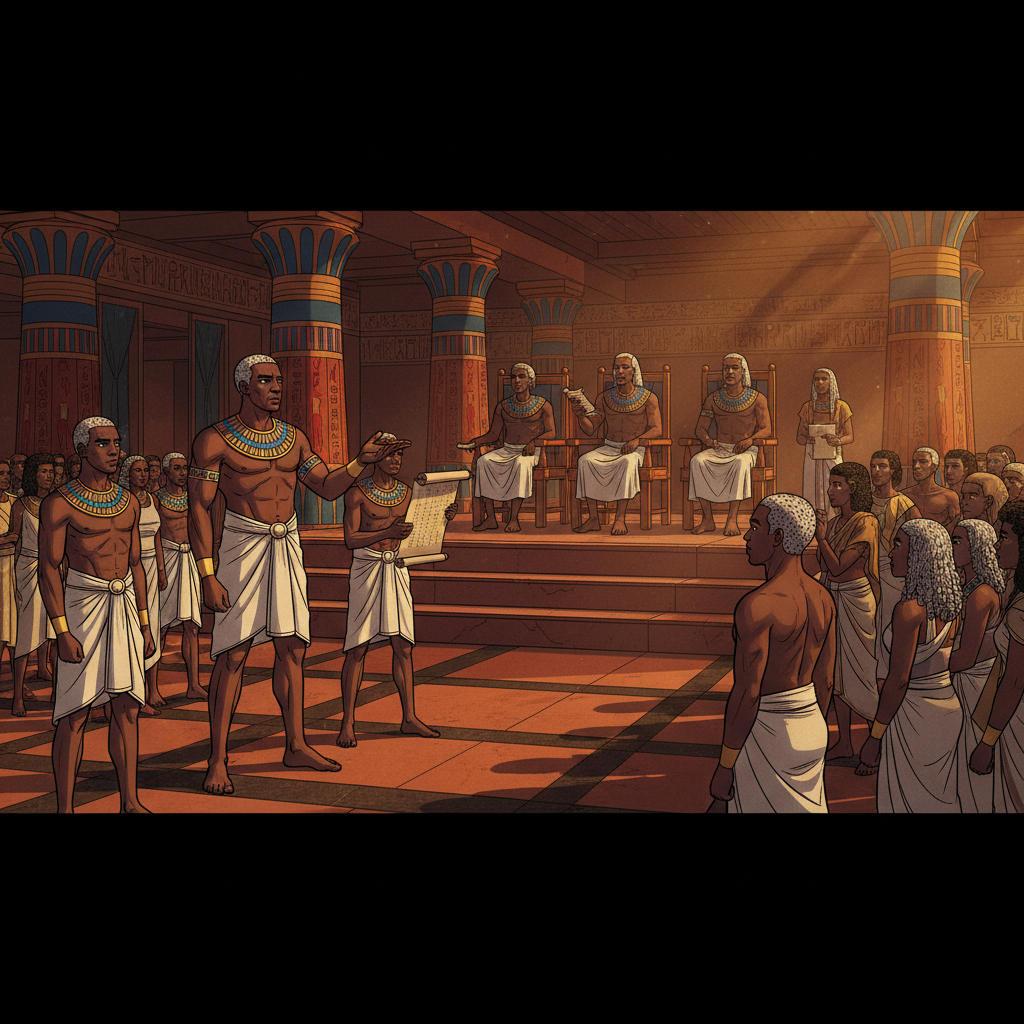
The aftermath was neither clean nor simple. The Vizier's court summoned Paneb for a hearing three weeks later. The proceedings lasted two days. Paneb denied everything with eloquent conviction. Amennakht presented his records with trembling hands. Hesysunebef testified under oath, his voice barely above a whisper. Half the village appeared as character witnesses for Paneb, praising his skill, his generosity to fellow workers, his devotion to the craft. The court's verdict was divided. The judges acknowledged the pattern of discrepancies but noted that accounting records alone, without the physical recovery of stolen gold, could not prove theft beyond doubt. Paneb was formally reprimanded and ordered to account for all future gold allocations under the direct supervision of a treasury scribe. He was not convicted. He was not exonerated. The truth remained suspended between evidence and doubt.
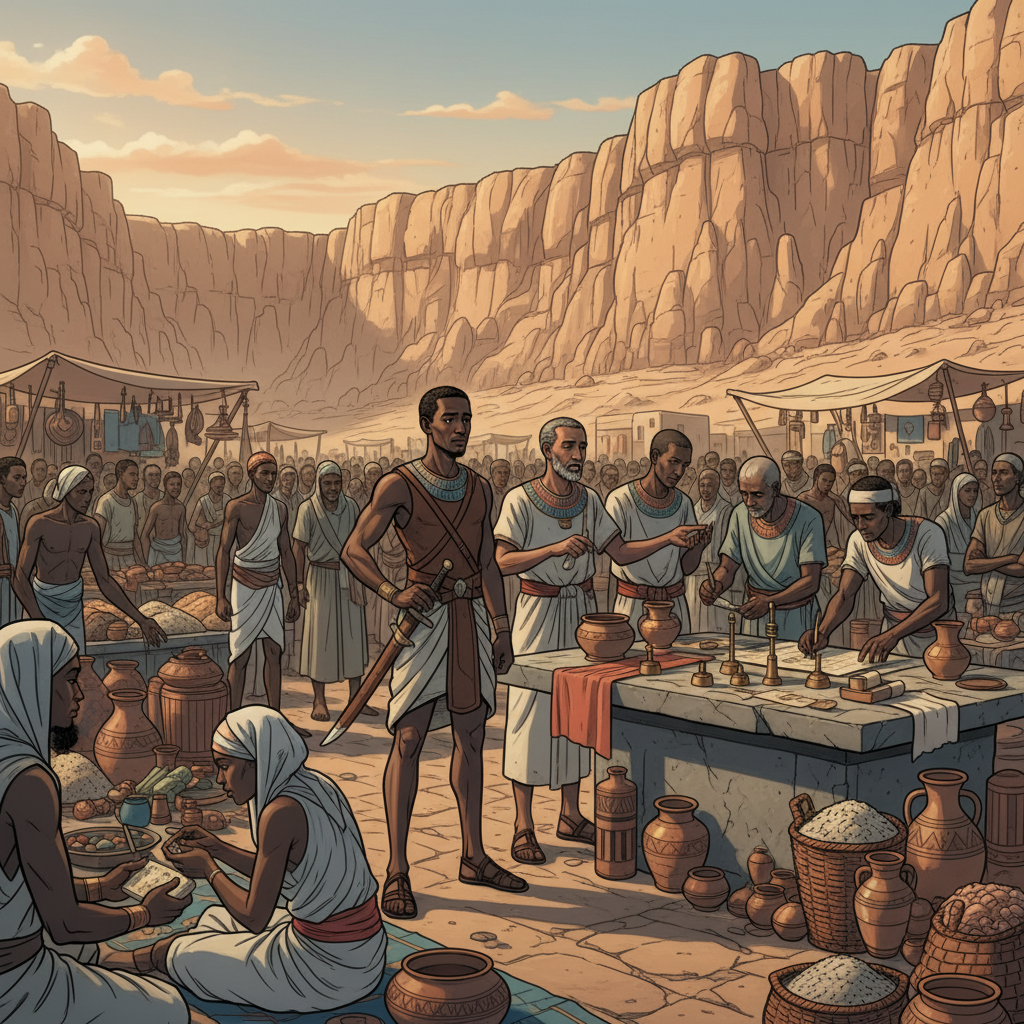
Was justice served? Merenptah wrestled with this question for years after. The historical record — preserved on the very ostraca and papyri that archaeologists would discover three thousand years later at Deir el-Medina — shows that Paneb continued as chief artisan for several more years before being removed from his position under circumstances the records do not fully explain. Amennakht eventually became foreman himself, suggesting that his complaints had been taken seriously even if they did not produce an immediate conviction. And the gold accounting system was reformed with additional checks — an institutional change that outlasted all the individual players. The Medjay's role in this story is the role that Maat assigns to those who serve justice: not to determine outcomes, but to ensure that truth enters the process. Merenptah could not control the Vizier's verdict. He could only control the quality of his investigation and the honesty of his report. In a world where truth is complicated, where evidence is incomplete, and where powerful people resist accountability, this is often the most that justice can ask of its servants.

Three thousand years later, archaeologists excavating Deir el-Medina would find the ostraca and papyri that documented this case and hundreds like it — the daily records of a village that functioned as one of the most thoroughly documented communities in the ancient world. The Turin Strike Papyrus, the records of the tomb robberies, the legal proceedings of the village kenbet, the personal letters between workers — all survived because the people of Set Maat understood that documentation was itself a form of justice. What is written down cannot be denied. What is recorded endures beyond the lifetime of any witness. Merenptah's report was among the documents found. His careful hand, his precise observations, his refusal to jump to conclusions — all preserved in the dry desert air for millennia, a testament to the principle that a Medjay's pen is more important than his sword. The truth he recorded may not have produced a satisfying verdict in 1200 BCE. But it produced something rarer: an honest record that allows us, across thirty centuries, to see justice attempted with integrity in a world as complicated as our own.

"Maat does not promise that the guilty will always be punished or the innocent always be vindicated," Iyneferti had told Merenptah on his last evening in Set Maat, years later, when he was transferred to a new posting. "Maat promises only that the truth will be sought and spoken. The outcome belongs to the gods and the courts. The seeking belongs to us." She poured the last of the beer and raised her cup. "You sought honestly, young Medjay. That is enough. That has always been enough." Merenptah drank, and the beer tasted of the village — its dust, its pride, its complicated loyalties, its fierce and imperfect justice. He carried that taste with him for the rest of his career, through postings across Kemet, through cases far more dangerous and far less ambiguous than Paneb's gold. And whenever a case resisted easy answers, whenever the evidence pointed in contradictory directions, whenever the truth refused to be simple, he remembered the Wise Woman's words: the seeking belongs to us. Maat asks nothing more. Maat asks nothing less.