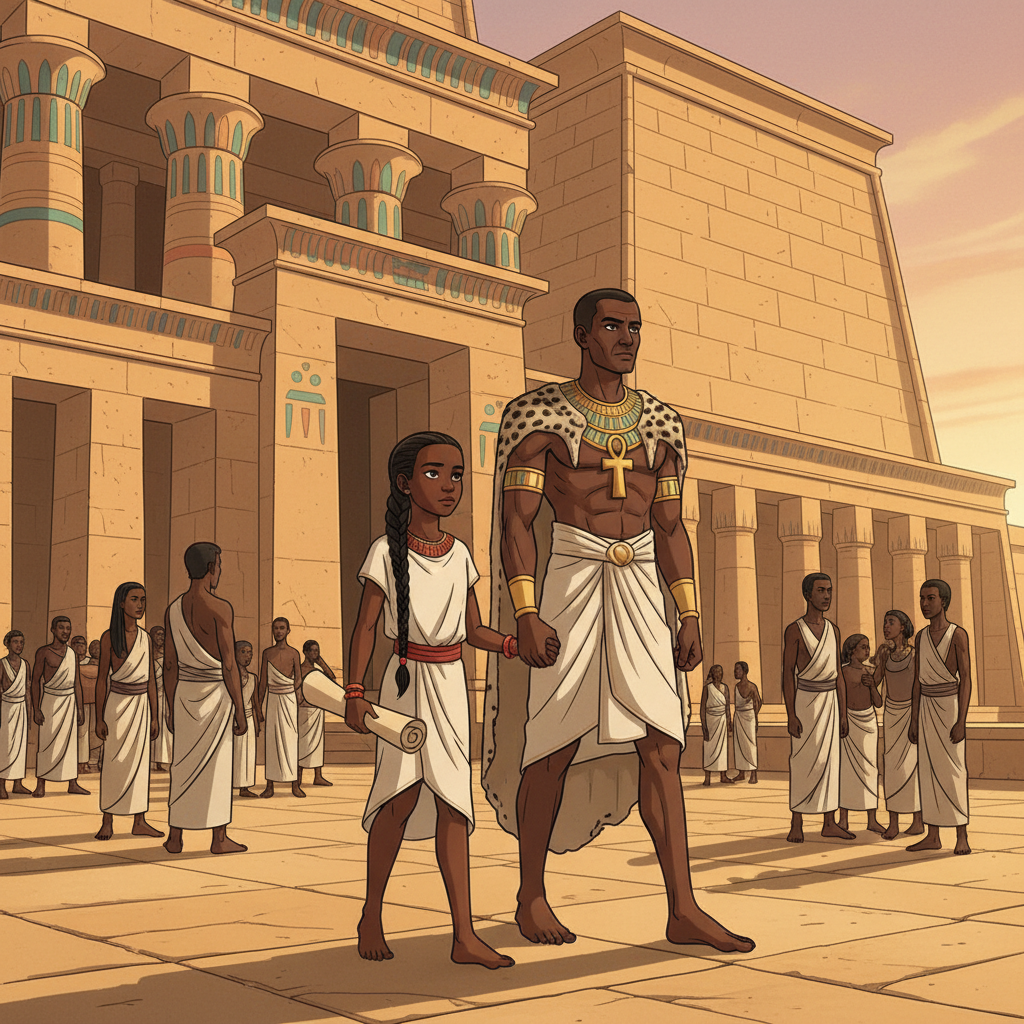
Senet was ten years old, and on the morning this story begins she was walking to a place no girl in her family had ever been allowed to go: the Per Ankh, the House of Life. Her skin was a rich deep brown, her hair bound back in a single careful plait, and she carried a clean blank papyrus her father had given her, rolled and tied with a reed. Her father, Ramose, was a scribe, and a scribe’s knowledge was supposed to pass from father to son. But Ramose had no son who could read — only Senet. And so, against the raised eyebrows of half the village, he was taking his daughter to the House of Life to ask that she be taught.
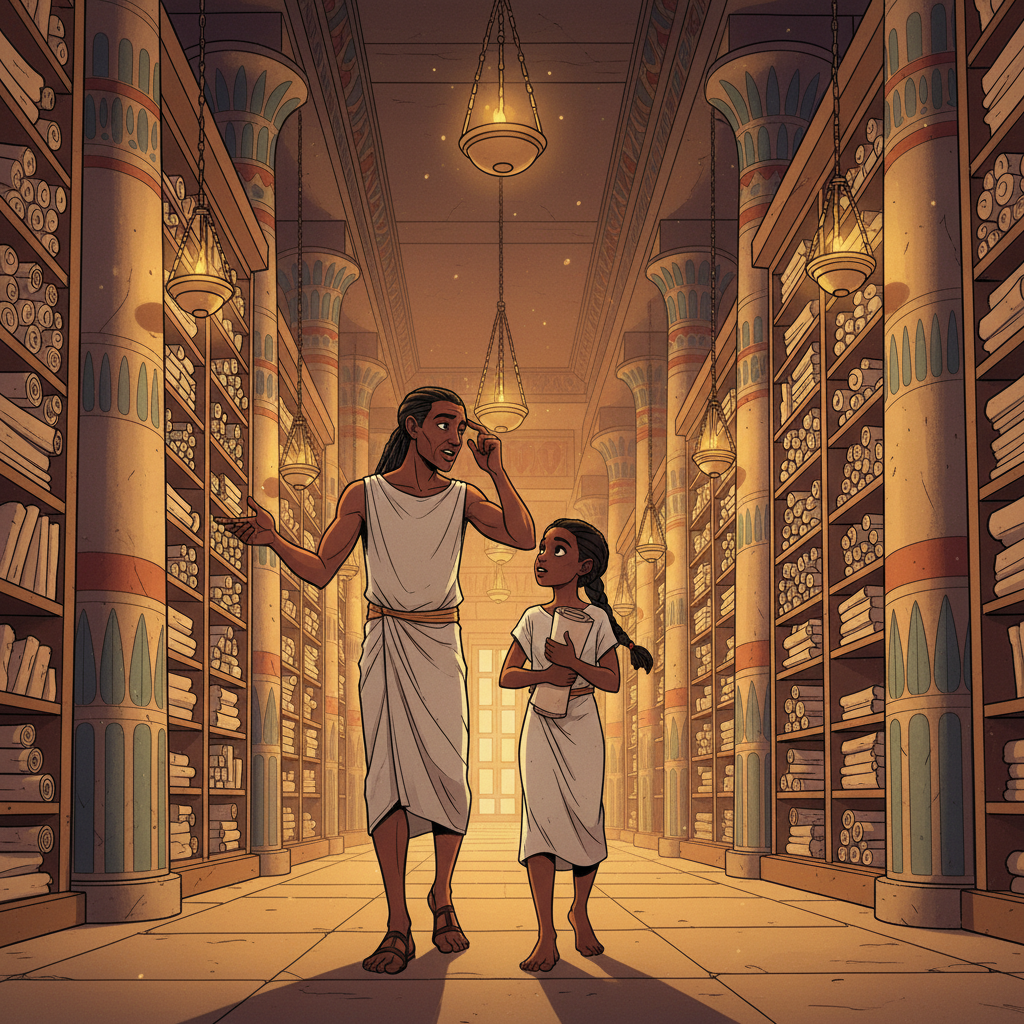
Ramose explained it to her as they walked. “Everything I know,” he said, “the counting of grain, the writing of law, the reading of the old medicine — all of it lives in here.” He tapped his head. “When I die, it dies with me, unless I pour it into someone who can hold it. The neighbors think I am foolish to pour it into a girl. I think I would be the fool if I let everything I know spill into the sand, only because the cup I was given was a girl and not a boy.” Senet held the blank papyrus a little tighter. She did not yet know whether she could be the cup. She only knew her father believed she could.
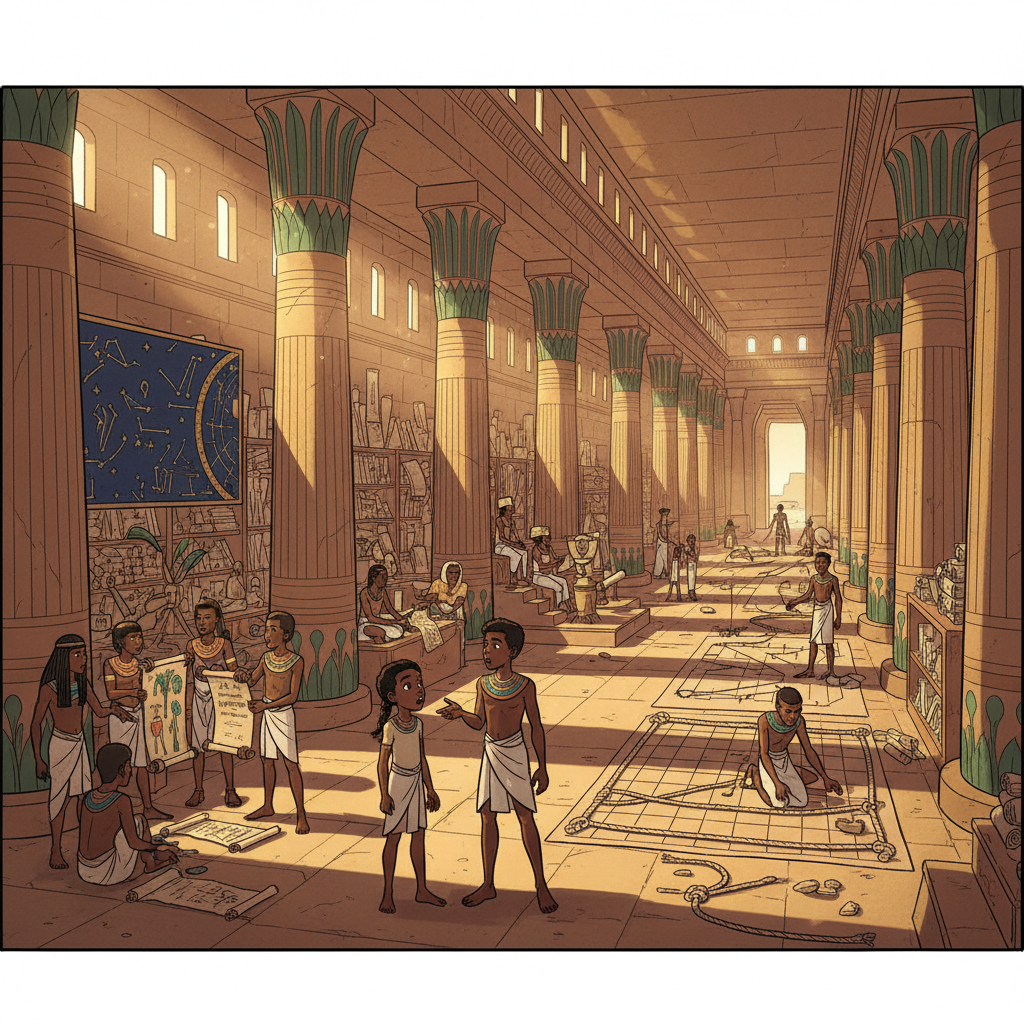
The Per Ankh — the House of Life — was not what Senet had imagined. It was not only a school for reading. Under one long roof of stone columns, the people of Kemet kept everything a kingdom needed to remember: the medicine scrolls that told a healer what to do, the star-charts that told farmers when the flood would come, the law-rolls that told judges what was just, the field-math that measured the land again after the water pulled back. Reading, writing, medicine, astronomy, law — all of it together, in one house. The teacher Obenga, in books not yet written, would name it among the oldest centers of organized knowing on the earth. The people of Kemet called it, simply, the House of Life — because a people that forgets how to do these things begins to die, and a people that remembers them stays alive.
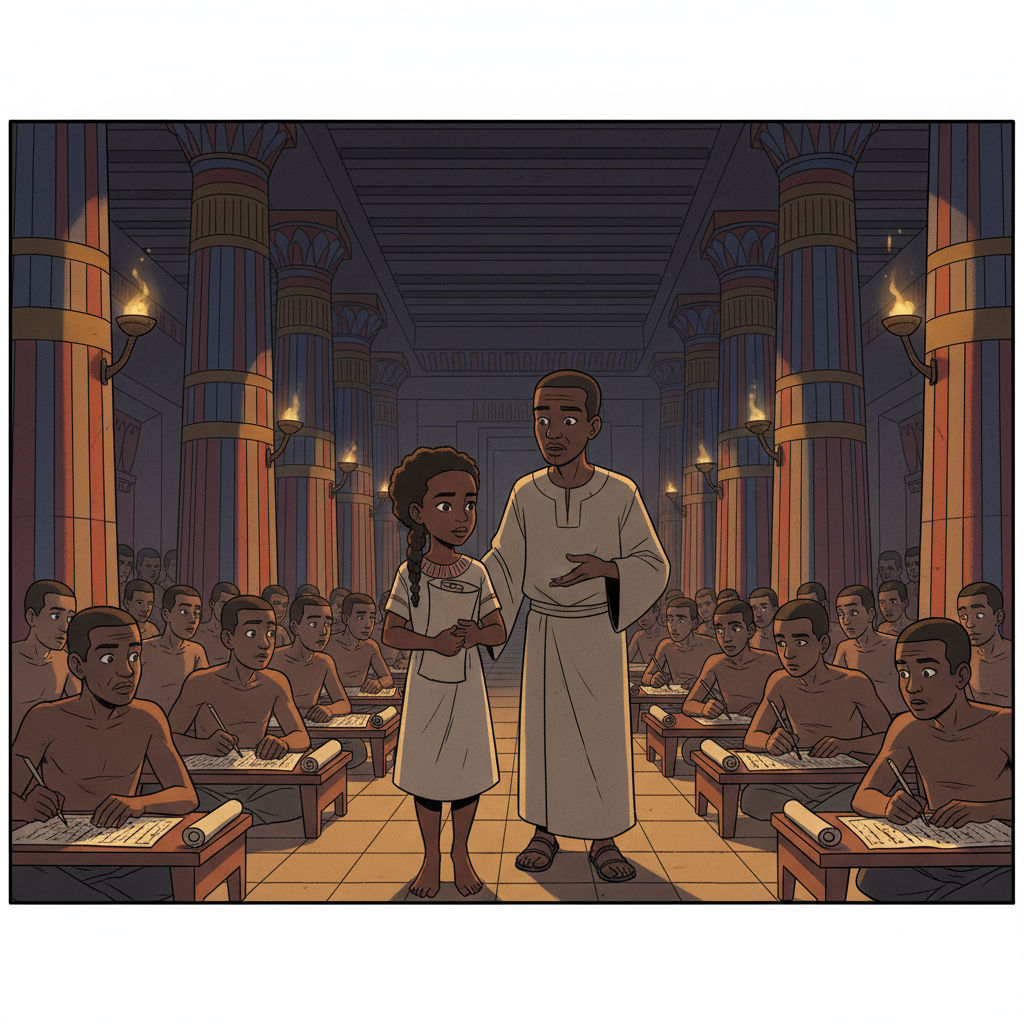
Inside, the air was cool and smelled of papyrus and cedar-oil. Tall columns held up the roof, and between them, in the shadowed bays, older students sat copying scrolls — and every one of them was a boy. When Ramose led Senet in, the copying slowed. Heads lifted. Senet felt a dozen pairs of eyes find her, then find one another, then drop back down, not quite hiding their surprise. A girl, in the House of Life. She kept her chin level the way her father had taught her, but her heart was loud in her ears.
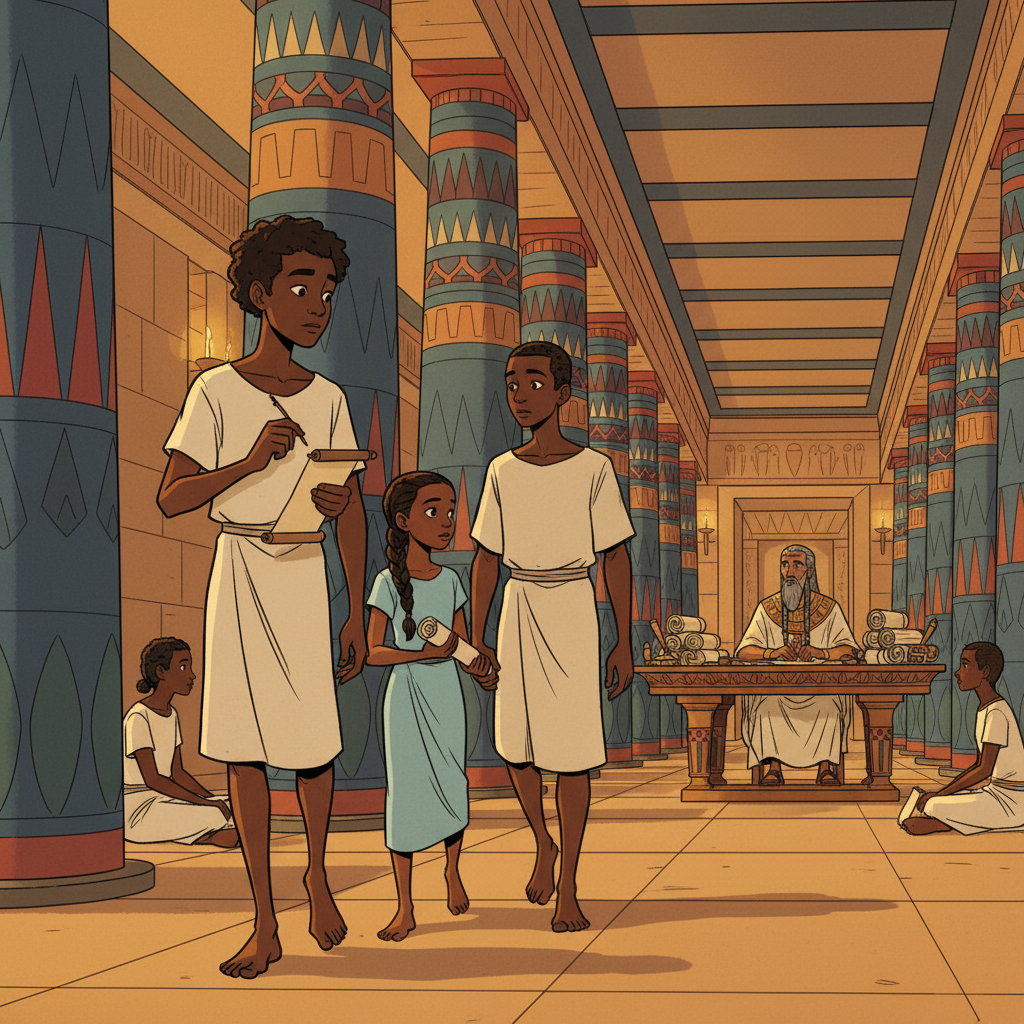
One of the older boys, perhaps fourteen, set down his reed pen. “Girls do not read here,” he said — not cruelly, but not kindly either. And he did not say it to Senet. He said it to Ramose, over her head, as if she were a parcel being delivered to the wrong door. Ramose did not argue. He only said, “Then let the master decide who reads here,” and he kept walking, with Senet beside him, toward the reading-table at the far end of the hall where the master of the House sat.
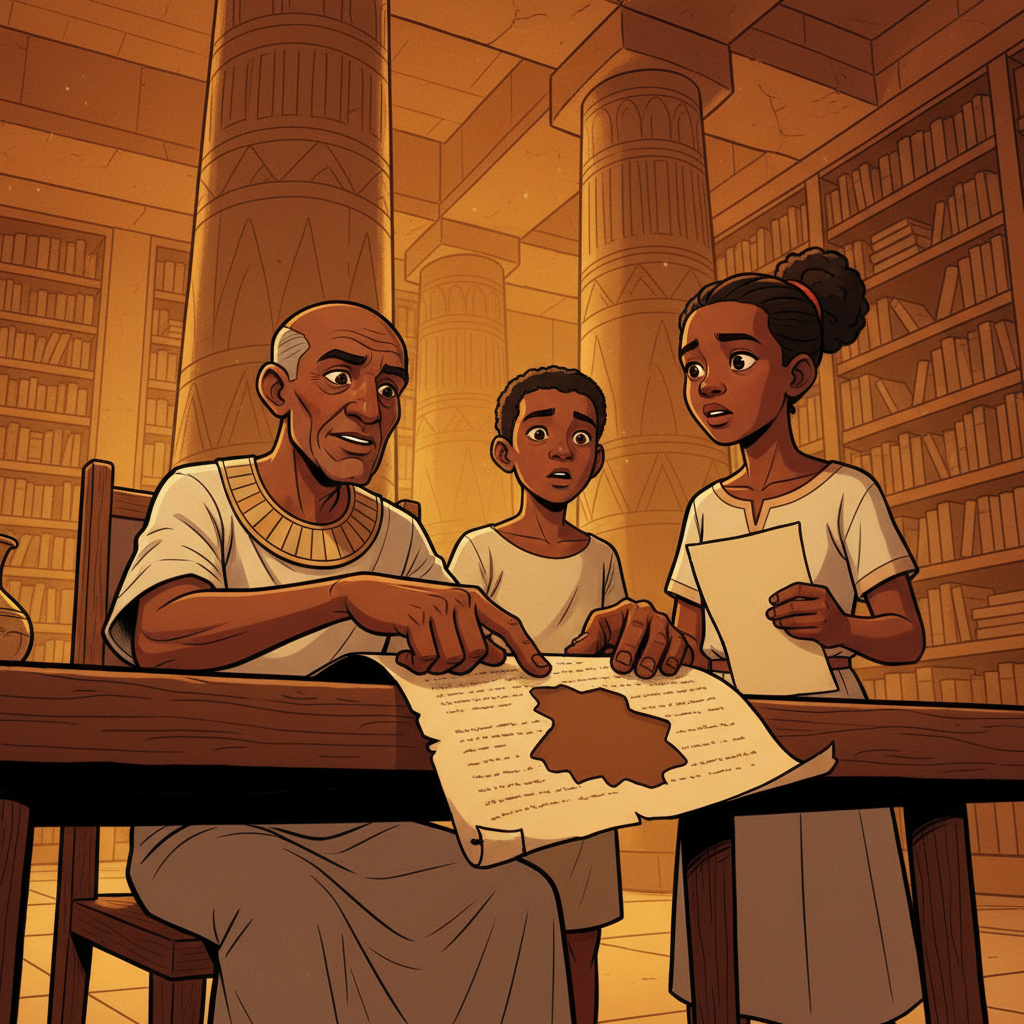
The master of the Per Ankh was an old man named Peshuper, with ink-dark fingers and eyes that did not seem to miss much. He listened to Ramose’s request without expression. Then he looked at Senet for a long moment. He did not ask how old she was, or whether her father had wasted his hope on her. Instead he reached behind him, took down a scroll, and laid it open on the table in front of her. The papyrus was old and badly damaged — a long brown gap had been eaten clean through the middle of it, where water or insects had destroyed a whole section of the writing. “This scroll is hurt,” Peshuper said. “Read what is left. Then tell me what is missing.”
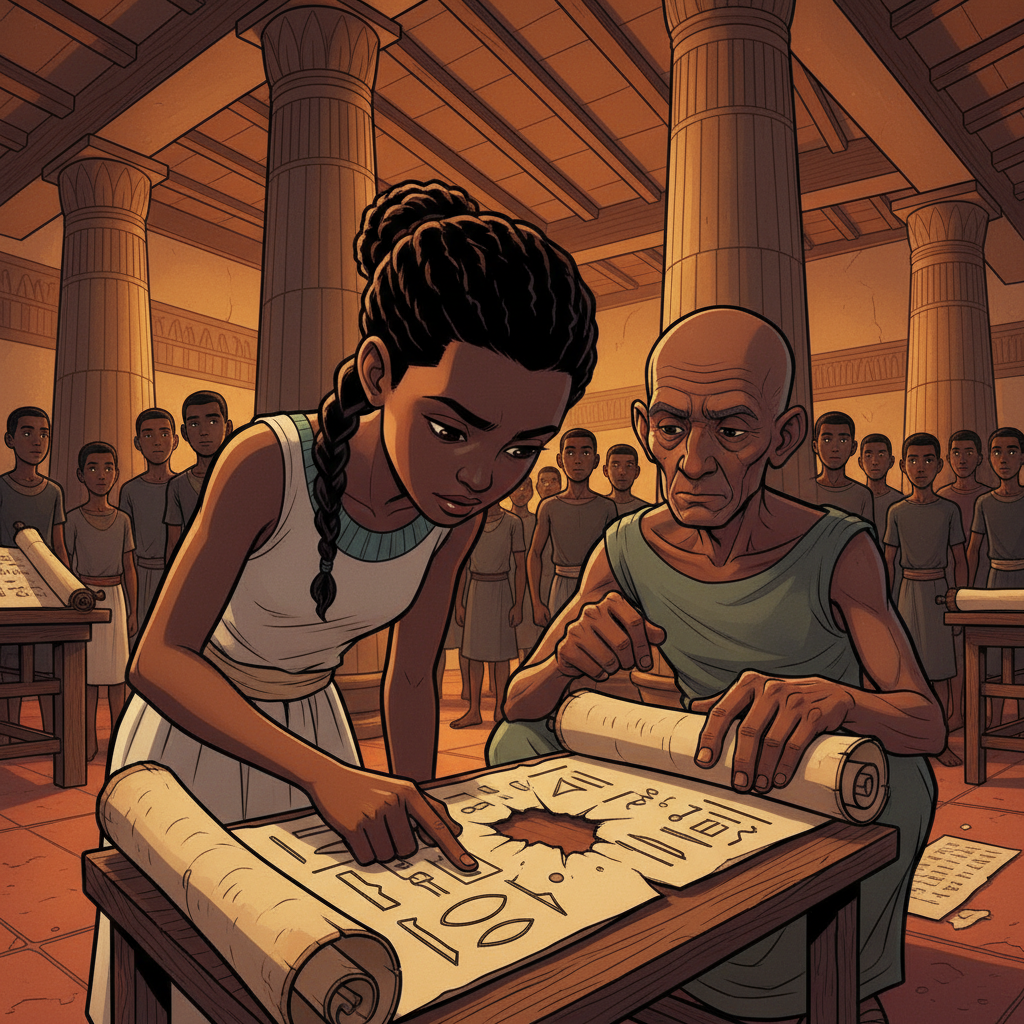
Behind Senet, the copying had stopped completely. She could feel the older boys watching from between the columns, half-visible in the shadow, every face turned toward the reading-table. The test was not only can you read — anyone could be taught the signs. The test was can you think. A scroll with a hole in it is a puzzle: the words before the gap and the words after the gap must still make sense together, and a good scribe can often tell what the lost piece had to say. Senet bent over the damaged scroll. Her finger found the first sign. She began to read.
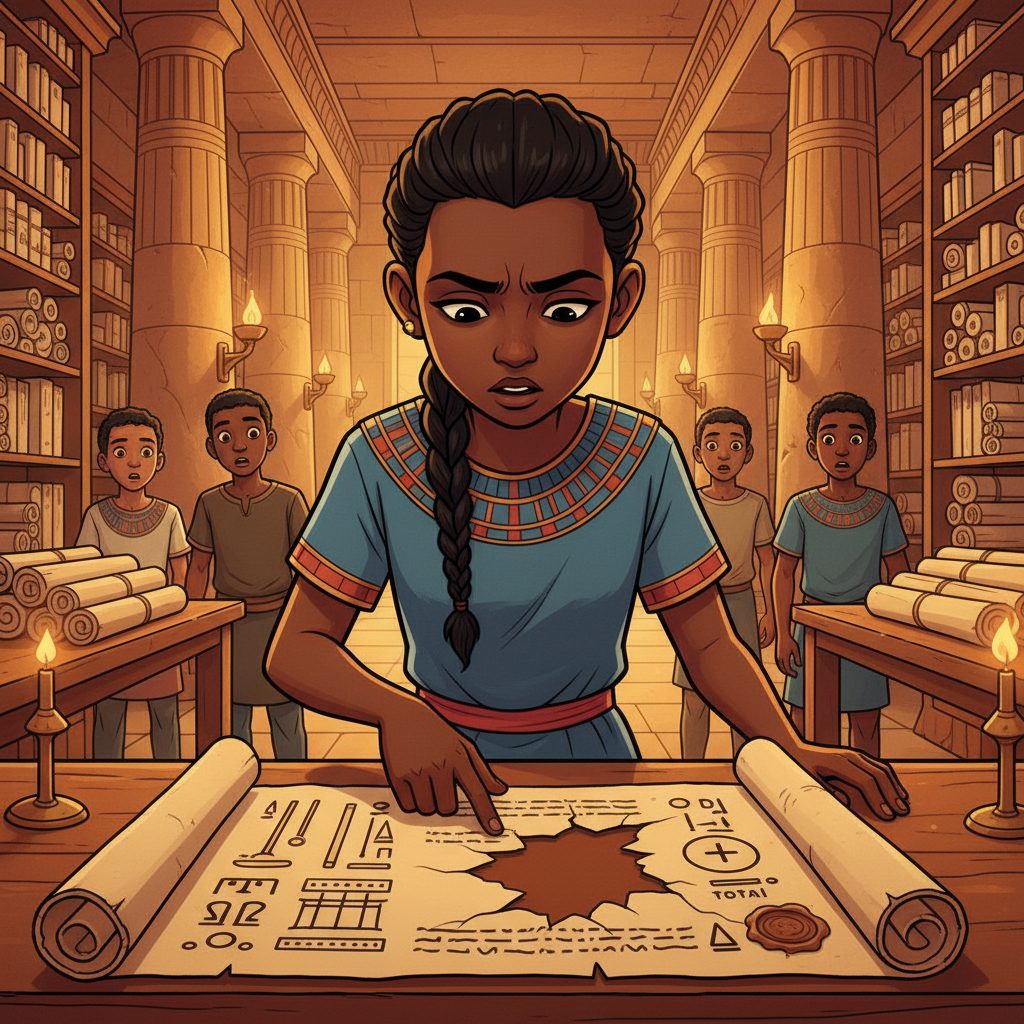
It was a scroll about the storing of grain — how much a granary of a certain size could hold, and how to keep the record of what went in and came out. Senet read the part before the gap: it described measuring the granary and beginning the count. Then the brown hole. Then, after the hole, the scroll picked up again with a total and an instruction to seal the record. She read it twice. Three times. The part before said begin the count. The part after said here is the total. What was missing, in between, was the count itself — the adding-up, sack by sack, that turns a beginning into a true total. “The middle is gone,” she said slowly. “The part that does the counting. It begins, and it ends with an answer — but the work that makes the answer true is the part the hole ate.”
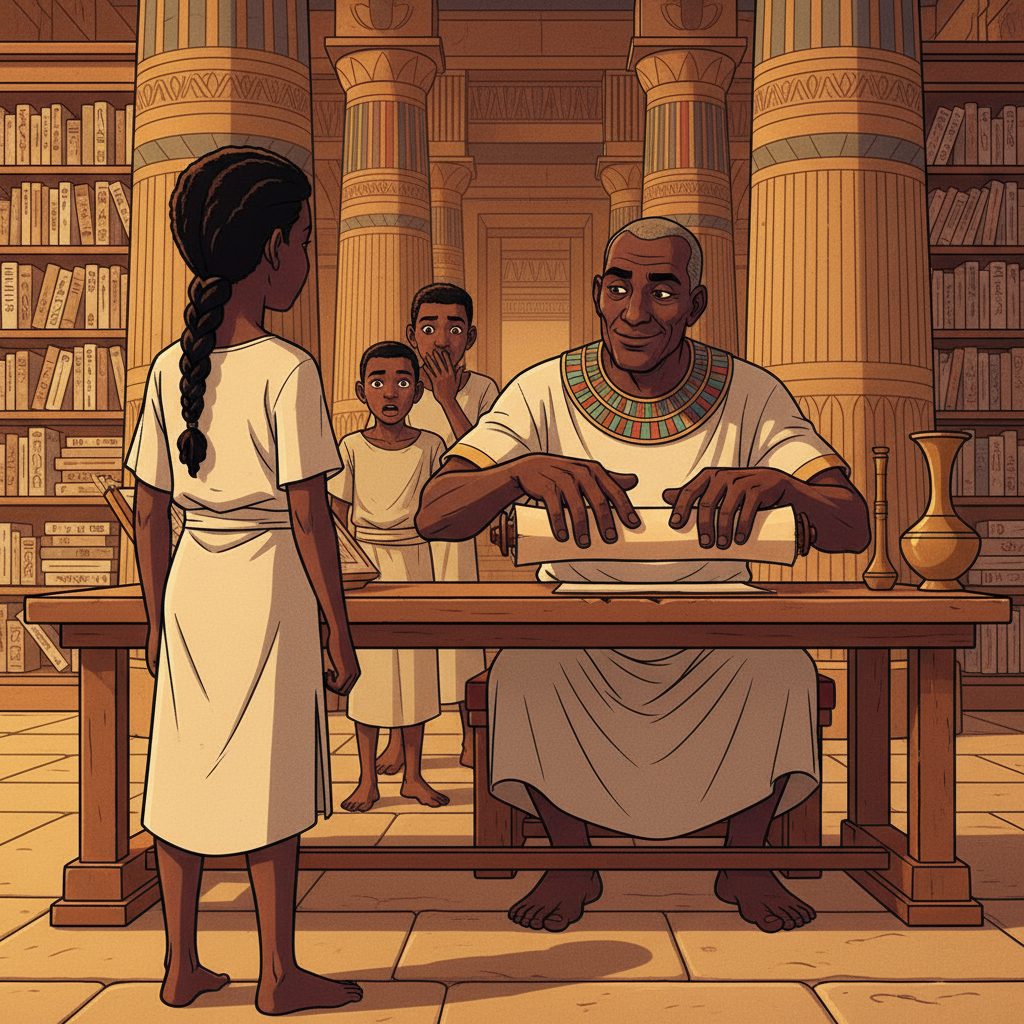
Master Peshuper was quiet. Then, behind Senet, one of the older boys let out a breath he had not meant to let out. The corner of Peshuper’s mouth moved, almost a smile. “Yes,” he said. “The counting is missing. A total with no counting behind it is only a number a man wishes were true. You did not merely read the signs, child. You read the shape of the thinking — and you saw the hole where the honesty should be.” He rolled the scroll closed. “Your father did not waste his hope.”
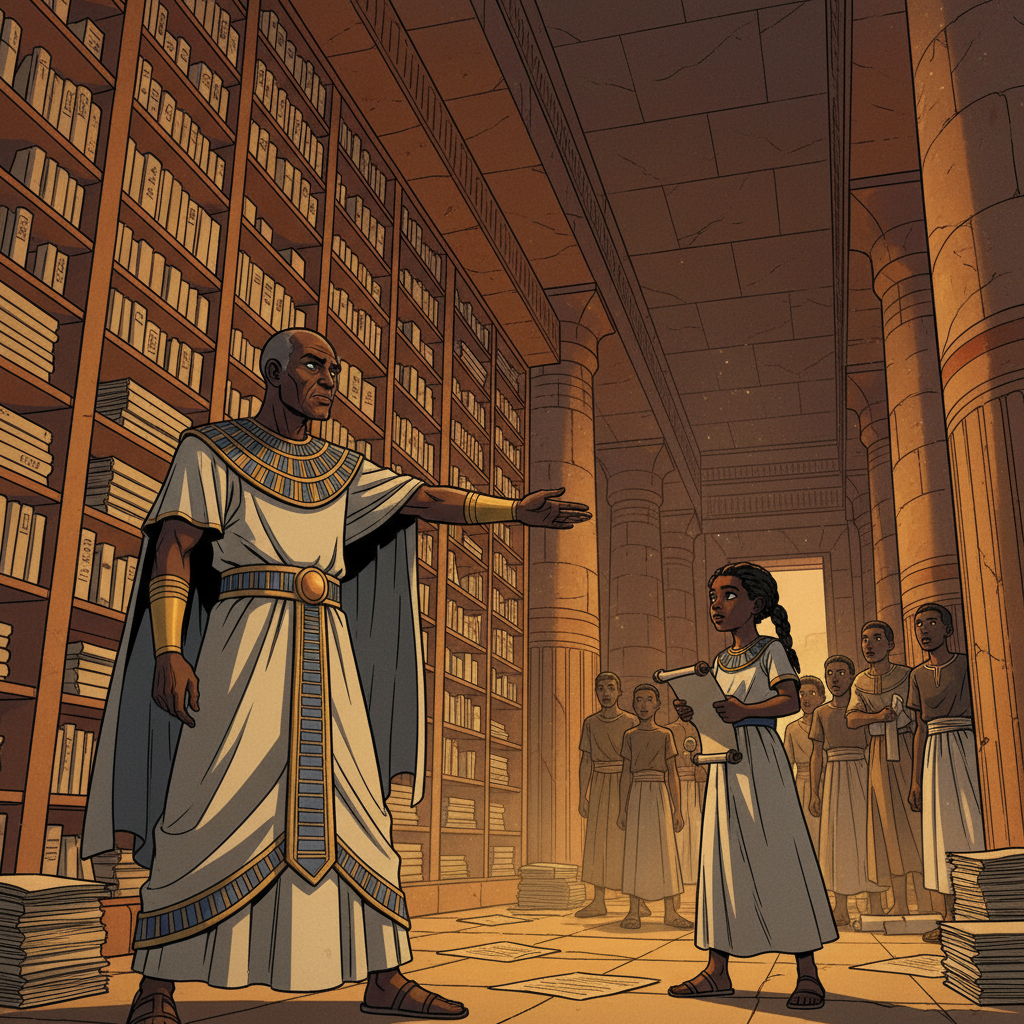
Then Peshuper turned the lesson into something larger, for the whole hall to hear. “This is what the House of Life teaches first,” he said. “Not the signs. Order. Knowledge is not a heap. It is a placement. Every scroll in its bay, every count beneath its total, every law beside its case. A scroll out of its order is lost even while it sits right here on the shelf. And a library that no one left alive can read is no library at all — it is only a room full of silence.” He looked at the boys in the shadows, and then at Senet. “Order is the right placement of knowledge, so that a people can find itself again. That is the work. Whoever can do the work belongs here.”

In the days that followed, Senet learned how dear each scroll was. A single one could take weeks to copy by hand, sign by careful sign. The House of Life held the only copies of things no one could afford to lose: the medicine that told a healer how to set a broken bone, the star-knowledge that told the farmers when the flood would rise, the field-math that gave every family back its land after the water pulled away. To lose one scroll — to misfile it, to let it rot, to copy it wrong — was not a small thing. It could mean a healer who did not know what to do, a planting done at the wrong time, or a family cheated of its field. Order, Senet came to understand, was not tidiness. Order was survival.
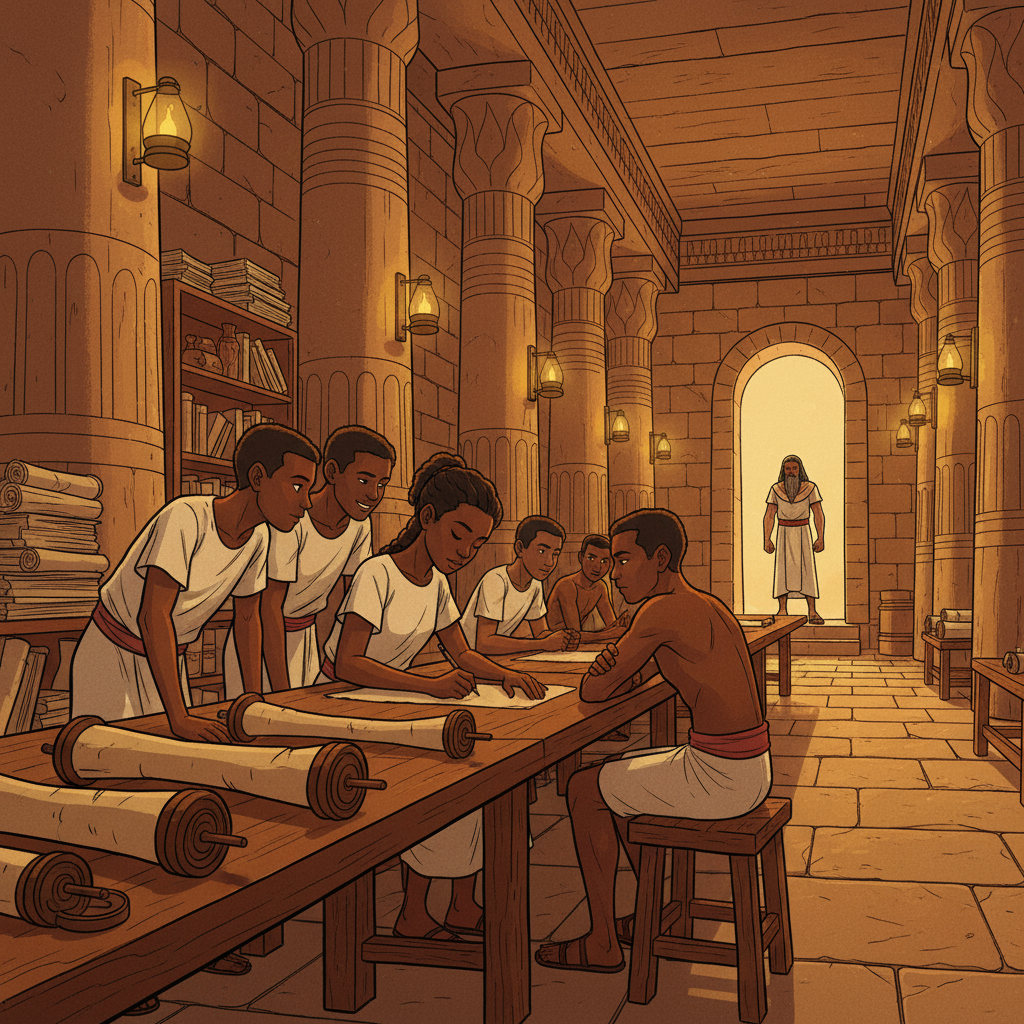
Senet was given a place at the copying tables, between the columns, beside the very boys who had doubted her. The work was slow and exact. She learned to copy without changing a single sign, to check her copy against the original three times, to return each scroll to its proper bay so the next reader could find it. Some of the boys warmed to her quickly; one or two never quite did. But the master had decided, and in the House of Life the master’s judgment held. Senet kept her head down and her copies clean, and slowly the surprise of a girl at the tables wore away into the ordinary fact of a scribe at work.
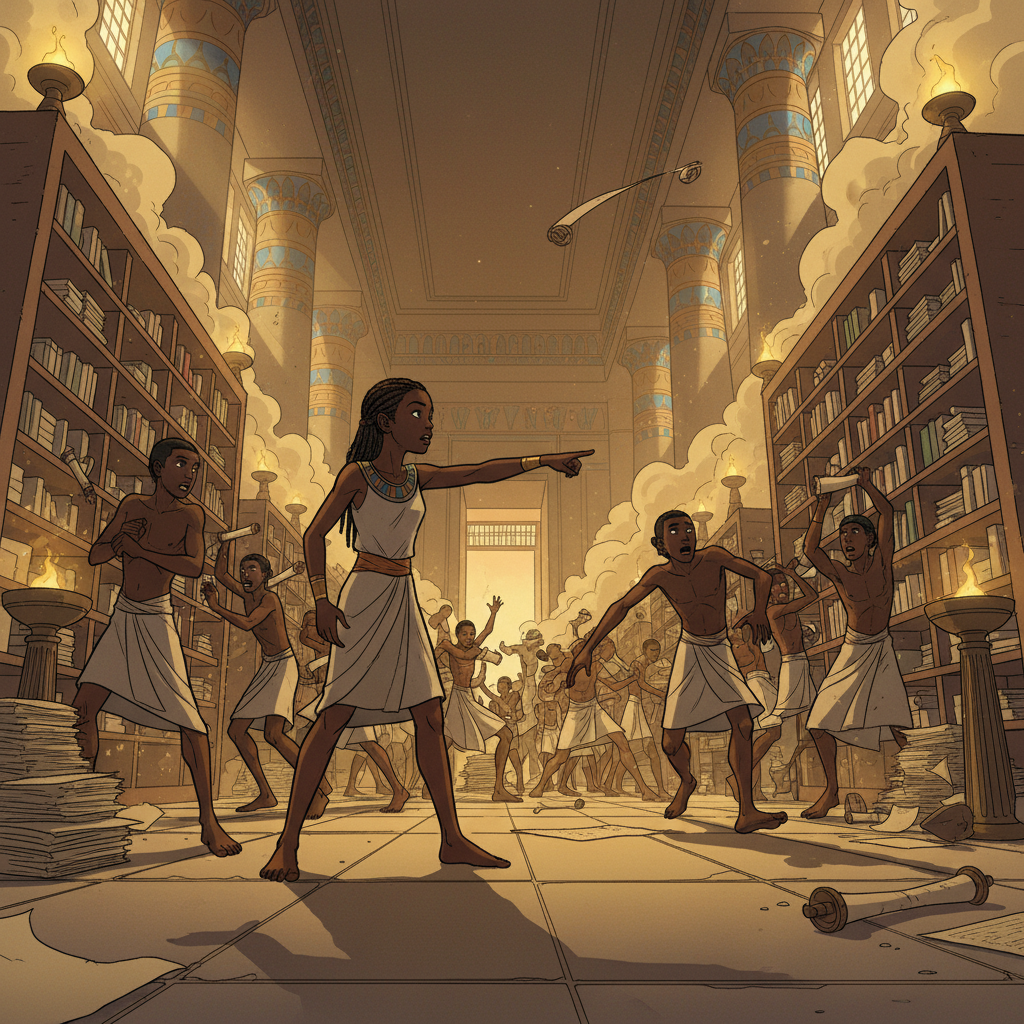
The lesson about Order stopped being only a saying the day a healer came running into the House of Life. A child in the city was burning with fever, and the healer needed the scroll that told how to treat it — but the scroll was not in its bay. Someone, months before, had returned it to the wrong shelf. The House went quiet with a different fear than the day Senet had arrived. Scribes pulled scrolls everywhere, searching. And it was Senet — who had spent her weeks learning exactly where each thing belonged — who remembered seeing the fever-scroll shelved by mistake among the field-math. She found it. The healer ran. The child lived. A scroll out of its order had nearly cost a life; the right placement of knowledge had saved one.
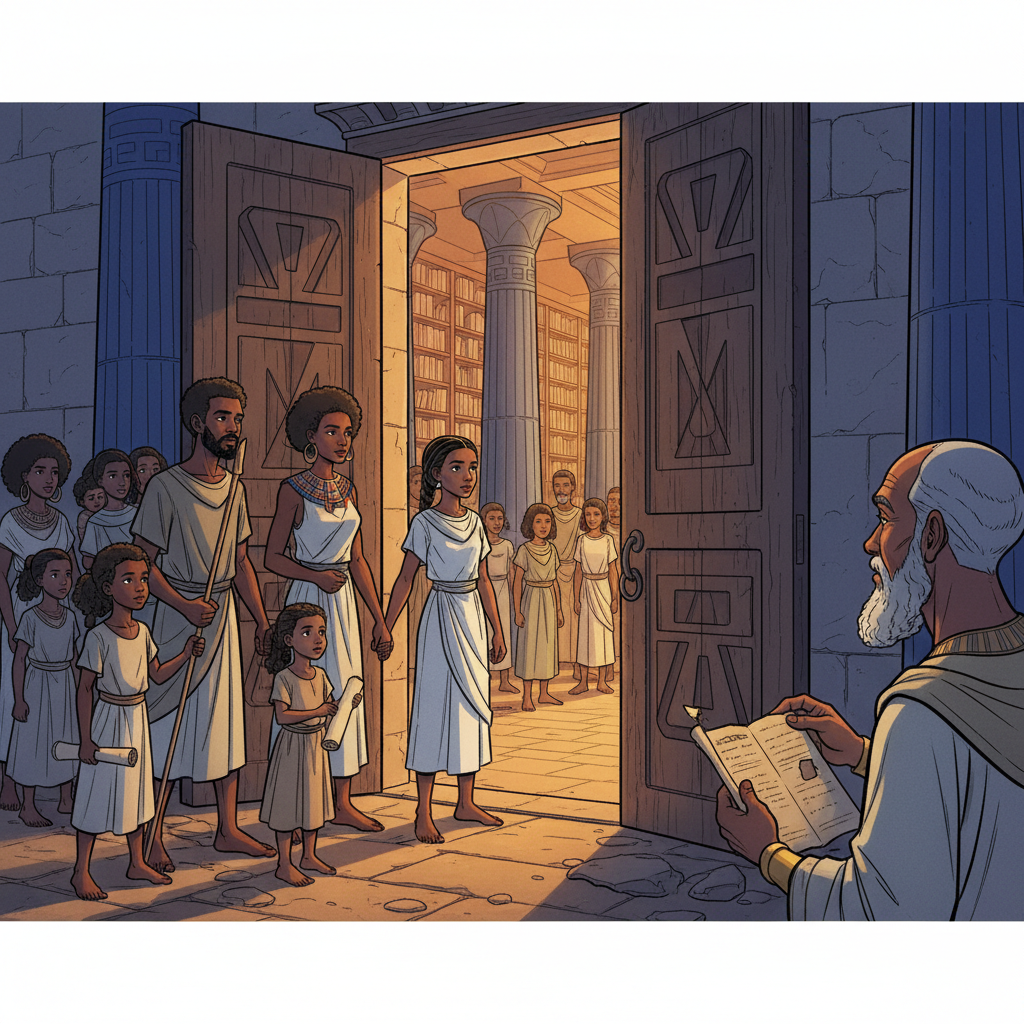
After that, something shifted. Other fathers — and a few mothers — began bringing their daughters to the door of the Per Ankh. Not many, at first. But Senet had cracked the door, and a cracked door is harder to shut again than one that was never opened. Master Peshuper tested the newcomers the way he had tested Senet: a damaged scroll, and a single question. Some passed and some did not, exactly as the boys did. The House of Life did not become a place only for girls, or only for boys. It became, a little more than before, a place for whoever could do the work — which was, Senet thought, what a House of Life had always been meant to be.
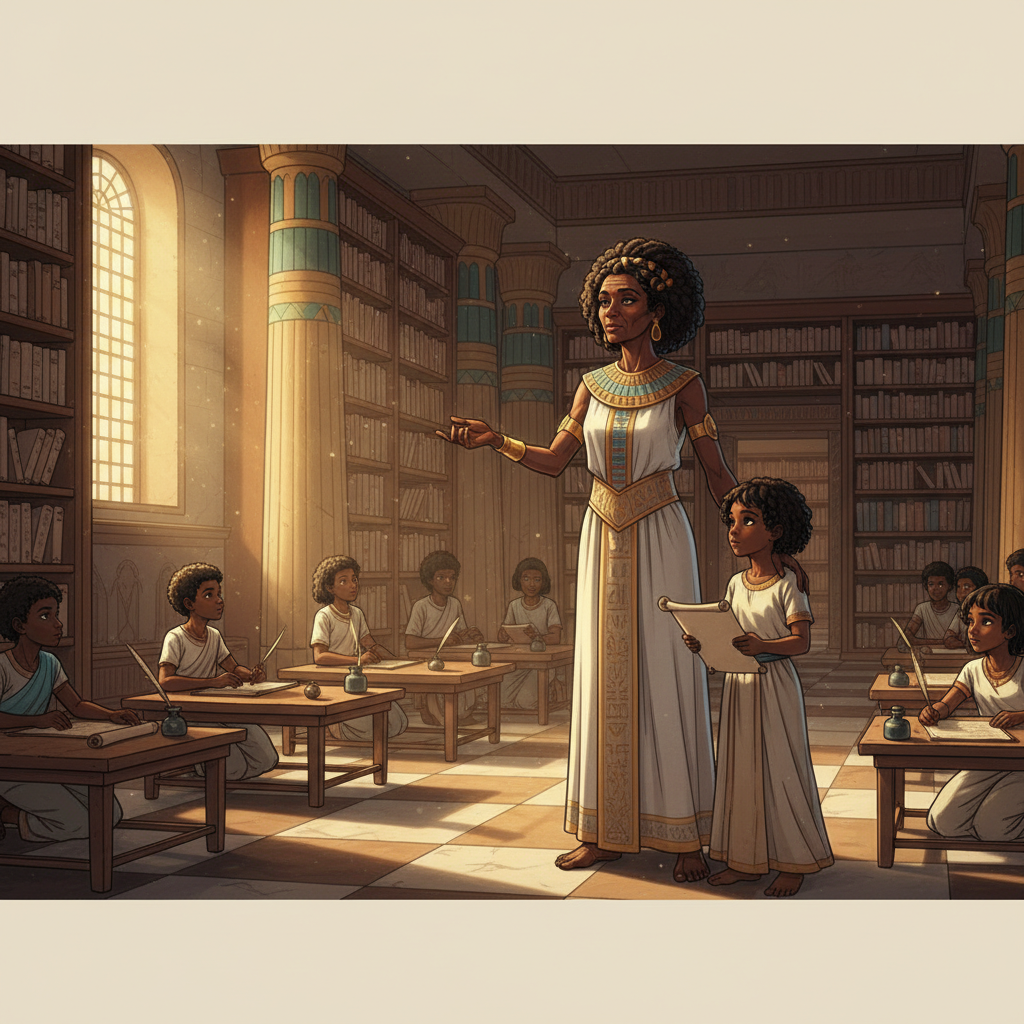
Senet grew up to be a scribe and, in time, a keeper of the House of Life herself — one of the hands that held a people’s memory in its right order. When the youngest students asked her what the House was, she never called it “the first great school,” the way some proud people liked to. She called it by its true name. “The House of Life,” she would say, “because a people that remembers how to heal, and count, and plant, and judge stays alive — and a people that lets that knowing spill into the sand begins to die.” Order, she taught them, is the right placement of knowledge: every scroll in its bay, every count beneath its total, and every child who can do the work given a place at the table — whether anyone expected that child or not.