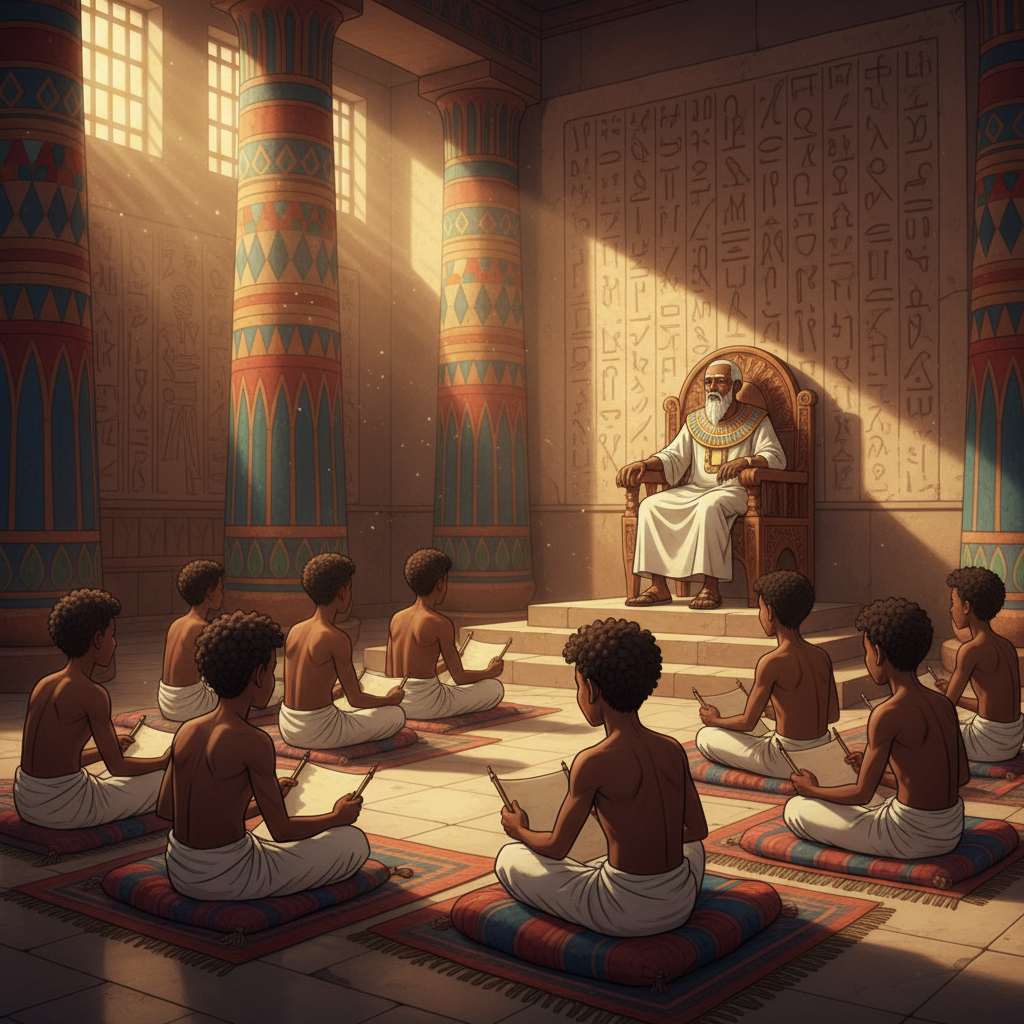
Khepri was thirteen, and he had not been born into the great house of Ptahhotep. He had come into it when his mother married the old vizier’s grandson — which made Khepri a grandson by marriage: close enough to be trained as a court official, distant enough that he felt he had to earn his place twice over. His skin was deep brown, his hands quick with a reed, his nerves always a little tight. On the morning this story begins he sat among the young scribes in the cool inner hall of Ptahhotep’s house, a fresh papyrus across his knees, because today the old man would begin to dictate his maxims, and Khepri had been chosen to help copy them.
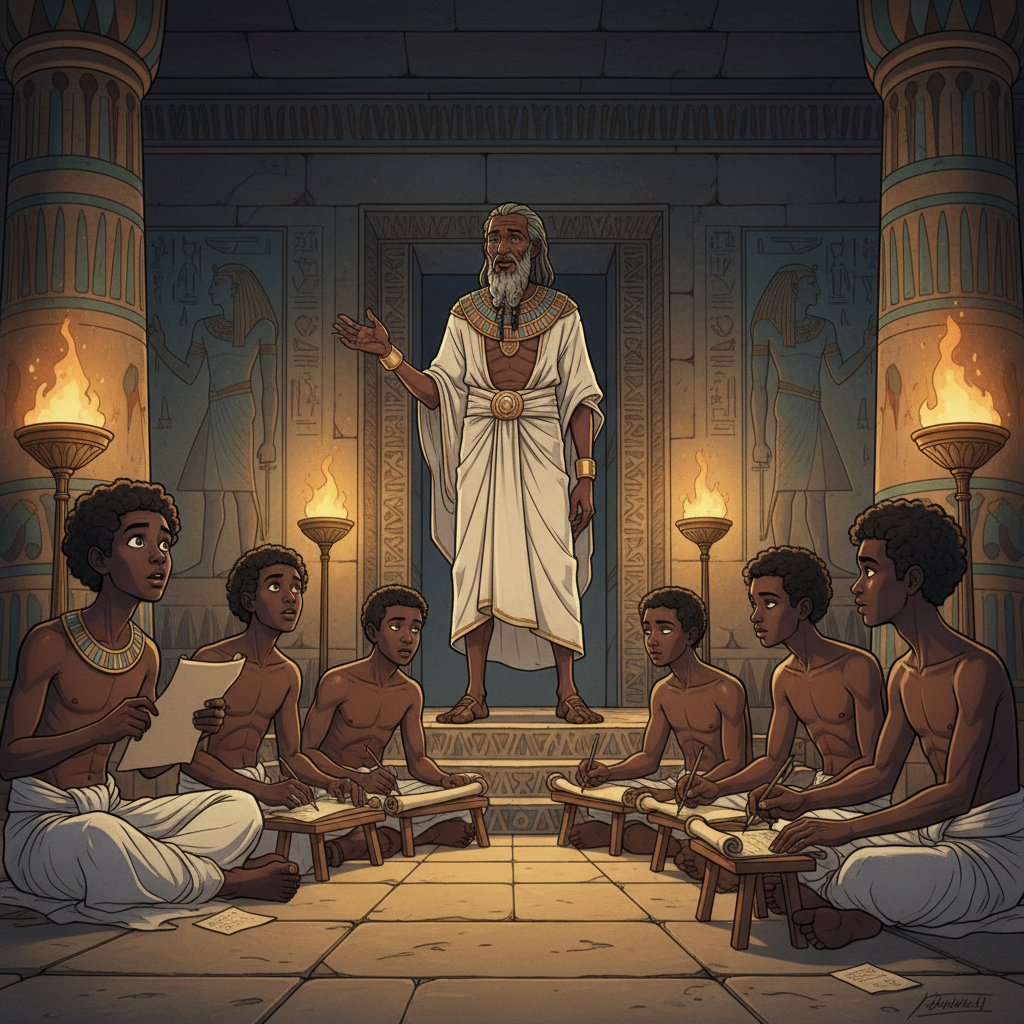
Ptahhotep was older than anyone Khepri knew. He had served as a vizier — the highest official under the king himself, the one who heard disputes and kept the order of the court. Now, near the end of his long life, he had asked the king’s leave to do one last thing: to set down in writing the wisdom of how to live well and serve rightly, so that it would not die with him when he died. The young scribes had been gathered to copy it as he spoke, so that the teaching would go out into many houses at once. Khepri could hardly believe he was one of the hands chosen to hold it.
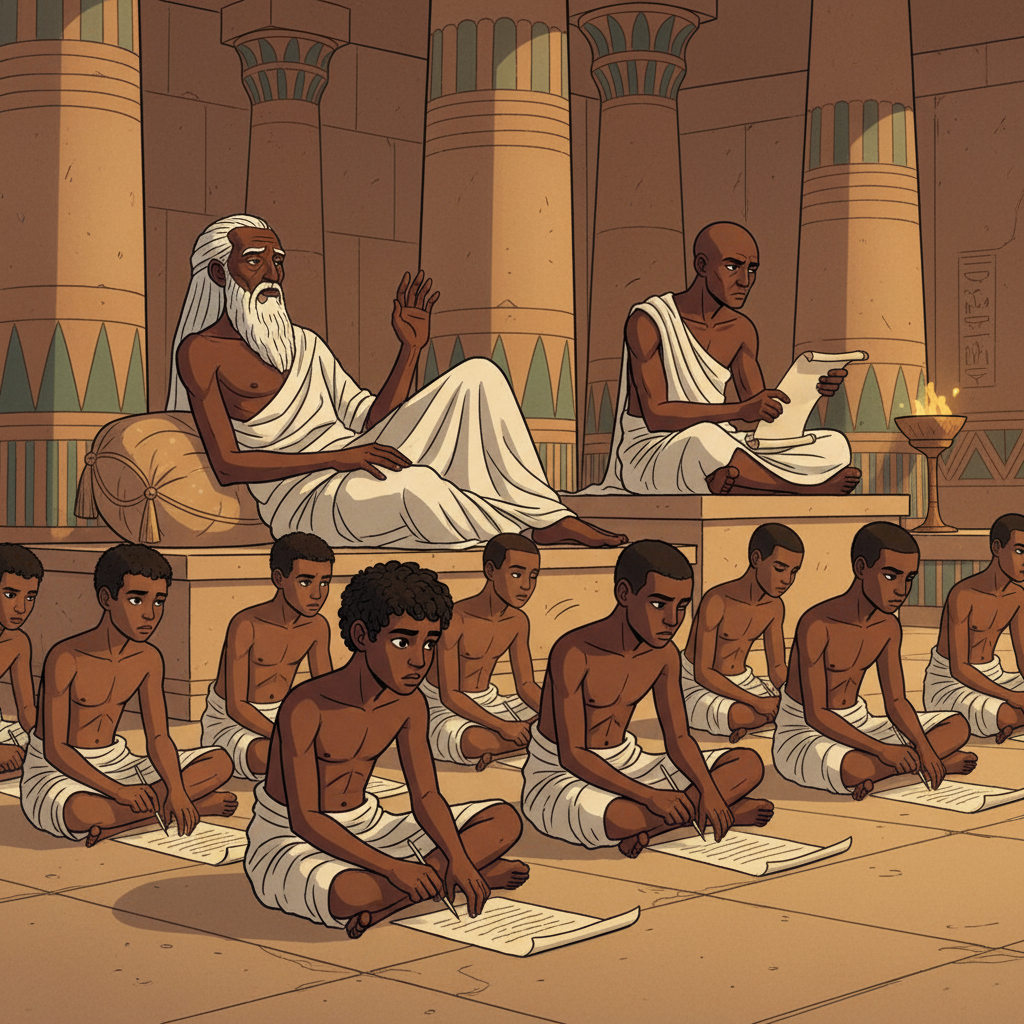
The old vizier was half-reclined on a low cushion, wrapped in fine white linen, his beard gone white, his thin hands resting still in his lap. A senior scribe sat at his right hand, ready to take down the master copy that the whole kingdom would one day keep. The younger scribes, Khepri among them, sat cross-legged in careful rows, each to make a copy of his own as Ptahhotep spoke. The hall was very quiet — the kind of quiet that has weight, that presses on the back of your neck. Khepri smoothed his fresh sheet of papyrus, dipped his reed, and waited, hardly daring to breathe. Then Ptahhotep lifted one thin hand and began, slowly, only a few words at a time, so that the reeds could keep his pace. And the dry whisper of many pens moving together at once filled the room like wind passing through dry grass.
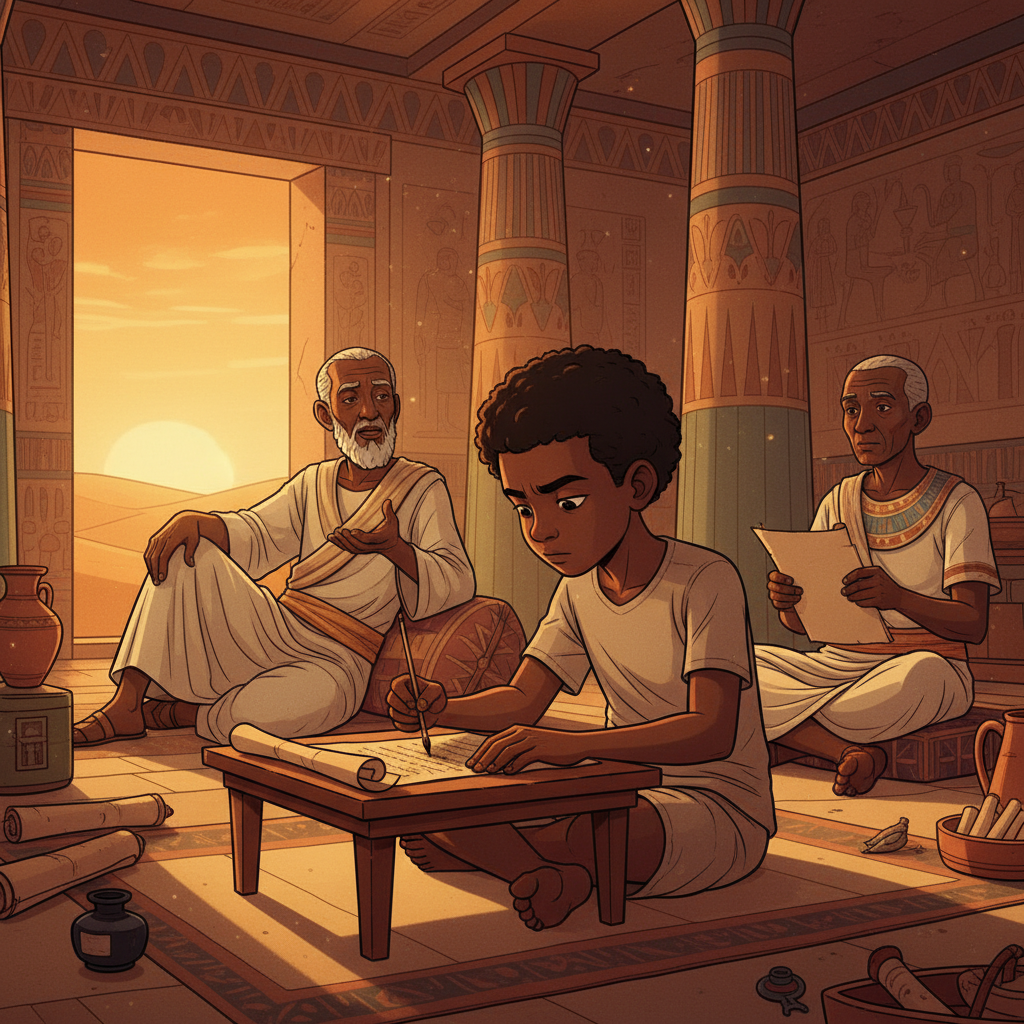
What Ptahhotep dictated were maxims — short, plain teachings about how a person should act. How to listen before answering. How to speak to one above you, and to one below you. How to disagree without making an enemy. How to carry good fortune without letting it make you proud. The teacher Karenga, in books that would not be written for four thousand years, would call these among the oldest written philosophy on the whole earth — older, by more than two thousand years, than the Greek thinkers the world would later credit. Khepri, dipping his reed, did not know he was copying the dawn of philosophy. He only knew his hand must not shake.
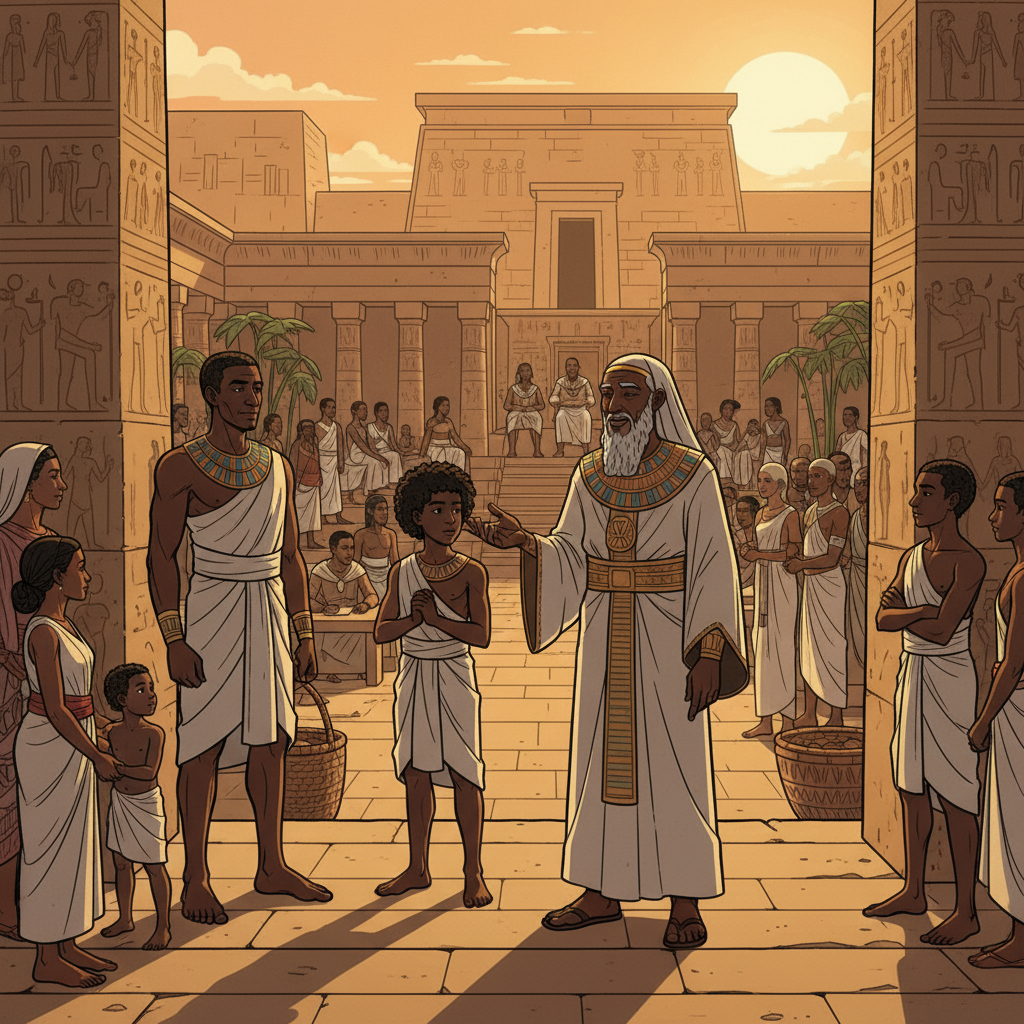
The thread running through every maxim was an idea the people of Kemet called propriety — right action toward each person. Propriety did not mean treating everyone the same. It meant treating everyone rightly, each in the proper way: the vizier with the honor owed a vizier, the doorkeeper with the respect owed a doorkeeper, the small child with the gentleness owed a child. People were ranked, yes. But no one, however low, stood outside the circle of being treated justly. That, Ptahhotep taught, was the order that held a court together — and a court held the kingdom together.
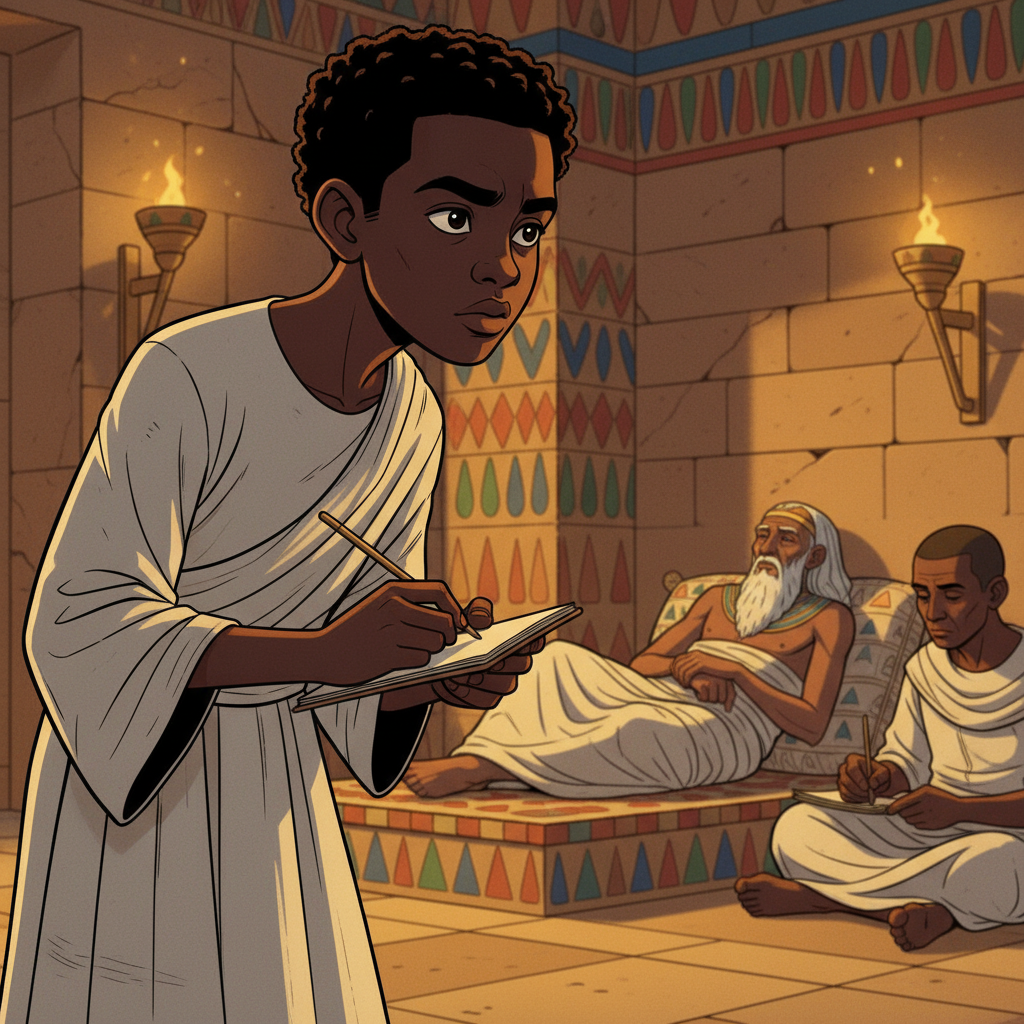
Khepri had a private reason to listen with everything in him. A court official who could not behave correctly did not last. The maxims were not only beautiful ideas; they were, very practically, the difference between keeping a post and being sent home in quiet disgrace. An advisor who insulted the wrong person, or flattered the wrong person, or waved away a petitioner he thought beneath him, could end his own career in a single afternoon. Khepri had no powerful father to catch him if he fell. He needed these maxims the way a swimmer in a current needs the far bank.
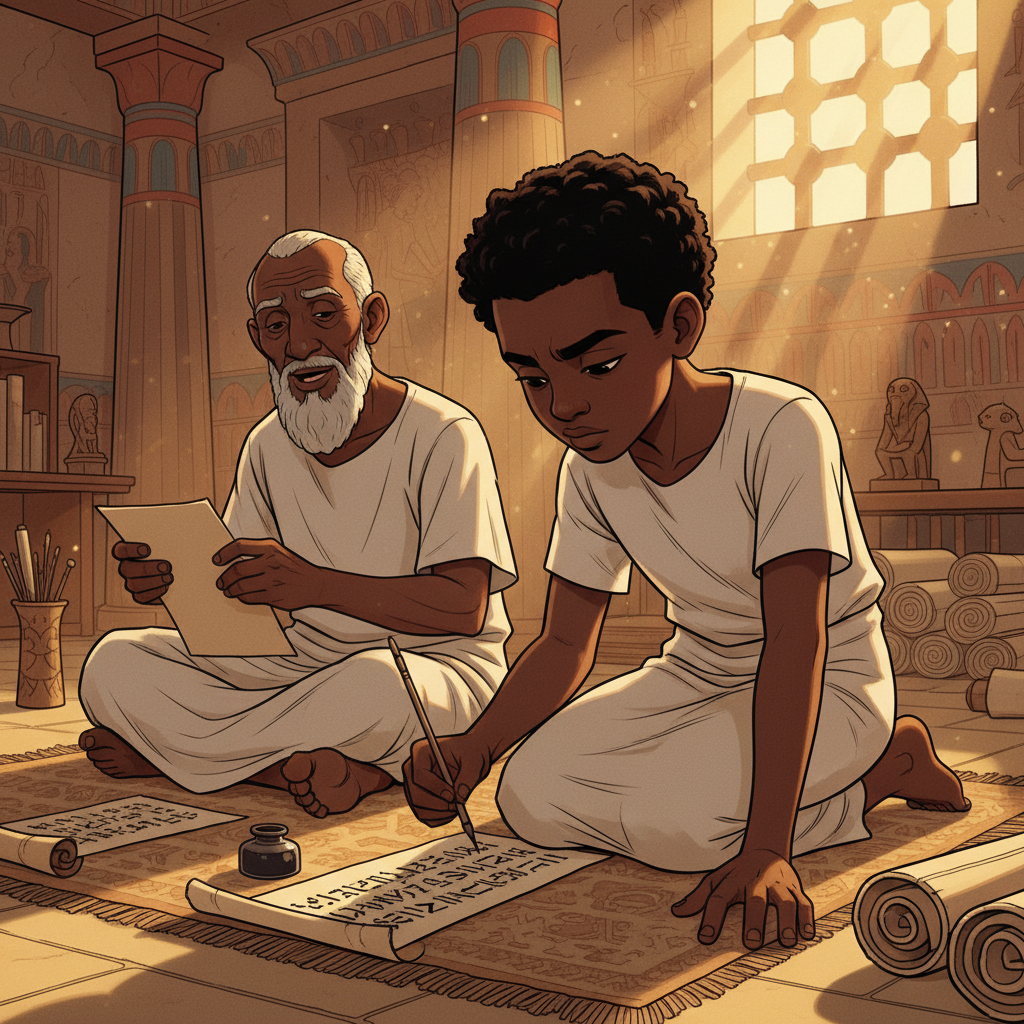
So he copied with all of himself. He matched the senior scribe’s pace, formed each sign cleanly, kept his column straight and true, and let no drop of ink fall where it should not. For a long while there was only the whisper of the reeds and the old man’s slow, certain voice, and Khepri felt — for the first time since he had entered this great house — that he truly belonged inside it. His hand was steady. His signs were clean. He was doing the thing exactly right. He was being, in that very moment, the perfect picture of a proper young scribe: still, attentive, flawless, his eyes on his work and his heart full of a quiet pride. He thought, just then, that this was the whole of what propriety meant. He was about to learn that he had it only half right.
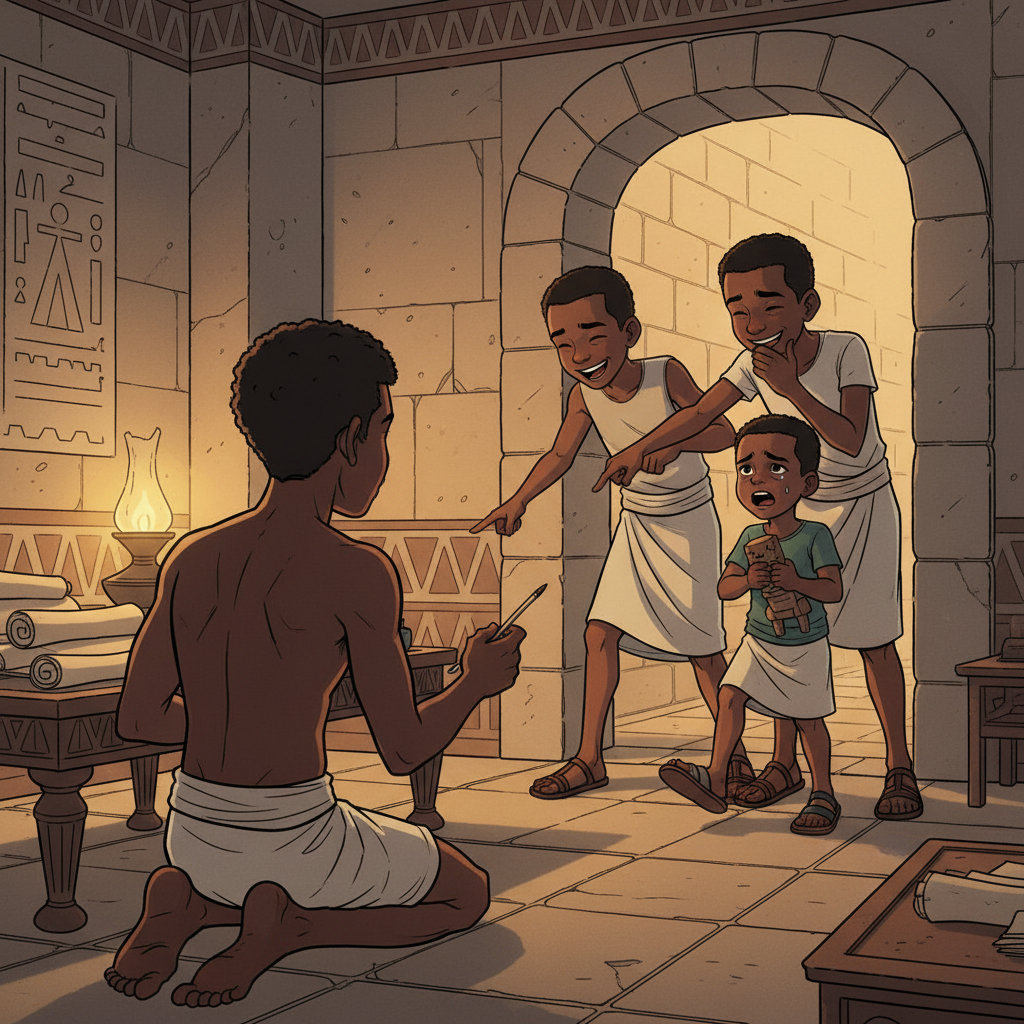
Then he heard it. A small sound from the doorway behind him — a child’s voice, and over it, laughter. He did not turn at first. But the laughter came again, sharper: the particular laughter of older boys who have found someone smaller to make a game of. Khepri knew the small voice. It was Nedjem, his youngest cousin, seven years old, who followed Khepri everywhere and was forever underfoot. Two of the household’s older pages had cornered the boy at the door and were mocking him — his stammer, his too-big sandals, the way he had trailed after his cousin and gotten in the way.

Khepri’s reed stopped on the papyrus. Here was a trap laid as neatly as if the old vizier had built it on purpose. To keep copying was his duty — and no small duty: he was recording the maxims of the greatest official of the age, in a hall where every other young scribe sat perfectly still. To rise and walk to the door in the middle of the dictation would be to break the order of the hall, to draw every eye, to be the one student who could not sit through the most important morning of his life. It would look, to everyone watching, like the very opposite of propriety.

And yet. The thing being dictated, in that exact moment, was a teaching about how to treat those who have less than you. Khepri sat with his stopped reed and felt the whole problem of his life held inside a single held breath: the words about kindness were flowing into his ear and down onto his clean papyrus — while three steps behind him a small, kind boy was being unkindly used. That cruelty was isfet, the disorder that gnaws at Maat, and it had walked right up to the door of the most orderly hall in all Kemet. He could copy the words about right action, or he could do the right action. He was not at all certain that the two were the same choice. And what frightened him most was the slow, growing suspicion that they were.
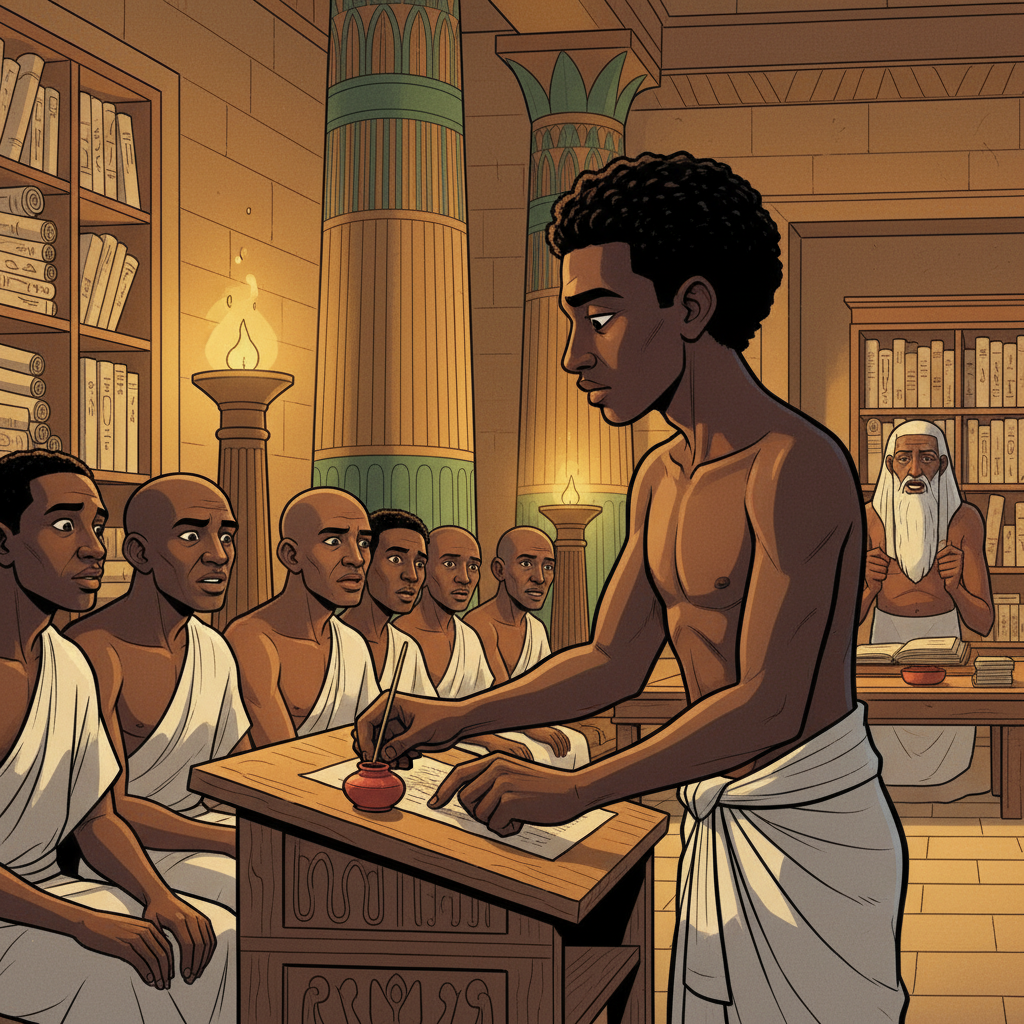
Khepri set down his reed across the ink-pot, slowly, so that it would not roll. He stood. The movement turned heads all down the row — he felt them turn, felt the senior scribe’s sharp glance, felt, worst of all, that he could not tell whether Ptahhotep had stopped speaking behind him. He did not look at the old man; he was far too afraid of what he might see written in that ancient face. He made himself walk the three steps to the doorway, his heart gone enormous and loud in his chest, and he put his own body between the two older pages and his small, stammering cousin. He had no plan, no clever words, no idea at all what would happen next. He knew only one thing for certain: that he could not write one more sign while that was going on behind his back.

He did not shout, and he did not raise his hand — for to brawl in the vizier’s doorway would have been its own kind of disorder, and Khepri felt that even now. He simply stood beside Nedjem, laid a hand on the boy’s shoulder, and said to the older pages, evenly, “He is mine. If you have time to mock a child, you have time to carry water. Go and be useful.” He named what they were doing plainly, without an insult of his own, and he left them a way to walk off without a fight. Nedjem pressed against his side, trembling and silent.

The two pages looked at Khepri, and at the hall full of scribes behind him, and at the plain fact that he had risen from the master’s own dictation to do this. Whatever they had expected, it was not that. Mockery needs an audience that will not interfere; Khepri had interfered, calmly, in the open, in front of everyone. The pages muttered something and went. It was over in the space of a few breaths. Khepri stood in the doorway with his cousin beneath his hand and his reed-brush still, absurdly, gripped in his other fist — and only now did the size of what he had done in front of the whole hall come down on him.
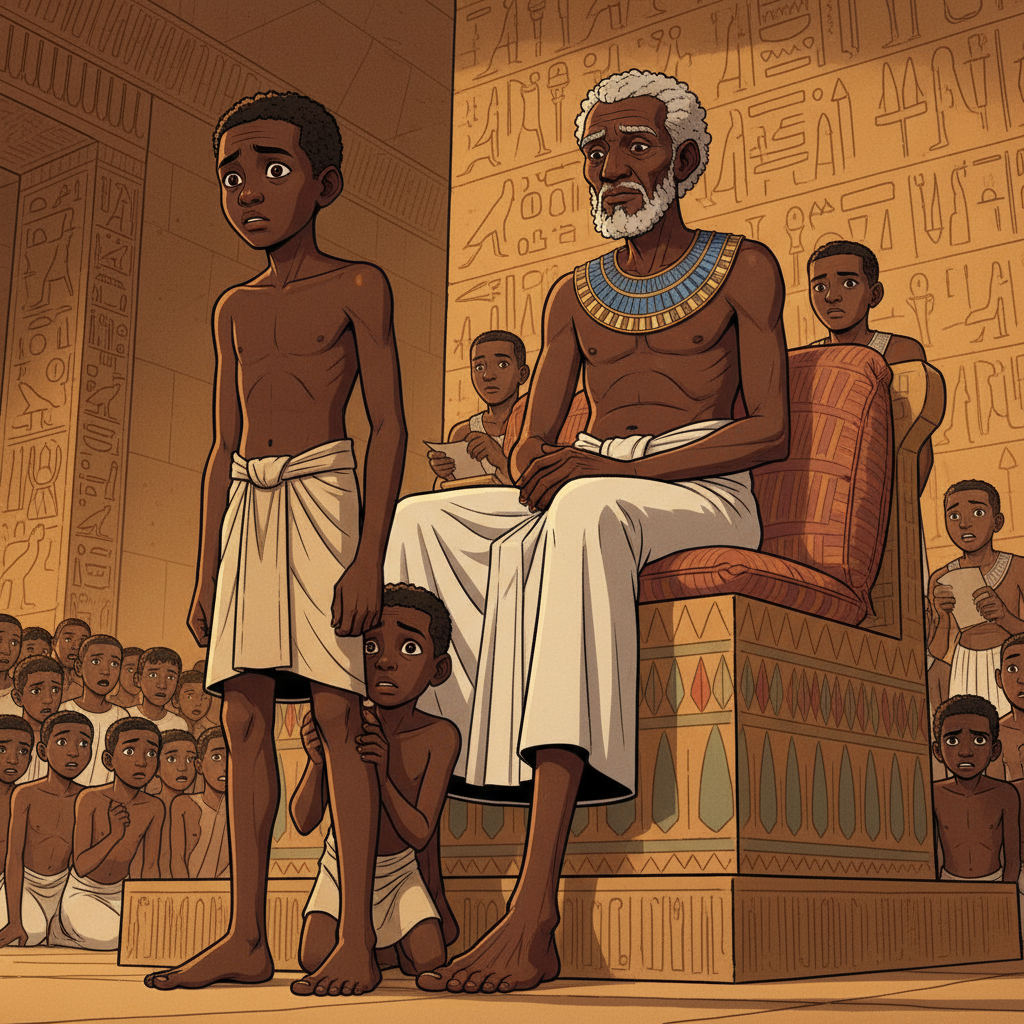
He turned back toward the hall, and his stomach dropped. Every single young scribe was looking at him. The senior scribe’s face gave away nothing at all, which was somehow worse than open anger. And Ptahhotep — the old vizier had stopped dictating altogether. He had pushed himself up a little straighter on his cushion, his thin hands folded in his lap, his dark eyes resting calmly on Khepri standing there in the doorway with little Nedjem still half-hidden behind his legs. Khepri’s mouth went dry as the desert sand. He had broken the order of the most important hall in his whole world, on the most important morning of his entire life, in front of the greatest official of the age. He stood where he was and waited, miserably, to be sent home in disgrace.
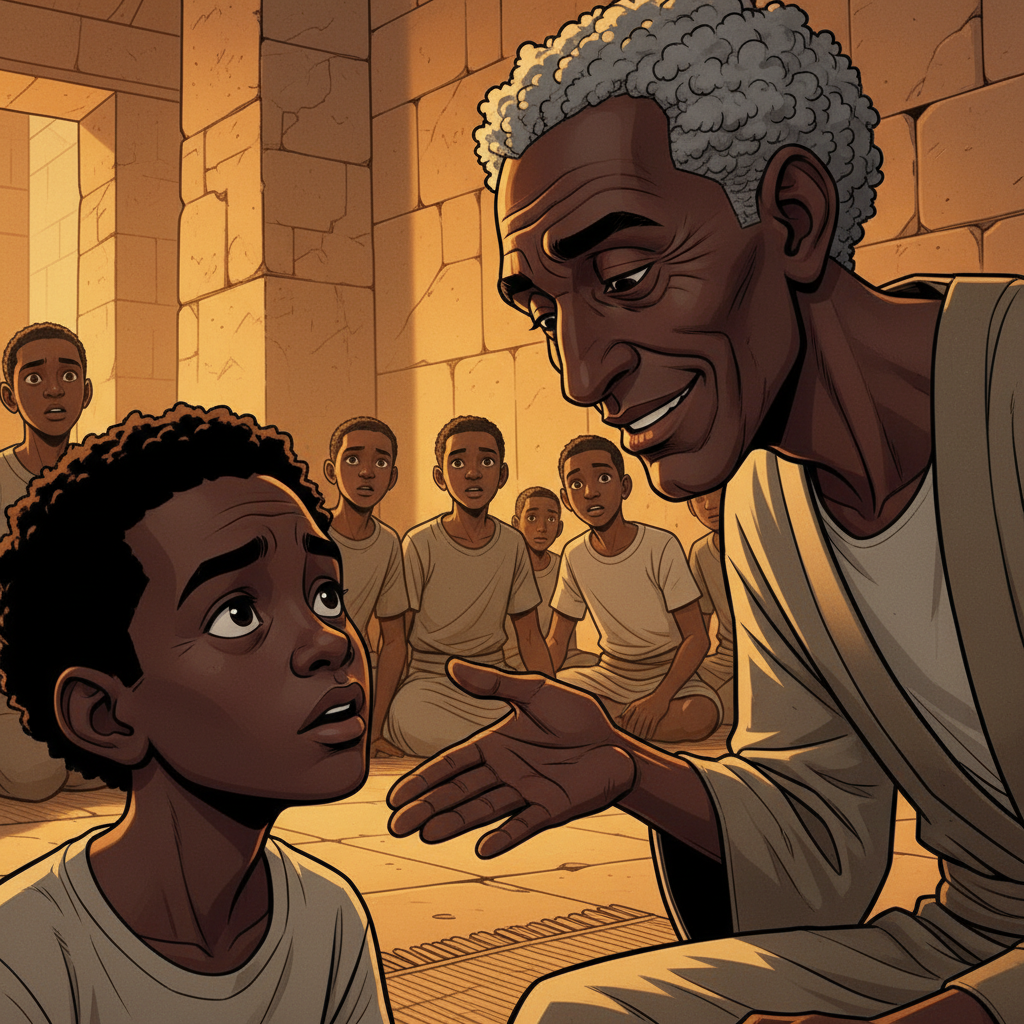
Ptahhotep looked at him for a long, long moment — long enough that Khepri felt every heartbeat of it. Then the old man’s face moved, and not into the anger Khepri had braced himself for, but into something he had not braced for at all. The deep creases at the corners of his eyes folded and deepened. “Good,” Ptahhotep said at last, in his slow and certain voice, pitched so that every scribe in the hall heard it plainly. “You have written one of my maxims already this morning — and you wrote it not with your reed, but with your feet. Come back and sit down, grandson.” He gestured to the empty mat. “The rest of what I have to say today is only words about the very thing that you just went and did.”
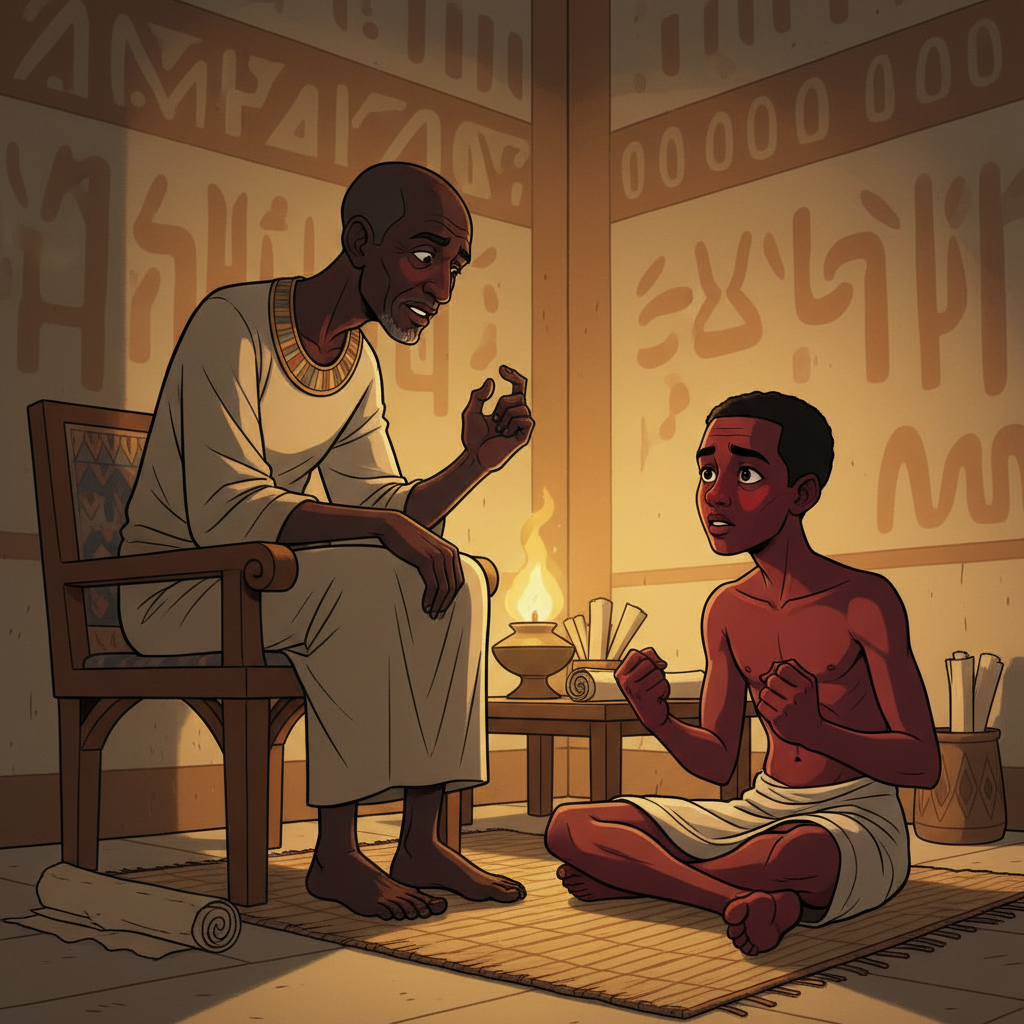
Khepri came back and sat down on his mat, his face hot, his hands not quite steady, not yet understanding what had just happened to him. Later, when the long dictation was finally done and the other scribes had filed quietly out, Ptahhotep called him close with one curled finger. “A maxim copied,” the old man said, “is worth a little. A maxim lived is worth everything there is. I have spent a very long life learning a hard thing, grandson: the words are not the wisdom. The words are only a net we throw out, again and again, to try to catch the wisdom — so that we can hand a little of it to the young before we go. You did not need my net this morning, Khepri. You already had the fish, alive and shining, in your own two hands.”

Then Ptahhotep taught him the part he would carry the rest of his days. “Propriety is not sitting still while you are watched. It is right action toward each person — the high and the low, ranked and not ranked. You owe the vizier the honor of a vizier and the doorkeeper’s child the gentleness of a child, and you must never confuse the two. But hear this carefully, grandson: a person’s rank tells you HOW to serve them. It never, ever tells you WHETHER to treat them justly. Your small cousin ranks beneath every page in this house. He was owed justice exactly as much as I am owed these maxims. You saw that. Most grown men live and die without seeing it.”
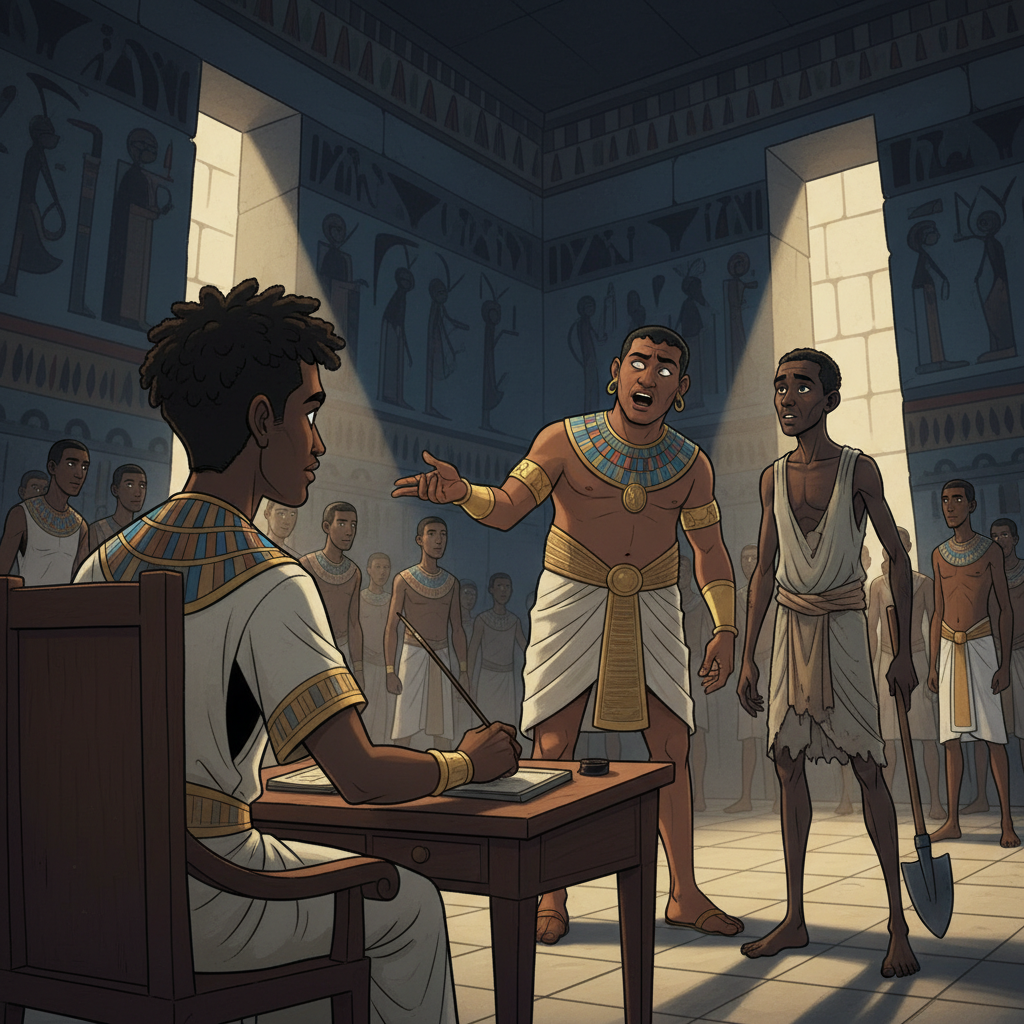
The lesson became real, and not just remembered, years later — when Khepri was himself a court official, trusted with the king’s business. A wealthy landholder came before the court and, in front of everyone, brushed aside the complaint of a poor canal-digger as the whining of a small man. The room, full of officials who depended on the landholder’s goodwill, went carefully, cowardly quiet. Khepri felt the old trap close around him again: the safe thing was to let it pass. Instead he set down his reed, exactly the way he had at thirteen, and asked the canal-digger to speak his complaint in full — and he listened to it as carefully as he would have listened to a vizier.
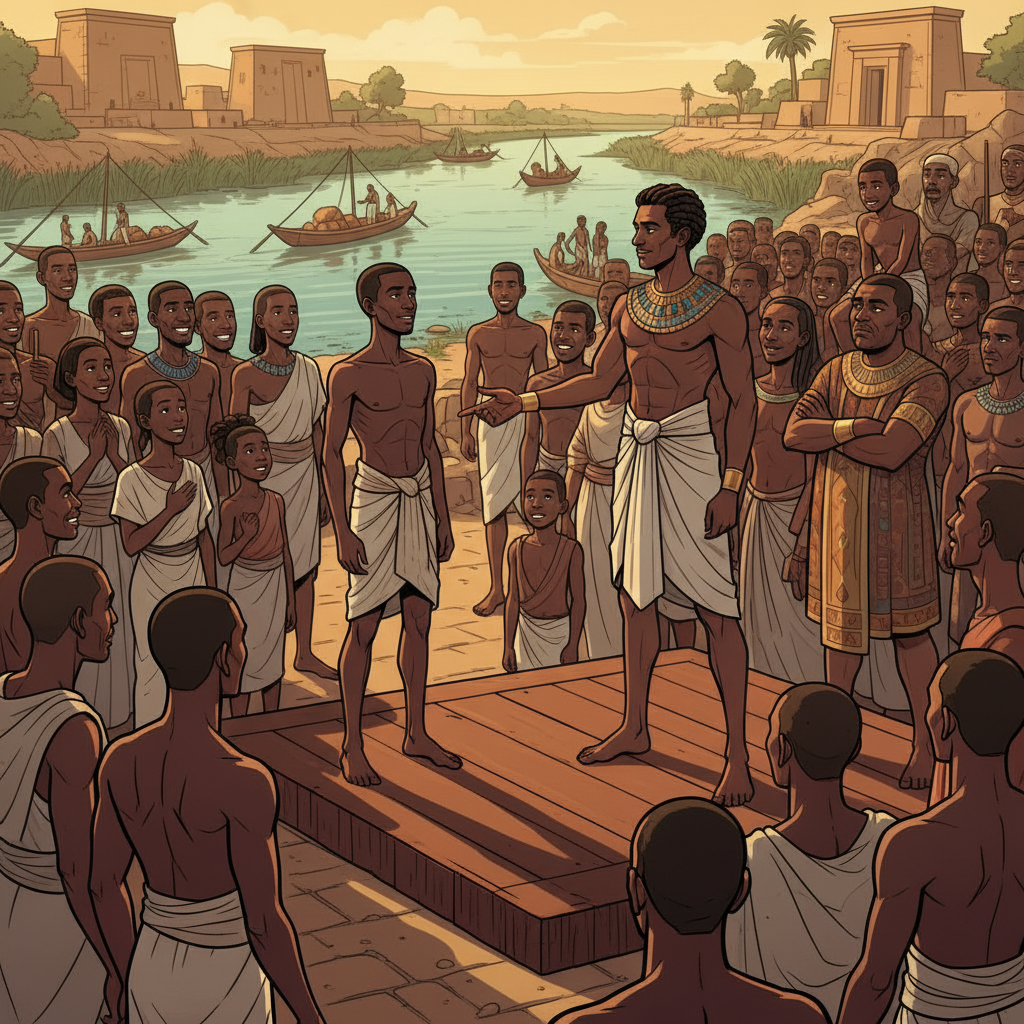
Heard fully, the complaint turned out to be just: the landholder had diverted water that was not his to take. Khepri ruled for the canal-digger. It cost him the landholder’s friendship, which was not nothing. But it earned him the thing the maxims had quietly promised — the trust of everyone who saw an official who measured the low and the high by the same justice, each only in their proper way. A court where the poor man is truly heard is a court the whole kingdom can believe in, and that belief, Khepri understood at last, was the real wealth the old vizier had been trying to hand down the morning he dictated his maxims.

Ptahhotep died not long after that first morning of dictation. The thirty-seven maxims he set down outlived him — copied and recopied, carried from house to house, read for four thousand years and more, the oldest book of its kind the human family has kept. The papyrus remembered his words the way the temple stone remembered the scribes’ true accounts: faithfully, longer than any one life. And yet Khepri, when he himself grew old, would say that the deepest of Ptahhotep’s maxims was the one never written at all — the one the old man had watched him live, with a frightened small cousin under his hand and a reed-brush forgotten in his fist.
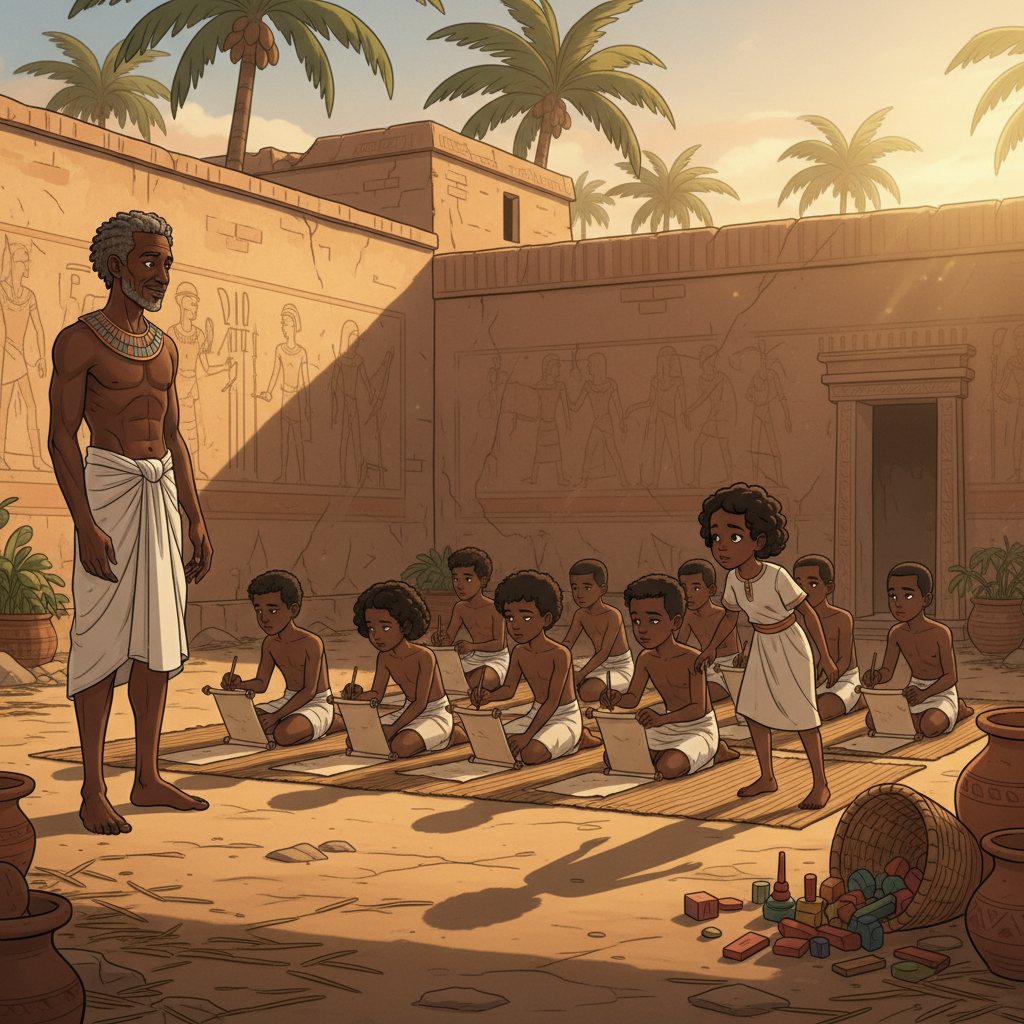
When Khepri became a teacher of the young in his own turn, he did not begin by making his students copy. He let them copy — the signs must be learned, and learned well. But he watched them for something else entirely. He watched what each of them did when a small wrong happened at the edge of the room, while their eyes were supposed to be fixed upon their work. He had learned, from an old man on a cushion, that you cannot know a proper person by how still they can sit. You can only know them by what finally moves them to stand.
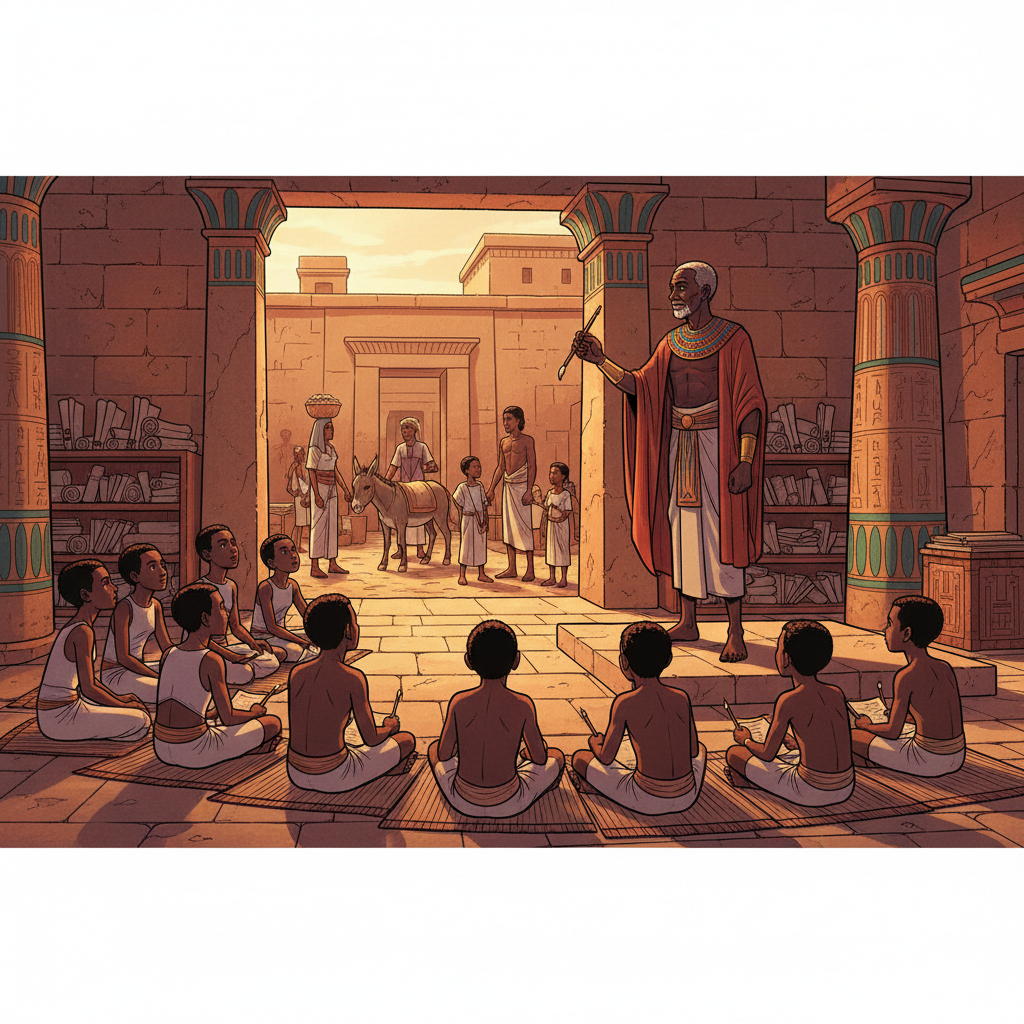
Propriety, Khepri taught, is right action toward each person — the high and the low, the ranked and the unranked, each one served in their proper way and not one of them left outside of justice. That is Maat; and its opposite — the careless cruelty that lets the small be used while everyone sits looking proper — is isfet, which creeps in most easily of all through people who are very busy appearing correct. A maxim copied is a net; a maxim lived is the fish itself. And the whole heart of it, Khepri would say at the end of his teaching, holding up his worn old reed-brush for the youngest scribes to see, he had learned in a single morning, in a single doorway, when he was not much older than they now were: on the day he stopped writing so beautifully about kindness just long enough to stand up, and walk three steps, and go and do some.