
The air shimmered above the Kemet fields, thick with the promise of the coming Inundation. Sekhemib, fourteen and built like a nimble reed, darted between the papyrus clumps. His short, dark 4C coils bounced with every stride. He loved the freedom of the Nile’s edge, where the great river began to swell, whispering secrets against its banks. His father, Imhotep, a steady farmer, always called him back. “Sekhemib! Stay clear of the main current! It carries more than just silt during this season.”
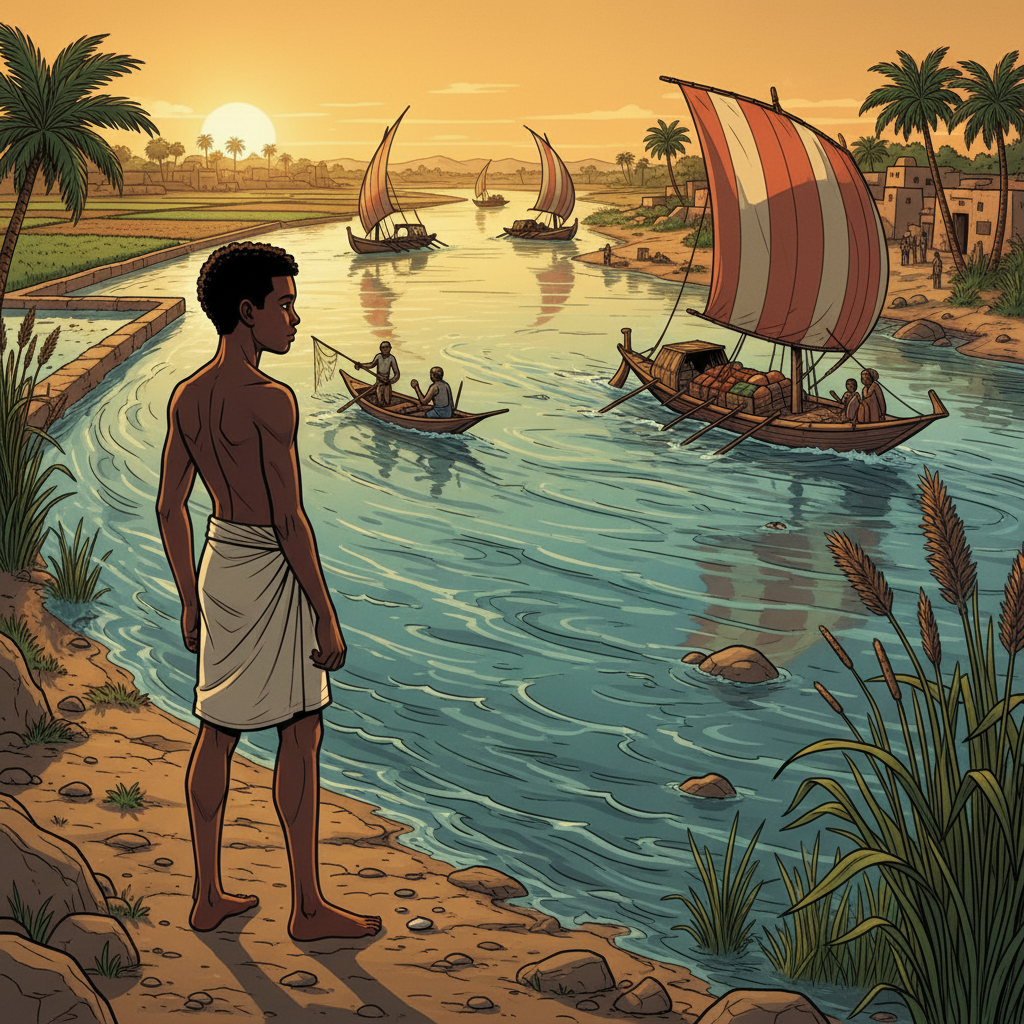
Sekhemib sighed, kicking at a loose pebble. His father’s words felt like invisible ropes, pulling him back from adventure. He understood the power of the Nile, how its waters brought life to the fields, but he also felt its magnetic pull, a wild energy mirroring his own. He wanted to explore the flooded marshes, to see where the `Hapy` truly touched the land. Why did there always have to be boundaries? He felt a constant tension, a small `isfet` brewing inside him, whenever his parents set limits.
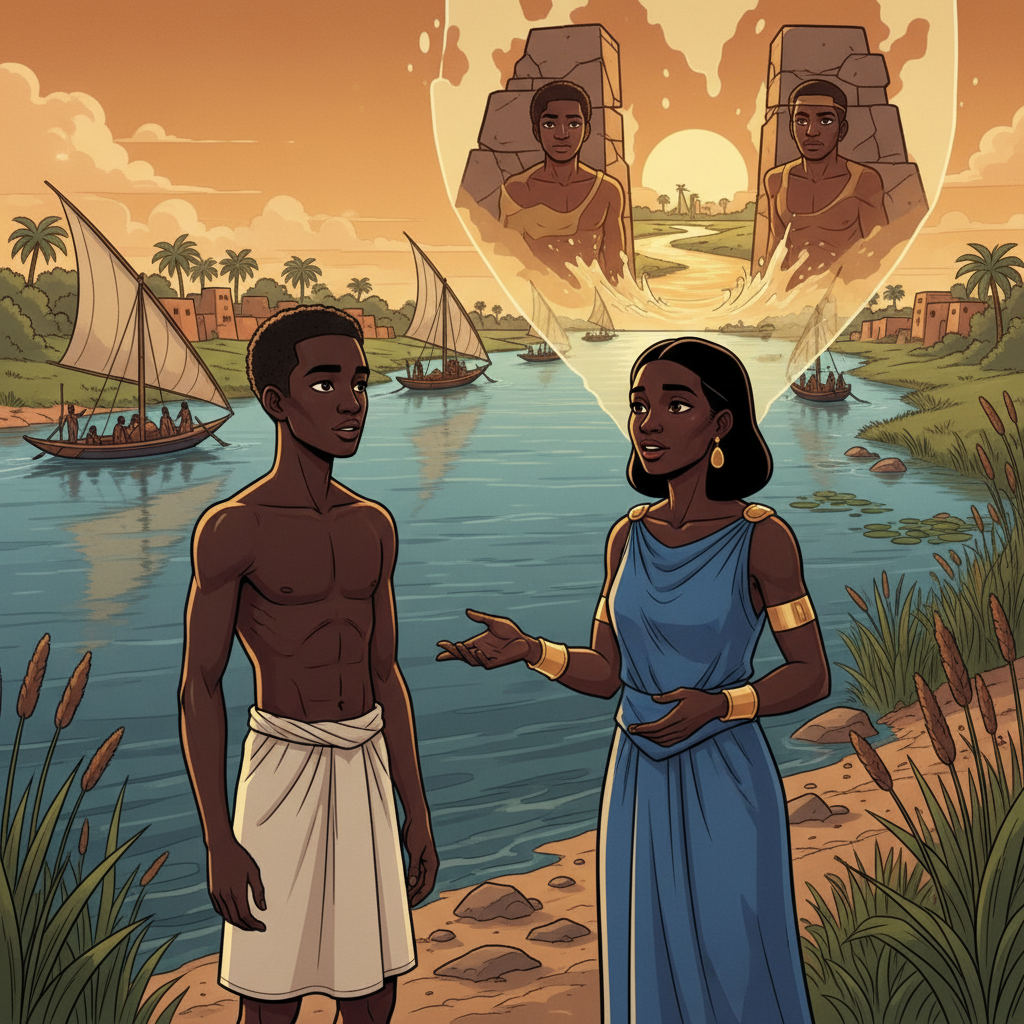
His mother, Nefertari, with her kind eyes and strong hands, would often say, “Sekhemib, the river seeks its path, but it is the banks that give it purpose. Without them, it would simply scatter.” Sekhemib nodded, but his mind raced. He imagined himself as the river, powerful and free, wanting to flow wherever he pleased. He saw his parents’ rules as confining banks, holding him back from his true strength. This struggle was a familiar dance in their home, especially during the busy agricultural season in Kemet.
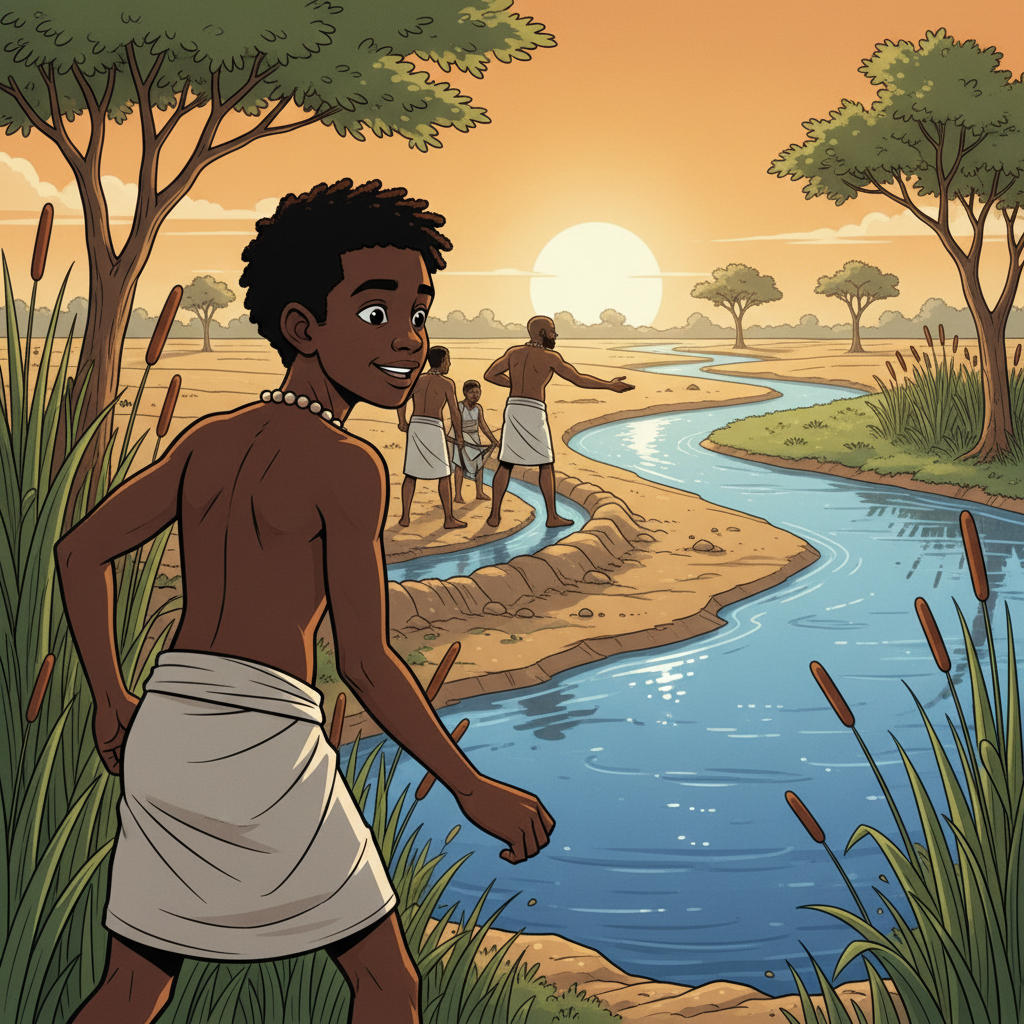
One morning, the sun already warm on his dark skin, Sekhemib was meant to help his father clear an irrigation `canal`. But the call of the wild `Hapy` was stronger. He slipped away, convincing himself he’d just scout for new fishing spots. He loved the thrill of choosing his own path, even if it meant a small rebellion. His heart thumped, a mix of excitement and guilt. He knew he was inviting a lecture, an unwanted discussion about responsibility and the principle of `Maat`, but the urge to be unbound was too strong.
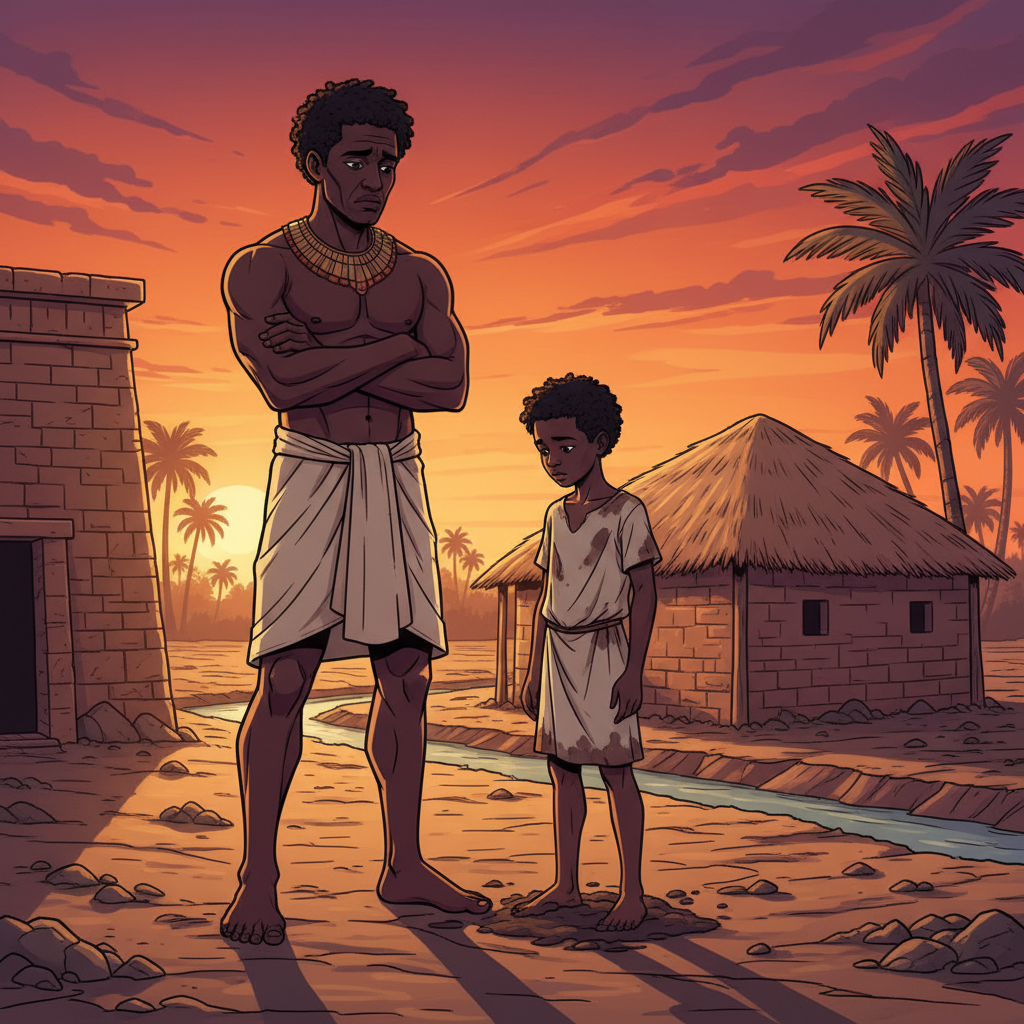
He spent hours downstream, watching the `herons` stalk fish in the shallows, the fertile mud squelching between his toes. The `Inundation` was still rising, the `nilometer` in the village surely showing higher marks. When he finally returned, the sun dipped below the horizon, painting the sky in fiery streaks. His father stood by their hut, arms crossed, his face etched with worry. “Sekhemib,” Imhotep said, his voice low, “where have you been? We needed your strength today.”
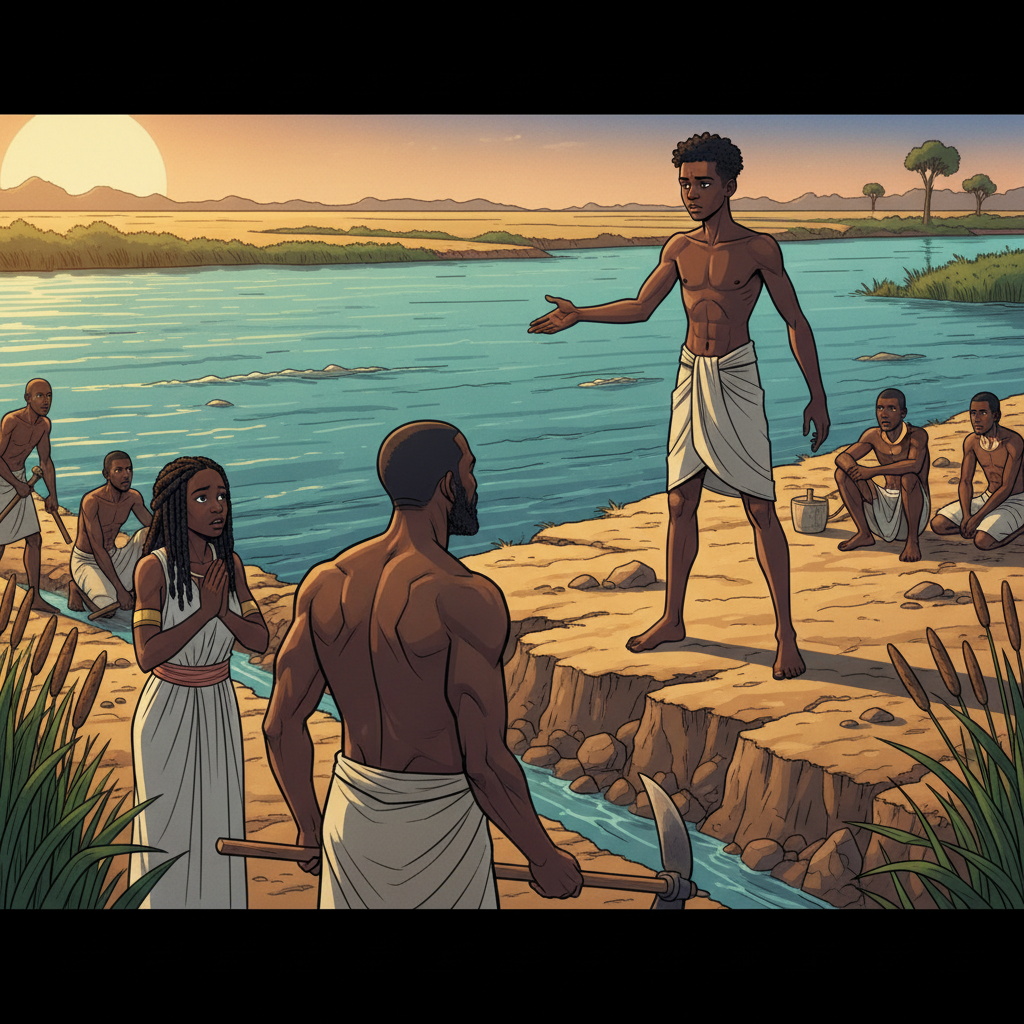
Sekhemib mumbled an excuse, something about finding a lost tool, but his eyes wouldn't meet his father's. He felt the familiar heat rise in his chest. “I just wanted to see more of the river, `Abba`,” he finally blurted, using the informal word for father. “I feel like I’m always trapped here, working the same fields, seeing the same sights. The river is so big, so much to explore!” His voice grew louder, frustration bubbling over like water over a breached `levee`.
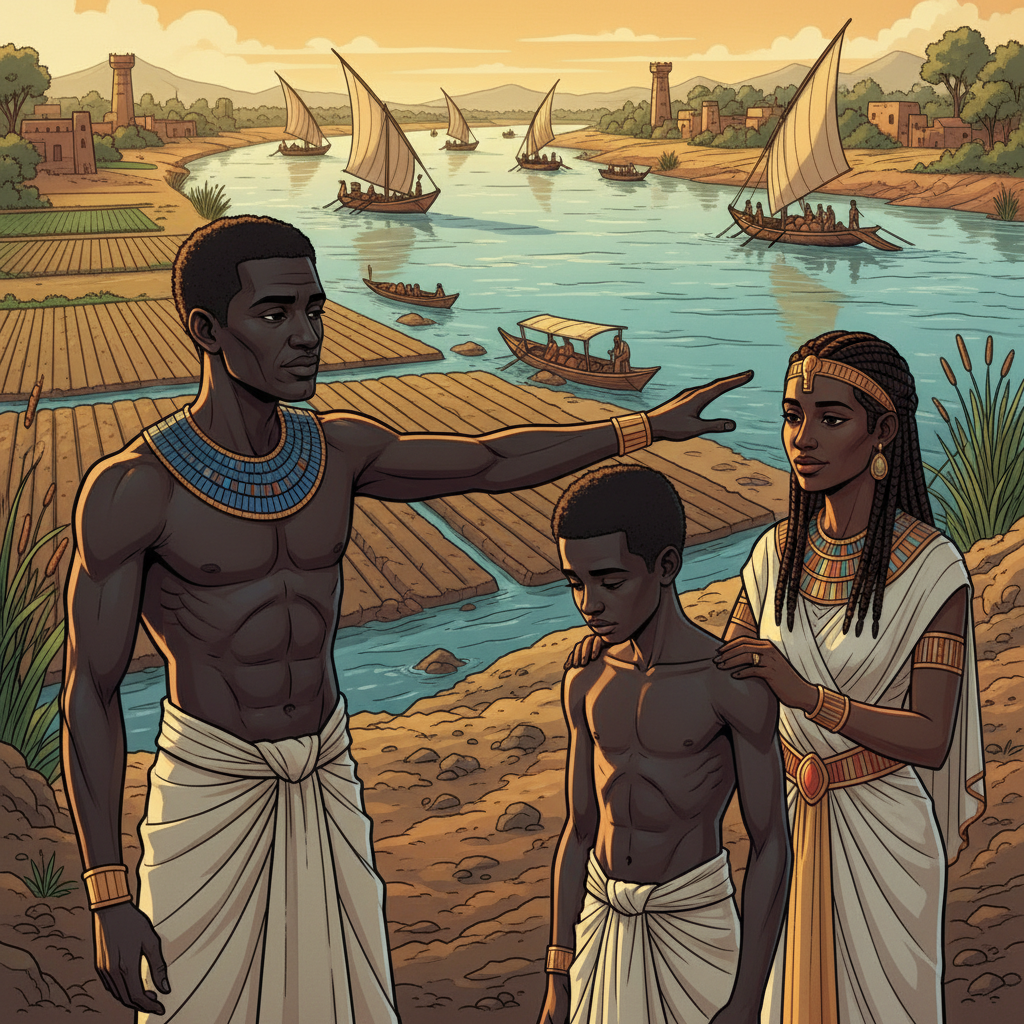
Imhotep sighed, his gaze sweeping over their neatly tilled fields. “Sekhemib, the Nile gives us life. Our work is to guide that life, not to squander it. Your wanderings create disorder, `isfet`, in our efforts.” Nefertari joined them, placing a hand on Sekhemib’s shoulder. “Harmony, `Maat`, comes from working together, understanding our place within the flow. Your father and I set boundaries to protect you, not to hold you prisoner.”
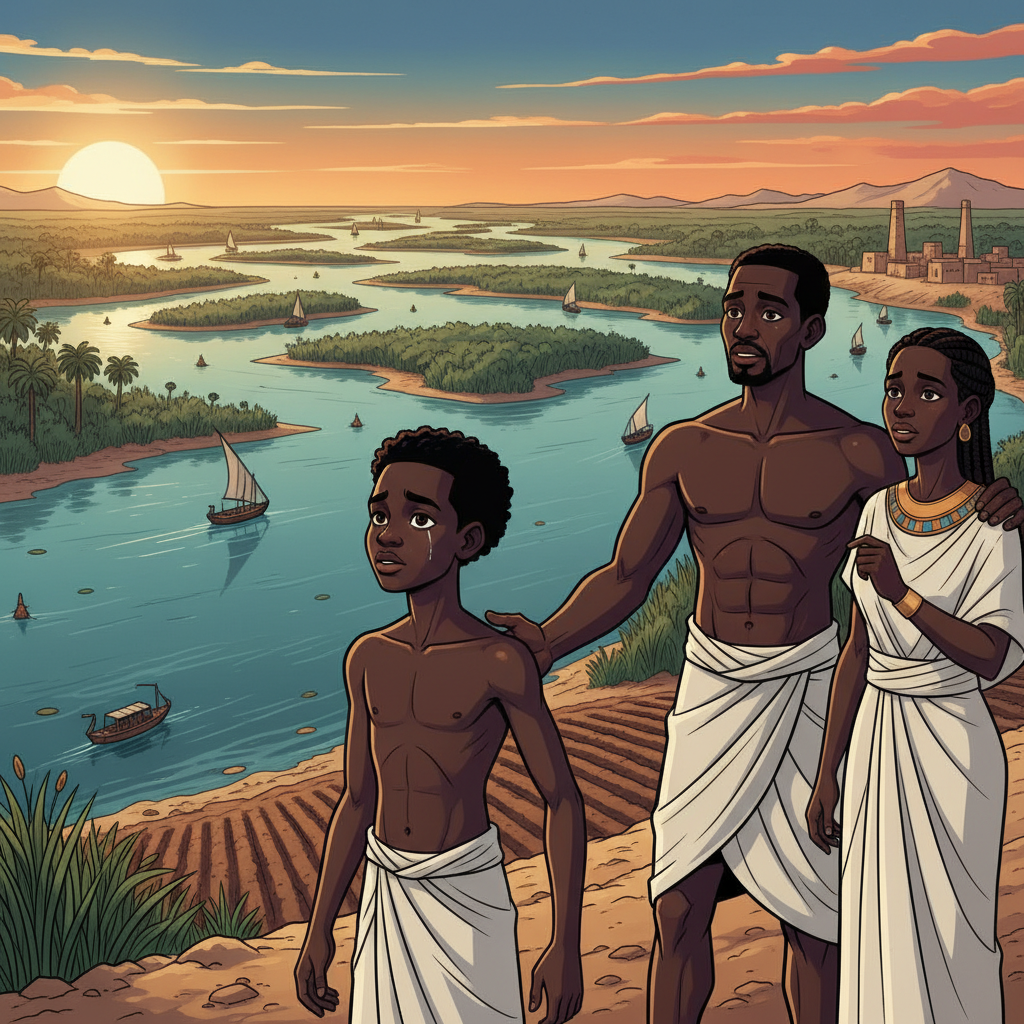
Sekhemib pulled away. “But it feels like imprisonment! I want to be free like the river, flowing wherever it wants!” He felt his throat tighten with unshed tears of frustration. His parents simply didn't understand his need for wildness, for unrestricted movement. He saw their love, yes, but it felt like a cage woven from good intentions. The `delta` stretched wide, full of possibilities, yet he was confined to their small village. He yearned to simply run, without expectation or task.
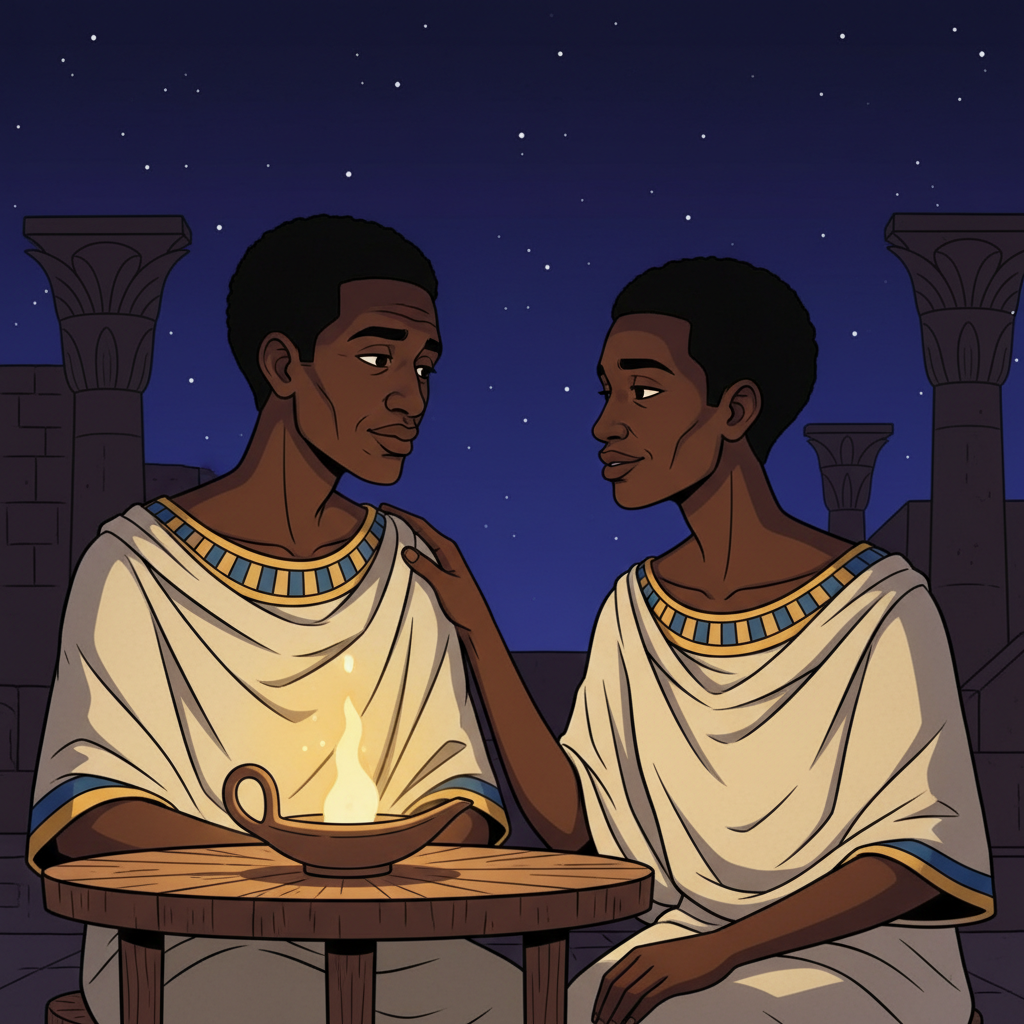
Imhotep looked at his wife, a silent conversation passing between them. Finally, he turned back to Sekhemib. “Tomorrow, you will spend the day with Khepri, the irrigation master. He has much wisdom about the river, perhaps more than I do.” Sekhemib’s shoulders slumped. Khepri was old, his movements slow and deliberate. This felt like a punishment, an even tighter `serekh` of rules. He was being sent away to be taught obedience, not freedom. He went to bed that night, feeling a deep `isfet` within his own heart.
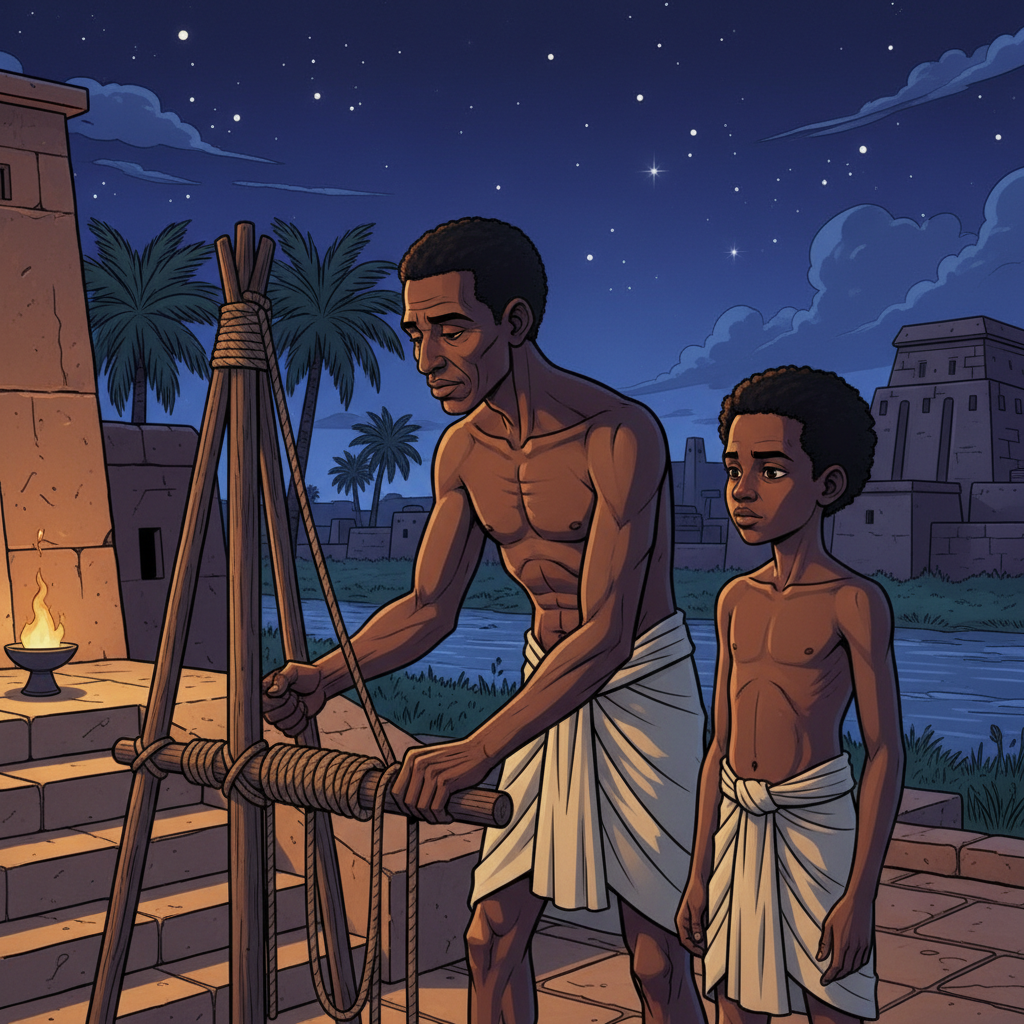
The next morning, Sekhemib trudged towards Khepri’s small hut, located near the main `nilometer`. Khepri, whose skin was like rich, dark earth and eyes sparkled with knowing, greeted him with a calm smile. “Ah, Sekhemib. Your father told me you wish to understand the river better.” He didn't sound angry or disappointed, just observant. Sekhemib mumbled a greeting, still feeling resentful. He watched Khepri’s hands, gnarled and strong, as the elder checked the ropes of a `shaduf`, used for lifting water.
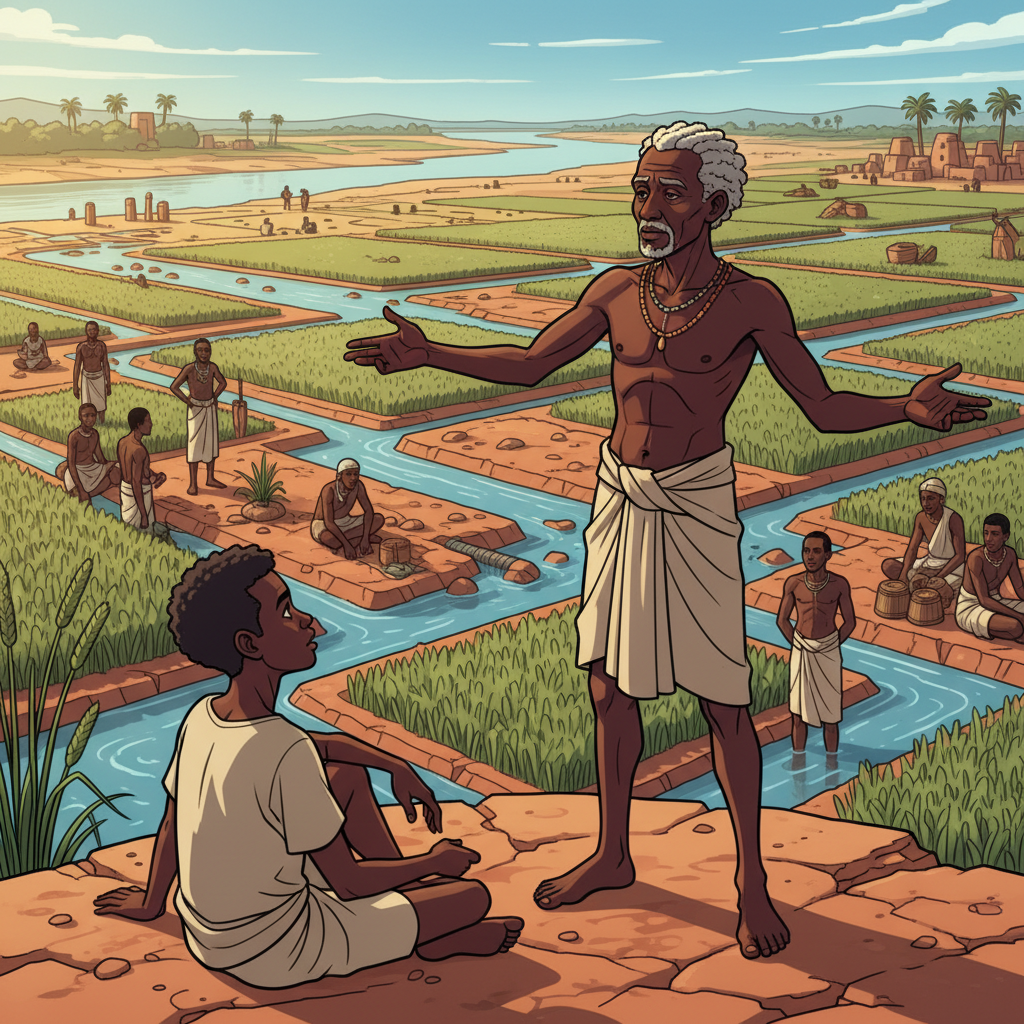
“The river, my boy,” Khepri began, his voice like the rustle of dry papyrus, “is not truly free. It is guided. We, the people of Kemet, work with it, not against it.” He gestured towards the intricate network of `canals` and `levees` that spread across the fields like veins. “These are not fences to keep the river out, but channels to welcome it in. They ensure its bounty reaches every single `shabti` of grain.” Sekhemib listened, but his restless energy still buzzed beneath his skin.
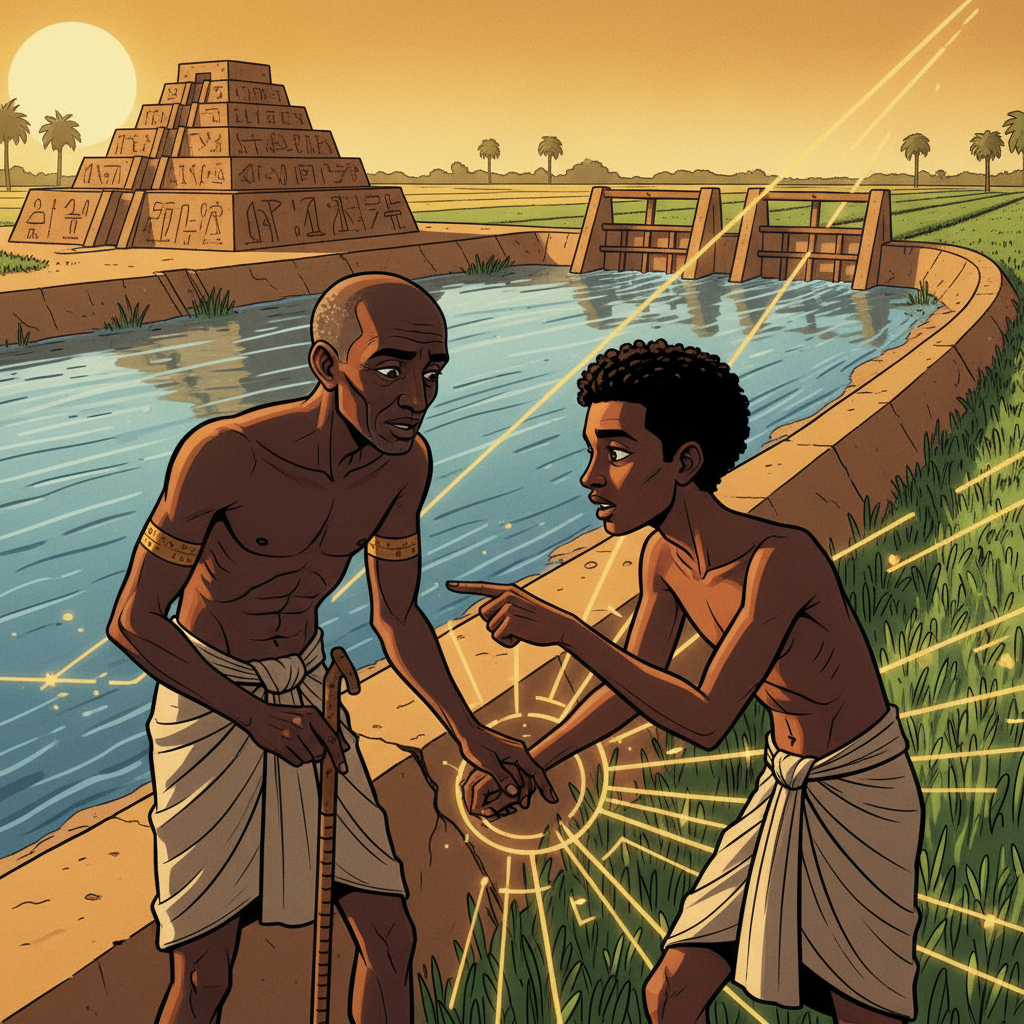
Khepri led Sekhemib along the banks, pointing out where the `levees` needed reinforcement, where small cracks could become dangerous breaches. He explained how the `nilometer` helped them predict the `Inundation`'s height, allowing them to prepare the fields and adjust the flow through the `sluice gates`. Sekhemib found himself surprisingly engrossed, not in the rules, but in the sheer ingenuity of it all. The work was precise, vital, and surprisingly beautiful in its design. He saw how every action was connected, a living web of `Maat`.
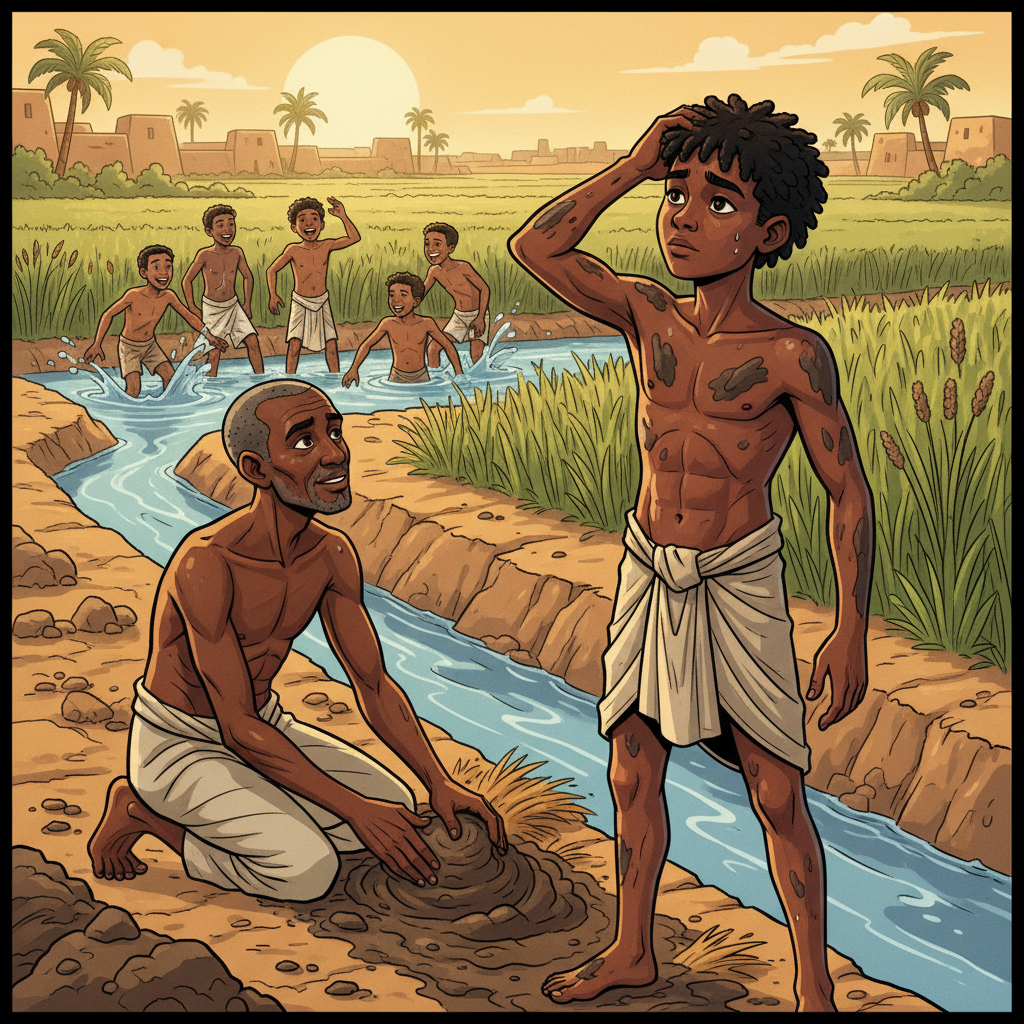
They spent the afternoon repairing a small section of a village `canal` bank, patching it with clay and straw. Khepri worked slowly, deliberately, teaching Sekhemib how to feel the soil, how to blend it to make it strong. Sekhemib’s muscles ached, but he felt a different kind of satisfaction than from simply running wild. He looked up, wiping sweat from his brow, and saw a group of boys his age splashing in a distant, shallow pool. A pang of longing shot through him, that old familiar pull for unburdened play. Khepri noticed his gaze.
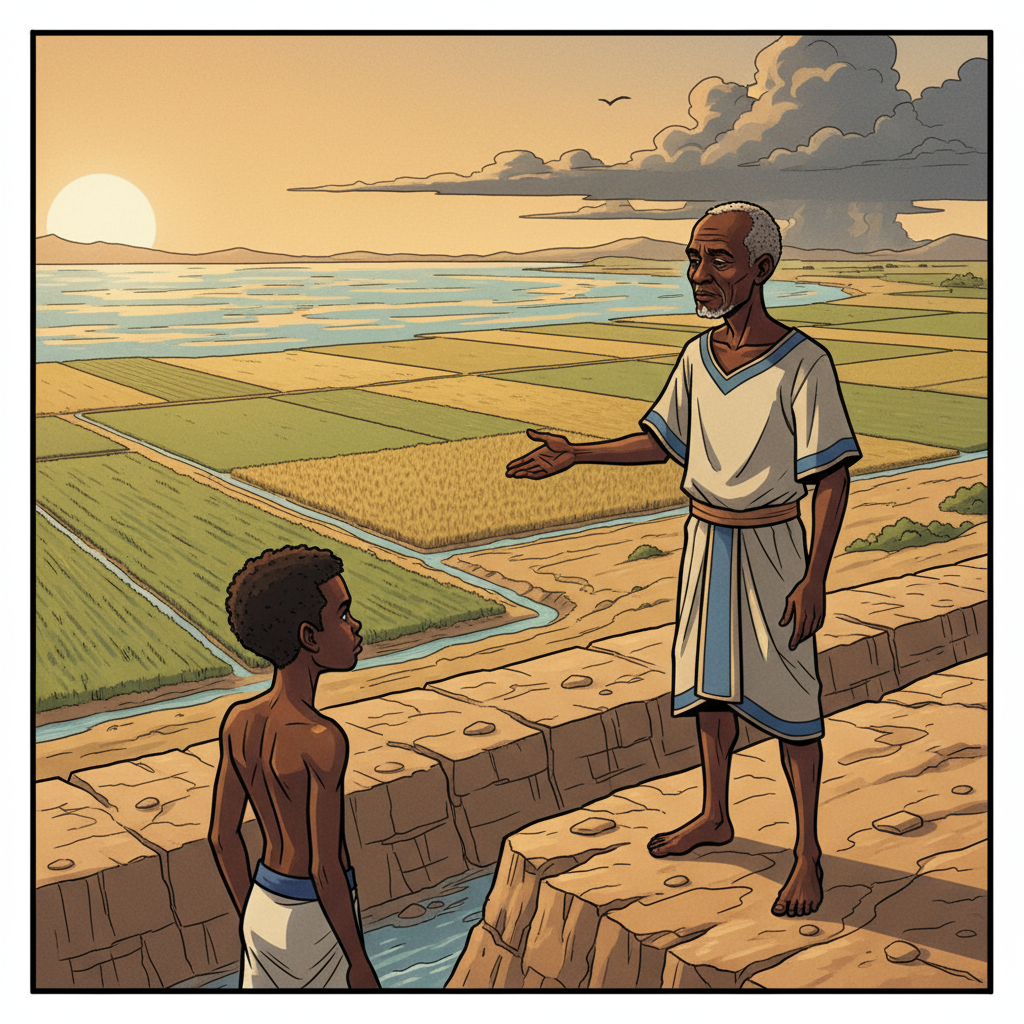
“Many see the `levees` as burdens,” Khepri said, his voice soft. “They long for the wild, uncontrolled flow of the `Hapy` without its banks. But tell me, Sekhemib, when the water bursts its banks and floods the land, does it truly bring life? Or does it bring chaos?” Sekhemib thought of his father's words about `isfet`. He looked at the strengthened bank, then at the distant fields. “It… it brings chaos,” he admitted, the answer feeling weighty and true. “It would ruin the crops.”
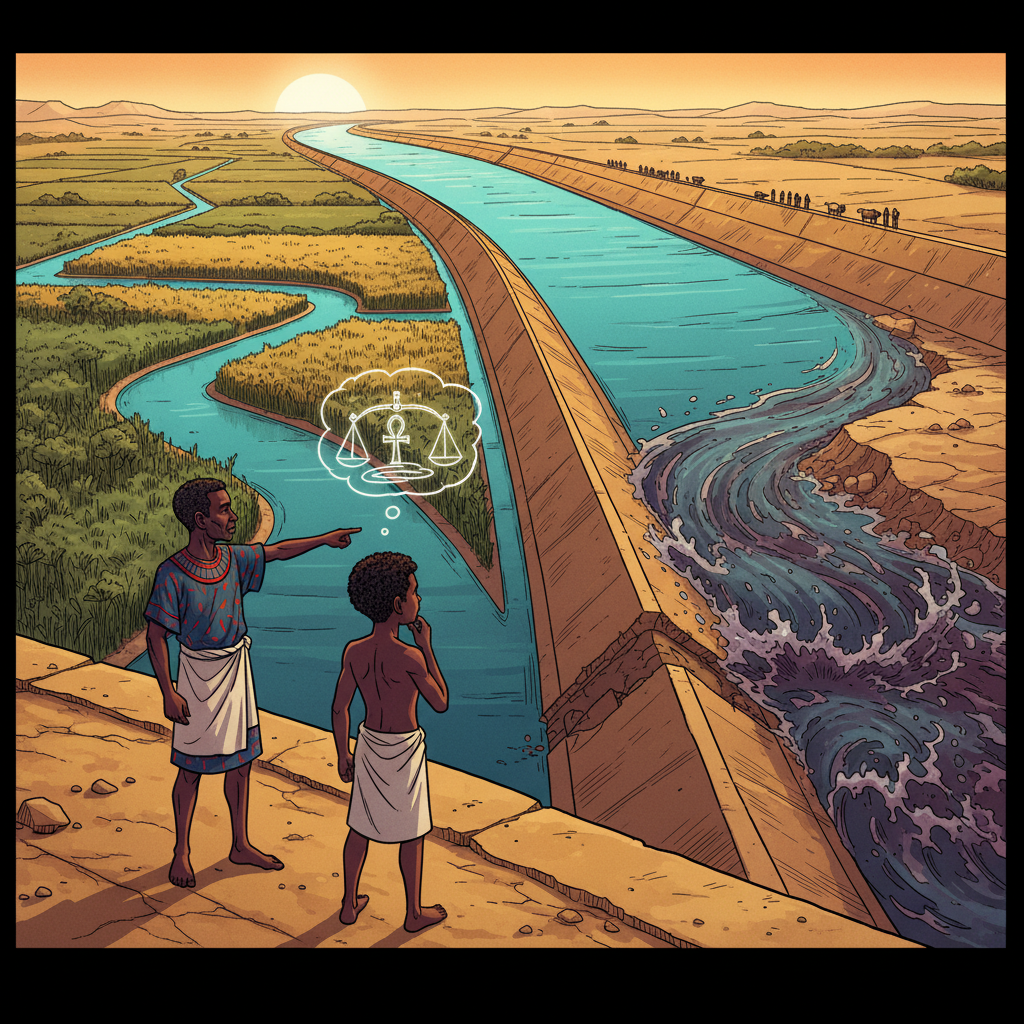
Khepri nodded. “Exactly. The river needs its banks not to imprison it, but to give it purpose. Without them, it would be destructive, losing its power to nourish. It would be `isfet`.” Sekhemib started to grasp something deeper. His parents’ rules, his `Abba`’s warnings – they weren’t meant to trap him. They were meant to guide his own powerful energy, just like the `levees` guided the Nile, so he could bring life and order, `Maat`, to his own journey. He still struggled with the idea, but a seed of understanding began to sprout.
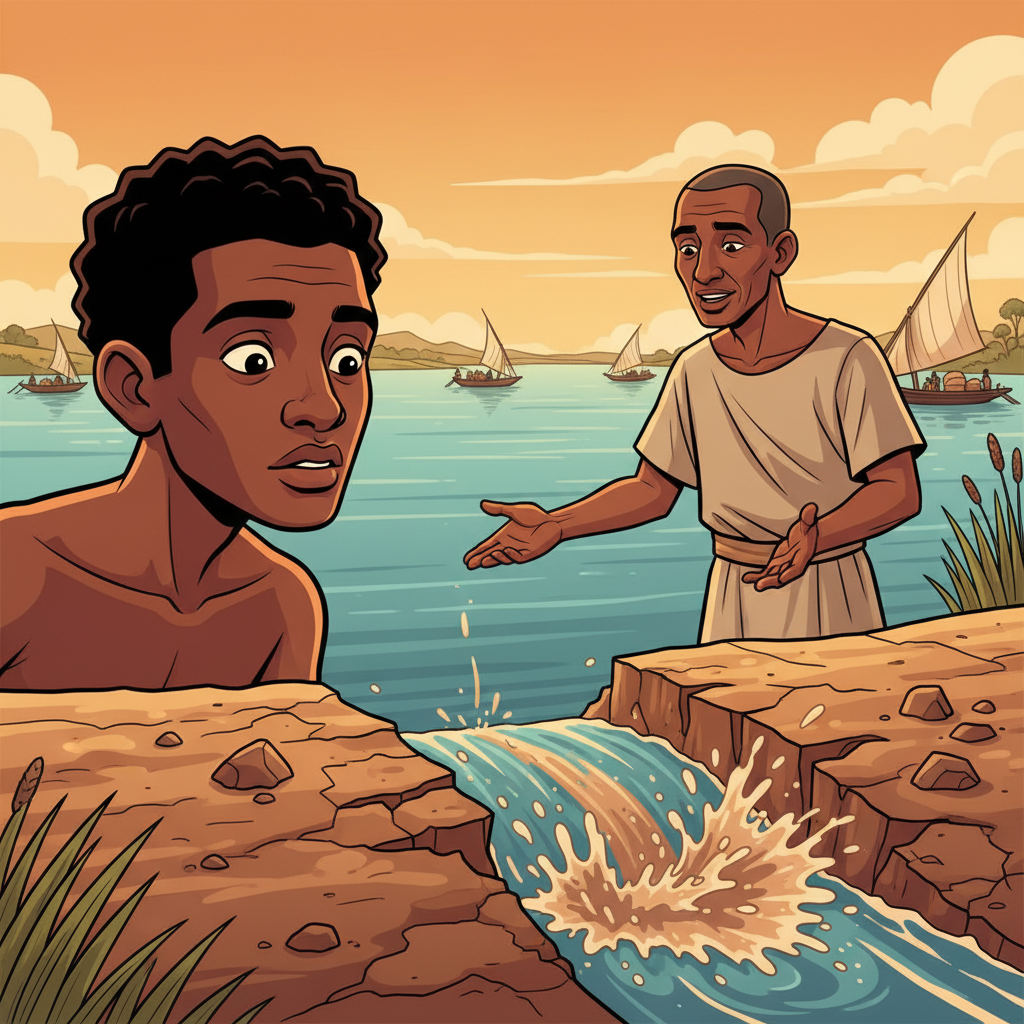
The next few days passed in a similar rhythm. Sekhemib helped Khepri check `sluice gates`, measure water levels, and repair small sections of `levees`. He learned about the careful balance required, the constant vigilance needed to maintain harmony with the `Hapy`. He saw how a tiny leak, if left unattended, could quickly become a raging torrent of `isfet`. His own quick temper and impulsive actions suddenly seemed less like freedom and more like those unchecked leaks, threatening to disrupt the `Maat` of his family.
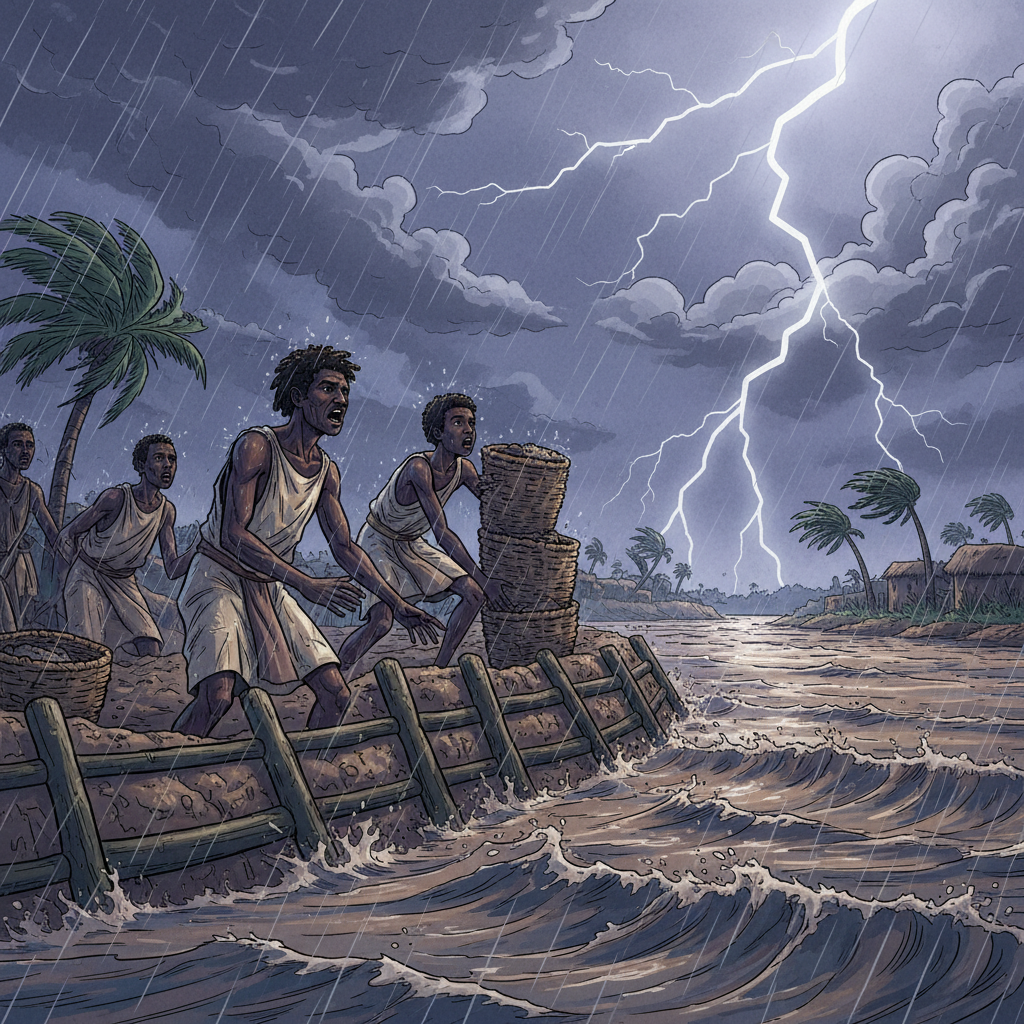
Then came the storm. A sudden, violent downpour lashed Kemet, turning the usually gentle `Inundation` into a furious beast. The sky turned a bruising purple-grey, and thunder cracked like the very heavens were splitting. Rain hammered the river, churning it into a muddy, swollen torrent. Khepri, Sekhemib, and the other villagers rushed to reinforce the `levees`, their hearts pounding with worry. This was the true test of their careful work, of their `Maat` against the storm’s `isfet`.
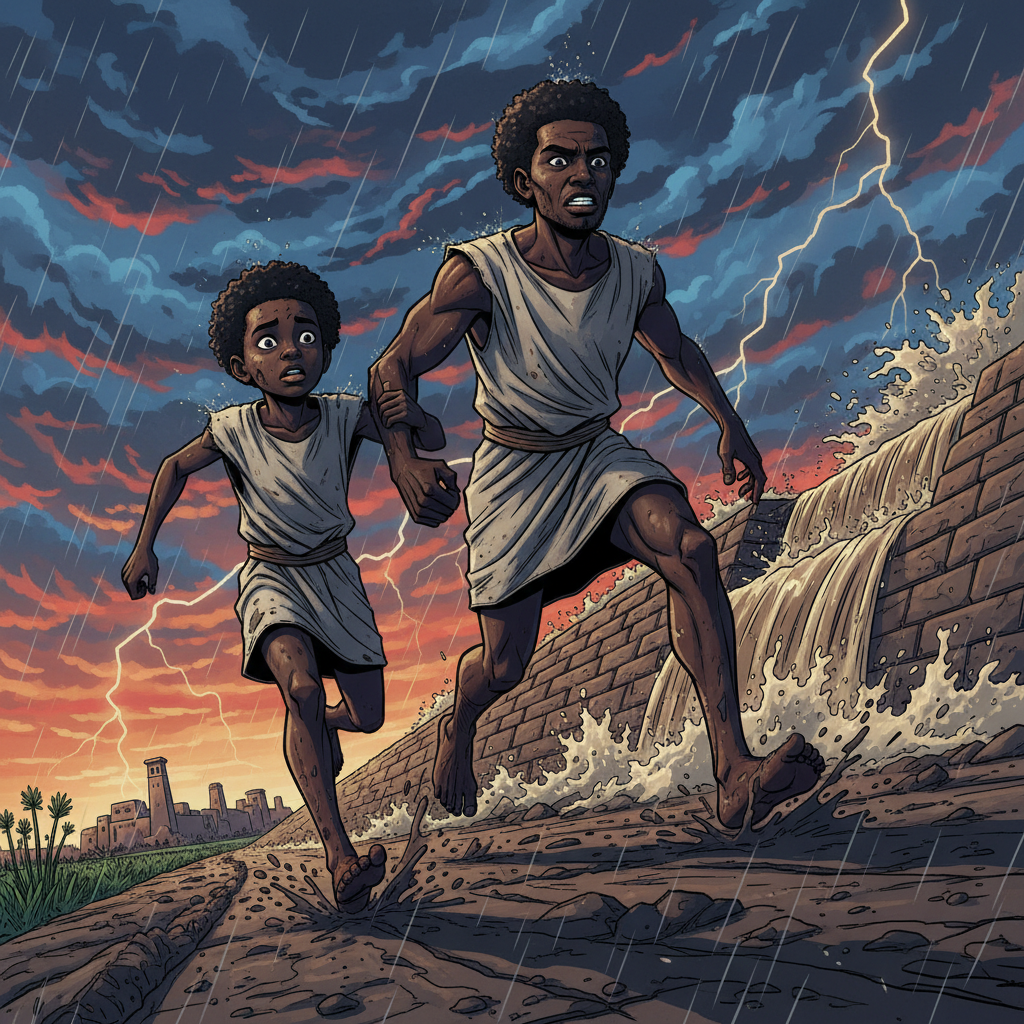
A cry went up from downstream. “A breach! The old `levee` by the `medjay` outpost!” Sekhemib’s stomach dropped. He knew that section; they had reinforced it, but it was ancient, softened by countless `Inundations`. Khepri grabbed his arm. “Come, Sekhemib! We must contain it!” They ran, the mud sucking at their feet, the roar of the river growing louder. The `isfet` was real now, not just a concept, but a powerful, destructive force threatening their home and their people.
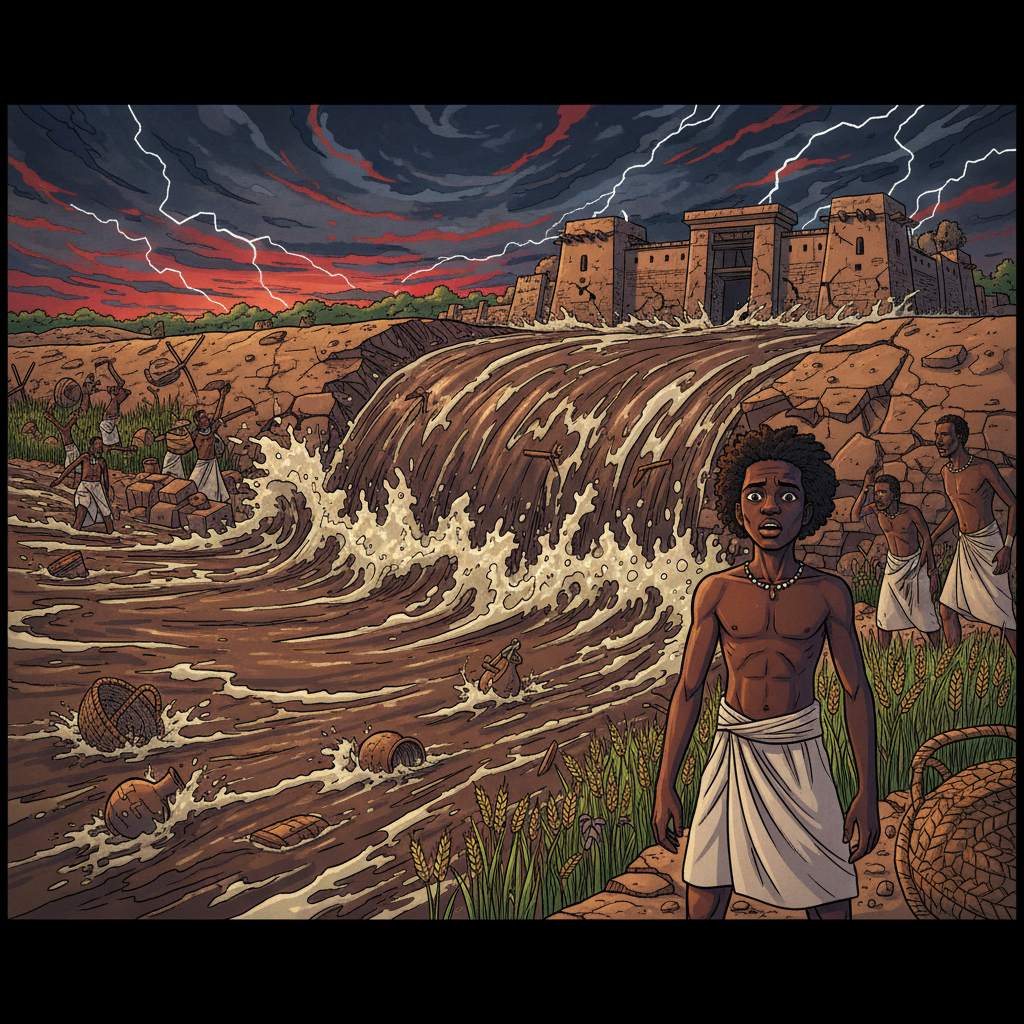
When they reached the breach, it was worse than Sekhemib imagined. A section of the `levee` had crumbled, and the `Hapy` raged through the gap, a thick, brown torrent, tearing at the earth. It wasn't flowing gently into the fields; it was ripping through them, submerging young crops, sweeping away tools. The water was no longer a giver of life; it was a hungry, uncontrolled force. The `medjay` outpost, usually a safe haven, was now perilously close to the swirling waters, its foundations being undermined.
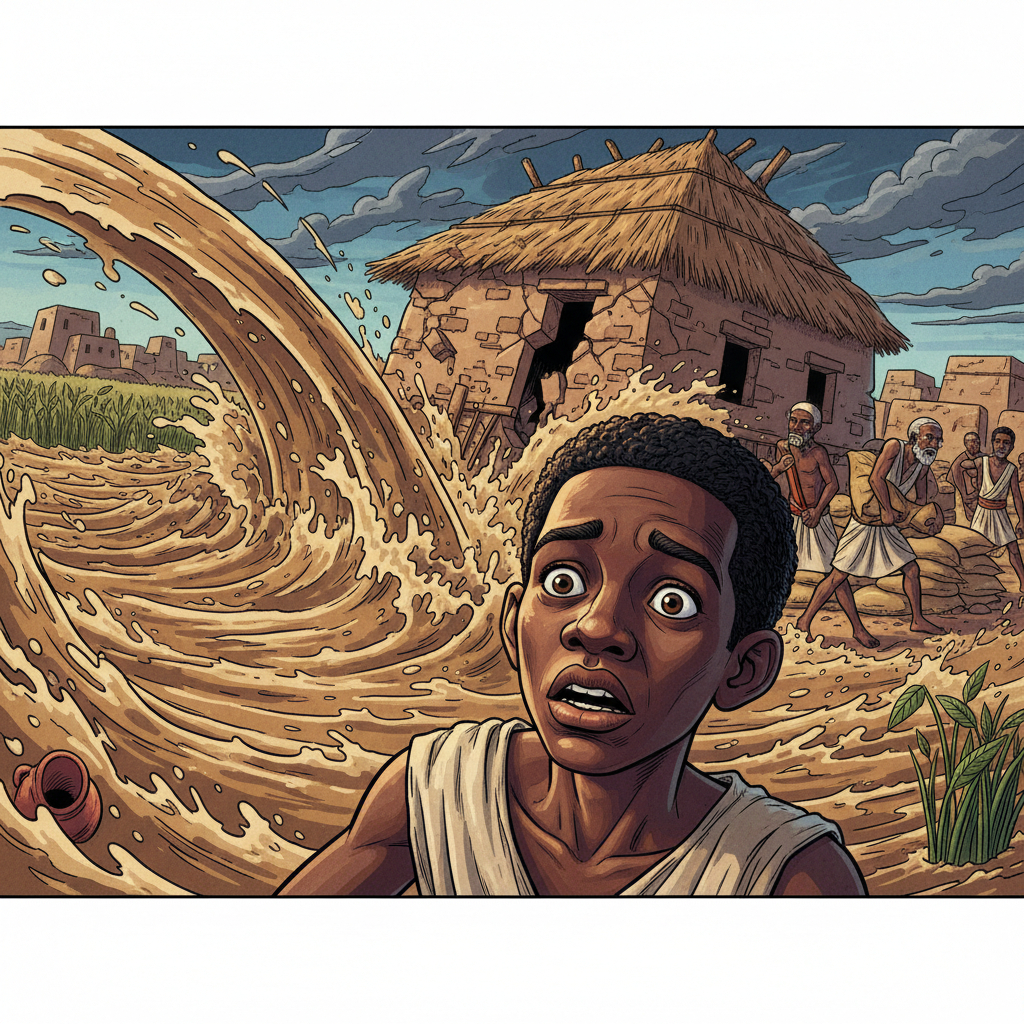
Villagers, including Imhotep, were already scrambling, piling sandbags, trying desperately to stem the flow, but the water was too powerful. It surged past the fields, heading directly towards the edge of the village, towards the homes. Sekhemib watched in horror as a small `shabti` hut, belonging to an elder `seba`, began to crumble under the relentless current. This wasn't the majestic `Hapy` he admired; this was a chaotic, destructive force. This was `isfet` unleashed.
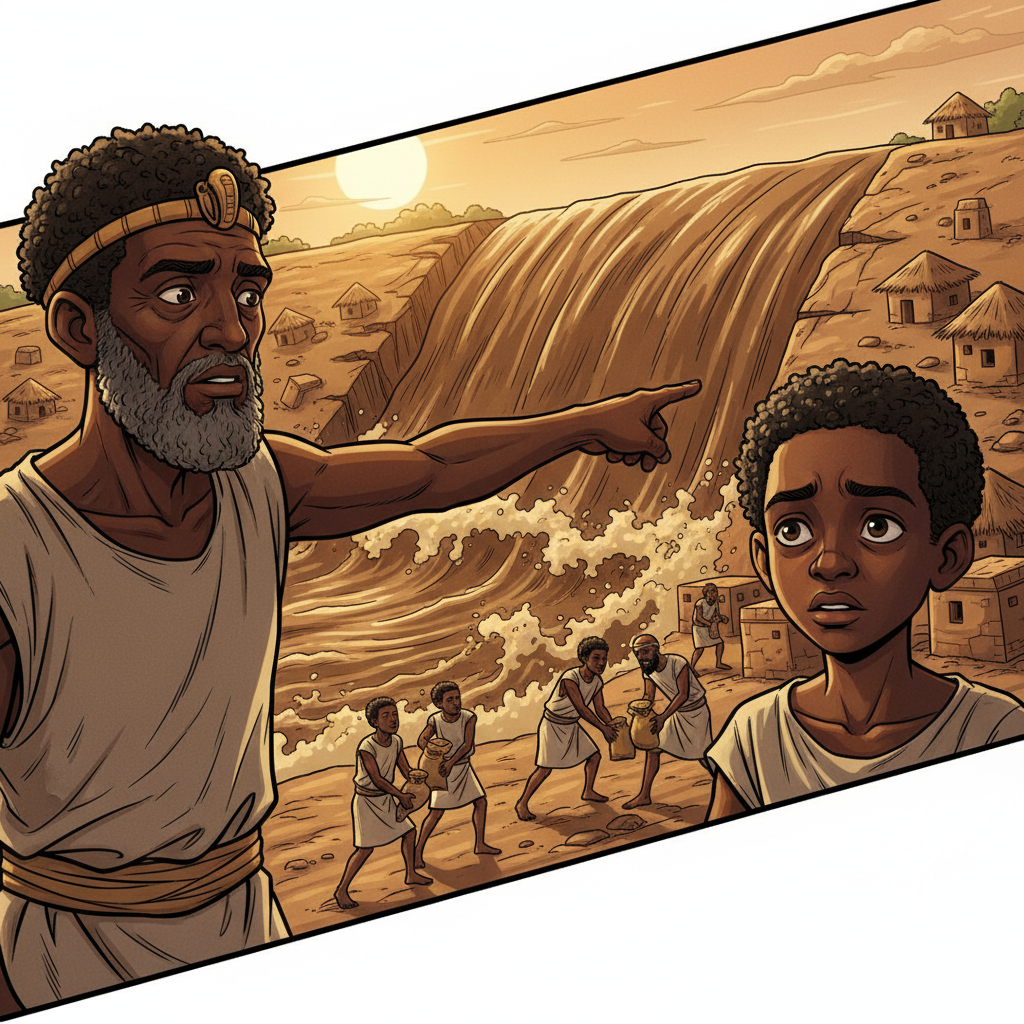
Khepri pulled Sekhemib aside, his voice cutting through the roar of the water. “Look, Sekhemib! See how it flows without its banks?” He pointed at the destructive torrent. “When the bank broke and the water flooded the village, was the water free? Or was it lost?” Sekhemib stared, the chaos of the scene burning into his mind. He saw the `isfet` consuming everything in its path. He thought of his parents' rules, of his own rebellious spirit. “It was… lost,” Sekhemib whispered, the truth hitting him with the force of the flood. “It went everywhere, but it fed nothing.”

Khepri gripped his shoulder. “Exactly. True freedom, Sekhemib, is not the absence of boundaries. It is finding purpose within them, allowing your power to nourish life, not destroy it.” Sekhemib nodded, tears mixing with the rain on his face. He finally understood. The `levees` didn't imprison the `Hapy`; they directed its immense power, making it a blessing instead of a curse. His parents' rules weren't chains; they were guides, meant to channel his own energy towards `Maat` and growth.
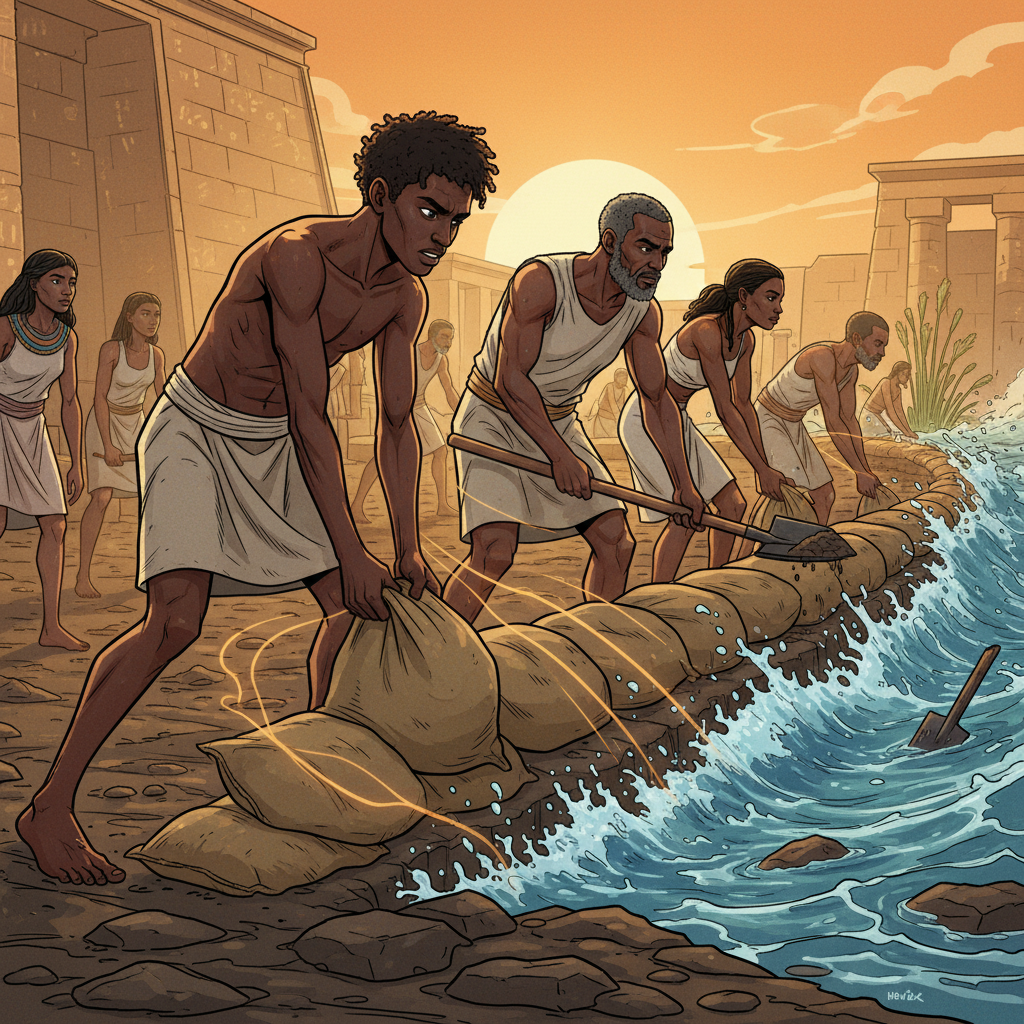
With a newfound purpose, Sekhemib threw himself into the work. He hauled sandbags, his wiry frame straining, but his mind clear. He understood the stakes now. He saw his `Abba` and other villagers, working together in a desperate, unified effort, their `Maat` shining through the `isfet` of the flood. They were the architects of order, bringing harmony back to a world momentarily consumed by chaos. Every bag of sand, every shovelful of mud, was a prayer for balance.
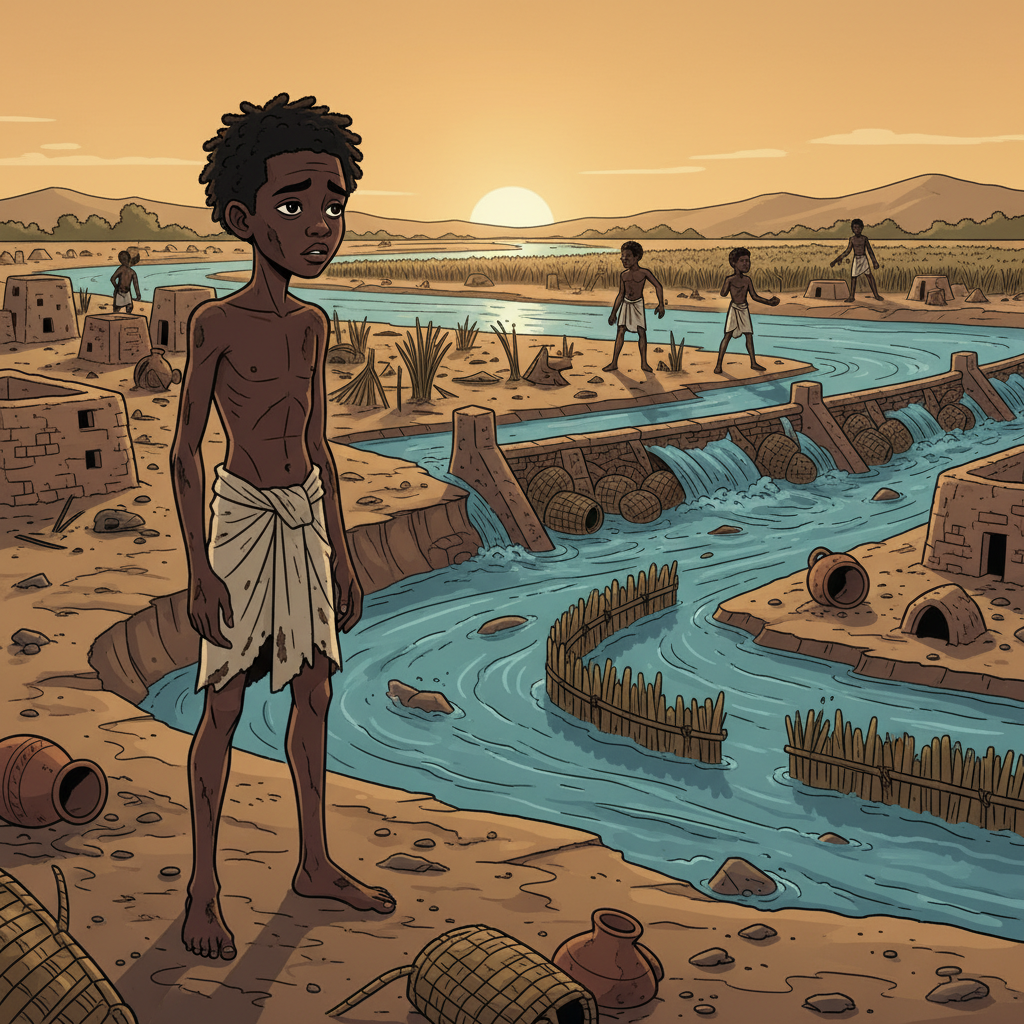
Hours later, exhausted but resolute, they managed to stem the worst of the breach. The water still flowed, but it was being redirected, slowed, brought back under control. The `Maat` was slowly reasserting itself. Sekhemib looked at the damaged fields, the mud-caked homes, and felt a pang of sorrow, but also a deep sense of understanding. He saw the consequences of `isfet` firsthand. He saw the vital role of boundaries, of guidance, in preventing utter destruction.
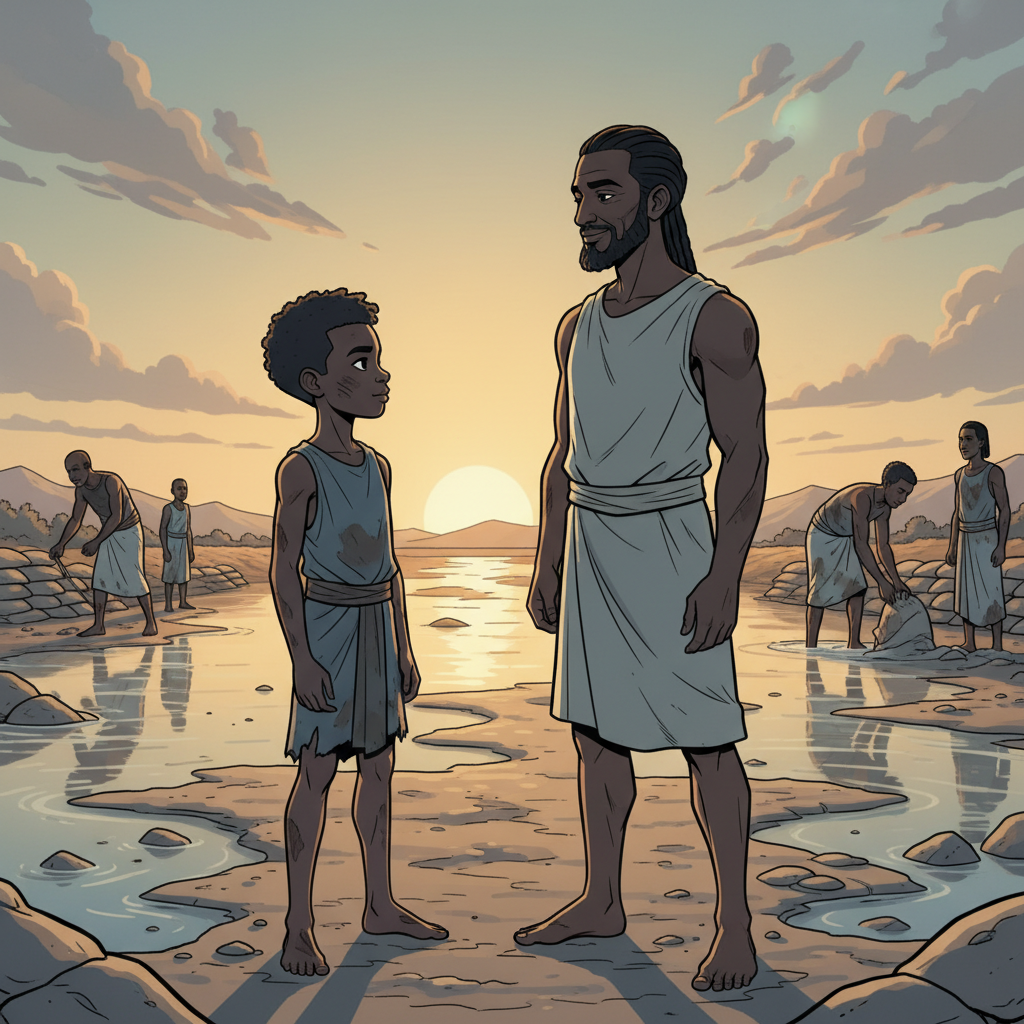
When the immediate danger passed and the skies began to clear, Sekhemib walked over to his `Abba`. “`Abba`,” he said, his voice hoarse but clear, “I understand now. About the banks. About purpose.” Imhotep looked at his son, his eyes filled with a quiet pride. He didn’t need Sekhemib to explain; the transformation was clear in his son’s steady gaze, in the new depth in his usually restless spirit. He saw a maturity, a `Maat`, settling over Sekhemib, like the rich silt left by the receding `Hapy`.
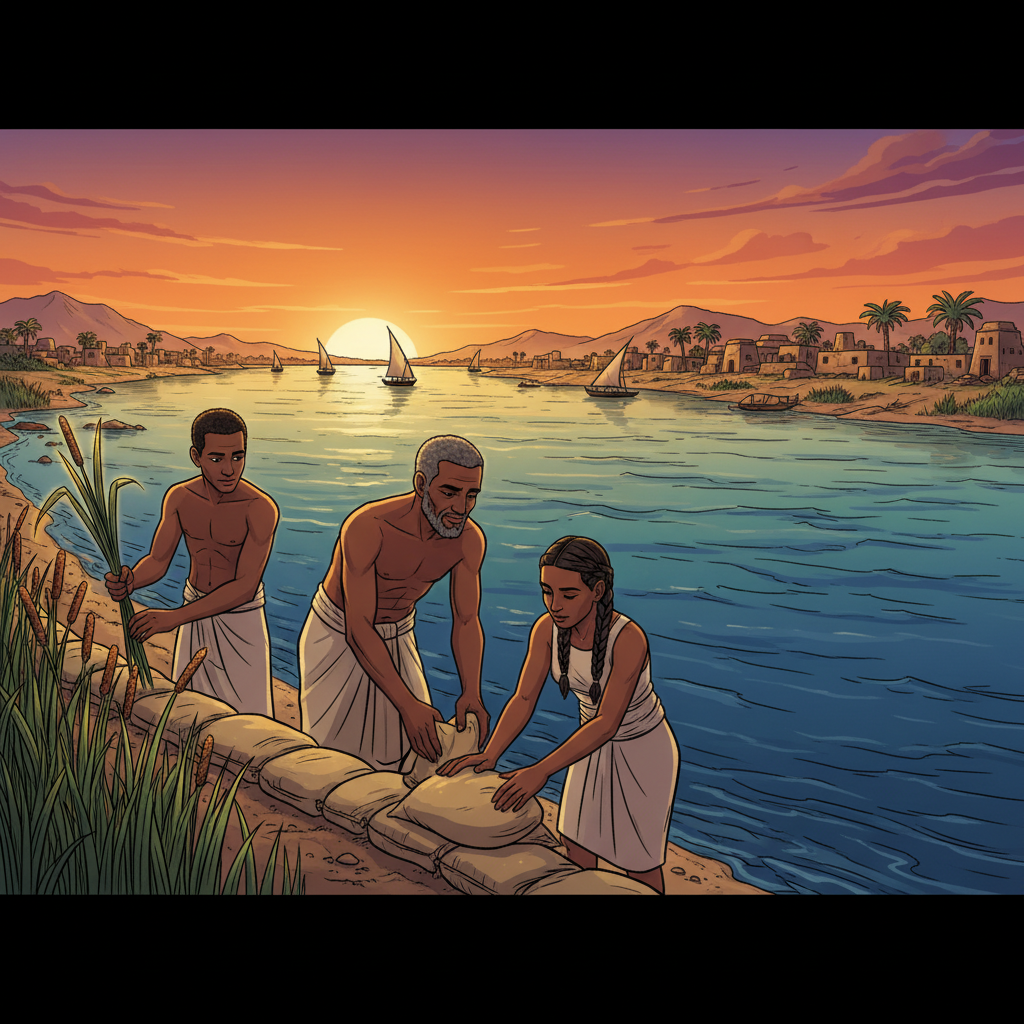
Sekhemib spent the next few days working tirelessly alongside his father and Khepri, repairing, cleaning, replanting. He no longer felt resentment towards the tasks. Instead, he felt a part of something larger, a vital cog in the machinery of life that was Kemet. He understood that his strength, his energy, was not meant to be wild and uncontrolled, but directed with purpose, contributing to the harmony, the `Maat`, of his community and his family. The river still beckoned, but now he saw its banks differently.
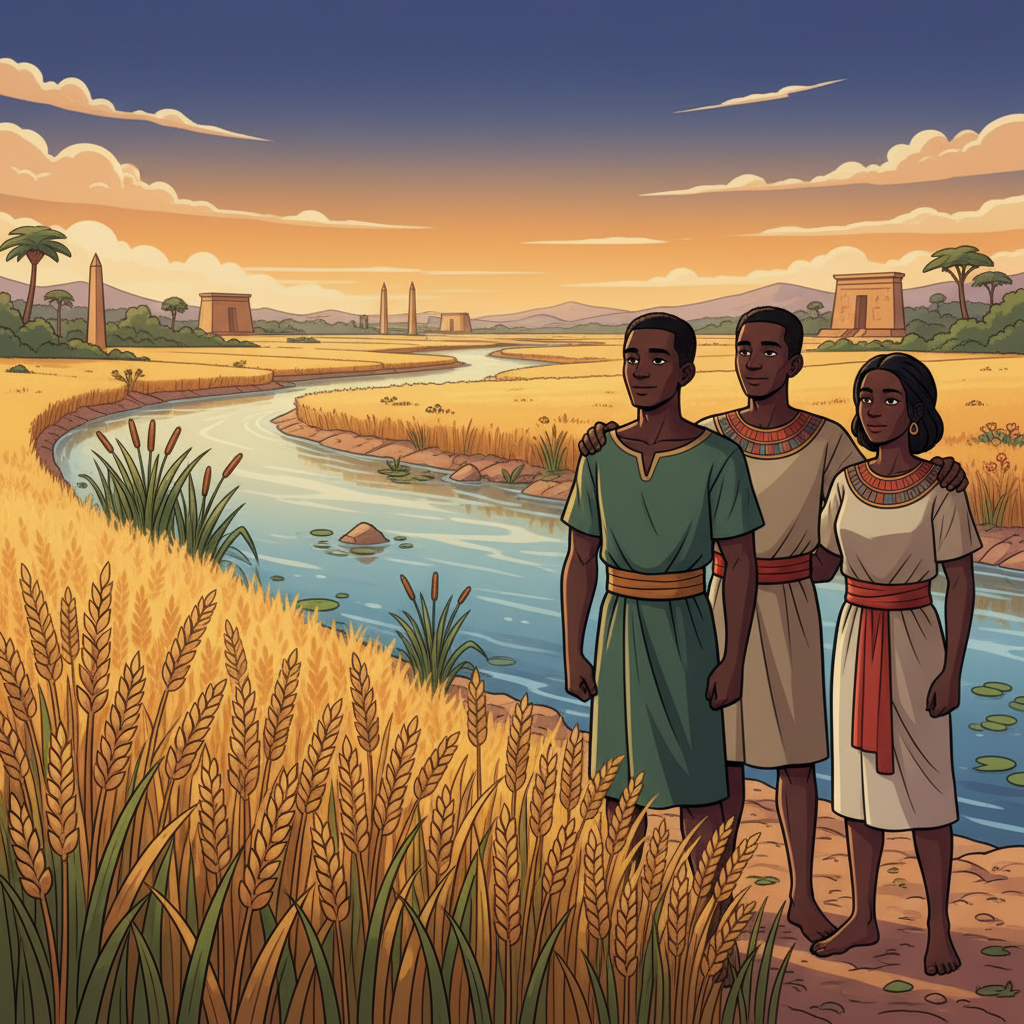
He learned that true freedom wasn't about the absence of rules, but about understanding their wisdom. It was about choosing to flow within the nourishing channels, bringing life wherever he went. Sekhemib, the boy who fought his banks, had become like the great `Hapy` itself: powerful, life-giving, and guided by the ancient wisdom of Kemet. He understood that his parents’ love, like the river’s banks, was not meant to hold him back, but to help him truly flourish. Harmony had found its way into his heart.