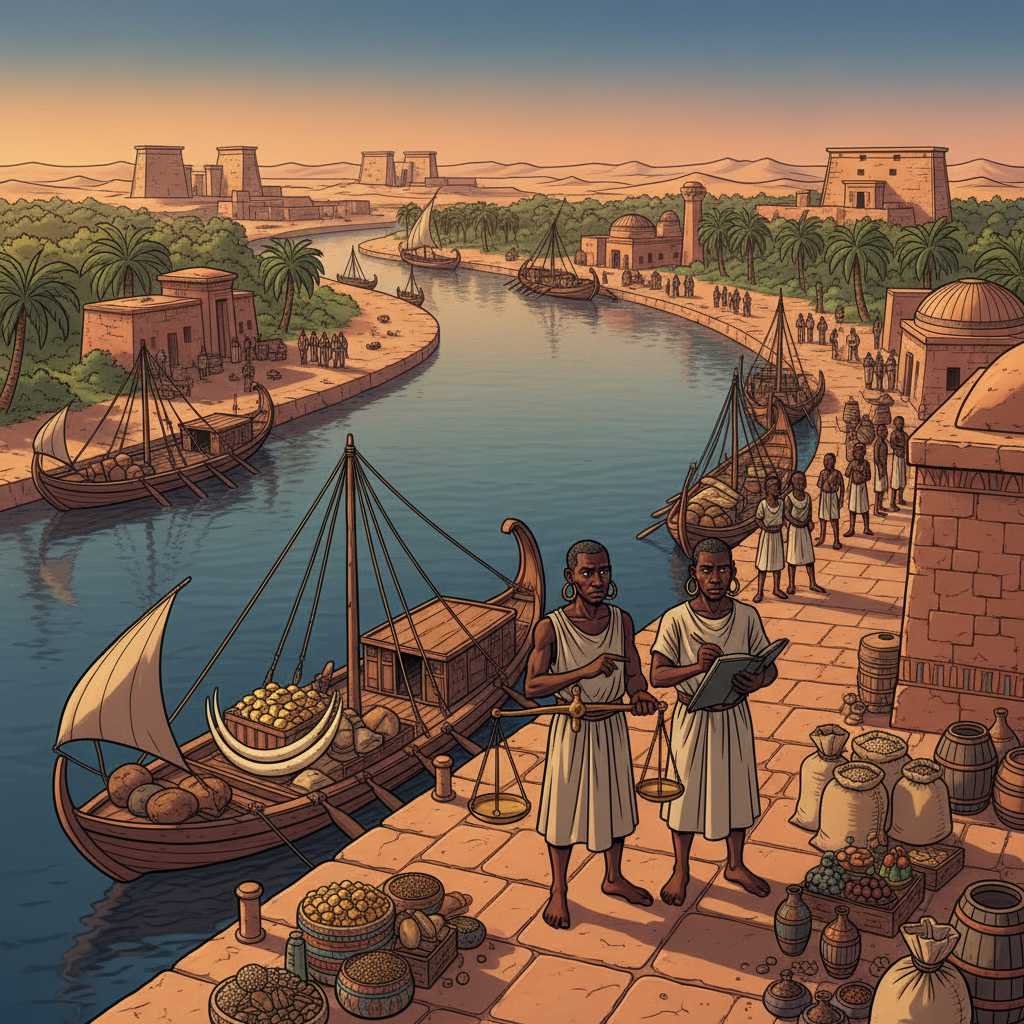
The river port of Napata sat where the Nile bent sharply westward before continuing its long journey north. It was a busy crossing — boats loaded with gold, ivory, incense, and grain passed through every day, and the port's tax collectors stood at the docks with their scales and their ledgers, weighing and recording every cargo that entered or left. The taxes funded the army that protected the border, the temples that held the city's sacred knowledge, and the granaries that fed the people during drought.

Medjay Sekhmet had been assigned to the port three months ago — a transfer from the southern border garrison where she had spent five years chasing raiders across sand and scrub. She was thirty-two, tall and muscular, with very dark skin scarred along her left forearm from a blade that had come too close during an ambush. Her hair was cropped short in the military style, and she moved with the coiled alertness of someone who had learned that threats come from every direction.
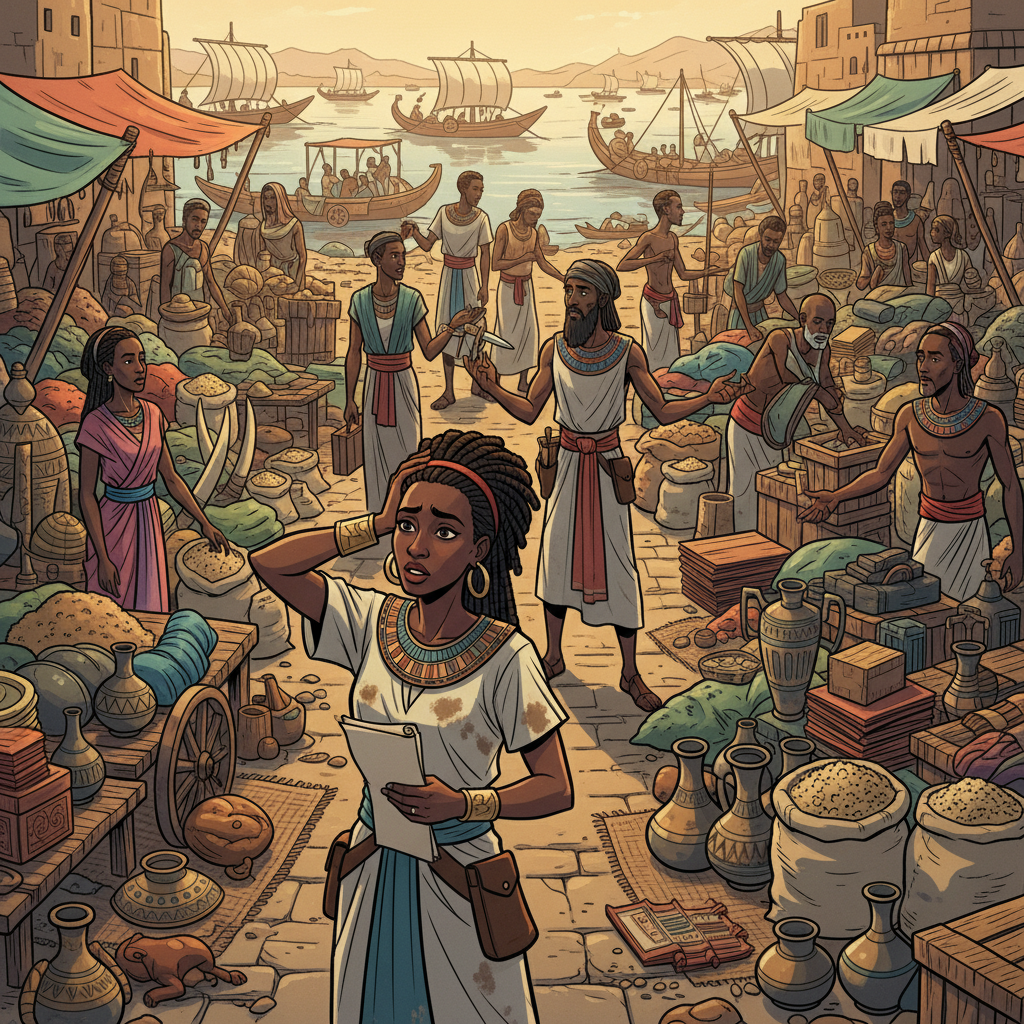
Sekhmet missed the simplicity of border patrol. On the border, justice was clean — raiders crossed the line, you stopped them. At the port, justice was tangled in paperwork, commerce, and the constant low hum of people finding creative ways to bend the rules. Smuggling was the port's open secret. Everyone knew it happened. The tax collectors turned blind eyes to small violations because the alternative — inspecting every vessel — would slow trade to a crawl and hurt the city's economy.

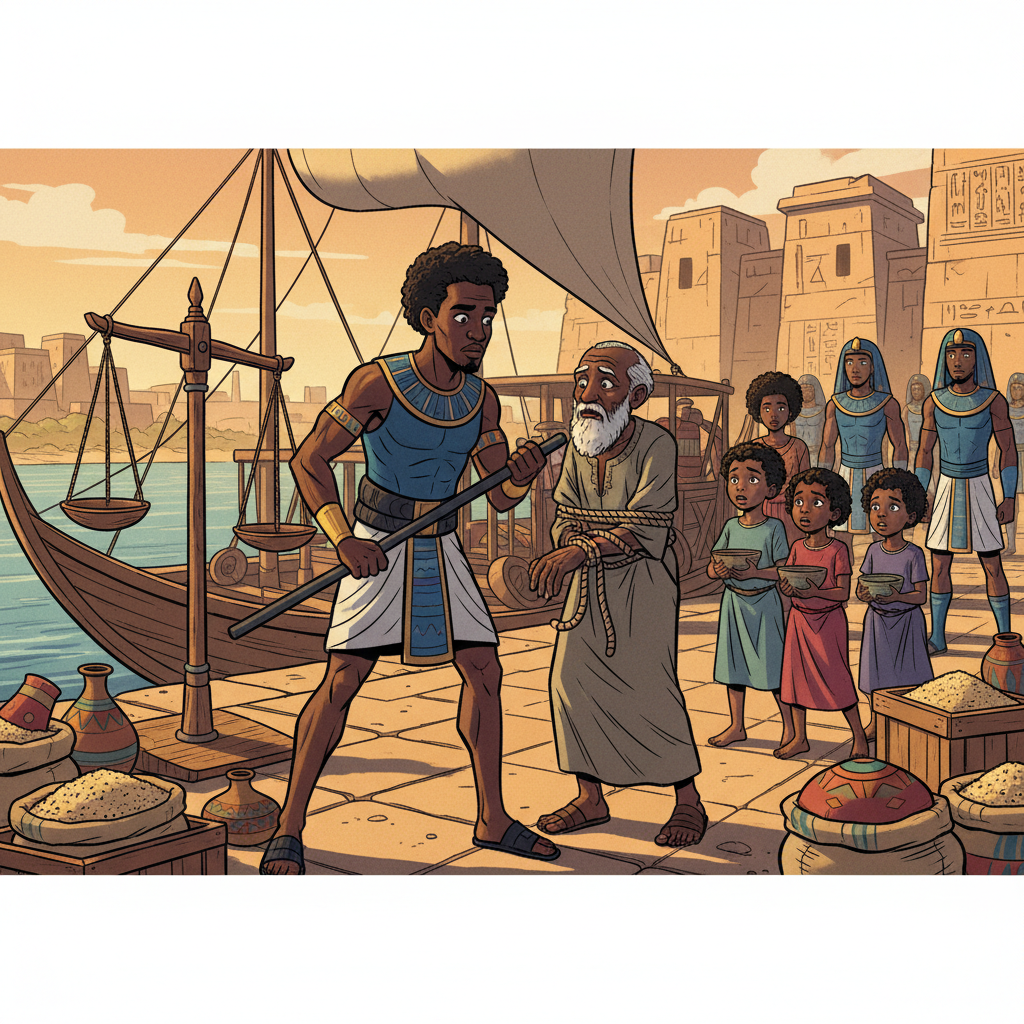
It was the children who drew Sekhmet's attention to Weni. Every evening, just as the sun touched the river and turned the water to copper, a line of children appeared at the back entrance of a warehouse on the southern dock. There were about forty of them — orphans, street children, the lost and the abandoned — ranging in age from four to thirteen. They were thin, ragged, and quiet in the way that hungry children become quiet: not peaceful, but conserving energy.

They lined up without pushing or fighting, and a large, cheerful man with deep brown-black skin and a booming laugh served them bowls of grain porridge, dried fish, and sometimes fresh fruit. This was Weni. He was forty-five, a river trader who had grown wealthy moving cargo between Napata and the northern cities. He owned three boats, employed twelve men, and was possibly the most popular person in the port district. Everyone loved Weni. He told jokes. He knew everyone's name. He sponsored festivals.

And every evening, without fail, he fed forty orphans from his own kitchen. Not thin gruel — real food, nutritious and filling, the kind of food that kept children alive through the cold season when street kids normally died. Sekhmet watched the feeding line for three evenings before she spoke to anyone about it. The children's faces when they ate — the desperate gratitude, the careful way they carried their bowls as though the food might disappear — made something ache behind her ribs.

The problem started with a number. Sekhmet was reviewing the port's tax ledgers as part of her regular duties when she noticed that Weni's declared cargo weights were consistently lower than the weights recorded by the dock workers who unloaded his boats. Not by much — a few measures here, a few there — but consistently. Over three months, the discrepancy added up to roughly two hundred measures of grain and sixty measures of dried goods that had passed through the port without being taxed.

She investigated quietly. She stationed herself at the docks during Weni's next delivery and watched his crew unload. The technique was clever: they used specially weighted baskets that looked standard but held more than the official measure. The extra goods were offloaded quickly into Weni's warehouse before the tax collectors weighed the remaining cargo. The tax was paid on the declared amount, and the surplus vanished into Weni's stores. It was professional smuggling — not crude or violent, but systematic and deliberate.

Sekhmet confronted Weni privately in his warehouse that evening, after the orphans had been fed and the kitchen was cleaned. He did not deny anything. He sat on a grain sack with his large hands folded in his lap and looked at her with the calm, steady gaze of a man who had been expecting this conversation for a long time. "Yes," he said. "I underreport my cargo. I have been doing it for four years." "You know the penalty," Sekhmet said. "Seizure of goods, heavy fines, possible imprisonment."

Weni nodded. "I know. But I want you to understand something before you decide what to do. Every copper weight I save on taxes goes into that kitchen." He gestured toward the back of the warehouse. "Forty children eat every night because of what I keep from the tax collectors. Not because I am greedy. Because no one else will feed them." He leaned forward. "The city does not care about orphans, Sekhmet. The temples say prayers for them. The officials write reports about them. But nobody feeds them. I do. With stolen money. And every one of those children is alive because of it."

"That does not make it right," Sekhmet said, though her voice was less certain than she wanted it to be. "Maybe not," Weni agreed. "But let me ask you this: the taxes I evade — they fund the army and the temples. Important things. But the army has thousands of soldiers and the temples have mountains of gold. They will survive without my two hundred measures. Those forty children will not survive without my kitchen. Is Maat served when the well-fed take from the only person feeding the hungry?"

Sekhmet walked the docks that night, alone, watching moonlight shatter on the river's surface. Weni's argument was seductive, and that was what made it dangerous. If she accepted his reasoning — that a good end justified illegal means — then every smuggler in Napata would find a good cause to hide behind. The merchant who evaded taxes to build his daughter's school. The boatman who underreported cargo to pay for his mother's medicine. The line between compassionate lawbreaking and simple theft would dissolve, and the system that protected everyone would collapse.

But the children were real. She had seen their faces. Four-year-old Hesi, who always ate with both hands and laughed when porridge stuck to his nose. Nefertari, twelve, who helped serve the younger ones and carried herself with a quiet dignity that no street child should have to learn. Merimaat, seven, who still cried every night for a mother who was not coming back. If Sekhmet arrested Weni, these children would lose the only reliable meal they had. Some of them would probably die during the cold season.

She went to her commanding officer, Captain Nakht, a grey-haired veteran who had served at the port for fifteen years. She laid out the evidence and the dilemma. Nakht listened without expression, then asked the question Sekhmet had been dreading: "What do you recommend?" "I do not know, sir. If I arrest him, the orphans starve. If I do not, the law means nothing." Nakht leaned back. "The law already means nothing to forty children sleeping in doorways. It meant nothing before Weni started feeding them. Maybe the question is not whether the law is broken, but whether the law is enough."

Sekhmet made her decision. She arrested Weni. She did it publicly, at the docks, in front of the tax collectors and the dock workers and the boat crews who all knew and loved him. The reaction was immediate and furious. "You are killing those children!" a dock worker shouted. "Weni feeds them when no one else will, and you arrest him for it?" Others joined the protest. Someone threw a sandal. Sekhmet stood with the crowd's anger washing over her like river current and said nothing, because there was nothing to say that would make this feel less terrible.

At the hearing, Sekhmet did something that no Medjay had ever done in the port's history: she presented the smuggling evidence AND formally petitioned the kenbet to address the orphan crisis. "Weni broke the law," she told the court. "The law must respond. But the law must also look at WHY he broke it. Forty children have no food source because this city has no system to feed them. Weni filled a hole that our institutions created. Punishing him without filling that hole is not justice — it is cruelty wearing a judge's robe."
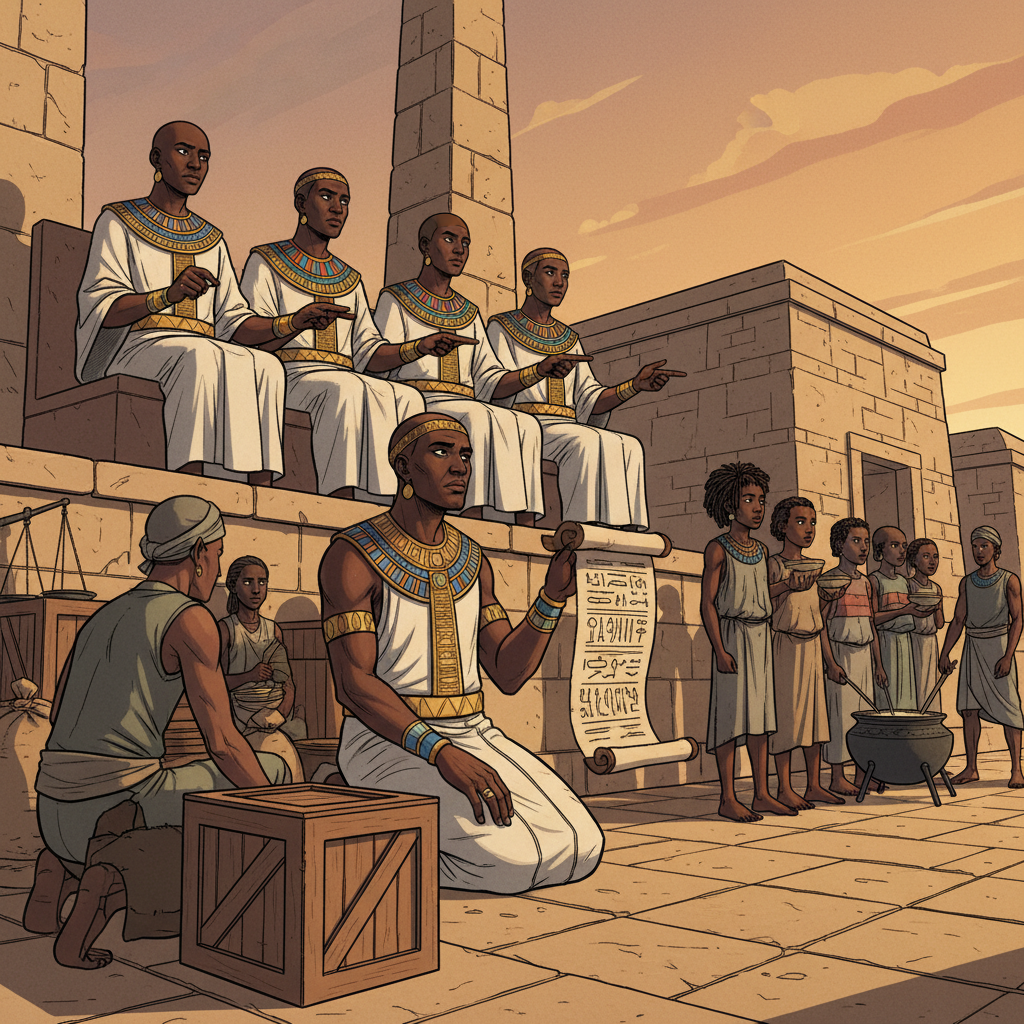
The kenbet sentenced Weni to a heavy fine and six months of supervised trade — every cargo inspected, every weight verified. His trading license was not revoked. The court also — for the first time — formally ordered the city to establish a public kitchen for orphaned children, funded by a small levy on port commerce. It was not Weni's kitchen. It was not as good. The grain was thinner, the portions smaller, the warmth of Weni's booming laugh replaced by the efficient indifference of city workers.
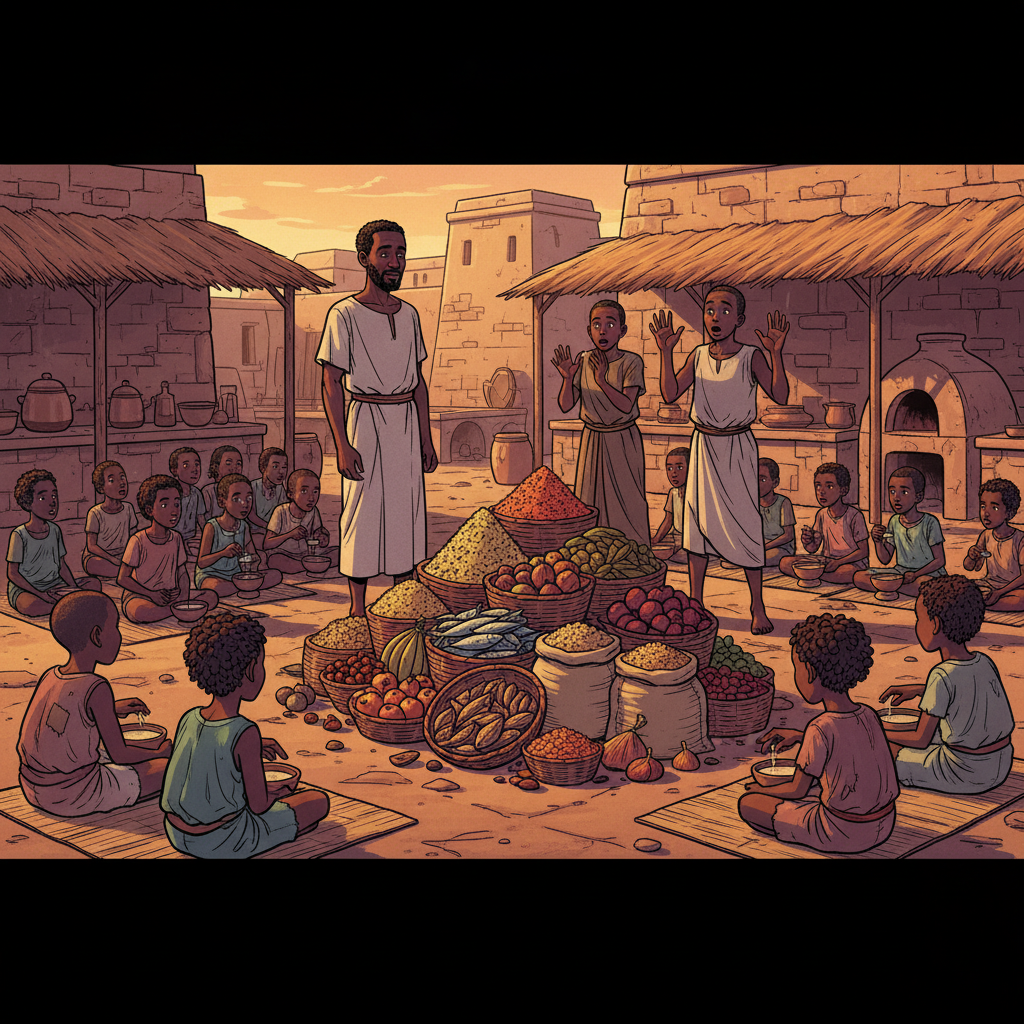
But it was something. It was the system acknowledging what Weni had known for years: that the children existed and that someone was responsible for feeding them. Weni paid his fine and served his supervised period without complaint. On the day his supervision ended, he walked to the new city kitchen, watched the orphans eat their thin porridge, and quietly donated six months' worth of supplementary food from his own stores. The city workers looked at the mountains of dried fish, fresh fruit, and good grain and did not know what to say.

Sekhmet visited the kitchen that evening. She found little Hesi eating porridge with both hands, as always, and Nefertari helping serve the younger children, and Merimaat sitting in a corner, quieter than before but alive. Alive. Sekhmet crouched beside Merimaat and the girl looked up at her with eyes that held neither anger nor gratitude — just the flat, watchful gaze of a child who had learned that the world takes things away. "Is the food good?" Sekhmet asked. Merimaat nodded. "Are you hungry?" Merimaat shook her head. It was the smallest possible victory.
Years later, when Sekhmet trained young Medjay recruits, she always used the Weni case. "The easiest thing would have been to look away," she would say. "Weni was feeding orphans. Who arrests a man for feeding orphans? But the next easiest thing would have been to arrest him and walk away — justice done, law upheld, consequences somebody else's problem. Neither of those was Maat."
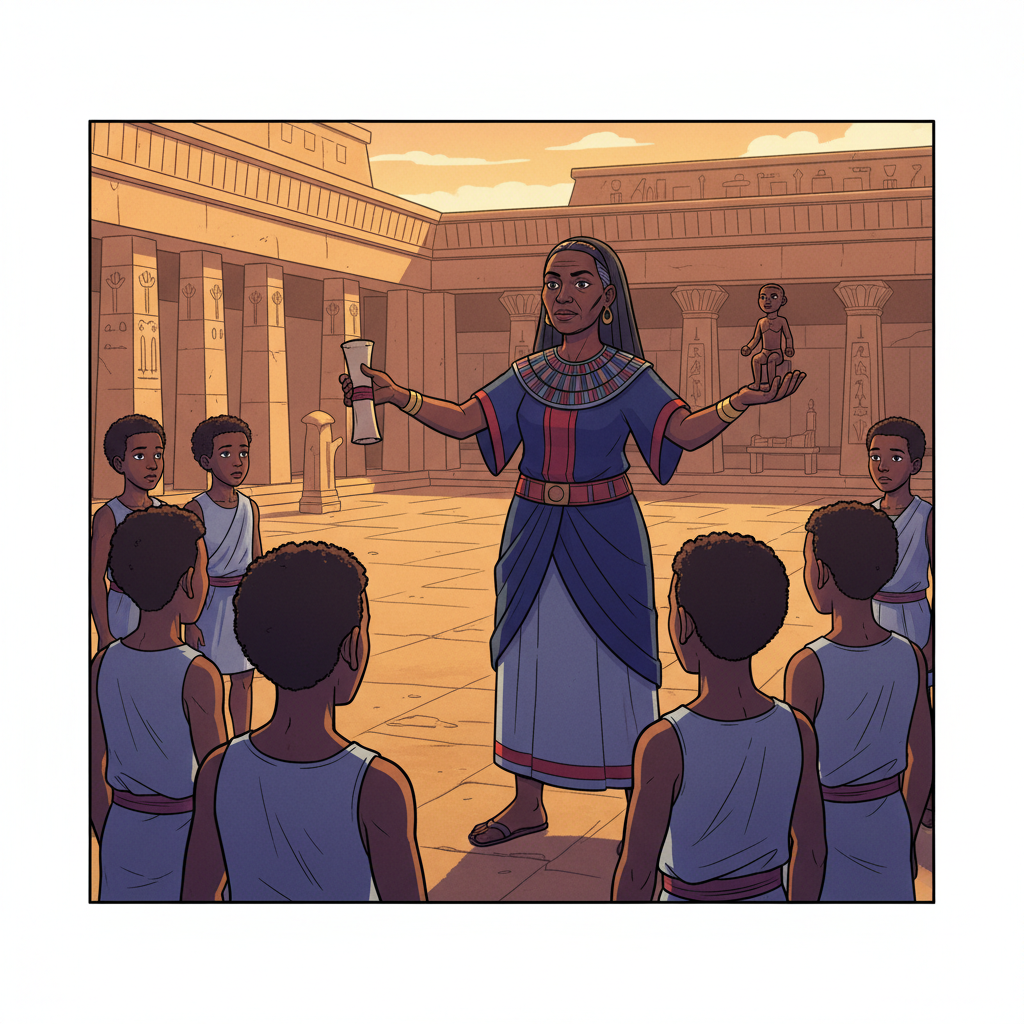
She would pause and look at their young, uncertain faces, and say: "Maat is not choosing between the law and compassion. Maat is refusing to choose. It is holding the law in one hand and compassion in the other and demanding — of yourself, of the system, of everyone — that both be served. Weni was wrong to smuggle. The city was wrong to ignore the orphans. I was wrong if I only fixed one and not the other. The hardest kind of justice is the kind that fixes the crime AND the conditions that created it. Everything else is just convenient."