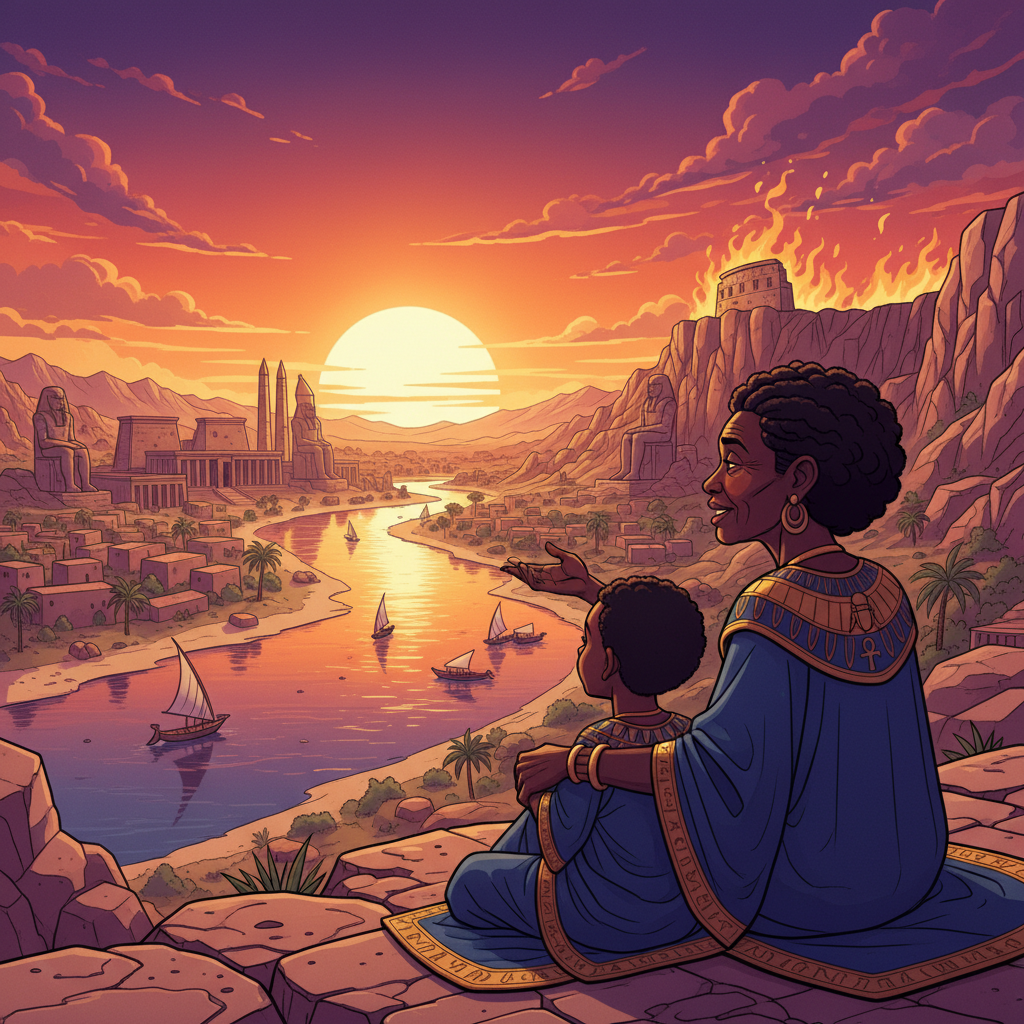
Ah, my dear one, come closer. The sun dips low over the western cliffs of Waset, painting the sky in hues of deep amethyst and fiery gold, much like the royal robes of our ancestors. Tonight, we shall journey not across the Nile, but through time, to a century when the heart of Kemet beat strong again, guided by hands from the south. We speak of the 25th Dynasty, a time when our Kushite cousins, rich with the spirit of Maat, returned to reclaim their birthright. This was no foreign invasion, understand? It was the elder sibling, the proud land of Kush, extending its powerful arm to embrace its younger, fragmented brother, Kemet. Think of it as the great river Nile itself, its source ever pure and strong in the lands of Nubia, surging northward to cleanse and nourish the delta, bringing life and order where chaos, or Isfet, had begun to creep. You, too, carry this ancient current within your veins, a legacy of truth and enduring strength.
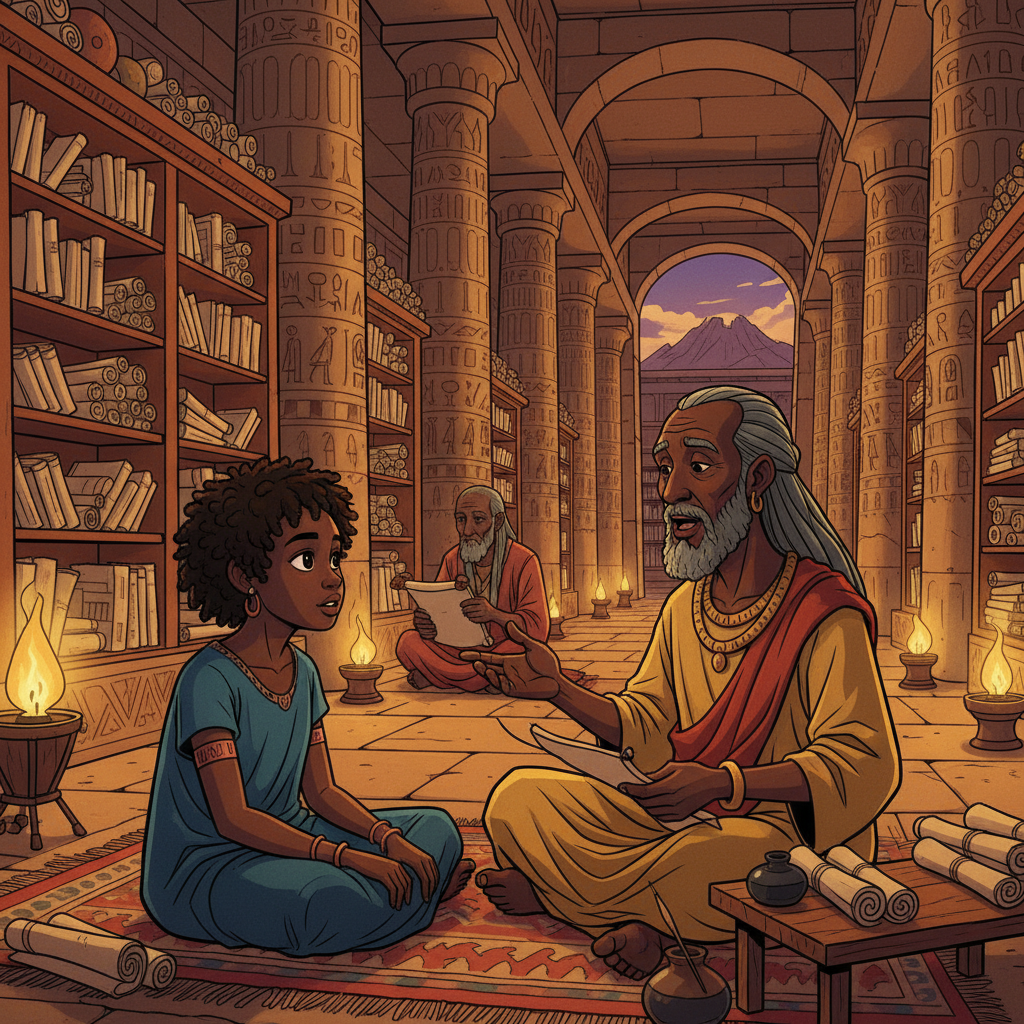
Now, imagine with me, generations after the great Pharaoh Taharqa’s rule in the north. Our story begins not in the grand temples of Karnak, but far to the south, in the vibrant city of Napata, nestled beneath the sacred mountain of Gebel Barkal. Here, life hummed with the rhythm of tradition, the air thick with the scent of incense and the murmur of prayers to Amun. This was the true homeland, the wellspring from which Kemet’s wisdom had first flowed thousands of years before. In Napata, a young girl named Sapana, with eyes like polished obsidian and tightly coiled hair, listened intently to the elders. She was perhaps your age, {name}, curious and eager, her spirit as bright as the morning star. She was the granddaughter of a venerable scribe who had walked the very halls of Pharaoh Taharqa’s palace, preserving ancient texts on papyrus and carving hieroglyphs into stone, ensuring the continuity of our knowledge.
Sapana's grandfather, his skin like rich, dark earth, his voice a low rumble, would often recount tales of the glorious 25th Dynasty. He spoke of Pharaoh Piye, who, guided by the neter Amun from Gebel Barkal, marched northward not for conquest, but for restoration. Piye saw the disarray, the petty kings squabbling, the decay of Maat in Kemet, and felt a profound spiritual call to set things right. He told her how Piye, a truly devout leader, refused to attack cities that surrendered, showing mercy and upholding the highest principles of justice. He would ritually purify himself before major battles, demonstrating his unwavering commitment to divine order. This was the essence of a true pharaoh, not merely a ruler, but a living embodiment of Maat, a channel for the divine harmony to flow back into the land.
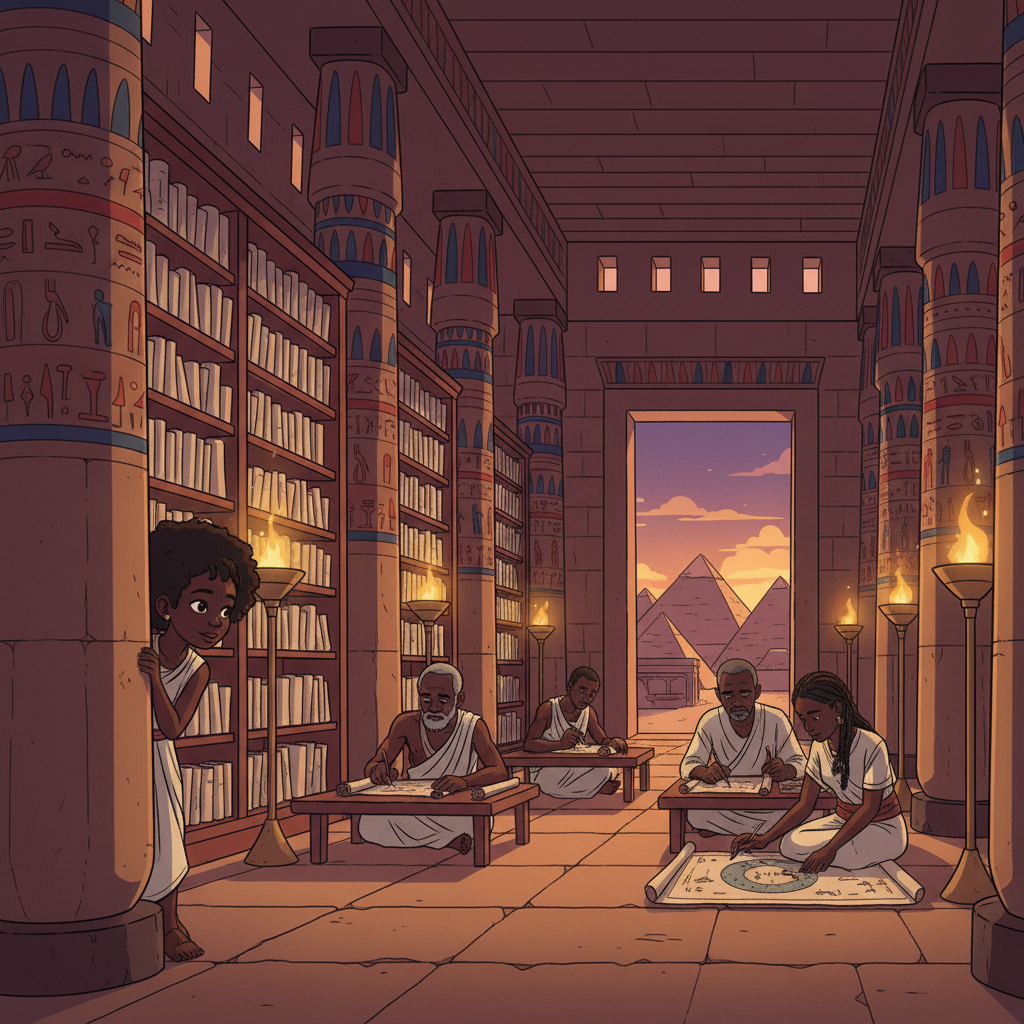
Napata itself, even after the direct rule of Kemet had shifted, remained a beacon of Kemetic civilization. The pyramids of El-Kurru and Nuri, where kings like Piye, Shabaka, and Taharqa lay, rose proudly against the sky, a testament to the enduring power of our ancestral traditions. These were not copies, but the continuation of an architectural and spiritual heritage that had originated in these very lands, in Ta-Seti, the Land of the Bow. The scribes continued their work in the Per Ankh, the House of Life, diligently copying ancient texts, studying the movements of the stars, and teaching the principles of Maat. Sapana would often peek into these sacred spaces, her young heart swelling with pride at the knowledge being preserved. Kush was not just a kingdom; it was the unwavering guardian of a sacred flame.
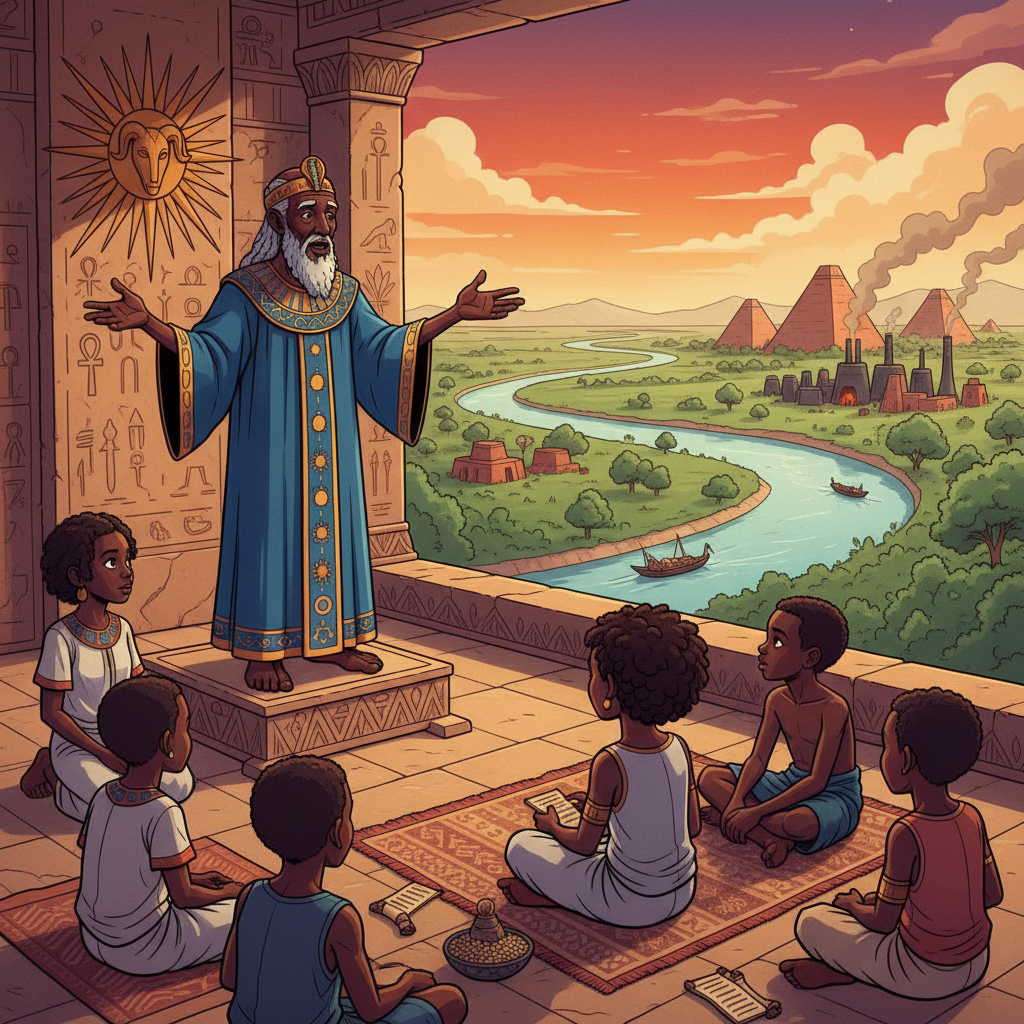
Yet, as Sapana grew, her gaze often drifted southward, down the winding path of the Nile, towards whispers of a new capital rising further upstream: Meroe. Her grandfather spoke of it as a place where the `ka` of Kush would find new expression, where the spirit of their ancestors would continue to build and thrive, adapting to the rich iron resources of the land. It was a promise of continuity, a vision of `weheh`, of eternity. Meroe was not a turning away from Kemet, but a deepening of the roots, a re-centering of power within the heart of Nubia. The river, which had carried the Kushite pharaohs north, now beckoned its people to explore new horizons within their own expansive territory, carrying the seeds of Maat to new fertile ground, ensuring the traditions would never perish.
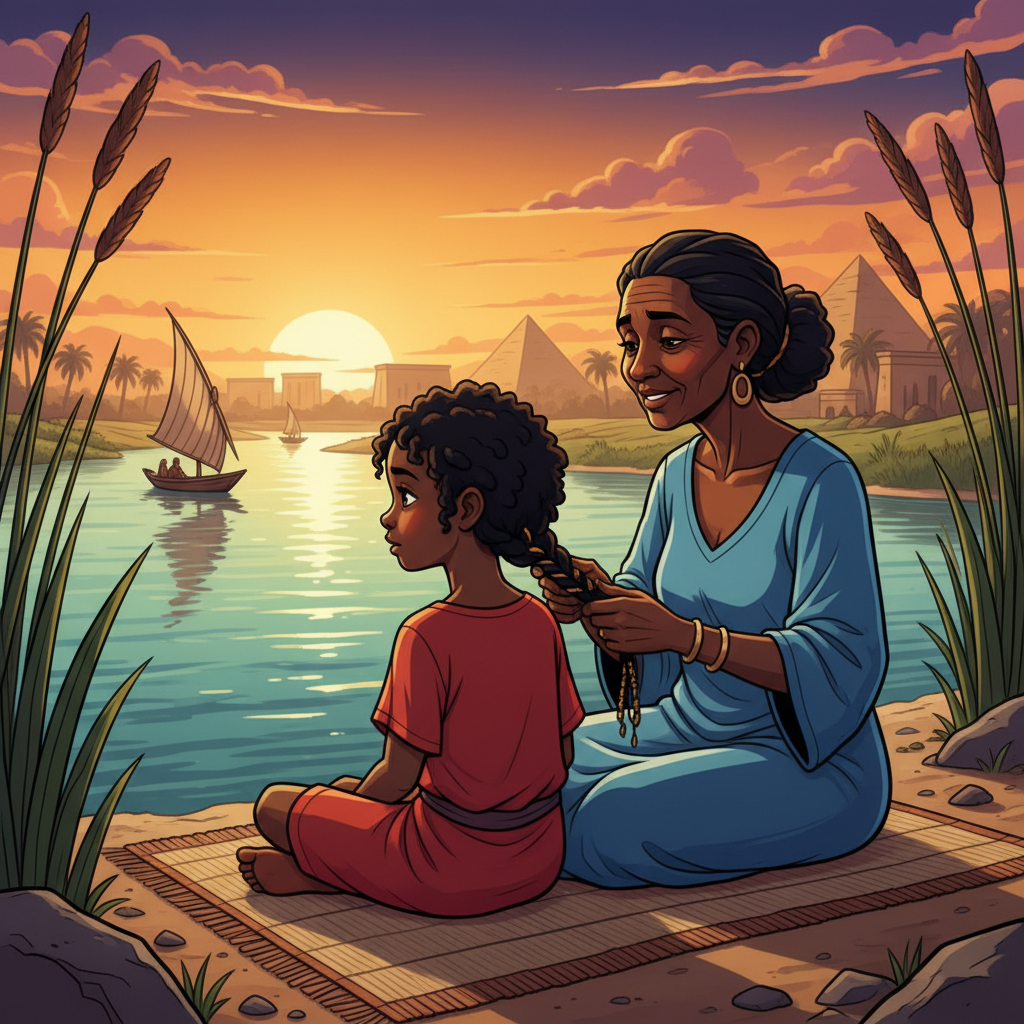
Sapana's grandmother, a woman whose wisdom was as deep and calm as the Nile at flood, would often sit with her, braiding her hair while telling stories not just of the past, but of the future. 'The strength of Maat,' she would say, 'is not found in how wide an empire stretches, but in how deeply its principles are rooted in the hearts of its people. The 25th Dynasty's direct rule in Kemet may have ended, but Kush did not fall, child. It simply drew its breath and continued to grow.' She explained that the Assyrian iron weapons, though mighty, could not extinguish the `ka` of a people dedicated to truth and justice. Just as a great tree sheds its leaves in one season to bloom more vibrantly in the next, so too did the spirit of Kush find new ways to flourish, protecting the ancient wisdom that might otherwise have been lost to the shifting sands of time.
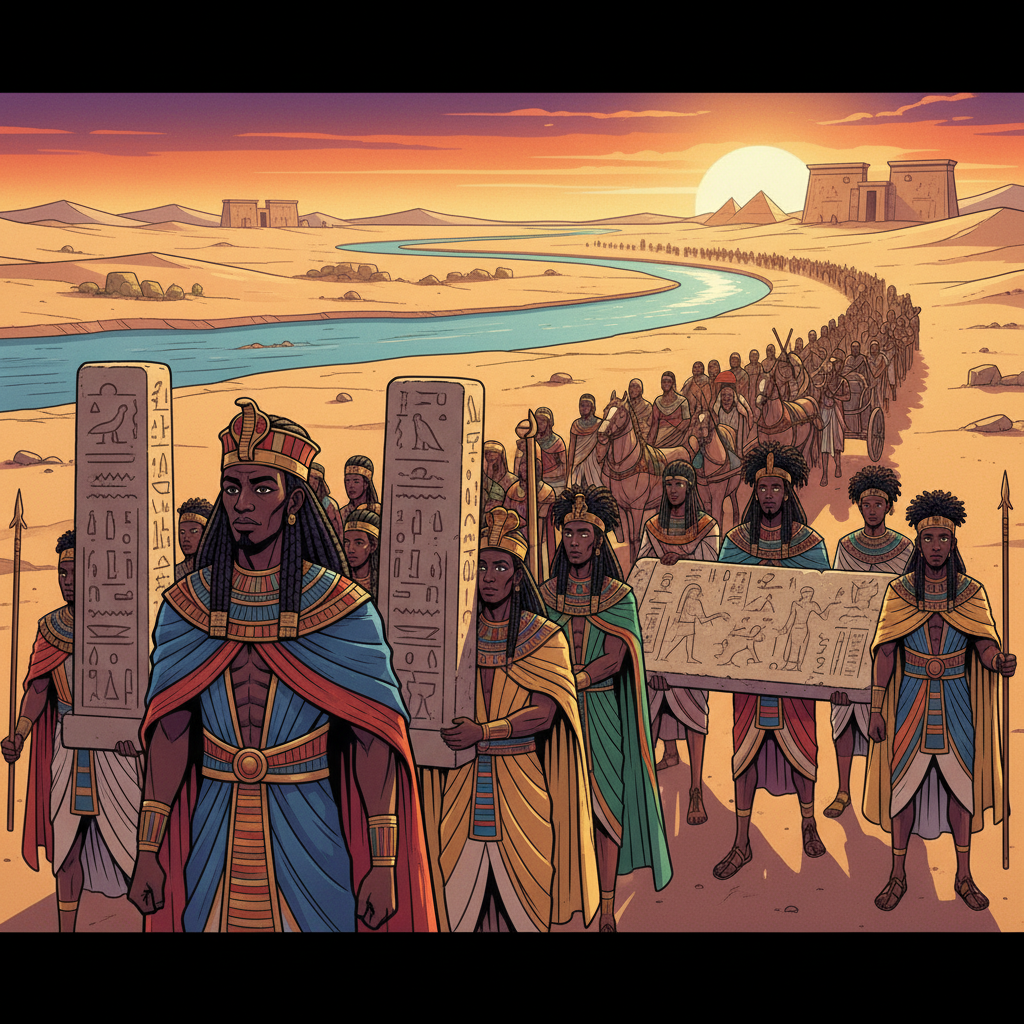
The grandmother emphasized that our Kushite pharaohs, from Piye to Taharqa, had always seen their role as guardians of Kemet's sacred traditions, not as foreign conquerors. They were the true inheritors of the ancient ways, the ones who upheld the rituals of Amun, Osiris, and Aset, ensuring the `djed` pillar of stability remained upright. Their journey north was a pilgrimage to restore harmony, to banish the `isfet` that had plagued the land. They rebuilt temples, revived festivals, and, like Pharaoh Shabaka, even preserved texts like the Memphite Theology by carving crumbling papyrus onto enduring granite, ensuring these profound teachings would last for `weheh`. This act alone speaks volumes, {name}. It shows a deep reverence for knowledge and a commitment to preserving the very soul of Kemet, demonstrating true reciprocity.
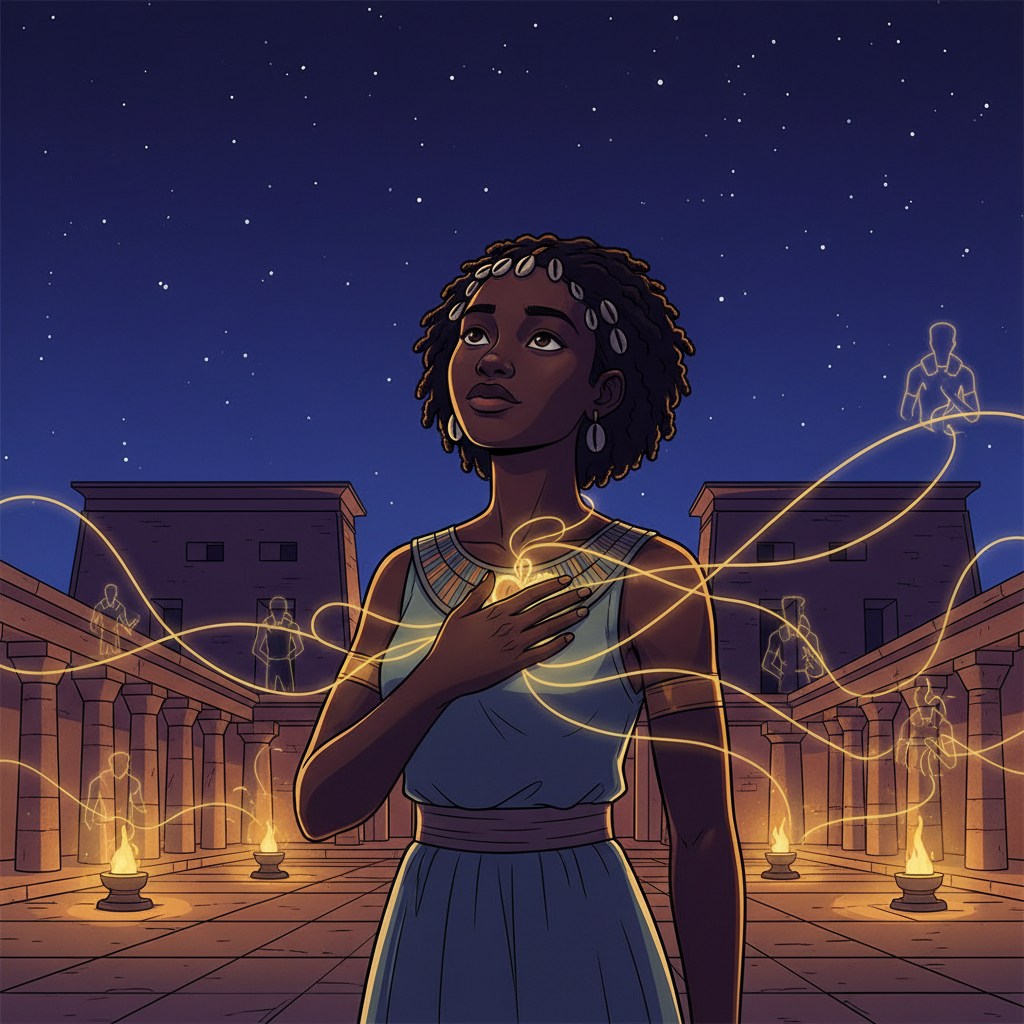
The fragmentation of Kemet had allowed `isfet` to spread like weeds in a carefully tended garden, threatening to choke the very life out of the ancient land. The Kushite pharaohs, with their strong faith and unwavering commitment to Maat, were like the skilled gardeners, carefully pulling out the weeds, nurturing the sacred plants, and restoring the balance. They reminded the northern child of its true heritage, its profound connection to the divine order. This was the reclamation of a cultural child by its parent, a reunion foretold by the very stars, a testament to the unbreakable bond between Kush and Kemet. Sapana understood that the strength of this bond was not measured by political borders, but by the shared spirit, the `ren`, that flowed through every heart devoted to truth.
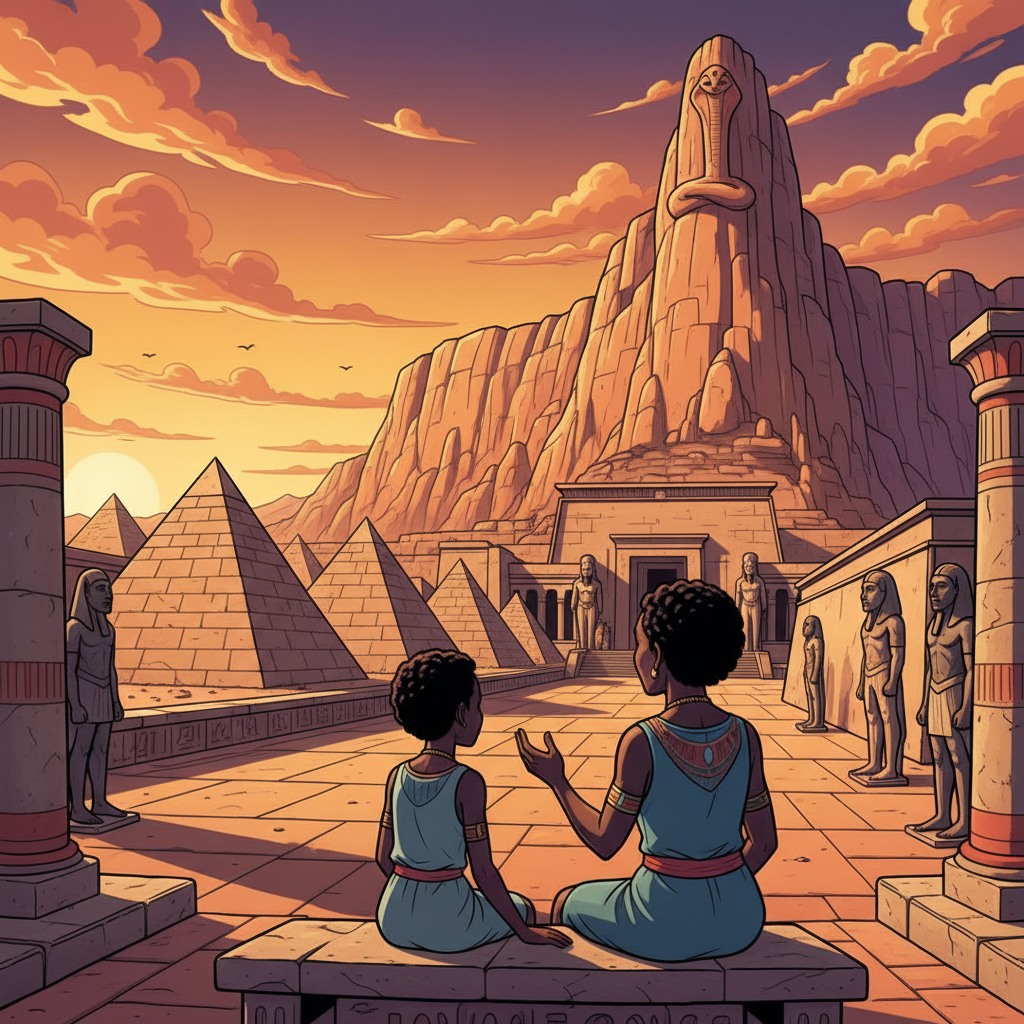
As Sapana listened, her grandmother's words painted a vivid picture of resilience. 'Though the Assyrians pressed hard, and the Kushite pharaohs eventually withdrew from the northern lands,' she explained, 'it was not an end, but a strategic re-centering. Kush was always its own sovereign power, with its own rich destiny. The withdrawal allowed the heart of our tradition to beat even stronger here, away from the constant strife.' This was a lesson in understanding that true strength lies not just in holding territory, but in holding fast to one's principles, to the `maat` that guides all actions. Napata, and soon Meroe, would become the undisputed centers of this enduring legacy, continuing the pyramid building, the scribal learning, and the worship of Amun, ensuring the `ka` of Kemet remained vibrant in its southern home.
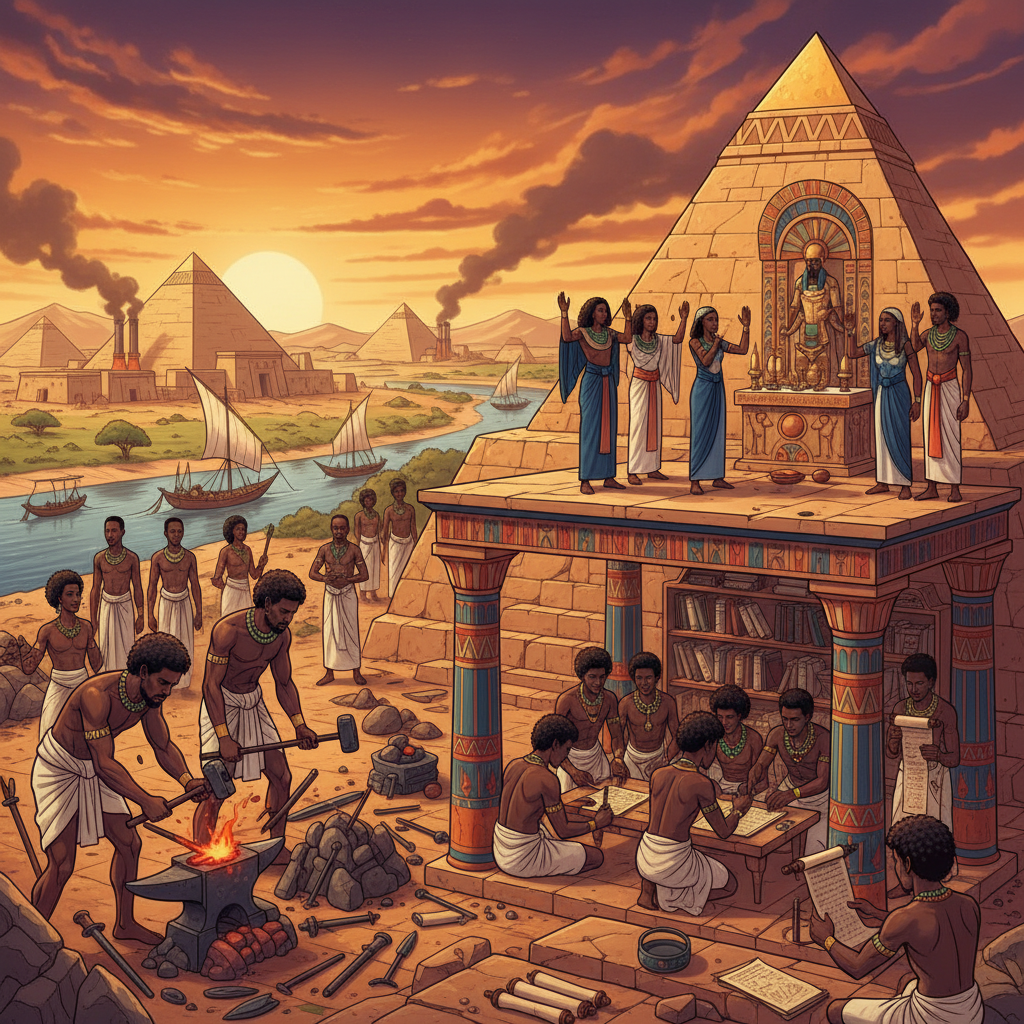
Sapana often imagined Meroe as a city of shimmering iron and deep wisdom, a place where the sun baked the rich earth, and the Nile flowed with ancient secrets. She pictured the artisans forging tools and weapons from the plentiful iron ore, the scribes meticulously recording history in hieroglyphs, and the priests honoring the `neteru` with elaborate ceremonies. Meroe was not a retreat, but an evolution, a strategic move to a land of abundant resources and renewed spiritual focus. It was here, in this new southern heartland, that the legacy of the 25th Dynasty would truly take root and flourish for centuries to come. While Rome was still a village of mud huts in the distant north, our Kushite civilization was building pyramids and developing sophisticated metalworking, demonstrating a continuity of power and innovation that few other cultures could match.
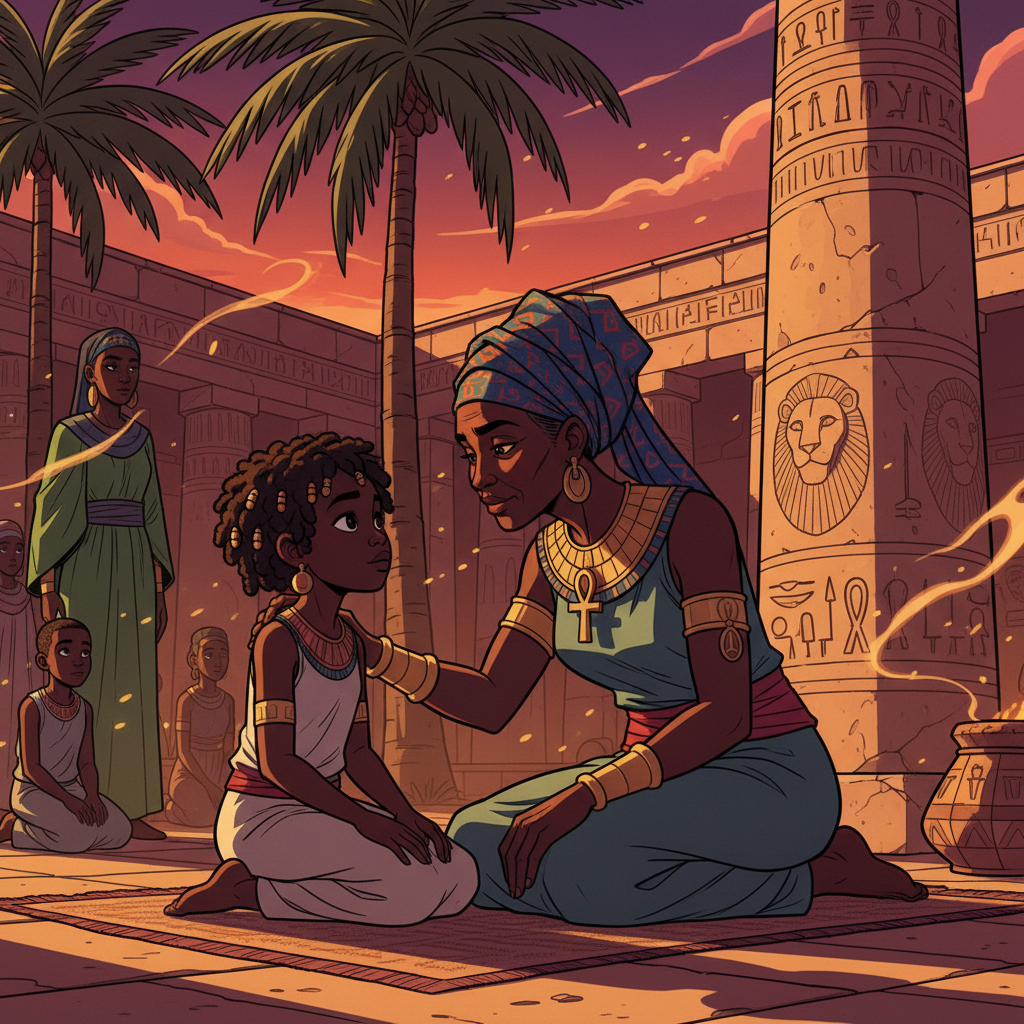
Then, one evening, as the desert winds whispered tales through the palm trees, Sapana's grandmother leaned in, her voice hushed with anticipation. 'Listen carefully, child, for the scribes of old, and those of Meroe to come, would record what I now share with you. The spirit of Maat, the `ka` of our ancestors, will manifest again in a powerful form, a guardian for our people when a new threat rises from across the great sea.' She spoke of a future `Kandake`, a queen of Kush, whose strength would be unmatched, whose wisdom would guide her people through a time of great challenge. This was not just a story, but a prophecy, a promise that the divine order would always find a champion among the descendants of Piye and Taharqa, ensuring that the `ankh` of life would continue to flow.
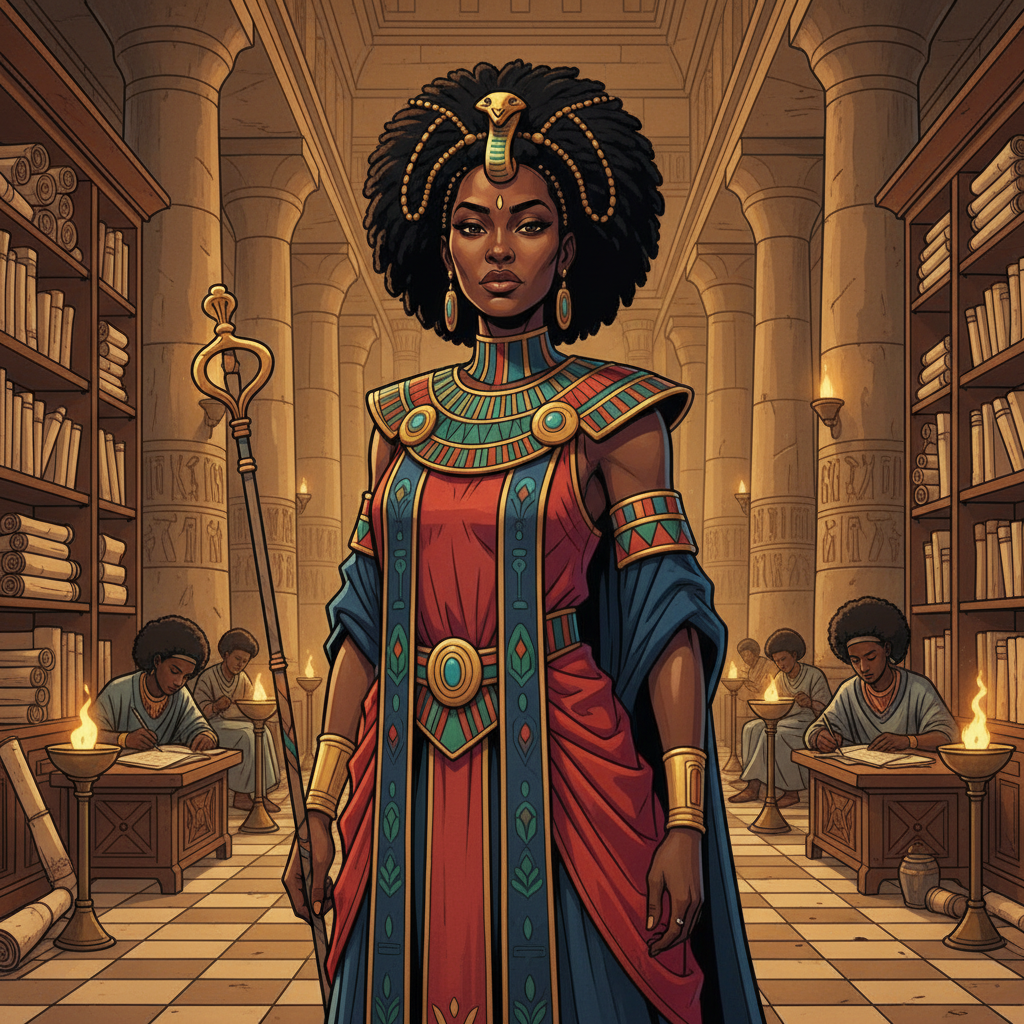
The title of `Kandake`, or Queen Mother, in Meroitic culture, held immense power and reverence. These were not merely consorts, but formidable rulers in their own right, often leading armies and making critical decisions for the kingdom. They wore the `uraeus` serpent on their brow, a symbol of divine authority, just like the pharaohs of Kemet, embodying the fierce protection of Aset and the wisdom of Djehuti. Sapana’s grandmother described this `Kandake` with vivid detail: a woman of striking presence, with broad shoulders and a gaze that could pierce through deception, her skin the color of polished ebony, her hair a majestic crown. She would be a true lioness of Kush, embodying the strength and resilience that flowed through the veins of every person in Napata and Meroe.
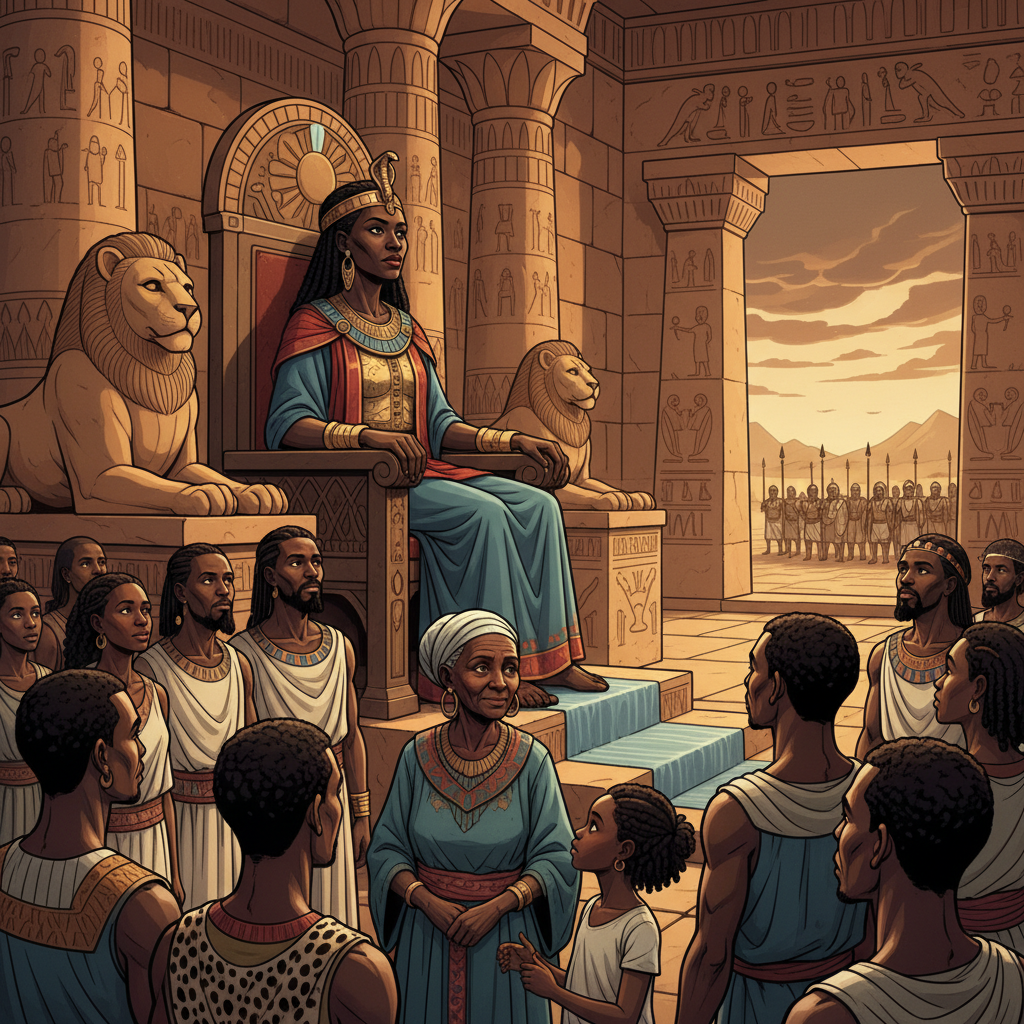
This particular `Kandake`, the grandmother revealed, would be named Amanirenas. She would be a descendant of the very line that had ruled Kemet, her spirit forged in the enduring fires of Kush. Her reign would come at a time when a formidable new empire, vast and ambitious, would emerge from the lands far to the northwest: the Romans, under their powerful emperor, Augustus Caesar. 'They will believe themselves invincible,' the grandmother said, her voice filled with ancient knowing, 'but they will meet their match in Amanirenas, a woman whose `ka` is entwined with the very spirit of the Nile. She will remind them that Kush, though it may not rule the northern lands, remains a sovereign power, unbroken and unyielding, a testament to the power of Maat.'
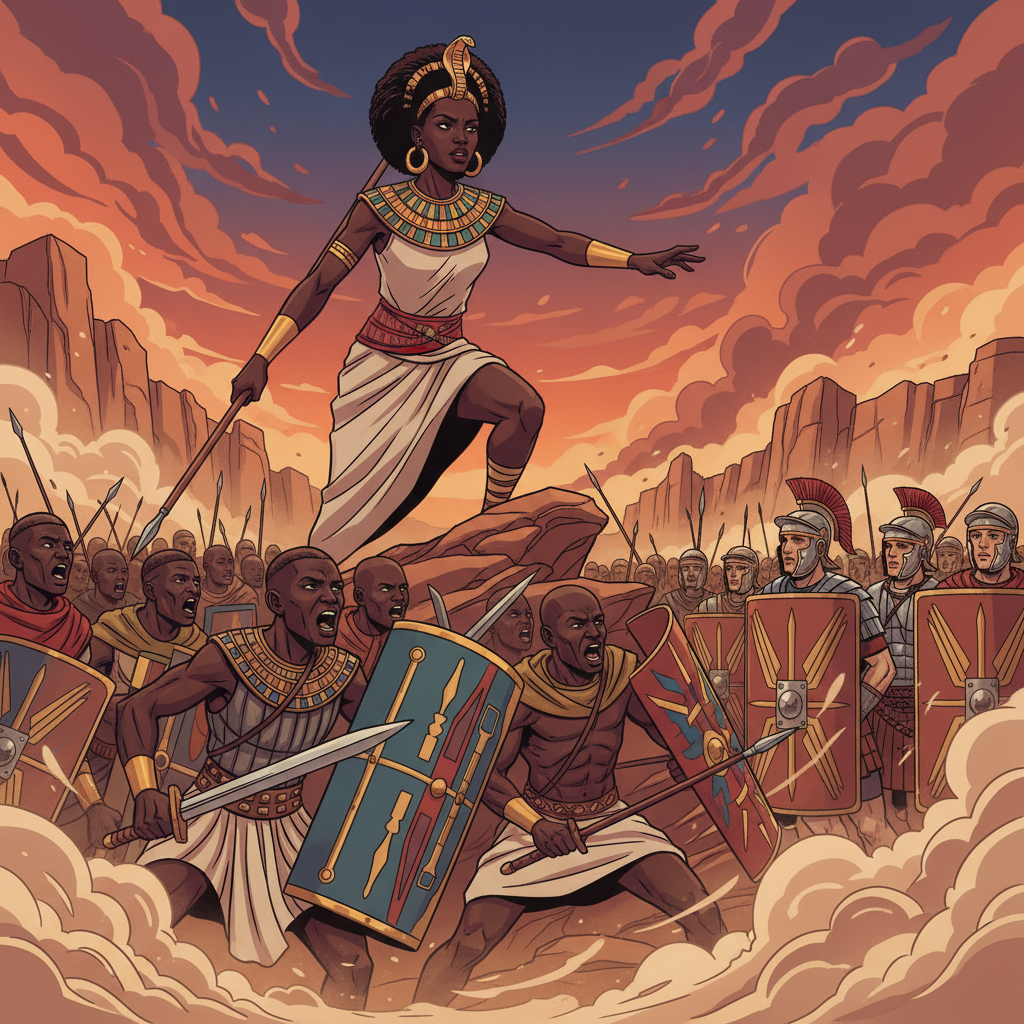
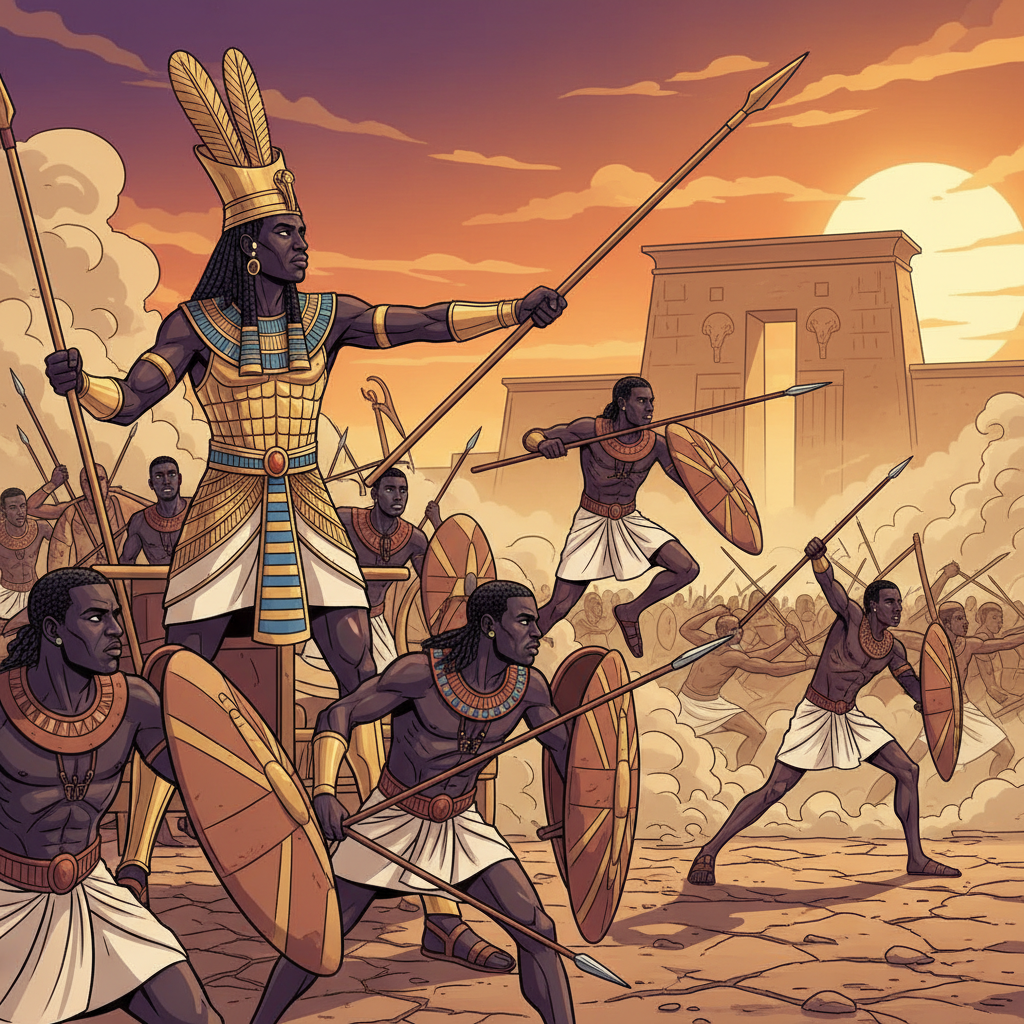
The grandmother’s story of Amanirenas was not one of easy victory, but of fierce determination and strategic brilliance. She described how Amanirenas, wearing her royal `wesekh` collar and `uraeus` crown, would personally lead her armies into battle. Her warriors, skilled and courageous, would fight not just for land, but for the sacred right to self-determination, for the `maat` that defined their very existence. Amanirenas would face the disciplined Roman legions, who had conquered much of the known world, and she would not falter. She would be a living embodiment of the strength of the desert lioness, an inspiration to her people, proving that true power comes from the spirit, from the unwavering commitment to justice and truth, rather than merely from numbers or advanced weaponry.
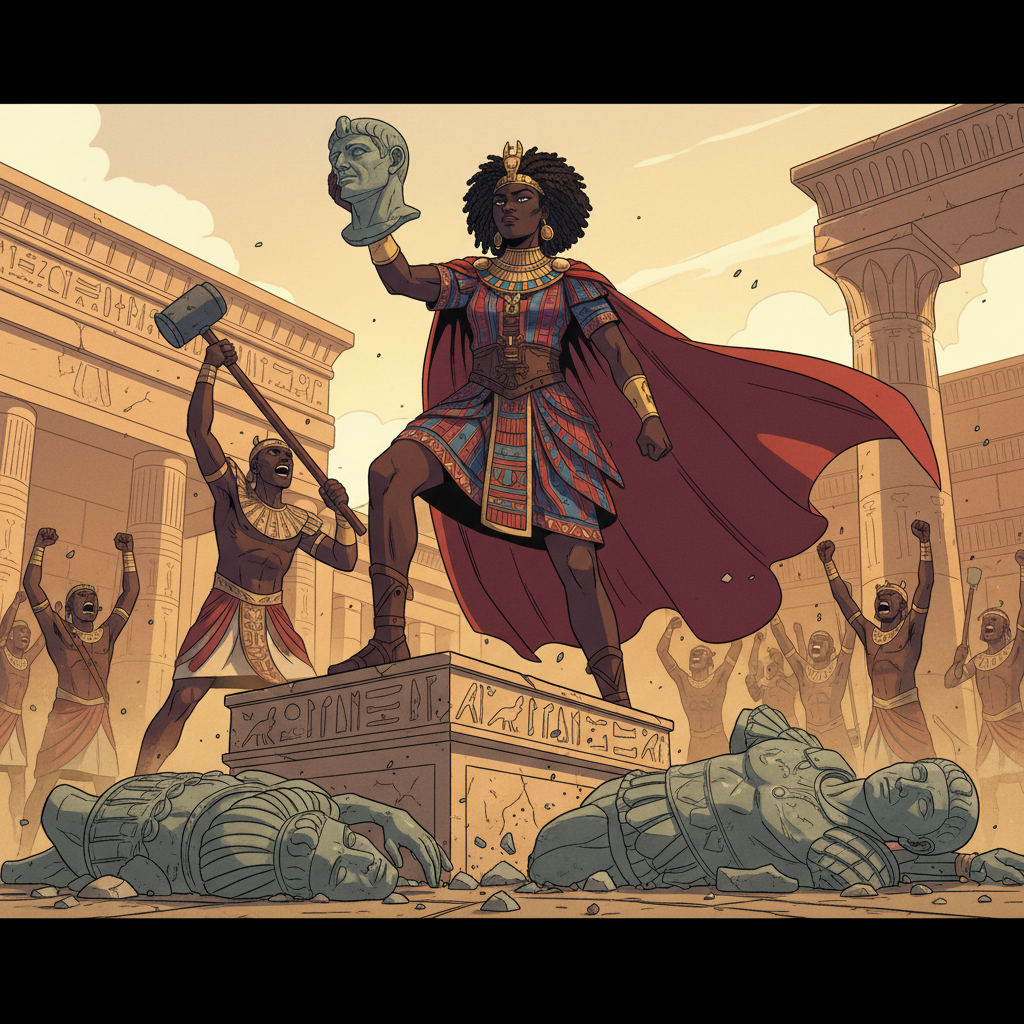
The climax of her tale was a moment of profound defiance. Amanirenas, having fought the Roman army to a standstill, even capturing several Kemetic towns held by the Romans, would send a message that echoed through the ages. In one of these captured towns, she ordered the destruction of statues of Augustus, the Roman emperor who believed himself a god. This was not random destruction, but a powerful symbolic act. And then, the grandmother's eyes twinkled with pride, 'She took a bronze head from one of those very statues of Augustus, and carried it back to Meroe. Not to display as a trophy, but to bury it beneath the threshold of her palace doorway. Imagine, {name}! For generations, every time she, her family, and her people entered their royal home, they would walk upon the head of the man who dared to challenge the sovereignty of Kush!'
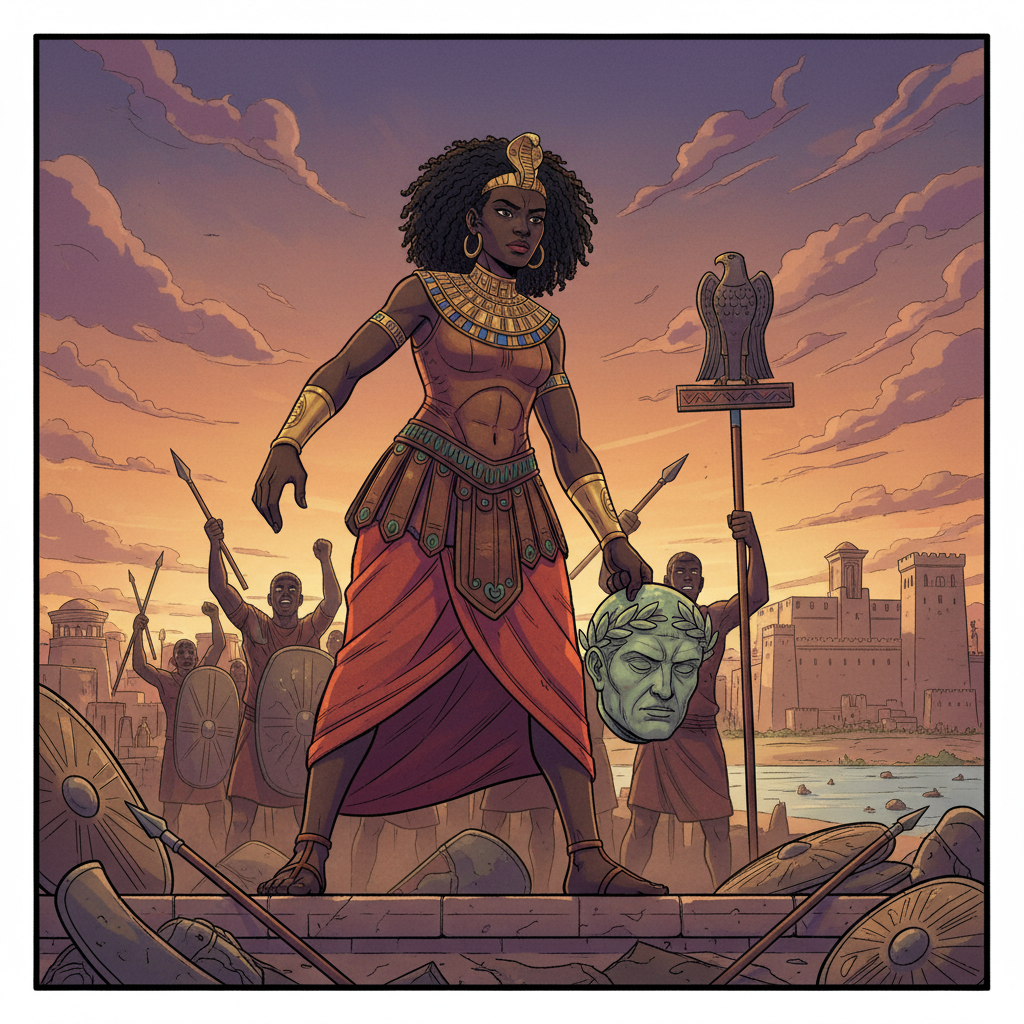
This act, Sapana understood, was a declaration of sovereignty, a refusal to be dominated. It was a physical manifestation of Maat triumphing over `isfet`, of the enduring spirit of Kush asserting its rightful place in the world. While the Roman Empire would eventually rise and fall, the kingdom of Kush, with Meroe as its heart, would continue to thrive for centuries more, a testament to its inner strength and the wisdom of its `Kandake` queens. The bronze head of Augustus, now resting in a museum far to the north, still tells this story. It is a silent witness to the power of an African queen, a descendant of the pharaohs who restored Maat to Kemet, and who ensured that the legacy of our people would continue, unbroken, like the eternal flow of the Nile.
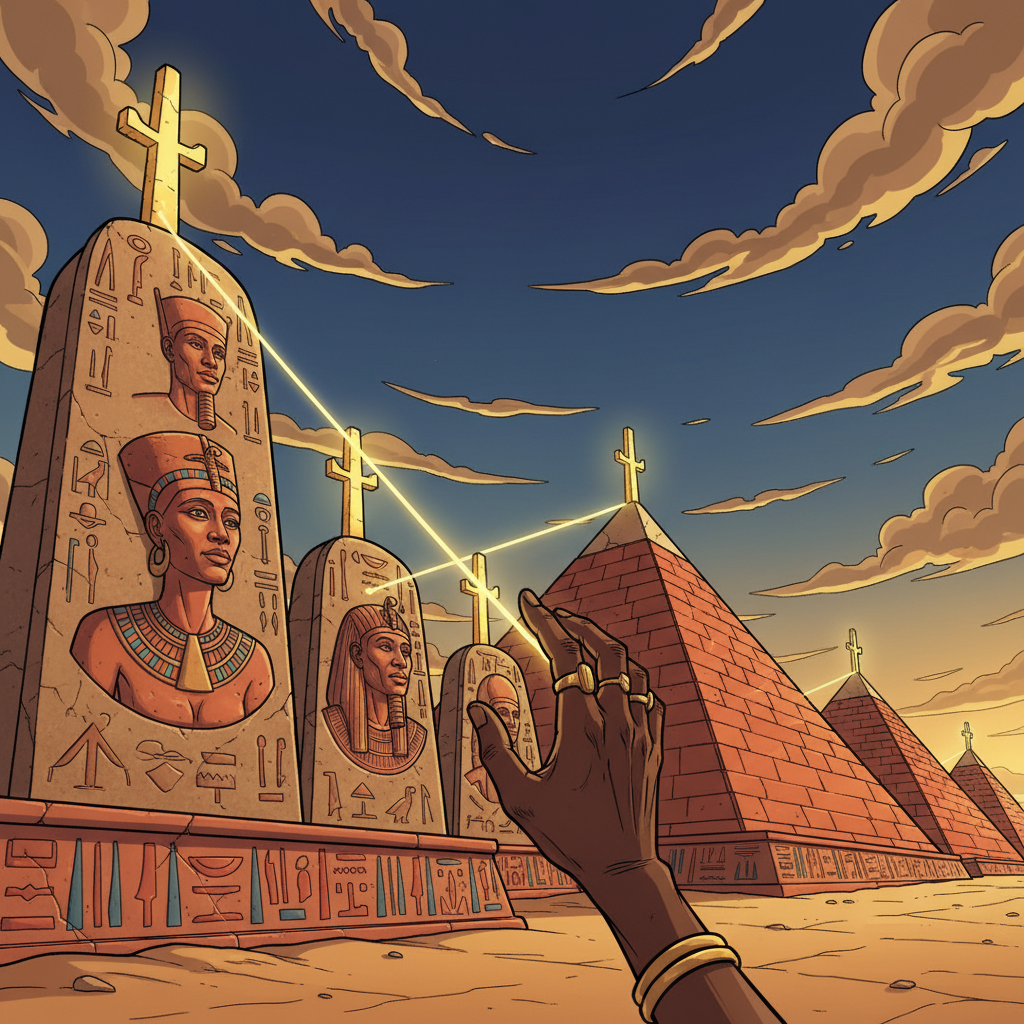
The grandmother then drew a line from Amanirenas back to Taharqa, and even further to Piye. 'The spirit that moved Piye to restore Maat in Kemet,' she explained, 'the vision that guided Taharqa to build and preserve, that same spirit flowed through Amanirenas. It guided her hand, strengthened her resolve, and protected our traditions.' The pyramid-building tradition, which Taharqa had revived with such vigor at Nuri, continued unbroken at Meroe, a tangible link to the glory of the 25th Dynasty. Each pyramid rising from the Meroitic sands was a `djed` pillar, a symbol of stability and endurance, connecting the living to the ancestors, and reaffirming the eternal cycle of life and rebirth. It was a clear message that the culture and wisdom of Kush, rooted in ancient Kemet, would continue to define their identity for `weheh`, no matter what empires rose and fell around them.
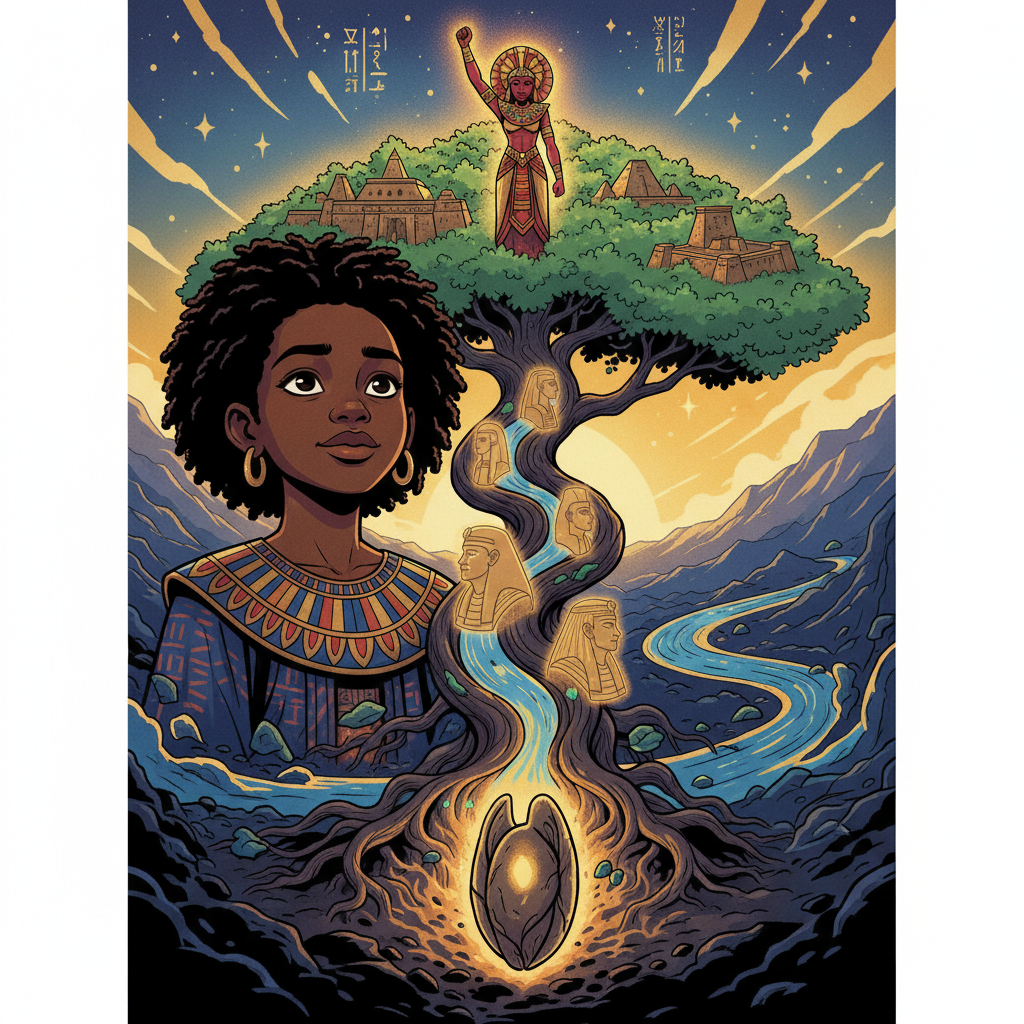
Sapana, her mind ablaze with these stories, finally grasped the true meaning of the 25th Dynasty. It was not an ending with the Assyrian withdrawal from Kemet, but a seed planted deeply in the southern earth. A seed that had germinated in Napata, grown strong through generations, and blossomed into the magnificent kingdom of Meroe, producing warrior queens like Amanirenas. The river of history had simply found a new, powerful channel. The lesson was clear: the essence of Kemet, the principles of Maat, the wisdom of the `neteru`, were not confined to geographical boundaries or a single dynastic period. They were a living, breathing current, flowing through the hearts of those who chose to uphold them, enriching the lives of all who embraced them, from the desert to the delta.
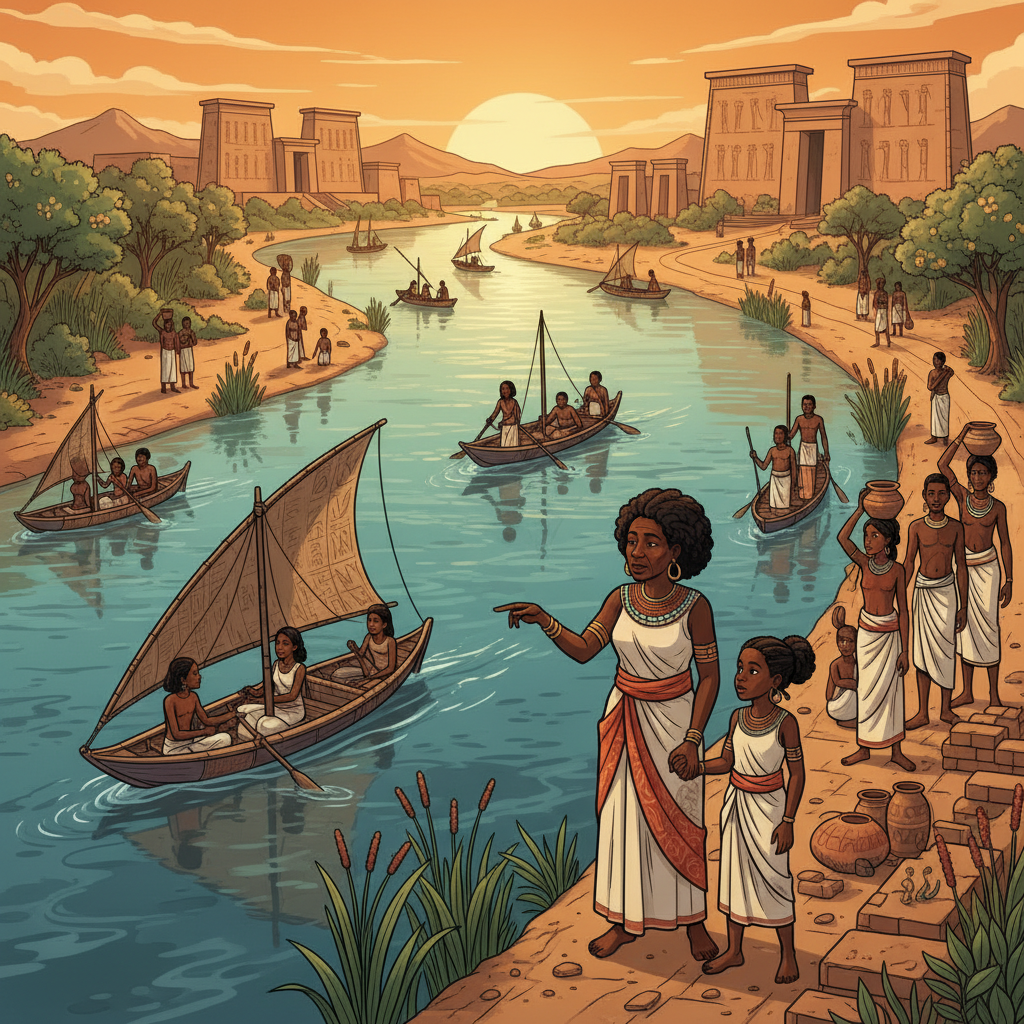
The spirit of Maat, my dear {name}, is like the Nile itself – it may change its course, it may ebb and flow, but its essence, its life-giving power, remains eternal, `weheh`. It outlives any single pharaoh, any empire, any challenge. What the Kushite pharaohs did in Kemet, and what queens like Amanirenas did in Meroe, was to ensure that this river of truth and justice continued to flow, strong and unpolluted, for future generations. You see, the 25th Dynasty was not simply a historical period; it was a profound act of cultural preservation and spiritual reaffirmation. It taught us that even when external pressures force change, the core identity, the `ka` of a people, can not only survive but thrive, as long as the principles of Maat are held sacred.
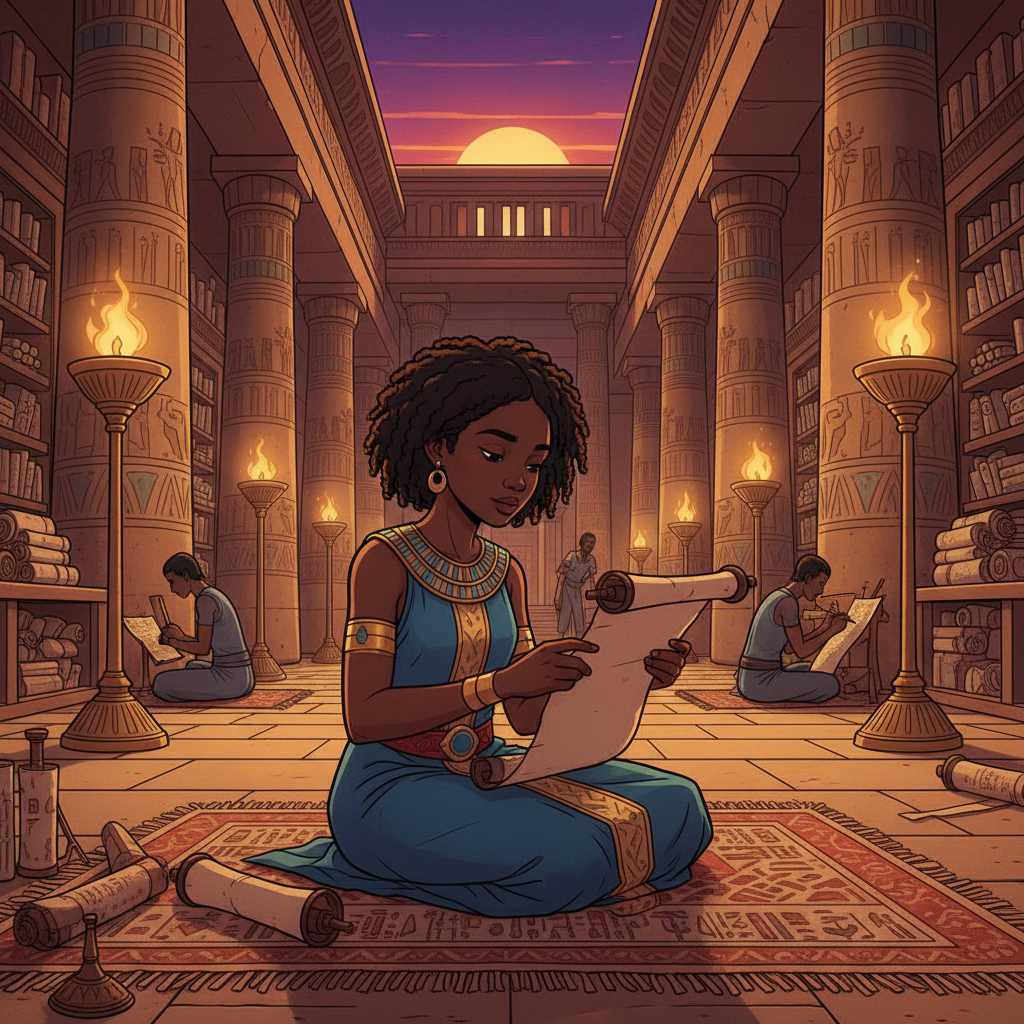
Sapana understood that her own life, even in the quiet rhythms of Napata, was a continuation of this grand story. She knew that every hieroglyph she learned, every prayer to Amun she recited, every act of kindness she performed, was a small but vital thread in the vast tapestry of `weheh`. She was not just a girl; she was an heir to a legacy of strength, wisdom, and unyielding spirit. And so it is with you, {name}. You are not merely a student in the Per Ankh. You are a direct descendant of this magnificent tradition, a living vessel for the `ka` of our ancestors. The stories of Piye, Taharqa, and Amanirenas are not just tales of the past; they are blueprints for how you, too, can carry Maat in your own life, today and always.
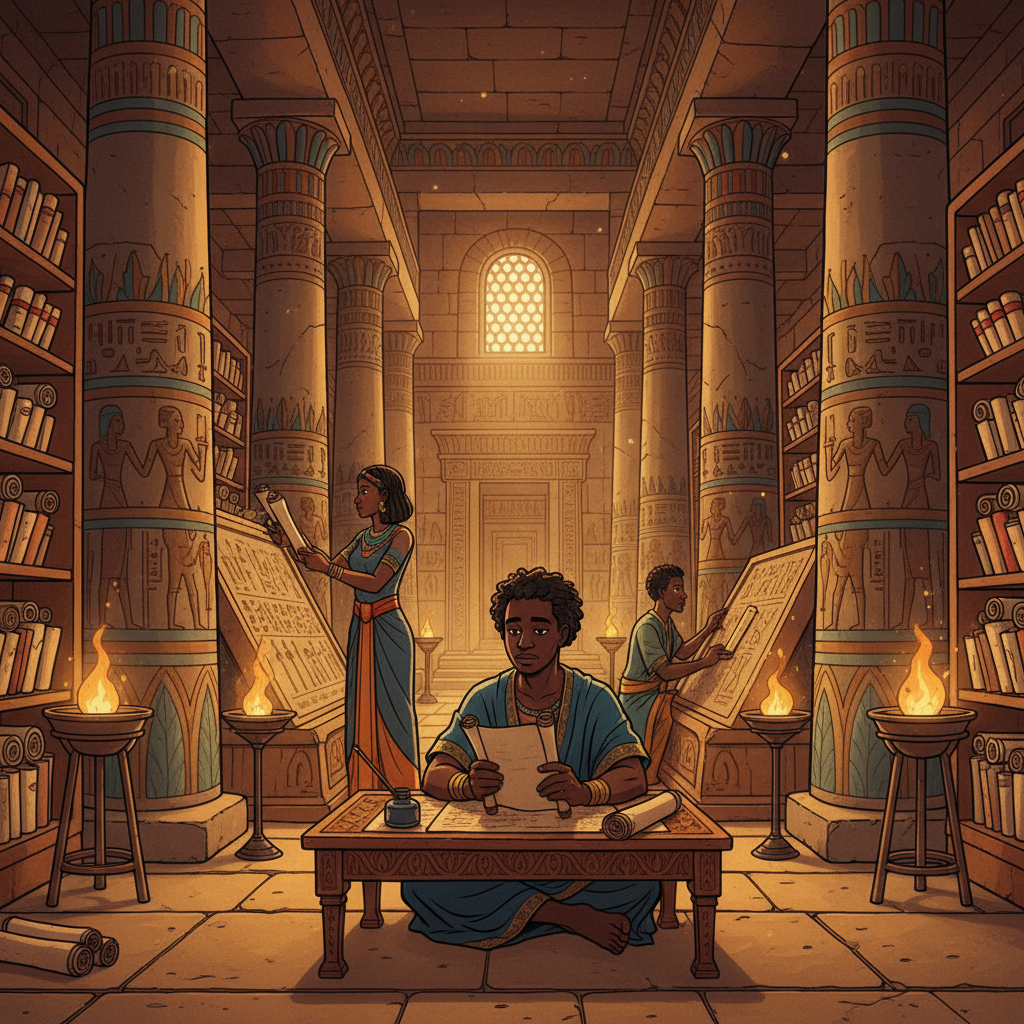
The enduring legacy of the Kushite pharaohs and queens, like Amanirenas, is a testament to the power of a people who knew who they were, where they came from, and what principles guided their `ren`. They understood that true power was not in conquering others, but in mastering oneself and upholding `Maat` in every aspect of life. They built pyramids and wrote histories not just for their time, but for `weheh`, for eternity. This is why, my child, we speak of them with such reverence in the Per Ankh. They preserved wisdom, they cultivated justice, and they showed us that the African spirit, rooted in the lands of Kush and Kemet, is a force of incredible resilience and profound creativity. You are the inheritor of this, and your responsibility is to let that `ka` shine brightly.
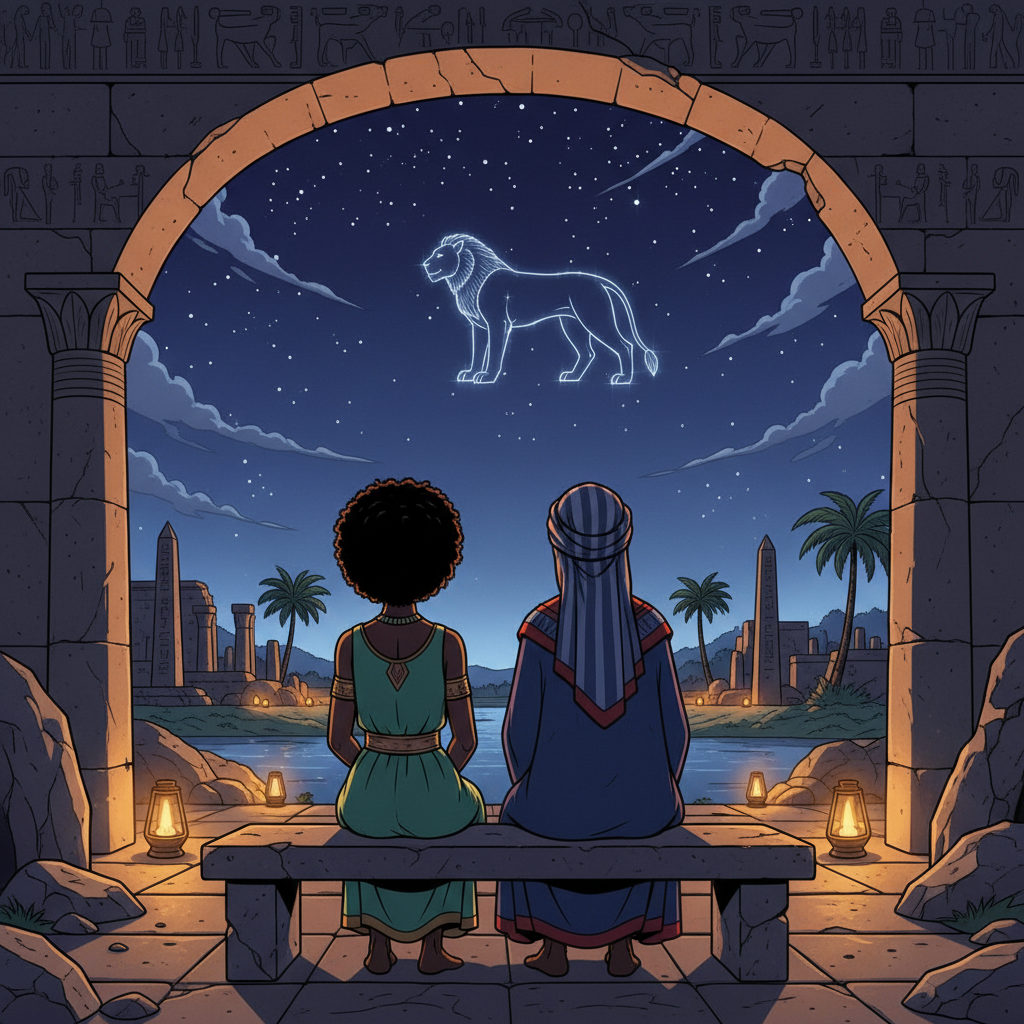
So, as the stars begin to emerge, mirroring the timeless wisdom above, remember Sapana and her grandmother. Remember that the 25th Dynasty was not an ending, but a glorious chapter that led to even more chapters, written by powerful queens and devoted scribes in Meroe. The river of our heritage flows on, strong and eternal. Your mind, {name}, is fertile ground. Plant the seeds of these stories deeply within it. Nurture them with your own pursuit of `Maat`. For you are the next guardian, the next storyteller, the next embodiment of this enduring legacy. The spirit of Kush, the wisdom of Kemet, lives within you. Go forth, and carry its light.