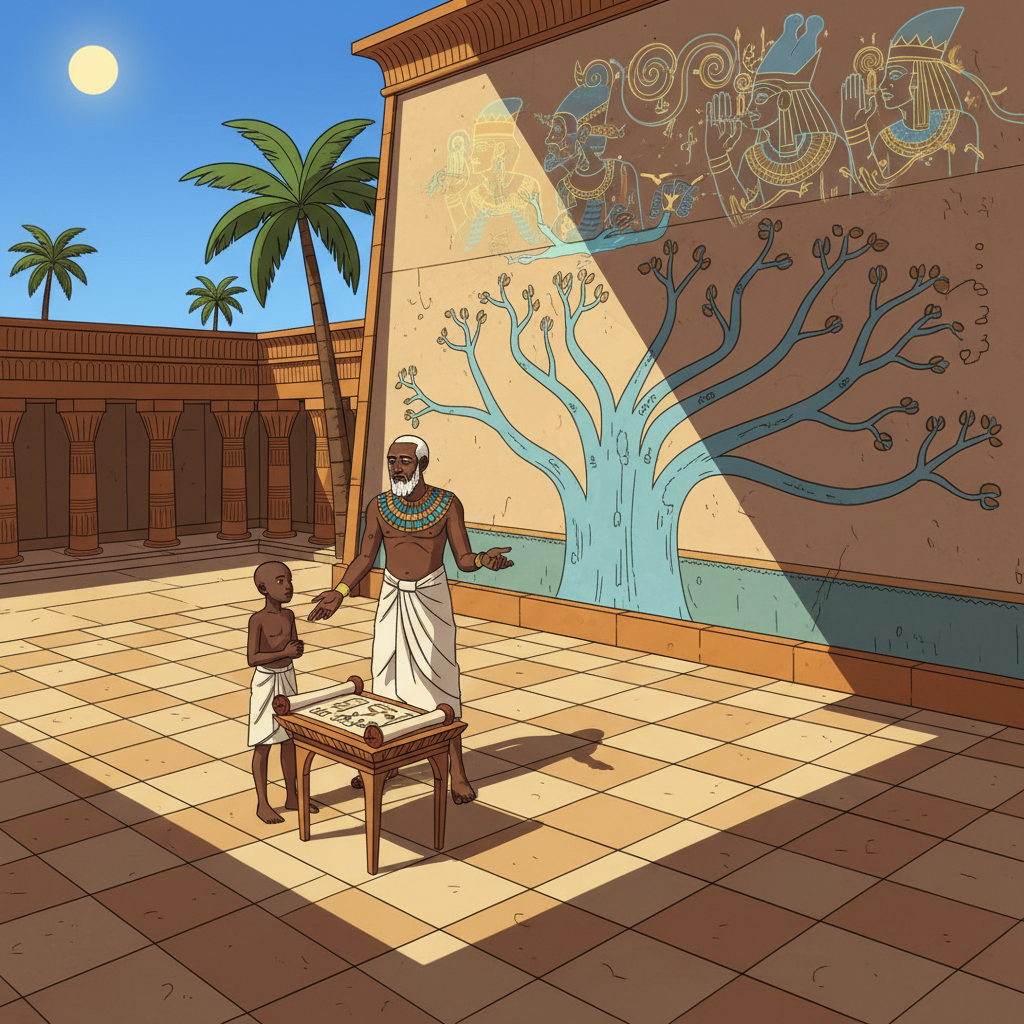
Seba Khafre’s voice, deep and resonant like the Nile’s ancient song, filled the Per Ankh’s sun-drenched courtyard. “Ah, {name}, come closer,” he beckoned, his hand sweeping towards a scroll unfurled on a low table. “Today, we journey back to a time when Kemet, our beloved Black Land, was like a scattered constellation in the night sky, its guiding stars dimming. But then, a brilliant light rose from the south, from the heartland of Kush, to gather its strength once more.” “Imagine, if you will, a great river that has split into many small streams, losing its powerful current and clear direction. That was Kemet, fractured and yearning for the unifying flow of Maat. Our Kushite cousins, from their ancient kingdom of Napata, heard the whispers of the ancestors and understood their sacred duty. They were not strangers, {name}, but the older kin, returning home to restore the very essence of our way of life.”
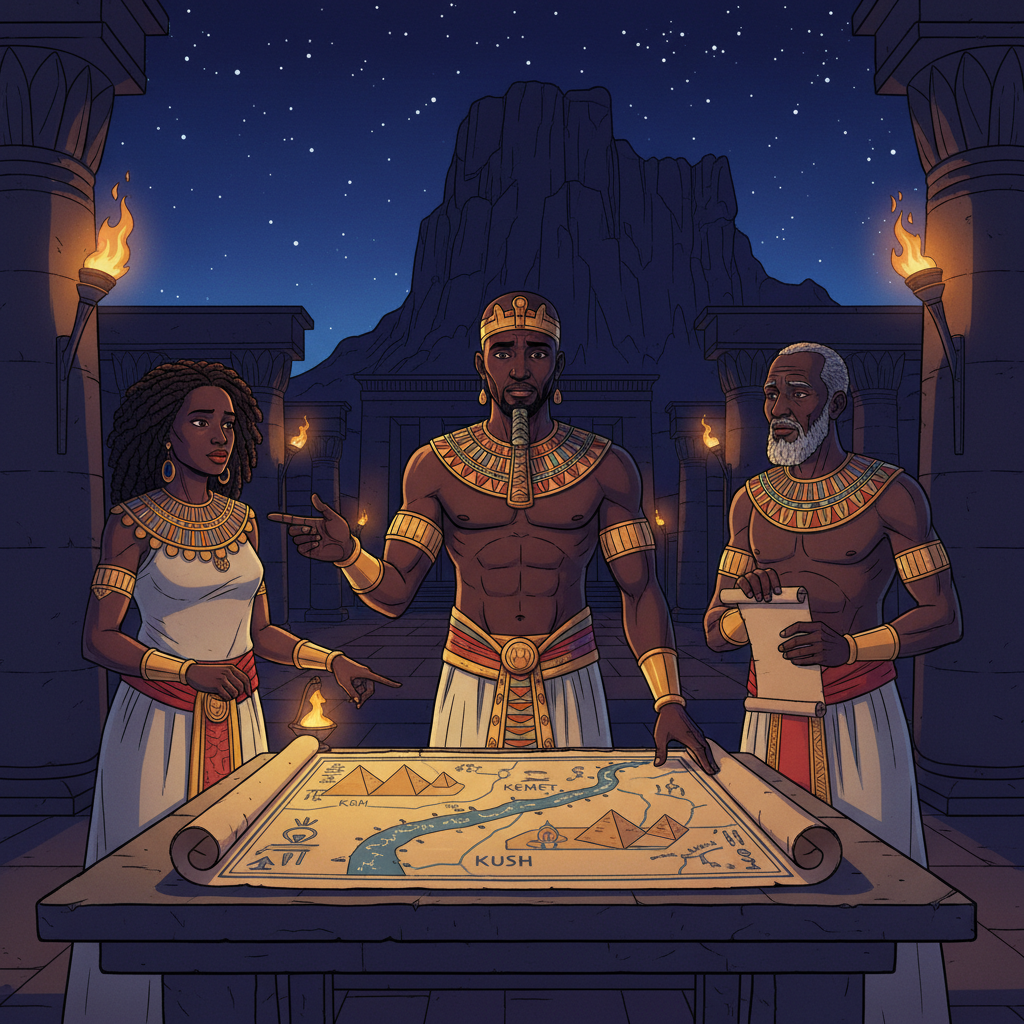
“For thousands of years before, the wisdom of Kemet had flowed from the south, from the lands we now call Nubia, where the Nile cradles the majestic Gebel Barkal. Our pharaohs, from the very beginning, were children of this rich African soil, with skin like polished ebony and hair like the deepest night. The people of Kush shared this heritage, their culture a vibrant, living tapestry woven from the same threads as ours, the true inheritors of Ta-Seti.” “So, when the kings of Napata looked north, they didn’t see a foreign land to conquer. They saw a child, Kemet, that had strayed from the path of Maat, its heart beating weakly. They felt the sacred call to reunite the family, to bring back the harmony and truth that had been lost. This was a mission of love and restoration, a powerful current flowing back up the Nile to nourish its roots, a true return to hetep.”
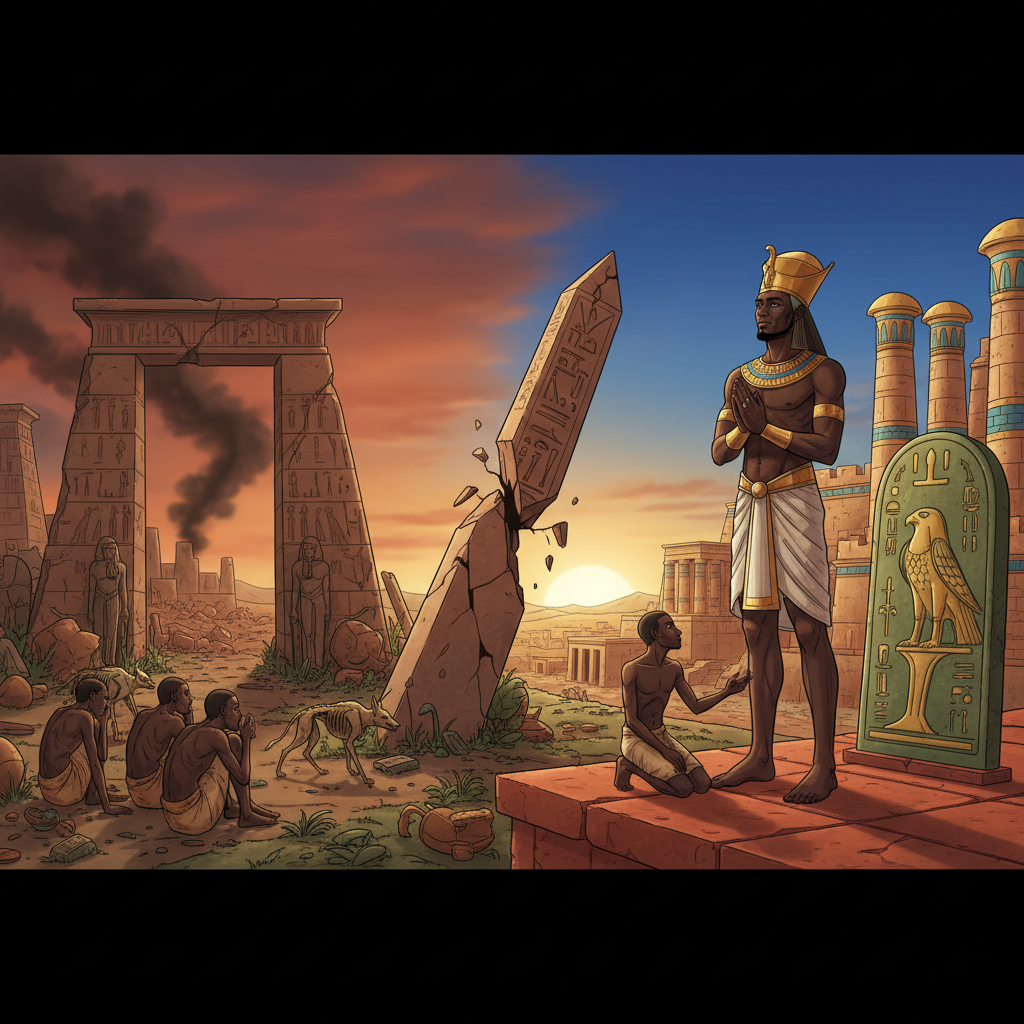
“In those days, the lands north of Waset were plagued by Isfet, the opposite of Maat. Petty kings, each ruling a small sliver of Kemet, squabbled amongst themselves like hungry jackals. Temples lay neglected, rituals were forgotten, and the people suffered from the discord. The sacred order, the very djed of our civilization, was crumbling. It was a time of great sorrow and confusion, a land adrift without its true compass.” “But in Napata, King Piye, a devout servant of Amun, watched and listened. His heart was heavy with the plight of Kemet. He knew that the ancestors, especially the great neter Amun, demanded action. His campaign was not for plunder or power, but a holy war to cleanse the land of Isfet and re-establish the righteous order of Maat, guided by the divine will of the neteru.”
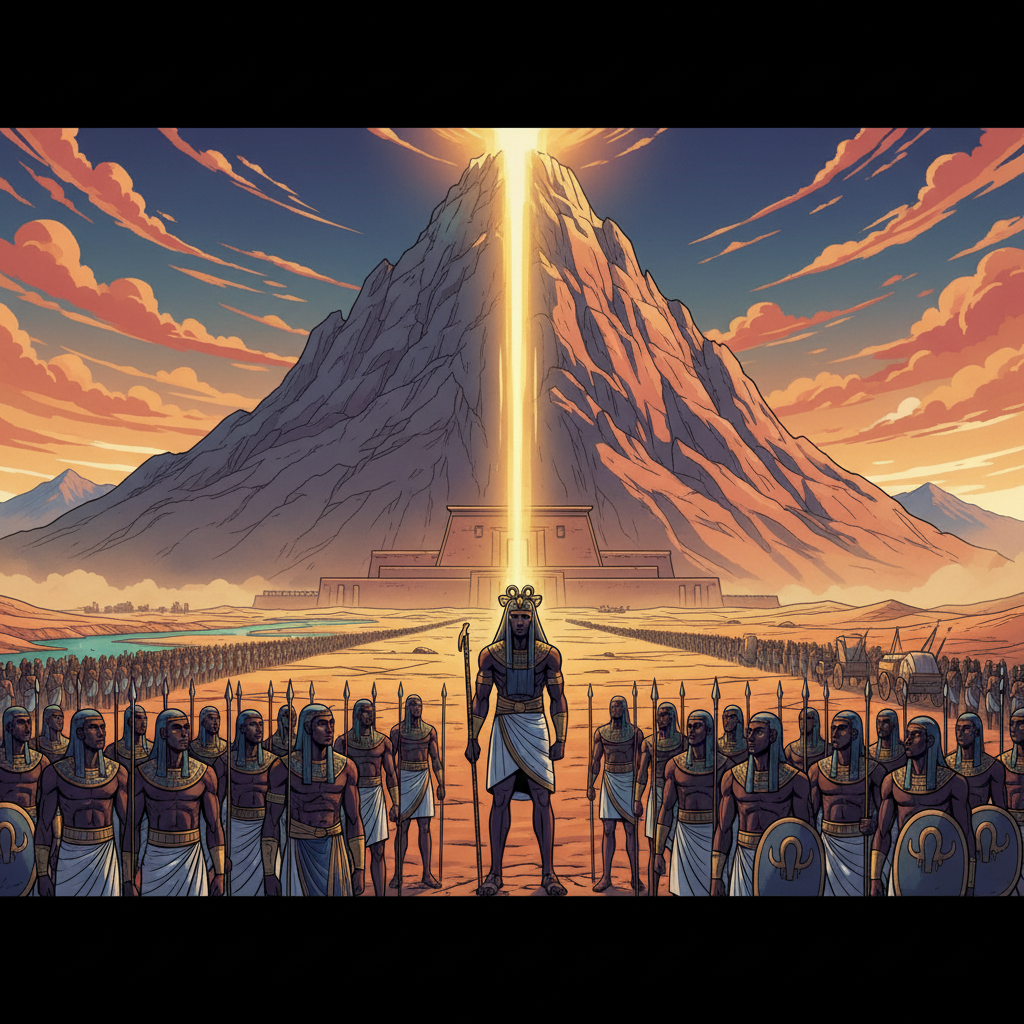
“Piye’s divine commission came not from a political calculation, but from the very heart of Gebel Barkal, the sacred mountain of Amun in Kush. There, in the shadow of that holy peak, the voice of the neter Amun spoke clearly to him, commanding him to go forth and restore balance to the Two Lands. This was a direct mandate from the divine, a calling to heal a broken world.” “He gathered his army, not of mercenaries, but of devoted warriors, strong and disciplined, their skin the color of rich earth, their hearts filled with purpose. They marched north, a tide of Maat flowing against the current of Isfet, their journey marked by prayer and purity. Piye himself led the way, his uraeus glinting, a symbol of divine authority and his unshakeable faith.”
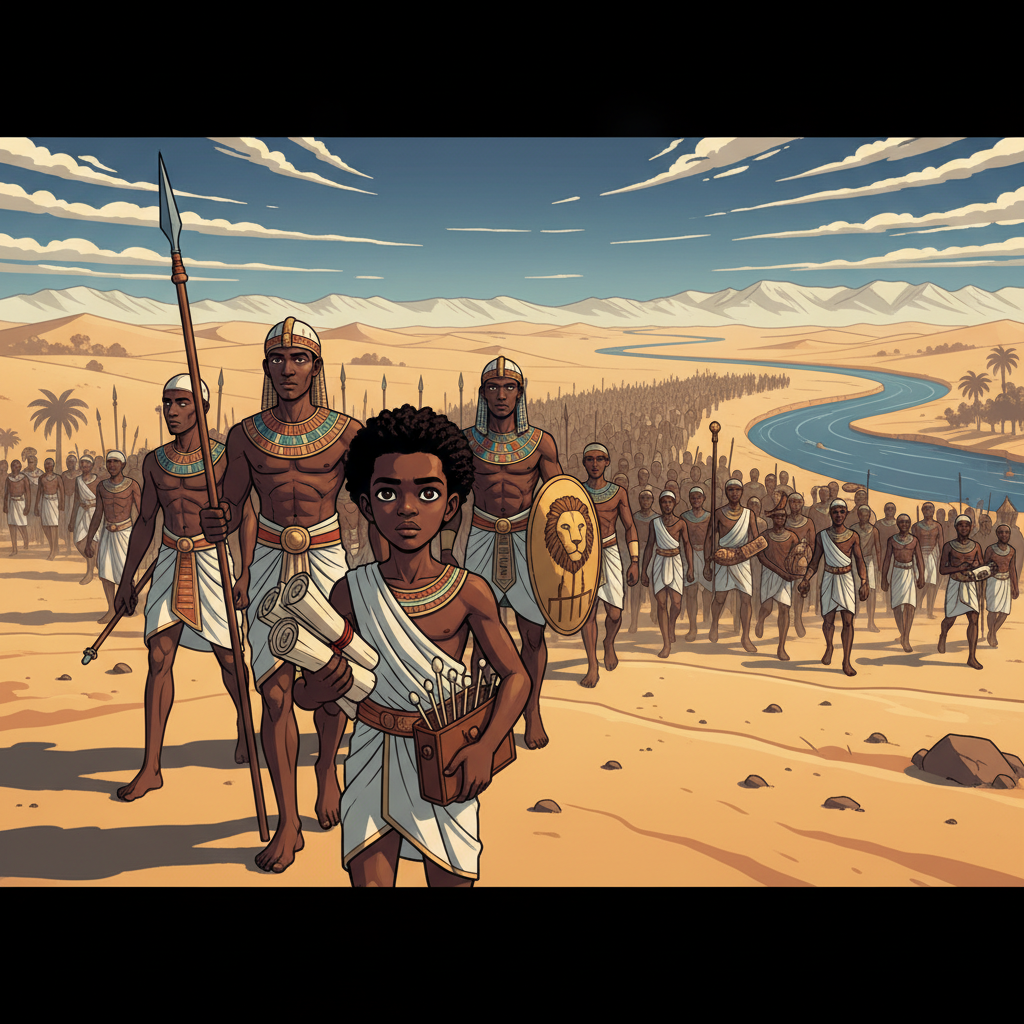
“Among the many who joined Piye’s great northward march was a young apprentice scribe from our own Waset, named Khumose. His eyes, bright with curiosity, had seen the chaos in the north, and his heart yearned for the return of order. He carried his papyrus scrolls and reed pens with the same reverence a warrior carried his spear, knowing the power of the written word.” “Khumose dreamed of recording history, of capturing the truth in hieroglyph. He understood, even then, that a scribe’s duty was to preserve Maat not just in deeds, but in words. He wanted to witness this reunion, this reclaiming of Kemet by its southern homeland, and ensure that the stories were told with precision and honor for all time.”
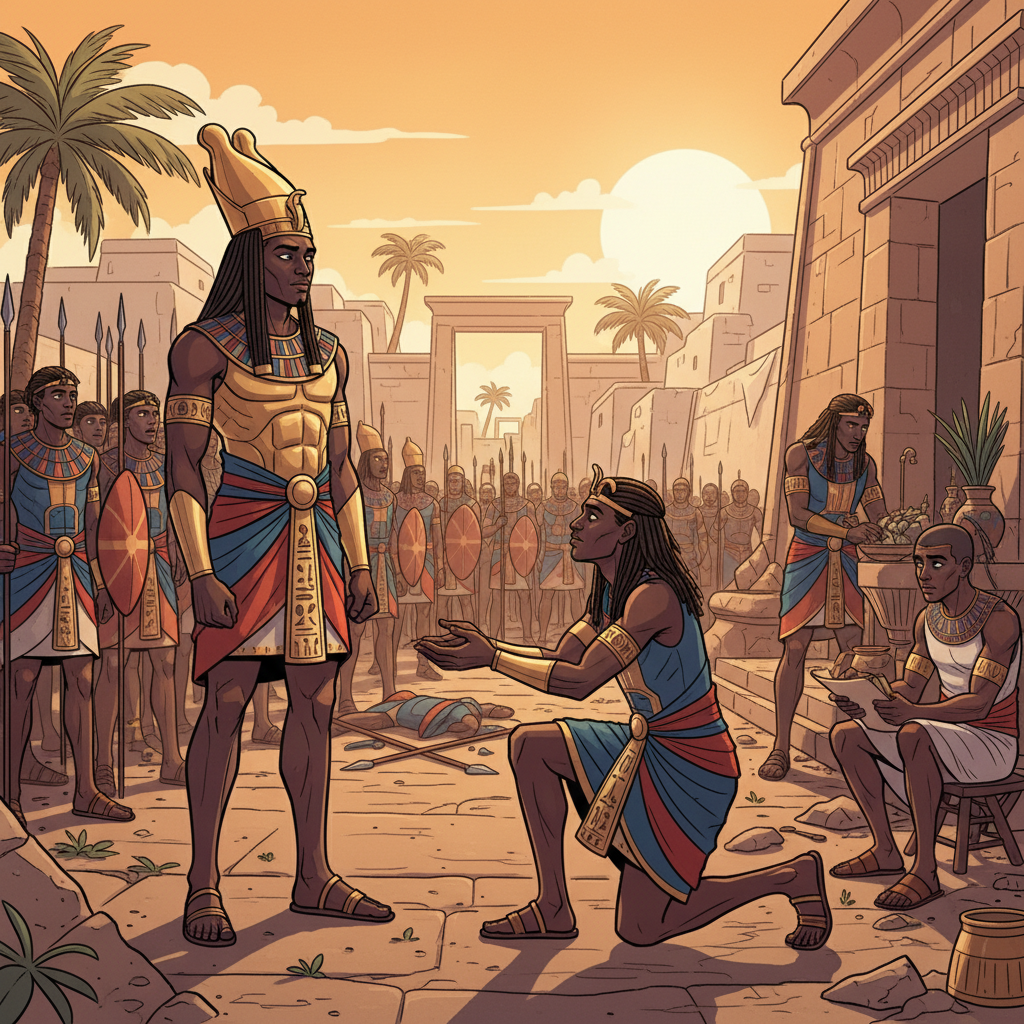
“As Piye’s forces advanced, they encountered cities guarded by the northern princes. Yet, Piye’s approach was unlike any conqueror’s. He offered terms of surrender, not of subjugation. At Hermopolis, the local ruler, Nimlot, saw the light of Maat in Piye’s eyes and chose to yield. Piye, true to his word, refused to attack the city, instead focusing on purifying its temples.” “This was the essence of his mission: not to destroy, but to restore. He understood that true strength lay in mercy and adherence to righteous order, not in brute force. Khumose meticulously recorded these acts, the careful cleaning of the temple sanctuaries, the proper offerings to the neteru, understanding that these details were as vital as any battle.”
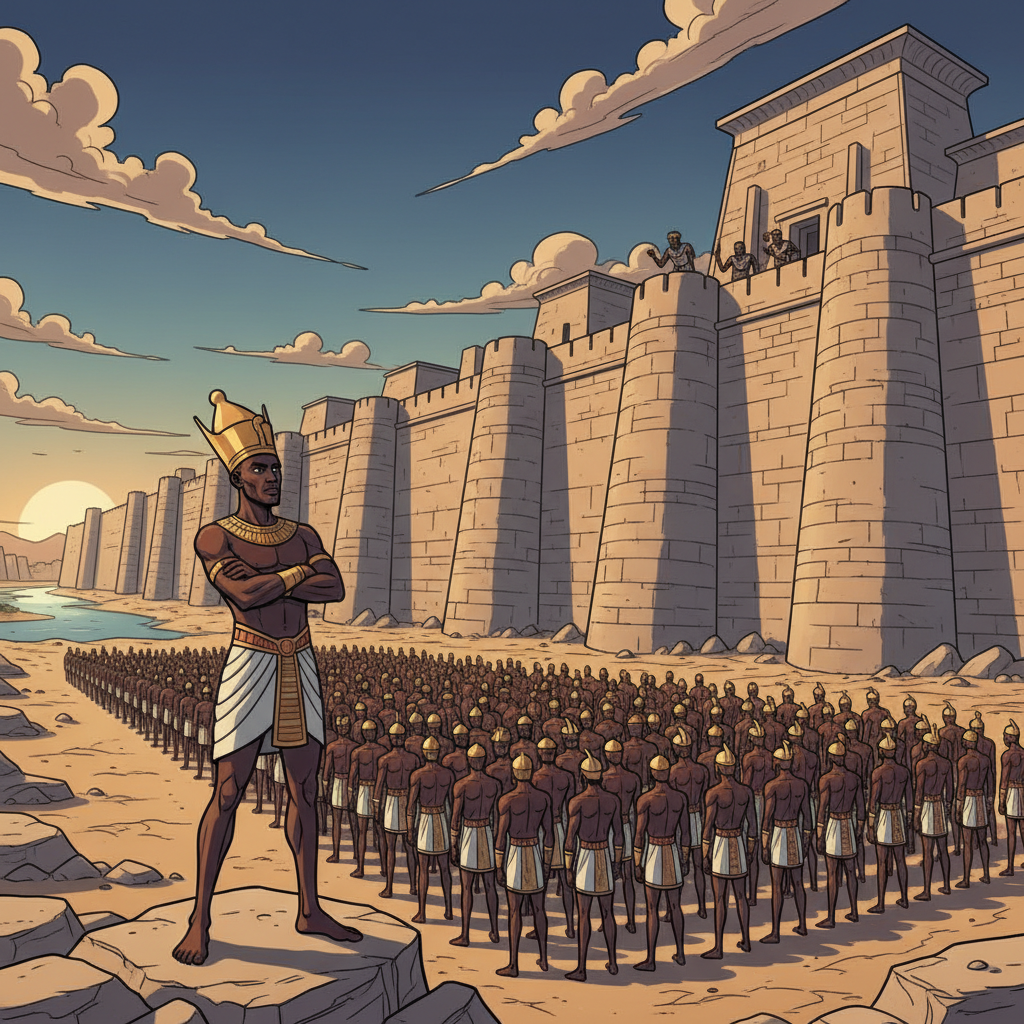
“Next, the great city of Memphis, ancient and formidable, stood in their path. Its massive walls, built of stone and reinforced with generations of might, seemed unbreachable. The northern princes, who had fled there, believed themselves safe, confident that Piye’s army would be bogged down in a long, costly siege. They mocked the Kushites, unaware of the ingenuity and piety that fueled their leader.” “But Piye was a pharaoh of deep wisdom and strategic brilliance. He surveyed the fortifications, his dark eyes discerning the city’s hidden vulnerabilities. He knew that a protracted siege would bring suffering to the innocent people within. His desire was not to inflict pain, but to swiftly restore Maat with as little bloodshed as possible, a true reflection of his noble ka.”
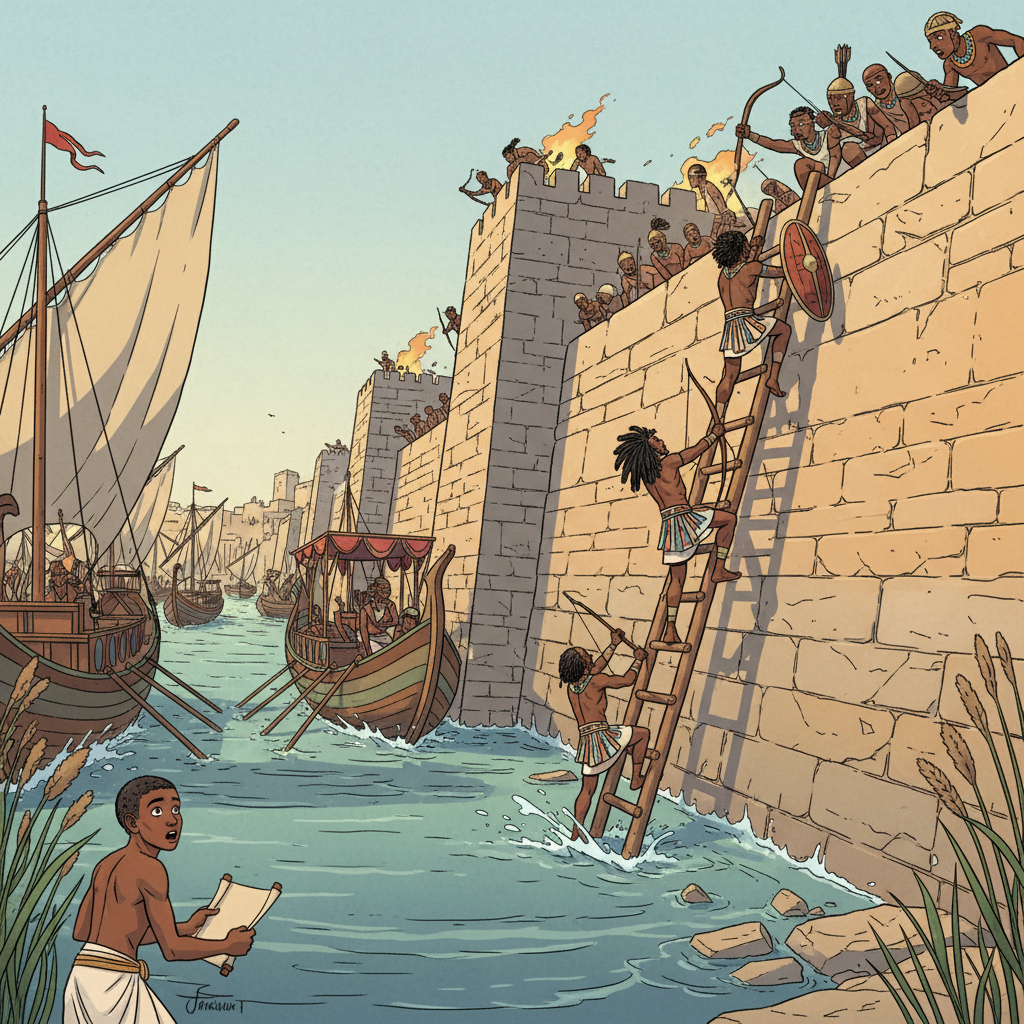
“Instead of a grinding siege, Piye devised a daring and unexpected plan. He ordered his ships, usually used for transport on the Nile, to be brought right up to the quay walls of Memphis. Imagine, {name}, the confusion and alarm of the defenders as they saw the Kushite warriors leap from the decks, scaling the walls directly, using the ships themselves as ladders!” “In a single, audacious assault, Memphis, the proud northern capital, fell. It was a victory born of cleverness and courage, demonstrating that Piye’s faith in Amun was matched by his tactical genius. Khumose watched, his reed pen poised, amazed at the speed and precision with which Maat had reclaimed this vital city. There was no time for traditional siege, only swift, decisive action.”
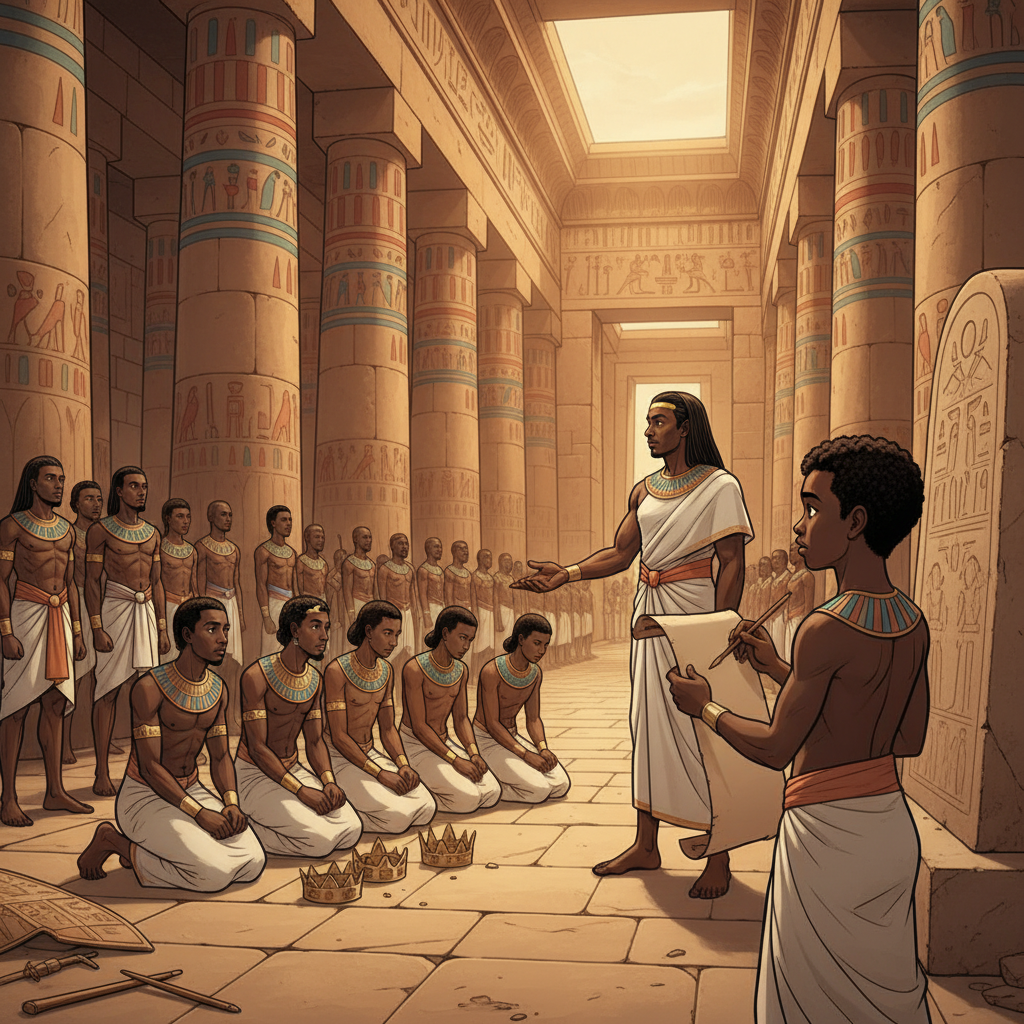
After the fall of Memphis, the remaining northern princes, their arrogance shattered, finally surrendered. They gathered, humbled and fearful, at the great Temple of Ptah, expecting a victor’s harsh judgment. Khumose, his heart racing, stood ready to record their abject submission, perhaps even their humiliation, for the historical record. Such moments were often etched in stone with scorn for the vanquished. But Piye, ever guided by Maat, had a different plan. He knew that true restoration wasn't about vengeance, but about healing. He approached the defeated rulers not with a sword, but with a question of their spiritual purity. This was not a moment for cruel triumph, but for a profound lesson in propriety and the true meaning of leadership.
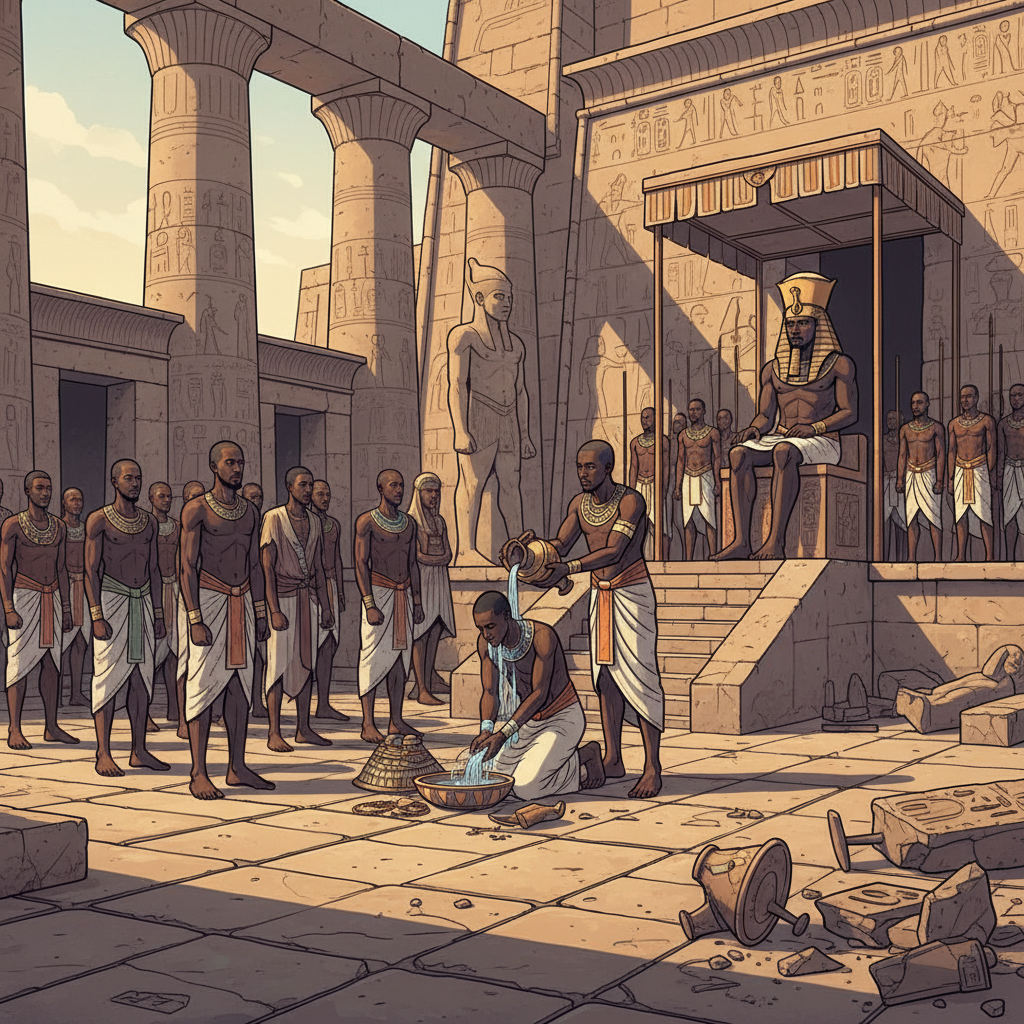
“To the astonishment of all, Piye refused to let the northern princes enter his presence until they had ritually purified themselves. Can you imagine their shock, {name}? These proud rulers, accustomed to power and privilege, now told they were unclean, unfit to stand before the Kushite pharaoh. It was a powerful, silent rebuke, not of their military defeat, but of their spiritual negligence.” “This wasn't meant as a humiliation, but a profound teaching. Piye understood that their fragmented rule, their Isfet, had led to the neglect of the neteru, the desecration of temples, and the abandonment of proper ritual. He demanded purification because true Maat began with a clean heart and a respectful spirit, a return to the sacred practices that bound Kemet together.”
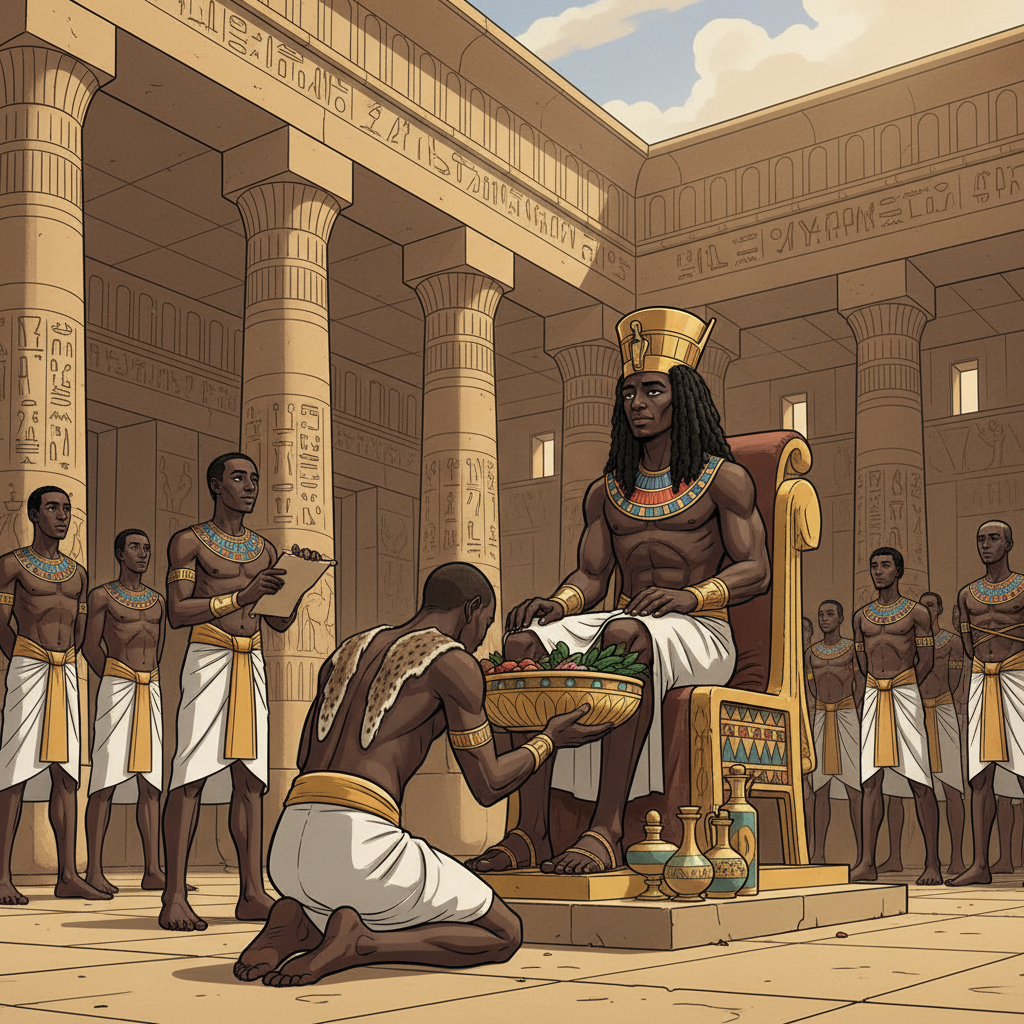
Only Nimlot of Hermopolis, the prince who had surrendered earlier and sought purification, was allowed into Piye’s sacred presence. He had understood Piye’s true intent, bringing with him the proper ritual cleansings and offerings. He alone could stand before the pharaoh, a testament to his understanding of Maat and his genuine desire for hetep. Piye’s message was clear: spiritual order superseded political power. He demonstrated that leadership was not just about governing lands, but about upholding the divine principles that sustained life itself. Khumose, observing this extraordinary scene, felt the weight of his reed pen, understanding that this moment, more than any battle, defined the true nature of Piye’s victory.
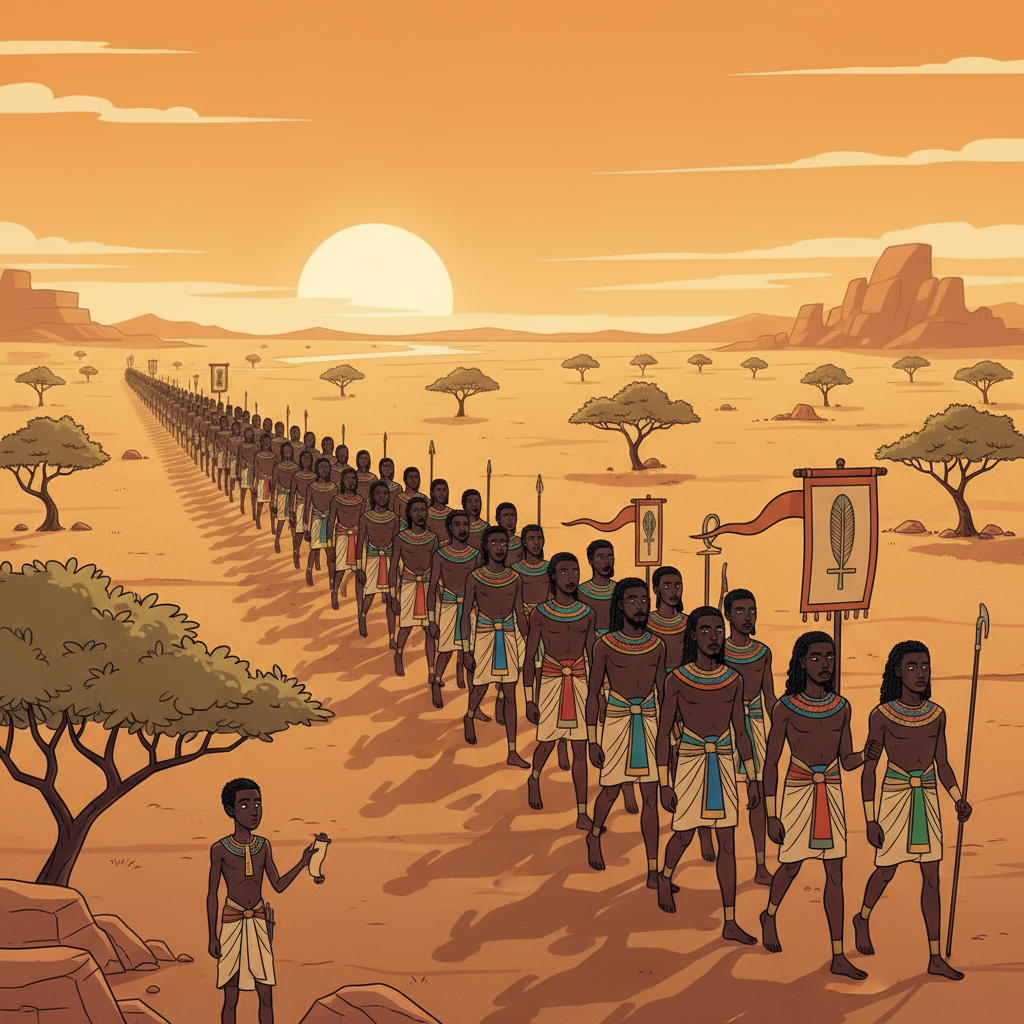
“Crucially, Piye ordered no plunder, no ransacking of Memphis or any other city. His army did not despoil the land or its people. This was not a conquest to enrich Napata with Kemetic treasures, but a restoration to enrich Kemet with Maat. He demonstrated that true power lay in restraint, in respect for the sacredness of the land and its heritage.” “Khumose, the young scribe, watched every gesture, every command. He saw a pharaoh who embodied the principles he taught. Piye returned to Napata with his army soon after, rather than staying to rule from Memphis, further proving his mission was about restoration, not occupation. This was a king whose heart belonged to Amun and the ancient traditions of Kush, his true homeland.”
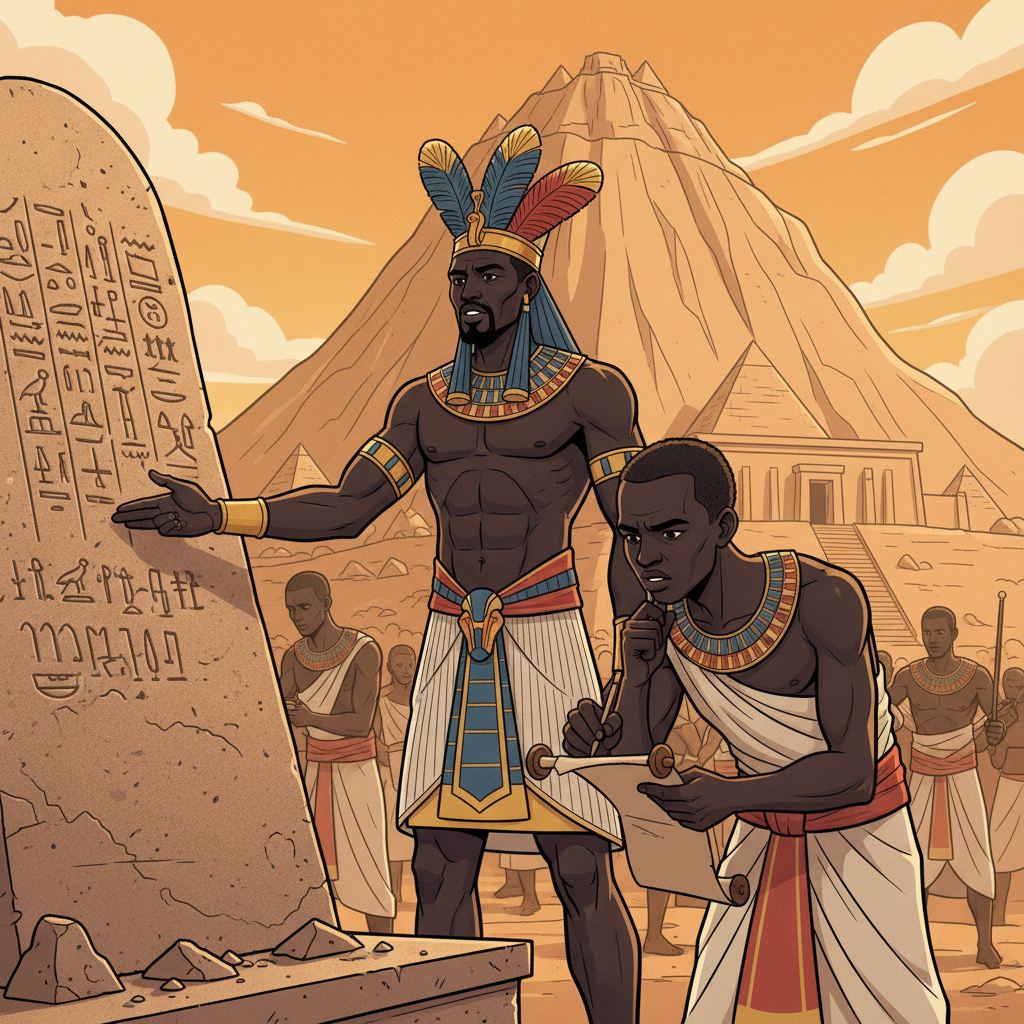
“Piye then commissioned the creation of a monumental stele, a towering slab of granite, to record his triumph for all time. This was the Great Triumphal Stele, a primary text, a voice from the past, to be erected at Gebel Barkal, the sacred mountain of Amun, a testament to the divine will and Piye’s unwavering faith. Its hieroglyphs would speak across millennia.” “Khumose was given the immense honor of assisting in the transcription of Piye’s own dictation for this stele. His heart pounded with the responsibility. How would he capture the nuances of this reunion? Would he, like many scribes before, record the northern princes with scorn, or would he reflect the profound Maat and mercy that Piye had shown?”
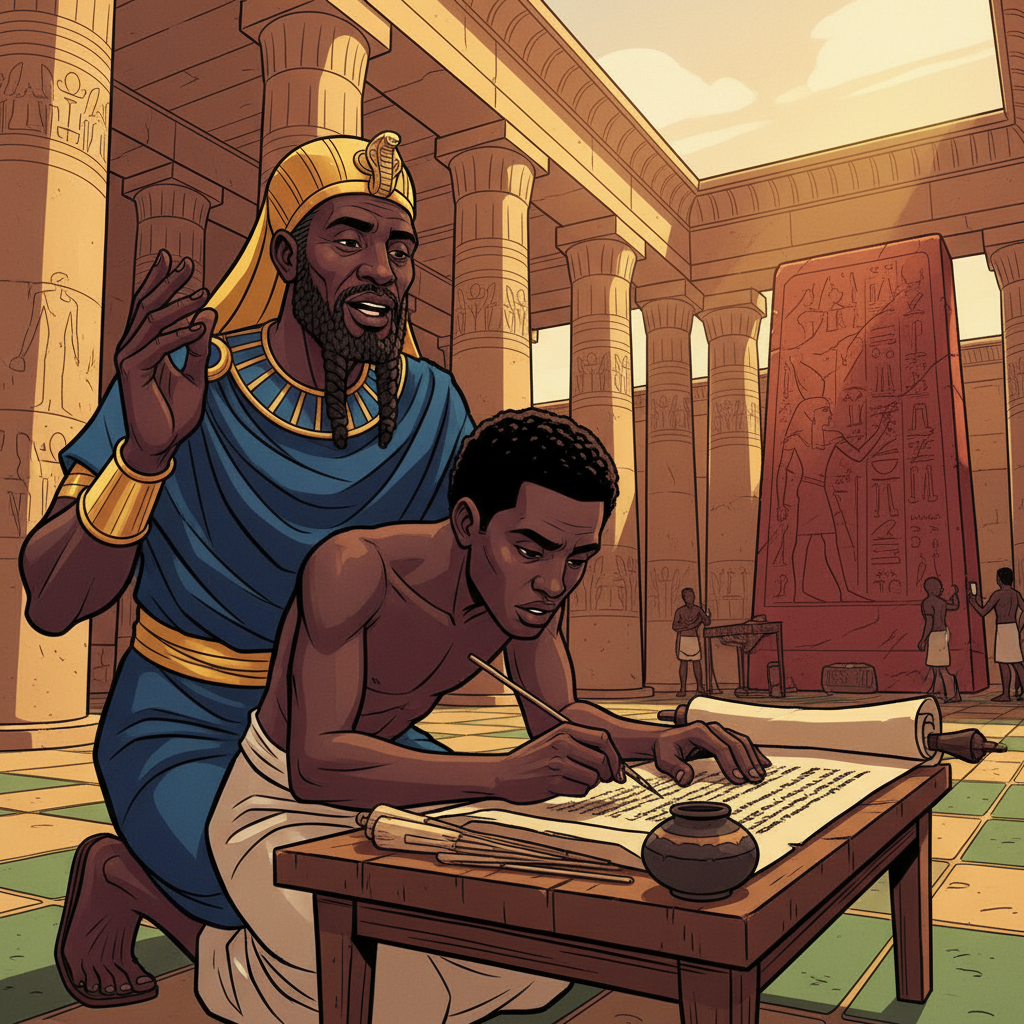
Piye began to dictate, his voice calm and authoritative, recounting his journey, his piety, and the divine mandate from Amun. Khumose listened intently, his reed pen flying across the papyrus, capturing every word. Piye spoke of the northern rulers’ fragmentation, their neglect of the neteru, and how their Isfet had torn the land apart. But then, Piye spoke of his mercy, his desire for true purification and healing, not just conquest. He emphasized that the purpose was to bring Kemet back to its true self, to reconnect it with its southern roots and the ancient ways of Maat. Khumose realized that the act of truthful recording was itself an act of Maat, a sacred duty to preserve the full, balanced story.
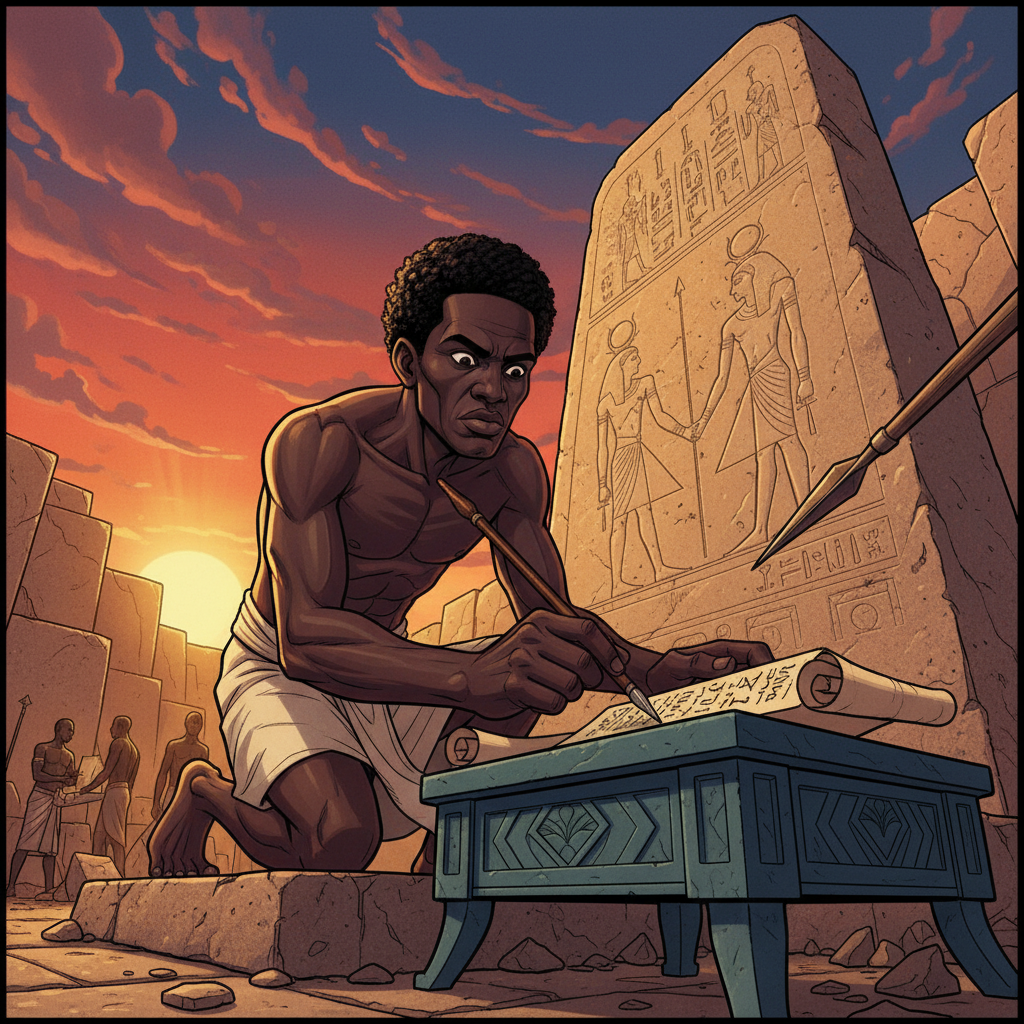
“Khumose understood that his reed was as mighty as any general’s spear. The truth he etched into the papyrus, and eventually into the granite, would shape how future generations understood this pivotal moment. He chose to record Piye’s actions not as a simple victory, but as a profound lesson in Maat, a pharaoh’s steadfast commitment to righteousness.” He carefully crafted the hieroglyphs, ensuring they conveyed the dignity Piye had granted even his defeated adversaries. The stele would not just celebrate a military success, but immortalize a spiritual restoration, a call for all of Kemet to return to the path of harmony, balance, and reciprocity, the very essence of hetep.
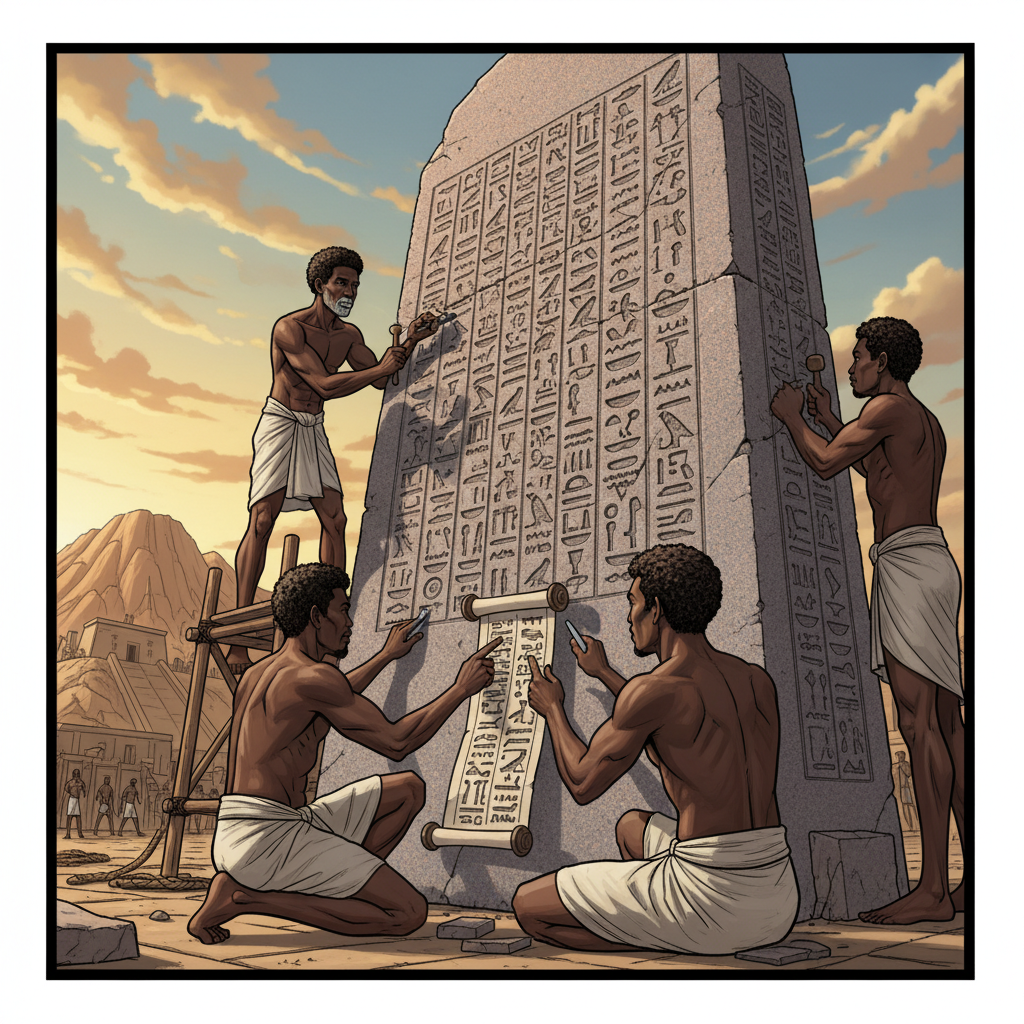
The massive granite slab, once rough and unyielding, slowly transformed under the skilled hands of the stone carvers, guided by Khumose’s transcription. Line after line of hieroglyphs, 159 in total, were painstakingly etched, telling Piye’s story for eternity. This was a record not just for the living, but for the ancestors and for the neteru themselves, a promise of Maat renewed. This stele, found at Gebel Barkal centuries later, became one of the most important primary texts of the African ancient world. It stood as a beacon, reminding all who saw it that true power comes from living in accordance with divine law, and that Kemet's strength lay in its profound connection to its southern, Kushite heartland.
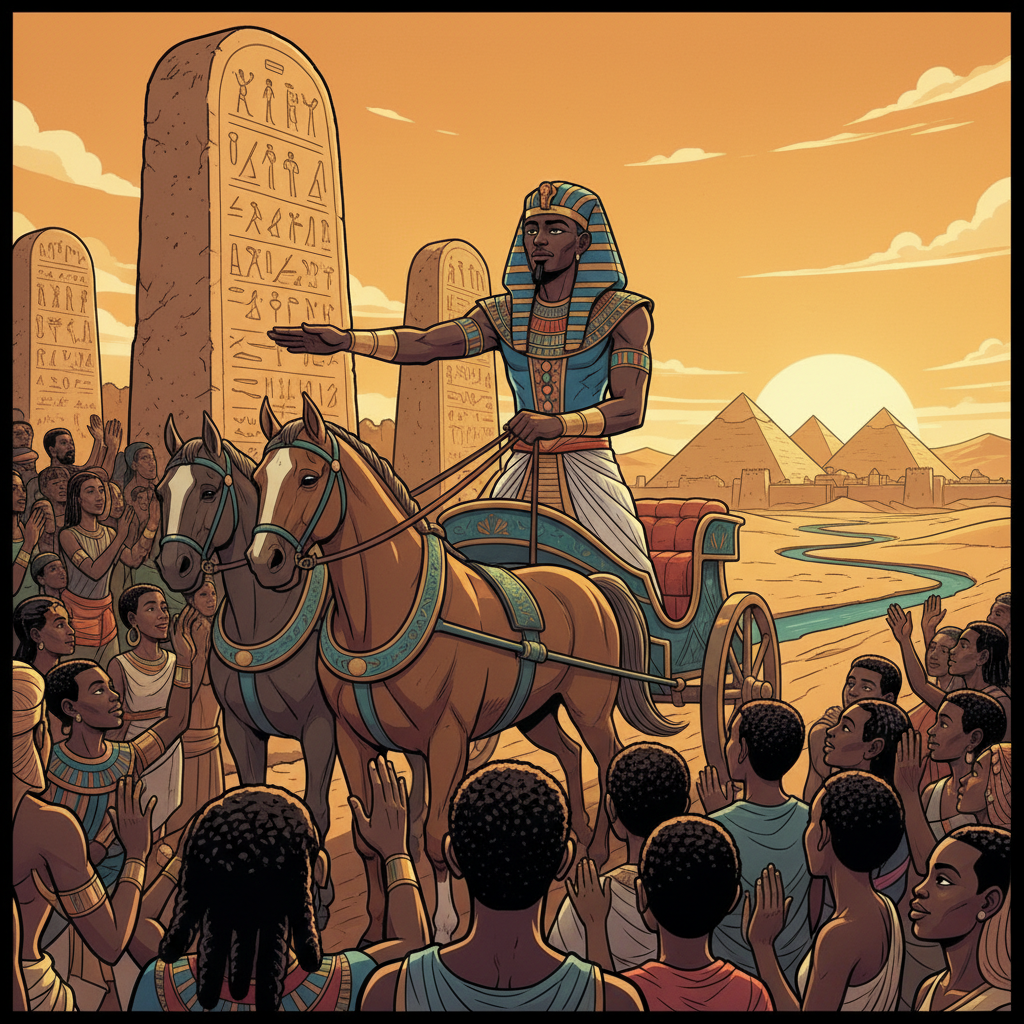
After his great work, Piye returned to his cherished Napata, the capital of Kush. He chose not to rule Kemet from Memphis, but from his southern home, demonstrating that his purpose was not to replace one fragmented rule with another, but to inspire Kemet to heal itself, guided by the principles he had re-established. This act of returning to Napata highlighted the unique nature of the 25th Dynasty. It was a reaffirmation of the deep spiritual and cultural connection between Kush and Kemet, not a foreign occupation. Piye was the son of Kush, bringing the wisdom of the south to nourish the north, much like the Nile itself brings life to all its lands.
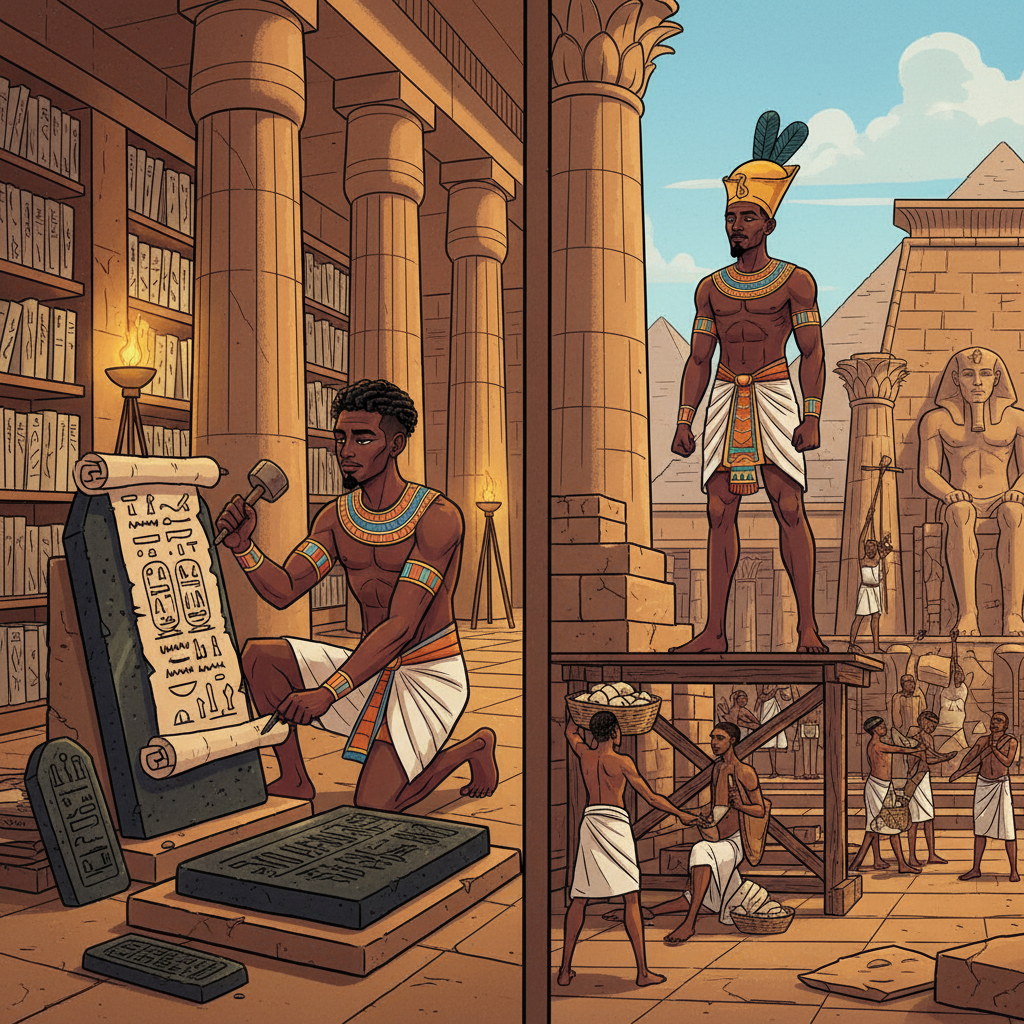
“The 25th Dynasty, these magnificent Kushite pharaohs, continued Piye’s legacy. Shabaka, his successor, famously preserved the ancient Memphite Theology by carving crumbling papyrus into enduring granite, ensuring wisdom wouldn't be lost. Taharqa, another great Kushite king, undertook vast building programs, consciously restoring the grandeur of earlier Kemetic ideals.” “Though the Assyrians, with their iron weapons, eventually pushed the Kushite pharaohs back south from Kemet around 656 BCE, this was not the end of our story. The heart of Kush continued to beat strongly, flourishing at Meroe, where powerful Kandake warrior queens would later challenge even the might of Rome, a city that was still just a village of mud huts when Piye ruled!”
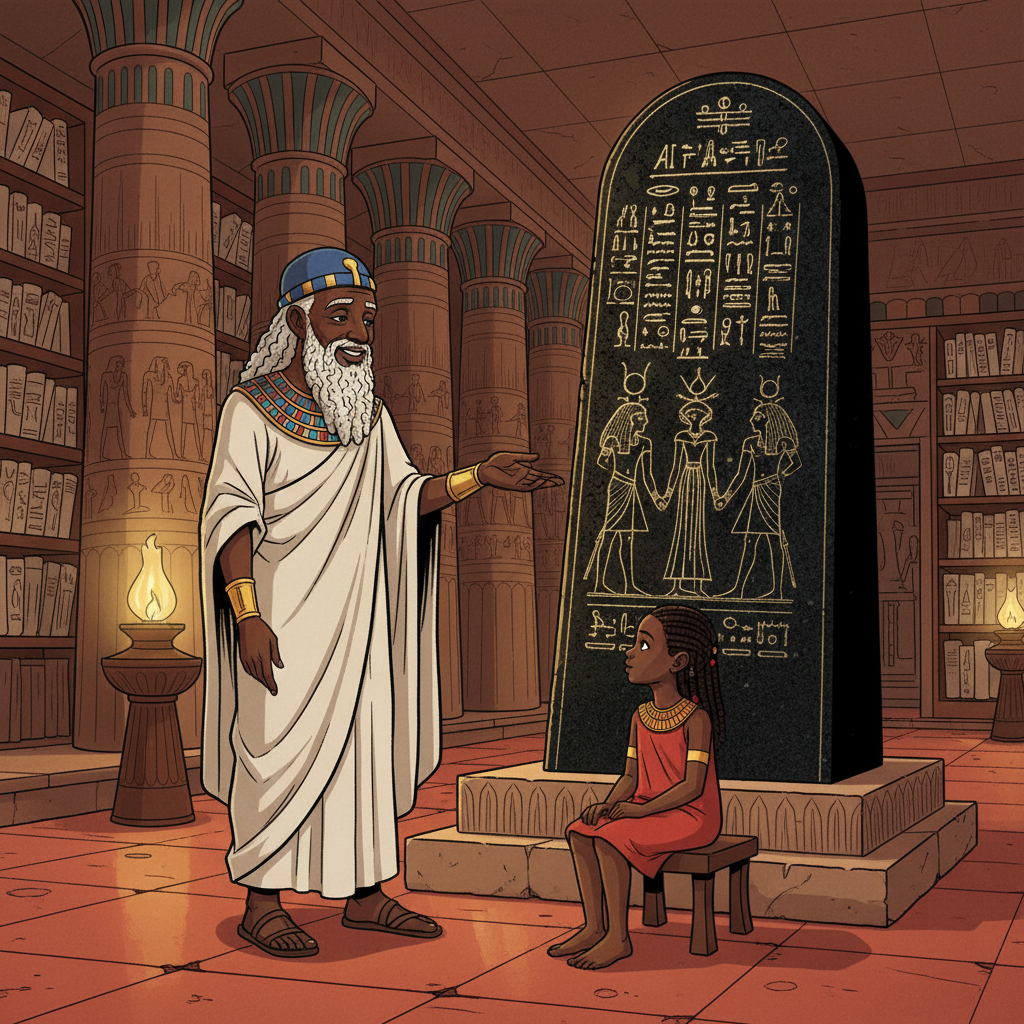
“The Great Triumphal Stele remains a powerful testament, {name}, to a time when Maat was restored by those who truly understood its sacred call. It reminds us that our history is rich with leaders who prioritized truth, justice, and harmony, even in times of conflict. It is a story of reunion, of a family reclaiming its heritage.” “Just as Khumose, the scribe, chose to record the truth with dignity, you too, {name}, are an heir to this tradition. Every time you choose honesty, every time you seek balance, every time you act with respect and understanding, you carry Maat in your own life. You are a living scribe, writing your story with the principles of our ancestors.”
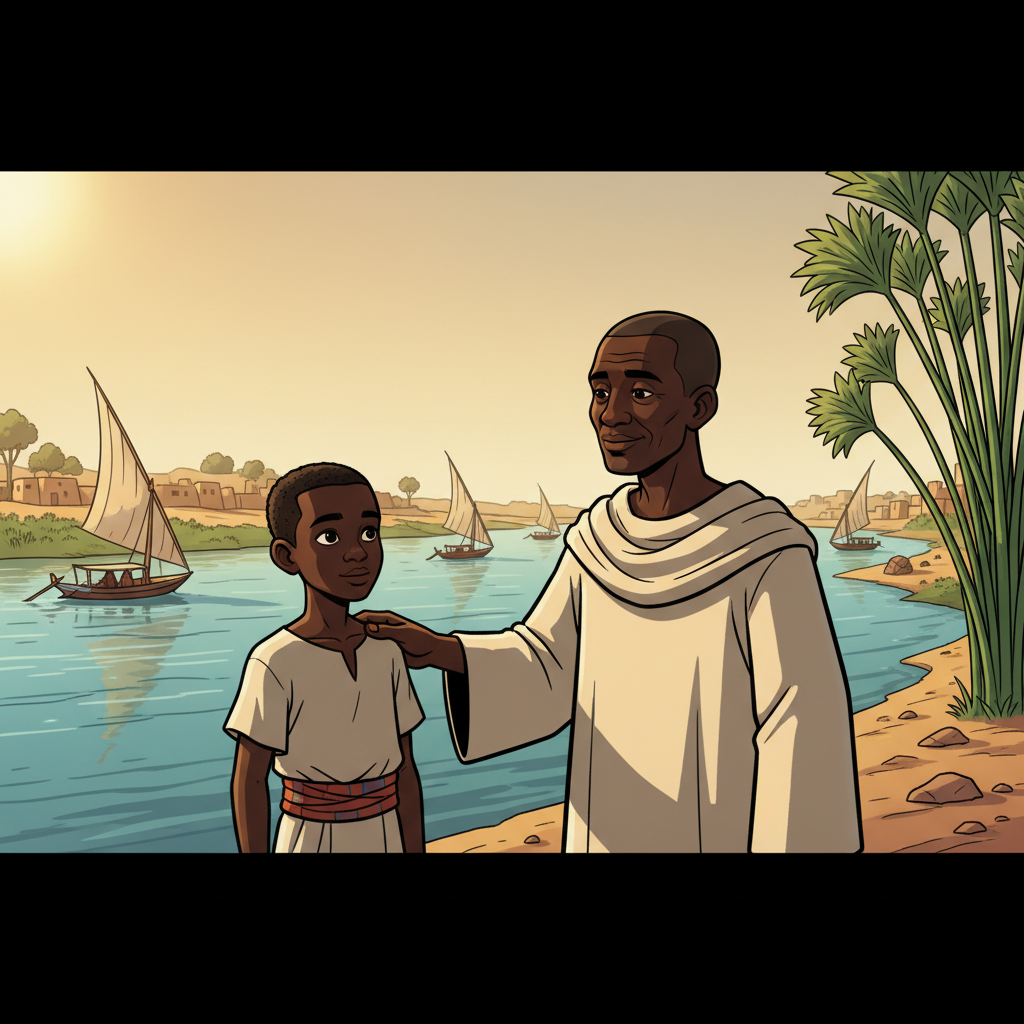
Seba placed his hand gently on the student’s shoulder. “Remember, {name}, our ancestors, the Kushite pharaohs, were not ‘black pharaohs’ as some distant lands might label them. They were Kemetic pharaohs, African pharaohs, who happened to rule from Napata, continuing a legacy that began with the very first kings of Kemet. Their skin was the same rich hue as the fertile soil of the Nile Valley.” “They embodied the strength and wisdom of our continent, a testament to the enduring power of African civilization. The 25th Dynasty reminds us that our roots run deep, far deeper than any fleeting challenge, and that the spirit of Maat, once kindled, can never truly be extinguished. It lives in you, in your choices, and in your understanding of our shared heritage.”
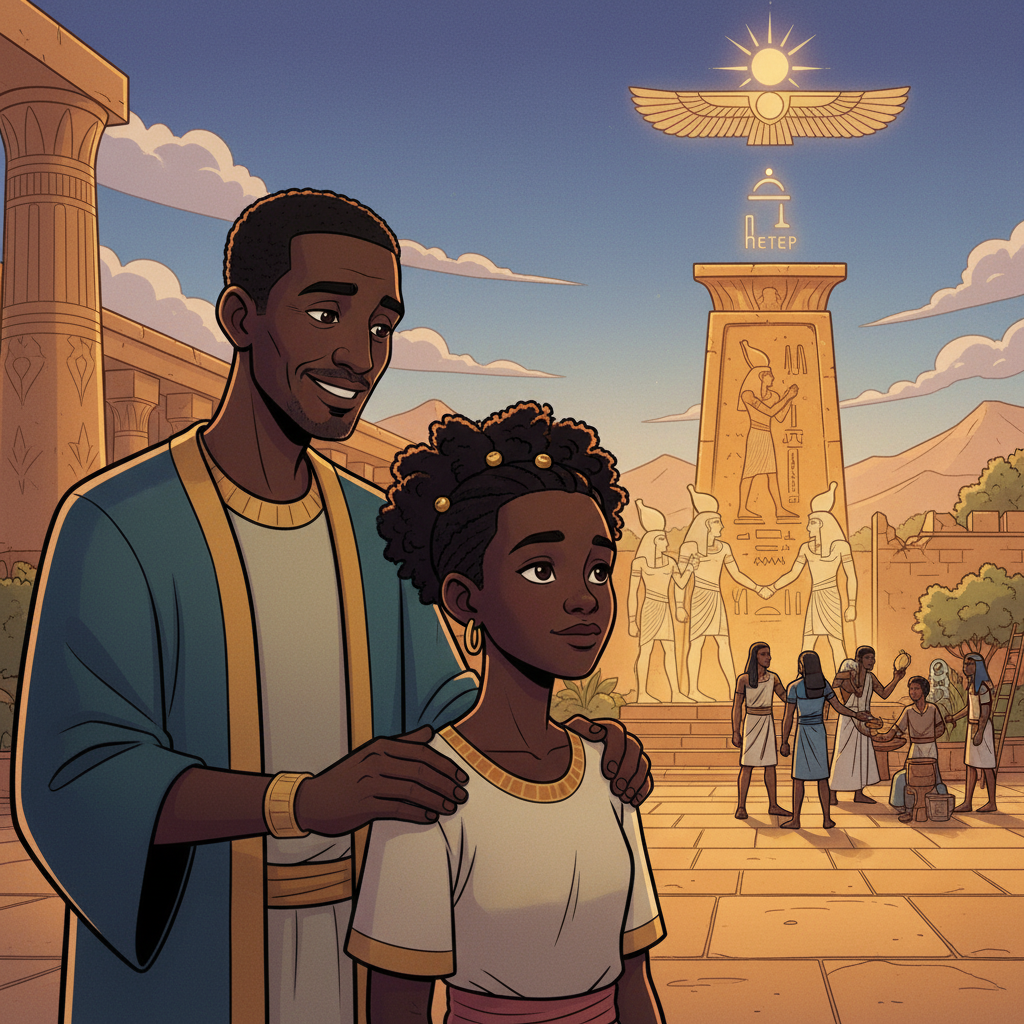
“This story of Piye, Khumose, and the Great Triumphal Stele is not just history, {name}. It is a living lesson. It teaches us that true strength is not in domination, but in restoration; not in division, but in reunion; and not in forgetting, but in remembering the sacred principles that guide us. It teaches us to seek hetep in our own lives and communities.” “So, as you walk through Waset, as you study our hieroglyphs, know that you carry the legacy of these great pharaohs. You are a guardian of Maat, just as they were. Let your actions reflect the truth and mercy that Piye embodied, and let your spirit shine with the harmony of our ancestors. The journey of Maat continues with you.”