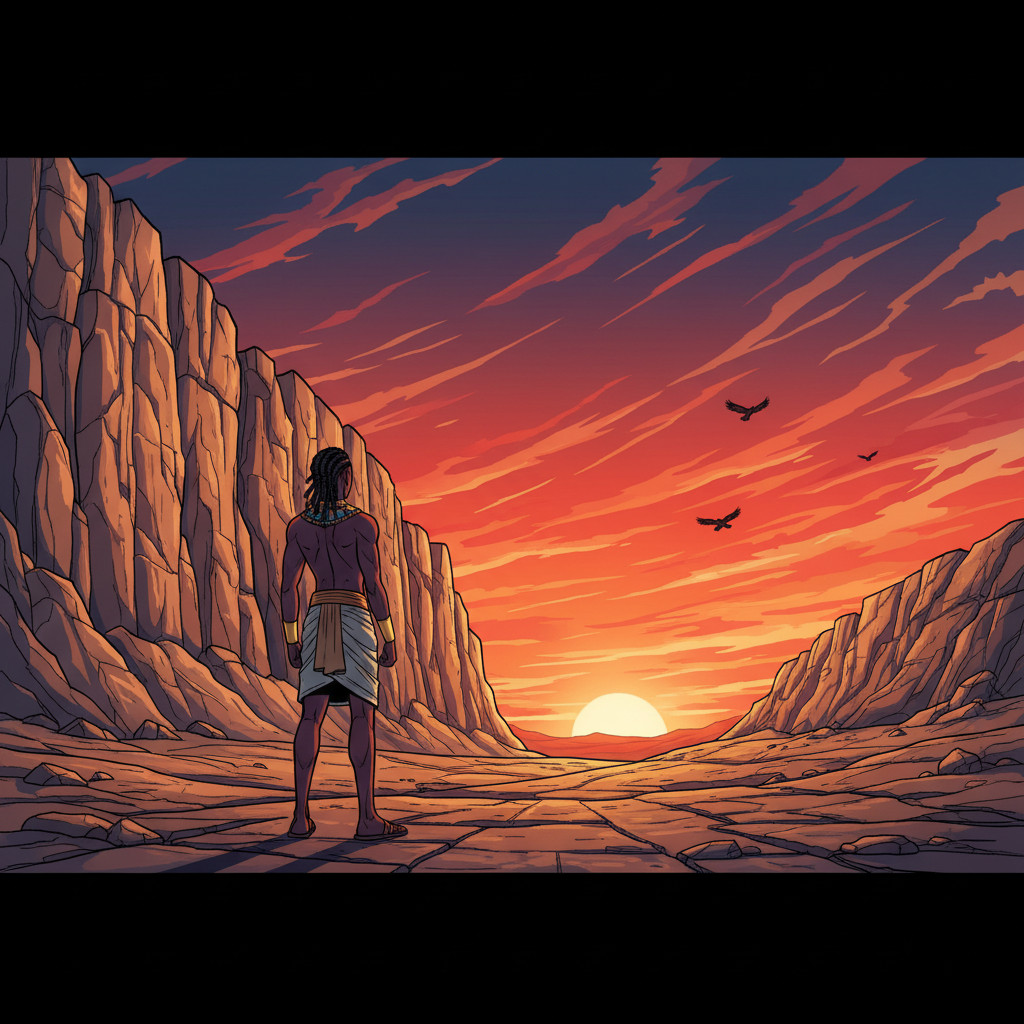
The sun was already low when Khonsu took his post at the mouth of the valley. He stood with his back to the cliff and his face to the west, where the last light was bleeding out of the sky in long red streaks. The valley itself was a dry cleft in the rock behind Waset — a hidden place, chosen for its emptiness. Medjay captains called it the Great Place. The priests of the pharaoh called it something older. Khonsu called it his post. His sandals left no print on the stone. The wind moved through the ravine and fell silent against the cliff faces. Two hawks turned on a high thermal and cried once to each other before they slid out of sight. The valley waited. Khonsu waited. This was the first rotation at the new necropolis.
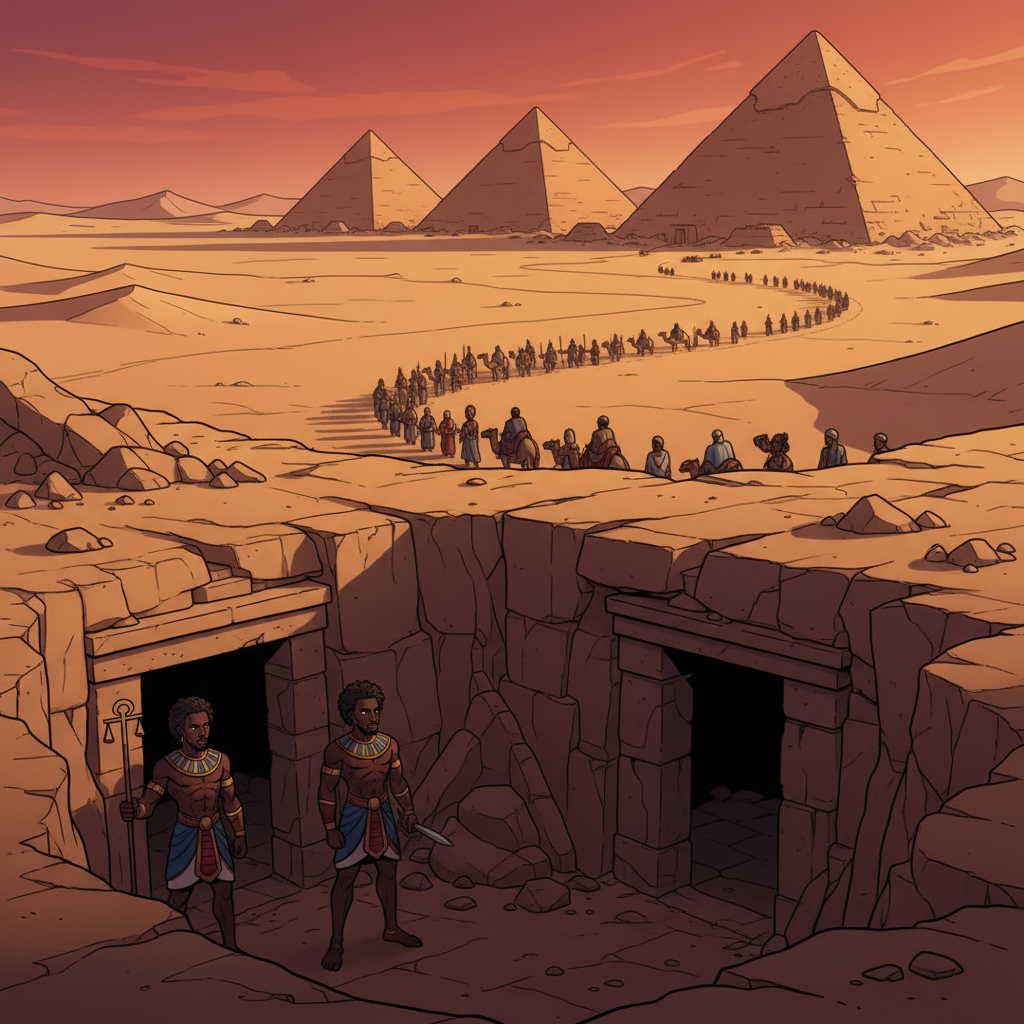
The pharaoh Thutmose I had given the order only a year before. His tomb would not be a pyramid. Pyramids drew thieves the way honey drew flies — a man could see them from a day's march away, and every generation since their raising had watched them picked over. The new practice was hiding. A hidden tomb cut deep into the cliff face. No marker on the valley floor. No pyramid pointing at the sky. The stonecutters had begun the first shafts that season. The chamber itself was still raw rock, unpainted, empty. Empty, and yet already sacred. Already under oath. The Medjay were posted at the valley mouth before the pharaoh had even finished living. Khonsu had drawn the rotation. The duty was simple on paper. The duty was heavy in practice. He had been warned of both.
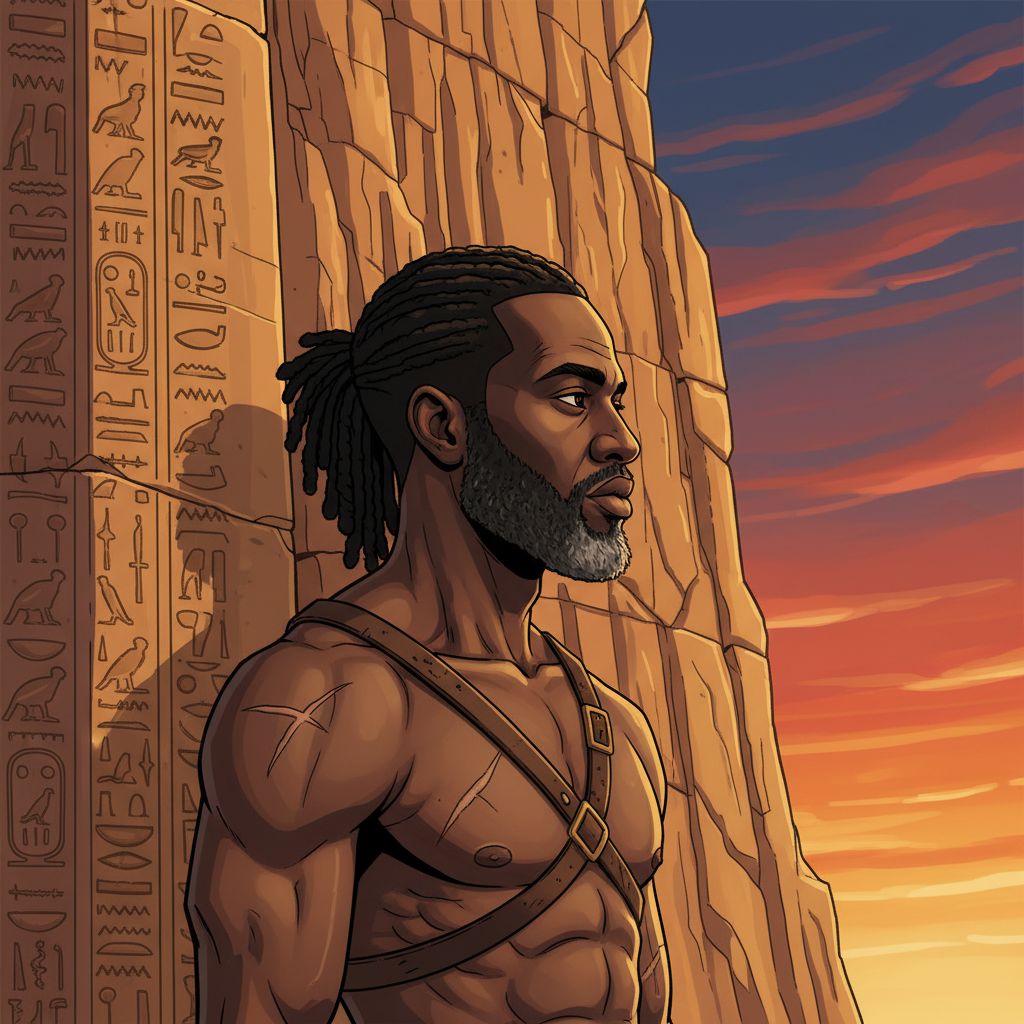
Khonsu was not a young Medjay. He had thirty-four summers on him, and his beard carried the first grey along the jaw. His temples had gone silver early, the way his father's had. His skin was deep ebony, weathered from campaign seasons, and across both shoulders lay the three ritual scars of a veteran who had served in the southern frontier. The Medjay of his company cut their ritual marks into the meat of the shoulder, where the armor covered them in daylight. He had seen many things that soldiers did not talk about. He was not romantic about duty. He had watched romance die in other men. What was left when romance died was the thing itself, the oath, plain. He did his duty anyway. That was all.
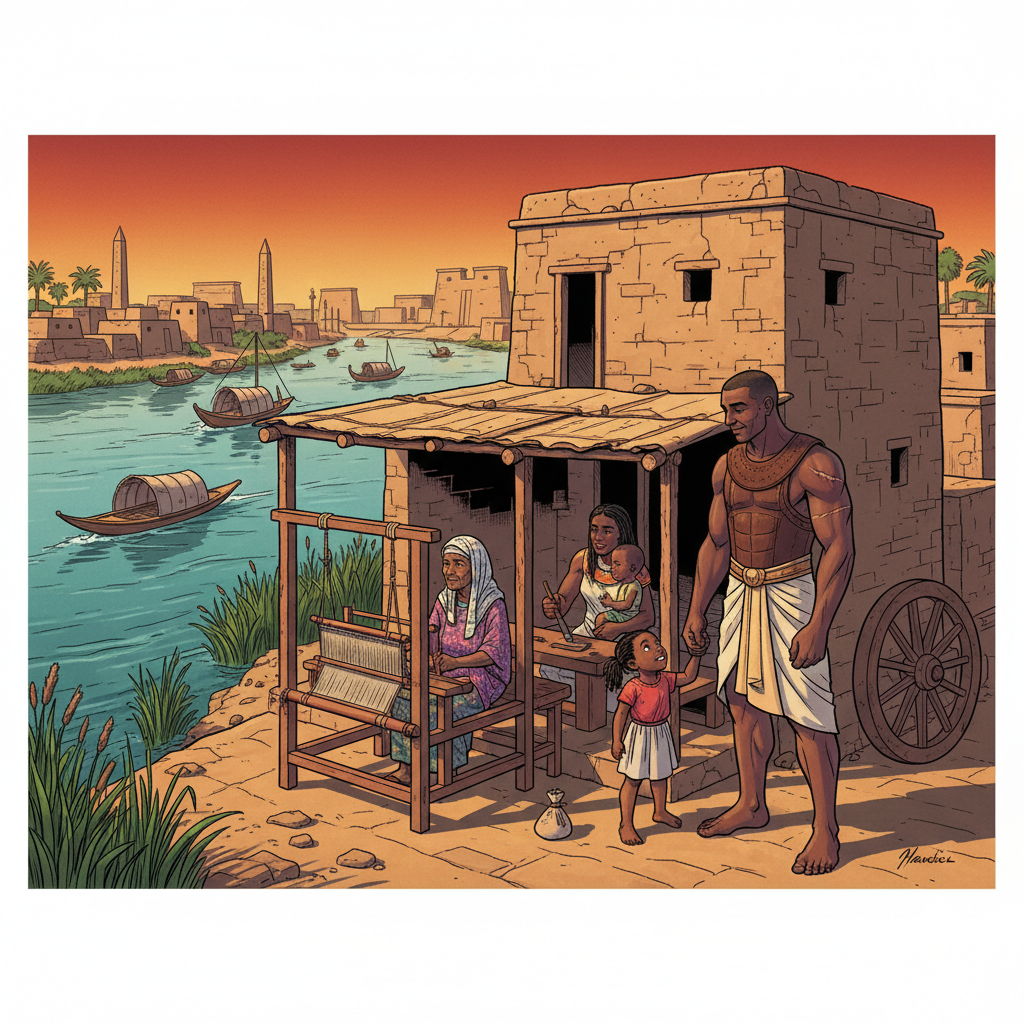
His family lived across the ridge in Waset. His mother was a widow — his father had died in the same southern campaign that had given Khonsu the three scars on his shoulders. She kept a small mudbrick house near the river and wove linen on a borrowed loom. His younger brother Pen-heb was twenty-eight, a cartwright who had never taken to the Medjay life. Pen-heb had a wife, a daughter of four, and a son of two. They shared the house with Khonsu's mother because rent anywhere else in Waset had climbed past them. They scraped by. Khonsu sent part of his ration to them each month. The children called him Uncle. The little girl would not let go of his hand when he visited. That was the family. That was the other side of the oath.
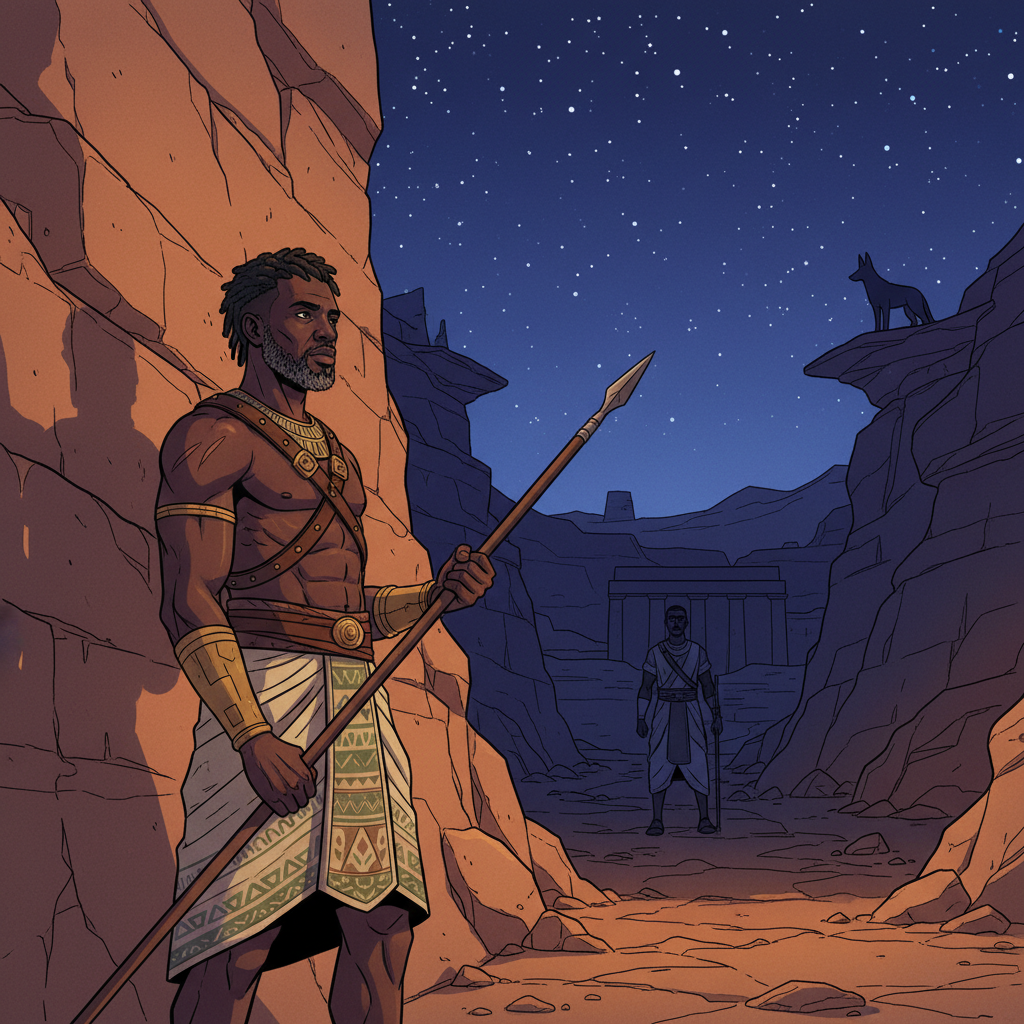
Second watch. The stars had come out thick and cold above the valley. Khonsu stood at the narrow throat where the path from Waset met the ravine floor, leaning his back against the sandstone wall so he could see in both directions without turning. A jackal yipped once in the higher crags. The pharaoh's tomb was two bends deeper into the valley — unlit, unguarded except by him at this hour. No one came this way at night. That was the point of the valley. Then he saw the figure. A man, alone, walking up the path from the direction of the city. Not an officer. Not a runner. A walker, heavy-footed in the way of someone coming a long distance. Khonsu lifted his spear off his shoulder and waited. Then the moonlight caught the face. He recognized it before he wanted to.
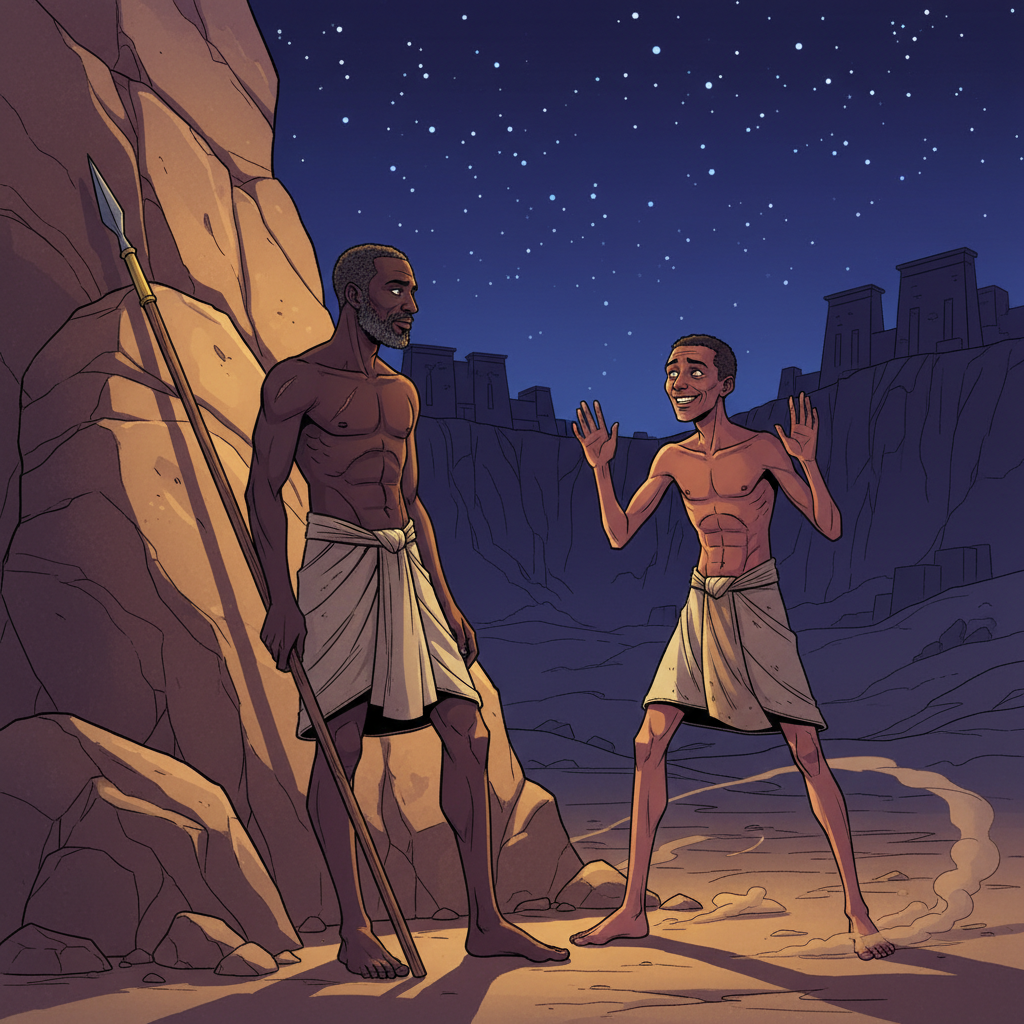
"Pen-heb." His brother stopped ten paces short, hands raised to show they were empty. He was thinner than Khonsu remembered. His kilt was dusty from the road. His smile was the wrong smile — too quick, too anxious. "Brother," Pen-heb said. "I wanted to see you. The children have not seen you in a season. Mother asks after you." Khonsu let the silence sit between them for two full heartbeats. The wind shifted. The smile on his brother's face held too long. Khonsu leaned the spear against the rock. He looked at Pen-heb with the same flat patience he had once used on captured smugglers in the south. "You did not walk ten miles in the dark to say hello." The smile faltered. That was all it took. Two heartbeats. The truth was already in his brother's eyes.
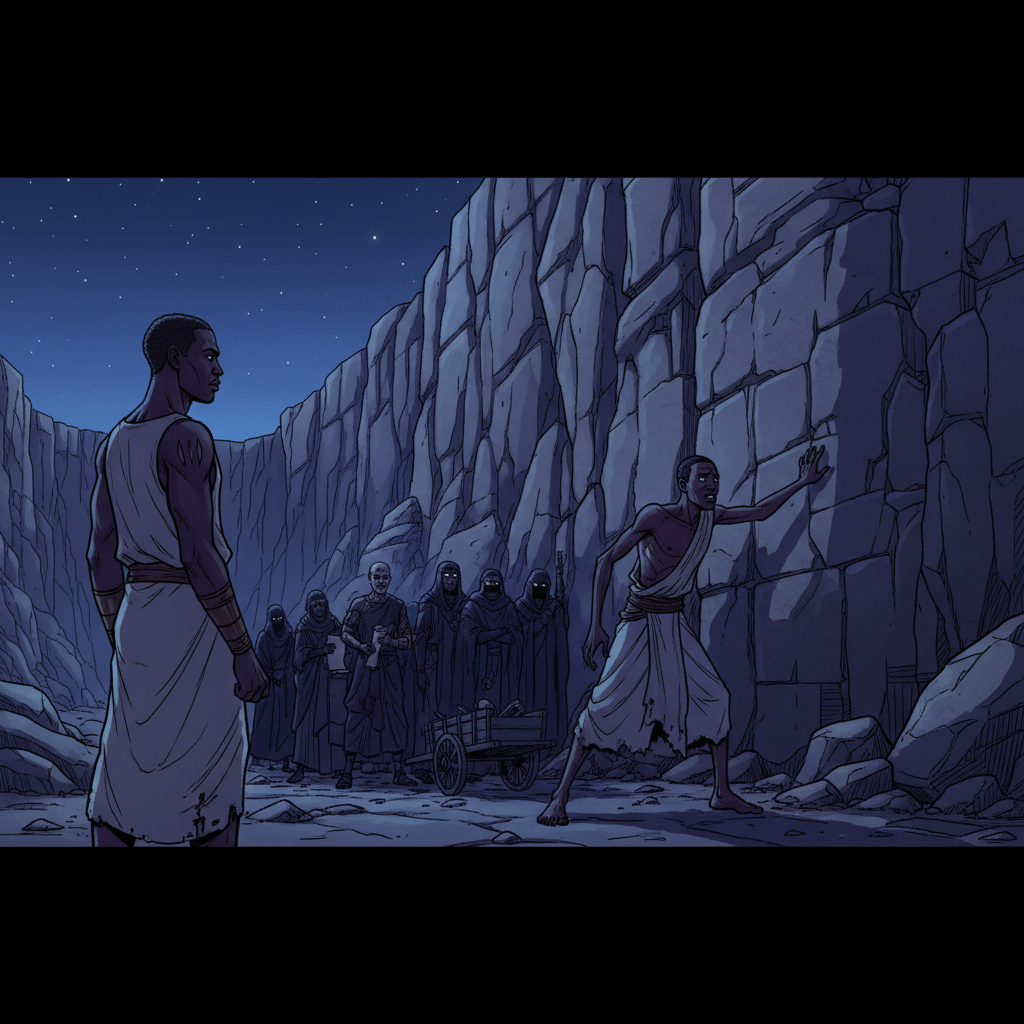
Pen-heb's voice dropped. He looked at the ground first. Then he looked at the cliff wall. Then, finally, at Khonsu. "There are men," he said. "I have been with them for a month. Maybe less. A cartwright hears things. They know the valley. One of them was a priest of the necropolis — dismissed, but he kept the drawings. They know where the first shaft opens. They know which chamber holds the grave goods of the old vizier, finished last season, already sealed." Khonsu did not interrupt. Pen-heb pressed on. "They want one item. Small. A pectoral of gold with the wedjat eye. It weighs no more than a child's sandal. They can have it out in an hour. The fence is already arranged. My share — my share feeds my family for a year, brother. A full year."
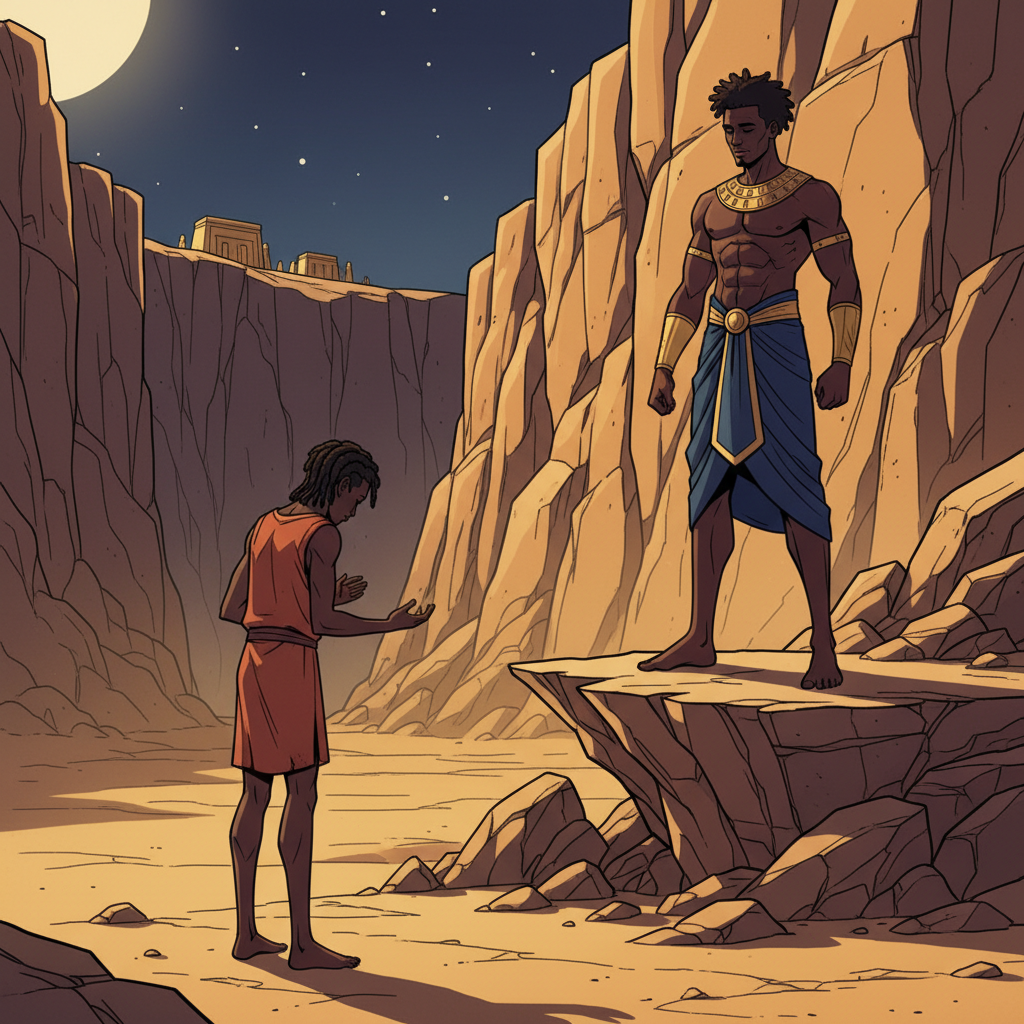
"And what do you need from me." Khonsu's voice was level. He already knew. He just wanted his brother to say it aloud, because Maat required that a man speak his own ask and own it in the air. Pen-heb swallowed. "You walk a different perimeter path tonight. For one hour. Just one. You do not enter the valley floor — you take the upper ridge. You do not see what is not there to see. You do not steal. You do not lie. You do not carry anything out. You simply walk the other path. That is all." He said it quickly, as if speed would make it smaller. "They do the rest. You never touch the tomb. You never touch the gold. A different path for one hour. That is the whole ask, brother."
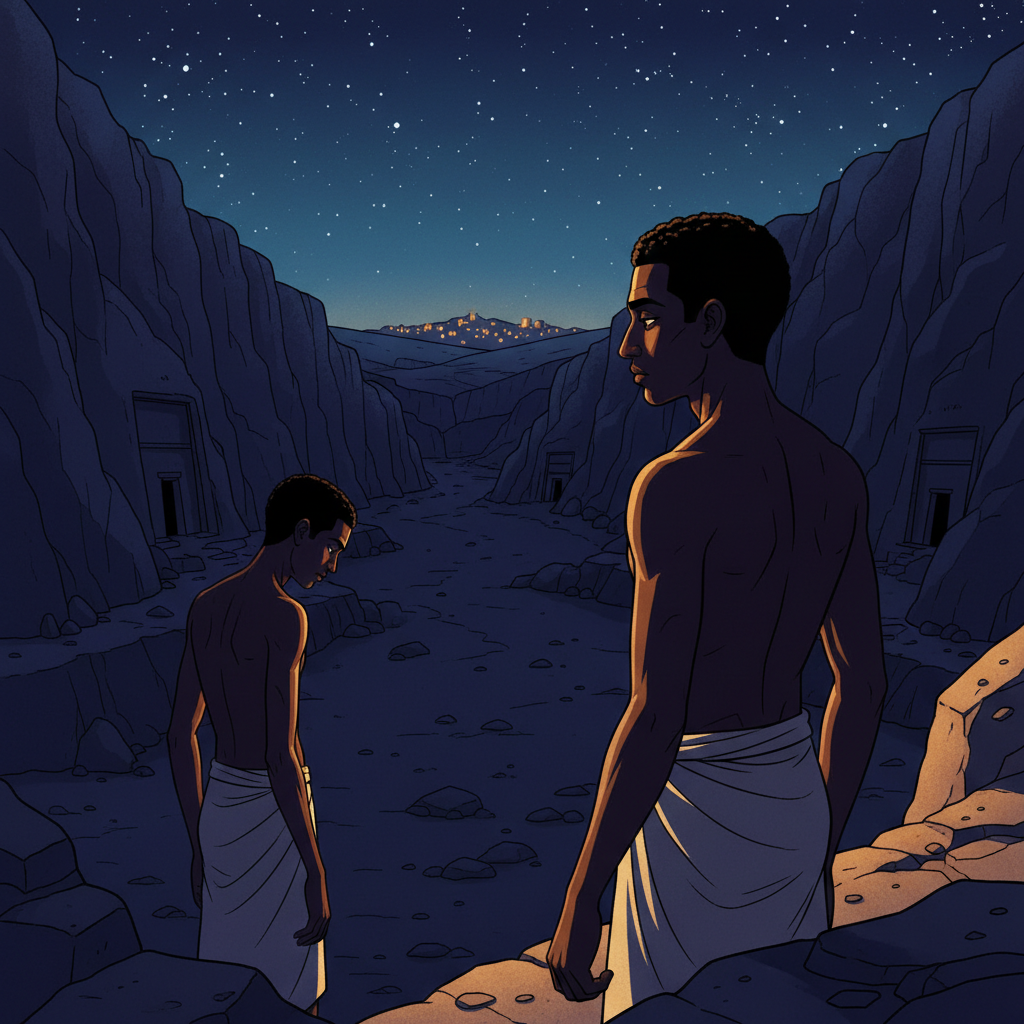
Khonsu did not answer. He looked past his brother at the valley floor, dark now, the cliff walls folding the starlight into pockets of shadow. Somewhere in that rock the pharaoh's unfinished chamber waited, empty as a pressed palm. Somewhere on the other side of the ridge, in a mudbrick house in Waset, his little niece was sleeping on a mat, her small thumb in her mouth, the way she always slept. His oath to the dead pharaoh was real. His oath to the children of his brother was also real. The dead pharaoh could not see him. His niece could. If he did this one thing — walked a different path for one hour — no living person would be harmed tonight. That was the argument. It was a good argument. That was the trouble with it.
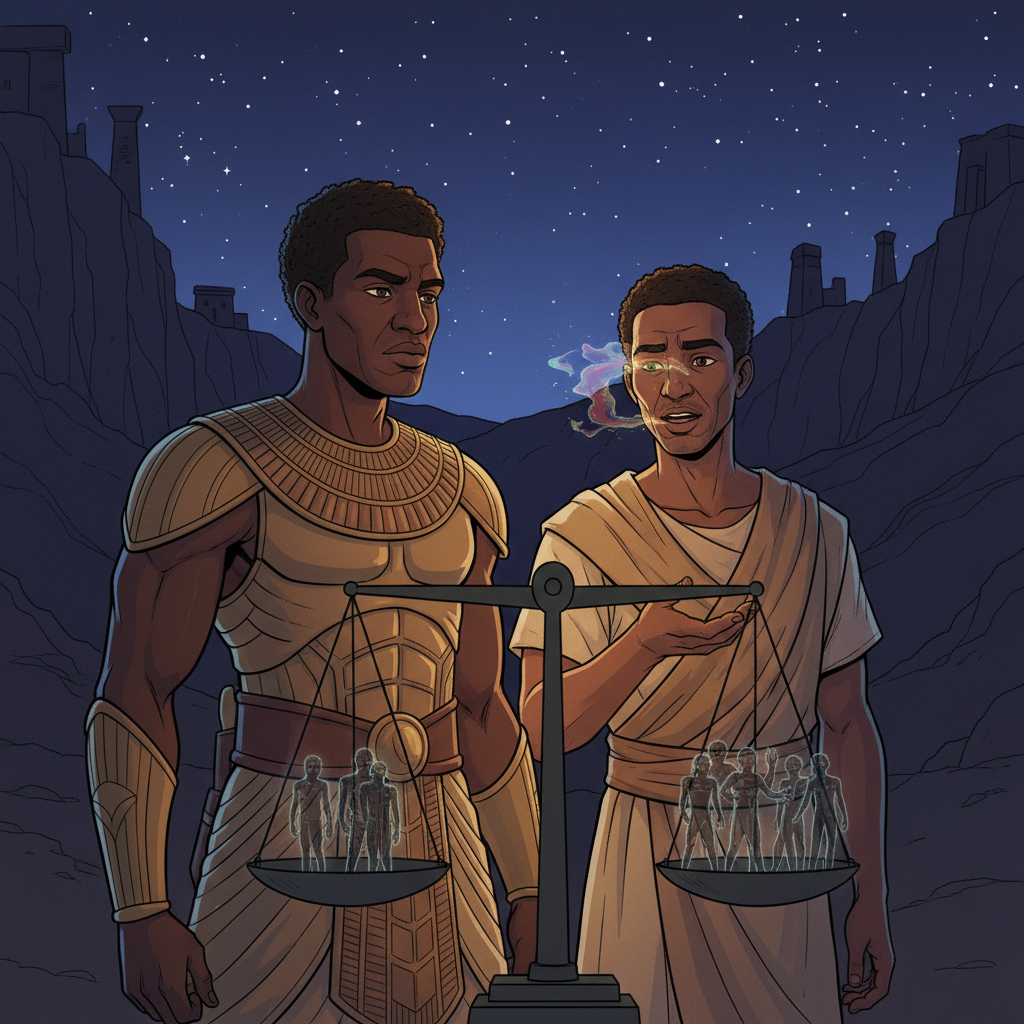
He felt Isfet moving in the valley air. Not as a monster. Not as a scream. Isfet was only ever a small shape, a convenient thing, a reasonable favor with a brother's face on it. It asked him to bend one hour. To trade the silent, unseeing dead for the loud, living hungry. It offered him a story he could tell himself for the rest of his life: I did nothing. I only walked. The oath he had taken at the founding of this rotation rose in his chest — the promise that Kemet would not again lose its kings to thieves, that the Medjay would be the living wall around the sleeping pharaohs. If he stepped off that wall for one hour, the wall was already broken. Reciprocity. He owed both. Tonight he had to choose which pan of the scale to lift first.
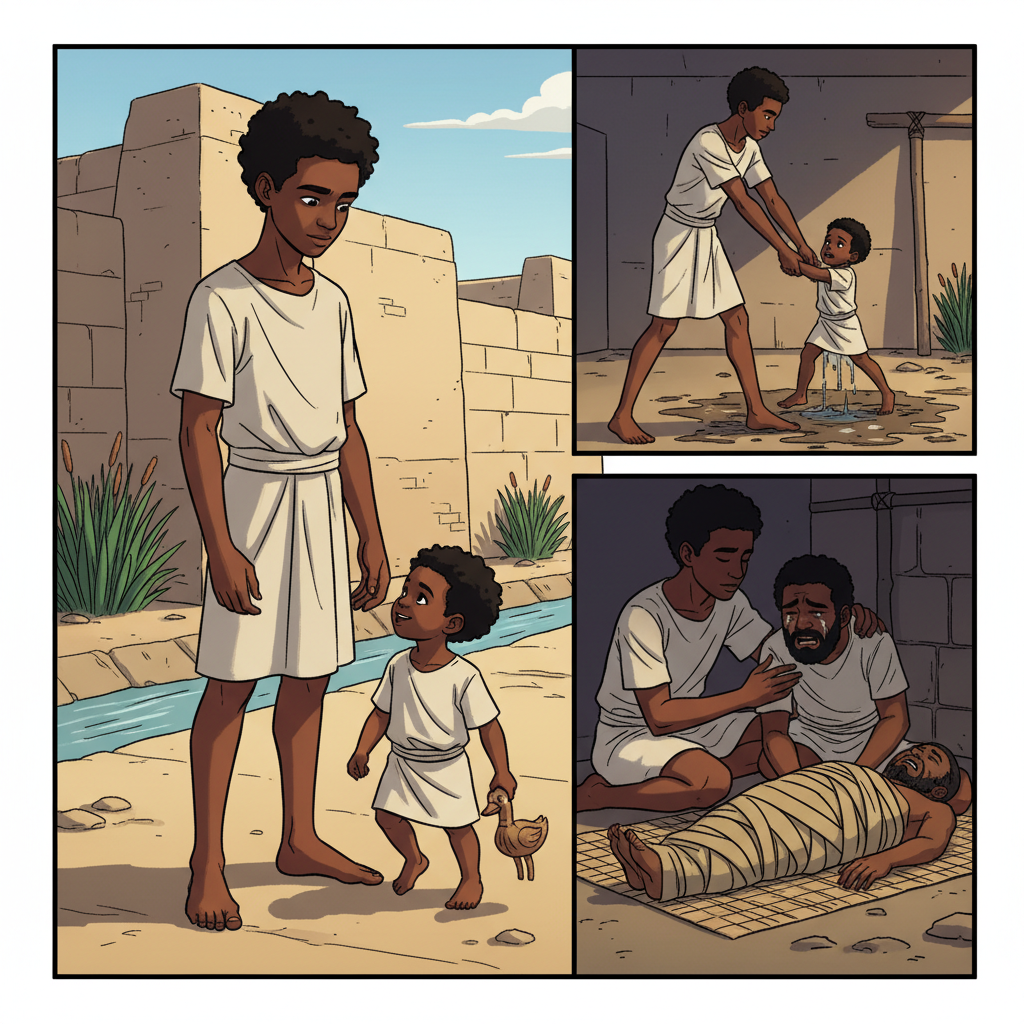
He did not answer right away. He looked at Pen-heb and remembered them as boys in the compound behind their mother's house. Pen-heb as a small child, no higher than Khonsu's hip, trailing after him with a carved wooden duck in his fist. Pen-heb falling into the canal and Khonsu hauling him out by the back of his tunic before the water took him. Pen-heb at seventeen, crying in the corner when their father's body came back wrapped in reed matting from the southern campaign. Khonsu had always been the older one. The one with the steadier voice. The one who said, Walk home, I will handle this. Now his brother was twenty-eight and a father himself, and he was standing in a necropolis asking his older brother to bend the duty that had kept them both alive.
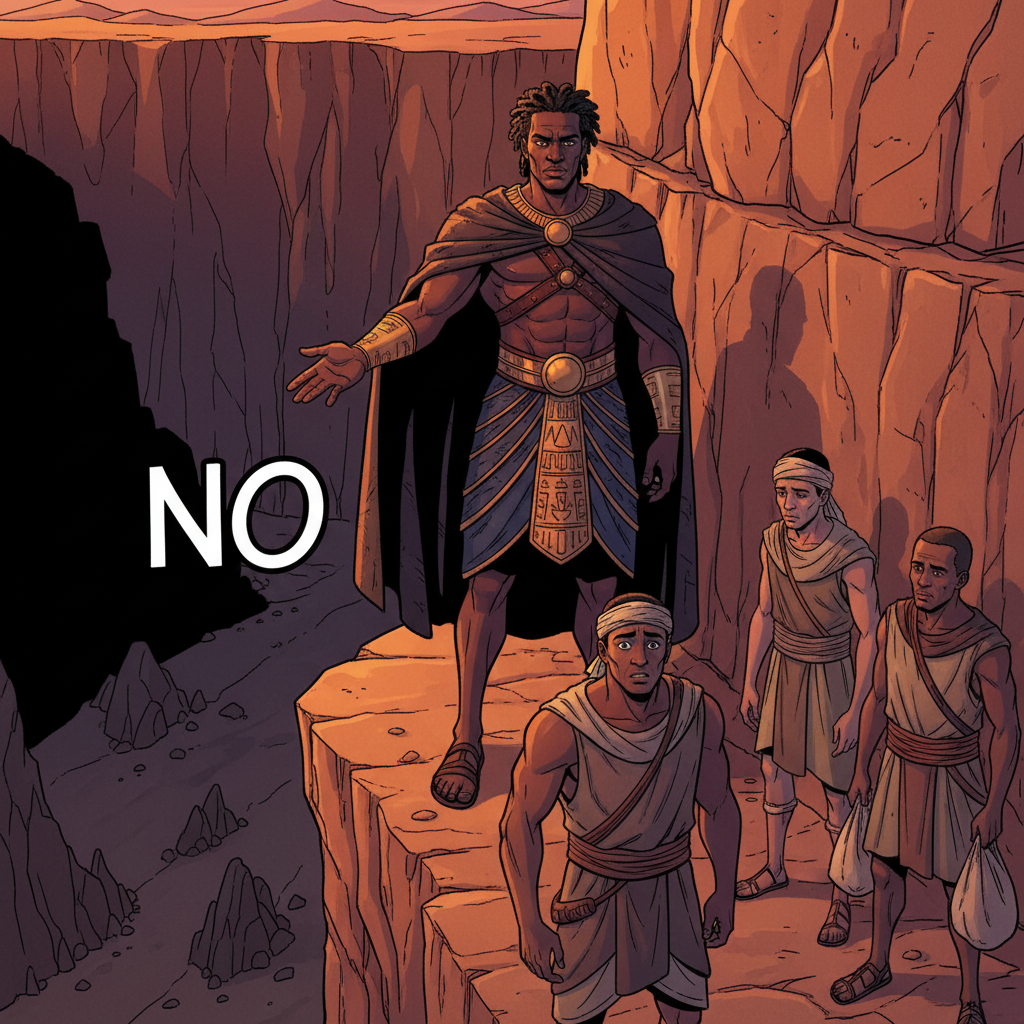
Khonsu spoke quietly. Not angrily. Anger would have made it easier to brush off. He said: "No." He let the word stand a moment in the air. Then he said: "Pen-heb, listen to me. Walk back down this path tonight. Do not come up it again. Do not speak of this to the men. Tell them the Medjay at the valley was the wrong Medjay. Tell them it cannot be done. Go home to your wife. Sleep in your own mat. In the morning, take the cart out and find three cartwright jobs before the sun is high. If the children are hungry, I will send more of my ration. But you will not take this path into the tomb, and I will not walk the other ridge tonight. Do you hear me." His voice did not rise.
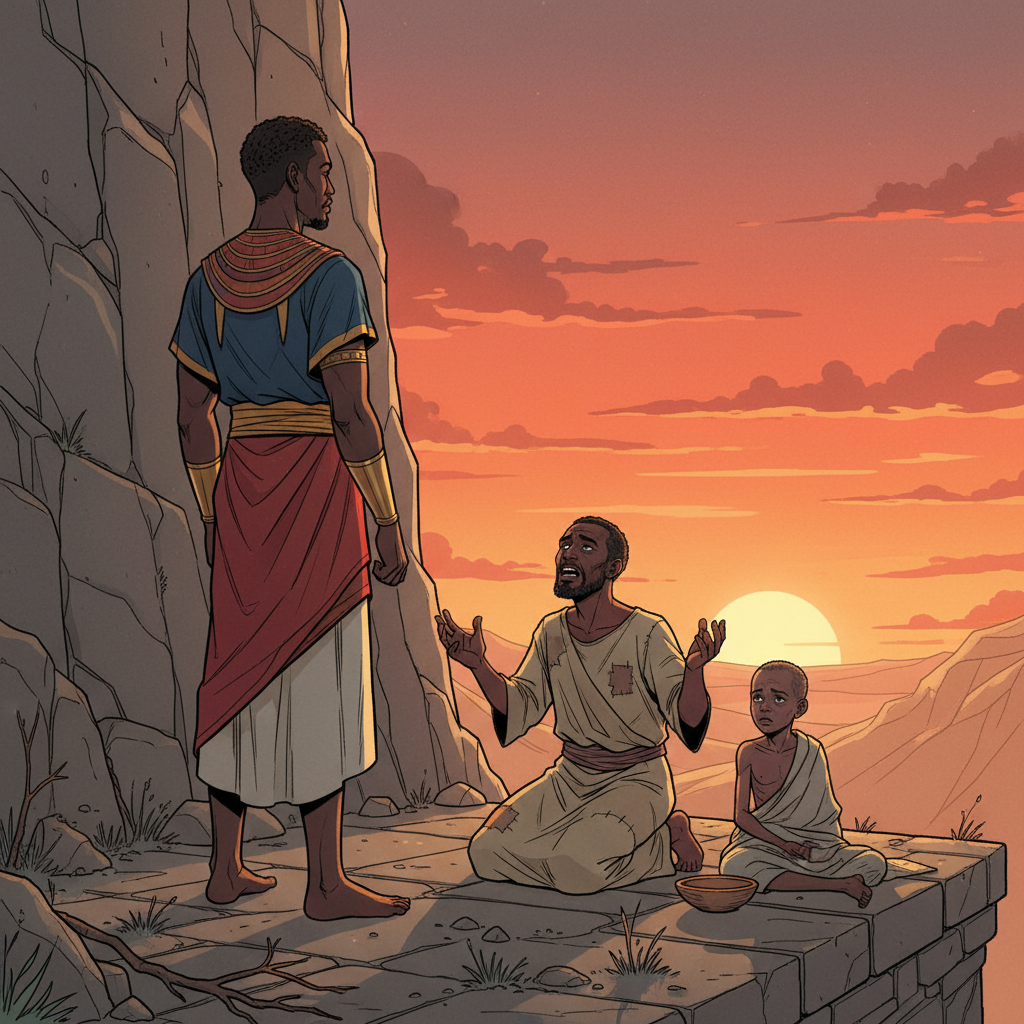
Pen-heb's face broke. His hands went up, palms open, empty again, the way they had been when he arrived. "Brother," he said, and his voice cracked on the word. "The little one asks for bread I cannot give her. She does not cry, and that is worse. Winter is coming. The rations from mother's linen will not cover it. You know this. I know you know this. I am not asking you to steal. I am asking you to walk a different path for one hour. One hour. That is all my children are worth — one hour of a different path. Please." Khonsu heard every word. Every single word. He did not flinch from them. He did not pretend they did not land. And the refusal held anyway.
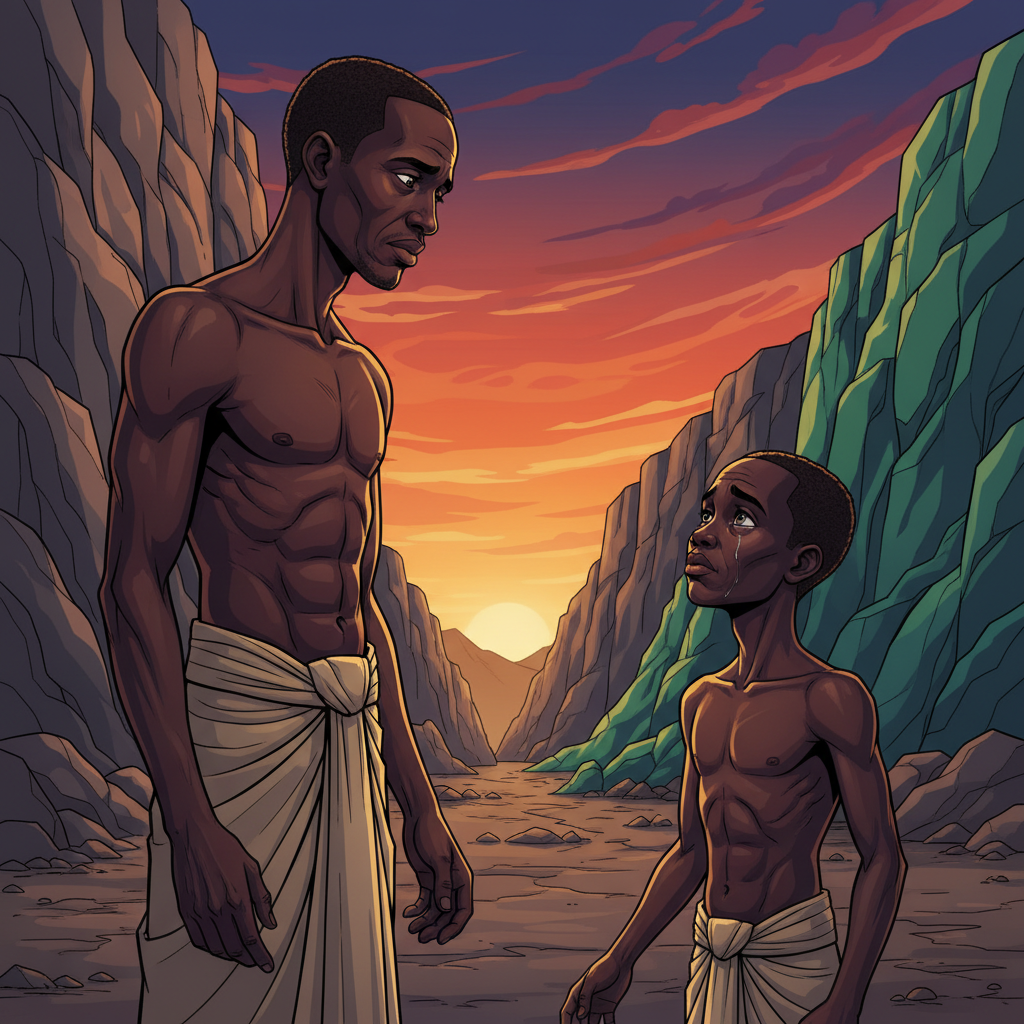
"I hear you," Khonsu said. His own voice was not quite steady now, but it did not break. "I hear every word. And the answer is still no. Go home, brother. Go now." Pen-heb stood for a long moment staring at him. Whatever he had hoped to see in his brother's face was not there. He looked, in that moment, like a very young man — younger than twenty-eight, younger even than seventeen, a boy who had been told that the older brother could not, after all, fix it. Then he turned. He walked back down the path the way he had come. Khonsu watched him go until the dark swallowed his shape, and then a long time after that, when there was nothing on the path but the stars and the wind and his own breath. He stood alone at the valley mouth.
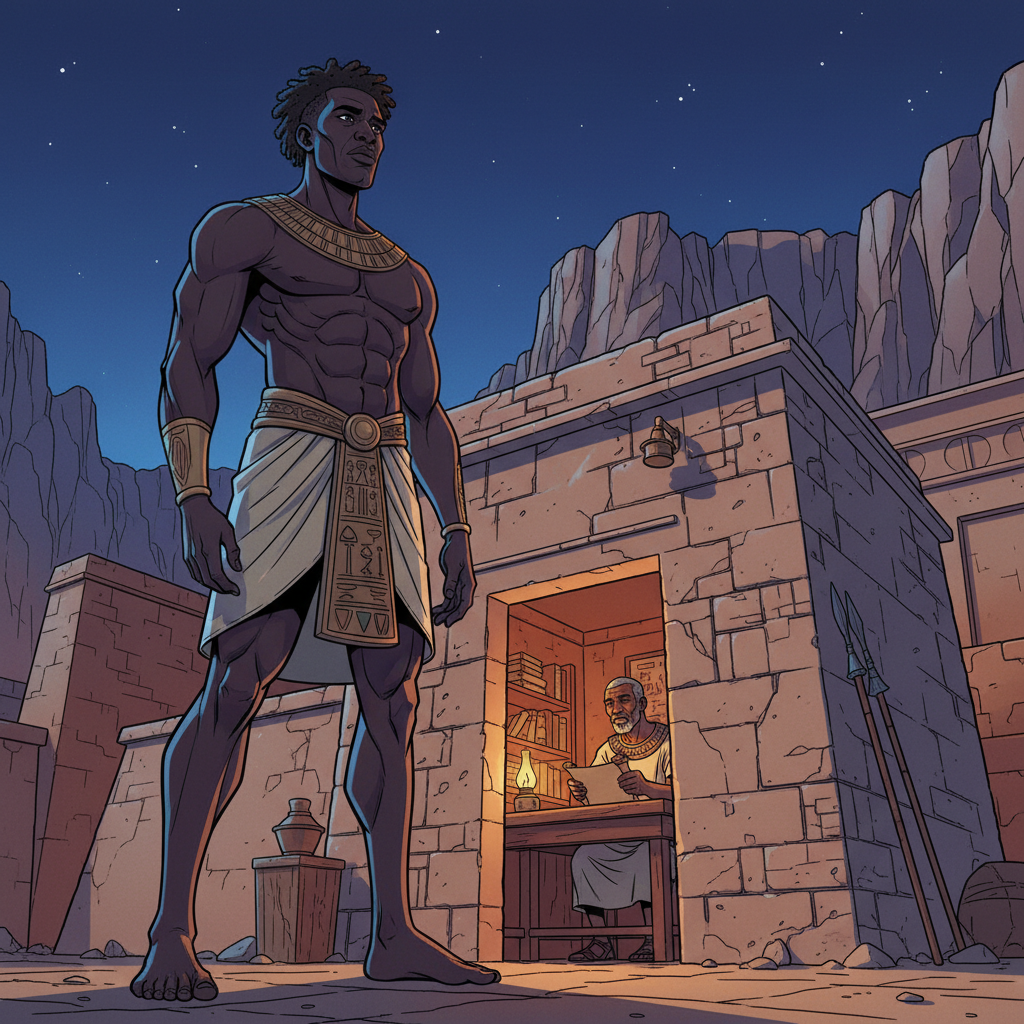
Khonsu did not sleep. He walked his ordinary rotation, the proper perimeter, two full passes before dawn. His feet learned a new kind of weight. When the relief came at first light, he turned his post over in the formal manner and did not mention the visitor. He did not go home to Waset. He walked instead to the Medjay station at the edge of the necropolis where his captain kept a small office built of unfired brick. The captain was a man named Bakenkhonsu, a senior officer with forty campaign summers on him. Khonsu stood at the door and waited until Bakenkhonsu looked up from his papyrus. "A matter came to me in the night," Khonsu said. "It concerns a tomb-robbing ring. I ask how I must proceed. I will name those I know, when I am told to name them."
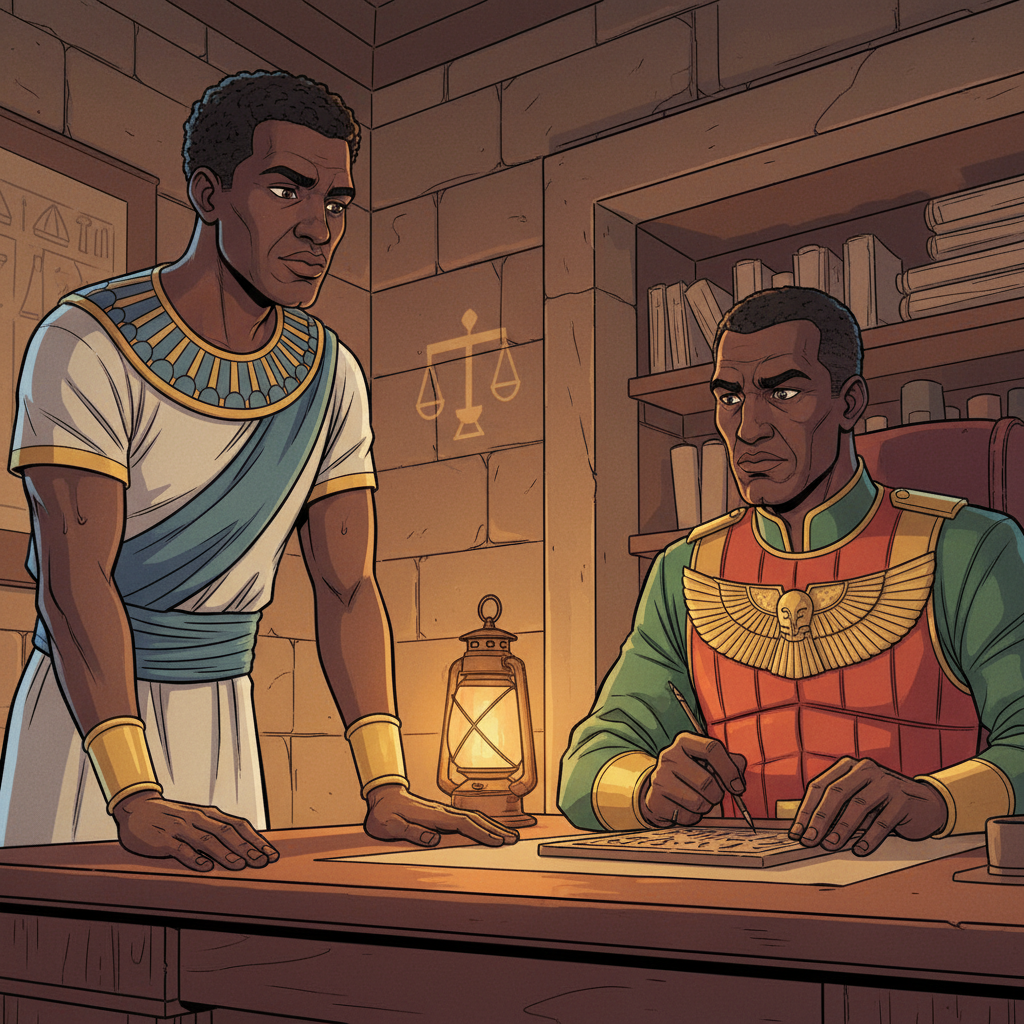
Bakenkhonsu did not speak until Khonsu had finished the full report. Khonsu held nothing back — the dismissed priest, the pectoral, the shift-change ask, the brother on the path in the dark. He named everything except the name. When he was done, Bakenkhonsu set down his reed pen with great care. "You know what the kenbet requires," the captain said. "A charge cannot be laid against unnamed men. A conspirator must be named. The process does not work in the dark." Khonsu nodded once. His voice stayed steady. "Pen-heb, son of Amenemhat. My younger brother. Cartwright of the western quarter of Waset. He is the one who carried the ask to me." His hands were not steady. He put them on the edge of the captain's desk so the captain would not see.
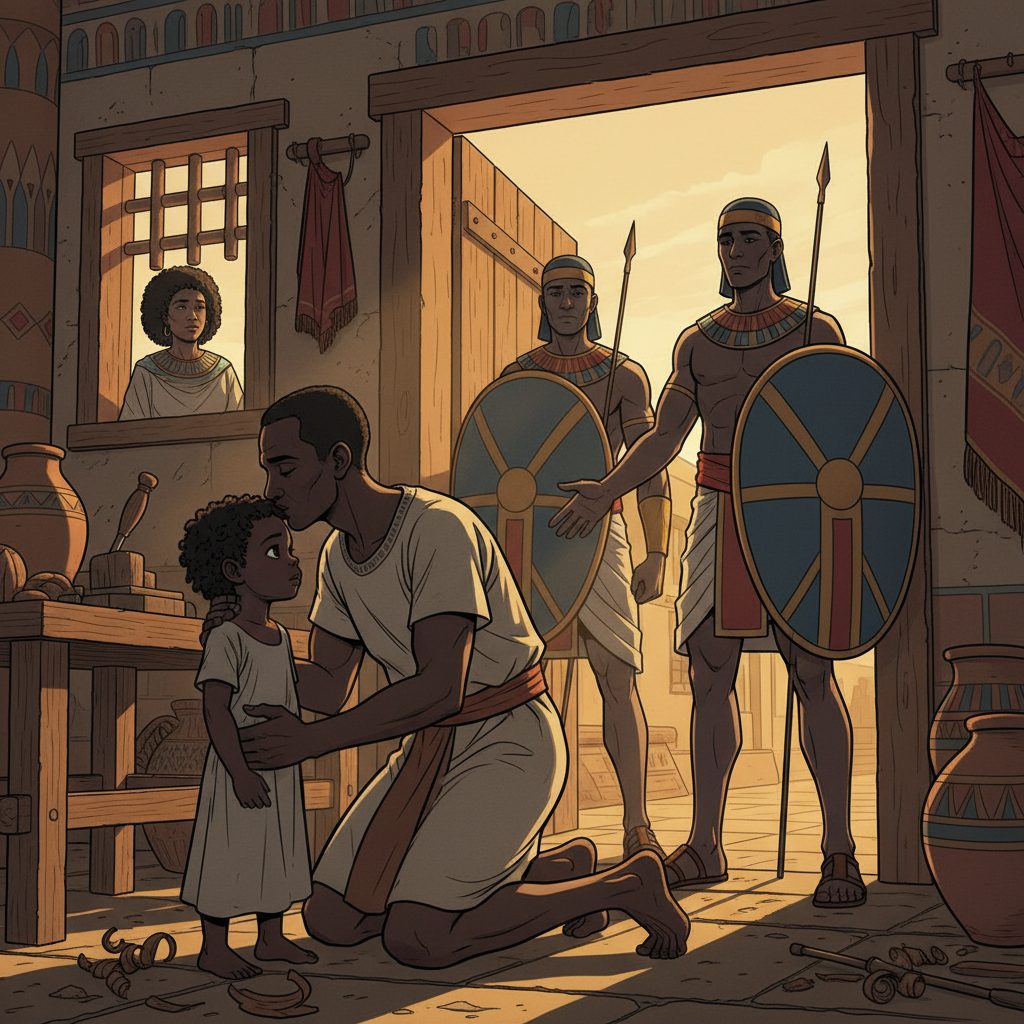
Pen-heb was arrested at the noon hour. Khonsu was not there. He had been sent back to the valley, on a new rotation, before the Medjay squad went to the house. He heard the account afterward, from a junior officer named Siptah, who had been told to give it plain. There was no struggle. Pen-heb saw the Medjay at the door and knew at once. He did not run. He did not shout. He set down the cartwright's awl he was holding, kissed the small daughter on the top of the head, and walked out with the squad. His wife watched from the window. She did not call out. She did not weep where anyone could hear. The door closed behind him quietly. That was all. That was the whole of it. Siptah did not embellish. Khonsu did not ask him to.
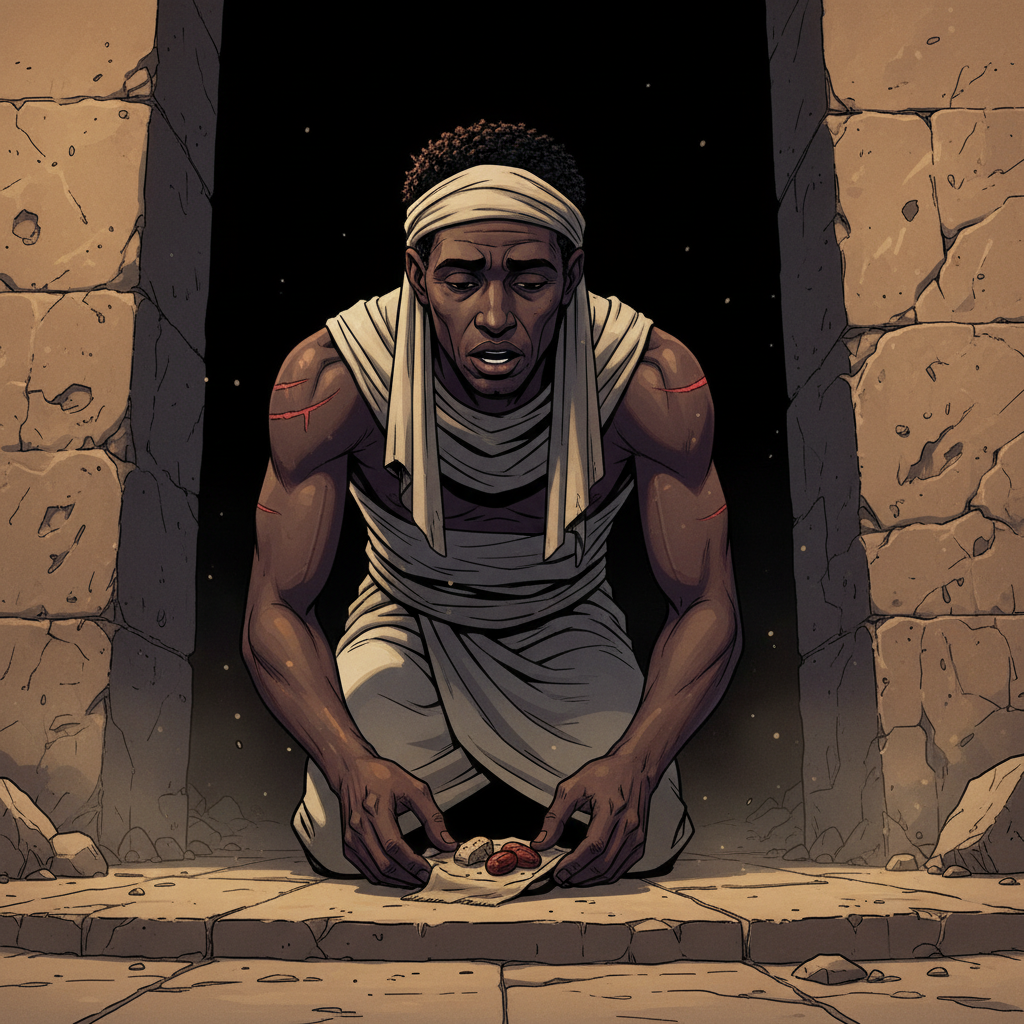
The next night Khonsu was on rotation again. He had not slept. His eyes burned. His shoulders ached where the old ritual scars lay, the way they always ached when he was exhausted. At the darkest hour of the watch he walked deeper into the valley than his post required and stood at the mouth of the pharaoh's still-empty chamber — raw stone, unpainted, the scent of chisel dust and cool earth. He did not enter. He knelt on the threshold and laid a small offering there: a fold of linen, a pinch of bread from his ration, a single date. He spoke three words under his breath that he did not say aloud even to the stone. The unfinished chamber did not answer. It did not need to. Khonsu rose and walked the perimeter again. His feet kept moving. That was the whole liturgy.
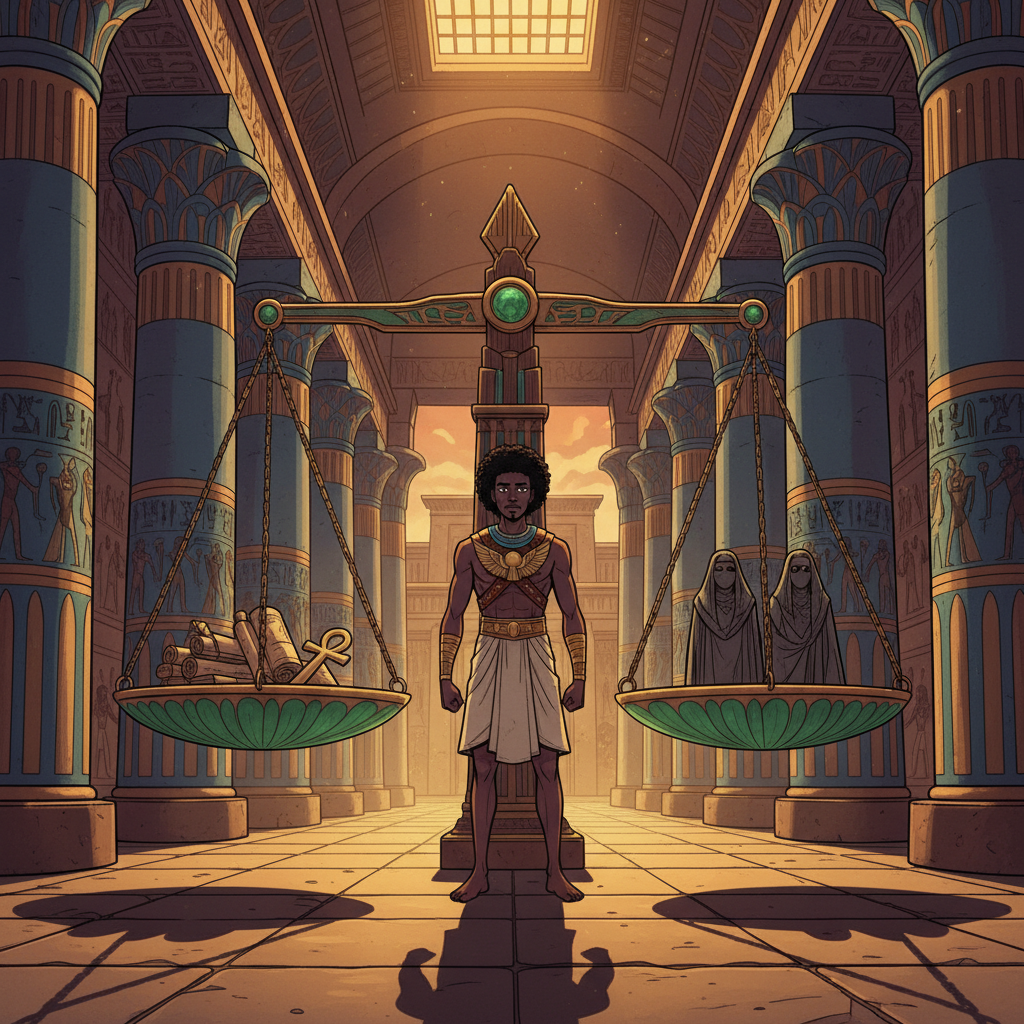
Reciprocity. The word had been plain to him since he was a boy in the temple school. He had not understood it until now. Reciprocity held both ways. The dead owed nothing except the weight of their memory. The living owed them protection — that was the covenant of the necropolis, the reason Medjay stood where they stood. But the living also owed the living. His sister-in-law had not chosen Pen-heb's ring. His niece had not chosen her father's crime. If Maat asked him to keep the valley, Maat also asked him to keep the children. A man could not be split in half. A man could only carry both oaths at once and refuse to drop either. That was what the scale was. Not one pan rising while the other fell. Both pans heavy. Both pans held. That was the work.
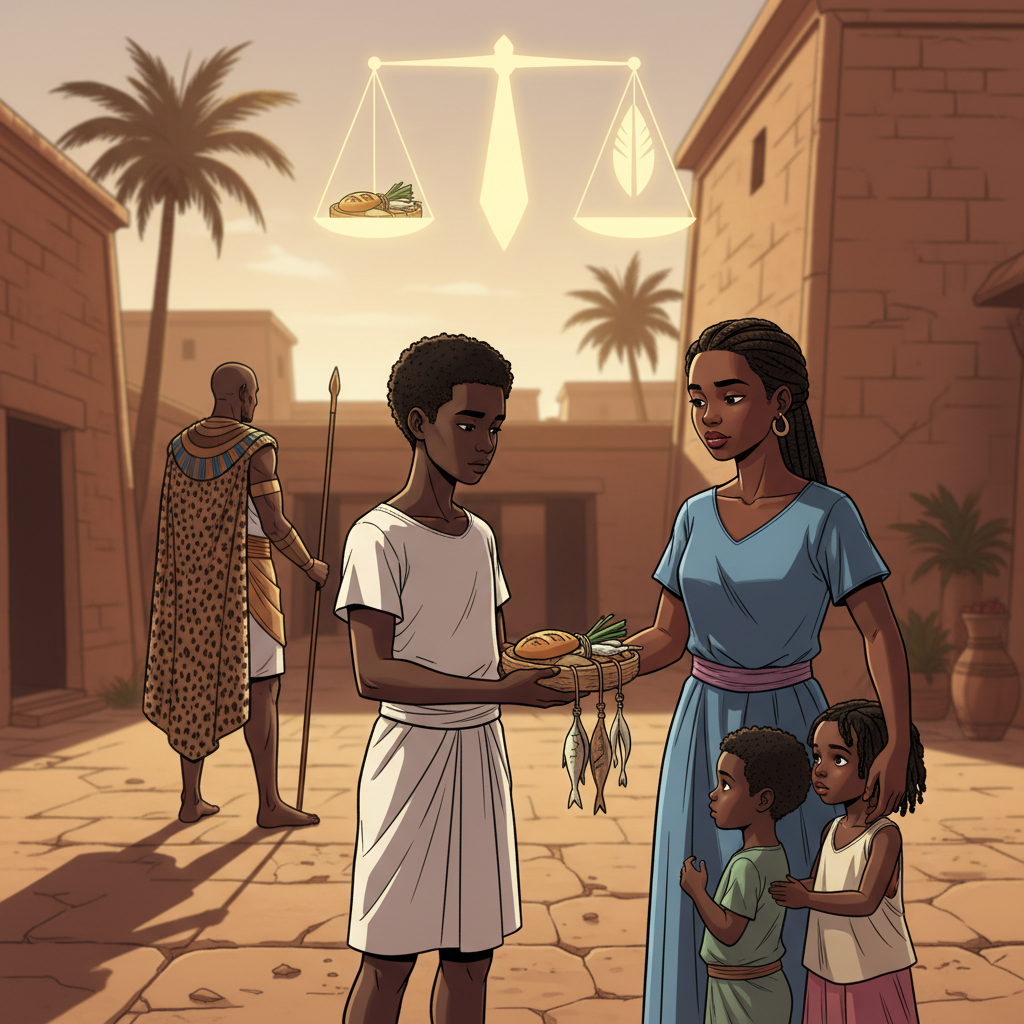
The next morning he took a third of his weekly ration — a small bundle of bread, a measure of dried fish, a twist of onions — and sent it by a trusted runner to his brother's wife. He did not attach his name. He told the runner only that it came from someone who owed the family a debt. The runner did not ask. Runners in the Medjay service did not ask. Every week after that, he sent the same portion. Some weeks, when his ration was short, he sent less of it. Some weeks he went without the fish himself. He did not speak of it to his mother. He did not speak of it to the captain. He did not speak of it to anyone at all. The two small children ate. The scale of Maat held both weights. That was the whole of his answer.
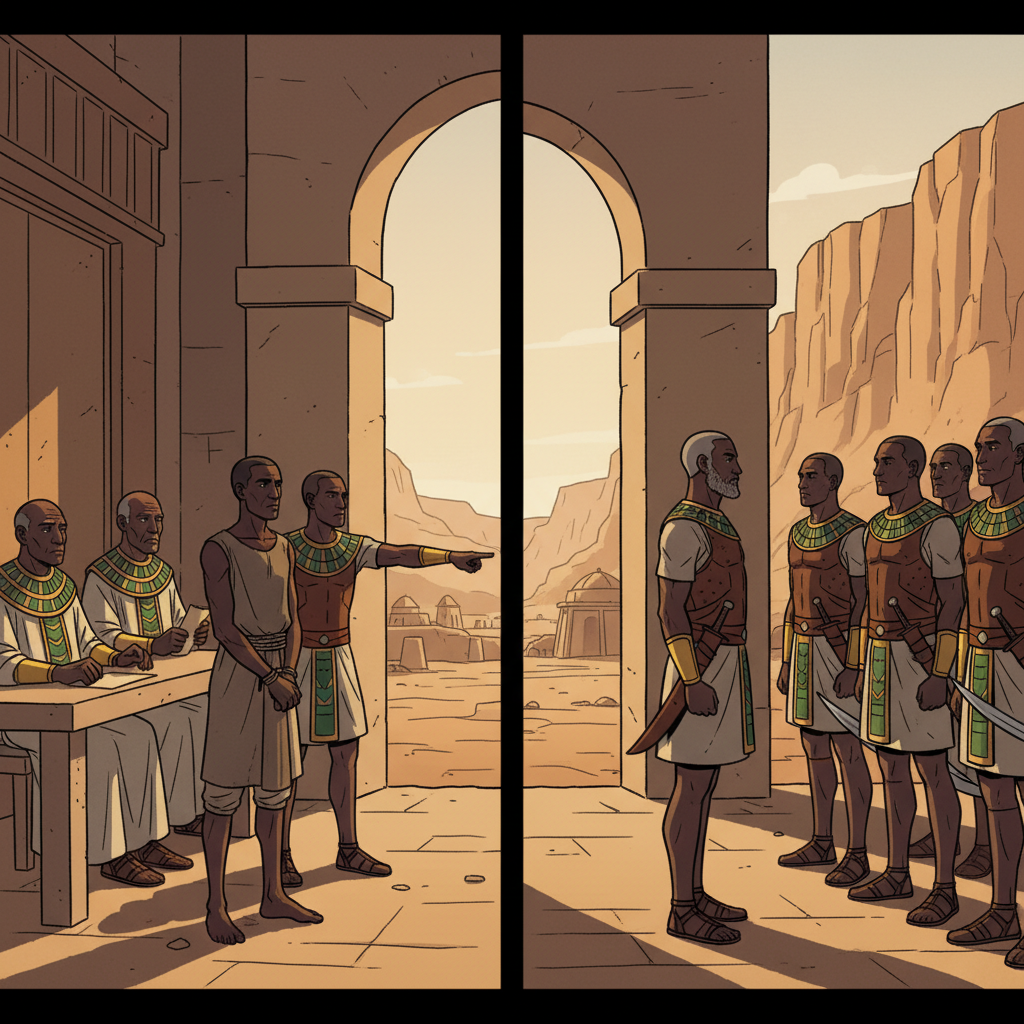
The seasons turned. Pen-heb was sentenced by the kenbet to five years in a western work-camp — not the deep quarries, not the worst of the sentences, because he had not himself entered the tomb, and because his confession had come cleanly once named. Khonsu was not promoted. He was not given a new insignia. He was not brought forward as an example, because the Medjay did not hold up a man who had named his own brother as a thing to be celebrated. That was not what Maat asked. His captain nodded to him in the morning roll, the same nod he gave every other officer, and that was the whole of the acknowledgment. His niece ate bread three times a week that she did not know came from her uncle. His nephew grew. His duty at the valley was complete.
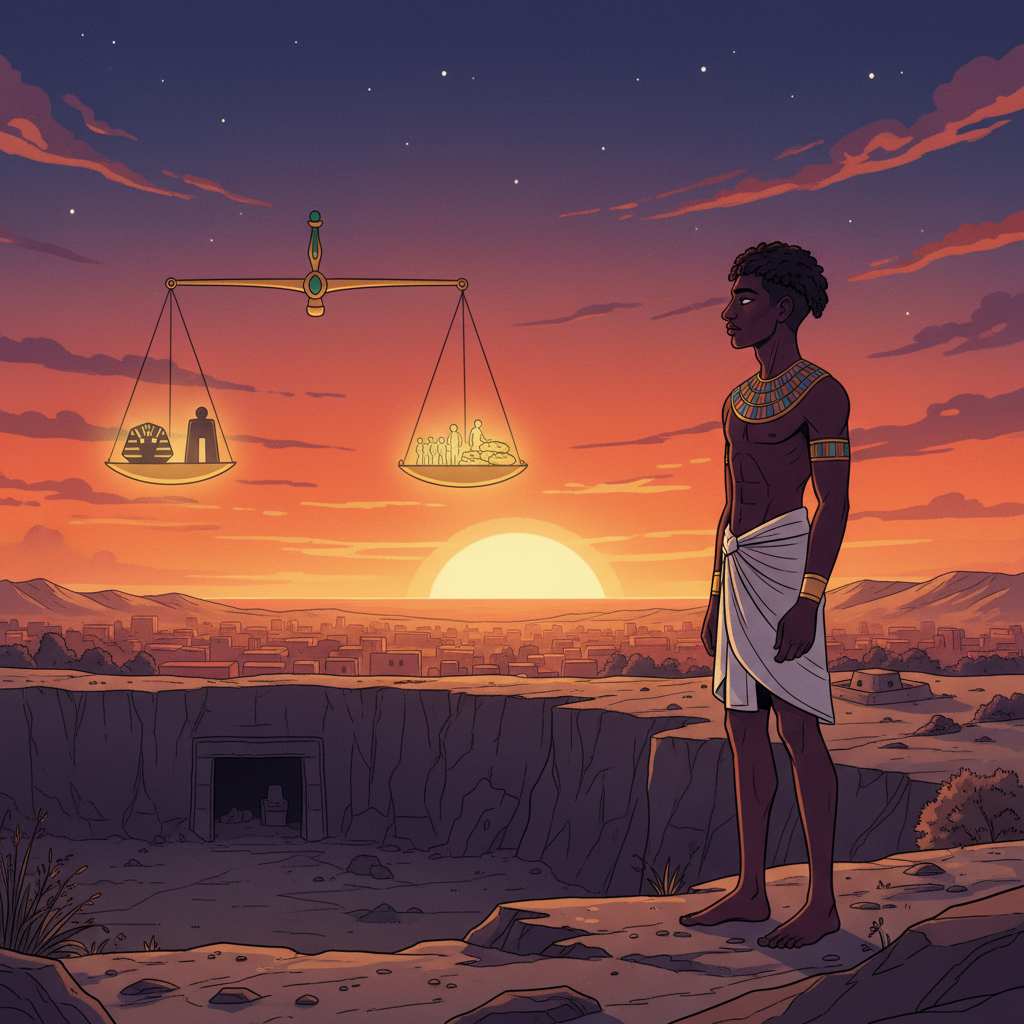
On an evening near the end of that year Khonsu climbed the ridge above the valley and watched the sun go down over Kemet. From up there he could see the red roofs of Waset in the far haze and the dark cleft of the necropolis below him. Two oaths. One scale. The pharaoh in the stone, still unseen and still kept. The children in the city, fed and unknowing. The scale of Maat with both pans heavy and both pans held. He had not been heroic. He had not been rewarded. He had reported his brother and fed his brother's wife, and neither of those acts had canceled the other. That was the point. Reciprocity was not the scale lifting one pan. Reciprocity was the scale bearing both. He stood on the ridge until the last light went. Then he walked down to his post.