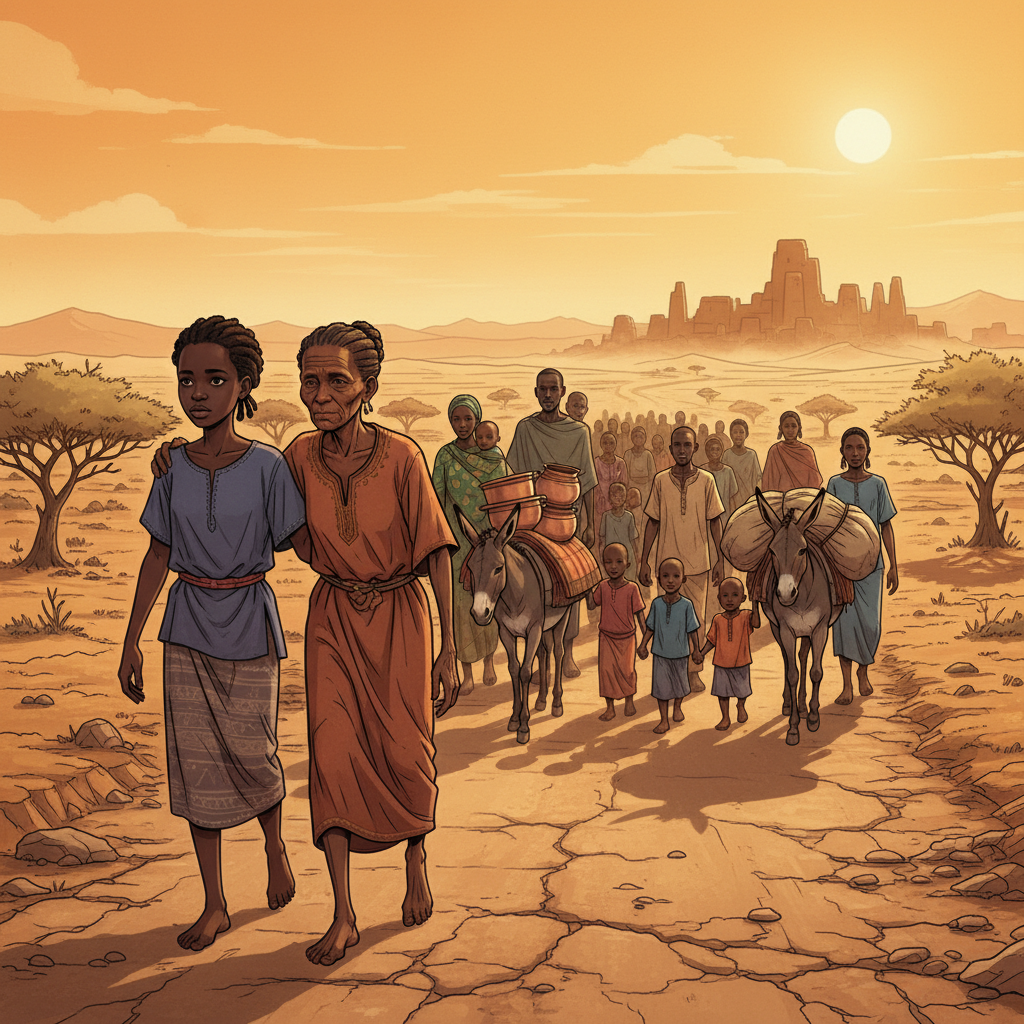
Sira was thirteen years old, and she was walking south. She had been walking south for nineteen days. Her grandmother walked beside her with one dry warm hand laid on Sira's right shoulder for balance, because the grandmother's knees had gone bad in the third year of the long drought and she could not walk on broken ground without a granddaughter's shoulder under her hand. The grandmother's name was Maimuna, and she was sixty-eight years old, and she was the senior griot of the family — the keeper of the names. Two thousand years of names lived inside her head. That was the family's true property. The cattle had been lost in the dry years. The horses had been sold to buy grain. The compound in the old city of Kumbi Saleh had been left behind one warm evening with the door standing open. The names walked with them. Behind Sira and Maimuna stretched the rest of the family in a long thin line on the dusty road. Sira's mother Awa carried her youngest brother Modibo on her back in a cotton wrap. Sira's father Issa walked at the back with the two donkeys, one of which carried a bundle of cooking pots and one of which carried Maimuna's mat for the nights. Sira's uncle Tunka walked with his three sons. Aunt Fatim walked with her two daughters. The little cousins — six of them, all under nine — walked between the grown-ups in a small clump, holding hands when the road narrowed. Twenty-two people in all. They were the last branch of the Sissoko griot family of the old Wagadu empire, and they were walking south because the empire was not the empire anymore.
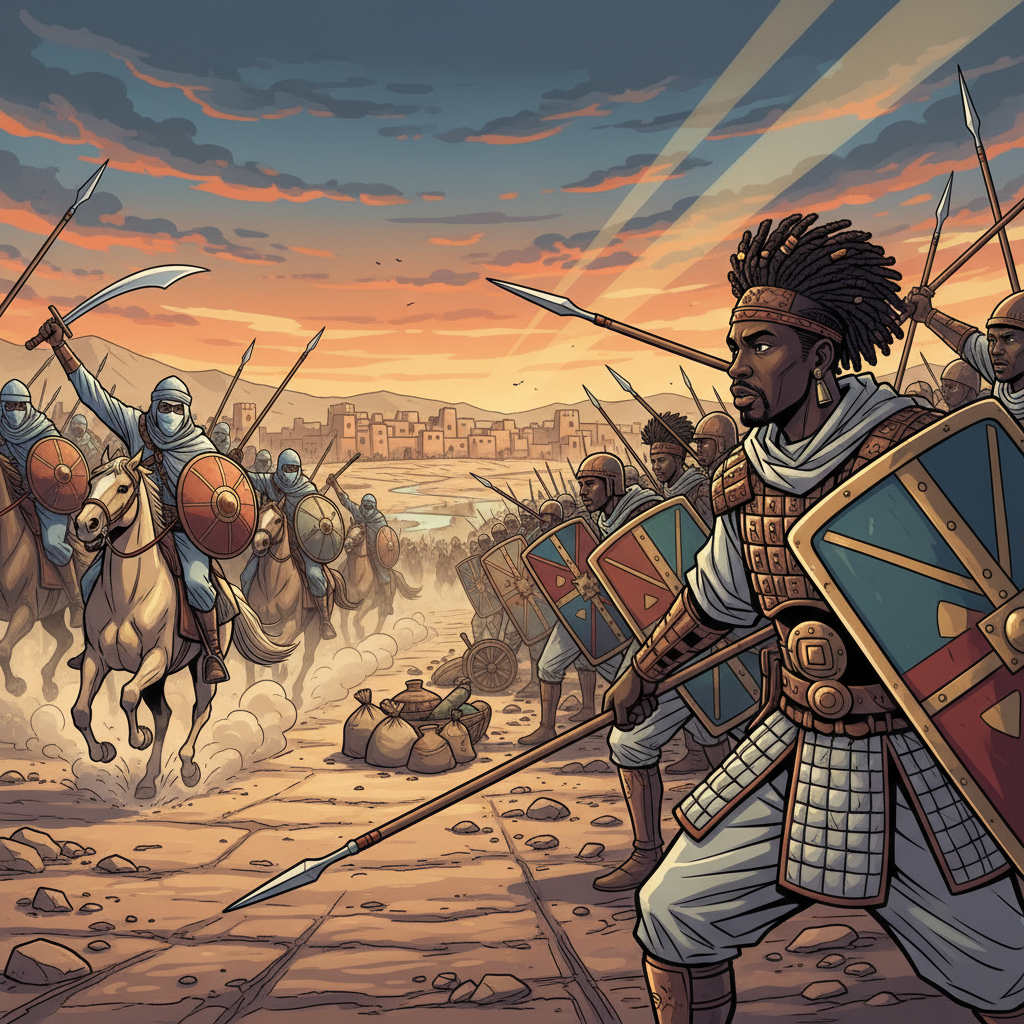
The trouble had come slowly, the way real trouble does. Sira had been a small child the first time she heard the grown-ups in the courtyard speak the word Almoravid. The Almoravids were a confederation of desert peoples from the far north, beyond the Sahara, who had been pressing south toward the trade routes for as long as Sira could remember. They had captured Awdaghust, the great northern market, fifteen years before Sira was born. They had pressed against the gold roads. The Wagadu empire — which the outsiders to the north sometimes called by the title of its ruler, ghana, mispronouncing the word until it became the name they used for the whole country — had held them off for two generations. But the holding had been expensive. The dry years had come. The river had moved. The wells in the old farming towns had failed one by one. The merchants who had carried gold from Bambuk in the south to the salt-mines of Taghaza in the north had begun to take their caravans by other roads, through other cities, paying their tolls to other kings. The empire had not fallen in a battle. There had been no great smoke. There had been, instead, the slow quiet leaking of life from the cities of the north — Kumbi Saleh emptying compound by compound, the well at the south gate going dry in the same season the cousins on the west side of the family had moved to Niani, the market at the great square losing first its salt sellers and then its gold weighers and then its cloth merchants. Sira had watched her own city shrink, year by year, the way a pool shrinks in the dry season. The family had held on through the worst of it. When the well in their own quarter had failed for good, Maimuna had said, quietly, at the evening meal: "Children. It is time to walk." Nobody had argued. Maimuna was the senior griot. When the names said walk, the family walked.
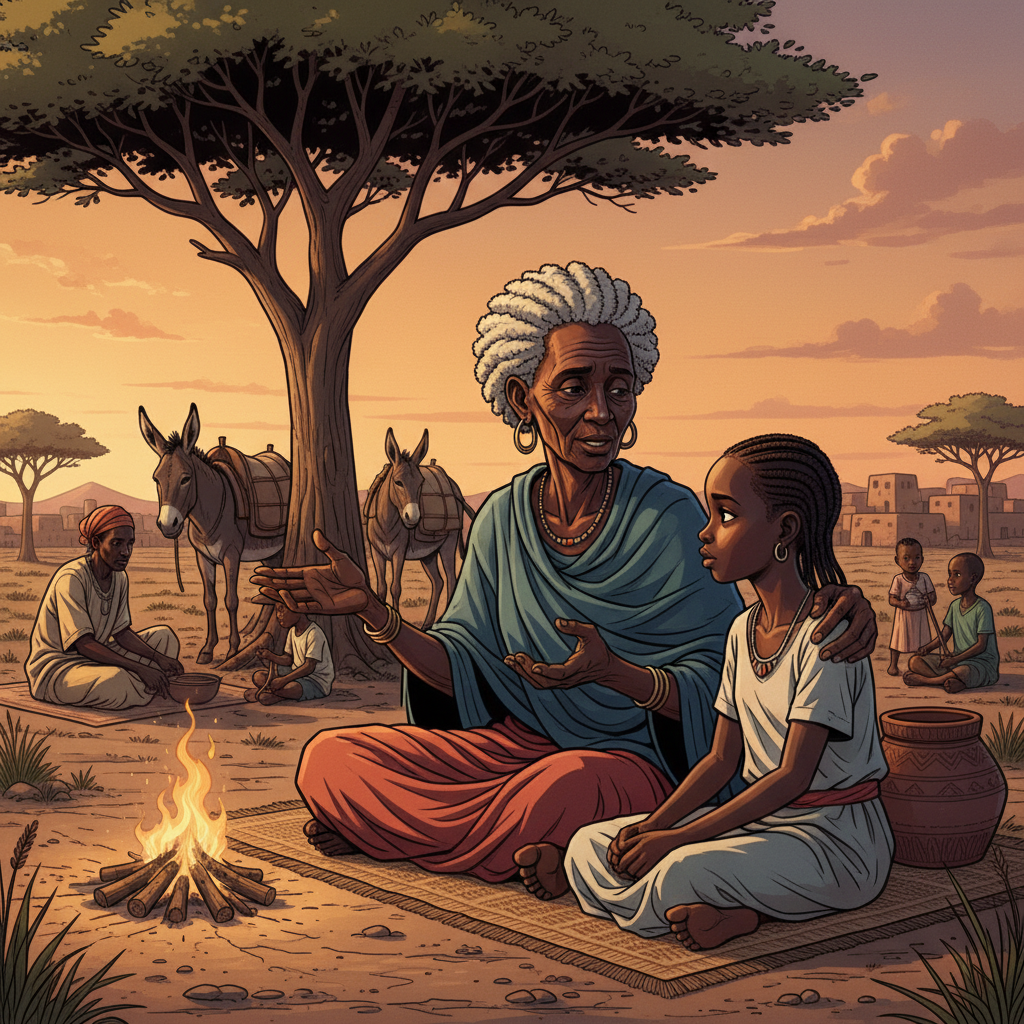
Sira had a job on the road, and it was the most important job in the family. She did not carry the cooking pots. She did not lead the donkeys. She did not watch the smallest cousins. She walked beside her grandmother, every step, with her grandmother's hand on her shoulder, and her job was to learn the names. Every evening when the family stopped in the shade of an acacia tree or at the edge of a small village willing to let them sleep, Maimuna would sit on her mat and Sira would sit at her grandmother's knee, and Maimuna would teach Sira another segment of the family's history. Not the legends. Not the songs the griots sang at weddings for outsiders. The real lineage. The names. Who had begotten whom. Who had married into which family. Which king had ruled in which generation. Which battle had been won and which had been lost and which had been refused. The whole inner structure of a thousand-year empire, generation by generation, kept in the head of one old woman. The teaching was slow because the road was tiring and Maimuna was tired by evening. Sometimes she could give Sira only ten names before her voice went rough and she needed to sleep. Sometimes she gave Sira a story to fix the names in the mind — the story of King Bassi who had ruled in the dry years three generations back, and how Bassi's sister Aminata had been the actual brain behind the throne, and how the family had been the ones who carried the messages between brother and sister in a season when speaking aloud in the palace would have been dangerous. Sira would repeat each name back. She would repeat the relationships back. She would repeat the orders of succession. Maimuna would correct her when she got one wrong, gently but precisely, the way a smith corrects an apprentice on the angle of a blade. The names were not a game. The names were the family's only remaining wealth.
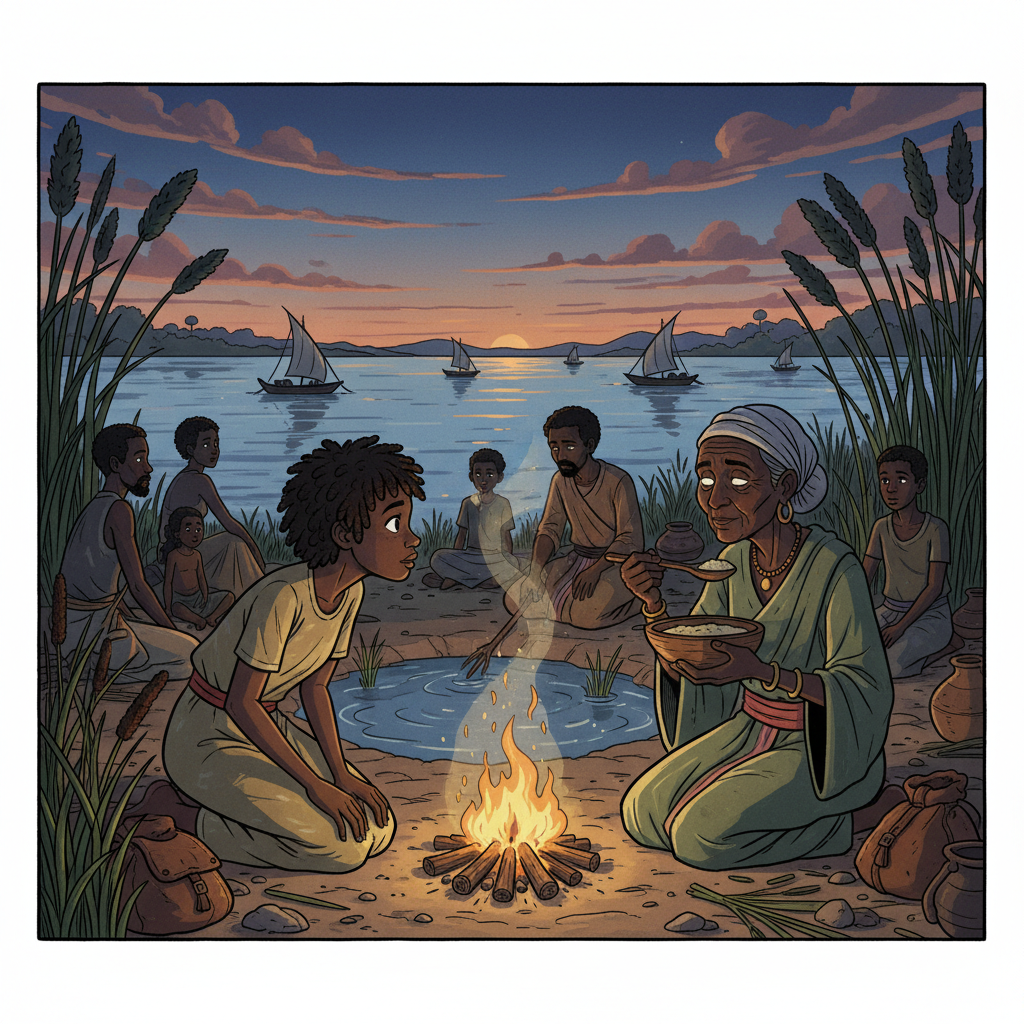
On the eleventh evening of the walk, when the family had stopped at a small water hole and Maimuna was eating a bowl of millet porridge that Awa had cooked over the small fire, Sira asked her grandmother a question that had been sitting in her chest for many days. "Grandmother," Sira said. "Why did you choose me?" Maimuna did not stop eating. She finished her mouthful of porridge slowly. She set down the wooden spoon. She wiped her lips on the back of her wrist. Then she looked at her granddaughter for a long time across the low fire. Her eyes were milky at the edges and very clear at the centers. "Because, Sira," she said, "you listen with your whole face. Most children listen with their ears. Some children listen with their ears and their hearts. You — I have watched you since you were two — you listen with your whole face. The mouth, the eyes, the brow. When a person is talking to you, they can see you taking them in. That is the face of a griot." Maimuna picked up her spoon again. She took another small bite of porridge. She chewed. She swallowed. "There is a second reason. The older grandchildren — your cousins — are good children. They are not griots. The names will not stay in their heads the way names need to stay. A griot's memory is not normal memory. A griot's memory is a discipline. It is closer to a smith's arm than to a normal mind. The discipline must be planted when the child is young and the road is open." She paused. She looked into the fire. "And the third reason is that we are walking, granddaughter, and the empire is not coming back, and the names must walk with us. If I die before I finish the teaching, the names die. The family becomes an ordinary family. I am sixty-eight. I do not have ten more years. Maybe five. Maybe three. We do not have time to be wrong about who learns."
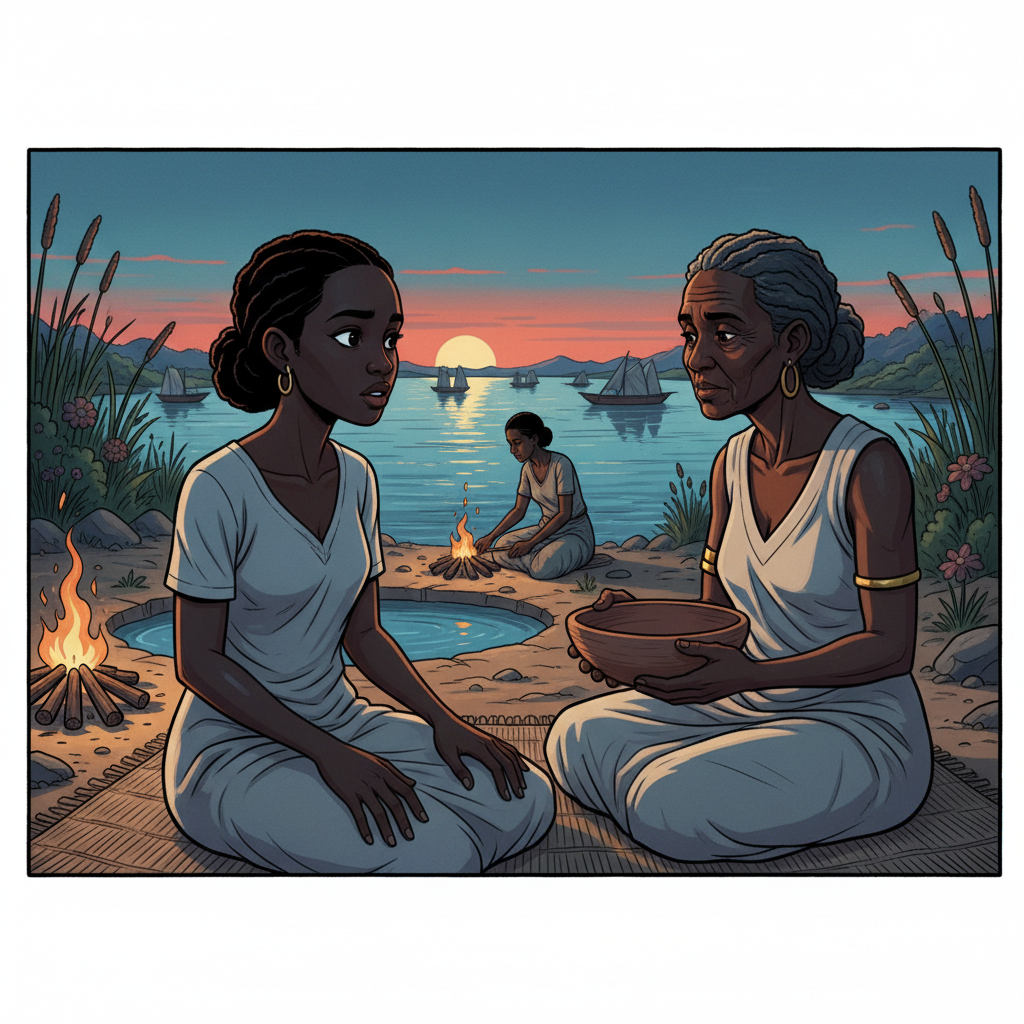
Sira listened to her grandmother with her whole face, the way she had listened her whole life, and her heart was beating very hard against the inside of her ribs. She had not understood, until that evening at the small water hole, that the teaching she had been receiving for the last eleven days was not a child's schooling. It was an inheritance being placed in her hands while the elder still had hands to place it with. Sira looked down at her own small hands resting on her knees. They were the same shape as her grandmother's hands, only younger. The fingers were long. The palms were narrow. The knuckles already had the careful look of someone who had been weaving and grinding and carrying since she was four. Sira understood, in that evening at the water hole, that her hands would be the hands that carried the names after Maimuna was gone. The thought did not make her proud. It made her serious. "Grandmother," Sira said, "I will not be wrong. I will learn them. Even the difficult ones. Even the ones that don't want to stay in my head. I will learn them all." Maimuna nodded once without smiling. She did not praise her granddaughter. Praise was not a thing griots gave for promises. Praise was a thing griots gave for finished work, decades later, after the names had been carried successfully to the next generation. "Good," Maimuna said only. She finished her porridge. She gave the empty bowl to Sira to wash at the water hole. As Sira walked the few steps to the water, she heard her grandmother begin, very softly, to hum a tune from the old generations — the welcome-tune that griot mothers had hummed to griot daughters since the time of the founder Dinga Cisse, six hundred years before Sira was born.
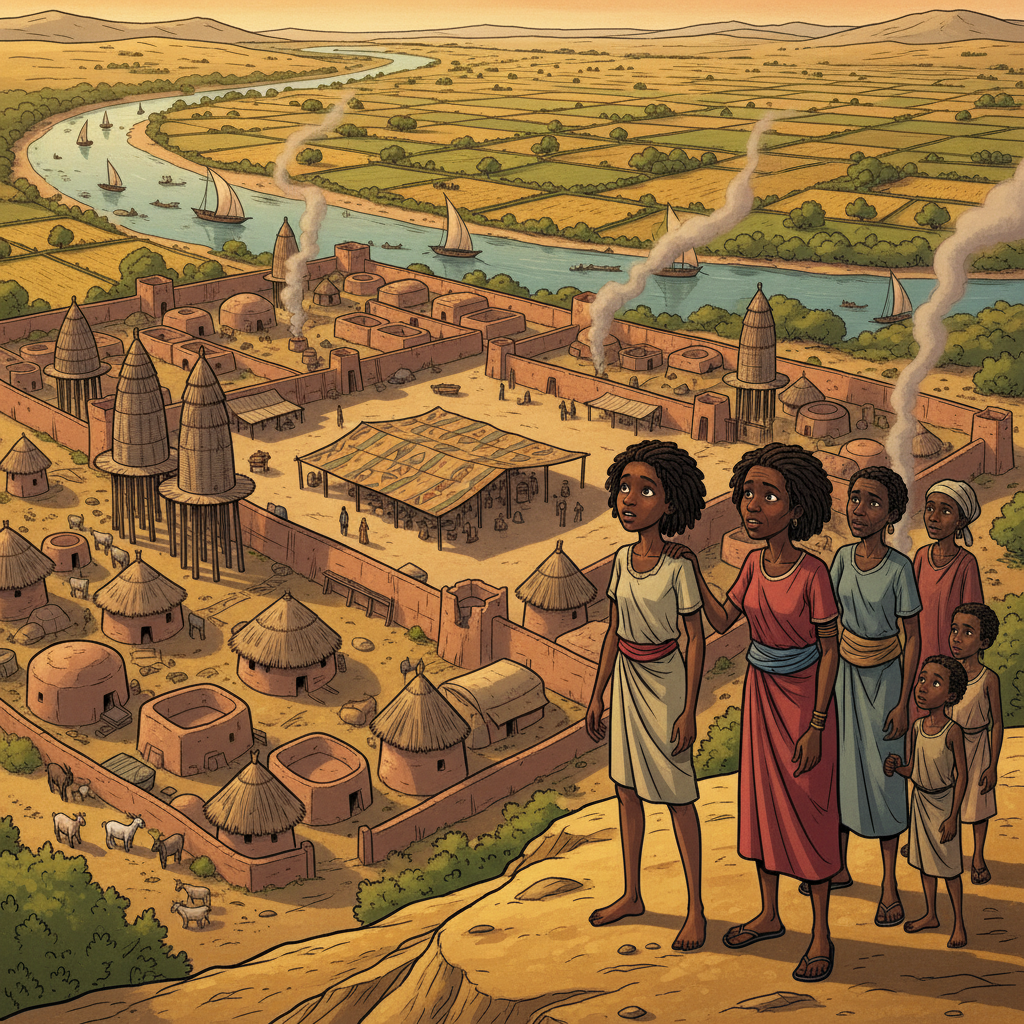
On the eighteenth day of the walk, the family came over a low rise in the road and saw, in the broad shallow valley below them, a town the like of which Sira had not seen since the empire-days of Kumbi Saleh. Round mud-brick compounds with thatched roofs. Tall granaries on stilts. A central square with what looked like a market stall covered by a great woven mat. Fields of millet and sorghum stretching back from the town in green-and-gold patches that meant the rains had come this far south even when they had failed in the north. Goats moved in small herds along the edges. Smoke rose from cooking fires. The smell of evening food — fish from a river that had to be close, and onions, and the particular nutty smell of millet toasted in a pan — drifted up the rise on the warm wind. Sira had been hungry for nineteen days. The smell almost made her cry. "Grandmother," she said. "Where are we?" Maimuna stood very still on the rise with her hand on Sira's shoulder and her eyes looking down into the valley. She was breathing slowly. "Mandinka country, granddaughter," she said. "We have come down out of the Sahel proper and into the lands the Mandinka people farm. This town below us — I cannot name it without asking. It will have its own chief. It will have its own histories. The Mandinka are not Soninke. They speak a related tongue but it is not our tongue. They have their own griots. Their own kings. Their own ways." She paused. She squeezed Sira's shoulder gently. "But they are kin in the larger family, Sira. The Sahel is the Sahel. The same drought has touched them. The same Almoravid pressure has frightened them. We will go down. We will ask for water. We will see what they say."
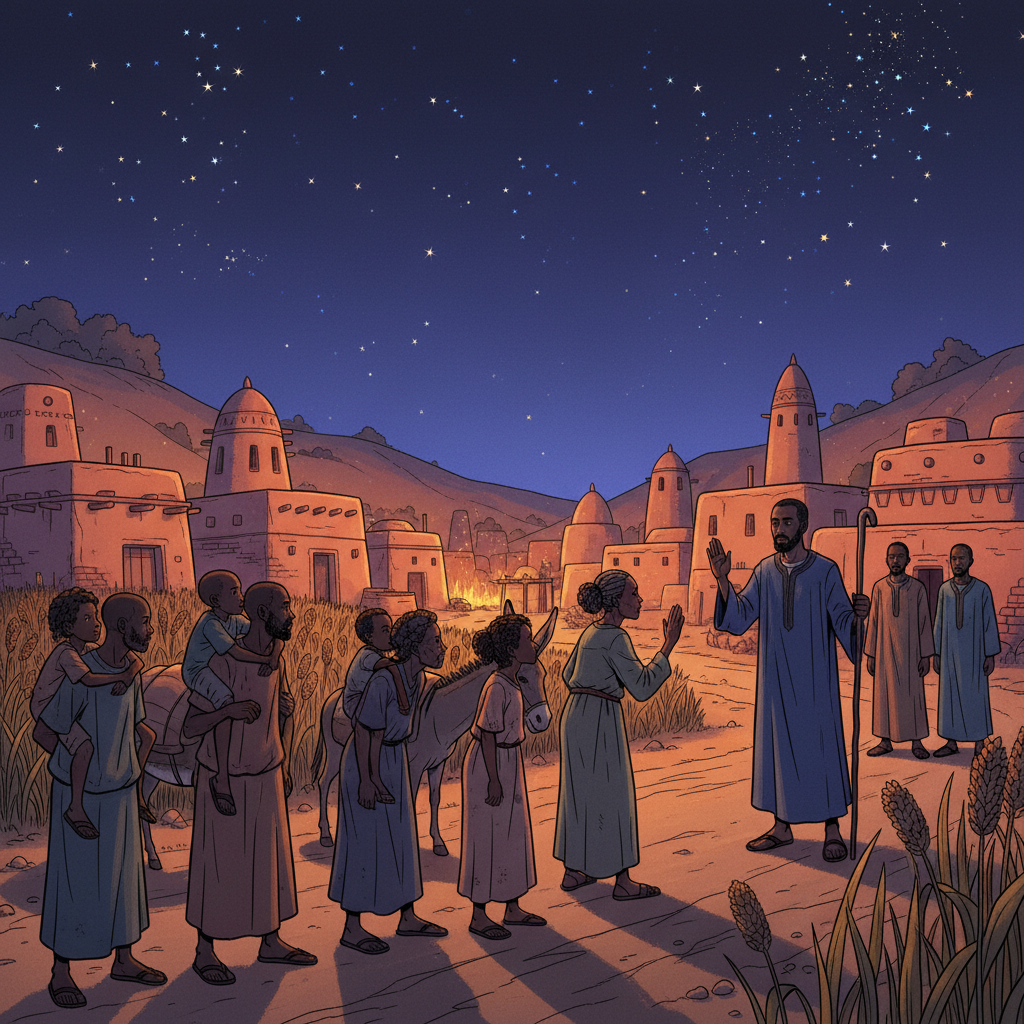
The family came down off the rise in the long evening light, twenty-two travelers and two donkeys in a thin line, the smallest cousins now riding piggyback on the older cousins' backs because they were too tired to walk the last stretch. They were seen from a long way off. By the time they reached the edge of the town's sorghum fields, a small delegation of Mandinka men had come out to meet them on the road. The leader was a tall thin man in his forties with a closely cropped beard and an indigo robe and a long iron-tipped staff. His name, when he gave it, was Famoro. He was the chief's second-in-command — what the Mandinka called the kafu's deputy. He stopped six paces in front of the family and raised his right hand in a slow respectful greeting. He did not approach closer. He waited. Maimuna, leaning on Sira's shoulder, took two slow careful steps forward of the rest of the family. She raised her own right hand to match Famoro's. "Peace upon this town and upon its people," Maimuna said in her own Soninke language, slowly, because she did not know how much of it Famoro would understand. Famoro answered in Mandinka, which Sira found she could follow about half of — the words were like Soninke words with the corners filed down. "Peace upon you, mother of these travelers, and upon your family. You have come from the north." It was not a question. It was a careful observation. Maimuna nodded. "We have come from Kumbi Saleh. We are the Sissoko, of the griot families. The well in our quarter failed in the dry season. We have walked nineteen days. We ask permission to drink at your water and to camp at the edge of your fields for one night." Famoro's eyes flicked, just once, at the word griot. He kept his face still.
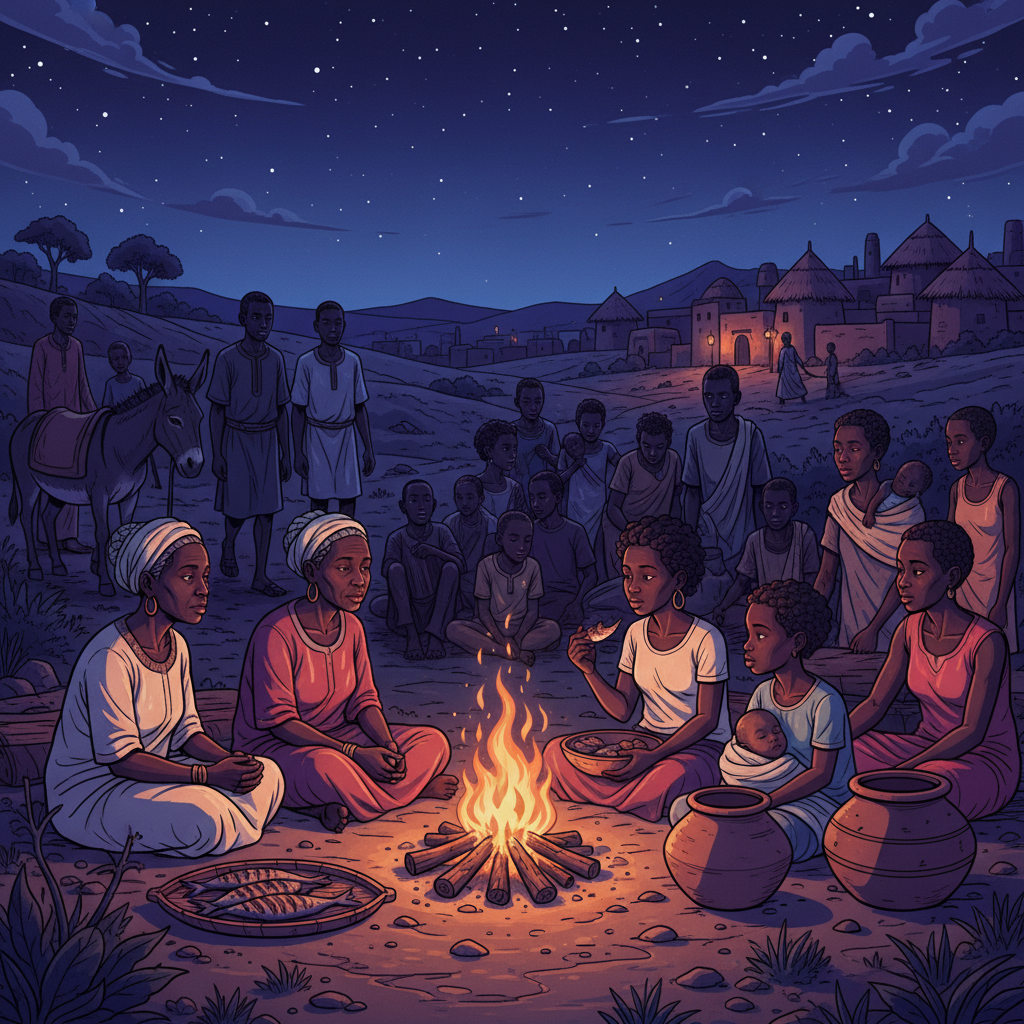
"You will drink at our water and camp at our fields, mother," Famoro said. "That is given. The chief will want to speak with you, but not tonight. Tonight you will eat. We will send millet and a fish from the river. Tomorrow morning the chief will send for you." He paused. He looked at the line of family behind Maimuna — at Sira's father Issa and the donkeys, at the cousins on each other's backs, at Awa with little Modibo asleep in the cotton wrap. He looked at Sira standing beside her grandmother with her hand still under her grandmother's hand. He looked at Sira for a moment longer than he looked at anyone else. Then he turned. He led the family to a stretch of clean ground beside a small thorny tree at the edge of the sorghum field, where there was a shallow pit-fire ring that travelers before them had used. He gestured at it. He nodded once to Maimuna. He walked back toward the town with his deputy. That night the Mandinka kept their word. A woman from the town came at dusk with two of her daughters, bringing a great clay pot of millet porridge and a wooden tray of grilled river fish and a smaller pot of an onion-and-fermented-fish sauce that Sira had never tasted before but that struck her tongue like home. The woman did not speak much. She set the food down. She placed her hand briefly on Maimuna's head — the universal gesture of a younger woman honoring an elder — and she withdrew. The family ate together around the small fire, twenty-two of them, slowly and reverently, the way people eat after nineteen days of being not-quite-fed. Sira ate two bowls of porridge and three pieces of fish. She watched her grandmother eat across the fire from her. Maimuna was eating slowly, looking into the flames, thinking about whatever the morning would bring.
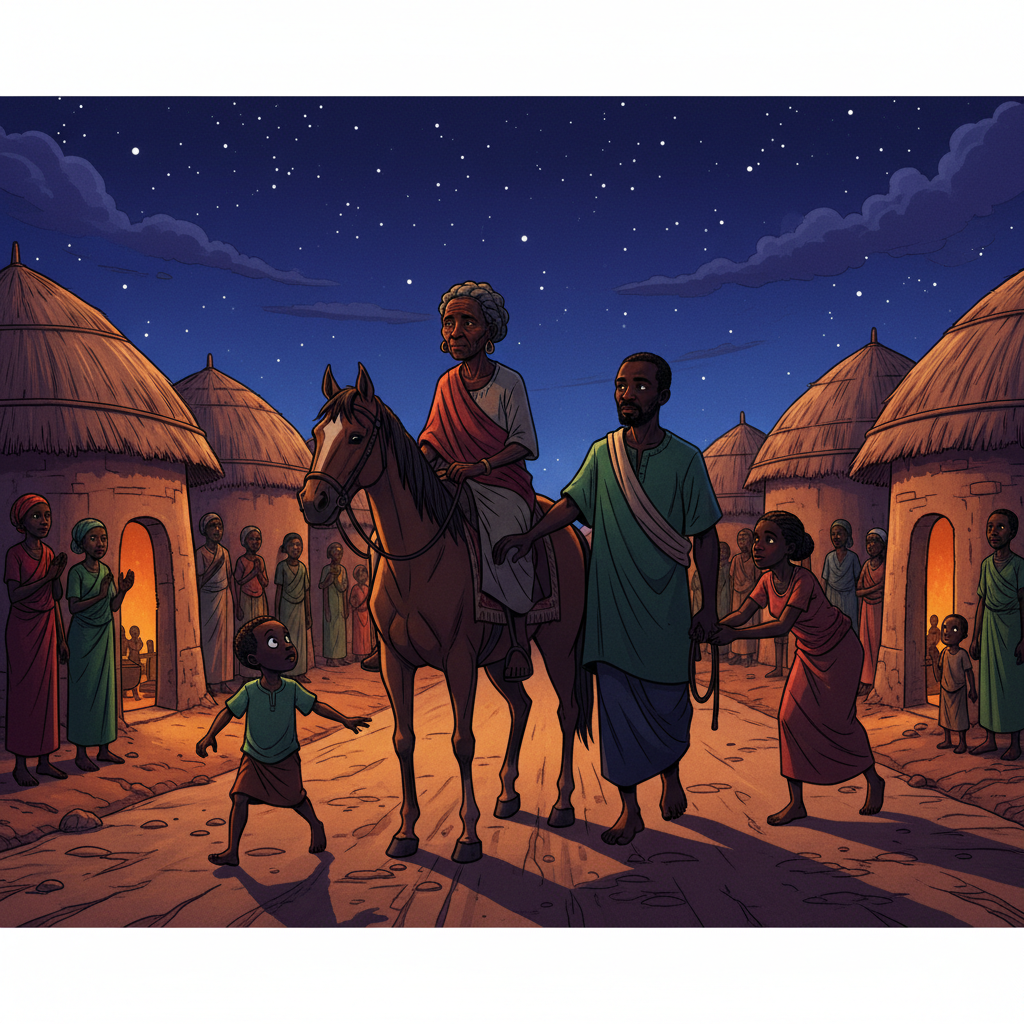
In the morning Famoro came back with two younger men and a horse. The horse was for Maimuna, because the chief had been told the old woman could not walk on broken ground without help. Famoro helped Maimuna up onto the horse himself, his hand steady on her elbow, his face respectful. Sira was permitted to walk alongside the horse, because Maimuna had asked. The rest of the family stayed at the camp at the edge of the field. The three of them — Maimuna on the horse, Sira walking, Famoro leading — entered the town along its main packed-dirt road. The townspeople had come out of their compounds. They stood quietly along the road and watched the old griot ride past. Some of the older women raised their hands as the horse passed them. A small boy ran along beside the horse for a few steps, looking up at Maimuna with enormous eyes, before his mother caught him by the wrist and pulled him back. Sira kept her hand on the saddle blanket beside her grandmother's knee. She kept her face listening, the way her grandmother had taught her. The chief's compound was the largest in the town — three round houses arranged around a central courtyard shaded by a great tamarind tree. The chief was waiting under the tamarind on a low stool of carved dark wood. His name, when Famoro gave it, was Bemba Kante. He was perhaps fifty years old, broad-shouldered and steady-eyed, with the heavy gold ring of his office in his right ear and a plain indigo robe. Standing behind him, half in the shade of the tamarind, was a boy of about Sira's age — perhaps a year older. The boy had the same broad shoulders and steady eyes as the chief. He wore the same indigo, only smaller. He did not speak. He watched. Famoro helped Maimuna down off the horse and led her, with Sira's shoulder still under her hand, to the stool that had been placed across from the chief's. Maimuna sat. Sira sat at her grandmother's knee on the swept earth.
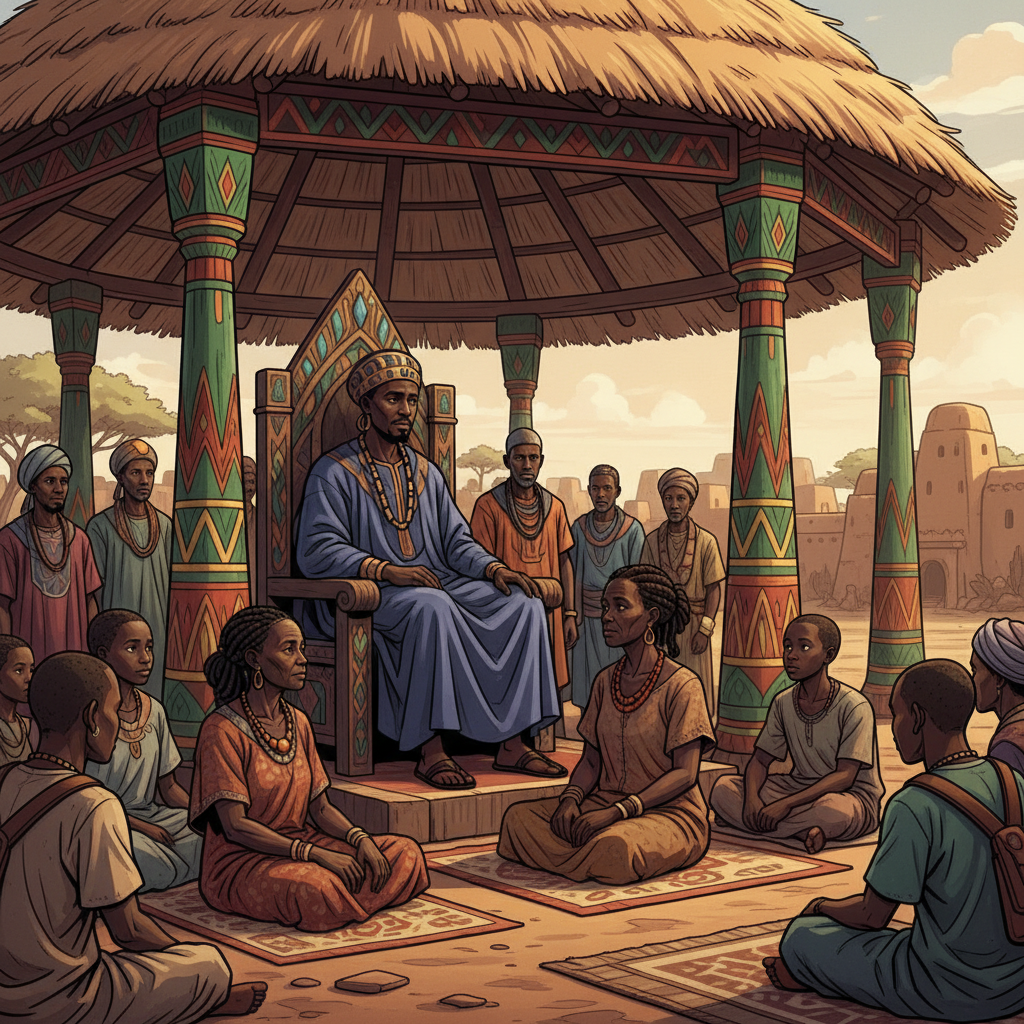
Bemba Kante did not begin the conversation by asking about the road. He did not ask about the dry years. He did not ask about the Almoravids. He waited for a long careful minute and then he said, in slow respectful Soninke that he must have practiced before the meeting: "Mother of the Sissoko. I have been told you are a griot of the Wagadu line. I have been told you have walked nineteen days. I have been told you have the names." Maimuna inclined her head once. "I have the names, kafu. Two thousand years of them. The lineage of the rulers. The lineage of the merchant houses. The lineage of the iron-smiths and the cloth-weavers and the salt-traders. The orders of the great markets. The places where the gold roads turn. I have the names of the towns that are gone and the towns that are coming. I have them in my head." Bemba Kante nodded once, slowly. He had known the answer. He had needed to hear it. "Mother," he said, and his voice went lower and more careful. "The empire of Wagadu is fading. We have watched it fade from down here for a generation. The trade routes that came through Kumbi Saleh are looking for new paths. The Mandinka people are not the Soninke, but we are kin in the larger Sahel, and the gold from Bambuk that used to flow north through your cities now flows north through our country instead. The world is shifting under our feet. We have a chance — the Mandinka have a chance — to build something new in the south, out of the wreckage of what is fading in the north. To do that, kafu-mother, we need what you carry. We need to know who traded with whom. We need to know how the courts of Wagadu kept their judgments. We need the governance. We need the law-memory. We need it whole, and we need it taught."
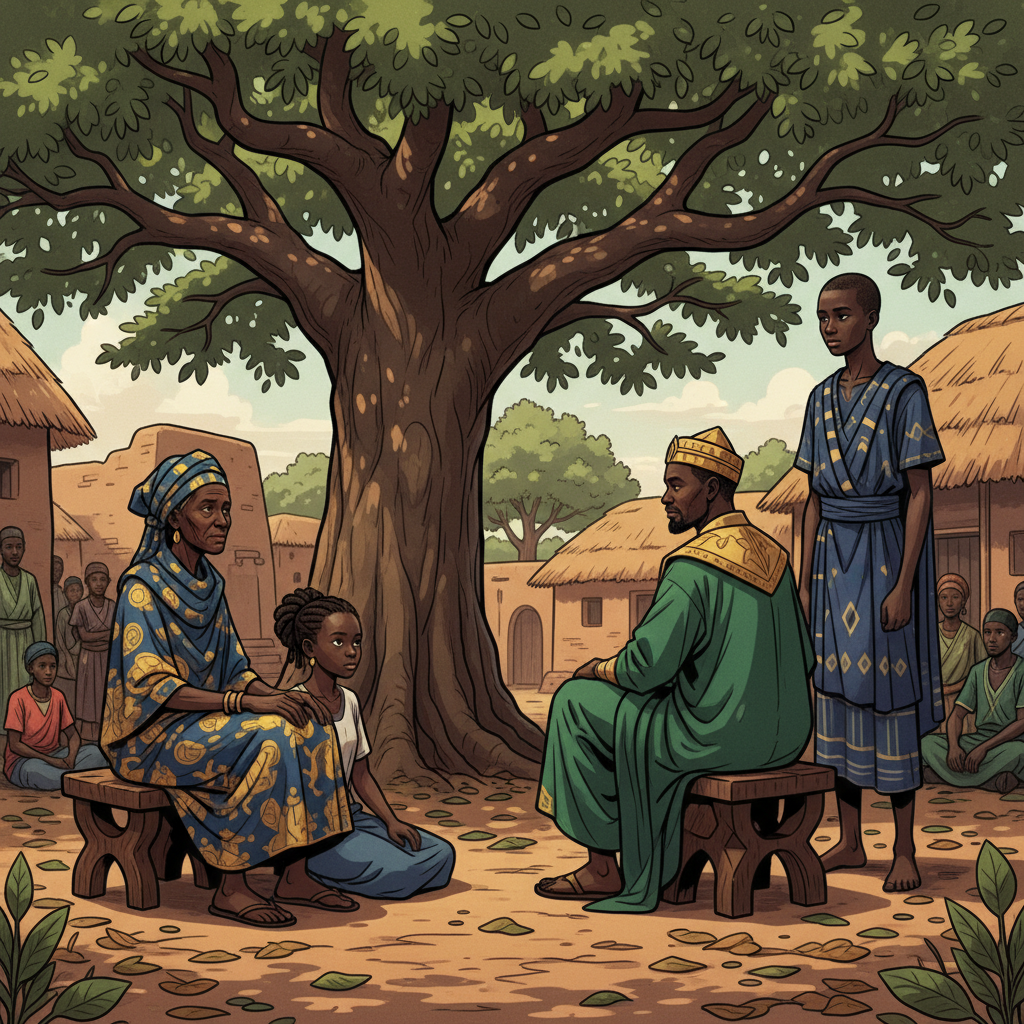
Maimuna sat very still on her stool under the tamarind tree. She did not answer immediately. Sira, sitting at her knee, felt her grandmother's hand come to rest on the top of her own head — the long-practiced gesture of a griot mother grounding herself before answering a hard question. Maimuna looked across the courtyard at the boy in indigo standing behind the chief's stool. She looked at him for a long time. The boy did not flinch. He met her eyes the way a child raised to be a chief meets the eyes of an elder — with respect, but without dropping his gaze. Maimuna spoke at last. "Kafu Bemba. Your son. What is his name?" The chief looked over his shoulder briefly, then back at Maimuna. "Sundiata, mother. He is fourteen. He is the eldest of my four sons." Maimuna nodded slowly. The name Sundiata — strong-hearted in the Mandinka language — settled into the air of the courtyard. "Kafu Bemba," Maimuna said, "I will give you what I carry. But I will not give it to you alone. The names will live where they are spoken aloud and where they are heard back. I have been teaching my granddaughter Sira for the nineteen days of the road. She is becoming the griot of the next generation in our family. I will teach your son Sundiata alongside Sira. Whatever Sira learns, Sundiata will learn. Whatever Sundiata learns, Sira will learn. The Wagadu memory will pass through both of them — a Soninke granddaughter and a Mandinka chief's son, hearing the same names from the same elder's mouth in the same evening sessions. That is my offer. That is the only way I will give the names."
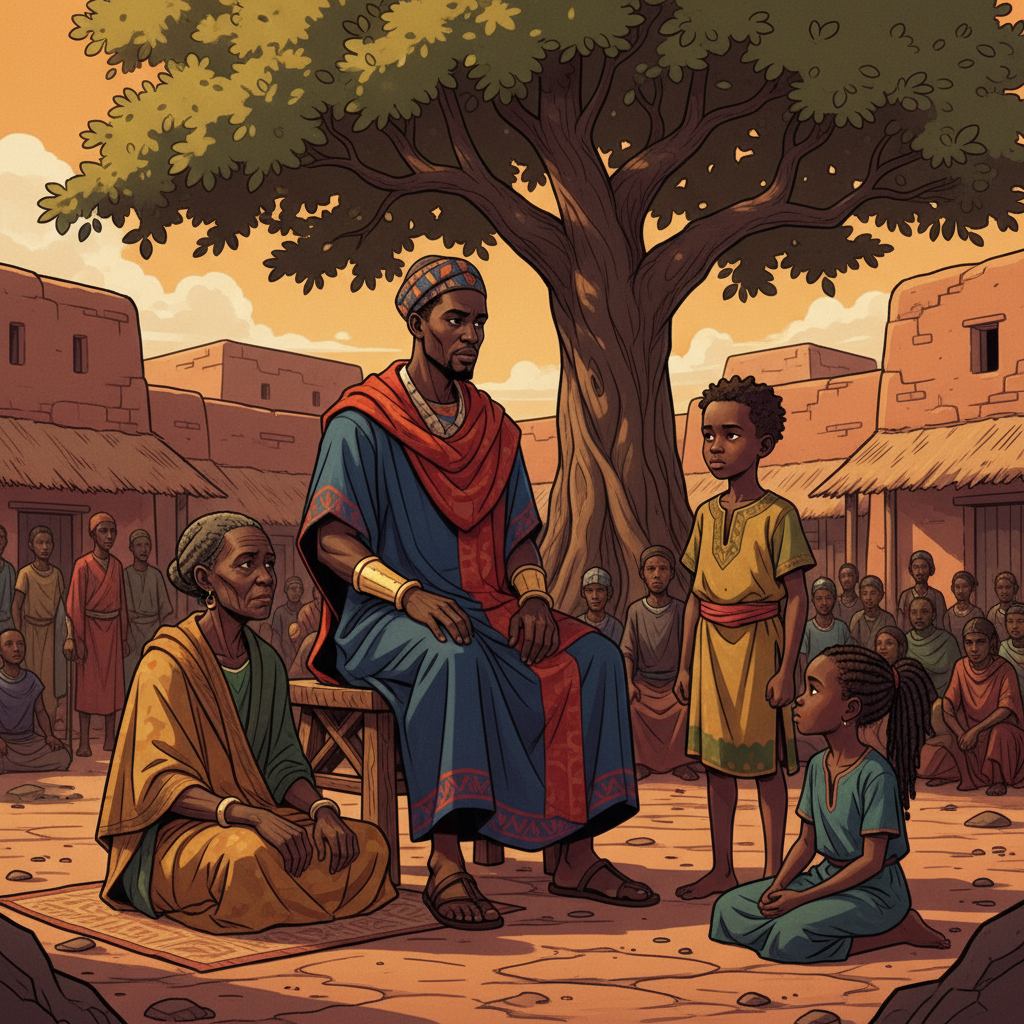
Bemba Kante looked at his son. Sundiata had stepped half a pace forward when Maimuna had spoken his name. The boy's face had gone serious in the way young faces go serious when they hear themselves named for a thing they had not asked for and cannot refuse. The chief was quiet for a careful minute. Then he said: "Mother of the Sissoko. The arrangement you propose is unusual. A chief's son normally would not study at the knee of the same elder as a daughter of a refugee family. The town will have questions." He paused. He let the difficulty sit in the air honestly, the way an honest leader lets a difficulty sit. "But I have been thinking, since Famoro brought me word of your arrival yesterday, about what the Mandinka will need in the generations my son will rule. We will need the memory of the empire that came before us. We will need it without rivalry and without pride. If the price of getting it is that my son sits beside your granddaughter at evening lessons — kafu-mother, the price is small. I accept your terms." Sundiata stepped fully forward then. He came around the side of his father's stool and walked across the courtyard and stopped in front of Maimuna. He did not bow excessively. He inclined his head the correct careful amount for a chief's son addressing a senior griot of another people. "Mother Maimuna," he said in Mandinka, slowly enough that Sira could follow it. "I will study at your knee for as long as you have breath to teach. I will study beside your granddaughter Sira. I will not be a poor student. I will not waste your time. I will remember what you give me." Sira looked up at the boy from her place on the swept earth at her grandmother's feet. Sundiata looked back at her. His eyes were steady. He nodded once. She nodded once. Something was decided between the two children in that look that neither of the adults had quite arranged.
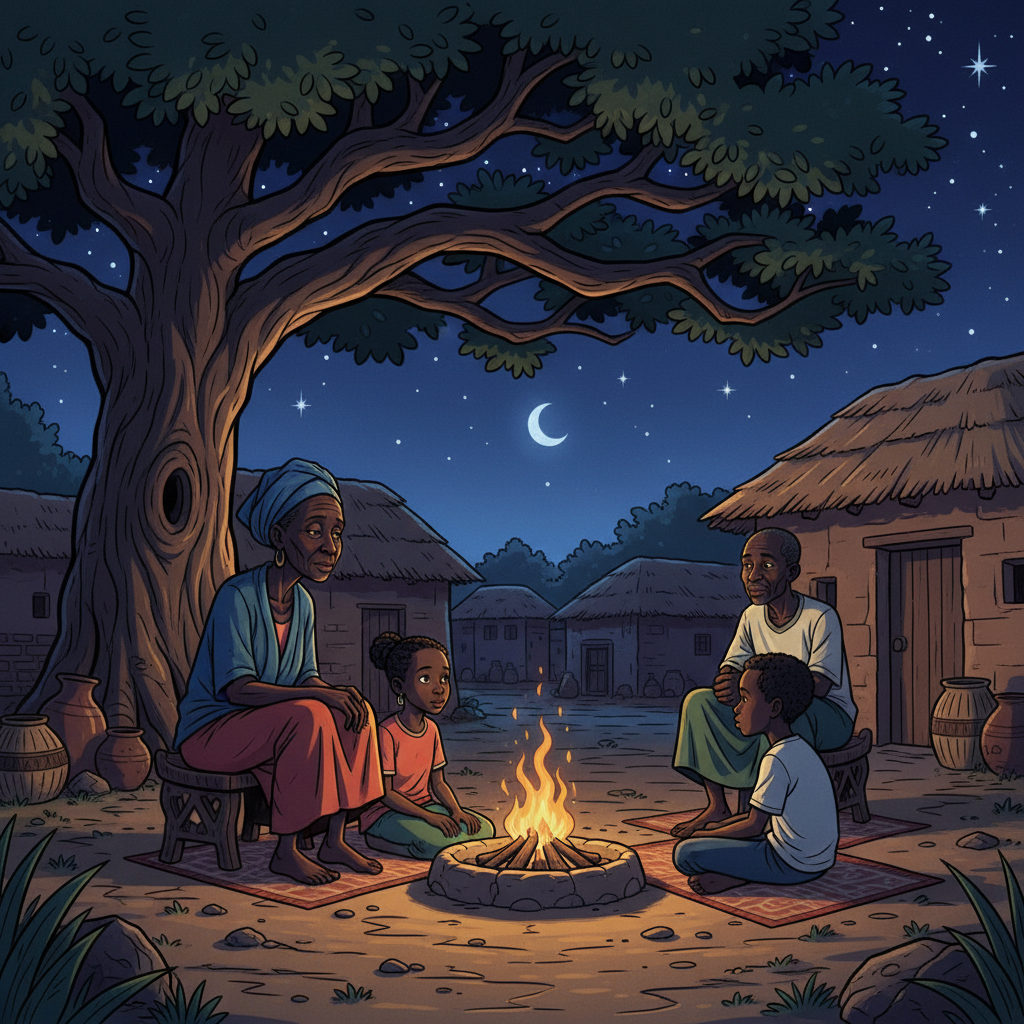
The lessons began the very next evening, in the courtyard of the chief's compound under the great tamarind tree, with a small fire built between the three of them. Maimuna sat on her stool. Sira sat at her grandmother's right knee. Sundiata sat at her grandmother's left knee. The chief Bemba Kante sat at a respectful distance on his own stool — not to participate, but to be present, in the careful Mandinka way of honoring an elder by witnessing the work. The first night, Maimuna gave the founder name: Dinga Cisse, who had come down from the north in the deep time before the eight kings of the dawn-line, who had built the first stone compound at Koumbi, who had married the daughter of the local snake-spirit and from that union had begun the lineage that became the Wagadu kingship. Sundiata repeated the name. Sira repeated the name. Maimuna corrected Sundiata's pronunciation — the Mandinka mouth shaped the Soninke vowels slightly differently, and the corrections mattered. The lessons continued for many nights, then weeks, then months. The family had been given a compound of their own on the edge of the town. Sira's father Issa worked the chief's fields in exchange for the family's grain. Awa joined the women at the river for the cloth-washing. The little cousins played with the Mandinka children in the dust of the central square. The family had become, slowly and gently and without anyone naming it, residents of the town. Each evening Sira walked to the chief's compound with her grandmother's hand on her shoulder, and each evening Sundiata met them at the gate of the courtyard, and the three of them sat by the fire under the tamarind, and the names went on flowing out of Maimuna's head into the heads of the two children — slowly, carefully, generation by generation, the long memory of the Wagadu empire passing across a border and into the bloodstream of the next.
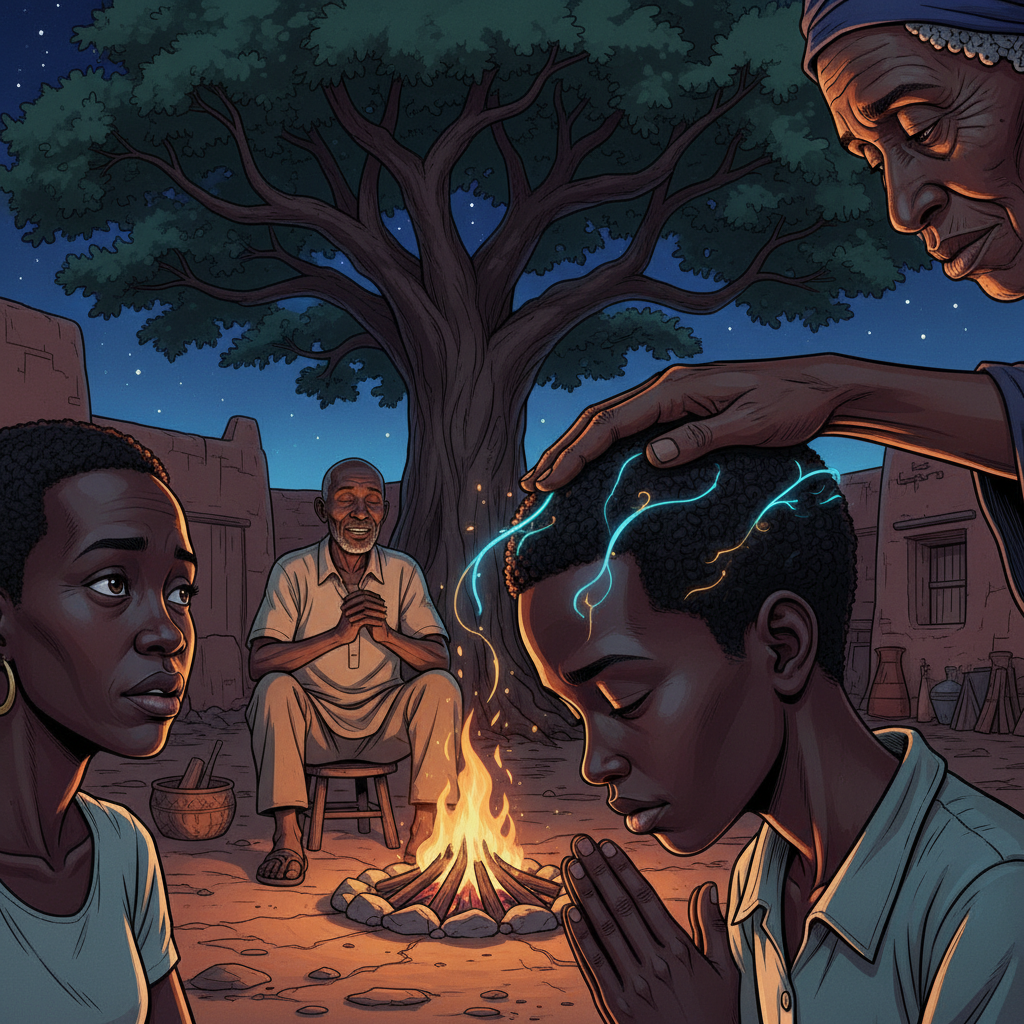
There was a moment, in the fourth month of the lessons, when the work became hard in a new way. Maimuna had begun to teach the section of the lineage that dealt with the failures of the empire — the kings who had ruled badly, the merchant houses that had cheated, the judgments that had gone wrong, the famines that the court had not relieved in time. This was the section that no griot taught in public songs and that few griots taught even in private lessons. The honest names of the failures lived in the same vault as the honest names of the triumphs. Maimuna was teaching them. Sundiata, on the fourteenth evening of this section, asked a question that made his father — sitting in the witness-position across the courtyard — go very still on his stool. "Mother Maimuna," Sundiata said. "Why are you giving us the names of the empire's wrongs as well as its rights?" Maimuna did not answer immediately. She let the question sit. Then she put her dry warm hand on the top of Sundiata's head, the same way she had put it on Sira's head a hundred times before. "Because, son of Bemba," she said, "an empire that hides its failures from the next generation builds the same failures into the next empire. You will be the kafu of the Mandinka after your father. Your sons will be kafu after you. If you want the Manden — the country your people will build — to last longer than Wagadu lasted, you must know the precise shape of every place where Wagadu broke. Then you can build the Manden so that it does not break in those same places. The wrongs are not given to shame the dead. The wrongs are given so the living can do better." Sundiata bowed his head under her hand. Bemba Kante, on his stool, exhaled slowly. Sira saw her grandmother's teaching enter the chief's son the way water enters dry earth.
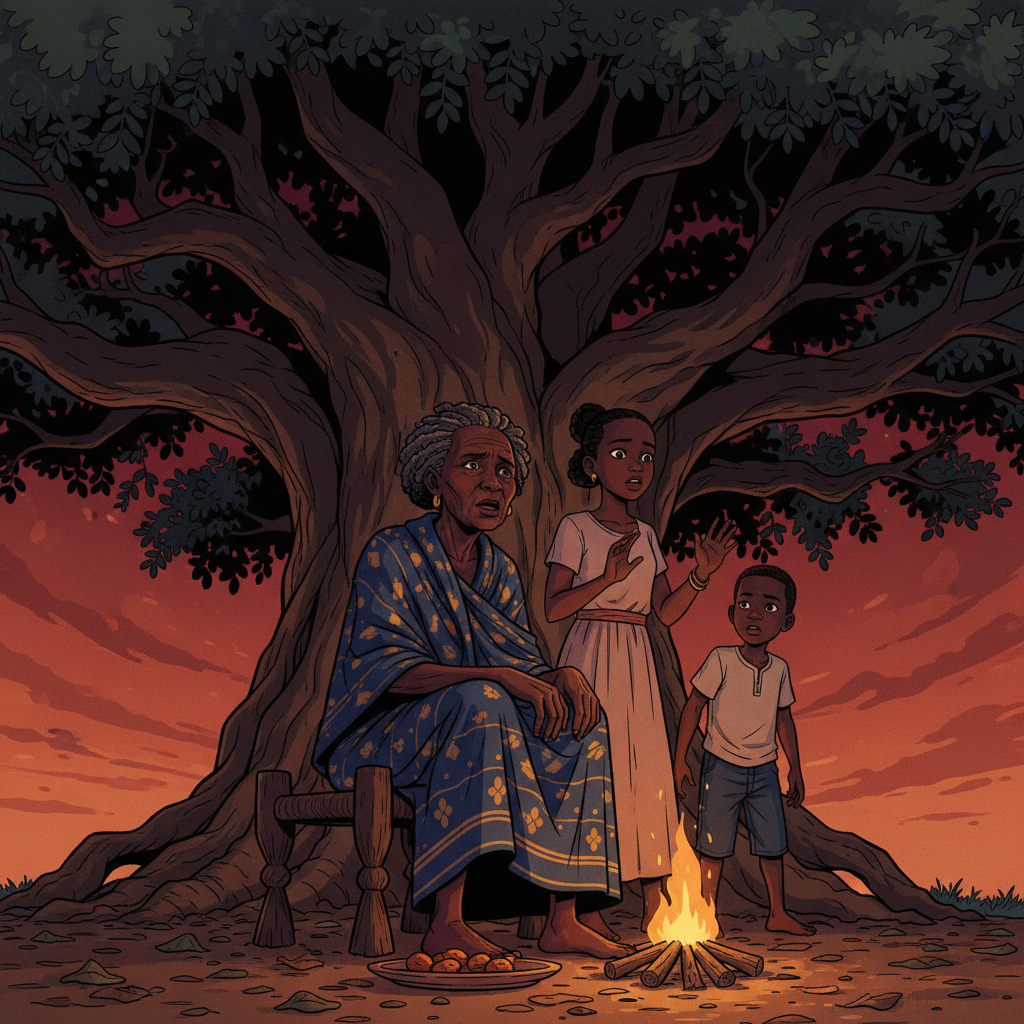
In the seventh month of the lessons, Maimuna began to weaken. Sira noticed it first. Her grandmother's appetite, which had been small but steady, became smaller. The walk from the family's compound to the chief's tamarind became slower. Maimuna's voice, which had carried for two hours at a stretch through the first months, now grew rough after a single hour. Some evenings she could give only twenty names before she needed to stop and rest. Sira watched her grandmother carefully. She did not speak of what she was watching, because speaking of an elder's weakening to the elder herself was not done. But she began to do something at the lessons that she had not done before. She began to repeat each name aloud in two voices — her own, and then Sundiata's — making sure he had heard it correctly, making sure he could give it back. She had become the second teacher in the room, quietly, without anyone having named it. Maimuna noticed. Of course she noticed. On a warm evening in the eighth month, after the lesson had finished and Sundiata had walked back into his father's house, Maimuna held Sira back at the gate of the courtyard. She put both hands on Sira's shoulders and looked at her granddaughter in the orange light of the evening. "Sira," she said. "You are doing the work. You are catching the names that I drop. You are correcting the boy when I do not have the breath. I have seen you. I want you to know I have seen you." Sira looked up at her grandmother. Her throat went tight. She did not let it show on her face. She nodded once, the careful griot-nod, the way Maimuna had taught her. "Grandmother," she said. "I will be ready. When the time comes. I will be ready." Maimuna squeezed her shoulders once and let her go.
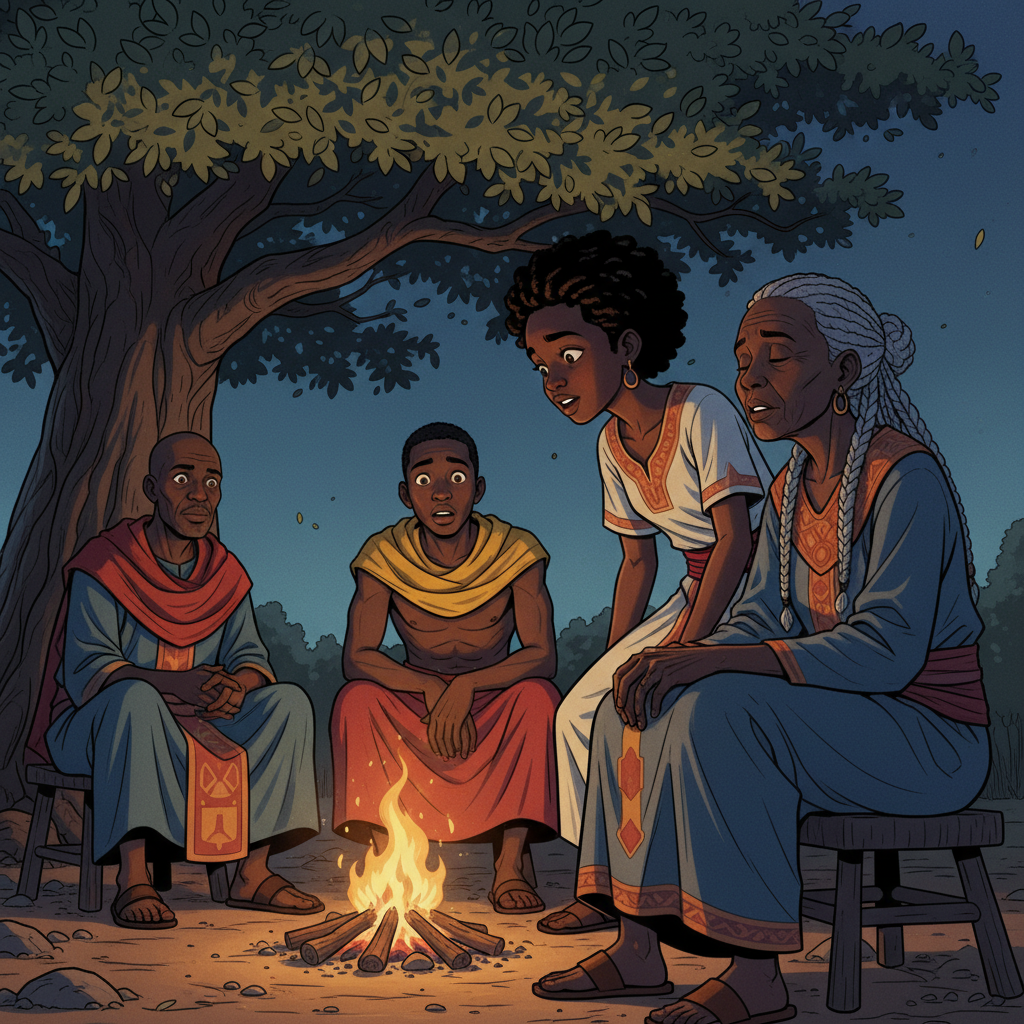
The moment Sira had been preparing for came in the eleventh month, on an evening when the wind off the river was warmer than it should have been and the tamarind's leaves were turning their pale undersides up in a small worried way. Maimuna sat down on her stool. She arranged her robes. She set her hands in her lap. She looked across the small fire at Sundiata. She opened her mouth to begin the night's lesson — they had reached the generation of King Ghana Bassi and the great drought of three hundred years past, the segment most relevant to the present hardship — and she could not begin. The names did not come. Maimuna closed her mouth. She tried again. Her voice produced a small dry sound. She looked over at Sira beside her. Her eyes were not afraid. Her eyes were saying, very calmly, granddaughter, the time has come, do the thing we have practiced for. Sira sat very still on the swept earth for one heartbeat. She looked at her grandmother. She looked at Sundiata across the fire. She looked at the chief Bemba Kante in his witness-position. She looked back at her grandmother. And then Sira, thirteen years old, with her own dry warm hand laid on the back of her grandmother's hand to ground them both, began the lesson herself. "Tonight," Sira said in a clear young voice that did not shake, "we will speak the names of the generation of King Ghana Bassi. Bassi was the eighth king of the second succession-line after Dinga Cisse. He ruled in the time of the great three-year drought. His sister Aminata was the wisdom-keeper at his court. The merchant house of Tunkara was the principal salt-trading house of that generation. The merchant house of Sylla was the principal gold-trading house." Sundiata's eyes widened. Maimuna closed her own eyes and listened.
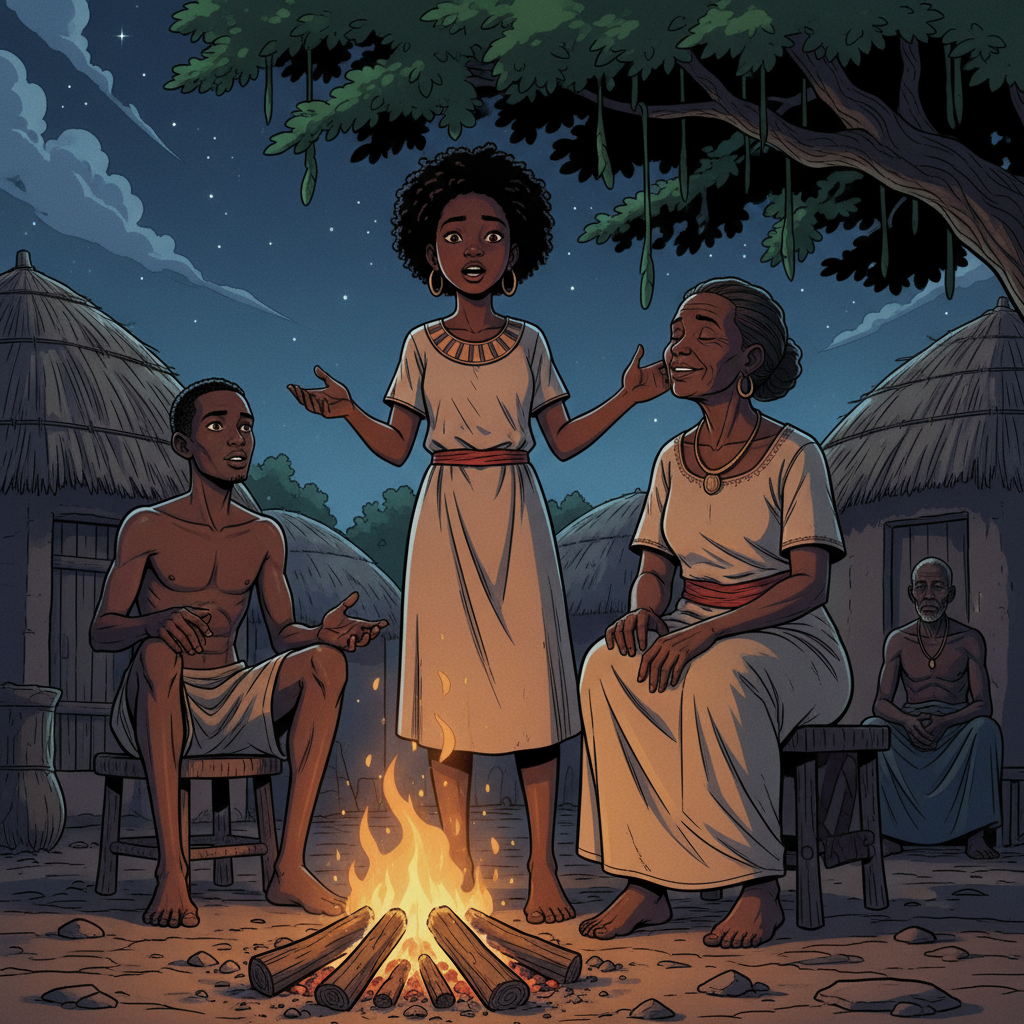
Sira gave the full lesson that night. She gave it in her grandmother's order. She gave it in her grandmother's rhythm. She corrected Sundiata's pronunciation in the same gentle precise way her grandmother had corrected it for the past eleven months. When she came to a name she was not sure of, she paused, she touched her grandmother's hand, she said the name softly as a question. Maimuna, eyes still closed, would nod or shake her head once, and Sira would adjust. The lesson took an hour and a half. When Sira finished, the tamarind leaves had stilled. The fire had burned down to coals. Bemba Kante had not moved from his stool. Sundiata had not looked away from Sira's face the entire time. The chief's son sat with his hands open on his knees, his face the face of a person who has just understood that the elder he had been studying with had been training a second elder alongside him without his quite seeing it. Maimuna opened her eyes when Sira had finished. She looked at her granddaughter for a long quiet moment. Then she did something she had not done in the entire eleven months of the lessons — she smiled at Sira openly, the full slow wrinkled smile of a senior griot acknowledging finished work. "Granddaughter," she said, "the names have crossed. They are in two heads now. Mine is one of them tonight. Yours is the other. Tomorrow night Sundiata will be the third. The work is done." She paused. She placed her hand on Sira's cheek — the elder's blessing-gesture, palm flat against the cheekbone — and held it there for the slow count of three. "I have carried them as far as I can carry them, Sira. They walk with you now."
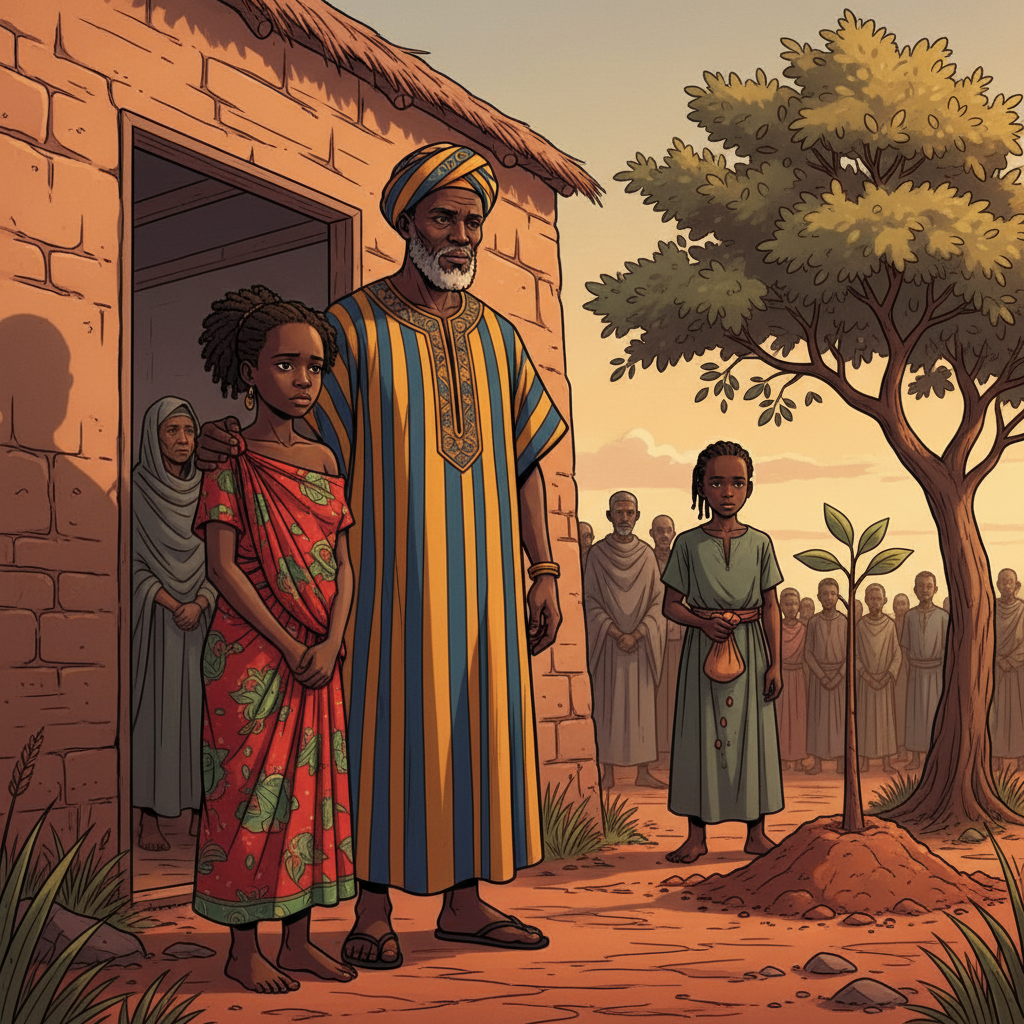
Maimuna died four months later, in the warm season, on a quiet afternoon when the family had gathered in her room. She had given Sira and Sundiata the full lineage by then. Two thousand years of names had been transferred from one head into two heads — a Soninke granddaughter and a Mandinka chief's son, the two of them sitting beside each other at evening under a tamarind, the elder's voice growing thinner and the children's memories growing fuller week by week. When Maimuna died, she had completed her work. The chief Bemba Kante came to the family's compound himself to pay his respects, and he stood for a long time with his hand on Sira's shoulder in the doorway of her grandmother's room, and he said only, "Daughter. The Mandinka are in your debt. Your grandmother saved knowledge that would have ended with her. Whatever you need in this town, ask. Whatever your family needs, ask." Sira nodded once, the griot-nod, and did not cry until after the chief had gone. The family buried Maimuna at the foot of a young baobab tree at the edge of the town, in Mandinka soil. Sira had asked for that — a young tree, so that the baobab would grow over her grandmother's grave for the rest of Sira's own life and beyond. Sundiata stood with the family at the burial, beside his father. He held a small handful of red Sahel earth that Maimuna had carried in a leather pouch from Kumbi Saleh — the earth of the old empire, brought south on her own person. Sundiata placed the red earth at the head of the grave so that a piece of Wagadu would always be in the soil under the Mandinka baobab. Sira watched him do it. She understood, watching, that the friendship between the chief's son and the granddaughter of the griot was no longer the friendship of children. It had become the friendship of two people who shared an inheritance.
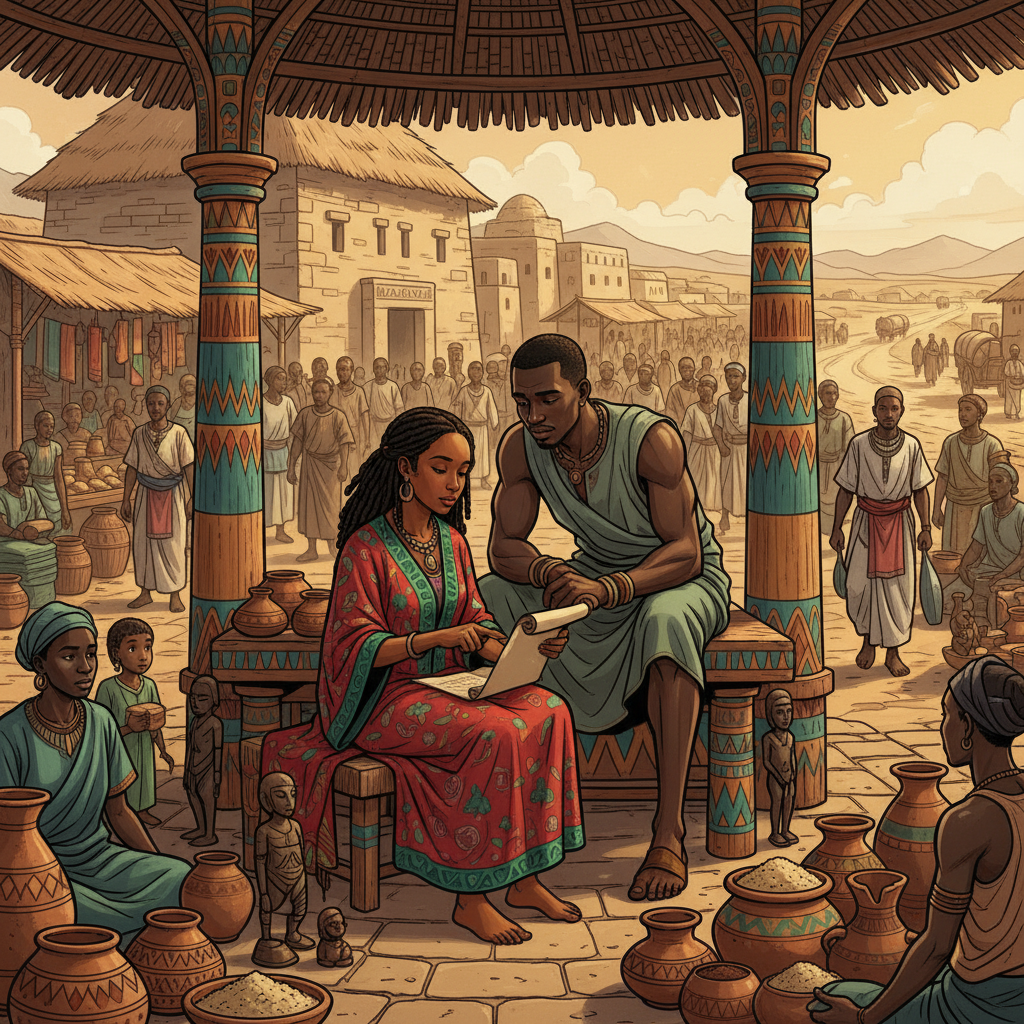
In the years that followed, Sira grew into the full role her grandmother had trained her for. By the time she was twenty, she was the recognized senior griot of the Sissoko family in their new Mandinka town, and the chief Bemba Kante consulted her on matters of governance the way his father had consulted the chief griots of the previous generation. Sundiata, growing into manhood beside her, became the kind of young leader who came to the griot's door with questions before he made decisions. He asked Sira about the failures of the old Wagadu kings before he made a ruling. He asked her about the merchant houses before he set tolls on the gold roads that now passed through Mandinka country. He asked her about the famines of three hundred years past before he set the grain-storage policy for the town. Sira answered him from the lineage her grandmother had placed in her. She answered him precisely. She answered him without flattering. The Manden — the country that the Mandinka were slowly building in the lands the dying Wagadu had once held — was rising. Not as a new empire yet. Not as a conquest. As a slow careful confederation of towns under chiefs who consulted their griots and traded with each other along the old gold roads. The merchants who had scattered out of Kumbi Saleh and the other Wagadu cities had been finding their way south for two decades. Some had settled in Niani, the Mandinka town that was growing into a small capital. Some had come to Sira's town. They brought their trading knowledge with them. They brought their family names. The griot-memory that Sira and Sundiata had inherited from Maimuna was beginning, year by year, to provide the law-frame and the governance-spine for what the Manden would become. The names had walked. They had crossed a border. They were rebuilding.
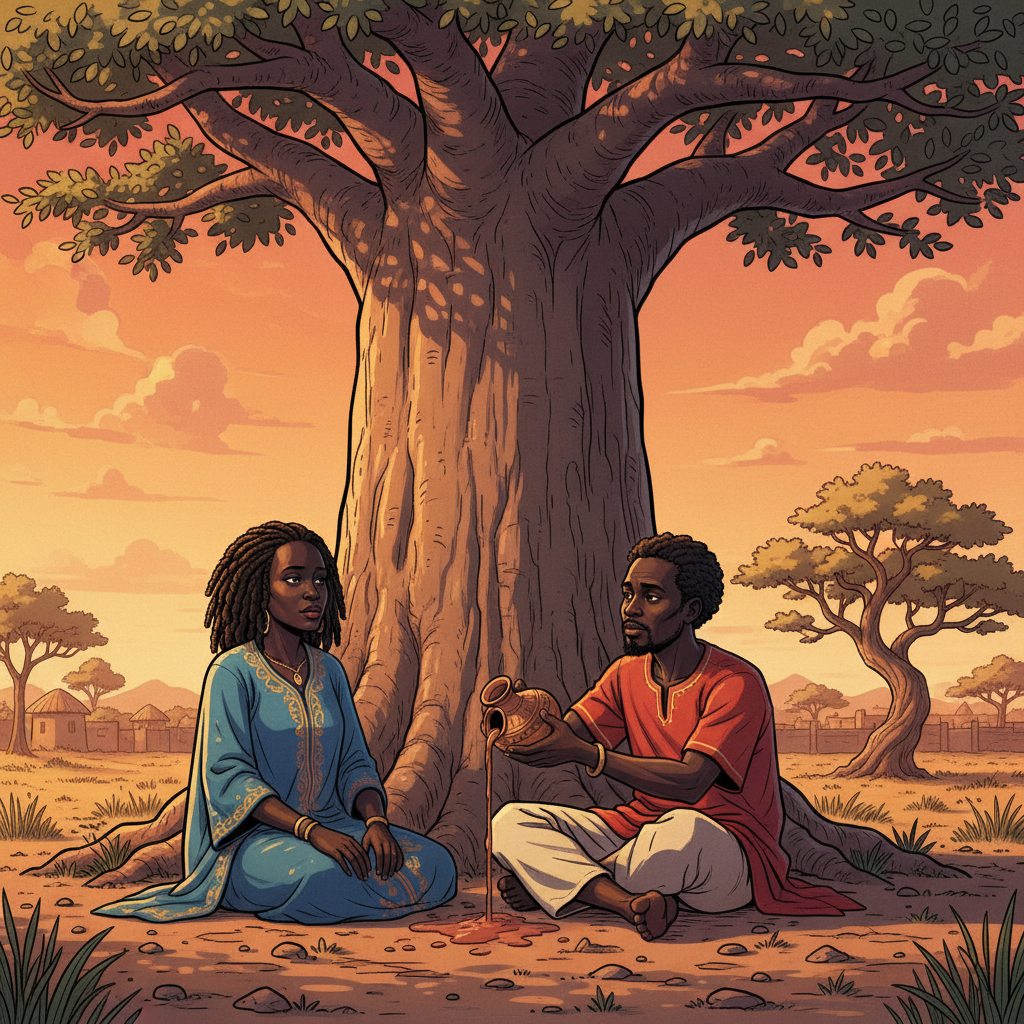
On a warm evening many years after the lessons under the tamarind, when Sira was twenty-eight and Sundiata was twenty-nine and the chief Bemba Kante had grown old and was preparing to hand his stool to his son, the two of them sat by themselves at the foot of the baobab that had grown up over Maimuna's grave. The tree was taller now than a tall man. Its trunk had begun to thicken. Sundiata had brought a small clay pot of millet beer — the kind that was poured on the ground at the foot of a grave when a descendant came to talk with the dead. He poured a portion at the base of the baobab. He sat down on the earth beside Sira. He did not speak for a while. Then he said: "Sira. My father will retire next moon. I will take the chief's stool. The Manden is changing. The towns are asking the chiefs to bind themselves more closely. Soon there will need to be a charter — a written law-frame that binds many chiefs. The other kafus have asked me to help draft it. I cannot draft it alone. I need the lineage your grandmother placed in us. I need YOU." Sira looked at her old friend in the evening light. She thought of her grandmother's hand on her shoulder on the long walk south, all those years ago. She thought of the eleventh evening at the water hole when Maimuna had told her, "You listen with your whole face." She thought of the way the names had crossed from Maimuna's head into two heads at once, hers and Sundiata's, under this same tree's younger ancestor. She thought of the bedtime words her grandmother had repeated softly to her all through the nineteen days of the walk, whenever Sira had grown afraid that they had lost their whole life and would have nothing in this strange southern country. The words came back to her clearly now, in her grandmother's voice, the voice Sira would carry inside her own voice for the rest of her life. Empires fall. Peoples don't.
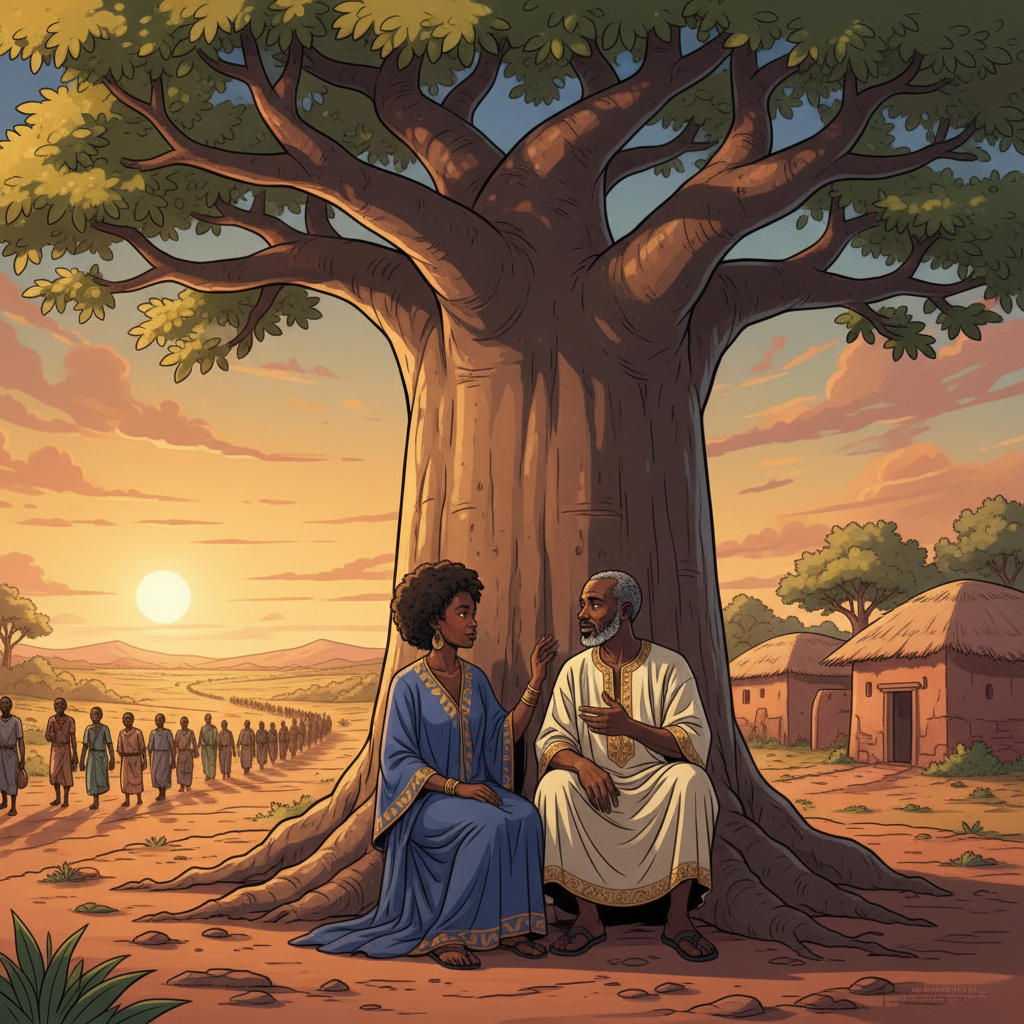
"Sundiata," Sira said. "I will help you draft it. The Mandinka law-frame your grandsons will inherit will carry the bones of Wagadu inside it. Not as a borrowed wisdom. As a gift that was given to your people by my grandmother on her last journey. The Manden charter you and the other kafus are going to write — it must say plainly where its memory comes from. It must say plainly that the law-spine was taught to a Mandinka chief's son and a Soninke griot's granddaughter together, by an old Soninke woman who could no longer walk on her own, in a Mandinka courtyard, during the months her empire was fading and your country was rising." Sundiata listened. He nodded slowly. He understood. "It will say that, Sira. I give you my word, as I will give my word in the charter itself, that the source of the law-memory will be named." They sat for a long time after that, at the foot of the baobab, watching the evening light go soft on the leaves of the great tree. Sira put her hand on the trunk where the bark was smooth. She thought of her grandmother lying under the roots. She thought of the long thin line of family that had walked south behind her, twenty-two people on a dusty road. She thought of the gift Maimuna had carried inside her own head for sixty-eight years — heavier than any cart of gold, harder to lose, easier to give once the right child was sitting at her knee. She felt the bark warm under her hand in the last of the day's heat. "Grandmother," Sira said quietly to the tree. "The road did its work. The names walked. They have arrived. I will carry them the rest of the way. So will your friend's son. So will his sons after him." The baobab did not answer. It did not need to. The Manden was already being built.
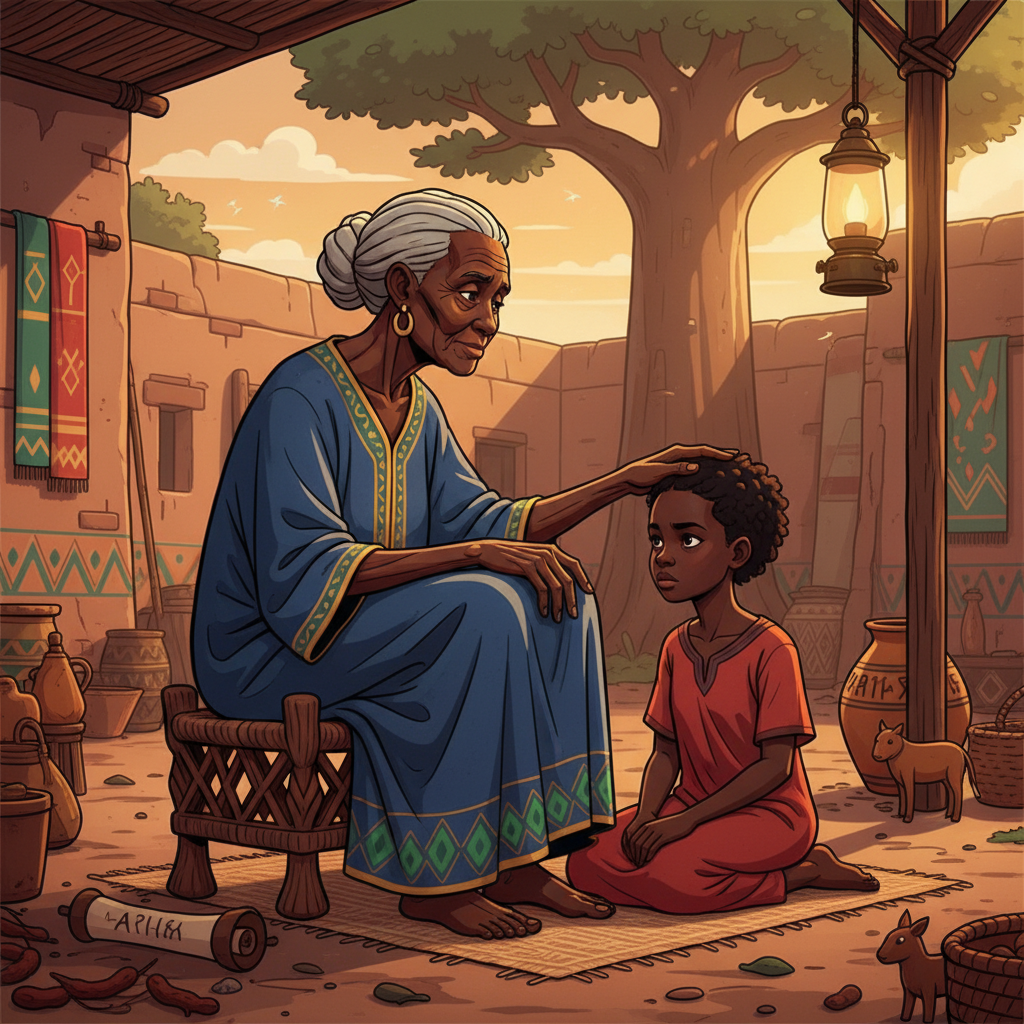
Many years after that evening at the baobab, when Sira was an old woman herself with white hair and slow careful hands and a grown granddaughter of her own, she would sit on a low stool in the courtyard of her family's compound at evening and teach the names of the lineage to a small serious-faced girl at her knee. The granddaughter's name was Aminata, and she was twelve, and she listened with her whole face the way her grandmother had once listened to her own grandmother on the road south. Sira would teach Aminata the lineage of Wagadu — the founder Dinga Cisse and the eight kings of the dawn-line and King Bassi and his sister the wisdom-keeper — and Sira would teach Aminata the lineage of the Manden too, the chiefs who had come after Bemba Kante, the careful slow building of the confederation of towns, the names of the merchants who had carried the gold north and the salt south and the cloth in every direction. The two lineages walked together now in one head. On the evening Sira finished the final segment of the teaching — when Aminata had given back the last name perfectly and her young face was tired and proud — Sira placed her dry warm hand on the top of her granddaughter's head, the way Maimuna had once placed her hand on Sira's head a thousand times. "Aminata," Sira said quietly. "Your great-great-grandmother walked nineteen days down a dusty road with my hand on her shoulder, and she gave me the names. I have given them to you. One day you will give them to your own granddaughter, and the road will keep going. Remember what Maimuna said to me at every evening fire of the long walk. Empires fall. Peoples don't. The names walk. We walk with them." Aminata nodded once, the careful griot-nod. The lineage continued. It would continue for many generations after Sira was gone, the way a thing continues when it has been placed with the right hands at the right hour.