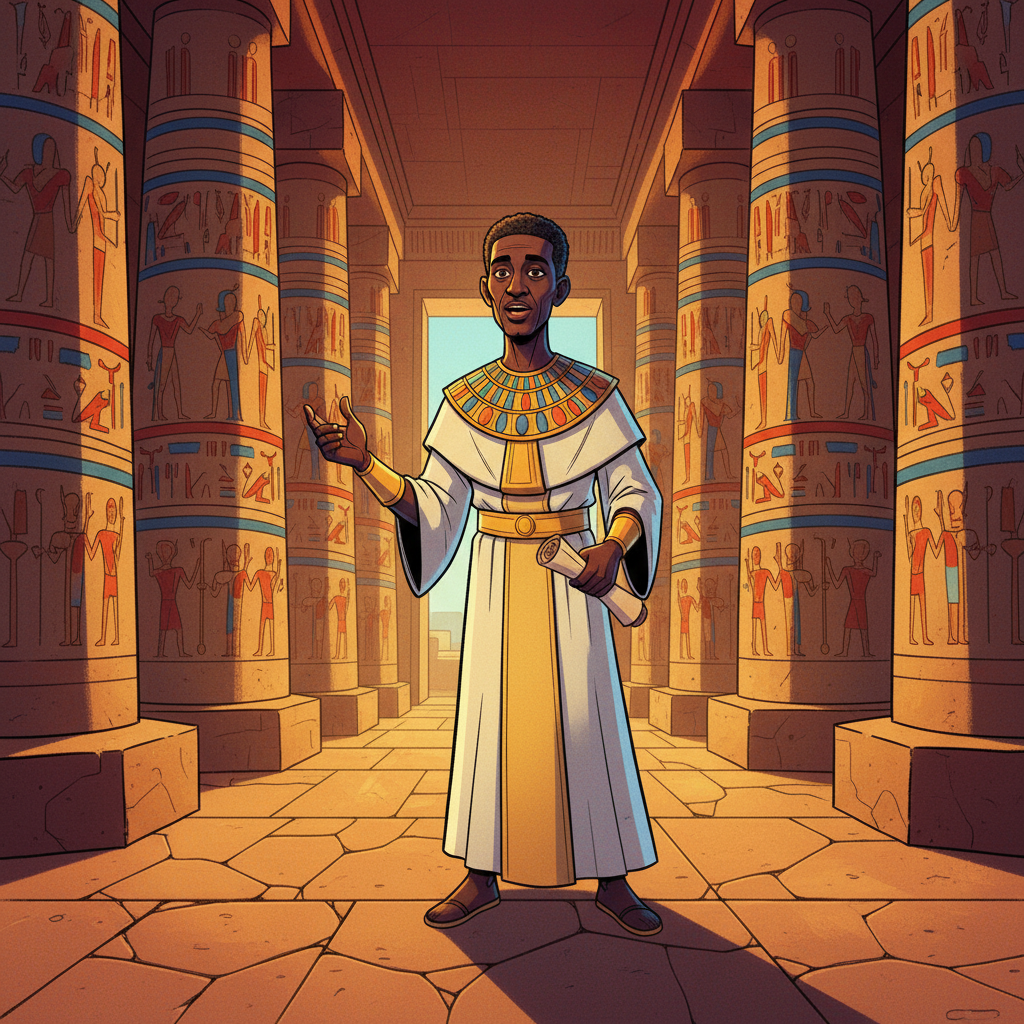
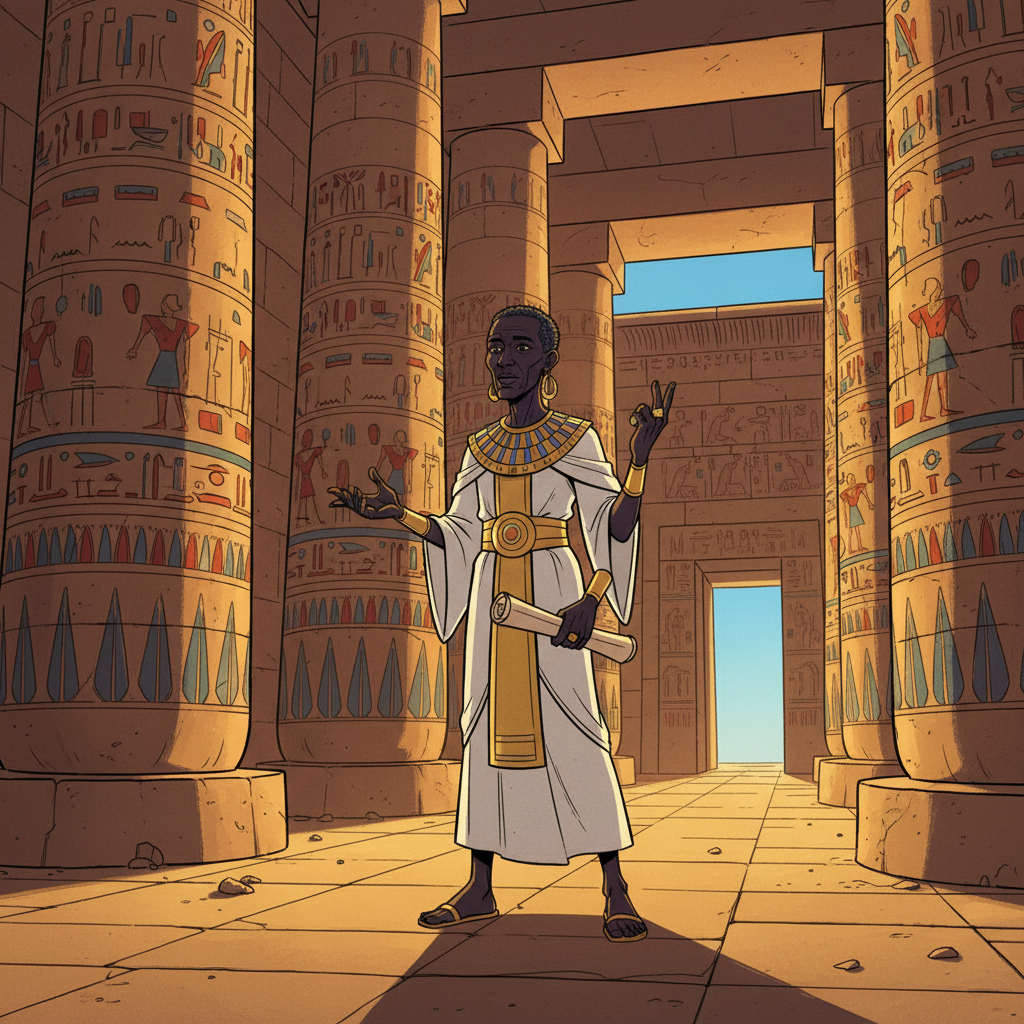
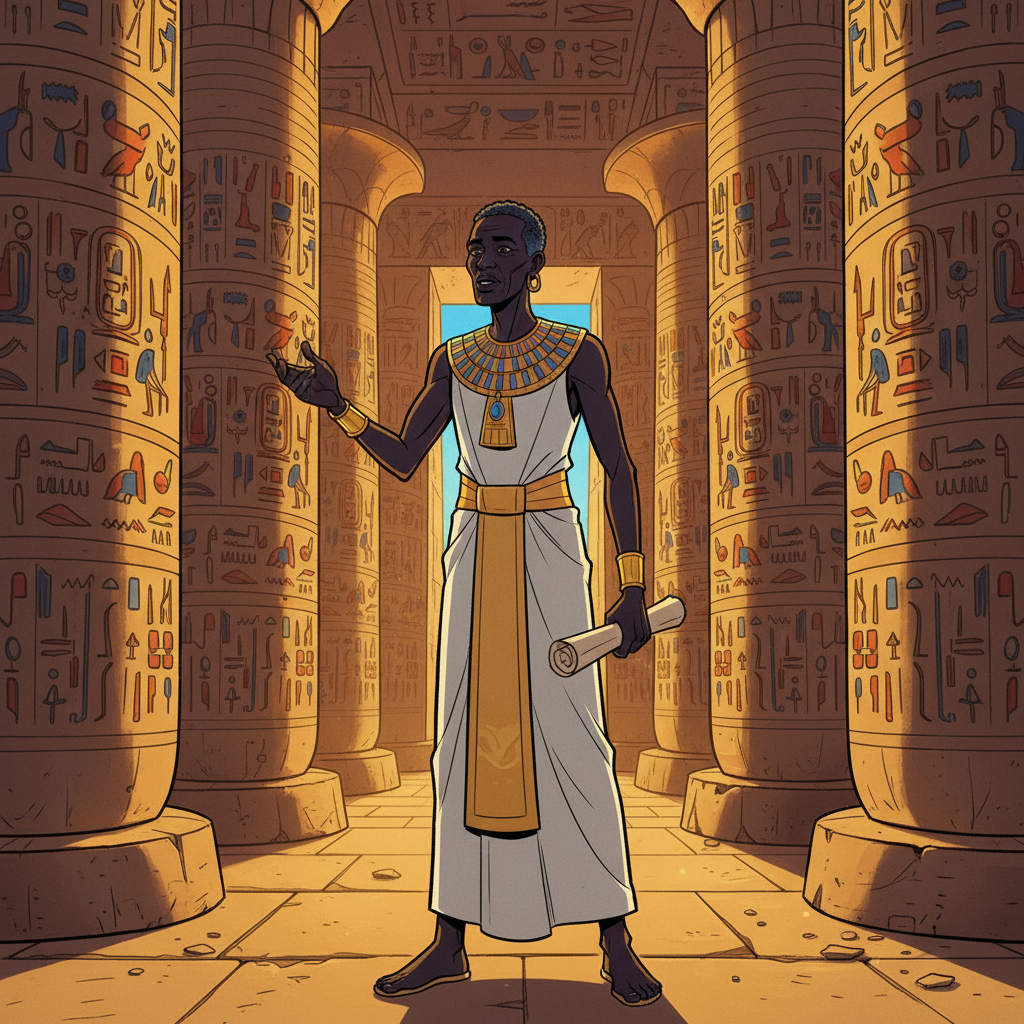
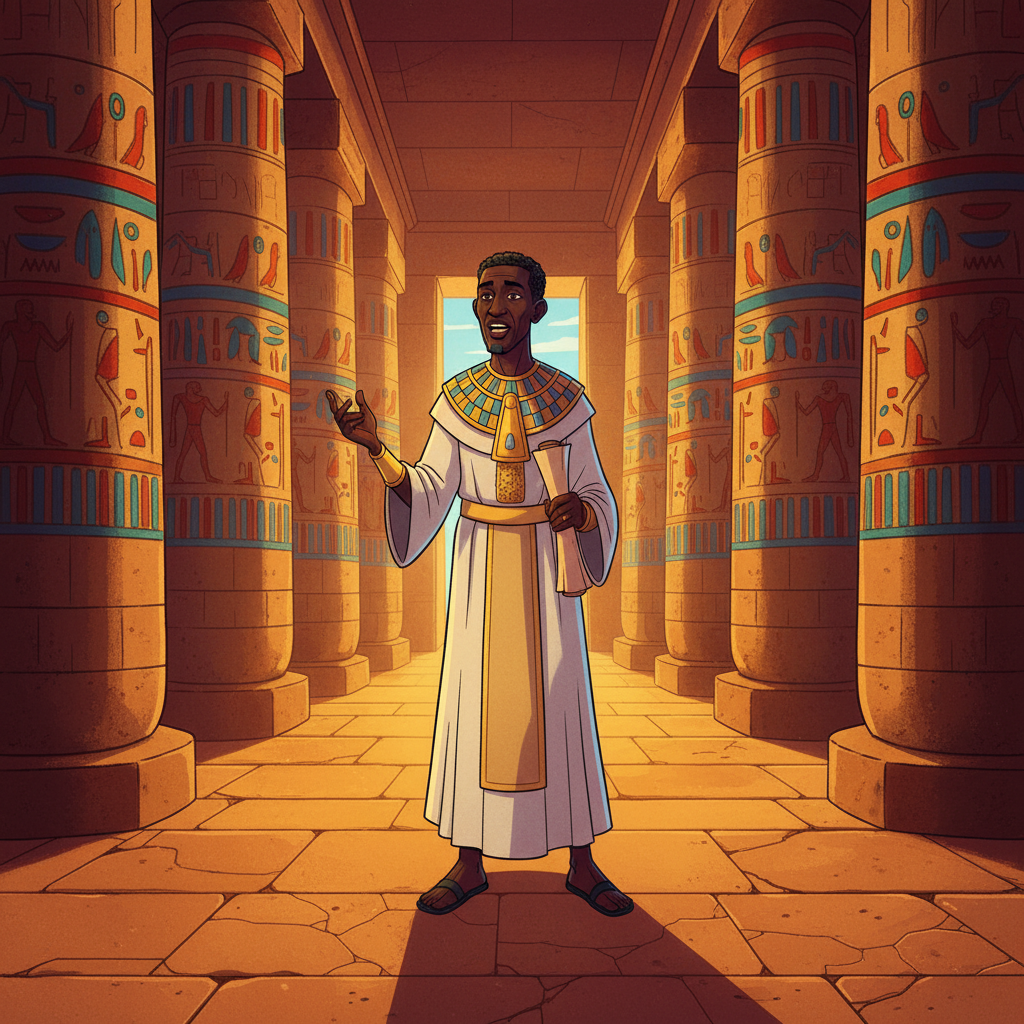
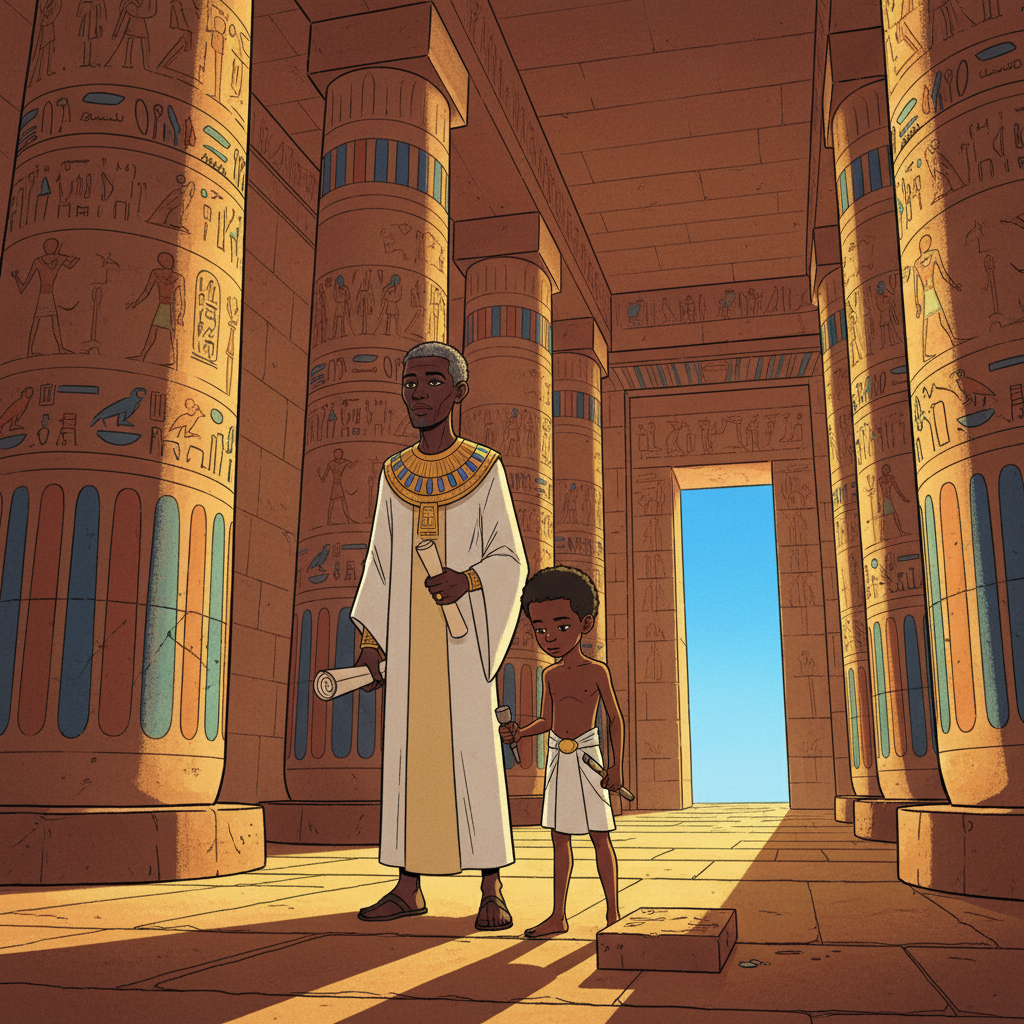
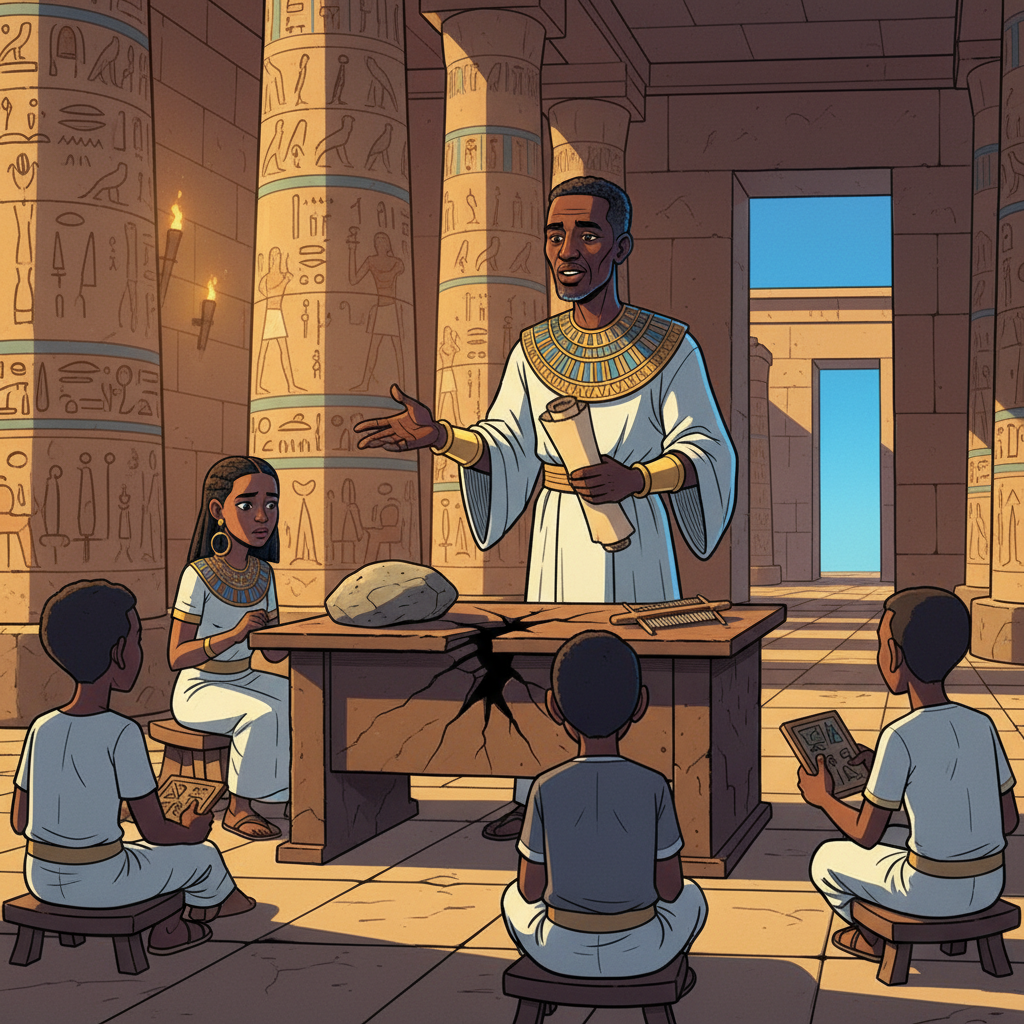
In the Per Ankh — the House of Life — the morning light slipped through high windows and fell across rows of papyrus scrolls. Students sat cross-legged on reed mats, their dark brown skin glowing in the warm amber light. The air smelled of ink and old paper. This was the oldest school in the district, where children of Kemet came to learn writing, mathematics, medicine, and the laws of Ma'at. The teacher Senenmut placed two objects on the wooden desk before his students. On the left, a smooth river stone pulled from the banks of the Nile. On the right, a single white feather from an ibis bird. "These represent your two choices every time you open your mouth," he said. "The stone is a careless word. The feather is a truthful one."
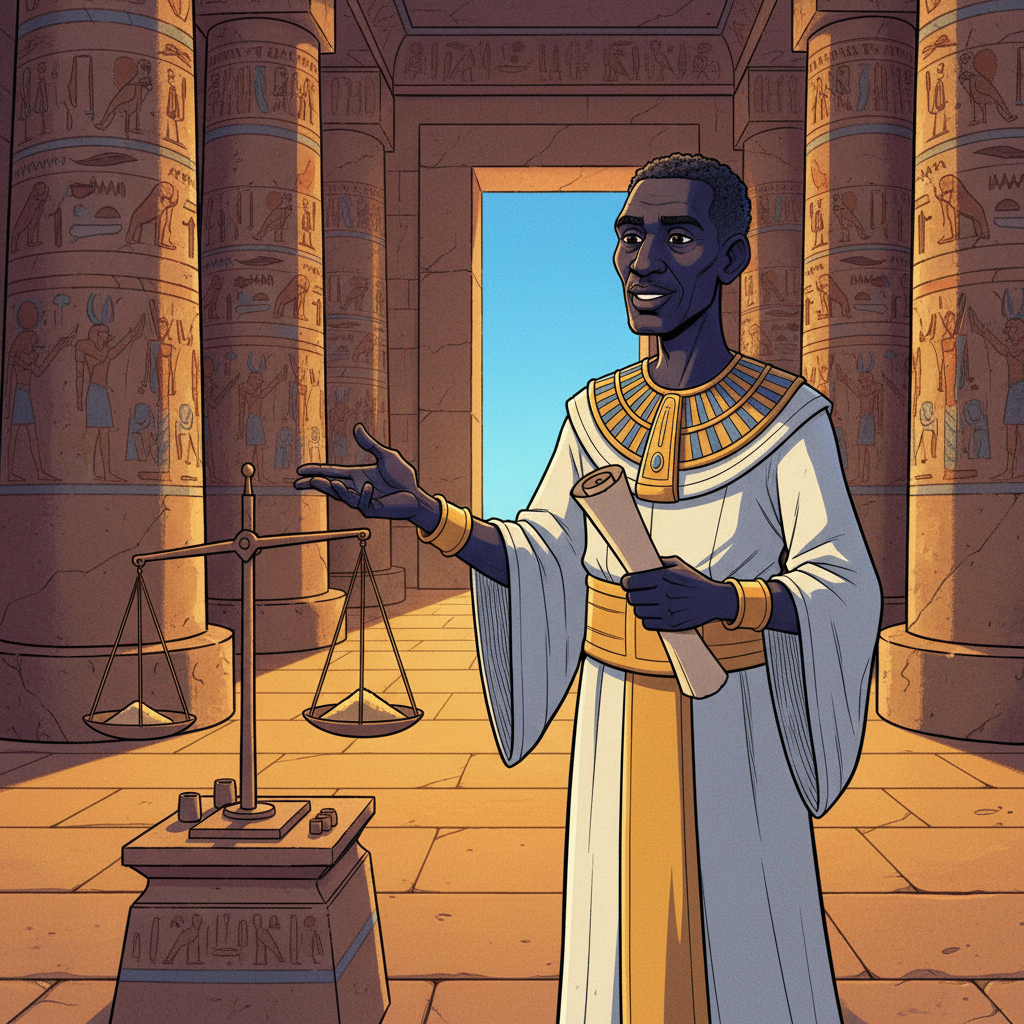
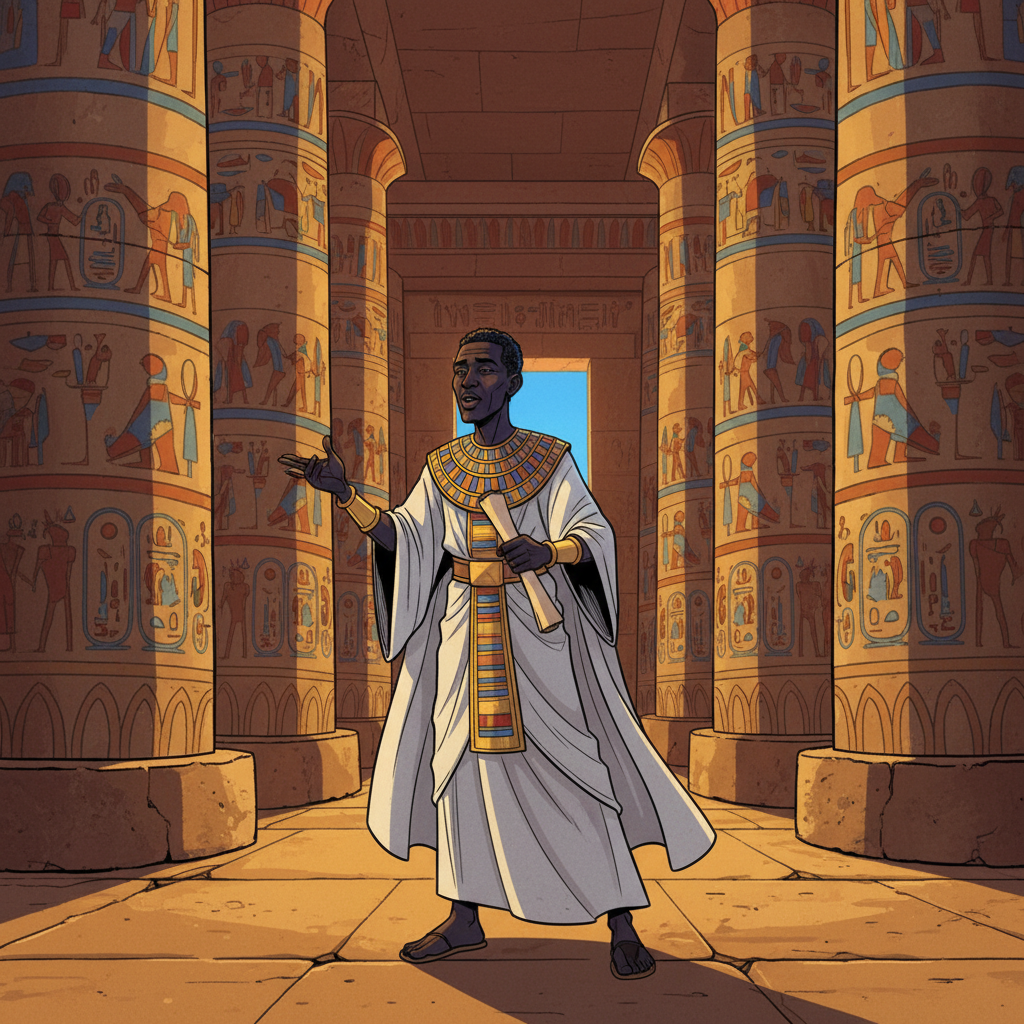
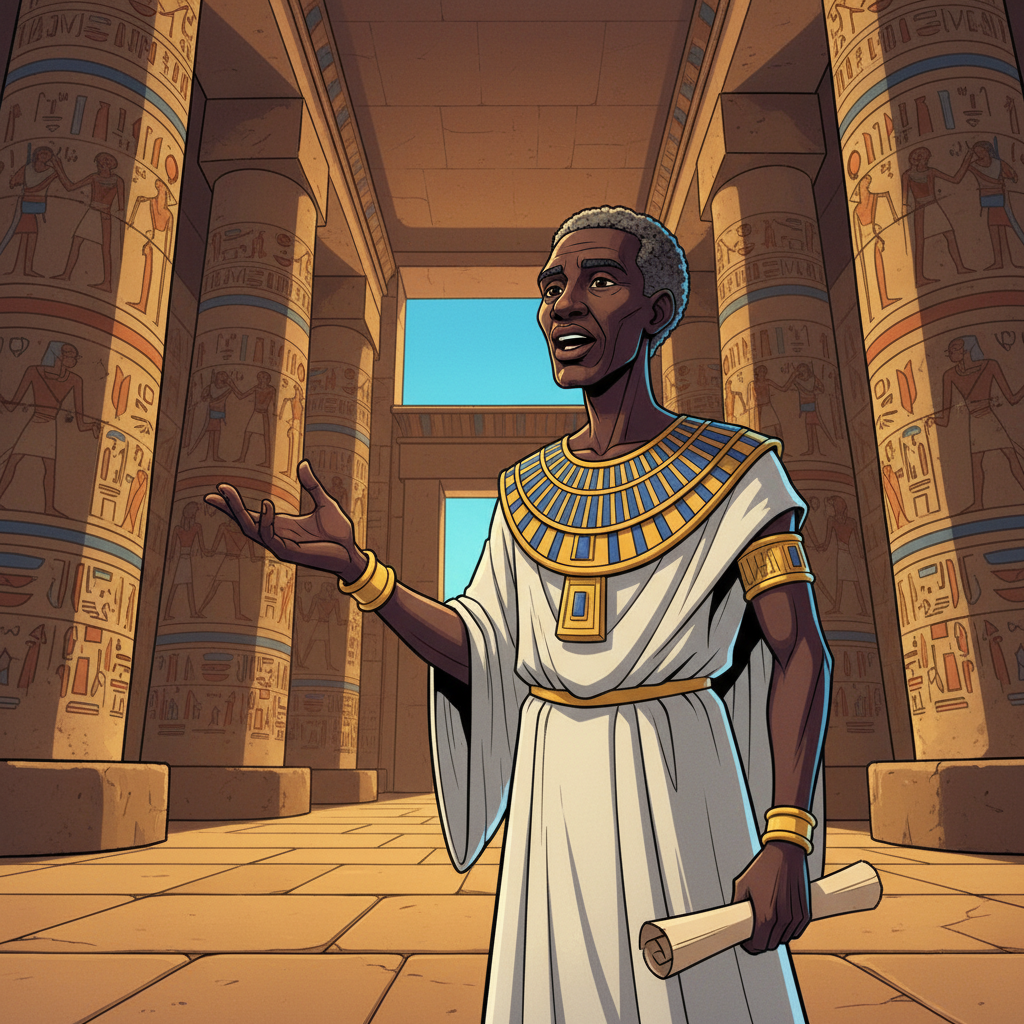
Senenmut stood tall at the front of the room, his deep ebony skin lined with years of study and patience. His shaved head caught the light. Around his neck hung a small pendant of Ma'at — the goddess of truth — with her feather carved in bone. He wore a simple white linen robe, clean and pressed, because he believed a teacher should show order in all things. "Words have weight," Senenmut continued, his voice low and serious. "When you say something true, it is like placing a feather on the scale. Light. Clean. It builds trust between people. When you say something careless — a lie, a cruel joke, gossip — it is like dropping a stone. It damages things that are hard to repair."
The students listened closely. There were twelve of them today, boys and girls between ten and thirteen years old, all children of farmers, craftspeople, and scribes. In the Per Ankh, every child was equal. It did not matter if your father built boats or your mother baked bread. What mattered was your willingness to learn and your devotion to Ma'at — to truth, balance, and justice. Senenmut picked up the feather and balanced it on his open palm. "See how gently it sits? Truth does not need force. It rests easily because it belongs. But a lie —" He picked up the stone and held it high. "A lie is heavy. You must carry it. And eventually, it falls."
A student named Panhesy spoke up from the second row. He was a broad-shouldered boy with rich dark skin and short-cropped hair. His father was a builder who worked on the temple walls. Panhesy was clever but sometimes spoke before thinking, which had gotten him into trouble more than once. "But what if you are just joking?" Panhesy asked, leaning forward on his mat. "What if you do not mean it? Is a joke the same as a lie?" Senenmut picked up the stone and dropped it on the desk. THUNK. The sound made several students jump. "Did the desk care whether I meant to drop the stone? The dent is the same whether I dropped it carelessly or on purpose."
Panhesy looked down at the small mark the stone had left in the soft wood. He touched it with his finger. It was real. It was there. And no amount of saying "I did not mean it" would remove the dent from the surface. "This is why the ancestors taught us about isfet," Senenmut said. "Isfet is the opposite of Ma'at. It is chaos, disorder, harm. Every careless word feeds isfet. Every truth feeds Ma'at. You are not just talking when you speak. You are choosing a side — order or chaos, building up or tearing down. Your mouth is a doorway, and what passes through it changes the world around you."
A girl named Takhat raised her hand. She sat near the window, her deep brown face thoughtful, her black braids tied back with a strip of blue cloth. "Teacher, can a word really change things? It is only sound. It disappears into the air." Senenmut smiled at her — the smile of a teacher who had been waiting for exactly that question. "Let me tell you a story," he said, "about two sisters who lived in a village along the Nile, not far from here. Their names were Mutemwia and Ife. What happened between them will show you that words do not disappear into the air. They land somewhere. Always."
The older sister, Mutemwia, was talented at weaving. By the age of fourteen, she could produce linen cloth so fine that merchants traveled from distant towns to buy it. She had quick hands and a sharp eye, and the patterns she created were known throughout the village. People said her ka — her spirit — was meant for the loom. The younger sister, Ife, was still learning. She was eleven, with deep mahogany skin and large curious eyes. Her fingers were not as fast as Mutemwia's. Her patterns were uneven. But she tried every day, sitting beside her sister at the second loom, watching and copying, determined to improve. She admired Mutemwia more than anyone in the world.
One afternoon, a group of friends gathered at the sisters' home to watch Mutemwia work. They admired her latest cloth — a beautiful piece with a border of lotus flowers. Then someone glanced at Ife's loom, where a simpler, rougher piece of fabric sat half-finished. Mutemwia saw them looking and laughed. "Ife's weaving is so ugly even the goats will not sleep on it." The room erupted in laughter. Ife's friends. Ife's neighbors. People she saw every day. They all laughed. Mutemwia grinned, pleased with her joke. Ife sat perfectly still, her hands frozen on the loom, her face burning. She said nothing. She did not cry. She simply stopped.
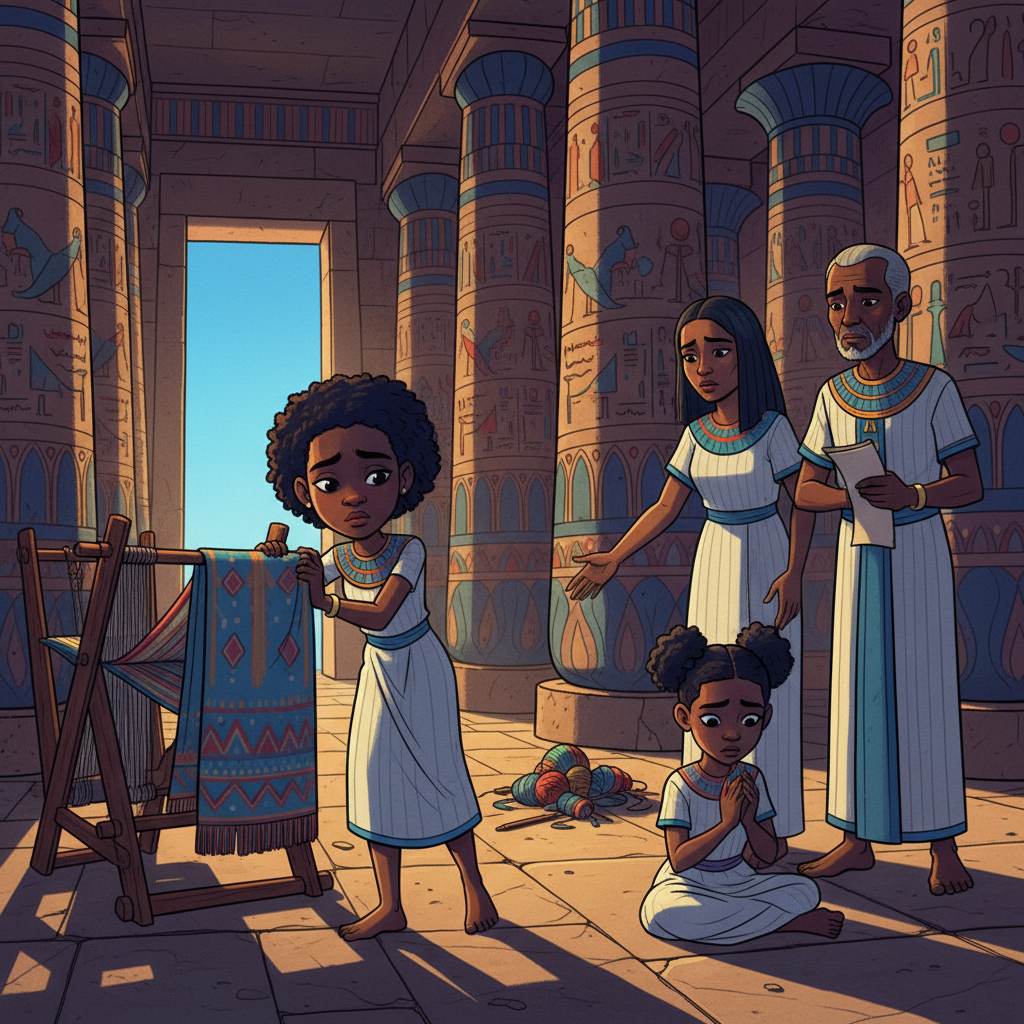
It was a joke. Mutemwia meant nothing by it. She loved her sister and would have been horrified to know the damage she had caused. But that night, Ife quietly pushed her loom into the corner of the room. She covered it with a cloth. She did not touch it the next day, or the day after that, or the day after that. Weeks became months. Months became years. Ife refused to weave. When her mother asked why, Ife just shook her head. But inside, the stone had landed. She believed she was bad at weaving because her sister — the person she trusted most — had said so publicly. One careless sentence destroyed a skill that could have fed a family.
"Think about what was lost," Senenmut said quietly to his students. The room was very still. "Ife had the talent inside her. She needed time and practice, like every weaver does. Like every scribe does. Like every one of you does. No one in this room wrote perfect hieroglyphs on the first day. You practiced. You improved. That is how skill works." He paused and looked around the room at each student. "But Mutemwia's words told Ife's ka — her inner spirit — that there was no point in trying. The stone did not just dent the desk. It broke something inside her sister. And Mutemwia never even knew."
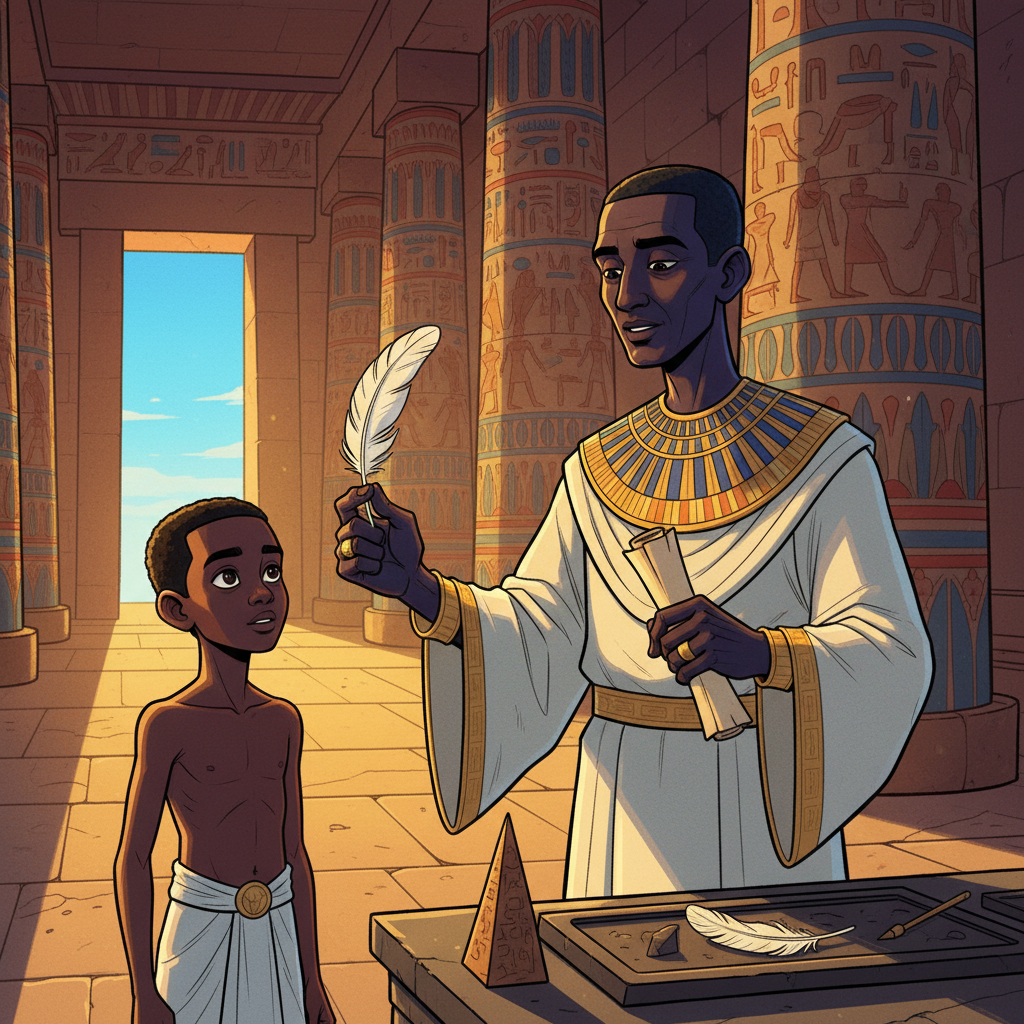
"Now," Senenmut said, "consider what Mutemwia could have said instead." He held up the white feather again, turning it slowly in the light. "She could have said: 'Ife is still learning, and every weaver improves with practice.' Same truth — Ife's weaving was not good yet. But the word carried differently." He placed the feather on the desk beside the stone. "One version dropped a stone. The other placed a feather. Both acknowledged the truth. But the feather gave Ife room to grow. It honored her effort instead of mocking it. Truth does not require cruelty. You can be honest without being harmful. That is the way of Ma'at."
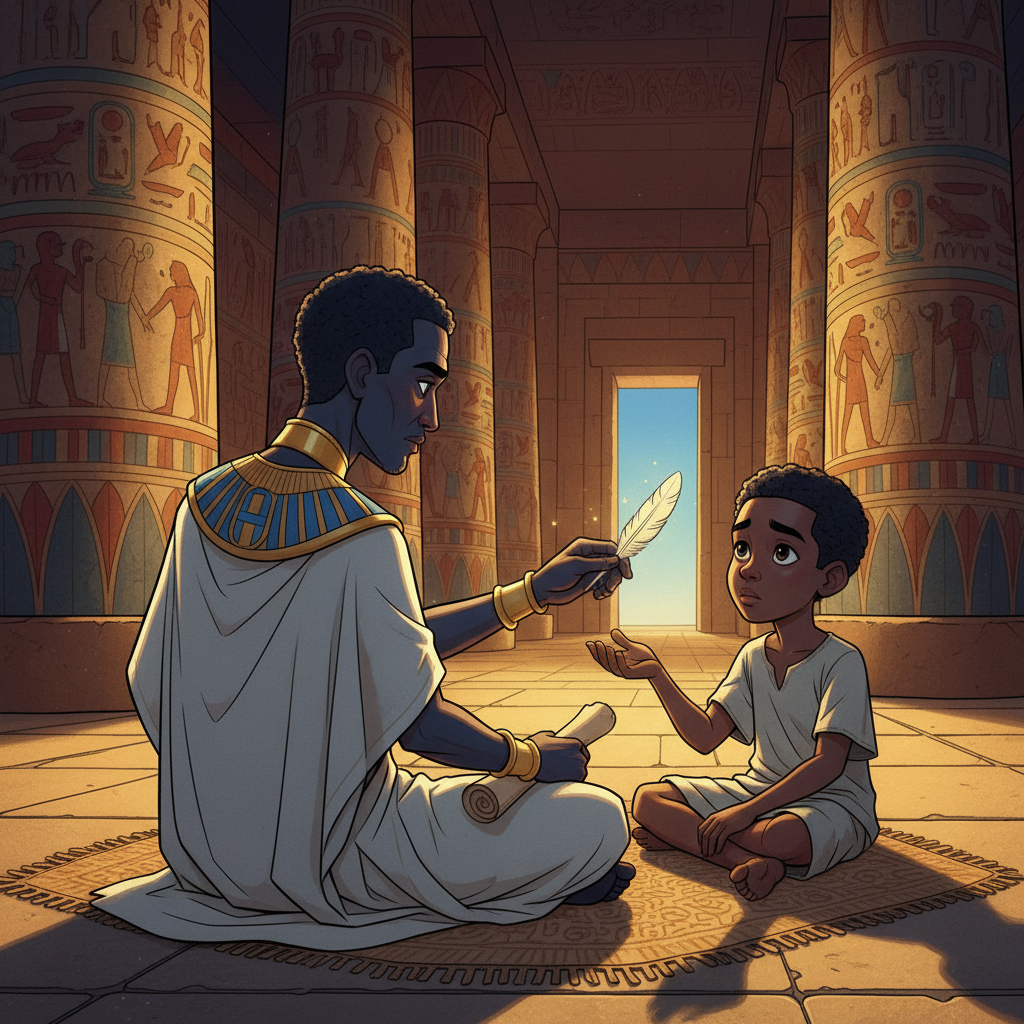
Panhesy shifted on his mat. His face had changed during the story. The playful look was gone. "I have said things like that," he admitted quietly. "To my younger brother. I told him his drawings looked like a sick bird made them. He stopped drawing after that." The room was silent. No one laughed. Senenmut nodded slowly. "That takes courage to say, Panhesy. Recognizing the stone after you have already dropped it — that is the beginning of wisdom. You cannot undo the dent. But you can choose never to drop that stone again. And you can go to your brother and speak words that place feathers where stones once fell."
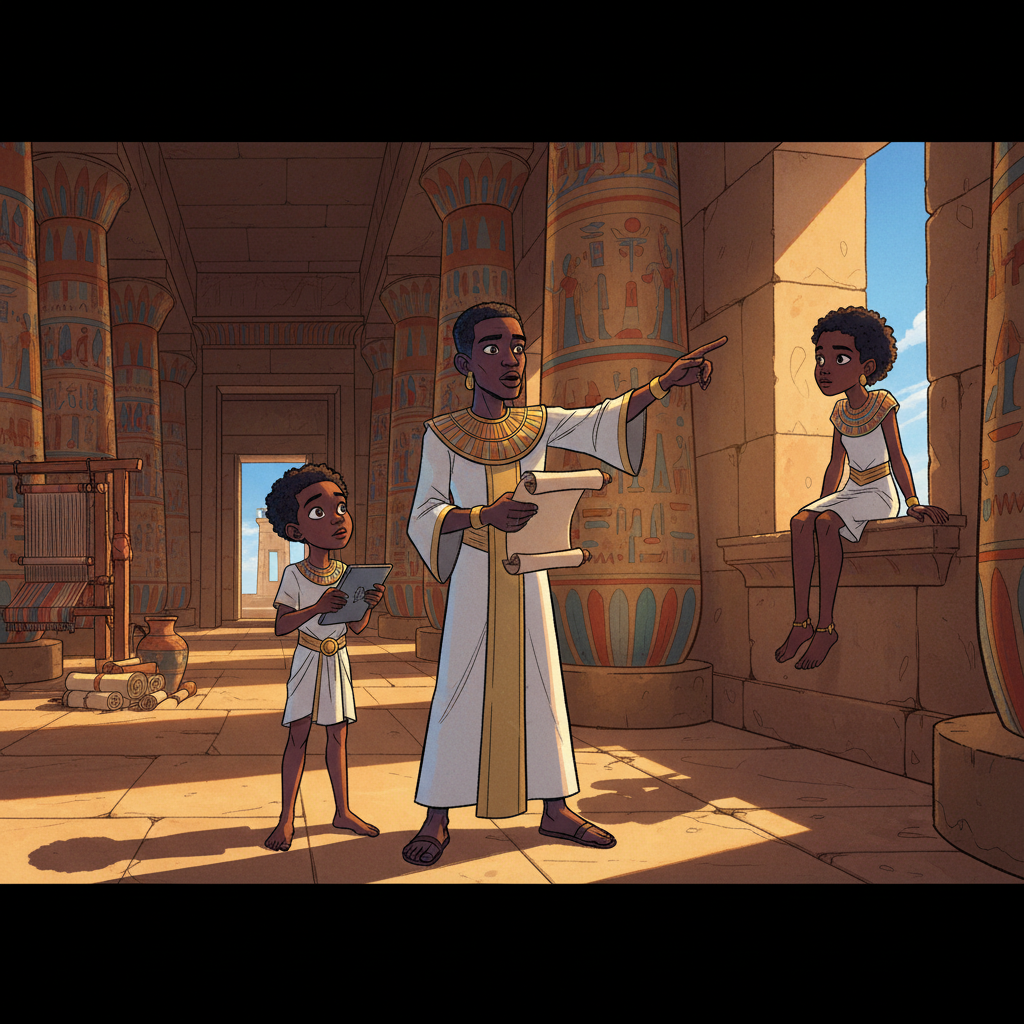
Takhat spoke again from her place by the window. "Teacher, is there a way to fix what careless words have broken?" Senenmut considered this carefully before answering. In the Per Ankh, teachers did not rush their answers. Wisdom required patience. "You can speak new words," he said. "True words. Kind words. Consistent words. If Mutemwia had gone to Ife the next day and said, 'I was wrong to mock you. Your weaving has promise, and I want to help you improve,' it might have changed everything. Words broke the thing. Words can begin to mend it. But mending takes longer than breaking. It always does."
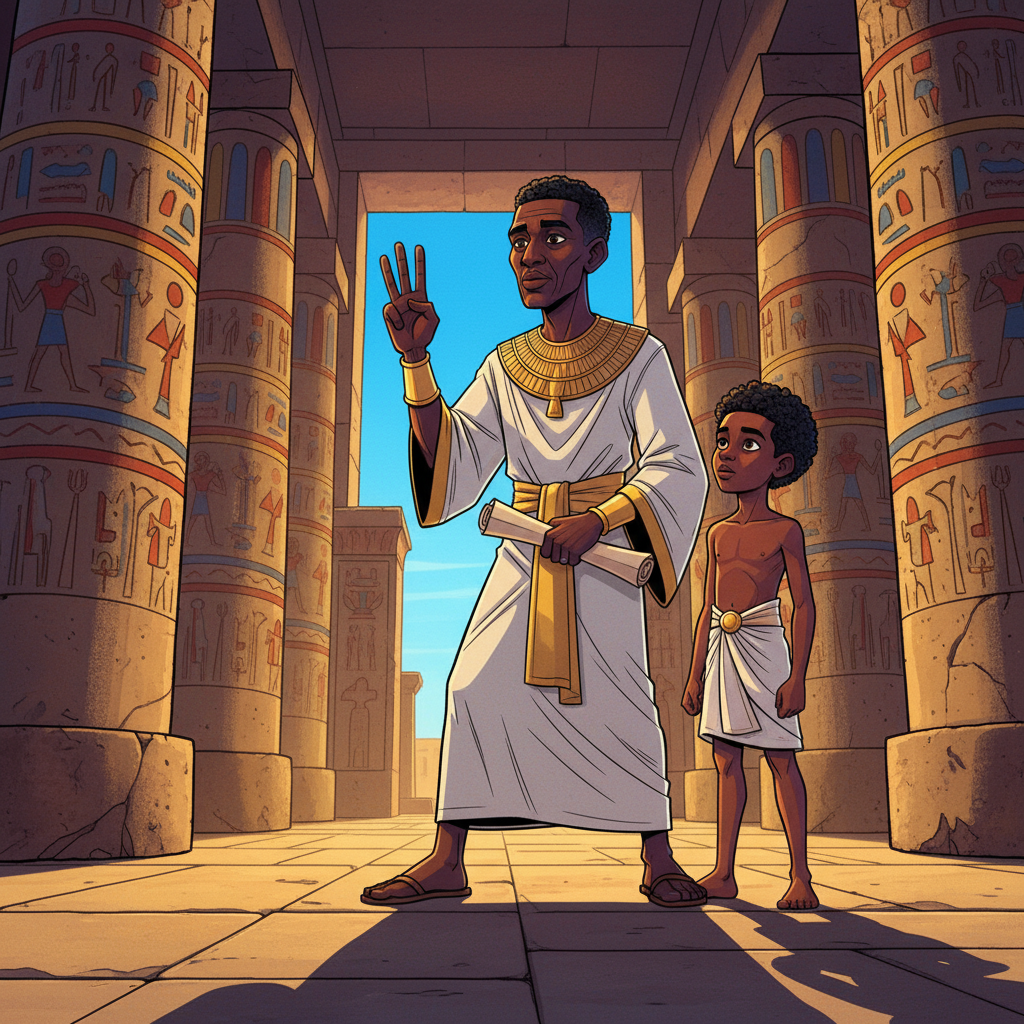
"The forty-two declarations of Ma'at include: 'I have not spoken falsehood.' And: 'I have not caused suffering.' And: 'I have not let my mouth run unchecked.'" Senenmut held up three fingers as he recited each one. "Three separate declarations about speech. Out of forty-two laws that govern a righteous life, three are about the words you say. Why?" He looked at his students, letting the question hang in the warm air. "Because the ancestors of Kemet knew that the mouth is the most powerful tool a person carries. More powerful than any weapon. A sword can wound a body. But a word can wound a ka — a spirit — and that wound may never fully heal."
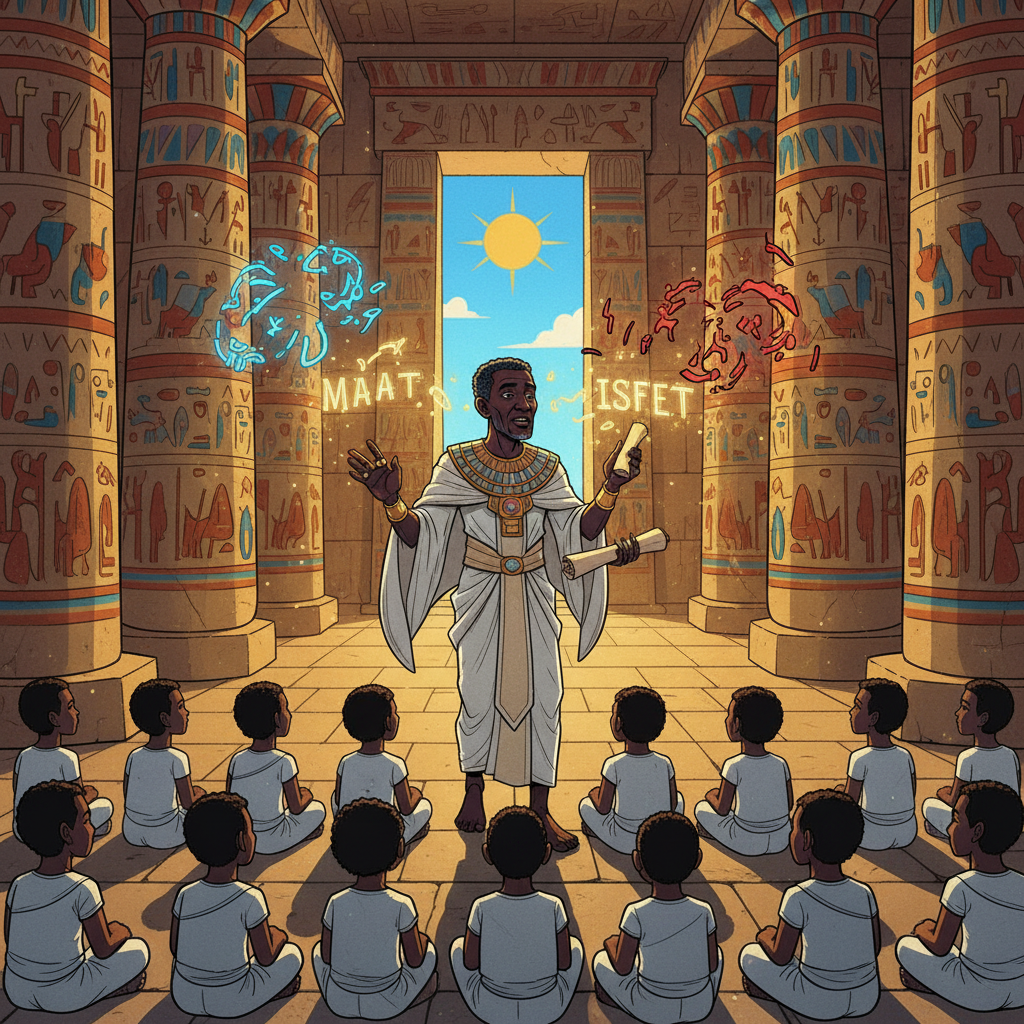
"In the old texts," Senenmut continued, walking slowly between the rows of seated students, "it is written that the god Ptah created the entire world through speech. He thought a thing in his heart and then spoke it, and it became real. The Nile, the sky, the animals, the people — all spoken into existence. That is how powerful words are in our tradition." He stopped in the center of the room. "You are children of Kemet. You carry that same power in your mouths every single day. When you speak, you create something. The only question is whether you are creating Ma'at — truth and order — or isfet — chaos and harm. There is no middle ground."
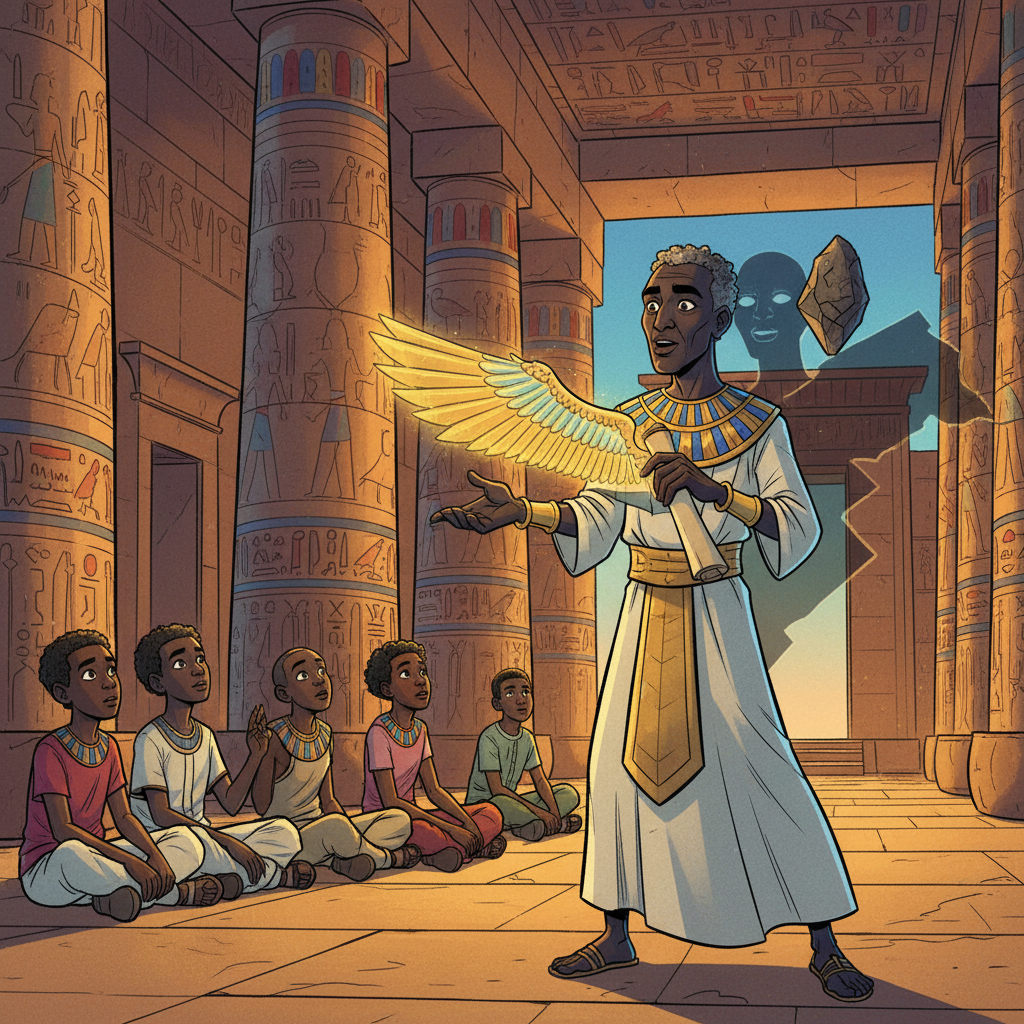
Another student, a quiet boy named Amenhotep with deep black skin and thoughtful eyes, raised his hand for the first time all morning. "Teacher, what about silence? What if you see something wrong and say nothing? Is silence a feather or a stone?" Senenmut's eyebrows rose. "An excellent question. Silence can be either. If you are silent because the words are not true, not necessary, or not kind, then your silence is wise. But if you are silent when someone is being harmed — if you see isfet and say nothing — then your silence is itself a stone. The declarations also say: 'I have not turned away from truth.' Sometimes, speaking is your duty."
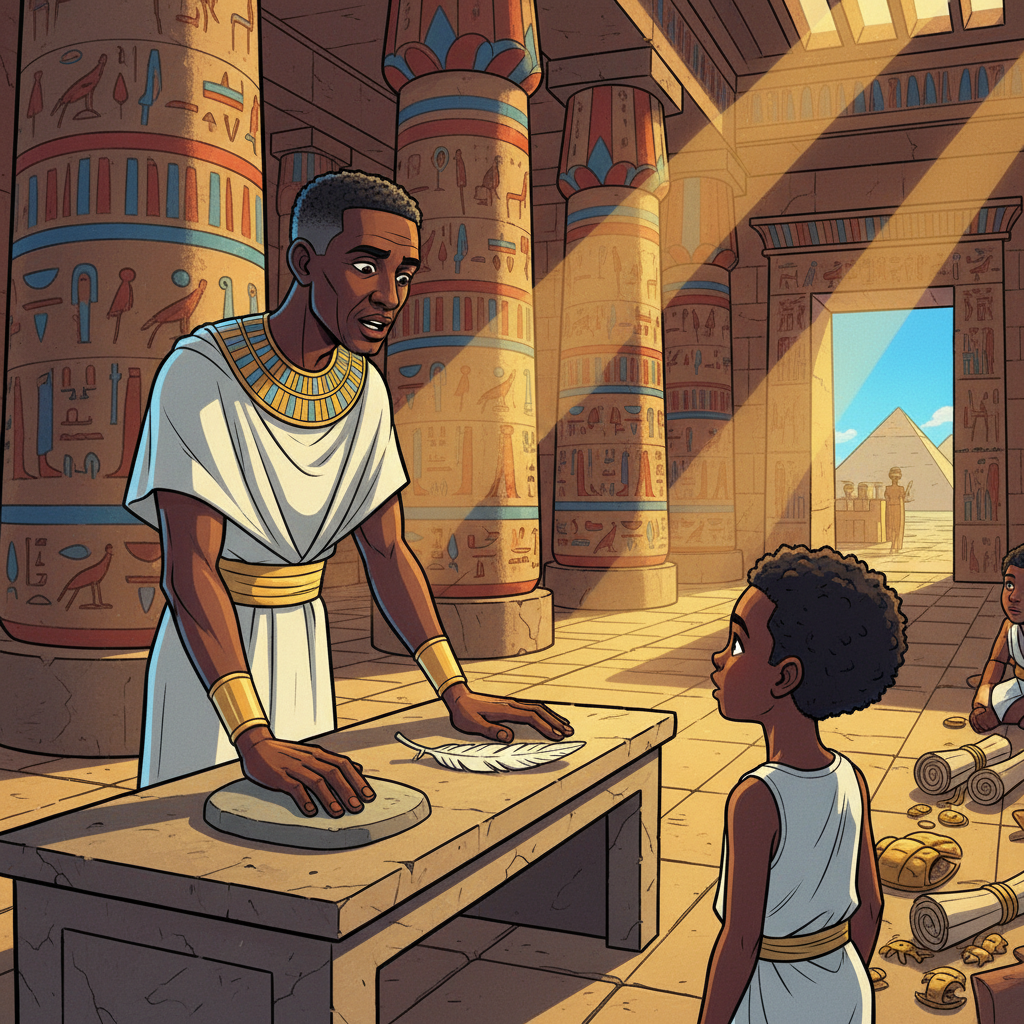
The morning lesson was nearly over. The light through the high windows had shifted, now falling in long golden bars across the floor of the Per Ankh. Senenmut returned to the front of the room and placed his hands on the desk, one on the stone, one on the feather. "Before you speak," he taught, "ask three questions: Is it true? Is it necessary? Is it kind? If a word fails all three tests, it does not deserve to leave your mouth. If it passes even two, consider it carefully. Your words build or destroy. They add feathers or drop stones. Every time you speak, you are choosing which one."
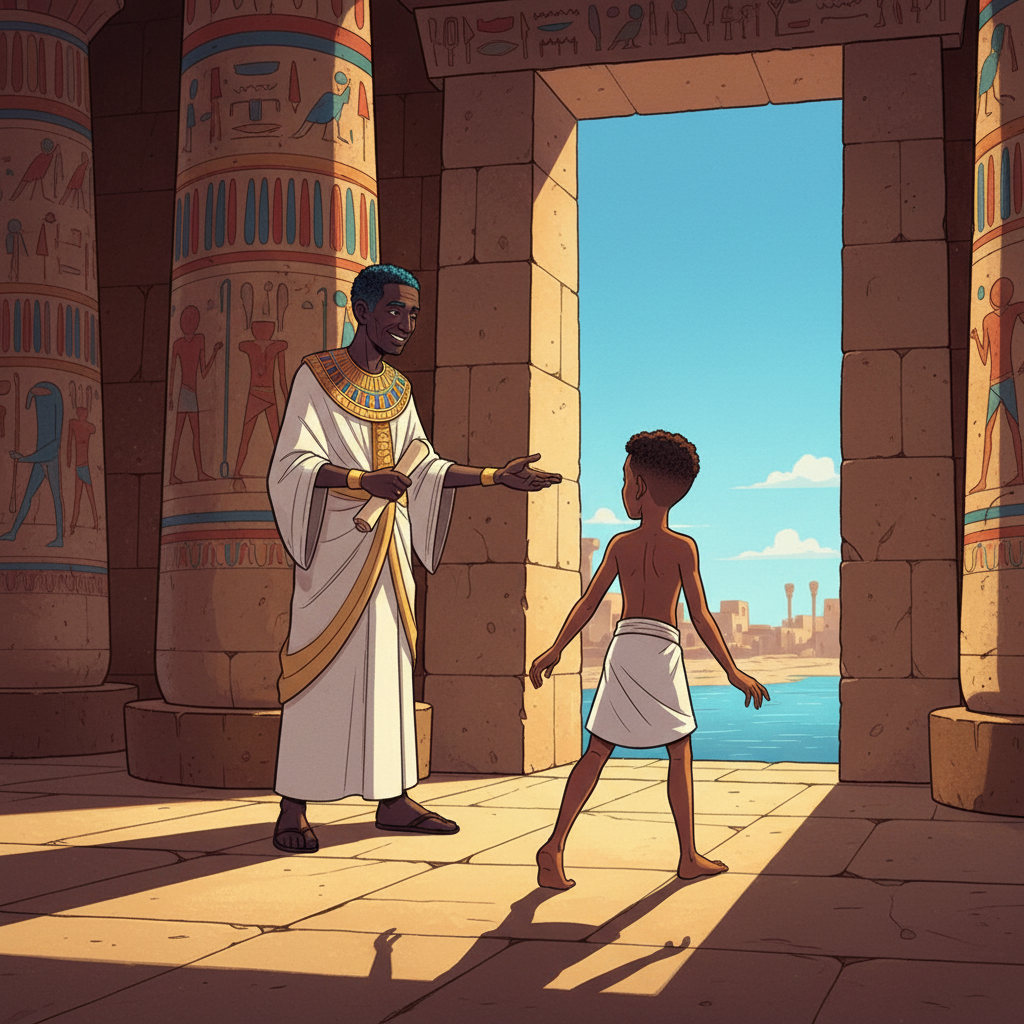
The students rose from their mats and began to file out of the room, back into the bright sun and the noise of the village. Panhesy lingered at the door. He looked back at Senenmut. "Teacher, I am going to talk to my brother today. About the drawings." Senenmut smiled. "Then you have already begun placing feathers." Outside, the Nile moved slowly under the afternoon sky, the same river that had carried the people of Kemet for thousands of years. Its waters did not rush. They were patient and steady, like truth. Panhesy walked toward home, carrying no scrolls, no ink, no tools — only the weight of knowing that his next words mattered, and the lightness of choosing to make them good.