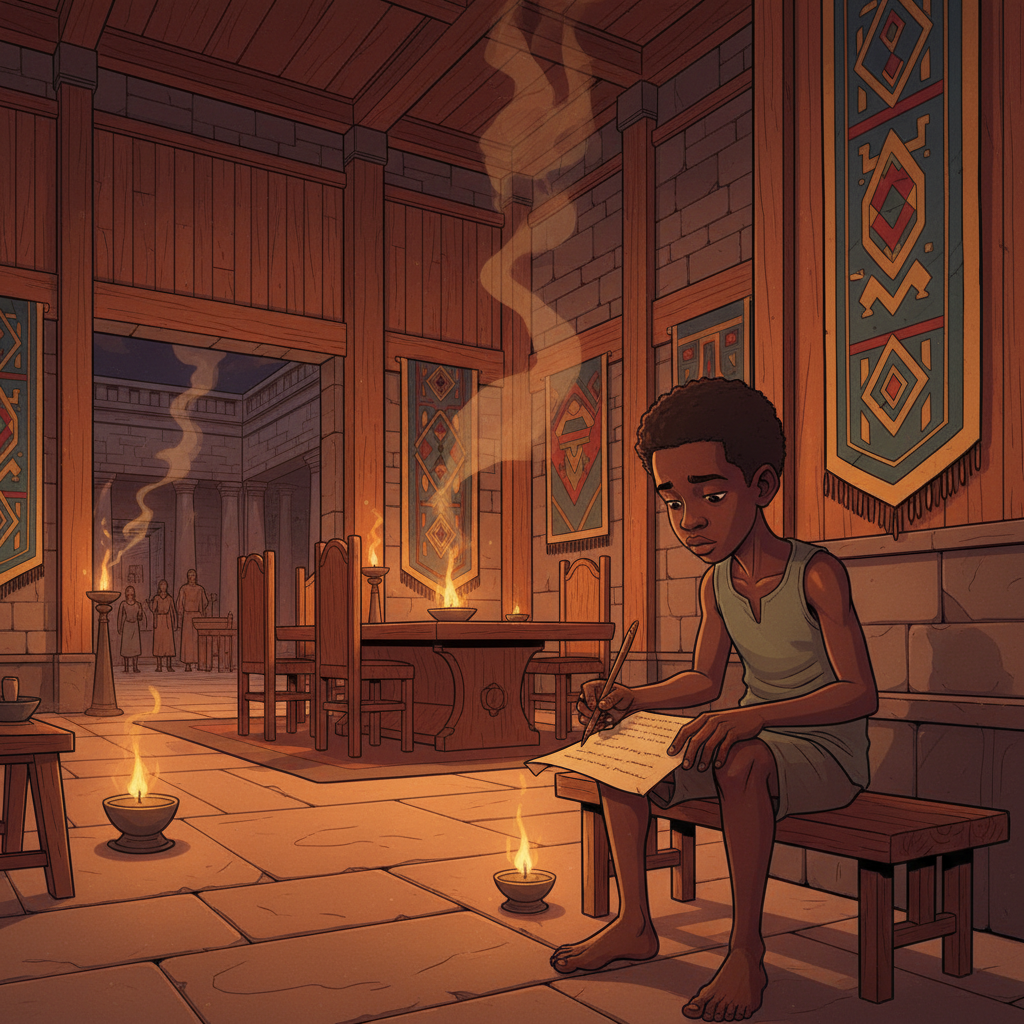
Benaya was sixteen years old, and his hands were shaking. He sat on the low wooden bench in the corner of the high priest's chamber, a sheet of papyrus balanced on his knees and a reed pen already wet with black ink. His skin was the deep brown of the Africana people who had lived in Galilee for a thousand years, since the days when their ancestors came up from Kemet along the ancient trade roads. He was an apprentice scribe in the temple court, and tonight was the first night he had ever been called to record a trial. It was past midnight. The oil lamps burned low, and the chamber smelled of cedar smoke and fear. Outside in the courtyard, torches flickered against the stone walls. Benaya pressed his pen against the papyrus to keep his fingers steady. His teacher had told him: "A scribe writes what happens. Not what he wishes. Not what he fears. Only what is." But Benaya already suspected that tonight, what happened would be something no heart should be asked to witness.
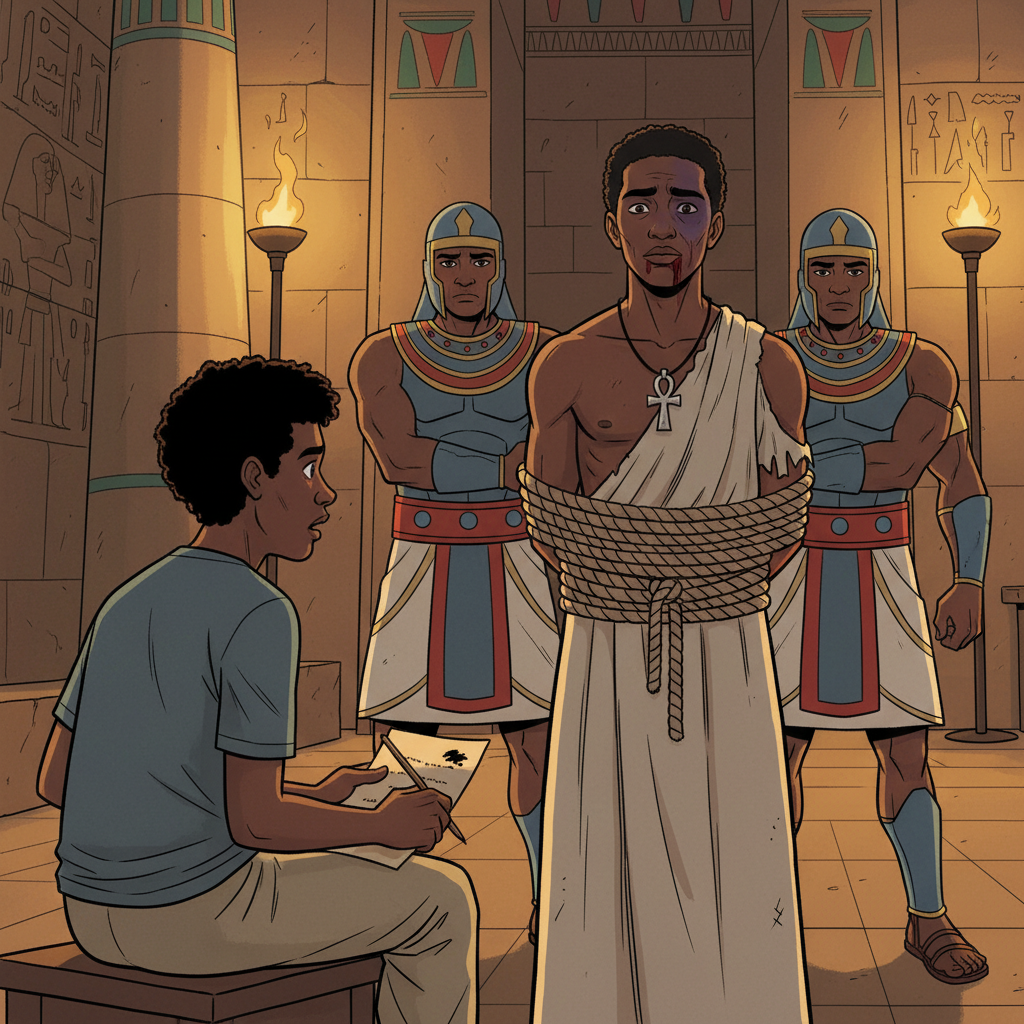
The prisoner was brought in between two temple guards. His wrists were bound with coarse hemp rope, and there was a bruise blooming purple beneath his left eye where someone had struck him. His robe was torn at the shoulder. But around his neck, hanging against his battered chest, Benaya saw a small silver ankh — dented now, its edges scratched, but still catching the lamplight with a soft silver gleam. This was the teacher. This was Yeshua of Nazareth, whom Benaya had heard preaching in the outer courts only a few days before. The man who had spoken of Maat — though he used the Aramaic word tsedeq, righteousness — in a voice that had made merchants weep and soldiers lower their eyes. Now he stood silent, his dark face calm, his hands bound, blood drying at the corner of his mouth. Benaya's pen hovered above the papyrus. He did not know what to write first. The weight of what he was seeing pressed down on him like a stone.
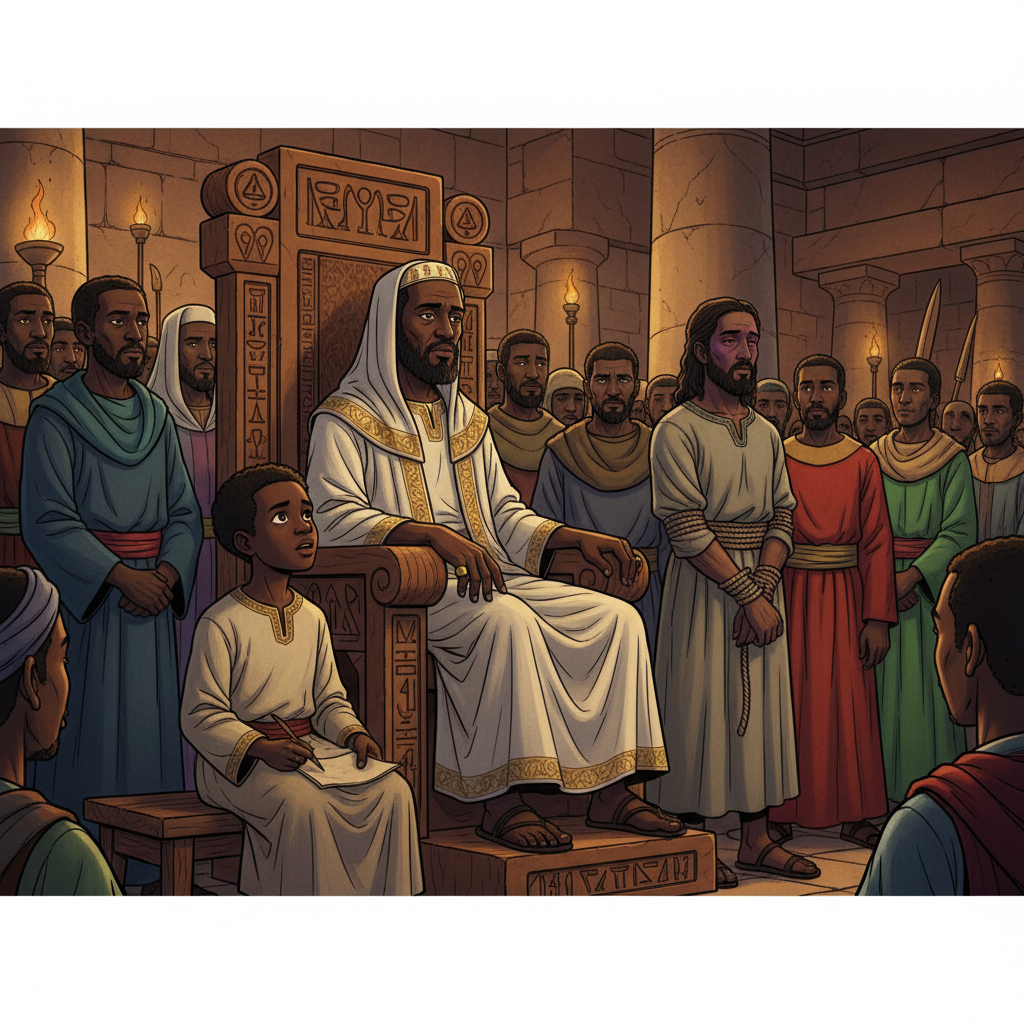
Kayafa the high priest sat upon his carved chair, his white linen robes catching the firelight. He was a man in his fifties, with a neatly trimmed beard and deep-set eyes that had seen too many crises already. His skin was the warm brown of the Judean priestly caste, and rings of gold glinted on his fingers. He did not hate Yeshua. Benaya understood this, even as a boy — Kayafa was not a cruel man. He was a frightened one. For thirty years, Kayafa had kept peace with Rome by careful negotiation. He had buried friends who had pushed too hard and watched Roman soldiers crucify whole villages over lesser provocations than what this Galilean was stirring up. In his mind, he was saving his people. "One man dies," he had told the council earlier that evening, his voice heavy, "or the whole nation is broken." It was the oldest calculation of empire, made by men who had already surrendered something inside themselves without noticing the loss.
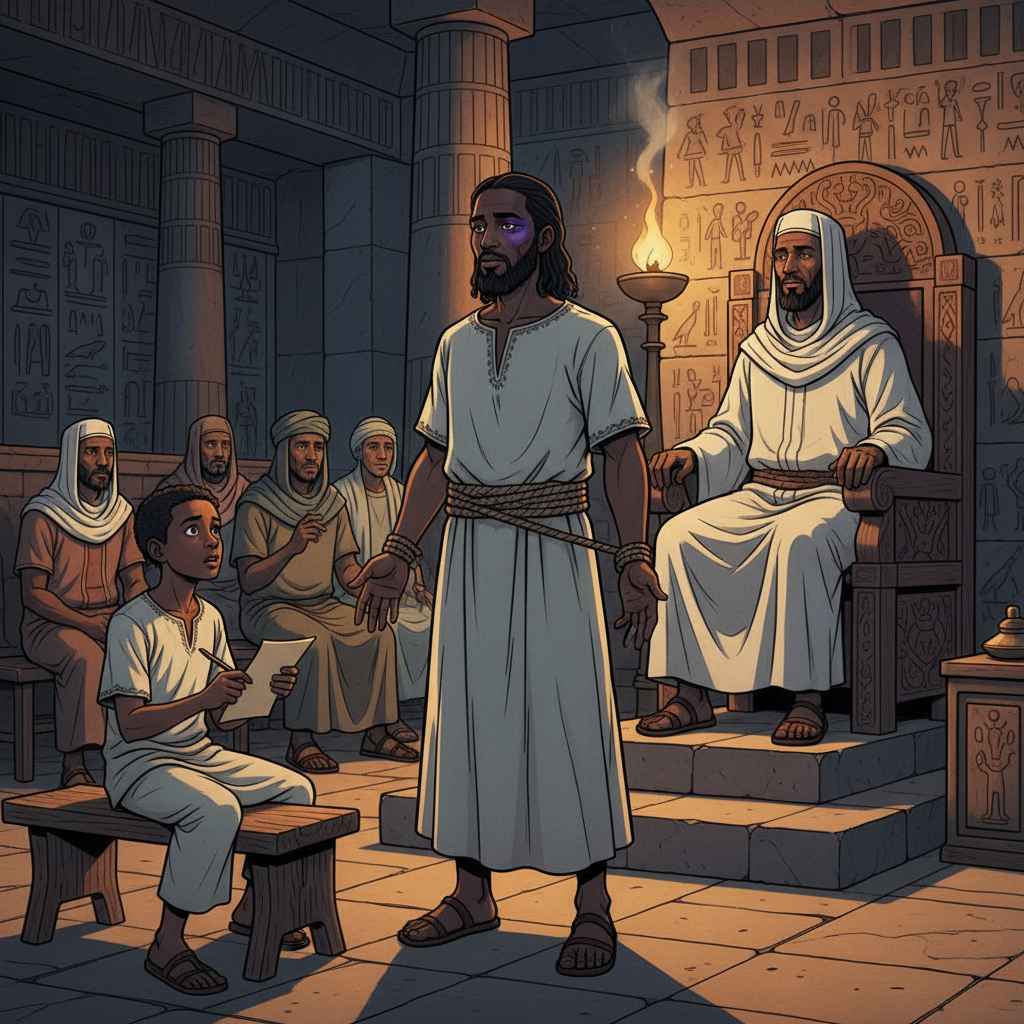
"You are accused of blasphemy," Kayafa said. His voice was tired, not angry. "You are accused of claiming authority the temple has not given you. You are accused of calling yourself a son of the Most High. Do you answer?" Yeshua looked at him, and for a long moment said nothing. The silence stretched. One of the older priests shifted on his bench. A lamp guttered. Benaya's pen trembled above the papyrus. The silence was not empty. Benaya could feel that, even as a boy of sixteen. It was the silence of a man who had already weighed every word in the scales of Maat and had decided that no defense was worth making to a court that had already written the verdict. It was the silence of the Hall of Two Truths — the old Kemetic courtroom of the dead, where the heart was weighed against the feather of Maat and no lawyer could speak for you. Yeshua stood before Kayafa the way a soul stands before Ausar: with nothing in his hands.
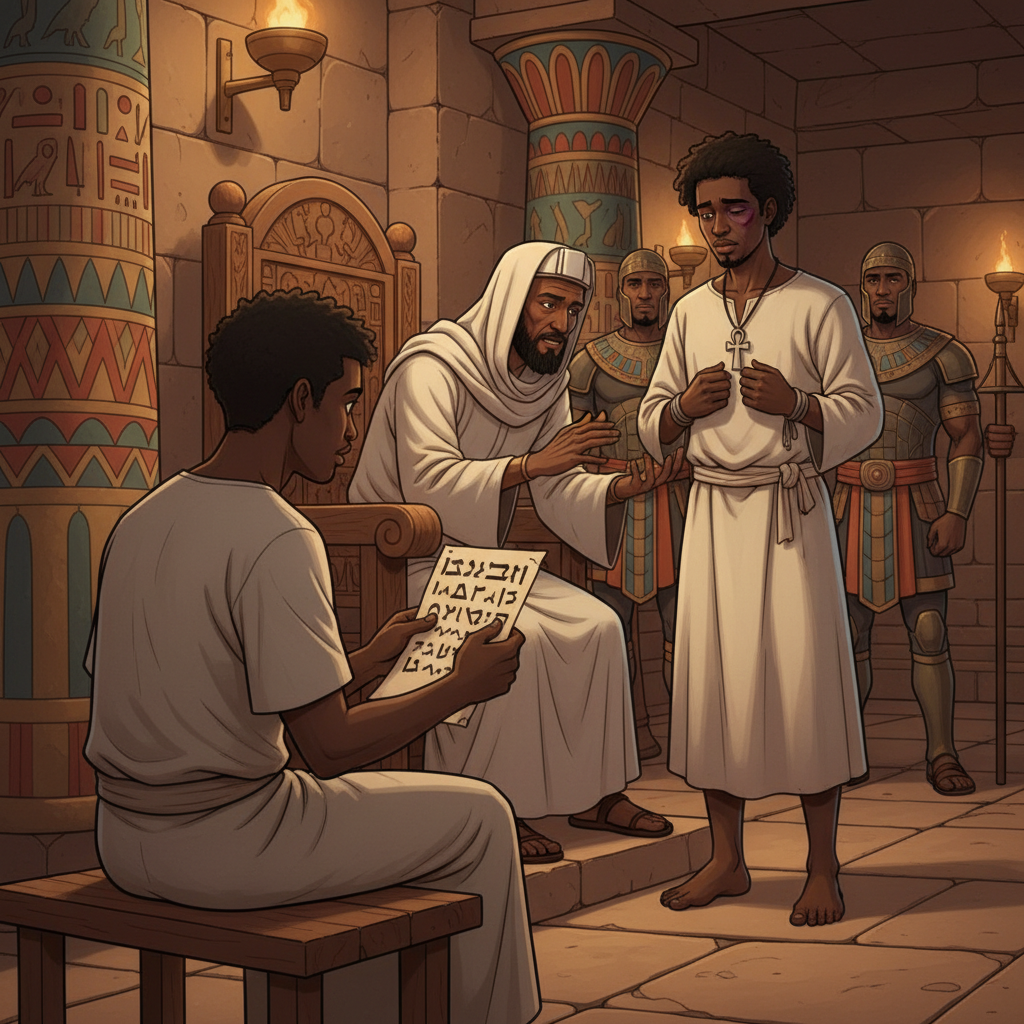
Kayafa leaned forward, and Benaya saw the flicker of something in the high priest's face — not anger, but disturbance. A man who had prepared arguments expected arguments. A man who had rehearsed his own righteousness expected to hear guilt protest itself. Yeshua's silence gave him nothing to fight against. It was the most dangerous answer in the world, because it left Kayafa alone with his own scale. "Do you claim it?" the high priest asked again, and now there was an edge of something that was almost pleading in his voice. "Say the words and we may find a way. Deny the charge and I can send you home." Yeshua lifted his bound hands slightly, enough to touch the small silver ankh at his chest. He spoke four words, quietly, in Aramaic: "You have said so." That was all. Benaya wrote it down with a pen that trembled so badly that the letters came out shaped like small trembling birds.
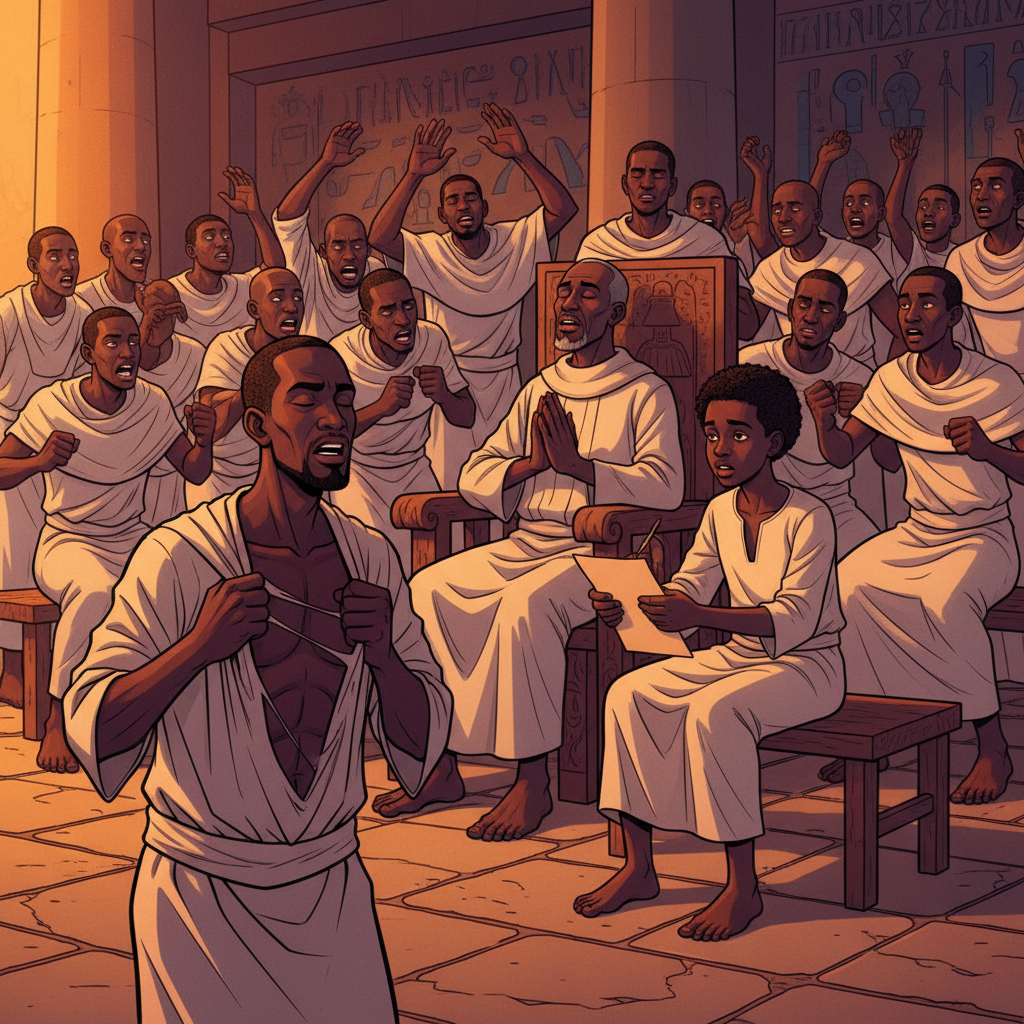
There was an uproar. Priests rose from their benches. One tore his own robe in the ancient gesture of grief and accusation. Kayafa closed his eyes for a long moment, and Benaya thought he saw the high priest's lips move in something that might have been a prayer, or might have been a curse, or might have been both. Then Kayafa opened his eyes and spoke the verdict that sealed Yeshua's fate under Judean law. But a verdict of blasphemy meant nothing to Rome. Rome did not care which god a provincial peasant claimed to follow. For Yeshua to die, Rome would have to approve the death. And so the high priest gave the order that Benaya wrote with trembling hand: at first light, the prisoner would be sent to Pilatos, the Roman prefect. There he would be reshaped from a religious offender into a political threat. The machinery of empire required specific charges. Kayafa, even in his fear, knew how to write them.
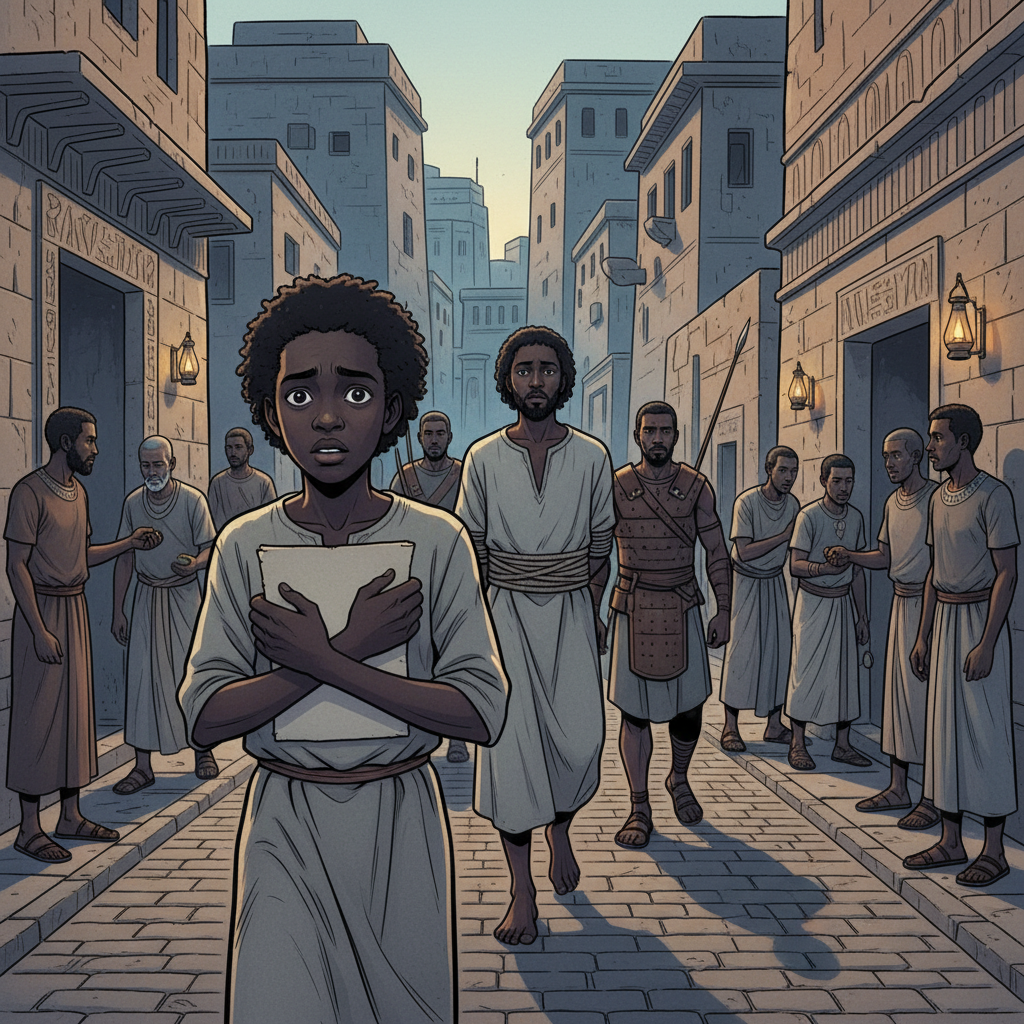
Benaya was told to come with the guards. A trial record was required in both the priest's chamber and the prefect's hall, and the court scribes were overworked already with the Passover crowds. As they walked through the narrow streets in the grey-blue hour before dawn, Benaya carried his papyrus pressed tight against his chest, as if it were a living thing he had to protect. Yeshua walked ahead of him between the guards, bound, silent. The streets were not empty. Paid agitators from the temple were already moving through the markets, stopping at the doors of those who owed favors, whispering instructions. Benaya saw coins pass from hand to hand. He saw an older man listen, then turn and knock on his neighbor's door. The crowd that would shout for Yeshua's blood later that morning was not a spontaneous crowd. It was a manufactured one. Benaya understood, with a cold clarity that stripped away the last of his childhood, that empire does not only kill — it arranges the voices that call for the killing.
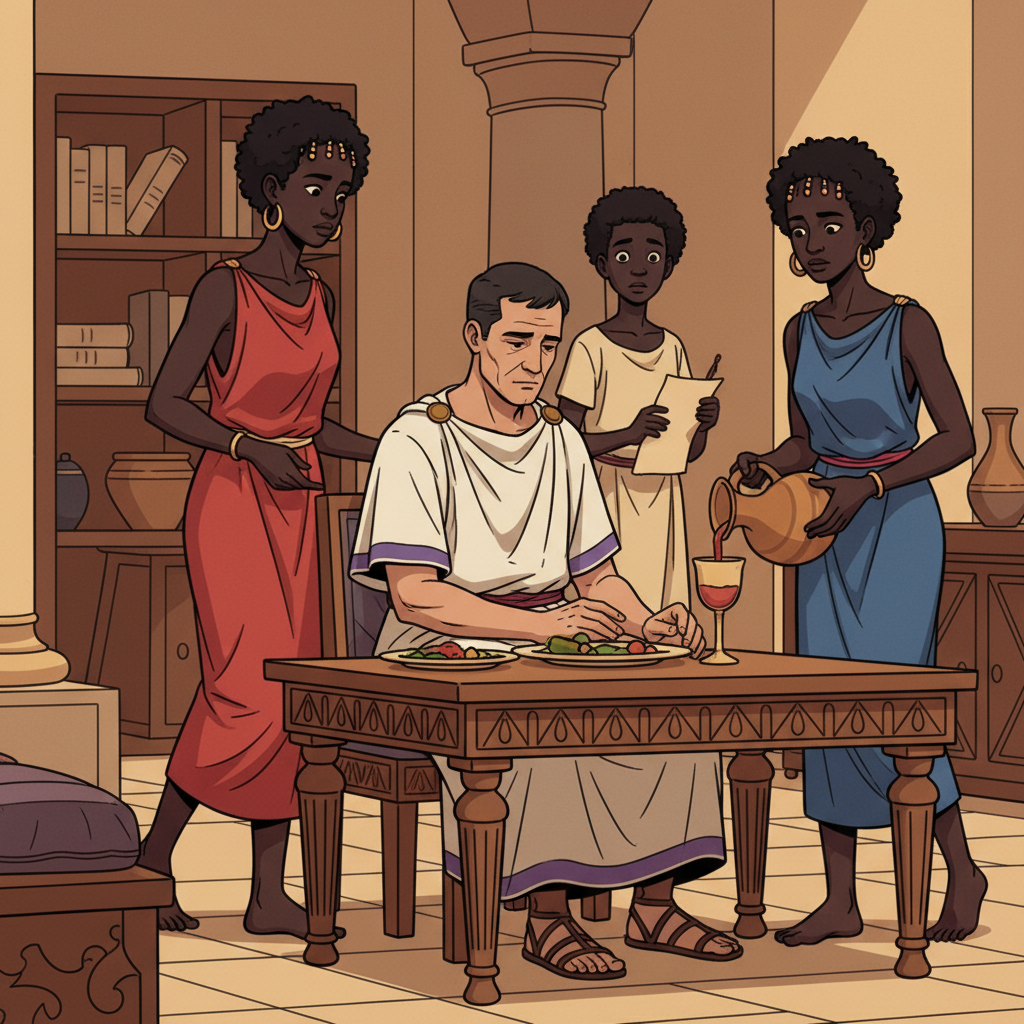
Pilatos the prefect was just finishing his breakfast when the prisoner arrived. He was a Roman of middle years, his skin the olive-pale of the Italian provinces, his hair cut short in the military style. He wore a white tunic trimmed with the narrow purple band of his rank. Around him moved his household slaves — two young women with the dark rich skin of Nubia, taken in wars their own mothers had not survived. They poured his wine and cleared his plate with practiced, silent efficiency. He did not look at them. He had not looked at them in years. Pilatos was not a malicious man. He was something worse, Benaya would later understand: he was a tired administrator in the fifteenth year of a difficult posting, counting the months until he could go home. He did not want to kill Yeshua. He did not want any of this. But not wanting something, the boy scribe was about to learn, is not the same as refusing to do it.
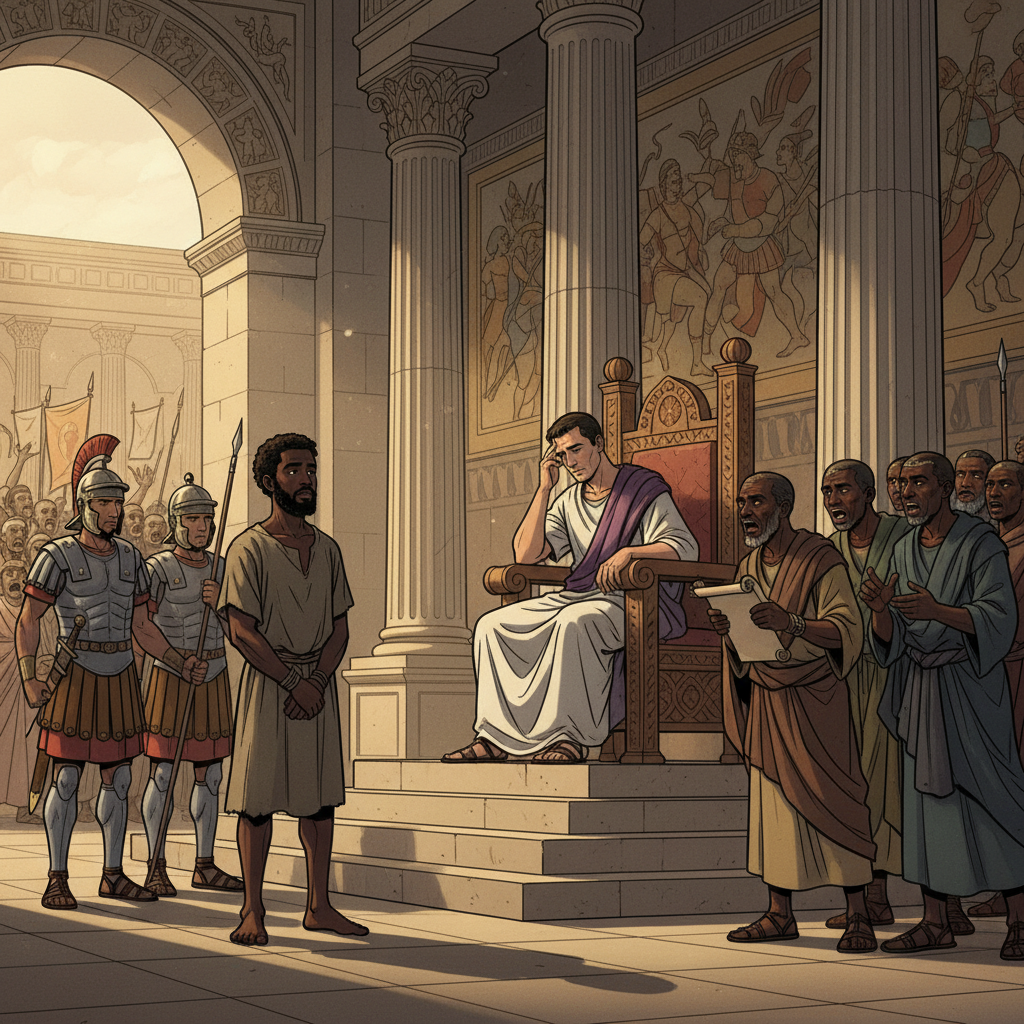
The prefect listened as the charges were read aloud. He rubbed his temples with two fingers. He asked Yeshua questions — whether he had claimed to be a king, whether he had called for rebellion, whether he had urged his followers to refuse Roman taxes. Yeshua answered a few words, then fell silent again. Pilatos sighed. He could see what he was looking at: not a revolutionary, but a teacher. Not a threat, but a man. "I find no fault in him," Pilatos said aloud, speaking to the temple delegation that had come with the prisoner. His Greek was the formal Greek of Roman administration. The words should have been the end of it. In a just court, they would have been. But Pilatos already heard the sound from the courtyard outside — a crowd shouting, growing louder, chanting the name of a known rebel named Barabbas, demanding his release and the death of this Galilean. The shouting was organized. The rhythm was too clean. Pilatos knew manufactured crowds the way a farmer knew weather.
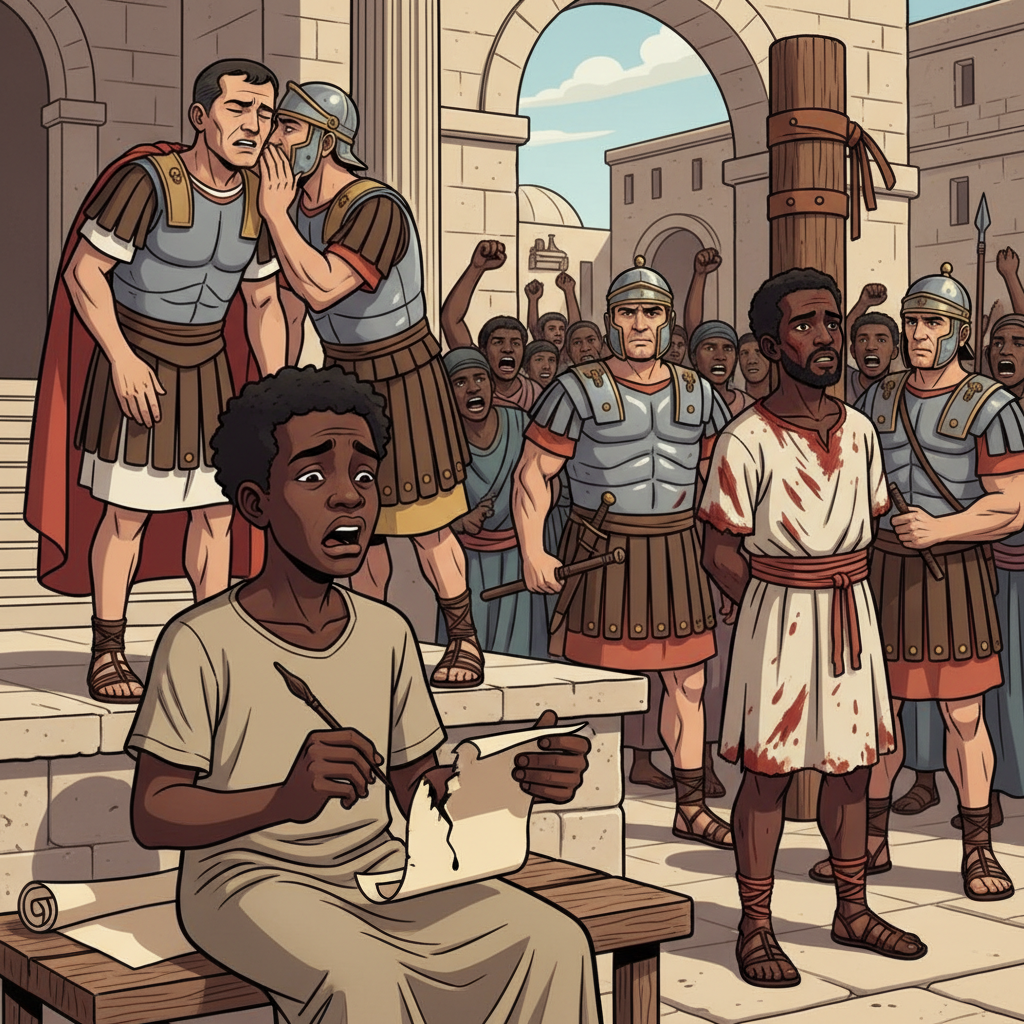
A Roman centurion stepped forward and spoke quietly in the prefect's ear. Benaya could not hear the words, but he saw Pilatos close his eyes the same way Kayafa had closed his eyes the night before. It was the expression of a man doing arithmetic he did not want to do — weighing the life of one rural teacher against a riot at Passover, against a bad report to the emperor, against his own career, against the simple desire to go home to dinner without any of this noise. The arithmetic took less than a minute. Pilatos opened his eyes and gave the order that even he thought was unjust. Yeshua was to be flogged first, to appease the crowd. Perhaps, the prefect hoped, a beating would be enough. Perhaps the sight of a bloodied man would satisfy the shouting. Benaya wrote the order on his papyrus and felt his pen cut through the page. He had to take a new sheet. His hand did not belong to him anymore. It belonged to the machinery.
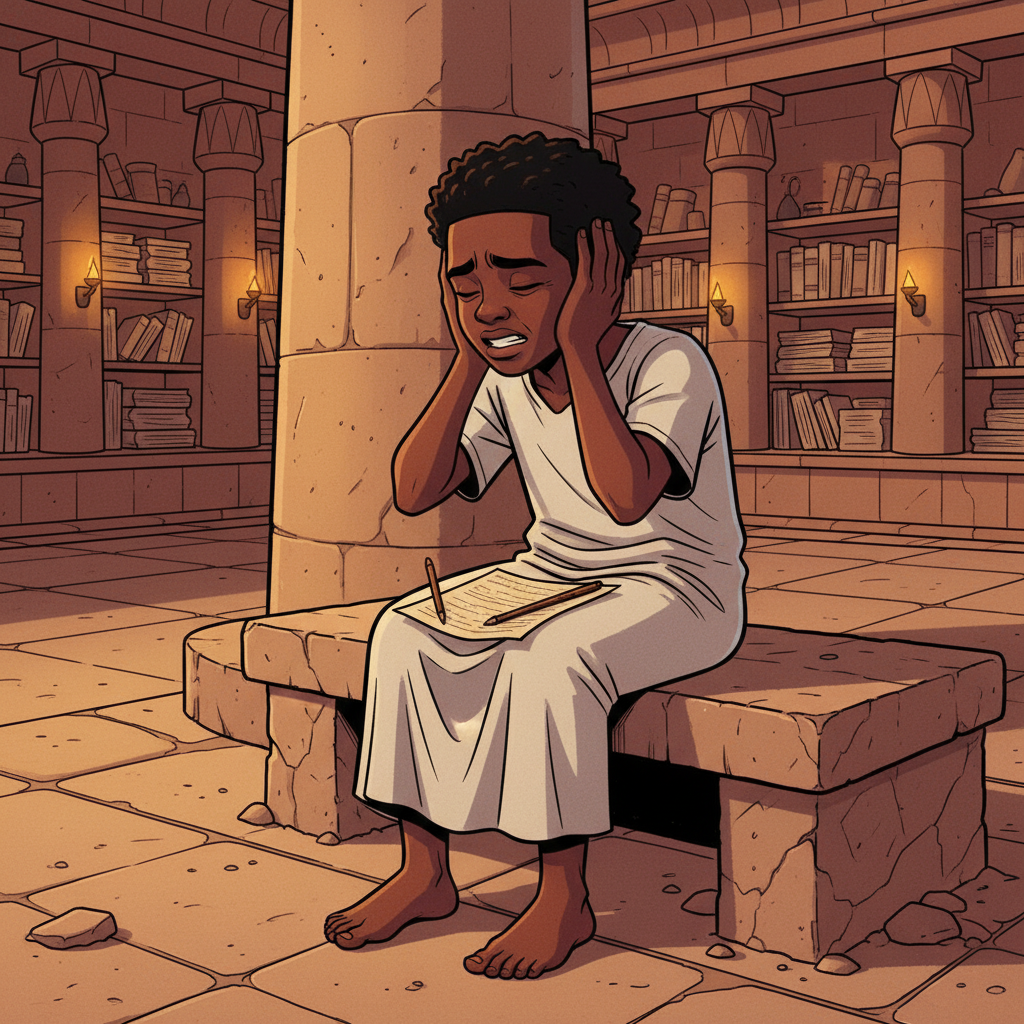
The flogging was done in the inner courtyard, out of Benaya's sight but not out of his hearing. He sat on a stone bench with his papyrus in his lap and he did not write. He could not write. There are sounds a sixteen-year-old should not have to record and still grow into a whole man afterward, and the sound of the leather and the iron tips biting into the back of a teacher who had done nothing but speak of mercy was one of them. Benaya pressed his palms against his ears, then took them away, ashamed. A scribe does not look away. When Yeshua was brought back, he could barely stand. His back was a ruin of torn skin. The silver ankh still hung at his chest, but now it was spotted with his own blood. His face was grey. His eyes, though — his eyes were still present. Somewhere inside that ruined body, the teacher was still awake. Benaya saw it and had to turn his face away.
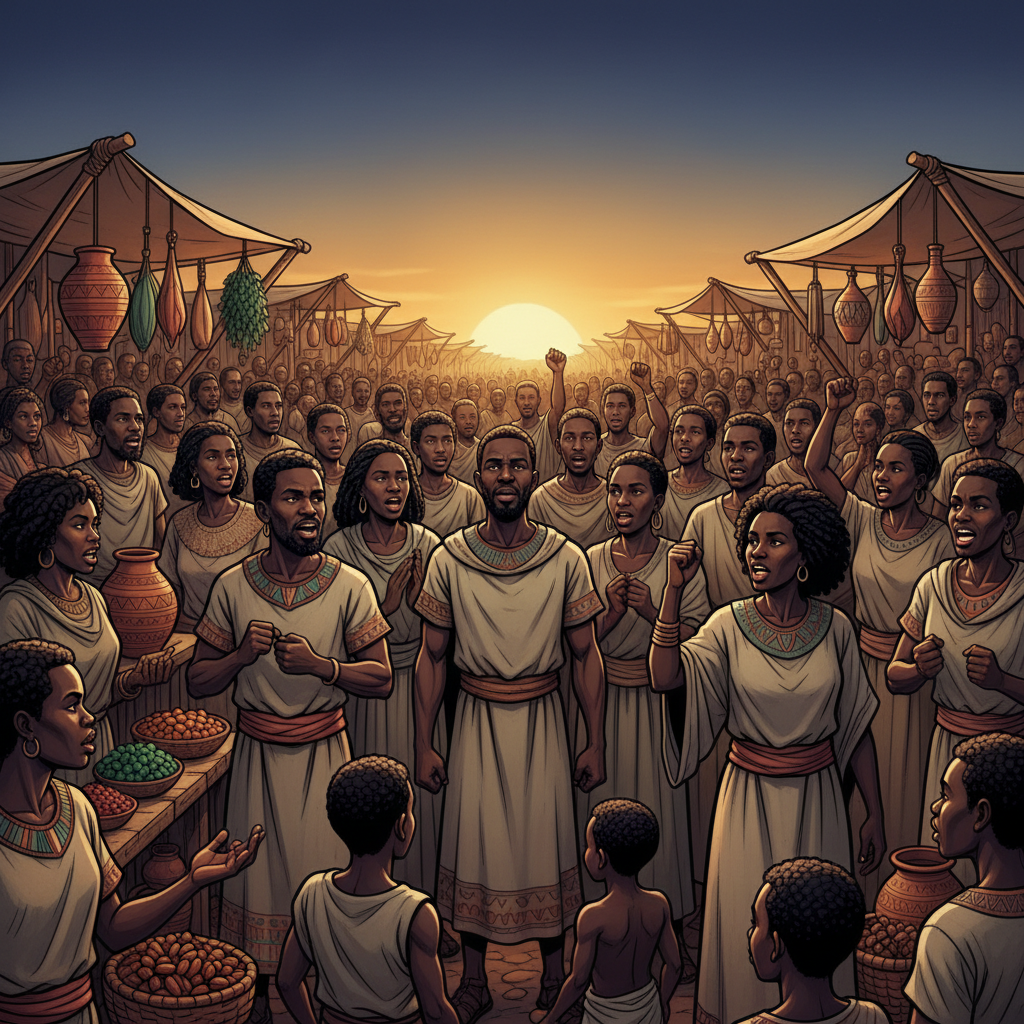
Pilatos brought Yeshua out onto the stone porch where the crowd could see him. It was a bet, Benaya understood later. The prefect was gambling that the sight of a broken man would be enough — that the crowd, seeing what had been done already, would accept it and disperse. Pilatos did not know the crowd. He had not walked through the markets at dawn the way Benaya had. He had not seen the coins change hands. The shout came back louder than before. "Crucify him!" It was not a question. It was a transaction that had been paid for in advance. Pilatos stood on the porch with his hands at his sides and Benaya saw the exact moment that the prefect realized he had lost the argument with himself. The emperor would hear of any unrest. Tiberius did not forgive prefects who let provinces riot. The arithmetic of empire had already tipped. A man's life weighed less than a career. This was Isfet, dressed in clean white linen.
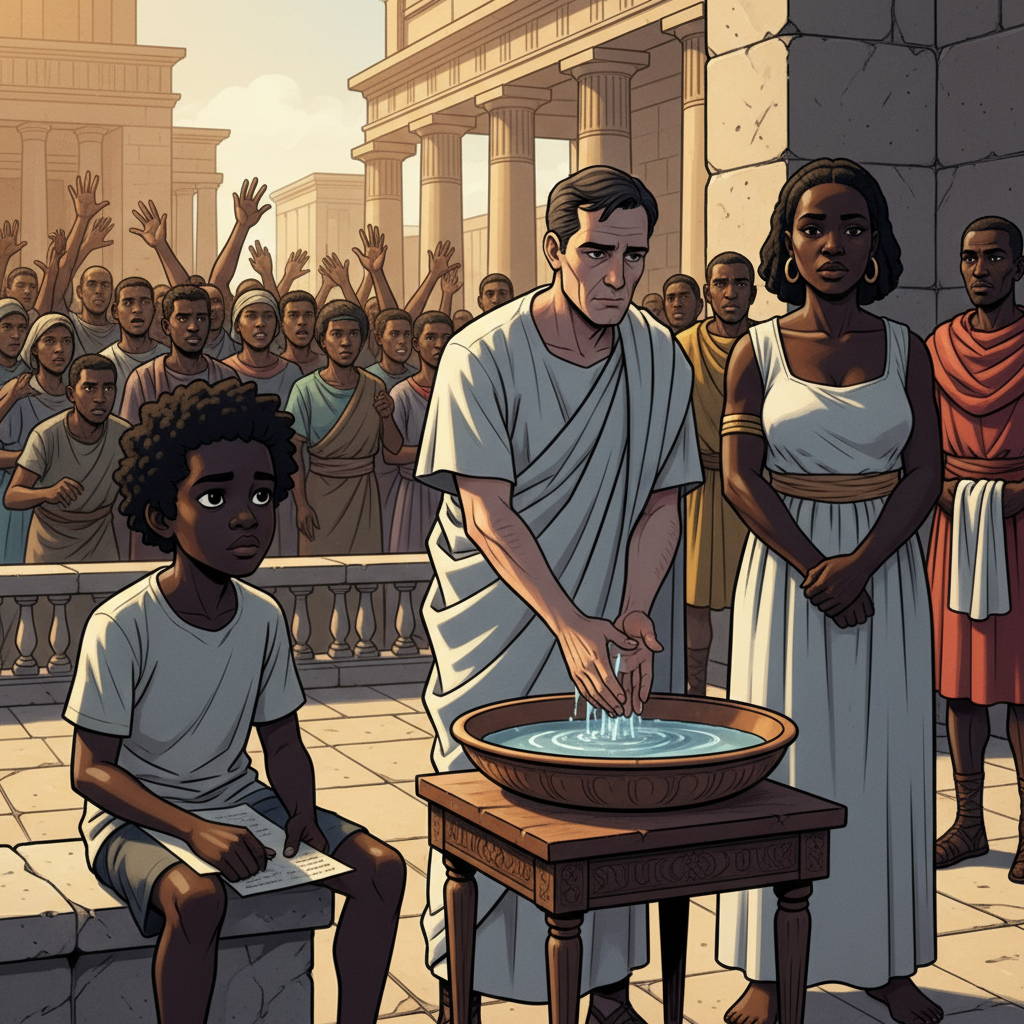
Pilatos called for a basin of water. One of the Nubian slave-women brought it — a wide bronze bowl with clean water shining in it, her dark hands steady, her eyes carefully blank. Benaya watched her set the basin on a small table. He watched her step back and fold her hands. He wondered what she thought of the men she served, these Romans who bought and sold her people by the ship-load. He wondered if she had ever seen this ritual before, or if it was new to her today. Her face told him nothing. It was not safe for her face to tell him anything. Pilatos dipped his hands into the water. He washed them slowly and deliberately, so the crowd could see. Then he spoke the words that would be remembered for centuries: "I am innocent of this man's blood. See to it yourselves." He dried his hands on a white cloth. And then, with the same dry hands, he signed the order of execution.
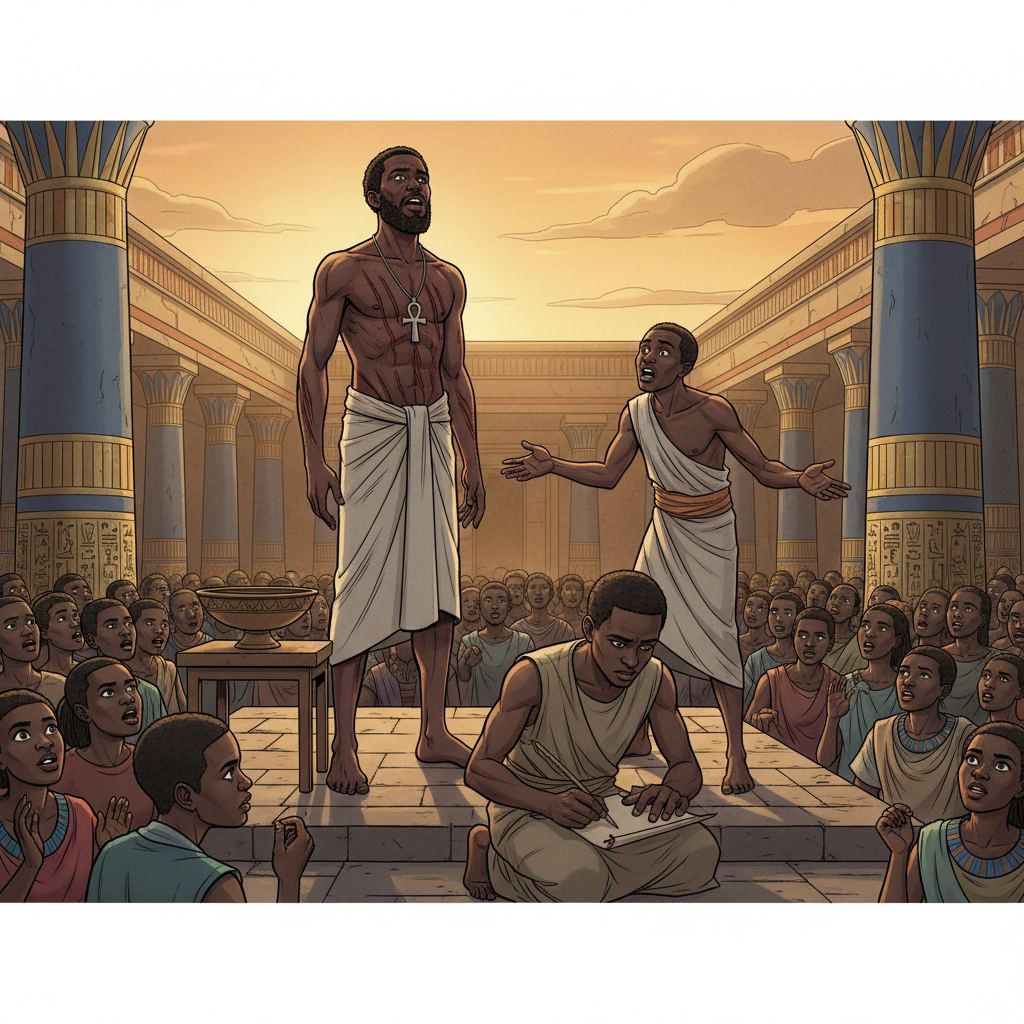
It was then that Yeshua spoke. He had been silent through almost all of it, but now, standing on the porch in front of the man who had just washed the blood off his hands before he had even shed it, Yeshua of Nazareth lifted his head. His back was torn. His face was swollen. The silver ankh at his neck trembled with his breathing. But his voice, when it came, was level and clear and carried across the courtyard the way the voice of an elder priest carried in the Hall of Two Truths. Benaya had been told to write everything. He gripped his pen. He did not blink. He wrote as fast as his hand could move, because something in the cadence of the teacher's voice told him that these words would need to survive. They would need to be carried forward by people who did not yet exist, into years no one in this courtyard would live to see. He wrote, and he listened, and he did not look away.
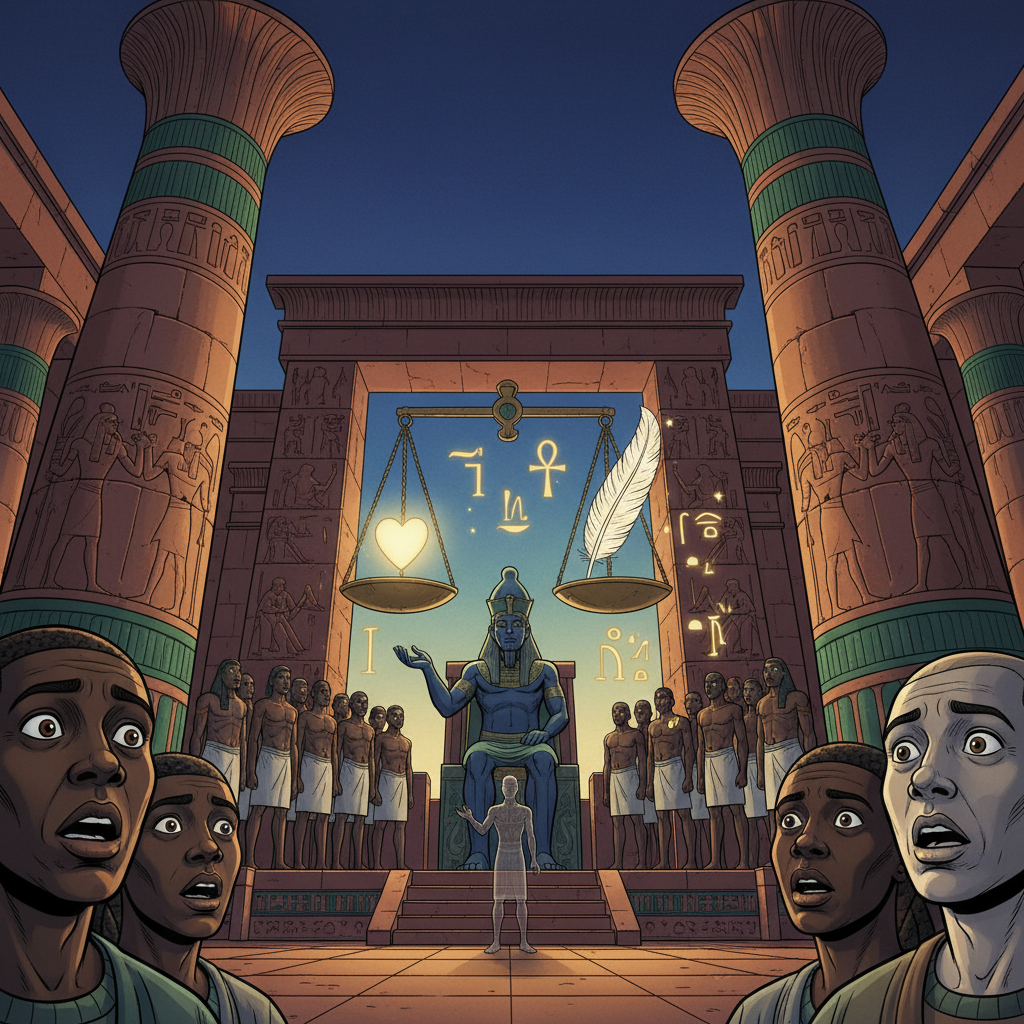
"Prefect," Yeshua said, "you have washed your hands. The crowd has seen it. The scribes have written it. And yet your scale has already tipped. Your law judges the body. It puts a man on a cross and calls the matter closed. But there is another court. It sat in Kemet long before Rome was a village of mud. It sits still, in the Hall of Two Truths, where the heart is weighed against the feather of Maat, and no water can clean what a heart has chosen. You did not want this. I know. Kayafa did not want this. I know that also. You are both men caught in the teeth of a machine you did not build and will not destroy. But the machine does not absolve you. It grinds, and you feed it, and the feather on the scale does not care whose hand signed the order — only whose heart knew what it was signing. My body goes to your cross. My heart goes to the feather. And your heart, prefect, goes with mine to the balance."
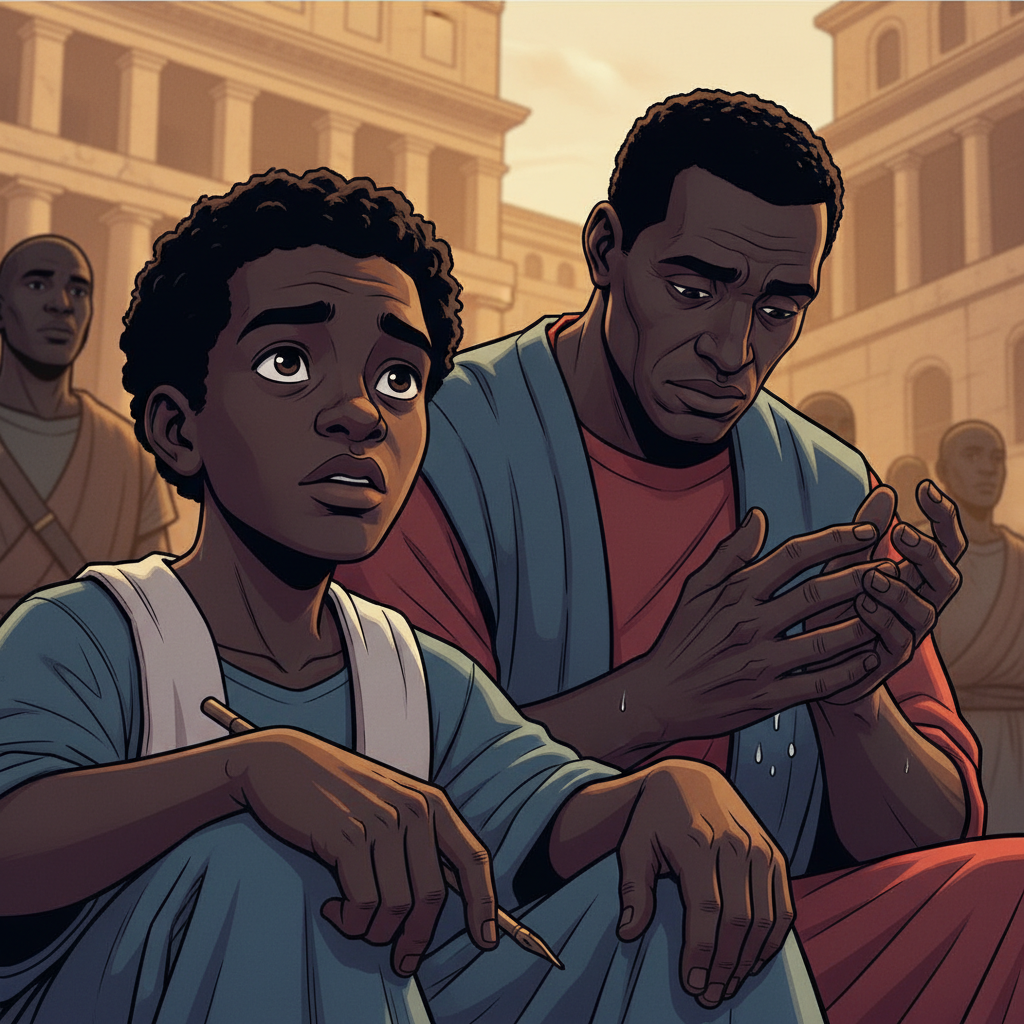
Pilatos did not answer. What could he have said? Benaya finished writing and his hand dropped into his lap. The courtyard was silent for one long breath. Even the crowd outside seemed to pause, as if some deep part of them had heard the words and recognized them. Then a centurion barked an order, and the guards closed around Yeshua again, and the moment ended. But Benaya knew — he knew the way a young scribe knows when he has just copied down something that will outlive every stone in the city — that what he had just written was sacred. He looked at Pilatos. The prefect was staring at his own hands. They were still damp. He was rubbing them together slowly, as if he could feel something on them that the water had not removed. And Benaya understood, with the cold total clarity of the young: the ritual had been a lie. The water had not cleaned anything. The scale had already moved.
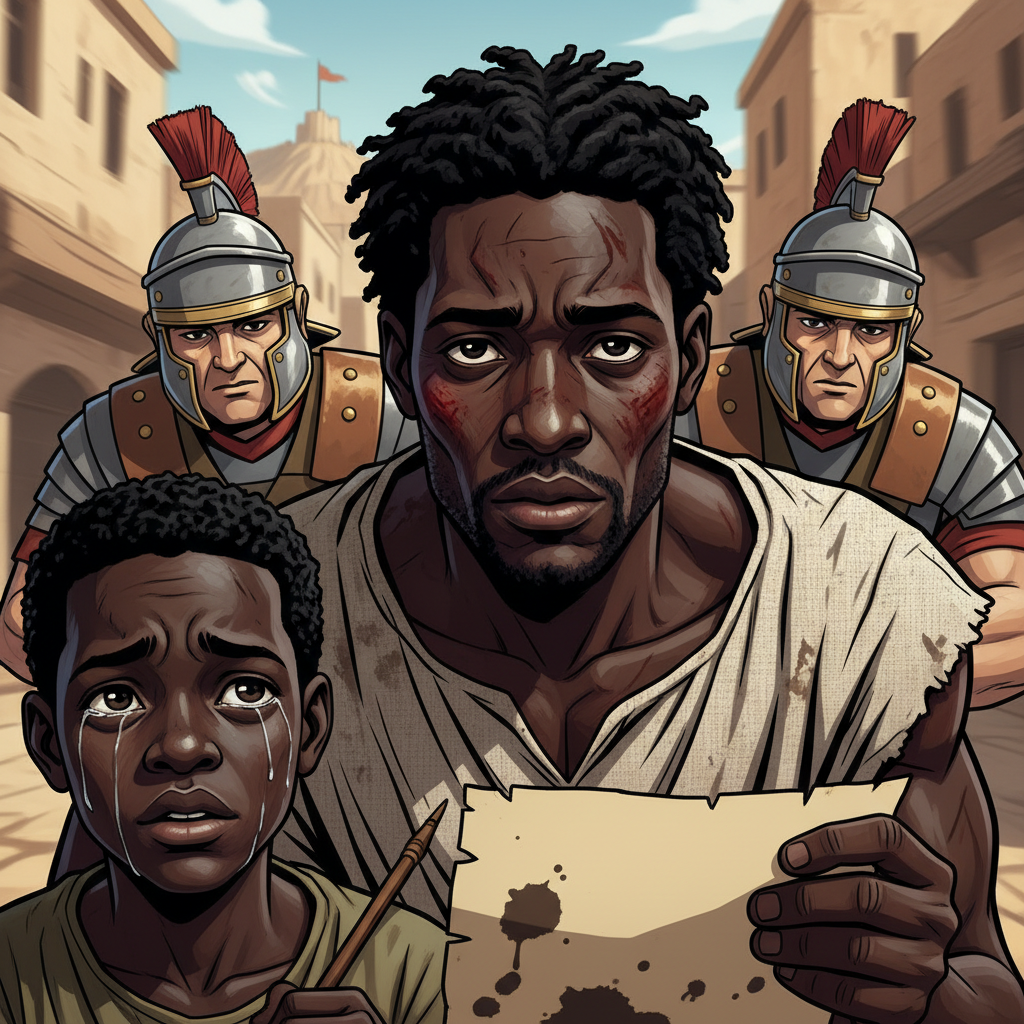
As Yeshua was led away toward the place of execution, he passed close enough to Benaya that the boy could have reached out and touched him. Their eyes met for an instant. Yeshua's dark face, bruised and bloodied, held no hatred. He looked at Benaya with the steady attention of a teacher who has recognized a student. Then he was gone, swallowed by the guards, moving toward a hill outside the city walls. Benaya sat very still with his papyrus on his knees. He realized he was crying. He had not noticed when it began. The tears dropped onto the dry ink and smudged some of the letters, and Benaya did not try to stop them. He understood that the weeping was part of the record now — that the papyrus itself would carry the mark of a witness who had been broken open by what he had seen. He thought of the Hall of Two Truths. He thought of every person in that courtyard. He thought of his own heart, and what it weighed.
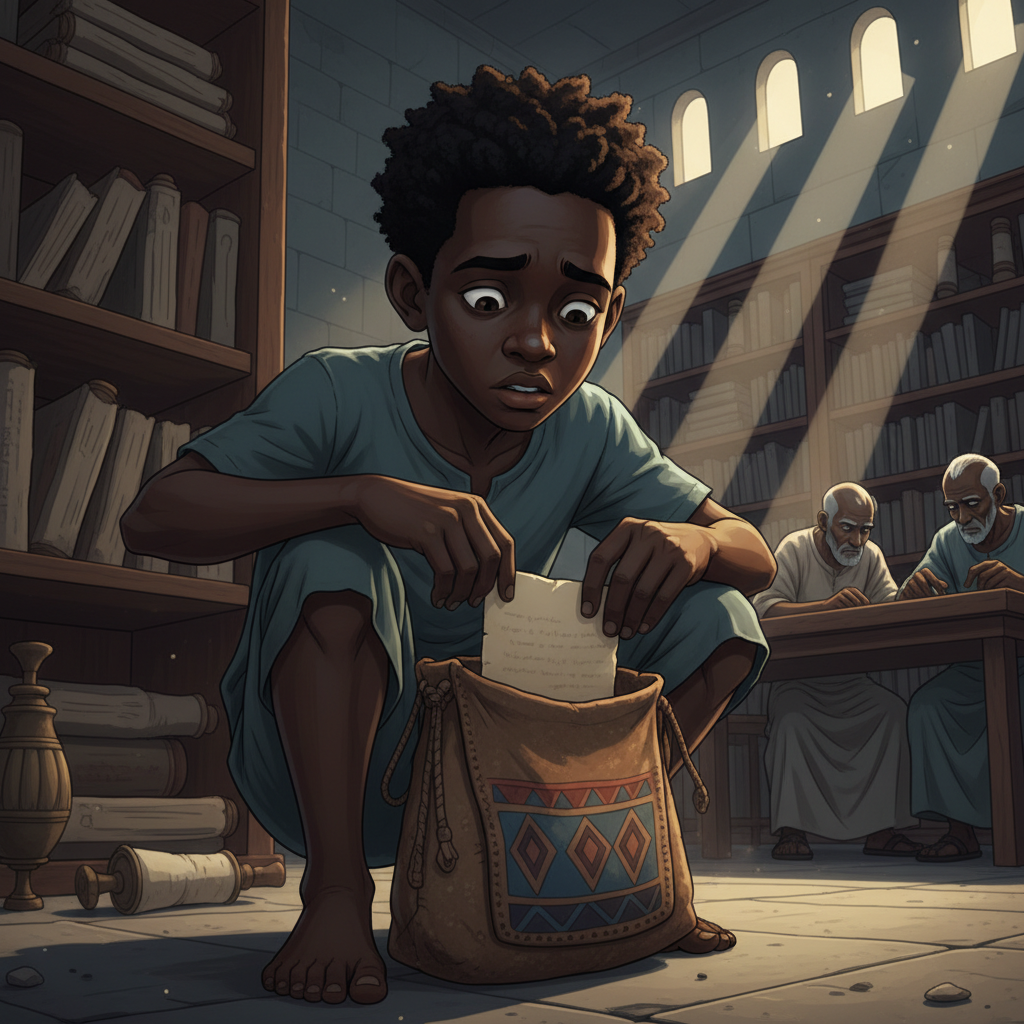
Later that morning, while Yeshua was dying outside the city walls, Benaya returned to the temple to file his record in the priestly archives. The scribes' hall was cool and dim, smelling of dust and old cedar. Old men bent over codices by the light of narrow windows. No one spoke to him. No one asked what he had seen. The machinery had its own rhythm, and the rhythm did not pause for a boy's shaking hands. Benaya laid his papyrus on the long table and smoothed it flat. He read the words he had written. He read Yeshua's speech three times. Then he did something that could have cost him his apprenticeship, and perhaps his life if anyone discovered it. He made a second copy. The official scroll went into the archive, where it would be buried under a hundred other trials and forgotten inside a generation. But the second copy he folded small and hid inside the lining of his satchel. That copy was for later. That copy was for the people who would need it.
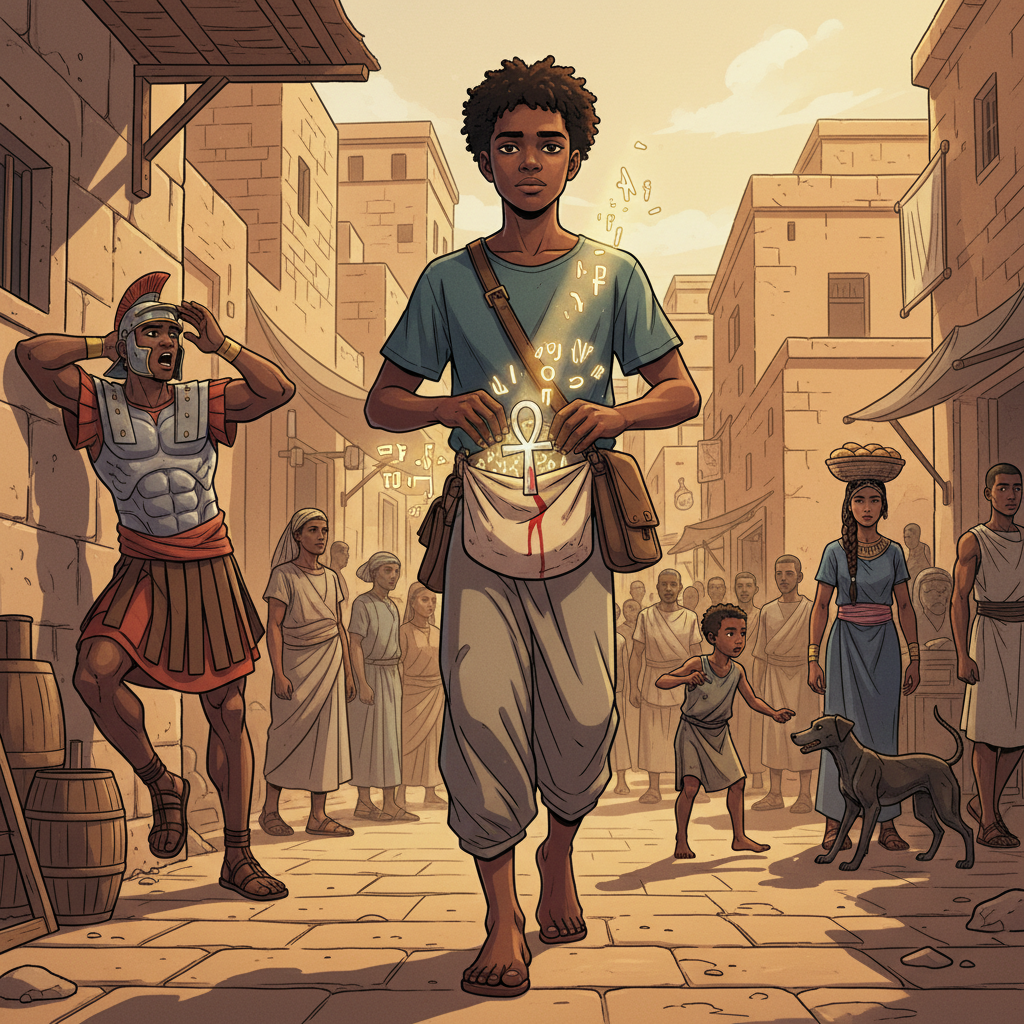
Walking home through the streets of the city, Benaya passed beggars and merchants and Roman soldiers leaning against walls. He passed a legionary complaining about the heat. He passed a woman selling bread. He passed a child throwing stones at a stray dog. The world had not noticed that something enormous had just happened. The world was going about its business, and that indifference was itself a kind of verdict. The empire had killed a teacher, and the streets had not even stuttered. But inside the lining of his satchel, Benaya carried words. He carried a name. He carried the memory of a silver ankh that had kept its gleam even under blood. He carried the sound of a voice that had said, calmly, that the feather of Maat does not weigh the water on a prefect's hands, only the choice in his heart. The empire did not know what the boy scribe carried. The empire rarely knows these things. That was why the empire, in the long run, could never win.
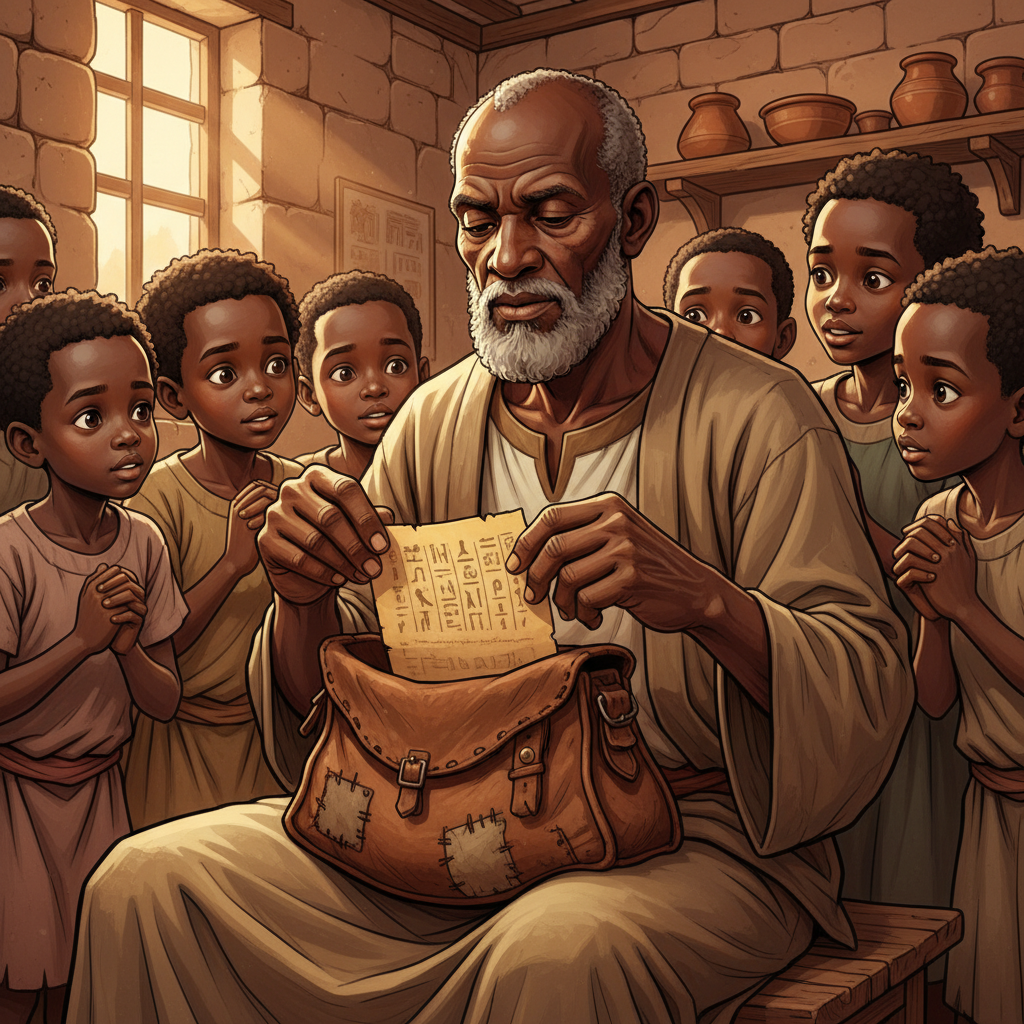
Years later, when Benaya was an old teacher in a small village school in Galilee, his students would ask him: "Master, were you truly there? Did you see it with your own eyes?" And the old man, whose skin had darkened further with decades of sun, whose beard was now grey, would nod and pull from his satchel — the same satchel, repaired a hundred times — the same folded papyrus, brittle and browned at the edges but still readable. He would read them the words of Yeshua. He would tell them about Kayafa, who had thought he was saving his people, and about Pilatos, who had only wanted to go home to dinner. He would tell them that neither man was a monster, and that the absence of monsters did not absolve them. "Maat does not ask whether you meant to do harm," he would say, his voice carrying the same quiet weight he had first heard in the high priest's chamber. "Maat asks what you did."
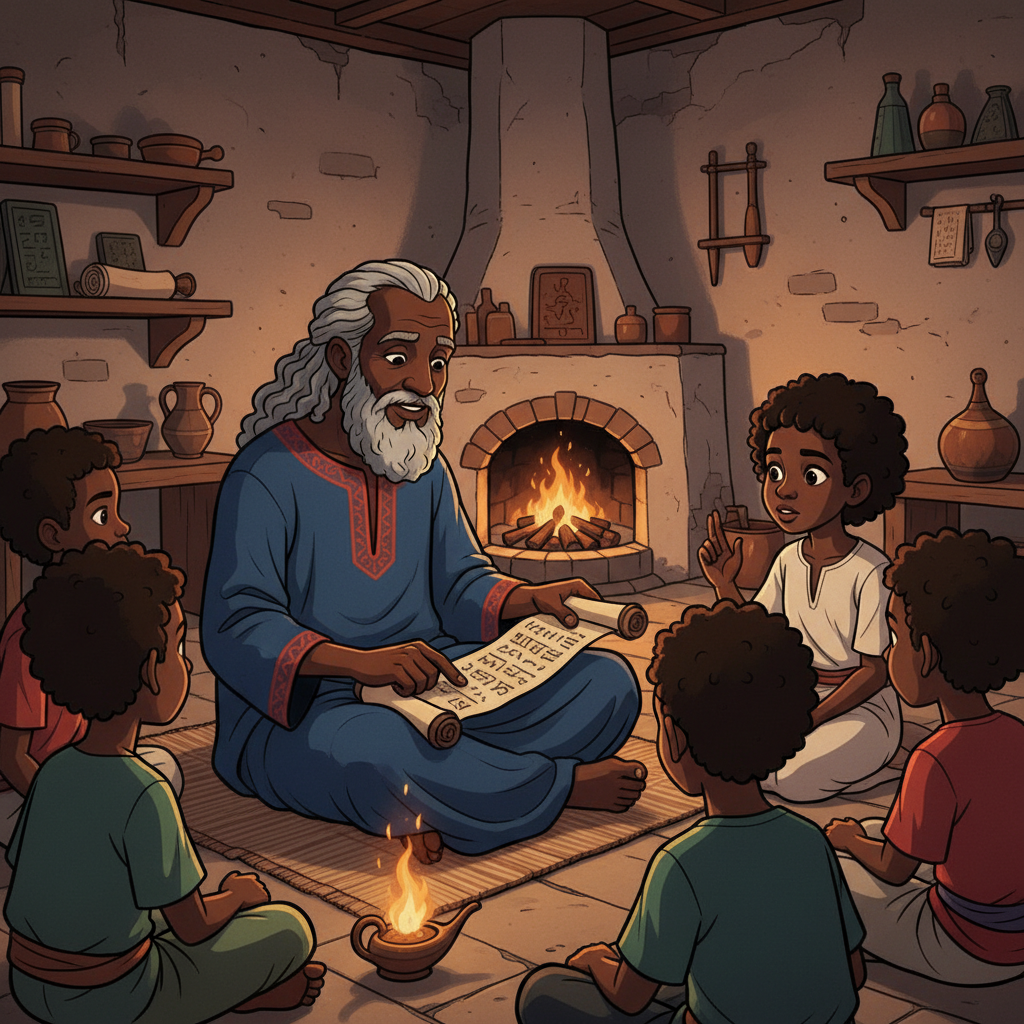
And when a student, as students always did, asked him the hard question — "But master, if the prefect and the priest were not evil, then who killed him?" — Benaya would smile the slow smile of a man who had carried the answer for fifty years. "The machine killed him," he would say. "The machine that empires build and then pretend they do not control. Rome called it law. The temple called it necessity. Each blamed the other. Each washed his hands. And a teacher died between them, because the machine requires a body, and the men who feed it always find one." Then he would tap the papyrus with his finger. "But listen. The machine requires forgetting also. It needs the teacher to be unknown. It needs the scribe to destroy his record. That is why I made this second copy. That is why you will make your own copies, and pass them on. Maat lives in what is remembered. Isfet lives in what is erased."
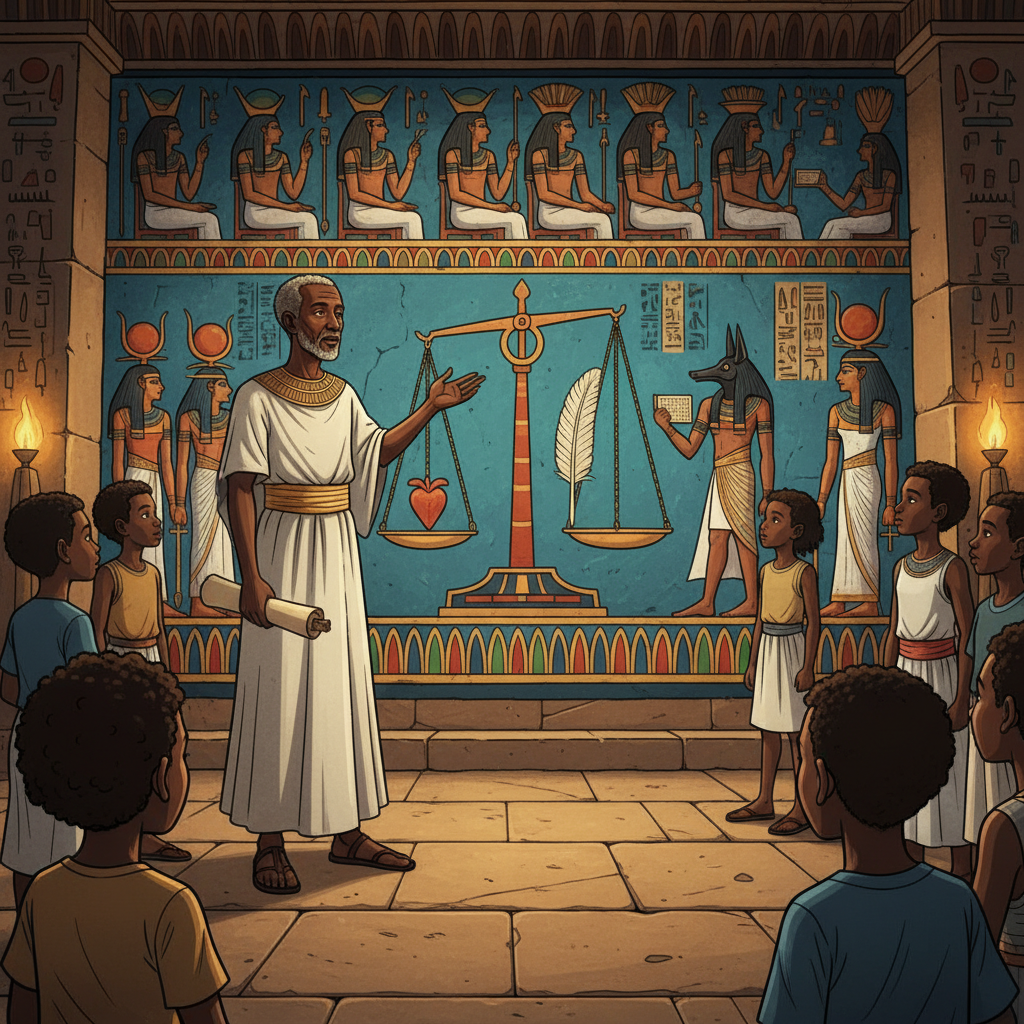
The Africana continuity ran deep, Benaya understood. Long before Yeshua stood before Pilatos, the ancestors of Kemet had painted the Hall of Two Truths on the walls of tombs. Forty-two judges. A scale. A feather. A heart that either balanced or did not. The imagery had traveled up the Nile, across the centuries, into the mouths of teachers and the songs of mothers and the quiet convictions of scribes. Yeshua had stood in that older tradition when he spoke of the heart being weighed. He had not invented it. He had carried it. And now Benaya carried it. And his students would carry it. The courtroom of empire would pass. Rome would fall. The temple would fall. Even the language Benaya wrote in would one day grow strange to the ears of future children. But the image of the feather, the scale, the heart — this would not fall. This was older than empire and would outlive empire. This was the inheritance of the Africana continuum, passed hand to hand, scribe to scribe, heart to heart.
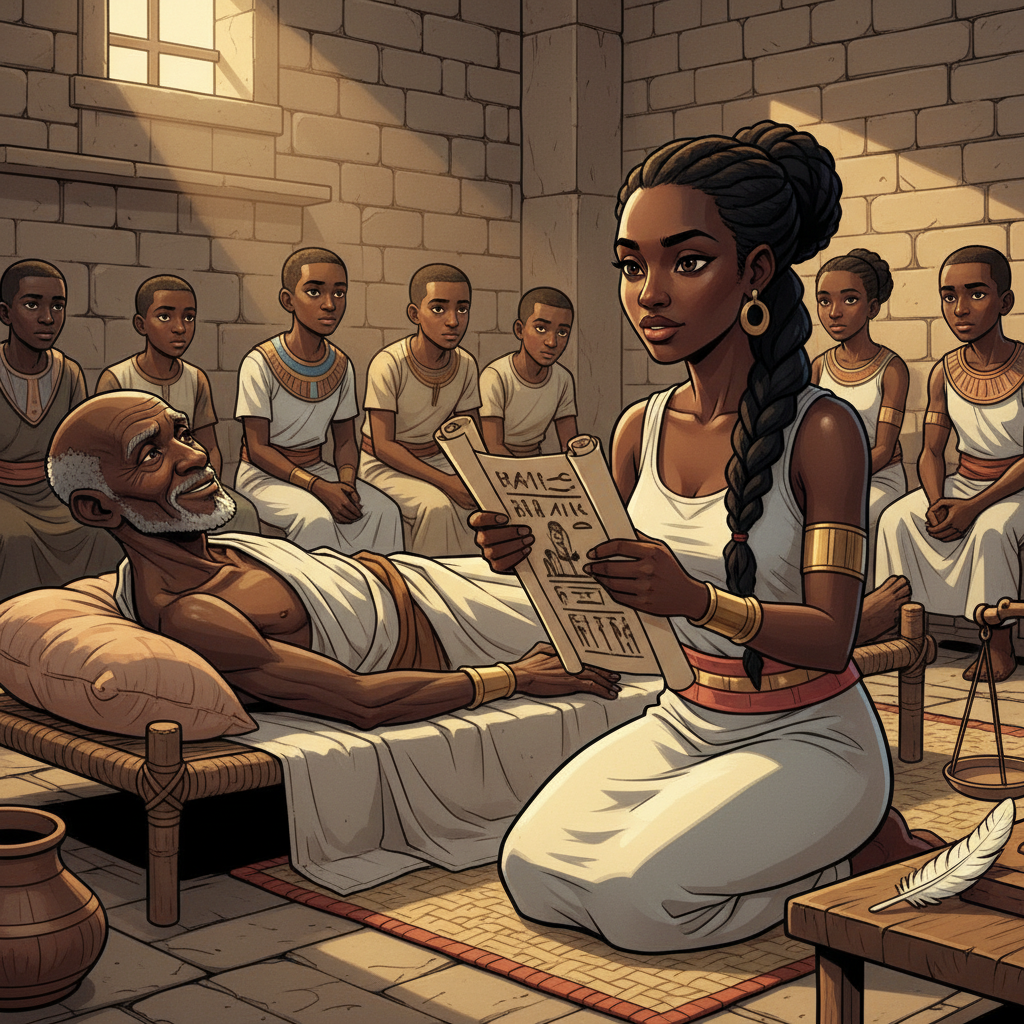
On the day he died, very old now, Benaya gave the papyrus to his own student — a young woman with skin like polished mahogany and eyes that did not look away from hard things. She held it carefully, with both hands. "What do I do with it, master?" she asked. Benaya, whose voice was thin now but whose mind was still clear, smiled up at her from his pallet. "You copy it," he said. "You read it aloud to those who will listen. You teach what you have learned. You tell them that silence in the face of empire is not peace — it is the first page of another trial. You tell them that washing your hands does not clean them. You tell them that the feather of Maat is still out there, balancing the scale, and it does not care about our excuses. You tell them what a teacher said on a stone porch in a city that thought it could kill him. And when you are old, you give this to another."
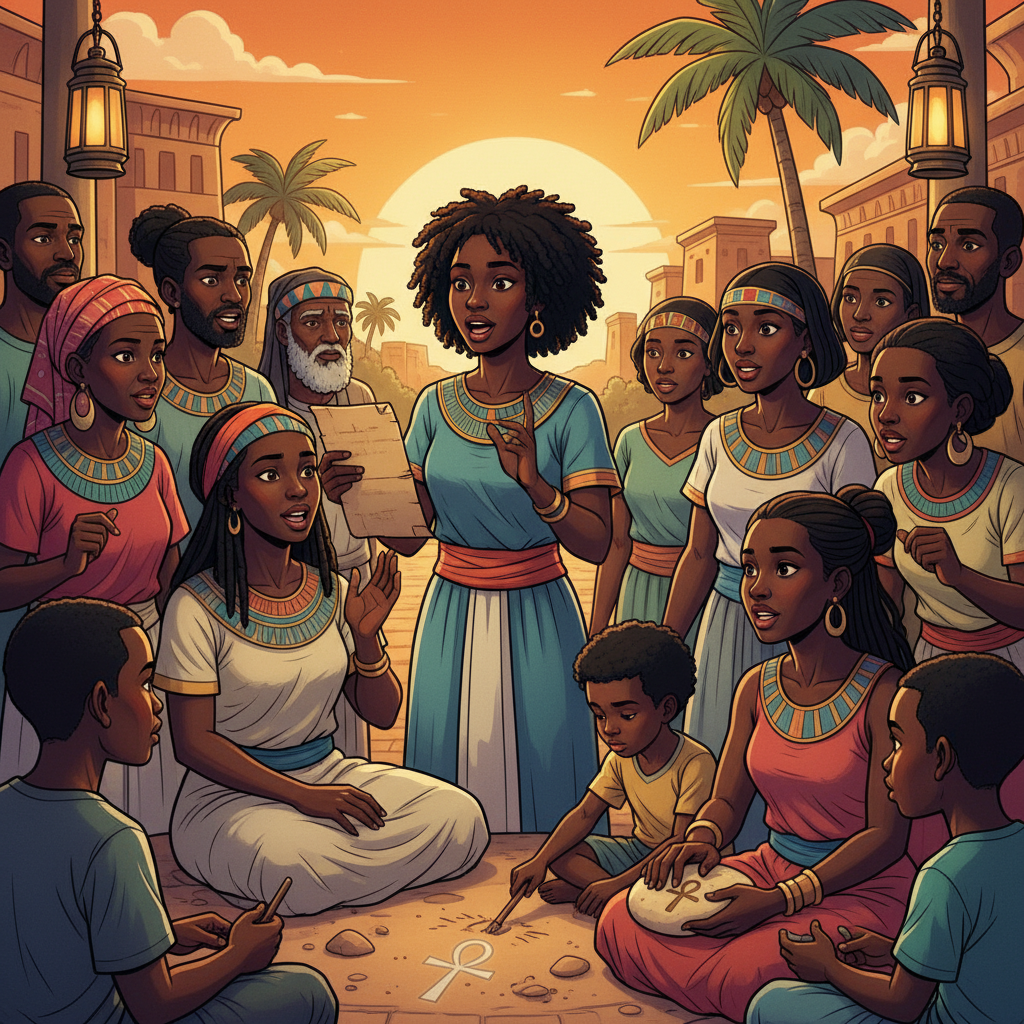
The young woman kept her word. And the one after her kept her word. And so the words of a Galilean teacher, caught by a boy scribe's shaking hand in the hour when an empire washed its hands of him, traveled forward — not through the archives of priests or the edicts of prefects, but through the quiet persistence of Africana witnesses who understood that Maat is kept alive by memory, and that memory is kept alive by the courage to speak. The silver ankh, by then, was long lost. No one knew what had become of it. Perhaps a soldier had taken it. Perhaps it had fallen in the dust beneath the cross. But the symbol did not need the metal. The ankh was a shape a child could draw with a stick in the sand, a shape any mother could press into bread-dough, a shape that meant life-that-continues. And the life of the teacher continued, because Benaya had not looked away, and because a thousand students after him had also refused to look away.