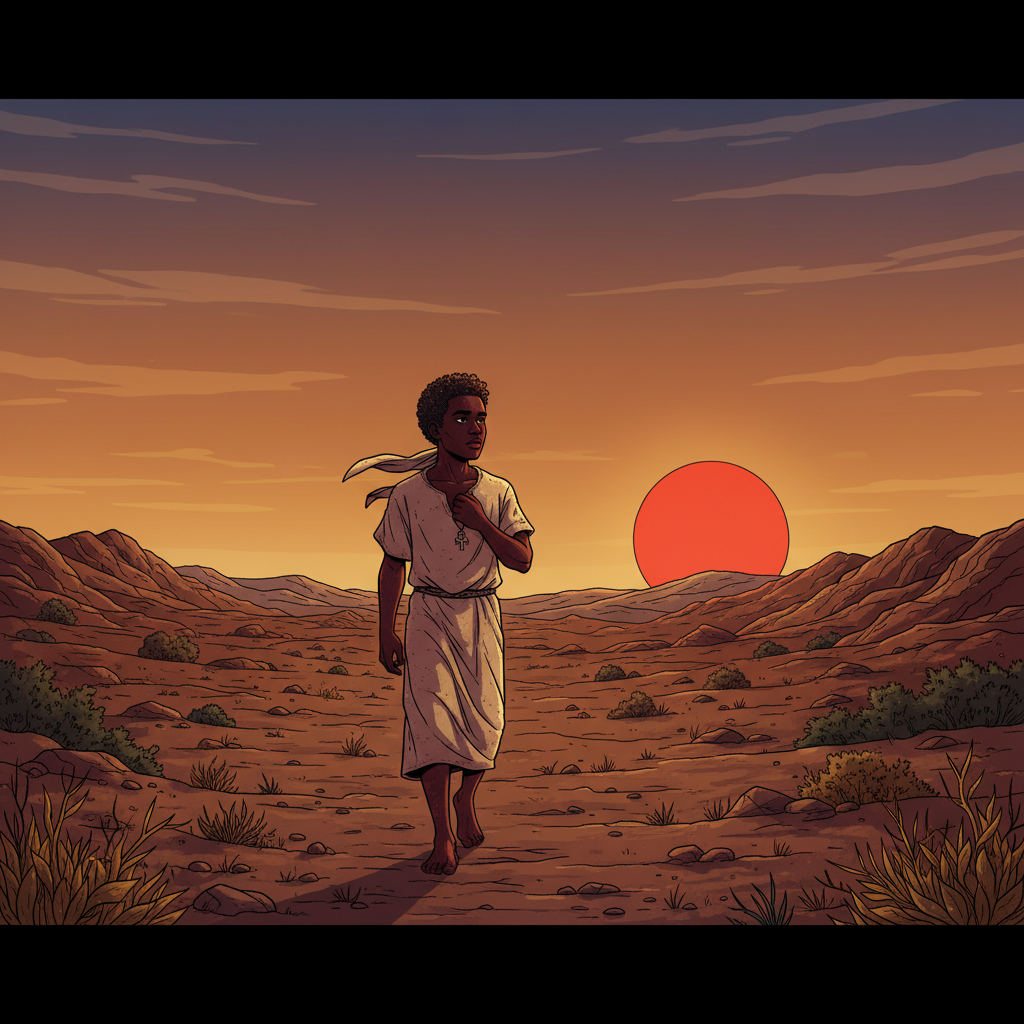
The Jordan water was still drying on Yeshua’s dark brown skin when he turned his face toward the wilderness. His cousin Yohanan had baptized him only hours before, and the sky above the river had cracked open with a sound like a mother whispering her son’s true name. Now Yeshua walked east, alone, into the brown hills of Judea where almost nothing grew but thorn and silence. His hair was tight 4C coils, dusted already with the pale grit of the road. His nose was broad, his lips full, his jaw set with a young man’s certainty that was not yet tested. Around his neck, tucked beneath his linen tunic, hung the small silver ankh his mother Miriam had pressed into his palm when he was seven years old. He touched it now without thinking, the way a man touches a door before he opens it.
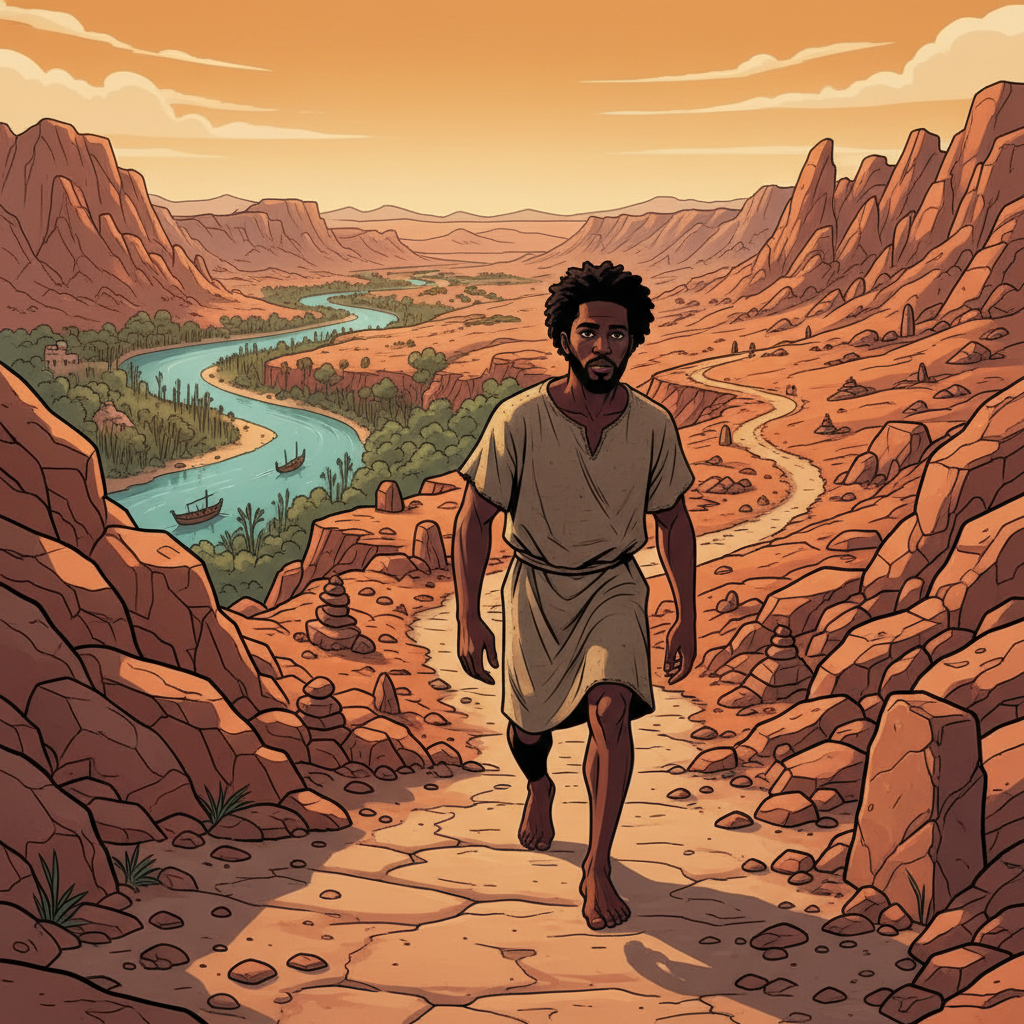
The road climbed out of the river valley and into a country of broken stone. Yeshua had heard the elders speak of this place all his life. In Galilee, the fishermen called it the Desolation. In the old Kemetic tongue his great-grandfather had taught him, it was simply ta-desheret — the red land, the land outside the green — a place priests of On had walked for forty days every generation to empty themselves of everything that was not ka. He was not the first to come here. He knew that. Dr. Ben would one day write that the forty-day purification rite was already ancient when Moses walked it, and older still when the priests of Heliopolis measured their initiations by it. Yeshua was walking a path already worn smooth by African feet, long before any Roman map had given the desert a new name.
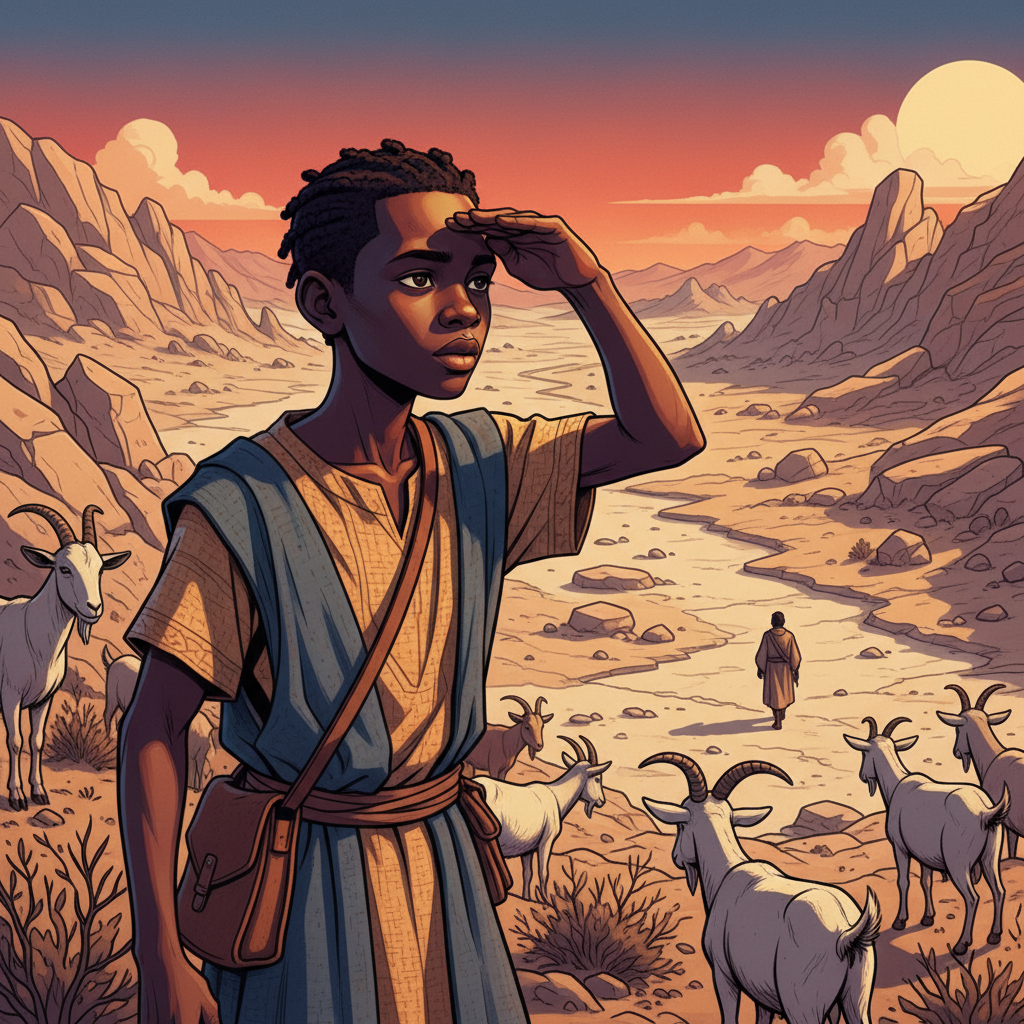
High on a ridge above the wadi, a boy named Nadav was counting his father’s goats. He was twelve years old, lean as a reed, with skin the color of wet acacia bark and hair he wore in small twists that his grandmother re-did every new moon. His eyes were sharp — the eyes of a shepherd boy who had learned to spot a lost kid at a thousand paces. He saw the traveler first as a smudge of movement against the pale rock. A man, alone, walking without pack or waterskin into the deep wilderness. That was wrong. That was the kind of thing only holy fools and dying men did. Nadav shaded his eyes with a small brown hand and watched until the figure became a dot, then a memory. He whispered a blessing his grandmother had taught him — an old Kemetic phrase, older than the Torah — and he did not forget the man’s face.
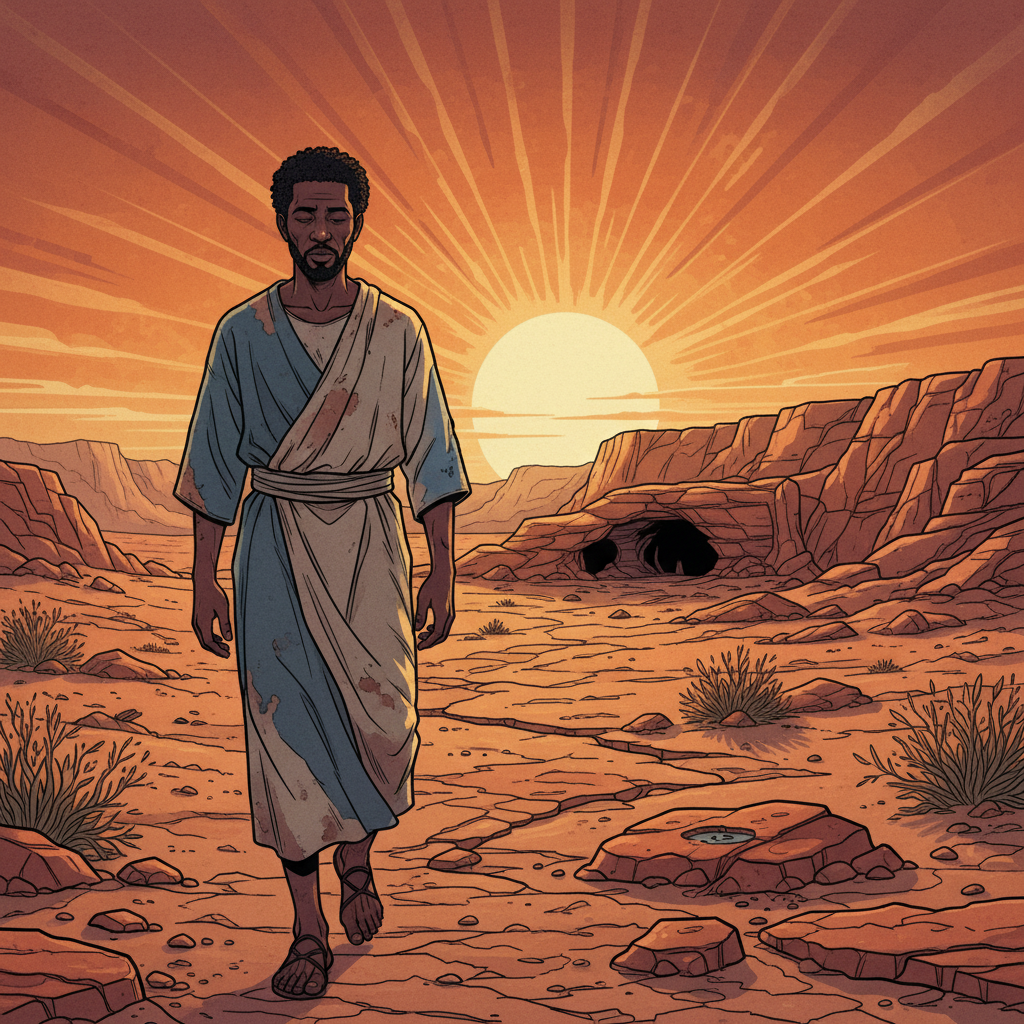
Yeshua walked for a full day and did not eat. He walked for two, then three, and the sun above him turned the sky to hammered bronze. His tongue dried against the roof of his mouth. His belly tightened, then loosened, then grew quiet in the way bellies do when the body understands that food is not coming. He chose a shallow cave in the face of a cliff. There was no spring nearby, but there was a hollow in the rock where the dew gathered before dawn, and he learned quickly to wake before the sun and press his lips to the cool stone. In the Per Ankh schools of old Kemet, the Sebau had taught that fasting was not punishment. It was the clearing of the water so the ka could see its own face. Yeshua remembered the teaching. He settled into the cave, and he waited for the water to still.
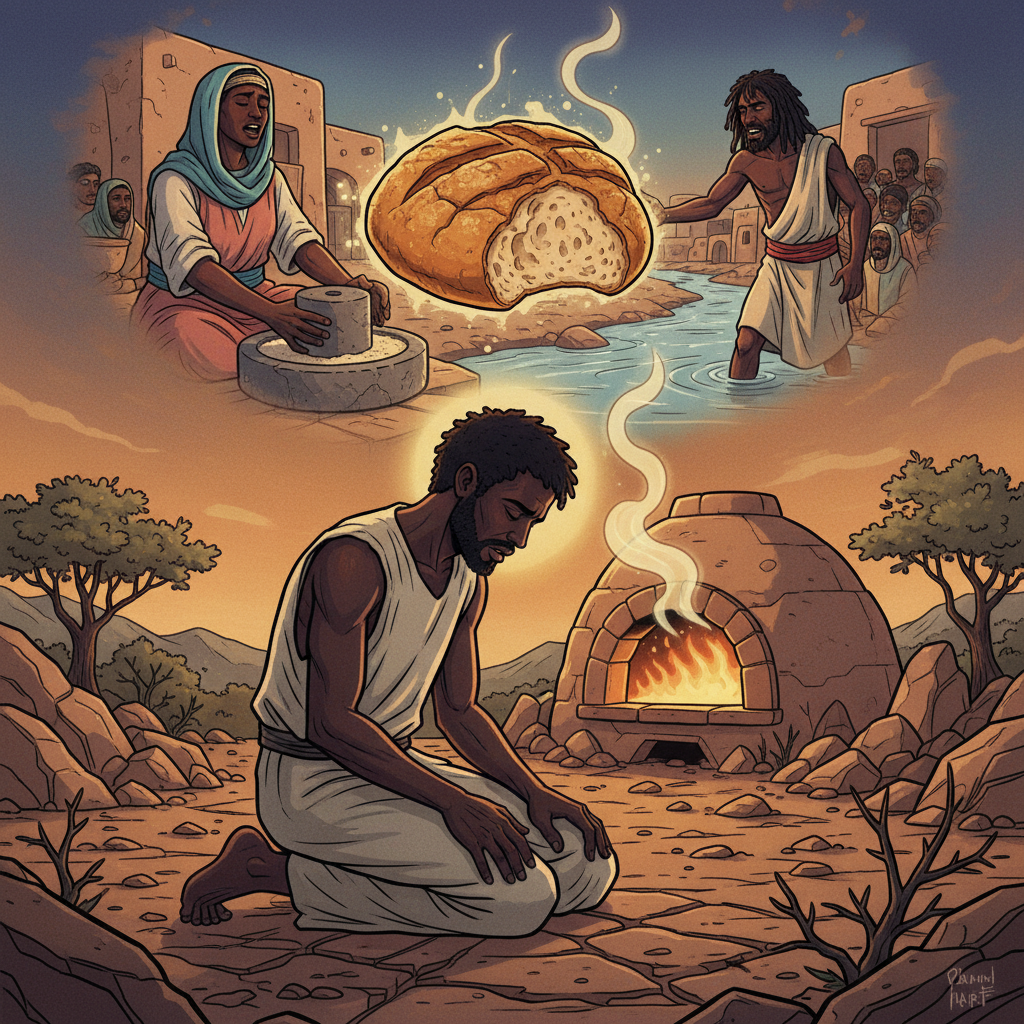
The first week, his mind raced. He thought of his mother Miriam grinding grain in the courtyard at Nazareth, her dark hands moving in the old rhythm, her voice singing the Kemetic lullabies her own mother had taught her. He thought of his cousin Yohanan standing waist-deep in the Jordan, wild-haired and fierce, calling the people to turn their hearts. He thought of the bread he had not eaten. He thought of it in detail — the crust, the crumb, the smell of it pulled hot from the clay oven. His belly cramped. His hands shook. And then, slowly, the hunger itself began to change. It stopped shouting. It began to speak in a quieter voice, a voice almost like his own. That was when Yeshua understood that the real work had not yet begun. The hunger was only the door. Something else was coming through it.
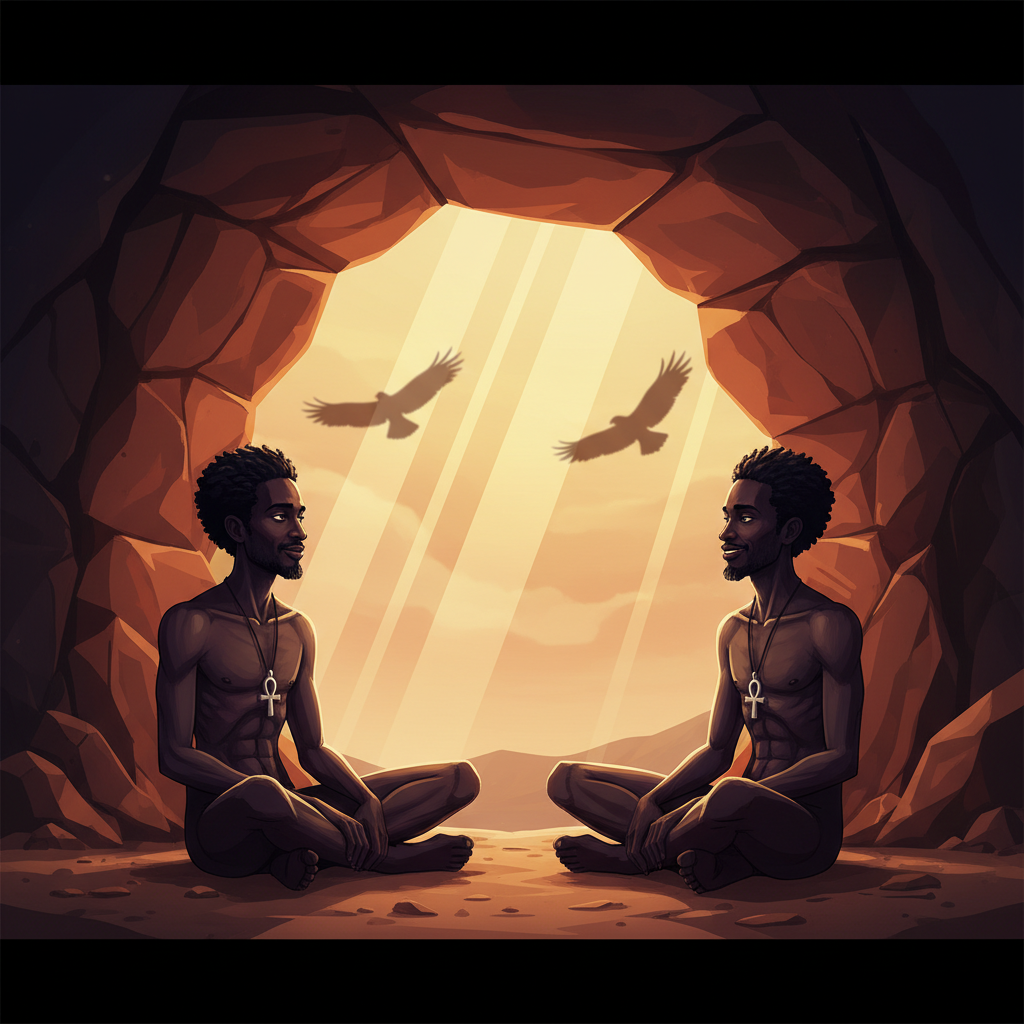
By the end of the second week, Yeshua could see his own ribs. His silver ankh hung farther from his chest than it had in Galilee. He spoke aloud sometimes, not to hear himself but to remember that he still had a voice. Mostly he sat in the mouth of the cave and watched the shadows of hawks slide across the red rock. On the fifteenth night, the shadow came. It did not come as a horned beast or a fire-breathing monster — that was the framing of empires still to come, the binary picture that Dr. Asa Hilliard would one day teach his students to recognize as foreign to African thought. The shadow came instead as a figure who looked almost exactly like Yeshua. Same dark skin. Same broad nose. Same 4C hair. Same eyes. It sat down across from him in the cave, cross-legged, patient, and it smiled a small, knowing smile.
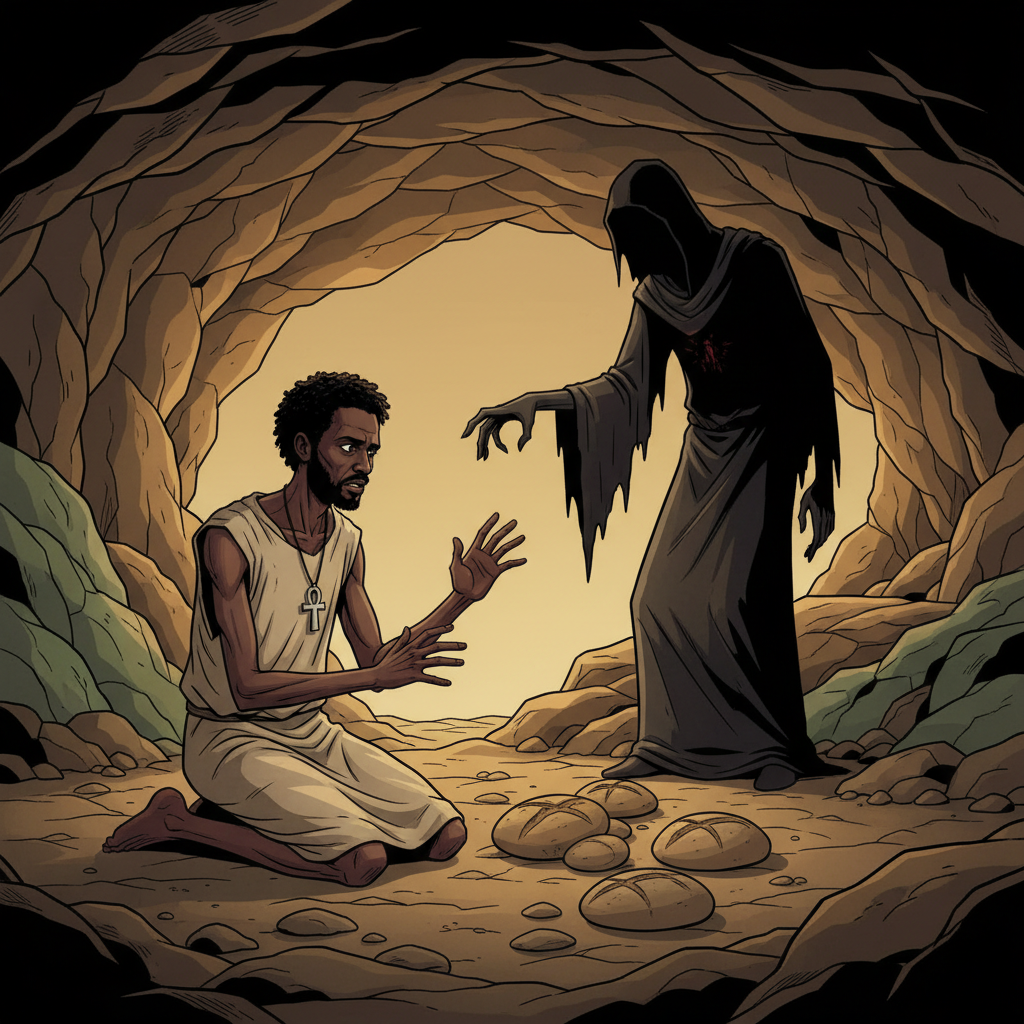
"You are hungry," the shadow said. Its voice was Yeshua’s voice, only a half-step lower, a little smoother, a little tired in a way that invited agreement. "I am hungry," Yeshua said. His throat was dry. Speaking hurt. The shadow gestured at the floor of the cave. Between them lay a scatter of smooth stones, pale and round, the size of loaves. "You are a son of the Most High. You carry the Name in your chest. Say the word, and these stones become bread. Eat. There is no one here to see. There is no witness. Your body is starving, and the body is a temple — you have said so yourself. Would you let the temple fall?" Yeshua looked at the stones. He looked at his own thin hands. He understood that this was not a test of whether he could turn stone to bread. It was a test of who he would become if he did.
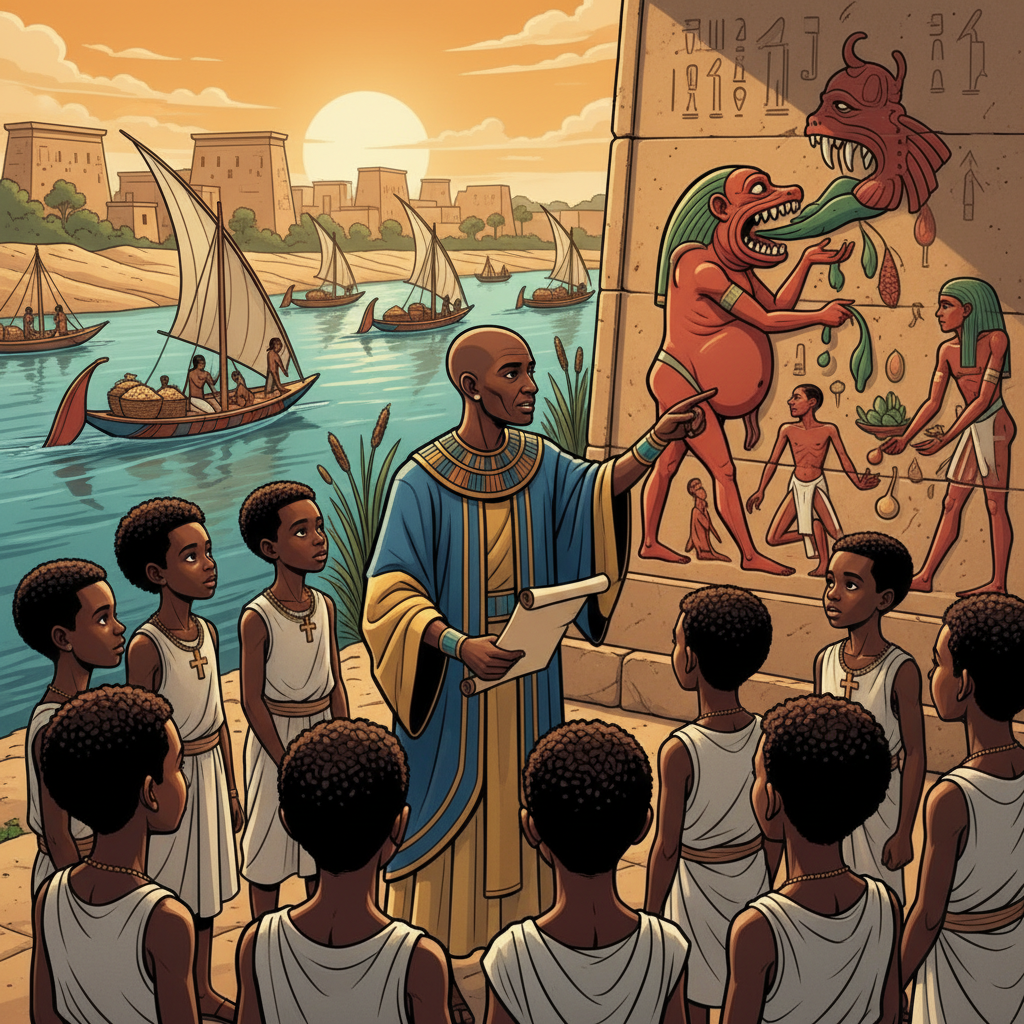
He thought of his people. Of the farmers in Galilee whose grain was taxed three times before it reached their own table. Of the mothers in Nazareth who watered the soup when the Roman tax collector came twice in one season. Of the children in the Kemet of his grandfathers’ grandfathers, where the priests of On had taught that appetite unbalanced was the first face of Isfet — not evil, but disorder, the hunger that eats until there is nothing left for anyone else. If he turned stones to bread for himself alone, in secret, to quiet his own belly, he would become a man whose first power was used for his own comfort. That man could not free anyone. That man would only teach the hungry to envy him. Yeshua closed his eyes. He felt the silver ankh against his breastbone, cool and steady. He did not reach for the stones.
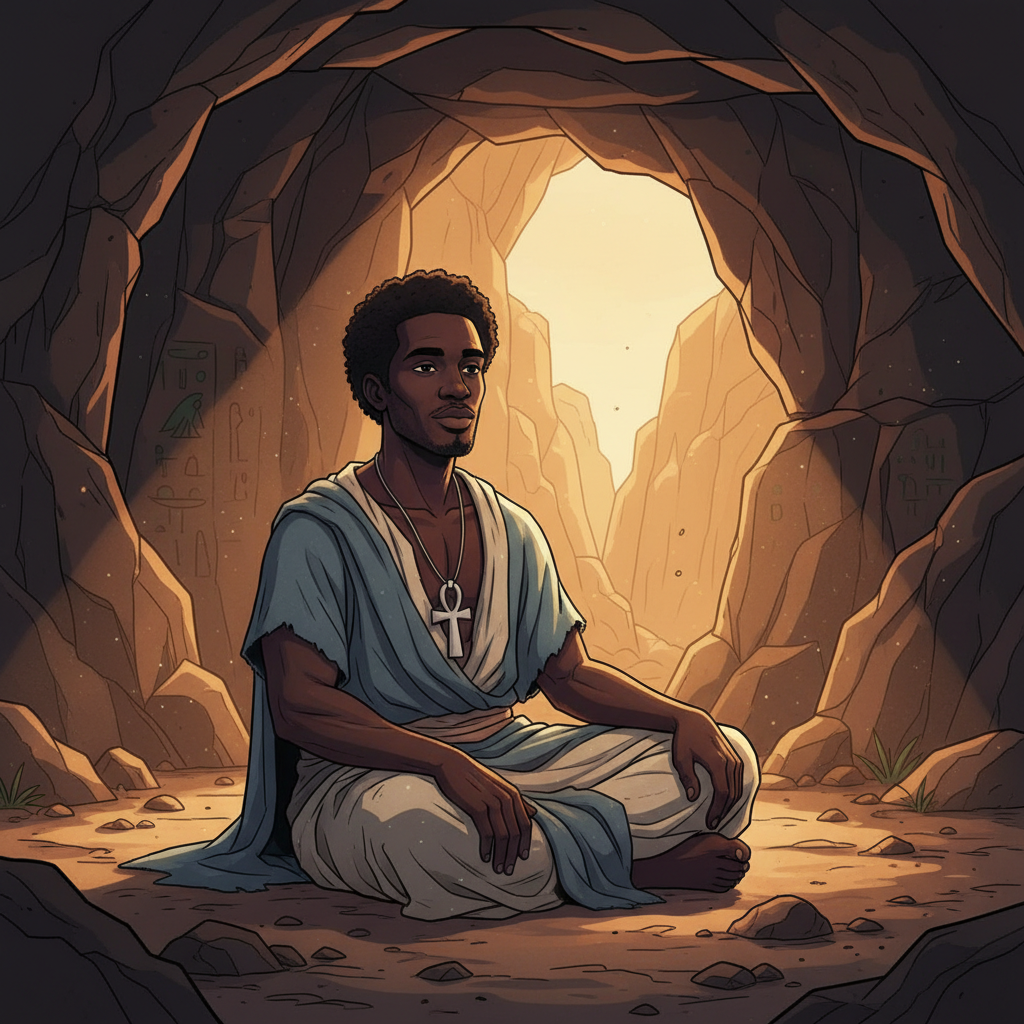
"Man does not live by bread alone," Yeshua said. His voice was quiet but it did not shake. "The ka is fed by the Word that proceeds from the mouth of the Most High. I know who I am. I do not need to prove it to a hungry belly." The shadow tilted its head. It was not angry. It was studying him, the way a scribe studies a line of hieroglyphs he has not seen before. "That is one answer," it said. "There are two more." And then it was gone — not in a flash of lightning, not in a puff of smoke, but simply absent, the way a thought leaves when you stop thinking it. Yeshua sat alone in the cave. His hunger was still there, but it was smaller now. It had been named. And anything that has been named, the old Sebau had taught, has lost its power to rule.
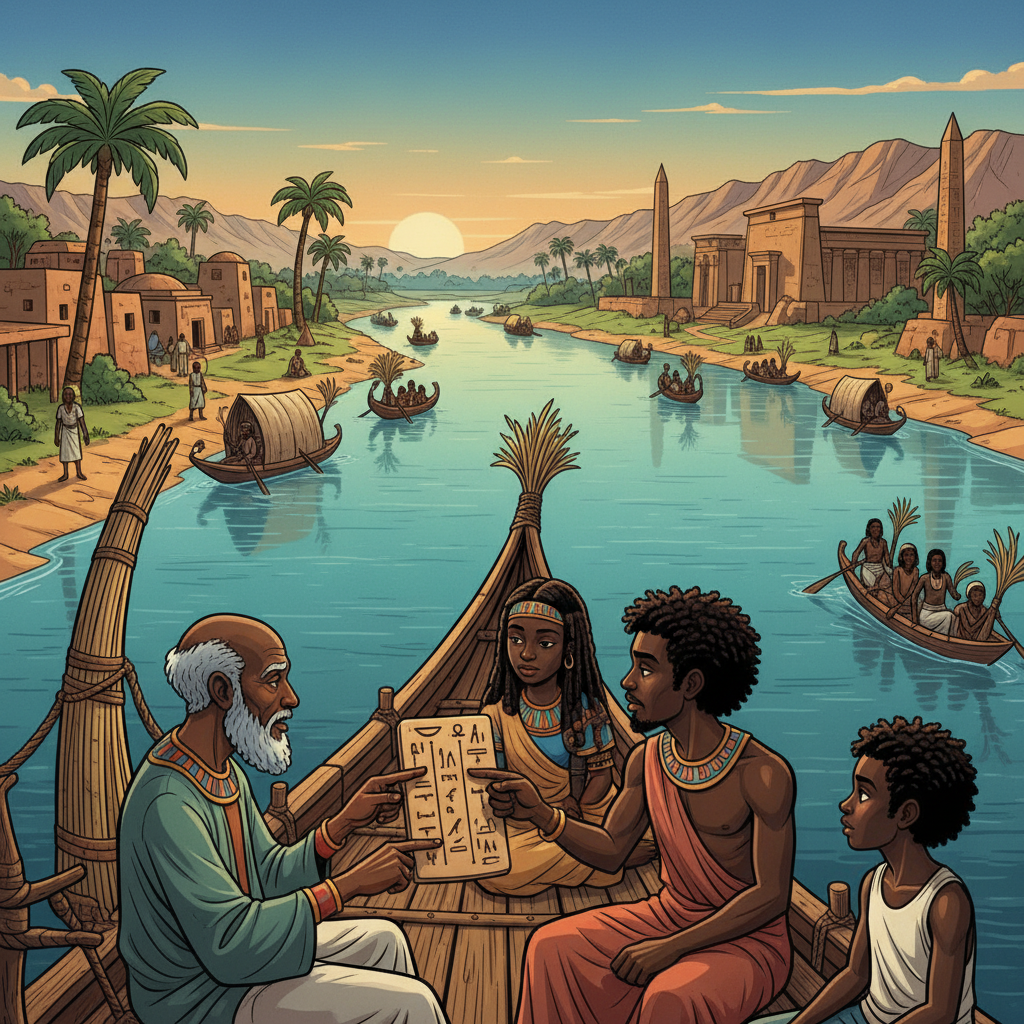
A full week passed. Yeshua grew weaker in his body but clearer in his mind. He no longer thought about bread. He thought about his people — about the Galilee villages where Roman soldiers took what they wanted, about the temple in Jerusalem where the priests had learned to speak softly in the presence of imperial power, about the long continuity his great-grandfather had shown him on a clay tablet: the line from the priests of On to the prophets of Israel to this moment, his moment, in this cave. He thought of Cheikh Anta Diop — a name he could not know, a scholar who would one day write, two thousand years in the future, that the contemplative tradition Yeshua was practicing right now had traveled unbroken up the Nile corridor from Kemet into Galilee. Yeshua did not know the name, but he felt the truth of it in his bones. He was not alone. He was a link in a chain.
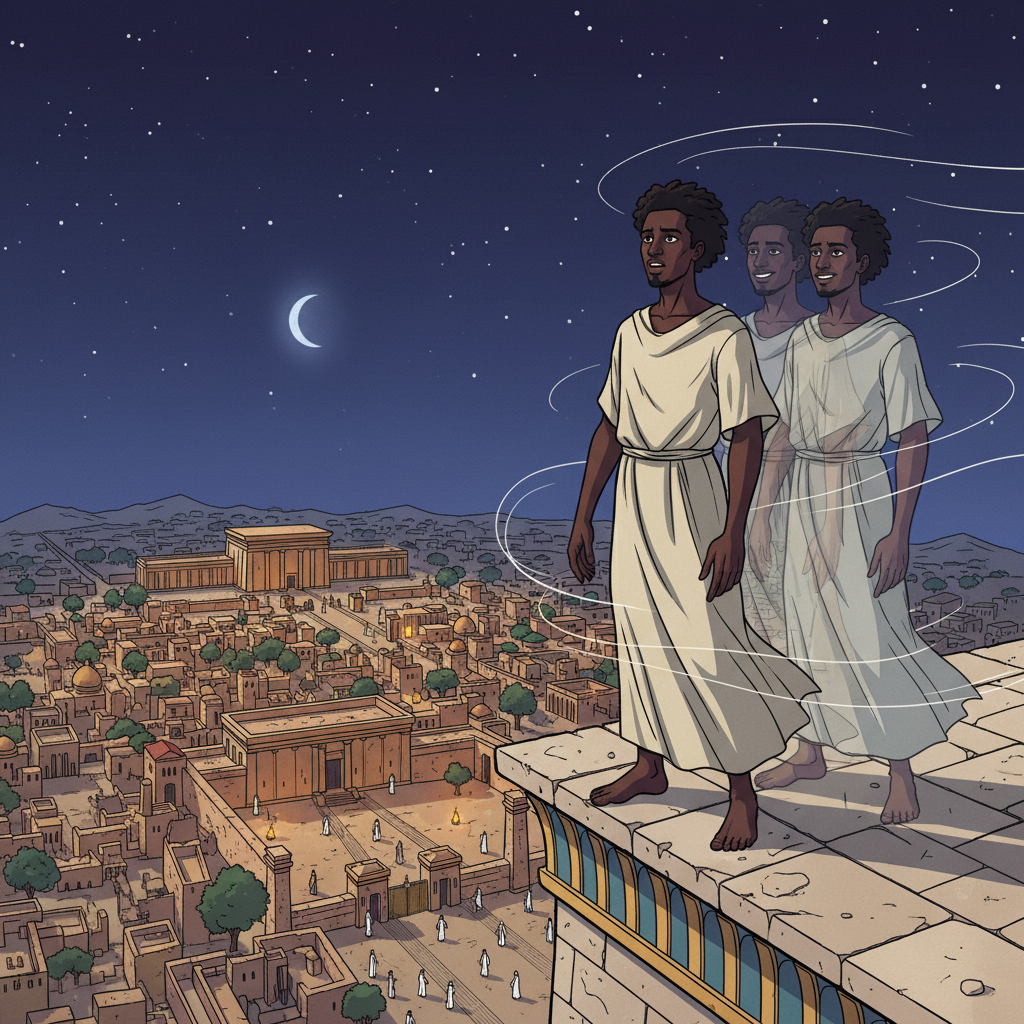
On the twenty-third night, the shadow returned. This time it did not sit in the cave. This time Yeshua opened his eyes and found himself standing on the high pinnacle of the Temple in Jerusalem, the whole city spread below him like a map of clay and gold. He knew he had not walked there. His feet were still in the cave. But the vision was as solid as stone. The shadow stood beside him, tall and calm, wearing Yeshua’s own face. The wind up here smelled of incense and dust. Far below, in the courtyards, the priests moved like tiny white ants. "Throw yourself down," the shadow said gently. "You are the beloved son. The angels will catch you before your foot strikes a stone. Let the people see it. Let the priests see it. One leap, and every eye in Jerusalem will know who you are."
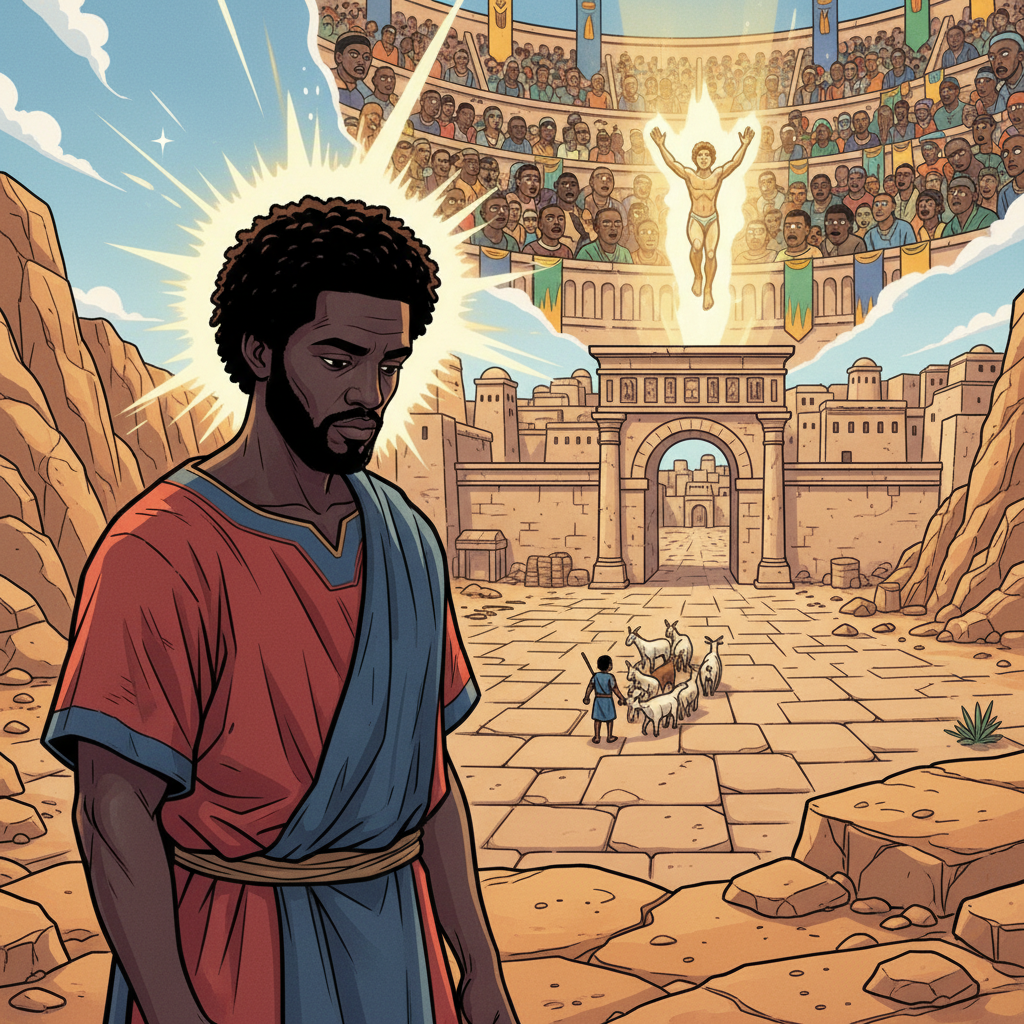
Yeshua looked down. He could see the flagstones of the courtyard, could see a shepherd boy — not Nadav, some other boy — driving a small flock of goats through the outer gate. He thought about what it would mean to leap. To force the heavens to prove him. To make a spectacle so huge that no one could doubt him, not the Romans, not the Sanhedrin, not the skeptics in his own village. And he saw, in a flash, what kind of teacher that would make him. A teacher whose followers believed because they had seen a trick. A movement built on proof, not on turning. A kingdom of spectators. In the old Kemetic teachings, to test the Netjer — the Divine — was already to have fallen out of right relationship. It meant you no longer trusted. It meant you needed the Most High to perform for you, the way a Roman emperor performed in the arena.
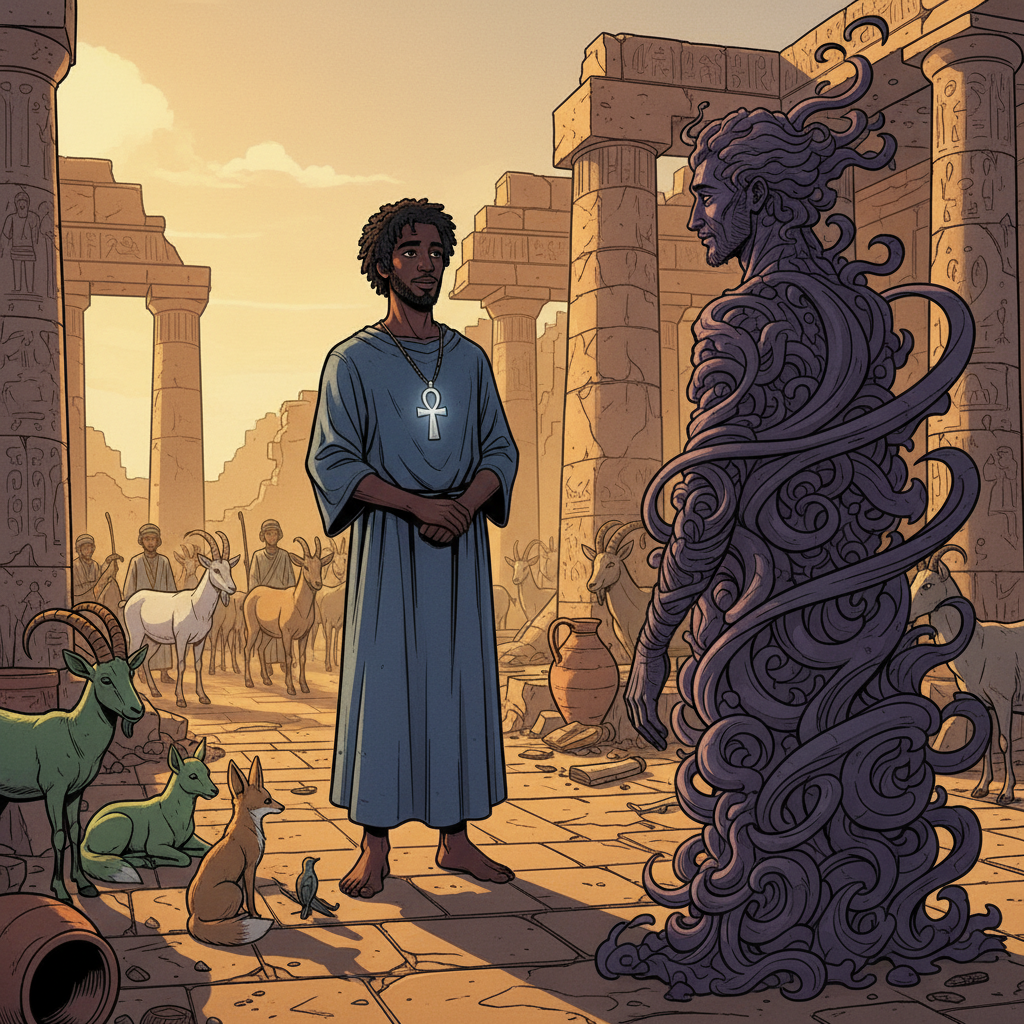
"It is written," Yeshua said, and his voice was steadier now, "you shall not put the Most High to the test." He looked at the shadow with something that was almost compassion. "If I leap because I need the sky to catch me, I have already stopped trusting. I will not bargain with the Divine. I will not stage a miracle to feed my own pride. That is not the way of the ka that knows itself." The shadow nodded slowly. Its face did not twist. It did not rage. It simply considered him, the way one scholar considers another across a table of scrolls. And then Yeshua was back in the cave, on his knees, his palms on the cold stone. He was breathing hard. He could feel the silver ankh swinging against his chest, warm now from his skin, and he understood: the shadow had studied him twice, and he had not yet broken.
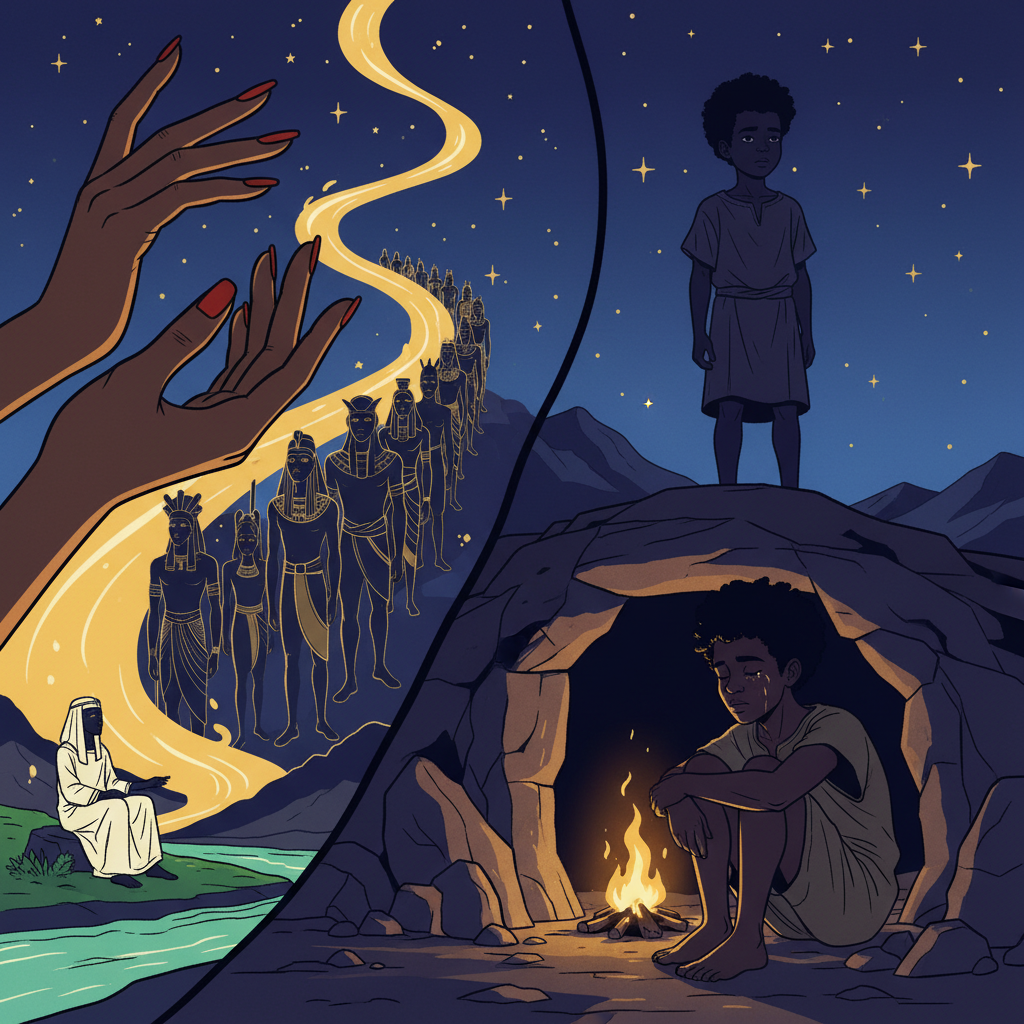
Ten more days passed. Yeshua stopped counting. His body had become so light that he felt, when the wind moved through the cave mouth, that he might lift like a dry leaf. He slept little. He dreamed more. In his dreams he saw his mother Miriam’s hands, and the Jordan River running backwards, and a long line of dark-skinned ancestors stretching all the way back to the first priest who had ever sat in stillness on the banks of the Nile. He dreamed once of Nadav the shepherd boy, though he did not know the boy’s name. The boy stood on a ridge and watched him, and the boy’s face was full of something that was not fear and not pity. It was a witnessing. Yeshua woke from that dream and wept, quietly, without knowing why. The tears made tracks down his dust-covered cheeks and dried before they reached his jaw.
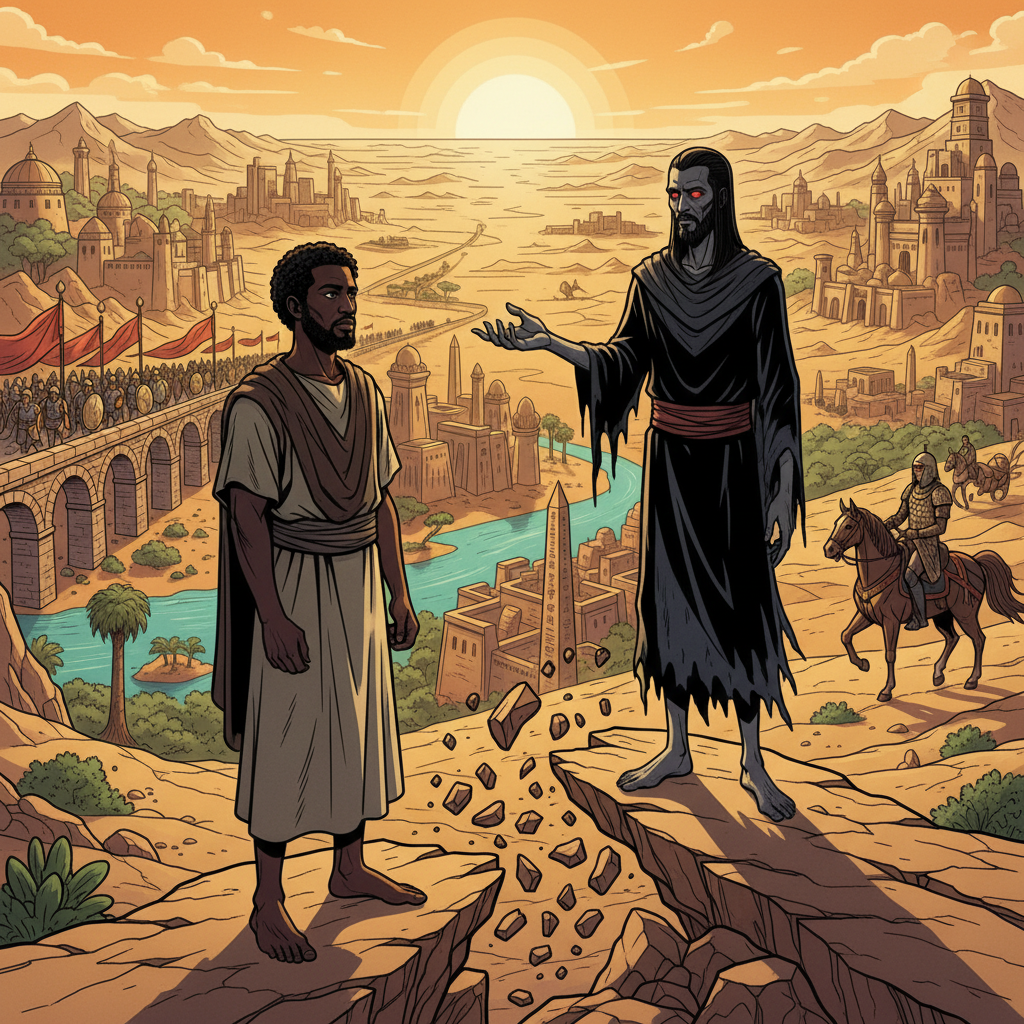
On the fortieth day, the shadow came for the third time. Yeshua was ready. He had been ready for days. He stepped out of the cave at dawn, and the shadow was already there, standing on a spur of rock, looking east into the rising sun. Without speaking, the shadow lifted a hand, and the wilderness fell away. Yeshua saw — not with his eyes, but with something older — every kingdom of the earth. Rome, its legions in glittering ranks. Parthia to the east. The Kushite cities far south along the Nile. The distant kingdoms of Aksum and beyond. Cities of the Indus. Markets of lands whose names he did not know. All of them, spread like a great cloth, and all of them, somehow, for the taking. "These," the shadow said quietly, "are yours. Every throne. Every army. Every tax road and every treasury. Bow to me once, and it is done."
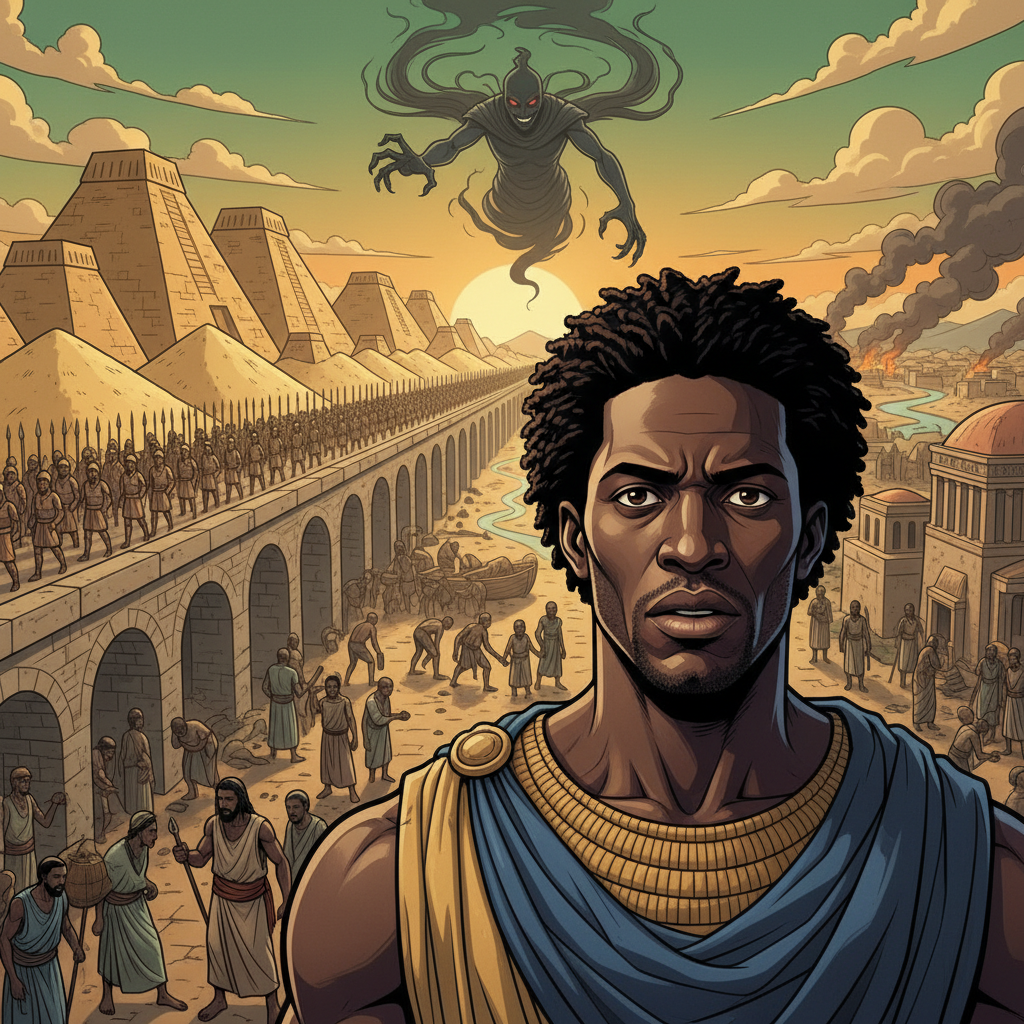
Yeshua looked at the kingdoms. He saw the shining legions and the piled grain. He also saw, underneath, what the legions stood on. The broken backs of farmers. The chains of captured children. The burned villages along the Nile where Roman troops had marched south. The tax collectors in Galilee. The enslaved women in Rome’s great houses. The whole structure of imperium built on Isfet — on hunger that would not stop eating. He understood, then, what the shadow was really offering. Not freedom. Not the liberation of his people. It was offering him the chance to become the next empire — wearing a different face, perhaps a kinder face, but still an empire, still a boot, still Isfet dressed in new cloth. To rule the kingdoms of the earth the way the shadow was offering them was to bow to the logic that made them. And the logic that made them was the oldest lie of all.
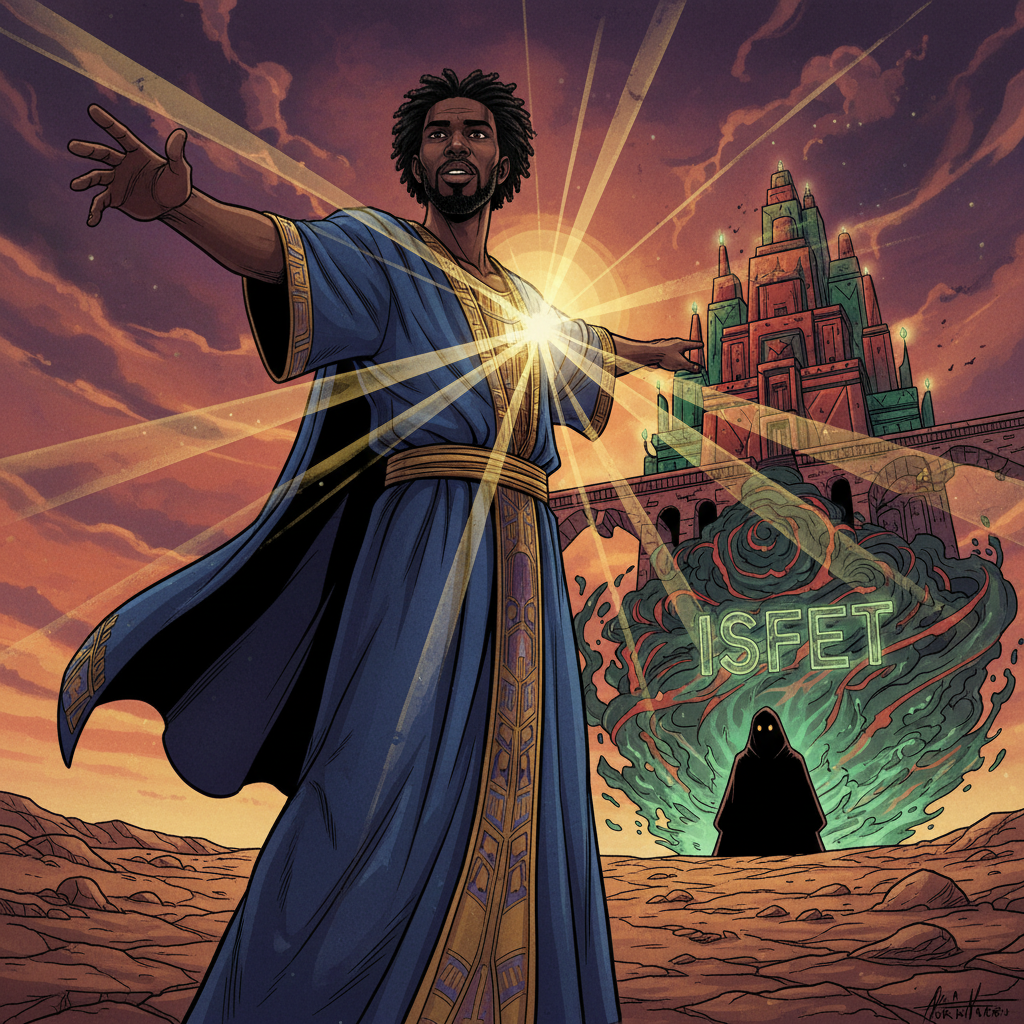
"Go," Yeshua said. His voice rang across the wilderness like a struck bell. "You shall worship the Most High, and the Most High only shall you serve. The kingdoms you offer me are built on Isfet. I will not add another empire to the pile. I came to dismantle the logic that makes empires, not to wear one." The shadow looked at him for a long moment. It was not angry. It was, if anything, a little proud — as a teacher is proud of a student who has finally understood the hardest lesson. "You have chosen the harder road," it said. "Sovereignty without a throne. Power without a sword. You will be hunted for this." "I know," Yeshua said. "You will die for this." "I know." The shadow nodded. And then, for the last time, it was gone — not cast out, not defeated in battle. Simply integrated. Recognized. Named, and therefore no longer able to rule.
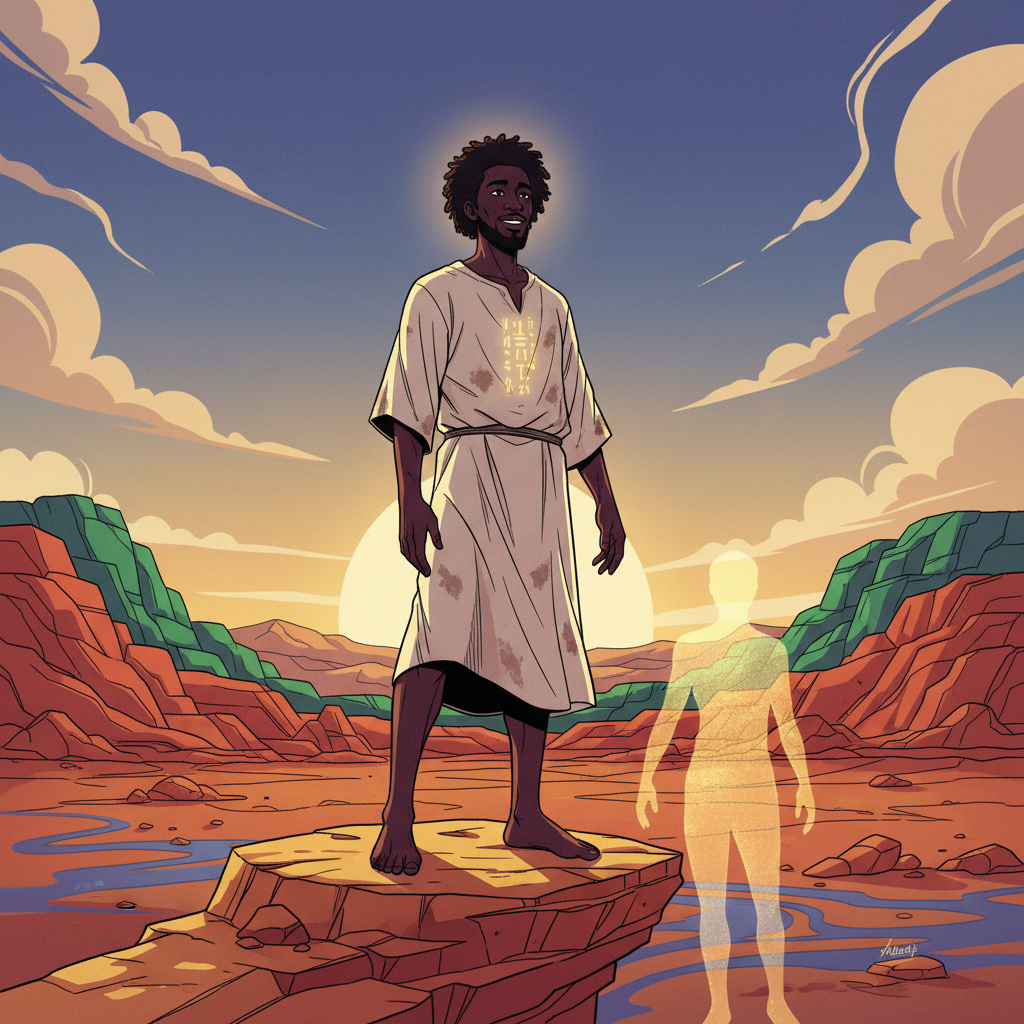
Yeshua stood on the spur of rock alone. The sun was fully up now. His legs trembled. His mouth was cracked. But inside him, something had settled — a stillness deeper than the cave, deeper than the hunger, deeper than the forty days. He understood now, with the quiet clarity of the priests of On, that the shadow had not been an enemy. The shadow had been the unformed part of him, the hunger that had not yet been named, the appetite for bread and pride and empire that lives in every human heart. He had not destroyed it. You cannot destroy a shadow. He had simply turned the light of his own ka upon it until it could not pretend to be a stranger. In the old Kemetic weighing, he had put his own heart on the scale, and the feather of Maat had not tipped. His ka was his own. He was sovereign.
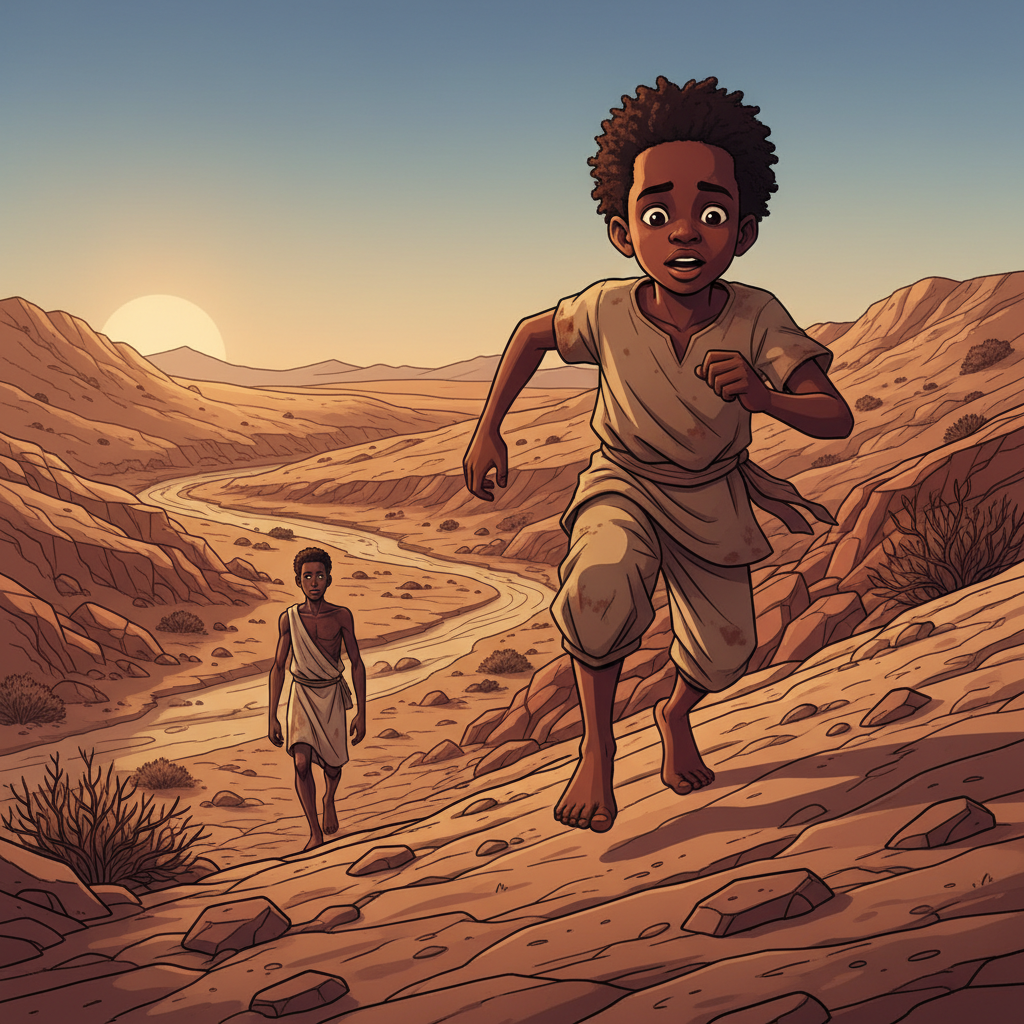
Far up on the ridge above the cave, Nadav was counting goats again. Forty days had passed in his village too. His grandmother had grown thinner. His little sister had learned two new songs. Nadav had thought about the lone traveler almost every day, and every morning he had climbed to this ridge, half hoping and half afraid that he would see the man again. And then, on the fortieth morning, he did. The traveler walked out of the wadi, slow, so thin that Nadav could see the shape of his shoulder bones through the dust-streaked tunic. But the traveler was upright. He was walking. And even from this distance, Nadav could see something in the way the man held his head — the way a shepherd holds his head when he has found every lost goat and is bringing them home. Nadav’s chest tightened in a way he did not understand. He began to run.
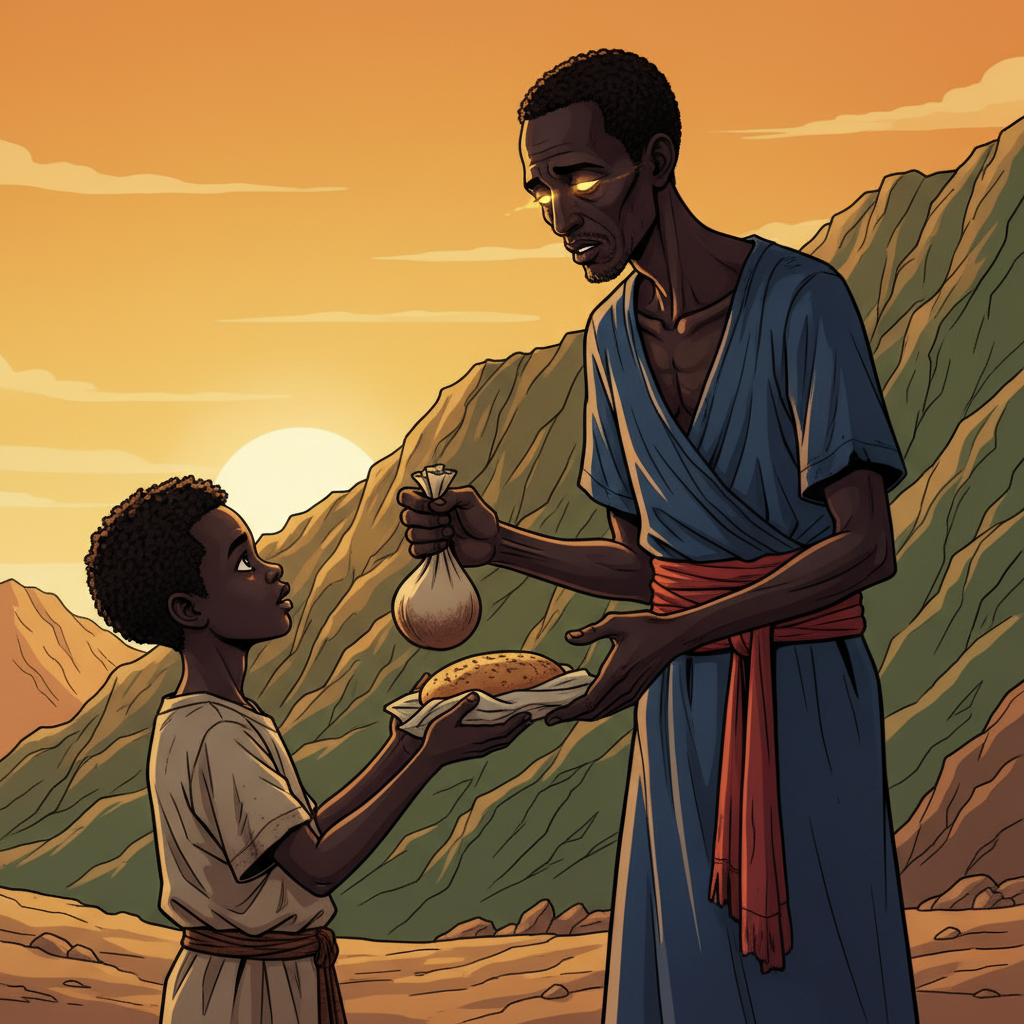
Nadav met the man at the foot of the ridge. Up close, the traveler was even thinner than he had seemed from above. His lips were cracked and his cheeks were hollow. But his eyes — his eyes were what Nadav would remember for the rest of his life. They were dark brown, almost black, and they held a kind of light that Nadav had only ever seen in one other place: in the faces of the oldest elders in his village, the women who had buried their children and still sang at the new moon. The boy did not speak. He simply held out a small goatskin of water and a heel of barley bread his grandmother had wrapped in a cloth that morning, as if she had known. The man took them. His hands were shaking. He looked at Nadav, and Nadav saw that he was trying to speak and could not quite find the words.
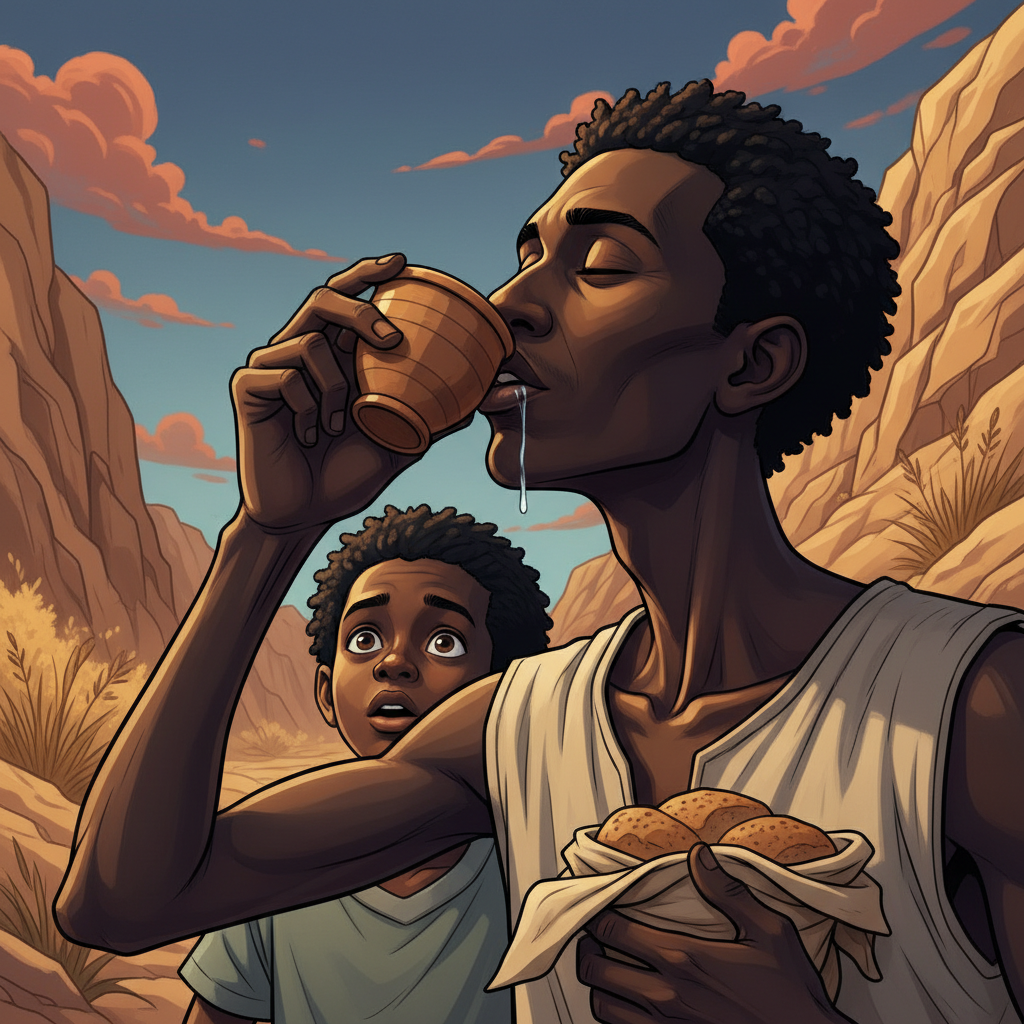
"Thank you, little brother," the traveler finally said. His voice was rough as sand. He drank slowly, sip by sip, the way Nadav’s grandmother drank when she was recovering from fever. He ate one small piece of the bread, chewing it for a long time before he swallowed. Then he wrapped the rest in the cloth and handed the cloth back. "Save the rest for your sister," he said, as if he had known Nadav had a sister, as if he had seen her in a dream. "Tell your grandmother her blessing reached me on the first day. Tell her I remembered the old words." Nadav stared at him. Old words? Blessing? His grandmother had whispered a Kemetic phrase over him on the morning he first saw the traveler — a phrase older than the Torah, his grandmother had said. He had not spoken a word of this to anyone. He felt his knees wobble. He did not yet know what had happened in that cave, but he knew something had.
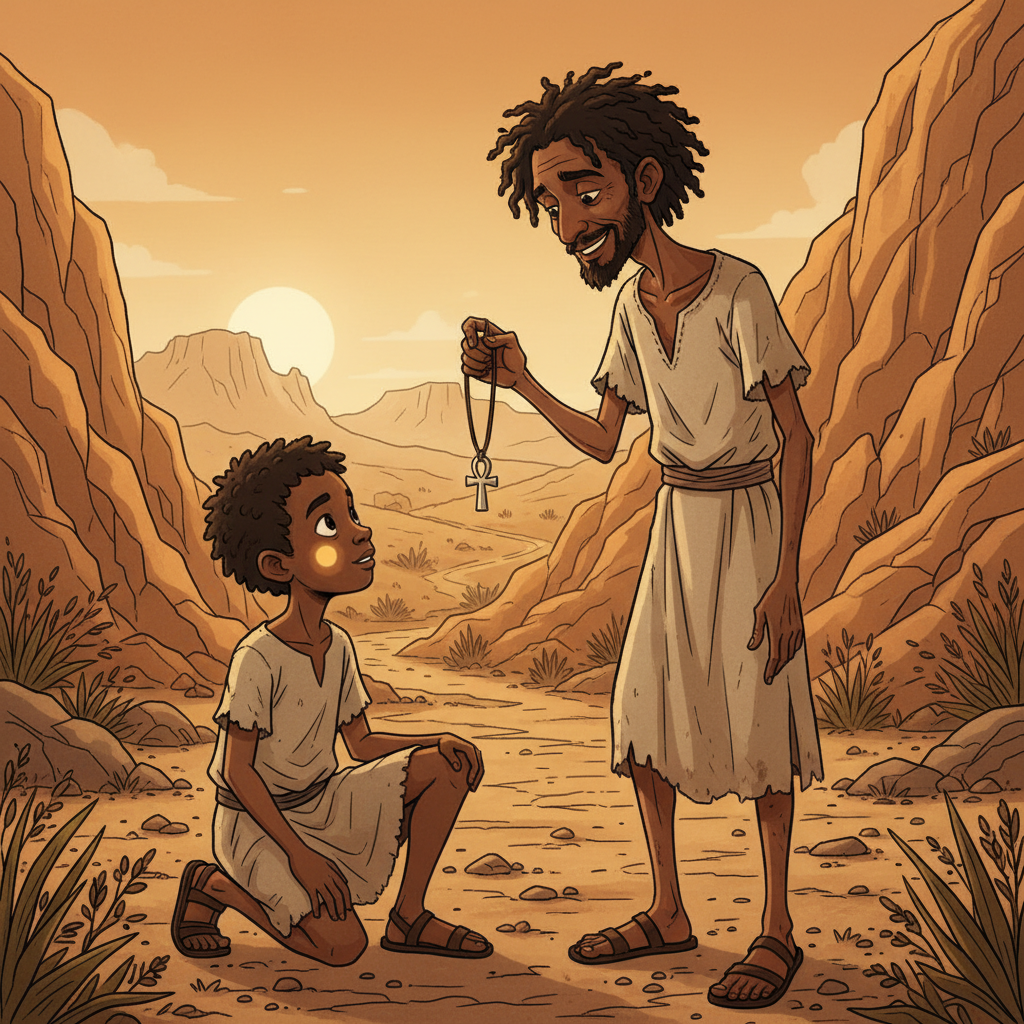
"Who are you?" Nadav whispered. The traveler looked at him a long time. Then he reached up and drew out from beneath his tunic a small silver ankh on a leather cord. He held it so Nadav could see it clearly — the loop at the top, the cross-beam, the shape of life older than any empire. It caught the morning sun and threw a small circle of light onto the boy’s dusty cheek. "My name is Yeshua," the man said. "My mother’s name is Miriam. I am from Nazareth in Galilee. I am a son of the Most High, like you. And I just learned who I am." He paused. He smiled, and it was the smile of a man who has been crying and laughing at the same time. "I will remember your kindness, little brother. The day will come when you hear my name again. When you do, remember this morning."
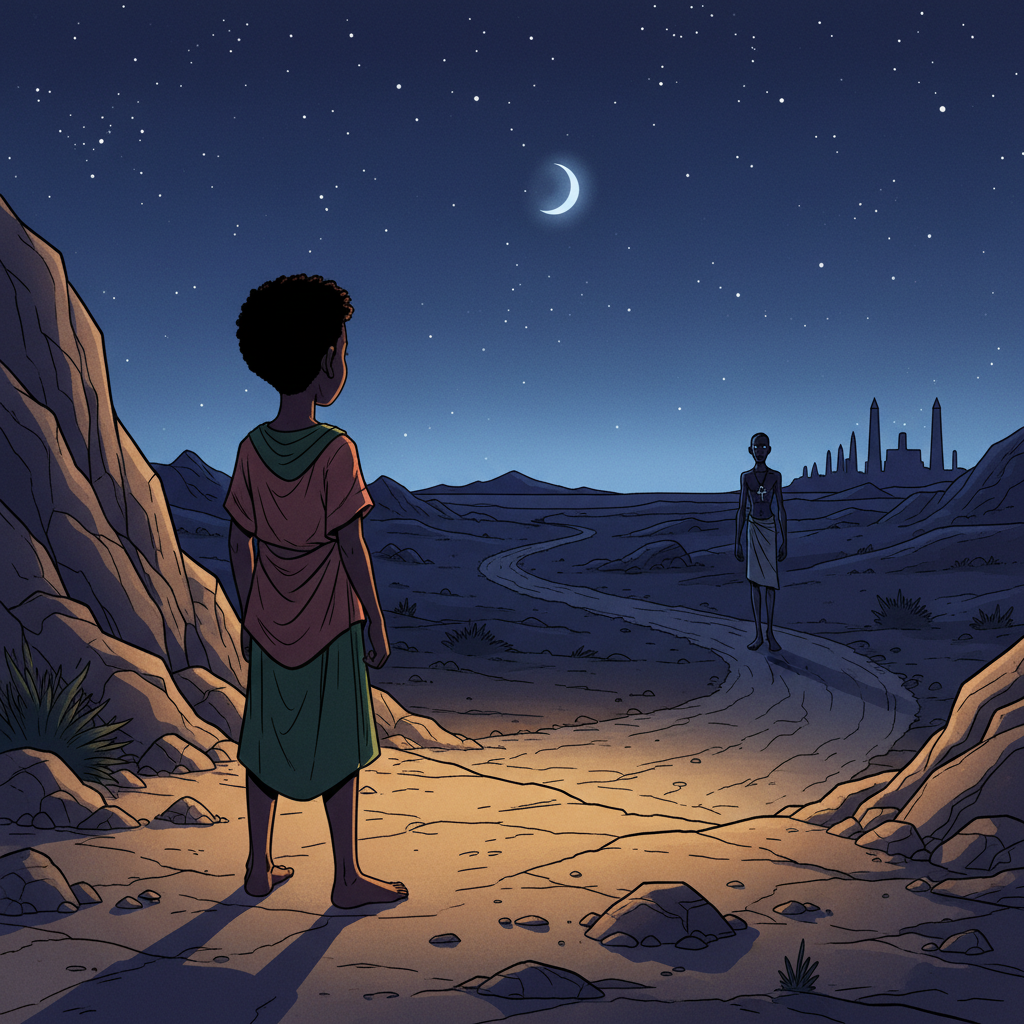
Nadav watched the man walk away down the road toward the Jordan. The traveler moved slowly, but he moved without doubt — as a man moves when he has decided something and will not unmake the decision. The silver ankh bounced softly against his chest with every step. Nadav stood at the foot of the ridge until the figure was only a smudge again, then only a memory. He did not tell his father what had happened. He told his grandmother, though, that same night, sitting by the small fire in their tent. She listened without interrupting. When he was done, she was quiet for a long time. Then she reached out and touched the place over his heart with one calloused brown finger. "You have met a ka that knows itself," she said softly. "Remember his face. Remember the silver ankh. Remember the morning. One day, little one, your grandchildren will ask."
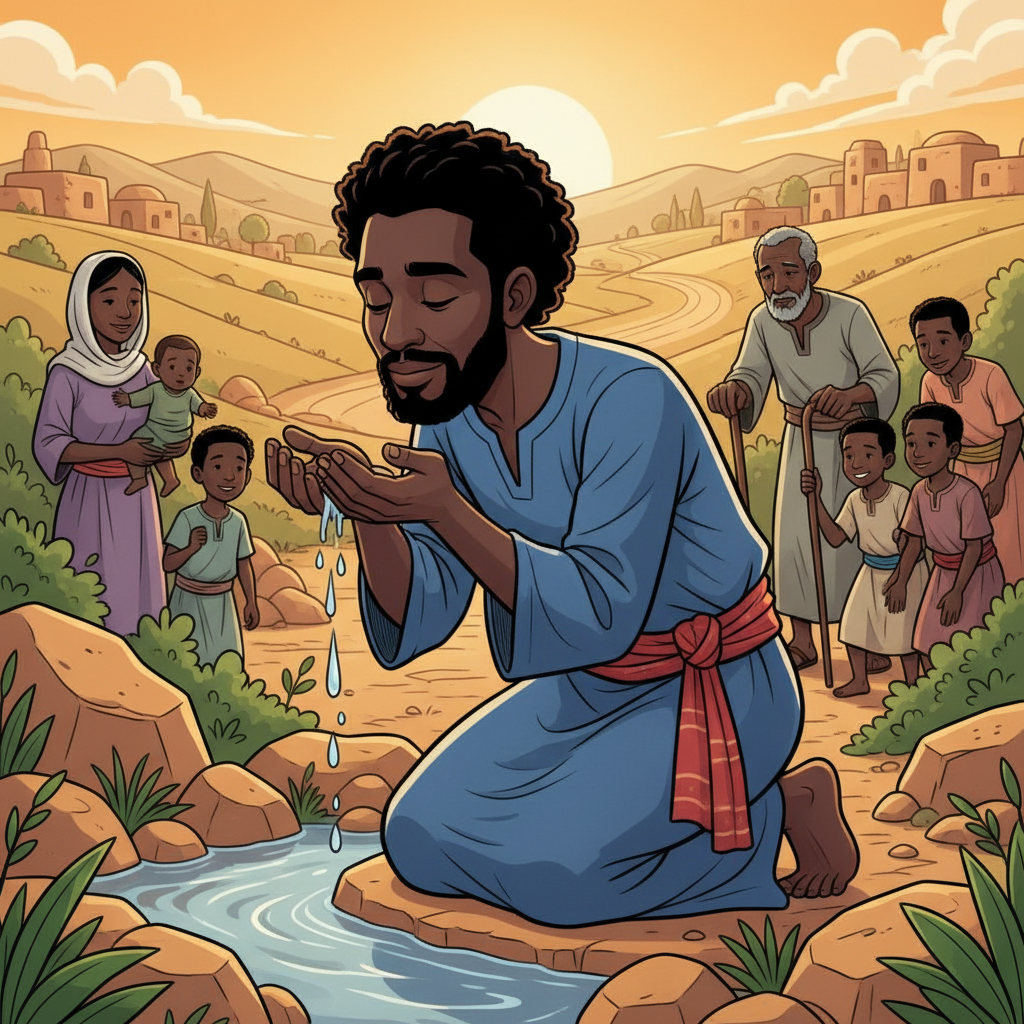
Yeshua walked the long road back to Galilee. He did not hurry. He stopped at springs and drank. He stopped at villages and ate small meals and slept on clean straw and spoke gently to the people who welcomed him. His body filled out again. His lips healed. The hollow places in his cheeks softened. But something inside him did not go back to the way it had been before. He had walked into the wilderness as a young man with a question. He walked out of it as a man who had answered the question in his own bones. He was not the stones-to-bread man. He was not the leap-from-the-temple man. He was not the all-the-kingdoms man. He was Yeshua — son of Miriam, son of the Most High, brother to every hungry farmer and every shepherd boy on every ridge from here to the headwaters of the Nile.
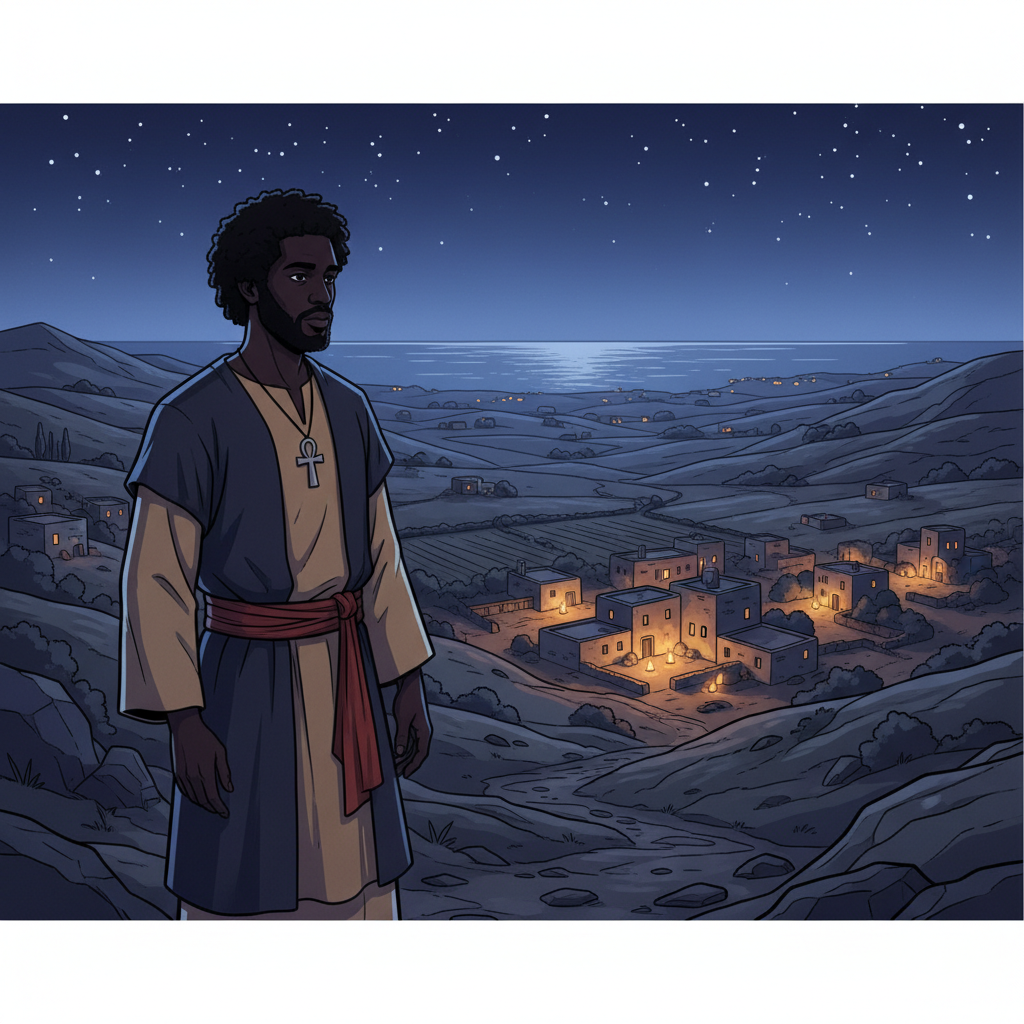
When he reached the edge of Galilee, he paused on a hilltop and looked out over the fields and the small stone houses and the distant shimmer of the lake. The people he loved were down there — working, cooking, arguing, laughing, taxing and being taxed, dying and being born. They did not yet know he was coming. They did not yet know what he had learned. He touched the silver ankh at his chest. He whispered his mother’s name. He whispered the name of the shepherd boy he had just met and did not know, trusting that the Most High had given him that boy as a first witness for a reason. Then he started down the hill. Dr. Ben would one day write that the great African teachers always came out of the desert knowing. Yeshua came out of the desert knowing. The work — the real work — was about to begin.
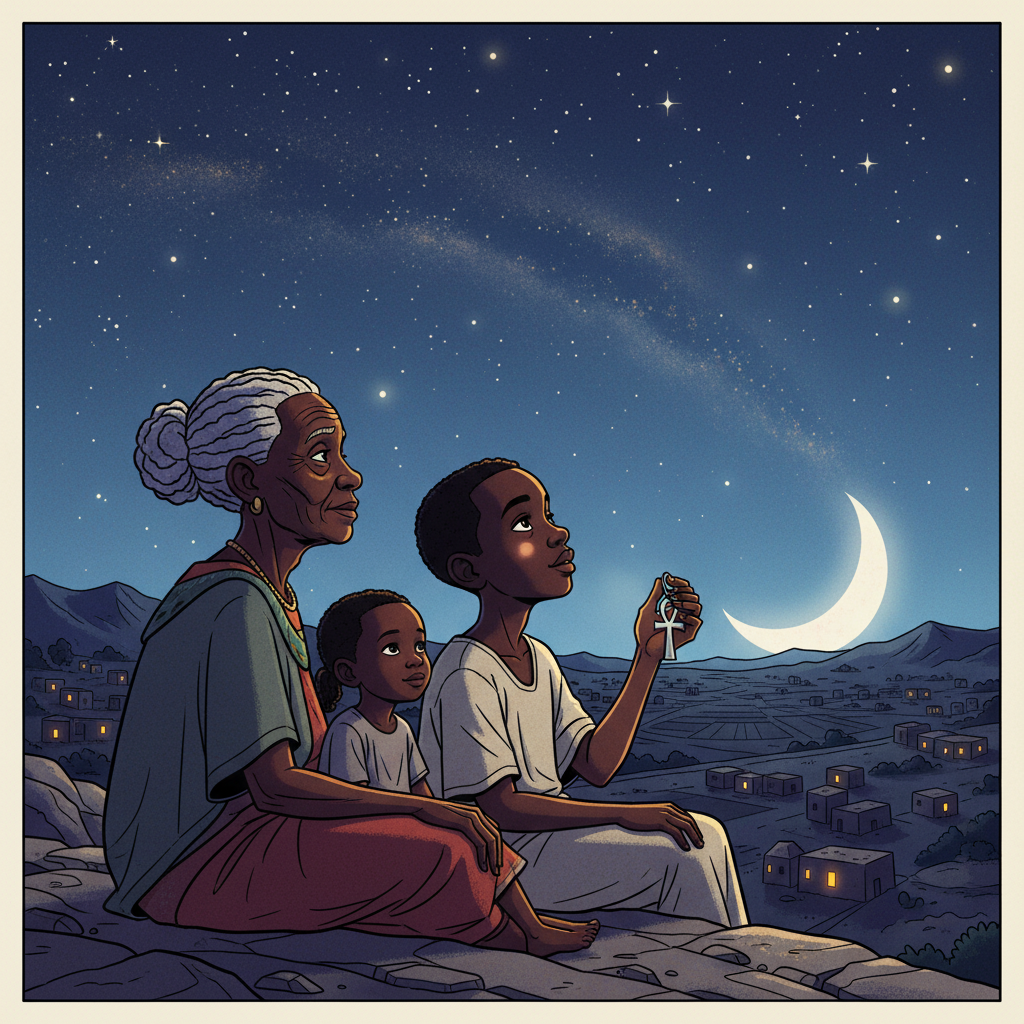
And on a ridge far to the south, Nadav the shepherd boy sat with his grandmother and his little sister and watched the stars come out. He did not know what the traveler would do. He did not know that one day he would be an old man in a mud-brick house, bouncing a grandchild on his knee, telling a story that began "I saw him before anyone. I saw him when he was only a thin man walking into the desert, and I saw him when he came out." He did not know any of that yet. But he knew he had seen something. He knew a ka had passed through his wadi. He knew that the silver ankh on the traveler’s chest had caught the morning sun and threw a small circle of light onto his cheek. And sometimes, he thought, that is the only kind of knowing a person gets. The rest is faith — and the patience to tell the story when the time is right.