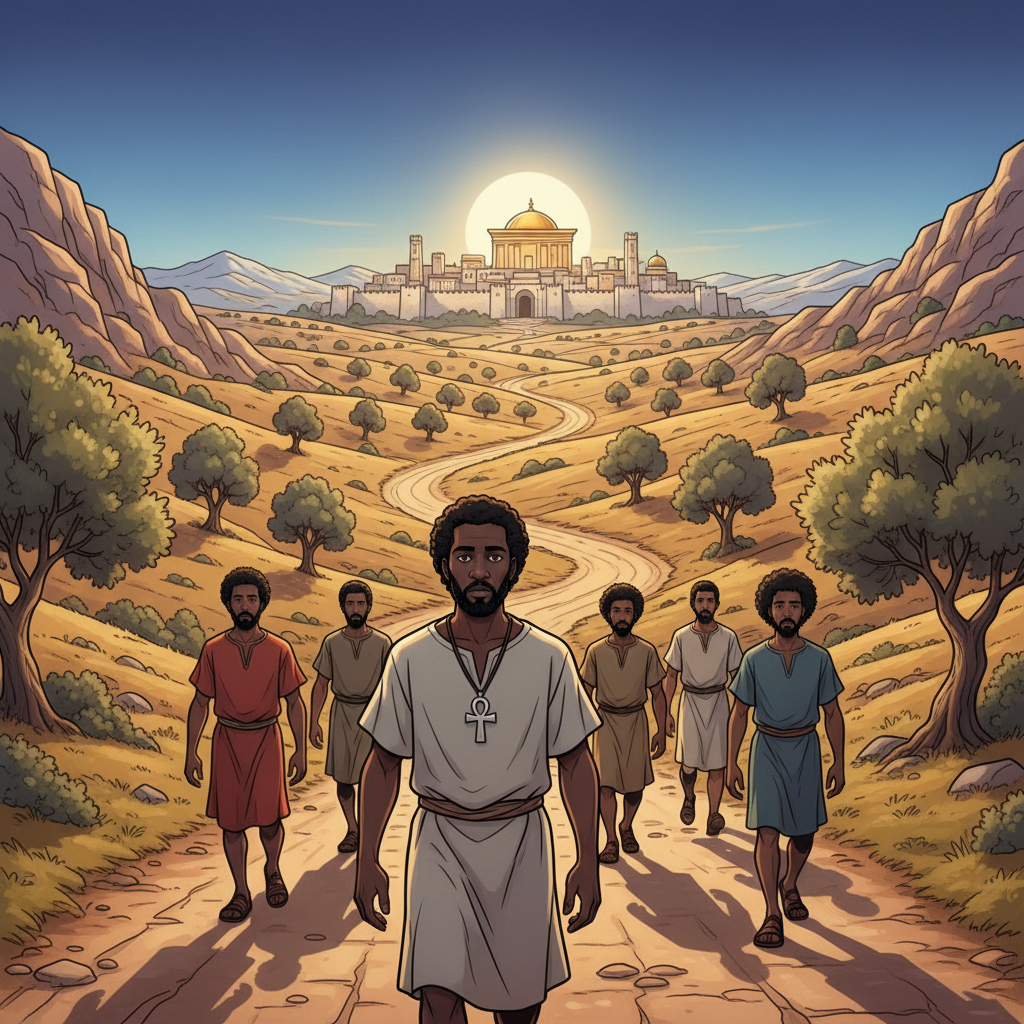
The road to Jerusalem climbed through hills that had watched pilgrims walk for a thousand years. Yeshua walked at the front, his silver ankh catching the morning sun. Behind him came Kepha, Yaakov, Yohanan, Matthayah, and Yehudah. Passover was near, and the city ahead would be crowded with worshippers from every land the African continuum touched. "Teacher," Yohanan asked softly, "why are you quiet today?" Yeshua did not answer at first. His eyes were fixed on the white walls of the temple rising in the distance. The great building had been raised by Herod the king, who served Rome more than he served Yah. Inside those walls, something sacred had been twisted. Yeshua could feel it the way a healer feels fever in a child. "Today," he finally said, "we go to Maat's house. And I do not think Maat is at home."
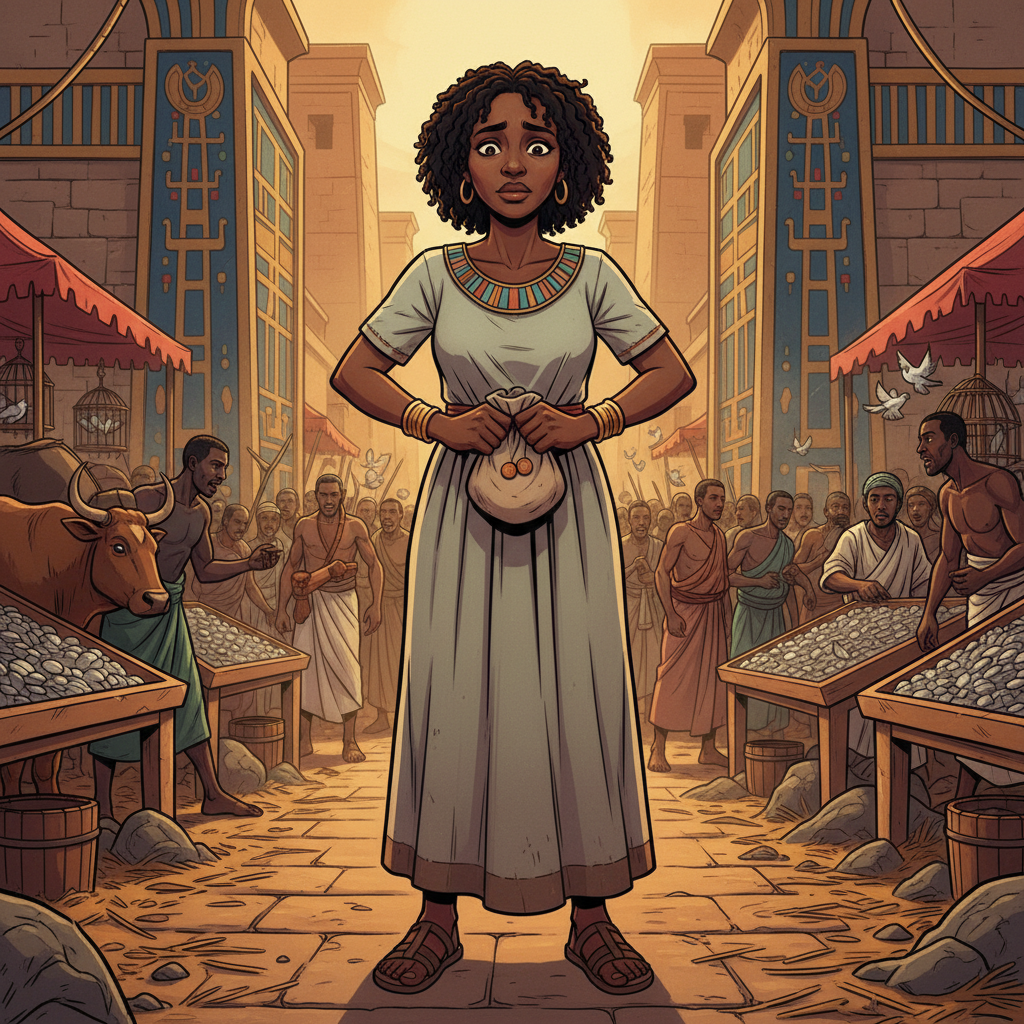
Miryam bat-Yose had walked three days from Galilee. Her sandals were worn thin and her feet burned. In a cloth tied at her waist she carried two small copper coins — all she owned in the world. They were for the Passover offering. A widow's gift to Yah. She had heard stories of the temple all her life. Her mother spoke of it as a place of hetep, of peace, where the poor and the rich stood equal before the divine. Miryam climbed the final hill and saw the great gates. Her heart lifted. Then she stepped inside the outer court, and her heart sank like a stone in a well. She had walked into a marketplace. Cattle lowed in pens. Doves beat their wings against wooden cages. Men shouted prices. Silver coins rang on stone tables. The air smelled of dung and greed, not of incense and prayer.
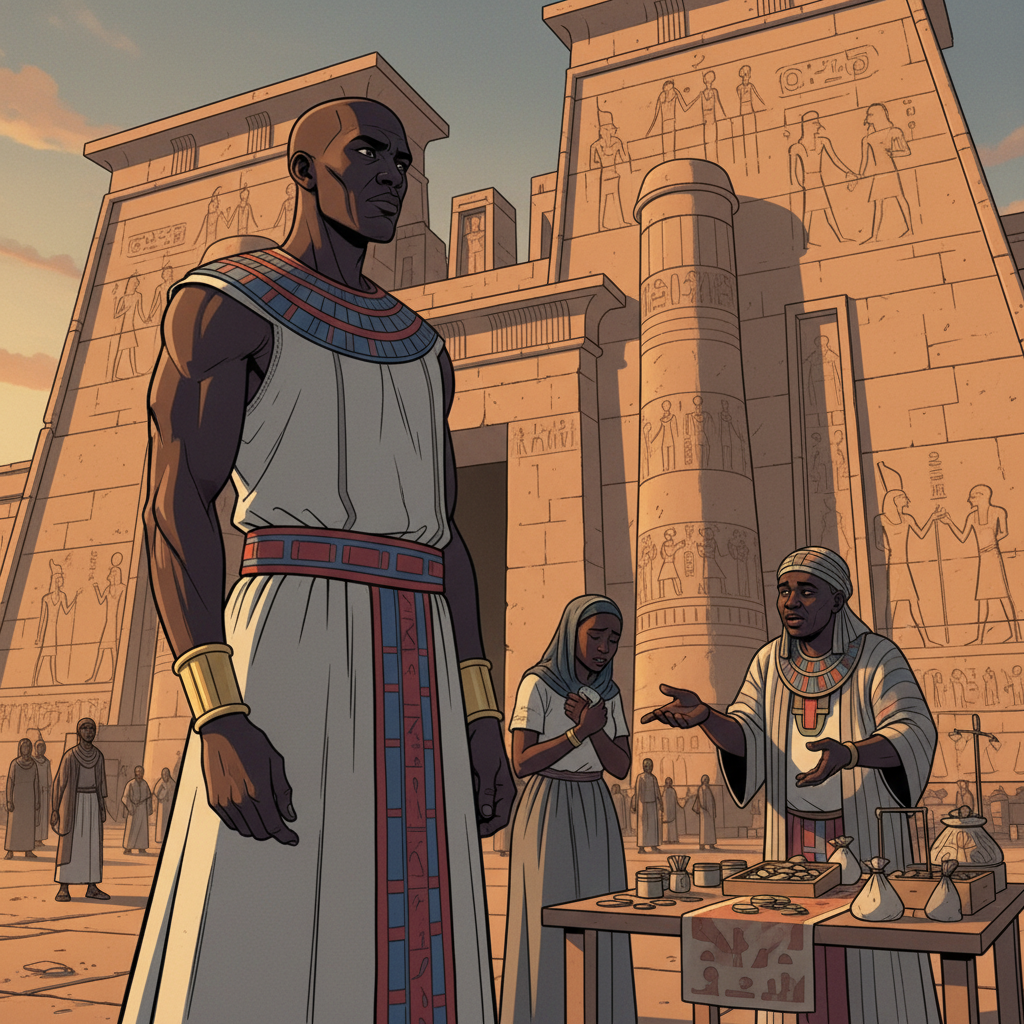
A money-changer waved Miryam forward. "Roman coin is not permitted, woman. Only temple shekels are holy enough for Yah." He smiled, but his eyes were cold. "I will exchange your coppers for you. A small fee, of course." He took her two coins, weighed them, and slid back a single tiny piece of temple silver. "That is not fair," Miryam whispered. "Those are all I have." "Then you should have brought more," the man said, already turning to the next pilgrim. Behind her, a tall Kushite pilgrim from Meroe watched with narrowed eyes. He had crossed deserts to reach this place. He had traveled the same ancient road his ancestors walked when Kush and Kemet were sister-kingdoms under one Maat. He saw the widow's shoulders shake. He saw her clutch the small coin. "This is not the house I came to find," he said quietly. "This is Isfet wearing a holy robe."
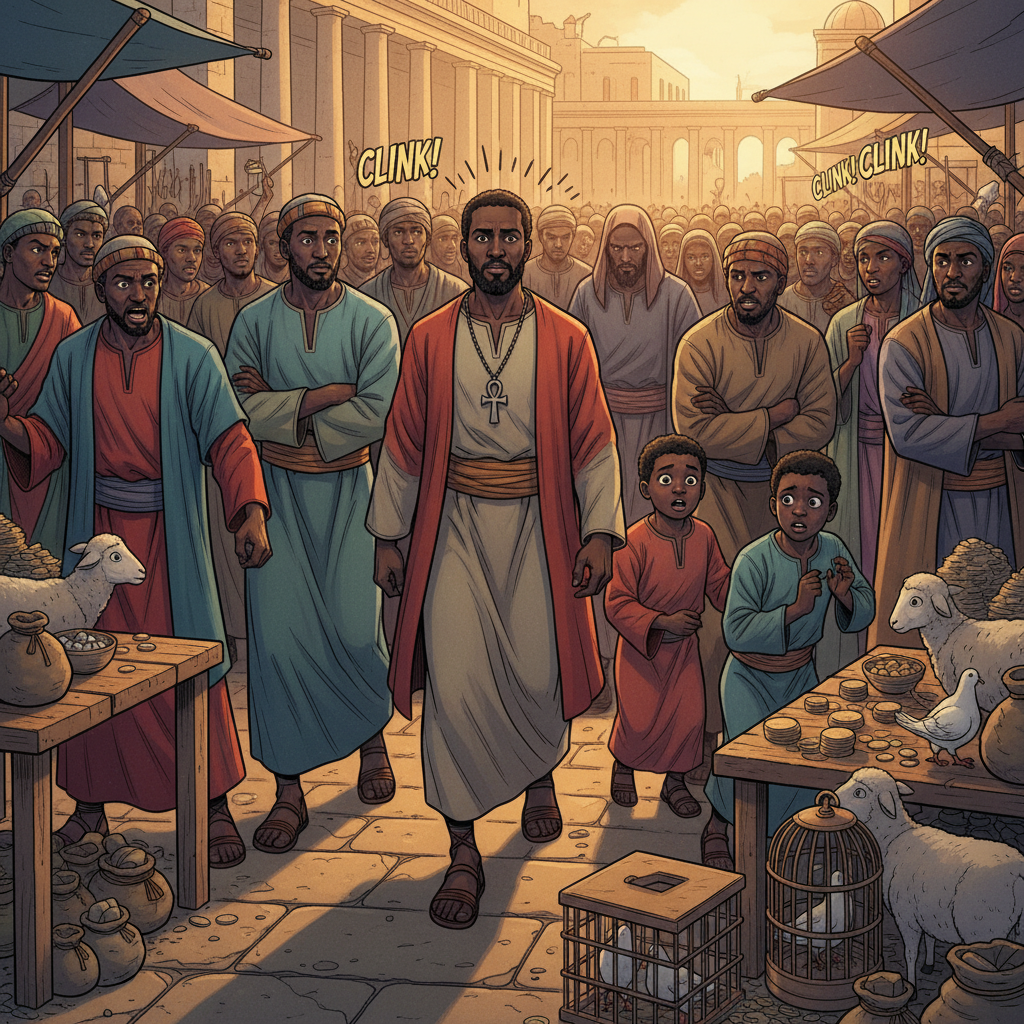
Yeshua entered through the southern gate. His disciples followed, pressed close by the crowd. The noise hit them first — shouting, bleating, the crack of coins. Then the smell. Then the sight of it all. Matthayah stopped cold. Before he followed Yeshua, he had been a tax-collector. He knew the look of rigged scales. He knew the smile of a man cheating a widow. His face went gray. "Teacher," he said, "these prices are five times what a dove costs in Galilee. Ten times. These people are being robbed in the name of Yah." Kepha's fists were already clenching. Yaakov's jaw was tight. Young Yohanan looked frightened. Yehudah stood apart, watching, saying nothing, his eyes moving from the tables to Yeshua's face and back again. Yeshua did not speak. He walked slowly through the chaos, seeing every table, every cage, every weeping pilgrim.
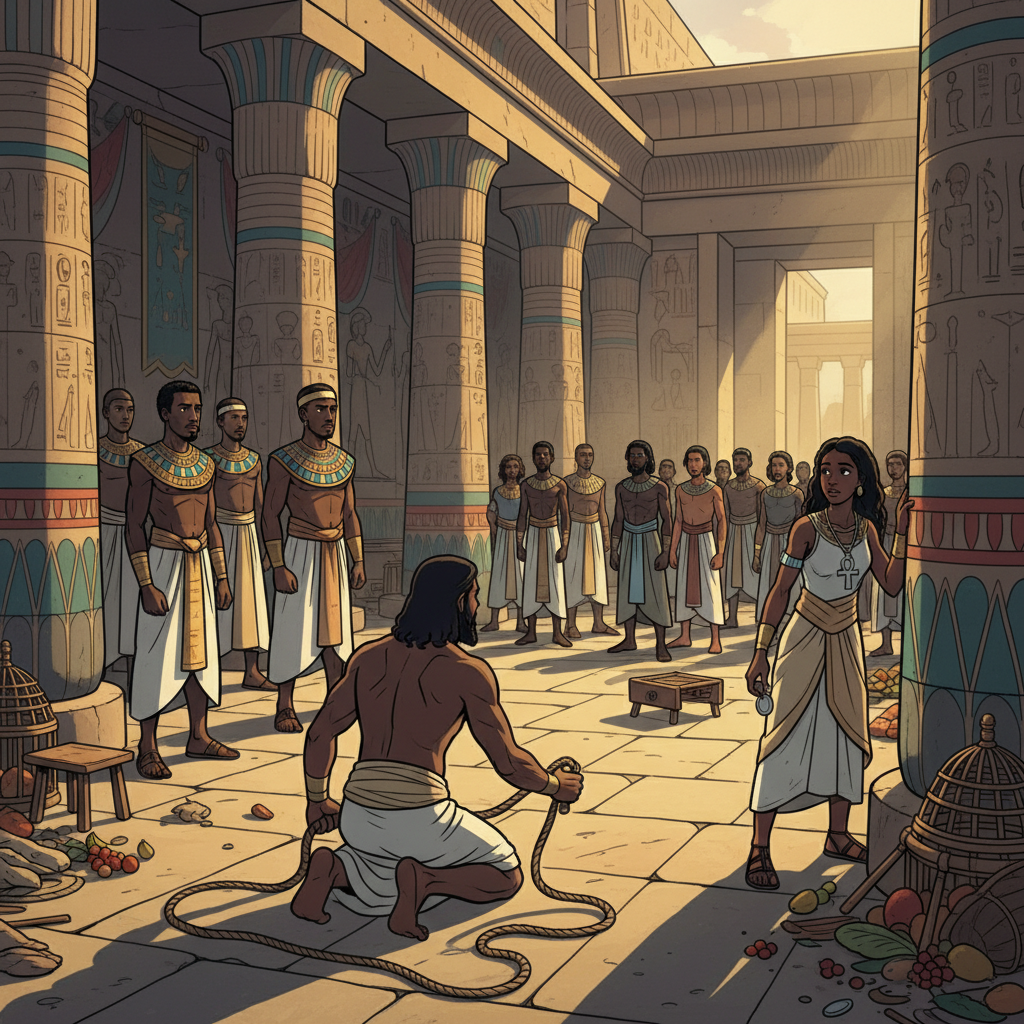
He reached the center of the court. From high up in the shaded colonnades, the priests of Kayafa watched. They wore white linen and gold. They had made their peace with Rome long ago. The temple had become a business, and business was good. Yeshua bent down. Near a pillar lay a pile of discarded ropes — cords used to tie the cattle. He gathered them in his strong carpenter's hands. His fingers moved quickly, plaiting the cords together, knot by knot, the way a fisherman makes a net. The disciples watched in silence. Miryam, still holding her single small coin, saw him. She did not know his name. But she saw his eyes, and she saw the ankh of silver around his neck, and something inside her woke up. She stepped back against a wall and waited. She knew, without being told, that something was about to happen.
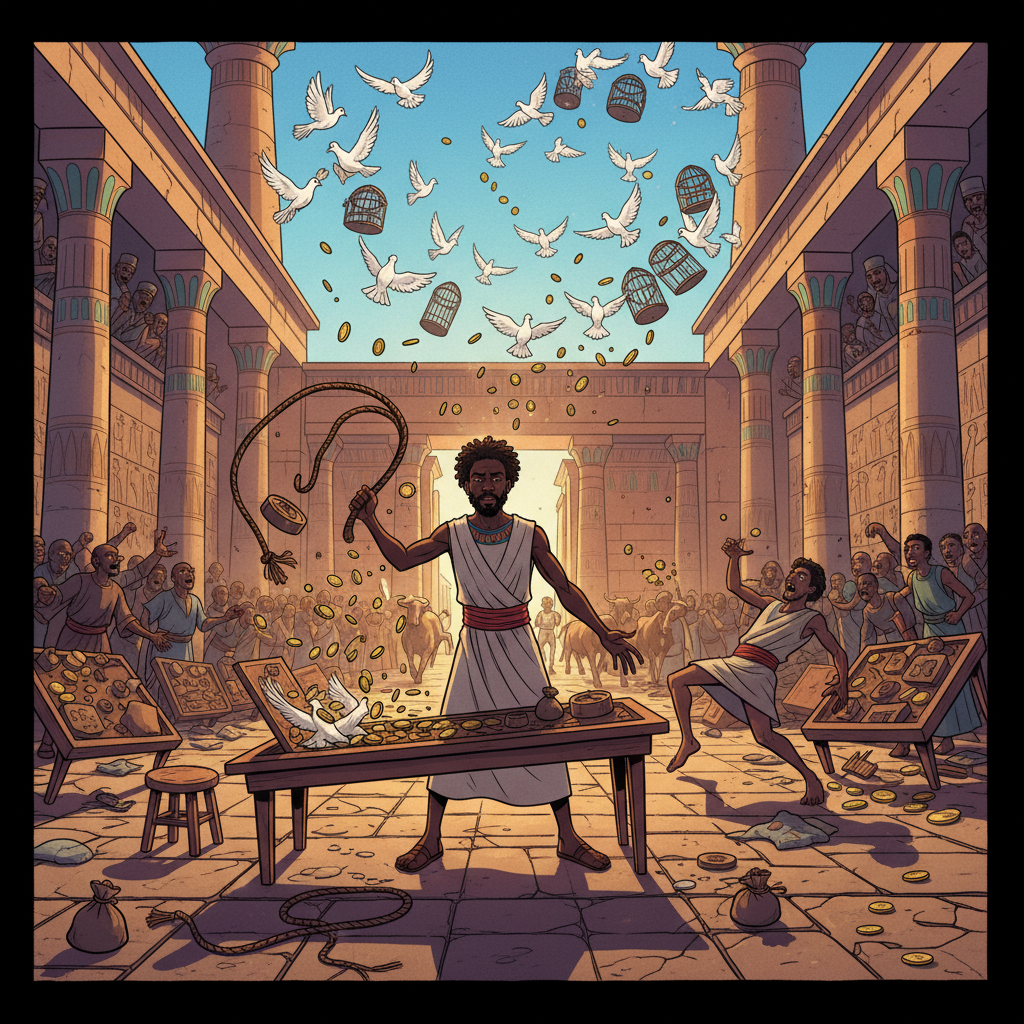
Yeshua stood. The braided cord hung in his right hand. His left hand rested open at his side. He walked to the nearest money-changer's table — a long low bench heaped with silver coins, bronze weights, and leather pouches. For one breath, everything was still. Then he gripped the edge of the table and flipped it. Coins flew into the air like startled birds. Bronze weights clattered across the stones. The money-changer leaped back, shouting. Yeshua moved to the next table. Over it went. And the next. And the next. He cracked the knotted cord once, sharply, toward the cattle pens, and the animals bolted through the open gate into the street. He unlatched the dove cages, and the white birds exploded upward in a rush of wings, free, circling the columns, climbing toward the open sky. He did not strike one person. He struck only Isfet.
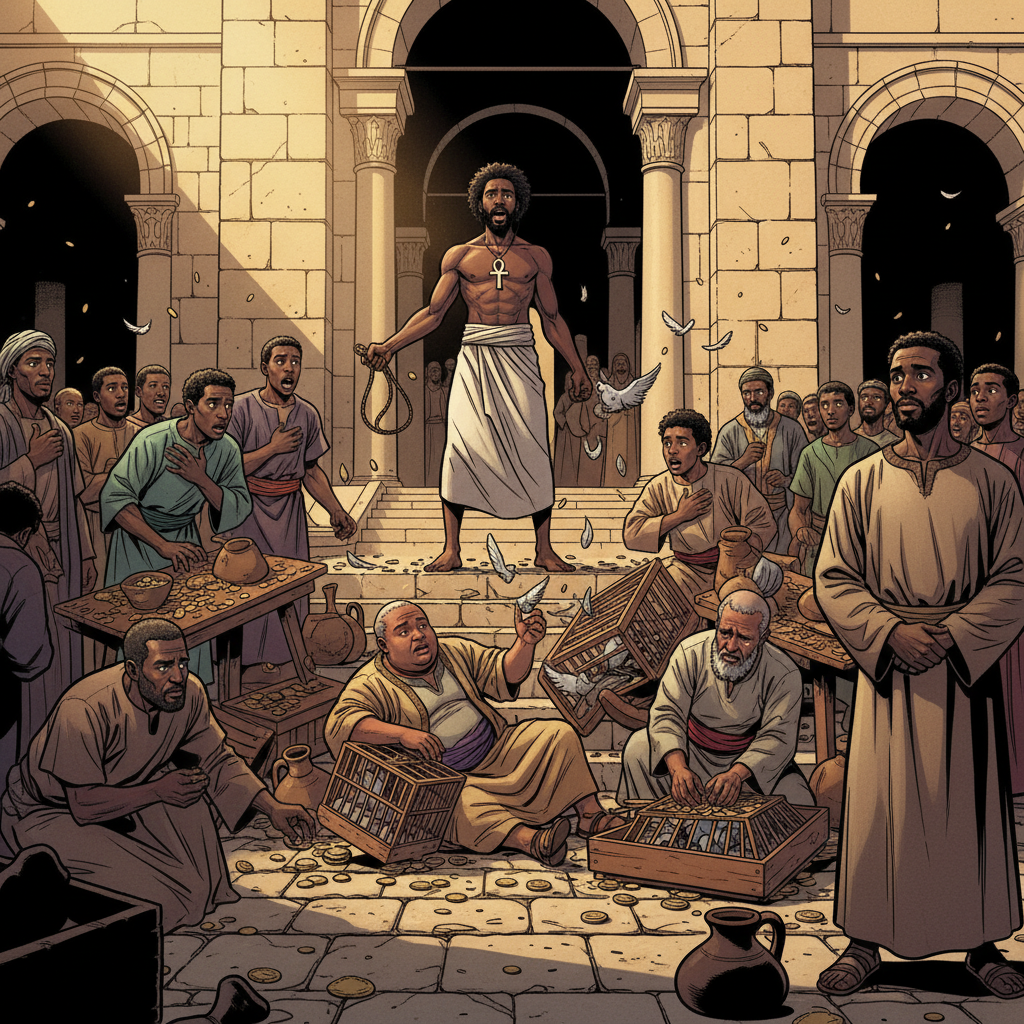
"Out!" Yeshua's voice rang across the court, bigger than the noise of the falling coins. "Take your tables and go! You have made Maat's house into a den of thieves!" The sellers scrambled to grab what silver they could. The money-changers cursed and gathered pouches from the floor. A fat merchant stumbled into a dove cage and went sprawling. Kepha stared, eyes huge. He had never seen the Teacher like this. Yaakov felt his own heart beating like a drum. Yohanan was half-afraid and half-shining with pride. Matthayah — the old tax-collector — was weeping quietly. Every coin that rolled past his feet was a coin that should have gone back to a widow. Yehudah watched from the edge of the crowd. His face showed nothing. But his hands, hidden in his sleeves, were trembling. This was not the quiet teacher he had followed. This was something else.
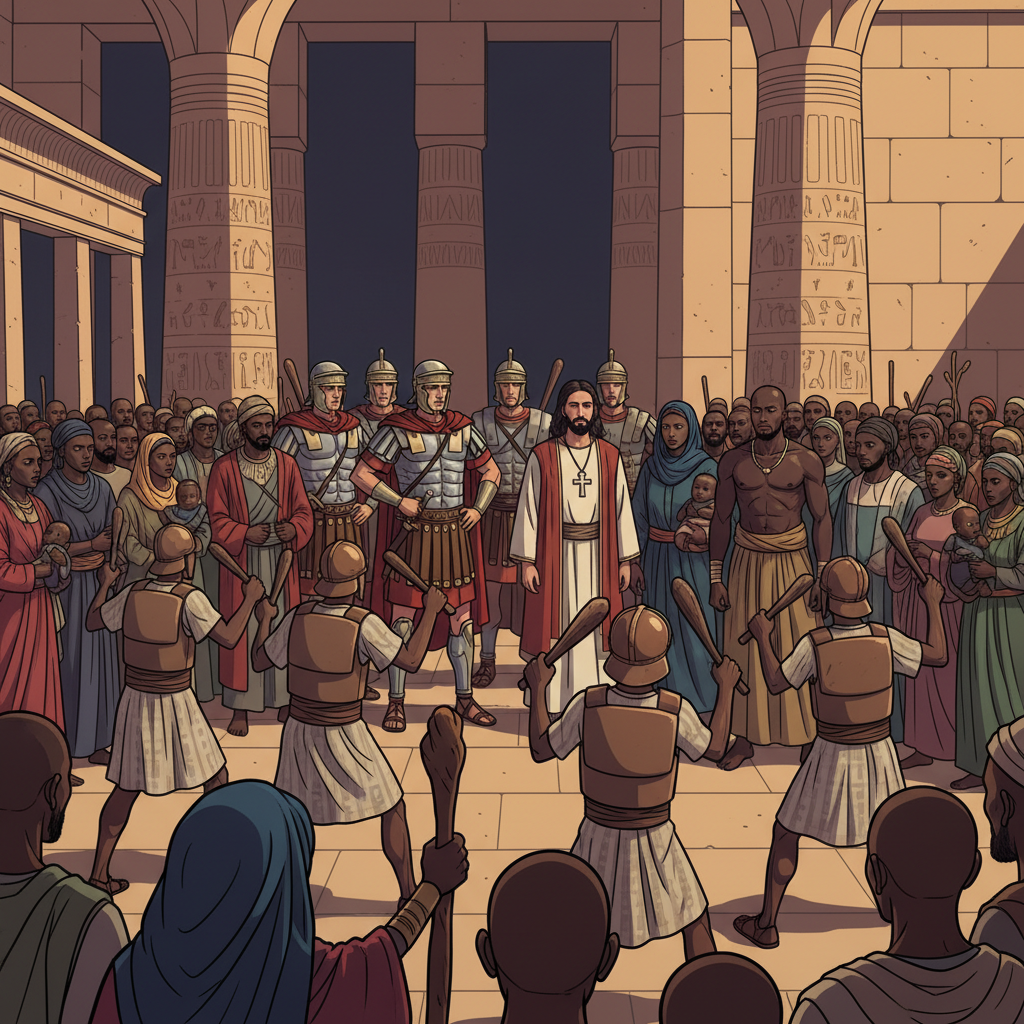
A squad of temple guards pushed through the crowd, short clubs raised. Behind them came a Roman centurion from the fortress nearby, his helmet bright, six legionaries at his back. Their hands rested on their sword hilts. Rome did not like disturbances during Passover. Rome did not like anything it could not control. But then a strange thing happened. The poor pilgrims — the ones who had been cheated, the ones who had walked for days, the ones whose last coins had just been stolen by holy robbers — they did not scatter. They moved closer to Yeshua. They formed a ring around him. Men set down their staffs. Women lifted their children to their hips and stood firm. Miryam bat-Yose pushed forward from the wall. The tall Kushite from Meroe stepped beside her. Within moments, hundreds of bodies stood between Yeshua and the guards.
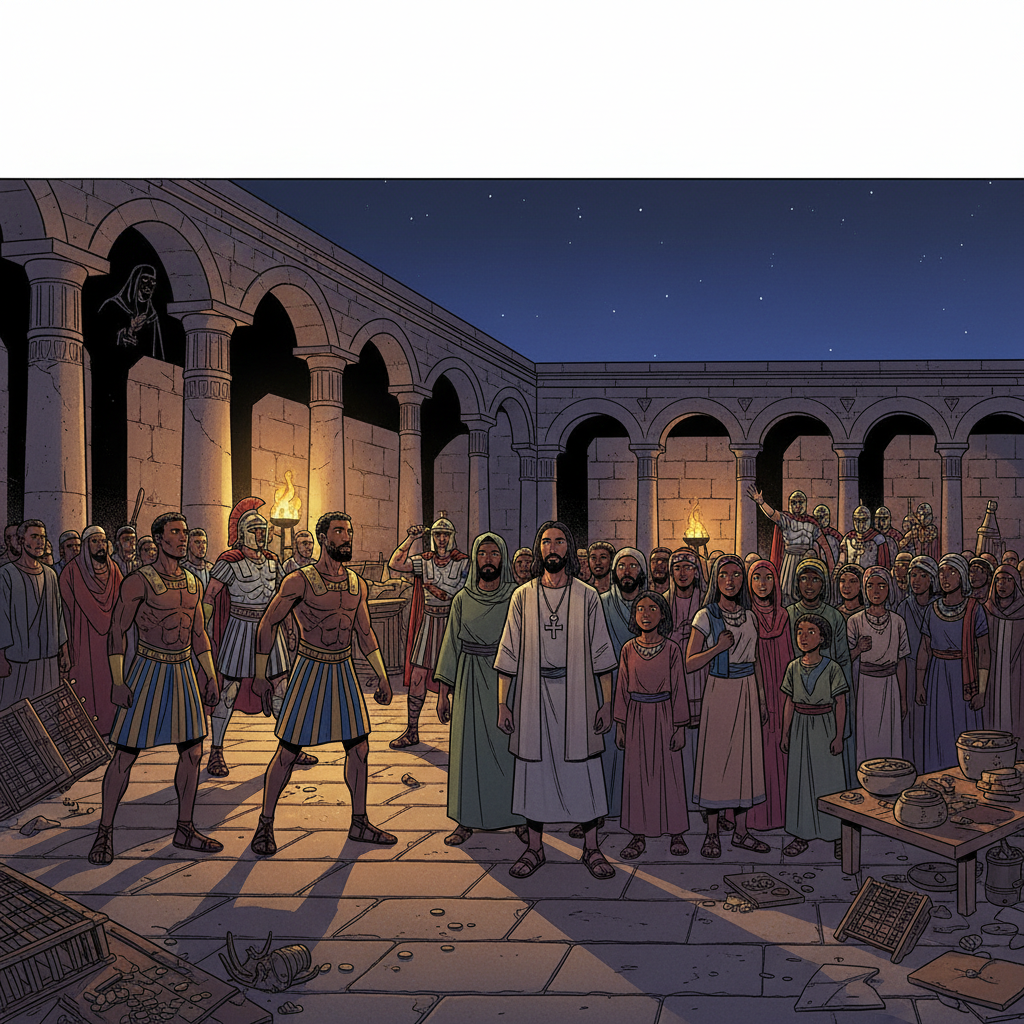
The centurion raised his hand to halt his men. He was a soldier, not a fool. He could count. Six legionaries against five hundred angry pilgrims at Passover, with tens of thousands more in the city, would end one way — with fire in the streets. His orders were to keep peace, not make war. The temple guards looked up at the colonnades for instruction. Kayafa, the high priest, stared down at Yeshua. Their eyes met across the ruined court. Kayafa's mouth was a thin hard line. He gave the smallest shake of his head. Not now. Not here. Not with the crowd this hot. The guards lowered their clubs and stepped back. The Romans withdrew to the arches. For this hour, in this place, the teacher from Galilee was untouchable. The poor had become his shield, and the shield was made of all the peoples Rome had failed.
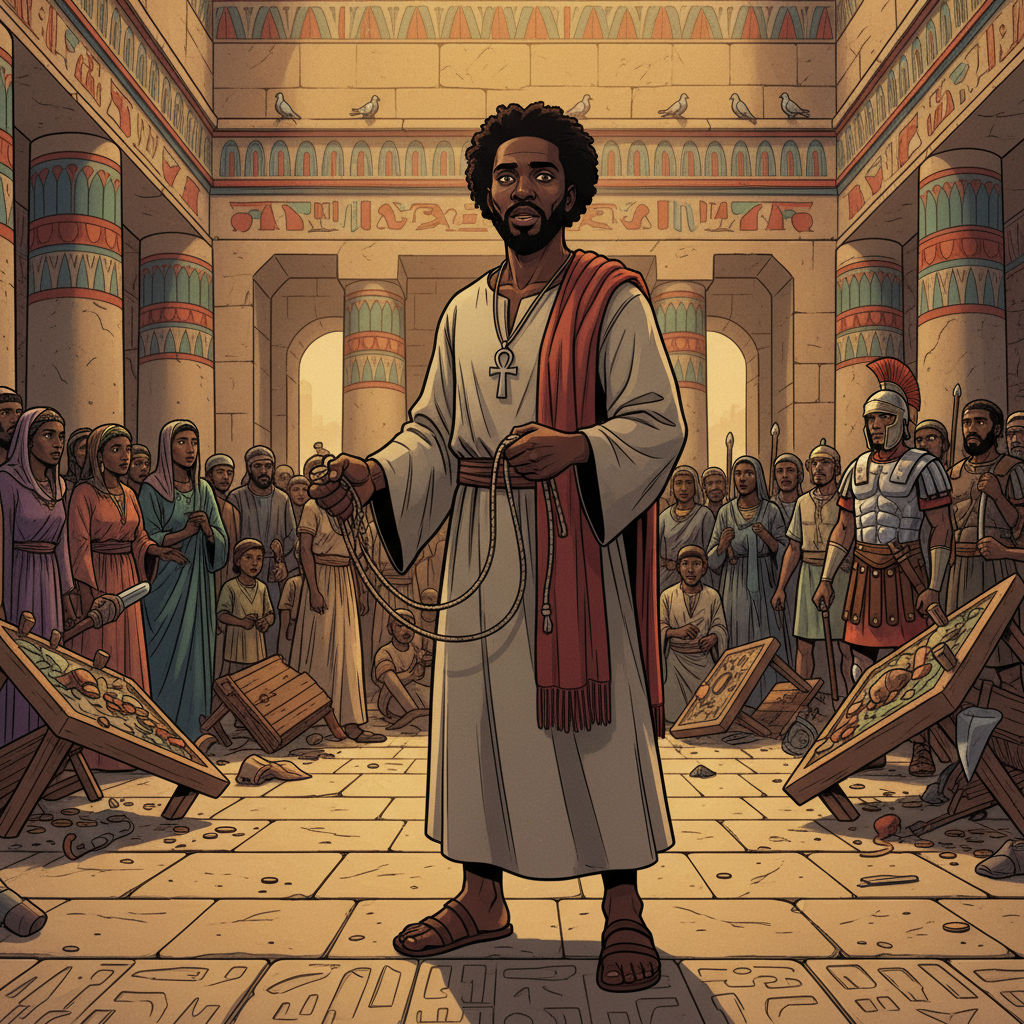
Yeshua turned in a slow circle, the knotted cord still in his hand, and looked at every face. His breathing was steady now. The fire in his eyes had not gone out, but it had become a steady light, the way the sun becomes steady after it rises. "Hear me," he said, and the court went quiet. Even the doves seemed to hush in the rafters. "This place was built to be a house of prayer for all nations. For the Galilean. For the Kushite. For the poor widow with two coins. For the child who has never seen a city. For every ka that ever turned toward the divine." He pointed at the overturned tables. "But they turned it into a counting-house. They turned reciprocity into robbery. They turned sema into silver. I tell you, Maat will not live where the poor are eaten for profit."
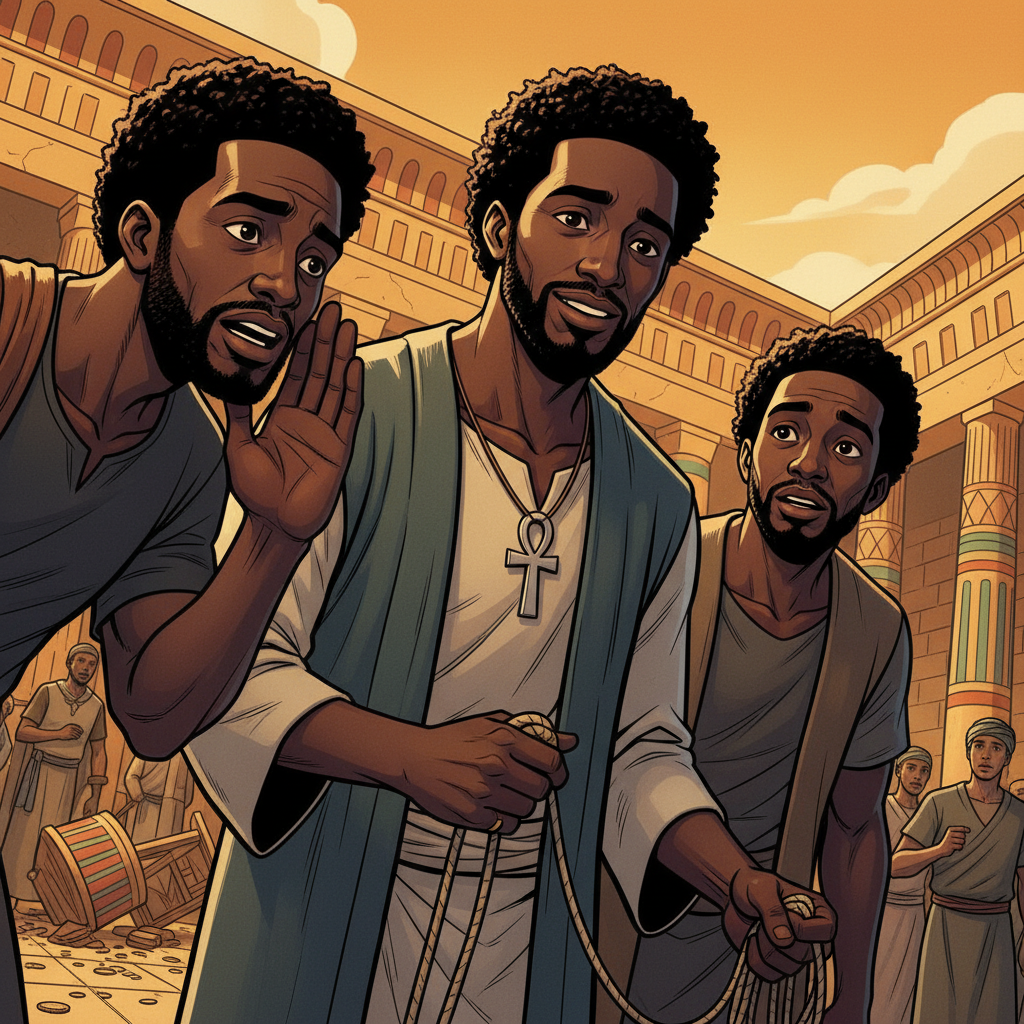
"Teacher," Kepha said, stepping to his side, voice low, "the priests will not forget this." "I know," Yeshua answered. "They will come for you." "I know that too." Yaakov moved close on the other side. "Then why?" Yeshua looked at him with great gentleness. "Because a widow came three days on broken sandals to offer her only coins, and they were taken from her by men in white linen. Because the Kushite crossed a desert to pray, and he was made to feel like a stranger in his own ancestors' temple. Because the pharaohs of Kemet, in the oldest days, knew that the priest-king must throw down Isfet when it grows inside the sacred. That is the older law. That is the Maat beneath all laws." He smiled faintly. "Today I was a pharaoh of no kingdom. Today I only cleaned a room."
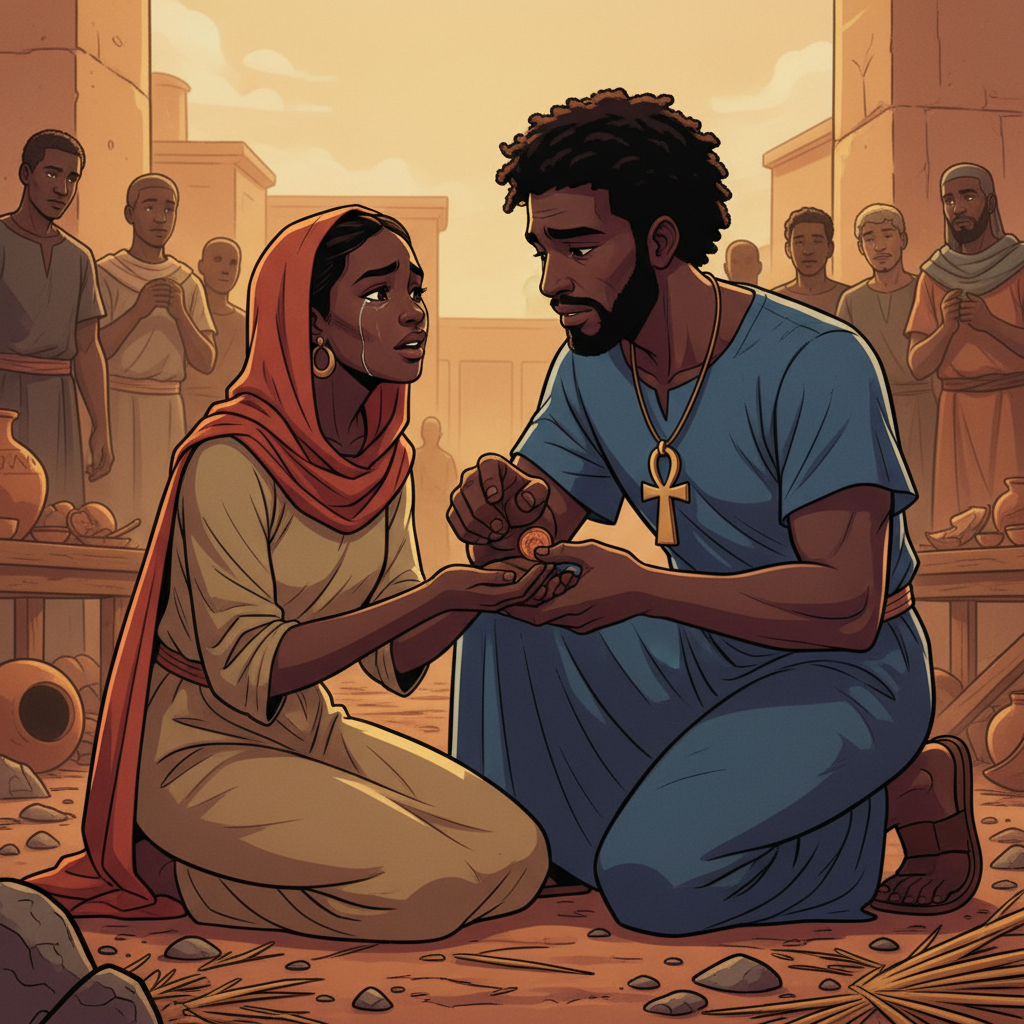
Miryam bat-Yose came forward slowly. In her open palm lay her one small temple coin. Her eyes were wet, but her voice was steady. "Master," she said, "they took my copper. This is all they gave back. Is it still a worthy offering?" Yeshua knelt in the dust so his eyes were level with hers. He did not take the coin. He closed her fingers gently around it. "Daughter of Galilee," he said, "your two copper coins weighed more on the scales of Yah than all the silver on those tables. What they did to you was Isfet. What you carried in your heart when you walked here was Maat. Keep your coin. Give it to the next widow you meet on the road home. That is sema. That is reciprocity. That is how Maat's house gets rebuilt — not in stone, but in kindness." Miryam wept, and nodded, and could not speak.
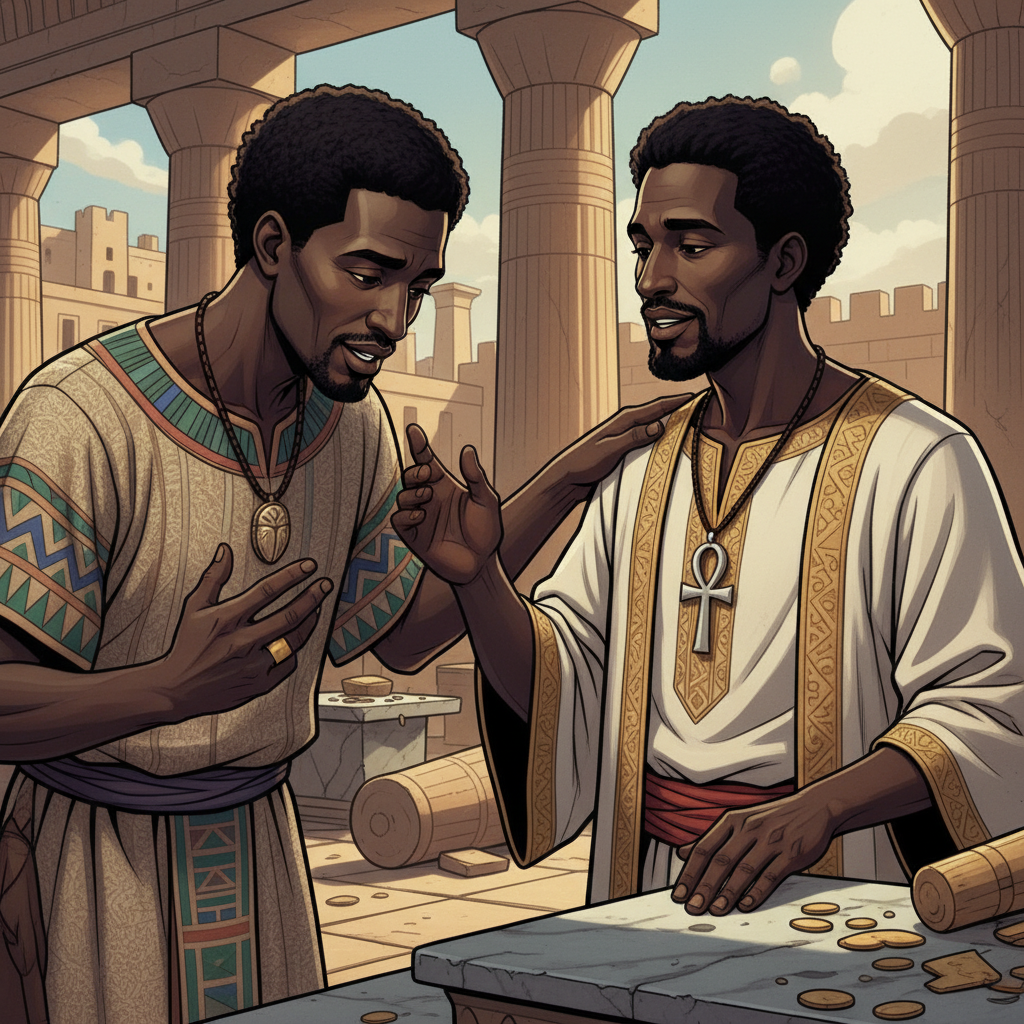
The tall Kushite from Meroe stepped near. He bowed his head slightly, the old greeting of one Per Ankh traveler to another. He spoke in a deep voice that carried the accents of the upper Nile. "Teacher of Galilee," he said, "I have walked from Meroe. My grandfather was a priest of Amun. In my land we still remember when Kush and Kemet shared one Maat. I came here hoping to find that old Maat in this new temple. Instead I found merchants. But today I have found what I came for. It was not in the building. It was in you." Yeshua placed a hand on the pilgrim's shoulder. "Brother of Meroe, carry it home. The flame does not live in walls. It lives in ka. Go and tell your people that Maat still walks, even in strange cities, even among broken courts."
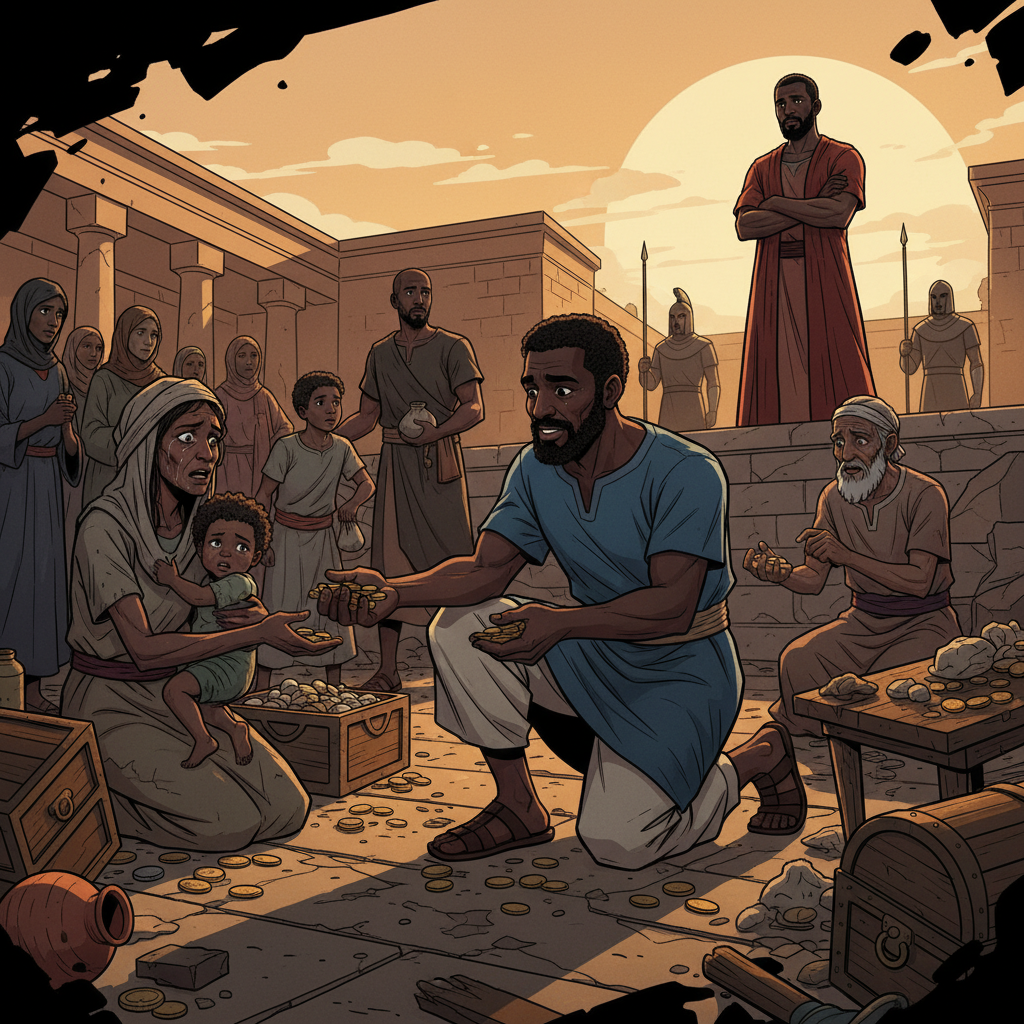
Matthayah knelt and began picking up coins from the floor. He was not stealing them. He was gathering them into small piles and pressing them into the hands of the poorest pilgrims — the thin women, the dusty children, the old men with shaking hands. "This was taken from you," he told each one. "Take it back. It was never theirs." Some wept. Some could not believe him. But they took. Kepha and Yaakov and Yohanan helped. They walked through the ruined court returning silver to the robbed. Even the temple guards, watching from their new distance, did not stop them. The shame of the moment held them still. Only Yehudah did not move. He stood where he had been standing, arms folded inside his sleeves. His face was like water over a deep pool. Something was working in him that none of the others could yet see.
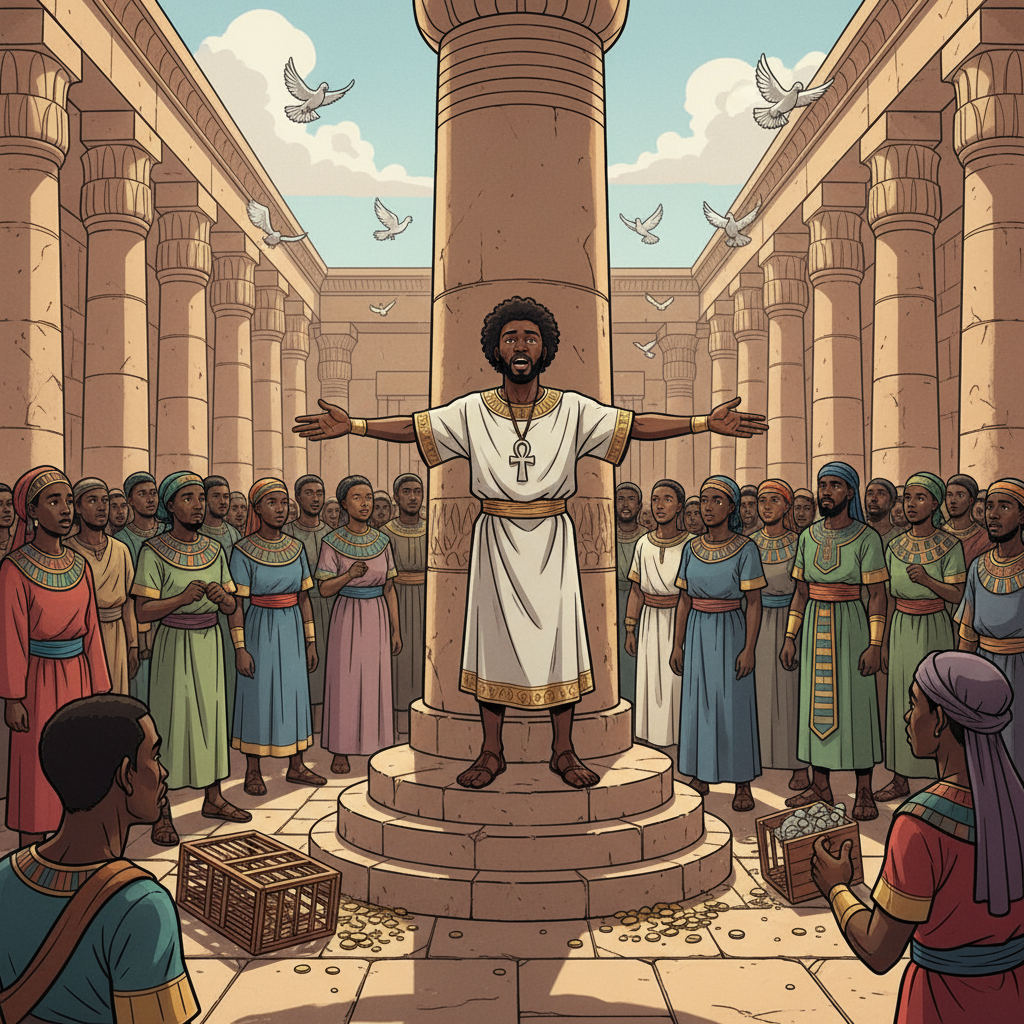
Yeshua climbed three steps onto the base of a pillar so the whole court could see him. The sun was high now. Doves still circled the columns. His voice came clear and strong, carrying over the scattered coins and broken cages. "My house shall be called a house of prayer for all nations, but you have made it a den of thieves. Tear down this Isfet, and in three days of truth, Maat will rise again. The temple is not these stones. The temple is every ka that keeps reciprocity alive. Wherever one person feeds a widow and takes nothing, that place is Per Ankh. Wherever sema is given without price, Maat is there. No high priest can sell what Yah has made free." The crowd stood frozen. Some were weeping. Some were nodding. Some were afraid. But every single one of them would carry his words back to their villages.
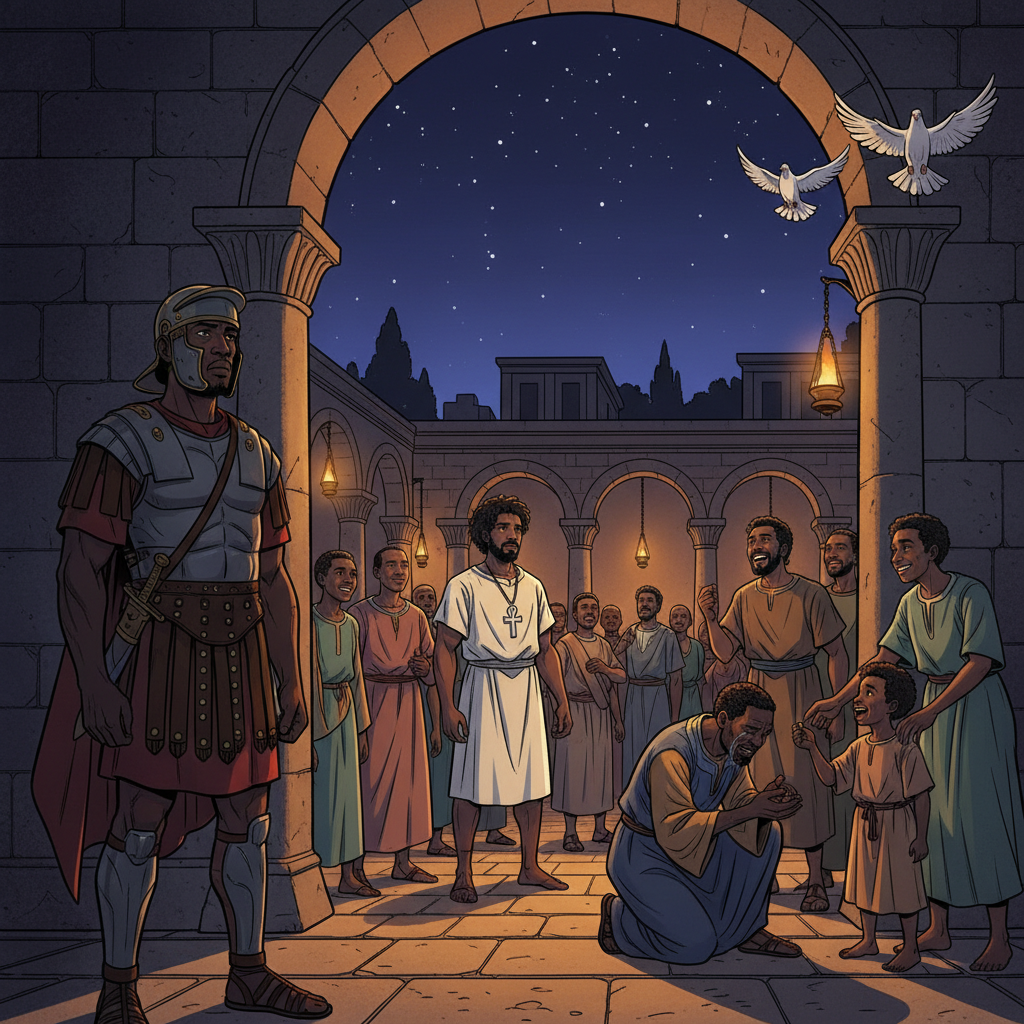
As the sun fell toward evening, Yeshua and his disciples left the temple. The crowd parted for him like water for a fishing boat. The Roman centurion watched from the shadows of the arch and did not move. Kayafa had already withdrawn into the inner chambers to begin the quiet work of men who cannot answer in daylight. Plans were being whispered. Names were being written. The night was long in Jerusalem. But in the outer court, something was being born. A Kushite pilgrim was on his knees weeping the tears of a man who had come home. A widow from Galilee was pressing her coin into the hand of a child with no sandals. A former tax-collector was laughing through his tears. Young Yohanan was watching the doves above and understanding for the first time what freedom sounded like when it had wings.
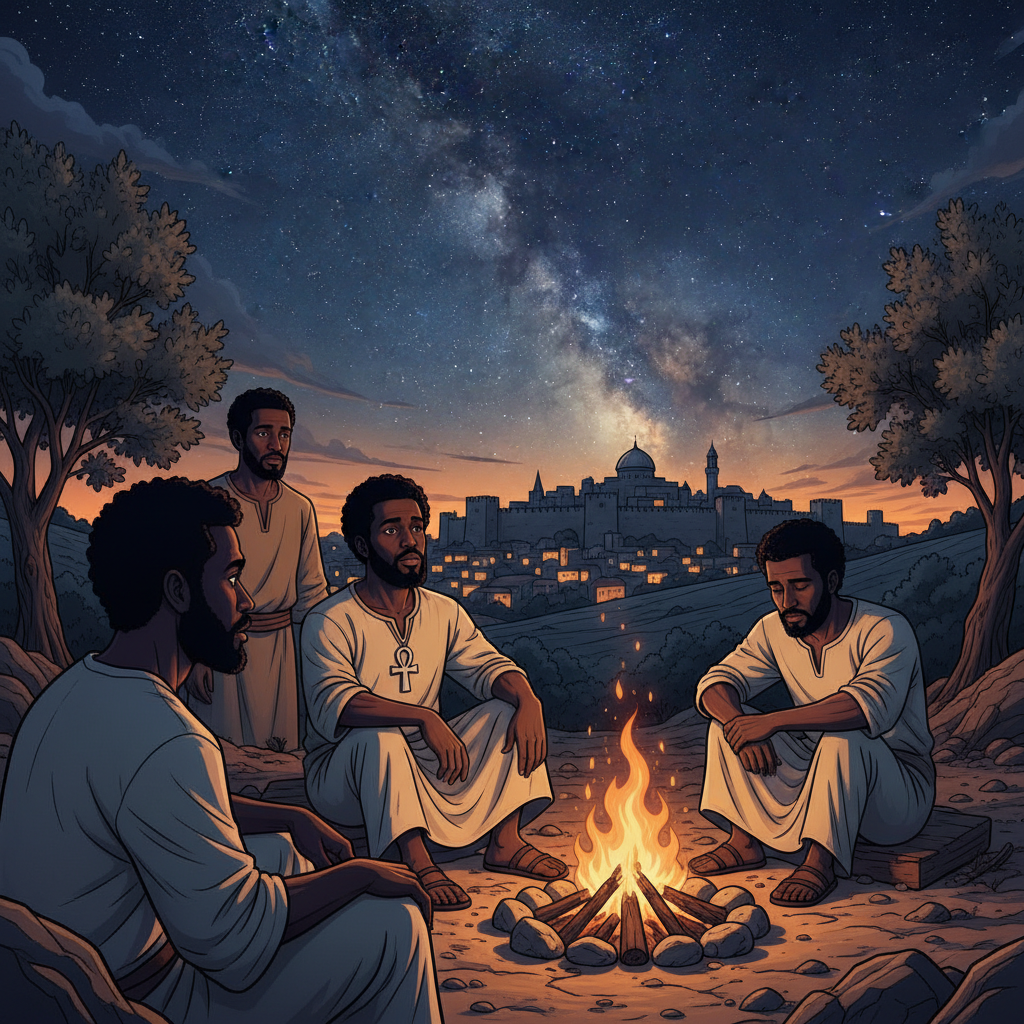
That night, camped on the Mount of Olives outside the walls, Kepha asked the question that had been burning in him. "Teacher, will they kill you for this?" Yeshua looked at the stars over Jerusalem. His silver ankh rested on his chest, rising and falling with his breath. "Perhaps," he said. "But the tables were going to be overturned one way or another. Either the priests would overturn their own corruption, or Maat would use smaller hands." He smiled in the firelight. "Today she used mine. Tomorrow she will use yours. And a thousand years from now she will still be finding hands. That is the work of the Per Ankh. That is why we walk." He slept peacefully that night. Yehudah, on the far side of the fire, did not sleep at all. And above them, Jerusalem's lamps burned late, late, late into the dark.