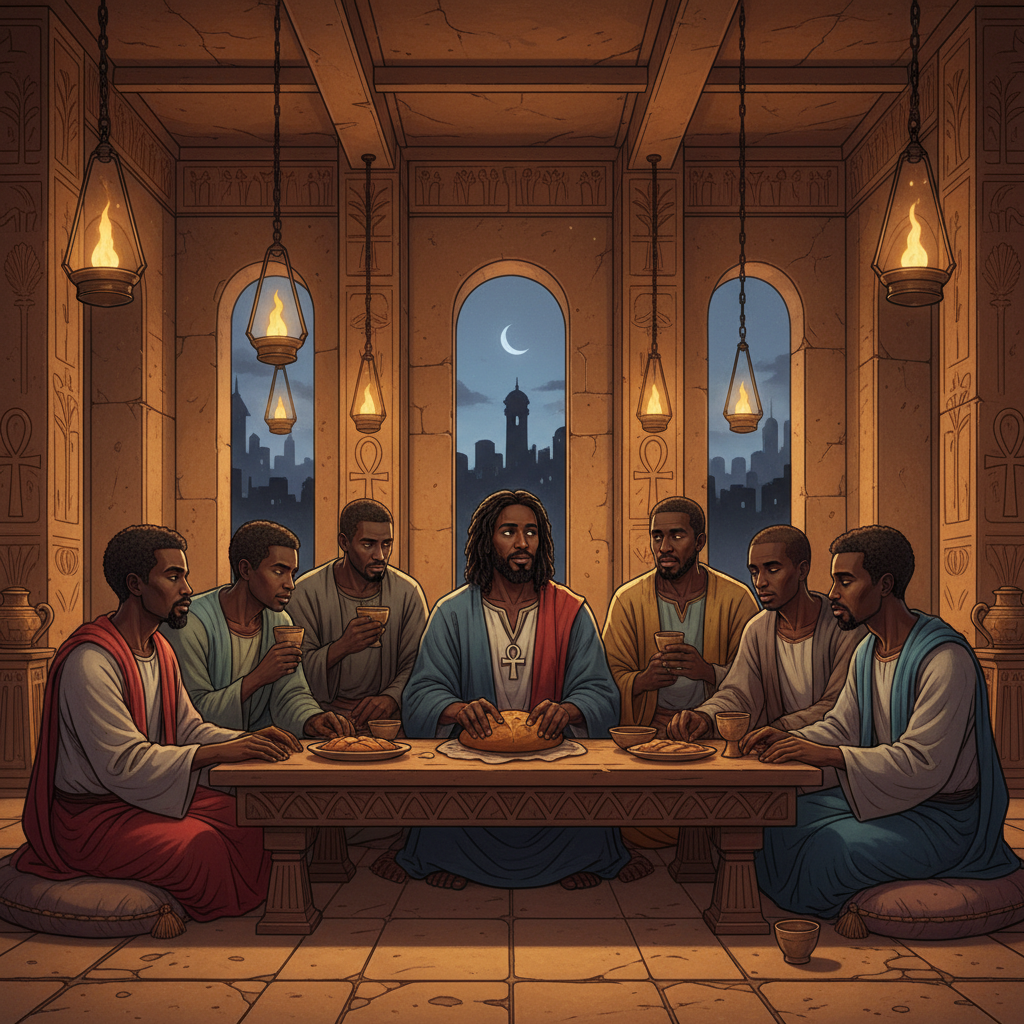
The upper room in Jerusalem was warm with oil lamps. Yeshua sat with the twelve at the low table. Bread was passed. Wine was poured. His hands moved slowly, the way a priest moves in the House of Life. He lifted the loaf. He broke it. He looked at his friends with a love so heavy it could almost be touched. "This is my body," he said. "When you eat, remember the feeding of the ka. When you drink, remember the river that carries us all home." Kepha did not understand. Yohanan leaned close. Yehudah looked at the floor. Outside, the city of Yerushalem breathed a thick, watching silence. The silver ankh under Yeshua's robe warmed against his chest, the way it had warmed when he was twelve. He knew what the night would ask of him.
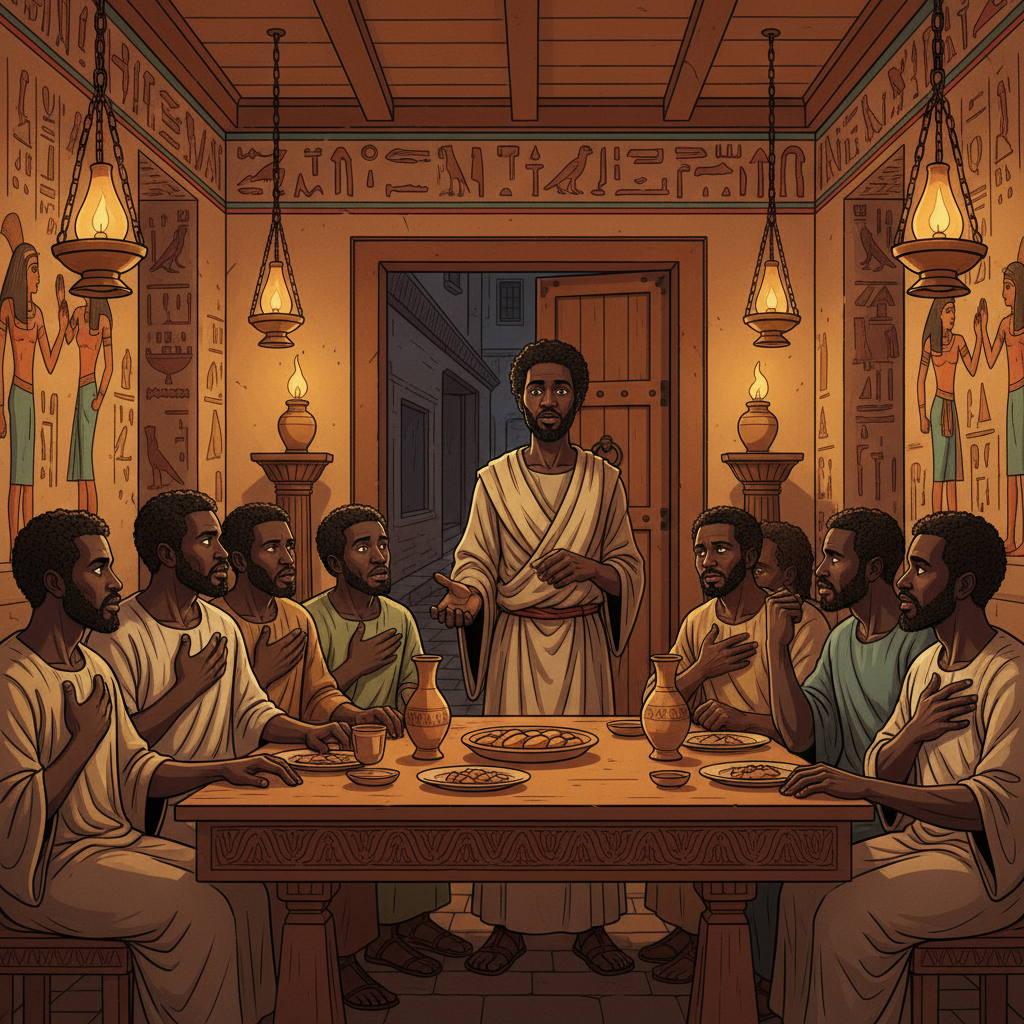
"Tonight," he said, "one of you will hand me over." The room went still. The lamps bent low. Each of the twelve looked at the others, then at themselves. "Is it I, Rabbi?" each asked, one by one. Yeshua did not name the one. He only dipped the bread and passed it. Yehudah took it. His hand trembled. He did not meet Yeshua's eyes. Then Yeshua spoke softly, the way Seba Ptahhotep had taught him to speak of hard truths. "What you must do, do quickly." Yehudah rose. He stepped into the dark street. The door closed behind him. Kepha pounded the table. "I will never leave you, Rabbi! Even if all others flee, I will stand!" Yeshua placed a hand on his shoulder. "Kepha. Brother. Before the rooster calls, you will say three times that you do not know me."
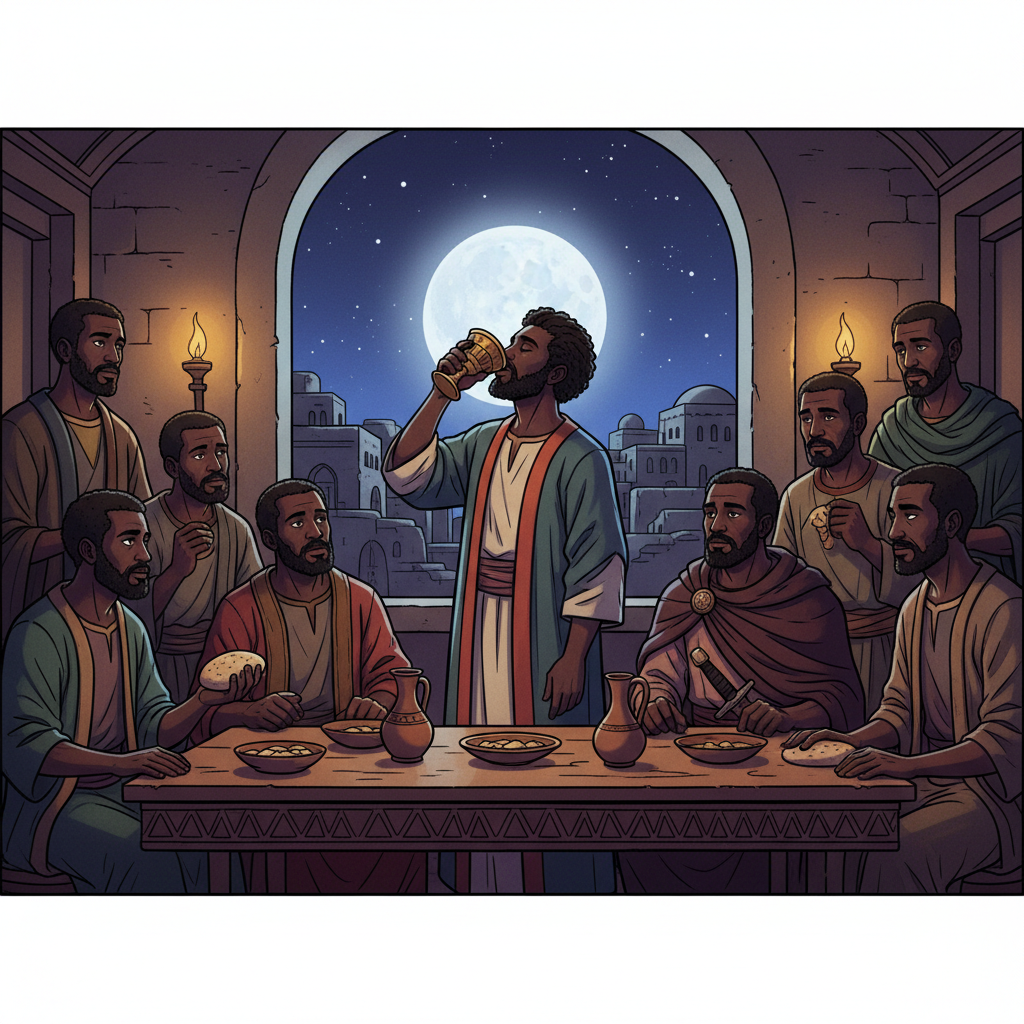
They sang an old psalm together, the kind his mother Miriam had sung when he was small in Galilee. The melody was older than the kings, older even than the temple. It was a river song. Yeshua lifted the cup one last time. "This is the cup of the covenant. A new covenant that is as old as Kemet. When two people share bread and cup in truth, the ka is fed, and Maat is poured between them." He drank. He passed the cup. Each of the eleven drank. Then he said, "Rise. Let us go to the garden." They walked through the narrow streets. The moon was full. The stones of Yerushalem were white as bone. Yohanan walked beside him. Kepha walked a pace behind, a short sword hidden in his cloak. Yeshua did not ask him to leave it. He already knew.
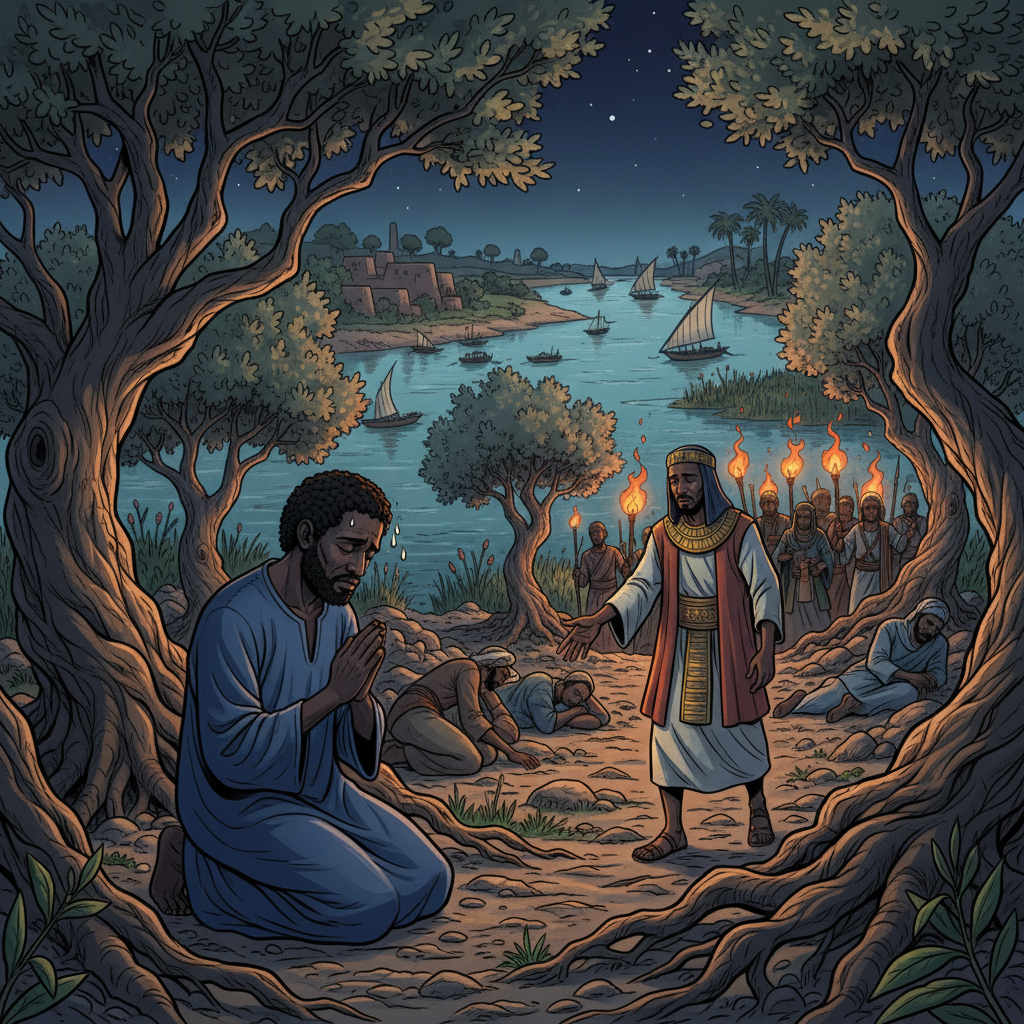
The garden was called Gethsemane. Old olive trees bent like tired old men. Yeshua knelt alone among the roots. "Father Yah," he prayed. "If this cup can pass from me, let it pass. But not my will. Your will. Let Maat be done." His sweat fell heavy as river drops. The disciples, a little way off, slept. He woke them once, twice. "Can you not watch with me one hour?" Their eyes were heavy with grief they did not yet understand. Then torches came through the olives. Soldiers. Priests. Yehudah walked in front of them. Yehudah stepped up and kissed Yeshua on the cheek. Yeshua looked at him, not with anger, but with a sorrow as wide as the Nile. "Friend," he said, "with a kiss?" Then he stood. He did not run. He faced the torches.
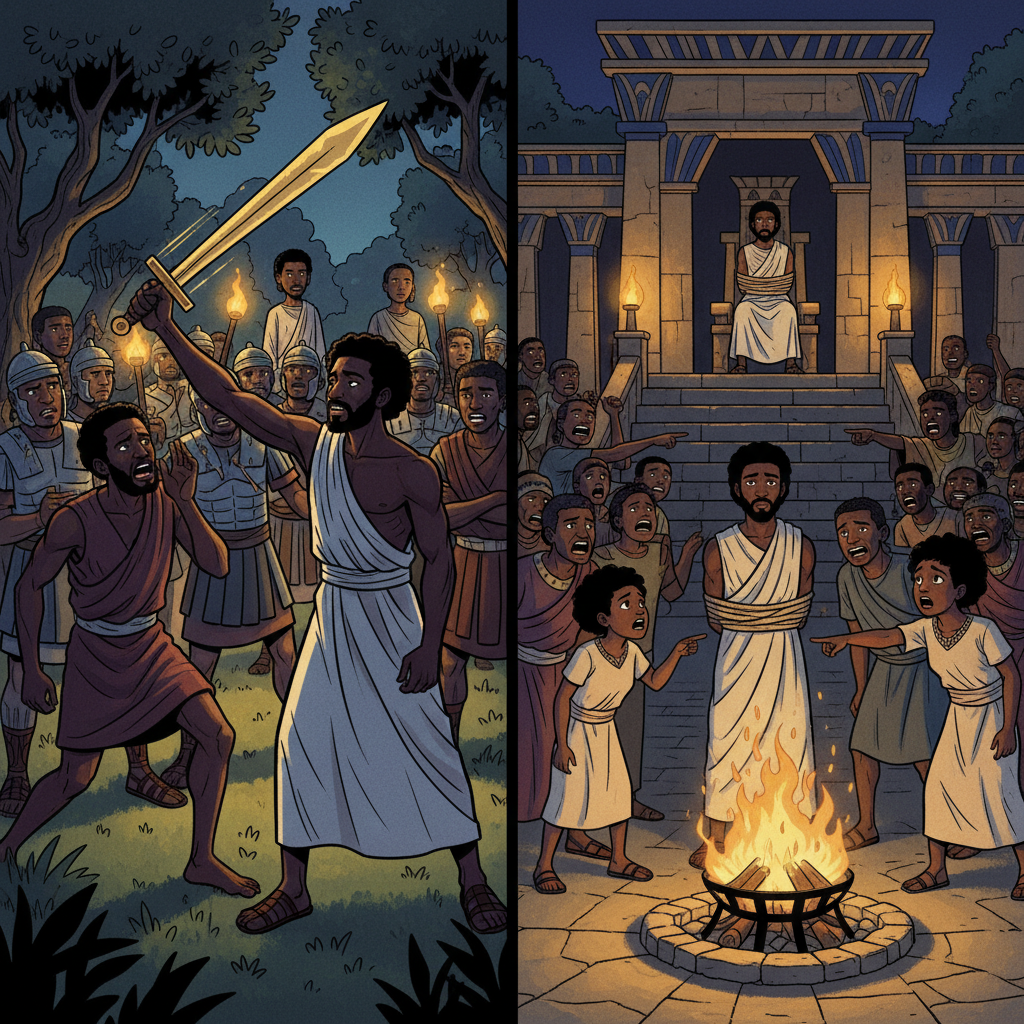
Kepha drew his sword. He swung wildly and cut the ear of a servant of the high priest. The servant cried out. "Sheathe it," Yeshua said. His voice was calm as deep water. "Those who live by the blade fall by the blade. That is not the way of Maat." He reached out. He touched the servant's ear. The bleeding stopped. The wound closed. The servant stared, trembling. Then the soldiers bound Yeshua's wrists with rope. The disciples scattered into the dark like startled birds. Only Yohanan lingered at the edge of the trees, weeping silently. They led Yeshua first to Kayafa, the high priest. Kayafa's house was full of angry voices. They spat accusations. Yeshua answered almost nothing. Isfet is loudest when truth simply stands quiet. Outside in the courtyard, Kepha warmed his hands by a fire. A servant girl pointed at him.
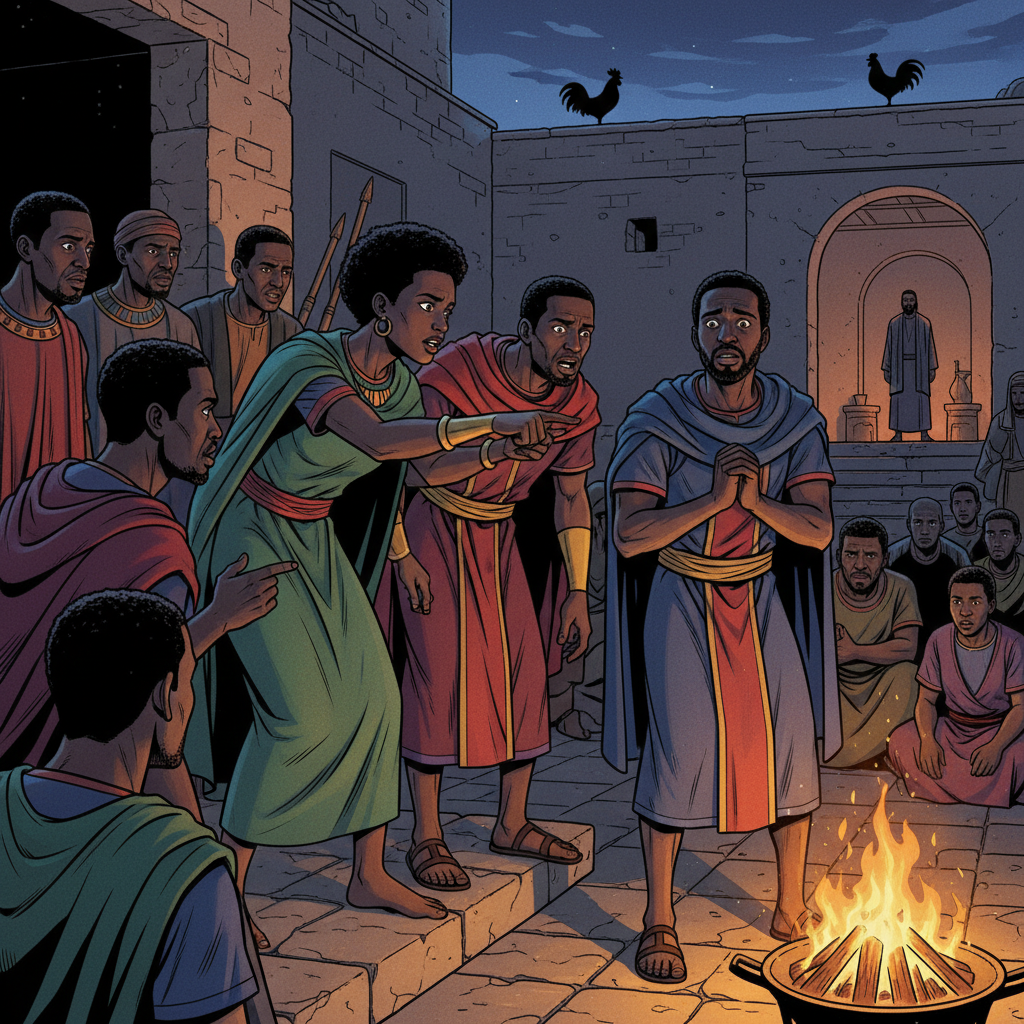
"You were with him," the girl said. "I was not," Kepha answered. His voice cracked. A second person pointed. "You are a Galilean. I hear it in your speech." "I do not know the man," Kepha said again. His hands shook over the fire. A third time, someone leaned close. "Surely you are one of his." "I swear," Kepha said, "I do not know him." And from somewhere in the pale, thin hour before dawn, a rooster crowed. Kepha's knees nearly gave out. He remembered. He remembered the upper room. He remembered Yeshua's hand on his shoulder. He stumbled out into the street and wept the way only a man who has broken his own word can weep. Inside the judgment hall, Yeshua said nothing of it. He had already forgiven Kepha before the rooster ever opened its throat.
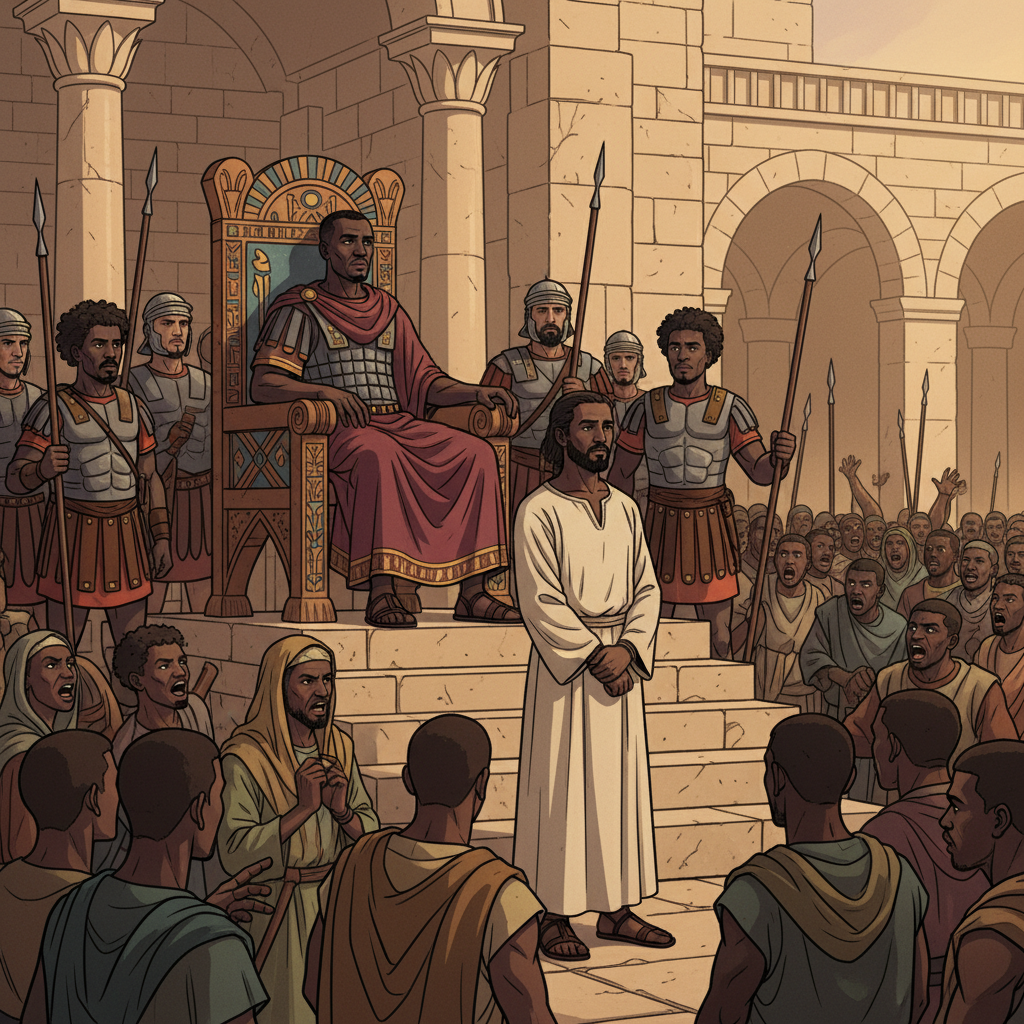
At dawn they brought Yeshua to Pilatos, the Roman governor. Pilatos sat on a carved chair. His soldiers stood with iron spears. Rome had no love for the sons of the small provinces. "Are you a king?" Pilatos asked. "You have said it," Yeshua answered. "But my kingdom is not of this stone and iron. My kingdom is of Maat." "What is truth?" Pilatos asked, almost to himself. Yeshua did not answer. Sometimes, Seba Ptahhotep had taught, the best answer to a closed heart is silence. A closed heart hears only echoes of itself. The crowd outside had been stirred by the priests. They shouted, "Crucify him! Crucify him!" Their voices were not their own voices. Isfet uses crowds the way a wind uses dry leaves. Pilatos looked at Yeshua. He saw no crime. Only a tired man in a plain robe, standing very still.
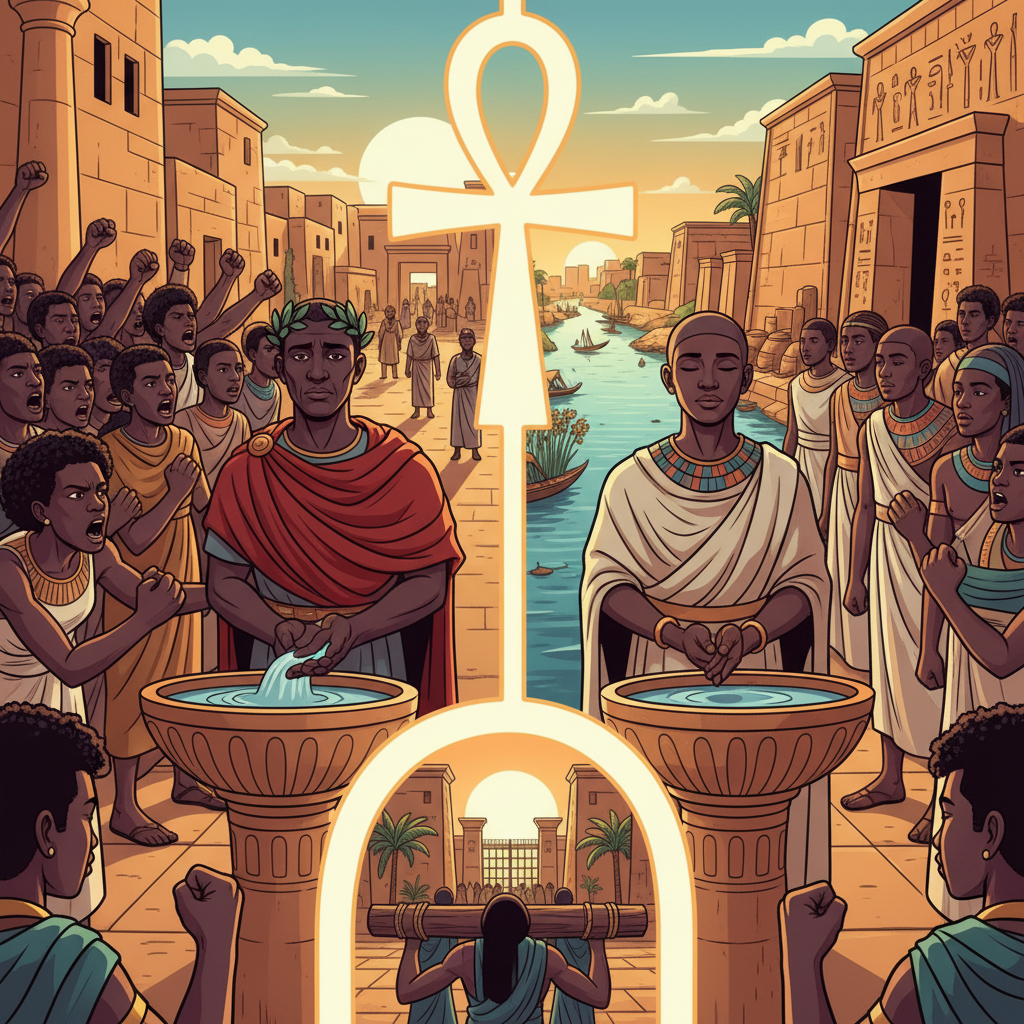
Pilatos tried three times to set him free. Three times the crowd roared louder. At last Pilatos called for a bowl of water. He dipped his hands. He washed them before the people. "I am innocent of this man's blood," he said. "See to it yourselves." But water cannot wash a choice. In Kemet, a priest washed his hands to enter the Hall of Two Truths in purity. Pilatos washed his hands to leave the hall and walk away. The gesture was the same. The meaning was opposite. Dr. Yosef ben-Jochannan wrote that Yeshua's trial was a mirror held up to Rome. Rome saw itself and did not like what it saw. So Rome reached for nails instead of wisdom. They tied a rough wooden beam across Yeshua's shoulders. They pushed him toward the gate. The sun was already high. The road outside was long.
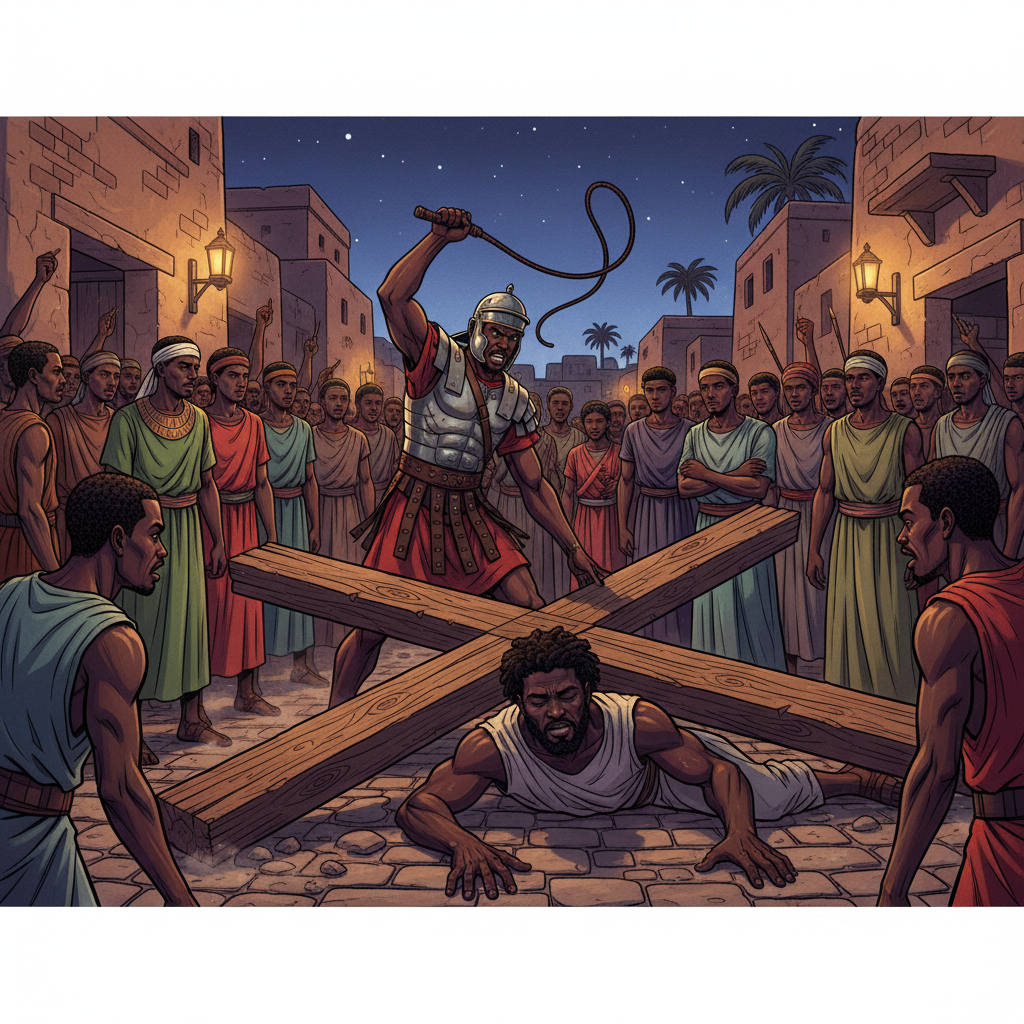
The road was called the Way of Sorrows. Stones cut Yeshua's sandals. The beam was heavier than a full grown man. Soldiers shouted. People lined the road. Some wept. Some mocked. Some were silent, not knowing what they watched. Yeshua had not slept. He had not eaten. He had been struck by guards during the night. He was thirty three years old and he had carried the teaching of Maat across Galilee for three years. His strength had limits. Every body has limits. Halfway up the hill, his legs folded. He fell under the beam. The wood slammed into the stones. The crowd gasped. A Roman soldier cursed and raised his whip. Yeshua could not rise. His breath came shallow. His eyes found the sky between the rooftops. Amun was there, behind the blue, watching. The Roman soldier looked for someone in the crowd to force into service.
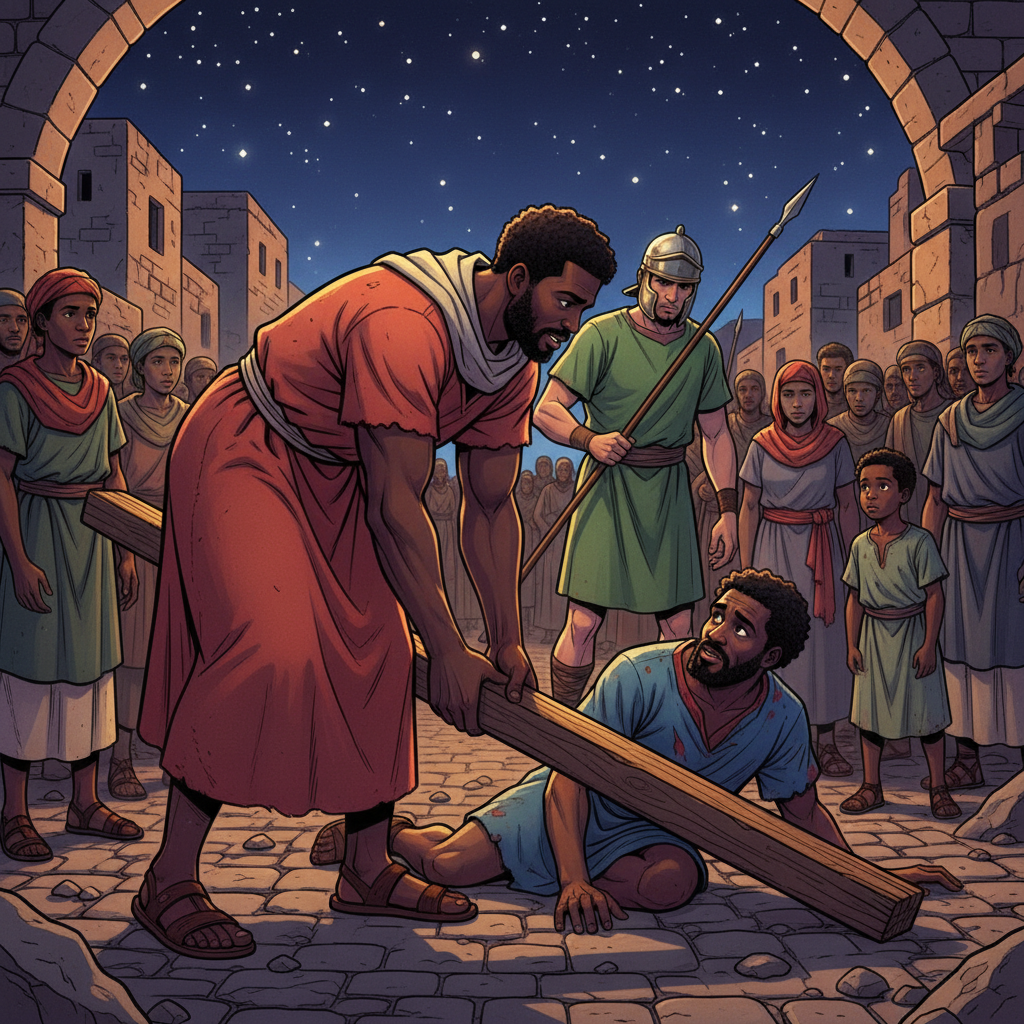
His eyes landed on a traveler at the edge of the road. The man was tall and broad shouldered. His skin was dark as the rich black soil of the Nile. He wore the dust of a long road on his robe. He had come from Libya, from a city called Cyrene, across the sea in North Africa. He was a pilgrim, in Jerusalem for the festival. He had two young sons with him, named Alexander and Rufus. His name was Simon. "You," the soldier barked, pointing his spear. "African. Take up the cross." The crowd went still. Simon of Cyrene stepped forward. He did not have to. A lesser man would have slipped backward into the bodies. But Simon looked down at Yeshua lying in the stones, a brother of his own blood, and his heart knew what his hands must do. He bent. He lifted the beam.
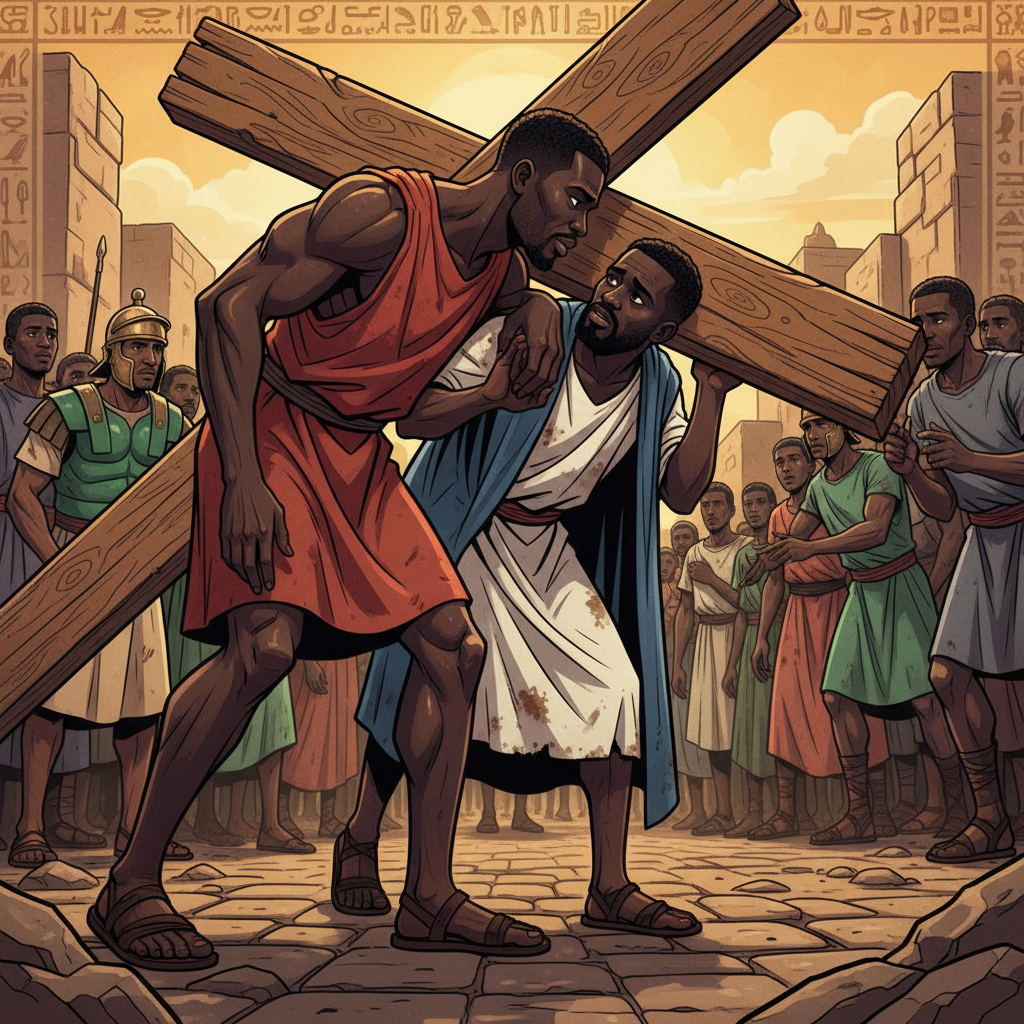
John Henrik Clarke taught that this moment is the heartbeat of the whole story. When the teacher from Galilee could not carry his own cross, it was an African brother from Libya who carried it for him. The wood that bore the weight of the world was lifted on the shoulders of a Black man from the African continent. Simon of Cyrene did not say a word. He did not need to. His back bent. The beam rose. Yeshua stood, slowly, leaning on Simon's arm. Their eyes met for one long breath. Two dark faces. Two sons of the same ancient river. One carrying, one carried. Dr. Yosef ben-Jochannan wrote that in that single step, Kemet reached across a thousand years and placed her hand on the shoulder of her son. The continent did not abandon Yeshua at the hour of his weakness. Africa walked the last road with him.
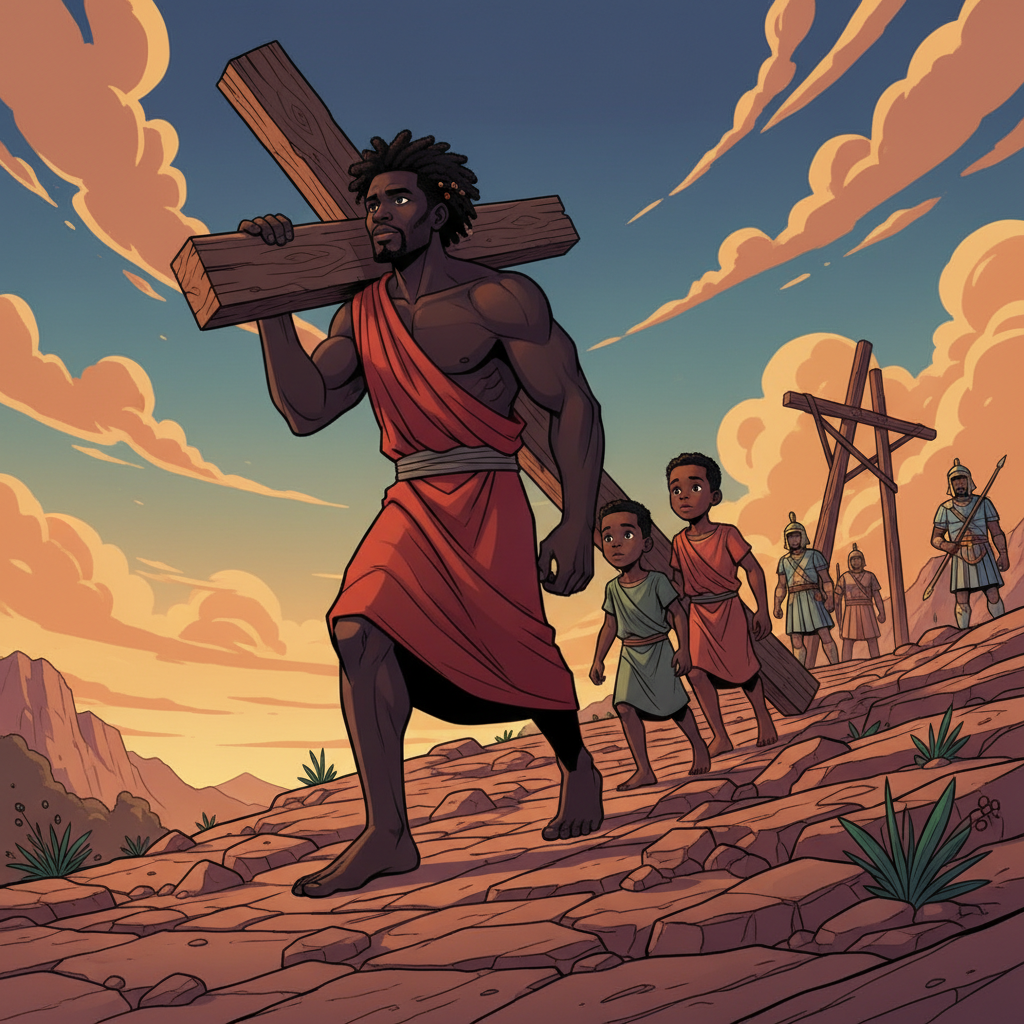
They climbed the hill together. Simon's breath was steady. His feet were sure. His sons walked behind, eyes wide. At the top of the hill, the soldiers took the beam from Simon. They set it in the ground. They did what Rome had ordered them to do. We will not speak of the details here. Some stories are told softly, out of respect for the one they are about. Yeshua was lifted. He hung between earth and sky. His mother Miriam stood at the foot of the wood. Miryam of Magdala stood beside her, tears running without shame down her dark cheeks. Yohanan, the youngest disciple, stood with them. Yohanna stood just behind. The women did not flee. Zora Neale Hurston wrote that in every sacred story, the women are the ones who stay when the sky falls. The men ran. The women remained.
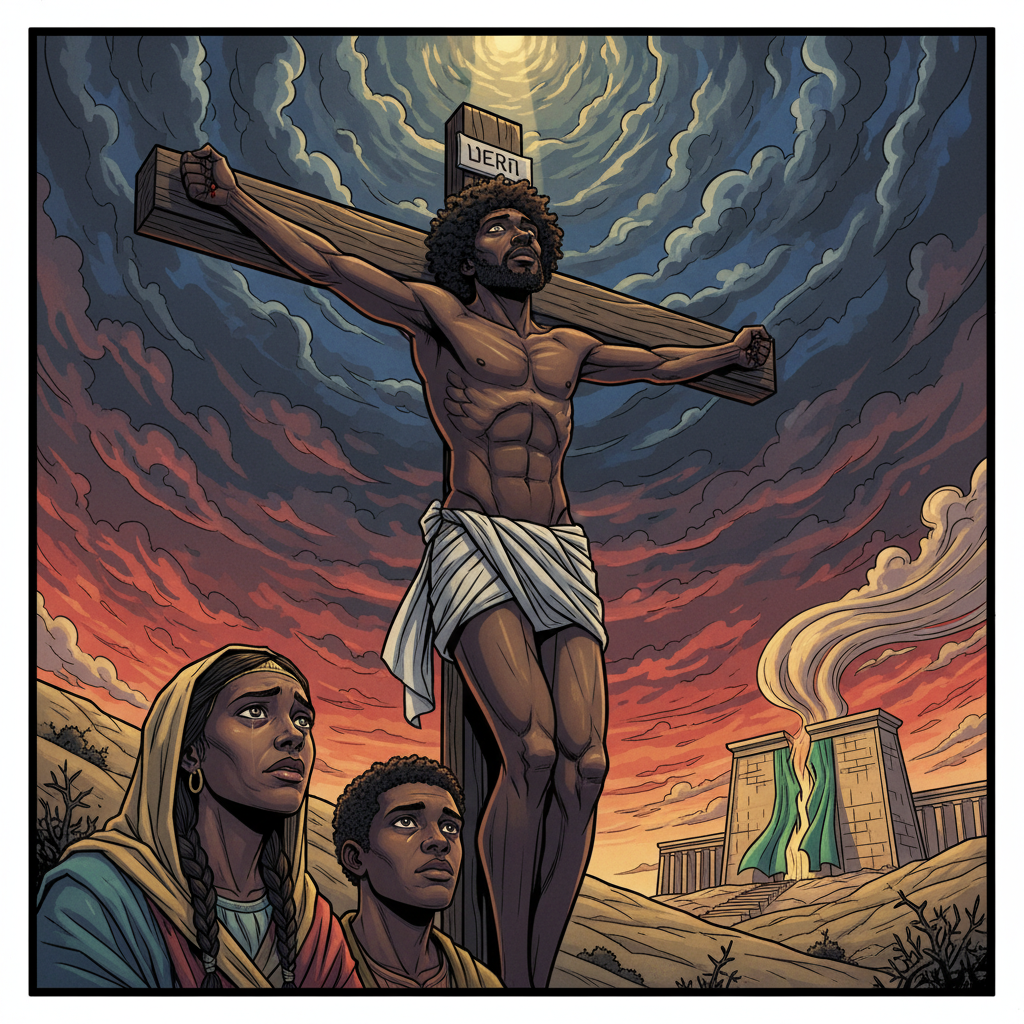
The sun climbed. The hours were long. Yeshua's lips were cracked. He looked down at his mother. "Behold your son," he said to Yohanan, giving his mother into the young man's care. He looked up to the sky. "Father Yah," he whispered, "forgive them. They do not know what they are doing." The sky began to darken. A strange shadow moved across the land. Birds fell silent. The priests in the great temple below felt a rush of wind, and the inner veil of the holy place tore from top to bottom with a sound like a long sigh. Yeshua bowed his head. His last breath left him. "It is finished," he said. "Into your hands, I place my ba." And he died. In the Kemetic frame, at that very moment, his heart was laid on the great golden scale of Maat.
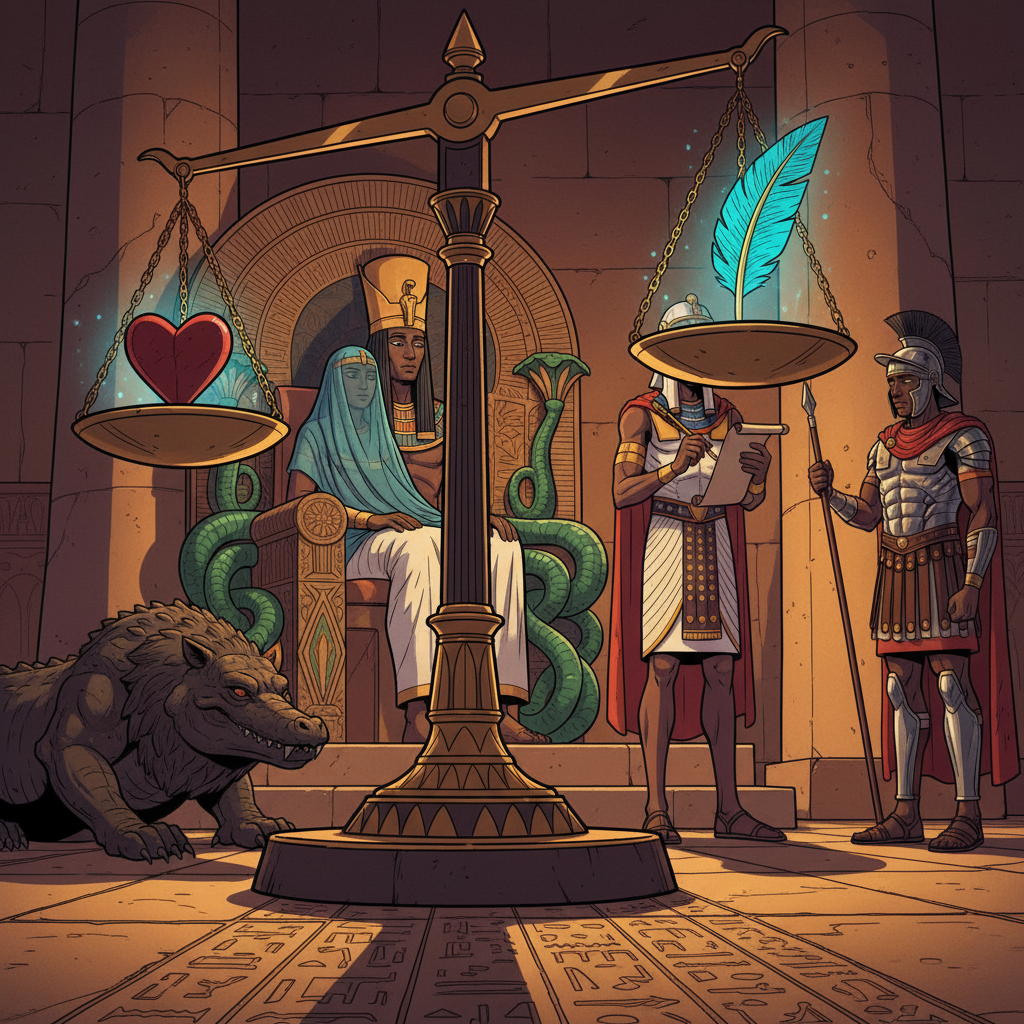
The feather of truth rested on the other pan. Ammit the devourer crouched nearby, hungry as she had been for ten thousand years. The gods watched. Thoth held his pen ready to record. Auset stood veiled. Ausar sat upon his throne of green. The scale did not move. The heart of Yeshua was lighter than the feather. Lighter than breath. Lighter than the first morning of the world. Ammit turned away. She had no claim. The heart of Yeshua had carried Maat through every road of his life, even the last one. It had forgiven the soldier. It had blessed the thief beside him. It had given his mother to his friend. It had not poured one drop of Isfet, not even at the end. A Roman centurion at the foot of the cross lowered his spear. He bowed his head. "Truly," he said, "this man carried Maat."
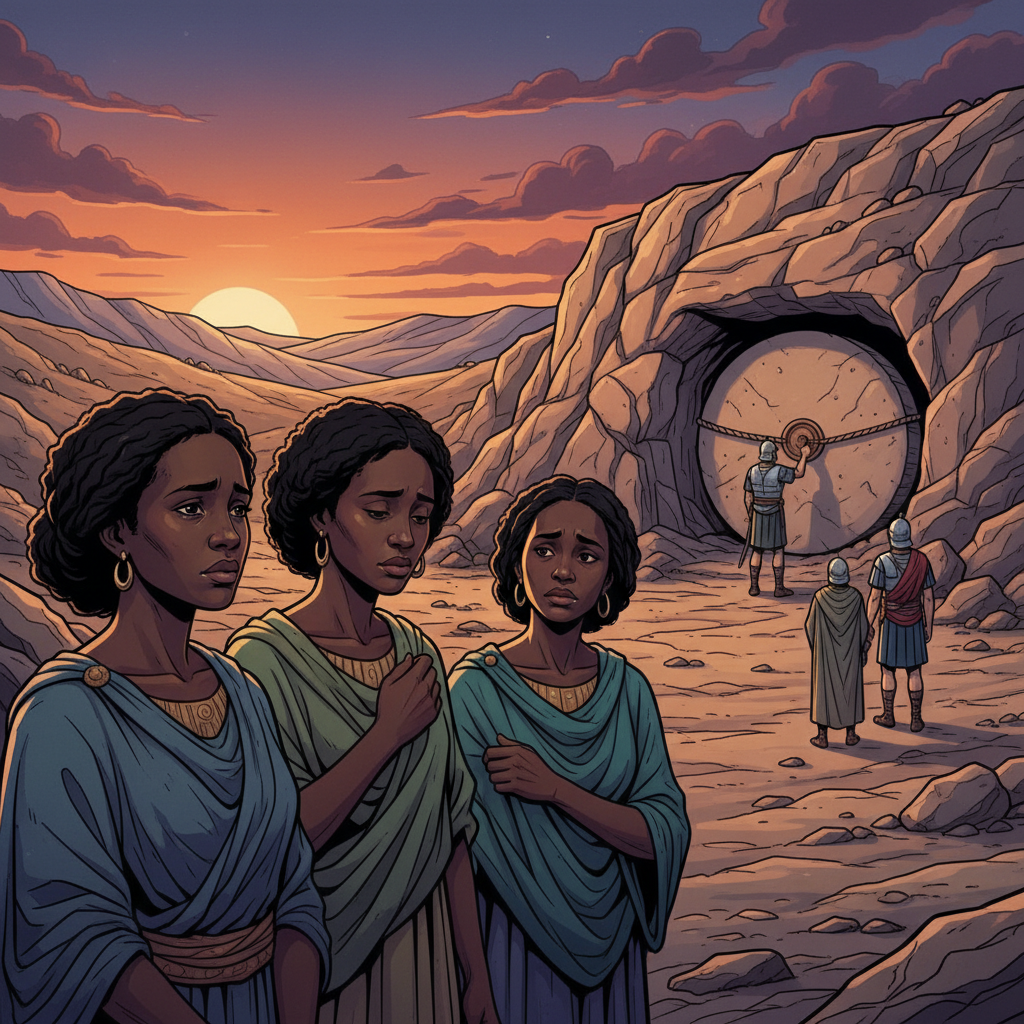
They took his body down carefully. A good man named Yosef of Arimathea had prepared a tomb cut from the rock, a new tomb never used. Miriam and Miryam of Magdala washed him with spices, the way Kemetic priests had washed the blessed ones for five thousand years. They wrapped him in clean linen. The silver ankh still lay warm upon his chest. They did not remove it. The tomb was a small cave. They laid him inside. Roman soldiers rolled a great stone across the opening and set a seal upon it. The women watched from a distance. Then the soldiers left a guard and walked away. The Sabbath fell. The city grew quiet. Kepha wept in a borrowed room. Yohanan held Miriam while she trembled. Simon of Cyrene, far across the city, sat with his sons and said nothing for a long time. Three days passed.
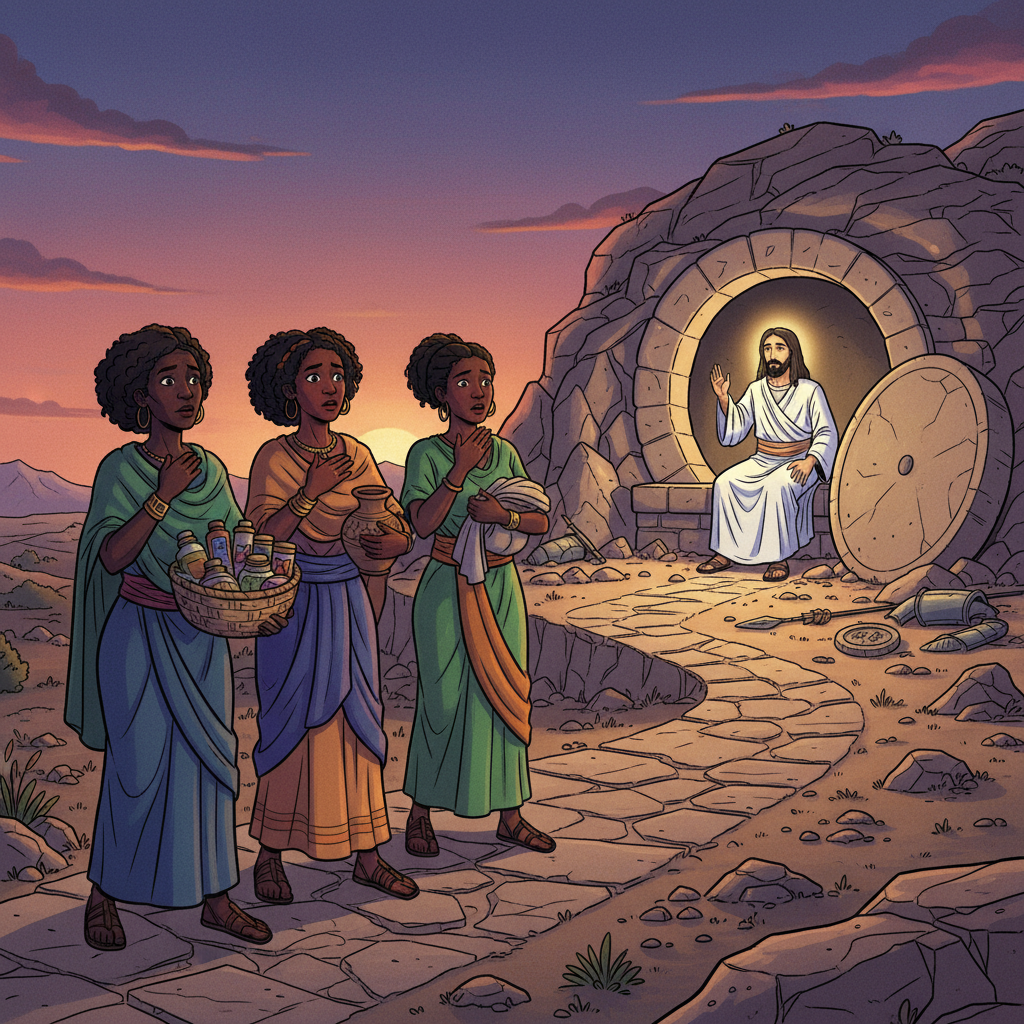
On the third morning, before the sun had fully risen, the women walked to the tomb. Miriam the mother. Miryam of Magdala. Yohanna. They carried more spices, because love does not stop working just because the heart is broken. As they walked, they worried aloud. "Who will roll the stone away for us? It is too heavy." But when they came around the last bend, they stopped. The stone was already rolled back. The seal was broken. The guards were gone. Inside the tomb there was no body. Only the linen, folded. And a figure in a white robe sitting where Yeshua had lain. His face was bright as morning on the river. "Do not be afraid," he said. His voice was gentle. "You are looking for Yeshua of Galilee, who was crucified." The women could not speak.
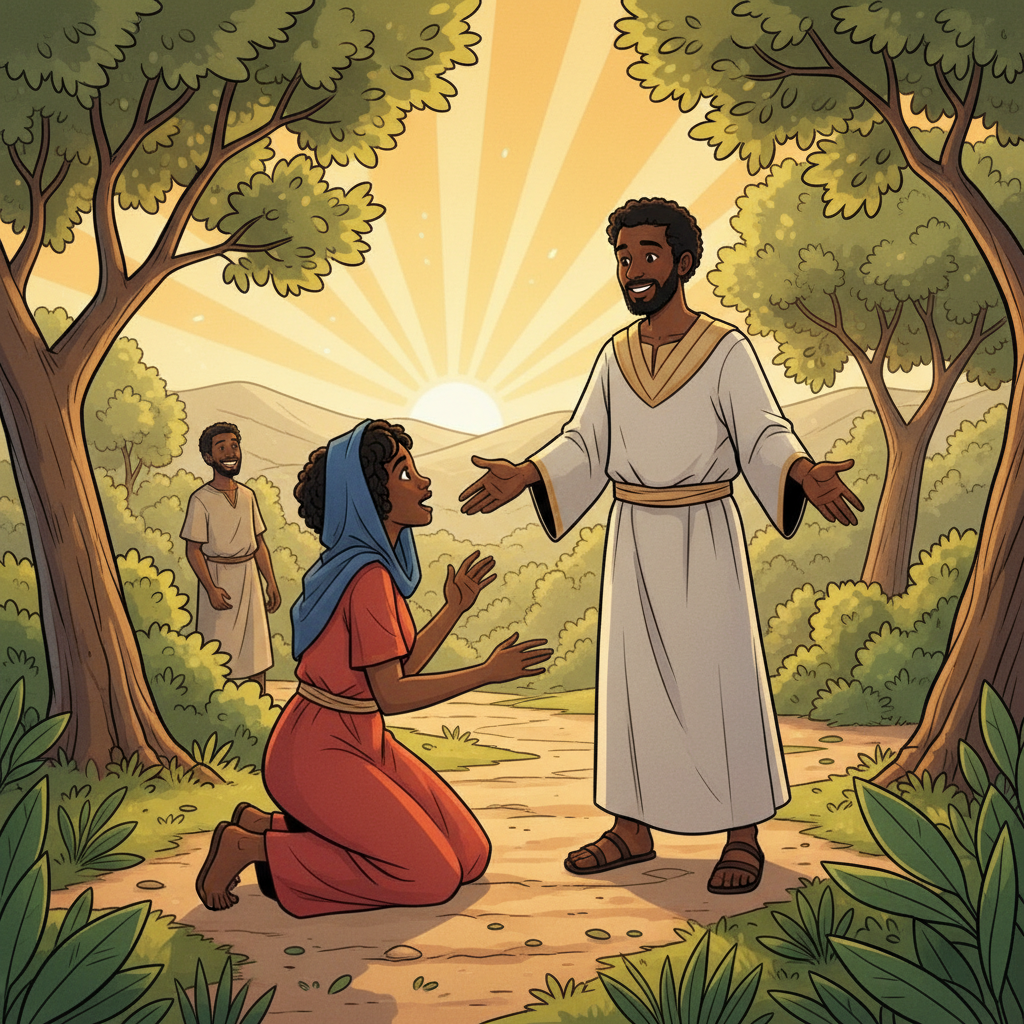
"He is not here," the messenger said. "He has come forth by day." Pert em Heru. The ancient Kemetic words. The true name of the journey of the blessed soul. To come forth by day is to rise from the night of death into the light of the eternal morning. This is the oldest promise of the Nile. And now, on this morning, the promise walked on two feet. Miryam of Magdala turned and ran into the garden. A man stood among the trees. She thought at first he was the gardener. Then he spoke her name. "Miryam." She fell at his feet. It was Yeshua. Alive. Breathing. Smiling the tired, beautiful smile of one who has come a very long way home. Far across the land, on the road back to Libya, Simon of Cyrene looked up from the dust and saw a figure walking toward him. He smiled too. Hetep. Peace. The teacher had risen. Maat had returned. And the Kemet within every heart was coming forth by day, and would be, forever.